

Page 1

20V CORDLESS JIGSAW
MODEL NO: CJS20Li
PART NO: 6487025
OPERATION & MAINTENANCE
INSTRUCTIONS
LS1013
Page 2

INTRODUCTION
Thank you for purchasing this CLARKE 20V Cordless Jigsaw.
Before attempting to use this product, please read this manual thoroughly and
follow the instructions carefully. In doing so you will ensure the safety of yourself
and that of others around you, and you can look forward to your purchase
giving you long and satisfactory service.
GUARANTEE
This product is guaranteed against faulty manufacture for a period of 12
months from the date of purchase. Please keep your receipt which will be
required as proof of purchase.
This guarantee is invalid if the product is found to have been abused or
tampered with in any way, or not used for the purpose for which it was
intended.
Faulty goods should be returned to their place of purchase, no product can
be returned to us without prior permission.
This guarantee does not effect your statutory rights.
WHAT’S SUPPLIED
Unpack your tool and make sure that the following items are present. Should
there be any damage caused during transit contact your Clarke dealer
immediately.
1 x 20 Volt Cordless Jigsaw 1 x Wood Blade
1 x Parallel Fence 1 x Metal Blade
2
Parts & Service: 020 8988 7400 / E-mail: [email protected] or [email protected]
Page 3

SAFETY PRECAUTIONS
WARNING: READ ALL INSTRUCTIONS. FAILURE TO FOLLOW ALL
INSTRUCTIONS LISTED BELOW MAY RESULT IN ELECTRIC SHOCK, FIRE AND/
OR SERIOUS INJURY. THE TERM “POWER TOOL” IN ALL WARNINGS LISTED
BELOW REFERS TO YOUR 20V CORDLESS JIGSAW.
1) WORK AREA SAFETY
a. Keep work area clean and well lit. Cluttered or dark areas invite accidents.
b. Do not operate power tools in explosive atmospheres, such as in the presence of
flammable liquids, gases or dust. Power tools create sparks which may ignite the
dust or fumes.
c. Keep children and bystanders away while operating a power tool. Distractions
can cause you to lose control.
2) ELECTRICAL SAFETY
a. Power tool plugs must match the outlet. Never modify the plug in any way. Do
not use any adapter plugs with earthed (grounded) power tools. Unmodified
plugs and matching outlets will reduce risk of electric shock.
b. Avoid body contact with earthed or grounded surfaces, such as pipes, radiators,
ranges and refrigerators. There is an increased risk of electric shock if your body is
earthed or grounded.
c. Do not expose power tools to rain or wet conditions. Water entering a power tool
will increase the risk of electric shock.
d. Do not abuse the cord. Never use the cord for carrying, pulling or unplugging the
power tool. Keep cord away from heat, oil, sharp edges or moving parts.
Damaged or entangled cords increase the risk of electric shock.
e. When operating a power tool outdoors, use an extension cord suitable for
outdoor use. Use of a cord suitable for outdoor use reduces the risk of electric
shock.
f. If operating a power tool in a damp location is unavoidable, use a residual
current device (RCD) protected supply. Use of an RCD reduces the risk of electric
shock.
3) PERSONAL SAFETY
a. Stay alert, watch what you are doing and use common sense when operating a
power tool. Do not use a power tool while you are tired or under the influence of
drugs, alcohol or medication. A moment of inattention while operating power
tools may result in serious personal injury.
b. Use personal protective equipment. Always wear eye protection. Protective
equipment such as dust mask, non-skid safety shoes, hard hat, or hearing
protection used for appropriate conditions will reduce personal injuries.
3
Parts & Service: 020 8988 7400 / E-mail: [email protected] or [email protected]
Page 4

c. Prevent unintentional starting. Ensure the switch is in the off-position before
connecting to power source and/or battery pack, picking up or carrying the
tool. Carrying power tools with your finger on the switch or energising power tools
that have the switch on invites accidents.
d. Remove any adjusting key or wrench before turning the power tool on. A wrench
or a key left attached to a rotating part o the power tool may result in personal
injury.
e. Do not overreach. Keep proper footing and balance at all times. This enables
better control of the power tool in unexpected situations.
f. Dress properly. Do not wear loose clothing or jewellery. Keep your hair, clothing
and gloves away from moving parts. Loose clothes, jewellery or long hair can be
caught in moving parts.
g. If devices are provided for the connection of dust extraction and collection
facilities, ensure these are connected and properly used. Use of dust collection
can reduce dust-related hazards.
4) POWER TOOL USE AND CARE
a. Do not force the power tool. Use the correct power tool for your application. The
correct power tool will do the job better and safer at the rate for which it was
designed.
b. Do not use the power tool if the switch does not turn it on and off. Any power tool
that cannot be controlled with the switch is dangerous and must be repaired.
c. Disconnect the plug from the power source and/or the battery pack from the
power tool before making any adjustments, changing accessories, or storing
power tools. Such preventive safety measures reduce the risk of starting the
power tool accidentally.
d. Store idle power tools out of the reach of children and do not allow persons
unfamiliar with the power tool or these instructions to operate the power tool.
Power tools are dangerous in the hands of untrained users.
e. Maintain power tools. Check for misalignment or binding of moving parts,
breakage of parts and any other condition that may affect the power tool's
operation. If damaged, have the power tool repaired before use. Many
accidents are caused by poorly maintained power tools.
f. Keep cutting tools sharp and clean. Properly maintained cutting tools with sharp
cutting edges are less likely to bind and are easier to control.
g. Use the power tool, accessories and tool bits etc. in accordance with these
instructions, taking into account the working conditions and the work to be
performed. Use of the power tool for operations different from those intended
could result in a hazardous situation.
4
Parts & Service: 020 8988 7400 / E-mail: [email protected] or [email protected]
Page 5

5. BATTERY TOOL USE AND CARE
a. Recharge only with the charger specified by the manufacturer. A charger that is
suitable for one type of battery pack may create a risk of fire when used with
another battery pack.
b. Use power tools only with specifically designated battery packs. Use of any other
battery packs may create a risk of injury and fire.
c. When battery pack is not in use, keep it away from other metal objects, like
paper clips, coins, keys, nails, screws or other small metal objects, that can make
a connection from one terminal to another. Shorting the battery terminals
together may cause burns or a fire.
d. Under abusive conditions, liquid may be ejected from the battery; avoid
contact. If contact accidentally occurs, flush with water. If liquid contacts eyes,
additionally seek medical help. Liquid ejected from the battery may cause
irritation or burns.
6) SERVICE
a. Have your power tool serviced by a qualified repair person using only identical
replacement parts. This will ensure that the safety of the power tool is
maintained.
ENVIRONMENTAL PROTECTION
Recycle unwanted materials instead of disposing of them as waste.
All tools, accessories and packaging should be sorted, taken to a
recycling centre and disposed of in a manner which is compatible
with the environment.
SAFETY INSTRUCTIONS FOR ALL SAWS
a. Keep hands away from cutting area and the blade. Keep your second hand on
the auxiliary handle, or motor housing. If both hands are holding the saw, they
cannot be cut by the blade.
b. Do not reach underneath the workpiece. The guard cannot protect you from the
blade below the workpiece.
c. Never hold the piece being cut in your hands or across your leg. Secure the
workpiece to a stable platform. It is important to support the work properly to
minimise body exposure, blade binding, or loss of control.
d. Hold the power tool by insulated gripping surfaces when performing an
operation. Contact with a live wire will also make exposed metal parts of the
power tool live and shock the operator.
5
Parts & Service: 020 8988 7400 / E-mail: [email protected] or [email protected]
Page 6

SYMBOLS & PICTOGRAPHS
Laser Radiation, Class 2 Laser: Do not stare
into the beam
Weee Symbol CE Mark
Read instruction manual before use
KICKBACK
Kickback is a sudden reaction to a pinched or misaligned saw blade which causes the
saw to lift up and out of the workpiece.
When the blade is pinched or bound tightly by the kerf closing down, the blade stalls
and the motor reaction moves the unit back quickly towards the operator.
If the blade becomes twisted or misaligned in the cut, the teeth at the back edge of the
blade can dig into the top of the workpiece causing the blade to climb out of the kerf
and jump back towards the operator. Kickback is the result of misuse or incorrect
operating procedures and can be prevented by taking the following precautions:
a. Hold the saw tightly and position your arms to resist kickback forces. Position your
body to one side of the blade.
b. If the blade starts to bind, or when interrupting a cut, release the trigger and hold
the saw still in the material until the blade comes to a full stop. Do not attempt to
remove the saw from the work or pull the saw backward while the blade is
moving or kickback can occur. Investigate and take corrective actions to
eliminate the cause of blade binding.
c. When restarting a saw in the workpiece, centre the saw blade in the kerf and
make sure that saw teeth do not touch the material. If the blade is binding, it
can kickback from the workpiece as the saw is restarted.
d. Support large panels to minimise the risk of blade pinching and kickback. Large
panels tend to sag under their own weight. Supports must be put below the
panel on both sides, near the line of cut and near the edge of the panel.
e. Bevel adjusting locking screws must be tight and secure before making a cut. If
blade adjustment shifts while cutting, it may cause binding and kickback.
6
Parts & Service: 020 8988 7400 / E-mail: [email protected] or [email protected]
Page 7

FITTING THE BATTERY PACK (NOT SUPPLIED)
This 20V Jigsaw requires a 20V battery pack (6487040) and 1 Hour Charger
(6487050) to operate. Both are available separately from your local Clarke
dealer.
TO FIT THE BATTERY
1. Slide the battery pack on to the
jigsaw.
TO REMOVE THE BATTERY
1. Push and hold the release buttons
on the side of the battery pack.
2. Slide the battery pack away from
the jigsaw.
INSTALLING/CHANGING BLADES
CAUTION: MAKE SURE THAT THE BATTERY PACK IS REMOVED TO AVOID
RISK OF ACCIDENTAL STARTING.
This jigsaw is equipped with a tooless blade holder which allows fast and
convenient blade changing.
1. Push and hold the blade holder up.
2. Insert the blade as far as possible,
with the teeth facing forwards.
• Use only jigsaw blades with the
correct T-shank.
• Do not use blunt or damaged
blades.
3. Release the blade holder and gently
pull on the blade to make sure that it
is secure before refitting the battery.
7
Parts & Service: 020 8988 7400 / E-mail: [email protected] or [email protected]
Page 8

ADJUSTMENTS
ADJUSTING THE PENDULUM
The pendulum moves the blade away from the cut on the down (non-cutting)
stroke and forward into the workpiece on the upward (cutting) stroke. The
pendulum can be particularly useful when cutting thicker, denser materials.
1. Adjust the pendulum control to
suit the material being cut using
the following suggested settings
as a starting point if required. Do
not use the pendulum action for
cutting ceramics or metals.
Material Pendulum Setting
Ceramics 0
Metal 0
Plywood, Plastics 1-2
Timber, Fiberglass & Chipboard 1-3
ADJUSTING THE SOLE PLATE
The sole-plate is adjustable so that bevels of up to 45° may be cut. Loosen the
two socket head screws under the sole-plate before adjusting it to the desired
angle and re-tightening the screws.
8
Parts & Service: 020 8988 7400 / E-mail: [email protected] or [email protected]
Page 9
OPERATION
SWITCHING ON/OFF
• Ensure that the workpiece is securely held and the cutting line is
clearly marked.
1. Place the sole-plate on the workpiece taking care that the blade is not
touching the workpiece or striking on anything below.
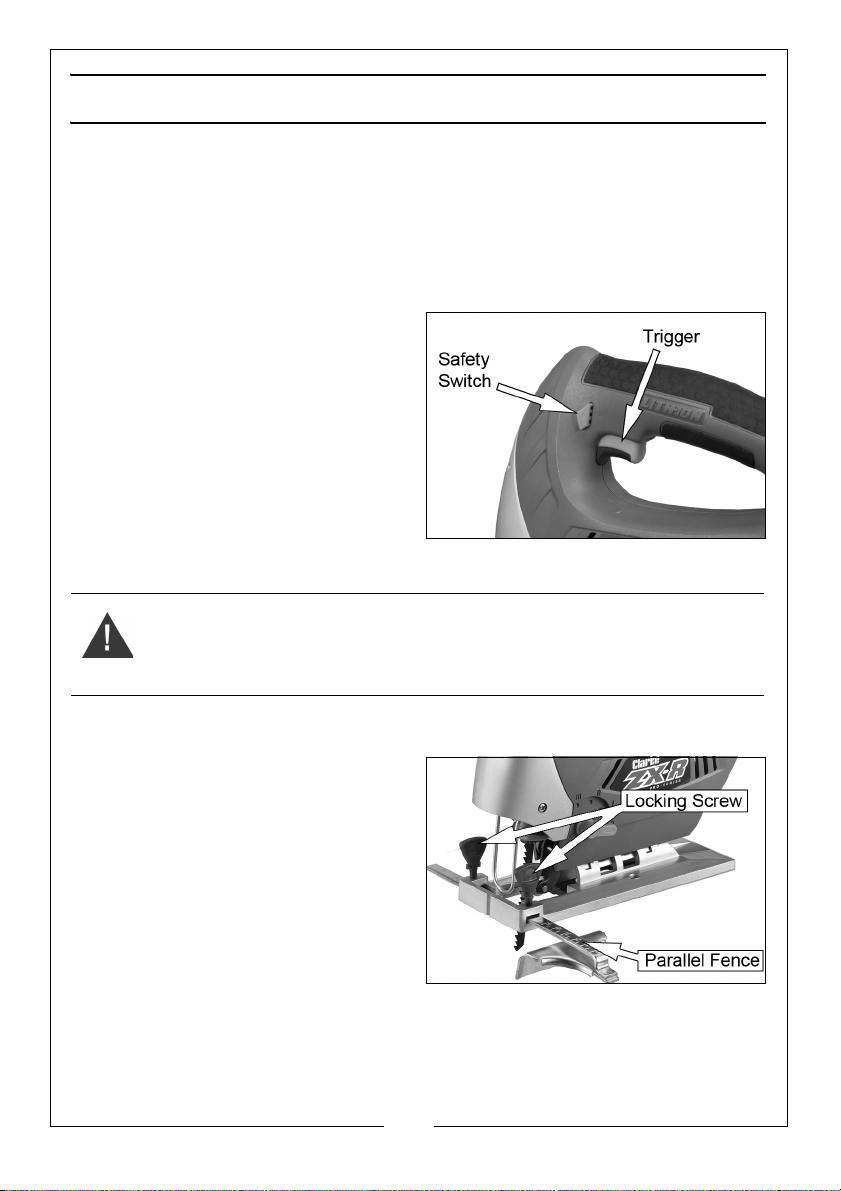
2. Press and hold the safety switch
and then squeeze the trigger.
• The jigsaw has a variable speed
trigger. For increased speed,
squeeze the trigger harder.
• Let the blade work through the
workpiece, ensuring the sole
plate is flush with the
workpiece.
3. Release the trigger to stop the
saw.
WARNING: THE BLADE WILL CONTINUE TO RUN FOR A SHORT PERIOD
AFTER THE TRIGGER HAS BEEN RELEASED. WAIT UNTIL IT STOPS BEFORE
REMOVING IT FROM THE WORKPIECE.
PARALLEL FENCE
1. Insert the parallel fence as shown.
2. Secure in place with the locking
screw.
9
Parts & Service: 020 8988 7400 / E-mail: [email protected] or [email protected]
Page 10
LASER GUIDE
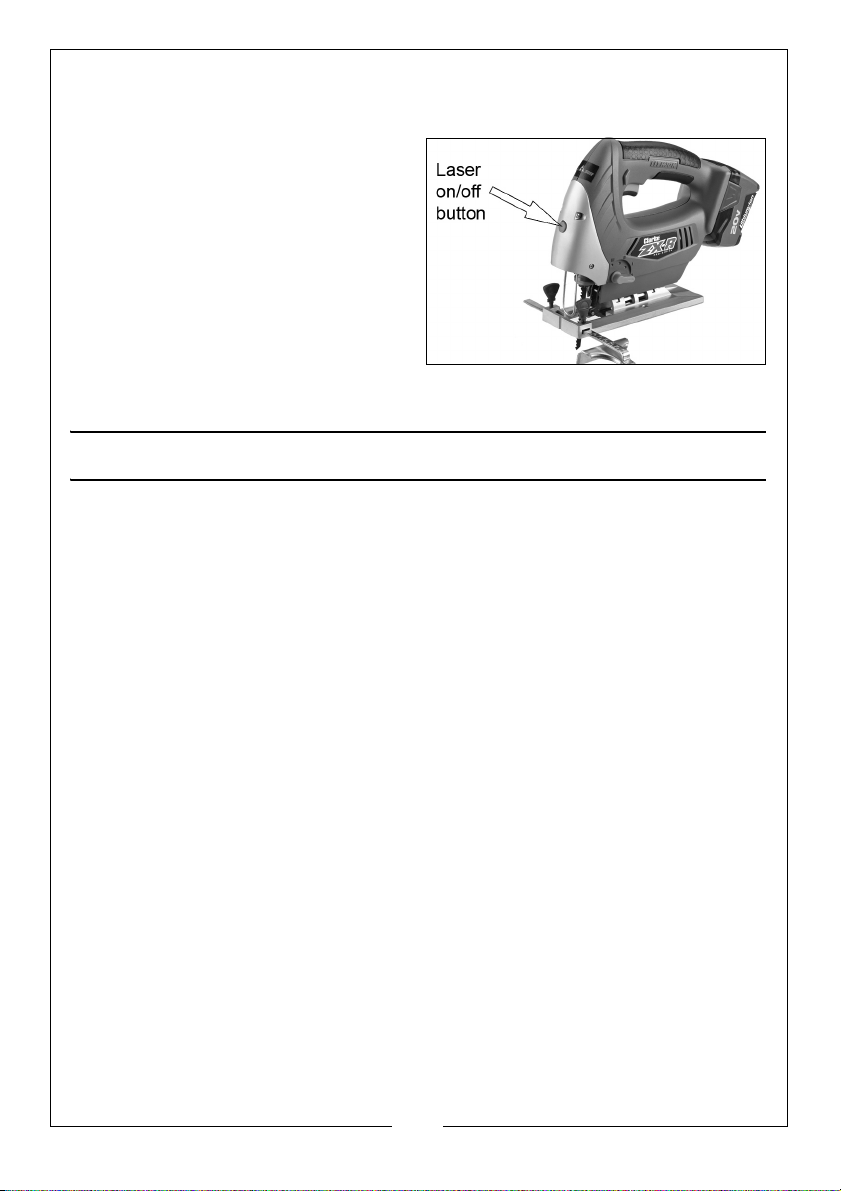
The laser guide helps keep the blade aligned with the cutting line.
1. Press the Laser on/off button to
turn the laser on.
• Do not point the laser beam at
people.
• Keep the laser beam below
eye level.
• Only turn on laser beam when
the tool is on the work piece.
2. Press the Laser on/off button
again to turn the laser off.
CUTTING TIPS
• Wait until the blade is running at full speed before attempting to cut
the workpiece.
• Do not put unnecessary pressure on the blade and avoid applying
lateral pressure.
• Take extra care when cutting curves - move the blade slowly to
avoid stress on the blade.
WOOD
• Check that any previously used timber being sawn does not contain
any nails or other metal objects which would damage the blade.
METAL
• Choose a suitable blade for cutting metal
• Lubricate the material and blade with cutting oil to prevent
overheating.
HOLE CUTTING
• When starting a cut from the center of a work piece, drill a 12mm
diameter hole to ensure that there is clearance for the blade
• Remember that the blade should emerge from the workpiece at
every point of the cut.
• When cutting tight curves, reduce the forward speed of the saw.
10
Parts & Service: 020 8988 7400 / E-mail: [email protected] or [email protected]
Page 11

MAINTENANCE
CLEANING
1. Keep air vents free of blockages, (use compressed air to clean the
machine if possible).
2. After use, clean all dust and wood chippings from the jigsaw.
3. Keep the blade locating clip and support roller clean, you should lightly oil
the support roller at regular intervals.
4. Keep the handle clean.
5. Regularly clean the sole plate to prevent scratches and scores on the
surface.
GENERAL MAINTENANCE
1. Make sure that the power cable it is sound and that there are no cracks or
bare wires.
2. Do not use solvents when cleaning plastic parts, most plastics are
vulnerable to damage from the different types of solvents.
• Make sure that all nuts, bolts and screws stay tight to keep the jigsaw
in a safe working condition.
• All bearings etc, in this tool are lubricated with a sufficient amount of
high grade lubricant for the tools lifetime in normal operating
conditions, therefore no further lubrication is necessary.
• Only use the replacement blades specified for this product (see your
Clarke dealer).
• Refer to your Clarke dealer if internal maintenance is necessary.
CONSUMABLE SPARE PARTS
Replacement saw blades for wood and metal are available from your Clarke
dealer.
Replacement Blades (10 per pack)
Wood: Part no. 6462188
Metal: Part no. 6462190
11
Parts & Service: 020 8988 7400 / E-mail: [email protected] or [email protected]
Page 12

SPECIFICATIONS
No Load Blade Speed 0-2400 Strokes per minute
Operating Voltage 20 V DC
Stroke length 25.4 mm
Maximum Blade Length 76 mm
Pendulum settings 3
Weight (without battery pack) 1.7 kg
Dimensions (without battery pack) (L x W x H) 227 x 74 x 215 mm
Sound pressure Level (LPA) 87.3 dB(A)
Sound Power Level (LWA) 98.3 dB(A)
Sound Uncertainty Value (K) 3 dB(A)
Vibration 5.383 m/s²
Vibration Uncertainty Value (K) 1.5 m/s²
MAXIMUM CUTTING DEPTH
Wood 50 mm
Aluminium 8 mm
Mild Steel 6 mm
12
Parts & Service: 020 8988 7400 / E-mail: [email protected] or [email protected]
Page 13

DECLARATION OF CONFORMITY
13
Parts & Service: 020 8988 7400 / E-mail: [email protected] or [email protected]
Page 14

CLARKE ZX-R RANGE
The Clarke ZX-R 20V cordless power tools are designed as a high power and
quality solution for the tradesman that requires a number of different tool
types.
20v
Hammer Drill.
Model:
CDD20Li
Part Number:
6487010
20v
Circular Saw
Model:
CCS20Li
Part Number:
6487015
20v
Led Lamp
Model:
CFL20Li
Part Number:
6487035
20v
Jig Saw
Model:
CJS20Li
Part Number:
6487025
20v
Multifunction
Tool.
Model:
CMFT20Li
Part Number:
6487030
20v
Reciprocating
Saw
Model:
CRS20Li
Part Number:
6487020
20v
Impact Driver
Model:
CID20Li
Part Number:
6487000
20V Battery
Model
BL1500Li
Part Number
6487050
Also Available
20V Battery Charger
Part Number
r6487050
14
Parts & Service: 020 8988 7400 / E-mail: [email protected] or [email protected]
Page 15

Page 16

 Loading...