

Page 1
FUEL-INJECTION PRESSURE
TEST SET
Model No: CHT713
Part No: 1801713
USER INSTRUCTIONS
GC06/12
Page 2
INTRODUCTION
Thank you for purchasing this CLARKE product.
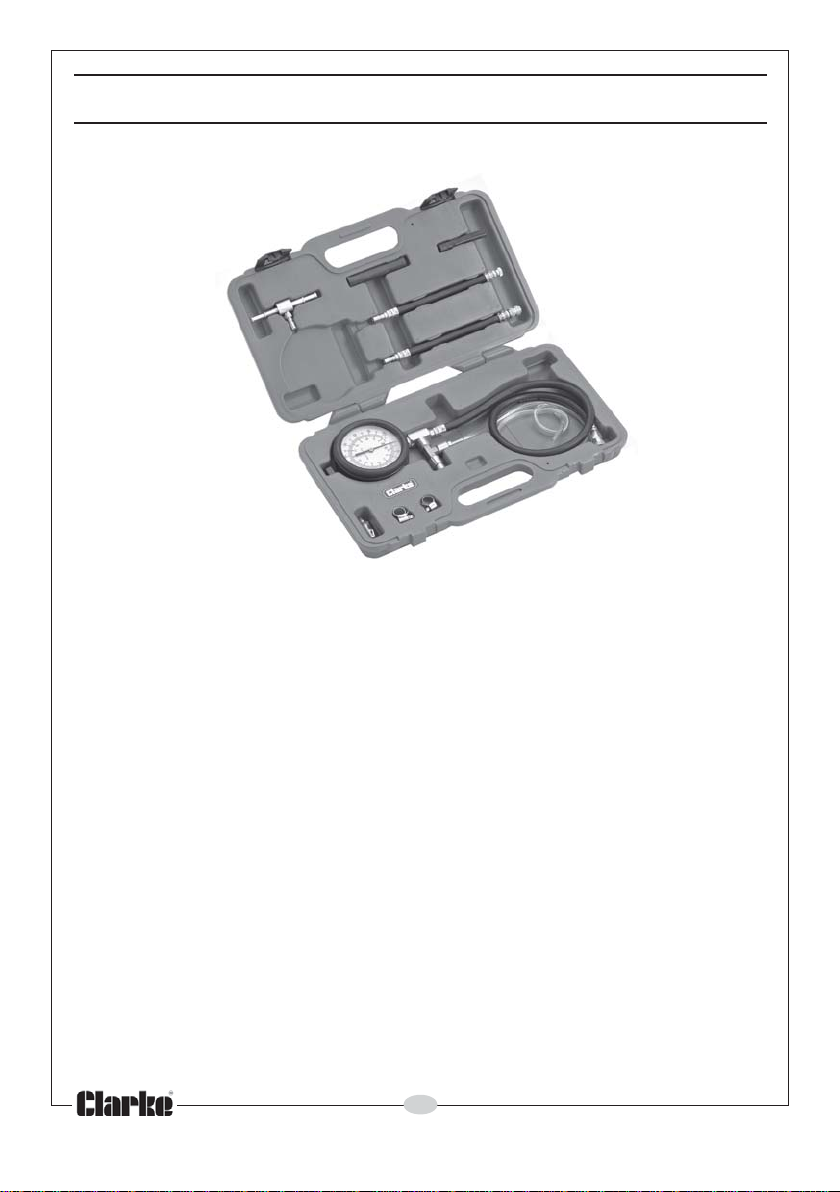
The CHT713 is a comprehensive kit of adaptors and fittings for modern
Schrader test port fuel injection systems. Components are fitted with a quick
coupling system and safety valve to prevent inadvertent discharge of fuel
under pressure. The kit is supplied with large, high pressure gauge, reading 0145 psi and 0-1000 kPa. The gauge has a hanging hook and protective
surround. A pressure release valve fitted with a long drain hose allows safe
recovery of fuel.
Please read and follow the instructions carefully. In doing so you will ensure
the safety of yourself and others around you, and you can look forward to
the product giving you long & satisfactory service.
Please keep these instructions in a safe place for future reference
GUARANTEE
This product is guaranteed against faulty manufacture for a period of 12
months from the date of purchase. Please keep your receipt which will be
required as proof of purchase.
This guarantee is invalid if the product is found to have been abused or
tampered with in any way, or not used for its intended purpose.
Faulty goods should be returned to their place of purchase. No product can
be returned to us without prior permission.
This guarantee does not effect your statutory rights.
2
Parts & Service: 020 8988 7400/E-mail:[email protected] or [email protected]
Page 3
SAFETY RULES
WARNING! DO NOT USE THIS KIT OR THE COMPONENTS FROM THIS KIT
ON DIESEL FUEL SYSTEMS OR HIGH PRESSURE PETROL INJECTION
SYSTEMS IN EXCESS OF 145 PSI. ENSURE YOU HAVE READ AND
UNDERSTOOD THE SAFETY ASPECTS OF DEALING WITH THE FUEL
INJECTION SYSTEM AND PETROL IN GENERAL BEFORE COMMENCING.
ENSURE ALL HEALTH AND SAFETY, LOCAL AUTHORITY, AND GENERAL
WORKSHOP PRACTICE REGULATIONS ARE STRICTLY ADHERED TO WHEN
USING THIS PRODUCT.
IMPORTANT: Always refer to the vehicle manufacturers service instructions, or
proprietary manual to establish the current procedure and data. These
instructions are provided as a guide only.
1. Always maintain tools in good and clean condition for best and safest
performance. DO NOT use the test kit if parts are damaged.
2. Always account for all tools and parts being used and do not leave them
in, or on the engine after use.
FUEL HAZARDS
WARNING! PETROL FUMES AND BATTERY GASES ARE EXPLOSIVE.
1. DO NOT smoke or allow an open flame or sparks in the work area.
2. Always keep a dry chemical (Class B) fire extinguisher near to the working
area.
3. Avoid fire hazards by using caution when disconnecting fuel lines and
installing adaptors - some spillage is inevitable.
4. When connecting to, or disconnecting from, a fuel system, relieve pressure
from the system and wrap a cloth around the fuel line fitting to absorb any
fuel leakage.
FUEL LEAKS
1. Constantly check the gauge and adaptor connections for leakage. If you
see leakage, turn off the ignition or disable the fuel pump. Relieve the fuel
pressure if necessary and correct any leaks before continuing.
2. DO NOT let fuel drip or spill onto a hot engine.
3. Wipe up any fuel spills immediately.
4. Always secure the connecting hoses with hose clamps to ensure leak-free
connections.
3
Parts & Service: 020 8988 7400/E-mail:[email protected] or [email protected]
Page 4

5. Check all adaptor sealing washers and ‘O’ rings are in good condition
before use.
6. DO NOT allow fuel to remain in the adaptors or hoses after use.
PERSONAL SAFETY
1. Wear approved eye protection. A range of personal safety equipment is
available from your CLARKE dealer.
2. Keep yourself, clothing and test equipment away from all moving or hot
engine parts.
3. Do not wear jewellery and tie back long hair.
4. Before performing a test with the engine running (unless the vehicle
manufacturers manual states otherwise), set the parking brake and place
the gear selector in neutral or park, and block the drive wheels.
5. Exhaust emissions contain deadly poisonous gases. The test area must be
well ventilated - route the exhaust gas outdoors.
6. Before repairing the fuel system, turn off the ignition switch and
disconnect the battery as stated in the manufacturers manual.
7. Never disconnect the battery whilst the engine is running.
4
Parts & Service: 020 8988 7400/E-mail:[email protected] or [email protected]
Page 5
WHAT IS SUPPLIED
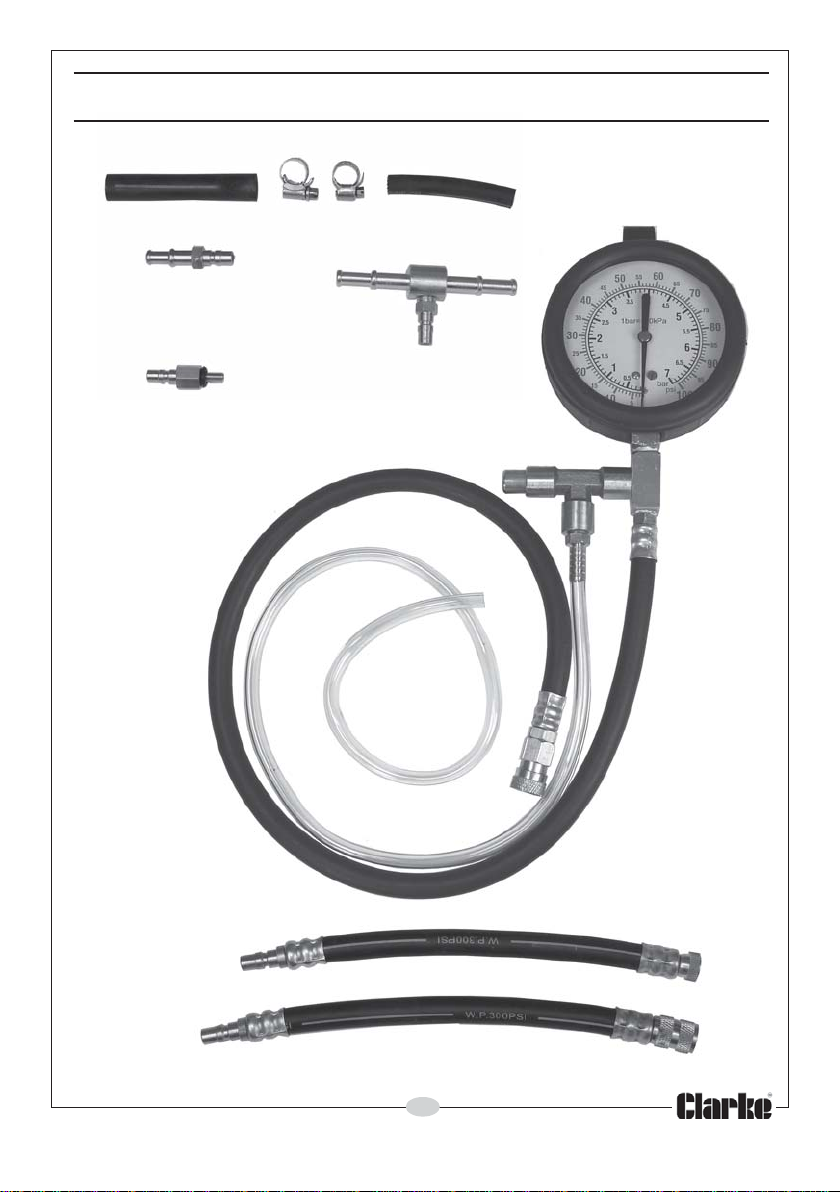
Hose Clamps
Single- Ended
Connector
Connector with
Fuel Seal
Connecting Hose
Pressure Gauge
Double-Ended
Connector
Pressure Release Valve
Clear T ube
Gauge Hose
Quick Coupler
Ford Schrader Hose
General Motors Schrader Hose
5
Parts & Service: 020 8988 7400/E-mail:[email protected] or [email protected]
Page 6
METHOD OF USE
RELEASING FUEL SYSTEM PRESSURE
Note: The following instructions are intended as a guide only. Always
adhere to manufacturers procedures for relieving system
pressure.
Before disconnecting fuel lines to connect the adaptors and pressure gauge
to the fuel system, the fuel system pressure must be released.
This will prevent fuel spraying when a joint is disconnected.
1. Switch off the ignition and loosen the fuel tank cap to release any tank
pressure, then re-tighten.
2. To release fuel pressure, it is necessary to prevent the fuel pump operating,
whilst still allowing both injection and ignition systems to operate. The
procedure may simply require the fuel pump relay, fuse or electrical
supply to be disconnected.
Note: Some models have two fuel pumps - make sure both are
disabled.
3. With the pump(s) disabled, run the engine until it stalls and then crank
over 5 to 10 times.
On some electronic fuel injection systems, removing the fuel pump fuse
disables both the fuel pump and the injectors. In this case refer to
manufacturers procedure.
WARNING! DO NOT ASSUME THAT PRESSURE IN THE FUEL SYSTEM HAS
BEEN RELEASED. WHEN DISCONNECTING, WRAP A CLOTH AROUND THE
FUEL LINE FITTING TO ABSORB ANY FUEL LEAKAGE.
CONNECTION AND USE
1. With the engine off and the fuel system pressure released, connect the
correct hose and adaptor to the fuel system at the point to be tested and
connect to the quick coupler on the gauge hose ensuring its locking
collar is secure.
CAUTION: WRAP A CLOTH AROUND THE FITTINGS TO ABSORB ANY
FUEL.
2. Re-connect the fuel pump(s).
3. Start engine and allow to idle.
6
Parts & Service: 020 8988 7400/E-mail:[email protected] or [email protected]
Page 7
4. Read the fuel pressure on the gauge and compare to the manufacturers
specification.
5. Turn off the engine.
6. Place the end of the clear tube in a suitable container and push the relief
button to depressurise the system.
7. Remove the tester and adaptors from the fuel line.
8. Restore the fuel lines to their original positions, restart the engine and
check the system for leaks.
CLARKE AUTOMOTIVE EQUIPMENT
Other automative test equipment from CLARKE includes:
CHT692 Compression Tester Kit HS0031 Part No 1801692
CHT693 Compression Tester Kit HS1000 Part No 1801693
CHT703 Diesel Engine Pressure Test Kit Part No 1801703
CEOBD Engine Fault Code Reader Part No 4501117
7
Parts & Service: 020 8988 7400/E-mail:[email protected] or [email protected]
Page 8
 Loading...