

Page 1

AIR HAMMER
MODEL NO: CAT200
PART NO: 3120517
OPERATING & MAINTENANCE
INSTRUCTIONS
ORIGINAL INSTRUCTIONS GC02/22 - Rev
Page 2
INTRODUCTION
Thank you for purchasing this CLARKE Air Hammer. Before attempting to use
this product, please read this manual thoroughly and follow the instructions
carefully. In doing so you will ensure the safety of yourself and that of others
around you, and you can look forward to your purchase giving you long and
satisfactory service.
Keep these instructions in a safe place for future reference.
SPECIFICATIONS
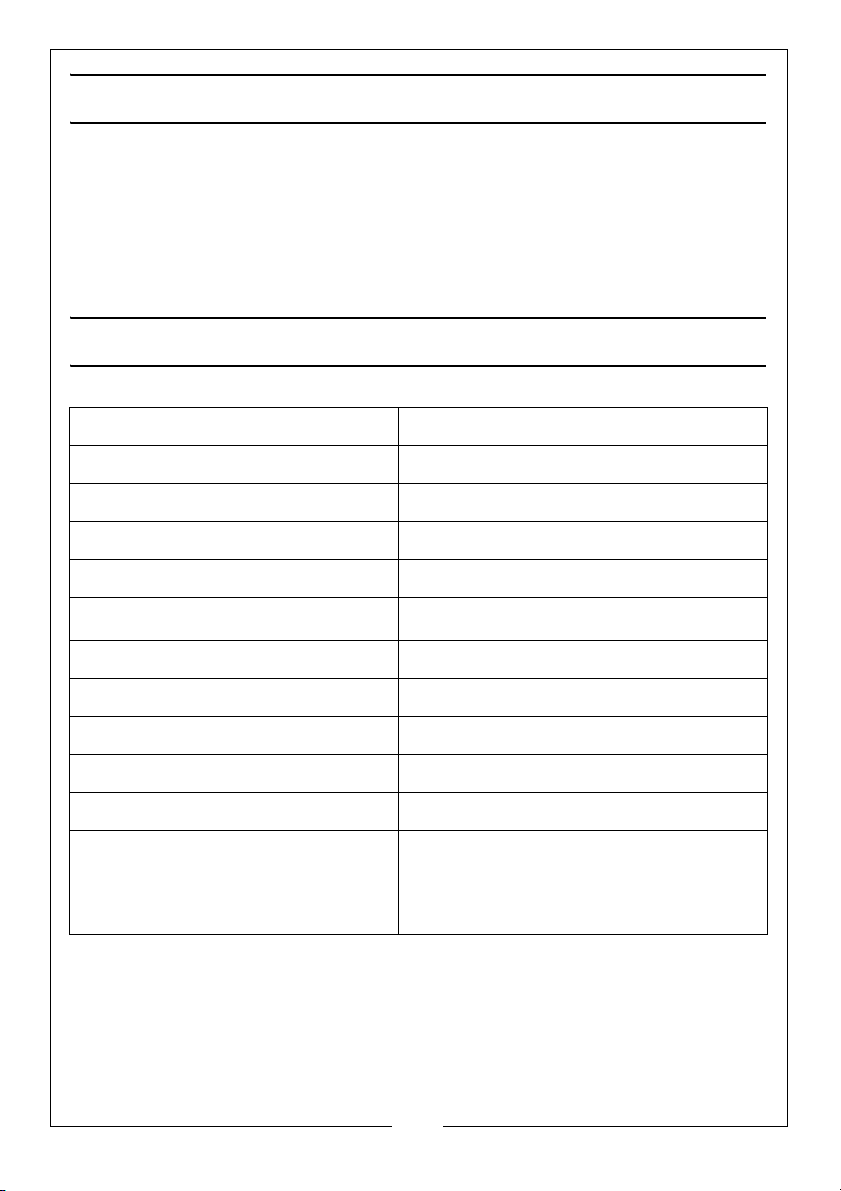
Maximum Operating Pressure 90 psi (6.2 bar)
Air Consumption (under load) 5.5 cfm
Max Blows per minute 3000
Variable speed Trigger operated
Air Inlet Size 1/4” BSP female thread
Vibration Levels
Sound pressure level 97 dB LpA
Sound power level 108 dB LWA
(uncertainty factor K 3 dB
Dimensions (L x W x H) 167 x 50 x 163 mm
Weight 1.35 kg
Chisel size Overall length = 175 mm
Please note that the details and specifications contained herein are correct
at the time of going to print. However CLARKE International reserve the right to
change specifications at any time without prior notice.
Parts & Service: 020 8988 7400 / E-mail: [email protected] or [email protected]
9.8 m/s
Body width = 11.6 mm
Shank length = 42 mm
Shank width = 10.2 mm
2
(uncertainty factor K= 1.5m/s2)
2
Page 3
GENERAL SAFETY RULES
CAUTION: FAILURE TO FOLLOW THESE PRECAUTIONS COULD RESULT IN
PERSONAL INJURY, AND/OR DAMAGE TO PROPERTY.
THE WORK ENVIRONMENT
1. ALWAYS keep the work area clean and tidy.
2. ALWAYS dress appropriately - Do not wear loose clothing or jewellery. Tie
long hair out of the way.
3. ALWAYS keep children and visitors away - Do not let children handle the air
tool.
USE OF AIR POWERED TOOLS
1. ALWAYS stay alert and use common sense - do not operate this air tool
when you are tired or under the influence of alcohol, drugs or medication.
2. ALWAYS wear eye protectors when using air tools. Eye protectors must
provide protection from flying particles from the front and the side.
3. ALWAYS wear ear protectors and a dust mask when using an air hammer.
4. DO NOT overreach - keep proper footing and balance at all times.
5. DO NOT fit the air tool to a stand or clamping device that may damage it.
6. NEVER use oxygen, CO
source of power for the grease gun. This product should only be used with
a suitably rated compressed air supply.
7. DO NOT connect the air hose with your finger on the trigger of the air tool.
8. ALWAYS keep the air supply hose away from heat, oil and sharp edges.
9. DO NOT exceed the maximum pressure for the tool of 90 psi / 6.2 bar.
10. ALWAYS check hoses for leaks or excessive wear before use and ensure
that all connections are secure.
11. DO NOT use the tool for any other purpose than described in this manual.
12. DO NOT carry out any alterations or modifications to the air tool.
13. ALWAYS disconnect from the air supply when:
• Performing any maintenance.
• The tool is not in use.
2
, combustible gases, or any bottled gas, as a
3
Parts & Service: 020 8988 7400 / E-mail: [email protected] or [email protected]
Page 4

• The tool will be left unattended.
• Moving to another work area.
14. Avoid damaging the tool by applying excessive force of any kind.
15. ALWAYS maintain the tool with care. Keep it clean for the best and safest
performance.
16. DO NOT force or misuse the tool. It will do a better and safer job at the rate
for which it was designed.
17. This tool vibrates with use. Vibration may be harmful to your hands or arms.
Stop using the tool if discomfort, a tingling feeling or pain occurs. Seek
medical advice before resuming use.
18. DO NOT carry an air tool by the air supply hose.
19. DO NOT carry an air tool with your finger on the trigger.
AIR HAMMER SPECIFIC HAZARDS
1. Only use accessories designed for use with this air tool.
2. DO NOT use any of the chisels supplied as hand struck tool.
3. DO NOT use blunt chisels which require excessive pressure and can break
from fatigue. Always use sharp tools.
4. NEVER mis-use the tool by prising which can result in a broken tool.
5. ALWAYS ensure there are no hidden electrical cables, gas pipes etc, which
could cause a hazard if damaged by action of the chisels.
4
Parts & Service: 020 8988 7400 / E-mail: [email protected] or [email protected]
Page 5
COMPRESSED AIR REQUIREMENTS
WARNING: COMPRESSED AIR CAN BE DANGEROUS. ENSURE THAT YOU
ARE FAMILIAR WITH ALL PRECAUTIONS RELATING TO THE USE OF
COMPRESSORS AND A COMPRESSED AIR SUPPLY.
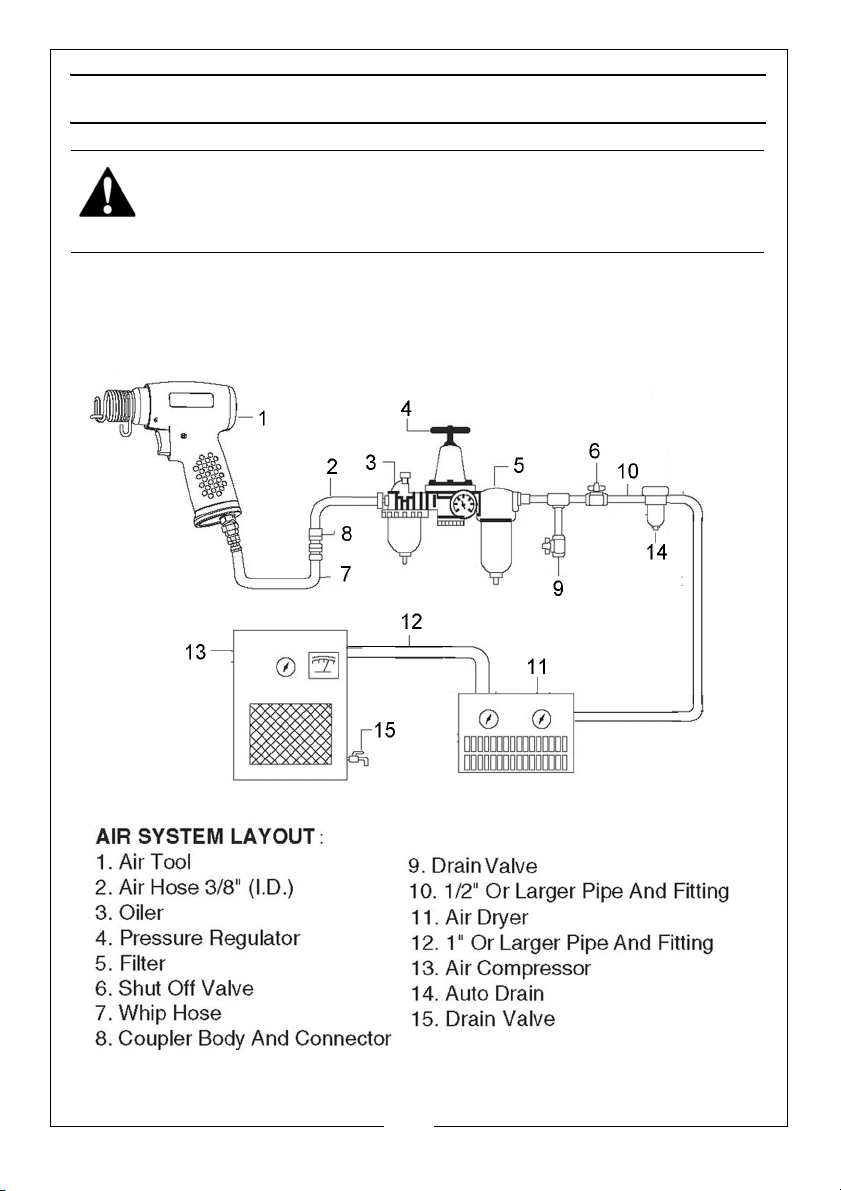
A typical air line layout is shown below. If an automatic in-line filter/regulator is
used, it will keep the tool in good condition, but should be regularly checked
& topped up with oil. CLARKE air-line oil should be used, and the lubricator
adjusted to approx 2 drops per minute.
5
Parts & Service: 020 8988 7400 / E-mail: [email protected] or [email protected]
Page 6

Use only clean, dry, regulated compressed air as a power source.
Air compressors used with the air tool must comply with the appropriate
European Community Safety Directives.
A build-up of moisture or oil in the air compressor will accelerate wear and
corrosion in the tool. ensure any moisture is drained from the compressor daily
and the inlet filter is kept clean.
If an unusually long air hose is required, (over 8 metres), the line pressure or the
hose inside diameter may need to be increased.
The air hose must be rated at least 150% of the maximum operating pressure of
the air tool.
DO NOT exceed the maximum operating pressure for the air tool. It is
recommended that air pressure to this tool does not exceed 90 psi at the tool
when running. Higher pressures and unclean air will shorten the life of an air
tool due to faster wear and is a possible safety hazard.
6
Parts & Service: 020 8988 7400 / E-mail: [email protected] or [email protected]
Page 7
OVERVIEW
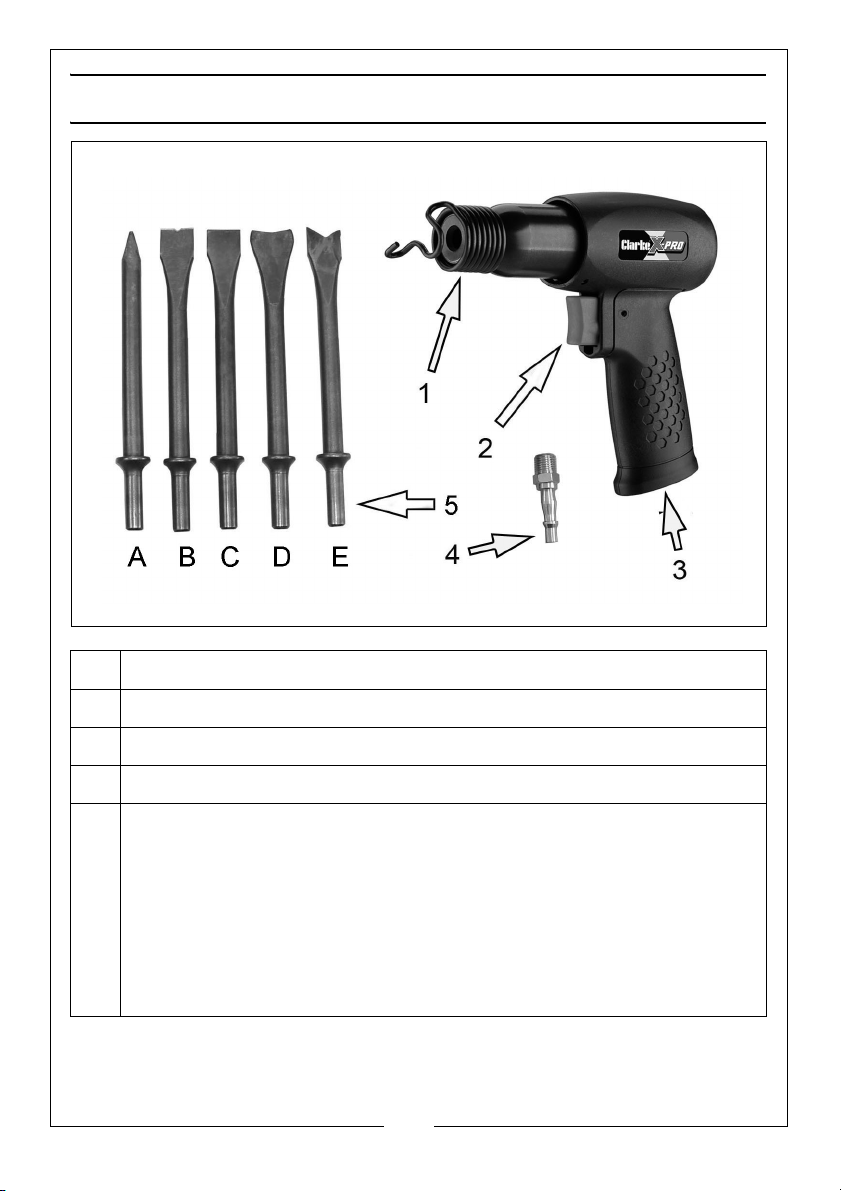
1 Retaining spring
2Trigger
3 Air Inlet
4 Inlet adaptor
5 Chisel Set including:
A - Piercing cutter
B - Spot weld chisel
C - Rivet cutter
D - Bush splitter
E - Panel cutter
7
Parts & Service: 020 8988 7400 / E-mail: [email protected] or [email protected]
Page 8
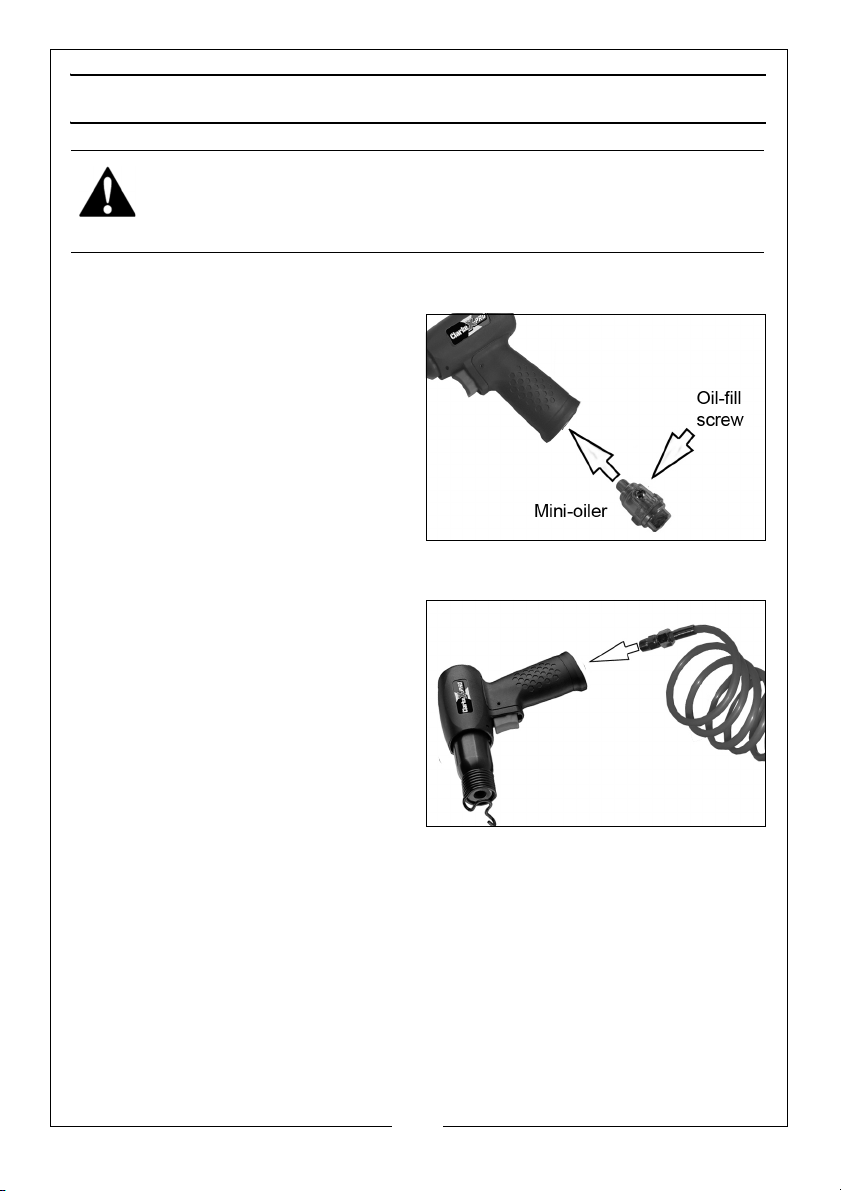
BEFORE USE
WARNING: COMPRESSED AIR CAN BE DANGEROUS. ENSURE THAT YOU
ARE FAMILIAR WITH ALL PRECAUTIONS RELATING TO THE USE OF AIR
COMPRESSORS AND A COMPRESSED AIR SUPPLY.
CONNECTING THE AIRLINE
1. Remove the travel plug.
2. Pour 2-3 drops of CLARKE airline oil
into the oil filling port. This should
be done regardless of whether or
not a lubricated air supply is used.
3. If required, connect an in-line mini
oiler to the tool. Read the
instructions supplied with the minioiler before use.
• A mini oiler helps to prolong the
life of any air tool.
4. Connect a suitable hose. This can
be done using either the male
adaptor supplied or using a mini
oiler from your CLARKE dealer.
5. Connect the other end of the hose
to the compressor.
• PTFE tape may be useful for
sealing threaded connections.
6. Turn on the air supply and check
for air leaks. Rectify any found
before proceeding. Set the working pressure to 90psi (6.2 bar) for best
performance
7. Place a sheet of paper next the exhaust port and squeeze the trigger for
approximately 30 seconds. The oil volume is correctly set when a light stain
of oil can be seen on the paper. Excessive oil should be avoided.
8
Parts & Service: 020 8988 7400 / E-mail: [email protected] or [email protected]
Page 9
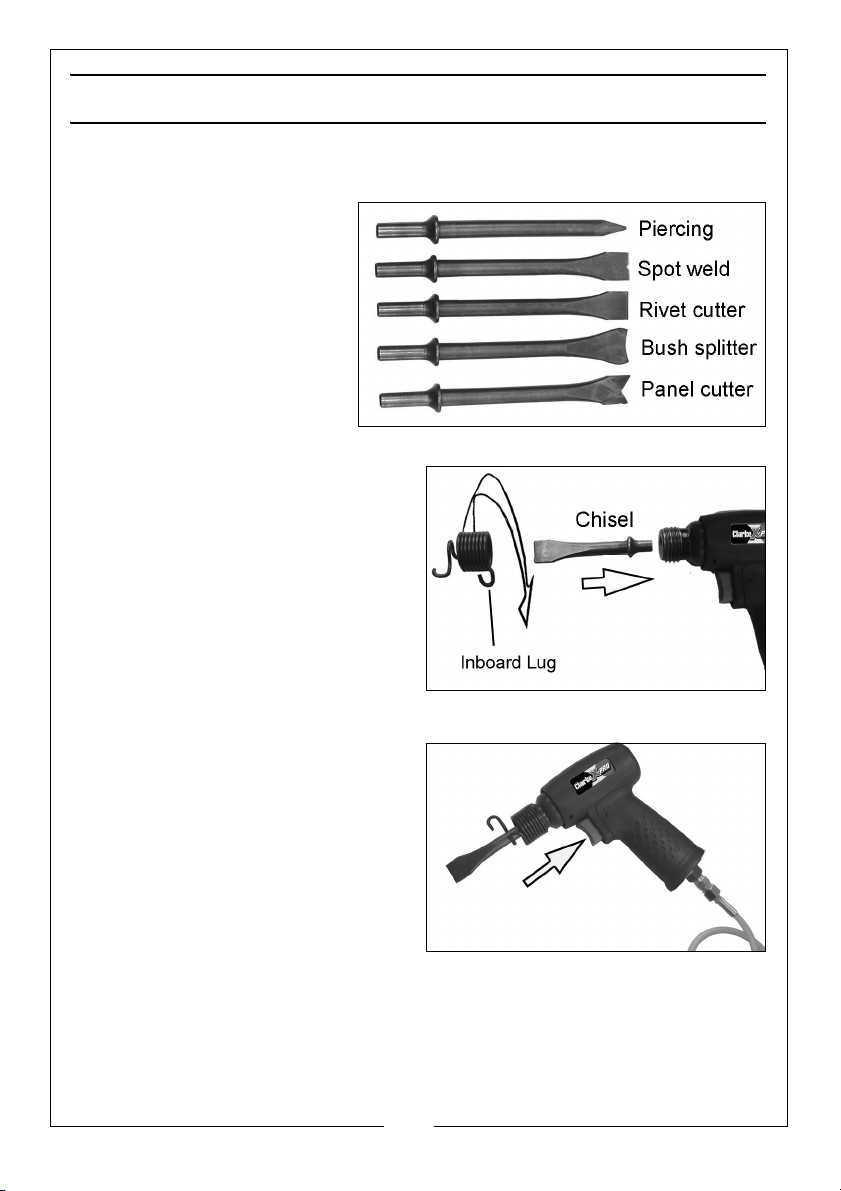
OPERATION
FITTING THE CHISEL
1. Select which chisel is best
suited to the task. A
selection of chisels is
supplied as shown.
2. First remove the retaining spring
from the nose by unscrewing it.
• Use the inboard lug to gain
purchase.
3. Insert the chisel into the air
hammer as shown.
4. Replace the retaining spring.
• Use the lugs to help tighten.
USING THE AIR HAMMER
1. Hold the tool firmly, then bring the
tool towards the work at an angle
of approximately 60-70 degrees.
2. Squeeze the trigger with the chisel
in light contact with the work.
• The chisel speed is controlled by
squeezing the trigger.
3. Move slowly across the work
surface. To remove scale, rust or
other contaminants, only a light force should be required.
4. Release the trigger to stop operation whilst maintaining contact with the
work.
NOTE: The air tool may operate briefly after the trigger is released.
9
Parts & Service: 020 8988 7400 / E-mail: [email protected] or [email protected]
Page 10

NOTE: The retaining spring has a life expectancy, depending upon the
intensity of usage. It is recommended that you procure a spare
spring for use in the event of failure occurring during the course of
a particular job.
DISCONNECTING THE AIR SUPPLY
1. Do not disconnect the air hose until the supply is isolated at a shut-off
valve.
2. Once the pressure has been isolated, disconnect the air supply hose from
the air tool.
3. Shut down the compressor at the end of the work session.
10
Parts & Service: 020 8988 7400 / E-mail: [email protected] or [email protected]
Page 11

MAINTENANCE
WARNING: MAKE SURE THAT THE AIR TOOL IS DISCONNECTED FROM THE
COMPRESSED AIR SUPPLY BEFORE STARTING ANY CLEANING OR
MAINTENANCE PROCEDURES.
DAILY
1. Before use, drain water from the compressed air supply.
2. If no line lubricator or mini oiler is used, ensure that oil is applied to the tool
on a daily basis through the air inlet connection. Run a few drops of oil
through the tool before use. It may be entered into the tool air inlet,
(ensuring the strainer is clear), or into the hose at the nearest connection to
the air supply. Then operate the tool.
3. This procedure should be repeated after every two to three hours of use, or
at the start of the working day.
4. Keep the body of the tool clean and free from debris.
CLEANING
1. Grit or gum deposits in the tool may reduce efficiency.
2. After extensive use, remove the inlet screen filter and flush out the
mechanism with gum solvent oil or an equal mixture of CLARKE air-line oil
and paraffin. Allow to dry before use.
3. If the tool still runs erratically or becomes inefficient, and the air supply is of
good quality, it may be necessary to dismantle the air motor and replace
worn or damaged parts. You may prefer to take the tool to your CLARKE
dealer if internal maintenance is required.
PERFORMANCE
Please note that outside factors may affect the operation and efficiency of
the air tool, such as reduced compressor output, excessive drain on the airline,
moisture or restrictions in the air-line, or the use of connectors of improper size
or poor condition which will reduce air supply.
Your air tool has been designed to give long and trouble free service. If,
however, having followed the instructions in this booklet carefully, you
encounter problems, take the unit to your local CLARKE dealer.
11
Parts & Service: 020 8988 7400 / E-mail: [email protected] or [email protected]
Page 12

TROUBLESHOOTING
SYMPTOM PROBLEM SOLUTION
Tool runs at normal
speed but slows down
under any load.
Tool runs slowly. Air flows
weakly from exhaust.
Tool will not run. Air flows
freely from exhaust.
1. Motor parts worn.
2. Worn or sticking
mechanism due to
lack of lubricant.
1. Motor parts jammed
with gum/dirt.
2. Air-line regulator in
closed position.
3. General airflow
blocked by dirt.
1. Motor vanes stuck
due to buildup of
foreign material.
1. Return to CLARKE dealer
for repair.
2. Drip air tool lubricating
oil into air inlet. Allow oil
to soak moving parts
before using.
1. Examine inlet air filter for
blockage and clean if
necessary. Drip a few
drops of air tool lubricat ing oil into air inlet.
2. Adjust in-line regulator to
open position.
3. Operate tool in short
bursts.
1. Disconnect air supply
and rotate tool assembly
manually.
2. Try operating tool in
short bursts.
3. Tap motor housing gently
with a rubber mallet.
4. Drip a few drops of air
tool lubricating oil into air
inlet to soak moving
parts.
Tool will not shut off. 1. O-rings damaged
or ill-fitting in seat.
1. Return to CLARKE dealer
for repair.
STORAGE
When not in use, disconnect from the air supply, clean & store in a safe, dry
place. If the tool is to be stored, or is idle for longer than 24 hours, run a few
drops of CLARKE air line oil into the air inlet, and run the tool for 5 seconds in
order to lubricate the internal parts.
When storing, replace the blanking plug on the airline inlet once the airline has
been disconnected.
12
Parts & Service: 020 8988 7400 / E-mail: [email protected] or [email protected]
Page 13
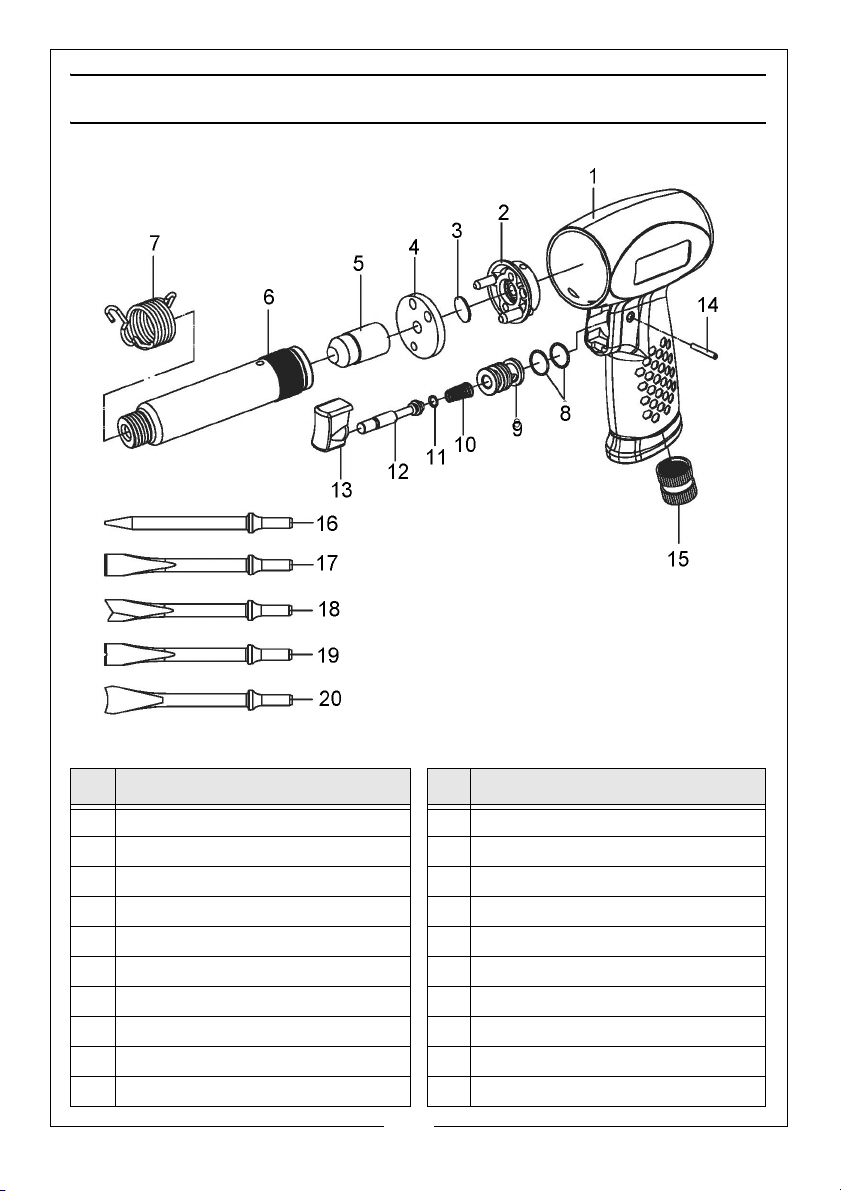
PARTS LIST & DIAGRAM
No Description No Description
1 Main housing 11 O-ring
2 Valve seat 12 Valve stem
3 Valve plate 13 Trigger
4 End cap 14 Set pin
5 Piston 15 Air inlet
6 Cylinder 16 Piercing chisel
7 Retainer spring 17 Rivet cutting chisel
8 O-ring 18 Panel cutting chisel
9 Valve sleeve 19 Spot weld chisel
10 Spring 20 Bush splitting chisel
13
Parts & Service: 020 8988 7400 / E-mail: [email protected] or [email protected]
Page 14

ACCESSORIES
A wide range of accessories are available including filter/regulators,
lubricators, high-pressure hoses (5 to 50 metres) etc.
Contact your CLARKE dealer or the CLARKE International Service Department
for further information.
CLARKE Air Line Oil (part no. 3050825) is available from your CLARKE dealer.
GUARANTEE
This product is guaranteed against faulty manufacture for a period of 12
months from the date of purchase. Please keep your receipt which will be
required as proof of purchase.
This guarantee is invalid if the product is found to have been abused or
tampered with in any way, or not used for the purpose for which it was
intended.
Faulty goods should be returned to their place of purchase, no product can
be returned to us without prior permission.
This guarantee does not effect your statutory rights.
14
Parts & Service: 020 8988 7400 / E-mail: [email protected] or [email protected]
Page 15
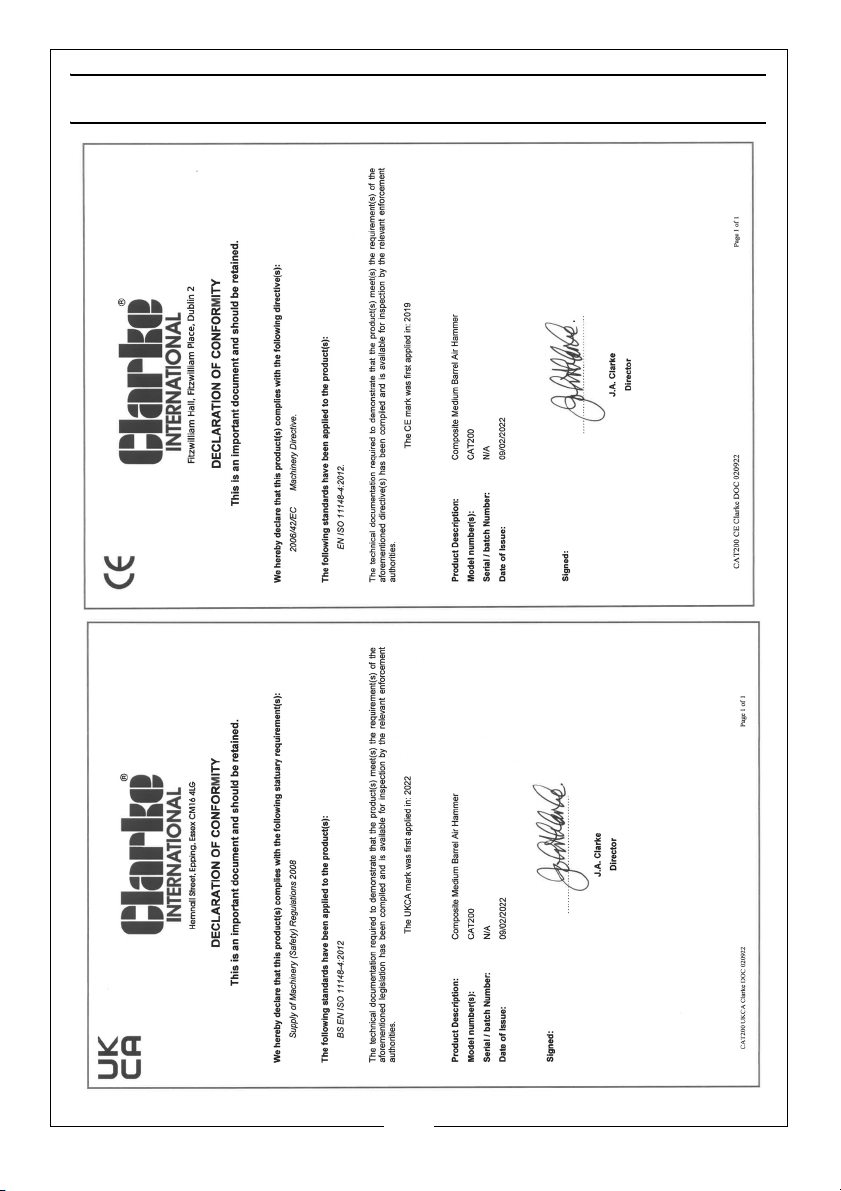
DECLARATION OF CONFORMITY
15
Parts & Service: 020 8988 7400 / E-mail: [email protected] or [email protected]
Page 16

 Loading...