

Page 1

1500W BENCH TOP SHAPER
MODEL NO: CBTSR
PART NO: 6462079
OPERATION & MAINTENANCE
INSTRUCTIONS
ORIGINAL INSTRUCTIONS
LS0320 - ISS 5
Page 2
INTRODUCTION
Thank you for selecting this Clarke Bench Top Shaper.
The machine is ideal for shaping wood and plastic and also for cutting out
knots, cutting grooves, removing recesses, copying curves and logos, etc. The
machine must not be used on metal, stone, etc.
Please note that setting up and adjustment of this product ideally requires
some experience of working with this type of equipment.
GUARANTEE
The machine is guaranteed against faulty manufacture for a period of 12
months from the date of purchase. Your receipt is required as proof of
purchase.
This guarantee is invalid if the machine is found to have been abused,
tampered with, or not used for the purpose for which it was intended.
Faulty goods must be returned to their place of purchase, it must not be
returned to us without prior permission.
This guarantee does not effect your statutory rights.
ENVIRONMENTAL PROTECTION
Through purchase of this tool, the customer is taking on the obligation
to deal with the WEEE in accordance with the WEEE regulations in
relation to the treatment, recycling & recovery and environmentally
sound disposal of the WEEE.
In effect, this means that this tool must not be discarded with general waste.
Refer to the laws governing Waste Electrical and Electronic Equipment (WEEE) at
a recognised disposal facility.
2
Parts & Service: 020 8988 7400 / E-mail: [email protected] or [email protected]
Page 3
SPECIFICATIONS
Item Item Specification
Operating Voltage and Frequency 230V ~ @ 50 Hz
Rated Input Wattage: 1500W
Table Size (with extension) L x W (mm) 1030 x 360 mm
Speeds 11500 rpm to 24500 rpm
Spindle height adjustment 0 - 40 mm
Max Dimension of workpiece (L x W x H) 650 x 160 x 65 mm
Table Insert Sizes 32/47/55 mm
Dust extractor Diameter Adaptor:
Outer Dia: 100 mm
Inner Dia: 93 mm
Rear of the fence:
Outer Dia: 70 mm
Inner Dia: 57.5 mm
Sound Power LpA 93 dB
Sound Power Guaranteed LWa 106 dB
Product Weight (Unpacked): 20.3 kg
SAFETY SYMBOLS
Read instruction
manual before
use
Wear safety
glasses
3
Parts & Service: 020 8988 7400 / E-mail: [email protected] or [email protected]
Wear ear defenders
Wear a breathing
mask.
Page 4

GENERAL POWER TOOL SAFETY WARNINGS
WARNING: READ ALL SAFETY WARNINGS AND ALL INSTRUCTIONS.
FAILURE TO FOLLOW THE WARNINGS AND INSTRUCTIONS MAY RESULT IN
ELECTRIC SHOCK, FIRE AND/OR SERIOUS INJURY.
Save all warnings and instructions for future reference.
1. Keep the work area tidy.
• Clutter in the work area can lead to accidents.
2. Take environmental influences into account.
• Do not expose electric tools to rain.
• Do not use electric tools in a damp or wet environment.
• Make sure that the work area is well-illuminated.
• Do not use electric tools where there is a risk of fire or explosion.
3. Protect yourself from electric shock.
• Avoid physical contact with earthed parts (e.g. pipes, radiators, electric
ranges, cooling units).
4. Keep other persons away.
• Do not let persons, especially children, not involved in the work touch
the tool or the extension cord and keep them away from the work area.
5. Securely store unused electric tools.
• Unused electric tools should be stored in a dry, elevated or closed
location out of the reach of children.
6. Do not overload your electric tool.
• They work better and more safely in the specified output range.
7. Use the correct electric tool.
• Do not use low-output electric tools for heavy work.
• Do not use the electric tool for purposes for which it is not intended. For
example, do not use handheld circular saws for the cutting of branches
or logs.
8. Wear suitable clothing.
• Do not wear wide clothing or jewelry, which can become entangled in
moving parts.
• When working outdoors, anti-slip footwear is recommended.
4
Parts & Service: 020 8988 7400 / E-mail: [email protected] or [email protected]
Page 5

• Tie long hair back in a hair net.
9. Use protective equipment.
• Wear protective goggles.
• Wear a mask when carrying out dust-creating work.
10. Connect the dust extraction device if you will be processing wood,
materials similar to wood, or plastics.
• If connections for dust extraction and a collecting device are present,
make sure that they are connected and used properly.
• When processing wood, materials similar to wood, and plastics.
Operation in enclosed spaces is only permitted with the use of a suitable
extraction system.
11. Do not use the cable for purposes for which it is not intended.
• Do not use the cable to pull the plug out of the outlet. Protect the cable
from heat, oil and sharp edges.
12. Secure the workpiece.
• Use the clamping devices or a vice to hold the workpiece in place. In
this manner, it is held more securely than with your hand.
• An additional support is necessary for long workpieces (table, trestle,
etc.) in order to prevent the machine from tipping over.
• Always press the workpiece firmly against the working plate and stop in
order to prevent bouncing and twisting of the workpiece.
13. Avoid abnormal posture.
• Make sure that you have secure footing and always maintain your
balance.
• Avoid awkward hand positions in which a sudden slip could cause one
or both hands to come into contact with the cutter bit.
14. Take care of your tools.
• Keep cutting tools sharp and clean in order to be able to work better
and more safely.
• Follow the instructions for lubrication and for tool replacement.
• Check the connection cable of the electric tool regularly and have it
replaced by a recognised specialist when damaged.
• Check extension cables regularly and replace them when damaged.
• Keep the handle dry, clean and free of oil and grease.
5
Parts & Service: 020 8988 7400 / E-mail: [email protected] or [email protected]
Page 6

15. Pull the plug out of the outlet.
• Never remove loose splinters, chips or jammed wood pieces from the
running cutter bit.
• When the cutter bit is blocked due to abnormal feed force during
cutting, turn the machine off. Remove the work piece and ensure that
the cutter bit runs freely. Turn the machine on and start a new cutting
operation with less feed force.
16. Do not leave tools inserted in the machine.
• Before switching on, make sure that adjusting tools are removed.
17. Avoid inadvertent starting.
• Make sure that the switch is switched off when plugging the plug into an
outlet.
18. Stay Alert.
• Pay attention to what you are doing. Remain sensible when working. Do
not use the electric tool when you are distracted or tired.
19. Check the electric tool for potential damage.
• Protective devices and other parts must be carefully inspected to
ensure that they are fault free and function as intended prior to
continued use of the electric tool.
• Check whether the moving parts function faultlessly and do not jam or
whether parts are damaged. All parts must be correctly mounted and
all conditions must be fulfilled to ensure fault free operation of the
electric tool.
• The moving protective hood may not be fixed in the open position.
• Damaged protective devices and parts must be properly repaired or
replaced.
• Do not use any faulty or damaged connection cables.
• Do not use any electric tool on which the switch cannot be switched on
and off.
20. ATTENTION!
• The use of other tools or accessories than recommended items can
have a risk of injury.
21. Have your electric tool repaired by a qualified electrician.
• This electric tool conforms to the applicable safety regulations. Repairs
may only be performed by an electrician using original spare parts.
Otherwise accidents can occur.
The operator must always stand in front of the machine to avoid danger.
6
Parts & Service: 020 8988 7400 / E-mail: [email protected] or [email protected]
Page 7

ADDITIONAL SAFETY INSTRUCTIONS
1. Check that the cutters are in perfect condition before use.
2. Use table insert rings appropriate for the size of the cutters.
3. Always wear suitable personal protective equipment. This includes:
• Hearing protection to avoid the risk of becoming hearing impaired.
• Respiratory protection to avoid the risk of inhaling harmful dust.
• Wear safety goggles to avoid eye injuries due to ejected parts.
4. There is the possibility of injury when handling the cutters and rough
materials due to sharp edges.
5. When working with wood, the operator must be informed of the conditions
that affect the release of dust, e.g. the type of material to be processed,
the significance of local separation (collection or source) and the correct
setting of the hood/guide plates/guides.
6. Support long workpieces sufficiently to hold their position.
7. Possible rebound, a sudden reaction due to the guide for a small
workpiece being out of control.
8. Use additional equipment, such as horizontal pressure devices, when
processing narrow workpieces.
9. Tools that have not been maintained can trigger uncontrollable situations.
Only use sharp, maintained milling tools in accordance with the tool
manufacturer’s specifications.
10. Before changing cutters or making adjustments, switch off the machine
and unplug the power plug.
11. Select a rotational speed that is suitable for the milling tool and material
used.
12. Do not lift the machine by the extension tables.
7
Parts & Service: 020 8988 7400 / E-mail: [email protected] or [email protected]
Page 8

RESIDUAL RISKS
The machine is built according to the state of the art and the recognized
safety-relevant regulations. Nevertheless individual residual risks can occur
during work.
• Danger of injury to fingers and hands by the tool due to inappropriate
guidance of the work piece.
• Injuries caused by work piece flying off due to inappropriate mounting
plate or guidance, such as working without notice.
• Health hazard by forms of wood dust or wood chips. Wear personal
protection equipment, such as eye protection. Use ventilation system!
• Injuries by defective tools. Examine the tool regularly for soundness.
• Danger of injury to fingers and hands during tool change. Wear suitable
working gloves.
• Danger of injury when switching on the machine with the starting tool.
• Hazard due to current by use of incorrect electrical connecting cables.
• Health hazard due to the tool because of long hair and loose clothes.
Wear personal protection equipment, such as hair net and closely fitting
work clothes.
• Residual risks can be minimized if the “safety instructions” and the
“intended use” as well as the operating instructions are followed in full.
8
Parts & Service: 020 8988 7400 / E-mail: [email protected] or [email protected]
Page 9
ELECTRICAL CONNECTIONS
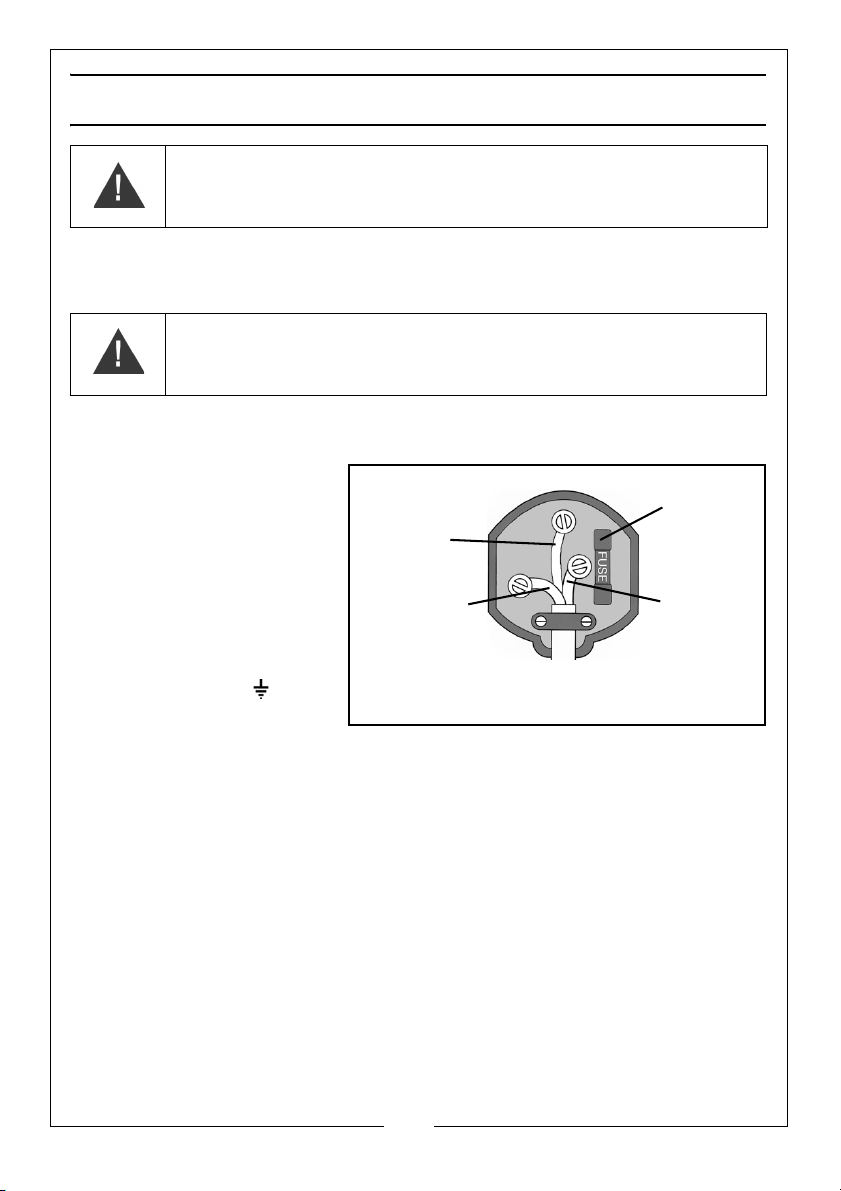
Plug must be BS1363/A approved.
Always fit
Ensure that the outer sheath of
Neutral
(Blue)
Live
(Brown)
Earth
(Green and
a 13 Amp
the cable is firmly held by the clamp
fuse.
Yel low )
WARNING! READ THESE ELECTRICAL SAFETY INSTRUCTIONS FULLY
BEFORE CONNECTING THE MACHINE TO THE MAINS SUPPLY.
This machine is provided with a standard 13 amp, 230 volt (50Hz), BS 1363 plug,
for connection to a standard, domestic electrical supply. Should the plug
need changing, make sure that a plug of identical specification is used.
WARNING! THE WIRES IN THE POWER CABLE OF THIS PRODUCT
ARE COLOURED IN ACCORDANCE WITH THE FOLLOWING CODE:
BLUE = NEUTRAL BROWN = LIVE YELLOW AND GREEN = EARTH
If the colours of the wires in the power cable do not agree with the markings
on the plug:
• Connect the blue wire
to the terminal which
is marked N.
• Connect the brown
wire to the terminal
which is marked L.
• Connect the yellow
and green wire to the
terminal which is
marked E or
We strongly recommend that this machine is connected to the mains supply
through a Residual Current Device (RCD)
If you are not sure, consult a qualified electrician. DO NOT try to do any
repairs.
CABLE EXTENSION
Always use an approved cable extension suitable for the power rating of this
tool (see specifications), the conductor size should also be at least the same
size as that on the machine, or larger. When using a cable reel, always unwind
the cable completely
Parts & Service: 020 8988 7400 / E-mail: [email protected] or [email protected]
9
Page 10
ASSEMBLY
WARNING: BEFORE CARRYING OUT ANY ADJUSTMENT OR
MAINTENANCE, MAKE SURE THAT THE MACHINE IS DISCONNECTED FROM
THE MAINS SUPPLY.
MOUNTING THE MACHINE
It is recommended to fix the machine to a work bench using the four holes
provided.
1. Holes must be drilled in the workbench which align with those on the
machine base.
2. Each corner must be secured to the workbench using nuts and bolts long
enough to go through the workbench (not supplied).
3. The workbench must be large enough to prevent tilting of the shaper when
working.
THE MOULDING FENCE
The moulding fence has been shipped in the carton disassembled.
Before starting work, it must be assembled and fitted onto the working table.
FITTING THE SLIDING BRACKET ONTO THE FENCE
Parts needed for this step
1 x Sliding bracket
1 x Carriage bolt M6 x 25
1 x Plastic cap nut M6
1 x Washer 6mm
1. Insert the carriage bolt into the
fence from below as shown.
10
Parts & Service: 020 8988 7400 / E-mail: [email protected] or [email protected]
Page 11
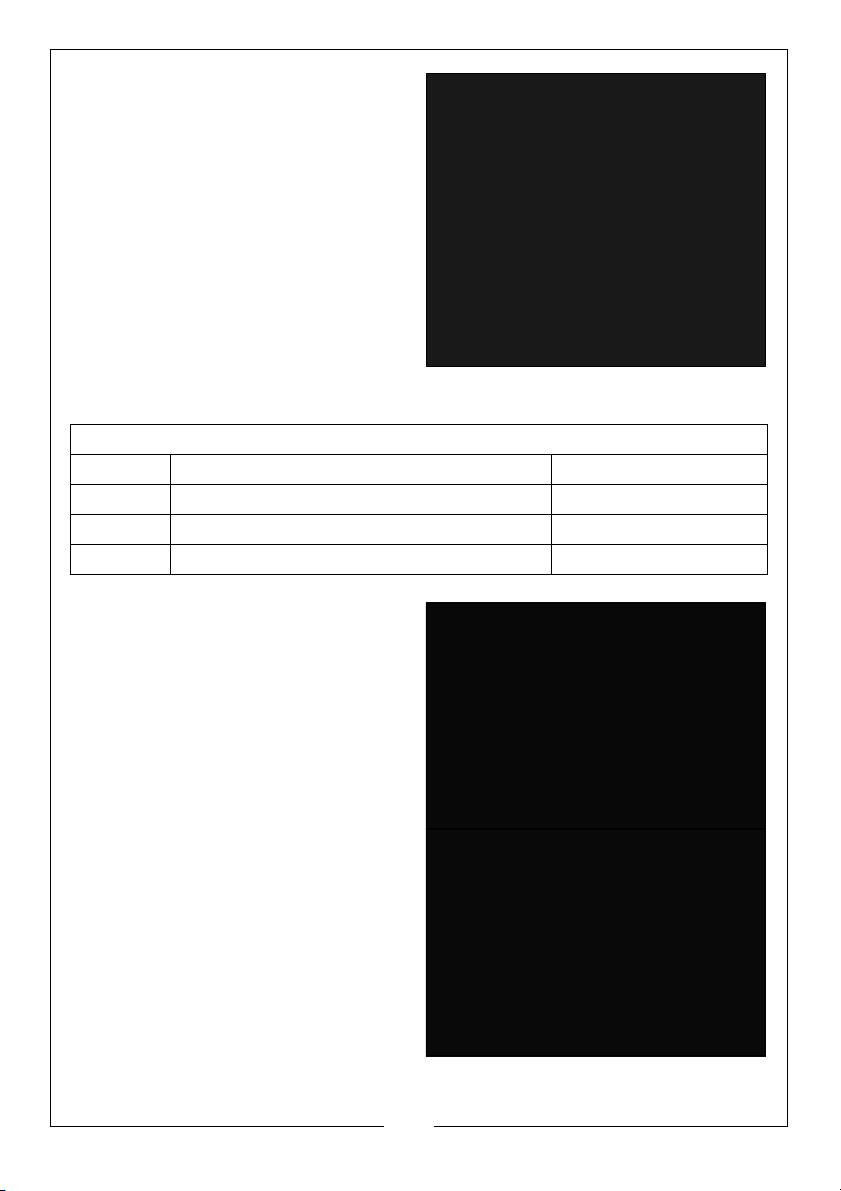
2. Drop the sliding bracket over the
bolt so that it sits in the grooves on
the fence.
3. Secure in place using the washer
and plastic cap nut.
FITTING THE FENCE PLATES
Parts needed for this step
4 x Carriage bolt M6 x 25
4 x Plastic cap nut M6
4 x Washers 6mm
2 x Fence plates
1. Insert the 4 carriage bolts into the
attachment holes and screw
them on finger tight with a washer
and a plastic cap nut.
2. Slide the fence plates over the
carriage bolt heads.
• Make sure that the fence
plates are at the same height.
3. Tighten the plastic cap nut to lock
the fence plates in position.
11
Parts & Service: 020 8988 7400 / E-mail: [email protected] or [email protected]
Page 12
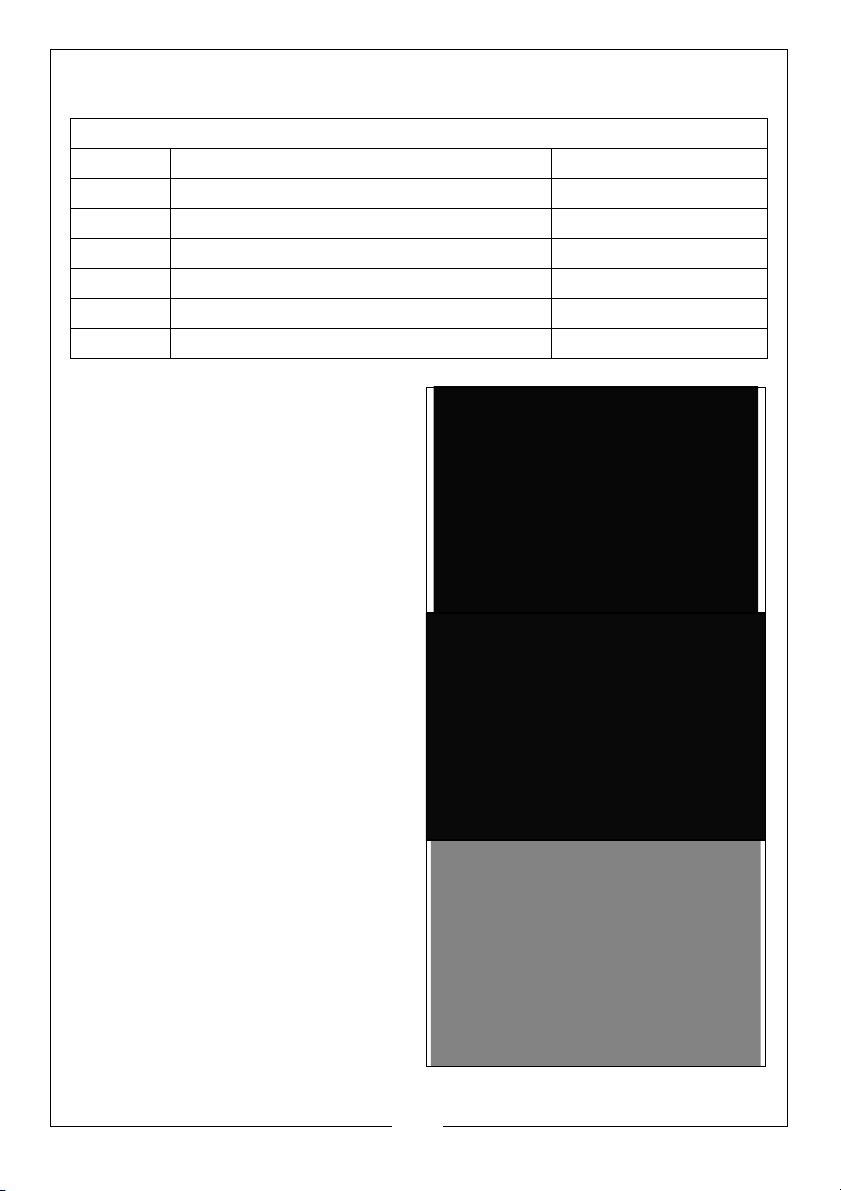
FITTING THE DOWNWARD PRESSURE BAR
Parts needed for this step
1 x Mounting Bracket
2 x Bolt M6 x 40
2 x Nut M6
4 x Washers 6mm
1 x Pressure Bar
2 x Carriage Bolts M6 x 35
2 x Wingnuts M6
1. Fit the mounting bracket to the
central part of the main fence as
shown.
2. Secure in place using 2 x M6 x 40
bolts (from below), 2 washers and
2 x M6 nuts supplied.
3. Position the pressure bar and lock
in position using the 2 carriage
bolts, 2 washers and 2 wing nuts
provided.
12
Parts & Service: 020 8988 7400 / E-mail: [email protected] or [email protected]
Page 13
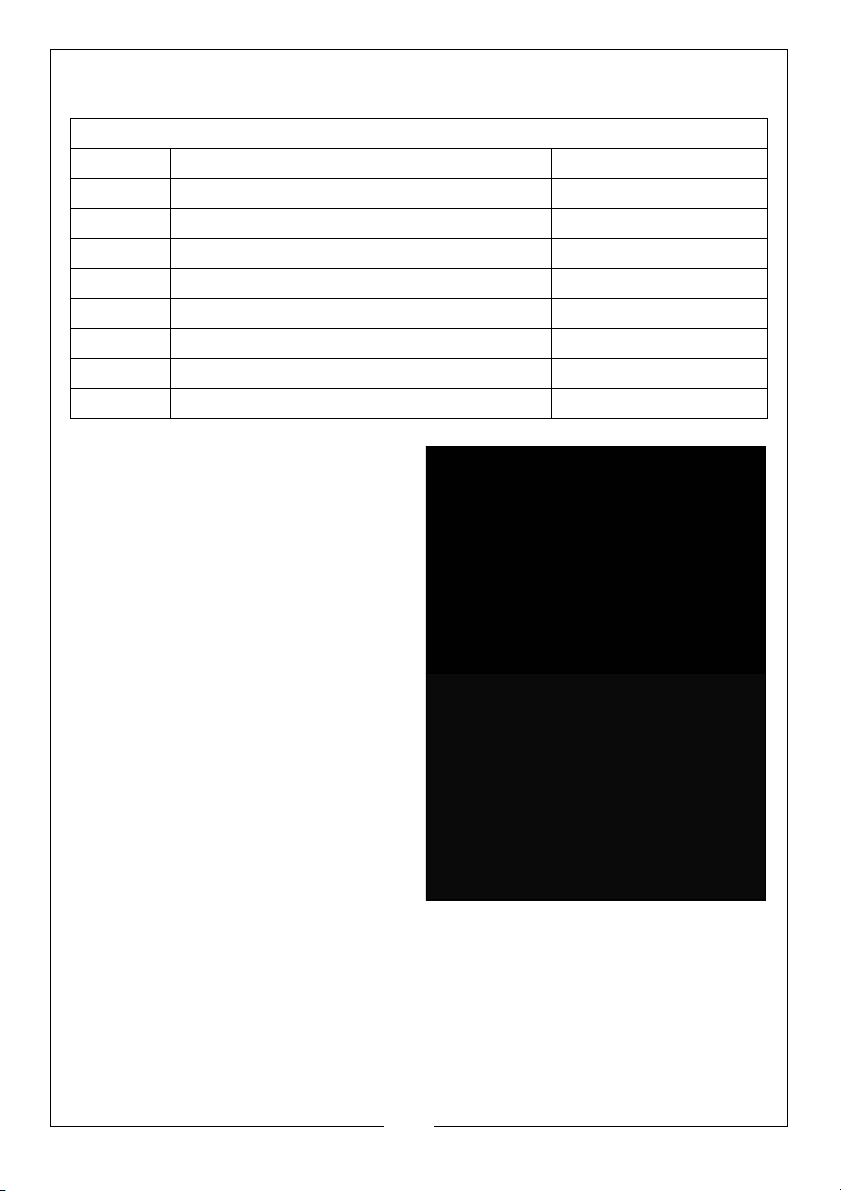
FITTING THE PRESSURE PADS
Parts needed for this step
2 x Pressure pads
2 x Square mounting plate
2 x Square supports
2 x Clamp
2 x Allen screws M6 x 12
2 x Plastic cap screws M6 x 20
4 x Carriage bolts M6 x 35
4 x Plastic cap nuts M6
4 x Washers 6mm
1. Insert the 2 square supports in the
2 square sockets on the main part
of the fence.
2. Secure them with the 2 Allen
screws from below.
NOTE: You will need to slide the
sliding bracket forward to
gain access to one of the
holes.
13
Parts & Service: 020 8988 7400 / E-mail: [email protected] or [email protected]
Page 14

3. Slide the square mounting plate
into the clamp as shown.
4. Slide the clamp over the square
support as shown.
5. Secure in place by tightening the
knob on the clamp.
6. Fit the pressure pads to the square
mounting plates using 4 carriage
bolts, 4 washers and 4 plastic cap
nuts.
14
Parts & Service: 020 8988 7400 / E-mail: [email protected] or [email protected]
Page 15
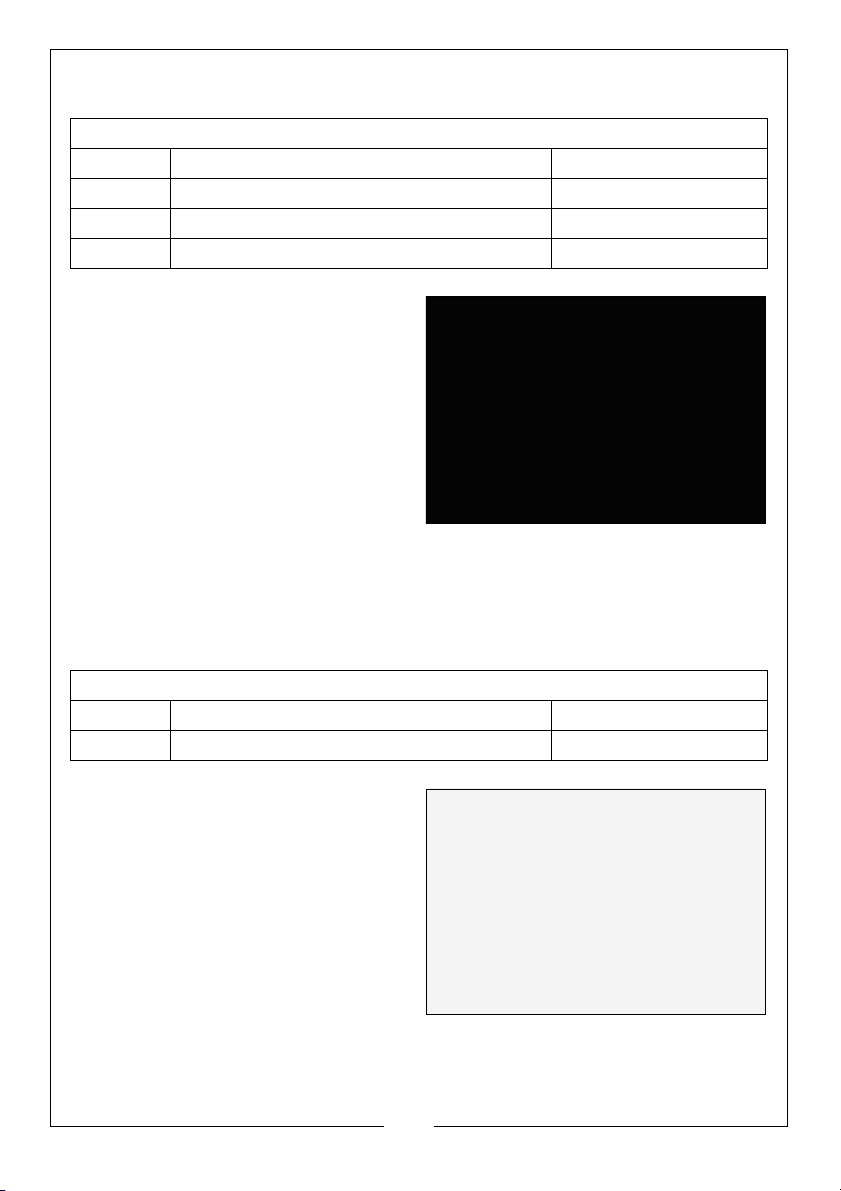
FITTING THE MOULDING FENCE ONTO THE WORKING TABLE
Parts needed for this step
1 x Carriage bolt M6 x 20
1 x Carriage bolt M6 x 40
2 x Plastic cap nuts M6
2 x Washers 6mm
1. Fix the 2 plastic cap screws into
the grooves in the moulding
fence using the washers and
carriage bolts as shown.
• The longer carriage bolt goes
on the right, when viewing the
fence from the rear.
2. Put the tops of the carriage bolts
through the opening in the table.
3. Position the moulding fence as
required and tighten the plastic cap nuts.
FITTING THE HANDLE
Parts needed for this step
1 x Handle
1 x Nut M8
1. Slide the handle over the shaft
making sure it engages with the
pin.
2. Secure in place using the nut
supplied.
15
Parts & Service: 020 8988 7400 / E-mail: [email protected] or [email protected]
Page 16
FITTING THE TABLE EXTENSION
Parts needed for this step
8 x Allen screws M5 x 20
6 x Allen screws M5 x 12
8 x Small Washers 5mm
6 x Large Washers 5mm
8 x Hexagonal nuts M5
14 x Spring washers 5mm
1. Remove the fence and flip the unit upside down onto a smooth flat
surface
2. Attach the extension table to
both sides with 4 allen screws M5 x
20, 4 washers, 4 spring washers
and 4 hexagonal nuts M5.
• Make sure that the channel on
top of the extension table lines
up with the main table.
3. Also secure using 3 allen screws
M5 x 12, 3 large washers and 3
spring washers each.
4. Align the table and tighten all
screws.
5. Repeat for the other table
extension.
6. Flip the unit the right way up
again (with assistance if required)
and replace the fence.
16
Parts & Service: 020 8988 7400 / E-mail: [email protected] or [email protected]
Page 17
FITTING THE KICKBACK SAFETY FENCE
Parts needed for this step
1 x Kickback safety fence
1 x Mounting bracket
2 x Recessed head screws M5 x 10
2 x Washers 5mm
2 x Spring washers 5mm
2 x Carriage bolts M6 x 25
2 x Washers 6mm
2 x Wing nuts M6
1. Align the mounting bracket with
the two holes on the front of the
table.
2. Insert the two recessed head
screws, 2 x 5mm spring washers
and 2 washers into the holes, and
tighten.
3. Install the kickback safety fence
• You can adjust the fence to the
thickness of the work piece.
4. After setting, fix it in place with the
help of the two carriage bolts, 2
washers and 2 wing nuts.
17
Parts & Service: 020 8988 7400 / E-mail: [email protected] or [email protected]
Page 18

CONNECTION OF A DUST EXTRACTOR
Slide the suction hose of the dust
extractor unit onto the dust
extraction port at the rear of the
moulding fence.
• For hoses with a dia. of 100 mm,
an adapter is supplied.
FITTING THE TRANSPARENT TOOL GUARD
1. Remove downward pressure bar and bracket shown on page 12.
2. Place transparent tool guard in
position as shown.
3. Insert pin to secure.
• Check to see the guard
functions correctly before use.
18
Parts & Service: 020 8988 7400 / E-mail: [email protected] or [email protected]
Page 19
BEFORE USE
INSTALLING AND CHANGING THE COLLETS AND CUTTER HEADS
WARNING: BEFORE CARRYING OUT ANY ADJUSTMENT OR
MAINTENANCE, MAKE SURE THAT THE MACHINE IS DISCONNECTED FROM
THE MAINS SUPPLY.
1. Remove the insert rings from the
table.
2. Loosen the securing screw and
use the handle to raise the spindle
to its highest position.
3. Press and hold the Spindle Lock
button.
19
Parts & Service: 020 8988 7400 / E-mail: [email protected] or [email protected]
Page 20

4. Loosen the collet nut using the
spanner provided and remove
the cutter and collet nut if
required.
5. Insert the required collet/collet
nut and tighten it slightly.
6. Insert the cutter into the collet.
• At least 3/4 of the cutter shank
must be in the collet before
tightening.
7. Press and hold the spindle lock button and tighten the collet nut securely.
• Before every use of the machine make sure that the cutting tool is firmly
clamped to the end of the spindle.
8. Place the insert rings back in to their original position.
• The insert rings must be used in order to keep the spacing between table
and cutter to a minimum. Only fit enough insert rings so as to allow the
cutter to come through the surface of the table without touching the
rings.
• Before switching on check the insert rings are seated correctly
9. Reconnect the machine to the power supply.
20
Parts & Service: 020 8988 7400 / E-mail: [email protected] or [email protected]
Page 21
ADJUSTMENTS
SPEED CONTROL
The speed control has 6 speeds.
Determine the optimal setting by
testing on a scrap piece of wood.
NOTE: The use of the correct setting
will increase the life-span of
the cutter. It, also affects the
quality of the cut.
RAISING/LOWERING THE CUTTER
To raise or lower the spindle height.
1. Loosen the securing screw.
2. Use the handle to raise or lower
the spindle to the required height.
3. Tighten the securing screw.
ADJUSTING THE FENCE
1. Loosen the plastic cap screws
shown on the back of the fence.
2. Move the fence to the desired
position.
3. Re-tighten the plastic cap screws
to keep the fence in this position.
21
Parts & Service: 020 8988 7400 / E-mail: [email protected] or [email protected]
Page 22

OUTFEED FENCE OFFSET
Once the workpiece passes the cutter, it may be thinner then when it started. If
so you should adjust the left fence to compensate for the missing material.
1. Loosen the plastic cap screws.
2. Move the left fence towards you
slightly and tighten the plastic cap
screws.
ADJUST THE CROSS-CUTTING JIG
1. Loosen the locking knob
2. Set to the desired angle.
3. Tighten the locking knob
• Always make a sample cut in a
piece of waste material in
order to guarantee that the
angles are correct.
SWITCHING ON AND OFF
• Press the Green ON (I) button to
start the machine.
• Press the Red OFF (O) button to
stop the machine
22
Parts & Service: 020 8988 7400 / E-mail: [email protected] or [email protected]
Page 23

USING THE MACHINE
1. Insert an appropriate cutting bit.
2. Adjust the speed, and adjust the fence in such a way that the material is
supported along its entire length.
3. Switch the machine on by pressing the green ON (I) button.
4. Make sure the work piece is firmly pressed against the fence.
5. Push the work piece softly from right to left against the turning direction of
the cutting bit.
• Keep your speed constant. Do not push too fast – it would slow down
the motor too much.
• Feeding the work piece too fast will result in poor cutting quality. There is
also the risk of damaging the cutting bit or the motor.
• Feeding the work piece too slow will result in burnt spots on the work
piece.
• The correct intake speed depends on the cutter size, the material type
of the work piece, and the cutting depth. It is recommended to practise
first with a piece of scrap wood in order to determine the correct speed.
6. With very hard wood and important cuts it may be better to work
progressively, taking several shallow cuts until the desired depth is
achieved.
7. Switch the machine off by pressing the red OFF (O) button.
OVERLOAD SWITCH
The machine is fitted with an
overload switch to protect the motor.
In the event of an overload situation,
the machine will cut out
automatically.
After a short time press the overload
reset button to reset the machine.
23
Parts & Service: 020 8988 7400 / E-mail: [email protected] or [email protected]
Page 24

MAINTENANCE AND SERVICING
WARNING: BEFORE CARRYING OUT MAINTENANCE, MAKE SURE THAT THE
MACHINE IS DISCONNECTED FROM THE MAINS SUPPLY.
CLEANING
• Keep all safety devices, air vents and the motor housing free of dirt and
dust. Wipe the equipment with a clean cloth or blow it with compressed
air at low pressure (always wear PPE when using compressed air).
• We recommend that you clean the machine as soon as you have
finished using it.
• Do not use cleaning agents or solvents; these could attack the plastic
parts of the machine.
• Make sure that no water can seep into the machine. The ingress of
water into an electric tool increases the risk of an electric shock.
• Never spray water on the machine!
CUTTING BIT
• Resin must be cleaned off the cutting bits at regular intervals with an
appropriate resin remover.
STORAGE
• Store the bench top shaper and accessories out of children’s reach in a
dark and dry place at above freezing temperature. The ideal storage
temperature is between 5 and 30 °C.
• Store the bench top shaper in its original packaging.
• Cover the bench top shaper in order to protect it from dust and
moisture.
• Store the operating manual with the bench top shaper.
24
Parts & Service: 020 8988 7400 / E-mail: [email protected] or [email protected]
Page 25

DECLARATION OF CONFORMITY
25
Parts & Service: 020 8988 7400 / E-mail: [email protected] or [email protected]
Page 26

OTHER ITEMS IN THE CLARKE RANGE
26
Parts & Service: 020 8988 7400 / E-mail: [email protected] or [email protected]
Page 27

OTHER ITEMS IN THE CLARKE RANGE
27
Parts & Service: 020 8988 7400 / E-mail: [email protected] or [email protected]
Page 28

 Loading...