

Page 1
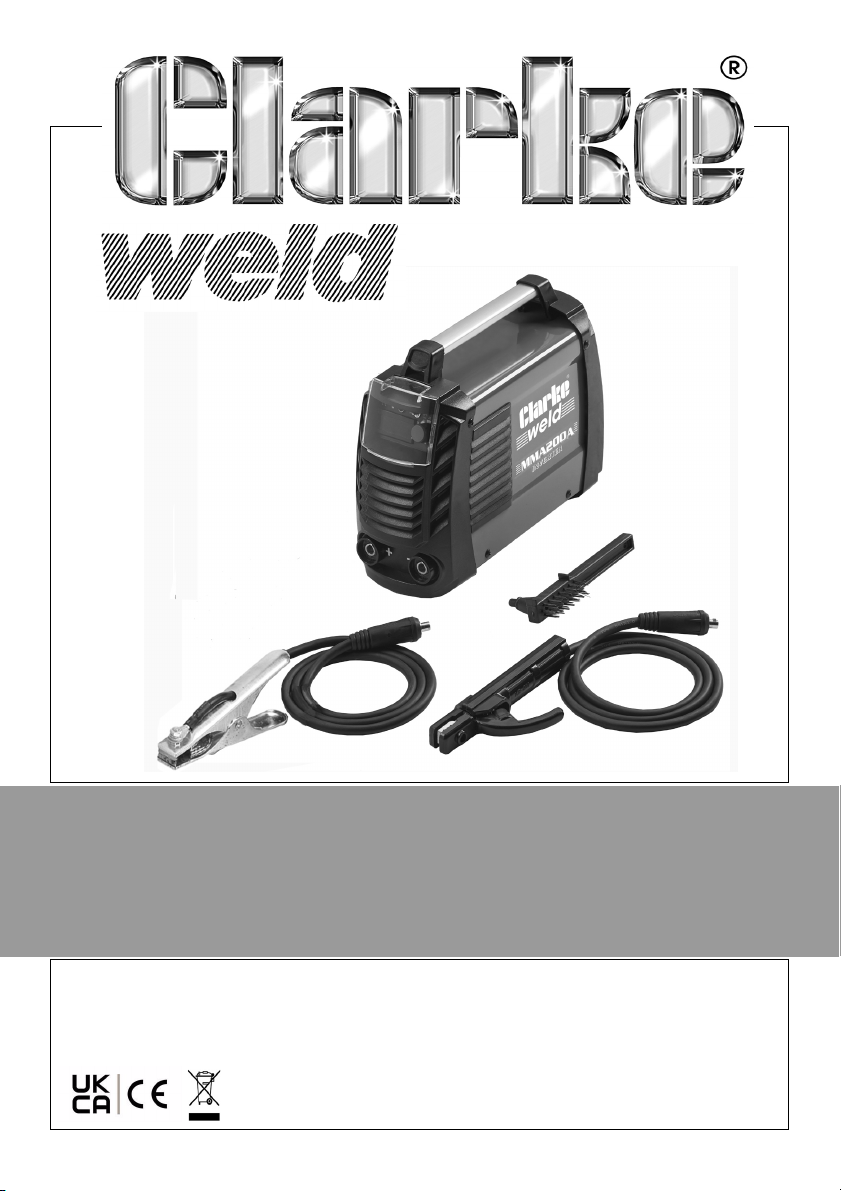
200A MMA INVERTER WELDER
MODEL NO: MMA200A
PART NO: 6012163
OPERATION & MAINTENANCE
INSTRUCTIONS
ORIGINAL INSTRUCTIONS GC0522 rev 1
Page 2
INTRODUCTION
Thank you for purchasing this CLARKE MMA (Arc) Welder. Before attempting to
operate the machine it is essential that you read this manual thoroughly and
carefully follow all instructions given. In doing so you will ensure the safety of
yourself and that of others around you, and you can also look forward to the
welder giving you long and satisfactory service.
When unpacking, any damage or deficiency should be reported to your
CLARKE dealer immediately.
PRINCIPLES OF THE MACHINE
MMA (Arc) welding uses a coated consumable electrode (stick) to lay the
weld, therefore an additional welding torch kit is not required. The arc melts
the core of the electrode to produce drop s of molten metal (weld pool) that
cool to create the welded joint. Because of the versatility and simplicity of
MMA welding, it requires less skill and is used primarily to weld iron and steel
(including stainless steel. but nickel and copper can also be welded using this
method.
MAIN DESIGN FEATURES
ARC-FORCE automatically increases the current to prevent the
electrode sticking when operating with a short arc
length.
HOT START increases the welding current at the beginning of the
welding process.
ANTI-STICK the electrode can be easily withdrawn without it
becoming damaged.
VOLTAGE REDUCTION
SAFETY DEVICE (VRD)
reduces open circuit voltage when not in use to prevent accidental injury
INVENTORY
The items supplied include the following:
• 1 x MMA Inverter Welder
• 1 x Torch Cable with Electrode Holder
• 1 x Earth Clamp & Cable
• 1 x Combination Wire Brush / Hammer
• 1 x Instruction Manual
2
Parts & Service: 020 8988 7400 / E-mail: [email protected] or [email protected]
Page 3
SAFETY PRECAUTIONS FOR ALL TYPES OF WELDING
WARNING: AS WITH ALL MACHINERY, THERE ARE CERTAIN HAZARDS
INVOLVED WITH THEIR OPERATION AND USE. EXERCISING RESPECT AND
CAUTION WILL CONSIDERABLY LESSEN THE RISK OF PERSONAL INJURY.
HOWEVER, IF NORMAL SAFETY PRECAUTIONS ARE OVERLOOKED, OR
IGNORED, PERSONAL INJURY TO THE OPERATOR MAY RESULT.
FAILURE TO FOLLOW THESE RULES MAY RESULT IN SERIOUS PERSONAL INJURY.
GENERAL PRECAUTIONS
BURN PREVENTION
Wear protective clothing - gauntlet gloves designed for use in welding, apron,
and protective shoes. Button shirt collar and pocket flaps and wear cuffless
trousers to avoid entry of sparks and slag. Wear helmet with safety goggles or
glasses with side shields underneath, appropriate filter lenses or plates
(protected by clear glass). This is a MUST for welding (and chipping) to protect
the eyes from radiant energy and spatter. Replace cover glass when broken,
pitted, or spattered. Avoid oily greasy clothing. A spark may ignite them. Hot
metal should never be handled without gloves. First aid facilities and a
qualified first aid person should be available unless medical facilities are close
by for immediate treatment of flash burns of the eyes and skin burns. Ear plugs
should be worn when working overhead or in a confined space. A hard hat
should be worn when others work overhead. Flammable hair preparations
should not be used by persons intending to weld or cut.
NOTE: ALL protective wear incl. masks & head shields MUST comply with
PPE Regulation (EU) 2016/425.
TOXIC FUME PREVENTION
Severe discomfort, illness or death can result from fumes, vapours, heat, or
oxygen enrichment or depletion that welding (or cutting) may produce.
Prevent them with adequate ventilation. NEVER ventilate with oxygen. Lead-,
cadmium-, zinc-, mercury- and beryllium-, bearing materials, when welded (or
cut) may produce harmful concentrations of toxic fumes. Adequate local
exhaust ventilation must be used, or each person in the area as well as the
operator must wear an air- supplied respirator. For beryllium, both must be
used. Metals coated with or containing materials that emit toxic fumes should
not be heated unless coating is removed from the work surface, the area is
well ventilated, or the operator wears an air-supplied respirator. Work in a
confined space only while it is being force ventilated and, if necessary, while
wearing an air-supplied respirator. Vapours from chlorinated solvents can be
decomposed by the heat of the arc (or flame) to form PHOSGENE, a highly
toxic gas, and other lung and eye irritating products. The ultraviolet (radiant)
energy of the arc can also decompose trichloroethylene and
3
Parts & Service: 020 8988 7400 / E-mail: [email protected] or [email protected]
Page 4

perchloroethylene vapours to form phosgene. DO NOT WELD where solvent
vapours can be drawn into the welding atmosphere or where the radiant
energy can penetrate to atmospheres containing even minute amounts of
trichloroethylene or perchloroethylene.
FIRE AND EXPLOSION PREVENTION
Causes of fire and explosion are:
1. Combustibles reached by the arc, flying sparks, hot slag or heated
material;
2. Short circuits.
BE AWARE that flying sparks or falling slag can pass through cracks, along
pipes, through windows or doors, and through wall or floor openings, out of
sight of the goggled operator.
To prevent fires and explosion: keep equipment clean and operable, free of
oil, grease, and (in electrical parts) of metallic particles that can cause short
circuits. If combustibles are in the area, do NOT weld. Move the work if
practicable, to an area free of combustibles.
Avoid working in paint spray rooms, dip tanks, storage areas, ventilators. If the
work cannot be moved, move combustibles away from sparks and heat; or
protect against ignition with suitable fire- resistant covers or shields.
Walls, ceilings, and floor near work should be protected by heat resistant
covers or shields. Fire watcher must be standing by with suitable fire
extinguishing equipment during and for some time after welding or cutting if:
1. appreciable combustibles (including building construction) are within 10m.
2. appreciable combustibles are further than 10m, but can be ignited by
sparks.
3. openings (concealed or visible) in floors or walls can expose combustibles
to sparks.
4. combustibles adjacent to walls, ceilings, roofs or metal partitions can be
ignited by radiant or conducted heat.
After work, check that area is free of sparks, glowing embers and flames. An
empty container that held combustibles or that can produce flammable or
toxic vapours when heated, must never be welded on or cut, unless the
container has first been cleaned. This includes a thorough steam or caustic
cleaning (or a solvent or water washing, depending on the combustible’s
solubility) followed by purging and inerting with nitrogen or carbon dioxide,
and using protective equipment.
Water filling just below the working level may substitute for inerting.
A container with unknown contents should be cleaned (see paragraph
above). Do NOT depend on sense of smell or sight to determine if it is safe to
4
Parts & Service: 020 8988 7400 / E-mail: [email protected] or [email protected]
Page 5

weld or cut. Hollow castings or containers must be vented before welding as
they can explode.
In explosive atmospheres, never weld or cut where the air may contain
flammable dust, gas, or liquid vapours.
ELECTRIC ARC WELDING
Comply with precautions in above and this section. Arc welding, properly
done, is a safe process but a careless operator invites trouble. The equipment
carries high currents at significant voltages. The arc is very bright and hot.
Sparks fly, fumes rise, ultraviolet and infrared energy radiates and work pieces
are hot. The wise operator avoids unnecessary risks and protects himself and
others from accidents.
BURN PROTECTION
The welding arc is intense and visibly bright. It’s radiation can damage eyes,
penetrate lightweight clothing, reflect from light coloured surfaces and burn
the skin and eyes. Skin burns resemble acute sunburn, those from gas shielded arcs are more severe and painful.
DON’T GET BURNED! FOLLOW ALL SAFETY PRECAUTIONS!
PROTECTIVE CLOTHING
Wear long sleeved clothing (particularly for gas shielded arc) in addition to
gloves, apron and strong shoes. As necessary, use additional protective
clothing such as leather jacket or sleeves, flameproof apron, and fire-resistant
leggings. Avoid outer garments of untreated cotton. Bare skin protection:
Wear dark substantial clothing, Button collars closed to protect the chest and
neck and button any pockets to prevent entry of sparks.
EYE AND HEAD PROTECTION
Protect eyes from exposure to arc. NEVER look at an electric arc without
protection. Welding helmet or shield containing an appropriate filter plate
(Please refer to the section ‘Welding Shield). Place over face before striking
arc. Protect filter plate with a clear cover plate. Cracked or broken helmet or
shield should NOT be worn; radiation can pass through to cause burns.
Cracked, broken, or loose filter plates must be replaced IMMEDIATELY.Replace
clear cover plate when broken, pitted, or spattered. WE SUGGEST you wear
flash goggles with side shields under the helmet, to give some protection to
the eyes should the helmet not be lowered over the face before an arc is
struck. Looking at an arc momentarily with unprotected eyes (particularly high
intensity gas-shielded arc) can cause a retinal burn that may leave a
permanent dark area in the field of vision. Before welding whilst wearing
contact lenses, seek advice from your optician.
5
Parts & Service: 020 8988 7400 / E-mail: [email protected] or [email protected]
Page 6

PROTECTION OF NEARBY PERSONNEL
For production welding, a separate, well vented room or enclosed bay is best.
In open areas, surround the operation with low reflective, non- combustible
screens or panels. Allow for free air circulation, particularly at floor level.
Provide face shields for all persons who will be looking directly at the weld.
Others working in the area should wear flash goggles. Before starting to weld,
make sure that screen or bay doors are closed.
TOXIC FUME PREVENTION
Comply with all precautions above.
FIRE AND EXPLOSION PREVENTION
Do not overload arc welding equipment. It may overheat cables and cause a
fire. Loose cable connections may overheat or flash and cause a fire. Never
strike an arc on a cylinder or other pressure vessel. It creates a brittle area that
can cause a violent rupture or lead to such a rupture later under rough
handling.
SHOCK PREVENTION
Exposed live conductors or other bare metal in the welding circuit, or in
unearthed, electrically-LIVE equipment can fatally shock a person whose
body becomes a conductor. DO NOT STAND, SIT, LIE, LEAN ON, OR TOUCH a
wet surface when welding, without suitable protection.
PROTECTION FOR WEARERS OF ELECTRONIC LIFE SUPPORT DEVICES
(PACEMAKERS).
Magnetic fields from high currents can affect pacemaker operation. Persons
wearing pacemakers should consult with their doctor before going near arc
welding or spot welding operations.
PROTECTION AGAINST SHOCK
Keep your body and clothing dry. Never work in damp area without
adequate insulation against electric shock. Stay on a dry duckboard or rubber
mat when dampness or sweat can not be avoided. Sweat, sea water, or
moisture between body and an electrically LIVE part - or earthed metal reduces the body surface electrical resistance, enabling dangerous and
possibly lethal currents to flow through the body.
EARTHING THE EQUIPMENT
When arc welding equipment is earthed according to the National Electrical
Code and the workpiece is earthed, a voltage may exist between the
electrode and any conducting object.
Examples of conducting objects include, but are not limited to, buildings,
electrical tools, work benches, welding power source cases, workpieces, etc.
Never touch the electrode and any metal object unless the welding power
6
Parts & Service: 020 8988 7400 / E-mail: [email protected] or [email protected]
Page 7

source is off. When installing, connect the frames of each unit such as welding
power source, control, work table, and water circulator to the building earth.
Conductors must be adequate to carry earth currents safely. Equipment
made electrically LIVE by stray current may shock, possibly fatally. Do not
EARTH to electrical conduit, or to a pipe carrying ANY gas or a flammable
liquid such as oil or fuel.
CABLES
Frequently inspect cables for wear, cracks and damage. IMMEDIATELY
REPLACE those with excessively worn or damaged insulation to avoid possibly
lethal shock from bared cable. Cables with damaged areas may be taped to
give resistance equivalent to original cable. Keep cable dry, free of oil and
grease and protected from hot metal and sparks.
TERMINALS AND OTHER EXPOSED PARTS
Terminals and other exposed parts of electrical units should have insulating
covers secured before operation.
SAFETY DEVICES
Safety devices such as interlocks and circuit breakers should not be
disconnected or shunted out. Before installation, inspection, or service of
equipment, shut OFF all power and remove line fuses (or lock or red-tag
switches) to prevent accidental turning ON of power. Do not open power
circuit or change polarity while welding. If, in an emergency, it must be
disconnected, guard against shock burns, or flash from switch arcing. Always
shut OFF and disconnect all power to equipment. A power disconnect switch
must be available near the welding power source.
7
Parts & Service: 020 8988 7400 / E-mail: [email protected] or [email protected]
Page 8
PREPARATION OF THE WORKING AREA
The working area must be sufficiently spacious, not humid, and well-ventilated
as to avoid any fumes which develop from the welding process and from
incidental material adhering to the pieces to be welded (oils, paints, tars...)
which may cause danger to the operator.
Avoid welding tanks which may contain flammable residuals.
WARNING: ELECTRIC SHOCK CAN BE FATAL. A PERSON QUALIFIED IN FIRST
AID SHOULD ALWAYS BE PRESENT IN THE WORKING AREA. IF PERSON IS
UNCONSCIOUS AND ELECTRIC SHOCK IS SUSPECTED, DO NOT TOUCH
THE PERSON IF HE OR SHE IS IN CONTACT WITH THE WELDER OR CABLES.
DISCONNECT THE WELDER FROM THE POWER SOURCE AND THEN USE FIRST
AID. DRY WOOD, OR OTHER INSULATING MATERIAL CAN BE USED TO
MOVE CABLES, IF NECESSARY, AWAY FROM THE PERSON.
ADDITIONAL PRECAUTIONS FOR MMA WELDING
1. ALWAYS ensure that there is full free air circulating around the outer casing
of the machine and that the louvres are unobstructed.
2. A welding arc can seriously damage your eyes. Both operator and
spectators must ALWAYS use a proper welding face shield or helmet with
suitable filter lenses. Proper gloves and working clothes should be worn at
all times.
3. ALWAYS remove all flammable materials from the welding area.
4. NEVER remove any of the panels unless the machine is disconnected from
the supply and never use the machine with any of the panels removed.
5. NEVER use or store in a damp environment. DO NOT EXPOSE TO RAIN.
6. NEVER attempt any electrical or mechanical repair unless your are a
qualified technician. If you have a problem with the machine contact your
local CLARKE dealer.
7. ALWAYS keep a fire extinguisher handy (Dry Powder, C02 or BCF, NOT
Water).
8. NEVER continue to weld, if, at any time, you feel even the smallest electric
shock. Stop welding IMMEDIATELY and DO NOT attempt to use the
machine until the fault is diagnosed and corrected.
9. NEVER allow the earth cable or torch to become wrapped around the
operator or any person in the vicinity.
8
Parts & Service: 020 8988 7400 / E-mail: [email protected] or [email protected]
Page 9
A comprehensive range of CLARKE safety equipment for use when welding is
available from your local dealer.
Consideration should be given to shielding the supply cable of permanently
installed welding equipment, in metallic conduit or equivalent. Shielding
should be electrically continuous throughout its length.
The shielding should be connected to the welding power source so that good
electrical contact is maintained between the conduit and the welding power
source enclosure.
The welding equipment should be routinely maintained according to the
manufacturer’s recommendations. All access and service doors and covers
should be closed and properly fastened when the welding equipment is in
operation. The welding equipment should not be modified in any way except
for those changes and adjustments covered in the manufacturer’s
instructions. In particular, the spark gaps of arc striking and stabilizing devices
should be adjusted and maintained according to the manufacturers
recommendations.
SAFETY SYMBOLS
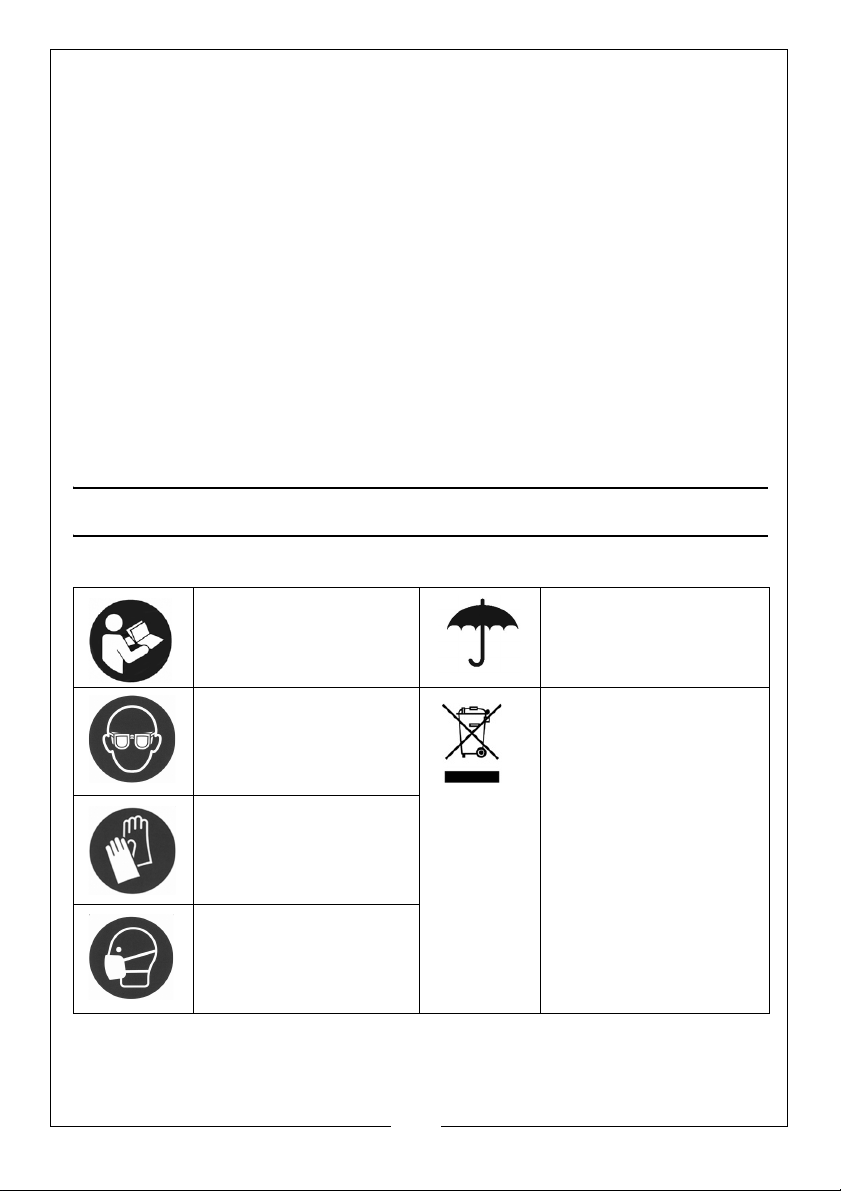
The following symbols may be displayed on the machine.
Read this instruction
booklet carefully
before use.
Wear eye protection Recycle unwanted
Wear protective gloves
Wear a dust mask
9
Parts & Service: 020 8988 7400 / E-mail: [email protected] or [email protected]
Do not expose to rain.
materials instead of
disposing of them as
waste. All tools,
accessories and
packaging should be
sorted, taken to a
recycling centre and
disposed of in a manner
which is compatible
with the environment.
Page 10
ELECTRICAL CONNECTION
CONNECTING TO MAINS POWER
NOTE: This welder is earthed and must only be connected to the mains
with an earth connection. Do not attempt to use it without one.
• This welder is not supplied with a mains electrical plug because at
full capacity it will draw far too much power for a normal domestic
230V mains plug and socket. This welder must not be fitted with a
standard 13A UK plug.
• A high current 230V mains socket or terminal must be installed by a
qualified and accredited professional electrician. A 16A socket and
plug conforming to IEC 60309 is recommended.
• A non-socketed mains connection also requires welder connection
by a qualified and accredited professional electrician. However, a
socketed connection is safer and is recommended so the welder
can be safely isolated when necessary. If directly wired to the mains,
a double pole, double throw isolator switch must be fitted.
• The welder must be connected using a circuit protected by an RCD.
• Please refer to the Specification for details of the maximum current
required by this welder.
If in any doubt, do not attempt to connect or use this welder until a
professional electrician has been consulted.
ENVIRONMENTAL RECYCLING POLICY
Through purchase of this product, the customer is taking on the
obligation to deal with the WEEE in accordance with the WEEE
regulations in relation to the treatment, recycling & recovery and
environmentally sound disposal of the WEEE.
In effect, this means that this product must not be disposed of with general
household waste. It must be disposed of according to the laws governing
Waste Electrical and Electronic Equipment (WEEE) at a recognised disposal
facility.
If disposing of this product or any damaged components, do not dispose of
with general waste. This product contains valuable raw materials. Metal
products should be taken to your local civic amenity site for recycling of metal
products.
10
Parts & Service: 020 8988 7400 / E-mail: [email protected] or [email protected]
Page 11
MMA/ARC WELDING
PREPARATION
To prepare the machine for ARC welding it is important that you follow the
procedure below.
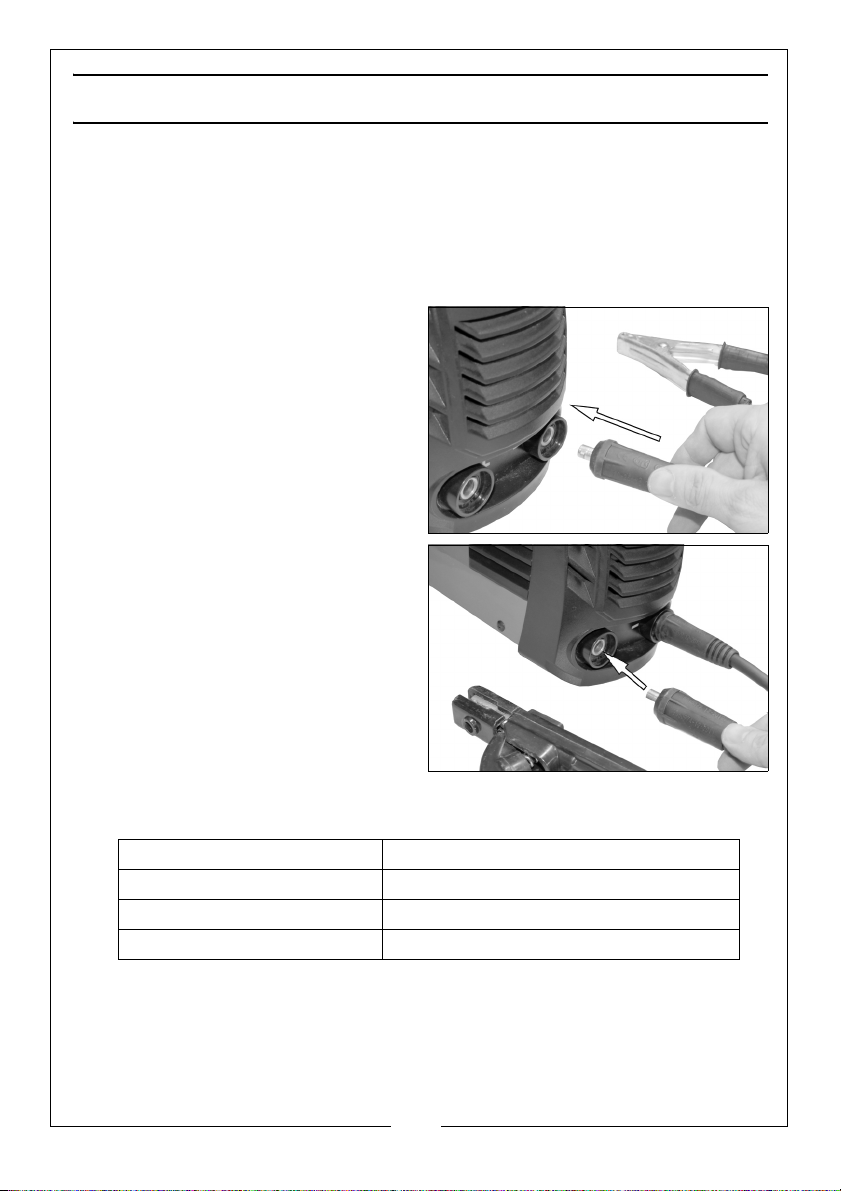
1. Making sure that the ON/OFF switch, located on the rear panel is in the OFF
position, connect the welding leads as follows:
• Work clamp lead to the (-)
Negative terminal.
• Welding rod holder lead to the
(+) Positive terminal
2. Select the appropriate welding rod and insert it into the welding rod holder.
ROD DIAMETER MATERIAL THICKNESS
2.5 mm 1.0 - 2.0 mm
3.2 mm 2.0 - 5.0 mm
4.0 mm 2.0 - 8.0 mm
3. Attach the work clamp to the workpiece as close as possible to the area
being welded. Clean with a wire brush where necessary to ensure the
connection is as clean as possible.
11
Parts & Service: 020 8988 7400 / E-mail: [email protected] or [email protected]
Page 12
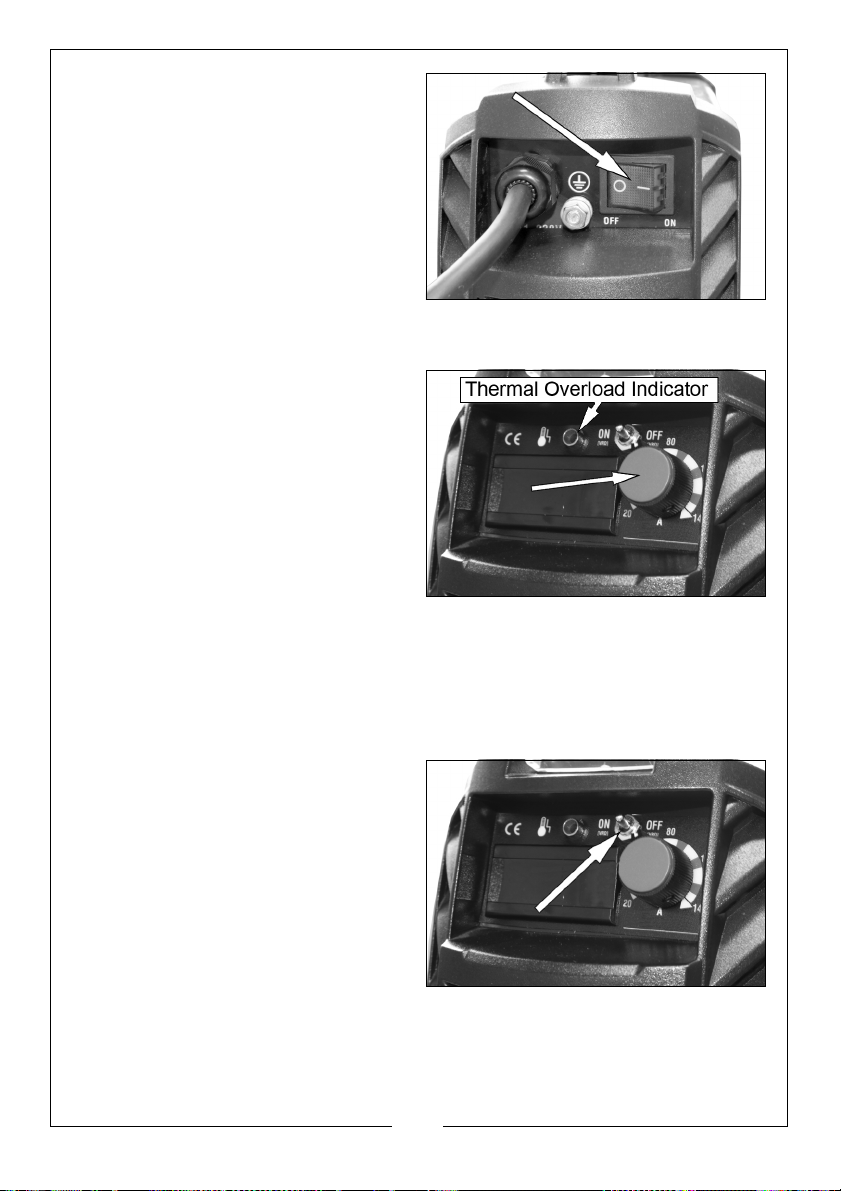
4. Switch ON using the switch
located on the rear panel.
• The display on the front panel
will come on and show the
current setting in amps.
• If the machine stops at any time
and the thermal overload
indicator comes ON, the thermal
overload device has intervened.
Wait until the welder has cooled
sufficiently (the thermal overload indicator goes out) before restarting
work.
5. Set the required current using the
current selector.
• With practice you will gain a
feel for the correct current
setting for different welding rod
thicknesses.
VRD-VOLTAGE REDUCTION DEVICE
The VRD is a safety feature that It is also known as “Anti-shock”.
Its function is to lower the open circuit voltage across the output terminals to a
safe 12V when the welder is not in use.
As soon as the welder is used (a load
of 200 ohms or less is detected), the
voltage will increase to the full output
to enable welding to commence.
The “VRD” will only turn the output of
the welder back to a reduced output
state of 12 volts once the electrode Is
removed from the work piece or If
the resistance across the output rises
above 200 ohms.
If you wish to turn off this feature, set the VRD switch on the front panel to OFF.
We recommend that you leave it switched ON.
12
Parts & Service: 020 8988 7400 / E-mail: [email protected] or [email protected]
Page 13
STRIKING THE ARC - WELDING
WARNING: WHEN WELDING ALWAYS ENSURE THERE IS ADEQUATE
VENTILATION IN THE WORK AREA AS THE WELDING PROCESS GIVES OFF
TOXIC FUMES.
WARNING: WELDING ARCS PRODUCE HARMFUL UV/IR LIGHT WHICH CAN
SERIOUSLY DAMAGE YOUR EYES. ALWAYS USE A WELDING HELMET WITH
A SUITABLE FILTER THAT CONFORMS TO CURRENT STANDARDS.
WARNING: NEVER LOOK AT THE ARC WITHOUT A SUITABLE WELDING
MASK
WARNING: PROTECT BYSTANDERS BY USING WELDING SCREENS/
CURTAINS.
The most difficult aspect of the arc welding process, particularly for beginners,
is that of striking an arc. We strongly recommend that you practice on some
pieces of scrap metal to get the feel of the operation, before you start on an
actual welding job.
1. Hold the electrode about 10 mm from the work and at an angle of about
70° to 80° to the work surface; take care not to accidentally touch the
workpiece until you are ready to start.
2. Holding the welding mask close-up to your face, give a short stroke with
the electrode on the workpiece. As soon as the arc is primed, withdraw the
electrode from the workpiece to leave a tiny gap of around 1.5mm (1/16").
The current will flow across the gap with a crackling noise and a brilliant
arc. Continue to weld in one direction, maintaining the small gap as you
go.
NOTE: When you prime the arc, be sure to withdraw the electrode swiftly
to leave the 1.5 mm. gap, otherwise the electrode will weld itself
to the workpiece. If this occurs give the electrode a short sharp
jerk to free it and, if necessary, prime the arc again. If you cannot
free the electrode, switch the machine off immediately and free
it. Take care the electrode will get red hot very quickly and will be
capable of burning through welding gloves.
3. At the end of the run, just lift the electrode away from the workpiece.
4. Inspect the job carefully. Any slag forming on the surface should be
chipped away with a chipping hammer or pick. ALWAYS wear your safety
goggles when chipping away slag.
13
Parts & Service: 020 8988 7400 / E-mail: [email protected] or [email protected]
Page 14
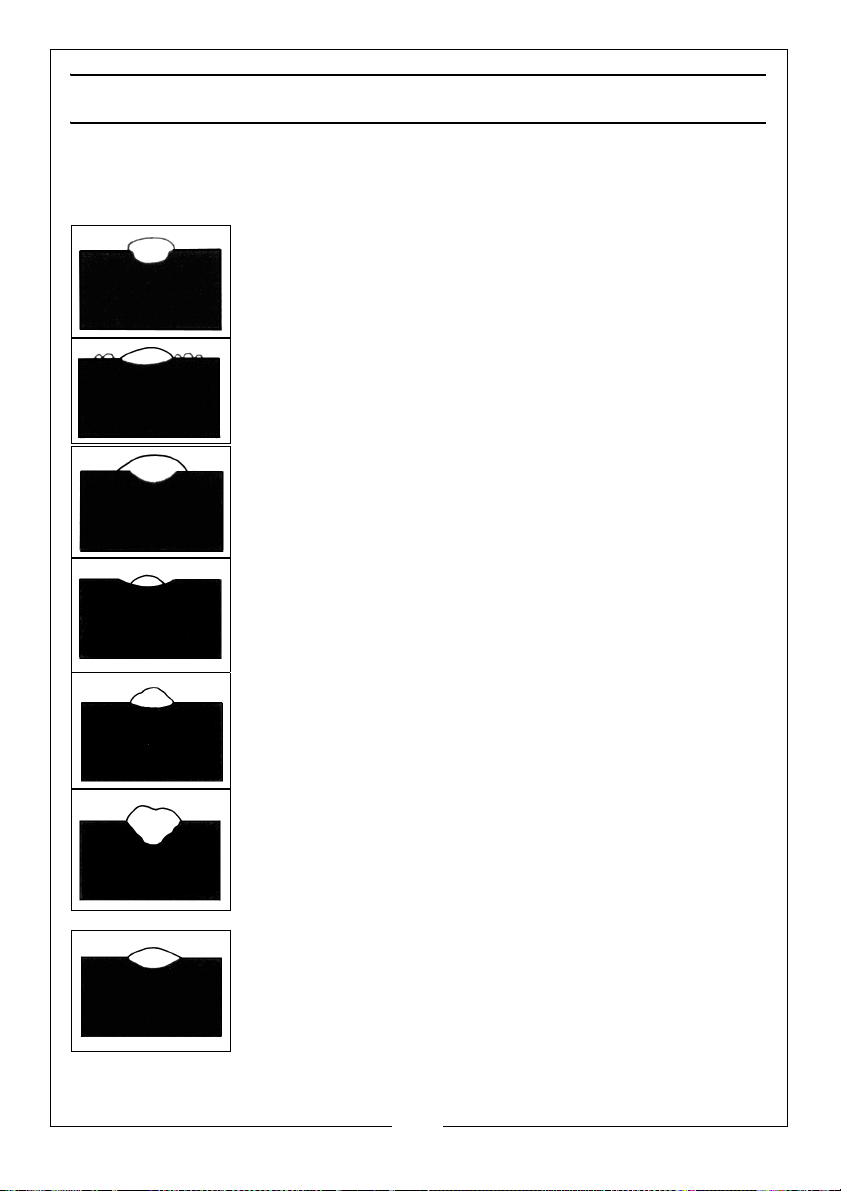
WELDING PITFALLS
The arc welding technique is an acquired skill and requires considerable
practice before perfect results are obtained. The diagrams below will help to
explain the pitfalls in your technique and how to overcome them.
ARC TOO SHORT
This causes irregular masses of weld to be deposited, with
slag contamination on an uneven surface.
ARC TOO LONG
This causes poor penetration resulting in a weak weld with
excessive spatter and porosity. Surface of the weld is rough
and the arc makes a hissing sound
ELECTRODE MOVED TOO SLOWLY
This causes a very wide and heavy deposit which overlaps
at the sides. It is wasteful both in terms of time and electrode
use.
ELECTRODE MOVED TOO QUICKLY
This causes poor penetration with a ‘stringy’ and incomplete
weld deposit. Slag is very hard to remove.
CURRENT TOO LOW
This causes poor penetration and causes the electrode to
stick to the workpiece too readily. Also results in a very
irregular and high weld deposit. Slag is very hard to remove.
CURRENT TOO HIGH
This causes excessive penetration with spatter and deep
pointed crater. It may also cause holes to be burned in the
workpiece.
Burns electrodes very quickly.
THE PERFECT WELD
With the correct combination of arc length, current
regulation, inclination and speed of the electrode, you will,
with practice, produce the perfect weld.
This should be regular with uniform ripples and no slag
contamination. The arc will make a steady crackling sound.
14
Parts & Service: 020 8988 7400 / E-mail: [email protected] or [email protected]
Page 15
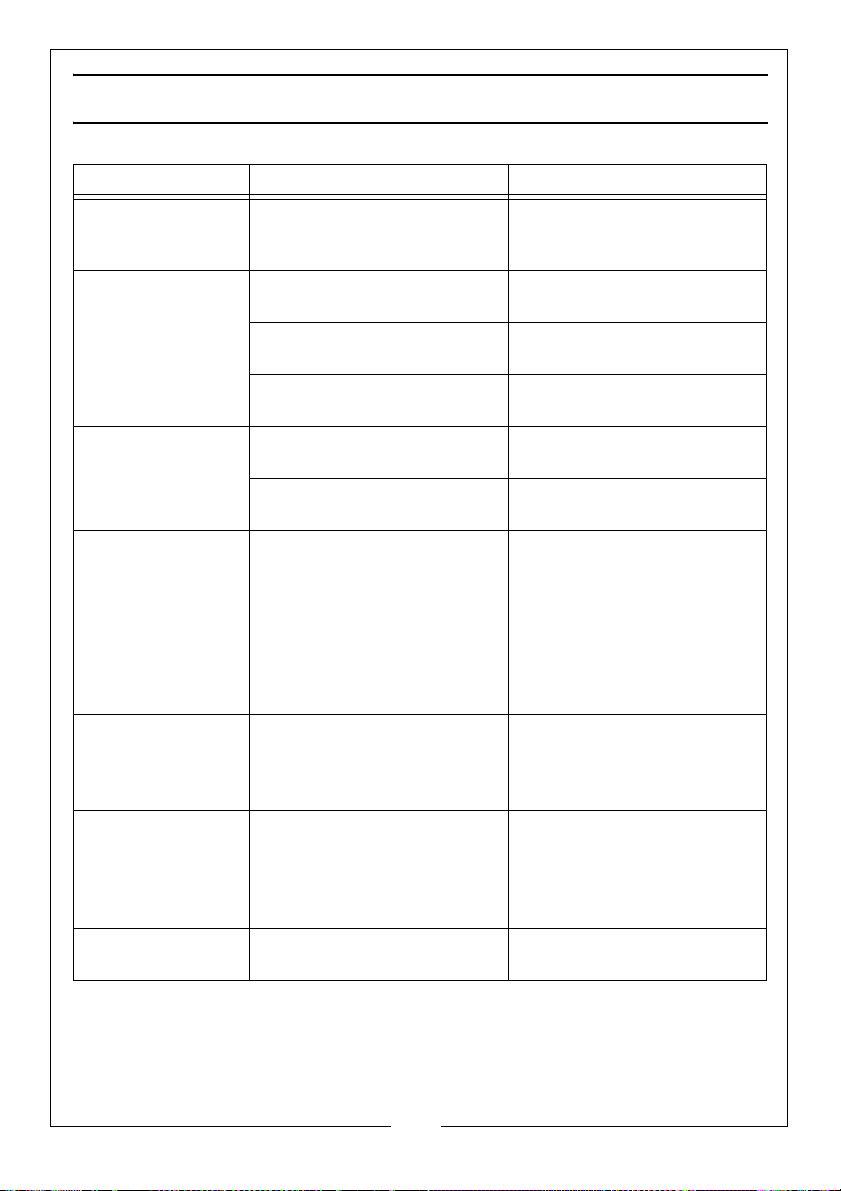
TROUBLESHOOTING
DEFECT CAUSES SUGGESTIONS
Spark will not start Bad clamp connection.
Inverter printed circuit is
defective.
No output voltage Overheated machine (the
red LED should be on).
Internal relay has failed. Contact your nearest
Inverter printed circuit is
defective.
Wrong output
current
Porosity of welds Acid electrode on steel
Cracks in weld Material being welded is
Limited
penetration
High Sprays Electrode is too inclined. Make appropriate
Current selector control is
defective.
Low power supply voltage. Check the mains distribution
with high sulphur content.
Electrode oscillates too
much.
Workpieces are too far
apart.
Workpiece being welded is
cold.
dirty (e.g.oil, paint, rust,
oxides).
Not enough current.
Low current, high welding
rate, reversed polarity.
Electrode inclined in
position opposite to it's
movement.
Check clamp connection.
Contact your nearest
CLARKE dealer.
Wait for thermal cutout to
be reset.
CLARKE dealer.
Contact your nearest
CLARKE dealer.
Contact your nearest
CLARKE dealer.
system.
Use basic electrode.
Move edges to be welded
closer together. Move slowly
at the beginning.
Clean workpiece before
welding is an essential
method of achieving neat
weld beads.
Ensure operating para meters are regulated and
improve preparation of
work pieces.
corrections.
15
Parts & Service: 020 8988 7400 / E-mail: [email protected] or [email protected]
Page 16
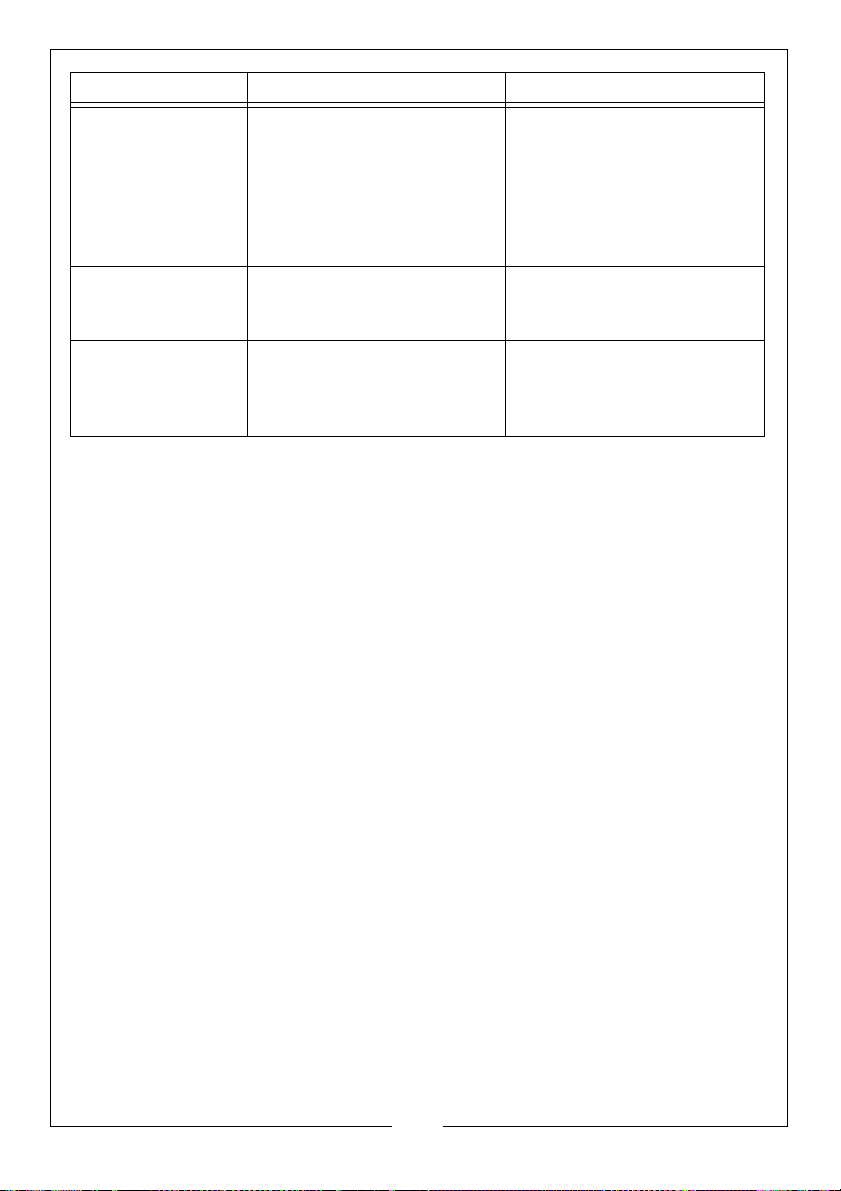
DEFECT CAUSES SUGGESTIONS
Profile defects Welding parameters are
incorrect.
Pass rate is not related to
operating parameter
requirements.
Electrode not inclined
constantly while welding.
Arc is unstable Insufficient current. Check condition of
Electrode melts
obliquely
Electrode core is not
centred.
Magnetic blow
phenomenon.
Follow basic and general
welding principles.
electrode and earth wire
connection.
Replace electrode.
Connect two earth wires
to opposite sites of the
work piece.
16
Parts & Service: 020 8988 7400 / E-mail: [email protected] or [email protected]
Page 17
MAINTENANCE
WARNING: DISCONNECT FROM MAINS BEFORE CLEANING.
WARNING: DO NOT ATTEMPT TO CARRY OUT REPAIRS YOURSELF, UNLESS
YOU ARE FULLY COMPETENT, ALL WORK MUST BE CARRIED OUT BY A
QUALIFIED TECHNICIAN.
The machine requires very little maintenance other than the following
guidelines. Under normal working conditions removing the covers and
cleaning with dry compressed air at reduced pressure once a year will be
quite sufficient. Cleaning at more frequent intervals is advisable however, if the
unit is operating in a dusty and dirty environment.
1. Keep the louvres clean to avoid a build up of dirt and oxides inside the
machine, which can reduce machine output.
2. Check all cables periodically for condition and secure. They must be in
good condition and not cracked.
3. Always avoid getting particles of metal inside the machine since they
could cause short circuits.
17
Parts & Service: 020 8988 7400 / E-mail: [email protected] or [email protected]
Page 18
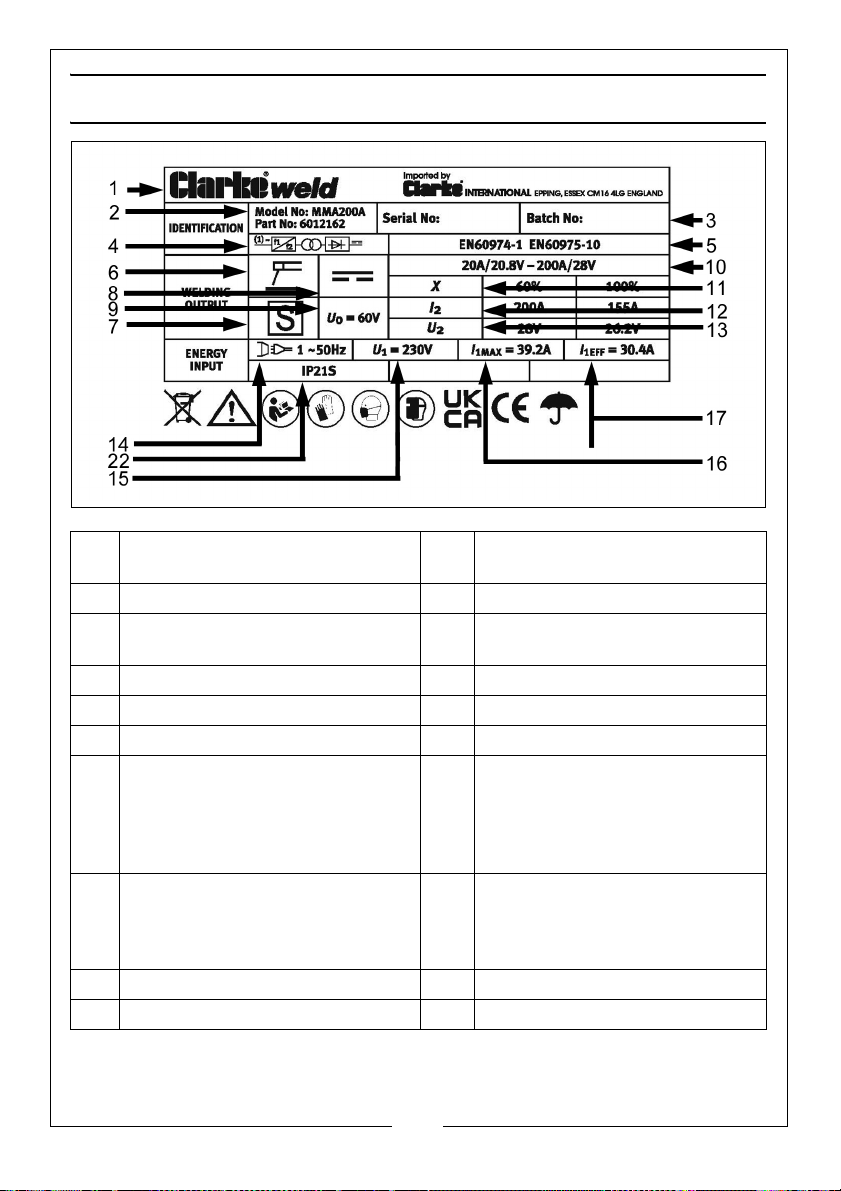
RATING PLATE
1 Name and address of
manufacturer
2 Model Number, / Part Number 12 Rated Welding Current Symbol
3 Serial / Batch Number 13 Conventional Load Voltage
4 Welding Power Source 14 Energy Supply Symbol
5 British Standards applied 15 Rated Supply Voltage
6 Welding Process Symbol 16 Rated Maximum Supply Current
7 This symbol indicates that the unit
is suitable for carrying out
welding operations in an
environment which has an
increased risk of electric shock
8 Welding Current Symbol 18
9 Rated No-load Voltage 22 Degree of Ingress Protection
10 Range Of Output
Parts & Service: 020 8988 7400 / E-mail: [email protected] or [email protected]
11 Duty Cycle Symbol
Symbol
17 Maximum Effective Supply
Current
N/A
19
20
21
18
Page 19
DUTY CYCLE
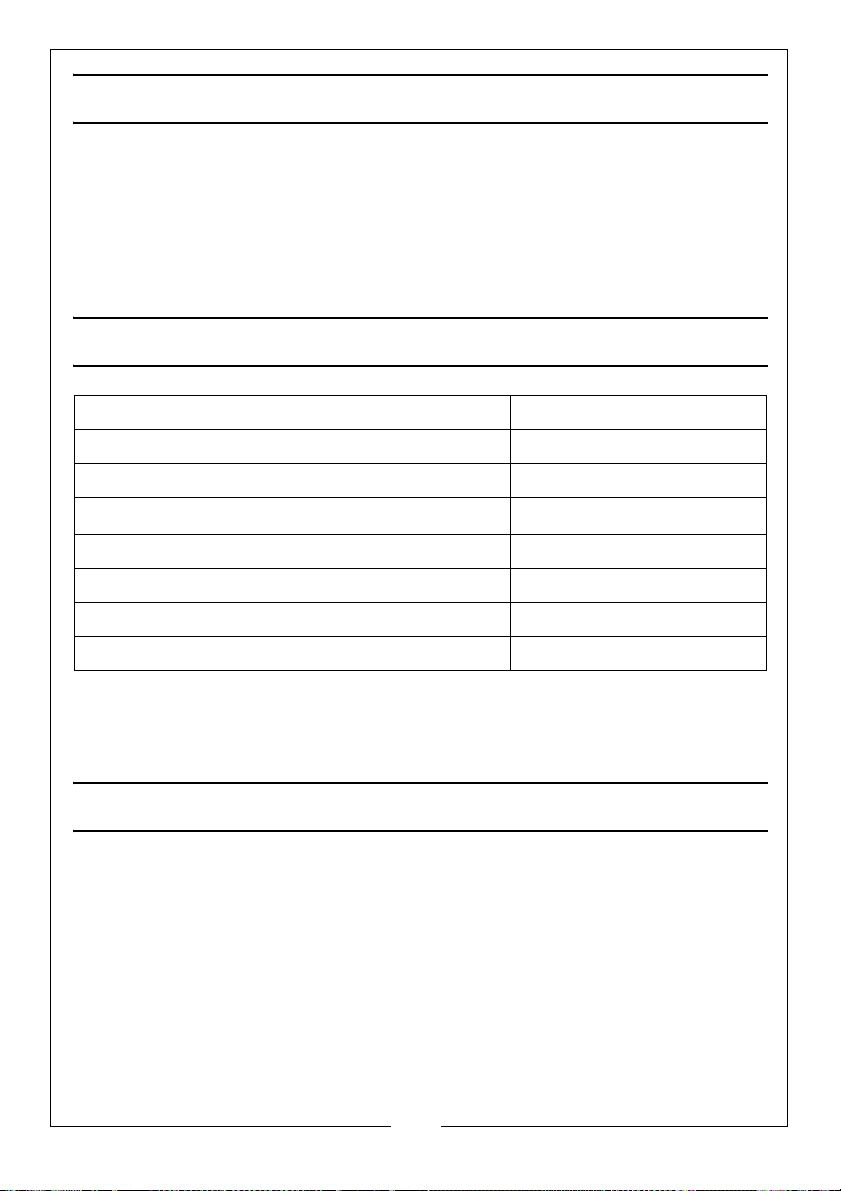
This welder is covered by regulations EN IEC 60974-1:2018+A1:2019 / EN 6097410:2014+A1:2015, where the Duty Cycle (X) is expressed as a percentage of
time the machine may be used in a given period for a specified welding
current.
i.e. When welding at 200 Amps the machine may be used for 6 minutes (60%)
in any10 minute period,
SPECIFICATIONS
Unpacked Weight (kg) 5.05
Dimensions (l x w x h) (mm) 365 x 130 x 255
Power Supply 230V AC~ 50Hz
Rated Max Input Current (A) I
No Load Voltage (V) 60
Max/Min Welding Current (A) 20A/200A
IP Rating IP21S
Suitable Electrodes (mm) 2.5 - 4.0
Max / I1eff (A) 39.2 / 30.4
1
NOTE: The details and specifications contained herein, are correct at the
time of going to print. However, CLARKE International reserve the
right to change specifications at any time without prior notice.
GUARANTEE
This CLARKE product is guaranteed against faulty manufacture for a period of
12 months from the date of purchase. Please keep your receipt as proof of
purchase.
This guarantee is invalid if the product is found to have been abused or
tampered with in any way, or not used for the purpose for which it was
intended.
Faulty goods should be returned to their place of purchase, no product can
be returned to us without prior permission. This guarantee does not effect your
statutory rights.
19
Parts & Service: 020 8988 7400 / E-mail: [email protected] or [email protected]
Page 20
CONSUMABLES
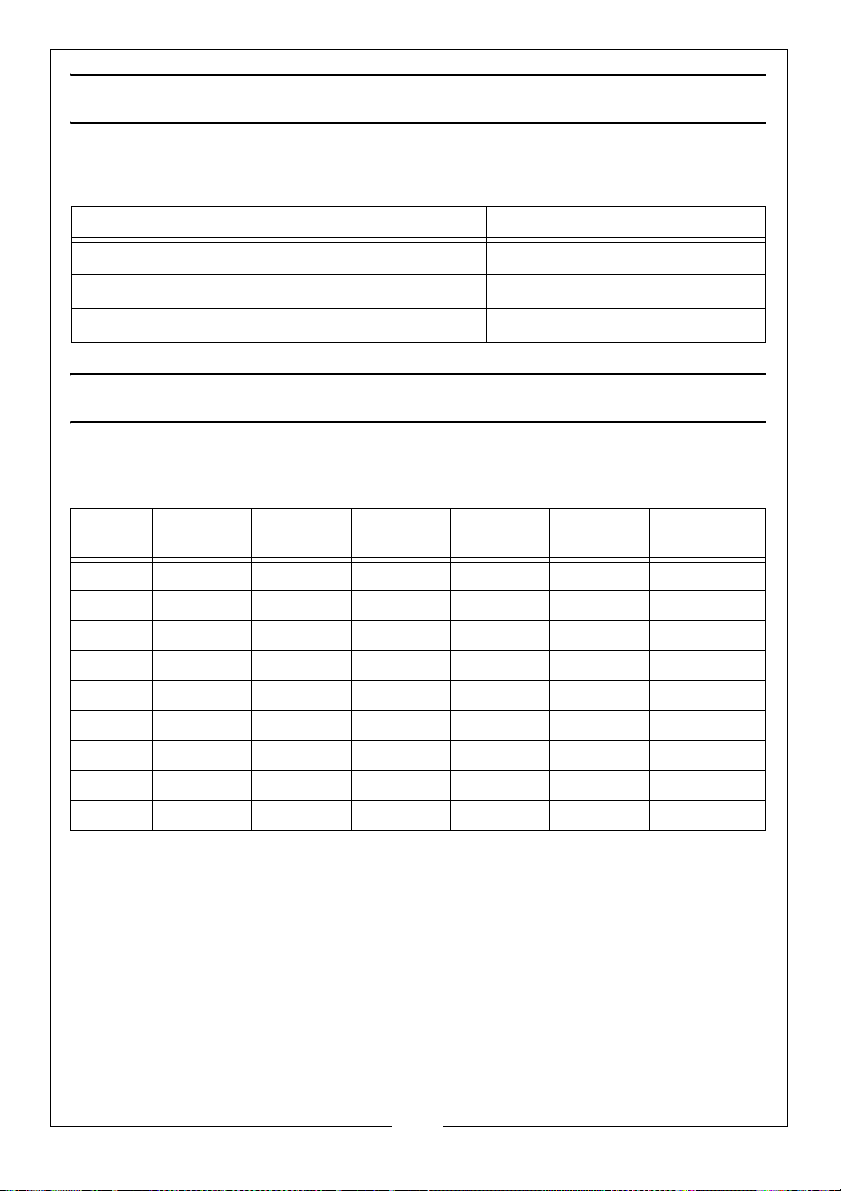
The following are some of the accessories available from your CLARKE dealer.
Please quote the part numbers shown below.
DESCRIPTION PART NUMBER
2.5 mm Arc Welding Electrodes 3050584
3.2 mm Arc Welding Electrodes 3050586
4.0 mm Arc Welding Electrodes 3050588
ARC ACTIVATED HEADSHIELDS
These highly popular headshields activate instantly when the arc is struck and
allow you to have both hands free when welding.
Model Arc
Activated
GWH4 ✔✔✔ 6000706
GWH7 ✔✔✔ 6000709
GWH5 ✔✔✔ 6000707
GWH6 ✔✔✔ 6000708
GWH3 ✔✔✔ 6000698
GWH2 ✔✔✔ 6000697
PG4 ✔✔✔ 6000716
HS1 ✔✔6000700
HSF1 ✔✔6000705
Grinding
function
Solar
Powered
Fixed
Shade
Flip Up Part
Number
20
Parts & Service: 020 8988 7400 / E-mail: [email protected] or [email protected]
Page 21
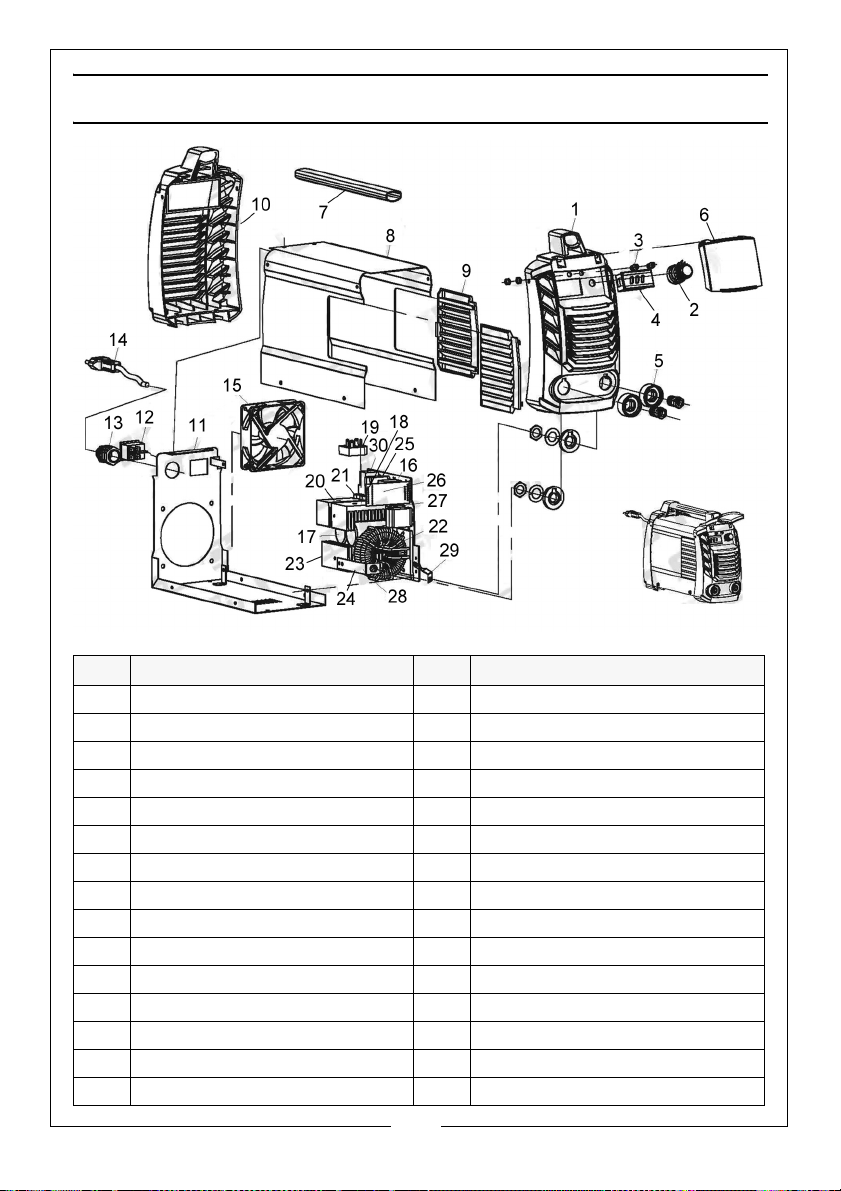
COMPONENT PARTS
NO DESCRIPTION NO DESCRIPTION
1 Front panel 16 Printed circuit board
2 Potentiometer 17 Capacitor
3 Indicator light 18 Silicon bridge radiator
4 Digital display 19 Silicon bridge
5Plug 20IGBT radiator
6 Gauge cover 21 IGBT
7 Handle 22 Main transformer
8 Cover 23 Rectifier radiator
9 Air Vent 24 Rectifier tube
10 Rear panel 25 Driver transformer
11 Machine base 26 Control PCB
12 Power switch 27 CBB
13 Waterproof joint 28 Positive connector
14 Power cable 29 Negative connector
15 Fan assembly 30 Relay
21
Parts & Service: 020 8988 7400 / E-mail: [email protected] or [email protected]
Page 22
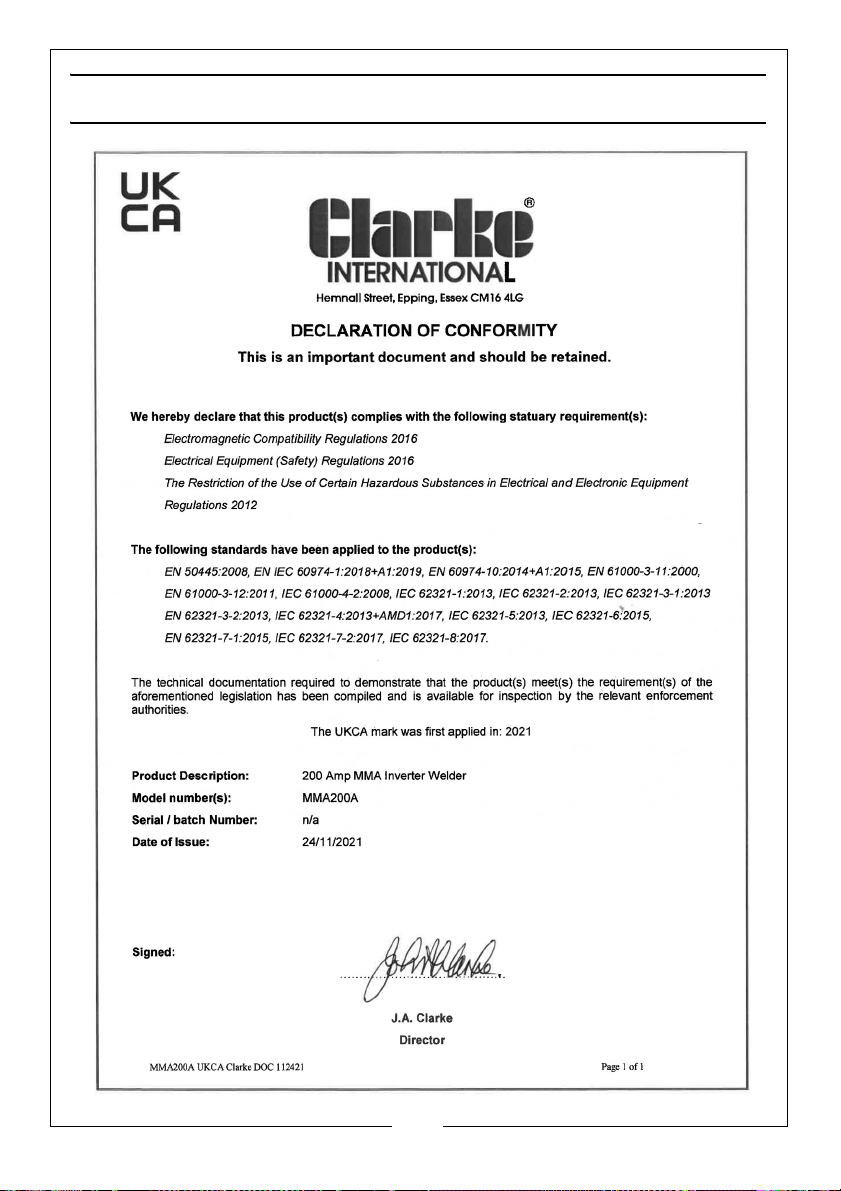
DECLARATIONS OF CONFORMITY
22
Parts & Service: 020 8988 7400 / E-mail: [email protected] or [email protected]
Page 23
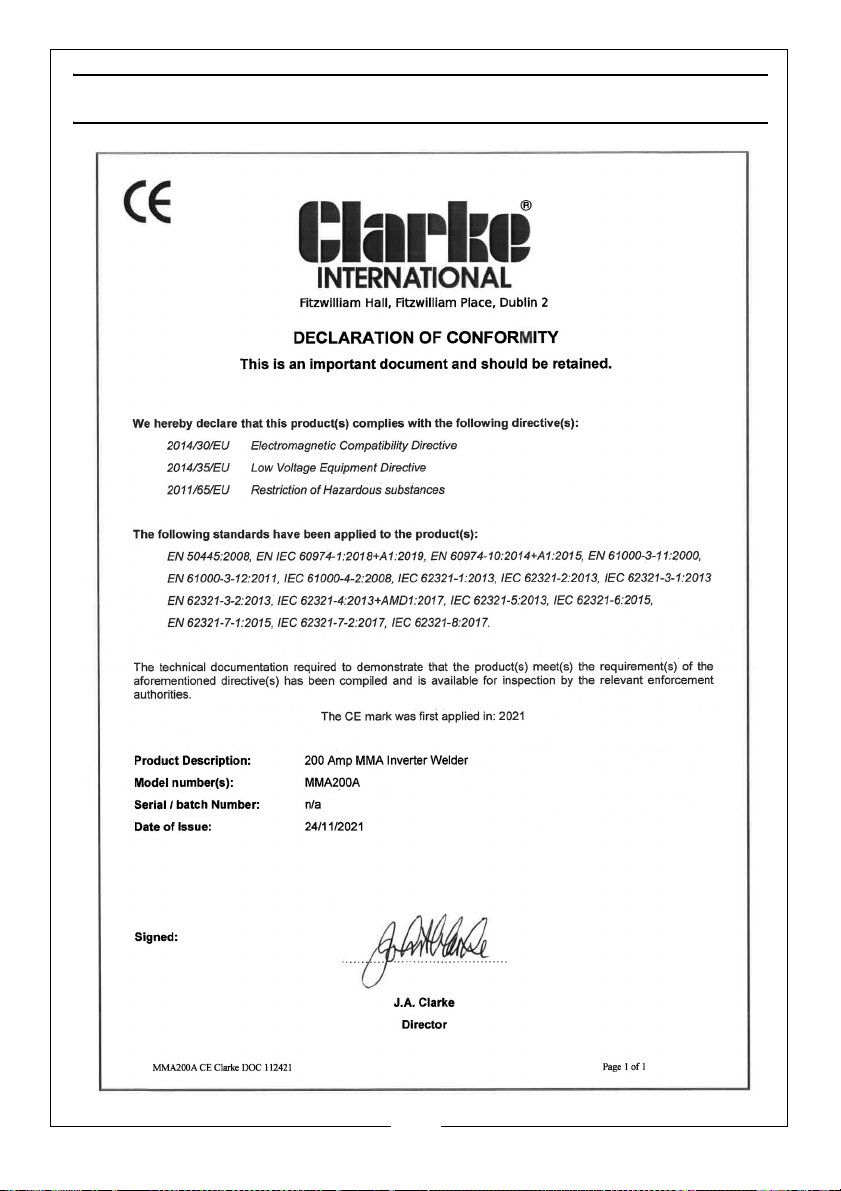
DECLARATIONS OF CONFORMITY
23
Parts & Service: 020 8988 7400 / E-mail: [email protected] or [email protected]
Page 24

 Loading...