

Page 1
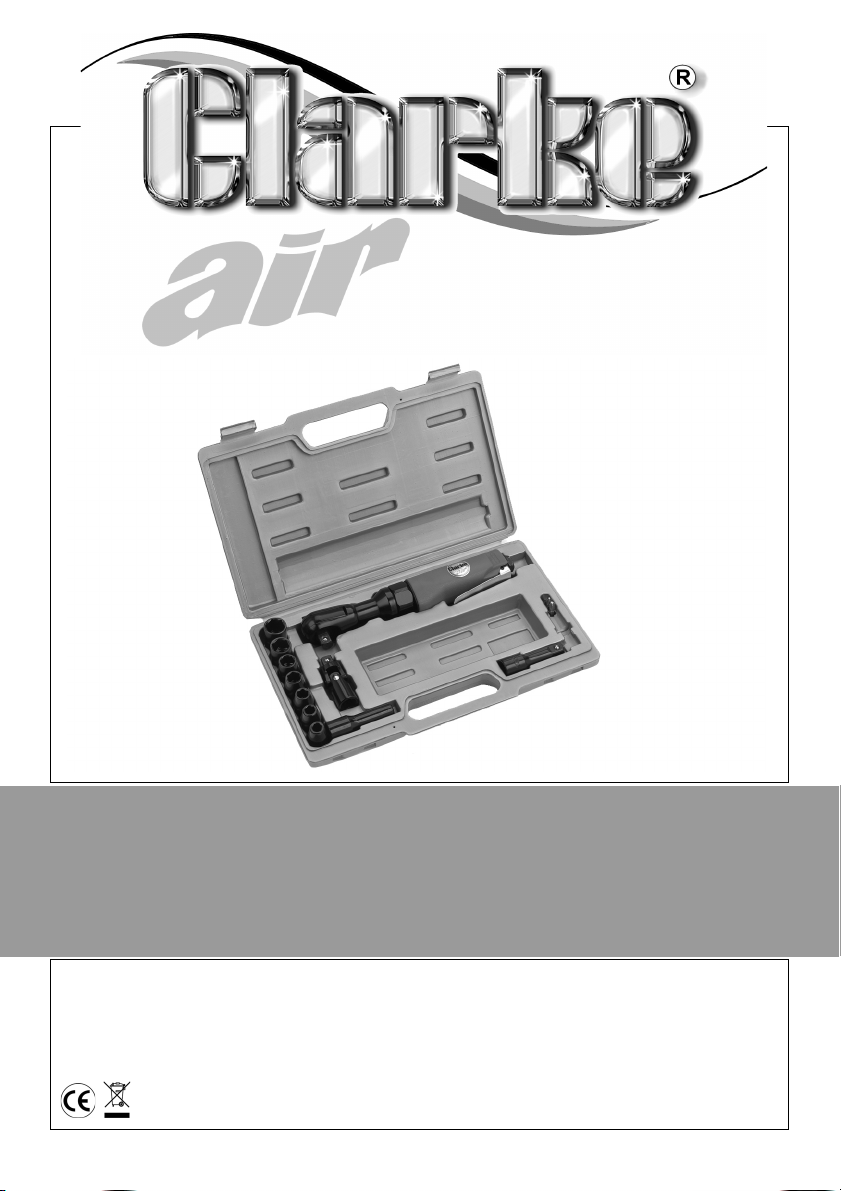
½” REVERSIBLE AIR RATCHET
MODEL NO: CAT115
PART NO: 3110871
OPERATION & MAINTENANCE
INSTRUCTIONS
LS0311
Page 2
INTRODUCTION
Thank you for purchasing this CLARKE product.
Before attempting to use this product, please read this manual thoroughly and
follow the instructions carefully. In doing so you will ensure the safety of yourself
and that of others around you, and you can look forward to your purchase
giving you long and satisfactory service.
GUARANTEE
This product is guaranteed against faulty manufacture for a period of 12
months from the date of purchase. Please keep your receipt which will be
required as proof of purchase.
This guarantee is invalid if the product is found to have been abused or
tampered with in any way, or not used for the purpose for which it was
intended.
Faulty goods should be returned to their place of purchase, no product can
be returned to us without prior permission.
This guarantee does not effect your statutory rights.
ENVIRONMENTAL PROTECTION
Recycle unwanted materials instead of disposing of them as
waste. All tools, accessories and packaging should be sorted,
taken to a recycling centre and disposed of in a manner which is
compatible with the environment.
KIT CONTENTS
1 x ½" Square Drive Air Ratchet;
7 x ½" Square Drive Impact Sockets - Sizes 9, 10, 11, 13, 14, 17, 19
1 x 75mm ½" Square Drive Extension bar
1 x 75mm ½" Square Drive to 6.35 Hexagon Shank Adaptor
1 x ½" Square Drive Universal Joint - 1 x ¼” BSP air inlet snap connector
3 x Screwdriver bits - 1 x 5.5mm slot head - 2 x Nos. 2 & 3 Philips head
1 x Oil bottle
2
Parts & Service: 020 8988 7400 / E-mail: [email protected] or [email protected]
Page 3
GENERAL SAFETY RULES
CAUTION: FAILURE TO FOLLOW THESE PRECAUTIONS COULD RESULT IN
PERSONAL INJURY, AND/OR DAMAGE TO PROPERTY.
WORK ENVIRONMENT
1. Keep the work area clean and tidy.
2. Dress appropriately - Do not wear loose clothing or jewellery. Tie long hair
out of the way.
3. Keep children and visitors away - Do not let children handle the air tool.
4. Do not operate the air tool where there are flammable liquids or gases.
5. Keep the air supply hose away from heat, oil and sharp edges.
6. Do not fit the air tool to any stand or clamping device that may damage
the tool.
USE
1. Stay alert and use common sense - Do not operate the air tool when you
are tired or under the influence of alcohol, drugs or medication.
2. Always wear eye protectors when using the air tool - Eye protectors must
provide protection from flying particles from the front and the side.
3. Always wear ear protectors when using the air tool.
4. Do not overreach - Keep proper footing and balance at all times.
5. Never use any type of bottled gas as a source of power for the air tool.
6. Do not connect the air supply hose with your finger on the trigger of the air
tool.
7. Do not exceed the maximum pressure of 90 psi / 6.2 bar.
8. Check hoses for leaks or worn condition before use, and ensure that all
connections are secure.
9. Do not use the air tool for any other purpose than that described in this
book.
10. Do not carry out any alterations or modifications to the air tool.
11. Never use the air tool if it is defective or operating abnormally.
3
Parts & Service: 020 8988 7400 / E-mail: [email protected] or [email protected]
Page 4

12. Always disconnect from the air supply when:
• Performing any maintenance
• The air tool is not in use.
• The air tool will be left unattended.
• Moving to another work area.
• Passing the air tool to another person.
13. The air tool should be serviced at regular intervals by qualified service
personnel.
14. Avoid damaging the air tool for example by applying excessive force of
any kind.
15. ALWAYS maintain the tool. Keep it clean for the best and safest
performance.
16. Quick change couplings should not be located at the tool. They add
weight and could fail due to vibration.
17. DO NOT force or misuse the tool. It will do a better and safer job at the rate
for which it was designed.
18. Do not remove any labels. Damaged labels should be replaced.
19. This tool vibrates with use. Vibration may be harmful to your hands or arms.
Stop using the tool if discomfort, a tingling feeling or pain occurs. Seek
medical advice before resuming use.
20. NEVER use standard sockets. These may shatter with serious consequences.
Use ONLY impact sockets.
TRANSPORTATION
1. Never carry the air tool by the air supply hose.
2. Never carry the air tool with your finger on the trigger.
STORAGE
1. When not in use the air tool must be disconnected from the air supply and
stored in a dry place out of the reach of children (preferably in a locked
cabinet).
2. Avoid storing the air tool in environments where the temperature is below
o
0
C.
4
Parts & Service: 020 8988 7400 / E-mail: [email protected] or [email protected]
Page 5
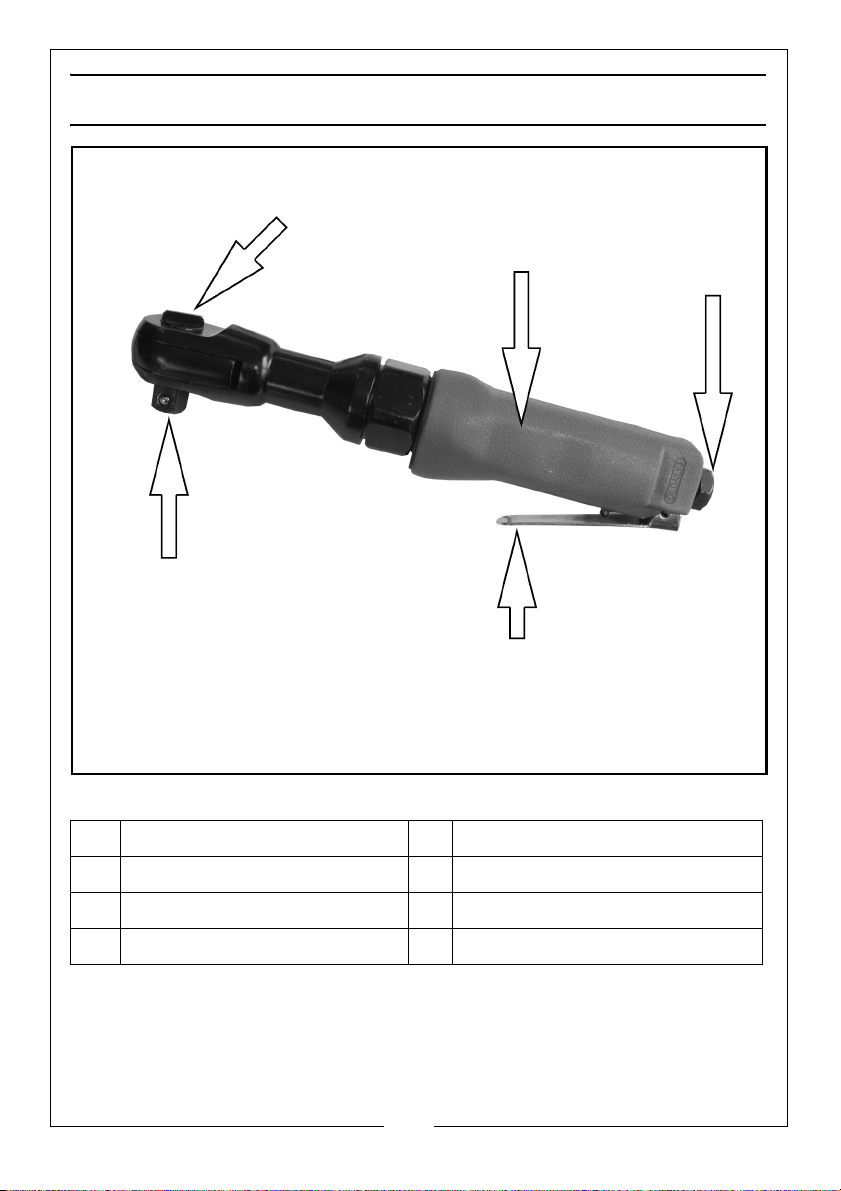
OVERVIEW
1
2
3
4
5
NO DESCRIPTION NO DESCRIPTION
1 Direction Switch 4 Trigger
2 Handle 5 Anvil
3 Air Hose Connection
5
Parts & Service: 020 8988 7400 / E-mail: [email protected] or [email protected]
Page 6
BEFORE USE
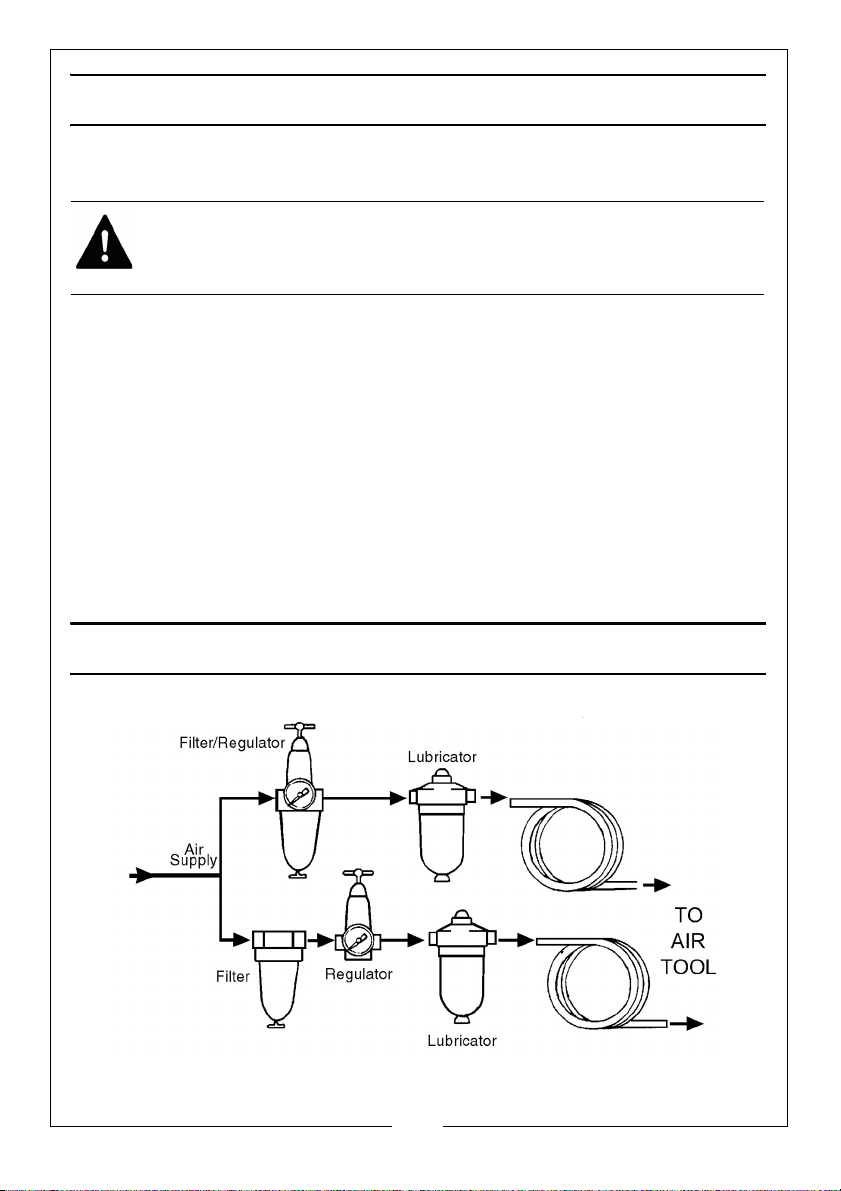
AIR SUPPLY
WARNING: COMPRESSED AIR CAN BE DANGEROUS. ENSURE THAT YOU
ARE FAMILIAR WITH ALL PRECAUTIONS RELATING TO THE USE OF
COMPRESSORS AND COMPRESSED AIR SUPPLY.
• Use only clean, dry, regulated compressed air as a power source for
the ratchet.
• Air compressors used with the ratchet must comply with the
appropriate EC safety directives.
• A build up of moisture or oil in the air compressor will accelerate
wear and corrosion in the ratchet.
• Never exceed the maximum operating pressure for the ratchet.
AIR HOSE
• The air hose must be rated at least 150% of the maximum operating
pressure of the tool.
RECOMMENDED AIR SUPPLY CONNECTION
6
Parts & Service: 020 8988 7400 / E-mail: [email protected] or [email protected]
Page 7
BEFORE USE
WARNING: COMPRESSED AIR CAN BE DANGEROUS. ENSURE THAT YOU
ARE FAMILIAR WITH ALL PRECAUTIONS RELATING TO THE USE OF
COMPRESSORS AND COMPRESSED AIR SUPPLY.
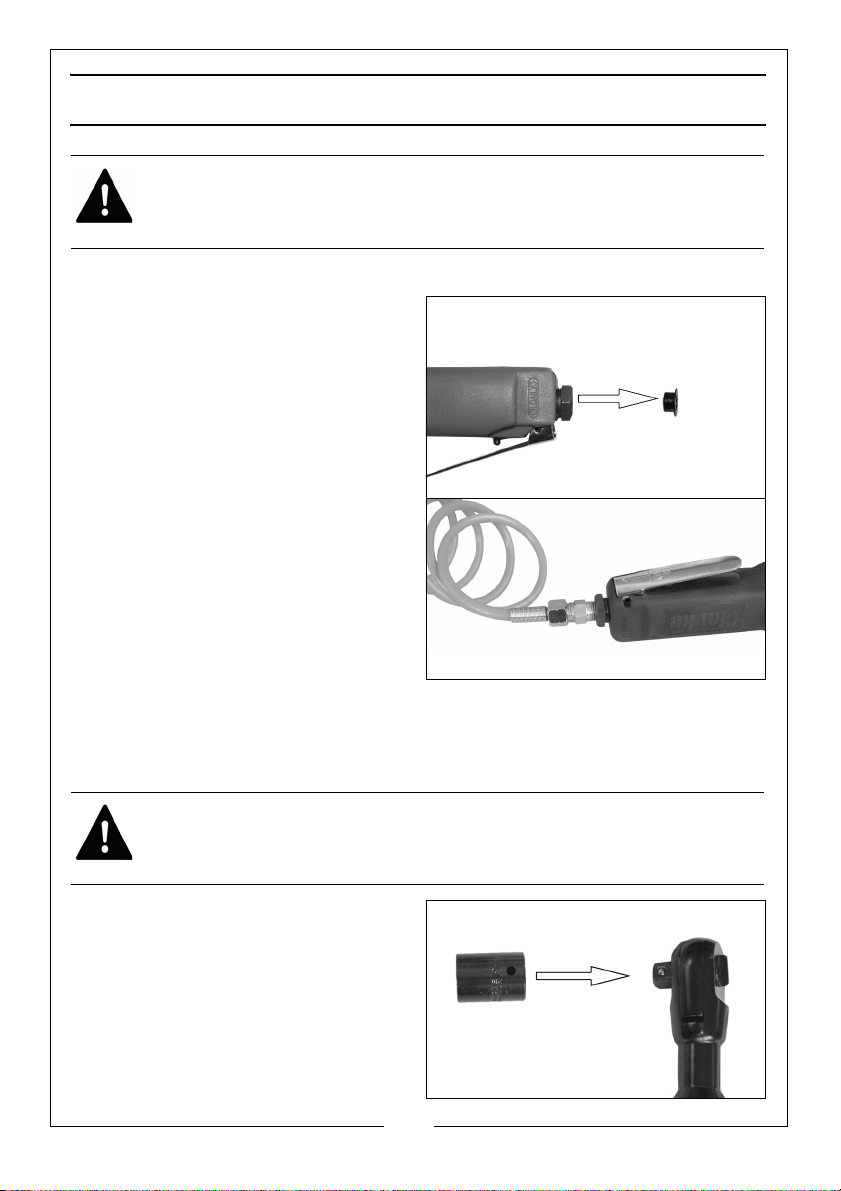
NOTE: Ensure the compressor is turned off.
1. Remove the travel plug from the
bottom of the ratchet as shown.
2. Connect a suitable hose to the
ratchet as shown.
• Use the adapter supplied if
required.
3. Connect the other end of the hose
to the compressor.
4. Your ratchet is now ready for use.
• You can fit a whip hose with a quick fit coupling if required
(available from your Clarke dealer.)
FITTING THE SOCKET
WARNING: NEVER USE STANDARD SOCKETS. THESE MAY SHATTER WITH
SERIOUS CONSEQUENCES. ONLY USE IMPACT SOCKETS DESIGNED FOR
USE WITH IMPACT TOOLS.
1. Select the impact socket you
require.
2. Push the impact socket onto the
anvil as shown.
7
Parts & Service: 020 8988 7400 / E-mail: [email protected] or [email protected]
Page 8
OPERATION
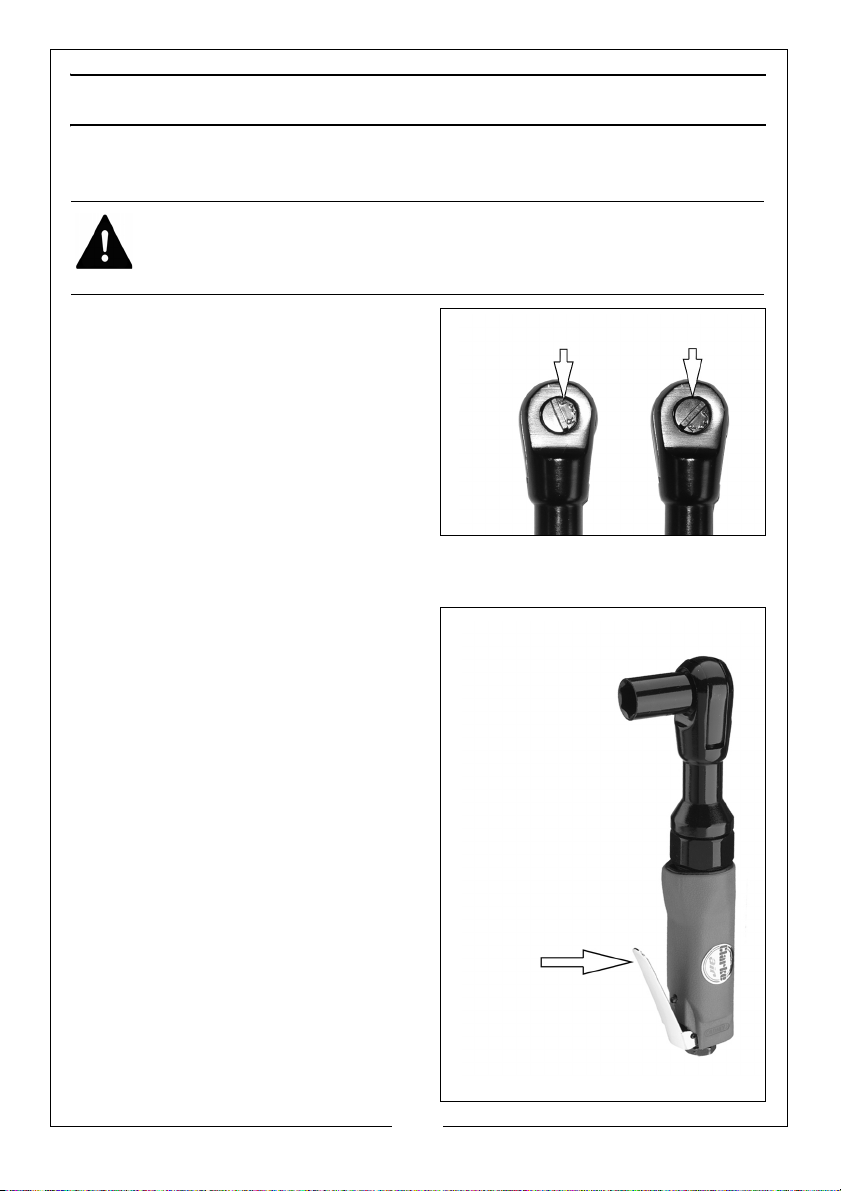
Forward
Reverse
Squeeze
USING THE DIRECTIONAL CONTROL
WARNING: WAIT UNTIL THE ANVIL HAS STOPPED ROTATING BEFORE
OPERATING THE DIRECTION CONTROL.
To select the direction of rotation turn
the direction control as follows.
1. For tightening, turn the direction
control anti-clockwise to F
(Forward).
2. For loosening, turn the direction
control clockwise to R (Reverse).
USING THE AIR RATCHET
1. Select the impact socket you require.
2. Press the impact socket until it clicks
into place on the anvil.
3. Place the impact socket over the
subject nut.
• Take care that the impact socket
is firmly engaged on the nut to be
tightened or removed.
4. Squeeze the trigger against the
body of the tool to start.
5. Release the trigger to stop the tool.
6. Always ensure the tool has stopped
before putting it down.
Parts & Service: 020 8988 7400 / E-mail: [email protected] or [email protected]
8
Page 9
DISCONNECTING THE AIR SUPPLY
Do not disconnect the air supply hose until the compressor has been shut
down and the compressed air released.
1. Refer to the compressor instruction book for the procedures to shut down
and release the compressed air.
2. Once the pressure has been released, disconnect the air supply hose from
the ratchet.
STORAGE
• If the tool is to be stored, or is idle for longer than 24 hours, run a few
drops of Clarke air line oil into the air inlet, and run the tool for 5
seconds in order to lubricate the internal parts.
• When not in use, disconnect from air supply, clean tool and store in
a safe,dry place.
• Store the ratchet safely in its box in a dry, secure environment.
ACCESSORIES
A wide range of accessories are available, including Filter/Regulators,
Lubricators, High Pressure Hoses (5 to 100 Metres), etc.
Contact your CLARKE dealer for further information, or CLARKE International
Sales Department on 01992 565 333.
Contact your CLARKE dealer for further information, or CLARKE International
Sales Department on 01992 565 333.
9
Parts & Service: 020 8988 7400 / E-mail: [email protected] or [email protected]
Page 10
MAINTENANCE
WARNING: MAKE SURE THAT THE RATCHET IS DISCONNECTED FROM THE
AIR SUPPLY BEFORE STARTING ANY CLEANING OR MAINTENANCE
PROCEDURES.
DAILY
• Drain water from air tank, air line and compressor.
• Pour a few drops of CLARKE air line oil, into the air inlet. This should be
carried out regardless of whether or not the inline mini oiler is used. If
the inline mini oiler is not used, this procedure should be repeated
after every two to three hours of use.
CLEANING
• Keep the body of the ratchet clean and free from debris, grit or gum
deposits.
SERVICE AND REPAIR
• All servicing and repair must be carried out by qualified service
technicians.
NOTES
• Please note that factors other than the tool may effect its operation
and efficiency such as reduced compressor output, excessive
demand on the airline, moisture or restrictions in the line, or the use
of connectors of improper size or poor condition which will reduce
air supply.
• **Clarke air line oil (part no. 3050825) is available from your CLARKE
dealer.
10
Parts & Service: 020 8988 7400 / E-mail: [email protected] or [email protected]
Page 11
SPECIFICATIONS
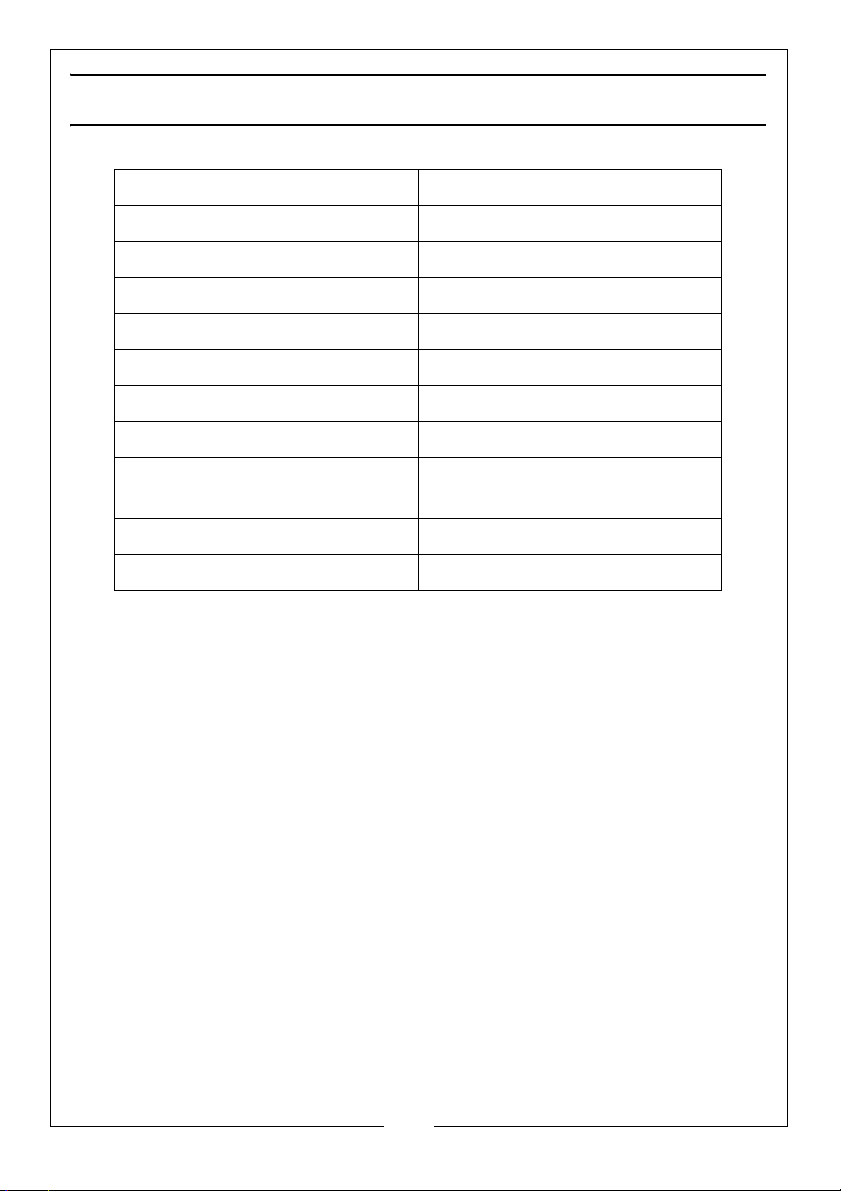
Model Number CAT115
No Load Speed 160 rpm
Maximum Torque 50 ft/lb
Air Consumption 4 cfm
Operating Pressure 90 psi (6.2 bar)
Air Inlet Size ¼” inch BSP
Sound Pressure Level (L
Sound Power Level (L
Vibration Levels
pA dB) 90.8 dB(A)
wA dB) 101.8 dB(A)
2
1.2 m/s
at the Main Handle
K = 0.6 m/s
2
Dimensions (L x W x H) 280 x 55 x 45 mm
Weight 1.1 kg
Please note that the details and specifications contained herein, are correct at
the time of going to print. However CLARKE International reserve the right to
change specifications at any time without prior notice. Always consult the
machine’s data plate.
11
Parts & Service: 020 8988 7400 / E-mail: [email protected] or [email protected]
Page 12
VIBRATION EMMISIONS
Employers are advised to refer to the HSE publication “Guide for Employers”.
All hand held power tools vibrate to some extent, and this vibration is
transmitted to the operator via the handle, or hand used to steady the tool.
Vibration from about 2 to 1500 herz is potentially damaging and is most
hazardous in the range from about 5 to 20 herz.
Operators who are regularly exposed to vibration may suffer from Hand Arm
Vibration Syndrome (HAVS), which includes ‘dead hand’, ‘dead finger’, and
‘white finger’. These are painful conditions and are widespread in industries
where vibrating tools are used.
The health risk depends upon the vibration level and the length of time of
exposure to it……in effect, a daily vibration dose.
Tools are tested using specialised equipment, to approximate the vibration
level generated under normal, acceptable operating conditions for the tool in
question. For example, a grinder used at 45° on mild steel plate, or a sander
on soft wood in a horizontal plane etc.
These tests produce a value ‘a’, expressed in metres per second per second,
which represents the average vibration level of all tests taken, in three axes
where necessary, and a second figure ‘K’, which represents the uncertainty
factor, i.e. a value in excess of ‘a’, to which the tool could vibrate under
normal conditions. These values appear in the specification panel below.
Model Number CAT115
Description Reversible Rachet
Declared vibration emission value in accordance with EN12096
Measured vibration emission value - a:
Value determined according to EN28622-1
1.2 m/s
2
You will note that a third value is given in the specification - the highest
measured reading in a single plane. This is the maximum level of vibration
measured during testing in one of the axes, and this should also be taken into
account when making a risk assessment.
2
‘a’ values in excess of 2.5 m/s
are considered hazardous when used for
prolonged periods. A tool with a vibration value of 2.8 m/s2 may be used for
2
up to 8 hours (cumulative) per day, whereas a tool with a value of 11.2 m/s
may be used for ½ hour per day only.
12
Parts & Service: 020 8988 7400 / E-mail: [email protected] or [email protected]
Page 13
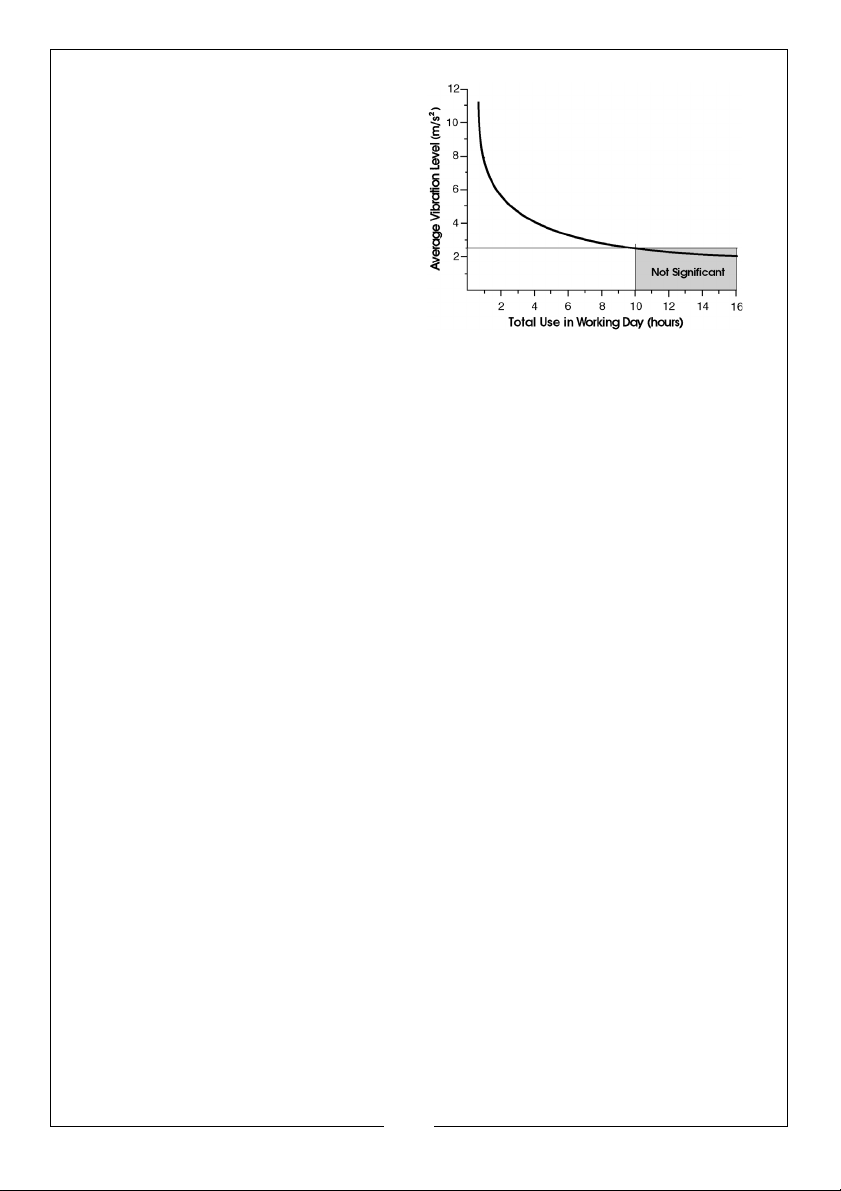
The graph on the right shows the
vibration value against the maximum
time the respective tool may be
used, per day.
The uncertainty factor should also be
taken into account when assessing a
risk. The two figures ‘a’ and ‘K’ may
be added together and the resultant
value used to assess the risk.
It should be noted that if a tool is
used under abnormal, or unusual
conditions, then the vibration level
could possibly increase significantly. Users must always take this into account
and make their own risk assessment, using the graph above as a reference.
Some tools with a high vibration value, such as ratchetes, are generally used
for a few seconds at a time, therefore the cumulative time may only be in the
order of a few minutes per day. Nevertheless, the cumulative effect,
particularly when added to that of other hand held power tools that may be
used, must always be taken into account when the total daily dose rate is
determined.
13
Parts & Service: 020 8988 7400 / E-mail: [email protected] or [email protected]
Page 14
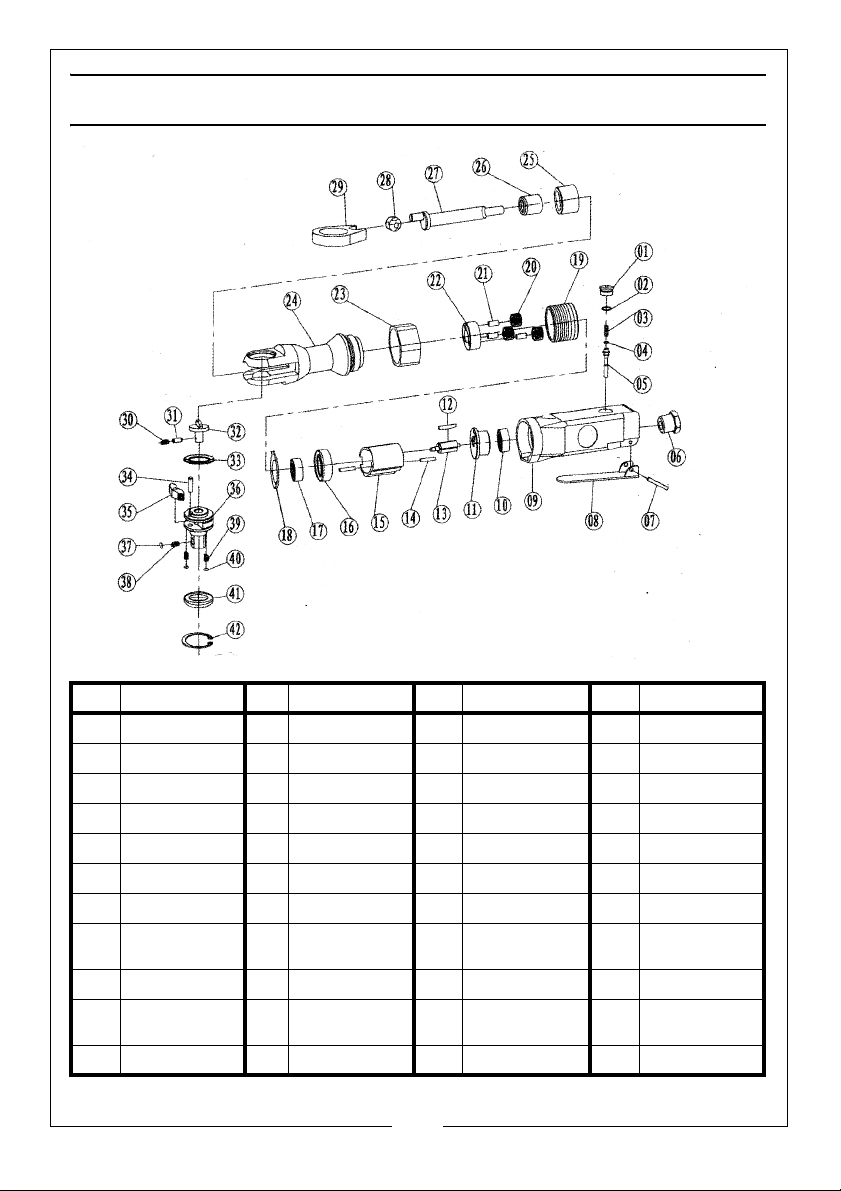
EXPLODED DIAGRAM & PARTS LIST
No Description No Description No Description No Description
1 Valve Plug 12 Rotor Blade 23 Clamp Nut 34 Pin
2 O-ring 13 Rotor 24 Rachet Housing 35 Rachet Pawl
3 Spring 14 Cylinder pin 25 Needle Bearing 36 Rachet Anvil
4 O-ring 15 Cylinder 26 Bearing Shell 37 Steel Ball
5 Valve Bushing 16 Front plate 27 Crack Shaft 38 Spring
6 Air Inlet Plug 17 Bearing 28 Drive Bushing 39 Spring
7 Roll Pin 18 Washer 29 Rachet Yoke 40 Steel Ball
8 Trigger 19 Thread Ring
Gear
9 Housing 20 Idler Gear 31 Lock Pin 42 Retaining Ring
10 Rear Bearing 21 Idler Gear Pin 32 Direction
11 Rear Plate 22 Idler Gear Boss 33 Washer
30 Spring 41 Thrush Washer
Selector Switch
14
Parts & Service: 020 8988 7400 / E-mail: [email protected] or [email protected]
Page 15
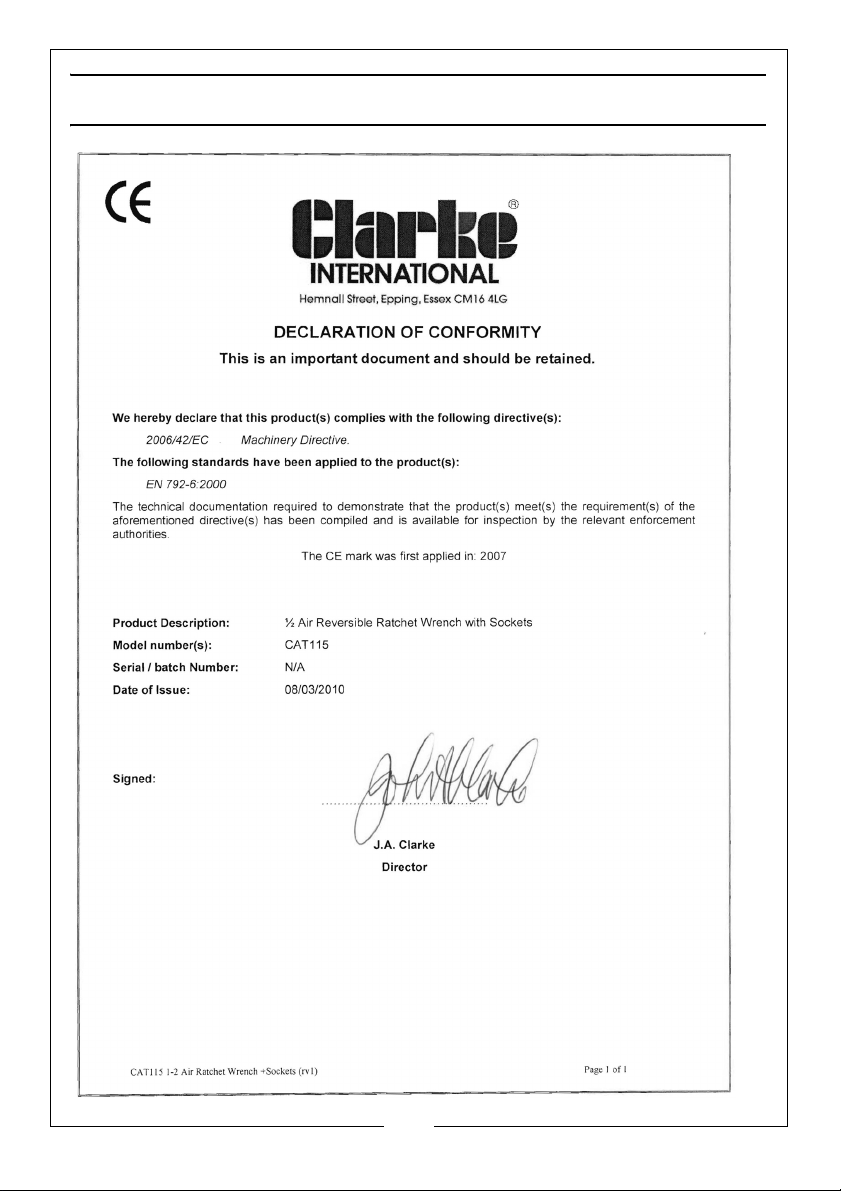
DECLARATION OF CONFORMITY
15
Parts & Service: 020 8988 7400 / E-mail: [email protected] or [email protected]
Page 16
 Loading...