

Page 1
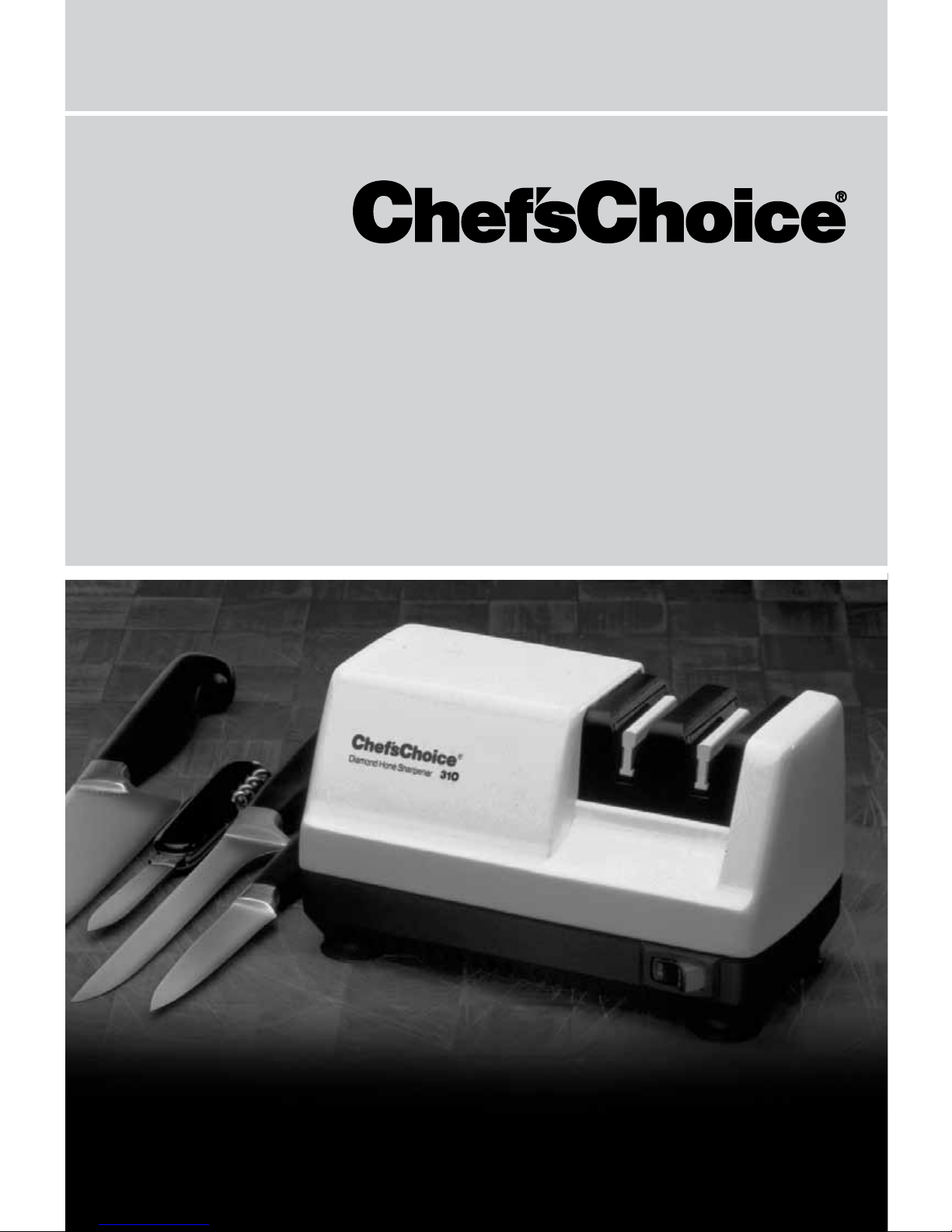
MODEL 310
InstructIOns
Diamond Hone® Sharpener
Read these instructions before use.
It is essential that you follow these
instructions to achieve optimum results.
© 2013 EdgeCraft Corp.
Page 2

2
IMPORTANT SAFEGUARDS
When using electrical appliances, basic safety precautions should always be
followed including the following:
1. Read all instructions.
2. To protect against electrical hazards, do not immerse the Chef’sChoice
®
in water or
other liquid.
3. Make sure that only clean knife blades are inserted in the Chef’sChoice
®
.
4. Unplug from outlet when not in use, before putting on or taking off parts and
before cleaning.
5. Avoid contacting moving parts.
6. Do not operate any appliance with a damaged cord or plug or after the appliance
malfunctions, or is dropped or damaged in any manner.
U.S. Customers: You can return your sharpener to EdgeCraft’s factory for service where
the cost of repair or electrical or mechanical adjustment can be estimated. When the
electrical cord on this appliance is damaged, it must be replaced by the Chef’sChoice
distributor or other qualified service to avoid the danger of electrical shock.
Outside U.S.: Please return your sharpener to your local distributor where the cost of repair
or electrical or mechanical adjustment can be estimated. If the supply cord of this appliance is damaged, it must be replaced by a repair facility appointed by the manufacturer
because special tools are required. Please consult your Chef’sChoice distributor.
7. CAUTION! This appliance may be fitted with a polarized plug (one blade is wider than
the other). To reduce the risk of electric shock, this plug will fit in a polarized outlet
only one way. If the plug does not fit fully in the outlet, reverse the plug. If it still does
not fit, contact a qualified electrician. Do not modify the plug in anyway.
8. The use of attachments not recommended or sold by EdgeCraft Corporation may
cause fire, electric shock, or injury.
9. The Chef’sChoice
®
Model 310 is designed to sharpen kitchen knives, pocket knives
and most sport knives. Do not attempt to sharpen scissors, ax blades or any blade
that does not fit freely in the slots.
10. Do not let the cord hang over edge of table or counter or touch hot surfaces.
11. When in the “ON” position the Chef’sChoice
®
should always be on a stable
countertop or table.
12. WARNING: KNIVES PROPERLY SHARPENED ON YOUR CHEF’SCHOICE
®
WILL BE
SHARPER THAN YOU EXPECT. TO AVOID INJURY, USE AND HANDLE THEM WITH
EXTREME CARE. DO NOT CUT TOWARD ANY PART OF YOUR FINGERS, HAND OR
BODY. DO NOT RUN FINGER ALONG EDGE. STORE IN A SAFE MANNER.
13. Do not use outdoors.
14. Close supervision is necessary when any appliance is used by or near children.
15. Do not use honing oils, water, or any other lubricant with the Chef’sChoice
®
.
16. For household use only.
17.
SAVE THESE INSTRUCTIONS.
Page 3

3
YOU MADE
A GOOD
CHOICE
Congratulations on your selection of the Model 310 Chef’sChoice®
Diamond Hone
®
Sharpener. It will put an incredibly sharp edge on all your
kitchen, pocket and fillet knives.
Although the Chef’sChoice
®
Diamond Hone® Sharpener is easy to use, it is
important that you read through this instruction booklet thoroughly before
you use the sharpener so you can optimize your sharpening results.
Gourmet cooks and sportsmen world-wide acknowledge the value of a
fine cutting edge. As an owner of a Chef’sChoice
®
sharpener you have
the finest and easiest system presently known to man to place incredibly
sharp edges on all your knives. For the first time it will be a joy to sharpen
your knives. Remember, a sharp knife is a safe knife because you expect it
to be sharp and respect it. With the Chef’sChoice
®
you will be able to place
better than razor sharp edges on your knives regardless of the type of steel
or the quality of the knife.
You will find your knives stay sharp longer and reward you with years of
superior performance. Whether you are cutting, slicing or chopping, it will
be a pleasure.
Page 4

4
GETTING TO KNOW YOUR SHARPENER
Before using your sharpener you may wish to become familiar with its features.
1. Place Chef’sChoice
®
Diamond Hone Sharpener on a level table or kitchen counter surface.
Do not plug the sharpener cord into an outlet.
2. (Refer to Figures 1 and 2). Pick up a kitchen knife and place the heel area of the knife blade
in any of the sharpening slots. Loosen your grip. You will notice that the knife will be pulled
to the side of the slot and into the slot by a magnet.
3. Now, while holding the knife with a secure yet relatively loose grip as in Figure 4, pull the
knife blade towards you while allowing the knife blade to lie against the magnet. Let the
magnet establish the blade angle. Except when sharpening the tip, keep the knife blade
level with the table.
“BREAKING-IN” YOUR KNIFE
When sharpening a knife for the first time with Chef’sChoice®, it is necessary first to reangle
the factory edge– a process called “Breaking-in” your knife. For each knife this is a one-time
operation.
Because factory edge angles vary widely, it is essential that the initial sharpening in Stage 1
be sufficient to completely reangle the factory edge. This takes extra time. However, once this
“Break-in” process is complete, a knife can be resharpened very quickly.
Place the Chef’sChoice
®
on a sturdy table or counter. Plug the sharpener cord into an
appropriate electric outlet.
Figure 3. Magnets control the blade angle.
Figure 4. You will find it easier to use a loose grip.
Figure 2. Typical kitchen knife.
Heel
Bolster
Handle
Edge
Tip
Proper speed, correct sharpening grip
1… 2… 3 seconds, keep knife level
Figure 1. Chef’sChoice® Model 310.
Stage 1 Sharpening
(Orbiting Diamonds®)
Stage 2 Honing
(Orbiting Diamonds®)
On/Off
Switch
Honing Slots:
Left
Right
Sharpening Slots:
Right
Left
Page 5

5
Press the switch, on the lower right front of the sharpener, to “ON”. Hold knife with the illustrated
grip shown in Figure 4. Place the heel area of the knife blade in the left SHARPENING slot of
Stage 1.
STAGE 1
Using a secure yet relatively loose grip, pull the knife toward you allowing the magnet to position
the blade at the proper sharpening angle. Let the magnets control blade angle. Apply light to
moderate downward pressure on the knife blade. Do not apply excessive pressure or you will
stop the orbiting action. Keep the blade level as you pull it through that slot. After you pull the
knife through the left SHARPENING slot, place the knife in the right SHARPENING slot and pull
through in the same manner. Repeat these two (2) steps 15 to 20 times alternating left and right
slots. With relatively new knives, these 20 passes (on each side), will be sufficient to reangle
(“Break-in”) the factory edge.
You can verify that the “Break-in” process is complete by moving your finger carefully across
and away from the edge to feel for a burr. Any burr will be present on the last unsharpened side.
When a burr forms on each successive stroke the “Break-in” process is complete. With most
knives the burr is relatively easy to feel; however, with harder knives the burr will not be as
evident. With very dull knives or very thick knives, more than twenty (20) pulls on each side may
be required to “Break-in” the knife.
You should take approximately three (3) seconds for each pass to pull a 6” long knife through
each slot. A longer blade will require more time; for example take five (5) seconds for a
10” blade. To sharpen the tip area of the blade lift the handle slightly as the curved portion of
the blade moves through the sharpening area. Keep the edge portion of blade being sharpened
nominally “parallel” to the table. NEVER PUT THE TIP OF THE BLADE INTO THE SLOT FIRST AND
PUSH THROUGH.
With a new sharpener some diamond particles may tend to “grab” the knife. Less downward
pressure on the knife and “conditioning” of the diamond particles will minimize the tendency for
this to occur. (SEE “SUGGESTIONS”)
Before leaving Stage 1 pull the knife through each slot with four (4) relatively fast pulls—
about one (1) second each, alternating between the left and right SHARPENING slots. This will
complete the “Breaking-in” process.
Stage 1. “Breaking-in” knife in Stage 1 will take 15 to 20 passes through each slot, alternating left and right slots.
Subsequent resharpenings require fewer passes in Stage 1. Apply light to moderate downward pressure.
Page 6

6
STAGE 2
The final operation is HONING, Stage 2. Using these slots, again take about three (3) seconds
per pass for a 6” blade. As in Stage 1, alternate each pull from one HONING slot to the other.
Do not apply downward pressure on knife in this stage. You should pull the blade through both
HONING slots four (4) to six (6) times. Complete HONING with eight (8) to twelve (12) fast pulls,
(one [1] second each), alternating between the left and right slots.
After sharpening, wipe the blade clean, test for sharpness and use. If the knife is not sharp
enough repeat Stages 1 and 2. Your knife should be razor sharp.
RESHARPENING
After normal use you can resharpen your knife quickly. Starting with SHARPENING (Stage 1)
make eight (8) to ten (10) passes through each slot, alternating left and right. Complete with
eight (8) fast passes each side in Stage 1 before moving to Stage 2. In HONING (Stage 2) make
four (4) to six (6) passes through each slot, alternating left and right. Complete with eight (8) fast
passes each side. In RESHARPENING you are removing only micro amounts of steel immediately
adjacent to the edge— a unique feature of Chef’sChoice
®
that allows you to resharpen often
without any concern for the life of your knife.
SUGGESTIONS
Chef’sChoice® Professional Model 310 is designed to produce incredibly sharp knife edges in a
fast and easy manner. To ensure that you obtain razor sharp edges we suggest:
1. “Breaking-in” Suggestions. “Breaking-in” can be likened to commercial sharpening to
produce a factory-like edge. This is a one time operation for each knife, but it is important to
“break-in” the knife adequately. It is relatively easy to determine what is adequate and avoid
needless removal of excessive steel from your blade edge. You need sharpen in Stage 1 only
until the knife edge on successive pulls develops a burr along its entire edge. You can verify
there has been sufficient sharpening by moving your finger carefully across and away from
the edge to feel for the burr. A burr will be present on that last unsharpened side. With a soft
steel knife (and most are soft) you will usually find a burr develops when you have pulled the
knife through Stage 1, 15 to 20 times on each side. With unusually hard steel knives you may
find it necessary to pass through Stage 1 more than twenty (20) times on each side. With
harder steel knives, the burr will not be as evident. Remember, in Resharpening you need
pass through Stage 1 only eight (8) to ten (10) times.
Stage 2. Four (4) to six (6) passes alternating through each slot, (left and right HONING slots). Apply no downward
pressure in Stage 2.
Page 7

7
You can speed the “breaking-in” process by applying light to moderate downward pressure
on the knife in Stage 1. Do not apply any pressure in Stage 2.
2. Slow down! Pull the knife through the sharpening slots slowly. Allow one (1) second
for each two (2) inches of knife blade on the “slow pulls,” i.e., three (3) seconds for a six (6)
inch knife. For optimum results, give yourself at least the full three (3) seconds, and maybe a
little more.
3. Additional pulls through Stage 2. For the ultimate in sharpness make three to four extra
normal pulls through Stage 2 and then make three to four “fast pulls” on each side through
Stage 2. If your knife is not razor sharp, review the suggestions above and repeat the entire
sharpening procedure.
4. Make sure that the knife is kept level. This means that the knife edge should be main-
tained in parallel position relative to the table the sharpener sits on. By maintaining it level, the
edge will be sharpened more uniformly. When you sharpen the tip area, lift the handle
up slightly so that the edge along the tip can be maintained “parallel” to the table and
sharpened completely.
5. Your grip on the knife. Let the magnets control the knife position and sharpening angle. To
do this, place the knife in the slot and lean the knife face against the face of the magnet—
then loosen your grip sufficiently so that the magnets can pull the knife into position. Do not
fight the magnets. Apply light to moderate pressure in Stage 1 and no pressure in Stage 2.
With very heavy knives, thick knives or knives with wide cutting edge facets, if there is a
tendency for the knife to chatter or vibrate in Stage 1 or 2, lift up slightly to relieve some of
the knife’s weight pressing on the orbiting diamond plate and slow down a little.
6. Serrated knives. While the Chef’sChoice
®
sharpener is designed for non-serrated knives, it
will improve the performance of serrated knives by sharpening the tips of the serrations. Do
not oversharpen in Stage 1. With serrated knives, fewer pulls are typically required in Stage
1 before proceeding to Stage 2. If excessive chattering occurs in Stage 1, skip this Stage and
proceed to Stage 2.
7. Conditioning the diamonds. With a new sharpener some diamond particles may tend to
“grab” the knife blade, particularly small pocket knife blades. Sharpening 3 or 4 large kitchen
knives first, before sharpening pocket knives, will significantly reduce this tendency.
By giving careful attention to these suggestions, all of your kitchen knives will be razor sharp.
Because of the ultra sharpness and perfection of the edge, use of a sharpening steel or any other
sharpening device on your newly sharpened edge will only deteriorate the edge quality.
CHEF’S KNIVES AND PARING KNIVES
The blade of a well designed chef’s knife is curved continuously from the blade tip to the end
near the handle so that, with a rocking action on a cutting surface, the entire blade length will
cut cleanly. Chef’sChoice
®
will sharpen the entire blade uniformly avoiding a swale common to
other sharpening methods. If your chef’s knife has a heavy bolster near the handle extending
to the edge, a commercial grinder can modify or remove the lower portion of the bolster so that
the bolster will not interfere with proper cutting action of the knife. Chef’sChoice
®
Model 310
will sharpen the entire cutting edge from tip to the bolster or handle. For this reason, when using
paring knives, it is essential to exercise extreme care to keep fingers away from the incredibly
sharp edge near the handle.
Page 8

8
POCKET AND FILLET KNIVES
The Model 310 is an excellent sharpener for your favorite pocket or fillet knives. It will put the
same incredibly sharp edges on the entire length of these blades from the tip to the bolster.
The Model 310 Sharpener is not designed for large and heavy hunting knives. For these
types of knives we recommend the Chef’sChoice
®
Professional 110 Heavy Duty Model or the
Chef’sChoice
®
EdgeSelect® Model 120.
NORMAL MAINTENANCE
NO lubrication is required for any moving parts, motor, bearing surfaces or sharpening surfaces.
Your sharpener may be cleaned by carefully wiping with a damp cloth. Do not use detergents
or abrasives.
SERVICE
In the event post-warranty service is needed, return your sharpener to your local retailer or
national distributor where the cost of repair can be estimated before the repair is undertaken.
Please include your return address, daytime telephone number and a brief description of the
problem or damage on a separate sheet inside the box. Retain a shipping receipt as evidence of
shipment and as your protection against loss in shipment.
Assembled in the U.S.A. www.chefschoice.com
This product may be covered by one or more EdgeCraft patents and/or patents pending as marked on the product.
Chef’sChoice
®
, EdgeCraft®, Diamond Hone® and the overall design of this product are registered trademarks of
EdgeCraft Corporation, Avondale, PA.
Conforms to UL Std. 982 Certified to CAN/CSA Std. C22.2 No. 64
Certified to EN 60335-1, EN 60335-2, EN 55014-1+A1, EN 61000-3-2, EN 61000-3-3
© EdgeCraft Corporation 2013 Printed in China.
B13 C1482Z1
®
EdgeCraft Corporation
825 Southwood Road, Avondale, PA 19311 U.S.A.
Customer Service (800) 342-3255 or 610-268-0500
 Loading...