

Page 1
SteelPro
Model 470 Series
®
Page 2
SteelPro
®
Congratulations!
As an owner of the Chef’sChoice® SteelPro® Model 470, you will be able to
experience for the first time the pleasure of cutting and slicing with perfectly
steeled edges. The SteelPro
that obtainable with conventional steels. The SteelPro
have a good “bite” and will, uniquely, stay very sharp as you continue to use the
®
. No skill is required and even a first time user will find it easy to use.
SteelPro
The SteelPro
®
eliminates the uncertainty, inconsistency and intimidation of the
age-old method of unguided manual steeling. With the SteelPro
seconds be able to consistently obtain superior edges with that extra “bite” and
sharpness unmatched by even the most experienced professionals.
You will quickly realize how much less intimidating it is to use the SteelPro
compared to conventional uncontrolled manual steeling.
®
creates a unique cutting edge much superior to
®
edge will consistently
®
you will in just
®
2
Page 3
Description of SteelPro
®
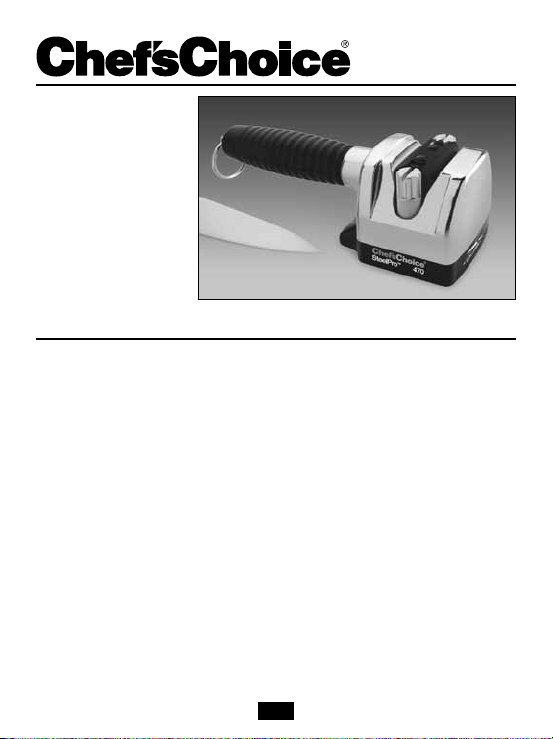
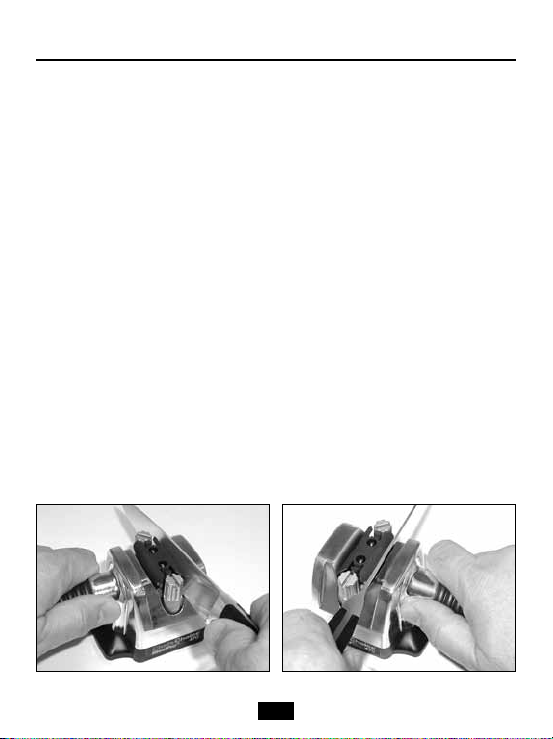
The SteelPro® is designed to be used either right or left handed (Figure 1 and 2).
The soft-touch handle is shaped and sized for a comfortable hold. The SteelPro
can be hung by the metal ring attached to the handle or stored flat in a drawer
or on a shelf.
®
The SteelPro
contains two unique rods made of a special high carbon steel
hardened to about Rockwell C-65, which is much harder than any commercially
available cutlery. Consequently these special rods will show very little wear from
the repeated contact with the edge of your finest and hardest knives.
Two precision knife guides, with planes set at about 23 degrees to the vertical
center line of the hardened rods, control and precisely align the face of the knife
as the balde is inserted into the slot between the guide and the blade retention
spring. In use, the blade is inserted alternately into the left and then the right
slots and pulled forward so that the knife edge slides along the surface of the
hardened steel rod.
The steel rods are supported by elastomeric materials that allow the rods to
deflect when excessive force is applied to the blade. This feature and the ultraprecise and consistent angular contact maintained stroke after stroke between
the knife edge and the hardened steel rods are key to optimizing the edge
structure. Viewed under a microscope, the SteelPro
formation of exceedingly fine and super-sharp micro-serrations. Furthermore,
even after many uses of the SteelPro
®
on a knife, the original edge geometry is
®
edge presents a uniform
maintained and the edge does not round-off like it would using a conventional
steel with no angle control.
®
Figure 1. Right-handed use. FIgure 2. Left-handed use.
3
Page 4
Because of the consistent angular relationship between the individual facets
on each side of the knife edge and the steel rods, the SteelPro
®
simultaneously
maintains a shaving sharp edge while it creates the uniform row of microscopic
serrations along the edge. If the edge is damaged when used for cutting, the
®
will restore the edge micro-serrations while maintaining the sharpness
SteelPro
of the edge. This type of edge conditioning is unique to the SteelPro
®
.
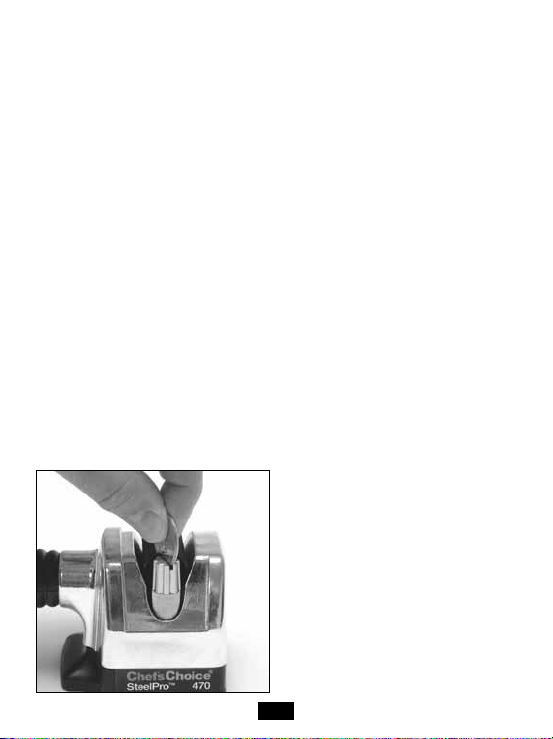
On top of each steel rod is a slotted cap that accepts a coin or other tool so you
can rotate the steel rod slightly to expose a fresh area of the steel rod surface
(Figure 3). This is necessary only if the rod becomes sufficiently worn that the
edge conditioning process slows significantly. When the rod is rotated, fresh surfaces are made available in both the left and right slots. A spring finger extends
from each end of the knife retention spring and clicks into a shallow groove in
the cap on top of each steel rod. When necessary to use a new surface on the
steel, rotate the slot counter-clockwise one click. By this means approximately
55 pairs of “steeling” areas are available over the lifetime of the rods. You will
find with use that the rod closest to you will experience the most wear. The rod
to the read need not be rotated as often. Because the knife edge can be pulled
over a given pair of areas on the rods several thousand times before the wear
affects the rate or precision of the edge formation, the rods need not be rotated
very often and they can last a lifetime in normal household use. Replacement
rods are, however, available from the EdgeCraft Corporation.
®
The SteelPro
features small rubber feet for a secure hold to any dry surface.
The soft-touch handle is designed to improve the grip and reduce hand slippage.
Figure 3.
4
Page 5

Using the SteelPro
®
You will find the SteelPro® can maintain an exceedingly effective razor sharp
edge on all of your cutlery. While it is extremely simple to use, we urge you to
read the instructions in order to optimize your results.
Knife manufacturers have for years suggested steeling as a good way to maintain the knife edge. Users and manufacturers alike know however that knives
must be professionally sharpened before steeling and periodically thereafter
when the steeling process becomes too slow or ineffective. Consequently,
whether you are steeling with a conventional steel or the SteelPro
®
, you will
need to resharpen the edge periodically with a professional sharpener.
If you are uncertain of the angle of your knife edges, we recommend that you
presharpen the edge at a total angle of 40° before using the SteelPro
®
. Most new
factory edges are sharpened in the range of 30 to 40 degrees but a very few are
sharpened as low as 20 degrees total. Any edge angled at 40° or less can be
effectively maintained with the SteelPro
recommend that it be sharpened first with a quality knife sharpener angled at
about 40 degrees. The SteelPro
®
. Similarly if your edge is very dull we
®
can then swiftly and repeatedly create an
extremely effective microstructure along the edge while maintaining its sharpness. You will be impressed with the how effective this type of edge can be.
®
Chef’sChoice
wide for their premium angle control, have a first sharpening stage that is ideal
for presharpening the knife for the SteelPro
manual and professional electric sharpeners, recognized world
®
. If you are uncertain about the
sharpening angle of your sharpener, contact the manufacturer and inquire what
angles are used.
®
To use the SteelPro
®
handle with your left and hold the knife in your right. Move the blade
SteelPro
, if you are right handed (Figure 1), grip and steady the
forward as you insert it between one guide plane and the blade retaining spring
as close as possible to the bolster or handle. The face of the blade should be in
intimate contact with the guide plane. Pull the blade toward you as you press
down lightly on the blade so that the edge makes good contact with the steel
rod. Make sure that the edge maintains steady contact with the steel rod from
the handle to the tip of the blade. Repeat this procedure, making a full stroke in
the opposite slot between that guide and the spring. You should repeat this
motion, making alternating pairs of pulls until the edge is fully conditioned.
5
Page 6

If your knife is freshly sharpened (at about 40 total degrees) prior to using the
®
, you need make only about 10 pairs of alternating pulls to develop a
SteelPro
good edge. Making another 10 pairs of alternating pulls will further refine the
edge and remove virtually all remnants of the burr left from pre-sharpening.
You will find now that the knife cuts exceedingly well.
Whenever you knives appear to lose their “bite” or to be slightly dull, the
®
can restore the edge to its prior performance with only about 10 pairs
SteelPro
of alternating pulls. You will need more pulls than that only if you have used the
knife heavily for an extended time. With the SteelPro
®
you will be able to
recondition your knife edge more than a hundred times before it is again
necessary to resharpen the edge with an abrasive sharpener. It’s time to
consider resharpening when you feel it is taking too long (too many strokes) to
recondition the edge to its initial performance. When resharpening, remember
that it is best to sharpen at a total angle of 40 degrees or less.
Because you can reestablish the microstructure along the edge of your knives
so easily and so many times with the SteelPro
®
before it will be necessary to
resharpen the edge, you will find your knives last longer. Conventional steels
lacking angle control will in most hands create a rounded and dull edge after
steeling the edge only a few times, making it necessary to resharpen the edge
frequently, thus reducing the useful life of the knife.
®
In order to obtain the best results with the SteelPro
a sharpener that is built with precision sharpening guides. Performance of the
®
is optimum when the sharpening angle is 20° (half the total edge
SteelPro
, always resharpen with
angle) or just a few degrees smaller than the 23° angle built in to the SteelPro
Notes:
Serrated Knives
The SteelPro® is not designed to sharpen serrated blades.
Japanese Kataba Knives
You can use the SteelPro® on Japanese Kataba type knives. Because the edge
on one side of these knives is not beveled, you will optimize your results by
applying slightly less pressure when that side of the edge is being conditioned.
®
.
6
Page 7

Ceramic Knives
The SteelPro® is not recommended for ceramic knives.
Scissors
Do not attempt to use the SteelPro® for scissors.
Brands of Knives
You will find that the SteelPro® will put an excellent edge on all of your metal
knives regardless of brand including, Wüsthof, Henckels, Sabatier, Chicago
Cutlery, Lamson and Goodnow, Global, Russel Harrington, Forshner,
Chef’sChoice, Messermeisser, Mundial, Viking, Cuisinart, Kitchen Aid and
many, many more.
Safety:
Keep your fingers clear of the blade edge at all times.
Presharpening the Knife Edge
EdgeCraft offers a wide range of Chef’sChoice® manual and electric knife
sharpeners tha have sharpening angles compatible with the SteelPro
We recommend, however, that you presharpen only in the first stage of the
Chef’sChoice sharpener, which will create an optimal single bevel edge for
the SteelPro
®
. Any burr created in the first stage will not interfere with the
steeling action.
On those occasions when your cutting task calls for the sharpest edge without
the bite provided by the SteelPro
®
, follow the instructions received with your
sharpener and sharpen in all stages.
®
.
Test for Sharpness
To test periodically for sharpness and cutting ability of your knife, hold a sheet of
paper by the edge and carefully cut through the sheet a small (but safe) distance
from your fingers. A sharp edge will cut smoothly without tearing the paper.
Alternatively try cutting a tomato. The knife should pierce through the skin of
the tomato and cut through it on the first pull without significant force applied
to the knife.
7
Page 8
Limited Warranty: Used with normal care, this EdgeCraft product is guaranteed against defective material
and workmanship for a period of one (1) year from the date of original purchase (“Warranty Period”). We will
repair or replace, at our option, any product or part that is defective in material or workmanship without charge
if the product is returned to us postage prepaid with dated proof of purchase within the Warranty Period. This
warranty does not apply to commercial use or any product abuse. ALL IMPLIED WARRANTIES, INCLUDING
IMPLIED WARRANTIES OF MERCHANTABILITY AND FITNESS FOR A PARTICULAR PURPOSE, ARE LIMITED TO
THE WARRANTY PERIOD. EDGECRAFT CORPORATION SHALL NOT BE LIABLE FOR ANY INCIDENTAL OR
CONSEQUENTIAL DAMAGES. Some states do not allow limitations on how long an implied warranty lasts and
some states do not allow exclusions or limitation of incidental or consequential damages, so the above limitations or exclusions may not apply to you. This Limited Warranty gives you specific legal rights, and you may
also have other rights which vary from state to state.
Engineered and assembled in the U.S.A.
By the makers of the professional Chef’sChoice
®
Diamond Hone®
Knife Sharpeners, sold worldwide.
EdgeCraft Corporation
825 Southwood Road
Avondale, PA 19311 U.S.A.
(800)342-3255 • (610)268-0500
Chef’sChoice®, SteelPro® and EdgeCraft® are registered trademarks of the EdgeCraft Corporation.
© 2012 EdgeCraft Corporation E12 M471960
www.chefschoice.com
8
 Loading...