

Page 1
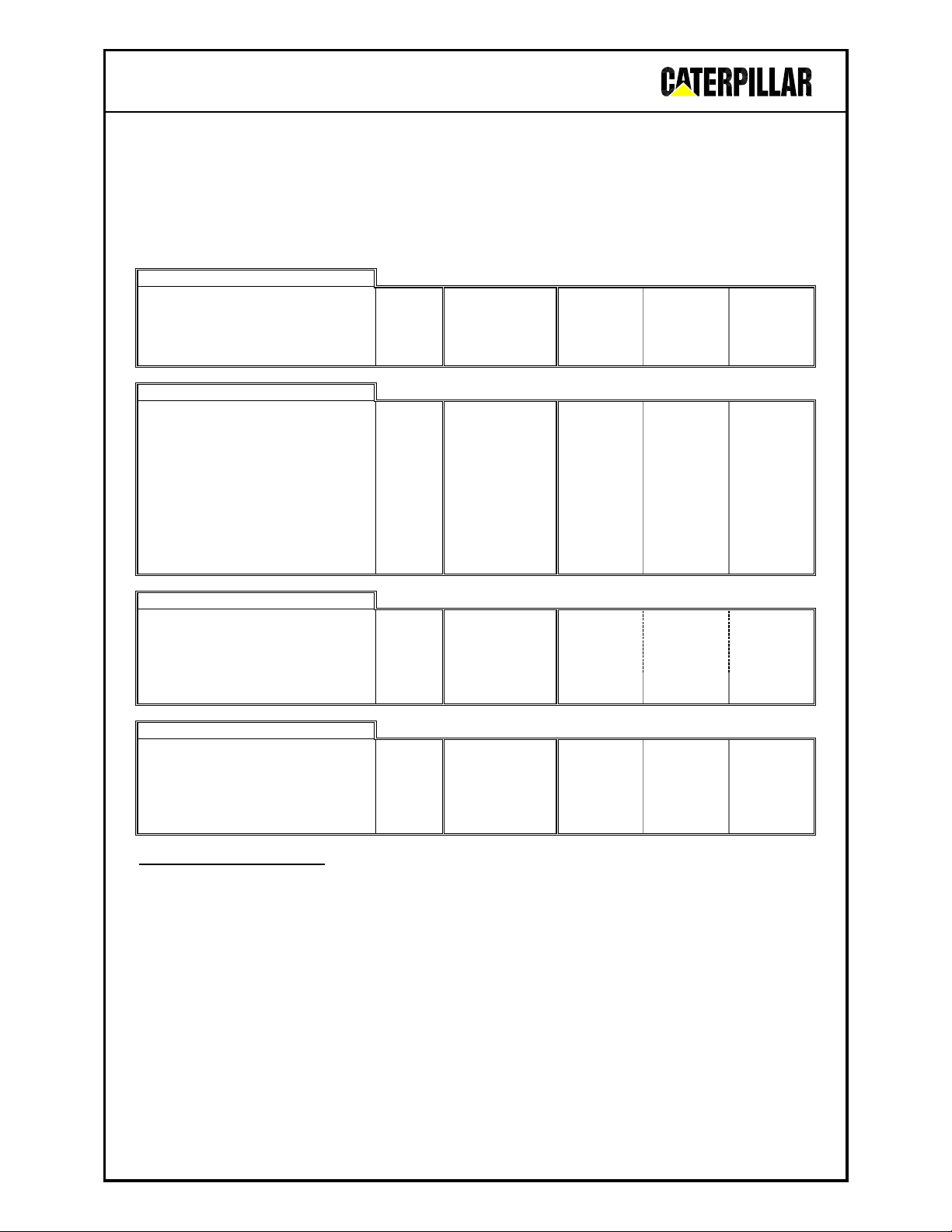
G3406 TA
COOLING SYSTEM:
HEAT REJ. TO EXH.
HEAT REJ. TO EXH.
CONDITIONS AND DEFINITIONS
DM5440-00
Jun-01
GAS ENGINE TECHNICAL DATA
ENGINE SPEED: 1800 FUEL: NATURAL GAS
COMPRESSION RATIO: 10.3:1 FUEL SYSTEM: LPG IMPCO
AFTERCOOLER (°F): 130
JACKET WATER (°F): 210 MIN. FUEL PRESS. (psig): 1.5
COMBINED
MIN. METHANE NUMBER: 80
IGNITION SYSTEM: CDIS MAX. RATED ALTITUDE (ft): 5000
EXHAUST MANIFOLD: WET AT AMBIENT TEMP (°F): 77
COMBUSTION: STOICH NOx EMISSION LEVEL: STD
RATING AND EFFICIENCY NOTES LOAD 100% 75% 50%
LHV OF FUEL btu/scf 919.6 919.6 919.6
ENGINE POWER bhp 301 226 151
ENGINE EFFICIENCY (1) % 34.7 32.7 29.5
THERMAL EFFICIENCY (5) % 50.1 52.2 55.5
TOTAL EFFICIENCY (6) % 84.8 84.9 85.0
ENGINE DATA
FUEL CONSUMPTION (1) btu/bhp-hr 7329 7782 8637
AIR FLOW (WET) lb/hr 2136 1652 1144
AIR FLOW (WET) scfm 466 360 250
COMPRESSOR OUT PRESS. in. Hg (abs) 45.4 42.4 37.5
COMPRESSOR OUT TEMP. °F 203 177 147
INLET MAN. PRESS. in. Hg (abs) 41.3 32.6 23.2
INLET MAN. TEMP. (10) °F 133 133 132
TIMING
(11)
°BTDC 22 22 22
EXHAUST STACK TEMP. °F 977 968 957
EXHAUST FLOW (@STACK TEMP) (WET) cfm 1424 1086 756
EXHAUST FLOW (WET) lb/hr 2246 1740 1209
®
EMISSIONS
NOx (as NO2) (9) g/bhp-hr 19.7 20.4 18.7
CO (9) g/bhp-hr 1 1 1.1
THC (9) g/bhp-hr 4.2 4.5 4.7
NMHC (9) g/bhp-hr 0.63 0.68 0.71
EXHAUST O2 (DRY) % 4.0 3.4 2.2
LAMBDA 1.24 1.19 1.12
HEAT BALANCE DATA
LHV INPUT (1) btu/min 36767 29280 21664
HEAT REJ. TO JACKET (2) (7) btu/min 11946 10351 8638
HEAT REJ. TO A/C (3) (8) btu/min 694 352 94
HEAT REJ. TO ATMOSPHERE (4) btu/min 1471 1171 867
(LHV to 77°F) (2) btu/min 9892 7831 5684
(LHV to 350°F) (2) btu/min 6460 4944 3388
ENGINE RATING OBTAINED AND PRESENTED IN ACCORDANCE WITH ISO 3046/1 (STD. REF. CONDITIONS OF 25°C, 100 KPA).
NO OVERLOAD PERMITTED AT RATING SHOWN. CONSULT ALTITUDE CURVES FOR APPLICATIONS ABOVE MAXIMUM
RATED ALTITUDE AND/OR TEMPERATURE.
1) FUEL CONSUMPTION TOLERANCE ACCORDING TO ISO 3046/1. TOLERANCE IS ±5% OF FULL LOAD DATA
2) HEAT REJECTION TO JACKET AND EXHAUST TOLERANCE IS ±10% OF FULL LOAD DATA.
3) HEAT REJECTION TO A/C TOLERANCE IS ±5% OF FULL LOAD DATA.
4) HEAT REJECTION TO ATMOSPHERE TOLERANCE IS ±50% OF FULL LOAD DATA.
5) THERMAL EFFICIENCY: JACKET WATER +EXH. HEAT TO 350°F
6) TOTAL EFFICIENCY: ENGINE EFF. + THERMAL EFF. TOLERANCE IS +/- 10% OF FULL LOAD DATA
7) TOTAL JW HEAT: JACKET HEAT + OIL COOLER HEAT (HEAT RATE BASED ON TREATED WATER)
8) TOTAL A/C HEAT: A/C HEAT x A/C HEAT REJ. FACTOR (HEAT RATE BASED ON TREATED WATER)
9) EMISSION DATA SHOWN ARE NOT TO EXCEED VALUES.
PUBLISHED PART LOAD DATA MAY REQUIRE ENGINE ADJUSTMENT.
10) MEASURED BETWEEN AFTERCOOLER OUTLET AND PLENUM ENTRY.
11) TIMING INDICATED IS FOR USE WITH A MINIMUM FUEL METHANE NUMBER SPECIFIED. CONSULT THE APPROPRIATE
FUEL USAGE GUIDE FOR TIMING AT OTHER METHANE NUMBERS.
Page 2
G3406 TA GAS ENGINE TECHNICAL DATA
<3030354045505560657075
80 to 100
130
120
110
100
90
80
70
60
50
0
1000
2000
3000
4000
5000
6000
7000
8000
9000
10000
11000
12000
130
120
110
100
90
80
70
60
50
0
1000
2000
3000
4000
5000
6000
7000
8000
9000
10000
11000
12000
DM5440-00
FUEL USAGE GUIDE
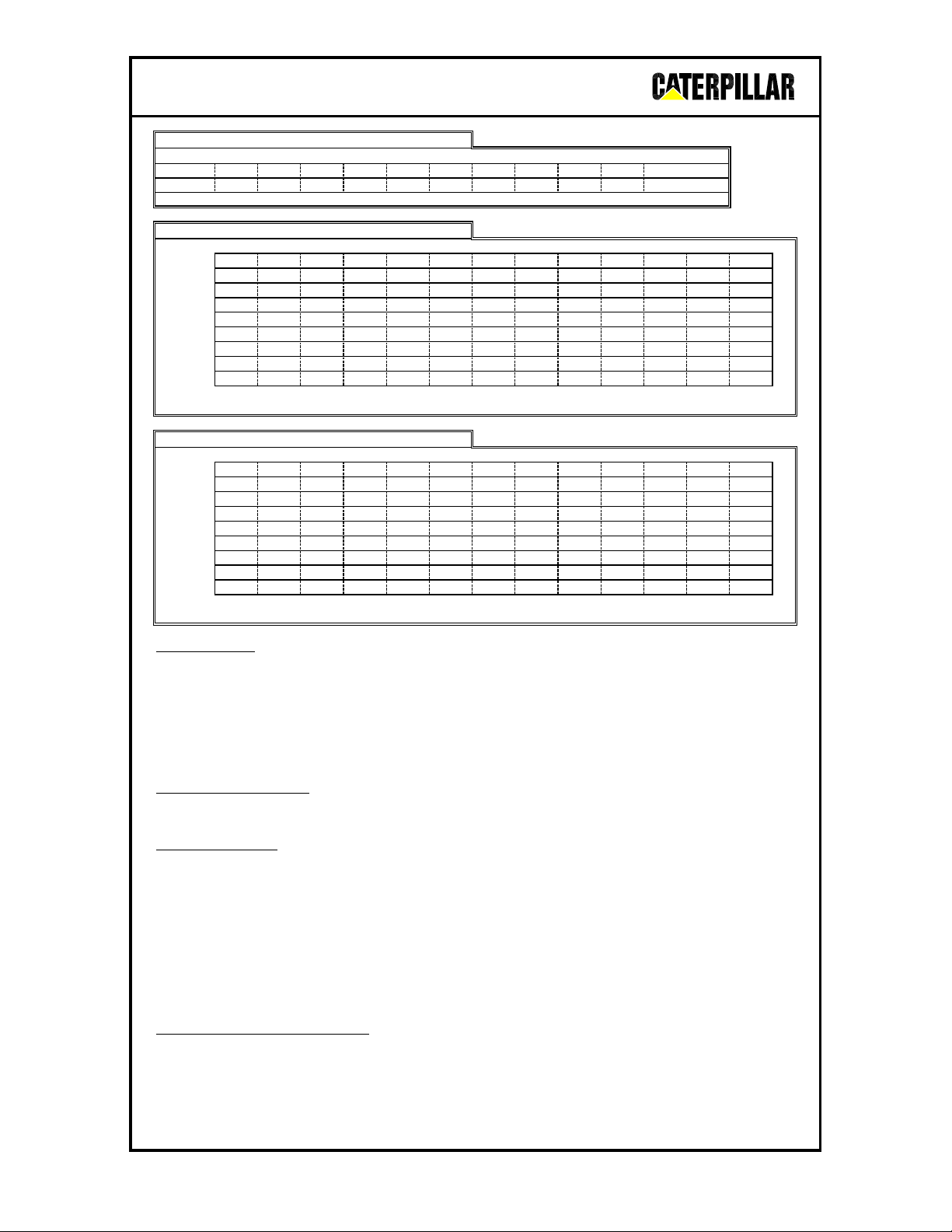
DERATE FACTOR/ENGINE TIMING vs METHANE NUMBER
0 0/-- 0/-- 0/-- 0/-- 0/-- 0/-- 0/-- 0/-- 1.0/19 1.0/22 1.0/22
ALTITUDE DERATION FACTORS
®
A
M
B
I
E
N
T
1.00 1.00 1.00 0.98 0.95 0.91 0.88 0.84 0.81 0.78 0.75 0.72 0.69
1.00 1.00 1.00 1.00 0.96 0.93 0.89 0.86 0.82 0.79 0.76 0.73 0.70
1.00 1.00 1.00 1.00 0.98 0.94 0.91 0.87 0.84 0.80 0.77 0.74 0.71
1.00 1.00 1.00 1.00 1.00 0.96 0.92 0.89 0.85 0.82 0.79 0.75 0.72
1.00 1.00 1.00 1.00 1.00 0.98 0.94 0.90 0.87 0.83 0.80 0.77 0.74
1.00 1.00 1.00 1.00 1.00 0.99 0.96 0.92 0.88 0.85 0.81 0.78 0.75
1.00 1.00 1.00 1.00 1.00 1.00 0.97 0.94 0.90 0.86 0.83 0.80 0.76
1.00 1.00 1.00 1.00 1.00 1.00 0.99 0.95 0.92 0.88 0.85 0.81 0.78
(°F)
1.00 1.00 1.00 1.00 1.00 1.00 1.00 0.97 0.94 0.90 0.86 0.83 0.79
ALTITUDE (FEET ABOVE SEA LEVEL)
AFTERCOOLER HEAT REJECTION FACTORS
A
M
B
I
E
N
T
1.80 1.96 2.13 2.30 2.47 2.64 2.64 2.64 2.64 2.64 2.64 2.64 2.64
1.63 1.79 1.96 2.12 2.29 2.46 2.46 2.46 2.46 2.46 2.46 2.46 2.46
1.47 1.63 1.79 1.95 2.12 2.29 2.29 2.29 2.29 2.29 2.29 2.29 2.29
1.31 1.46 1.62 1.78 1.94 2.11 2.11 2.11 2.11 2.11 2.11 2.11 2.11
1.14 1.29 1.45 1.60 1.76 1.93 1.93 1.93 1.93 1.93 1.93 1.93 1.93
1.00 1.12 1.28 1.43 1.59 1.75 1.75 1.75 1.75 1.75 1.75 1.75 1.75
1.00 1.00 1.11 1.26 1.41 1.57 1.57 1.57 1.57 1.57 1.57 1.57 1.57
1.00 1.00 1.00 1.08 1.24 1.39 1.39 1.39 1.39 1.39 1.39 1.39 1.39
(°F)
1.00 1.00 1.00 1.00 1.06 1.21 1.21 1.21 1.21 1.21 1.21 1.21 1.21
ALTITUDE (FEET ABOVE SEA LEVEL)
FUEL USAGE GUIDE:
This table shows the derate factor required for a given fuel and what engine timing to use. Note that deration occurs as the methane number
decreases. Methane number is a scale to measure ignition and burning characteristics of various fuels. Representative values are shown below.
Methane 100.00
Ethane 44.00 Most dry pipeline natural gas has a methane number of 67 or above. The gas quality should be analyzed to
Propane 34.00 determine the percentage of each constituent and then determine the methane number. Consult the dealer or
n-Butane 10.00 factory for assistance.
Hydrogen 0.00
ALTITUDE DERATION FACTORS:
This table shows the deration required for various ambient temperatures and altitudes. Use this information to help determine actual engine
power for your site.
ACTUAL ENGINE RATING:
It is important to note that the Altitude/Temperature deration and the Fuel Usage Guide deration are not cumulative, i.e., they are not to be added
together. The same is true for the Low Energy Fuel deration (reference the Caterpillar Methane Number Program) and the Fuel Usage Guide
deration. However, the Altitude/Temperature deration and Low Energy Fuel deration are cumulative; and they must be added together in the
method shown below. To determine the actual power available, take the lowest rating between 1) and 2).
1) (Altitude/Temperature Deration) + (Low Energy Fuel Deration)
2) Fuel Usage Guide Deration
Note: For NA's always add the Low Energy Fuel deration to the Altitude/Temperature deration. For TA engines only add the Low Energy Fuel
deration to the Altitude/Temperature deration whenever the Altitude/Temperature deration is less than 1.0 (100%). This will give the actual rating
for the engine at the conditions specified.
AFTERCOOLER HEAT REJECTION FACTORS:
Aftercooler heat rejection is given for standard conditions of 77°F and 500 ft altitude. To maintain a constant inlet air manifold temperature, as
the ambient air temperature goes up, so must the heat rejection. As altitude increases, the turbocharger must work harder to overcome the
lower atmospheric pressure. This increases the amount of heat that must be removed from the inlet air by the aftercooler. Use the aftercooler
heat rejection factor to adjust for ambient and altitude conditions. Multiply this factor by the standard aftercooler heat rejection. Failure to
properly account for these factors could result in detonation and cause the engine to shut down or fail.
Jun-01
 Loading...