

Page 1
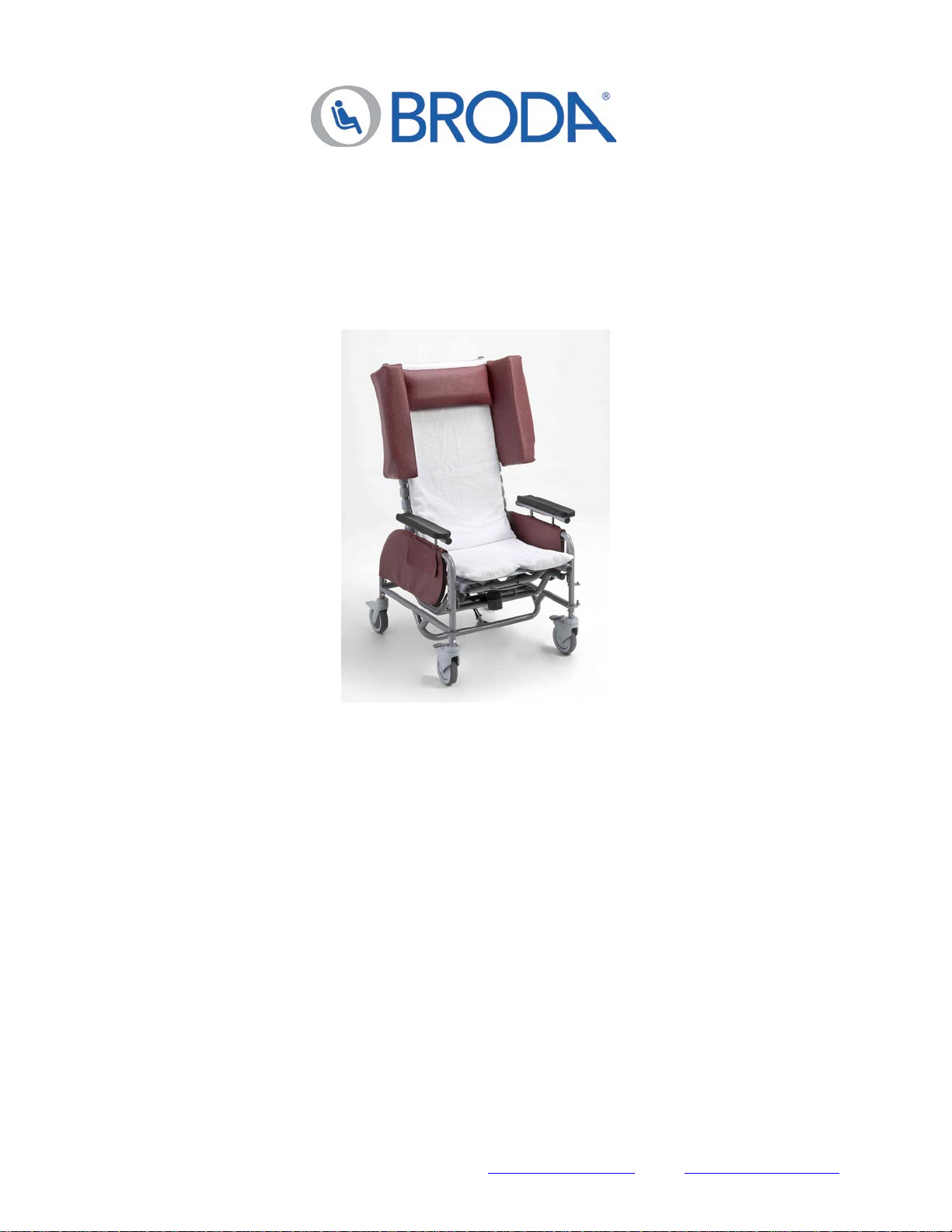
Full padding upgrade shown
Operating Manua l
Model 48R Pedal Rocker
Distributor/Rep: This manual must
be given to the caregiver responsible
for this chair and its occupant.
Caregiver: Before using this chair,
read this manual thoroughly and save
for future reference.
Page 2

Contents
FOREWORD ................................................................................................................................................................. 1
GENERAL INFORMATION ........................................................................................................................................ 2
1 DEFINITIONS ...................................................................................................................................................... 3
2 SAFETY REQUIREMENTS ................................................................................................................................ 4
2.1 Training ........................................................................................................................................................ 4
2.2 Application ................................................................................................................................................... 4
2.3 Shipping and Storage ................................................................................................................................... 4
2.4 Pre-Service Check ........................................................................................................................................ 5
2.5 Hazards ........................................................................................................................................................ 5
2.5.1 Position of Chair - “Danger of Falling” ................................................................................................... 5
2.5.2 Position of Seat Tilt - “Danger of Tipping” ............................................................................................. 5
2.5.3 Location of Chair - “Danger of Tipping or Falling Objects” ................................................................... 5
2.5.4 Total Lock Wheel Brakes - “Danger of Falling” ..................................................................................... 5
2.5.5 Re-Positioning of Resident - “Danger of Clamping” ............................................................................... 6
2.5.6 Unintended Mo vement - “Danger of Falling or Collision” ...................................................................... 6
2.5.7 Resident Clothing - “Risk of Injury to Re sident’s S kin” ......................................................................... 6
2.5.8 Improper Restraint Use - “Risk of Serious Injury” .................................................................................. 6
2.6 Improper Use................................................................................................................................................ 6
2.7 Cleaning ....................................................................................................................................................... 7
2.8 Maintenance ................................................................................................................................................. 8
2.9 Resident Specific Instructions ...................................................................................................................... 9
3 OPERATION AND MOVEMENT ..................................................................................................................... 10
3.1 Rocking Funct ion ....................................................................................................................................... 10
3.2 Seat Tilt ...................................................................................................................................................... 10
3.3 Rocking Te ns i on ........................................................................................................................................ 11
3.4 Removable Wings ...................................................................................................................................... 11
3.5 Shoulder Bolsters ....................................................................................................................................... 12
3.6 Height Adjustable Armrests ....................................................................................................................... 12
3.7 Adjustable Seat Height ............................................................................................................................... 13
3.8 PAB BAR (Optional) ................................................................................................................................. 13
3.9 Casters ........................................................................................................................................................ 14
3.10 Accessories (Options) ................................................................................................................................ 14
4 INSPECTION AND FUNCTIONAL TESTING ................................................................................................ 15
4.1 Inspection ................................................................................................................................................... 15
4.2 Functional Testing ...................................................................................................................................... 15
5 TECHNICAL INFORMATION .......................................................................................................................... 16
5.1 Specifications ............................................................................................................................................. 16
5.2 Labels ......................................................................................................................................................... 17
5.3 BRODA Seating 48R Pedal Rocker Parts Schematic Drawing ................................................................. 18
6 COMMON TROUBLESHOOTING AND REPAIR .......................................................................................... 20
6.1 Troubleshooting for Gas Cylinders ............................................................................................................ 20
7 WARRANTY ...................................................................................................................................................... 22
ii
Page 3

GENERAL INFORMATION
This document provides guidance on the safe and effective operation of the BRODA chair.
Information in this manual must be followed at all times.
Anyone involved with the operation or maintenance of the BRODA chair, including the
resident’s family members, must read this operating manual before using the chair.
The resident’s primary caregiver is responsible for ensuring that anyone who is unfamiliar with,
unwilling, or unable to adhere to the safety and operating instructions, is not permitted to operate
or move the chair.
A copy of this instruction manual must always be available.
BRODA accepts no liability for damages, injury or accidents caused by operating errors,
improper maintenance, or disregard of the instructions in this manual, including any resident
specific instructions.
BRODA reserves the right to make changes to the specifications, dimensions, functions, or
components of its products without notice. Product representations in this manual may vary from
delivered products.
Each BRODA chair has a unique identifying serial number that must be maintained on the chair
as well as with any equipment records.
2
Page 4

1 DEFINITIONS
“BRODA” means BRODA Enterprises Inc. doing business as BRODA Seating.
“BRODA chair” refers to Model 48R Pedal Rocker.
“Long-Term Care Institution” refers to a nursing home, hospital, or other healthcare facility that provid es health and
personal care to its residents on a long-term basis.
“Resident” refers to an individual living in a long-term care instituti on under the care of professional caregivers.
“Professional Caregiver” refers to doctors, nurses, therapists, nursing aids, healthcare aids, and other specialists who
work in a long-te rm care institution and provide health and personal care to its residents.
“Caregiver” refers to any person in a long-term care institution who is appropriately trained to provide care or
services to the resident or the chair used by the resident and may include the resident’s family members or guardian.
“Seat Tilt” refers to changing the relative angle between the chair’s seat and the chair frame or gr ound without
changing the relative angle between the back and the seat.
“Transfer(s)” refers to the movement of a resident into or out of the chair with the assistance of their caregiver(s).
“Mechanical Transfer(s)” refers to the movement of a resident into or out of the chair with the assistance of their
caregiver(s) using a patient lift or other assistive device that bares the weight of the resident.
3
Page 5

2 SAFETY REQUIREMENTS
2.1 Training
Before the chair is put into service, this manual must be read thoroughly by the caregiver(s) directly
responsible for the resident’s care.
After the chair is put into service, this manual must be re ad thoroughly by any new caregivers prior to
operating or moving the chair.
For the purpose of this manual, a resident’s family member who shares responsibility for their care is considered a
caregiver and is subject to the same competency before being permitted by the resident’s primary caregiver to
operate of move the chair.
Prior to first use, the customer must arrange for an in-service on the operation and safety requirements in this
manual, must be given to the resident’s caregivers by the local BRODA representative who supplied the chair.
The primary caregiver must maintain a list of caregivers who have read this manual and who they have authorize d to
operate and move the chair.
The resident’s primary caregiver is responsible for ensuring that anyone who is unfamiliar with, unwilling, or unable
to adhere to the safety and operating instructions, is not permitted to operate or move the chair.
The operations of the chair must be performed by the resident’s primary caregiver who is responsible for seating. All
The operations and adjustments performed should be done in a manner to ensure the overall safety, comfort and
well-being of the resident, caregiver and thi rd party. All operations and adjustments required for the resident should
be determined by the resident’s primary caregiver who is responsible for seating.
2.2 Application
BRODA chairs are intended exclusively for residents of long-term care institutions who are under the care of
professional caregivers. The suitability of a BRODA chair must be determined by a qualified car egiver who is
familiar with the s eating needs of the intended resident. Any other use of the chair is excluded from possible liability
claims.
The Pedal Rocker is not to be used in the shower. The frame and components will rust, and will void the warranty.
The chairs are not explosion resistant and must not be used where there are flammable gases or liquids present (e.g.,
anesthetics, volatile solvents and cleaners, etc.)
BRODA chairs are designed for use with specific BRODA parts and accessories. The use of non-BRODA parts or
accessories with a BRODA will void the warranty and is excluded from possible liab ility claims.
BRODA chairs may only be used as de scribed in this manual and with proper r egard for recognized healthcare and
workplace safety and accident prevention practices.
2.3 Shipping and Storage
BRODA chairs should be shipped and stored in an upright position and not stacked higher than 3 boxes. No other
materials should be shipped or stored on top of a BRODA box. BRODA boxes should not be placed on pallets.
BRODA chairs should b e shipped and stored at temperatures between -20ºC and 40ºC. BRODA chairs should not be
used until they are between 0ºC and 30ºC.
4
Page 6

BRODA chairs should be kept in a clean, dry environment. Do not leave BRODA chairs outdoors as it may cause
the paint to peel.
Upon receipt, the shipping carton must be immediately examined for damage. Any damage should be noted on the
delivery receipt and a request for inspection by the transportation company should be made. Next, the shipping
carton should be opened and the chair must be examined for concealed shipping damage. If the chair appears to be
damaged, do not use the chair. File a concealed damage report with the transportation company.
2.4 Pre-Service Check
BRODA chairs are delivered fully assembled. If the chair does not appear to be ready to use upon receipt,
immediately contact your supp lie r a nd do not put the chair into service until any concerns have been resolved.
Visually inspect the chair for damage, missing parts, and loose fasteners prior to testing the chair’s functions.
Functional testing must be successfully completed after visual inspection and before use. These obligations apply to
the chair’s first use and to all subsequent uses (Section 4: Inspection and Functional Testing).
2.5 Hazards
2.5.1 Position of Chair - “Danger of Falling”
After a resident is transferred into a chair, assess the amount of tilt required. We recommend that the chair’s seat be
tilted sufficiently to prevent the resident from sliding or falling forward off the chair. The amount of seat tilt used
should be determined by the resident’s caregiver who is responsible for seating.
2.5.2 Position of Seat Tilt - “Danger of Tipping”
We recommend that the chair’s seat be tilte d sufficiently to prevent an agitated resident from tipping the chair
forward or backward, or from slumping and sliding in the chair. The amount of seat tilt used should be determined
by the resident’s caregiver who is responsible for seating. Always ensure that the resident is properly positioned
before operating the seat tilt.
2.5.3 Location of Chair - “Danger of Tipping or Falling Objects”
We recommend that when a resident has been moved to their destination, the chair is placed where the resident
cannot reach handrails or other objects, fixed or movable. This is to prevent the resident from pulling the chair over
or pulling themselves off the seati ng surface and to prevent the resident from pul ling movable objects onto the chair
and themselves.
We recommend that the chair be used in a supervised area to prevent untrained residents, caregivers, or third parties
from unaut horized operation, movement, or unsafe actions such as sitting or lea ning on the r eclined back, elevated
footrest, or the armrests. These a c tions, if not prevented, put the chair at risk of tipping or damage to the chair.
We recommend that a chair only be located on a level surface to minimize the risk of tipping over.
2.5.4 Total Lock Wheel Brakes - “Danger of Falling”
The special casters found on the BRODA chair ha ve total lock brakes which prevent the wheels fr om turning a nd
swiveling. The brakes must always be applied when:
1) the chair is not in use;
2) a resident is being transferred (moved) into or out of the chair.
It is important to note that if the wheel brakes are applied while the resident is in the chair, that the caregiver does
not leave the resident unattended, especially those residents who have the capability or tendency to move the chair
and/or those who may be agitated. This could cause harm to the resident if they attempt to move the chair while the
wheel brakes are applied.
Note that removing and attaching the footrest may be easier for the caregiver with the brakes applied
Failure to follow these instructions will unnecessarily increase the risk of serious falls by residents, caregivers, or
third parties caused by the chair unintentionally moving.
5
Page 7

2.5.5 Re-P ositioning of Resident - “Danger of Clamping”
BRODA Pedal Rocker chairs offer the benefits of sea t tilt and height adjustable arms. During t he movement of any
of these functions, the following safety measures must b e observed:
1) The resident’s arms must be positioned on the armrests or inside the chair frame with their hands
on their body or on.
2) Only one caregiver at a time attempts to operate the chair’s functions.
3) Only one chair function is operated at a time.
4) The residents’ and caregivers’ body are clear of all pinch points before operating the chair’s
functions.
Failure to follow these safety measures can put the residents’ or caregivers’ limbs at risk of injury. Residents who
may be unaware of their body position or unable to maintain a safe body position are at the most risk of the danger
from clamping and caregivers should be more cautious with these residents. A second caregiver may be required to
ensure the safety of these residents during these operations.
2.5.6 Unintended Movement - “Danger of Falling or Collision”
We recommend BRODA chairs for indoor use within a long-term care institution and wher e there is not e nough
slope to cause the chairs to move unaided. Chairs used where the surface is uneven or sloped are at risk of
unintended movement and could become a serious danger to the resident, caregiver(s), or a third party. We
recommend that BRODA chairs are located away from stairwells, elevators, and exterior doorways within a longterm care institution.
Outdoor use is appropriate only under the strict supervision and full attention of a caregiver who is physically
capable of preventing any unintended movement over any surfaces that are to be traveled on. We recommend that a
second caregiver assist when the chair is moved over surfaces that could cause significant unintended movement.
2.5.7 Reside nt Clothing - “Risk of Injury to Resident’s S kin”
We recommend that residents only be seated while they are fully dressed in clothing that meets the needs of their
specific condition. If after being fully dressed, a r e sident’s bare arms, legs, or body could still come into direct
contact with the vinyl straps or vinyl pads, we recommend the use of a covering, such the BRODA terry cloth
covered seat and/or back pad or a folded cloth bed sheet to prevent direct contact. Direct contact of bare skin on the
straps over a period of time could cause moisture on the resident, and/or cause the skin to stick to the straps. Prior to
the operat ion or movement of a chair with a covering, the caregiver must ensure any covering placed on the chair
does not come into contact with any moving parts and is securely placed, so not to slip.
2.5.8 Improper Restraint Use - “Risk of Serious Injury”
We recommend that alternatives to physical restraints be used with residents while seated in the chair except under
the specific instructions of the re sid e nt’s primary caregiver and with permiss ion of the resident’s family or guardian.
Physical restraints have been identified as a common cause of serious injury to residents while they are seated. We
recommend that the primary caregiver responsible for seating first consider the re-positioning options available in
the chair to reduce the risks of slidin g, falling, or self-injury.
If a physical restraint is determined to be appropriate to prevent sliding or falling out of the chair, we recommend
that the BRODA thigh belt be used. In all cases, it is the resident’s primary caregiver that must take responsibility
for the safety of the resident if restraints are used.
2.6 Improper Use
As outlined , the improper use of the chair is dangerous to the resident, caregivers, or third parties, and can consist of,
but is not limited to the following:
1) Unauthorized operation of the chair’s functions.
2) Unauthoriz ed movement of the chair.
3) Inappropriate use of the chair for a resident who has not been assessed by a qualified caregiver
responsible for their seating.
4) Failure to frequently reposition the resident in the chair
5) Attempting to operate of multiple chair functions simultaneously by one or more caregivers.
6
Page 8

6) Attempting to move the chair with the b rake(s) applied.
7) Leaving the resident unattended in the chair near other objects.
8) Leaving an agitated resident in the chair in an unsupervised area.
9) Leaving a resident unattended.
10) Leaving a resident in a chair on a sloping surface.
11) Leaving a chair unattended on a sloping surfac e.
12) Using non-BRODA accessories on the chair.
13) Using the chair at temperatures below 0ºC.
14) Using the chair as a shower or bathing chair.
15) Using the chair for any use other than its intend ed purpose.
2.7 Cleaning
BRODA chairs should be wiped clean with soap and water. Diluted household strength ammonia or chlorine based
cleaner, as well as a hospital grade cleaner may be used if necessary.
Refer to the following guide for cleaning certain staining agents (Applies to the Permablok3® vinyl, as pe r the vinyl
manufacturer’s recommendations) The frame and components of the chair can be cleaned using the same procedure
as the vinyl.
The steps below are also located in the Cleaning Guide found on the back of the Broda chair
Staining Agent Cleaning Procedure
Eye Shadow / Mascara Step 1
Grease / Suntan Lotion / Chocolate Step 1
Blood / Bodily Fluids Step 2
Red Lipstick Step 2
Oil Base Paint / Tar / Asphalt Step 3
Other Tough Stains Step 4 or 5*
Step 1: Remove excess spill with a damp cloth. Clean with a 1:1 mix of Ivory® liquid and water. Rinse with clean
water and dry.
Step 2: Use a straight application of concentrated cleaners such as Formula 409® or Fantastik® Spray Cleaner.
Then wipe with a clean cloth. If usin g a hosp ita l grade cleaner, follo w the diluting instructions on the label.
Step 3: Use a 1:1 mix of ammonia and water or a 1:4 mix of bleach and water. Rinse with clean water and dry.
Step 4: Use a straight application of naphtha (lighter fluid). Rinse thoroughly with clean water and pat surface dry.
Step 5: Use a 1:1 mix of isopropyl alcohol and water. If the stain persists, use straight alcohol. Rinse thoroughly
with clean water and pat dry. If the stain remains, use a 1:1 mix of acetone and water. Rinse with clean water and pat
surface dry.
*Note: for cleaning that requires steps 4 or 5 – Use a soft cotton cloth saturated with the cleaning material and rub
the stain in circles 10 times. Pat d ry with another soft cotton cloth, and check results.
For best cleaning results, certain parts and padding on the chair should be removed: Instructions for removal of the
following parts are loca te d in this manual: Ensure that the en tire chair including removable a nd no n removable parts
is thoroughly cleaned.
Pay close attention to the frame, sockets, fasteners, parts and casters, as well as the padding for an even, thorough
clean.
Remove parts for cleaning if desired:
1) Wings
3) Footrest
4) Padding
7
Page 9

Thoroughly clean all removable parts and padding, as well as the frame and components around the parts and
padding that have been removed.
BRODA chairs should not be cleaned with petroleum based cleaners. Any petroleum based products that come in
contact with any vinyl surface should be removed as quickly as possible. Petroleum based products make vinyl
brittle and will damage the seating surface and cushions. Metal parts and cushions should be wiped completely dry
after cleaning. Do not launder vinyl padding. Terry seat and back covers can be laundered and tumble dried.
Do not allow the chair to air dry. Leaving the chair to air dry and not ensuring the entire chair is completely dry may
cause the frame and components to rust. Solvents such as those found in spray lubricants should not be used on
BRODA Chairs as they can damage moving parts.
Frequency and method of cleaning the chairs should be determined by facility infection control protocols. If visibly
soiled, thoroughly clean the chair immediately as per the cleaning instructions in this manual.
The cleaning instructi ons in this manual are guidelines only. Results may vary u nder actual conditions. The
information does not relieve the user of proper and safe use of the product and all cleaning agents and consideration
for the overall cleaning maintenance of the chair. Cleaning and care instructions must be followed in conjunction
with facility infection control protocols.
BRODA will not accept warranty or liability claims on chairs that have not been cleaned according to the
instructions or cared for in proper regard for patient, caregiver and third party safety and hygiene.. The use of certain
agents may be harmful to the surface appearance and lifespan of the vinyl. BRODA assumes no responsibility
resulting fr om the use of such clea ning agents to the vinyl.
Touch up paint is available for the powder coated frame. Please call Broda’s Customer Service Department if touch
up paint is required. Do not leave BRODA chairs outdoors as the frame is not UV protected. Leaving the chairs
outdoors could cause the paint to peel.
Formula 409® is a trademark of the Clorox Company.
Fantastik™® is a trademark of Do wBrands, Inc.
Trademark of the Dow Chemical Company.
Ivory® is a trademark of Proctor and Gamble.
2.8 Maintenance
The maintenance on a BRODA chair wil l vary with the amount of use and the condition of the resident using the
chair.
In regular use, after the initial inspection and functional testing, the chair should be inspected and tested bimonthly.
We recommend visually inspecting for signs of wear, damage, loose or missing fasteners, and other safety concerns.
Periodic testing of chair functions is also necessary. If a breakage, defect, or operational problem is detected, the
chair must be successfully repaired, inspected and tested for function before it is returned to service.
The chair should be inspected and tested as often as each use if the chair is used by:
1) Aggressive or agitated residents.
2) Residents who ha ve invo lu ntary movement s.
3) Residents weighing over 220 lbs.
4) A facility with irregular or sloped surfaces.
5) Any unauthorized person.
Do not use lubricants tha t contain solvents. Solvents may compromise any rubber components on the chair. If
necessary, white food grade grease or lubricant can be used on any sliding components.
8
Page 10

2.9 Resident Specific Instructions
The primary caregiver responsible for the specific resident’s seating shall add additional instructions necessary for
the safe and effective use of the chair based on their professional experience and knowledge of the resident’s
specific conditions and requirements.
BRODA representatives are not professional caregivers and will not know the specific requirements of the
individual using the chair. BRODA relies on the knowledge, experience, and judgment of the resident’s professional
caregiver to ensure the specific resident’s safety and comfort needs are satisfied while using the chair.
These instructions form an essential part of the Safety Requirements for using the chair and must be made available
to all caregivers. Space is provided below to include these instructions.
BRODA Enterpr i ses Inc.
560 Bingemans Centre Drive
Kitchener, Ontario Canada N2B 3X9
Phone: 1-519-746-8080 Toll Free Can/US: 1-800-668-0637
Fax: 1-519-746-8616
Email: [email protected]
URL: www.brodaseating.com
9
Page 11
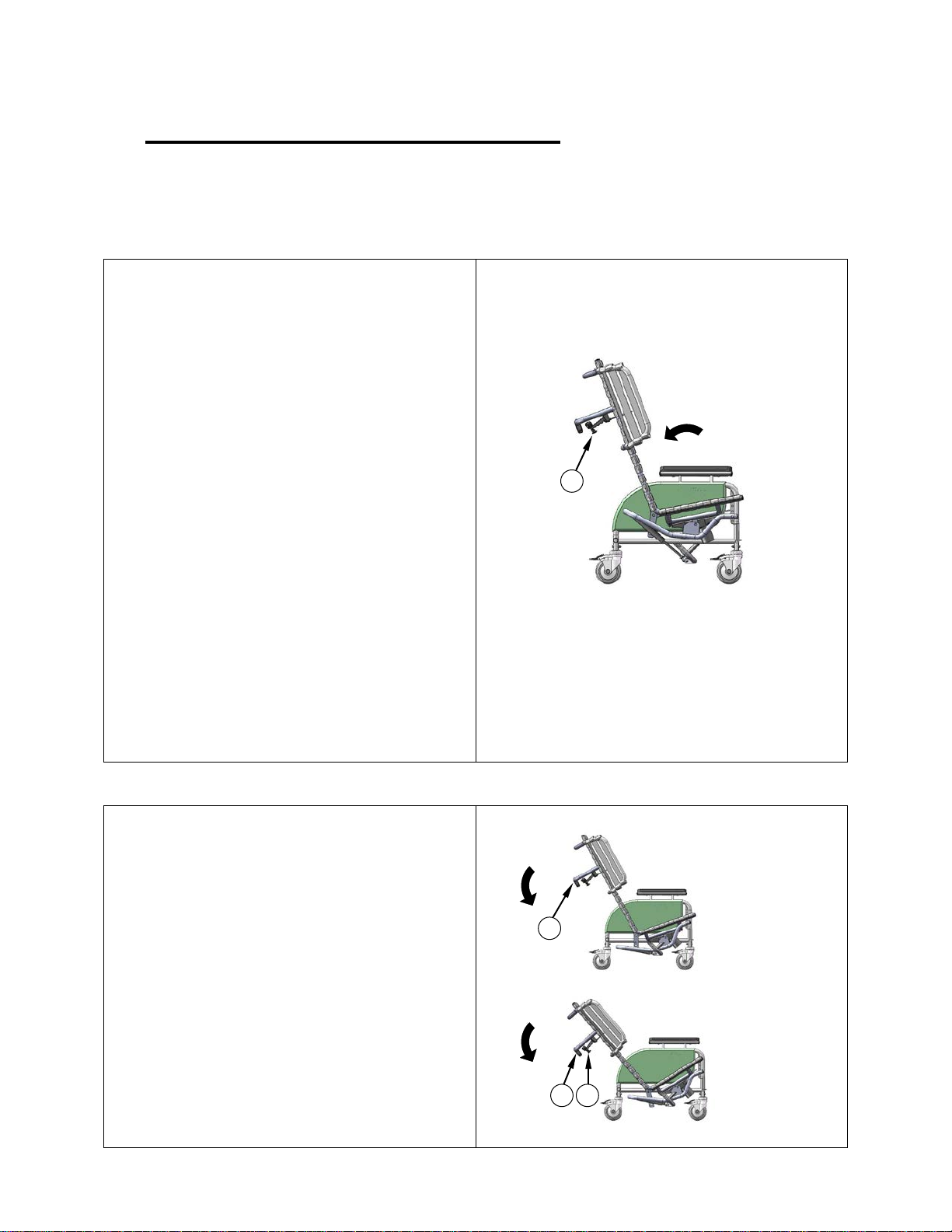
3 OPERATION AND MOVEMENT
The Pedal Rocker has a rocking function that helps to
Gas cylinders allow the seat to be tilted to any position
1 1 1 2
Safety measures as described in Section 1 must be observed when operating the chair’s functions or moving the
chair. Only authorized caregivers should attempt to operate or move a chair. The caregiver must use proper body
mechanics when operating the chair, and be prepared to support the weight of the resident while operating the chair.
3.1 Rocking Function
calm agitated residents. The rocking function has a lock
that is activated or deactivated by the caregiver. The
rocking can be used independently or in conjunction
with tilt for a deeper tilt angle. (See instructions- Seat
Tilt)
To Activate Rocking:
- Ensure the seat is in an upright or sli ghtly tilted
position. (See instructions- Se a t Tilt)
-Squeeze and lock the rock handle by securing it t o the
frame.
-Adjust the rocking tensio n according to resident in
the chair. (See instruction- Rocking Tension)
To deactivate rocking:
-Release the rock handle from the frame.
WARNING: DO NOT place hand near cable housing
on handle as this could cause pinching.
-Let the seat engage in the desired position. To engage
in the most upright position, the seat may need to be
lifted up slightly to guide into position.
3.2 Seat Tilt
from most upright to the lowest wit hin i ts ra nge. Use
seat tilt to safely position the resident, r e distribute
pressure and increase comfort. The Pedal Rocker seat tilt
is designed to allow for foot propulsion while tilted.
To Activate the Seat Tilt:
-Place right hand on the bar to assist movement and
squeeze the tilt handle with left hand.
-Raise or lower the seat tilt until the desired angle is
achieved.
Both the tilt and rocking functio ns can be used together
to achieve a deeper seat tilt by tilting first, then
activatin g the rocking mechanism.
10
Page 12
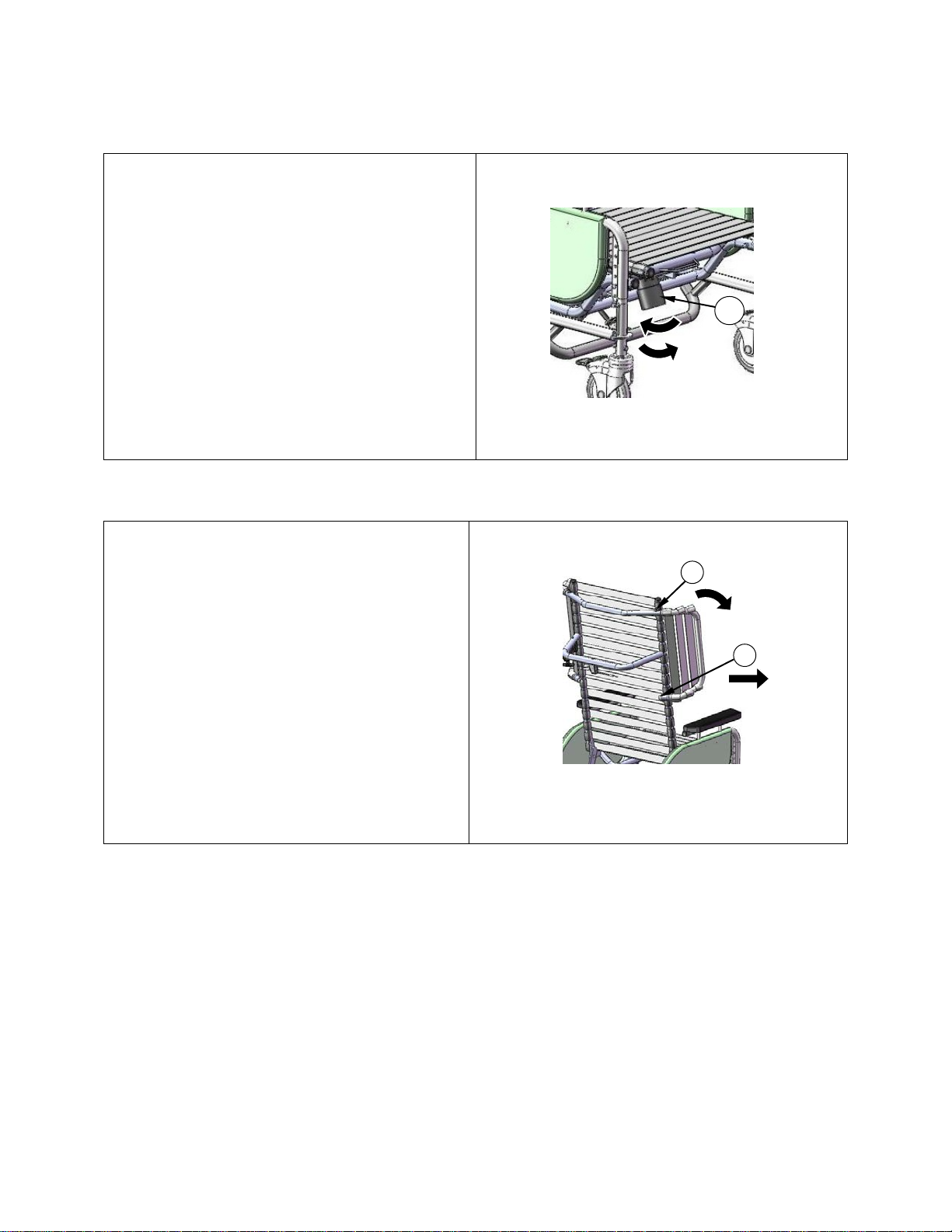
3.3 Rocking Tension
The rocking tension can be adjusted to accommodate
Wings support the Shoulder Bolsters which provide
1
2
_
1
+
residents of vario us weights. For ease of rocking, the
rocking tension should be:
decreased for lighter occupants.
increased for heavier occupants.
For residents with rigid movements, the rocking tension
may need to be increased accordingly to their rocking
force.
To adjust rocking tension:
To decre ase tension (lighter occup ants) turn the knob
clockwise.
To increase tension, (heavier occupants) turn the knob
counter-clockwise.
3.4 Removable Wings
upper body lateral support to the resident.
To Remove t he Wing:
-Depress the top button (1) and pull the wing from the
receptacle. The wing may be moved out of the way
without its full removal.
-To completely remove the wing, depres s the bottom
button (2) and remove from the receptacle.
To Insert the Wing:
- Insert the lower end of the wing into the lower
receptacle.. Then insert the upper end into the upper
receptacle. Ensure the wing is secured in place.
11
Page 13
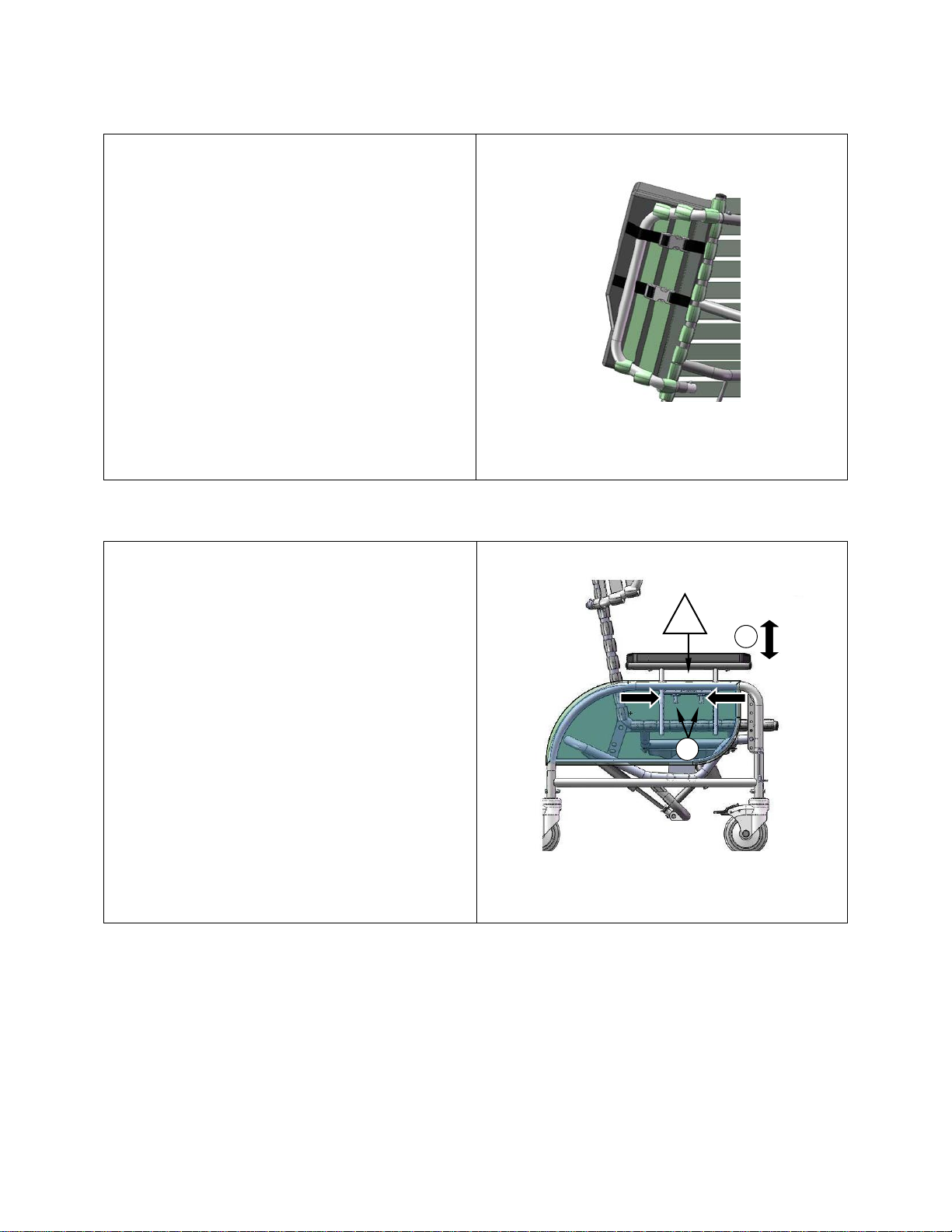
3.5 Shoulder Bolsters
The Shoulder Bolsters provide upper torso support,
The armrest height can easily be adjusted in order to
1
2
protection and containment and accommodate
asymmetries in the chair user. Their unique design
allows for proper elbow access to the arm rest. The
Shoulder Bolster is always used in conjunction with the
side wing.
To Attach the Shoulder Bolster s:
-Feed both Shoulder Bolster straps between the inner
strap of the wing and the frame of the chair.
-Secure the b uckles and cinc h the straps to secure the
bolster to the wing. The bolster can be slid up and down
the wing if desired.
Note: The Shoulder Bolster can be inverte d on the wi ng
in order to provide support to narrower residents.
3.6 Height Adjustable Armrests
accommodate various residents. The armrest height
should be adjusted to provide correct arm support for the
resident as determined by the caregiver.
To Adjust the Armrest Height:
-Squeeze the pins together which are located under the
armrest flap.
WARNING: DO NOT place fingers at the top of the
pins as this could cause pi nching. Place fingers in the
concave shape of the pins.
-Raise or lower the arm to the desired height.
WARNING: DO NOT place fingers anywhere
underneath the arm w hile adjusting, as this could
cause pinching. Upon releasing the pins the armrest
height will lock into place.
Secure the outside flap on the side panel.
12
Page 14
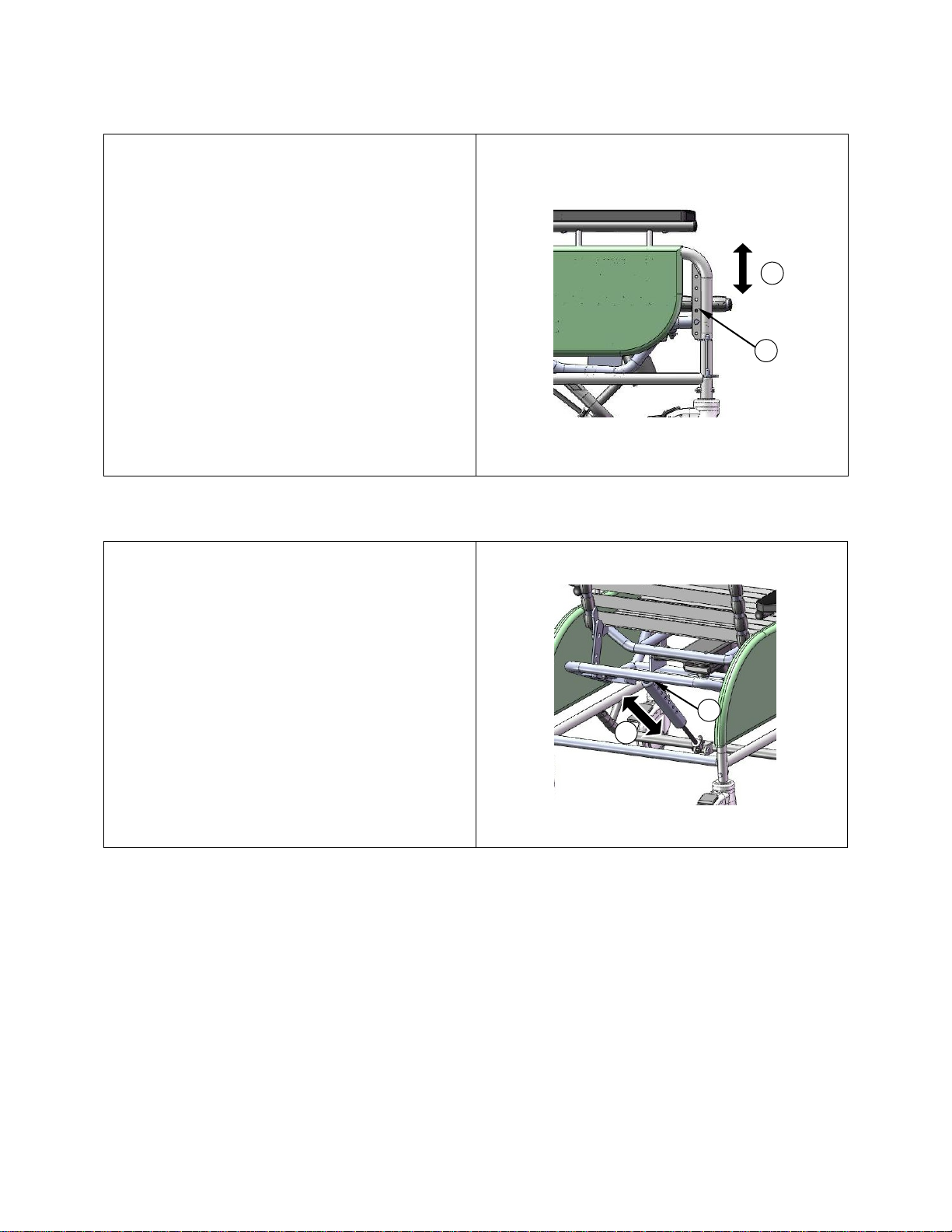
3.7 Adjustable Seat Height
The seat to floor height is adjustable to a llow for proper
The PAB B AR may be used to maintain the original
1 2 1
2
“foot on floor” position for foot propulsion.
To Adjust the Seat Height:
-Using 7/16 wrenches, remove the bolts.
-Raise or lower the front of the seat to correspond with
the holes at the desired seat height.
- Insert the bolts through the desired corresponding holes
and tighten the bolts.
Changing the seat height on the Pedal Chair may affect
the range of seat tilt as only the front of the seat is being
raised. If desired, a PAB Length Adjustment Bar may be
used on the ti lt cylinde r to maintain t he original r ange of
tilt.
3.8 PAB BAR (Optional)
range of tilt when the seat height has been adjusted.
-Remove the bolts and spacers from the top of the
cylinder.
-Slide the P AB Bar over t op of the cylinder.
-Determine the height for the PAB BAR and insert a
2 ¼” bolt through the appropriate hole. After inserting
the bolt, place 2 spacers- (1/2” and 3/8”) before inserting
the bolt through the cylinder.
-Insert the bolt through the cylinder and secure . Attach
the top portion of the PAB BAR to the cha ir back.
13
Page 15
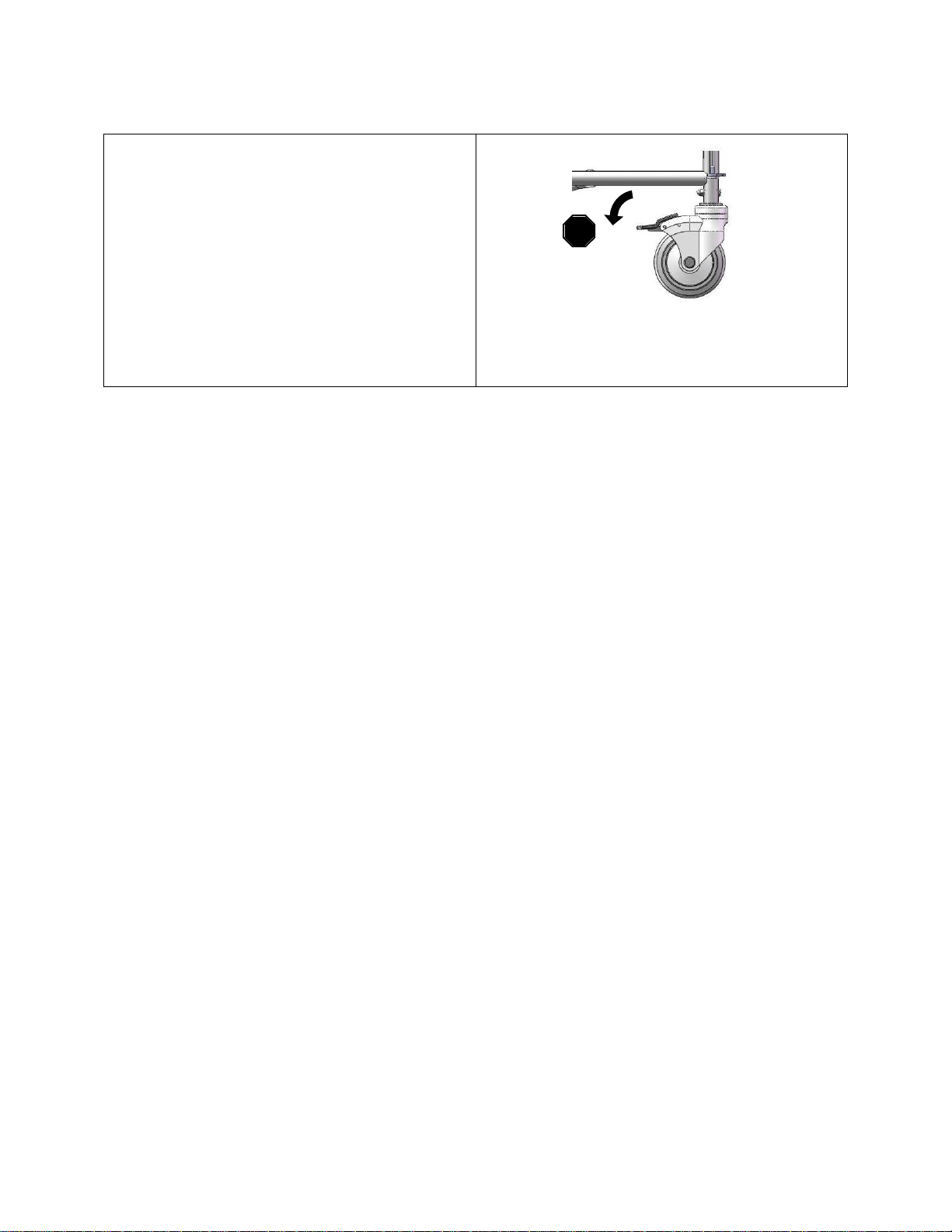
3.9 Casters
The Pedal Rocker features 5” total lock front casters and
5” fixed rear casters.
To Operate the Casters:
Step on/off the caster pedal to lock/unlock the caster.
Always ensure the brakes are not locked when
wheeling the chair.
For chairs with mag wheels, lock and unlock using the
handbrake.
3.10 Accessories (Options)
We recommend BRODA accessories for use only on BRODA chairs. The correct installation of the BRODA
accessory is very important. We recommend that the BRODA chair is ordered with the required accessories already
installed. Only authorized caregivers who thoroughly understand the accessory installation procedures should
attempt to install their BRODA accessories without assistance from their local BRODA representative. BRODA
does not recommend use of other manufacturer’s accessories on BRODA chairs.
14
Page 16

4 INSPECTION AND FUNCTIONAL TESTING
Safety measures as described in Section 1 must be observed when inspecting or testing a chair. Only authorized
caregivers or maintenance staff should attempt to inspect or test a chair.
4.1 Inspection
We recommend regular visual inspection for signs of wear, damage, loose or missing fittings, and other safety
concerns. If a breakage, defect, or operational problem is detected, the chair must be repaired inspected and tested
for function before it is returned to service.
We recommend that the chair be inspected as often as each use if there is any reason to be concerned about the
possibility of increased wear or loose or missing fittings. At a minimum, in regular use the chai r should be
inspected on a bimonthly basis. The visual inspection procedure should include at least the observation of all the
fittings (fasteners):
The visual inspection procedure should include at least the observation of the following parts:
1) The cylinde r that positions the seat tilt
2) The vinyl str aps used in the seat, back and wings
3) The cushio ns
4) The black handle and cable
5) The armrest height adjustment pins
The visual inspection procedure should include the observation of any installed accessories. The visual inspecti on
should be performed by the facility, or if in a private residence, by the individual responsib le for the chair.
4.2 Functional Testing
We recommend that the chair should be tested for operation of the chair’s functions without a resident in the
chair. The testing may be as often as each use if there is any reason to be concerned about the possibility of
increased wear or damage to the chair’s components. At a minimum, in regular use the chair should be tested for
functions as described in Section 3.
If the careg i ver or maintenance department performing the functional testing believes that any functi on is not
operating co rr ectly, the chair should be taken out of service until a satisfactory functional test can be completed.
The caregiver or maintenance department performing the testing should be aware that the seat tilt will be
more difficult without a resident in the chair.When performing repairs or maintenance, do not use lubricants that
contain sol vents. Solvents will damage many of the moving components in the chair. If necess ary, a white , food
grade grease (lubricant) may be used on the sliding components in the chair. Do not use spray lubricants on any part
of the chair.
15
Page 17

5 TECHNICAL INFORMATION
1. Seat Tilt:
Up to 18º of seat tilt (infinitely adjustable), Up to 33 º of infinitely adjustable seat tilt
2. Rocking Func tion
Provides gentle rocking while user is seated in the chair.
3. Frame:
16 gauge powder coated tubular steel
4. Seat/Back Surface:
BRODA Comfort Tension Seating Strapping is 1.5” wide, by .130” thick; contains
5. Arms:
Adjustable armrest height
6. Padding:
Standard removable padding – Neck rest and Lower Side Pads
7. Casters:
5” total lock front casters, 5” fixed rear casters
8. Seat Depth:
17”
9. Seat Height:
Adjustable 14” – 19”
10. Seat Width:
20” (18” also standard)
11. Overall Width:
25”
12. Weight Capacity:
250 lbs
13. Overall Weight:
Approx. 80 lbs standard features
5.1 Specifications
Specifications Based on 20” Wide Pedal Rocker Standard Features
when combined with rocking function.
Rocking has caregiver lock to activate or deactivate
Rocking tension can be a djusted according to the weight of the i ndividual in the chair.
fungicide, has shape memory retention, is fire retardant
The 34 ounce healthcare vinyl fabric covering is manufactured to meet the following
requirements: DIN 75 200/DIN 53 438; MVSS 302, M2;CAL 117, and Wyzenbeck
Heavy Duty Abrasion Test; has an anti microbial, antibacterial, anti-stain and anti -static
finish; Cold crack of -20ºC. Polyurethane foam meets CAL 117-2013.
Removable seat and back pads are covered with an 8 ounce soft vinyl which meets
CAN2-162 fla mmability standard for hospital textiles. Polyurethane foam meets CAL
117-2013. Removable, washable, pre-shrunk fitted cotton terry covers are provided for
the seat and back pads. Terry covers provide absorption, and vapor and heat transfer.
All dimensions are ± 0.5”.
16
Page 18
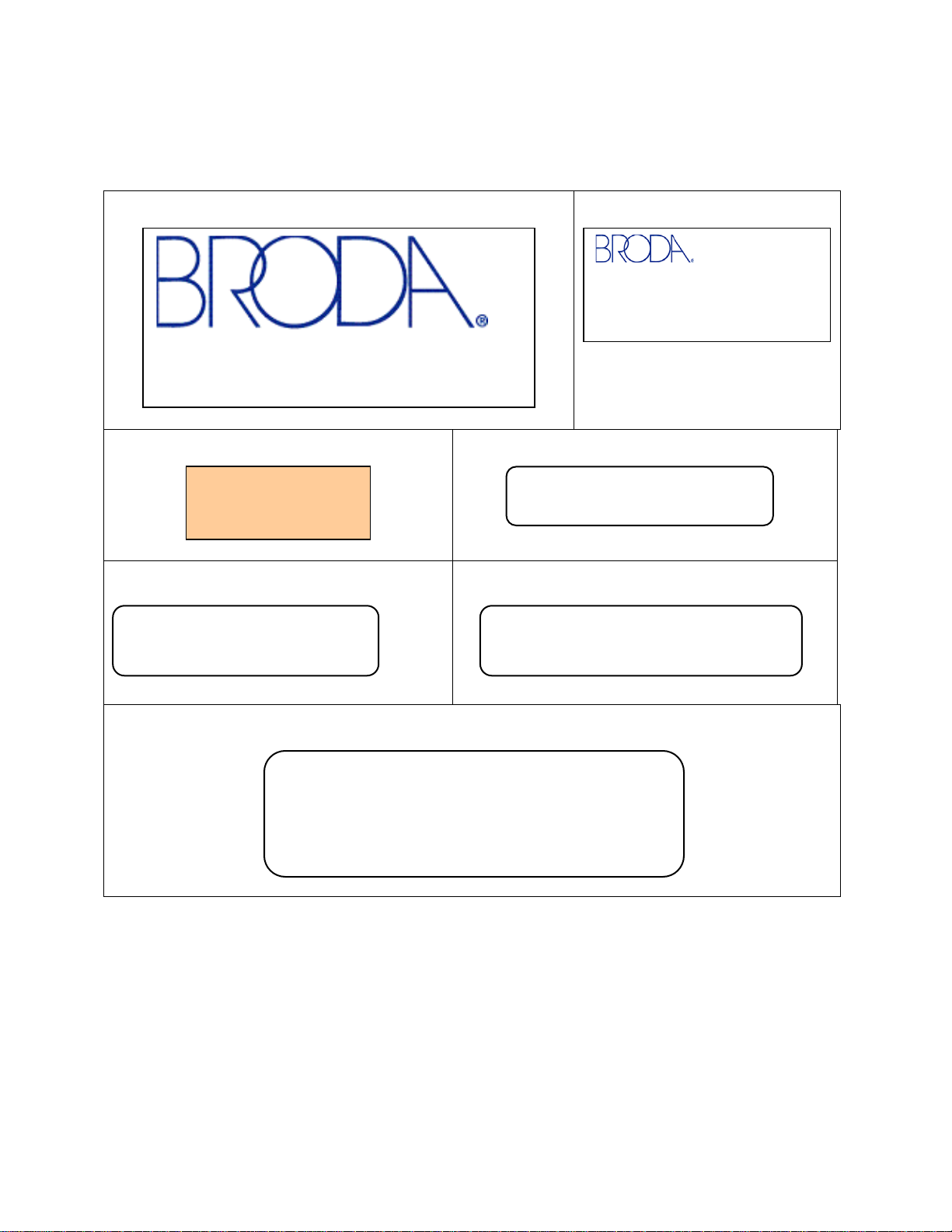
5.2 Labels
SEAT TILT
MADE IN CANADA
Rocking Fu nction Label
To Activate Rocking
Deactivate Rocking Before
To Adjust Rocking Tension See
BRODA uses certain labels to assist caregivers to identify items which permit the operation of the chair ’s fu nct ions.
Manufacturer’s Label (White)
MADE IN CANADA / FABRIQUE AU CANADA
560 Bingem ans Centre Drive, Kitchener, ON Canada, N2B 3X9
PHONE 1 – 519 746-8080 FAX 1-519-746-8616
Tilt Label (Tan)
SQUEEZE HANDLE
Tilt and Rocking Label
Operating Tilt
Rocking Adjustment Notification Label
Serial Number Label (Gray)
SEATING
1-800-668-0637
PRODUCT #
SERIAL #
Squeeze and Lock Handle
Knob under Seat
Rocking Adjus t me nt Lab e l
ROTATE KNOB
Decrease Rocking Tension (Lighter Occupants)
Increase Rocking Tension (Heavier Occupants)
ROTATE KNOB
17
Page 19
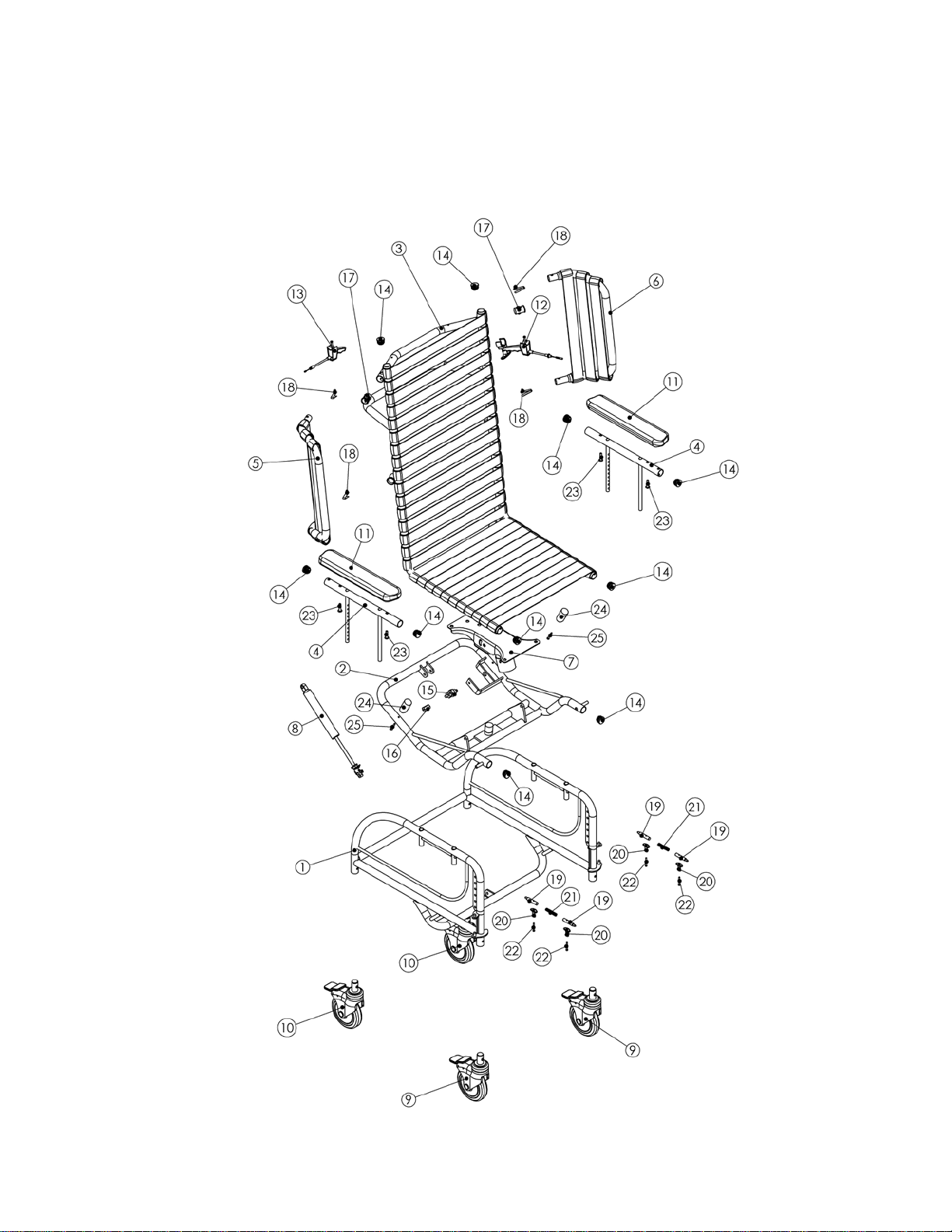
5.3 BRODA Seating 48R Pedal Rocker Parts Schematic Drawing
18
Page 20

3
Tilt Seat Frame One Piece 48R (width) (color)
1
SEAT/BACK-48R
4
Arm Frame Height Adjustable V2/V3 (left/right) (color)
2
ARM-TOP
13
Cable and Handle Assembly (cable length 48”)
1
CABLE-HAND
14
Plug rnd 1" 16-18ga inside ribbed
10
REPLACEMENT HARDWARE
15
Locking Mechanism for 48R (plunger)
1
PR-LOCK
REPLACEMENT HARDWARE
Broda 48R Pedal Rocker Schematic Legend
# Description Quantity Item
1 Base Frame 48R (width) (color) 1 BASE-48R
2 Seat Frame Sub Tilt 48R (width) (color) 1 SEAT-SUBTILT-48R
5 & 6 Wing Strapped Frame Removable (left/right) (color) 1 WING-STRAP
7 Rocking Mechanism 48R 1 ROCKMECH
8 Cylinder Gas Spring 600N and Actuator w/lever 1 CYL-LOCK-KIT
9 Caster 5 Total Lock (color) 2 CASTER-5”TL
10 Caster 5 Fixed (color) 2 CASTER-5”FX
11 Armrest Soft 2 AR
12 Cable and Handle Assembly 48R Rocking Mechanism 1 CAB-HAND-48R
16 Coupling 8mm to 10-24" Thread 1 COUPLING
17 Bushing arm sleeve 2 BUSH-ARM-SLV
18 Spring for Arm Bottoms and Wings 4 DETENT-PIN
19, 20, 21 & 22 Push Pin Assembly (Kit) 2 PUSH-PIN
23 Screw 1/4-20x1-1/4 pan quad, zinc 4
24 Die Spring 2 DIE-SPRING
25 Screw # 8 x 1-1/2” Pan Quad Zinc 2
REPLACEMENT HARDWARE
19
Page 21
6 COMMON TROUBLESHOOTING AND REPAIR
Symptom
Problem
Solution
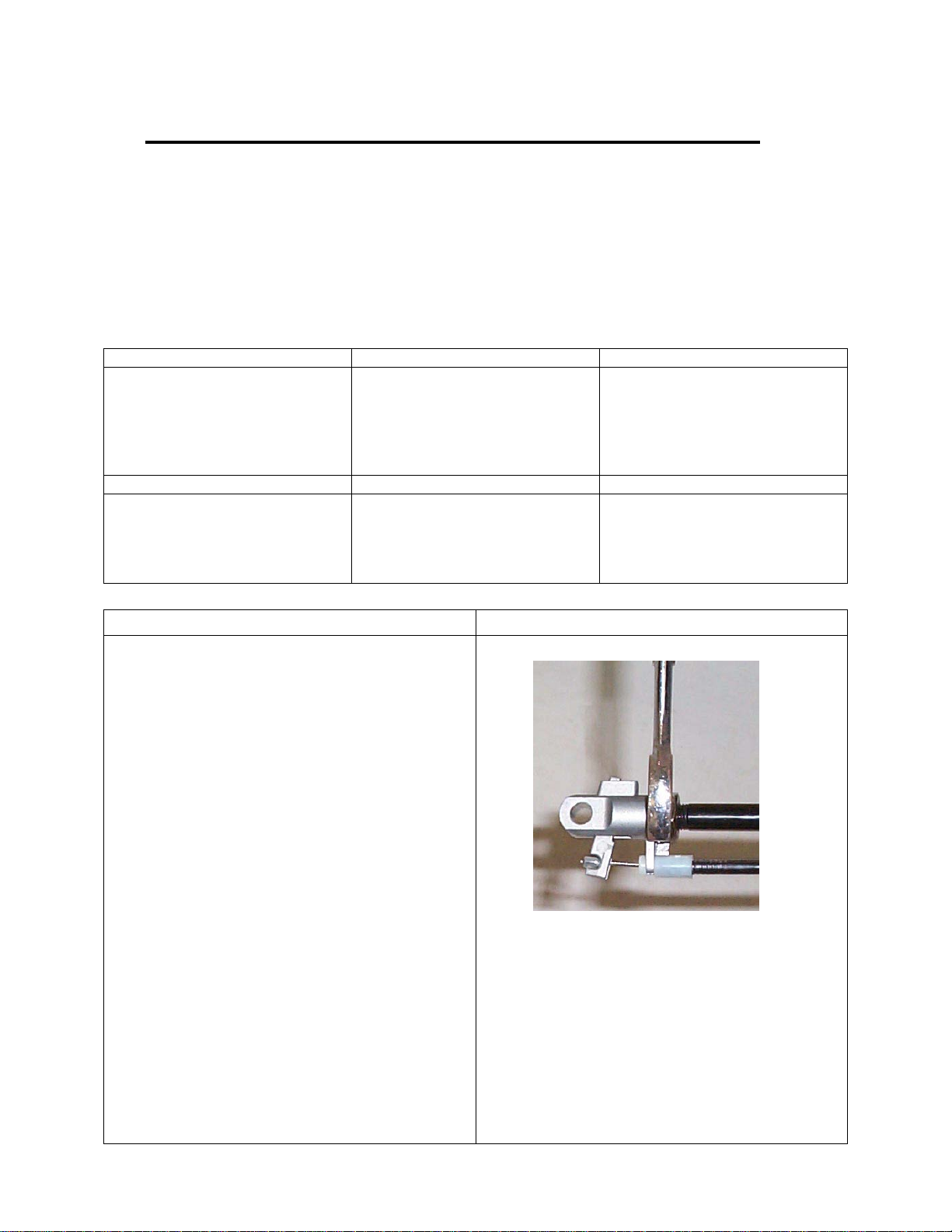
The chair is not tilting when the
The pin in the end of the c ylinder is
Ensure the cable is attached to the
The chair (tilt) seems to slowly slide
The pin in the end of the c ylinder
See Adjustment Steps below:
Adjustment Steps:
-Loosen the lock nut locat ed on the stem of the gas
Please have the chair serial number ready when contacting BRODA or your local area representative for parts or
assistance for your chair. The serial number can be found on a grey sticker on the rear of the chair.
6.1 Troubleshooting for Gas Cylinders
The use of gas charged springs (cylinders) on BRODA products allows the caregive r to easily make adjus tments to
the tilt, recline, and leg rest with a minimal effort. The gas cylinders contain Nitrogen gas, it is not flammable nor is
it toxic. The cylinders provide a lifti ng force which counterbalances the weight of the occupant thereby reducing the
amount of weight the caregiver needs to lift.
handle is squeezed
out of position
cylinder ne xt to the actuator (17mm or 11/16” wrench)
-From the above instruction determine whether you want
to wind the stem further i nto the actua t or or further out
of the actuator. Wind the stem further into the
actuator if the chair i s not tilting or reclining, (wind
clockwise) and wind it further out of the actuator if
the chair is slowly sliding out of position. (wind
counter-clockwise)
-Wind the stem in the correct direction one half turn.
-Check the f unction of the cylinder and repeat the above
step until the cylinder functions properly.
-Tighten the lock nut loosened in the first step.
-If adjusting the cylinder does not correct the problem,
the cylinder may need to be replaced. Please contact
BRODA at or your local area representative.
not being depressed when the handle
is pulled.
may be still partially depressed .
Note: Cylinder does not need to be removed from the
chair to make this adjustment.
20
cylinder actuator.
If cable is attached, see Adjustment
Step sbelow.
Page 22
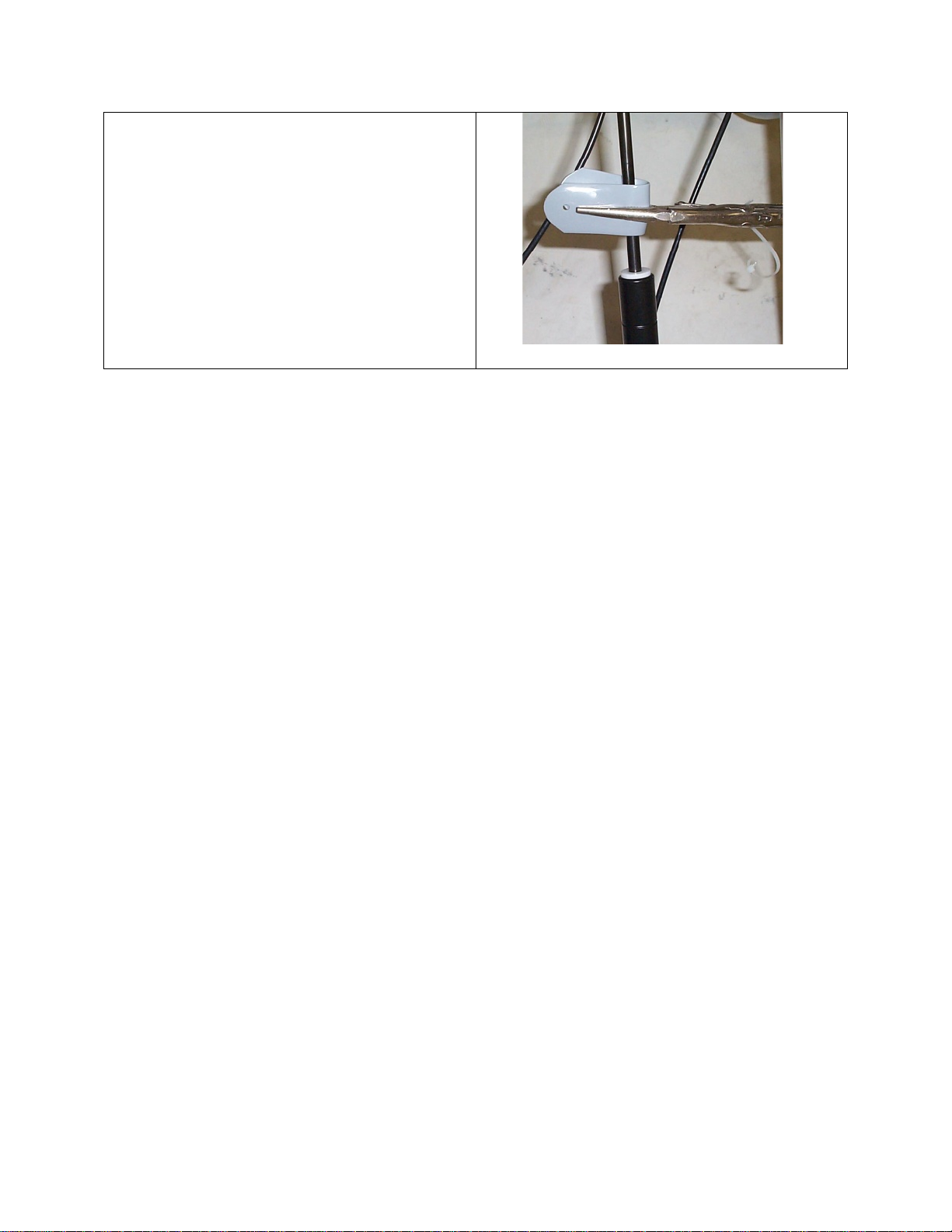
Note: When adjusting cylinders with tools that co me in
contact with the cylinder rod s, a clo th or some other
protective material must be used to protect the sliding
surface of the rod.If the rod becomes scratched or
marred it will damage the seal on the cylinder and the
cylinder will fail.
Damaging a cylinder in this fashion voids the
manufacturer’s warranty.
21
Page 23
7 WARRANTY
BRODA SEATING
WARRANTY
BRODA provides a Three Year Warranty on the chair frame, and a One Year Warranty on all other
component s subject to the following conditions:
No warranty is provided on seat pads or cloth covers.
The chair frames are guaranteed for three years against structural defects or failure. All other parts (except
seat pads and cloth covers) including but not limited to strapping, cushions, gas springs and attachments,
casters, wheels, brakes and armrests are guaranteed for one year against defects in materials and
workmanship based on normal institutional use. The guarantee does not cover malicious or deliberate
damage or damage from misuse. The guarantee does not cover use of BRODA chairs in a shower or pool,
with the exception of the BRODA Commode/Shower Chair.
Modifications to BRODA products or the use of non-BRODA supplied parts voids the warranty. This
warranty does not cover shipping damage (see below).
BRODA will provide new or refurbished parts for installation by the owner at no cost following confirmation
by the local BRODA Representative or the BRODA Head Office Customer Service Representative. On
request, defective parts must be returned to the factory within thirty days of receipt of the replacement parts
by the owner. If the defective parts are not returned to BRODA on request, the owner will bear the cost of the
replacement parts on invoice from BRODA.
Warranty does not include on-site labor for the installation of warranty parts or warranty repairs. The owner
may return to BRODA products for warranty replacement or repair by shipping items prepaid and insured to
the factory. Warranty completed at the factory includes both materials and labor. The decision to repair or
replace parts is at the discretion of BRODA. All returns to the factory require prior authorization from
BRODA.
BRODA retains the ri ght to make design and application chan ges without notice. All orders will be filled
with BRODA's current models unless otherwise specified by the purchaser.
BRODA chairs are designed for patient mobility, positioni ng, and co mfort i n speci alty se atin g, ho wever, the
application of BRODA products shall remain the responsibility of the purchaser or user.
This warranty is not transferable.
RETURNS
BRODA Seating will not accept any returns without a prior Returned Goods Authorization Number. Please
contact our Head Office Customer Service Representative at 1-800-668-0637 for assistance. Returns must be
insured when shipped .
DAMAGED FREIGHT
NOTIFY THE CARRIER OF ANY DAMAGE IMMEDIATELY
It is the responsibility of the person receiving the goods to examine cartons and goods before accepting
receipt. Note all damages on the bill of lading and file a claim if necessary. Notify the carrier of any
concealed damaged within 48 hours of receipt.
BRODA ins ures all pr oducts for in transit d amage, failure to notif y the carrier of in transit da mage voids both
the insurance and the BRODA warranty. If you require assistance, contact our Head Office at 1-800-668-
0637.
SALES TAX
Most BRODA products are G.S.T. Zero Rated and Exempt from Canadian Provincial Sales Tax. Purchasers
may be required to check with their Provincial or State Tax Office for purchaser tax payment.
22
 Loading...