

Page 1
Power
BostonAcoustics
.com
PowerV
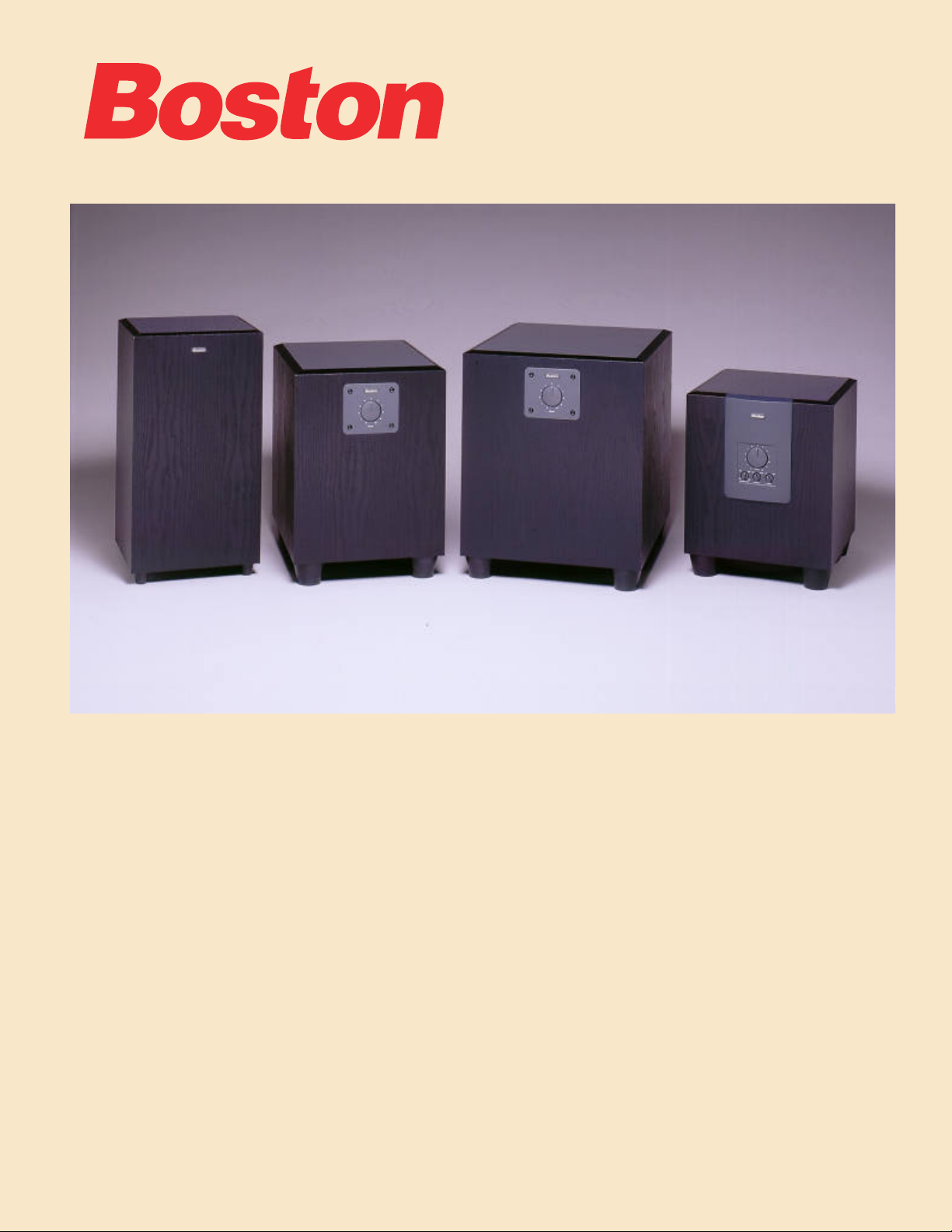
Boston's new PowerVent subwoofers deliver the dynamic
±
. Drama. Impact.
ent® Subwoofers
bass foundation that is essential for lifelike reproduction of
movie soundtracks and music in the home.
All four of the new subwoofers utilize rugged, long-excursion bass units built in Boston's state-of-the-art manufacturing facility in Peabody, Massachusetts. Every one is tested
as it comes off the line to be within
unit, an incredibly tight tolerance. The amplifiers have
built-in variable crossovers that make it easy to achieve a
seamless blend with the main speakers, while 24dB/octave
low-pass filters prevent the subwoofer from being easily
localized by ear, increasing placement flexibility. A crossover bypass position is provided for use with home
theater electronics that perform their own bass management
functions.
The PV800 and PV1000 use special high-efficiency amplifiers that deliver high power with low distortion. Our
amplifiers use a linear output stage for superior sound
1dB of the lab reference
quality, and a digital tracking power supply that delivers the
required output voltage without power line "sag" or excessive thermal buildup.
Because of their high-powered amplifiers and computeroptimized tuning, all four models are capable of impressive
deep bass and high output from remarkably compact enclosures. In addition, all four units feature BassTrac,
a proprietary new Boston-designed circuit that tracks the
input signal to the subwoofer and prevents its amplifier from
being driven into audible distortion. Unlike conventional
limiters, it preserves the waveform’s shape so the fidelity of
the signal is maintained, while preventing distortion. The
benefit: The bass stays clean and strong at any listening
level.
Auto on-off amplifier switching and easily accessible controls make the PowerVent subwoofers as convenient to use
as they are exciting to listen to.
™
Page 2
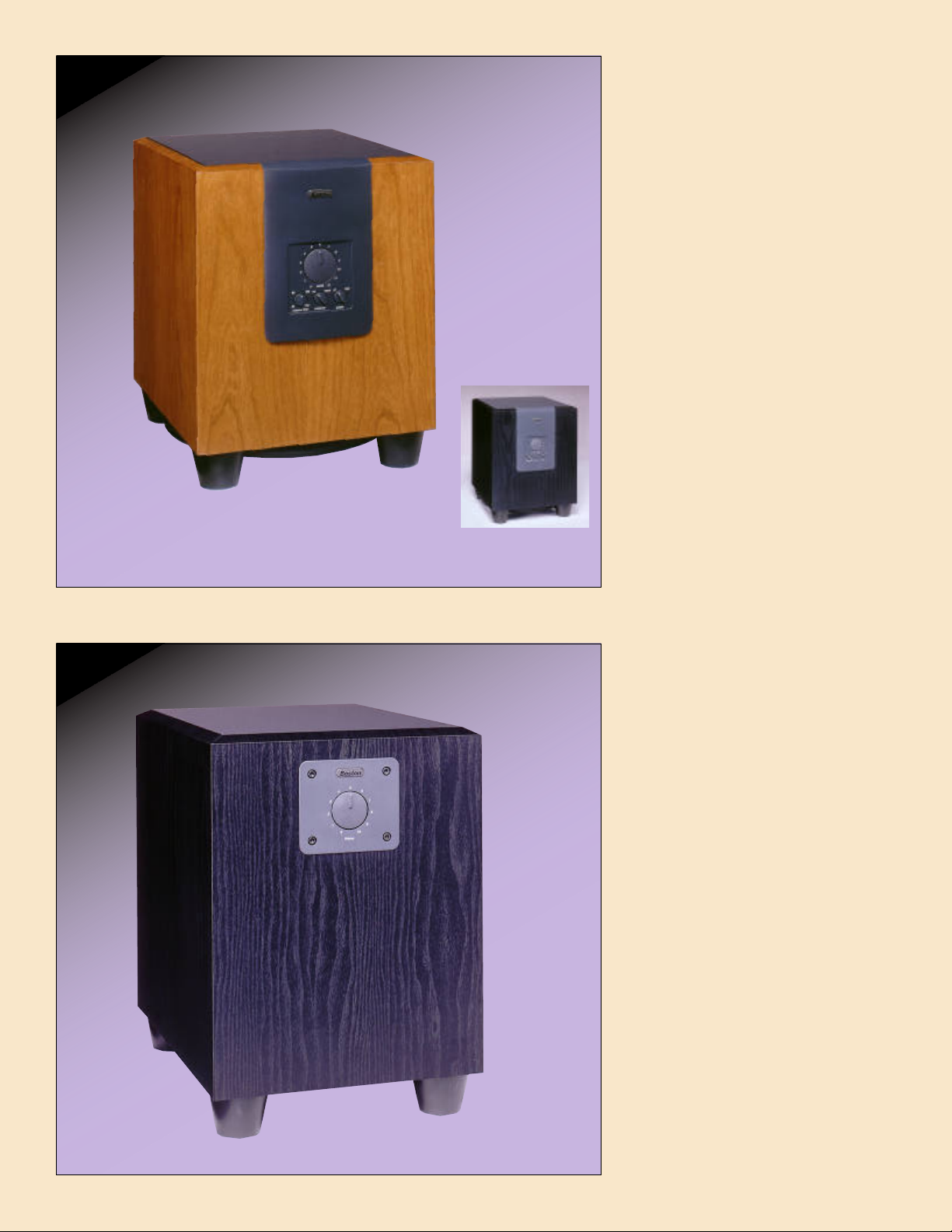
Also available in black
ash wood veneer
PV1000
The PV1000 is proof that powerful
things come in small packages. Here is
a subwoofer that delivers stunning low
frequency performance while occupying barely over one square foot of
floor space.
Advanced Boston technology makes
this performance possible. A 10"
(250mm) down-firing long-excursion
bass driver with cast aluminum basket
and patented
coupled with a 10-inch rear-firing passive radiator for bass that excites your
senses. With its 1000-watt, high efficiency amplifier providing the driving
muscle, the PV1000 is the subwoofer of
choice for the most demanding music
or home theater systems.
Front-mounted volume, crossover
frequency, bypass, and phase controls
are easy to reach, making it simple to
achieve the optimum performance.
* Covered by U.S. Patent no. 5,940,522
*
RadialVent™ cooling is
PV600
We believe the PV600 redefines the
price/performance relationship for moderately-priced subwoofers. In terms of
low-frequency extension, maximum
output, and freedom from audible distortion, the PV600 sets a new standard
at its price.
The key to its outstanding performance
is its Boston-built 10-inch (250mm)
bass driver. Manufactured on Boston's
state-of-the-art assembly line to a tolerance of ±1dB, this driver features a
long-excursion DCD voice coil and a
high-mass, low-resonance diaphragm
for response down to 29Hz (-3dB).
The dual 2-inch (50mm) down-firing
ports are flared at both ends to reduce
audible turbulence. The high-current
120-watt amplifier has both speakerand line-level inputs, as well as a crossover bypass position. A front-mounted
volume control makes it easy to adjust
the bass to the desired level.
Page 3
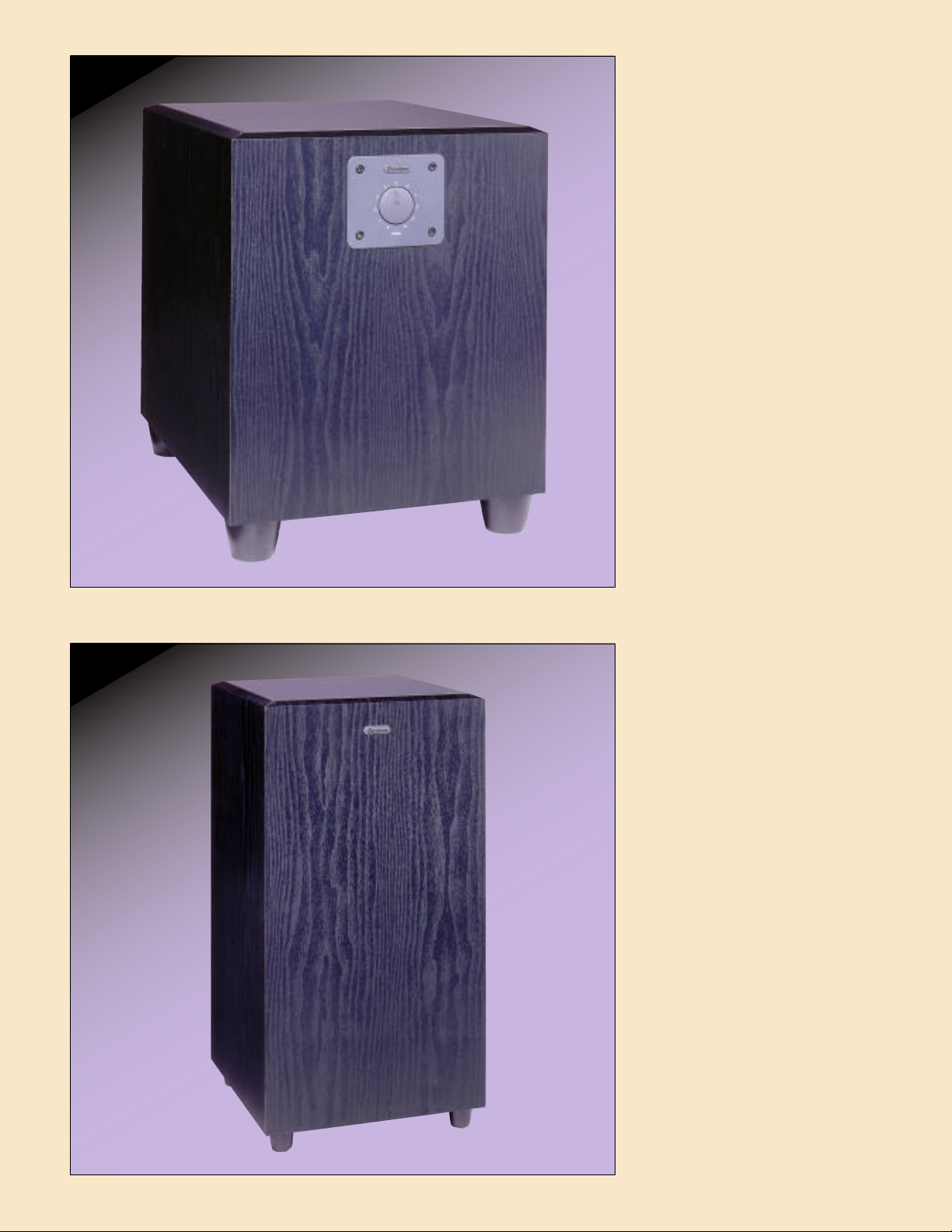
PV800
With its Boston-built 12-inch (300mm)
woofer and 300-watt amplifier, the
PV800 is a powerful answer to those
seeking the best bass reproduction for
their home entertainment system.
The down-firing driver features DCD™
(Deep Channel Design) technology.
Using Finite Element Analysis computer modeling to optimize the driver's
magnetic structure, we cut a groove in
the poleplate, increasing voice coil excursion, while maintaining the driver's
high efficiency. The result is a driver
that can move a large volume of air for
high output and low distortion, without
bottoming out.
The amplifier has both speaker- and
line-level inputs for complete hookup
flexibility. A variable crossover control
makes it easy to blend the PV800 with
any speakers, and a crossover-bypass
position is provided for use with digital
home theater electronics.
PV400
The PV400 delivers powerful, articulate bass performance that's hard to
believe from a such compact enclosure.
With a footprint of just 10 x 11 inches
(255 x 280mm), this trim unit fits
almost anywhere. It's the perfect solution to getting big bass when space is at
a premium.
Using a Boston-built 7-inch (180mm)
DCD driver in a dual-bandpass enclosure, the PV400 responds strongly down
to 44Hz (-3dB), giving music and movies a solid, satisfying foundation. Its
65-watt high-current amplifier has
speaker, line, and crossover-bypass
connections. The dual 2-inch (50mm)
down-firing ports are flared at both ends
to reduce audible turbulence.
The PV400 may not have the same bass
extension as our other subs, but in terms
of clean, powerful output and lack of
audible distortion, it's pure Boston.
Page 4
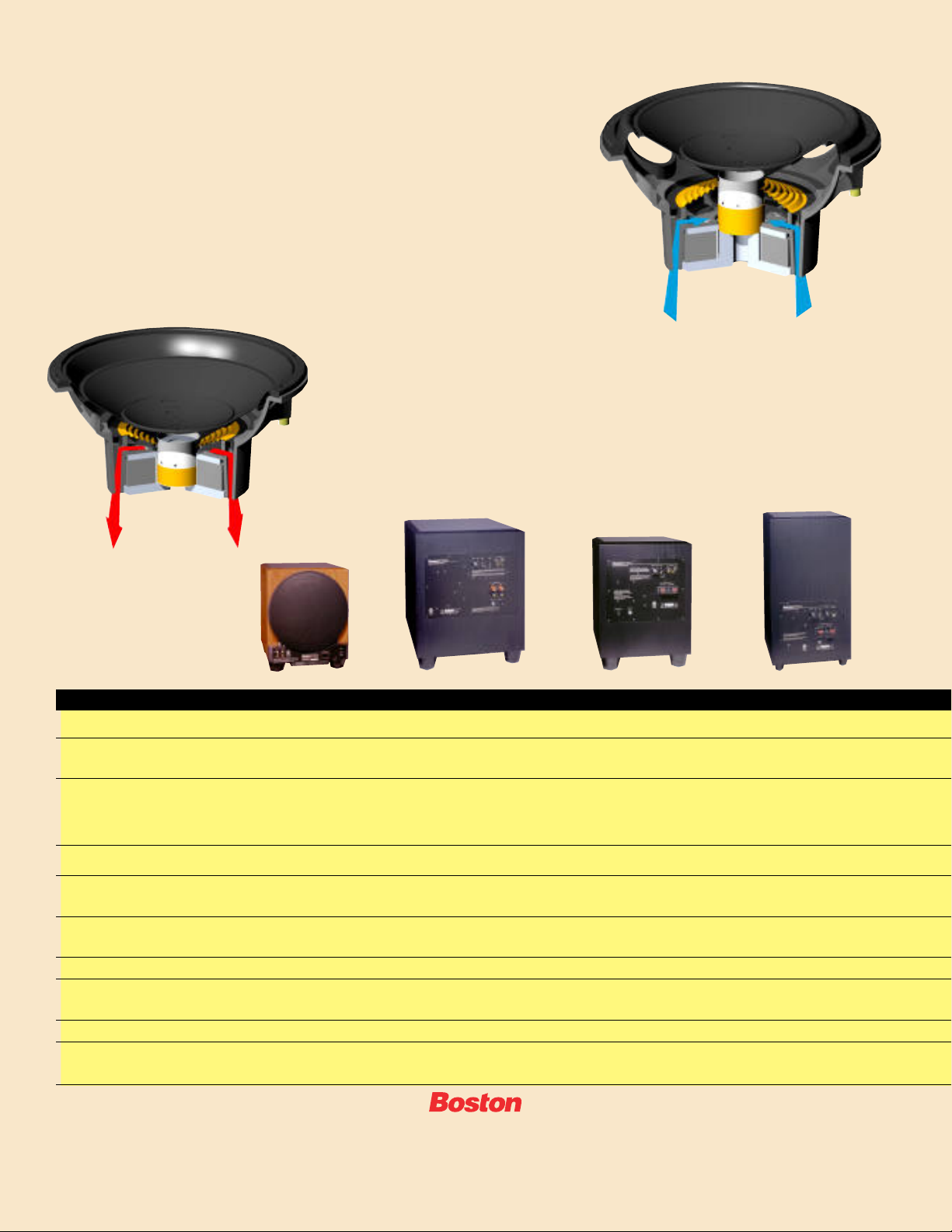
Specifications PV1000 PV800 PV600 PV400
Frequency Response (±3dB) 22–150Hz 26–150Hz 29–150Hz 44–150Hz
Subwoofer Amplifier Power 1000 watts continuous 300 watts continuous 120 watts continuous 65 watts continuous
<.5% THD, 850 watts, 20-150Hz <.5% THD, 250 watts, 20-150Hz <.5% THD, 100 watts, 20-150Hz <.5% THD, 50 watts, 30-150Hz
Subwoofer Crossover 50–150Hz 50–150Hz 75–150Hz 75–150Hz
24dB/octave low-pass 24dB/octave low-pass 24dB/octave low-pass 24dB/octave low-pass
Crossover Bypass Yes Yes Yes Yes
Bass Unit 10" (250mm) DCD 12" (300mm) DCD 10" (250mm) DCD 7" (180mm) DCD
down-firing down-firing down-firing internal
Passive Radiator 10" (250mm) — — —
rear-firing
Enclosure Type Passive Radiator Dual Ported Dual Ported Bandpass
Dimensions (H x W x D) 143/4 x 111/2 x 141/8" 18 x 141/4 x 19" 161/2 x 117/8 x 161/8" 191/2 x 10 x 11"
(375 x 293 x 359mm) (458 x 363 x 483mm) (420 x 302 x 410mm) (496 x 254 x 280mm)
Weight 40 lbs (18kg) 40 lbs (18kg) 30 lbs (14kg) 25 lbs (12kg)
Finish Cherry or Black Black Ash Black Ash Black Ash
Wood Veneer Vinyl Veneer Vinyl Veneer Vinyl Veneer
PV1000 Technical Highlight: RadialVent™ Cooling
It's an immovable law of physics: If you want deep bass response from a small
enclosure, you need lots of power. There's no way around it. In the case of the
PV1000, we use a high-efficiency 1000-watt amplifier to get response down to
22Hz from a remarkably small cabinet. But high power is only half of the
equation. We also need a rugged, high-output bass driver that can handle 1000
watts safely.
When a signal is applied to a voice coil, it heats up, and in turn, heats the air and the
speaker basket around it. Under extremely high power input conditions, the heat at the
voice coil builds up faster than the basket can reradiate it, eventually leading to thermal
failure or speaker "burn out."
To meet this challenge, Boston engineers developed RadialVent, a patented system
where the driver's action draws in cool air and circulates it though the double wall
of aluminum in the driver's basket (see blue arrows). The aluminum basket
effectively acts as a heat sink with forced-air cooling. The drawn air also provides
convective cooling for the basket which has absorbed heat from the voice coil. The
driver's motion then expels this heated air through the vents (red arrows). The net
result is a speaker that can operate safely at very high power levels, without danger
of thermal overload.
90Hz, 6dB/octave high-pass — — —
BostonAcoustics.com
300 Jubilee Drive Peabody, MA 01960 978-538-5000 Fax: 978-538-5199
Specifications subject to change without notice. BassTrac, RadialVent and DCD are trademarks and Boston, Boston Acoustics and PowerVent are
registered trademarks of Boston Acoustics, Inc. © 2000 Boston Acoustics, Inc. All rights reserved.
 Loading...