

Page 1

Manual
KASP-TF V5.0 Master Mix
For Research Use Only. Not for use in diagnostic procedures.
Page 2

Manual
KASP-TF V5.0 Master Mix
Contents
1. Productdescriptionandspecication 3
2. Kit contents and storage 3
3. Before you start 3
4. Prepare the KASP genotyping mix 4
5. Dispensing 5
6. KASP cycling conditions 5
7. Reading KASP reactions 6
Appendix A: Performing the KASP thermal cycle on the IntelliQube instrument 7
For Research Use Only. Not for use in diagnostic procedures.
Page 3

Manual
KASP-TF V5.0 Master Mix
1. Productdescriptionandspecication
KASP-TF V5.0 Master Mix by LGC, Biosearch Technologies™ has been optimised for high-throughput
single nucleotide polymorphism (SNP) and insertion/deletion (indel) genotyping in Array Tape™. This 2X
mix has been designed specically for use with Array Tape on the Nexar™ in-line liquid handling and assay
processing system (Nexar system) and the IntelliQube™ instrument.
In high-throughput experiments, users typically perform thermal cycling of Array Tape using a
Hydrocycler2™ or a Soellex™. It is possible to perform thermal cycling of Array Tape on the IntelliQube
instrument; please see Appendix A for details.
KASP-TF V5.0 Master Mix is available in three pack sizes, as detailed in Table 1.
Product code Pack size Pack size
KBS-1050-201 2.5 mL KASP-TF V5.0 2X Master Mix, Standard ROX
KBS-1050-202 25 mL KASP-TF V5.0 2X Master Mix, Standard ROX
KBS-1050-204 250 mL KASP-TF V5.0 2X Master Mix, Standard ROX
KBS-1050-203
Table 1. Product codes and pack sizes for KASP-TF V5.0 Master Mix.
2. Kit contents and storage
i. KASP-TF V5.0 Master Mix – supplied at 2X concentration. Contains FAM™ and HEX™ specic
FRET cassettes, KASP Taq , dNTPs, salts, and buffer.
ii. MgCl2 – 50 mM, for optimisation of assays in particularly A/T-rich DNA regions.
iii. DMSO – for optimisation of assays in particularly G/C-rich DNA regions.
KASP-TF V5.0 Master Mix can be safely stored for 1 week at 4 °C, one year at -20 °C, or indenitely at
-80 °C. KASP-TF V5.0 Master Mix should be aliquoted for storage, and use of light-protective tubes is
recommended. Frequent freezing and thawing of KASP-TF V5.0 Master Mix is not recommended.
(250 mL)
(10 × 25 mL)
KASP-TF V5.0 2X Master Mix, Standard ROX
3. Before you start
• KASP Assay Mix should be ordered from Biosearch Technologies. Each KASP Assay Mix is specic
to the SNP or indel that is to be targeted, and consists of two competitive allele-specic primers and
one common reverse primer. Two options are available for ordering KASP Assay Mix:
– KASP-by-Design (KBD) – primers based on in silico design, no wet lab validation.
– KASP-on-Demand (KOD) – optimised and functionally validated in our genotyping laboratory.
3
For Research Use Only. Not for use in diagnostic procedures.
Page 4

Manual
KASP-TF V5.0 Master Mix
• Thaw and vortex KASP Assay Mix and KASP-TF V5.0 Master Mix.
• Prepare DNA samples – ensure that these are at the appropriate concentration for the genome size
of your organism. Most KASP assays will function well with 5-50 ng of high quality DNA per reaction
(based on human genome size).
• If DNA is to be dried down into the Array Tape on a Nexar system with two drying heads, each drying
head should be set at 75 °C for 42000 ms on each array. These conditions will need to be optimised
if using a Nexar with greater or fewer than two DNA drying heads.
4. Prepare the KASP genotyping mix
KASP-TF V5.0 Master Mix can be dispensed at 1X or 2X concentration, depending on the format of the
DNA template, as detailed in Table 2.
DNA format Instrument KASP-TF V5.0 Master Mix
IntelliQube instrument
Wet DNA
Nexar system
Nexar system in conjunction
with the Array Tape Sample
Dry DNA
Table 2. Format for dispensing KASP-TF V5.0 Master Mix for both wet and dried down DNA samples.
Dryer (i.e. DNA samples
dried down prior to KASP
Genotyping mix dispense).
Dispense at 2X concentration
(as supplied).
Dispense at 1X concentration.
N.B. KASP-TF V5.0 2X Master
Mix must be diluted by the
addition of molecular biology
grade water, to bring the overall
nal mix concentration to 1X.
Recommended total
reaction volume
1.6 µL (See Table 3)
0.8 µL (See Table 4)
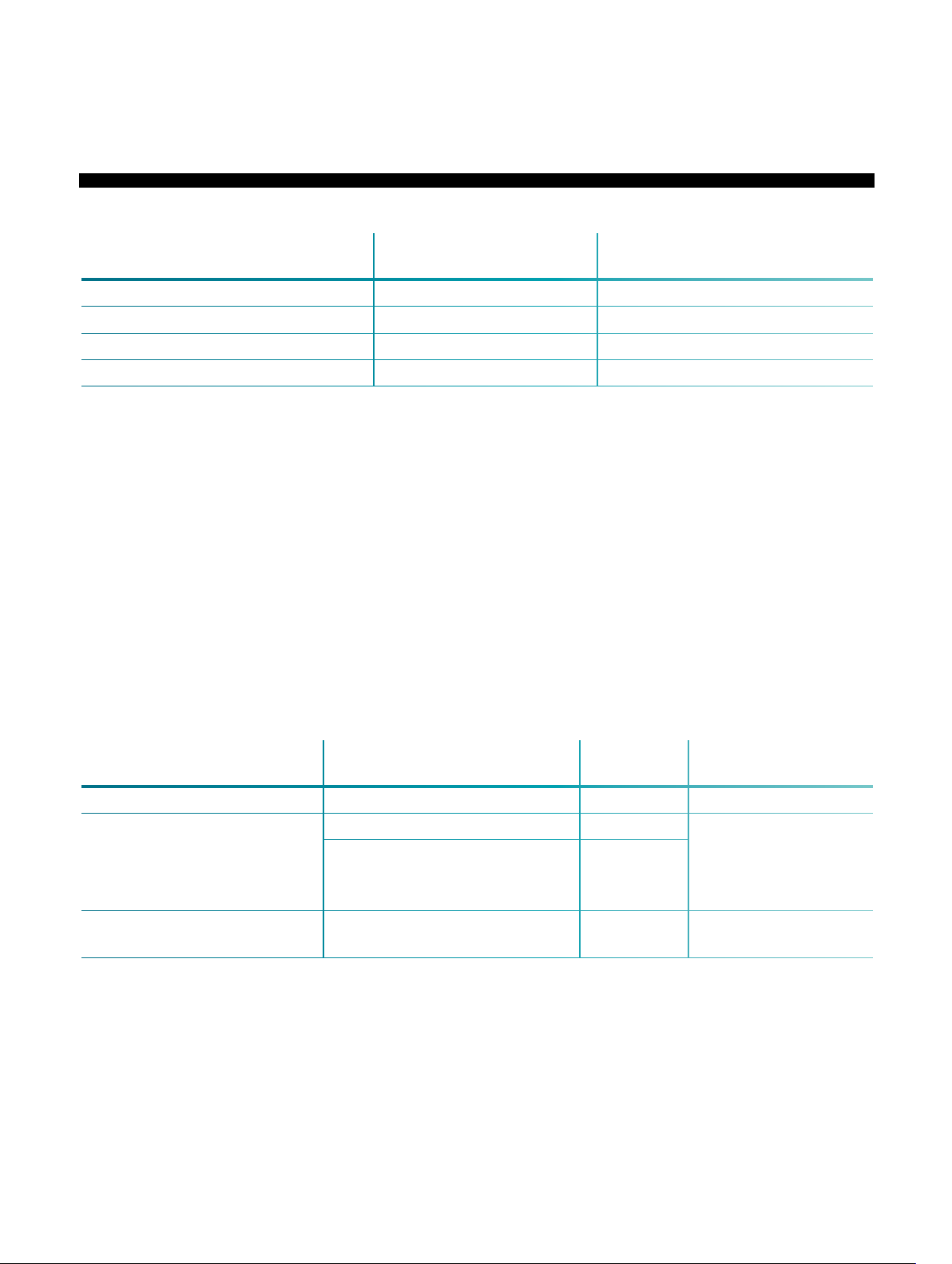
Prior to dispensing, KASP-TF V5.0 Master Mix must be combined with KASP Assay Mix according to the
ratios detailed in Tables 3 and 4 (for wet and dry DNA respectively). Exact volume requirements for each
Array Tape will be calculated by the Nexar or IntelliQube software depending on your dispensing format
(Tables 3 and 4 are for illustration only).
In Array Tape format, KASP performs well with total reaction volumes ranging from 0.8-1.6 µL.
Volume per reaction
DNA sample 0.8 µL -
KASP-TF V5.0 Master Mix 2X 0.8 µL 368.6 µL
KASP Assay Mix (72x, as supplied) 0.022 µL 10 .14 µ L
Total reaction volume 1.6 µL -
Volume for 384 reactions
(including 20% excess)
Table 3. Constituent reagent volumes for KASP genotyping reactions using wet DNA. KASP-TF V5.0 Master Mix should be used as supplied (2X).
4
For Research Use Only. Not for use in diagnostic procedures.
Page 5
Manual
KASP-TF V5.0 Master Mix
Volume per reaction
DNA sample n/a (dry DNA) -
KASP-TF V5.0 Master Mix 1X 0.8 µL 368.6 µL
KASP Assay Mix (72x, as supplied) 0.011 µ L 5.07 µL
Total reaction volume 0.8 µL -
Table 4. Constituent reagent volumes for KASP genotyping reactions using dry DNA. KASP Array Tape Master Mix should be diluted to 1X using molecular biology
grade water.
Volume for 384 reactions
(including 20% excess)
5. Dispensing
After preparation of the KASP genotyping mix as detailed in Section 4, this should be dispensed using
the Nexar system or IntelliQube instrument. For detailed instructions on programming the dispense steps,
please refer to the appropriate instrument manual.
6. KASP cycling conditions
The KASP thermal cycling conditions detailed in Table 5 should be used when running KASP in Array Tape,
using a waterbath-based high-throughput thermal cycler (Hydrocycler2 or Soellex). Appendix A details the
thermal cycle program to use when Array Tape is to be thermally cycled on the IntelliQube instrument.
Protocol stage Temperature Duration
Stage 1 hot start Taq activation 94 °C 15 minutes × 1 cycle
94 °C 20 seconds
Stage 2 touchdown
Stage3amplication
Table 5. KASP thermal cycling conditions for reactions that will be read using the Nexar System or the IntelliQube® instrument. Please note that these conditions are
optimised specically for Array Tape and should not be used for standard PCR plates.
65 °C
(65 °C decreasing 0.8 °C per
cycle to achieve a nal annealing/
extension temperature of 57 °C)
94 °C
57 °C
60 seconds
20 seconds
60 seconds
Number of cycles
for each stage
× 10 cycles
× 26 cycles
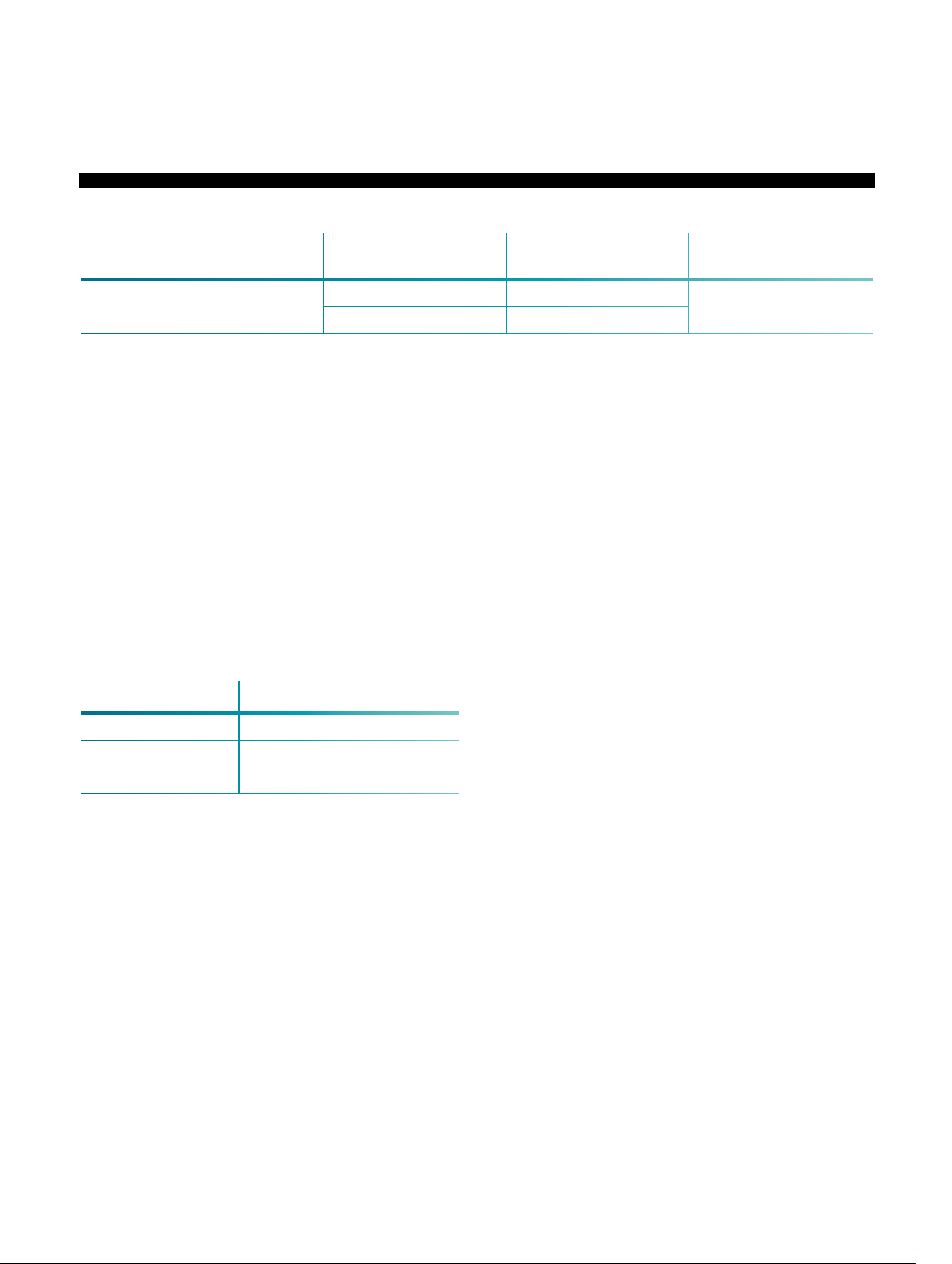
If sufciently dened genotyping clusters are not obtained after 36 PCR cycles, Array Tape should be
further thermally cycled in increments of three cycles; the recommended recycling protocol is detailed in
Table 6. After each ‘recycling protocol’ (see Table 6), the reactions should be re-read.
5
For Research Use Only. Not for use in diagnostic procedures.
Page 6
Manual
KASP-TF V5.0 Master Mix
Protocol stage Temperature Duration
94 °C 20 seconds
Stage1amplication
57 °C 60 seconds
Table 6. KASP further cycling conditions for for reactions that will be read using the the Nexar system or the IntelliQube instrument when additional thermal cycling
is required.
Number of cycles
for each stage
x 3 cycles
Please note, if you are using the IntelliQube to perform thermal cycling, instead of a Hydrocycler or the
Sollex, refer to the protocol detailed in Appendix A.
7. Reading KASP reactions
Reactions should be read after completion of 36 cycles (as per Table 5). KASP reactions run on the
Nexar system can be read on the Araya™ in-line uorescence detection system using standard genotyping
conditions; there is no requirement to modify any of the read settings.
To read KASP on the IntelliQube instrument, the uorophores detailed in Table 7 should be selected during
run setup.
Fluorophore IntelliQube reference
ROX Passive reference dye
FAM x-axis
HEX (or VIC*) y-axis
Table 7. Fluorophores required to read completed KASP reactions on the IntelliQube instrument.
*If the available dye sets contain VIC but not HEX, VIC can be used instead as the excitation and emission values for HEX and VIC are extremely similar.
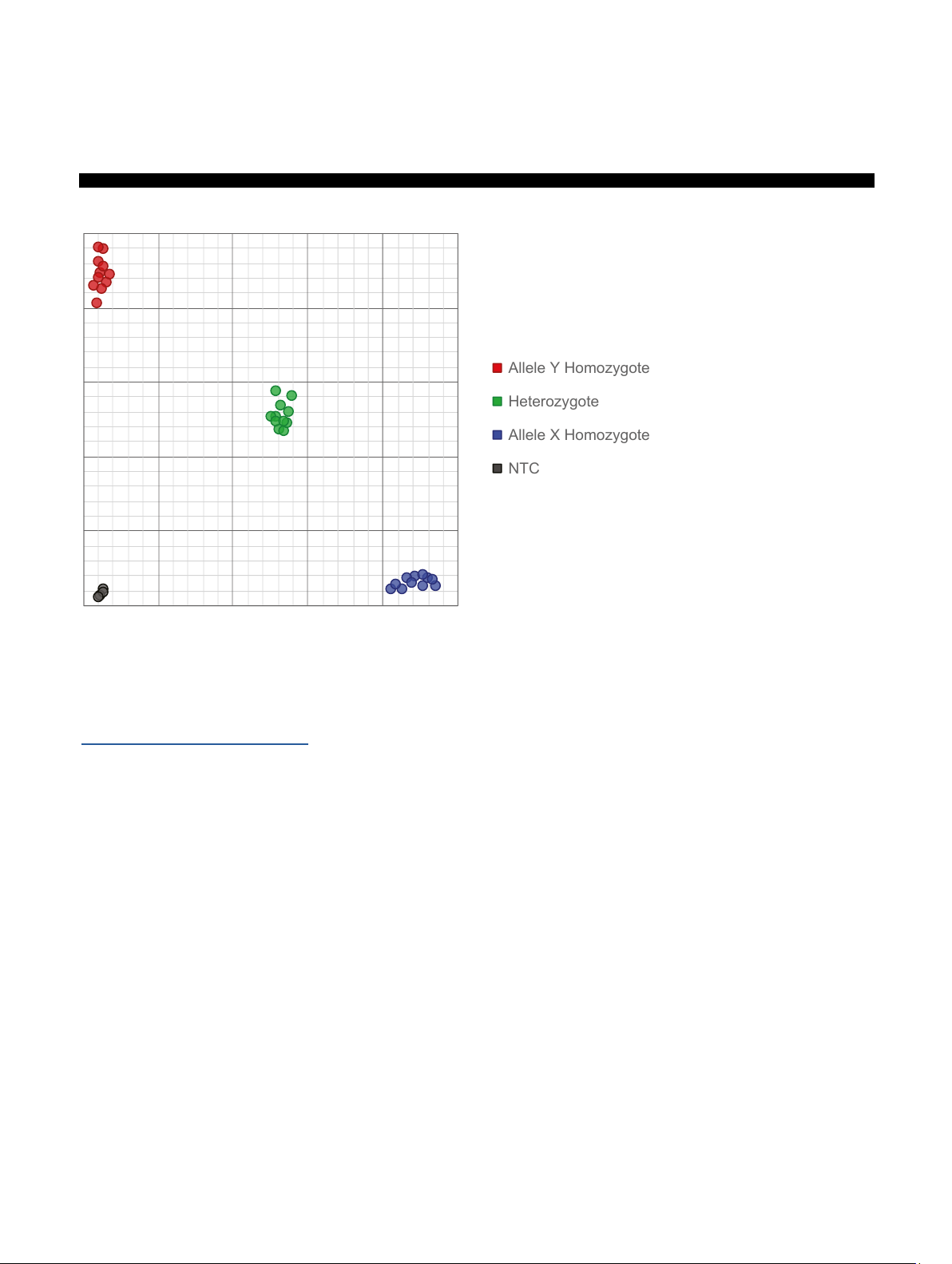
KASP genotyping data should be plotted in a cluster plot format; typically FAM values are plotted on the
x-xis and HEX values are plotted on the y-axis. Values can be normalised using the ROX values for each
well thus removing the variable of liquid volume and leading to tighter clustering of data points. Figure 1
illustrates an example genotyping cluster plot.
6
For Research Use Only. Not for use in diagnostic procedures.
Page 7
Manual
Allele Y Homozygote
Heterozygote
Allele X Homozygote
NTC
KASP-TF V5.0 Master Mix
Figure 1. Example genotyping plot illustrating three clear clusters. Each data point represents the uorescence signal of an individual DNA sample. Samples of the
same genotype will have generated similar levels of uorescence and will therefore cluster together on the plot. The FAM allele is reported on the x-axis (blue data
points) and the HEX allele is reported on the y-axis (red data points). The green data points represent heterozygous samples and the black data points are the No
Template Controls (NTCs).
If you have any queries, please contact Technical Support:
Appendix A: Performing the KASP thermal cycle on the IntelliQube instrument
If the IntelliQube is being used to perform the thermal cycle, as well as to dispense and read KASP
reactions in Array Tape, LGC, Biosearch Technologies recommend that one of the following thermal cycles
is programmed:
• KASP IntelliQube Inline protocol: 61-55 °C touchdown (Table A1, Figure A1).
• KASP IntelliQube Inline protocol: 65-57 °C touchdown (Table A2, Figure A2).
These protocols involve a hot-start activation, a 10 PCR cycle touchdown, and then 35 PCR cycles
(totalling 45 cycles, nine more than the typical KASP thermal cycle). In the third stage, a read is performed
on the IntelliQube at the end of each cycle. It is not possible to carry out a traditional KASP recycling
protocol in Array Tape on the IntelliQube, after the IntelliQube Inline thermal prole has been completed.
Instead, performing a read every cycle in Stage 3, and running more cycles as standard, enables the most
appropriate read to be selected for data analysis upon run completion.
Please note that reading the reactions every cycle does not equate to these reactions being run in real-time;
the most appropriate read is selected for end-point genotyping analysis.
7
For Research Use Only. Not for use in diagnostic procedures.
Page 8

Manual
KASP-TF V5.0 Master Mix
Protocol stage Temperature Duration
Stage 1 hot start Taq activation 93.5 °C
Cycle 1
Cycle 2
Cycle 3
Cycle 4
Cycle 5
Stage 2 touchdown
Cycle 6
Cycle 7
Cycle 8
Cycle 9
Cycle 10
Stage3amplication
Table A1. KASP IntelliQube in-line thermal cycle protocol for 61-55 °C touchdown.
93.5 °C 20 sec
61.0 °C 1 min
93.5 °C 20 sec
60.4 °C 1 min
93.5 °C 20 sec
59.8 °C 1 min
93.5 °C 20 sec
59.2 °C 1 min
93.5 °C 20 sec
58.6 °C 1 min
93.5 °C 20 sec
58.0 °C 1 min
93.5 °C 20 sec
57.4 °C 1 min
93.5 °C 20 sec
56.8 °C 1 min
93.5 °C 20 sec
56.2 °C 1 min
93.5 °C 20 sec
55.6 °C 1 min
93.5 °C 20 sec
55.0 °C 1 min
15 min
(900 seconds)
Number of cycles
for each stage
× 1 cycle No
× 1 cycle No
x 1 cycle No
× 1 cycle No
× 1 cycle No
× 1 cycle No
× 1 cycle No
× 1 cycle No
× 1 cycle No
× 1 cycle No
× 1 cycle No
× 35 cycles Yes
Read
Figure A1. Screenshot of the 61-55 °C protocol when programmed in the IntelliQube software.
8
For Research Use Only. Not for use in diagnostic procedures.
Page 9

Manual
KASP-TF V5.0 Master Mix
Protocol stage Temperature Duration
Stage 1 hot start Taq activation 93.5 °C
Cycle 1
Cycle 2
Cycle 3
Cycle 4
Cycle 5
Stage 2 touchdown
Cycle 6
Cycle 7
Cycle 8
Cycle 9
Cycle 10
Stage3amplication
Table A2. KASP IntelliQube in-line thermal cycle protocol for 65-57 °C touchdown.
93.5 °C 20 sec
65.0 °C 1 min
93.5 °C 20 sec
64.2 °C 1 min
93.5 °C 20 sec
63.4 °C 1 min
93.5 °C 20 sec
62.6 °C 1 min
93.5 °C 20 sec
61.8 °C 1 min
93.5 °C 20 sec
61.0 °C 1 min
93.5 °C 20 sec
60.2 °C 1 min
93.5 °C 20 sec
59.4 °C 1 min
93.5 °C 20 sec
58.6 °C 1 min
93.5 °C 20 sec
57.8 °C 1 min
93.5 °C 20 sec
57.0 °C 1 min
15 min
(900 seconds)
Number of cycles
for each stage
× 1 cycle No
× 1 cycle No
× 1 cycle No
× 1 cycle No
× 1 cycle No
× 1 cycle No
× 1 cycle No
× 1 cycle No
× 1 cycle No
× 1 cycle No
× 1 cycle No
× 35 cycles Yes
Read
Figure A2. Screenshot of the 61-55 °C protocol when programmed in the IntelliQube software.
9
For Research Use Only. Not for use in diagnostic procedures.
Page 10

For Research Use Only. Not for use in diagnostic procedures
@LGCBiosearch
All trademarks and registered trademarks mentioned herein are the property
of their respective owners. All other trademarks and registered trademarks are
the property of LGC and its subsidiaries. Specications, terms and pricing are
subject to change. Not all products are available in all countries. Please consult
your local sales representative for details. No part of this publication may be
reproduced or transmitted in any form or by any means, electronic or mechanical,
including photocopying, recording or any retrieval system, without the written
permission of the copyright holder. © LGC Limited, 2020. All rights reserved.
GEN/870/SW/1220
biosearchtech.com
 Loading...