

Page 1
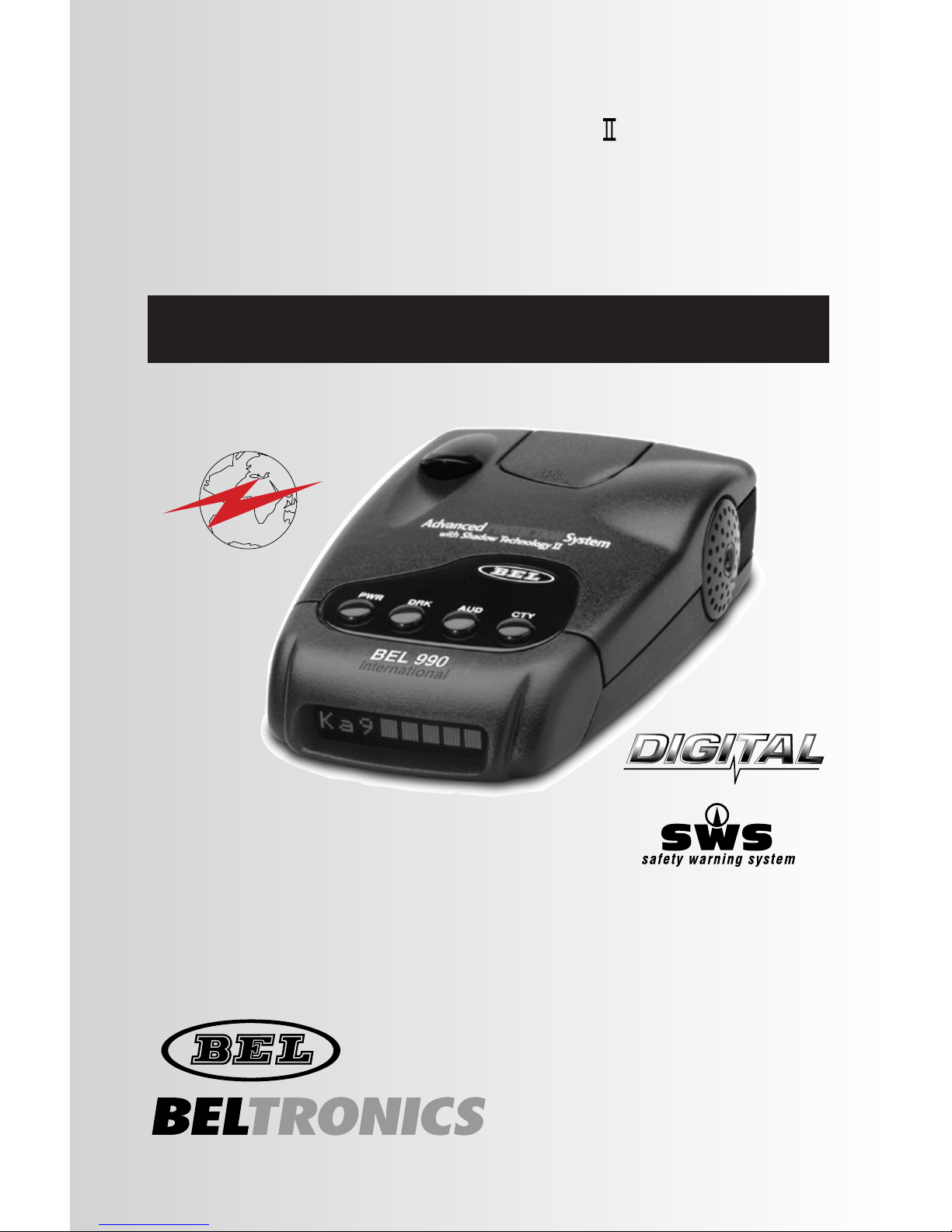
BEL 990 International
RADAR
•
LASER
•
SAFETY DETECTOR
Operating instructions for model 990
Advanced
PROTECTION
System
TM
with Shadow Technology
®
®®®®
DIGITAL PLL SYNTHESIZED
OSCILLATOR
TM
I
N
T
E
R
N
A
T
I
O
N
A
L
F
R
E
Q
U
E
N
C
I
E
S
World’s First
International Frequency
Radar/Laser/Safety Detector
Page 2

introduction
Thank you for purchasing a bel 990 International Radar/Laser/
Safety detector with the Advanced Protection System™and
Shadow Technology®II. bel 990 International is the world’s first
Radar/Laser/Safety detector which detects International Radar
frequencies, making it the choice for those looking for protection
where ever they travel.
Remember, owning a Radar detector does not give you a license to
speed.Alerts from a Radar detector serve as an effective reminder to
check your speed. Laws vary throughout the world governing the use
of a Radar detector. It is your responsibility to follow these laws.
software upgradable – an industry first
bel 990 International contains technology which provides the
highest capability to be reprogrammed as the threat of new Police
traffic Radar monitoring technologies emerge.Please ensure that
you promptly send in your Consumer Information card. This will
ensure you are notified about new, approved traffic monitoring
technologies and will be provided the details of service cost and
where to send your unit for software upgrade.
shadow technology® ii
bel 990 International contains Shadow Technology® II making it
undetectable to the Interceptor vg-2 or any other Radar Detector
Detector (rdd).Only Shadow Technology®has been consistently
proven undetectable to the vg-2.
selectable features
These featues may be selected depending upon your driving
environment. (See page 10 for the operation of Selectable
Features.)
City X or City All
X/K/Ka Band on or off
Auto-Mute on or off
Ka Narrow (34.3 ghz 100 mhz/Super Wideband Ka
Radar/Laser Digital Voice Prompts or “beeps”
Safety Warning System
®
on or off
Safety Warning System
®
with Digital Voice on or off
Audio/Visual Scroll Rate (fas t or slow)
+
–
Page 3

table of contents
Profile of Features lpage 4
Description of Features
l
page 5
Power-Up Test Sequence/Start-up Mode lpage 5
Tutor i a l Modelpage 6
Set and Forget Memorylpage 6
Reset to Factory Settings
l
page 7
Voltage Wa rning
l
page 7
drk (Bright/Dim/Dark) Button
l
page 7
aud (Auto-Mute/Volume Control) Button lpage 7
cty (City/Highway) Button
l
page 8
International Frequencies
l
page 9
What are International Frequencies?
l
page 9
Engaging International Frequencieslpage 10
Selectable Features
l
page 10
Entering Selectable Features Modelpage 12
Installation
l
page 13
General Guidelineslpage 13
Understanding Radar, Laser and sws
™
l
page 15
Interpretation of Alerts
l
page 17
Radar Alerts lpage 17
Instant-On/Pulsed Radar Alert lpage 19
Typical False Alert (Radar) lpage 19
Laser Alertslpage 20
Safety Warning System®(sws™) Alertslpage 20
Performance Verification
l
page
Conditions That Affect Radar Alerts lpage
Conditions That Affect Laser Alerts lpage 22
Tr ou b l e sh o o t i n g
l
page 23
Consumer Warranty
l
page 24
Service
l
page 25
Warranty Service lpage 25
Post-Warranty Servicelpage 25
Specifications
l
page 26
Accessories
l
page 26
Page 4
profile of features
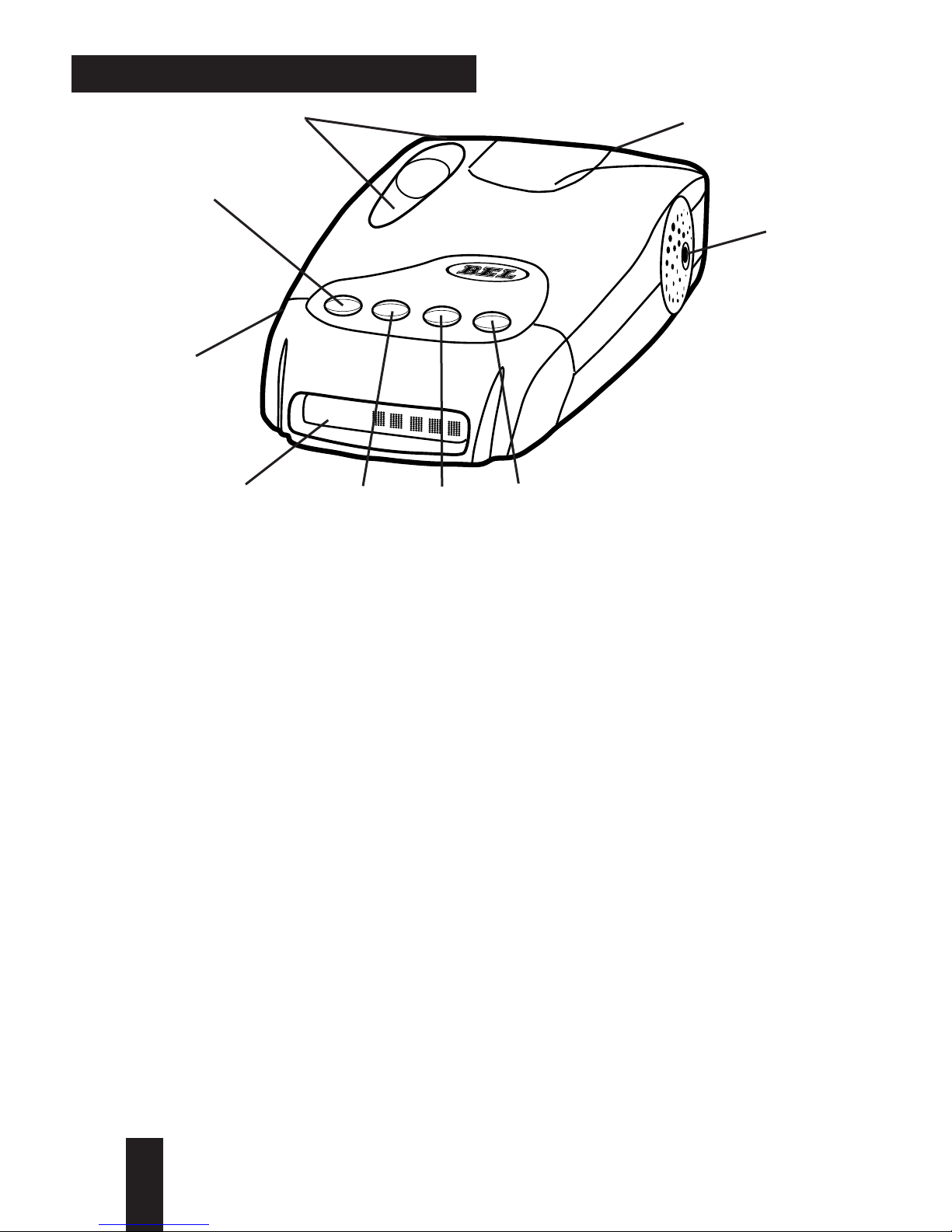
1. pwr (Power/Start-Up Mode) Button: pressing and holding
pwr briefly will turn the unit on. Continuing to press the pwr
button will scroll through the three start-up mode options:
NORMAL, MODS (Modificaitons), Q-START (Quick Start) plus
TUTORIAL MODE.
2 Text Message Display: communicates all mode selections
(i.e. DIM, DARK, CITY, HIGHWAY, and AUTOMUTE)and
confirms Radar band and signal strength, presence of Laser
and sws™messages received.
3. drk (Bright/Dim/Dark) Button: provides bright, dark and
fully adjustable dim settings of the Text Display for discreet
night travel. Audio alerts are not affected.
4. aud (Audio Mute/Volume Control) Button: provides manual
muting of all Radar and sws
™
alerts. Pressing and holding the
aud button will change the audio level.
5. cty (City/Highway) Button: choose between Highway mode
or for urban/suburban travel, City X or City All modes.
6. Antenna Opening: Radar and sws
™
signals are received by
a patented diecast antenna with integrated transition to
microstrip mixer.
PWR DRK AUD CTY
International
K
a
9
Advanced Protection System
with Shadow Technology
II
BEL 990
7
2
4
1
9
6
3
5
8
Page 5

7. Laser Optical Sensors: collect Laser signals from in front
and behind.
8. Audio Alert Speaker: all audible alerts and Digital Voice
Messages are emitted from this location.
9. Power Jack: using the straight or coiled cord, the
bel 990 International operates in any vehicle with a 13.8 volt
dc negative ground system (10.5 volt to 16 volt range).
description of features
Power-Up Test Sequence/Start-up Mode
Each time your detector is turned on, bel 990 International
will perform a power-up test sequence based upon the start-up
mode selected. There are three start-up modes of operation
plus a Tutorial mode. Release the pwr button at your chosen
selection.
Note—Pressing pwr at any time during start-up test will bypass
the sequence.
NORMAL (Factory pre-set Mode)
Presents
START UP, followed by Audio and Text Messages for
Laser, Ka, K, X and Safety Warning System® (sws™) and the
Travel Mode selected (factory default is NAmerica). After this
sequence,the status of Selectable Features is displayed:
“
CTY X or CTYALL”; “X/K/KA BAND ON/OFF”;
“ AUTOMUTE, ON/OFF”;“VoiceON”,“V o i c e OFF”;
“KANARROW”,“KAS-WIDE”;“SWS o n ”,“SWS o f f ”;
“SWSv o i c e ”,“SWSc lic k ”; SCROLfa s t ”, SCROLslow”.
Unit is now ready for operation.
MODS (Modifications Mode)
Presents
START UP, followed by Travel Mode selected and
Selectable Features as chosen by the user. Unit is ready for
operation.
Page 6

Q-START (Quick-Start Mode)
Unit will bypass any form of a power-up test sequence when
powered-up and will display
CITY or HIGHWAY depending
upon the mode retained in memory. Unit is ready for
operation.
TUTORIAL MODE
The tutorial mode allows you to become more familiar with
all audible and visual alerts. To engage this mode, press the
aud and cty buttons simultaneously when the unit is on.
The message “TUTORIAL” appears in the display followed by
the audio and corresponding Text Message for “LASER”,“Ka
AUDIO”,“K AUDIO”,“X AUDIO”, sample Radar alert (K
band signal ramping from weak to strong) and “SAFETY
WARNING SYSTEM SAMPLE ALERTS”.Three samplesws
™
messages are then presented in the display along with the
corresponding Digital Voice Message:
Sample 1 “
ACCIDENT AHEAD”
Sample 2 “HIGHWAY WORKCREW AHEAD”
Sample 3 “POLICE IN PURSUIT”
While sample messages are playing you can access the
complete list of sws™messages by pressing the cty button to
move forward in the list.“MSG 1” will appear in the display
confirming your selection (to move backward in the list,
press the drk button). Pressing the aud button allows you to
listen to the sws™message while viewing it in the display.
Press the cty button again to step to the next message; press
the aud button to review,and so on. This allows you to
review all 60 messages.
To exit Tu tori a l Mo d e , p ress t h e pwr button and your unit
will be on and ready to receive signals.
Set and Forget Memory
Any time bel 990 International is turned off or unplugged
from the cigarette lighter socket, all feature settings you have
selected are retained in the unit’s memory. Set and Forget
Memory eliminates the need to reset your preferred feature
settings each time your unit is turned off and then back on.
Page 7

Reset to Factory Settings
You can reset your unit to factory settings for start-up mode,
volume, drk, aud, cty, Travel Mode and Selectable Features. To
reset,press and hold the cty button until the display shows
“
RESET”. Two “beeps” will sound and your unit will be on and
ready for operation.
Volta g e War n ing
BEL 990 International continually checks your vechicle’s voltage
to ensure proper performance of the detector.The unit’s
operating range is 10.5 to 16.0 volts.If voltage is above 10.5, the
display will flash “
HI VOLT” until condition is rectified. If voltage
falls below 10.5 volts, display will flash “LOW VOLT”until
condition is rectified.
drk (Bright/Dim/Dark) Button
The drk button allows selection of a bright, fully adjustable
dim mode or dark mode. The unit is factory preset to full
bright display. To engage dim mode, press and hold the drk
button. The display will cycle through various levels of dim
illumination. Release the button at your chosen level. To
engage dark mode, press the drk button a second time. A
single “beep” coupled with the brief illumination of “DARK”
on the display confirms your selection.You’ll notice an “H”
(Highway mode) or “C” (City mode) remains dim to confirm
your unit is receiving power. To return to a full bright setting,
press the drk button a third time; two “beeps” confirm this
selection. Use of the drk button does not affect audio alerts.
Important—if you press the the drk button and do not receive
audible confirmation, the audio level has been set too low.
aud (Auto-Mute/Volume Control) Button
Manual Muting of Audio Alerts (Radar and sws
™
)
Whether Auto-Mode is selected on or off in Selectable
Features the audio alerts can be completely muted by
Page 8

pressing the aud button during an alert. The display will
briefly show “Quite.”No audible alert will be heard for at
approximately 20 seconds. If the signal is still present after 20
seconds, press the aud button again if you do not want to
receive any audible alerts.
Note—because Laser alerts are not lengthy or sustained, muting
is not required (see page )
Volume Co n t rol
Press and hold the aud button to engage the volume control.
The Audio level has 9 settings. Release the aud button when
you have reached your desired audio setting.
cty (City/Highway) Button
The cty mode has been designed to effectively reduce
unwanted audio alerts caused by intrusion alarms, door
openers, and other devices which share X band with police
Radar — without reducing sensitivity. Signals from non-police
Radar sources are frequently encountered in urban and
suburban areas, making use of this mode ideal in these areas.
Pressing the cty button once engages the cty mode which is
confirmed by “
CITY” in the display coupled with a single audio
“beep”. Pressing the cty button a second time returns you to
highway mode; “HIGHWAY” will appear in the display coupled
with two“beeps”.Once engaged, weak X band signals
encountered will produce no audible alert until the signal
strength reaches a preset level. However, visual alerts are
processed the instant an X band signal is detected, keeping
you quietly informed. Since most “false”X band signals are
weak, the use of the cty mode allows you to drive out of their
range before they reach the preset level and trigger a full
audio alert. In contrast, signals from X band traffic Radar are
generally stronger and will exceed the preset level, causing a
full X band audio alert.Activating the cty mode will not
change Super Wideband Ka, K or instant-on X band Radar
alert patterns.
Note—the cty mode does not change the presentation of alerts
for Laser or sws
™
.
Page 9

City All
City All mode is a Selectable Feature of the bel 990 International
(see Selectable Features page 10). This feature provides an
alternate approach for improving selectivity on ALL Radar
Bands and is ideal for use in areas with a high level of
microwave transmissions which can cause falsing on all
Radar bands.
While in City All mode, bel 990 International will provide an
initial short X, K, or Super Wideband Ka alert coupled with
visual confirmation of the band detected and signal strength in
the display. No further audible alert is provided until the signal
strength reaches a preset level.When no audio alert is
provided, the visual alert keeps you quietly informed.
Note—Once “
CTY X”or “CTY ALL” is chosen in Selectable
Features the cty button must to be pressed to engage your
selection.
international frequencies
What are International Frequencies?
bel 990 International is the world’s first Radar detector
designed to operate anywhere you travel. Because different
countries use different frequencies to monitor traffic, there has
been no way of using existing technology to detect ALL the
various frequency types. That is until now. bel 990 International
is the world’s first Radar detector designed to operate anywhere
you travel.
All Radar Bands, whether used in North America or Europe,
fall under the X, K or Ka Band classification. The difference is
the operating frequency, measured in Gigahertz, which the X, K
or Ka Band signal is transmitted.Regardless of the Travel Mode
selected, bel 990 International will sound an X, K or Ka Digital
Voice Message or an X, K or Ka “tone” (whichever you have
chosen in Selectable Features) when Radar is encountered.The
Text Message Display will confirm the actual frequency detected,
depending upon the frequency type received. (see sample Text
Display readouts below.)
X BAND 10. 525 (North American signal)
X BAND 9.9 (UK signal)
Page 10

Engaging International Frequencies
bel 990 International is factory preset to detect all North
American Radar frequencies (X,K, Super Wideband Ka). To
engage one of the three Travel Modes for operation outside North
America, with the unit on, press and hold the cty button until
the display scrolls through the following prompts:“
NAMERICA”,
“TRAVEL 1,” “TRAVEL 2,” and “TRAVEL 3.” To deter m i n e
which Travel mode best represents the frequencies used in the
country you will be driving, refer to the label on the bottom of
your unit. Release the cty button at your chosen selection.
Note—If you encounter excessive falsing on X, K or Ka Bands
when operating your unit in any of the travel modes,you can
engage the City All mode in Selectable Features or turn the
offending Band or Bands off in Selectable Features (see below).
If excessive falsing occurs specifically on Super Wideband Ka
(33.4 – 36.0 gh
z) you can select Ka Narrow (33.4 100 mhz) in
Selectable Features.
Disabling X, K or Ka Bands in Selectable Features will defeat
detection of ALL frequencies within the X, K or Ka Band
classification (See page 00 for a complete listing of frequencies).
selectable features
The following features may be selected depending upon your
driving environmnet and preference.
City X or City All
X/K/Ka Band on or off
Auto Mute on or off
Radar/Laser Digital Voice Prompts or “beeps”
Ka Narrow (34.3 ghz 100 mhz)/Super Wideband Ka
Safety Warning System® on or off
Safety Warning System® Digital Voice on or off
Audio/Visual Scroll Rate (fast or slow)
+
–
+
–
Page 11

City X or City All
When “
CTY X ” is selected,your unit provides standard
X Band selectivity which is suitable for most urban areas.
City All provides an increased level of selectivity on all Bands
in high density microwave areas.Factory setting is “CTY X ”.
Note—once “
CTY X”or “CTY ALL” is chosen in
Selectable Features, the cty button must be pressed to engage
your selection.
X/K/Ka Band On or Off
Select “X ON/XOFF”,“K ON/K OFF”or “Ka ON/Ka
OFF” dependng upon your driving environment and selec-
tivity requirements. This mode is especially useful when
operating your unit outside North America, where falsing
may occur and disabling the offending band may be
required. Factory setting is on for all three Bands.
Auto-Mute On/Off
With “AmuteON”, unit will provide several X, K, Super
Wideband Ka audio alerts followed by the Digial Voice
announcement of the signal detected.After the Digital Voice
announcement, a “clicking”tone keeps you quietly informed
for as long as the signal is present. This clicking becomes more
rapid as the strength of the Radar signal increases.
“AmuteON”enables you to conveniently monitor extended
encounters without having to manually mute or adjust the
volume setting.
Note—Because of their urgency, Laser alerts are not affected.
With “
Amuteoff,” unit will provide a continuous series of
X, K, Super Wideband Ka and Laser audio alerts and a Digital
Voice announcement of the signal detected. Digital Voice
prompts are provided once after the initial audio alert. This
standard setting is often preferred when background noise in a
vehicle is loud. Factory setting is “Amuteoff.”
Page 12

Radar/Laser Digital Voice Prompts
With “
VoiceON”, unit will provide Digital Voice prompts
followed by “beeps”when X/K/Ka and Laser signals are
detected. Factory setting is on.With “V o i c e OFF”, unit will
sound unique audio tones only. Factory setting is
“VoiceON”.
Ka Narrow (33.4 100 mh
z) /Super Wideband Ka
When “Ka S-Wid e ” is selected, unit detects Super Wideband
Ka signals and provides alarms at the 33.4 gh
z to 36.0 range.
When “K a narrw ”is selected, unit detects Super Wideband Ka
signals and alarms at 33.4 to 36.0 ghz)
Safety Warning System
®
(sws™)
When on, unit will provide a Text Message when signals from
sws
™
transmitters are detected. Factory setting is on.
Note—sws
™
signals are not common outside North America.
Safety Warning System
®
(sws™) with Digital Voice Messages
When “
SWSv o i c e ” is selected, unit will provide Digital Voice
announcements when sws™transmitters are detected. Factory
setting is “SWSvoice.”When “SWSc l i c k ” is selected, Digital
Voice is replaced by “tone/clicking” only. Factory setting is
“SWSv o i c e ”.
Audio/Visual Scroll Rate
When “SCRLslow” is selected, unit will provide a slow cycling
of audio/visual messages.When “SCRLfast” is selected, unit
will provide a fast cycling of audio/visual messages. Factory
setting is “SCRLf a s t ”.
Entering Selectable Features Mode
1. With the unit off, press and hold the cty button, then press
the pwr button. The word “
FEATURES”will appear in the
display and a short audible “beep” will sound indicating you
are now in the Selectable Features Mode.
2. Immediately after the “beep”, the display will show the status
of the first Selectable Feature (City X or City All).
+
–
Page 13

3. Press the aud button to make your selection. Press the cty
button to move to the next Selectable Feature. Repeat the
process until you have made your selection for each of the
eight Selectable Features.
4. Press the pwr button to exit Selectable Features mode. Two
“beeps” confirm that you have exited this mode and either
“
HI GHWAY”or “CITY” will be presented in the display, based
on your previous selection.Your unit is ready for operation.
installation
General Guidelines
Do not mount your unit directly behind windshield wipers or
mirrored sunscreens which block Radar and Laser signals
and substantially reduce warning range. Unlike “after market”
mirrored sun-screens,regular tinted glass does not affect
Radar reception. Radar signals are also reflected by the “heated
windshields”known as Instaclear
®
and ElectriClear®available
as an option on some vehicles. This type of windshield makes
any dash,visor or windshield mounted detector ineffective.
(If in doubt, check with an appropriate dealership to see if
this applies to your vehicle.) To achieve optimum performance,
regardless of which mounting position you choose, follow
the basic steps on the following page.
1. Consider occupant safety when selecting a mounting location.
Choose a location where the unit will not be hazardous in
case of an accident.
2. For optimum detection,position your unit with a clear,
unobstructed view of the road from the front and rear.
3. Do not allow the unit to make contact with the windshield.
This will eliminate unnecessary vibration.
4. Avoid placing your unit in direct sunlight.During the summer,
interior temperatures of an enclosed vehicle can sometimes
reach temperatures that will cause premature aging of the unit.
5. Your detector is not waterproof; exposure to water may cause
damage.
Instaclear is a registered trademark of the Ford Motor Company.
ElectriClear is a registered Trademark of Libbey, Owens, Ford, and Delco-Remy.
Page 14

Dash Mounting
You can mount your unit to a level
area of your vehicle’s dash using
the hook and loop fastener or the
four non-skid dash mounting
pads provided.
Windshield Bracket Assembly
The visor clip is fully assembled.
To a ss e m ble t h e w indshield
bracket, follow this diagram.
Windshield Mounting
1. Remove the mounting bracket cover on top of the unit by
pressing on the raised dots and pushing outward. Store the
cover in a safe place.
2. Clean the selected windshield area, position the suction-cup
mount on the windshield, and press firmly on each suction
cup to secure it in place.
3. Use a screwdriver or a small coin to adjust the angle of the
suction-cup mount until the base plate is level.
4. Slide detector onto base plate until it snaps into place.
Note—some vehicles have a plastic coating on the inside of the
windshield designed to protect occupants in case of an accident.
Use of the windshield bracket on this type of windshield can
permanently mark the surface. Check with your dealer if you
are unsure whether your vehicle is equipped with this type of
windshield.
Windshield Bracket Assembly
Page 15

Visor Mounting
1. Remove the mounting bracket cover by pressing on the
raised dots and pushing outward. Store the cover in a
safe place.
2. Slide the visor clip onto the top of the detector until it snaps
into place. Clip the detector to the edge of the sun visor nearest
the windshield.
Fuse Replacement
1. If the fuse has blown, remove the tip from the lighter plug
followed by the old fuse. Replace the fuse with a 1-amp, 3AG
fuse. Defeating the fuse protection can damage your unit or
your vehicle’s electrical system and will void your warranty.
Note—the tip is in two pieces; be careful not to lose either piece
or the spring inside the holder. (See diagram on page 13).
understanding radar, laser and sws
™
Three Radar Frequencies
Three microwave frequencies have been allocated by the fcc
(Federal Communications Commission) and are used for
traffic Radar in North America. They are:
X band: 10.525 gh
z
K band: 24.150 ghz
Super Wideband Ka: 33.4 ghz to 36.0 ghz
Page 16

Both X and K bands are well known to motorists who have
traveled with Radar detectors.Introduced first was X band
Radar which became common during the 1960s. In the mid
1970s the lower powered, more difficult to detect K band Radar
was introduced. In 1987, fcc approval was given for Radar
equipment using a third frequency, Ka. In response to this,
beltronics introduced the first Radar detectors capable of
detecting X, K and Ka band signals.In late 1990, fcc approval
was given to Wideband Ka: 34.2 ghz to 35.2 ghz. Once again,
bel responded with Wideband Ka detection. Today, the
bel 990 International detects the complete Super Wideband Ka
frequency allotted for police monitoring—33.4 ghz to 36.0 ghz,
as well as all International frequencies.(See Specifications for a
complete listing of frequencies.)
Total Tr a c k i n g L aser
™
(ttl™)
Unlike Radar signals, which are highly reflective, Laser signals
have very poor reflective characteristics. Many of today’s
Laser detectors do not have the high sensitivity necessary to
detect Laser within a large “field of view”. bel 990 International
incorporates bel’s number one rated Laser detection. Twin
Laser ports detect energy far outside the main Laser beam—
including off-axis signals—providing the largest achievable
360° “field of view.” The alerts provided by your unit are the
same whether signals are received from the front or rear.
Safety Warning System®(sws™)—What is it?
The Radio Association Defending Airwave Rights, Inc.
(r.a.d.a.r.) conceived and developed the Safety Warning
System
®
. The concept behind this system is to warn motorists
of potential road hazards by employing Safety Warning System
®
transmitters in areas such as construction zones, accident
sites and detours. These sws™transmitters operate within
the 24 ghz portion of the K band frequency, and broadcast
uniquely coded signals that are detected by your unit.
Note: SWS signals are not common outside North America.
Page 17

interpretation of alerts
Radar Alerts
The alerts provided by your unit are affected both by the type
of transmission (continuous wave or instant-on), and the
position of the Radar source. These critera hold true whether
you are traveling in or outside of North America. Generally,
when you drive closer to a Radar source, the intensity of the
received signal increases, resulting in the increase of the
number of bar graph segments as well as numerical digit
[1–9] and a corresponding increase in the audio alert rate.
Described below are five common types of Radar encounters
and the alerts you will typically receive.
1. Stationary or moving Radar, straight ahead aimed in your
direction.
Since Radar signals travel in a straight line, this Radar
encounter potentially offers maximum warning range.Once
the signal is received, the initial warning consists of an X, K or
Super Wideband Ka audio alert coupled with simultaneous
identification of the Radar band (X, K or Ka) and signal
strength in the Text Display. The number of bar graph segments
displayed depends upon the strength of the signal received.As
the strength of the Radar signal increases,the audio alert
becomes more rapid and the bar graph will display the
maximum number of five segments and the digit “9” will also
appear indicating maximum signal strength.Assuming the
Radar signal remains uninterrupted, the audible and visual
alerts will clearly indicate a “weak” signal becoming stronger
as you drive closer to the Radar source. Remember, when the
police Radar source is moving toward you, the Radar signal
strength will increase much more rapidly than if you are
approaching a stationary source.
Page 18

2. Stationary Radar aimed around a corner
Under this circumstance, reaction time is considerably
reduced. Since the Radar signals are transmitted across your
line of travel, there is generally no signal available to receive
until you are relatively close to the source. Once an alert is
received, expect the strength of the signal to increase very
quickly. Advanced warning in this situation may be reduced.
3. Stationary Radar concealed by the crest of a hill aimed in your
direction.
Radar signals travel in a straight line and do not pass through
earth. Consequently, police Radar aimed at the crest of a steep
hill cannot be received until you are at or near the top.
Warning time may be minimal (as in situation #2) since a
strong signal is not present until you are near the crest of the
hill. At this point, you may be nearly in the police officer’s line
of sight.When cresting a hill, a weak initial alert followed very
quickly by a full alert is typical. This alert pattern requires
prompt attention.
Page 19

4. Moving Radar behind you, traveling in the same direction.
Police Radar signals transmitted from behind your vehicle
can be received when reflected by objects in front of you
such as large signs, bridges and trucks.As you drive, the size
and configuration of these objects are constantly changing
causing the strength of any reflected Radar signal received to
vary.A strong, uninterrupted alert indicates the patrol car is
close behind.
Instant-On/Pulsed Radar
This type of signal appears suddenly when a Radar unit is
“triggered”. The instant-on alert consists of an intense, three
second audio “burst”, coupled with the type of band detected
and flashing of the signal strength bar graph in the display.
Instant-on/pulsed alert to Ka band
Ka 9
Typical False Alert (Radar)
Ideally, a Radar detector should only alert in the presence of
police Radar. However,because other devices share X band with
police Radar, false alerts sometimes occur. Generally, a false
signal produces only a short audio and visual alert. Since they
are most often weak, it is possible to drive out of the signal’s
range very quickly and receive only a brief alert. Although many
times the probable source of the false signal can be identified
(supermarket, bank,commercial building, etc.), caution is
advised until the source can be confirmed. The X band alert
pattern caused by a non-police source can look like the initial
alert produced by actual police Radar. For this reason
appropriate action is required any time an alert is received.
Page 20

Laser Alerts
When Laser is detected, the display will flash “
LASER”
coupled with a distinct Laser audio alert. If a vehicle is a long
distance from the source of Laser pulses, fewer pulses will
generally be received. The closer the vehicle is to the source of
Laser pulses, the greater the likelihood of receiving a steady
stream of Laser pulses. The reason for this is the aiming
stability of the Laser gun and the fact that it is difficult to hold
the gun absolutely still. Any movement of the gun results in
motion of the beam at the target.The further the target, the
greater the displacement of the beam and the shorter the dwell
time of the beam at the target point. Therefore, there is the
possibility of receiving only a few Laser pulses.Due to these
characteristics, all Laser alerts should be taken seriously.
Safety Warning System
®
(sws™) Alerts
With the Safety Warning System
®
feature on and an sws
™
transmitter in use, your detector will provide a unique, 2 second
sws™tone coupled with a Safety Warning System®category
word (i.e.“HazdZone”indicating Highway Hazard Zone
Advisory) to quickly orient you to the type of situation
ahead. This introductory message is followed by a specific Text
Message (i.e.“SHARP CURVE AHEAD”) and Digital Voice
Message which is repeated twice.After the Digital Voice, the
unit will continue to present the message and provide the
“clicking” tone for as long as an sws™signal is detected.
If two separate sws™messages are received, each message is
presented twice before the “clicking”resumes.
You can replay the last sws
™
message received by pressing
the drk button within 30 seconds of receiving an sws™alert.
Both Digital Voice and Text Message are replayed.
If you have selected “
SWSc l i c k ” (Digital Voice off), your
unit will show just the Text Message (see Selectable Features,
page 9).
Note—the end of a multiple word sws
™
message is indicated by
an asterisk.
Page 21

Abbreviated SWS™ Category Words
“
Hw y Wo r k ”
confirms Highway Construction/Maintenance
(messages 1–11)
“
Ha z d Zo n e ”
confirms Highway Hazard Zone Advisory
(messages 13–31)
“
Weather”
confirms Weather Related Hazards
(messages 33–41)
“
Tr a v I n f o ”
confirms Travel Information/Convenience
(messages 43–59)
“
Moving”
confirms Emergency/Slow Moving Vehicles in transit
(messages 61–64)
“
Message Unknow n”
confirms incomplete or unknown messages
Note—for a complete listing of the five Safety Warning System
®
categories and corresponding messages, please refer to the Safety
War ning System®Alert Card enclosed with your manual.
Page 22

performance verification
Conditions that Affect Radar Alerts
If you feel your unit is not alerting properly,keep in mind that
there are many conditions that influence the intensity or
duration of an alert:
1. The police are using instant-on/pulsed Radar, in which case
no signal is transmitted until visual contact has been made
with your vehicle. For detection of this signal, you must rely
on reflected signals from Radar directed at traffic traveling
ahead of you.
2. The police Radar unit is positioned perpendicular to the
road, around a curve, or just over the crest of a hill thus
significantly reducing the reception range.
3. The highway traffic between your vehicle and the police Radar
source is heavy. This blocks/reflects transmitted signals. The
presence of several large trucks between you and the police
Radar unit could also significantly reduce reception.
4. Rain or humid weather conditions can absorb transmitted
signals before they reach your vehicle, again reducing detection
range.
5. The police Radar unit is not properly tuned and is transmitting
outside the fcc allocated X, K or Super Wideband Ka frequency
ranges.
Conditions that Affect Laser Alerts
If you feel your unit is not properly alerting to the presence of
Laser signals, keep in mind that rain, fog, high humidity and
traffic conditions can affect the range that the Laser beam
can be detected.
Page 23

troubleshooting
Solutions for Common Problems
If your unit is not operating properly, please refer to the
outline below.
Problem Possible Cause Corrective Procedure
Unit not Plug not properly inserted Reinsert plug and rotate
receiving power
Fuse in power cord is Replace with 1 amp
defective 250 Vo l t 3ag fuse (see page 12)
Lighter socket not clean Consult your dealer or a
and negatively grounded professional mechanic
Fuse or electrical wiring Consult your dealer or a
for lighter socket defective professional mechanic
“Poor detection Antenna/lens opening Reposition unit with
range” partially blocked unobstructed view of
road ahead and behind.
Radar signals unable to Determine whether
pass through windshield your vehicle has a
“heated windshield”
known as Instaclear
®
or ElectriClear®,or
is covered with a
metallic sun screen.
Erratic or frequent High concentration of Use cty mode
alerts non-police X band sources
Review section in this
manual on Performance
Ve r i f i c at i o n
Partial or no display Dim or dark mode engaged Disengage dim or
dark mode
If you experience a problem with your unit that is not covered
in this outline please call, Monday to Friday, 9 am–5 pm est,
for assistance:
1-800-341-2288 usa
1-800-268-3994 canada
Page 24

consumer warranty
2-year Warranty
1. This warranty covers all defects in materials and workmanship.
This warranty does not apply if the unit has been subject to
physical abuse, improper installation, modification, or if the
housing or serial number of the unit has been removed.
2. The enforceability of this warranty is limited to the original
consumer purchaser and is not transferable to, or enforceable
by, any subsequent owner.
3. In the event of a defect, malfunction or other failure to conform
to this warranty,
BELTRONICS will, at its sole discretion, repair
or replace the unit at no charge.You are responsible for all
shipping costs in connection with warranty service pursuant
to this warranty.
4. This warranty commences on the date of retail purchase and
shall be effective for a period of two years.
5. There are no express warranties covering the unit other than
those set forth in this warranty. All implied warranties are
limited to the period of this warranty and no warranties,
expressed or implied, extend beyond this period. Some states
do not allow limitation on how long an implied warranty
lasts, so the above limitation may not apply to you.
6.
BELTRONICS will in no event be liable for any consequential,
incidental, indirect or special damages (including, but not
limited to, lost profits) arising out of or in connection with
the use, misuse, or function of the unit. Some states do not
allow the exclusion of limitation of incidental or consequential damages, so the above limitation or exclusion may not
apply to you.
7. This warranty gives you specific legal rights,and you may
also have other rights which vary from state to state.
8. You must provide a copy of a dated sales receipt for your unit
in order to receive service under warranty.
Page 25

service
Warrant y S er v i ce
If you feel your detector is not funtioning properly please
review this manual,particularly the section on Performance
Ver i f i ca t i o n . If you still feel service is required, please follow
the instructions on below.
1. To obtain service during the warranty period, please call the
apporpriate number below to obtain an RA number and
shipping instructions. Rember to return your detector
postage paid, insured and in suitable packaging.
1-800-341-2288 usa
1-800-268-3994 can
2. For your own proctection, obtain a proof of delivery receipt.
Shipping costs are your responsibility.
3. Enclose with your unit the following information:
(a) Your name, complete return address and written
description of the problem. (No p. o. b o x please.)
(b) A telephone number where you can be reached during
regular business hours.
(c) A copy of your dated sales receipt.
Post-Warranty Service
The following arrangements apply if the warranty period has
expired or you are not able to provide a copy of your dated
sales receipt indicating purchase within the last twenty-four
months.
1. Return your unit to the appropriate address under War r an t y
Service and follow steps 1 through 3(b) outlined in that section.
2. Enclose with your unit $85 us or $115 Canadian to cover
inspection and postage return. Prices subject to change
without notice.
Page 26

specifications
Radar Receiver Frequencies:
9.41 gh
z (X Band), 9.9 ghz (X Band), 10.525 ghz (X Band), 13.45
ghz (X Band), 24.150 ghz (K Band), 24.120 ghz (K Band),
34.3 100 mhz (Ka Band), 33.4 ghz to 36.0 ghz (Super
Wideband Ka)
Operating Temperatures: -4°f to 158°f (-20°c to 60°c)
Power Supply Requirements: 13.8 Volts (10.5 volt to 16 volt
range), 250 mA
Radar Antenna Type: Patented Diecast Horn with Integrated
Transition to Microstrip Mixer
Maximum Dimensions: 5.3"(l) x 3.1"(w) x 1.8"(h)
We i g h t : 9.0 ounces
BELTRONICS reserves the right to incorporate design improvements which may
not be reflected in the specifications listed in this owner’s manual.
accessories
If you require any additional accessories, replacement
accessories or any accessory which is not included with your
unit, call to order or for more information, Monday to Friday,
– .
1-800-341-2288 usa
1-800-268-3994 canada
+
–
Page 27

list of accessories
model cost cost
description number usa canada
Suction Cup Kit (2) da-6 $ 2.95 $ 3.95
Straight Power Cord (4') da-16 $ 9.95 $ 11.95
Coiled Power Cord (6') da-17 $ 11.95 $ 16.95
Power Cord Fuses (2) da-19 $ 3.95 $ 5.95
Hook & Loop Fastener da-20 $ 2.95 $ 3.95
Visor Bracket da-48 $ 9.95 $ 11.95
Windshield Bracket da-702 $ 11.95 $ 16.95
Non-Skid Dash da-1000 $ 2.95 $ 3.95
Mounting Pads
Protective Travel Case da-62 $ 13.95 $ 19.95
Owner’s Manual 990 int’l n/c n/c
Prices subject to change without notice.
Page 28

Page 29

Page 30

Page 31

Page 32

Head Office
2422 Dunwin Drive
Mississauga, Ontario
Canada L5L 1J9
Tel: (905) 828-1002 Fax: (905) 828-2951
www.beltronics.com
This product is subject to one or more of the following patents:
u.s.p. #4,571,593 #4,939,521 #5,402,087 #5,600,132
#4,625,210 #4,952,936 #5,446,923
#4,630,054 #4,961,074 #5,587,916
c.p. #1,187,586 #1,295,714
#1,187,602 #1,295,715 Other Patents Pending
Safety Warning System l.c.–Patents Pending
, Fundamental Mixer Technology, fmt and Shadow Technology are registered
trademarks of BELTRONICS.bel 990 International, Tot al Tra ck in g L as er and ttl are
trademarks of BELTRONICS. Safety Warning System® is a registered trademark of
Safety Warning System® l.c.SWS is a trademark of Safety Warning System® l.c.
Printed in Canada 273003-73
TM
 Loading...