

Page 1
PECM1SS
Semi-automatic built in
espresso maker
Y
1
Page 2
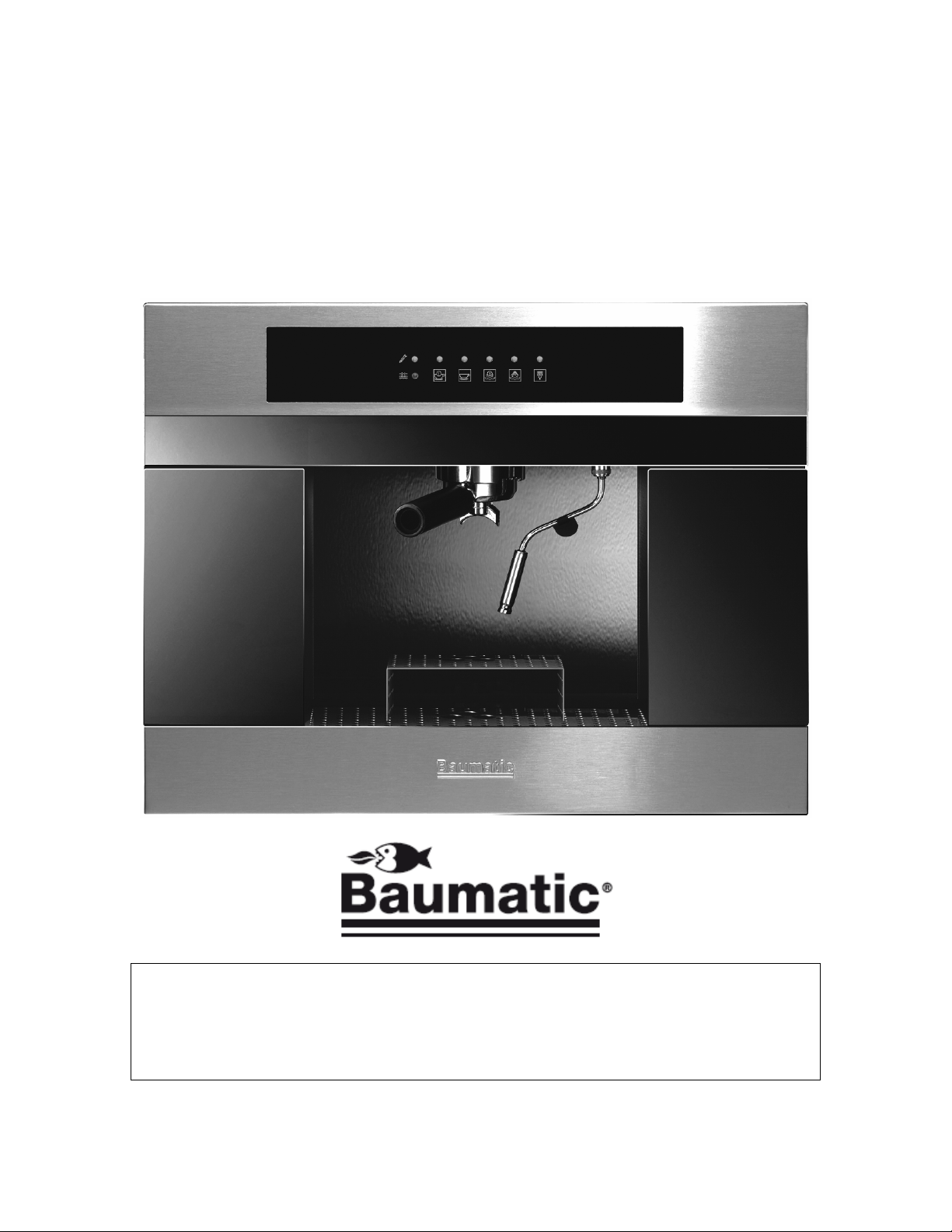
User Manual for your Baumatic
PECM1SS
Semi-automatic built-in espresso maker
NOTE: This User Instruction Manual contains important
information, including safety & installation points, which will
enable you to get the most out of your appliance. Please keep it
in a safe place so that it is easily available for future reference; for
you or any person not familiar with the operation of the appliance.
DD 04/06/09
2
Page 3

Contents
Environmental note 4
IMPORTANT SAFETY INFORMATION 5 – 7
Specifications 7 – 11
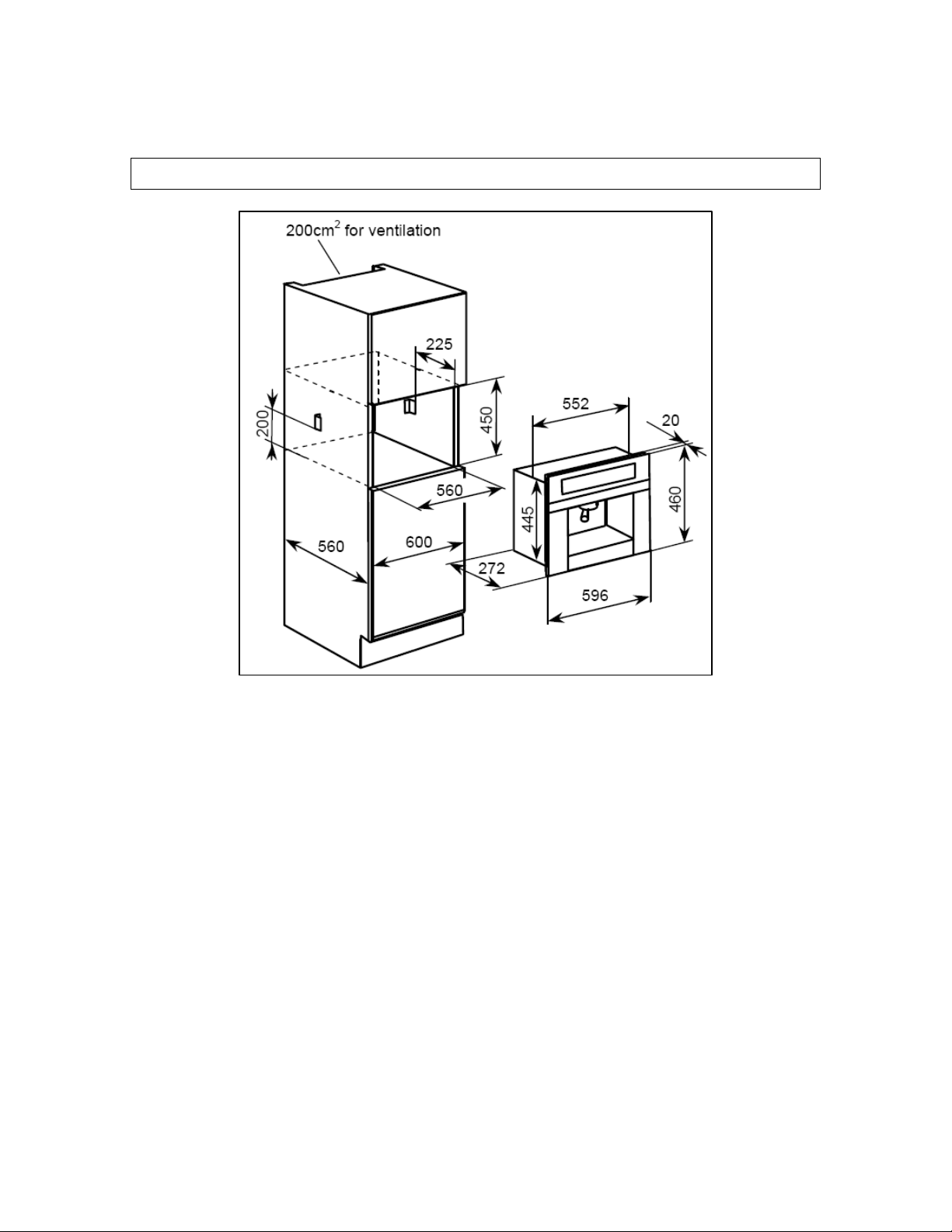
Product and aperture dimensions 7
Product specifications 7 - 8
Standard accessories 8
Technical specifications 9
Description of the coffee machine 9 - 10
Control panel 10
The filters 11
Things to do before first use 11 – 14
Cleaning 11
Filling the water reservoir (manual fill mode) 11 – 12
What to do if the water level runs low during operation 12 – 13
Filling the water reservoir (auto-fill mode) 13
What to do if the water level runs low during operation 14
Getting started (Loading the system with water) 14
Using your espresso maker 15 – 17
Dispensing hot water through the main boiler 15
Dispensing steam through the steam boiler 15 – 16
Dispensing boiler water through the steam boiler 16 – 17
Making drinks 18 – 22
Connecting the filter holder to the main boiler 18
Making a drink using coffee pods 18 – 19
Making drinks using espresso ground coffee 19 – 20
Tips on making an espresso 20 – 21
Tips on making a cappuccino 21 – 22
Tips on making tea 22
Cleaning and maintenance 23 – 25
Installation 25 – 30
Electrical connection 25
Installing the espresso maker into a kitchen cabinet 26 – 28
Connecting the espresso maker to the mains water supply 29 – 30
Troubleshooting 30 – 31
Coffee glossary 31 – 32
Contact details 33
3
Page 4
Environmental note
o The packaging materials that Baumatic uses are environmentally
friendly and can be recycled.
o Please discard
environment.
all packaging material with due regard for the
4
Page 5
IMPORTANT SAFETY INFORMATION
Your safety is of the utmost importance to Baumatic.
Please make sure that you read this instruction booklet
before attempting to install or use the appliance. If you
are unsure of any of the information contained i
ooklet, please contact the Baumatic Advice Line.
b
eneral Information
G
n this
o This appliance is designed for domestic household use only. It
can ONLY be built into a standard kitchen cabinet or ho
unit and should NOT be used as a freestanding appliance.
o The use of this appliance for any other purpose or in any other
environment without the express agreemen
will invalidate any warranty or liability claim.
o Your new appliance is guaranteed against electrical or
mechanical defects, subject to certain exclusions that are noted
in Baumatic’s Conditions Of
affect your statutory rights.
Guarantee. The foregoing does not
t of Baumatic Ltd.
using
o Repairs may only be carried out by Baum
engineers or their authorised service agent.
arning and safety instructions
W
atic service
o This appliance complies with all current European
safety legislation. Baumatic do wish to emphasise
that this compliance does not remove the fact
that the appliance surfaces will become
extremely h
operation.
o Extreme care MUST be taken when removing any of the
filters or nozzles. They should be allo
they are removed from the appliance.
ot during use and retain heat after
wed to cool before
5
Page 6
Child Safety
o Baumatic strongly recommend that
are prevented from being near to the appliance and not allowed
to touch the appliance at any time.
o If it is nece
kitchen, please ensure that they are kept under close supervision
at all times.
General Safety
ssary for younger family members to be in the
babies and young children
o Do not leave the espresso maker unattended.
o Do not allow electrical fittings or cables to come into contact
with areas on the appliance that get hot.
o Do not curtains or soft furnishings.
install the appliance next to
Cleaning
o Cleaning of the espresso maker should be carried
out on a regular basis.
o Great care should be taken whilst using this appliance and when
following the cleaning procedure.
o IMPORTANT: The appliance must be disconnected from the
mains before following the cleaning procedure.
Installation
This applian
qualified person, strictly in accordance with the
manufacturer’s instructions.
ce must be installed by a suitably
o Baumatic Ltd. declines any responsibility fo
damage, to any person or property, as a result of
improper use or installation of this appliance.
r injury or
6
Page 7
o The manufacturer declares that the espresso maker is
built using certified materials and requires the appliance
to be installed in accordance
in force. This appliance must be used by a trained person
for domestic
pecific
S ations
Product Dimensions
Height: 460 mm
Width: 596 mm
Depth: 272 mm
Product specifications
o Touch control operation
o Mark resistant coating
o Choice of 1 or 2 cup filters
o Suitable
o Steam spout for
coffee
o Pull-out drawer
o Compartment for cu
o Single pump with individual
cappuccino/steam
o Auto or manual fill system
for sealed coffee pods or ground coffee
purposes only.
cappuccino, hot chocolate, tea and instant
ps & saucers
with the standards currently
Aperture Dimensions
Height: 450 mm
Width: 600 mm
Depth: (min) 560 mm
boilers for coffee making &
7
Page 8

o Removable water tank (capaci
o Empty water tank warning light
o LED high density ill
Standard accesso
o Filter holder
o 1 x one measure espresso cup fi
o 1 x two measure
o 2 x espresso cups with saucers
o Water softener
Technical specifications
o Coffee pump pressure 15 bar
o Total output 1860 W
o Coffee boiler output 1000 W
o Steam boiler output 800 W
o Power supply 230 Vac 50 Hz
o Supply connection 13 A (double
with 3 mm contact gap)
o Mains supply lead 3 x 1.5mm²
For future reference please record the following information which can
be found on the rating plate and the date of purchase which can be
found on your
n be located by opening the pull out drawer at the bottom of the
ca
coffee maker.
Model Number ……………………………….
Serial Number ……………………………….
ate of Purchase ………………………………
D
ries
sales invoice. The rating plate for your coffee machine
umination
espresso cup filter
ty 1.8 litres)
lter
pole switched fused outlet
8
Page 9
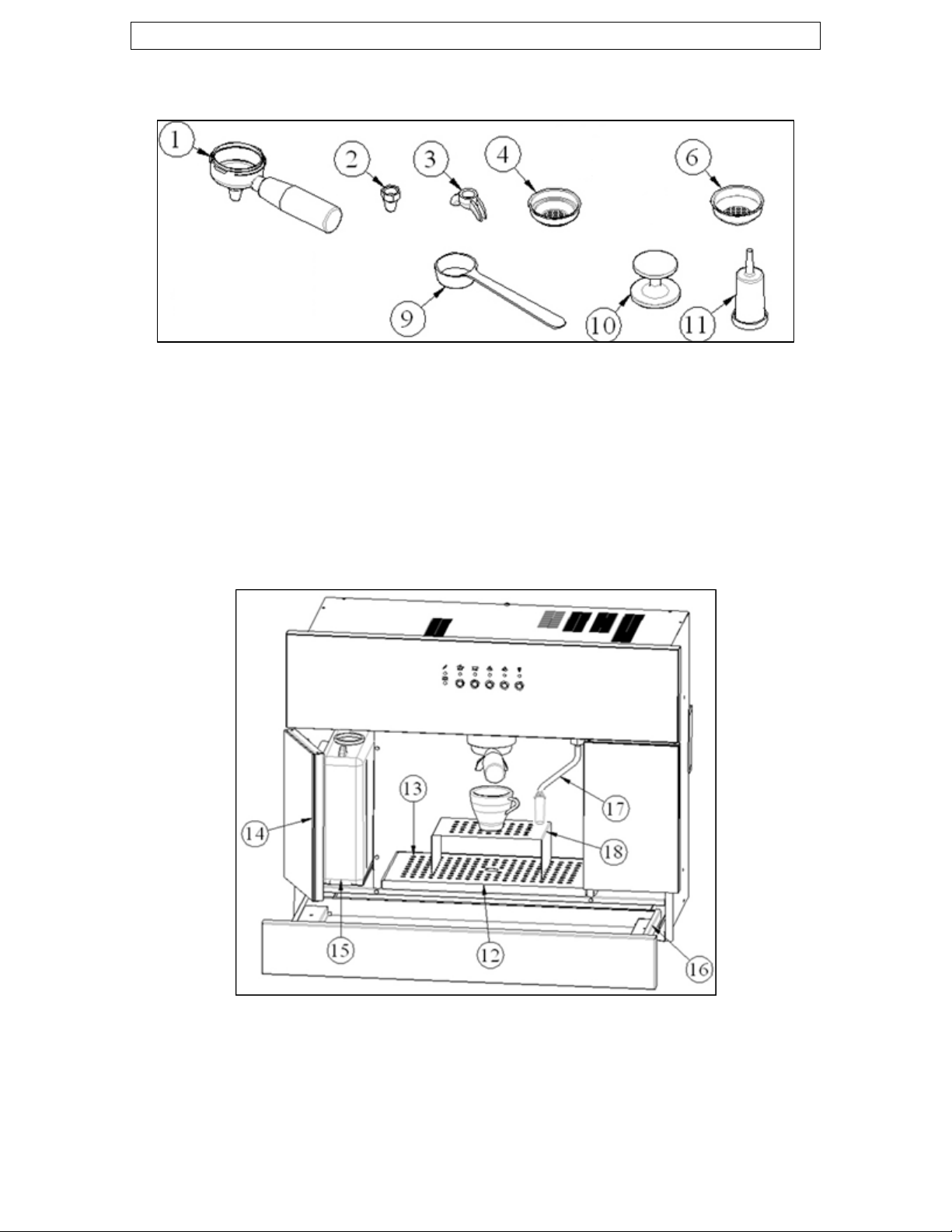
esso maker Description of the espr
Standard accessories
1) Filter holder
2) Spout for a single coffee dose
3) Spout for a double coffee dose
4) Filter for 1 Italian coffee pod or 1 d
6) Filter for 2 doses of e
9) Espresso coffee batcher (ground)
0) Coffee pressing tool
1
11) Water softener filter for the reservoir
13) Drip tray grid 17) Pipe for boiling wate
14) Water reservoir door
15) Water reservoir
spresso coffee or 1 French coffee pod
ose of ground coffee
16) Pull out dra12) Drip tray
and steam
18) Espresso cup stand
wer
r
9
Page 10
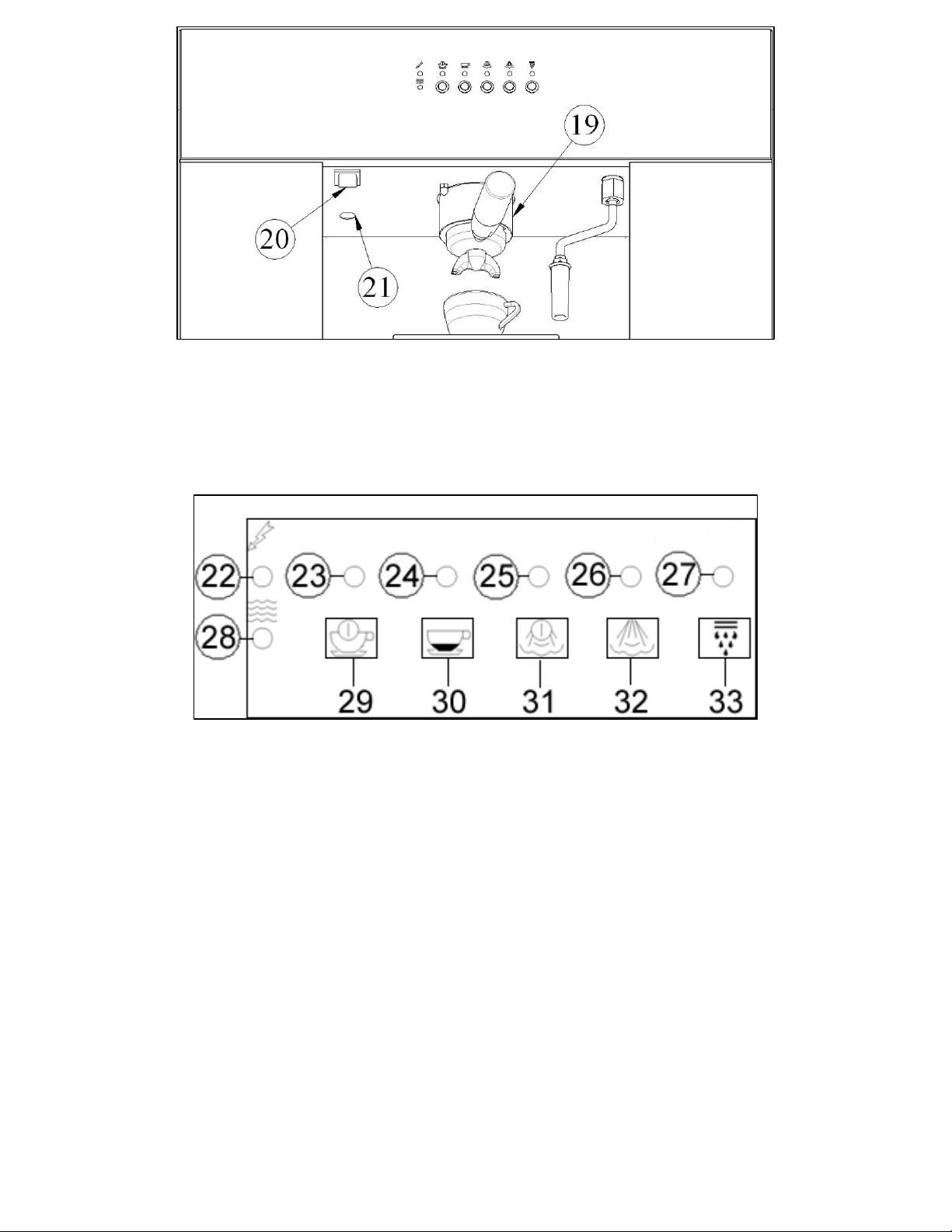
19) Filter holder ring nut
20) Power ON/OFF switch
21) Light
Control panel
22) Power ON indicator (green)
23) Main boiler status indicator (green)
24) Main boiler dispensing indicator (green)
25) Steam boiler status indicator (green)
26) Steam dispensing indicator (green)
27) Boiling water dispensing indicator (green)
28) Low water level indicator (red)
29) Main boiler activation button
30) Main boiler dispensing button
31) Steam boiler activation button
32) Steam boiler dispensing button
33) Boiling water dispensing button
10
Page 11
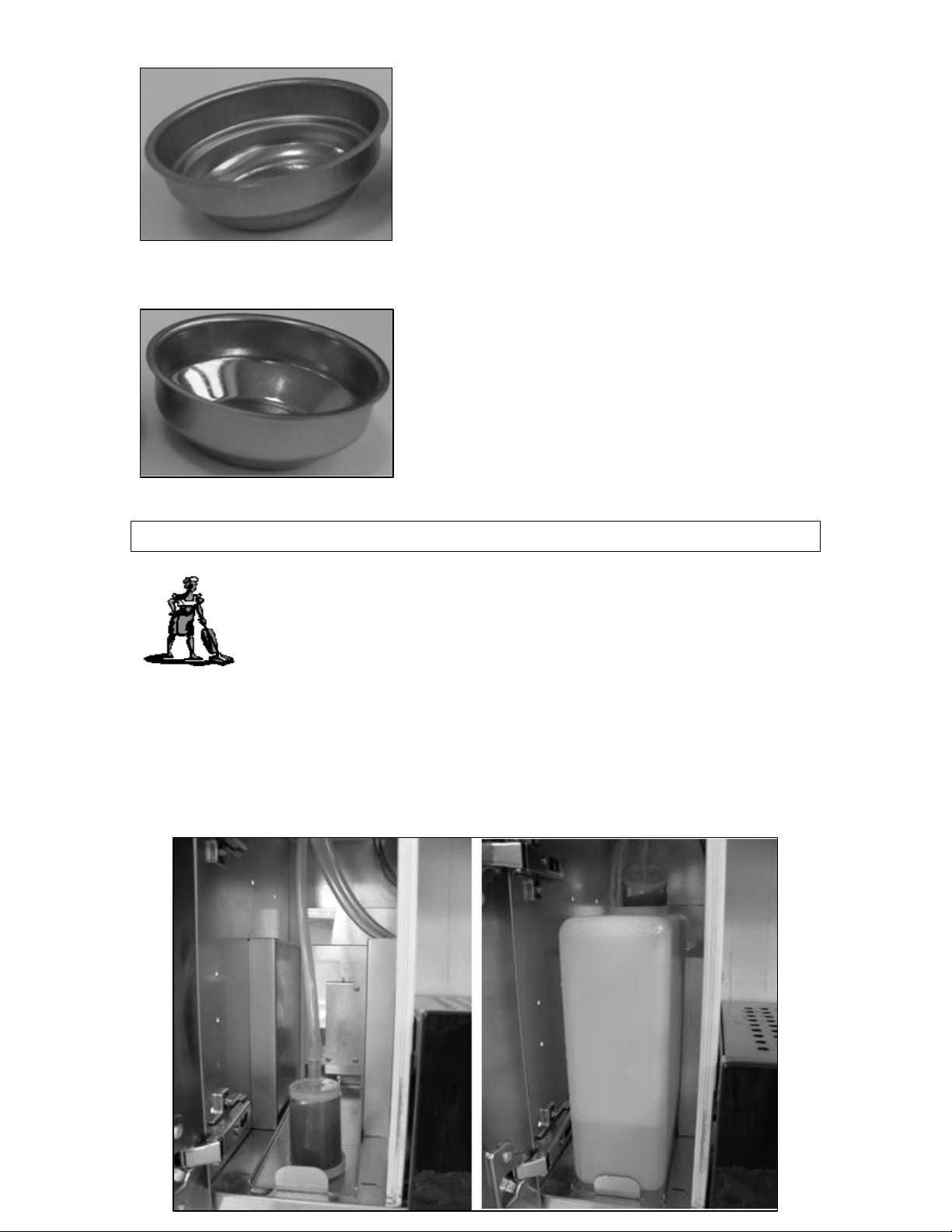
The filters
o Filter for 1 Italian coffee pod or 1
dose of ground coffee.
o Filter for 2 measures of espresso
coffee of 1 French coffee pod.
Things to do before first use
1) Cleaning
o It is strongly recommended to clean the appliance
prior to its first use. Particular attention should be
paid to the water reservoir.
o For further information on cleaning the appliance, please refer to
the cleaning instructions on pages 23 - 25.
2) Filling the water reservoir (manual fill mode)
11
Page 12

o Install the appliance as per the installation instructions contained
within this booklet.
o Open the water reservoir door (14) and remove the water
reservoir (15) from the cabinet.
o Remove the water softener filter (11) from its connecting pipe
and immerse it in a bowl of cold water for approximately five
minutes prior to reconnecting.
o Fill the water reservoir with cold water until it is two thirds full.
o Re-connect the water softener filter (11) to the longest tube and
then place it inside the water reservoir, along with the other two
tubes.
o Put the water reservoir back into the cabinet.
o IMPORTANT: Make sure that the water reservoir is
positioned correctly on the pedal inside the water
reservoir cabinet (as shown in the picture on the
previous page).
o Switch the appliance on using the power ON/OFF switch (20);
the power ON indicator (22) will light.
o If the water level in the water reservoir is not sufficient the low
water level indicator (28) will start flashing. You should add
more water to the water reservoir.
o IMPORTANT: If the low water level indicator (28)
remains steady even after filling the water reservoir
with additional water, you should switch the machine
off using the power ON/OFF switch (20) and then
restart after few seconds.
2a) What to do if the water level runs low during operation
o If whilst making drinks, the water reservoir runs low
on water, the low water level indicator (28) will
flash. The espresso machine will stop any drinks
making operation that is in progress.
o You should turn the appliance off using the power ON/OFF switch
(20).
o Then follow the process described above on filling the water
reservoir manually.
12
Page 13

o Restart the machine using the power ON/OFF switch (20).
o You must start the drinks making process right from the
beginning, as stated in the “Using your espresso maker” section
(pages 15 – 17).
3) Filling the water reservoir (auto-fill mode)
o Install the appliance as per the installation instructions contained
in this booklet.
o Open the water reservoir door (14) and remove the water
reservoir (15) from the cabinet.
o Remove the water softener filter (11) from its connecting pipe
and immerse it in a bowl of cold water for five minutes prior to
reconnecting.
o Re-connect the water softener filter (11) to the longest tube and
then place it inside the water reservoir, along with the other two
tubes.
o Put the water reservoir back into the cabinet.
o IMPORTANT: Make sure that the water reservoir is
positioned correctly on the pedal inside the water
reservoir cabinet (as shown in the picture on page
11).
o Switch the appliance on by using the power ON/OFF switch
(20); the power ON indicator (22) will light.
o The reservoir will fill for approximately 40 seconds. During this
operation the low water level indicator (28) will continue to
flash.
o The low water level indicator (28) will remain steady if the
appliance is insufficiently filled. If this occurs, you should switch
off the appliance using the power ON/OFF switch (20) and
restart after a few seconds. The appliance will automatically
commence a further fill of the water reservoir.
o When the water reservoir has been filled sufficiently, the low
water level indicator (28) will go out.
o DO NOT touch any other button on the espresso
machine during this process.
13
Page 14

3a) What to do if the water level runs low during operation
o If water in the water reservoir runs low during the
drinks making process the low water level indicator
(28) will start flashing. The espresso machine will
stop any drinks making processes that are in
progress.
o The water reservoir will start filling with water automatically
after a few seconds.
o When the water reservoir has filled sufficiently, the low water
level indicator (28) will switch off.
o The low water level indicator (28) will remain steady if the
appliance is insufficiently filled. If this occurs, you should switch
off the appliance using the power ON/OFF switch (20) and
restart after a few seconds. The appliance will automatically
commence a further fill of the water reservoir.
o DO NOT touch any other button on the espresso machine during
this process.
o You must start the drink making process right from the
beginning, as stated in the “using your espresso maker” section
(pages 15 – 17).
4) Getting started (Loading the system with water)
IMPORTANT: YOU MUST FOLLOW THE STEPS BELOW
BEFORE HEATING THE WATER BOILER FOR THE
FIRST TIME.
o Place a jug below the pipe (for boiling water and steam) (17).
o Push the boiling water dispensing button (33).
o Allow the appliance to have a constant flow of water running
through the system for a few seconds.
o Press the boiling water dispensing button (33) again to stop the
flow of water from the pipe.
14
Page 15

Using your espresso maker
IMPORTANT: Please note that the main boiler and
the steam boiler CANNOT be operated at the same
time.
1) Dispensing hot water through the main boiler
o Follow the instructions on filling the water reservoir as stated
previously and proceed as follows:-
o Press the main boiler activation button (29) to allow the boiler
to heat up. During this process, the main boiler status indicator
(23) will flash.
o When the boiler has reached its operating temperature, the main
boiler status indicator (23) will stop flashing and remain steady.
o Place a cup underneath the filter holder ring nut (19) and then
press the main boiler dispensing button (30).
o To stop hot water from dispensing, press the same button again.
¾ Noise generated during this operation is perfectly
normal. This is caused by the activation of the high
pressure pump during this operation.
¾ It is also quiet normal for a certain amount of water
to drip into the drip tray after water has been
dispensed.
2) Dispensing steam through the steam boiler
o Follow the instructions on filling the water reservoir (pages 11 –
14) as stated previously and proceed as follows:-
o Press the steam boiler activation button (31) to allow the boilers
to heat up. During this process, the steam boiler status indicator
(25) will flash.
o Whilst the steam boiler is heating up, it is normal to get a small
amount of water dripping from the pipe for boiling water and
steam. (17).
o When the boilers have reached their operating temperature, the
steam boiler status indicator (25) will stop flashing and remain
steady.
15
Page 16

o To dispense steam, press the steam boiler dispensing button
(32).
NOTE: Steam will dispense from the pipe for boiling water and
steam (17).
o To stop steam from dispensing, press the same button again.
¾ The noise generated during this operation is perfectly
normal. This is caused by the activation of the high
pressure pump during this operation.
¾ It is also quiet normal for a certain amount of water to
drip into the drip tray after water has been dispensed.
o WARNING: During this operation,
extreme caution should be
exercised, as the dispensing pipe wi
get hot.
o When releasing steam, avoid
directing the steam towards your
person.
scalding.
o Always use a container or a mug
underneath the dispen
whilst dispensing steam.
3) Dispensing boiling water through the steam boiler
o Follow the instructions on filling the water reservo
14) as stated previously and proceed as follows:-
o Press the steam boiler activation button (31) to allow the boilers
to heat up. Durin
(25) will flash.
o Whilst the steam boiler is heating up, it is nor
amount of water dripping from the pipe (17).
o When the boilers have reached their operating temperature, the
steam bo
steady.
o To dispense bo
button (33).
iler status indicator (25) will stop flashing and remain
g this process, the steam boiler status indicator
iling water, press the boiling water dispensing
There is a danger of
sing pipe
ir (pages 11 –
mal to get a small
ll
16
Page 17

NOTE: Boiling water will dispense from the pipe (for boiling water
and steam) (17).
o To stop boiling water from dispensing, press the same button
again.
¾ The noise generated during this opera
normal. This is caused by the activation of the high
pressure pump during this operation.
¾ It is also quiet normal for a certain amount of water to
drip into the drip tray after water has been dispensed.
o WARNING: During this operation,
extreme c
exercised, as the dispensing pipe
will get hot.
o When releasing boiling water, avoid
directing
your person. There is a danger of
scalding.
o Alw
ays use a container or a mug
underneath the pipe whilst
dispensing boiling water.
aution should be
boiling water towards
tion is perfectly
17
Page 18

Making drinks
Connecting the filter ho
o Lift the
making sure that it is in the position shown in the drawing
above.
o Continue lifting the holder until it locates inside of the ring nut.
o Turn the handle of the holder anti-clockwise, making sure that it
is fully secured.
o When you have finished using the holder, turn the handle
clockwise and remove it from
Making a drink using coffee pods
Coffee pods are an easy, practical and hygien
he pac
T kaging used for coffee pods does not allow excess coffee to
spill out an
o For best results ensure that the coffee pods are used prior
to their use by date.
Followo the instructions on filling the water reservoir (pages 11 –
14) and “Dispensing hot water through the main boiler” (page
15).
filter holder (1) towards the filter holder ring nut (19);
IMPORTANT: If the filter gets attached to the boil
hould carefully remove it. This is a result of a vacuum
s
being created during the espresso making process.
d can be easily removed after use.
o IMPORTANT: If you are using Italian coffee
pods, then the filter for 1 Italian coffee pod (4)
must be used. I
pods, then the filter for 1 French coffee pod (6)
must be used.
lder to the main boiler
the filter holder ring nut (19).
er, you
ic way to make coffee.
f you are using French coffee
18
18
Page 19

o To make a single dose of espresso, use the spout for a single
coffee dose (2) and use one espresso cup.
To make a double dose of espresso, use the spout for a double
o
coffee dose (3) and use two espresso cups.
Insert an appropriately sized coffee pod filter (4) or (6) into the
o
filter holder (1).
o Place the coffe
the filter holder ring nut (19) on to the main boiler and lock it
into position.
o Place a
espresso for making espresso shots use the espresso cup stand
(18).
o Press the main boiler dispensing button (30).
o When your espresso is made, press the same button again to
stop hot water from dispensing.
o Release the filter holder (1) from the filter holder ring nut (19).
o When the coffee pod is sufficiently cooled, remove it from the
filter holder (1) and discard it.
o Wipe over the filters with a damp cloth, if you want to make
another drink.
o When you have finished making drinks, you can either wash the
filters and spouts in hot soapy water or in a
Making drinks using espresso ground coffee
o Follow
14) and “Dispensing hot water through the main boiler” (page
15).
o To make a single dose of espresso, use the spout for a single
coffee dose (2) and use one espresso cup.
o To make a double dose of espresso, use the spout for a double
coffee dose (3) and use two espresso cups.
o Insert the appropriately sized coffee pod filter (4) or (6) into
the filter holder (1).
suitably sized cup under the main boiler. If using the
the instructions on filling the water reservoir (pages 11 –
e pod into the filter holder (1) and place it onto
dishwasher.
19
Page 20

o Using the supplied espresso coffee batcher (ground) (9) put the
required amount of espresso coffee into the filter holder (1).
Use the coffee pressing tool (10) to pack down the espresso
o
co
ffee in the filter holder. Place the filter holder into the filter
ho
lder ring nut (19) on the main boiler and lock it in position.
o IMPORTANT: Do not overfill or compact the
espresso coffee too tightly. Doing this will not
allow the water to flow freely.
o Place a suitably sized cup under the main
espresso cup stand (18) if using the espresso cup.
o Press the main boiler dispensing
o When your espresso is made, press the same button again to
stop hot water from dispensing.
o Release the filter holder (1) from the filter holder ring nut (19)
and discard the
o Wipe over the filters with a damp cloth, if you want to make
another drink.
o When you have finished making drinks, you can either wash the
filters and spouts in hot soapy water or in a dishwasher.
Tips on making an espresso
A
by forcing pressurised hot water, through finely
ground espresso coffee.
o Approximately 7 grams of coffee is required for an espresso.
After filling the filter with coffee, use the coffee pressing tool
(10) to tap down the coffee in the filter holder. Remove any
excess coffee from the filter holder before making the espresso.
If you are using the small cups especially designed for
o
espressos, then you should utilise the espresso cup stand (18)
to raise the cup closer to the filter holder (1).
o The main boiler should be pre-heated and a small amount of
water should be
used espresso coffee.
n espresso is a strong black coffee that is made
dispensed through the machine to warm it up.
button (30).
boiler. Use the
20
Page 21

The espresso cups should also be warmed before making any
o
espresso dri k.
o After making a cup of espresso, you should follow the dispensing
steam from the steam boiler section (pages 15 – 16).
Press the steam boiler dispensing button (32) and release steam
o
for a few seconds onto the drip tray. During this time, a certain
amount of co
o Pr
o Press the steam boiler dispensing button for the third time and
o Move the container of milk up and down very slowly whilst
o The temperature of the milk should be monitored by carefully
o Milk should not be overheated, in order to avo
o When the required froth has been achieved, press the steam
ess the steam boiler dispensing button again to stop the steam
dis
pensing.
allow the
a steady flow of steam is obtained, immerse the pipe (for boiling
water and steam) (17) into the milk, holding the rubber sleeved
section.
simultaneously rotating the container at the same tim
touching the container with the palm of your hand.
boiler dispensing button to stop the function.
n
Tips on making a cappuc
n espresso topped with an equal amount of
A
teamed milk and froth.
s
o IMPORTANT: When mak
steam boiler should be heated before the main
boiler in order to reduce the time taken to heat
up the main boiler.
ndensed water will be released.
o IMPORTANT: Using the metal jug supplied along
with the appliance, fill approximately 150 - 200 ml of
milk required for frothing.
steam to flow onto the drip tray for few seconds. Once
cino
ing a cappuccino, the
e.
id it being diluted.
21
Page 22

o Put the espresso shot into a large cup and then pour the heated
m
ilk from the jug into it. The froth achieved during the frothing
pro
cess should be spooned over the top.
o IMPORTANT: To get the best results, milk should
be semi-skimmed and preferably at room
temperature.
o After using the above function, a certain amount of steam
should be dispensed through the pipe several times and
the froth making
o The froth making nozzle can be dismantled and washed
in a dishwasher.
o NOTE: You can also use the steam pipe to heat up other
beverages such as water, punch and hot chocolate etc.
Tips on making tea
o For tea bags, follow the instructions as stated in the dispensing
boiling water through the steam boiler section (pages 15 – 16).
nozzle cleaned with a damp cloth.
o For loose leaf tea, follow the instructions as
stated in the “Making drinks using espresso
ground coffee” section (page 19 - 20).
22
Page 23

nd maintenance Cleaning a
Cleaning operations must only be carried out
when the coffee maker is cold.
The appliance should be disconnected from your
mains sup
process.
Stainless steel sections
o The stainless steel sections should be cleaned using war
water.
o No abrasive detergents or cleaners should be used.
o No abrasive sponges or steel wool should be used on any a
the appliance.
o Dry the appliance afterwards thoroughly with a soft cloth.
o We would recommend that an appropriate stainless steel cleaner
and poli
Steam pipe
o You should flush the steam pipe thoroughly with steam after
each use.
o NOTE:
the steam discharge hole and cause the appliance to function
poorly.
o If you have used
making device and wipe both the sections using a clean sponge
or a damp clo
Water reservoir
o If you are not using the appliance for a long
should drain the boiler by following the “Dispensing hot water
through the main boiler” section (page 15).
o Press the main boiler dispensing button (30) until the reservoir
is empty.
o If your appliance is connected to your mains water s
should turn the machine off using the power ON/OFF switch or
from the mains, before it starts to refill the reservoir.
sh is regularly used on the stainless steel surfaces.
When milk cools, it creates impurities which may block
th.
ply before commencing any cleaning
m soapy
the steam pipe, you should dismantle the froth
period of time, you
upply, you
rea of
23
Page 24

o Clean the water reservoir regularly using warm soapy water and
make sure that the water reservoir has been rinsed thoroughly
before being placed back in the machine.
The drip tray
o Pull the storage drawer forward and remove the drip tray.
o You can either wash this drip tray in warm soapy water or wash
it in a dishwasher.
o Make sure that the drip tray and cover are thoroughly dried
before reinstalling.
Water boiler
o Depending on the water hardness in your area of the country, it
is normal for limescale to form in the boilers. Therefore it is
recommended that you should carry out the following process at
least every six months.
o Manually fill the water reservoir with 2 litres of water.
o Add half a glass of citric acid or vinegar to the water reservoir.
o Follow the process stated in the “Dispensing hot water through
the main boiler” section (page 15) and follow the process stated
in the “Dispensing boiling water through the steam boiler”
section (pages 15 – 16).
o When the water reservoir is completely empty, fill the reservoir
with cold water (either manually or automatically) and then
dispense water until the reservoir is empty again.
o You should do this twice to make sure that there are no traces of
citric acid or vinegar left in the water reservoir.
o IMPORTANT: There are coffee boiler cleaners that are readily
available from supermarkets or D.I.Y. stores. Please refer to the
manufacturer’s instructions when using these products.
Water softener
o The water softener will need to be replaced approximately every
six months.
o If the colours of the granules in the water softener have changed
from their original colour, then it is time to replace it.
24
Page 25

o A replacement water softener can be obtained from the
Baumatic Spares Department.
o When a new water softener is fitted, you should follow the filling
the water reservoir instructions.
INSTALLATION
Installation of this appliance must be carried
out by a suitably qualified person, in
accordance with the current version of the
following.
o UK Regulations and Safety Standards or their European Norm
Replacements.
o Building Regulations (issued by the Department of the
Environment).
o Building Standards (issued by the Scottish Development
Department).
o IEE Wiring Regulations.
o Electricity At Work Regulations.
Before connecting the appliance, make sure that the supply voltage
marked on the rating plate corresponds with your mains supply
voltage.
WARNING: THIS APPLIANCE MUST BE EARTHED.
o This appliance should be wired into a 13 A double pole
switched fused spur outlet, having 3 mm contact separation and
placed in an easily accessible position adjacent to the appliance.
The spur outlet must still be accessible even when your coffee
machine is located in its housing.
o If you have to change the coffee machine power cord, the
earthing (yellow/green) conductor must always be 10 mm longer
than the line conductors.
o Care must be taken to ensure that the temperature of the mains
supply cable does not exceed 50°C.
o If the mains supply cable is damaged, then it must be replaced
with a suitable cable.
25
Page 26

Installing the espresso maker into a kitchen cabinet
o Ensure that the aperture that you will be fitting the coffee
machine into is of the size given in the diagram above.
o Ensure that the rear panel of the furniture housing unit has been
removed and that the ventilation cut out shown is adhered to.
26
Page 27

o You must ensure that there is a hole to feed the electrical cable
through. If you are going to connect the appliance to your mains
water supply, then you must ensure that there is a hole to feed
the inlet hose through too. These steps must be done before
commencing the rest of the installation process.
o IMPORTANT: If the appliance has been plumbed to your
mains water, make sure that the stop valve is easily
accessible during an emergency.
1. Measure a height of
200 mm from the
base of the housing
unit. Then at that
height, measure out
a distance of 225
mm from the front
of it and mark it.
You should make
the same
measurement and
marking on both
sides of the housing
unit.
2. On the marks that you have just made,
use the screws provided to fix a support
piece to either side of the housing unit.
3. Use a spirit level to make sure that the support
pieces are vertically level.
IMPORTANT: You must complete the water connection at
this stage, if you are going to connect the appliance to
your mains water supply.
27
Page 28

Do not proceed with the rest of the installation steps listed
below, until you have completed the “Connecting the espresso
maker to the mains water supply” section on the next page.
You should also feed the electrical cable through the hole that you
have made for it in the housing unit. You should NOT connect the
cable to the spur outlet at this stage.
4. Place the coffee machine inside of the housing unit.
5. Sit the coffee machine in the housing unit. You must make sure
that the coffee machine is flush with the housing unit, otherwise
it will not line up properly with the support pieces.
6. There are two screw holes on the main body of the coffee maker,
one on the right hand side of the machine and the other on the
left hand side. You have to open the water reservoir door (14)
and remove the water reservoir (15) to access the left hand
one.
7. Fix the coffee machine against the housing unit by fully
tightening the screws provided, through the screw holes on the
above drawing.
8. Follow the electrical connection information on page 24 and then
check that the appliance is functioning correctly.
IMPORTANT: You must follow the before first use section on pages
11 - 14.
28
Page 29

Connecting the espresso maker to the mains water supply
Your coffee machine can be connected permanently to your mains
water supply.
IMPORTANT: The inlet hose used for connecting the appliance
to the mains water supply should be suitable for supplying
water for human consumption (FDA approved) and obtained
from a DIY or plumbing store.
1. Connect the inlet hose coupling
connecter to the inlet valve at the
rear of the espresso machine as
shown in the opposite picture.
Make sure the connection is
securely tightened.
2. Insert the end of the inlet hose into
the inlet hose coupling that you
connected to the espresso maker in step
1.
3. Feed the inlet hose through a pre-cut hole in the housing
unit before installing the espresso maker.
4. Connect the other inlet hose coupling
to your mains water supply.
Warning: Connect the inlet
hose to water mains
connection fit for human
consumption only.
5. The inlet hose coupling connector
should be hand tightened only.
IMPORTANT: DO NOT over tighten the
inlet hose coupling.
29
Page 30

7. Insert the other end of the inlet hose
into the coupling.
8. IMPORTANT: Test the joint connections for any leak by turning on
the water supply.
TROUBLESHOOTING
My espresso machine will not work at all.
o Check your mains supply and the electrical connection.
My espresso machine will not dispense water.
o Check that the water reservoir is filled with water.
o If your appliance is connected to your mains water supply then
check:-
That the water inlet hose is not kinked or blocked.
That the water softener and other tubes are immersed in the
water reservoir.
Is it ‘OK’ to leave my espresso machine switched ON?
o Appliance should not be left unattended when drinks making
process is in progress.
o The appliance will go in a stand by mode when not in use after
approximately 60 minutes. To restart follow the drink making
processes from the start.
30
Page 31

Flashing red light
o Low water level in the water reservoir. Follow the filling
instructions.
Steady red light
o Low water level in the water reservoir. Follow the filling
instructions.
All ‘LED’ light indicators flashing constantly
o Switch off the appliance and restart after approximately
60 minutes. If the error still persists, contact the
Baumatic Customer Care Department to arrange an
engineer’s visit.
Coffee glossary
Caffe- Italian word for a standard espresso
Caffe Americano- a thin espresso with water added
Caffe latte- a double espresso mixed in a large cup
with hot milk. It should be topped with little or no
foam.
Caffe mocha- made from equal parts milk and
cocoa.
Caffeine- espresso’s caffeine content is only a third or
half of that found in coffee. The stronger the roast, the
less caffeine the espresso will contain.
Cappuccino- is espresso frothed with milk. It is
equal parts of espresso, foam and hot milk.
31
Page 32

Crema- this is the sign of the perfect cup of espresso; a fine, nutty or
cinnamon brown foam on the surface of the espresso. This is only
created when the pressure is sufficiently high. The crema contains the
foamed oils which are rich in flavour and aroma.
Espresso- see “caffe”.
Macchiato- espresso carrying a dollop of hot, foaming milk to give a
dappled look.
IMPORTANT: If your appliance appears not to be
operating correctly, then you should disconnect it
from your mains supply and then contact the
Customer Care Department on telephone number
(0118) 933 6911.
DO NOT ATTEMPT TO REPAIR THE APPLIANCE
YOURSELF.
The manufacturer has the right to change any specifications on
the product without giving prior notice.
Please note that if an engineer is asked to attend whilst the product is
under guarantee and finds that the problem is not the result of an
appliance fault, then you may be liable for the cost of the call out
charge.
The appliance must be accessible for the engineer to perform
any necessary repair. If your appliance is installed in such a
way that an engineer is concerned that damage will be caused
to the appliance or your kitchen, then he will not complete a
repair.
This includes situations where appliances have been tiled in,
sealed in with sealant, have wooden obstructions placed in
front of the appliance, like plinths. Or any installation other
than the one specified by Baumatic Ltd. has been completed.
Please refer to the conditions of guarantee that appear on the
warranty card that you receive with the appliance.
IMPORTANT: Baumatic Ltd. operates a policy of continuous
improvement and reserves the right to adjust and modify its
products without prior notification.
32
Page 33

United Kingdom
Baumatic Ltd.,
Baumatic Buildings,
6 Bennet Road,
Reading, Berkshire
RG2 0QX
United Kingdom
Sales Telephone
(0118) 933 6900
Sales Fax
(0118) 931 0035
Customer Care Telephone
(0118) 933 6911
Customer Care Fax
(0118) 986 9124
Spares Telephone
(01235) 437244
Advice Line Telephone
(0118) 933 6933
E-mail:
sales@baumatic.co.uk
customercare@baumatic.co.uk
spares@baumatic.co.uk
technical@baumatic.co.uk
Website:
www.baumatic.co.uk
Republic of Ireland
01- 6266 798
Czech Republic
Baumatic CR spol s.r.o.
Amperova 495
46215, Librec
Czech Republic
+420 800 185 263
www.baumatic.cz
Slovak Republic
Baumatic Slovakia, s.r.o.
Skultetyho 1
831 04 Bratislava 3
Slovakia
+421 255 640 618
Germany
Baumatic Gmbh
Janderstrasse 9
Mannheim, 68199
Germany
+4962 112 9190
www.baumatic.de
Italy
Baumatic Italia S.R.L.
Via Caltana 129
Campodarsego (Padova), 35011
Italy
+3904 9920 2297
www.baumatic.it
Holland
Baumatic Benelux B.V.
Grindzuigerstraat 22
1333 MS ALMERE
The Netherlands
+3136 549 1555
www.baumatic.nl
33
Page 34

34
Page 35

35
Page 36

36
 Loading...