

Page 1
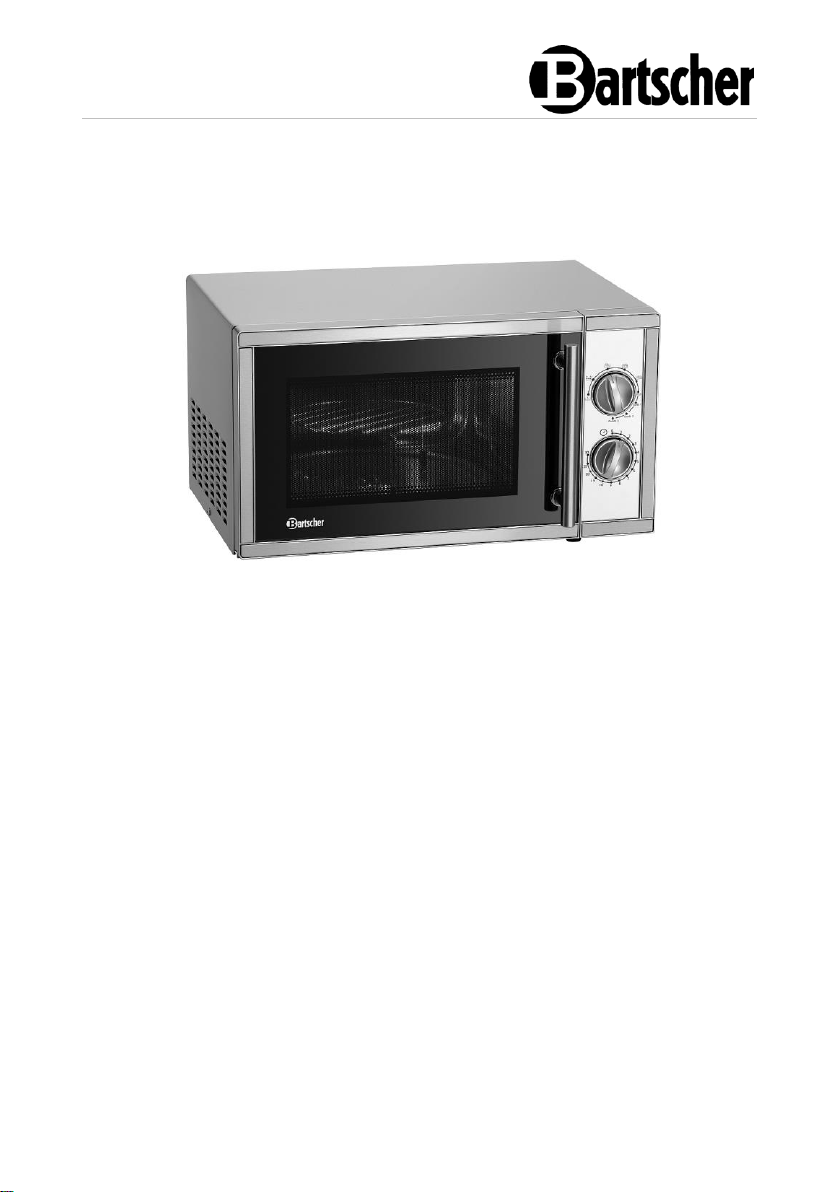
9231D-GR
610856
Page 2

Bartscher GmbH
Franz-Kleine-Str. 28
D-33154 Salzkotten
Germany
Phone: +49 5258 971-0
Fax: +49 5258 971-120
Technical Support Hotline: +49 5258 971-197
www.bartscher.com
Version: 1.0
Date of preparation: 2021-05-06
EN
Page 3

Original instruction manual
1 Safety ............................................................................................................ 2
1.1 Explanation of Signal Words .................................................................... 2
1.2 Safety instructions.................................................................................... 3
1.3 Intended Use ........................................................................................... 7
1.4 Unintended Use ....................................................................................... 7
2 General information ....................................................................................... 8
2.1 Liability and Warranty .............................................................................. 8
2.2 Copyright Protection ................................................................................ 8
2.3 Declaration of Conformity ........................................................................ 8
3 Transport, Packaging and Storage ................................................................ 9
3.1 Delivery Check ......................................................................................... 9
3.2 Packaging ................................................................................................ 9
3.3 Storage .................................................................................................... 9
4 Technical Data ............................................................................................. 10
4.1 Technical Specifications ........................................................................ 10
4.2 List of Components of the Appliance ..................................................... 11
4.3 Functions of the Appliance ..................................................................... 11
5 Installation and operation ............................................................................ 12
5.1 Installation .............................................................................................. 12
5.2 Basics of Thermal Processing in Microwave .......................................... 13
5.3 Cookware Suitable for Use in Microwave .............................................. 14
5.4 Operation ............................................................................................... 15
6 Cleaning ...................................................................................................... 20
6.1 Safety Instructions for Cleaning ............................................................. 20
6.2 Cleaning ................................................................................................. 21
7 Possible Malfunctions .................................................................................. 22
8 Disposal ....................................................................................................... 22
610856 1 / 24
Page 4
Safety
EN
Read this instruction manual before using and keep it available
at all times!
DANGER!
The signal word DANGER warns against hazards that lead to severe
injuries or death if the hazards are not avoided.
Diese Bedienungsanleitung beschreibt di e Installation, Bedienung und Wartung d es Geräts und gilt als wichtige Inform ationsquelle und Nachschlagewerk. Die Ken ntnis aller enthaltenen Sicherheitshin weise und Handlungsanweisungen sch afft die Voraussetzung für das sichere und sachgerechte Arbeiten mit dem Gerä t. Darüber hinaus müssen die für d en Einsatzbereich des Geräts geltende n örtlichen Unfallverhütungsvorschriften und allgemeinen Sicherheitsbestimmunge n eingehalten werden. Diese Bedienungs anleitung ist Bestandteil des Produ kts und muss in unmittelbarer Nähe des Geräts für das In¬stallations-, Bedi enungs-, Wartungs- und Reinigungspers onal jederzeit zugänglich auf¬bewahrt werd en. Wenn das Gerät an eine dritte Pers on
weitergegeben wird, muss die Bedienungsa nleitung mit ausgehändigt werden.
This instruction manual contains information about installation, operation and
maintenance of the appliance and constitutes an important source of information
and reference guide. The knowledge of all operational and safety instructions
included in this manual is a prerequisite for safe and proper handling of the
appliance. Additionally, accident prevention, occupational health and safety, and
legal regulations in force in the area the appliance is used apply.
Before you start using the appliance, especially before turning it on, read this
instruction manual in order to avoid personal injuries and property damages.
Improper use may cause damage.
This instruction manual forms and integral part of the product and must be stored in
an immediate vicinity of the appliance and be available at all times. The instruction
manual should be transferred together with the appliance.
1 Safety
This appliance has been manufactured in accordance with technical standards
currently in force. However, the appliance may be a source of hazards if used
improperly or contrary to its intended purpose. All persons using the appliance must
consider information included in this instruction manual and observe safety
instructions.
1.1 Explanation of Signal Words
Important safety instructions and warning information are indicated in this
instruction manual with appropriate signal words. You must strictly follow the
instructions, to prevent accidents, personal injuries and property damages.
2 / 24 610856
Page 5
Safety
EN
WARNING!
The signal word WARNING warns against hazards that may lead to
moderate or severe injuries or death if the hazards are not avoided.
CAUTION!
The signal word CAUTION warns against hazards that may lead to
light or moderate injuries if the hazards are not avoided.
IMPORTANT!
The signal word IMPORTANT indicates possible property damages,
which may occur if safety instructions are not observed.
NOTE!
The symbol NOTE indicates subsequent information and guidelines
for the user on usage of the appliance.
, die
1.2 Safety instructions
Electrical Current
• Too high a mains voltage or incorrect installation may cause electric shock.
• The appliance may be connected only if data on the rating plate correspond with
the mains voltage.
• To avoid short-circuit, the appliance should be kept dry.
• If there are malfunctions during operation, disconnect the appliance from the
power supply.
• Do not touch the appliance’s plug with wet hands.
• Never take hold of the appliance if it has fallen into water. Immediately
disconnect the appliance from the power supply.
• Any repairs or housing opening may be carried out by professionals and
relevant workshops only.
• Do not transport the appliance, holding it by the power cord.
• Do not allow the power cord to come into contact with heat sources or sharp
edges.
• Do not bend, pinch nor knot the power cord.
610856 3 / 24
Page 6

Safety
EN
• Always completely unwind the power cord.
• Never place the appliance or other objects on the power cord.
• Always take hold of the plug to disconnect the appliance from the power supply.
• Check the power cord regularly for damage. Do not use the appliance if the
power cord is damaged. If this cable is damaged, it must be replaced by
customer service or a qualified electrician in order to avoid dangers.
Flammable Materials
• Never subject the appliance to contact with high temperature sources, e.g.:
oven, furnace, open flame, heat generating devices, etc.
• To avoid fire hazard, clean the appliance regularly.
• Do not cover the appliance with, e.g., aluminium foil or cloths.
• Use the appliance only with materials designated to this end and with correct
temperature settings. Materials, groceries and left-overs remaining in the
appliance may catch fire.
• Never use the appliance near flammable or inflammable materials, e.g.: petrol,
spirit, alcohol, etc. High temperature triggers evaporation of these materials,
and, as a result of contact with sources of ignition, an explosion may occur.
• In case of fire, disconnect the appliance from the power supply before
attempting suitable fire-extinguishing actions.
• Never attempt to extinguish fire with water if the appliance is connected to the
power supply. Following extinction of fire, ensure sufficient fresh air inflow.
Fire or Explosion Hazard
• Do not place any objects inside the appliance (cookbooks, sponges, etc.).
Sudden activation of the appliance can cause damage to such objects, and
even burn them.
• When heating or cooking food products in containers from flammable materials
such as plastic or paper, remain near the appliance as there is a risk of the
appliance overheating.
• If objects in the device catch fire, leave the door closed, turn the appliance off
and remove the plug from its socket orR flip the main circuit breaker switch.
• Do not use metallic pots, pans or covers. Metal may lead to sparks in the
cooking chamber. Use only dishes resistant to high temperatures, designed for
use in microwave ovens (see sec. 5.3). Risk of fire!
• Do not prepare food products and beverages in closed or sealed containers.
Such containers may crack inside the device or injure the user when being
opened!
4 / 24 610856
Page 7
Safety
EN
• Do not use the appliance for preparation of fresh or hard-boiled eggs, either in
shell or peeled, as eggs may explode.
• Food products with thick skins, such as potatoes, pumpkins, apples or
chestnuts, should be pierced prior to heating.
• Do not place solutions inside containing water, oil or grease, as such a mixture
may explode.
Safety of Microwave Oven Operation
• Do not fry any food products in the appliance. Hot oil can lead to skin burns
and/or damage to the appliance.
• Food products prepared in the appliance are heated unevenly. Also, containers
are usually hotter than the food products inside. Carefully check the temperature
of food products, especially those prepared for children. Risk of burns!
• During the heating of liquids in the microwave oven it is possible that the liquid
may reach boiling temperature without externally visible bubbling. For this
reason, special care must be taken when handling the container. Even a light
bump, e.g. when removing the liquid from the device, may lead to spillage. Risk
of burns!
• For that reason avoid using tall, narrow containers with a thin neck.
• Place a spoon (only in exceptional cases use a metallic one) or glass stirrer in
the beverage, then place the dish in the center of the rotating tray. Stir the liquid
prior to heating and after half the heating time has elapsed. After heating: wait
for a moment, carefully stir the liquid, then remove from the cooking chamber.
• As food prepared in the microwave is heated unevenly, the contents of
children’s bottles must be mixed thoroughly - optimally by shaking – then, before
giving the bottle to the child, check the temperature of the food. Prior to heating
food remove the bottle cap and nipple!
610856 5 / 24
Page 8

Safety
EN
Microwave Radiation Hazard!
Exposure to microwave radiation may cause bodily injury. To avoid the effects of
this risk, follow the safety instructions presented below:
• Do not turn the microwave oven on when the door is open, as the appliance
may emit an excess of damaging electromagnetic waves.
• Never change the safety locks!
• It is extremely important to not damage the door and that it can be closed
properly. Example of damage to the door which may be unsafe include the
following:
– warping and indentations,
– cracked and/or properly secured hinges and screws,
– damaged door seals,
– cracked glass pane,
– damaged locking elements.
• The space between the door and the appliance must be free of foreign objects.
• Door seals must be tight and clean, as dirt and damage may allow
electromagnetic waves to escape from the microwave oven. Take care to
prevent buildup of any residues (e.g. cleaning agents, dust, grease, etc.).
Halten Sie Verpackungsmaterialien und S tyroporteile von Kindern fern. Sie könn en sich darin verfangen und ersticken.
Operating personnel
• The appliance can be used by children of 8 years old and older, as well as by
people with reduced physical, sensory or mental abilities and those with limited
experience/knowledge as long as they are under supervision or have been
instructed on safe use of the appliance and possible risks. Children should not
play with the appliance.
• Do not leave the appliance unattended in the presence of children.
Improper Use
• Unintended or prohibited use may cause damage to the appliance.
• The appliance may only be used when its technical condition is flawless and
allows for safe operation.
• The appliance may only be used when all connections are executed according
to rules of law in force.
• The appliance may only be used when it is clean.
• Use only original spare parts. Never attempt to repair the appliance on your own.
• Do not introduce any changes in the appliance nor modify it.
6 / 24 610856
Page 9
Safety
EN
1.3 Intended Use
As described below, every use of the appliance for a purpose differing and/or
diverging from its intended standard use, is prohibited and considered to be an
unintended use.
The following is an intended use:
– preparing, heating-up, grilling and defrosting foods with the use of
suitable cookware.
This appliance is intended for use in households and similar places, e.g.:
– in employee canteens in shops, offices, and similar areas;
– on farms;
– by customers in hotels, motels, and other typical accommodation
establishments;
– in lodging-houses.
1.4 Unintended Use
An unintended use may lead to personal injuries or property damages caused by
hazardous voltage, fire or high temperature. The appliance may only be used to
perform tasks described in this instruction manual.
The following is an unintended use:
– for industrial and laboratory needs,
– as a storage compartment (e.g., for cookware/dishes),
– drying paper, textiles or other flammable materials,
– heating/heating up flammable, harmful, and quickly evaporating liquids or
materials, etc.
610856 7 / 24
Page 10

General information
EN
2 General information
2.1 Liability and Warranty
All information and instructions in this instruction manual account for legal
regulations in force, current level of technical engineering knowledge as well as our
expertise and experience, developed over the years. If special models or additional
options are ordered, or state-of-the-art technical solutions were implemented, the
actual scope of delivery of the appliance may, in some circumstances, differ from
descriptions and numerous drawings in this instruction manual.
The manufacturer is not liable for any damages nor faults stemming from:
– failure to observe instructions,
– unintended use,
– technical alterations introduced by the user,
– usage of unapproved spare parts.
We reserve the right to introduce technical modifications to the product, intended for
improvement of the appliance and its performance.
2.2 Copyright Protection
This instruction manual, and texts, drawings and images included in it, as well as its
other components are copyright protected. It is prohibited to reproduce this
instruction manual (including its excerpts), in any form and by any means, and to
use and/or transfer its content to third parties without manufacturer’s written
permission. Violation of the above results in obligation to pay compensation. We
reserve the right to claim further damages.
2.3 Declaration of Conformity
The appliance meets the currently applicable standards and guidelines of the
European Union. We confirm the above in the EC Declaration of Conformity. We
may provide relevant Declaration of Conformity upon request.
8 / 24 610856
Page 11
Transport, Packaging and Storage
EN
3 Transport, Packaging and Storage
3.1 Delivery Check
Immediately upon reception, check the delivery for completeness and possible
shipping damage. In the case of visible transport damage refuse to accept the
appliance or accept it conditionally. Mark and note the scope of damage in shipping
documents/consignment list of the shipping company and lodge a complaint.
Concealed damage must be reported immediately upon its discovery, as
compensation claims may only be filed within applicable time limits.
If you find that parts or accessories missing, please contact our Customer Service
Department.
3.2 Packaging
Do not dispose of the appliance cardboard box. It may be used to store the
appliance when relocating or when shipping the appliance to our service point in the
case of any damages.
The packaging and its elements are made of recyclable materials. Particularly,
these are: plastic films and bags, cardboard box.
When disposing of the packaging, observe applicable domestic regulations.
Recyclable packaging materials should be recycled.
3.3 Storage
Leave the packaging closed until installation of the appliance; observe external
indications concerning method of placing and storage. Store the packaging in the
following conditions only:
– in closed rooms;
– in dry and dust-free surrounding;
– away from aggressive agents;
– in a location protected against sunlight;
– in a location protected against mechanical shocks.
In the case of extended storage (over three months), make sure you check the
condition of the packaging and the parts regularly. If needed, replace the packaging
with a new one.
610856 9 / 24
Page 12
Technical Data
EN
Name:
Microwave 9231D-GR
Article number:
610856
Material:
stainless steel | steel, painted
Thermal processing chamber material:
stainless steel
Rotary plate material:
glass
Diameter of rotary plate, in mm:
270
Microwave output, in W:
900
Grill output, in W:
1000
Number of magnetrons:
1
Number of power output levels:
9
Volume, in l:
23
Chamber dimensions (W x D x H), in mm:
315 x 312 x 198
Time setting, up to, in min.:
30
Connected load:
1,4 kW | 230 V | 50 Hz
Dimensions (W x D x H), in mm:
483 x 405 x 279
Weight, in kg:
15,4
4 Technical Data
4.1 Technical Specifications
We reserve the right to implement technical modifications.
Version / Characteristics
• Functions: heating-up, defrosting, grill (may be combined)
• Control: electronic, knob
• Timer
• Rotary plate
• Internal lighting
• The set includes: 1 grill grate, Ø189 mm, H 79 mm
10 / 24 610856
Page 13
Technical Data
EN
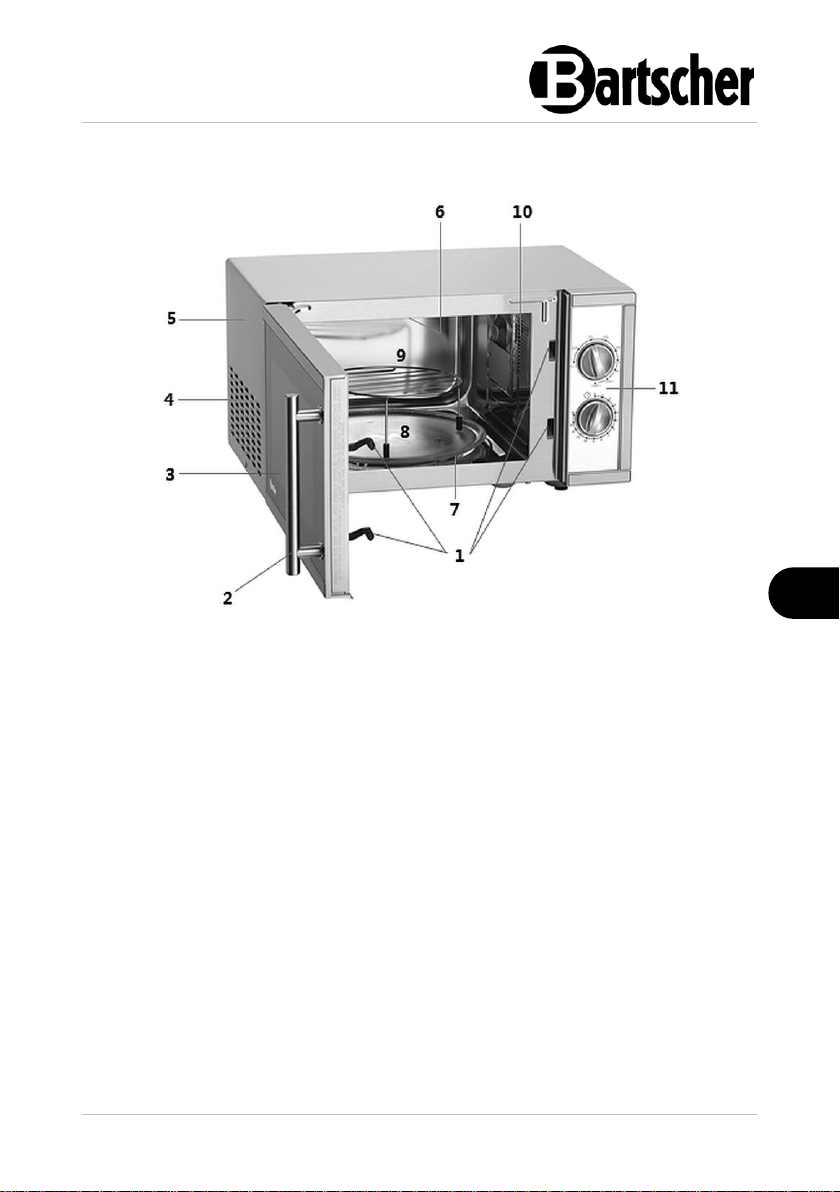
Fig. 1
1. Door safety lock system
2. Door handle
3. Door with sight glass
4. Ventilation openings
5. Housing
6. Grill heater
7. Roller ring
8. Rotary plate
9. Grill grate
10. Internal lighting
11. Control panel
4.2 List of Components of the Appliance
4.3 Functions of the Appliance
The microwave is designed for heating-up, defrosting and grilling foods with the use
of cookware suitable for use in microwave. With the use of suitable rotary
controllers you may set output and time, as required for a given dish.
610856 11 / 24
Page 14
Installation and operation
EN
CAUTION!
Choking hazard!
Prevent children from accessing package materials, for instance: plastic
bags and EPS.
5 Installation and operation
5.1 Installation
Unpacking / Positioning
• Unpack the appliance, remove all external and internal packaging elements and
shipment safeguards.
• If the appliance is covered with a protective film, remove it. Remove the film
slowly, so no glue residues are left. Remove any glue residues with the use of a
suitable solvent.
• Be careful not to damage the rating plate and warning labels fixed on the
appliance.
• Never place the appliance in humid or wet environment.
• Place the appliance in a way making the connections easily accessible, so that
they may be quickly disconnected if such a need arises.
• The appliance should be placed on surfaces that are:
– even, with sufficient bearing capacity, resistant to water, dry and resistant
to high temperatures;
– sufficiently large, and thus enabling usage of the appliance with no
problems;
– easily accessible;
– well ventilated.
• Maintain sufficient clearance from table edges. The appliance might turn over
and fall down.
• To ensure proper functioning, the device must have sufficient ventilation.
• Never block the ventilation ducts!
• It is necessary to maintain the following safe distances:
– above the device: 20 cm
– at rear of device: 10 cm
– at sides of device: 5 cm.
12 / 24 610856
Page 15
Installation and operation
EN
• The device must remain a minimum distance of 2 m from radios, televisions,
and other such electronics in order to avoid interference with the signal
reception.
Power supply connection
• Verify if technical data of the appliance (see rating plate) correspond with the
local electric power grid specification.
• Connect the appliance to a single, properly grounded mains socket with
protective contact. Do not connect the appliance to a multi-socket.
• The power cord should be laid in a way preventing anyone from threading on it
or tripping against it.
5.2 Basics of Thermal Processing in Microwave
Instead of traditional heat sources, a microwave oven applies an electron lamp
which emits electromagnetic waves. These waves, like radio waves, are invisible
but their effects can be observed. Such waves can pass through materials such as
glass, porcelain, artificial materials and paper. As these materials do not contain
water, grease or oil, they are not heated by the microwaves. Simply put, the
microwaves directly reach the food product, causing molecules of water, grease
and oil to vibrate; friction results in the creation of heat which is used for defrosting,
heating or cooking. During cooking with microwaves, heat remains inside the
product being prepared, in opposition to the processes of boiling or grilling in which
heat enters the food from the outside. If the device is not damaged, energy created
by the microwaves remains inside the device and does not pose a threat to the
user.
• Carefully place food products to be cooked inside the microwave oven, with
larger pieces at the outer edges.
• Remember the cooking time. It is best to at first set the shortest possible time
and then lenghten cooking time as necessary. Excessive cooking time may
cause the food product to smoke or catch fire.
• Cover food products during cooking. This will ensure even cooking and prevent
splattering.
• Turn food products over while cooking. This will speed up the process of
cooking such products as chicken or hamburgers. Large products, such as a
roast, should be turned over at least once.
• Such dishes as dumplings should, after half of the cooking time has elapsed, be
turned over, moved from the top to bottom, moved from the outside to the
inside, etc.
610856 13 / 24
Page 16

Installation and operation
EN
5.3 Cookware Suitable for Use in Microwave
• Check that a dish is suitable to be used in a microwave.
Test: place the empty dish together with a glass of water (never activate the
device when empty or with only an empty container inside), then heat at the
highest power level for 60 seconds. An appropriate dish will be lukewarm. If the
dish is hot, it is not appropriate for use in the microwave.
Proper materials for dishes for the microwave allow microwaves to pass
through. Energy goes through the container and heats the food product.
• Do not use metallic containers or containers containing metallic parts (e.g. gold
strips around the edge of a plate). Microwaves do not pass through metal.
• Do not use products from recycled materials, as they may contain small pieces
of metal. If such containers are used, sparks and even fire may result.
• Dishes of oval and round shapes should be used, as food products cook more
quickly in the corners of square-shaped containers.
• Wide, flat containers are best suited to use in the microwave as compared to
narrow and tall ones. Food products cook evenly in flat dishes.
• To avoid food from baking onto the edge of dishes, you may cover the edges
with thin strips of aluminum foil. Do not use too much aluminum foil, and leave a
minimum distance of 2.5 to 3.0 cm between the foil and walls of the microwave
cooking chamber.
14 / 24 610856
Page 17
Installation and operation
EN
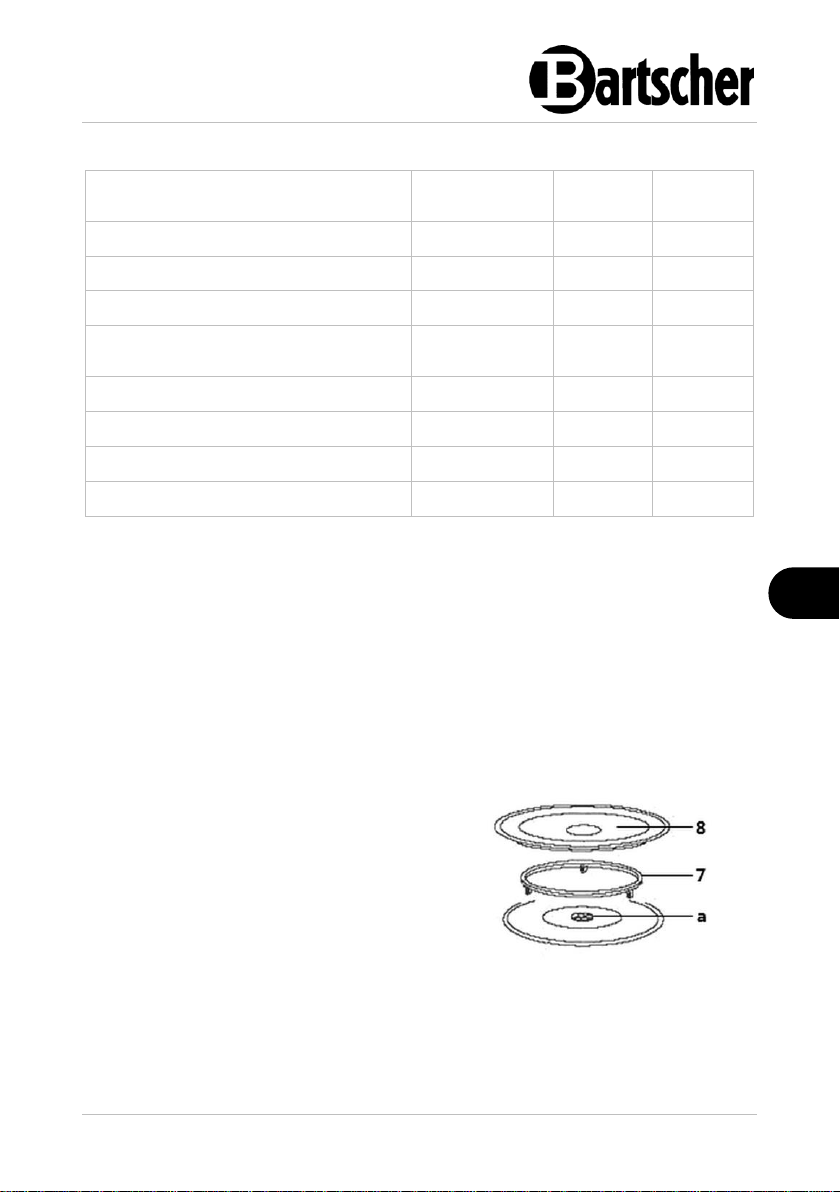
Cookware piece
Microwave
unit mode
Grill
mode
Combine
d mode
Heat resistant glass
yes
yes
yes
High temperature non-resistant glass
no
no
no
Heat resistant ceramics
yes
yes
yes
Plastic cookware suitable for
microwave units
yes
no
no
Kitchen paper
yes
no
no
Metal tray / metal bowl
no
yes
no
Metal grate
no
yes
no
Aluminium film & film container
no
yes
no
1. Insert the roller ring (7) in the groove in
the bottom of the thermal processing
chamber.
2. Put the rotary plate (8) at the bottom of
the chamber with the ribbed side down
and rotate it until it engages with the
rotary plate drive (a).
Fig. 2
The below table will be helpful in selecting suitable cookware:
5.4 Operation
Before Use
1. Remove accessories from the appliance chamber.
2. Prior to first operation, clean the appliance and its equipment according to
instructions in section 6 'Cleaning'.
3. Leave the door open for the chamber to dry completely.
Inserting Rotary Plate
610856 15 / 24
Page 18
EN
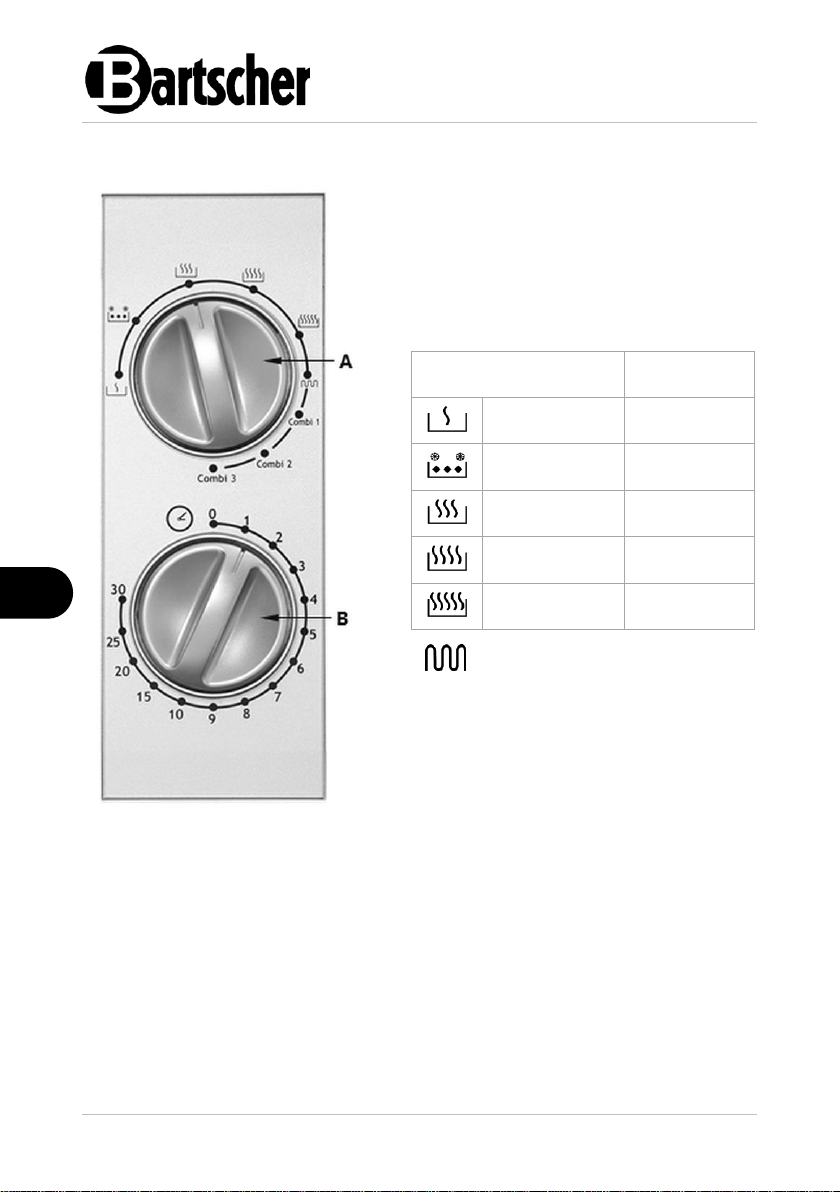
A – Function selector knob
a) Microwave unit functions
Output levels
Output
Low
18%
Defrosting
36%
Medium
58%
Medium high
81%
High
100%
b) – Grill function
c) Combined functions:
– Combi 1
– Combi 2
– Combi 3
B – Timer knob (0–30 min.)
Control Panel
Installation and operation
16 / 24 610856
Page 19
Installation and operation
EN
WARNING!
Risk of burns by hot cookware!
Cookware may be very hot, as high temperature from food is being
radiated.
Remove cookware using only oven mitts or kitchen dish-cloth.
CAUTION!
Risk of incineration!
Observe the appliance especially with high output levels.
Reduce the output in the case of abnormal noises, pouring or bubbling of
liquids.
Heating up Food
1. Before each use, check if the rotary plate and roller ring are correctly set.
The thermal processing chamber must be clean; the roller ring must lie in the
groove; the rotary plate must be snapped onto the drive of the rotary plate.
NOTE:
Never use the appliance without the rotary plate and without a container
with food nor without food in a container!
Nothing may protrude outside of the rotary plate edge.
Do not heat up food directly on the rotary plate.
When heating up a number of chunks / pieces, distribute them evenly in a
cookware / container, so that they do not touch each other.
2. Place a container with food on the rotary plate.
3. Close the appliance door.
4. Make sure that door seals are free of foreign objects and that the door closes
securely.
610856 17 / 24
Page 20
Installation and operation
EN
initial temperature:
the lower, the longer the thermal processing
duration
density:
the higher, the longer the thermal processing
duration
humidity:
the lower, the longer the thermal processing
duration
thickness:
the larger, the longer the thermal processing
duration
weight:
the larger, the longer the thermal processing
duration
5. Using the right controller, set the required output level and thermal processing
duration (1–30).
The thermal processing duration depends on the following food characteristics:
NOTE!
As soon as the thermal processing time is set, the appliance starts to
operate!
The thermal processing chamber is lit, and the rotary plate is rotating.
6. Make sure that the rotary plate is always free to rotate.
7. Open the door in order to stop the appliance during operation.
8. When food is removed before the set time elapses or when the appliance is not
in operation, always set the timer to '0'.
An acoustic signal is heard when the set time elapses.
9. Use the door handle to open the door and remove food.
Grill Function
The appliance is equipped with the grill function. The grill function is particularly
recommended for thin slices of meat, steaks, chops, meat sliced in narrow lanes
and sausages. Moreover, the function is also suitable for hot sandwiches and au
gratin dishes.
To use this appliance function:
– place the enclosed grill grate on the rotary plate,
– place food on the grill grate,
– place a suitable container on the rotary plate for collecting roast sauce or
liquid from processed food,
18 / 24 610856
Page 21
Installation and operation
EN
Program
Microwave unit
operation
Grill
operation
Suitable food
Combi 1
(30%)
(70%)
Fish, au gratin dishes,
potatoes
Combi 2
(49%)
(51%)
Puddings, omelettes, roast
potatoes
Combi 3
(67%)
(33%)
Poultry
– close the appliance door,
– rotate the function control knob to the right, to set the grill function and
prepare food.
Combined Functions
It is possible to combine in the appliance the function of microwave unit and grill for
the purpose of defrosting, cooking, heating up and au gratin processing. Owing to
this, some food obtain particular crispiness.
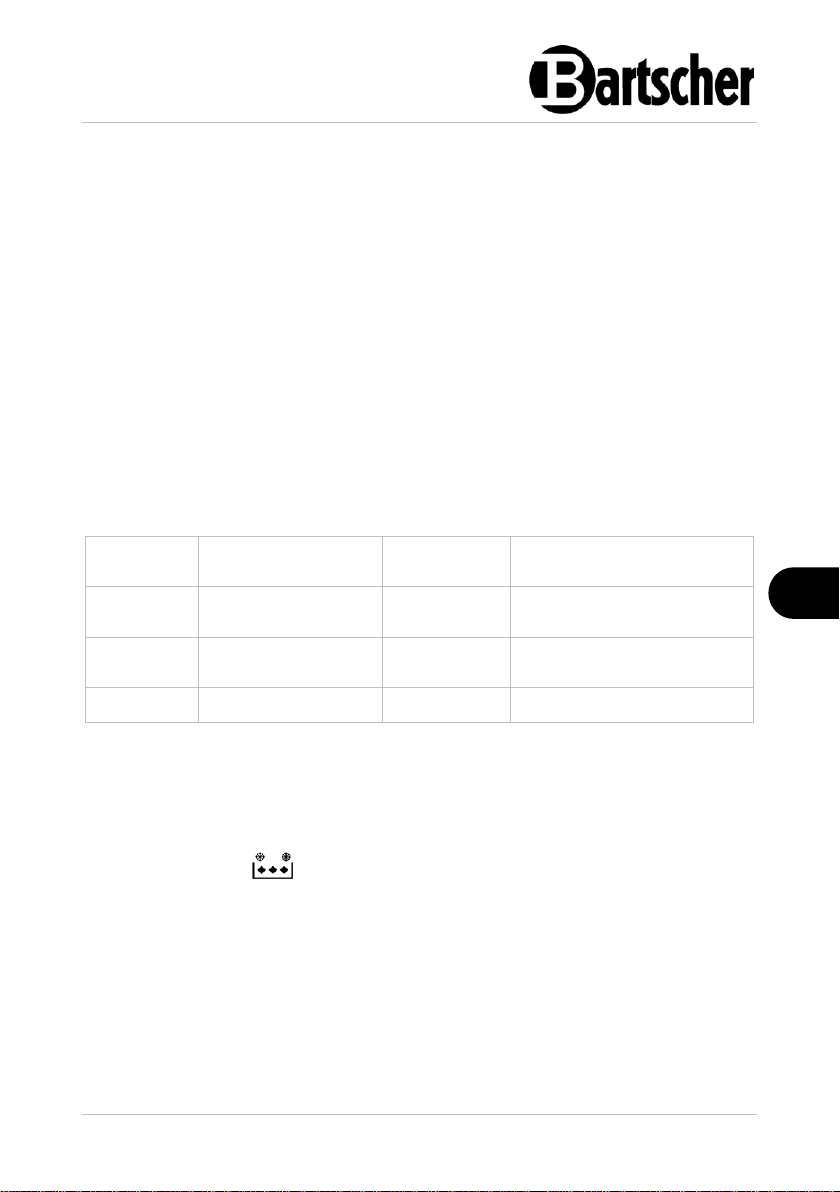
There are three possibilities to use combined functions:
Combi 1
Combi 2
Combi 3
In the case of combined programs, the microwave function operates
interchangeably with the grill function. The percentage share of these functions is
as follows and is factory default programmed:
1. Select program and total duration.
2. Prepare food with the use of the selected program.
Defrosting
The function labeled (DEFROST) allows the easy defrosting of frozen food
products. Energy created by the microwaves heats the external layer of the product,
and the heat slowly seeps into the interior of the product. This ensures even
defrosting of the food product.
1. Prior to defrosting, remove the packaging from the product.
2. Place the product on a plate.
While defrosting proceed in accordance with the following instruction:
610856 19 / 24
Page 22

Cleaning
EN
Covering
Food products should be covered, in order to:
– quicken their heating,
– avoid drying out,
– avoid splattering of grease in the cooking chamber,
Exceptions: bread, baked goods, breaded food products and products which are
supposed to be crunchy should not be covered.
Turning over / mixing
Practically all food products should turned over and/or mixed at least once during
defrosting.
1. Sticky pieces of food should be separated as quickly as is possible.
Smaller portions
Smaller portions defrost more evenly and quicker than larger ones.
1. Divide food products into smaller pieces prior to defrosting.
An entire meal can thus be quickly and easily prepared.
Delicate foods
Delicate foods such as pate / cakes, cream, cheese or bread should be only
partially defrosted, and the defrosting process should be finished at room
temperature. In this manner you will avoid a situation where the food is too hot on
the outside while still frozen on the inside.
Leaving dishes out
The time for leaving dishes out following defrosting is very important, as it
guarantees continuation of the defrosting process. After defrosting, the defrosted
food product should be cooked as soon as possible. Do not re-freeze defrosted
food products.
6 Cleaning
6.1 Safety Instructions for Cleaning
• Before cleaning, disconnect the appliance from the power supply.
• Leave the appliance to cool down completely.
20 / 24 610856
Page 23
Cleaning
EN
• Make sure water does not enter the appliance. Do not immerse the appliance in
water or other liquids during cleaning. Do not clean the appliance with a
pressurized water jet.
• Do not use any sharp or pointed, nor metal implements (knife, fork, etc.). Sharp
or pointed implements may damage the appliance, and when in contact with live
parts, they may cause electric shock.
• For cleaning, do not use any scouring agents that contain solvents nor corrosive
cleaning agents. They may damage the surface.
6.2 Cleaning
1. Clean the appliance regularly after the end of each working day, or more
frequently if needed.
2. Thoroughly remove all food left-overs and beverage remains from internal walls
with a soft and damp cloth. With extensive soiling you may also use a mild
cleaning agent.
3. Clean external surfaces with a soft, damp cloth.
NOTE!
To protect elements inside the appliance against damages, do not allow
water to enter the appliance through ventilation openings.
4. Wipe the door, door seals and neighbouring elements gently with a damp cloth.
5. Clean the control panel with a soft, damp cloth only. Leave the appliance door
open to avoid accidental switching on.
6. Regularly clean the roller ring, rotary plate and grill grate with warm water and a
mild cleaning agent, or in a dish-washer.
7. If condensed water is collecting on the inside and outside of the door, remove
the humidity with a soft cloth.
NOTE:
Condensed water is collecting when the appliance is used in conditions of
high air humidity. The phenomenon of water condensing is normal.
8. To remove odours from inside of the appliance, place a container suitable for
use with microwave units filled with a cup of water, and one lemon juice and
peel in the microwave unit for approx. 5 minutes.
9. Thoroughly dry the appliance and equipment with a dry, soft cloth.
610856 21 / 24
Page 24
Possible Malfunctions
EN
Electric appliances are marked with this symbol. Electrical
appliances must be disposed of and recycled in a correct
and environmentally friendly manner. You must not dispose
of electric appliances with household waste. Disconnect the
appliance from the power supply and remove power cord
from the appliance.
7 Possible Malfunctions
Mögliche
If the microwave does not work:
1. Check if the appliance is correctly connected to the power supply. Remove the
plug from the socket and wait for approx. 10 minutes before re-connecting it
correctly.
2. Check if a fuse has not been tripped or if the main switch is not switched off. If
they operate correctly, check the connection with another appliance.
3. Check if door is locked correctly (door safety lock system). Otherwise, due to
safety reasons, microwaves are not generated in the thermal processing
chamber.
NOTE:
If all the errors listed above may be excluded, have a qualified specialist or
a re-seller immediately check the appliance and repair it should it be
necessary.
8 Disposal
Electrical Appliance
Electrical appliances should be returned to designated collection points.
22 / 24 610856
 Loading...