

Page 1
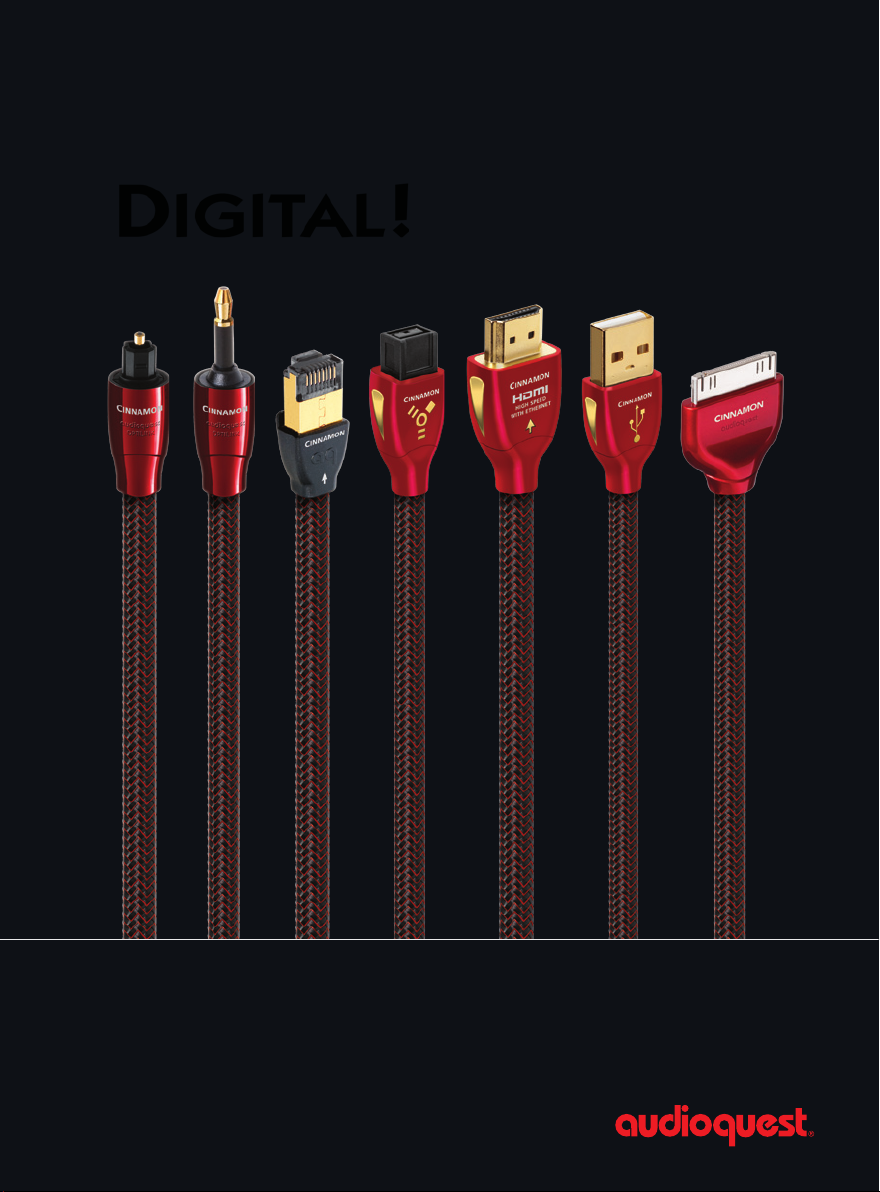
Digital!
Page 2
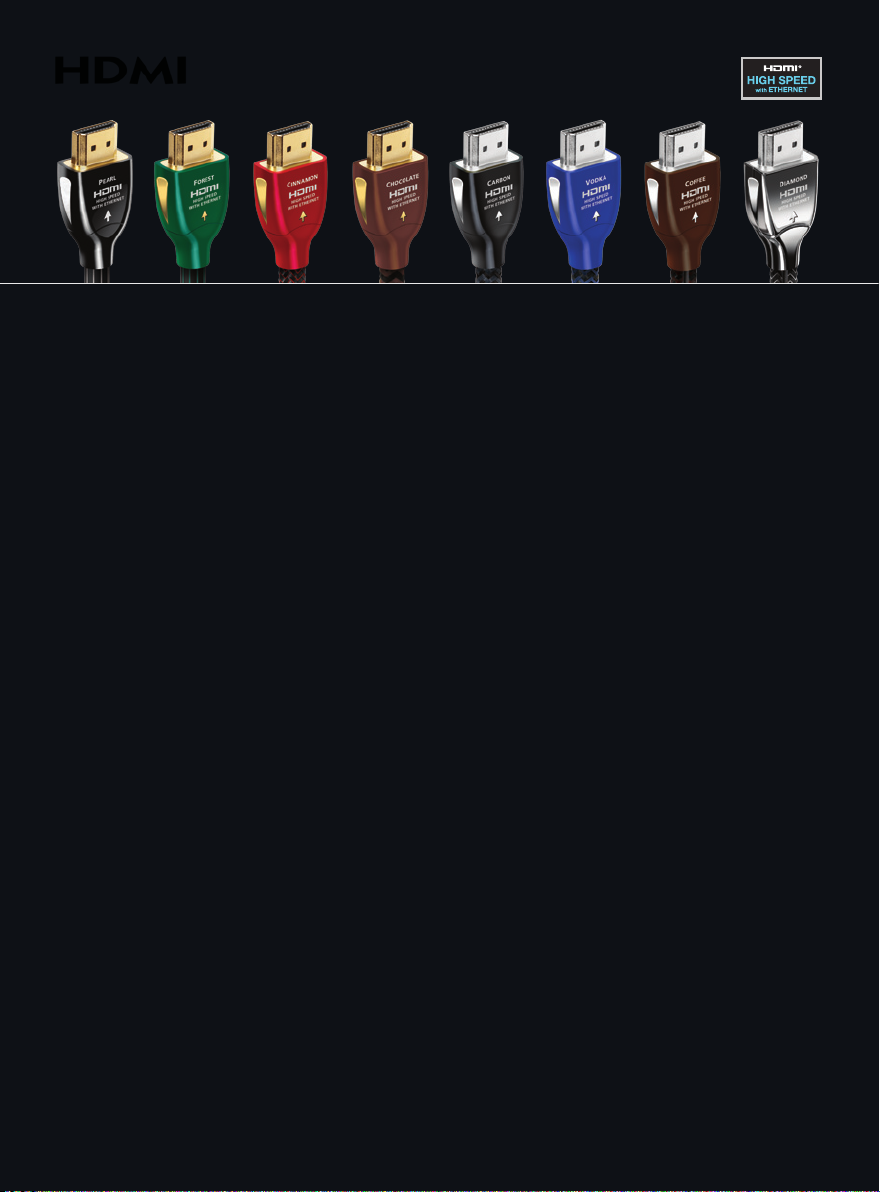
HDMi
For decades, Audi oQ uest has had a wel l- earned
reputation as a manufacturer of exceptional analog
audio and video cables. When DVI became an industry
standard for digital video, AudioQuest was there with
the best cables available. In 2004, HDMI® began to
replace DVI in consumer electronics, but as the AV
receivers of the day were not yet putt ing out audio
over HDMI, analo g or Toslink audio connections
ruled the day.
In 2008 AudioQuest sales of Toslink cables went down
over 50% … HDMI audio had become the dominant
audio connection in the world of home theater. This
was wonder ful for AudioQuest! V ideo differences
betwe en well-made HD MI cables are somewhere
between don’t-exist and a difference one has to look
for, but audio differences are slap-in-the-ears audible
between almost any two cables made.
A note of caution: The lack of in-your-face video differences
acknowledged above is true wh en co mp arin g a ll
AudioQuest models, despite huge price differences, and
is also true for many other respected brands of cable.
However, in the no-name world, many HDMI cables will
cause a lower-contrast, clearly inferior picture not unlike
what was seen on earlier generation LCD TVs.
The basic blueprint for HDMI cable construction was
established by the HDMI steering committee (HDMI,
LLC ). Th es e a re “give ns ” that all HDMI cables must
follow. However, not only is the quality of implementation
a very important variable, but the choice of materials
and other “ingredients” such as AudioQuest’s patented
Dielectric-Bias System (DBS) (US Patent #s 7,126,055 &
7,872,195 B1), make it possible to manufacture a series
of cables with obvious performance hierarchy.
All of the design and material elements that have proven
so effective in AudioQuest’s digital coax (S/PDIF) and
balanced digital (AES/EBU) cabl es are ex act ly as
meaningful for HDMI. Solid-core conductors, conductor metallurgy, insulation material and overall precision of manufacture are no more or less important for
maximum HDMI performance than they are for older
met hods of digi tal tr ans fer … an d as you’l l see
elsewhere in this brochure, are no different than at
the frontier of digital audio through USB, FireWire®
and Ethernet.
AudioQuest begins with Long-Grain Copper (LGC) and
adds increasing amounts of silver-plate, culminating
in Diamond HDMI, whose primary signal pairs are
made using solid Perfect-Surface Silver (PSS). Prior to
manufacture, in order to determine proper conductor
orientation, AudioQuest listens to the metal that will
be used for every signal conductor in every audio
cable we make, including every HDMI cable. Most
lengths use Solid High-Density Polyethylene Insulation
in order to ensure stable conductor geometry while
minimizing insulation-in duc ed ph ase dis tor tio n.
Th e two top HDM I cabl es, Coffee and Diamond,
use AudioQuest’s patented DBS, which polarizes and
saturates the insulation of the signal pairs, significantly
reducing dielectric-induced phase corruption, providing
a drop in the perceived noise floor and an increase in
dynamic contrast.
Despite the dramatic effectiveness of DBS in analog
and digital audio, AudioQuest analog-video and digitalvideo cables have never used DBS. The data package
ne ce ssary for 24Hz or 60Hz mov ing pic tures is
simply not vulnerable to the non-linear phase distortion
caused by dielectric. There is much discussion of dielectric
in video, but only because of signal loss … a total nonissue for most residential systems.
While HDMI cable test equipment is excellent at
tracking gross error-rate or ensuring data pass-through,
the current testing procedure is incapable of measuring
the more subtle ways in which a digital-audio information
package can be compromised, whether it’s a real-time
with-clock signal (as with coax and balanced digital
audio), or the more robust digital packet information
transferred through HDMI, USB, FireWire and Ethernet.
Probably because HDMI is thought of as a video cable,
its ability to transfer audio often doesn’t get as much
attention.
As an example, there are “active” HDMI cables which
package the data such that it can be transferred through
Page 3
thinner cables or longer cables. However, the particular
processor used most often so severely damages the
audio quality that even the worst practically-free HDMI
cable usually sounds better. Such a compromise might
be justified for a mobile-phone cable (though not for
AQ’s coming A-D HDMI cables), or a long video-only
cable to a projector, however at present AudioQuest has
elected not to make any such bad-audio cables.
While the focus of AudioQuest’s HDMI cables is groundbreaking audio quality, video performance is not an
afterthought. All AudioQuest HDMI cables are High
Speed compliant up to and including 10 meters, and
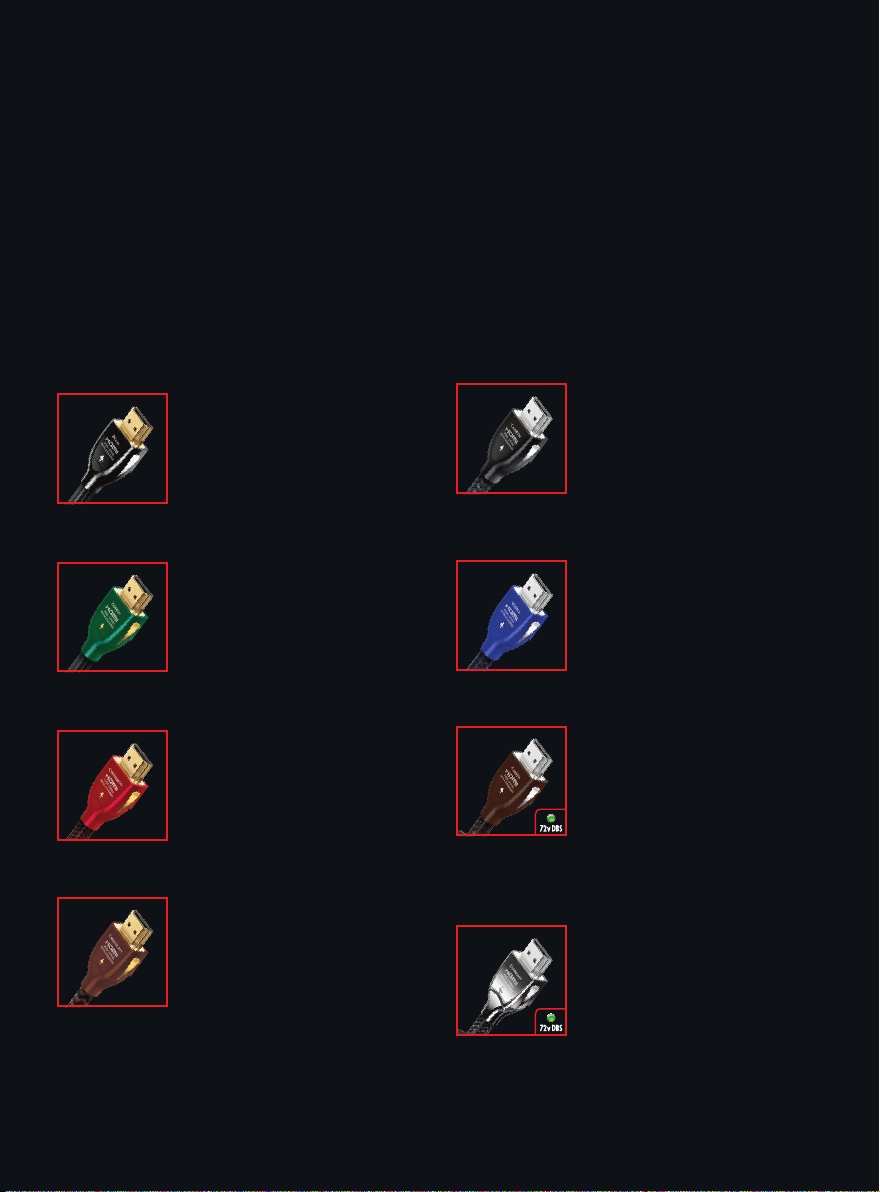
Pearl HDMi
• Solid Long-Grain Copper (LGC) Conductors
• Low-Jitter, Low-Distortion Audio
• Signal Conductors Controlled for Digital
Audio Directionality
• Bi-Directional Ethernet Communication and
Audio Return Channel Enabled
Lengths up to 3m in dark PVC jacket w/white stripes. 5m to 12m in white PVC
CL3/FT4 rated jacket. 0.6m to 8.0m High Speed HDMI w/Ethernet connection.
12m Standard Speed HDMI w/Ethernet Connection.
Forest HDMi
• Solid LGC Conductors
• Low-Jitter, Low-Distortion Audio
• Signal Conductors Controlled for Digital
Audio Directionality
• Bi-Directional Ethernet Communication
and Audio Return Channel Enabled
Lengths up to 3m in dark PVC jacket w/green stripes. 5m to 20m in white PVC
CL3/FT4 rated jacket. 0.6m to 10.0m High Speed HDMI w/Ethernet connection.
12m-20m Standard Speed HDMI w/Ethernet Connection.
CinnaMon HDMi
• Solid 1.25% Silver LGC Conductors
• Low-Jitter, Low-Distortion Audio
• Signal Conductors Controlled for Digital
Audio Directionality
• Bi-Directional Ethernet Communication
and Audio Return Channel Enabled
Lengths up to 3m in braided jacket. 5m to 20m in white PVC CL3/FT4 rated
jacket. 0.6m to 10.0m High Speed HDMI w/Ethernet connection. 12m-20m
Standard Speed HDMI w/Ethernet Connection.
CHoColate HDMi
• Solid 2.5% Silver LGC Conductors
• Low-Jitter, Low-Distortion Audio
• Signal Conductors Controlled for Digital
Audio Directionality
• Bi-Directional Ethernet Communication
and Audio Return Channel Enabled
Lengths up to 3m in braided jacket. 5m to 20m in white PVC CL3/FT4 rated
jacket. 0.6m to 8.0m High Speed HDMI w/Ethernet connection. 12m-20m
Standard Speed HDMI w/Ethernet Connection. Dark grey with black stripes
PVC is available from 5m to 20m.
all will transfer 1080p and 4k video, as well as 3D video
from Blu-ray. All AudioQuest HDMI cables deliver 100%
of the data required for 120Hz/240Hz/600Hz displays.
All AudioQuest HDMI cables are 100% QC tested to pass
1080p at every length and all containthe fifth twisted
pair required to enable Ethernet connectivity over
HDMI. All HDMI cables ever made enable the Audio
Return Channel (from the HDTV to the AV receiver),
though performance is better when the additional
Ethernet pair is available to carry this signal.
Look, listen, and enjoy!
Carbon HDMi
• Solid 5% Silver LGC Conductors
• Low-Jitter, Low-Distortion Audio
• Signal Conductors Controlled for Digital
Audio Directionality
• Bi-Directional Ethernet Communication
and Audio Return Channel Enabled
Lengths up to 3m in braided jacket. 5m to 20m in white PVC CL3/FT4 rated
jacket. 0.6m to 8.0m High Speed HDMI w/Ethernet connection. 12m-20m
Standard Speed HDMI w/Ethernet Connection. Dark grey with black stripes
PVC is available from 5m to 20m.
VoDka HDMi
• Solid 10% Silver LGC Conductors
• Low-Jitter, Low-Distortion Audio
• Signal Conductors Controlled for Digital
Audio Directionality
• Bi-Directional Ethernet Communication
and Audio Return Channel Enabled
Lengths up to 3m in braided jacket. 5m to 16m in white PVC CL3/FT4 rated
jacket. 0.6m to 8.0m High Speed HDMI w/Ethernet connection. 12m-16m
Standard Speed HDMI w/Ethernet Connection.
CoFFee HDMi
• Solid 10% Silver LGC Conductors
• 72V Dielectric-Bias System (DBS)
Saturates and Polarizes Dielectric
• Low-Jitter, Low-Distortion Audio
• Signal Conductors Controlled for Digital
Audio Directionality
• Bi-Directional Ethernet Communication
Lengths up to 3m i n braided j acket. 5m to 1 6m in white PVC CL3/FT 4 rated
jacket . 0.6m to 8.0m Hig h Speed HD MI w/Ethernet connection. 12m-16m
Standard Speed HDMI w/Ethernet Connection.
Lengths up to 5m in braided jacket. 8m to 16m in gray with black stripes PVC
CL3/FT4 rated jacket. 0.6m to 8.0m High Speed HDMI W/Ethernet connection.
12m-16m Standard Speed HDMI w/Ethernet Connection.
and Audio Return Channel Enabled
DiaMonD HDMi
• Solid 100% Perfect-Surface Silver (PSS)
Conductors
• 72V Dielectric-Bias System (DBS) Saturates and Polarizes Dielectric
• Low-Jitter, Low-Distortion Audio
• Signal Conductors Controlled for Digital
Audio Directionality
• Bi-Directional Ethernet Communication
and Audio Return Channel Enabled
Page 4
(
2.0
Usb
The acronym,
USB
)
, stands for Universal Serial Bus. True
to its name, this is an honest to goodness “universal”
standard that is open to all hardware and software
developers. All modern personal computers feature
one or more USB ports and include all the necessary
USB device driver support to communicate between
a host and client, such as from a computer (host) to a
digital-to-analog converter or AV receiver / surroundsound processor (client). Additionally, many smart
phones and tablets are capable of connecting to
audio systems over USB. While you can use the internal
DAC (digital-to-analog converter) in your computer
or mobile device, substantially better performance
will be attained by connecting your devices to a highperformance external USB-enabled digital decoder.
But no matter how predictable and trouble-free the
USB 2.0 standard is, and regardless of the data transfer
accuracy of both the host and client device, cableinduced distortions will still compromise the potential
performance of any USB-based audio system. Even
when either adaptive or asynchronous-enabled USB
protocols are implemented, or when a low-resolution
128Kbps MP3 file is played back, significant differences
among USB cables can and will be heard. Electrons
simply don’t differentiate between analog and digital
packets or protocol standards. The cable-induced
distortion mechanisms remain universal.
USB 2.0 has become the prevailing method with
which to connect a computer to a digital to analog
convertor. While USB 2.0’s speed (480 Mbit/s, or 60
MB/s) is above and beyond what is required to move
the highest speed packets of data (192KHz), USB 3.0
does have the advantage of moving stored data at
speeds 10 times that of USB 2.0 (5 Gbit/s or 640 MB/s).
As USB 3.0 continues to gain momentum and market
share, AudioQuest will continue to explore ways in
which we can add value and performance to your
system through this standard. Stay tuned…
As wit h all Aud ioQ ues t’s ot her dig ita l cab les
(HDMI, USB, FireWire, Coax and balanced AES/EBU),
AudioQuest’s USB cables benefit from the use of
superior metals, solid-core conductors, individual
signal-pair shielding, and critical signal-pair geometry.
The top two models, Coffee and Diamond, use
AudioQuest’s patented Dielectric-Bias System (DBS),
which polarizes and saturates the insulation of the
signal pairs, significantly reducing dielectric-induced
phase corruption, providing a drop in the perceived
noise floor and an increase in dynamic contrast.
Why shor t-c hange you r be loved mus ic col lec tion
with inferior-sounding generic USB cables when you
can choose to use low-distor tion, superior-sounding
AudioQuest USB digital interconnects. Sit back, relax, listen,
and enjoy!
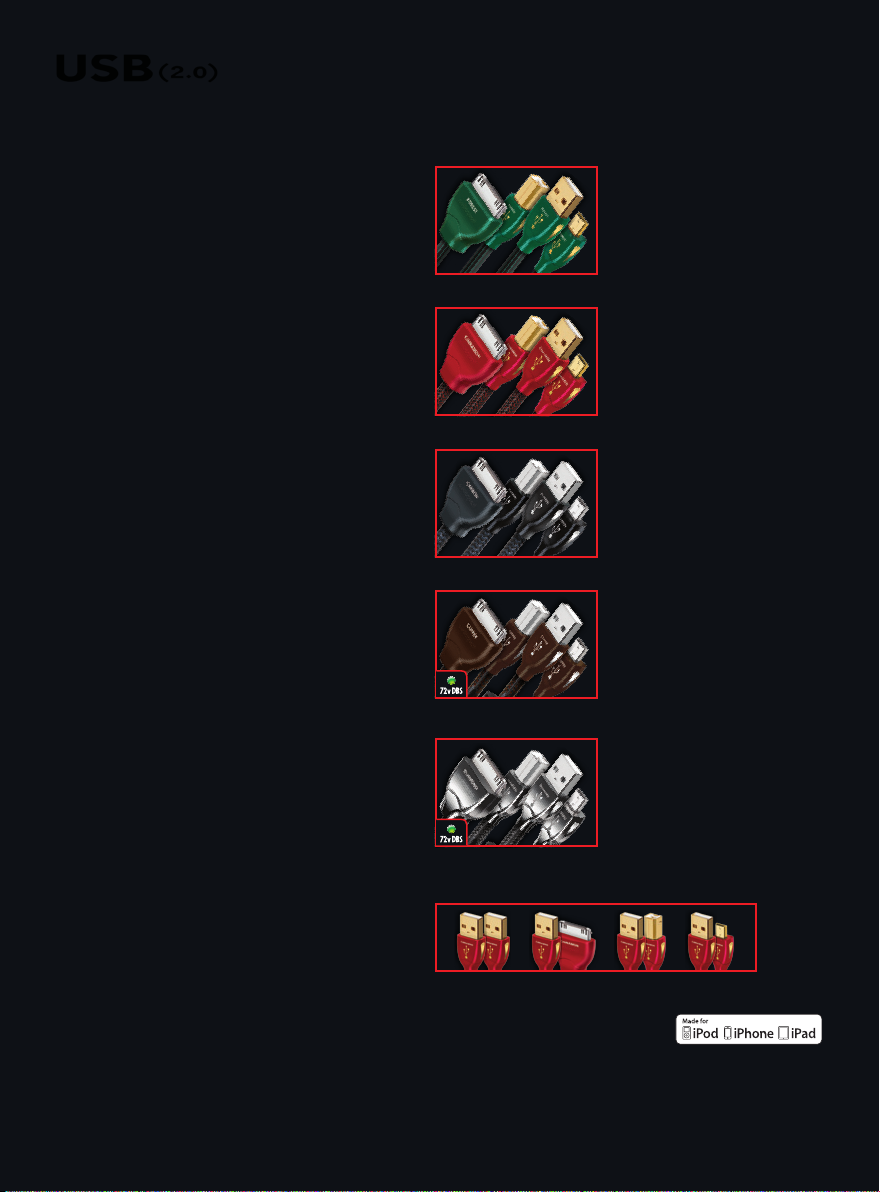
F
Available in 0.75m, 1.5m, 3m and
5m lengths.
Available in 0.75m, 1.5m, 3m and
5m lengths.
Available in 0.75m, 1.5m, 3m and
5m lengths.
Available in 0.75m, 1.5m, 3m and
5m lengths.
Available in 0.75m, 1.5m, 3m and
5m lengths.
Choice of Applications:
orest
• Solid Long-Grain Copper (LGC)
Conductors
• Gold-Plated Pins
• Low-Jitter, Low-Distortion Audio
• Signal Conductors Controlled for
Digital Audio Directionality
C
innaMon
• Solid 1.25% Silver LGC Conductors
• Gold-Plated Pins
• Low-Jitter, Low-Distortion Audio
• Signal Conductors Controlled for
Digital Audio Directionality
C
arbon
• Solid 5% Silver LGC Conductors
• Direct-Silver Plated Pins
• Low-Jitter, Low-Distortion Audio
• Signal Conductors Controlled for
Digital Audio Directionality
C
oFFee
• Solid 10% Silver LGC Conductors
• 72V Dielectric-Bias System (DBS)
Saturates and Polarizes Dielectric
• Direct-Silver Plated Pins
• Low-Jitter, Low-Distortion Audio
• Signal Conductors Controlled for
Digital Audio Directionality
D
• Solid 100% Perfect-Surface Silver
(PSS) Conductors
• 72V Dielectric-Bias System (DBS)
Saturates and Polarizes Dielectric
• Direct-Silver Plated Pins
• Low-Jitter, Low-Distortion Audio
• Signal Conductors Controlled for
Digital Audio Directionality
Usb
Usb
iaMonD
Usb
Usb
Usb
Page 5
FireWire
(
1394
)
Over twenty years ago, FireWire was created to move
large digital files such as photos and video from one
location to another. But, more important to music
lovers like us, the developers of FireWire also had
the foresight to include specific audio protocols
so profes sional recording studios could achieve
high-performance, low-jitter transfer of digital audio
information.
Even though FireWire-enabled DACs are fairly rare,
FireWire still plays a relevant and important role in
many high-performance computer audio systems .
Since digital music libraries are storage intensive,
external hard drives have become a crucial ingredient
in many computer audio systems. Connecting both
a DAC and an external hard drive to the same data
path causes unwanted and unnecessary distortion
in your computer. A computer’s USB bus, for example,
doesn’t perform at its maximum audio performance
potential while it is simultaneously pulling data from
an ext ernal har d drive and pus hing data to an
external DAC. Using FireWire between an external hard
drive and the computer is an especially effective way
to maximize computer audio performance when the
computer is connected to a USB-enabled DAC.
Because high-speed digital audio data is just as
susceptible to cable-induced distortions as analog
sig nals a re, AudioQuest ’s FireWire cables employ
a series of superior materials and construction
techniques to avoid corrupting and distorting the audio data. AudioQuest’s FireWire cables start with solid
Long-Grain Copper conductors and add increasing
amounts of silver-plate to reduce distortion, with the
top-of-the-line Diamond using solid 100% PerfectSurface Silver conductors. Advanced manufacturing
techniques and Solid High-Density Po ly et hy l e ne
Ins ulation ensure that stabl e geometry is attained,
and also guarantees that the critical signal-pair geometry
will not be compromised as a result of twisting and
be nding in ev ery day use. Both sig nal pa irs ar e
optimized for directionality, and in our top model
Diamond, AQ’s remarkably effective Dielectric-Bias
Sys tem (DB S) dram atically lowers the perceive d
nois e f l oo r and r a i se s d y na m i c co n t r a st . A l l
AudioQuest FireWire cables provide 100% internal
shielding between highly-sensitive signal conductors
and active power conductors. Please don’t compromise
the sonic performance of yo ur com put er- bas ed
au dio sy ste m w ith ge ner ic FireWire cables.
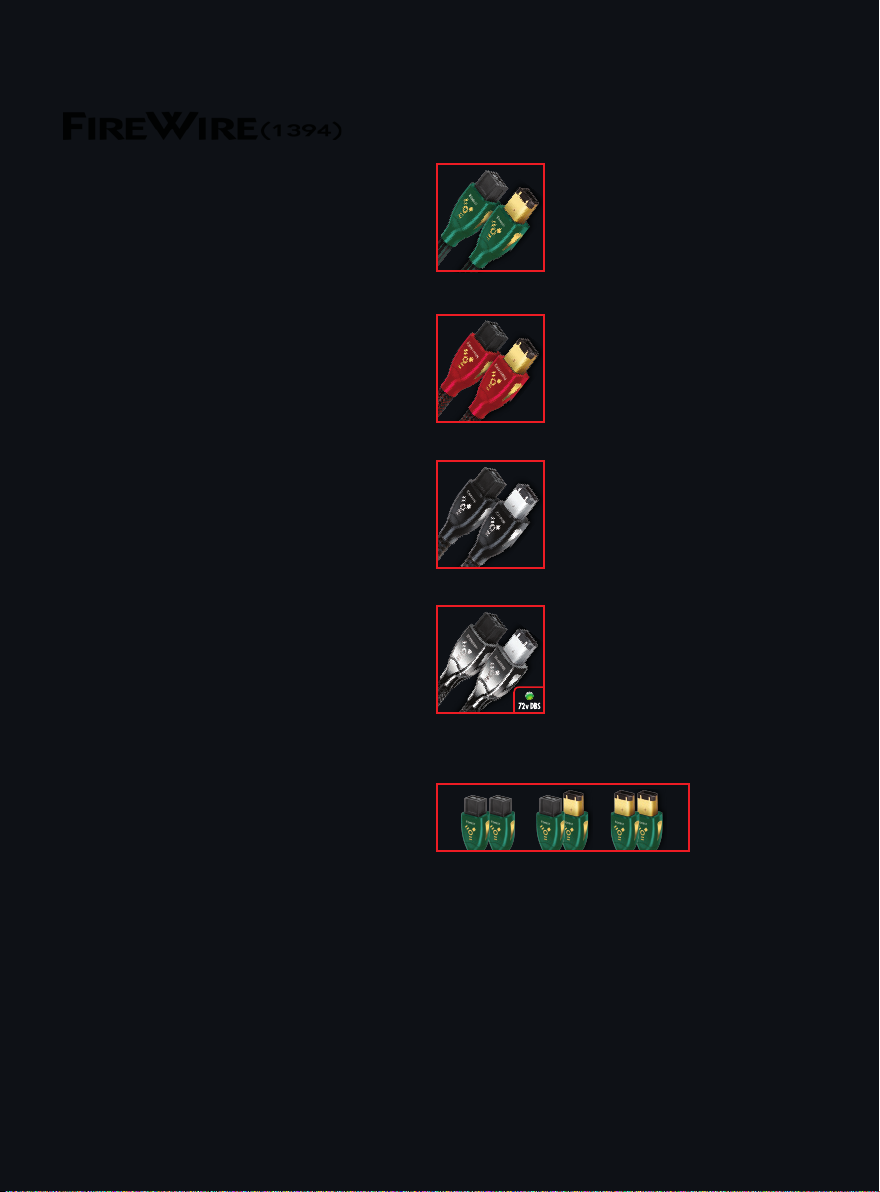
F
orest FireWire
• Solid Long-Grain Copper (LGC) Conductors
• Gold-Plated Pins
• Low-Jitter, Low-Distortion Audio
• Both Signal-Path Conductor Pairs
Controlled for Digital Audio Directionality
Available in 0.75m, 1.5m, 3m and 5m lengths.
C
innaMon FireWire
• Solid 1.25% Silver LGC Conductors
• Gold-Plated Pins
• Low-Jitter, Low-Distortion Audio
• Both Signal-Path Conductor Pairs
Controlled for Digital Audio Directionality
Available in 0.75m, 1.5m, 3m and 5m lengths.
C
arbon
• Solid 5% Silver LGC Conductors
• Direct-Silver Plated Pins
• Low-Jitter, Low-Distortion Audio
• Both Signal-Path Conductor Pairs
Controlled for Digital Audio Directionality
Available in 0.75m, 1.5m, 3m and 5m lengths.
D
iaMonD FireWire
• Solid 100% Perfect-Surface Silver (PSS)
Conductors
• 72V Dielectric-Bias System (DBS) Saturates
and Polarizes Dielectric
• Direct-Silver Plated Pins
Available in 0.75m, 1.5m,
3m and 5m lengths.
Choice of Applications:
• Low-Jitter, Low-Distortion Audio
• Both Signal-Path Conductor Pairs
Controlled for Digital Audio Directionality
F
ireWire
Page 6
e
tHernet
Over the past several years there’s been a revolution
in the way people store, distribute, and access digital
media (in real time), including photos, movies, and,
of course, music. No longer dependent on physical
media, our media is often data that’s moved from
multiple devices to multiple locations.
For audio applications and protocols, audio over
Ethernet offers the virtues of high-speed, low time
delay (latency), significant distance capability (1000
feet without an active booster or repeater), and
extremely low-jitter, bit-perfect communication. Who
wouldn’t want all of these things?
Organizations such as DLNA (Digital Living Network
Alliance) and UPnP (Universal Plug and Play) have
worked hard to create open standards that allow
consu me rs to choose components from various
manufacturers and create a networked system that
works seamlessly and predictably every time.
But no matter how robust, predictable, and precise
audio over Ethernet is, poor cable design will still
affect the playback quality of any Ethernet-based
audio system. The same cable-distortion mechanisms
which affect analog information also prey on digital
information. Poor metal quality, skin effect, poor
signal geometry, strand-interaction distortion, will all
reduce sound quality.
As with all AudioQue st ’s othe r di gi tal ca bl es
(HDMI, USB, FireWire, Coax and balanced AES/EBU),
AudioQuest’s Ethernet cables benefit from the use
of solid-core conductors, superior metals, and critical
signal-pair geometry. The top model Diamond uses
AudioQuest’s patented Dielectric-Bias System (DBS),
which polarizes and saturates the insulation of the
signal pairs, significantly reducing dielectric-induced
phase corruption, providing a drop in the perceived
noise floor and an increase in dynamic contrast.
All AudioQuest RJ/E cables use the Category 7
(Cat7) standard as a foundation and starting point. A
particular feature of Cat7 is that each of the four pairs
are individually shielded and drained. This is common
in HDMI, USB and FireWire cables (and of course is
true for AQ’s cables), but is extremely unusual in an
Ethernet cable, whether a terminated cable like our
RJ/E models, or a bulk Cat cable used for multi-room
distribution.
In order to maximize a total system, AudioQuest also
offers AQ Cat6/600 and Cat7/700 bulk cables. This
larger cable is meant to be terminated with female
RJ45 wall plates. It should be used as whole-house
data plumbing; however, using the RJ/E series of
cables directly from source to destination whenever
possible will clearly offer superior performance.
Please don’t handicap your Ethernet-based audio system
by using standard cables. AudioQuest’s Ethernet Cat6
and Cat7 cables provide a substantial improvement over
“stock” cables.
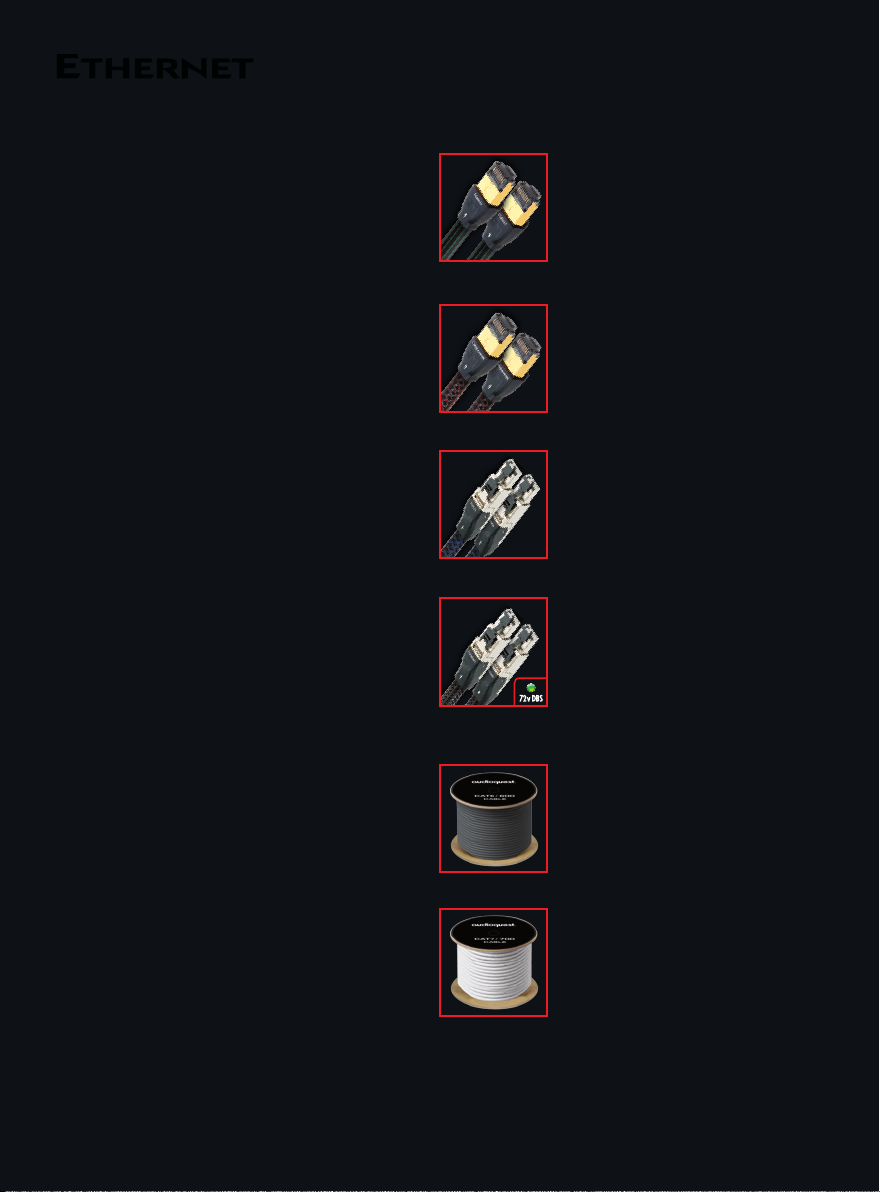
F
orest
• Solid 0.5% Silver Conductors
• Gold-Plated Connectors Provide 100% Shield
Coverage and Feature Extra-Strong Tab
• Conductors Controlled for Digital Audio
Directionality
CMG (CL3 & FT4) rated Black/green stripe PVC. Available in 0.75m,
1.5m, 3m, 5m, 8m and 12m lengths.
Up to 3.0 m. - Black/red braid 5.0 m. and longer – CMG (CL3 & FT4) rated Black/red
PVC. Available in 0.75m, 1.5m, 3m, 5m, 8m and 12m lengths.
Up to 3.0 m. - Black/blue braid 5.0 m. and longer – CMG (CL3 & FT4) rated Black/blue PVC.
Available in 0.75m, 1.5m, 3m, 5m, 8m and 12m lengths.
Available in 0.75m, 1.5m,
3m, 5m, 8m and 12m
lengths.
• Minimum Skew and Phase Smearing
C
innaMon
• Solid 1.25% Silver Conductors
• Gold-Plated Connectors Provide 100% Shield
Coverage and Feature Extra-Strong Tab
• Conductors Controlled for Digital Audio
Directionality
• Minimum Skew and Phase Smearing
V
oDka
• Solid 10% Silver Conductors
• Ultra-Performance Plugs, 100% Shielding,
Strongest Possible Tab
• Conductors Controlled for Digital Audio
Directionality
• Minimum Skew and Phase Smearing
D
iaMonD
• Solid 100% Perfect-Surface Silver (PSS)
Conductors
• 72V Dielectric-Bias System (DBS) Saturates
and Polarizes Dielectric
• Ultra-Performance Plugs, 100% Shielding,
Strongest Possible Tab
• Conductors Controlled for Digital Audio
Directionality
• Minimum Skew and Phase Smearing
rJ/e
rJ/e
rJ/e
rJ/e
Cat600
• Solid Long-Grain Copper (LGC) Conductors
• Central Spline Stabilizes Critical Geometry
• Conductors Controlled for Digital Audio
Directionality
• Minimum Skew and Phase Smearing
CMG (CL3 & FT4) rated PVC in White, Gray, Blue, Green, Yellow, or Purple. Available
in 1,000 ft. spools.
Cat700
• Solid LGC Conductors
• All Pairs Individually Shielded and Drained
• Conductors Controlled for Digital Audio
Directionality
• Minimum Skew and Phase Smearing
CMG (CL3 & FT4) rated PVC Charcoal w/ white stripes, Off-White w/ charcoal stripes.
Available in 500 ft. spools.
Page 7
t
oslink
The audio frontier is all abuzz these days with the
pleasure possible though HDMI, USB, FireWire and
Ethernet connections. However, these current generation
digital technologies are only part of the story, just as the
challenge of designing, manufacturing and choosing
the best analog interconnects and speaker cables is as
important as ever. The S/PDIF (Sony®/Philips® Digital
InterFace), which arrived in 1983 along with the CD,
is still very much a part of our world today. S/PDIF is
transmitted through Digital Coax and Toslink fiber
optics (EIA-J), making them still some of the most
important cables in electronic entertainment.
While thanks to HDMI, Toslink is not so often used to
connect a DVD player to an A/V receiver, Toslink connectors
are common on cable and Internet streaming set-top
boxes, TV sets, subwoofers, all sorts of products. And
now, the 3.5mm Mini Optical connector, also somewhat
incorrectly known as Mini-Toslink, is everywhere ... from
the 3.5mm dual-purpose headphone jack on a Mac®
laptop, to inputs on some of the finest portables.
For these many reasons, AudioQuest has refined and
renewed our line of serious high-performance OptiLink
cables. All models and all lengths are now available
Toslink Toslink and Toslink 3.5mm Mini Optical.
When the question is “how can a fiber-optic cable
change the sound?” ... the answer is easier to explain
than for almost any other type of cable. If the light
source were a coherent laser, firing into a vacuum, all
the light would stay straight, arriving at its destination
at the same time. Even if the LED light source in a Toslink
system were coherent, the light entering a fiber-optic
cable is scattered and dispersed by imperfections and
impurities in the fiber. This can be measured as a loss of
amplitude ... but amplitude is not the problem. A 50%
true loss would have no effect on sound quality.
The problem is that the dispersed light does get
through the cable, but only after it has taken a longer
path, like a pool ball bouncing off the side-rails, causing
it to arrive later. This delayed part of the signal prevents
the computer charged with decoding this information
from being able to decode properly, or even at all. The
inability to decode shows first at higher frequencies
(not audio frequencies, this is a mono stream of digital
audio information), so reduced bandwidth is a measurable
signature of light being dispersed by a fiber. The punch
line: The less dispersion in the fiber, the less distortion in
the final analog audio signal presented to our ears.
There is another serious dispersal mechanism in the
Toslink system. The fiber is a relatively huge 1.0mm in
diameter, and the LED light source is also relatively large,
spraying light into the fiber at many different angles.
Even if the fiber were absolutely perfect, the signal
would be spread across time because light rays entering
at different angles take different length paths and
arrives with different amounts of delay.
The almost complete solution to this problem is to use
hundreds of much smaller fibers in a 1.0mm bundle.
Because each fiber is limited as to what angle of input
can enter the fiber, there is far less variety, and far less
dispersion over time. This narrow-aperture-effect is
similar to how a pin-hole camera can take a picture
without a lens ... by letting in light at only a very
limited range of angles, a picture can be taken, whereas
removing the lens from a wider aperture would make
photography impossible. Less light gets through a
multi-fiber cable, but the light that does get into the
fibers comes out within a much smaller time-envelope.
So there is one problem, the dispersion of light across
time ... and two avenues towards a better result: less
dispersion in the fiber (better polymers and ultimately
quartz), and less dispersion by filtering the input angle.
How simple is that! Listen and enjoy.
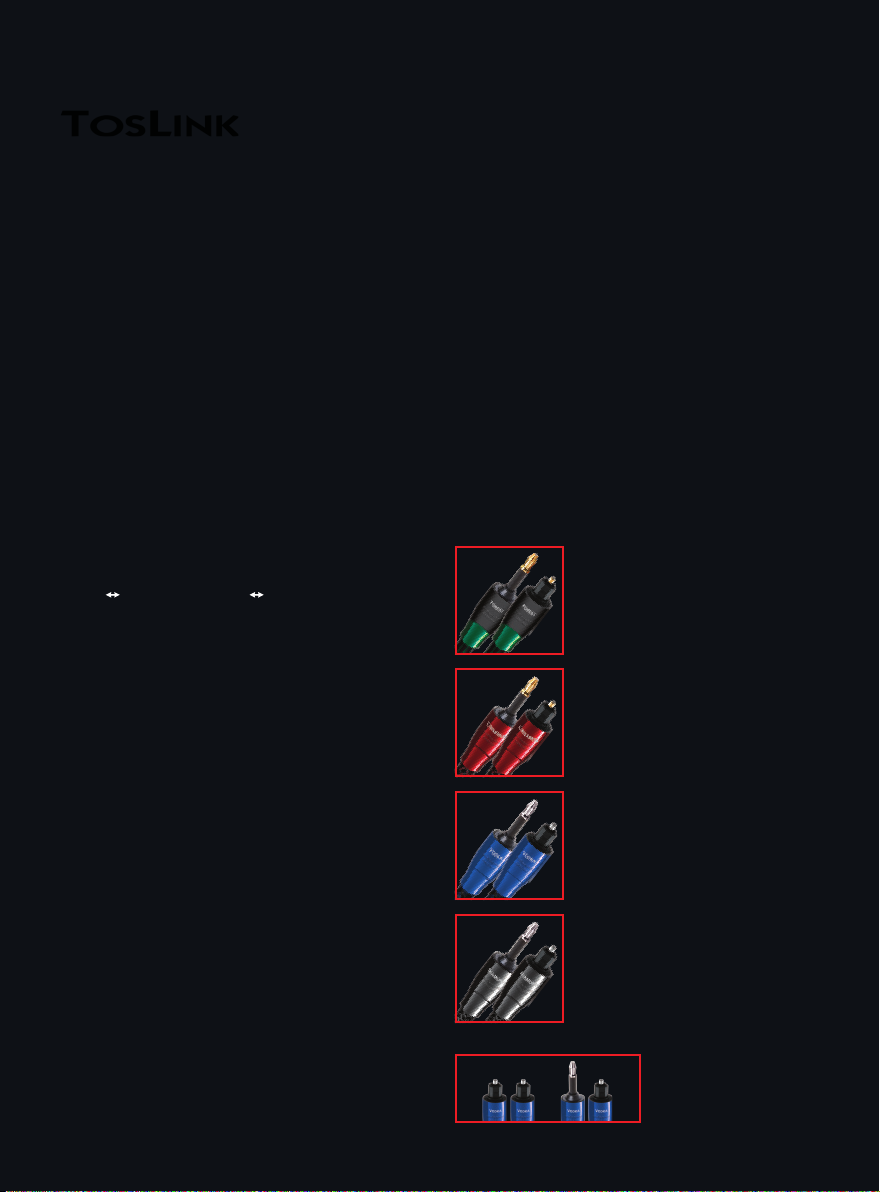
F
Choice of Applications:
orest
• Low-Dispersion Fiber
• Low-Jitter (Digital Timing Errors)
• Precision-Polished Fiber Ends
Available in 0.75m, 1.5m, 3m, 5m, 8m, 12m and
16m lengths.
C
innaMon
• Low-Dispersion Higher-Purity Fiber
• Low-Jitter (Digital Timing Errors)
• Precision-Polished Fiber Ends
Available in 0.75m, 1.5m, 3m, 5m, 8m, 12m and
16m lengths.
V
oDka oPtilink
• 217 Narrow-Aperture Synthetic Fibers
• Low-Jitter (Digital Timing Errors)
• Precision-Polished Fiber Ends
Available in 0.75m, 1.5m, 3m and 5m lengths.
D
• 280 Narrow-Aperture Quartz (Fused-
Silica) Fibers
• Low-Jitter (Digital Timing Errors)
• Precision-Polished Fiber Ends
Available in 0.75m, 1.5m, 3m and 5m lengths.
o
Ptilink
o
Ptilink
iaMonD oPtilink
Page 8
©2012 AudioQuest 2621 White Road, Irvine CA 92614 USA Tel (US): +1.949.585.0111 Tel (EU): +31.165.54.1404 www.audioquest.com
 Loading...