

Page 1
audio analogue
soundpleasure
Page 2
A wide set of careful
solutions inside the units
and the use of selected
components and cables
make this an extraordinary
line.
Four years of continuous
research based on
listening tests performed
under Claudio Bertini’s
supervision (Claudio is one
of the Audio Analogue
co-founders) make the
remarkable excellence
of these products now
available to the wider
public. And not only!
Audio Analogue has
decided to take advantage
of the Special Edition
Line to introduce the
most innovative and
experimental audio
technology. Technology
which, because of its
complexity and originality,
has never been used in
production before.
Una selezione molto accurata della componentistica e
l’utilizzo di cablaggi particolari rendono questa serie
straordinaria.
Quattro anni di ricerche, basate su prove di ascolto
sotto la guida di Claudio Bertini, co-fondatore di
Audio Analogue, rendono ora disponibili per il
grande pubblico l’eccellenza di questi prodotti. Non
solo! Audio Analogue ha deciso di approttare della
linea Special Edition per introdurre le tecnologie
audio più innovative e sperimentali. Tecnologie che
per la loro complessità e originalità non sono mai
state utilizzate precedentemente in produzione.
Nella linea Special Edition sono e saranno
compresi, non solo apparecchi di assoluto riferimento
per prestazioni e prezzo, ma anche apparecchi
originalmente nati in una fascia media o entry
level, e che, dopo una continua ricerca sulla
componentistica, hanno mostrato di raggiungere
prestazioni tali da potersi fregiare del logo SE.
Not only very expensive
products of absolute
reference specication are
and will be included in the
Special Edition line but
also equipment originally
developed for a medium
and entry level range
which, after exhaustive and
relentless research on the
electronic components, has
shown itself to be of such
a high performance level
to merit the SE logo.
Page 3
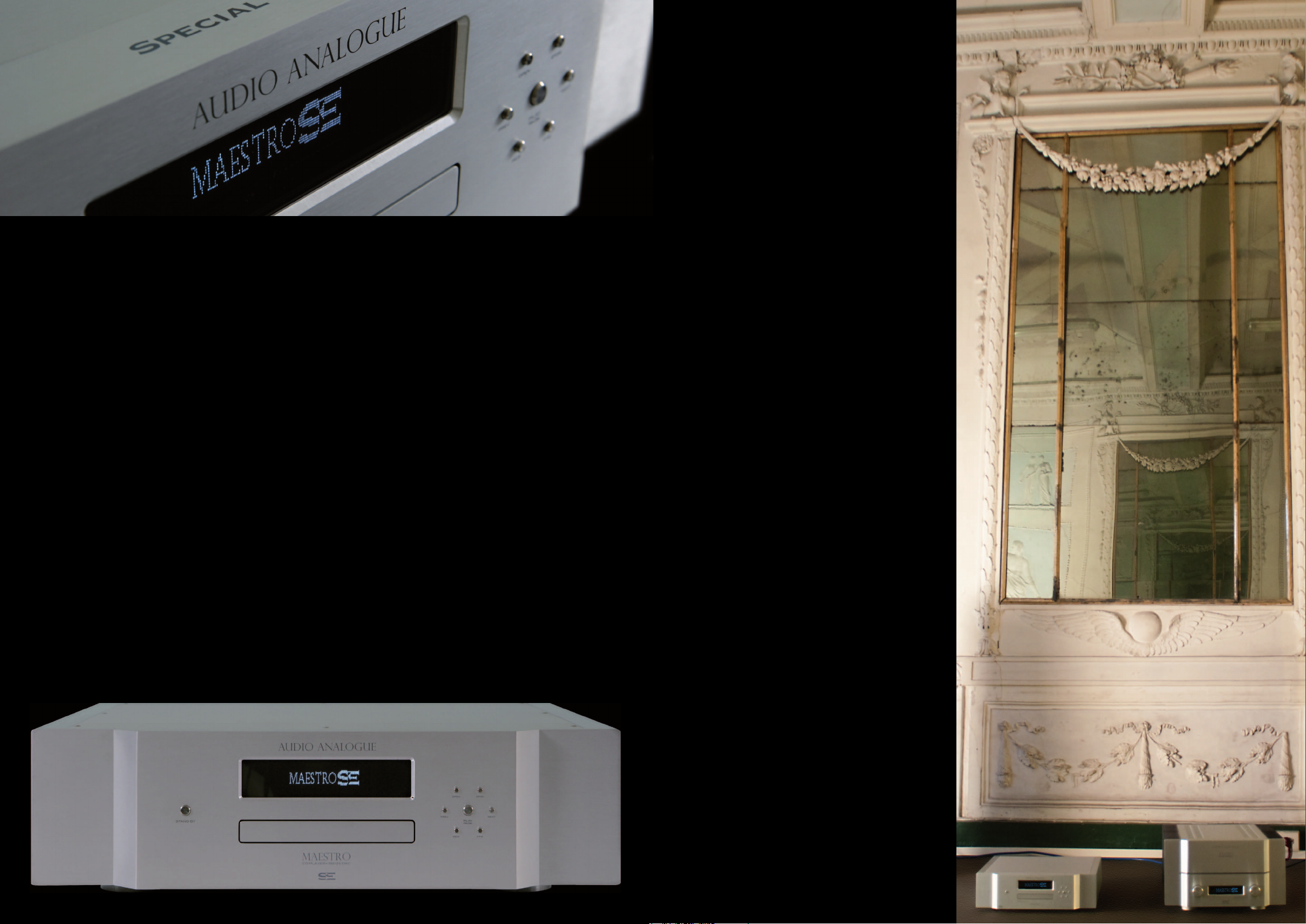
e Maestro CD Player SE is not based on the
development of pre-existing projects such as the
other components of the SE line but has been
totally built from scratch instead.
The Maestro CD player SE reduces jitter
problems thanks to an innovative piece of
technology entirely developed by Audio
Analogue. The technology uses a ”discrete
components” PLL to lock the digital signal. The
whole chain can reach 192 KHz/24bits and a
new previously unseen fully differential low noise
conguration has been used in the output stage.
The excellence of the player is made complete by:
- The extreme exibility which allows the user to
set many parameters of the DA conversion such
as the sampling frequency. - The digital input
which allows the user to use the unit as a DA
converter from a digital source with a sampling
frequency of up to 192 KHz.
It’s possible to select three different modes:
Direct Mode – The SPDIF RX receives the
selected digital signal which is then directly sent
to the DAC..
PLL Mode – This mode is available only when
the selected digital signal is the one coming from
the CD mechanism. The system clock from the
SPDIF RX is sent to the PLL, which, if it can
lock to it, regenerates and cleans it reducing the
jitter for frequencies higher than 20Hz (according
to a second order lter).
SRC Mode – The signals from the SPDIF RX
are sent directly to the SRC and from this to the
DAC. The SRC re-synchronize the signals with
an external reference clock reducing the Jitter
to an extremely low level. In fact, the reference
clock comes from the quartz crystals used inside
the PLL circuit. The sample frequency which the
DAC works on can be set to: 44,1kHz, 48kHz,
88,2kHz, 96kHz, 176,4kHz, 192kHz while the bit
resolution is always set to 24bits. The parameters
of the mode are set in the dedicated menu
option.
Features: High performance power supply with
two transformers (one of which toroidal) and
eight different voltage regulation sections. Highperformance 192KHz/24bit D/A converter.
The Over-Sampling of the DAC is present in all
congurations and allows the use of low slope
lters. Low-jitter, sample-rate converter. PLL
implemented by discrete components. Analogical
circuits implemented by discrete
components. Highest-quality passive components:
lowest-tolerance metallic-layered resistors
(MIL standard), Low-tolerance, non-polarized
polyester/polypropylene capacitors. Highspeed, low-loss, high-capacity electrolytic
capacitors and organic-electrolyte, low-capacity
electrolytic capacitors. High-contrast VFD graphic
display. Microcontroller system control.
Il Maestro CD player SE, diversamente degli
altri componenti della linea SE, non è il frutto
dello sviluppo di progetti pre esistenti ma è un
apparecchio totalmente inedito!
Il Maestro CD player SE riduce i problemi
legati al jitter grazie ad una tecnologia innovativa,
sviluppata interamente da Audio Analogue
basata su un PLL a componenti discreti che
viene utilizzato per agganciare il segnale digitale.
L’intera catena può arrivare no a 192KHz/24
bit e lo stadio di uscita utilizza una particolare
congurazione fully differential, inedita, a
bassissimo rumore. Completano l’eccellenza
del lettore: l’estrema congurabilità, che permette
all’utente di settare numerosi parametri della
conversione (quali ad esempio la frequenza di
campionamento) e l’ingresso digitale, grazie al
quale si può utilizzare il lettore anche come
convertitore DA per sorgenti a frequenza di
campionamento no a 192KHz.
E’ possibile selezionare fra 3 diverse modalità di
funzionamento:
Modalità Diretta – Il ricevitore SPDIF riceve il
segnale che viene inviato direttamente al DAC.
Modalità PLL – Questa modalità è disponibile
solo quando il segnale digitale selezionato è quello
proveniente dalla meccanica CD. Il segnale di
system clock proveniente dal ricevitore S/PDIF
viene inviato al PLL il quale lo rigenera
e pulisce riducendo il jitter per le frequenze superiori
a 20Hz (ltro del secondo ordine).
Modalità SRC – Il SRC risincronizza i segnali
di ingresso ad un clock di riferimento che gli arriva
dall’esterno riducendo drasticamente il Jitter. Il
clock di riferimento esterno arriva infatti dai
quarzi all’interno del PLL. La frequenza di
uscita può essere ssata a: 44,1kHz, 48kHz,
88,2kHz, 96kHz, 176,4kHz, 192kHz. La
risoluzione è sempre di 24bit.
Caratteristiche costruttive: Rafnata alimentazione
realizzata con due trasformatori dei quali
uno toroidale e otto sezioni di regolazione
distinte. Convertitore D/A al altissime prestazioni,
192kHz/24bit, l'Over-Sampling del DAC resta
in tutte le congurazioni e consente di usare ltri a
bassa pendenza. Convertitore di sample rate a basso
jitter. PLL a componenti discreti. Circuitazioni
analogiche a componenti discreti. Componenti
passivi di elevatissima qualità: resistenze a
strato metallico a bassissima tolleranza a norme
MIL. Condensatori non polarizzati in poliestere
o polipropilene a bassa tolleranza. Condensatori
elettrolitici di elevata capacità a bassa perdita
ed elevata velocità e condensatori elettrolitici di
bassa capacità ad elettrolita organico. Display
Graco VFD ad elevato contrasto e altissima
afdabilità. Gestione di sistema a microcontrollore.
Page 4
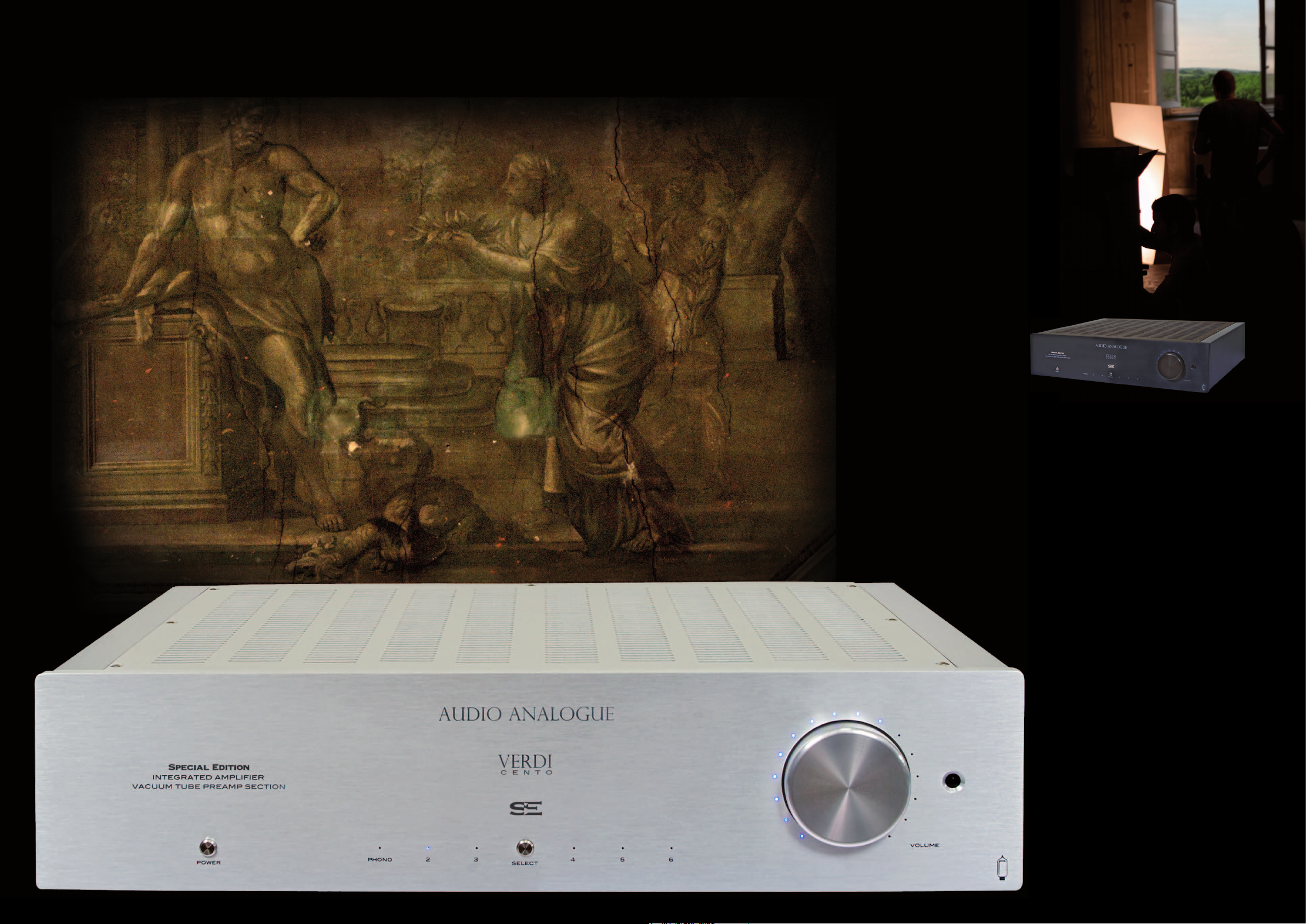
VERDI cento SE
We believe vacuum tube technology
is, even now, very valid in treating the
audio signal in a preamplier stage while
leaving to solid state technology the task
of the Power stage. So this has been
our design philosophy: a vaccum tube
preamplier stage to take advantage of
the audio properties of that technology
and a solid state power stage as much
“transparent” as possible. Other
important innovations concern the
settable Mono/Pre Out and added use
functionalities and the phono stage.
E’ nostra opinione che la tecnologia valvolare
sia, tuttora, molto interessante per trattare il
segnale audio in una fase di preamplicazione
lasciando invece alla tecnologia a stato solido
il compito della parte di potenza. Pertanto la
nostra losoa progettuale è stata la seguente:
creare un stadio preamplicatore a valvola per
sfruttare al meglio le proprietà audio di tale
tecnologia e disegnare uno stadio di potenza a
stato solido il più “trasparente” possibile. Altre
innovazioni riguardano l’uscita Mono/
Pre Out congurabile, la aggiunta di nuove
interessanti funzionalità e lo stadio di pre
Phono.
Page 5
Page 6
Class A Integrated Amplier SE
and
Class A Power Amplier SE
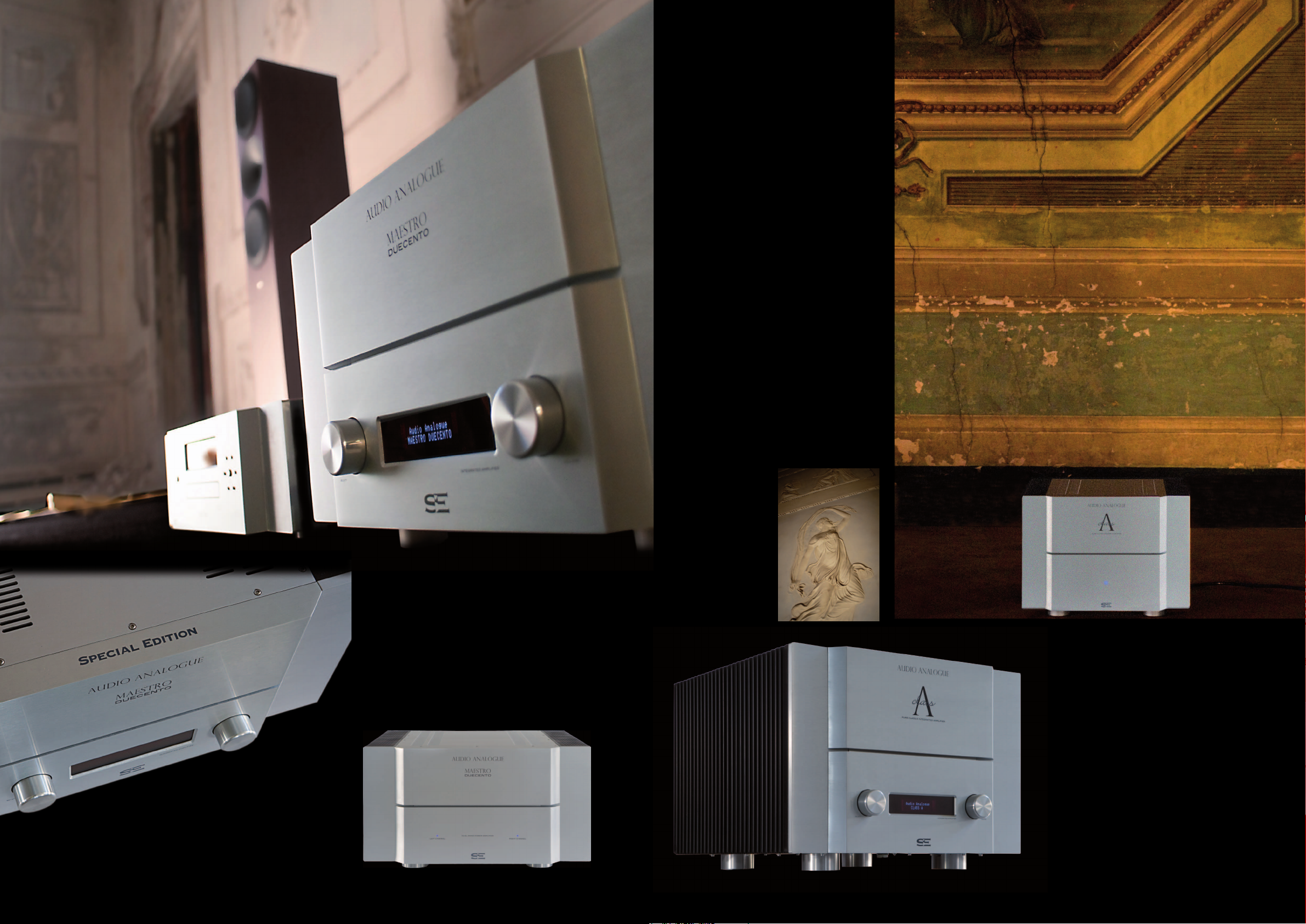
The Class A Integrated
Amplier SE and the Class
A Power Amplier SE come
after a four year period of
diligent research that Audio
Analogue has been developing
on the standard Class A
ampliers.
The research, directed towards a
perfect tuning of the units, has
concerned both the selection
of the passive components
(with special attention paid
to the capacitors) and several
inner wiring strategies. The
implemented changes in such
areas have permitted the units
to reach a higher level of audio
performance.
Maestro Duecento Integrated Amplier SE and Maestro Duecento Power Amplier SE
La ricerca, nalizzata ad accordare perfettamente
le varie parti degli apparecchi, ha riguardato sia
la selezione dei componenti passivi (con particolare
attenzione ai condensatori) che delle varie
congurazioni di cablaggio portando ancora più in
alto le performance di riproduzione audio.
The research, directed
towards a perfect tuning of the units,
has concerned both the selection of the passive
components (with special attention paid to the
capacitors) and several inner wiring strategies.
The implemented changes in such areas have
permitted the unit to reach
a higher level of audio performance.
Il Class A Integrated Amplier SE e il Class
A Power Amplier SE nascono dalle ricerche che
Audio Analogue ha portato avanti negli ultimi 4
anni sugli standard degli amplicatori Class A.
La ricerca, nalizzata ad accordare
perfettamente le varie parti delgli apparecchi, ha
riguardato sia la selezione dei componenti passivi
(con particolare attenzione ai condensatori) che
delle varie congurazioni di cablaggio portando
ancora più in alto le performance di riproduzione
audio.
Page 7
Maestro Line Preamplier SE
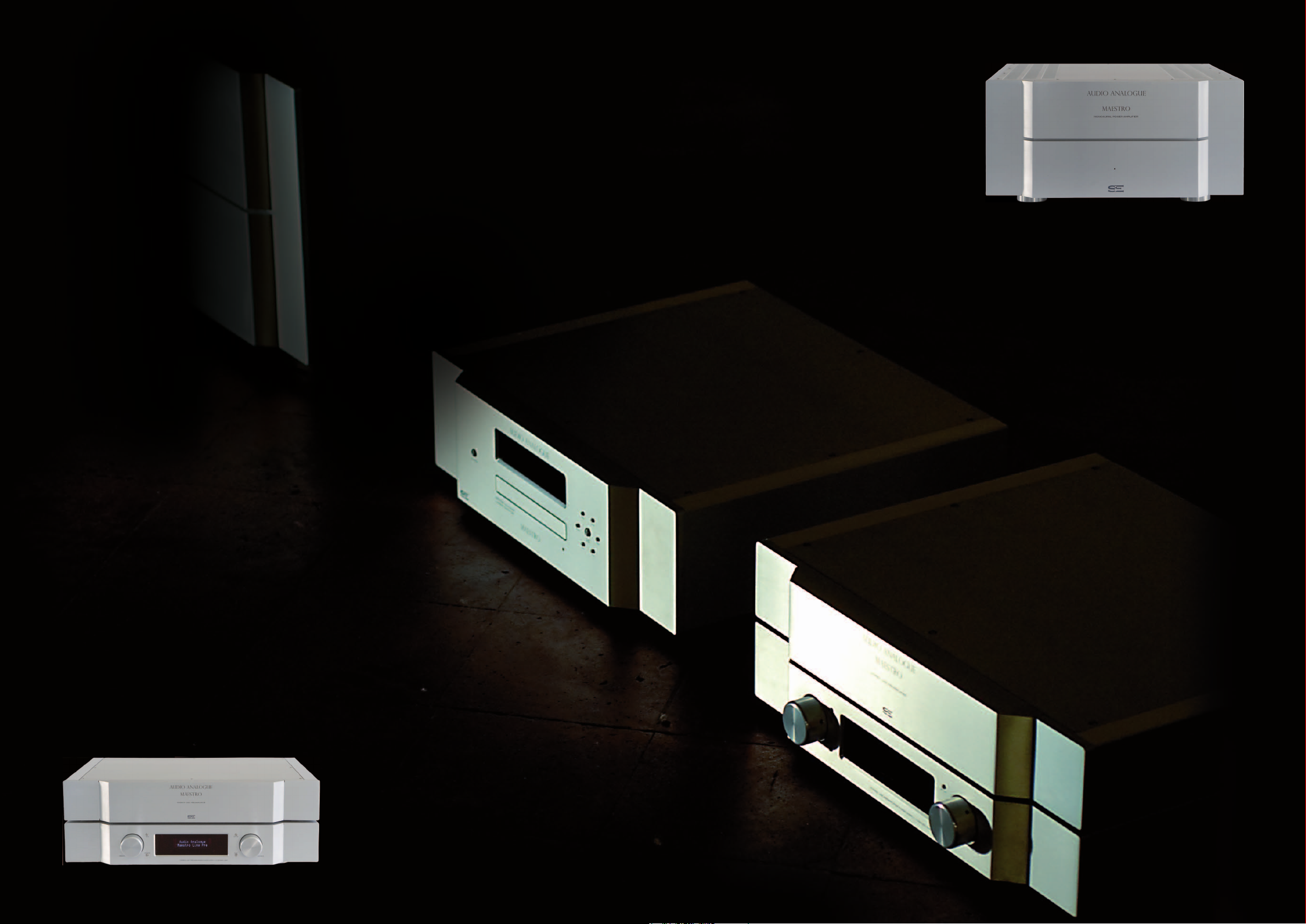
The Maestro Line Preamplier SE has
been developed based on the Maestro Line
Preamplier, completely renewing the power
supply stage and improving the preamp section
after highly accurate detailed listening tests
performed on the passive components. The
implemented technologies and the manic
attention in choosing each passive component has
elevated the sound output to absolute reference
quality and has made the sound of the Maestro
Line Preamplier SE a benchmark in the category
of preampliers of the very highest level.
VR Power Supply (voltage reference): The
power supply we have designed develops a
philosophy different from that generally followed
in the audio eld. In fact, the power supply is
normally obtained from a secondary stage of
the transformer whose voltage is rectied and
then stabilized and ltered as much as possible in
order to reduce the ripple. In the Maestro Line
Preamplier SE a “traditional” power supply,
such as the one previously described, has been
implemented to have a very clean voltage (as
much as 3 different stabilization stages have been
used for each supply!) but the voltage is not used
to supply the preamplier section! Instead, the
voltage, which is already very clean, just supplies
the circuit where the proper voltage for the
preamplier circuits is generated. The voltage to
supply the preamplier section is derived from
an extremely clean and stable (both thermically
and temporally) voltage reference. Such voltage
is hence treated to reach the level required for
the preamplier section. All the chain has been
designed using extremely low noise strategies.
The board for example is a 4 layer one (to have a
generalized bypassing of every signal) as apposed
to the standard 2 layer boards commonly used in
the audio eld…
Pre section: the preamplier section has been
revisited changing the passive components after
a series of highly accurate listening tests. In the
course of such tests many different kinds of
passive components have been checked in several
different positions to obtain the best sound
coherence. Moreover, in some parts of the board
the lay out has been changed to emphasize some
particular characteristics.
Il Maestro Line Preamplier SE è stato sviluppato
sulla base del Maestro Line Preamplier rinnovandone
completamente lo stadio di alimentazione e migliorando la
parte di preamplicazione mediante accuratissimi test sui
componenti passivi. Le tecnologie utilizzate e la attenzione
maniacale nella scelta di ciascun componente hanno
portato la resa sonora a livelli di assoluto riferimento nella
categoria dei preamplicatori di massima qualità.
Alimentazione VR (voltage reference): La alimentazione
sfrutta una losoa diversa da quella generalmente seguita
nella realizzazione di alimentazioni per applicazioni
audio. Infatti, solitamente, la tensione di alimentazione
viene ricavata da un secondario del trasformatore la cui
tensione viene raddrizzata e quindi stabilizzata e ltrata
il più possibile per eliminarne il ripple. Nel caso del
Maestro Line Preamplier SE è stata realizzata una
alimentazione
“tradizionale”
del tipo sopra
descritto per ottenere
una tensione che fosse il più
possibile pulita (utilizzando
ben 3 stadi di stabilizzazione in
cascata!), ma non è tale alimentazione a
essere portata alle sezioni di preamplicazione.
Bensì tali alimentazioni “tradizionali”, già molto
pulite, servono ad alimentare la parte di circuito
nella quale vengono generate le tensioni per i circuiti di
preamplicazione. Tali tensioni vengono ricavate partendo
da un riferimento di tensione estremamente pulito e stabile
sia termicamente che nel tempo e trattando tale tensione
per ottenere il valore necessario in ingresso alla sezione
di preamplicazione. Tutta la catena è stata progettata
secondo strategie a “basso rumore” estremamente spinte.
La scheda, ad esempio, è a 4 layer (in modo da avere un
bypassing generalizzato di tutti i segnali) e non a 2 layer
come solitamente nei prodotti audio…
Sezione Pre: La sezione di preamplicazione è stata
rivisitata cambiando i componenti dei vari stadi in seguito
a test di ascolto molto accurati durante i quali sono stati
provati diversi tipi di componenti passivi nelle varie
posizioni al ne di ottenere la migliore coerenza sonora. In
alcuni punti del circuito si sono inoltre effettuate modiche
di lay out per enfatizzare certe caratteristiche.
Maestro Monoblock Power Amplier SE
The basic structure of the amplier Maestro
Monoblock is the same used in the precision
balanced amplier used in the laboratories. It is
made of three different ampliers. The rst two
must amplify in tension the balanced signal and
the third one must supply the necessary current
amplication to drive the speakers. This kind of
structure has two important benets: the rst
one is a high immunity to the disturbs, while the
second one is the possibility to improve each
amplication stage. The separation between the
gain in tension and of the gain in current permits
to realize class A tension ampliers made with
low power components, so to obtain a frequency
response up to about 500kHz. Such frequency
extention gives the possibility to mantain the
phase errors to a very low level. The power section
has been designed to obtain a high gain in current
and not in tension. Thanks to this solution, it is
possible to keep the frequency response at full
power around at 200kHz. Also the bass frequency
extention has been realised with care applying an
off-set recover circuit able to go down to 3Hz.
Due to its two stages conguration, the amplier
Maestro Monoblock does not have a global
feedback between inputs and outputs.
POWER STAGE The Maestro Monoblock’s
nominal output power is of 200W on a 8OHM
impedance. This power goes up to 800W@2ohms.
The protections starts to work at around 1000W
with a load of 1ohm (if your house system can
support it!)
La struttura di base dell’amplicatore Maestro Mono
rispecchia quella utilizzata negli amplicatori bilanciati di
precisione da laboratorio. E’composta da tre amplicatori
distinti. I primi due si occupano di amplicare in tensione
il segnale bilanciato e l’ultimo di fornire l’amplicazione
in corrente necessaria al pilotaggio delle casse. Questo tipo
di struttura presenta due vantaggi fondamentali; il primo è
una alta immunità ai disturbi ed il secondo è la possibilità
di ottimizzare ciascuno stadio di amplicazione. La
separazione del guadagno in tensione da quello in corrente
ha permesso infatti di realizzare degli amplicatori di
tensione in classe A con componenti di piccola potenza,
quindi ha permesso di ottenere una risposta in frequenza
estesa no a circa 500kHz. Una simile estensione in
frequenza consente di mantenere gli errori di fase ad un
livello molto basso. Di contro la sezione di potenza è stata
progettata per avere un grosso guadagno in corrente ma non
in tensione. Questo ha consentito di mantenere la risposta
in frequenza a piena potenza intorno ai 200kHz. Anche
l’estensione a bassa frequenza è stata particolarmente
curata con l’applicazione di un circuito di recupero
dell’offset che scende n sotto i 3Hz. A causa della
sua congurazione a due stadi, l’amplicatore Maestro
Monoblock non ha una retroazione globale fra gli ingressi
e l’uscita.
STADIO DI POTENZA La potenza nominale del
Maestro Mono è di 200W su un carico di 8. Questa
potenza sale no ad 800W su 2., Le protezioni
intervengono a circa 1000W su un carico di 1, se la rete di
casa regge!
Page 8
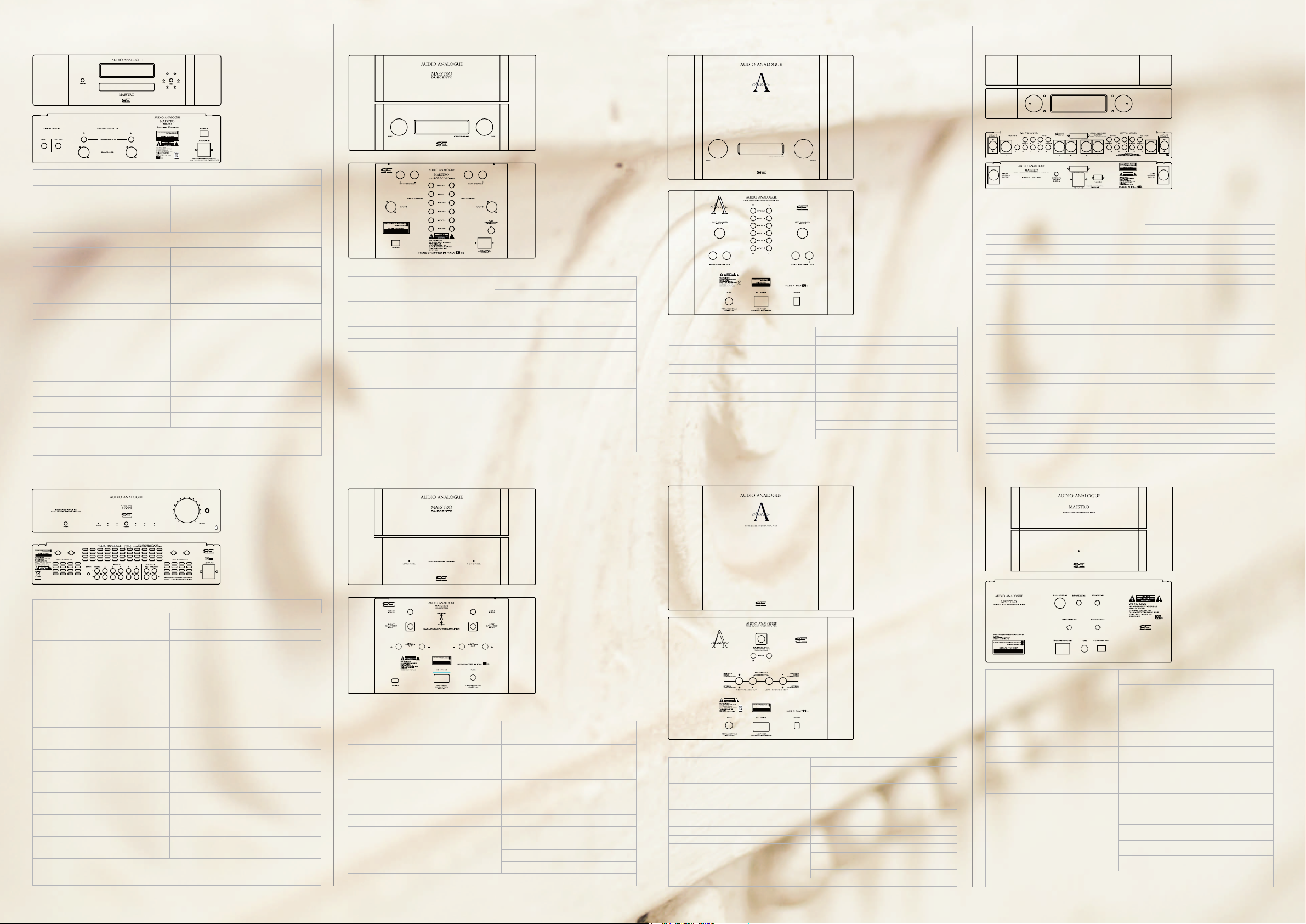
MAESTRO 192/24 CD PLAYER SE
CD Mechanism TEAC CD-5010A
Dimensions (n. 1)
Weight 13,4 kg (29,5 Lbs)
D/A Section
Transceiver
Sample Rate Converter (SRC)
DAC
THD+N @ 1KHz 0dBFs (n. 6) <0,001 %
THD+N @ 1KHz -10dBFs (n. 6) <0,003 %
Dynamic range (n. 6) 98 dB
Noise level (n. 6) -140 dB
Output Level (n. 7) 2,00
Output Level (Balanced Output) 4,0 Vrms maximum
Digital Input Coaxial
Digital Output Coaxial
Unbalanced/Balanced Output
135 x 445 x 395 mm
(5,3 x 17,5 x 15,5 ")
CS8416 192KHz/24bit
Cirrus Logic
SRC4193 192KHz/24bit
Burr-Brown
PCM1794A 192KHz/24bit
Burr-Brown
MAESTRO duecento SE • INTEGRATED AMPLIFIER
Dimensions (n. 1)
Weight 65,5 kg (144,4 Lbs)
Line gain 12 dB
THD+N (1W, 8Ohm 1KHz) 0,03%
Slew Rate (n. 11) 50V/µs
Frequency response (n. 2) 1 Hz - 160 KHz
Noise level (n. 10) -130 dB
SNR (n. 9) > 100 dB
Output power (n. 4)
5 Unbalanced + 1 Balanced Input + Tape Out
260 x 445 x 480 mm
(10,3 x 17,5 x 18,9 ")
200W/8Ohm p.c.
400W/4Ohm p.c.
800W/2Ohm p.c.
CLASS A SE • INTEGRATED AMPLIFIER
Dimensions (n. 1)
Weight 61,5 kg (135.6 Lbs)
Line gain 12 dB
THD+N (1W, 8Ohm 1KHz) 0,02%
Slew Rate (n. 11) 30V/µs
Frequency response (n. 2) 1 Hz - 160 KHz
Noise level (n. 10) -130 dB
SNR (n. 14) > 100 dB
Output power (n. 4)
5 Unbalanced + 1 Balanced Input + Tape Out
320 x 445 x 480 mm
(12,6 x 17,5 x 18,9 ")
50W classA/8Ohm p.c.
100W/4Ohm p.c.
200W/2Ohm p.c.
MAESTRO stereo line PREAMPLIFIER SE
Dimensions (n. 1)
Weight 18 kg (39,7 Lbs)
Unbalanced input and unbalanced output
Line gain 12 dB
Frequency response (Att. -10dB) <10Hz-115KHz +0/-1dB
Noise level (n. 10) 125 dB under 1V
SNR (22Hz - 22KHz) 80 dB
Balanced input and unbalanced output
Line gain 6 dB
Frequency response (Att.-10dB) <20Hz-115KHz +0/-1dB
Noise level (n. 10) 125 dB under 1V
SNR (22Hz - 22KHz) 85 dB
Unbalanced input and balanced output
Line gain 18 dB
Frequency response (Att. -10dB) <20Hz-92KHz +0/-1dB
Noise level (n. 10) 118 dB under 1V
SNR (22Hz - 22KHz) 87 dB
Balanced input and balanced output
Line gain 12 dB
Frequency response (Att. -10dB) <20Hz-166KHz +0/-1dB
Noise level (n. 10) 122 dB under 1V
SNR (22Hz - 22KHz) 98 dB
6 Unbalanced + 1 Balanced Input + 2 Unbalanced + 2 Balanced Outuput
160 x 445 x 415 mm
(18,1 x 17,5 x 16,3 ")
VERDI CENTO SE •INTEGRATED AMPLIFIER
Vacuum Tube Preamp Stage
Dimensions (n. 1)
Weight 12,5 kg (27,5 Lbs)
Line gain 4,6 dB
Power amp gain 32,5 dB
Phono gain
Line input impedance 40 KOhm
Phono input impedance
Frequency response (n. 2) > 150 KHz
Noise level (n. 5) -100 dBV
SNR (n. 3) 106 dB
Output power (n. 4)
5 Unbalanced Inputs + 1 Phono Input +
Tape Out + 1 Pre/Mono Output,
scales available
103 x 448 x 405 mm
(4,0 x 17,5 x 15,9 ")
60 dB (MM)
80 dB (MC)
56KOhm (MM)
100 Ohm (MC)
100W/8Ohm p.c.
190W/4Ohm p.c.
Balance, Bypass Mode, 4 volume
MAESTRO duecento
Dimensions (n. 1)
SE • DUAL MONO POWER AMPLIFIER
260 x 445 x 460 mm
(10,3 x 17,5 x 18,1 ")
Weight 65,5 kg (144,4 Lbs)
Sensitivity Unbalanced Input (n. 13) 1,5 Vrms
Sensitivity Balanced Input (n. 13) 3,0 Vrms
THD+N (1W, 8Ohm 1KHz) 0,03%
Slew Rate (n. 11) 50V/µs
Frequency response (n. 2) 1 Hz - 160 KHz
Noise level (n. 10) -130 dB
SNR (n. 9) > 100 dB
200W/8Ohm p.c.
Output power (n. 4)
400W/4Ohm p.c.
800W/2Ohm p.c.
Unbalanced/Balanced Input
CLASS A
Dimensions (n. 1)
Weight 61,5 kg (135,6 Lbs)
Sensitivity Unbalanced Input (n. 13) 1 Vrms
Sensitivity Balanced Input (n. 13) 2 Vrms
THD+N (1W, 8Ohm 1KHz) 0,02%
Slew Rate (n. 11) 50V/µs
Frequency response (n. 2) 1 Hz - 160 KHz
Noise level (n. 10) -130 dB
SNR (n. 9) > 100 dB
Output power (n. 4)
2 Unbalanced / 1 Balanced Input
SE • POWER AMPLIFIER
320 x 445 x 460 mm
(12,6 x 17,5 x 18,1 ")
50W classA/8Ohm p.c.
100W/4Ohm p.c.
200W/2Ohm p.c.
200W/8Ohm (Bridged Mode).
Le misure degli apparecchi sono state effettuate con Audio Precision Two CascadeAll measurements are made using Audio Precision Two Cascade
MAESTRO MONOaural POWER AMPLIFIER SE
Dimensions (n. 1)
Weight 61 kg (134,5 Lbs)
Input impedance (n. 12) 47 KOhm
THD+N (10W, 8Ohm 1KHz) 0,01%
Slew Rate (n. 11) 50V/µs
Frequency response (n. 2) 2Hz - 100 KHz
Noise level (n. 10) -130 dB
SNR (n. 9) > 100 dB
Output power (n. 4)
2 Unbalanced / 1 Balanced Input
225 x 445 x 470 mm
(8,9 x 17,5 x 18,5 ")
200W/8Ohm p.c.
400W/4Ohm p.c.
800W/2Ohm p.c.
1200W/1Ohm p.c.
Page 9
notes
note 1
note 2
note 3
note 4
note 5
note 6
note 7
note 8
note 9
note 10
note 11
note 12
note 13
note 14
Altezza x Larghezza x Profondità (H x W x D)
Height x Width x Depth
Attenuation 0dB, -3dB band
Attenuation: 0dB A weighted reffered to
8 Ohm load nominal power
1KHz input signal, two piloted channels
Band limits 0Hz-40KHz
Band limits 0Hz-22KHz
Maximum rms voltage output value
Attenuation 0dB, -3dB band, 1Vrms output
Attenuation: 0dB A weighted reffered to 200W
Band limits 0Hz-48KHz
Full power Bandwidth limited
Joined in AC for each phase to the common
For 200W @ 8Ohm
Attenuation: 0dB A weighted reffered to 50W
Audio Analogue policy is one of
continuous improvement. Design and
specications are therefore subject to
change without prior notice.
For the very latest, in-depth product
information, review coverage and extensive product
support, visit
www.audioanalogue.com
La linea di condotta di Audio Analogue
è indirizzata al continuo miglioramento.
I modelli e le speciche sono perciò
suscettibili di cambiamenti senza obbligo
di preavviso.
Per informazioni aggiornate e dettagliate
sul prodotto, le recensioni e l’assistenza
completa, visitate il sito
www.audioanalogue.com
Audio Analogue
Manufactured and Distributed by:
Audio FuturA SpA
Via Maestri Del Lavoro, 583
51015 Monsummano Terme (PT) Italy
Tel. +39 0572 954513 fax +39 0572 958099
www.audioanalogue.com - [email protected]
 Loading...