

Page 1

Features
• High Performance, Low Power AVR
• Advanced RISC Architecture
– 131 Powerful Instructions – Most Single Clock Cycle Execution
– 32 x 8 General Purpose Working Registers
– Fully Static Operation
– Up to 20 MIPS Throughput at 20 MHz
– On-chip 2-cycle Multiplier
• High Endurance Non-volatile Memory segments
– 4/8/16K Bytes of In-System Self-programmable Flash program memory
– 256/512/512 Bytes EEPROM
– 512/1K/1K Bytes Internal SRAM
– Write/Erase cyles: 10,000 Flash/100,000 EEPROM
– Data retention: 20 years at 85°C/100 years at 25°C
– Optional Boot Code Section with Independent Lock Bits
In-System Programming by On-chip Boot Program
True Read-While-Write Operation
– Programming Lock for Software Security
• Peripheral Features
– Two 8-bit Timer/Counters with Separate Prescaler and Compare Mode
– One 16-bit Timer/Counter with Separate Prescaler, Compare Mode, and Capture Mode
– Real Time Counter with Separate Oscillator
– Six PWM Channels
– 8-channel 10-bit ADC in TQFP and QFN/MLF package
– 6-channel 10-bit ADC in PDIP Package
– Programmable Serial USART
– Master/Slave SPI Serial Interface
– Byte-oriented 2-wire Serial Interface (Philips I
– Programmable Watchdog Timer with Separate On-chip Oscillator
– On-chip Analog Comparator
– Interrupt and Wake-up on Pin Change
• Special Microcontroller Features
– DebugWIRE On-Chip Debug System
– Power-on Reset and Programmable Brown-out Detection
– Internal Calibrated Oscillator
– External and Internal Interrupt Sources
– Five Sleep Modes: Idle, ADC Noise Reduction, Power-save, Power-down, and Standby
• I/O and Packages
– 23 Programmable I/O Lines
– 28-pin PDIP, 32-lead TQFP, 28-pad QFN/MLF and 32-pad QFN/MLF
• Operating Voltage:
– 1.8 - 5.5V for ATmega48V/88V/168V
– 2.7 - 5.5V for ATmega48/88/168
• Temperature Range:
–-40
°C to 85°C
• Speed Grade:
– ATmega48V/88V/168V: 0 - 4 MHz @ 1.8 - 5.5V, 0 - 10 MHz @ 2.7 - 5.5V
– ATmega48/88/168: 0 - 10 MHz @ 2.7 - 5.5V, 0 - 20 MHz @ 4.5 - 5.5V
• Low Power Consumption
– Active Mode:
250 µA at 1 MHz, 1.8V
15 µA at 32 kHz, 1.8V (including Oscillator)
– Power-down Mode:
0.1µA at 1.8V
®
8-Bit Microcontroller
2
C compatible)
()
8-bit
Microcontroller
with 8K Bytes
In-System
Programmable
Flash
ATmega48/V
ATmega88/V
ATmega168/V
Summary
Note: Not recommended for new
designs
Note: 1. See “Data Retention” on page 7 for details.
Rev. 2545RS–AVR–07/09
Page 2
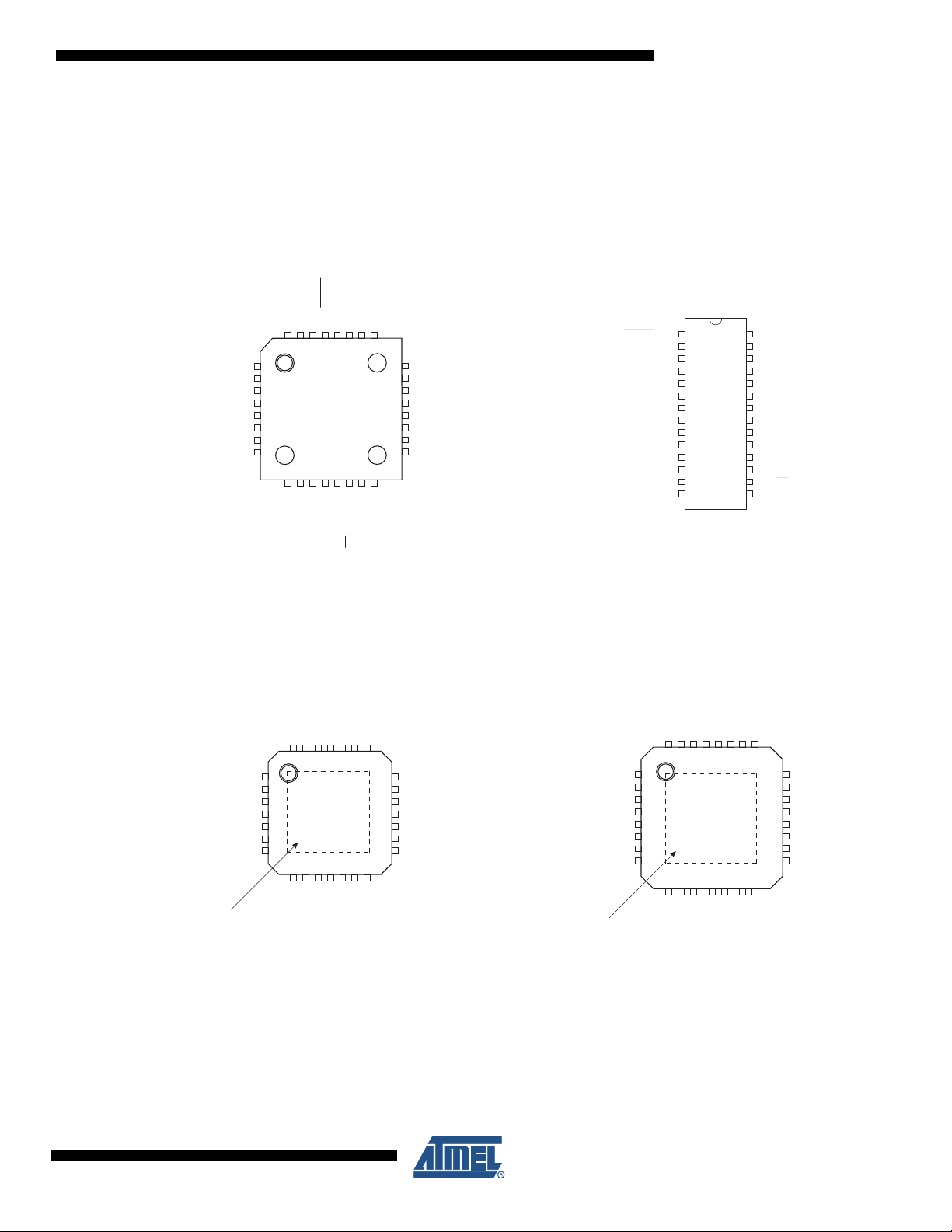
1. Pin Configurations
Figure 1-1. Pinout ATmega48/88/1682545RS
TQFP Top View
PD2 (INT0/PCINT18)
PD1 (TXD/PCINT17)
PD0 (RXD/PCINT16)
PC6 (RESET/PCINT14)
PC5 (ADC5/SCL/PCINT13)
PC4 (ADC4/SDA/PCINT12)
PC3 (ADC3/PCINT11)
32313029282726
GND
VCC
GND
VCC
1
2
3
4
5
6
7
8
9101112131415
(PCINT19/OC2B/INT1) PD3
(PCINT20/XCK/T0) PD4
(PCINT6/XTAL1/TOSC1) PB6
(PCINT7/XTAL2/TOSC2) PB7
PC2 (ADC2/PCINT10)
25
24
PC1 (ADC1/PCINT9)
23
PC0 (ADC0/PCINT8)
22
ADC7
21
GND
20
AREF
19
ADC6
18
AVC C
17
PB5 (SCK/PCINT5)
16
ATmega48/88/168
(PCINT14/RESET) PC6
(PCINT16/RXD) PD0
(PCINT17/TXD) PD1
(PCINT18/INT0) PD2
(PCINT19/OC2B/INT1) PD3
(PCINT20/XCK/T0) PD4
(PCINT6/XTAL1/TOSC1) PB6
(PCINT7/XTAL2/TOSC2) PB7
(PCINT21/OC0B/T1) PD5
(PCINT22/OC0A/AIN0) PD6
(PCINT23/AIN1) PD7
(PCINT0/CLKO/ICP1) PB0
VCC
GND
1
2
3
4
5
6
7
8
9
10
11
12
13
14
PDIP
28
PC5 (ADC5/SCL/PCINT13)
27
PC4 (ADC4/SDA/PCINT12)
26
PC3 (ADC3/PCINT11)
25
PC2 (ADC2/PCINT10)
24
PC1 (ADC1/PCINT9)
23
PC0 (ADC0/PCINT8)
22
GND
21
AREF
20
AVC C
19
PB5 (SCK/PCINT5)
18
PB4 (MISO/PCINT4)
17
PB3 (MOSI/OC2A/PCINT3)
16
PB2 (SS/OC1B/PCINT2)
15
PB1 (OC1A/PCINT1)
(PCINT19/OC2B/INT1) PD3
(PCINT20/XCK/T0) PD4
(PCINT6/XTAL1/TOSC1) PB6
(PCINT7/XTAL2/TOSC2) PB7
(PCINT21/OC0B/T1) PD5
NOTE: Bottom pad should be soldered to ground.
VCC
GND
(PCINT1/OC1A) PB1
(PCINT23/AIN1) PD7
(PCINT21/OC0B/T1) PD5
(PCINT0/CLKO/ICP1) PB0
(PCINT22/OC0A/AIN0) PD6
28 MLF Top View
PD2 (INT0/PCINT18)
PD1 (TXD/PCINT17)
PD0 (RXD/PCINT16)
PC6 (RESET/PCINT14)
PC5 (ADC5/SCL/PCINT13)
28272625242322
1
2
3
4
5
6
7
891011121314
(PCINT1/OC1A) PB1
(PCINT23/AIN1) PD7
(PCINT2/SS/OC1B) PB2
(PCINT0/CLKO/ICP1) PB0
(PCINT22/OC0A/AIN0) PD6
(PCINT4/MISO) PB4
(PCINT2/SS/OC1B) PB2
(PCINT3/OC2A/MOSI) PB3
PC4 (ADC4/SDA/PCINT12)
PC3 (ADC3/PCINT11)
PC2 (ADC2/PCINT10)
21
PC1 (ADC1/PCINT9)
20
PC0 (ADC0/PCINT8)
19
GND
18
AREF
17
AVC C
16
PB5 (SCK/PCINT5)
15
(PCINT4/MISO) PB4
(PCINT3/OC2A/MOSI) PB3
(PCINT19/OC2B/INT1) PD3
(PCINT20/XCK/T0) PD4
(PCINT6/XTAL1/TOSC1) PB6
(PCINT7/XTAL2/TOSC2) PB7
NOTE: Bottom pad should be soldered to ground.
GND
VCC
GND
VCC
1
2
3
4
5
6
7
8
32 MLF Top View
PD2 (INT0/PCINT18)
PD1 (TXD/PCINT17)
PD0 (RXD/PCINT16)
PC6 (RESET/PCINT14)
PC5 (ADC5/SCL/PCINT13)
PC4 (ADC4/SDA/PCINT12)
PC3 (ADC3/PCINT11)
32313029282726
9101112131415
(PCINT1/OC1A) PB1
(PCINT23/AIN1) PD7
(PCINT21/OC0B/T1) PD5
(PCINT22/OC0A/AIN0) PD6
(PCINT2/SS/OC1B) PB2
(PCINT0/CLKO/ICP1) PB0
(PCINT3/OC2A/MOSI) PB3
PC2 (ADC2/PCINT10)
25
PC1 (ADC1/PCINT9)
24
PC0 (ADC0/PCINT8)
23
ADC7
22
GND
21
AREF
20
ADC6
19
AVC C
18
PB5 (SCK/PCINT5)
17
16
(PCINT4/MISO) PB4
2545RS–AVR–07/09
2
Page 3

1.1 Pin Descriptions
1.1.1 VCC
Digital supply voltage.
1.1.2 GND
Ground.
1.1.3 Port B (PB7:0) XTAL1/XTAL2/TOSC1/TOSC2
Port B is an 8-bit bi-directional I/O port with internal pull-up resistors (selected for each bit). The
Port B output buffers have symmetrical drive characteristics with both high sink and source
capability. As inputs, Port B pins that are externally pulled low will source current if the pull-up
resistors are activated. The Port B pins are tri-stated when a reset condition becomes active,
even if the clock is not running.
Depending on the clock selection fuse settings, PB6 can be used as input to the inverting Oscillator amplifier and input to the internal clock operating circuit.
Depending on the clock selection fuse settings, PB7 can be used as output from the inverting
Oscillator amplifier.
ATmega48/88/168
1.1.4 Port C (PC5:0)
1.1.5 PC6/RESET
If the Internal Calibrated RC Oscillator is used as chip clock source, PB7..6 is used as TOSC2..1
input for the Asynchronous Timer/Counter2 if the AS2 bit in ASSR is set.
The various special features of Port B are elaborated in “Alternate Functions of Port B” on page
77 and “System Clock and Clock Options” on page 26.
Port C is a 7-bit bi-directional I/O port with internal pull-up resistors (selected for each bit). The
PC5..0 output buffers have symmetrical drive characteristics with both high sink and source
capability. As inputs, Port C pins that are externally pulled low will source current if the pull-up
resistors are activated. The Port C pins are tri-stated when a reset condition becomes active,
even if the clock is not running.
If the RSTDISBL Fuse is programmed, PC6 is used as an I/O pin. Note that the electrical characteristics of PC6 differ from those of the other pins of Port C.
If the RSTDISBL Fuse is unprogrammed, PC6 is used as a Reset input. A low level on this pin
for longer than the minimum pulse length will generate a Reset, even if the clock is not running.
The minimum pulse length is given in Table 26-3 on page 306. Shorter pulses are not guaranteed to generate a Reset.
The various special features of Port C are elaborated in “Alternate Functions of Port C” on page
80.
1.1.6 Port D (PD7:0)
2545RS–AVR–07/09
Port D is an 8-bit bi-directional I/O port with internal pull-up resistors (selected for each bit). The
Port D output buffers have symmetrical drive characteristics with both high sink and source
capability. As inputs, Port D pins that are externally pulled low will source current if the pull-up
3
Page 4

ATmega48/88/168
resistors are activated. The Port D pins are tri-stated when a reset condition becomes active,
even if the clock is not running.
The various special features of Port D are elaborated in “Alternate Functions of Port D” on page
83.
1.1.7 AV
CC
AVCC is the supply voltage pin for the A/D Converter, PC3:0, and ADC7:6. It should be externally
connected to V
, even if the ADC is not used. If the ADC is used, it should be connected to V
CC
through a low-pass filter. Note that PC6..4 use digital supply voltage, VCC.
1.1.8 AREF
AREF is the analog reference pin for the A/D Converter.
1.1.9 ADC7:6 (TQFP and QFN/MLF Package Only)
In the TQFP and QFN/MLF package, ADC7:6 serve as analog inputs to the A/D converter.
These pins are powered from the analog supply and serve as 10-bit ADC channels.
CC
2545RS–AVR–07/09
4
Page 5

2. Overview
2.1 Block Diagram
ATmega48/88/168
The ATmega48/88/168 is a low-power CMOS 8-bit microcontroller based on the AVR enhanced
RISC architecture. By executing powerful instructions in a single clock cycle, the
ATmega48/88/168 achieves throughputs approaching 1 MIPS per MHz allowing the system
designer to optimize power consumption versus processing speed.
Figure 2-1. Block Diagram
Powe r
RESET
Comp.
VCC
debugWIRE
PROGRAM
CPU
Internal
Bandgap
LOGIC
SRAMFlash
AVC C
AREF
GND
2
6
GND
Watchdog
Timer
Watchdog
Oscillator
Oscillator
Circuits /
Clock
Generation
EEPROM
8bit T/C 2
DATA B US
Supervision
POR / BOD &
16bit T/C 18bit T/C 0 A/D Conv.
Analog
2545RS–AVR–07/09
USART 0
SPI TWI
PORT C (7)PORT B (8)PORT D (8)
RESET
XTAL[1..2]
ADC[6..7]PC[0..6]PB[0..7]PD[0..7]
The AVR core combines a rich instruction set with 32 general purpose working registers. All the
32 registers are directly connected to the Arithmetic Logic Unit (ALU), allowing two independent
registers to be accessed in one single instruction executed in one clock cycle. The resulting
5
Page 6

ATmega48/88/168
architecture is more code efficient while achieving throughputs up to ten times faster than conventional CISC microcontrollers.
The ATmega48/88/168 provides the following features: 4K/8K/16K bytes of In-System Programmable Flash with Read-While-Write capabilities, 256/512/512 bytes EEPROM, 512/1K/1K bytes
SRAM, 23 general purpose I/O lines, 32 general purpose working registers, three flexible
Timer/Counters with compare modes, internal and external interrupts, a serial programmable
USART, a byte-oriented 2-wire Serial Interface, an SPI serial port, a 6-channel 10-bit ADC (8
channels in TQFP and QFN/MLF packages), a programmable Watchdog Timer with internal
Oscillator, and five software selectable power saving modes. The Idle mode stops the CPU
while allowing the SRAM, Timer/Counters, USART, 2-wire Serial Interface, SPI port, and interrupt system to continue functioning. The Power-down mode saves the register contents but
freezes the Oscillator, disabling all other chip functions until the next interrupt or hardware reset.
In Power-save mode, the asynchronous timer continues to run, allowing the user to maintain a
timer base while the rest of the device is sleeping. The ADC Noise Reduction mode stops the
CPU and all I/O modules except asynchronous timer and ADC, to minimize switching noise during ADC conversions. In Standby mode, the crystal/resonator Oscillator is running while the rest
of the device is sleeping. This allows very fast start-up combined with low power consumption.
The device is manufactured using Atmel’s high density non-volatile memory technology. The
On-chip ISP Flash allows the program memory to be reprogrammed In-System through an SPI
serial interface, by a conventional non-volatile memory programmer, or by an On-chip Boot program running on the AVR core. The Boot program can use any interface to download the
application program in the Application Flash memory. Software in the Boot Flash section will
continue to run while the Application Flash section is updated, providing true Read-While-Write
operation. By combining an 8-bit RISC CPU with In-System Self-Programmable Flash on a
monolithic chip, the Atmel ATmega48/88/168 is a powerful microcontroller that provides a highly
flexible and cost effective solution to many embedded control applications.
The ATmega48/88/168 AVR is supported with a full suite of program and system development
tools including: C Compilers, Macro Assemblers, Program Debugger/Simulators, In-Circuit Emulators, and Evaluation kits.
2.2 Comparison Between ATmega48, ATmega88, and ATmega168
The ATmega48, ATmega88 and ATmega168 differ only in memory sizes, boot loader support,
and interrupt vector sizes. Table 2-1 summarizes the different memory and interrupt vector sizes
for the three devices.
Table 2-1. Memory Size Summary
Device Flash EEPROM RAM Interrupt Vector Size
ATmega48 4K Bytes 256 Bytes 512 Bytes 1 instruction word/vector
ATmega88 8K Bytes 512 Bytes 1K Bytes 1 instruction word/vector
ATmega168 16K Bytes 512 Bytes 1K Bytes 2 instruction words/vector
ATmega88 and ATmega168 support a real Read-While-Write Self-Programming mechanism.
There is a separate Boot Loader Section, and the SPM instruction can only execute from there.
In ATmega48, there is no Read-While-Write support and no separate Boot Loader Section. The
SPM instruction can execute from the entire Flash.
2545RS–AVR–07/09
6
Page 7

3. About
3.1 Resources
A comprehensive set of development tools, application notes and datasheets are available for
download on http://www.atmel.com/avr.
3.2 Data Retention
Reliability Qualification results show that the projected data retention failure rate is much less
than 1 PPM over 20 years at 85°C or 100 years at 25°C.
3.3 Code Examples
This documentation contains simple code examples that briefly show how to use various parts of
the device. These code examples assume that the part specific header file is included before
compilation. Be aware that not all C compiler vendors include bit definitions in the header files
and interrupt handling in C is compiler dependent. Please confirm with the C compiler documentation for more details.
For I/O Registers located in extended I/O map, “IN”, “OUT”, “SBIS”, “SBIC”, “CBI”, and “SBI”
instructions must be replaced with instructions that allow access to extended I/O. Typically
“LDS” and “STS” combined with “SBRS”, “SBRC”, “SBR”, and “CBR”.
ATmega48/88/168
2545RS–AVR–07/09
7
Page 8
ATmega48/88/168
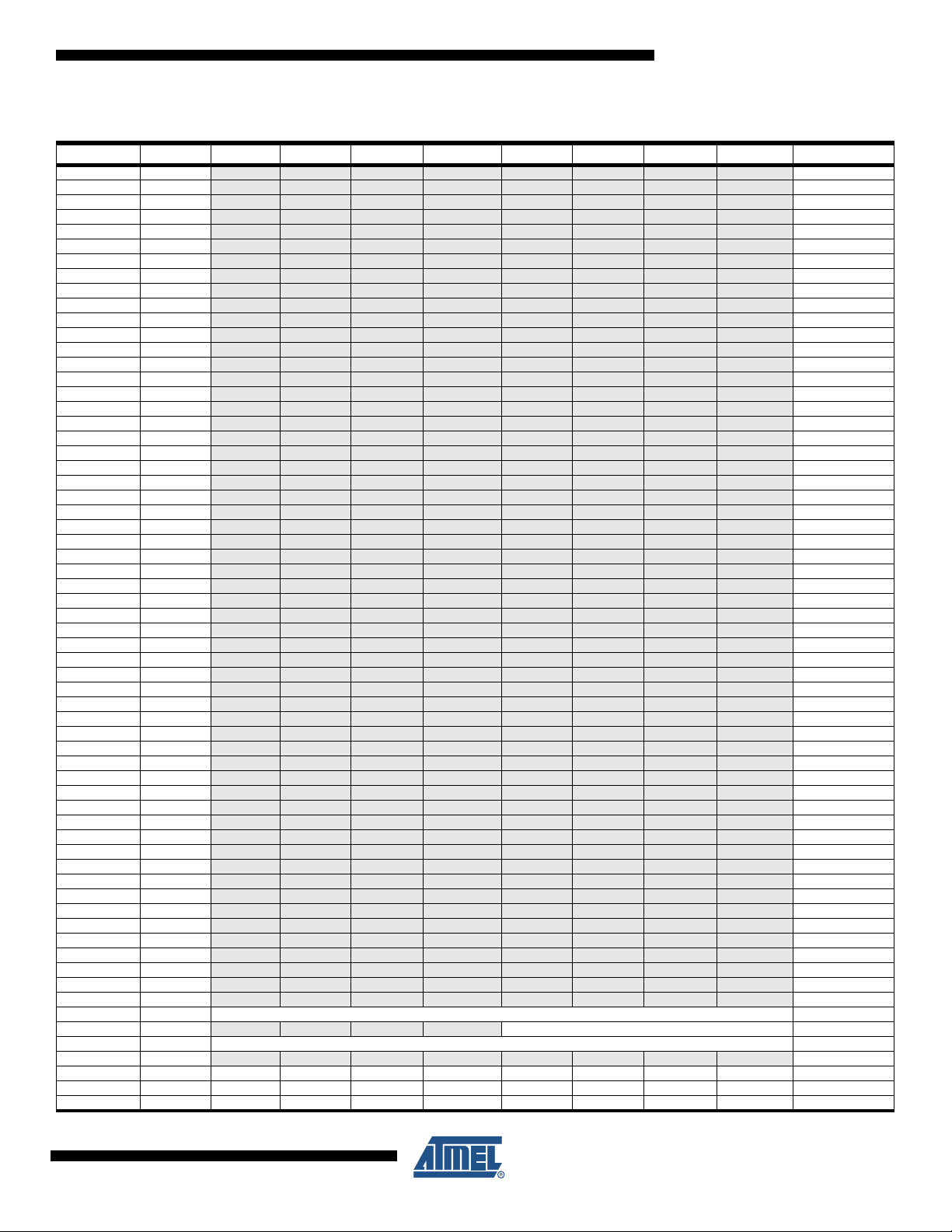
4. Register Summary
Address Name Bit 7 Bit 6 Bit 5 Bit 4 Bit 3 Bit 2 Bit 1 Bit 0 Page
(0xFF) Reserved – – – – – – – –
(0xFE) Reserved – – – – – – – –
(0xFD) Reserved – – – – – – – –
(0xFC) Reserved
(0xFB) Reserved
(0xFA) Reserved – – – – – – – –
(0xF9) Reserved – – – – – – – –
(0xF8) Reserved – – – – – – – –
(0xF7) Reserved – – – – – – – –
(0xF6) Reserved – – – – – – – –
(0xF5) Reserved – – – – – – – –
(0xF4) Reserved – – – – – – – –
(0xF3) Reserved – – – – – – – –
(0xF2) Reserved – – – – – – – –
(0xF1) Reserved – – – – – – – –
(0xF0) Reserved
(0xEF) Reserved
(0xEE) Reserved – – – – – – – –
(0xED) Reserved – – – – – – – –
(0xEC) Reserved – – – – – – – –
(0xEB) Reserved – – – – – – – –
(0xEA) Reserved – – – – – – – –
(0xE9) Reserved – – – – – – – –
(0xE8) Reserved – – – – – – – –
(0xE7) Reserved – – – – – – – –
(0xE6) Reserved – – – – – – – –
(0xE5) Reserved – – – – – – – –
(0xE4) Reserved – – – – – – – –
(0xE3) Reserved – – – – – – – –
(0xE2) Reserved – – – – – – – –
(0xE1) Reserved – – – – – – – –
(0xE0) Reserved – – – – – – – –
(0xDF) Reserved – – – – – – – –
(0xDE) Reserved – – – – – – – –
(0xDD) Reserved – – – – – – – –
(0xDC) Reserved – – – – – – – –
(0xDB) Reserved – – – – – – – –
(0xDA) Reserved – – – – – – – –
(0xD9) Reserved – – – – – – – –
(0xD8) Reserved – – – – – – – –
(0xD7) Reserved – – – – – – – –
(0xD6) Reserved – – – – – – – –
(0xD5) Reserved
(0xD4) Reserved
(0xD3) Reserved – – – – – – – –
(0xD2) Reserved
(0xD1) Reserved
(0xD0) Reserved
(0xCF) Reserved – – – – – – – –
(0xCE) Reserved
(0xCD) Reserved
(0xCC) Reserved – – – – – – – –
(0xCB) Reserved
(0xCA) Reserved
(0xC9) Reserved – – – – – – – –
(0xC8) Reserved
(0xC7) Reserved
(0xC6) UDR0 USART I/O Data Register 189
(0xC5) UBRR0H
(0xC4) UBRR0L USART Baud Rate Register Low 193
(0xC3) Reserved
(0xC2) UCSR0C UMSEL01 UMSEL00 UPM01 UPM00 USBS0
(0xC1) UCSR0B RXCIE0 TXCIE0 UDRIE0 RXEN0 TXEN0 UCSZ02 RXB80 TXB80 190
(0xC0) UCSR0A RXC0 TXC0 UDRE0 FE0 DOR0 UPE0 U2X0 MPCM0 189
– – – – – – – –
– – – – – – – –
– – – – – – – –
– – – – – – – –
– – – – – – – –
– – – – – – – –
– – – – – – – –
– – – – – – – –
– – – – – – – –
– – – – – – – –
– – – – – – – –
– – – – – – – –
– – – – – – – –
– – – – – – – –
– – – – – – – –
USART Baud Rate Register High 193
– – – – – – – –
UCSZ01 /UDORD0 UCSZ00 / UCPHA0
UCPOL0 191/206
2545RS–AVR–07/09
8
Page 9

ATmega48/88/168
Address Name Bit 7 Bit 6 Bit 5 Bit 4 Bit 3 Bit 2 Bit 1 Bit 0 Page
(0xBF) Reserved – – – – – – – –
(0xBE) Reserved – – – – – – – –
(0xBD) TWAMR TWAM6 TWAM5 TWAM4 TWAM3 TWAM2 TWAM1 TWAM0 –238
(0xBC) TWCR TWINT TWEA TWSTA TWSTO TWWC TWEN –TWIE 235
(0xBB) TWDR 2-wire Serial Interface Data Register 237
(0xBA) TWAR TWA6 TWA5 TWA4 TWA3 TWA2 TWA1 TWA0 TWGCE 238
(0xB9) TWSR TWS7 TWS6 TWS5 TWS4 TWS3 –TWPS1TWPS0 237
(0xB8) TWBR 2-wire Serial Interface Bit Rate Register 235
(0xB7) Reserved – – – – – – –
(0xB6) ASSR – EXCLK AS2 TCN2UB OCR2AUB OCR2BUB TCR2AUB TCR2BUB 158
(0xB5) Reserved – – – – – – – –
(0xB4) OCR2B Timer/Counter2 Output Compare Register B 157
(0xB3) OCR2A Timer/Counter2 Output Compare Register A 156
(0xB2) TCNT2 Timer/Counter2 (8-bit) 156
(0xB1) TCCR2B FOC2A FOC2B – – WGM22 CS22 CS21 CS20
(0xB0) TCCR2A COM2A1 COM2A0 COM2B1 COM2B0 – –WGM21WGM20 152
(0xAF) Reserved
(0xAE) Reserved
(0xAD) Reserved – – – – – – – –
(0xAC) Reserved
(0xAB) Reserved
(0xAA) Reserved – – – – – – – –
(0xA9) Reserved – – – – – – – –
(0xA8) Reserved – – – – – – – –
(0xA7) Reserved – – – – – – – –
(0xA6) Reserved – – – – – – – –
(0xA5) Reserved – – – – – – – –
(0xA4) Reserved – – – – – – – –
(0xA3) Reserved – – – – – – – –
(0xA2) Reserved – – – – – – – –
(0xA1) Reserved – – – – – – – –
(0xA0) Reserved – – – – – – – –
(0x9F) Reserved – – – – – – – –
(0x9E) Reserved – – – – – – – –
(0x9D) Reserved – – – – – – – –
(0x9C) Reserved – – – – – – – –
(0x9B) Reserved – – – – – – – –
(0x9A) Reserved – – – – – – – –
(0x99) Reserved – – – – – – – –
(0x98) Reserved – – – – – – – –
(0x97) Reserved – – – – – – – –
(0x96) Reserved – – – – – – – –
(0x95) Reserved – – – – – – – –
(0x94) Reserved
(0x93) Reserved
(0x92) Reserved – – – – – – – –
(0x91) Reserved
(0x90) Reserved
(0x8F) Reserved
(0x8E) Reserved – – – – – – – –
(0x8D) Reserved
(0x8C) Reserved
(0x8B) OCR1BH Timer/Counter1 - Output Compare Register B High Byte 133
(0x8A) OCR1BL Timer/Counter1 - Output Compare Register B Low Byte 133
(0x89) OCR1AH Timer/Counter1 - Output Compare Register A High Byte 133
(0x88) OCR1AL Timer/Counter1 - Output Compare Register A Low Byte 133
(0x87) ICR1H Timer/Counter1 - Input Capture Register High Byte 134
(0x86) ICR1L Timer/Counter1 - Input Capture Register Low Byte 134
(0x85) TCNT1H Timer/Counter1 - Counter Register High Byte 133
(0x84) TCNT1L Timer/Counter1 - Counter Register Low Byte 133
(0x83) Reserved
(0x82) TCCR1C FOC1A FOC1B
(0x81) TCCR1B ICNC1 ICES1
(0x80) TCCR1A COM1A1 COM1A0 COM1B1 COM1B0 – –WGM11WGM10 129
(0x7F) DIDR1
(0x7E) DIDR0
– – – – – – – –
– – – – – – – –
– – – – – – – –
– – – – – – – –
– – – – – – – –
– – – – – – – –
– – – – – – – –
– – – – – – – –
– – – – – – – –
– – – – – – – –
– – – – – – – –
– – – – – – – –
– – – – – –132
– WGM13 WGM12 CS12 CS11 CS10 131
– – – – – –AIN1DAIN0D 242
– – ADC5D ADC4D ADC3D ADC2D ADC1D ADC0D 258
155
2545RS–AVR–07/09
9
Page 10
ATmega48/88/168
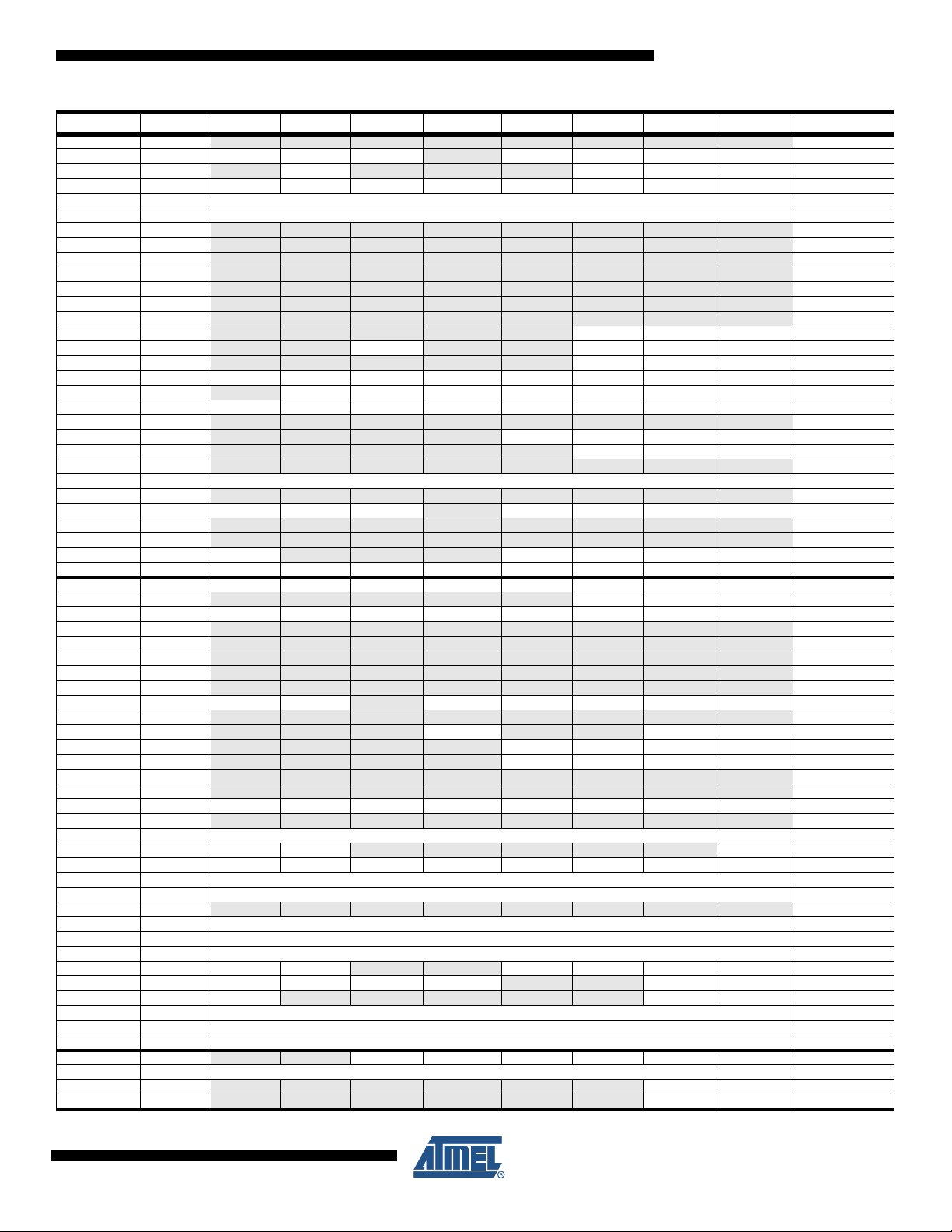
Address Name Bit 7 Bit 6 Bit 5 Bit 4 Bit 3 Bit 2 Bit 1 Bit 0 Page
(0x7D) Reserved – – – – – – – –
(0x7C) ADMUX REFS1 REFS0 ADLAR – MUX3 MUX2 MUX1 MUX0 254
(0x7B) ADCSRB –ACME – – – ADTS2 ADTS1 ADTS0 257
(0x7A) ADCSRA ADEN ADSC ADATE ADIF ADIE ADPS2 ADPS1 ADPS0 255
(0x79) ADCH ADC Data Register High byte 257
(0x78) ADCL ADC Data Register Low byte 257
(0x77) Reserved – – – – – – – –
(0x76) Reserved – – – – – – – –
(0x75) Reserved – – – – – – – –
(0x74) Reserved – – – – – – – –
(0x73) Reserved – – – – – – – –
(0x72) Reserved – – – – – – – –
(0x71) Reserved – – – – – – – –
(0x70) TIMSK2 – – – – – OCIE2B OCIE2A TOIE2 157
(0x6F) TIMSK1 – –ICIE1 – – OCIE1B OCIE1A TOIE1 134
(0x6E) TIMSK0 – – – – – OCIE0B OCIE0A TOIE0 105
(0x6D) PCMSK2 PCINT23 PCINT22 PCINT21 PCINT20 PCINT19 PCINT18 PCINT17 PCINT16 69
(0x6C) PCMSK1 – PCINT14 PCINT13 PCINT12 PCINT11 PCINT10 PCINT9 PCINT8 69
(0x6B) PCMSK0 PCINT7 PCINT6 PCINT5 PCINT4 PCINT3 PCINT2 PCINT1 PCINT0 69
(0x6A) Reserved
(0x69) EICRA
(0x68) PCICR – – – – – PCIE2 PCIE1 PCIE0
(0x67) Reserved – – – – – – – –
(0x66) OSCCAL Oscillator Calibration Register 36
(0x65) Reserved – – – – – – – –
(0x64) PRR PRTWI PRTIM2 PRTIM0 – PRTIM1 PRSPI PRUSART0 PRADC 40
(0x63) Reserved – – – – – – – –
(0x62) Reserved – – – – – – – –
(0x61) CLKPR CLKPCE – – – CLKPS3 CLKPS2 CLKPS1 CLKPS0 36
(0x60) WDTCSR WDIF WDIE WDP3 WDCE WDE WDP2 WDP1 WDP0 52
0x3F (0x5F) SREG I T H S V N Z C 10
0x3E (0x5E) SPH – – – – – (SP10)
0x3D (0x5D) SPL SP7 SP6 SP5 SP4 SP3 SP2 SP1 SP0 12
0x3C (0x5C) Reserved – – – – – – – –
0x3B (0x5B) Reserved – – – – – – – –
0x3A (0x5A) Reserved – – – – – – – –
0x39 (0x59) Reserved – – – – – – – –
0x38 (0x58) Reserved – – – – – – – –
0x37 (0x57) SPMCSR SPMIE (RWWSB)
0x36 (0x56) Reserved – – – – – – – –
0x35 (0x55) MCUCR – – –PUD– – IVSEL IVCE
0x34 (0x54) MCUSR – – – – WDRF BORF EXTRF PORF
0x33 (0x53) SMCR – – – –SM2SM1SM0SE 38
0x32 (0x52) Reserved
0x31 (0x51) Reserved
0x30 (0x50) ACSR ACD ACBG ACO ACI ACIE ACIC ACIS1 ACIS0 241
0x2F (0x4F) Reserved
0x2E (0x4E) SPDR SPI Data Register 169
0x2D (0x4D) SPSR SPIF WCOL – – – – – SPI2X 168
0x2C (0x4C) SPCR SPIE SPE DORD MSTR CPOL CPHA SPR1 SPR0 167
0x2B (0x4B) GPIOR2 General Purpose I/O Register 2 25
0x2A (0x4A) GPIOR1 General Purpose I/O Register 1 25
0x29 (0x49) Reserved – – – – – – – –
0x28 (0x48) OCR0B Timer/Counter0 Output Compare Register B
0x27 (0x47) OCR0A Timer/Counter0 Output Compare Register A
0x26 (0x46) TCNT0 Timer/Counter0 (8-bit)
0x25 (0x45) TCCR0B FOC0A FOC0B
0x24 (0x44) TCCR0A COM0A1 COM0A0 COM0B1 COM0B0
0x23 (0x43) GTCCR TSM – – – – – PSRASY PSRSYNC 138/159
0x22 (0x42) EEARH (EEPROM Address Register High Byte)
0x21 (0x41) EEARL EEPROM Address Register Low Byte 21
0x20 (0x40) EEDR EEPROM Data Register 21
0x1F (0x3F) EECR – – EEPM1 EEPM0 EERIE EEMPE EEPE EERE 21
0x1E (0x3E) GPIOR0 General Purpose I/O Register 0 25
0x1D (0x3D) EIMSK
0x1C (0x3C) EIFR
– – – – – – – –
– – – –ISC11ISC10ISC01ISC00 66
5.
5.
– – – – – – – –
– – – – – – – –
– – – – – – – –
– – – – – –INT1INT0 67
– – – – – – INTF1 INTF0 67
– (RWWSRE)
– – WGM02 CS02 CS01 CS00
5.
BLBSET PGWRT PGERS SELFPRGEN 282
– –WGM01WGM00
5.
SP9 SP8 12
21
2545RS–AVR–07/09
10
Page 11
ATmega48/88/168
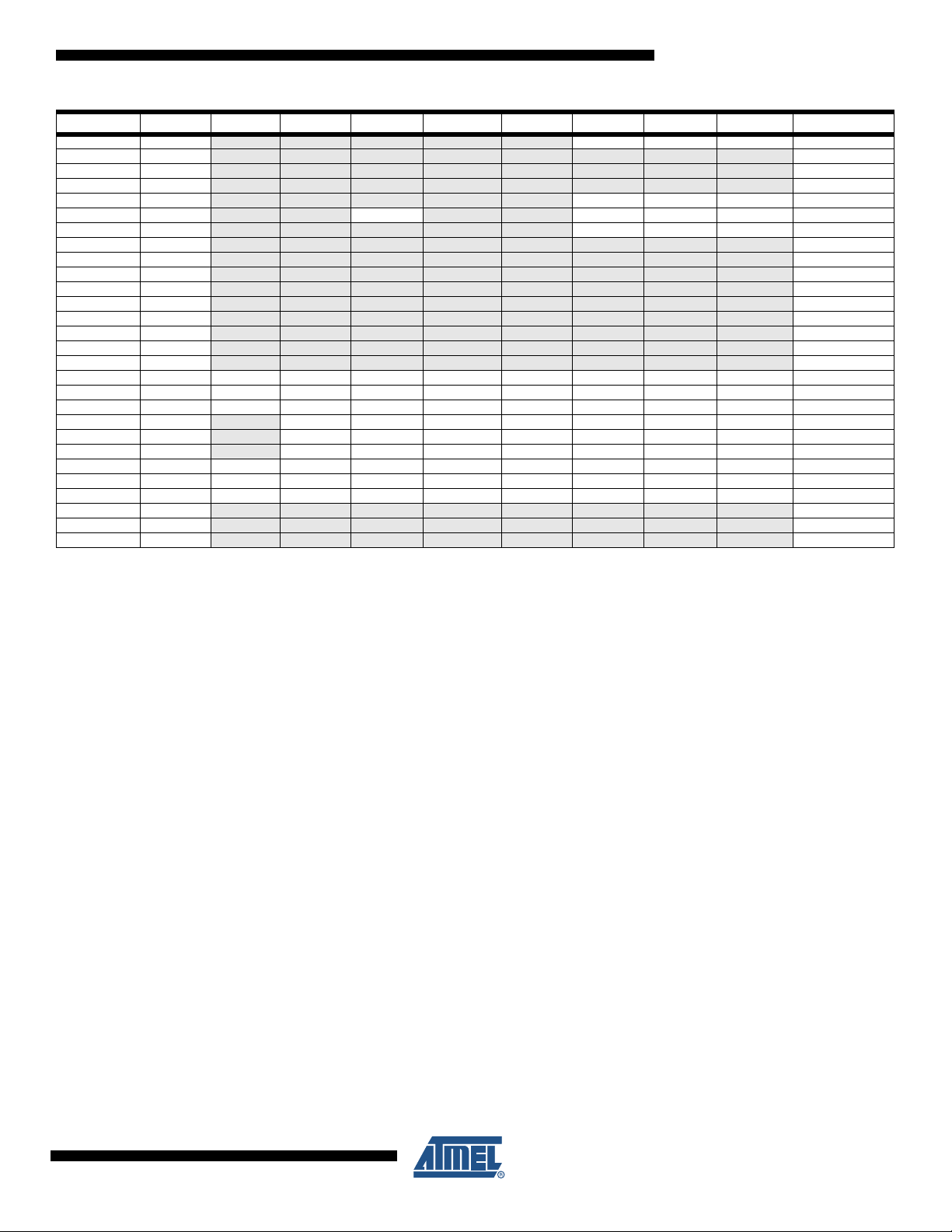
Address Name Bit 7 Bit 6 Bit 5 Bit 4 Bit 3 Bit 2 Bit 1 Bit 0 Page
0x1B (0x3B) PCIFR – – – – – PCIF2 PCIF1 PCIF0
0x1A (0x3A) Reserved – – – – – – – –
0x19 (0x39) Reserved – – – – – – – –
0x18 (0x38) Reserved – – – – – – – –
0x17 (0x37) TIFR2 – – – – – OCF2B OCF2A TOV2 157
0x16 (0x36) TIFR1 – –ICF1 – – OCF1B OCF1A TOV1 135
0x15 (0x35) TIFR0 – – – – – OCF0B OCF0A TOV0
0x14 (0x34) Reserved – – – – – – – –
0x13 (0x33) Reserved – – – – – – – –
0x12 (0x32) Reserved – – – – – – – –
0x11 (0x31) Reserved – – – – – – – –
0x10 (0x30) Reserved – – – – – – – –
0x0F (0x2F) Reserved – – – – – – – –
0x0E (0x2E) Reserved – – – – – – – –
0x0D (0x2D) Reserved – – – – – – – –
0x0C (0x2C) Reserved – – – – – – – –
0x0B (0x2B) PORTD PORTD7 PORTD6 PORTD5 PORTD4 PORTD3 PORTD2 PORTD1 PORTD0 87
0x0A (0x2A) DDRD DDD7 DDD6 DDD5 DDD4 DDD3 DDD2 DDD1 DDD0 87
0x09 (0x29) PIND PIND7 PIND6 PIND5 PIND4 PIND3 PIND2 PIND1 PIND0 87
0x08 (0x28) PORTC
0x07 (0x27) DDRC
0x06 (0x26) PINC – PINC6 PINC5 PINC4 PINC3 PINC2 PINC1 PINC0 86
0x05 (0x25) PORTB PORTB7 PORTB6 PORTB5 PORTB4 PORTB3 PORTB2 PORTB1 PORTB0 86
0x04 (0x24) DDRB DDB7 DDB6 DDB5 DDB4 DDB3 DDB2 DDB1 DDB0 86
0x03 (0x23) PINB PINB7 PINB6 PINB5 PINB4 PINB3 PINB2 PINB1 PINB0 86
0x02 (0x22) Reserved – – – – – – – –
0x01 (0x21) Reserved – – – – – – – –
0x0 (0x20) Reserved – – – – – – – –
Note: 1. For compatibility with future devices, reserved bits should be written to zero if accessed. Reserved I/O memory addresses
should never be written.
2. I/O Registers within the address range 0x00 - 0x1F are directly bit-accessible using the SBI and CBI instructions. In these
registers, the value of single bits can be checked by using the SBIS and SBIC instructions.
3. Some of the Status Flags are cleared by writing a logical one to them. Note that, unlike most other AVRs, the CBI and SBI
instructions will only operate on the specified bit, and can therefore be used on registers containing such Status Flags. The
CBI and SBI instructions work with registers 0x00 to 0x1F only.
4. When using the I/O specific commands IN and OUT, the I/O addresses 0x00 - 0x3F must be used. When addressing I/O
Registers as data space using LD and ST instructions, 0x20 must be added to these addresses. The ATmega48/88/168 is a
complex microcontroller with more peripheral units than can be supported within the 64 location reserved in Opcode for the
IN and OUT instructions. For the Extended I/O space from 0x60 - 0xFF in SRAM, only the ST/STS/STD and LD/LDS/LDD
instructions can be used.
5. Only valid for ATmega88/168
– PORTC6 PORTC5 PORTC4 PORTC3 PORTC2 PORTC1 PORTC0 86
– DDC6 DDC5 DDC4 DDC3 DDC2 DDC1 DDC0 86
2545RS–AVR–07/09
11
Page 12

ATmega48/88/168
5. Instruction Set Summary
Mnemonics Operands Description Operation Flags #Clocks
ARITHMETIC AND LOGIC INSTRUCTIONS
ADD Rd, Rr Add two Registers Rd ← Rd + Rr Z,C,N,V,H 1
ADC Rd, Rr Add with Carry two Registers Rd ← Rd + Rr + C Z,C,N,V,H 1
ADIW Rdl,K Add Immediate to Word Rdh:Rdl ← Rdh:Rdl + K Z,C,N,V,S 2
SUB Rd, Rr Subtract two Registers Rd ← Rd - Rr Z,C,N,V,H 1
SUBI Rd, K Subtract Constant from Register Rd ← Rd - K Z,C,N,V,H 1
SBC Rd, Rr Subtract with Carry two Registers Rd ← Rd - Rr - C Z,C,N,V,H 1
SBCI Rd, K Subtract with Carry Constant from Reg. Rd ← Rd - K - C Z,C,N,V,H 1
SBIW Rdl,K Subtract Immediate from Word Rdh:Rdl ← Rdh:Rdl - K Z,C,N,V,S 2
AND Rd, Rr Logical AND Registers Rd ← Rd • Rr Z,N,V 1
ANDI Rd, K Logical AND Register and Constant Rd ← Rd • K Z,N,V 1
OR Rd, Rr Logical OR Registers Rd ← Rd v Rr Z,N,V 1
ORI Rd, K Logical OR Register and Constant Rd ← Rd v K Z,N,V 1
EOR Rd, Rr Exclusive OR Registers Rd ← Rd ⊕ Rr Z,N,V 1
COM Rd One’s Complement Rd ← 0xFF − Rd Z,C,N,V 1
NEG Rd Two’s Complement Rd ← 0x00 − Rd Z,C,N,V,H 1
SBR Rd,K Set Bit(s) in Register Rd ← Rd v K Z,N,V 1
CBR Rd,K Clear Bit(s) in Register Rd ← Rd • (0xFF - K) Z,N,V 1
INC Rd Increment Rd ← Rd + 1 Z,N,V 1
DEC Rd Decrement Rd ← Rd − 1 Z,N,V 1
TST Rd Test for Zero or Minus Rd ← Rd • Rd Z,N,V 1
CLR Rd Clear Register Rd ← Rd ⊕ Rd Z,N,V 1
SER Rd Set Register Rd ← 0xFF None 1
MUL Rd, Rr Multiply Unsigned R1:R0 ← Rd x Rr Z,C 2
MULS Rd, Rr Multiply Signed R1:R0 ← Rd x Rr Z,C 2
MULSU Rd, Rr Multiply Signed with Unsigned R1:R0 ← Rd x Rr Z,C 2
FMUL Rd, Rr Fractional Multiply Unsigned R1:R0 ← (Rd x Rr) << 1 Z,C 2
FMULS Rd, Rr Fractional Multiply Signed R1:R0 ← (Rd x Rr) << 1 Z,C 2
FMULSU Rd, Rr Fractional Multiply Signed with Unsigned R1:R0 ← (Rd x Rr) << 1 Z,C 2
BRANCH INSTRUCTIONS
RJMP k Relative Jump PC ← PC + k + 1 None 2
IJMP Indirect Jump to (Z) PC ← Z None 2
(1)
JMP
RCALL k Relative Subroutine Call PC ← PC + k + 1 None 3
ICALL Indirect Call to (Z) PC ← ZNone3
(1)
CALL
RET Subroutine Return PC ← STACK None 4
RETI Interrupt Return PC ← STACK I 4
CPSE Rd,Rr Compare, Skip if Equal if (Rd = Rr) PC ← PC + 2 or 3 None 1/2/3
CP Rd,Rr Compare Rd − Rr Z, N,V,C,H 1
CPC Rd,Rr Compare with Carry Rd − Rr − C Z, N,V,C,H 1
CPI Rd,K Compare Register with Immediate Rd − K Z, N,V,C,H 1
SBRC Rr, b Skip if Bit in Register Cleared if (Rr(b)=0) PC ← PC + 2 or 3 None 1/2/3
SBRS Rr, b Skip if Bit in Register is Set if (Rr(b)=1) PC ← PC + 2 or 3 None 1/2/3
SBIC P, b Skip if Bit in I/O Register Cleared if (P(b)=0) PC ← PC + 2 or 3 None 1/2/3
SBIS P, b Skip if Bit in I/O Register is Set if (P(b)=1) PC ← PC + 2 or 3 None 1/2/3
BRBS s, k Branch if Status Flag Set if (SREG(s) = 1) then PC←PC+k + 1 None 1/2
BRBC s, k Branch if Status Flag Cleared if (SREG(s) = 0) then PC←PC+k + 1 None 1/2
BREQ k Branch if Equal if (Z = 1) then PC ← PC + k + 1 None 1/2
BRNE k Branch if Not Equal if (Z = 0) then PC ← PC + k + 1 None 1/2
BRCS k Branch if Carry Set if (C = 1) then PC ← PC + k + 1 None 1/2
BRCC k Branch if Carry Cleared if (C = 0) then PC ← PC + k + 1 None 1/2
BRSH k Branch if Same or Higher if (C = 0) then PC ← PC + k + 1 None 1/2
BRLO k Branch if Lower if (C = 1) then PC ← PC + k + 1 None 1/2
BRMI k Branch if Minus if (N = 1) then PC ← PC + k + 1 None 1/2
BRPL k Branch if Plus if (N = 0) then PC ← PC + k + 1 None 1/2
BRGE k Branch if Greater or Equal, Signed if (N ⊕ V= 0) then PC ← PC + k + 1 None 1/2
BRLT k Branch if Less Than Zero, Signed if (N ⊕ V= 1) then PC ← PC + k + 1 None 1/2
BRHS k Branch if Half Carry Flag Set if (H = 1) then PC ← PC + k + 1 None 1/2
BRHC k Branch if Half Carry Flag Cleared if (H = 0) then PC ← PC + k + 1 None 1/2
BRTS k Branch if T Flag Set if (T = 1) then PC ← PC + k + 1 None 1/2
BRTC k Branch if T Flag Cleared if (T = 0) then PC ← PC + k + 1 None 1/2
BRVS k Branch if Overflow Flag is Set if (V = 1) then PC ← PC + k + 1 None 1/2
BRVC k Branch if Overflow Flag is Cleared if (V = 0) then PC ← PC + k + 1 None 1/2
k Direct Jump PC ← kNone3
k Direct Subr outine Call PC ← kNone4
2545RS–AVR–07/09
12
Page 13

ATmega48/88/168
Mnemonics Operands Description Operation Flags #Clocks
BRIE k Branch if Interrupt Enabled if ( I = 1) then PC ← PC + k + 1 None 1/2
BRID k Branch if Interrupt Disabled if ( I = 0) then PC ← PC + k + 1 None 1/2
BIT AND BIT-TEST INSTRUCTIONS
SBI P,b Set Bit in I/O Register I/O(P,b) ← 1None2
CBI P,b Clear Bit in I/O Register I/O(P,b) ← 0None2
LSL Rd Logical Shift Left Rd(n+1) ← Rd(n), Rd(0) ← 0 Z,C,N,V 1
LSR Rd Logical Shift Right Rd(n) ← Rd(n+1), Rd(7) ← 0 Z,C,N,V 1
ROL Rd Rotate Left Through Carry Rd(0)←C,Rd(n+1)← Rd(n),C←Rd(7) Z,C,N,V 1
ROR Rd Rotate Right Through Carry Rd(7)←C,Rd(n)← Rd(n+1),C←Rd(0) Z,C,N,V 1
ASR Rd Arithmetic Shift Right Rd(n) ← Rd(n+1), n=0..6 Z,C,N,V 1
SWAP Rd Swap Nibbles Rd(3..0)←Rd(7..4),Rd(7..4)←Rd(3..0) None 1
BSET s Flag Set SREG(s) ← 1 SREG(s) 1
BCLR s Flag Clear SREG(s) ← 0 SREG(s) 1
BST Rr, b Bit Store from Register to T T ← Rr(b) T 1
BLD Rd, b Bit load from T to Register Rd(b) ← TNone1
SEC Set Carry C ← 1C1
CLC Clear Carry C ← 0 C 1
SEN Set Negative Flag N ← 1N1
CLN Clear Negative Flag N ← 0 N 1
SEZ Set Zero Flag Z ← 1Z1
CLZ Clear Zero Flag Z ← 0 Z 1
SEI Global Interrupt Enable I ← 1I1
CLI Global Interrupt Disable I ← 0 I 1
SES Set Signed Test Flag S ← 1S1
CLS Clear Signed Test Flag S ← 0 S 1
SEV Set Twos Complement Overflow. V ← 1V1
CLV Clear Twos Complement Overflow V ← 0 V 1
SET Set T in SREG T ← 1T1
CLT Clear T in SREG T ← 0 T 1
SEH Set Half Carry Flag in SREG H ← 1H1
CLH Clear Half Carry Flag in SREG H ← 0 H 1
DATA TRANSFER INSTRUCTIONS
MOV Rd, Rr Move Between Registers Rd ← Rr None 1
MOVW Rd, Rr Copy Register Word
LDI Rd, K Load Immediate Rd ← KNone1
LD Rd, X Load Indirect Rd ← (X) None 2
LD Rd, X+ Load Indirect and Post-Inc. Rd ← (X), X ← X + 1 None 2
LD Rd, - X Load Indirect and Pre-Dec. X ← X - 1, Rd ← (X) None 2
LD Rd, Y Load Indirect Rd ← (Y) None 2
LD Rd, Y+ Load Indirect and Post-Inc. Rd ← (Y), Y ← Y + 1 None 2
LD Rd, - Y Load Indirect and Pre-Dec. Y ← Y - 1, Rd ← (Y) None 2
LDD Rd,Y+q Load Indirect with Displacement Rd ← (Y + q) None 2
LD Rd, Z Load Indirect Rd ← (Z) None 2
LD Rd, Z+ Load Indirect and Post-Inc. Rd ← (Z), Z ← Z+1 None 2
LD Rd, -Z Load Indirect and Pre-Dec. Z ← Z - 1, Rd ← (Z) None 2
LDD Rd, Z+q Load Indirect with Displacement Rd ← (Z + q) None 2
LDS Rd, k Load Direct fr om SRAM Rd ← (k) None 2
ST X, Rr Store Indirect (X) ← Rr None 2
ST X+, Rr Store Indirect and Post-Inc. (X) ← Rr, X ← X + 1 None 2
ST - X, Rr Store Indirect and Pre-Dec. X ← X - 1, (X) ← Rr None 2
ST Y, Rr Store Indirect (Y) ← Rr None 2
ST Y+, Rr Store Indirect and Post-Inc. (Y) ← Rr, Y ← Y + 1 None 2
ST - Y, Rr Store Indirect and Pre-Dec. Y ← Y - 1, (Y) ← Rr None 2
STD Y+q,Rr Store Indirect with Displacement (Y + q) ← Rr None 2
ST Z, Rr Store Indirect (Z) ← Rr None 2
ST Z+, Rr Store Indirect and Post-Inc. (Z) ← Rr, Z ←
ST -Z, Rr Store Indirect and Pre-Dec. Z ← Z - 1, (Z) ← Rr None 2
STD Z+q,Rr Store Indirect with Displacement (Z + q) ← Rr None 2
STS k, Rr Store Direct to SRAM (k) ← Rr None 2
LPM Load Program Memory R0 ← (Z) None 3
LPM Rd, Z Load Program Memory Rd ← (Z) None 3
LPM Rd, Z+ Load Program Memory and Post-Inc Rd ← (Z), Z ← Z+1 None 3
SPM Store Program Memory (Z) ← R1:R0 None -
IN Rd, P In Port Rd ← PNone1
OUT P, Rr Out Port P ← Rr None 1
PUSH Rr Push Register on Stack STACK ← Rr None 2
Rd+1:Rd ← Rr+1:Rr
Z + 1 None 2
None 1
2545RS–AVR–07/09
13
Page 14

ATmega48/88/168
Mnemonics Operands Description Operation Flags #Clocks
POP Rd Pop Register from Stack Rd ← STACK None 2
MCU CONTROL INSTRUCTIONS
NOP No Operation None 1
SLEEP Sleep (see specific descr. for Sleep function) None 1
WDR Watchdog Reset (see specific descr. for WDR/timer) None 1
BREAK Break For On-chip Debug Only None N/A
Note: 1. These instructions are only available in ATmega168.
2545RS–AVR–07/09
14
Page 15

6. Ordering Information
6.1 ATmega48
ATmega48/88/168
Speed (MHz) Power Supply Ordering Code Package
10
20
ATmega48V-10AI
ATmega48V-10MI
ATmega48V-10PI
(3)
1.8 - 5.5
ATmega48V-10AU
ATmega48V-10MMU
ATmega48V-10MU
ATmega48V-10PU
(2)
(2)
(2)
(2)
ATmega48-20AI
ATmega48-20MI
ATmega48-20PI
(3)
2.7 - 5.5
ATmega48-20AU
ATmega48-20MMU
ATmega48-20MU
ATmega48-20PU
(2)
(2)
(2)
(2)
32A
32M1-A
28P3
32A
28M1
32M1-A
28P3
32A
32M1-A
28P3
32A
28M1
32M1-A
28P3
(1)
Operational Range
Industrial
°C to 85°C)
(-40
Industrial
°C to 85°C)
(-40
Note: 1. This device can also be supplied in wafer form. Please contact your local Atmel sales office for detailed ordering information
and minimum quantities.
2. Pb-free packaging alternative, complies to the European Directive for Restriction of Hazardous Substances (RoHS directive).Also Halide free and fully Green.
3. See Figure 26-1 on page 304 and Figure 26-2 on page 304.
Package Type
32A 32-lead, Thin (1.0 mm) Plastic Quad Flat Package (TQFP)
2545RS–AVR–07/09
15
Page 16

ATmega48/88/168
Package Type
28M1 28-pad, 4 x 4 x 1.0 body, Lead Pitch 0.45 mm Quad Flat No-Lead/Micro Lead Frame Package (QFN/MLF)
32M1-A 32-pad, 5 x 5 x 1.0 body, Lead Pitch 0.50 mm Quad Flat No-Lead/Micro Lead Frame Package (QFN/MLF)
28P3 28-lead, 0.300” Wide, Plastic Dual Inline Package (PDIP)
6.2 ATmega88
Speed (MHz) Power Supply Ordering Code Package
10
20
ATmega88V-10AI
ATmega88V-10MI
(3)
1.8 - 5.5
ATmega88V-10PI
ATmega88V-10AU
ATmega88V-10MU
ATmega88V-10PU
(2)
(2)
(2)
ATmega88-20AI
ATmega88-20MI
(3)
2.7 - 5.5
ATmega88-20PI
ATmega88-20AU
ATmega88-20MU
ATmega88-20PU
(2)
(2)
(2)
32A
32M1-A
28P3
32A
32M1-A
28P3
32A
32M1-A
28P3
32A
32M1-A
28P3
(1)
Operational Range
Industrial
°C to 85°C)
(-40
Industrial
°C to 85°C)
(-40
Note: 1. This device can also be supplied in wafer form. Please contact your local Atmel sales office for detailed ordering information
and minimum quantities.
2. Pb-free packaging alternative, complies to the European Directive for Restriction of Hazardous Substances (RoHS directive).Also Halide free and fully Green.
3. See Figure 26-1 on page 304 and Figure 26-2 on page 304.
2545RS–AVR–07/09
16
Page 17

ATmega48/88/168
Package Type
32A 32-lead, Thin (1.0 mm) Plastic Quad Flat Package (TQFP)
32M1-A 32-pad, 5 x 5 x 1.0 body, Lead Pitch 0.50 mm Quad Flat No-Lead/Micro Lead Frame Package (QFN/MLF)
28P3 28-lead, 0.300” Wide, Plastic Dual Inline Package (PDIP)
6.3 ATmega168
Speed (MHz)
(3)
10 1.8 - 5.5
20 2.7 - 5.5
Power Supply Ordering Code Package
ATmega168V-10AI
ATmega168V-10MI
ATmega168V-10PI
ATmega168V-10AU
ATmega168V-10MU
ATmega168V-10PU
ATmega168-20AI
ATmega168-20MI
ATmega168-20PI
ATmega168-20AU
ATmega168-20MU
ATmega168-20PU
(2)
(2)
(2)
(2)
(2)
(2)
32A
32M1-A
28P3
32A
32M1-A
28P3
32A
32M1-A
28P3
32A
32M1-A
28P3
(1)
Operational Range
Industrial
°C to 85°C)
(-40
Industrial
°C to 85°C)
(-40
Note: 1. This device can also be supplied in wafer form. Please contact your local Atmel sales office for detailed ordering information
and minimum quantities.
2. Pb-free packaging alternative, complies to the European Directive for Restriction of Hazardous Substances (RoHS directive).Also Halide free and fully Green.
3. See Figure 26-1 on page 304 and Figure 26-2 on page 304.
2545RS–AVR–07/09
17
Page 18

ATmega48/88/168
Package Type
32A 32-lead, Thin (1.0 mm) Plastic Quad Flat Package (TQFP)
32M1-A 32-pad, 5 x 5 x 1.0 body, Lead Pitch 0.50 mm Quad Flat No-Lead/Micro Lead Frame Package (QFN/MLF)
28P3 28-lead, 0.300” Wide, Plastic Dual Inline Package (PDIP)
2545RS–AVR–07/09
18
Page 19

7. Packaging Information
2325 Orchard Parkway
San Jose, CA 95131
TITLE
DRAWING NO.
R
REV.
32A, 32-lead, 7 x 7 mm Body Size, 1.0 mm Body Thickness,
0.8 mm Lead Pitch, Thin Profile Plastic Quad Flat Package (TQFP)
B
32A
10/5/2001
PIN 1 IDENTIFIER
0˚~7˚
PIN 1
L
C
A1
A2 A
D1
D
e
E1 E
B
Notes: 1. This package conforms to JEDEC reference MS-026, Variation ABA.
2. Dimensions D1 and E1 do not include mold protrusion. Allowable
protrusion is 0.25 mm per side. Dimensions D1 and E1 are maximum
plastic body size dimensions including mold mismatch.
3. Lead coplanarity is 0.10 mm maximum.
A – – 1.20
A1 0.05 – 0.15
A2 0.95 1.00 1.05
D 8.75 9.00 9.25
D1 6.90 7.00 7.10 Note 2
E 8.75 9.00 9.25
E1 6.90 7.00 7.10 Note 2
B 0.30 – 0.45
C 0.09 – 0.20
L 0.45 – 0.75
e 0.80 TYP
COMMON DIMENSIONS
(Unit of Measure = mm)
SYMBOL
MIN
NOM
MAX
NOTE
7.1 32A
ATmega48/88/168
2545RS–AVR–07/09
19
Page 20

7.2 28M1
TITLE
DRAWING NO. GPC
REV.
Package Drawing Contact:
packagedrawings@atmel.com
28M1ZBV B
28M1, 28-pad, 4 x 4 x 1.0 mm Body, Lead Pitch 0.45 mm,
2.4 x 2.4 mm Exposed Pad, Thermally Enhanced
Plastic Very Thin Quad Flat No Lead Package (VQFN)
10/24/08
SIDE VIEW
Pin 1 ID
BOTTOM VIEW
TOP VIEW
Note:
The terminal #1 ID is a Laser-marked Feature.
D
E
e
K
A1
C
A
D2
E2
y
L
1
2
3
b
1
2
3
0.45
COMMON DIMENSIONS
(Unit of Measure = mm)
SYMBOL
MIN
NOM
MAX
NOTE
A 0.80 0.90 1.00
A1 0.00 0.02 0.05
b 0.17 0.22 0.27
C 0.20 REF
D 3.95 4.00 4.05
D2 2.35 2.40 2.45
E 3.95 4.00 4.05
E2 2.35 2.40 2.45
e 0.45
L 0.35 0.40 0.45
y 0.00 – 0.08
K 0.20 – –
R 0.20
0.4 Ref
(4x)
ATmega48/88/168
2545RS–AVR–07/09
20
Page 21

7.3 32M1-A
2325 Orchard Parkway
San Jose, CA 95131
TITLE
DRAWING NO.
R
REV.
32M1-A, 32-pad, 5 x 5 x 1.0 mm Body, Lead Pitch 0.50 mm,
E
32M1-A
5/25/06
3.10 mm Exposed Pad, Micro Lead Frame Package (MLF)
COMMON DIMENSIONS
(Unit of Measure = mm)
SYMBOL
MIN
NOM
MAX
NOTE
D1
D
E1
E
e
b
A3
A2
A1
A
D2
E2
0.08
C
L
1
2
3
P
P
0
1
2
3
A 0.80 0.90 1.00
A1 – 0.02 0.05
A2 – 0.65 1.00
A3 0.20 REF
b 0.18 0.23 0.30
D
D1
D2 2.95 3.10 3.25
4.90 5.00 5.10
4.70 4.75 4.80
4.70 4.75 4.80
4.90 5.00 5.10
E
E1
E2 2.95 3.10 3.25
e 0.50 BSC
L 0.30 0.40 0.50
P – – 0.60
– – 12o
Note: JEDEC Standard MO-220, Fig. 2 (Anvil Singulation), VHHD-2.
TOP VIEW
SIDE VIEW
BOTTOM VIEW
0
Pin 1 ID
Pin #1 Notch
(0.20 R)
K 0.20 – –
K
K
ATmega48/88/168
2545RS–AVR–07/09
21
Page 22

7.4 28P3
2325 Orchard Parkway
San Jose, CA 95131
TITLE
DRAWING NO.
R
REV.
28P3, 28-lead (0.300"/7.62 mm Wide) Plastic Dual
Inline Package (PDIP)
B
28P3
09/28/01
PIN
1
E1
A1
B
REF
E
B1
C
L
SEATING PLANE
A
0º ~ 15º
D
e
eB
B2
(4 PLACES)
COMMON DIMENSIONS
(Unit of Measure = mm)
SYMBOL
MIN
NOM
MAX
NOTE
A – – 4.5724
A1 0.508 – –
D 34.544 – 34.798 Note 1
E 7.620 – 8.255
E1 7.112 – 7.493 Note 1
B 0.381 – 0.533
B1 1.143 – 1.397
B2 0.762 – 1.143
L 3.175 – 3.429
C 0.203 – 0.356
eB – – 10.160
e 2.540 TYP
Note: 1. Dimensions D and E1 do not include mold Flash or Protrusion.
Mold Flash or Protrusion shall not exceed 0.25 mm (0.010").
ATmega48/88/168
2545RS–AVR–07/09
22
Page 23

8. Errata
8.1 Errata ATmega48
The revision letter in this section refers to the revision of the ATmega48 device.
8.1.1 Rev. D
•
1. Interrupts may be lost when writing the timer registers in the asynchronous timer
8.1.2 Rev. C
•
• Interrupts may be lost when writing the timer registers in the asynchronous timer
ATmega48/88/168
Interrupts may be lost when writing the timer registers in the asynchronous timer
The interrupt will be lost if a timer register that is synchronous timer clock is written when the
asynchronous Timer/Counter register (TCNTx) is 0x00.
Problem Fix/Workaround
Always check that the asynchronous Timer/Counter register neither have the value 0xFF nor
0x00 before writing to the asynchronous Timer Control Register (TCCRx), asynchronous
Timer Counter Register (TCNTx), or asynchronous Output Compare Register (OCRx).
Reading EEPROM when system clock frequency is below 900 kHz may not work
8.1.3 Rev. B
1. Reading EEPROM when system clock frequency is below 900 kHz may not work
Reading Data from the EEPROM at system clock frequency below 900 kHz may result in
wrong data read.
Problem Fix/Workaround
Avoid using the EEPROM at clock frequency below 900 kHz.
2. Interrupts may be lost when writing the timer registers in the asynchronous timer
The interrupt will be lost if a timer register that is synchronous timer clock is written when the
asynchronous Timer/Counter register (TCNTx) is 0x00.
Problem Fix/Workaround
Always check that the asynchronous Timer/Counter register neither have the value 0xFF nor
0x00 before writing to the asynchronous Timer Control Register (TCCRx), asynchronous
Timer Counter Register (TCNTx), or asynchronous Output Compare Register (OCRx).
•
Interrupts may be lost when writing the timer registers in the asynchronous timer
1. Interrupts may be lost when writing the timer registers in the asynchronous timer
The interrupt will be lost if a timer register that is synchronous timer clock is written when the
asynchronous Timer/Counter register (TCNTx) is 0x00.
Problem Fix/Workaround
Always check that the asynchronous Timer/Counter register neither have the value 0xFF nor
0x00 before writing to the asynchronous Timer Control Register (TCCRx), asynchronous
Timer Counter Register (TCNTx), or asynchronous Output Compare Register (OCRx).
2545RS–AVR–07/09
23
Page 24

8.1.4 Rev A
ATmega48/88/168
Part may hang in reset
•
• Wrong values read after Erase Only operation
• Watchdog Timer Interrupt disabled
• Start-up time with Crystal Oscillator is higher than expected
• High Power Consumption in Power-down with External Clock
• Asynchronous Oscillator does not stop in Power-down
• Interrupts may be lost when writing the timer registers in the asynchronous timer
1. Part may hang in reset
Some parts may get stuck in a reset state when a reset signal is applied when the internal
reset state-machine is in a specific state. The internal reset state-machine is in this state for
approximately 10 ns immediately before the part wakes up after a reset, and in a 10 ns window when altering the system clock prescaler. The problem is most often seen during InSystem Programming of the device. There are theoretical possibilities of this happening also
in run-mode. The following three cases can trigger the device to get stuck in a reset-state:
- Two succeeding resets are applied where the second reset occurs in the 10ns window
before the device is out of the reset-state caused by the first reset.
- A reset is applied in a 10 ns window while the system clock prescaler value is updated by
software.
- Leaving SPI-programming mode generates an internal reset signal that can trigger this
case.
The two first cases can occur during normal operating mode, while the last case occurs only
during programming of the device.
Problem Fix/Workaround
The first case can be avoided during run-mode by ensuring that only one reset source is
active. If an external reset push button is used, the reset start-up time should be selected
such that the reset line is fully debounced during the start-up time.
The second case can be avoided by not using the system clock prescaler.
The third case occurs during In-System programming only. It is most frequently seen when
using the internal RC at maximum frequency.
If the device gets stuck in the reset-state, turn power off, then on again to get the device out
of this state.
2. Wrong values read after Erase Only operation
At supply voltages below 2.7 V, an EEPROM location that is erased by the Erase Only operation may read as programmed (0x00).
Problem Fix/Workaround
If it is necessary to read an EEPROM location after Erase Only, use an Atomic Write operation with 0xFF as data in order to erase a location. In any case, the Write Only operation can
be used as intended. Thus no special considerations are needed as long as the erased location is not read before it is programmed.
2545RS–AVR–07/09
3. Watchdog Timer Interrupt disabled
24
Page 25

ATmega48/88/168
If the watchdog timer interrupt flag is not cleared before a new timeout occurs, the watchdog
will be disabled, and the interrupt flag will automatically be cleared. This is only applicable in
interrupt only mode. If the Watchdog is configured to reset the device in the watchdog timeout following an interrupt, the device works correctly.
Problem fix / Workaround
Make sure there is enough time to always service the first timeout event before a new
watchdog timeout occurs. This is done by selecting a long enough time-out period.
4. Start-up time with Crystal Oscillator is higher than expected
The clock counting part of the start-up time is about 2 times higher than expected for all
start-up periods when running on an external Crystal. This applies only when waking up by
reset. Wake-up from power down is not affected. For most settings, the clock counting parts
is a small fraction of the overall start-up time, and thus, the problem can be ignored. The
exception is when using a very low frequency crystal like for instance a 32 kHz clock crystal.
Problem fix / Workaround
No known workaround.
5. High Power Consumption in Power-down with External Clock
The power consumption in power down with an active external clock is about 10 times
higher than when using internal RC or external oscillators.
Problem fix / Workaround
Stop the external clock when the device is in power down.
6. Asynchronous Oscillator does not stop in Power-down
The Asynchronous oscillator does not stop when entering power down mode. This leads to
higher power consumption than expected.
Problem fix / Workaround
Manually disable the asynchronous timer before entering power down.
7. Interrupts may be lost when writing the timer registers in the asynchronous timer
The interrupt will be lost if a timer register that is synchronous timer clock is written when the
asynchronous Timer/Counter register (TCNTx) is 0x00.
Problem Fix/Workaround
Always check that the asynchronous Timer/Counter register neither have the value 0xFF nor
0x00 before writing to the asynchronous Timer Control Register (TCCRx), asynchronous
Timer Counter Register (TCNTx), or asynchronous Output Compare Register (OCRx).
2545RS–AVR–07/09
25
Page 26

8.2 Errata ATmega88
The revision letter in this section refers to the revision of the ATmega88 device.
8.2.1 Rev. D
•
1. Interrupts may be lost when writing the timer registers in the asynchronous timer
8.2.2 Rev. B/C
Not sampled.
8.2.3 Rev. A
•
• Part may hang in reset
• Interrupts may be lost when writing the timer registers in the asynchronous timer
ATmega48/88/168
Interrupts may be lost when writing the timer registers in the asynchronous timer
The interrupt will be lost if a timer register that is synchronous timer clock is written when the
asynchronous Timer/Counter register (TCNTx) is 0x00.
Problem Fix/Workaround
Always check that the asynchronous Timer/Counter register neither have the value 0xFF nor
0x00 before writing to the asynchronous Timer Control Register (TCCRx), asynchronous
Timer Counter Register (TCNTx), or asynchronous Output Compare Register (OCRx).
Writing to EEPROM does not work at low Operating Voltages
1. Writing to EEPROM does not work at low operating voltages
Writing to the EEPROM does not work at low voltages.
Problem Fix/Workaround
Do not write the EEPROM at voltages below 4.5 Volts.
This will be corrected in rev. B.
2. Part may hang in reset
Some parts may get stuck in a reset state when a reset signal is applied when the internal
reset state-machine is in a specific state. The internal reset state-machine is in this state for
approximately 10 ns immediately before the part wakes up after a reset, and in a 10 ns window when altering the system clock prescaler. The problem is most often seen during InSystem Programming of the device. There are theoretical possibilities of this happening also
in run-mode. The following three cases can trigger the device to get stuck in a reset-state:
- Two succeeding resets are applied where the second reset occurs in the 10ns window
before the device is out of the reset-state caused by the first reset.
- A reset is applied in a 10 ns window while the system clock prescaler value is updated by
software.
- Leaving SPI-programming mode generates an internal reset signal that can trigger this
case.
The two first cases can occur during normal operating mode, while the last case occurs only
during programming of the device.
2545RS–AVR–07/09
26
Page 27

ATmega48/88/168
Problem Fix/Workaround
The first case can be avoided during run-mode by ensuring that only one reset source is
active. If an external reset push button is used, the reset start-up time should be selected
such that the reset line is fully debounced during the start-up time.
The second case can be avoided by not using the system clock prescaler.
The third case occurs during In-System programming only. It is most frequently seen when
using the internal RC at maximum frequency.
If the device gets stuck in the reset-state, turn power off, then on again to get the device out
of this state.
3. Interrupts may be lost when writing the timer registers in the asynchronous timer
The interrupt will be lost if a timer register that is synchronous timer clock is written when the
asynchronous Timer/Counter register (TCNTx) is 0x00.
Problem Fix/Workaround
Always check that the asynchronous Timer/Counter register neither have the value 0xFF nor
0x00 before writing to the asynchronous Timer Control Register (TCCRx), asynchronous
Timer Counter Register (TCNTx), or asynchronous Output Compare Register (OCRx).
8.3 Errata ATmega168
The revision letter in this section refers to the revision of the ATmega168 device.
8.3.1 Rev C
Interrupts may be lost when writing the timer registers in the asynchronous timer
•
1. Interrupts may be lost when writing the timer registers in the asynchronous timer
8.3.2 Rev B
•
Part may hang in reset
• Interrupts may be lost when writing the timer registers in the asynchronous timer
1. Part may hang in reset
The interrupt will be lost if a timer register that is synchronous timer clock is written when the
asynchronous Timer/Counter register (TCNTx) is 0x00.
Problem Fix/Workaround
Always check that the asynchronous Timer/Counter register neither have the value 0xFF nor
0x00 before writing to the asynchronous Timer Control Register (TCCRx), asynchronous
Timer Counter Register (TCNTx), or asynchronous Output Compare Register (OCRx).
Some parts may get stuck in a reset state when a reset signal is applied when the internal
reset state-machine is in a specific state. The internal reset state-machine is in this state for
approximately 10 ns immediately before the part wakes up after a reset, and in a 10 ns window when altering the system clock prescaler. The problem is most often seen during InSystem Programming of the device. There are theoretical possibilities of this happening also
in run-mode. The following three cases can trigger the device to get stuck in a reset-state:
2545RS–AVR–07/09
- Two succeeding resets are applied where the second reset occurs in the 10ns window
before the device is out of the reset-state caused by the first reset.
27
Page 28

ATmega48/88/168
- A reset is applied in a 10 ns window while the system clock prescaler value is updated by
software.
- Leaving SPI-programming mode generates an internal reset signal that can trigger this
case.
The two first cases can occur during normal operating mode, while the last case occurs only
during programming of the device.
Problem Fix/Workaround
The first case can be avoided during run-mode by ensuring that only one reset source is
active. If an external reset push button is used, the reset start-up time should be selected
such that the reset line is fully debounced during the start-up time.
The second case can be avoided by not using the system clock prescaler.
The third case occurs during In-System programming only. It is most frequently seen when
using the internal RC at maximum frequency.
If the device gets stuck in the reset-state, turn power off, then on again to get the device out
of this state.
2. Interrupts may be lost when writing the timer registers in the asynchronous timer
The interrupt will be lost if a timer register that is synchronous timer clock is written when the
asynchronous Timer/Counter register (TCNTx) is 0x00.
8.3.3 Rev A
Problem Fix/Workaround
Always check that the asynchronous Timer/Counter register neither have the value 0xFF nor
0x00 before writing to the asynchronous Timer Control Register (TCCRx), asynchronous
Timer Counter Register (TCNTx), or asynchronous Output Compare Register (OCRx).
•
Wrong values read after Erase Only operation
• Part may hang in reset
• Interrupts may be lost when writing the timer registers in the asynchronous timer
1. Wrong values read after Erase Only operation
At supply voltages below 2.7 V, an EEPROM location that is erased by the Erase Only operation may read as programmed (0x00).
Problem Fix/Workaround
If it is necessary to read an EEPROM location after Erase Only, use an Atomic Write operation with 0xFF as data in order to erase a location. In any case, the Write Only operation can
be used as intended. Thus no special considerations are needed as long as the erased location is not read before it is programmed.
2. Part may hang in reset
Some parts may get stuck in a reset state when a reset signal is applied when the internal
reset state-machine is in a specific state. The internal reset state-machine is in this state for
approximately 10 ns immediately before the part wakes up after a reset, and in a 10 ns window when altering the system clock prescaler. The problem is most often seen during InSystem Programming of the device. There are theoretical possibilities of this happening also
in run-mode. The following three cases can trigger the device to get stuck in a reset-state:
2545RS–AVR–07/09
28
Page 29

ATmega48/88/168
- Two succeeding resets are applied where the second reset occurs in the 10ns window
before the device is out of the reset-state caused by the first reset.
- A reset is applied in a 10 ns window while the system clock prescaler value is updated by
software.
- Leaving SPI-programming mode generates an internal reset signal that can trigger this
case.
The two first cases can occur during normal operating mode, while the last case occurs only
during programming of the device.
Problem Fix/Workaround
The first case can be avoided during run-mode by ensuring that only one reset source is
active. If an external reset push button is used, the reset start-up time should be selected
such that the reset line is fully debounced during the start-up time.
The second case can be avoided by not using the system clock prescaler.
The third case occurs during In-System programming only. It is most frequently seen when
using the internal RC at maximum frequency.
If the device gets stuck in the reset-state, turn power off, then on again to get the device out
of this state.
2. Interrupts may be lost when writing the timer registers in the asynchronous timer
The interrupt will be lost if a timer register that is synchronous timer clock is written when the
asynchronous Timer/Counter register (TCNTx) is 0x00.
Problem Fix/Workaround
Always check that the asynchronous Timer/Counter register neither have the value 0xFF nor
0x00 before writing to the asynchronous Timer Control Register (TCCRx), asynchronous
Timer Counter Register (TCNTx), or asynchronous Output Compare Register (OCRx).
2545RS–AVR–07/09
29
Page 30

9. Datasheet Revision History
Please note that the referring page numbers in this section are referred to this document. The
referring revision in this section are referring to the document revision.
9.1 Rev. 2545R-07/09
1. Updated “Errata” on page 357.
2. Updated the last page with Atmel’s new addresses.
9.2 Rev. 2545Q-06/09
1. Removed the heading “About”. The subsections of this sectionis now separate sections, “Resources”, “Data Retention” and “About Code Examples”
2. Updated “Ordering Information” on page 349.
ATmega48/88/168
9.3 Rev. 2545P-02/09
1. Removed Power-off slope rate from Table 28-3 on page 306.
9.4 Rev. 2545O-02/09
1. Changed minimum Power-on Reset Threshold Voltage (falling) to 0.05V in Table 28-
2. Removed section “Power-on slope rate” from “System and Reset Characteristics” on
9.5 Rev. 2545N-01/09
1. Updated “Features” on page 1 and added the note “Not recommended for new
2. Merged the sections Resources, Data Retention and About Code Examples under
3. Updated Figure 8-4 on page 34.
4. Updated “System Clock Prescaler” on page 35.
5. Updated “Alternate Functions of Port B” on page 77.
6. Added section “” on page 306.
7. Updated “Pin Thresholds and Hysteresis” on page 329.
3 on page 306.
page 306.
designs”.
one common section, “Resources” on page 7.
2545RS–AVR–07/09
30
Page 31

9.6 Rev. 2545M-09/07
1. Added “Data Retention” on page 7.
2. Updated “ADC Characteristics” on page 310.
3. “Preliminary“ removed through the datasheet.
9.7 Rev. 2545L-08/07
1. Updated “Features” on page 1.
2. Updated code example in “MCUCR – MCU Control Register” on page 63.
3. Updated “System and Reset Characteristics” on page 306.
4. Updated Note in Table 8-3 on page 29, Table 8-5 on page 30, Table 8-8 on page 33,
9.8 Rev. 2545K-04/07
ATmega48/88/168
Table 8-10 on page 33.
1. Updated “Interrupts” on page 55.
2. Updated“Errata ATmega48” on page 357 .
3. Changed description in “Analog-to-Digital Converter” on page 243.
9.9 Rev. 2545J-12/06
1. Updated “Features” on page 1.
2. Updated Table 1-1 on page 2.
3. Updated “Ordering Information” on page 349.
4. Updated “Packaging Information” on page 353.
9.10 Rev. 2545I-11/06
1. Updated “Features” on page 1.
2. Updated Features in “2-wire Serial Interface” on page 208.
3. Fixed typos in Table 28-3 on page 306.
9.11 Rev. 2545H-10/06
1. Updated typos.
2. Updated “Features” on page 1.
3. Updated “Calibrated Internal RC Oscillator” on page 32.
4. Updated “System Control and Reset” on page 44.
5. Updated “Brown-out Detection” on page 46.
6. Updated “Fast PWM Mode” on page 120.
7. Updated bit description in “TCCR1C – Timer/Counter1 Control Register C” on page
132.
2545RS–AVR–07/09
31
Page 32

8. Updated code example in “SPI – Serial Peripheral Interface” on page 160.
9. Updated Table 14-3 on page 100, Table 14-6 on page 101, Table 14-8 on page 102,
10. Added Note to Table 25-1 on page 264, Table 26-5 on page 278, and Table 27-17 on
11. Updated “Setting the Boot Loader Lock Bits by SPM” on page 276.
12. Updated “Signature Bytes” on page 287
13. Updated “Electrical Characteristics” on page 302.
14. Updated “Errata” on page 357.
9.12 Rev. 2545G-06/06
1. Added Addresses in Registers.
2. Updated “Calibrated Internal RC Oscillator” on page 32.
3. Updated Table 8-12 on page 34, Table 9-1 on page 38, Table 10-1 on page 53, Table
4. Updated “ADC Noise Reduction Mode” on page 39.
5. Updated note for Table 9-2 on page 42.
6. Updatad “Bit 2 - PRSPI: Power Reduction Serial Peripheral Interface” on page 43.
7. Updated “TCCR0B – Timer/Counter Control Register B” on page 103.
8. Updated “Fast PWM Mode” on page 120.
9. Updated “Asynchronous Operation of Timer/Counter2” on page 150.
10. Updated “SPI – Serial Peripheral Interface” on page 160.
11. Updated “UCSRnA – USART MSPIM Control and Status Register n A” on page 205.
12. Updated note in “Bit Rate Generator Unit” on page 215.
13. Updated “Bit 6 – ACBG: Analog Comparator Bandgap Select” on page 241.
14. Updated Features in “Analog-to-Digital Converter” on page 243.
15. Updated “Prescaling and Conversion Timing” on page 246.
16. Updated “Limitations of debugWIRE” on page 260.
17 Added Table 28-1 on page 305.
18. Updated Figure 15-7 on page 121, Figure 29-45 on page 338.
19. Updated rev. A in “Errata ATmega48” on page 357.
20. Added rev. C and D in “Errata ATmega48” on page 357.
ATmega48/88/168
Table 15-2 on page 129, Table 15-3 on page 130, Table 15-4 on page 131, Table 17-
3 on page 153, Table 17-6 on page 154, Table 17-8 on page 155, and Table 27-5 on
page 286.
page 299.
13-3 on page 77.
9.13 Rev. 2545F-05/05
1. Added Section 3. “Resources” on page 7
2. Update Section 8.6 “Calibrated Internal RC Oscillator” on page 32.
3. Updated Section 27.8.3 “Serial Programming Instruction set” on page 299.
4. Table notes in Section 28.2 “DC Characteristics” on page 302 updated.
5. Updated Section 34. “Errata” on page 357.
2545RS–AVR–07/09
32
Page 33

9.14 Rev. 2545E-02/05
1. MLF-package alternative changed to “Quad Flat No-Lead/Micro Lead Frame Package
2. Updated “EECR – The EEPROM Control Register” on page 21.
3. Updated “Calibrated Internal RC Oscillator” on page 32.
4. Updated “External Clock” on page 34.
5. Updated Table 28-3 on page 306, Table 28-6 on page 308, Table 28-2 on page
6. Added “Pin Change Interrupt Timing” on page 65
7. Updated “8-bit Timer/Counter Block Diagram” on page 89.
8. Updated “SPMCSR – Store Program Memory Control and Status Register” on page
9. Updated “Enter Programming Mode” on page 290.
10. Updated “DC Characteristics” on page 302.
11. Updated “Ordering Information” on page 349.
12. Updated “Errata ATmega88” on page 360 and “Errata ATmega168” on page 361.
ATmega48/88/168
QFN/MLF”.
305and Table 27-16 on page 299
266.
9.15 Rev. 2545D-07/04
1. Updated instructions used with WDTCSR in relevant code examples.
2. Updated Table 8-5 on page 30, Table 28-4 on page 306, Table 26-9 on page 281,
3. Updated “System Clock Prescaler” on page 35.
4. Moved “TIMSK2 – Timer/Counter2 Interrupt Mask Register” on page17.11.6 and
5. Updated cross-reference in “Electrical Interconnection” on page 209.
6. Updated equation in “Bit Rate Generator Unit” on page 215.
7. Added “Page Size” on page 288.
8. Updated “Serial Programming Algorithm” on page 298.
9. Updated Ordering Information for “ATmega168” on page 351.
10. Updated “Errata ATmega88” on page 360 and “Errata ATmega168” on page 361.
11. Updated equation in “Bit Rate Generator Unit” on page 215.
9.16 Rev. 2545C-04/04
1. Speed Grades changed: 12MHz to 10MHz and 24MHz to 20MHz
2. Updated “Speed Grades” on page 304.
3. Updated “Ordering Information” on page 349.
4. Updated “Errata ATmega88” on page 360.
and Table 26-11 on page 282.
“TIFR2 – Timer/Counter2 Interrupt Flag Register” on page17.11.7 to
“Register Description” on page 152.
2545RS–AVR–07/09
33
Page 34

9.17 Rev. 2545B-01/04
1. Added PDIP to “I/O and Packages”, updated “Speed Grade” and Power Consumption
2. Updated “Stack Pointer” on page 12 with RAMEND as recommended Stack Pointer
3. Added section “Power Reduction Register” on page 40 and a note regarding the use
4. Updated “Watchdog Timer” on page 48.
5. Updated Figure 15-2 on page 129 and Table 15-3 on page 130.
6. Extra Compare Match Interrupt OCF2B added to features in section “8-bit
7. Updated Table 9-1 on page 38, Table 23-5 on page 258, Table 27-4 to Table 27-7 on
8. Updated whole “Typical Characteristics” on page 314.
9. Added item 2 to 5 in “Errata ATmega48” on page 357.
10. Renamed the following bits:
11. Updated C code examples containing old IAR syntax.
12. Updated BLBSET description in “SPMCSR – Store Program Memory Control and
Estimates in 35.“Features” on page 1.
value.
of the PRR bits to 2-wire, Timer/Counters, USART, Analog Comparator and ADC
sections.
Timer/Counter2 with PWM and Asynchronous Operation” on page 139
page 285 to 287 and Table 23-1 on page 248. Added note 2 to Table 27-1 on page
284. Fixed typo in Table 12-1 on page 66.
- SPMEN to SELFPRGEN
- PSR2 to PSRASY
- PSR10 to PSRSYNC
- Watchdog Reset to Watchdog System Reset
Status Register” on page 282.
Page 35

Headquarters International
Atmel Corporation
2325 Orchard Parkway
San Jose, CA 95131
USA
Tel: 1(408) 441-0311
Fax: 1(408) 487-2600
Atmel Asia
Unit 1-5 & 16, 19/F
BEA Tower, Millennium City 5
418 Kwun Tong Road
Kwun Tong, Kowloon
Hong Kong
Tel: (852) 2245-6100
Fax: (852) 2722-1369
Product Contact
Web Site
www.atmel.com
Literature Requests
www.atmel.com/literature
Atmel Europe
Le Krebs
8, Rue Jean-Pierre Timbaud
BP 309
78054 Saint-Quentin-enYvelines Cedex
France
Tel: (33) 1-30-60-70-00
Fax: (33) 1-30-60-71-11
Technical Support
avr@atmel.com
Atmel Japan
9F, Tonetsu Shinkawa Bldg.
1-24-8 Shinkawa
Chuo-ku, Tokyo 104-0033
Japan
Tel: (81) 3-3523-3551
Fax: (81) 3-3523-7581
Sales Contact
www.atmel.com/contacts
Disclaimer: The information in this document is provided in connection with Atmel products. No license, express or implied, by estoppel or otherwise, to any
intellectual property right is granted by this document or in connection with the sale of Atmel products. EXCEPT AS SET FORTH IN ATMEL’S TERMS AND CONDI-
TIONS OF SALE LOCATED ON ATMEL’S WEB SITE, ATMEL ASSUMES NO LIABILITY WHATSOEVER AND DISCLAIMS ANY EXPRESS, IMPLIED OR STATUTORY
WARRANTY RELATING TO ITS PRODUCTS INCLUDING, BUT NOT LIMITED TO, THE IMPLIED WARRANTY OF MERCHANTABILITY, FITNESS FOR A PARTICULAR
PURPOSE, OR NON-INFRINGEMENT. IN NO EVENT SHALL ATMEL BE LIABLE FOR ANY DIRECT, INDIRECT, CONSEQUENTIAL, PUNITIVE, SPECIAL OR INCIDENTAL DAMAGES (INCLUDING, WITHOUT LIMITATION, DAMAGES FOR LOSS OF PROFITS, BUSINESS INTERRUPTION, OR LOSS OF INFORMATION) ARISING OUT OF
THE USE OR INABILITY TO USE THIS DOCUMENT, EVEN IF ATMEL HAS BEEN ADVISED OF THE POSSIBILITY OF SUCH DAMAGES. Atmel makes no
representations or warranties with respect to the accuracy or completeness of the contents of this document and reserves the right to make changes to specifications
and product descriptions at any time without notice. Atmel does not make any commitment to update the information contained herein. Unless specifically provided
otherwise, Atmel products are not suitable for, and shall not be used in, automotive applications. Atmel’s products are not intended, authorized, or warranted for use
as components in applications intended to support or sustain life.
© 2009 Atmel Corporation. All rights reserved. Atmel®, Atmel logo and combinations thereof, AVR® and others are registered trademarks or
trademarks of Atmel Corporation or its subsidiaries. Other terms and product names may be trademarks of others.
2545RS–AVR–07/09
 Loading...