

Page 1

ARTcessories
User's Manual
Page 2

Page 3

IMPORTANT SAFETY INSTRUCTION – READ FIRST
This symbol, whenever it appears alerts you to the
presence of uninsulated dangerous voltage inside
the enclosure-voltage that may be sufficient to
constitute a risk of shock.
This symbol, whenever it appears, alerts you to
important operating and maintenance instructions in
the accompanying literature. Please read the
manual.
Read Instructions: Retain safety and operating instructions for
future reference. Heed all warnings printed here and on the
equipment. Follow the operating instructions printed in this user
manual.
Do not open: There are no user serviceable parts inside. Refer
any service work to qualified technical personnel only.
Environment: Protect from excessive dirt, dust, heat, and
vibration when operating and storing. Avoid tobacco ash, drink
spillage and smoke, especially that associated with smoke
machines.
Handling: Protect the controls from damage during transit. Use
adequate padding if you need to ship the unit. To avoid injury to
yourself or damage to the equipment, take care when lifting,
moving or carrying the unit.
Servicing: Refer servicing to qualified technical personnel.
Installation: Install the unit in accordance with the instructions
printed in the user manual.
Page 4

INTRODUCTION
Thank you for purchasing Applied Research and Technology’s
RP-1. The RP-1 is the ideal solution to increasing the
performance of your ribbon and dynamic microphones. This
phantom powered preamp brings out all of the nuances of your
mic before running into your recording interface or Mixer
through long cable runs.
With the RP1 you can tailor the loading on the mic through the
variable impedance control. The low cut filter allows you to
remove wind noise and plosives before adding additional gain.
The discrete preamp circuitry inside is designed for low noise
and transparent operation. The balanced output drives long
cable runs with ease allowing you to place the preamp as close
as possible to the mic before picking up any noise or
interference.
The RP-1 is packaged in a rugged extrusion, metal XLR jacks
and a solid rubber foot underneath for long, reliable operation.
Get the very best out of your mics with the RP-1
1
Page 5

FEATURES
Very low noise mic preamp
Switchable Low Cut Filter
Variable Impedance control
Adds at least 20dB of gain to your mic
Low THD discrete circuitry
Runs off a Phantom power supply
Able to drive long balanced cables
Compact rugged package, extruded chassis
Designed and developed in the USA
INSTALLATION and OPERATION
Connect the outputs of the RP-1 to a Phantom powered source
such as a mixer or preamplifier.
Connect the RP-1 input to your Ribbon or dynamic mic.
Make sure you start with the gain pot set to their minimum
setting. Once connected engage the Phantom power and
adjust the gain on the RP-1 for the desired level. The
phantom power will not pass through to the input thus
avoiding any potential damage to any dynamic or ribbon
mic.
2
Page 6
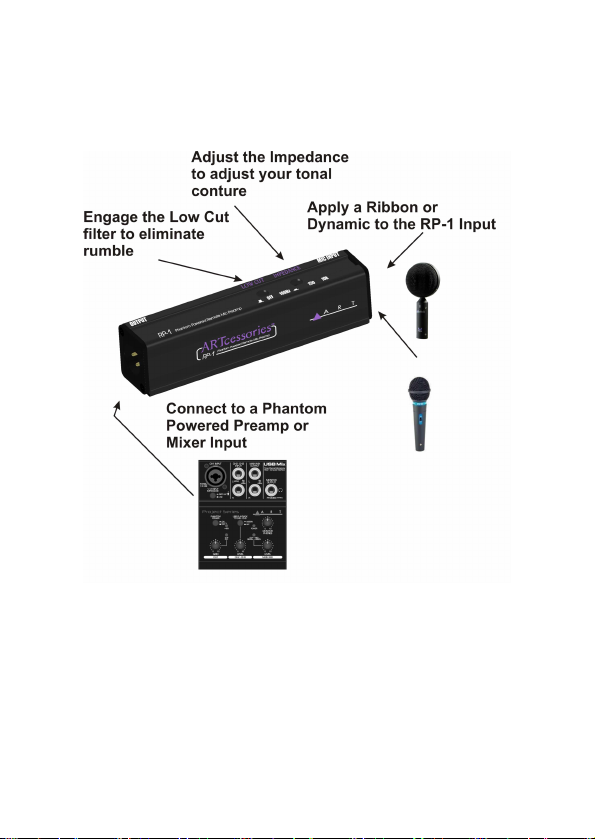
Connections
3
Page 7
APPLICATIONS
Perfect for: Live use, Project studios, Home and Commercial
installations.
The RP-1 may be used in a wide variety of applications and
environments. Self-contained in an extruded enclosure, the
remote mic Preamp is designed for continuous professional
use. Because the unit is compact and lightweight, mounting
location is not critical.
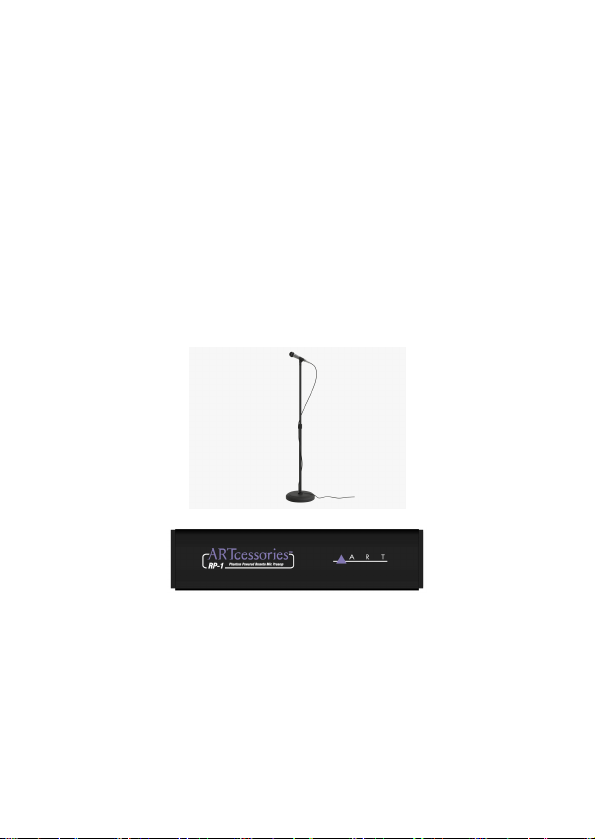
The RP-1 is placed inline with the Mic. The RP-1 can be zip
tied to the mic stand, so tonal adjustments can be made on the
fly.
4
Page 8

LOW CUT FILTER control
The Low Cut Filter is a single tuned High Pass Filter. The input
signal can be filtered to remove low frequency information. The
roll off frequency is set at 100Hz. Since it is single tuned, it
preserves some low frequency content so its use is less
obtrusive. It is especially useful in close mic’d applications
cutting out pops and wind noise.
Variable Impedance Function
Using this variable impedance function allows the user to adjust
the input impedance seen by the microphone, in turn achieving
better tonal response from your microphone used.
Dynamic Mic
Dynamic (coil) microphones are sensitive to loading. If these
mics are not coupled correctly, the result maybe a loss in
frequency response and could result in added distortion.
As an example a common mic like the SM57 prefers a 600ohm
load. When the load is varied above or below the 600ohms,
then the mid range resonance could sound harsh and distorted.
The low-end response will also sound more controlled with a
600ohm load. There are many dynamic mics that may have
similar issues but not be as sensitive to loading as the SM57.
5
Page 9

Ribbon Mic
Ribbon type (transformer coupled) microphones are sensitive
to the input impedance of the preamps or mixers used to
achieve the optimum frequency response. A Ribbon mic would
like to see an input impedance several times larger than its
output impedance. Ribbon mics, being transformer coupled,
have increased impedance at high and low frequencies. On the
low end the mic is power bound, as you load it there becomes
a low frequency cut off at higher levels, so it may sound
distorted. At the high end, the output impedance of the
transformer increases (independent of level), so the greater the
load the less high end.
As an example, a typical ribbon mic with a characteristic
impedance of 300ohms may have an inherent 600ohm
impedance at 20kHz and a 2k impedance at its low frequency
resonance (about 50Hz). If you set the input impedance to 10k
ohms your result would be a 0.25dB drop at 20kHz. This would
also drop the low frequency resonance by 1.3dB. Compare this
to a typical mixer input (3k input impedance) where you would
get a 0.75dB drop at 20kHz and 3.6dB at resonance.
6
Page 10

So increasing the input impedance seen by the mic using the
impedance pots on the Dual RP will result in an optimum
performance from the ribbon mic used. If the preamp or mixer
input impedance is too low then you will start to limit the
frequency response of the ribbon mic. When this occurs, the
low-end of the microphone’s sound quality will be limited and
the transient response will sound flat degrading the overall
performance of the microphone. So by adjusting the impedance
pot on the Dual RP, you can achieve a clean full frequency
response from your microphones using the Dual RP.
The beauty of the RP-1 may be the ability to operate at
higher impedance or control the impedance vs. the mixer1
you are currently using.
1
A Phantom power capable input has around 13K maximum
impedance simply due to the 6.8k Phantom power pull-up
resistors.
7
Page 11

WARRANTY INFORMATION
Limited Warranty
Applied Research and Technology will provide warranty and
service for this unit in accordance with the following warrants:
Applied Research and Technology, (A R T) warrants to the
original purchaser that this product and the components thereof
will be free from defects in workmanship and materials for a
period of three years from the date of purchase. Applied
Research and Technology will, without charge, repair or
replace, at its option, defective product or component parts
upon prepaid delivery to the factory service department or
authorized service center, accompanied by proof of purchase
date in the form of a valid sales receipt.
Online Registration
We recommend that you register your product online to insure
prompt warranty repair servicing on any repair issues. Please
go to www.artproaudio.com. Select “Support”, then "Product
Registration". Then input your information here.
8
Page 12

Exclusions
This warranty does not apply in the event of misuse or abuse of
the product or as a result of unauthorized alterations or repairs.
This warranty is void if the serial number is altered, defaced, or
removed.
A R T reserves the right to make changes in design or make
additions to or improvements upon this product without any
obligation to install the same on products previously
manufactured.
A R T shall not be liable for any consequential damages,
including without limitation damages resulting from loss of use.
Some states do not allow limitations of incidental or
consequential damages, so the above limitation or exclusion
may not apply to you. This warranty gives you specific rights
and you may have other rights, which vary from state to state.
For units purchased outside the United States, an authorized
distributor of Applied Research and Technology will provide
service
Fill in the following information for your reference:
Date of purchase ___________________
Purchased from ___________________
9
Page 13

SERVICE
The following information is provided in the unlikely event that
your unit requires service.
1. Be sure that the unit is the cause of the problem. Check to
make sure the unit has power, all cables are connected
correctly, and the cables themselves are in working
condition. You may want to consult with your dealer for
assistance in troubleshooting or testing your particular
configuration.
2. If you believe that the ART unit is at fault, go to
www.artproaudio.com.
3. Select “Support”, then “Return Authorization Request” to
request a return authorization number.
4. If you are returning the unit for service, pack the unit in its
original carton or a reasonable substitute. The original
packaging may not be suitable as a shipping carton, so
consider putting the packaged unit in another box for
shipping. Print the RA number clearly on the outside of the
shipping box. Print your return shipping address on the
outside of the box.
5. Include, with your unit, a note with the RA number and
your contact information, including a return shipping
address (we cannot ship to a P.O. box) and a daytime
phone number, and a description of the problem,
preferably attached to the top of the unit. Also include a
copy of your purchase receipt.
10
Page 14

SPECIFICATIONS
Input Connections XLR
Input Impedance 150 Ohms to 10k Ohms, variable
Max Input level -18dBu
Output Connections XLR
Max. Output Level +9dBu
Gain +27dB
Low Cut Filter Single pole 100hz
THD < .002% @1kHz typ.
E.I.N. -131dBu “A” wtd.
C.M.R.R. >60dB 20-20kHz
Power Requirements External Power requirements
Dimensions (HxWxD) 1.26-inch x 1.12-inch x 5.18-inch
Weight 0.31 lbs / 0.14 kg
Standard 48V Phantom power
supply, 8ma.
(32 x 28.4 x 132 mm)
11
Page 15

12
Page 16

www.artproaudio.com
E-mail: [email protected]
© 2020 Applied Research & Technology / Yorkville Sound
RP-1 RP1-5004-101
 Loading...