

Page 1
Reagent Guide
Applied Biosystems StepOne™
and StepOnePlus
™
Real-Time PCR Systems
Page 2

Page 3

Applied Biosystems StepOne™ and
™
StepOnePlus
Real-Time PCR
Systems
Reagent Guide
Page 4

© Copyright 2008, 2010 Applied Biosystems. All rights reserved.
Information in this document is subject to change without notice. Applied Biosystems assumes no responsibility for any errors that may appear in this
document.
APPLIED BIOSYSTEMS DISCLAIMS ALL WARRANTIES WITH RESPECT TO THIS DOCUMENT, EXPRESSED OR IMPLIED, INCLUDING BUT NOT LIMITED TO THOSE OF MERCHANTABILITY OR FITNESS FOR A PARTICULAR PURPOSE. IN NO EVENT SHALL
APPLIED BIOSYSTEMS BE LIABLE, WHETHER IN CONTRACT, TORT, WARRANTY, OR UNDER ANY STATUTE OR ON ANY OTHER
BASIS FOR SPE CIAL, INCIDENTAL, IN DIRECT, PU NI TIVE, MULTIPLE OR CONSEQU ENTIAL DAMAG ES IN CONNEC TI ON WITH OR
ARISING FROM THIS DOCUMENT, INCLUDING BUT NOT LIMITED TO THE USE THEREOF.
For R ese arc h U se On ly. Not for us e in dia gn ost ic p roc edu res .
NOTICE TO PURCHASER: Label License
The StepOne™ and StepOnePlus™ Real-Time PCR Systems are covered by US patents and corresponding claims in their non-US counterparts, owned
by Applied Biosystems Inc. No right is conveyed expressly, by implication, or by esto ppel under any other patent claim, such as claims to apparatus,
reagents, kits, or methods such as 5′ nuclease methods. Further infor mation on purchasing licenses may be obtained by contacting the Director of
Licensing, Applied Biosystems, 850 Lincoln Centre Drive, Foster City, California 94404, USA.
NOTICE TO PURCHASER:
PLEASE REFER TO THE USER'S GUIDE OR PRODUCT INSERT OF THE REAGENTS NAMED HEREIN FOR LIMITED LABEL LICENSE OR
DISCLAIMER INFORMATION.
TRADEMARKS:
Applied Biosystems, AB (Design), MicroAmp, Primer Express, and VIC are registered trademarks, and FAM, JOE, MicroAmp, MultiScribe, NED,
ROX, StepOne, StepOnePlus, TAMRA, TET, and VeriFlex are trademarks of Applied Biosystems or its subsidiaries in the U.S. and/or certain other
countries.
AmpErase, AmpliTaq Gold, and TaqMan are registered trademarks of Roche Molecular Systems, Inc.
SYBR is a registered trademark of Molecular Probes, Inc.
All other trademarks are the sole property of their respective owners.
Part Number 4379704 Rev. E
06/2010
Page 5

Contents Front Cover
Preface
How to Use This Guide . . . . . . . . . . . . . . . . . . . . . . . . . . . . . . . . . . . . . . . . . . . . . . . . . . vii
How to Obtain More Information . . . . . . . . . . . . . . . . . . . . . . . . . . . . . . . . . . . . . . . . . . . . ix
How to Obtain Support . . . . . . . . . . . . . . . . . . . . . . . . . . . . . . . . . . . . . . . . . . . . . . . . . . xii
Chapter 1 Introduction
About the StepOne™ and StepOnePlus™ Systems . . . . . . . . . . . . . . . . . . . . . . . . . . . . 1-2
Supported Consumables . . . . . . . . . . . . . . . . . . . . . . . . . . . . . . . . . . . . . . . . . . . . . . . 1-4
Preparing for Experiments . . . . . . . . . . . . . . . . . . . . . . . . . . . . . . . . . . . . . . . . . . . . . . . 1-6
Select the Experiment Type . . . . . . . . . . . . . . . . . . . . . . . . . . . . . . . . . . . . . . . . . . . . . . 1-7
Select the Reagent Type . . . . . . . . . . . . . . . . . . . . . . . . . . . . . . . . . . . . . . . . . . . . . . . . 1-8
Select the Assay Type . . . . . . . . . . . . . . . . . . . . . . . . . . . . . . . . . . . . . . . . . . . . . . . . . . 1-9
Chapter 2 Reagent Overview
Overview . . . . . . . . . . . . . . . . . . . . . . . . . . . . . . . . . . . . . . . . . . . . . . . . . . . . . . . . . . . . 2-2
Ta qM an
SYBR
Selecting the Appropriate Reagent Type . . . . . . . . . . . . . . . . . . . . . . . . . . . . . . . . . . . . 2-6
Minimizing DNA Contaminants . . . . . . . . . . . . . . . . . . . . . . . . . . . . . . . . . . . . . . . . . . . 2-7
®
Reagents . . . . . . . . . . . . . . . . . . . . . . . . . . . . . . . . . . . . . . . . . . . . . . . . . . . . 2-2
®
Green Reagents . . . . . . . . . . . . . . . . . . . . . . . . . . . . . . . . . . . . . . . . . . . . . . . . 2-4
Chapter 3 Quantitation Experiments
Section 3.1: About Quantitation Experiments . . . . . . . . . . . . . . . . . . . . . . . . . . . . . . 3-3
Overview . . . . . . . . . . . . . . . . . . . . . . . . . . . . . . . . . . . . . . . . . . . . . . . . . . . . . . . . . . . . 3-4
Select a Quantitation Method . . . . . . . . . . . . . . . . . . . . . . . . . . . . . . . . . . . . . . . . . . . . 3-5
Select 1-Step or 2-Step RT-PCR . . . . . . . . . . . . . . . . . . . . . . . . . . . . . . . . . . . . . . . . . . 3-8
Select Singleplex or Multiplex PCR . . . . . . . . . . . . . . . . . . . . . . . . . . . . . . . . . . . . . . . 3-10
Select the Reagent Type . . . . . . . . . . . . . . . . . . . . . . . . . . . . . . . . . . . . . . . . . . . . . . . 3-12
Select the Assay Type . . . . . . . . . . . . . . . . . . . . . . . . . . . . . . . . . . . . . . . . . . . . . . . . . 3-12
Section 3.2: Design Guidelines . . . . . . . . . . . . . . . . . . . . . . . . . . . . . . . . . . . . . . . . . 3-15
Inventoried/Made to Order Assays . . . . . . . . . . . . . . . . . . . . . . . . . . . . . . . . . . . . . . . 3-16
TaqMan
®
Gene Expression Assays . . . . . . . . . . . . . . . . . . . . . . . . . . . . . . . . . . . 3-16
iiiApplied Biosystems StepOne™ and StepOnePlus™ Real-Time PCR Systems Reagent Guide
Page 6

Custom TaqMan® Gene Expression Assays . . . . . . . . . . . . . . . . . . . . . . . . . . . . . 3-18
Select the Master Mix . . . . . . . . . . . . . . . . . . . . . . . . . . . . . . . . . . . . . . . . . . . . . . 3-19
Design the Experiment . . . . . . . . . . . . . . . . . . . . . . . . . . . . . . . . . . . . . . . . . . . . . 3-20
Custom Assays . . . . . . . . . . . . . . . . . . . . . . . . . . . . . . . . . . . . . . . . . . . . . . . . . . . . . . 3-21
Design Primers and Probes Using Primer Express
Select the Reagents . . . . . . . . . . . . . . . . . . . . . . . . . . . . . . . . . . . . . . . . . . . . . . . 3-24
Use the Recommended Thermal Cycling Conditions . . . . . . . . . . . . . . . . . . . . . . 3-27
Optimize Primer Concentrations . . . . . . . . . . . . . . . . . . . . . . . . . . . . . . . . . . . . . . 3-30
Optimize the Probe Concentration . . . . . . . . . . . . . . . . . . . . . . . . . . . . . . . . . . . . 3-33
For More Information . . . . . . . . . . . . . . . . . . . . . . . . . . . . . . . . . . . . . . . . . . . . . . . 3-35
Chapter 4 Genotyping Experiments
Section 4.1: About Genotyping Experiments . . . . . . . . . . . . . . . . . . . . . . . . . . . . . . . 4-3
Overview . . . . . . . . . . . . . . . . . . . . . . . . . . . . . . . . . . . . . . . . . . . . . . . . . . . . . . . . . . . . 4-4
Select the Assay Type . . . . . . . . . . . . . . . . . . . . . . . . . . . . . . . . . . . . . . . . . . . . . . . . . . 4-6
Section 4.2: Design Guidelines . . . . . . . . . . . . . . . . . . . . . . . . . . . . . . . . . . . . . . . . . . 4-9
Pre-Designed/Validated Assays . . . . . . . . . . . . . . . . . . . . . . . . . . . . . . . . . . . . . . . . . . 4-10
TaqMan
TaqMan
Pre-Developed TaqMan
Select the Master Mix . . . . . . . . . . . . . . . . . . . . . . . . . . . . . . . . . . . . . . . . . . . . . . 4-13
Design the Experiment . . . . . . . . . . . . . . . . . . . . . . . . . . . . . . . . . . . . . . . . . . . . . 4-14
Custom Assays . . . . . . . . . . . . . . . . . . . . . . . . . . . . . . . . . . . . . . . . . . . . . . . . . . . . . . 4-14
Custom TaqMan
Select the Master Mix . . . . . . . . . . . . . . . . . . . . . . . . . . . . . . . . . . . . . . . . . . . . . . 4-16
Design the Experiment . . . . . . . . . . . . . . . . . . . . . . . . . . . . . . . . . . . . . . . . . . . . . 4-16
®
SNP Genotyping Assays . . . . . . . . . . . . . . . . . . . . . . . . . . . . . . . . . . . . 4-10
®
Drug Metabolism Genotyping Assays . . . . . . . . . . . . . . . . . . . . . . . . . . 4-11
®
Assay Reagents for Allelic Discrimination . . . . . . . . . . 4-12
®
SNP Genotyping Assays . . . . . . . . . . . . . . . . . . . . . . . . . . . . . 4-14
®
Software . . . . . . . . . . . . . . . 3-21
Chapter 5 Presence/Absence Experiments
Section 5.1: About Presence/Absence Experiments . . . . . . . . . . . . . . . . . . . . . . . . . 5-3
Overview . . . . . . . . . . . . . . . . . . . . . . . . . . . . . . . . . . . . . . . . . . . . . . . . . . . . . . . . . . . . 5-4
Select the Assay Type . . . . . . . . . . . . . . . . . . . . . . . . . . . . . . . . . . . . . . . . . . . . . . . . . . 5-6
Section 5.2: Design Guidelines . . . . . . . . . . . . . . . . . . . . . . . . . . . . . . . . . . . . . . . . . . 5-9
Inventoried/Made to Order Assays . . . . . . . . . . . . . . . . . . . . . . . . . . . . . . . . . . . . . . . 5-10
TaqMan
Custom TaqMan
TaqMan
Select the Master Mix . . . . . . . . . . . . . . . . . . . . . . . . . . . . . . . . . . . . . . . . . . . . . . 5-15
Design the Experiment . . . . . . . . . . . . . . . . . . . . . . . . . . . . . . . . . . . . . . . . . . . . . 5-16
Custom Assays . . . . . . . . . . . . . . . . . . . . . . . . . . . . . . . . . . . . . . . . . . . . . . . . . . . . . . 5-16
iv Applied Biosystems StepOne™ and StepOnePlus™ Real-Time PCR Systems Reagent Guide
®
Gene Expression Assays . . . . . . . . . . . . . . . . . . . . . . . . . . . . . . . . . . . 5-10
®
Gene Expression Assays . . . . . . . . . . . . . . . . . . . . . . . . . . . . . 5-12
®
Exogenous Internal Positive Control Reagents . . . . . . . . . . . . . . . . . . . 5-13
Page 7

Appendix A Formulas
Standard Deviation Calculation Using the Standard Curve Method . . . . . . . . . . . . . . . A-2
Standard Deviation Calculation Using the Comparative Method . . . . . . . . . . . . . . . . . A-5
Formula for Comparative C
(ΔΔCT) Experiments . . . . . . . . . . . . . . . . . . . . . . . . . . . . . A-7
T
Appendix B Primer Limiting in Multiplex PCR
Appendix C Assay Design Guidelines
Appendix D Reagent Part Numbers
Quantitation Experiments . . . . . . . . . . . . . . . . . . . . . . . . . . . . . . . . . . . . . . . . . . . . . . . D-2
Inventoried/Made to Order Assays . . . . . . . . . . . . . . . . . . . . . . . . . . . . . . . . . . . . . D-2
Custom Assays . . . . . . . . . . . . . . . . . . . . . . . . . . . . . . . . . . . . . . . . . . . . . . . . . . . . D-2
Genotyping Experiments . . . . . . . . . . . . . . . . . . . . . . . . . . . . . . . . . . . . . . . . . . . . . . . . D-5
Pre-Designed/Validated Assays . . . . . . . . . . . . . . . . . . . . . . . . . . . . . . . . . . . . . . . D-5
Custom Assays . . . . . . . . . . . . . . . . . . . . . . . . . . . . . . . . . . . . . . . . . . . . . . . . . . . . D-5
Presence/Absence Experiments . . . . . . . . . . . . . . . . . . . . . . . . . . . . . . . . . . . . . . . . . . D-7
Inventoried/Made to Order Assays . . . . . . . . . . . . . . . . . . . . . . . . . . . . . . . . . . . . . D-7
Custom Assays . . . . . . . . . . . . . . . . . . . . . . . . . . . . . . . . . . . . . . . . . . . . . . . . . . . . D-8
Bibliography
Glossary
Index
vApplied Biosystems StepOne™ and StepOnePlus™ Real-Time PCR Systems Reagent Guide
Page 8

vi Applied Biosystems StepOne™ and StepOnePlus™ Real-Time PCR Systems Reagent Guide
Page 9

Preface
How to Use This Guide
About the System
Documentation
The guides listed below are shipped with the Applied Biosystems StepOne™ and
StepOnePlus
Guide Purpose and Audience PN
Applied Biosystems StepOne
StepOnePlus
™
Real-Time PCR Systems
™
and
Getting Started Guide for Genotyping
Experiments
™
Applied Biosystems StepOne
StepOnePlus
™
Real-Time PCR Systems
and
Getting Started Guide for
Presence/Absence Experiments
™
Applied Biosystems StepOne
StepOnePlus
™
Real-Time PCR Systems
and
Getting Started Guide for Relative
™
and
T
Standard Curve and Comparative C
Experiments
Applied Biosystems StepOne
StepOnePlus
™
Real-Time PCR Systems
Getting Started Guide for Standard Curve
Experiments
™
Applied Biosystems StepOne
and
StepOnePlus™ Real-Time PCR Systems
Installation, Networking, and Maintenance
Guide
™
Applied Biosystems StepOne
and
StepOnePlus™ Real-Time PCR Systems
Installation Quick Reference Card
Applied Biosystems StepOne
™
and
StepOnePlus™ Real-Time PCR Systems
Reagent Guide
™
Real-Time PCR Systems (StepOne™ and StepOnePlus™ systems).
Explains how to perform experiments on the StepOne and
4376786
StepOnePlus systems. Each Getting Started Guide
functions as both:
• A tutorial, using example experiment data provided with
the Applied Biosystems StepOne
Software (StepOne™ software).
™
Real-Time PCR
4376787
• A guide for your own experiments.
Intended for laboratory staff and principal investigators who
perform experiments using the StepOne or StepOnePlus
system.
4376785
4376784
Explains how to install and maintain the StepOne and
4376782
StepOnePlus systems.
Intended for laboratory staff responsible for the installation
and maintenance of the StepOne or StepOnePlus system
4376783
Provides information about the reagents you can use on the
4379704
StepOne and StepOnePlus systems, including:
®
• An introduction to TaqMan
and SYBR® Green reagents
• Descriptions and design guidelines for the following
experiment types:
– Quantitation experiments
– Genotyping experiments
– Presence/absence experiments
Intended for laboratory staff and principal investigators who
perform experiments using the StepOne or StepOnePlus
system.
viiApplied Biosystems StepOne™ and StepOnePlus™ Real-Time PCR Systems Reagent Guide
Page 10

Preface
Guide Purpose and Audience PN
Applied Biosystems StepOne™ and
StepOnePlus™ Real-Time PCR Systems
Site Preparation Guide
™
Applied Biosystems StepOne
PCR Software Help
Assumptions
Real-Time
This guide assumes that you:
• Are familiar with the Microsoft Windows
• Are familiar with the Internet and Internet browsers.
• Know how to handle DNA and/or RNA samples and prepare them for PCR.
• Understand data storage, file transfer, and copying and pasting.
• Have networking experience, if you plan to integrate the StepOne or
StepOnePlus system into your existing laboratory data flow.
Explains how to prepare your site to receive and install the
StepOne and StepOnePlus systems.
Intended for personnel who schedule, manage, and perform
the tasks required to prepare your site for installation of the
StepOne or StepOnePlus system.
Explains how to use the StepOne software to:
• Set up, run, and analyze experiments using the StepOne
and StepOnePlus systems.
• Monitor networked StepOne and StepOnePlus
instruments.
• Calibrate StepOne and StepOnePlus instruments.
• Verify the performance of StepOne and StepOnePlus
instruments with an RNase P run.
Intended for:
• Laboratory staff and principal investigators who perform
experiments using the StepOne or StepOnePlus system.
• Laboratory staff responsible for the installation and
maintenance of the StepOne or StepOnePlus system.
®
XP operating system.
4376768
NA
Te xt Co n ve n ti o ns
This guide uses the following conventions:
• Bold text indicates user action. For example:
Ty p e 0, then press Enter for each of the remaining fields.
• Italic text indicates new or important words and is also used for emphasis.
For example:
Before analyzing, always prepare fresh matrix.
• A right arrow symbol () separates successive commands you select from a
drop-down or shortcut menu. For example:
Select FileOpen.
User Attention
Words
Two user attention words appear in Applied Biosystems user documentation. Each
word implies a particular level of observation or action as described below:
Note: – Provides information that may be of interest or help but is not critical to the
use of the product.
IMPORTANT! – Provides information that is necessary for proper instrument
operation, accurate reagent kit use, or safe use of a chemical.
viii Applied Biosystems StepOne™ and StepOnePlus™ Real-Time PCR Systems Reagent Guide
Page 11

Examples of the user attention words appear below:
Note: The Calibrate function is also available in the Control Console.
IMPORTANT! To verify your client connection, you need a valid user ID.
How to Obtain More Information
Preface
Related
Documentation
Other StepOne and StepOnePlus System Documents
The documents listed in the table below are not shipped with the StepOne or
StepOnePlus instrument.
Document PN
™
Applied Biosystems StepOne
and StepOnePlus™ Real-Time PCR
Systems Installation Performance Verification Protocol
™
Applied Biosystems StepOne
and StepOnePlus™ Real-Time PCR
Systems Installation Qualification-Operation Qualification Protocol
Applied Biosystems StepOne
™
and StepOnePlus™ Real-Time PCR
Systems Planned Maintenance Protocol
Documents Related to Genotyping Experiments
Document PN
Allelic Discrimination Pre-Developed TaqMan
Reference Card
®
Custom TaqMan
Custom TaqMan
Ordering TaqMan
Performing a Custom TaqMan
Genomic Assays Protocol 4367671
®
SNP Genotyping Assays Protocol 4334431
®
SNP Genotyping Assays Quick Reference Card 4374204
®
SNP Genotyping Assay for 96-Well
Plates Quick Reference Card
®
Performing a TaqMan
Drug Metabolism Genotyping Assay for 96-Well
Plates Quick Reference Card
Pre-Developed TaqMan
®
Assay Reagents Allelic Discrimination
Protocol
®
TaqM an
TaqM an
Drug Metabolism Genotyping Assays Protocol 4362038
®
SNP Genotyping Assays Protocol 4332856
®
Assay Reagents Quick
4376791
4376790
4376788
4312212
4371394
4367636
4312214
ixApplied Biosystems StepOne™ and StepOnePlus™ Real-Time PCR Systems Reagent Guide
Page 12

Preface
Documents Related to Presence/Absence Experiments
Document PN
DNA Isolation from Fresh and Frozen Blood, Tissue Culture Cells, and
4343586
Buccal Swabs Protocol
NucPrep® Chemistry: Isolation of Genomic DNA from Animal and Plant
4333959
Tissue Protocol
®
PrepMan
Documents Related to Relative Standard Curve and Comparative C
Ultra Sample Preparation Reagent Protocol 4318925
Experiments
T
Document PN
Amplification Efficiency of TaqMan
®
Gene Expression Assays
127AP05
Application Note
Applied Biosystems High-Capacity cDNA Reverse Transcription Kits
4375575
Protocol
®
Custom TaqMan
Primer Express
®
TaqM an
Gene Expression Assays Protocol 4333458
Gene Expression Assays Protocol 4334429
®
Software Version 3.0 Getting Started Guide 4362460
User Bulletin #2: Relative Quantitation of Gene Expression 4303859
Documents Related to Standard Curve Experiments
Document PN
®
Amplification Efficiency of TaqMan
Gene Expression Assays
Application Note
Custom TaqMan
Primer Express
TaqM an
®
®
Gene Expression Assays Protocol 4334429
®
Software Version 3.0 Getting Started Guide 4362460
Gene Expression Assays Protocol 4333458
User Bulletin #2: Relative Quantitation of Gene Expression 4303859
127AP05
x Applied Biosystems StepOne™ and StepOnePlus™ Real-Time PCR Systems Reagent Guide
Page 13

Documents Related to the Reagent Guide
Document PN
Preface
Applied Biosystems High-Capacity cDNA Reverse Transcription Kits
Protocol
Custom TaqMan
Custom TaqMan
Custom TaqMan
Power SYBR
Pre-Developed TaqMan
®
Gene Expression Assays Protocol 4334429
®
Genomic Assays Protocol: Submission Guidelines 4367671
®
SNP Genotyping Assays Protocol 4334431
®
Green PCR Master Mix and RT-PCR Protocol 4367218
®
Assay Reagents Allelic Discrimination
Protocol
Primer Express
®
Green PCR and RT-PCR Reagents Protocol 4304965
SYBR
®
SYBR
Green PCR Master Mix and RT-PCR Reagents Protocol 4310251
TaqM an
TaqM an
TaqM an
TaqM an
TaqM an
TaqM an
TaqM an
TaqM an
®
Software Version 3.0 Getting Started Guide 4362460
®
Drug Metabolism Genotyping Assays Protocol 4362038
®
Exogenous Internal Positive Control Reagents Protocol 4308335
®
Fast Universal PCR Master Mix (2✕) Protocol 4351891
®
Gene Expression Assays Protocol 4333458
®
Gene Expression Master Mix Protocol 4371135
®
Genotyping Master Mix Protocol 4371131
®
SNP Genotyping Assays Protocol 4332856
®
Universal PCR Master Mix Protocol 4304449
4375575
4312214
Obtaining
Information from
the Software Help
User Bulletin #2: Relative Quantitation of Gene Expression 4303859
Using TaqMan
Endogenous Control Assays to Select an Endogenous
127AP08
®
Control for Experimental Studies Application Note
For more documentation, see “How to Obtain Support” on page xii.
Note:
The StepOne Software Help describes how to use each feature of the user interface.
Access the Help from within the software by doing one of the following:
•Press F1.
• Click in the toolbar.
• Select HelpStepOne Software Help.
To find topics of interest in the Help:
• Review the table of contents.
• Search for a specific topic.
• Search an alphabetized index.
xiApplied Biosystems StepOne™ and StepOnePlus™ Real-Time PCR Systems Reagent Guide
Page 14

Preface
Send Us Your
Comments
Applied Biosystems welcomes your comments and suggestions for improving its
user documents. You can e-mail your comments to:
IMPORTANT! The e-mail address above is only for submitting comments and
suggestions relating to documentation. To order documents, download PDF files, or
for help with a technical question, go to http://www.appliedbiosystems.com, then
click the link for Support. (See “How to Obtain Support” on page Front Matter-xii).
How to Obtain Support
For the latest services and support information for all locations, go to
http://www.appliedbiosystems.com, then click the link for Support.
At the Support page, you can:
• Search through frequently asked questions (FAQs)
• Submit a question directly to Technical Support
• Order Applied Biosystems user documents, MSDSs, certificates of analysis,
and other related documents
• Download PDF documents
• Obtain information about customer training
• Download software updates and patches
In addition, the Support page provides access to worldwide telephone and fax
numbers to contact Applied Biosystems Technical Support and Sales facilities.
IMPORTANT! When directed to do so by this guide, or when you need to schedule
maintenance for your StepOne
planned maintenance or temperature verification/calibration), contact the
Applied Biosystems Care Center. To obtain a phone number for or to send an email
to the center, go to http://www.appliedbiosystems.com/support/contact.
™
or StepOnePlus™ instrument (such as annual
xii Applied Biosystems StepOne™ and StepOnePlus™ Real-Time PCR Systems Reagent Guide
Page 15

Introduction 1
This chapter covers:
About the StepOne
Supported Consumables . . . . . . . . . . . . . . . . . . . . . . . . . . . . . . . . . . . . . . . . . . . . . 1-4
Preparing for Experiments. . . . . . . . . . . . . . . . . . . . . . . . . . . . . . . . . . . . . . . . . . . . 1-6
Select the Experiment Type. . . . . . . . . . . . . . . . . . . . . . . . . . . . . . . . . . . . . . . . . . . 1-7
Select the Reagent Type . . . . . . . . . . . . . . . . . . . . . . . . . . . . . . . . . . . . . . . . . . . . . 1-8
Select the Assay Type . . . . . . . . . . . . . . . . . . . . . . . . . . . . . . . . . . . . . . . . . . . . . . . 1-9
™
and StepOnePlus™ Systems . . . . . . . . . . . . . . . . . . . . . . . . . 1-2
1
1-1Applied Biosystems StepOne™ and StepOnePlus™ Real-Time PCR Systems Reagent Guide
Page 16

Chapter 1 Introduction
About the StepOne™ and StepOnePlus™ Systems
There are two models available for this Real-Time PCR System:
System Features
About Data
Collection
Applied Biosystems StepOne
PCR System (StepOne™ system)
Applied Biosystems StepOnePlus™ RealTime PCR System (StepOnePlus
™
Real-Time
™
system)
• 48-well platform
• Three-color system
• 96-well platform
• Four-color system
•VeriFlex
™
sample blocks
The StepOne and StepOnePlus systems use fluorescent-based polymerase chain
reaction (PCR) reagents to provide:
• Quantitative detection of target nucleic acid sequences (targets) using real-time
analysis.
• Qualitative detection of targets using post-PCR (endpoint) analysis.
• Qualitative analysis of the PCR product (achieved by melt curve analysis that
occurs post-PCR).
The StepOne and StepOnePlus systems collect raw fluorescence data at different
points during a PCR, depending on the type of run that the instruments perform:
Run Type Data Collection Point
Real-time runs Standard curve The instrument collects data following each
Relative standard
curve
extension step of the PCR.
Comparative C
)
(ΔΔC
T
Post-PCR
(endpoint) runs
Genotyping The instrument collects data:
Presence/absence
Regardless of the run type, a data collection point or read on the StepOne
StepOnePlus
™
instrument consists of three phases:
T
• Before the PCR (For presence/absence
experiments, data collection before the PCR
is optional, but recommended.)
• (Optional) During the PCR. The instrument can
collect data during the run (real-time);
collecting data during the run can be helpful
for troubleshooting.
•After the PCR
™
or
1. Excitation – The instrument illuminates all wells of the reaction plate within
the instrument, exciting the fluorophores in each reaction.
1-2 Applied Biosystems StepOne™ and StepOnePlus™ Real-Time PCR Systems Reagent Guide
Page 17

Chapter 1 Introduction
2. Emission – The instrument optics collect the residual fluorescence emitted from
the wells of the reaction plate. The resulting image collected by the device
consists only of light that corresponds to the range of emission wavelengths.
About the Filters
3. Collection – The instrument assembles a digital representation of the residual
fluorescence collected over a fixed time interval. The StepOne
™
software stores
the raw fluorescent image for analysis.
After a run, the StepOne software uses calibration data (spatial, dye, and
background) to determine the location and intensity of the fluorescent signals in each
read, the dye associated with each fluorescent signal, and the significance of the
signal.
The StepOne and StepOnePlus systems use the following filters:
StepOne system StepOnePlus system
Filter Dye Filter Dye
1FAM
2JOE™ dye 2 JOE™ dye
3ROX
™
dye 1 FAM™ dye
®
Green dye SYBR® Green dye
SYBR
®
dye VIC® dye
VIC
™
dye 3 TAMRA™ dye
NED™ dye
4ROX
™
dye
About the
VeriFlex
™
Te ch no lo gy
For More
Information
The StepOnePlus instrument contains six independently thermally regulated
Ve ri Fl ex
™
blocks to help you optimize your thermal cycling conditions. You can set a
different temperature for one or more of the VeriFlex blocks, creating up to six
different zones for samples, or you can set the same temperature for each of the
VeriFlex blocks.
For more information about any of the topics discussed in this guide, access the Help
from within Applied Biosystems StepOne
™
Real-Time PCR Software v2.0 by
pressing F1, clicking in the toolbar, or selecting HelpStepOne Software Help.
1-3Applied Biosystems StepOne™ and StepOnePlus™ Real-Time PCR Systems Reagent Guide
Page 18

Chapter 1 Introduction
G
A
C
D
C
F
B
C
# Consumable
AMicroAmp™ Fast Optical 48-Well Reaction Plate
BMicroAmp
™
Fast 48-Well Tray
CMicroAmp™ 96-Well Support Base
DMicroAmp
™
Optical 8-Cap Strip
EMicroAmp
™
Fast 8-Tube Strip
FMicroAmp® Fast Reaction Tube with Cap
GMicroAmp
™
48-Well Optical Adhesive Film
HMicroAmp
™
48-Well Base Adaptor
E
B
H
H
Supported Consumables
StepOne System
The StepOne system supports the consumables listed below. These consumables are
for use with both standard and Fast reagents/protocols.
IMPORTANT! Use only Fast consumables (reaction plates, tube strips, and tubes)
with the StepOne and StepOnePlus systems, even when performing an experiment
with standard reagents.
Consumable Part Number
•MicroAmp
•MicroAmp
•MicroAmp
•MicroAmp
•MicroAmp
•MicroAmp
•MicroAmp
•MicroAmp™ 96-Well Support Base
™
Fast Optical 48-Well Reaction Plate
™
48-Well Optical Adhesive Film
• 4375816
• 4375323 and
4375928
™
Fast 8-Tube Strip
™
Optical 8-Cap Strip
®
Fast Reaction Tube with Cap • 4358297
™
Fast 48-Well Tray
™
48-Well Base Adaptor
• 4358293
• 4323032
• 4375282
• 4375284
• 4379590
1-4 Applied Biosystems StepOne™ and StepOnePlus™ Real-Time PCR Systems Reagent Guide
Page 19

Chapter 1 Introduction
G
A
C
F
B
C
# Consumable
AMicroAmp™ Fast Optical 96-Well Reaction Plate
BMicroAmp™ 96-Well Tray for VeriFlex™ Blocks
CMicroAmp
™
96-Well Support Base
DMicroAmp
™
Optical 8-Cap Strip
EMicroAmp™ Fast 8-Tube Strip
FMicroAmp
®
Fast Reaction Tube with Cap
GMicroAmp
™
Optical Adhesive Film
D
C
E
B
StepOnePlus
System
The StepOnePlus system supports the consumables listed below. These consumables
are for use with both standard and Fast reagents/protocols.
IMPORTANT! Use only Fast consumables (reaction plates, tube strips, and tubes)
with the StepOne and StepOnePlus systems, even when performing an experiment
with standard reagents.
Consumable Part Number
•MicroAmp™ Fast Optical 96-Well Reaction Plate with
Barcode
•MicroAmp™ Optical Adhesive Film
™
•MicroAmp
Fast 8-Tube Strip
•MicroAmp™ Optical 8-Cap Strip
®
•MicroAmp
•MicroAmp
Fast Reaction Tube with Cap • 4358297
™
96-Well Tray for VeriFlex™ Blocks
•MicroAmp™ 96-Well Support Base
™
•MicroAmp
Adhesive Film Applicator
•MicroAmp™ Cap Installing Tool (Handle)
• 4346906 and
4366932
• 4360954 and
4311971
• 4358293
• 4323032
• 4379983
• 4379590
• 4333183
• 4330015
1-5Applied Biosystems StepOne™ and StepOnePlus™ Real-Time PCR Systems Reagent Guide
Page 20

Chapter 1 Introduction
Preparing for Experiments
General Workflow
Information in
This Guide
Before performing experiments on the StepOne and StepOnePlus systems, prepare
for the experiment as follows:
1. Select an experiment type (page 1-7).
2. Select the reagent type (page 1-8).
3. Select the assay type (page 1-9).
This chapter provides general information on the experiment types, reagent types,
and assay types you can use with the StepOne and StepOnePlus systems.
Subsequent chapters provide specific information:
Chapter Description
Chapter 2, Reagent Overview • Describes and compares the TaqMan® and
• Provides information on minimizing DNA
Chapter 3, Quantitation
Experiments
Chapter 4, Genotyping
Experiments
• Explains how the experiment type works.
• Provides a specific workflow for the experiment
• Provides design guidelines for each assay type.
®
SYBR
contamination.
type.
Green reagents.
Chapter 5, Presence/Absence
Experiments
1-6 Applied Biosystems StepOne™ and StepOnePlus™ Real-Time PCR Systems Reagent Guide
Page 21

Select the Experiment Type
In this guide, the term experiment refers to the entire process of performing a run
using the StepOne or StepOnePlus system, including setup, run and analysis. You
can perform the following types of experiments on the StepOne and StepOnePlus
systems:
• Quantitation, including:
– Standard curve
– Relative standard curve
– Comparative C
•Genotyping
• Presence/absence
Note: You can also perform melt curve analysis on the StepOne and StepOnePlus
systems. For more information, access the Help from within the StepOne software by
clicking in the toolbar or pressing F1.
(ΔΔCT)
T
Chapter 1 Introduction
Endpoint vs.
Real-Time
Experiments
The three experiment types can be categorized as real-time or endpoint experiments,
as described below.
Category Properties Experiment Type
Real-time • The instrument monitors the progress of the
PCR as it occurs.
• Data are collected throughout the PCR
process.
• Reactions are characterized by the point in
time during cycling when amplification of a
target is first detected.
Endpoint • Data are collected at the end of the PCR
process.
• Reactions are characterized by the quantity
of the target accumulated at the end of PCR.
• The datapoint is the normalized intensity of
the reporter dye, or R
‡
§
.
n
Note: Some endpoint experiments also include
pre-PCR datapoints. If so, the system calculates
the delta R
formula:
ΔRn = Rn (post-PCR read) – Rn (pre-PCR read)
where Rn = normalized reporter
(ΔRn) value per the following
n
Quantitation
Genotyping
Presence/absence
§
‡ Kwok and Higuchi, 1989.
§Saiki et al., 1985.
1-7Applied Biosystems StepOne™ and StepOnePlus™ Real-Time PCR Systems Reagent Guide
Page 22

Chapter 1 Introduction
Select the Reagent Type
You can use the following reagent types (chemistries) on the StepOne and
StepOnePlus systems:
•TaqMan
• SYBR
• Other fluorescent-based reagents
®
reagents
®
Green reagents
Taq Ma n
Reagents
SYBR Green
Reagents
TaqMan reagents include Applied Biosystems TaqMan® assays (preformulated
mixes that contain probe and primer sets) and Applied Biosystems TaqMan
®
master
mixes. You can use TaqMan reagents for the following experiment types:
• Quantitation, including:
– Standard curve
– Relative standard curve
– Comparative C
(ΔΔCT)
T
•Genotyping
• Presence/absence
IMPORTANT! Applied Biosystems does not recommend the use of TAMRA
™
dye
as a reporter or quencher with the StepOne system. TAMRA dye may be used as a
reporter or quencher with the StepOnePlus system.
SYBR Green reagents include primers and master mixes that contain SYBR® Green
dye. You can use SYBR Green reagents for quantitation experiments:
• Standard curve
• Relative standard curve
• Comparative C
Note: You cannot perform multiplex PCR using SYBR Green reagents. For more
(ΔΔCT)
T
information, see “Select Singleplex or Multiplex PCR” on page 3-10.
Other Reagents
You can use other fluorescent-based reagents on the StepOne and StepOnePlus
systems, but note the following when using the StepOne software:
• You must design your experiment using Advanced Setup instead of the Design
Wizard.
• For Applied Biosystems TaqMan and SYBR Green reagents, the StepOne
software automatically calculates reaction volumes in the Reaction Setup
screen.
1-8 Applied Biosystems StepOne™ and StepOnePlus™ Real-Time PCR Systems Reagent Guide
Page 23

Select the Assay Type
In the StepOne software, you can select the following assay types for quantitation,
presence/absence, and genotyping experiments:
Exp e r i me n t Ty pe Ass a y Ty pe See . . .
Chapter 1 Introduction
Quantitation and
Presence/
Absence
Experiments
Quantitation
Presence/absence
Genotyping • Pre-Designed/Validated
‡ Quantitation experiments include standard curve, relative standard curve, and
comparative C
Inventoried/Made to Order Assays
‡
experiments.
T
• Inventoried/Made to Order
•Custom
•Custom
•User-Designed
below
page 1-10
For quantitation or presence/absence experiments, select the Inventoried/Made to
Order assay type in the StepOne software if you are using:
• Taq Ma n
labeled TaqMan
®
Gene Expression Assays, Inventoried – Predesigned FAM™ dye-
®
MGB (minor groove binder) probe and primer sets that can be
purchased off-the-shelf. The assay mix is available in a single, preformulated
20✕ tube.
• Taq Ma n
®
Gene Expression Assays, Made to Order – Predesigned FAM dye-
labeled TaqMan MGB probe and primer sets that are manufactured at the time
of order. The assay mix is available in a single, preformulated 20✕ tube.
• Custom TaqMan
®
Gene Expression Assays – FAM dye-labeled TaqMan
MGB probe and primer sets that are designed, synthesized, and formulated by
the Custom TaqMan
®
Genomic Assays service based on sequence information
that you submit. The assay mix is available in a single, preformulated 20✕ or
60✕ tube.
Note: To select the assay type in the StepOne software, go to the Reaction Setup
screen in either the Design Wizard or Advanced Setup, then select
Inventoried/Made to Order from the Assay Type dropdown menu.
Custom Assays
For quantitation and presence/absence experiments, select the Custom assay type in
the StepOne software if you are designing your own assays (primers and probes)
with Primer Express
®
Software and TaqMan or SYBR Green reagents. When
designing your own assays, follow the Applied Biosystems Assay Design Guidelines
to optimize results.
IMPORTANT! Applied Biosystems does not recommend the use of TAMRA
™
dye
as a reporter or quencher with the StepOne system. TAMRA dye may be used as a
reporter or quencher with the StepOnePlus system.
Note: To select the assay type in the StepOne software, go to the Reaction Setup
screen in either the Design Wizard or Advanced Setup, then select Custom from the
Assay Type dropdown menu.
1-9Applied Biosystems StepOne™ and StepOnePlus™ Real-Time PCR Systems Reagent Guide
Page 24

Chapter 1 Introduction
Genotyping
Experiments
Pre-Designed/Validated Assays
For genotyping experiments, the Pre-Designed/Validated assay type includes:
• Taq Ma n
labeled TaqMan
available as TaqMan
®
SNP Genotyping Assays – Predesigned FAM™ dye- and VIC® dye-
®
MGB (minor groove binder) probes and primer sets that are
®
Pre-Designed SNP Genotyping Assays. The TaqMan PreDesigned SNP Genotyping Assays are manufactured at the time of order (Made
to Order). The assay mix is available in a single, preformulated 20✕ tube.
• Taq Ma n
®
Drug Metabolism Genotyping Assays – Predesigned FAM dye- and
VIC dye-labeled TaqMan MGB probes and primer sets that can be purchased
off-the-shelf (Inventoried). The assay mix is available in a single, preformulated
20✕ tube.
• Pre-Developed TaqMan
(TaqMan
®
PDARs for AD) – Predesigned FAM dye- and VIC dye-labeled
®
Assay Reagents for Allelic Discrimination
TaqMan MGB probes and primer sets that can be purchased off-the-shelf
(Inventoried). The assay mix is available in a single, preformulated 10✕ tube.
Note: To select a SNP assay in the StepOne software, go to the SNP Assays screen
in the Design Wizard or to the Plate Setup screen in Advanced Setup. In the SNP
Assays screen or Plate Setup screen, select an assay from the library or create a new
assay.
Custom Assays
For genotyping experiments, the Custom assay type includes the Custom TaqMan®
SNP Genotyping Assays. The Custom TaqMan SNP Genotyping Assays are FAM
dye- and VIC dye-labeled TaqMan MGB probes and primer sets that are designed,
synthesized, and formulated by the Custom TaqMan
®
Genomic Assays service based
on sequence information that you submit. The assay mix is available in a single,
preformulated 40✕ or 80✕ tube.
Note: To select a SNP assay in the StepOne software, go to the SNP Assays screen
in the Design Wizard or to the Plate Setup screen in Advanced Setup. In the SNP
Assays screen or Plate Setup screen, you can select an assay from the library or
create a new assay.
User-Designed Assays
If you want to design your own primers and probes for SNP assays, refer to the
Primer Express
IMPORTANT! Applied Biosystems does not recommend the use of TAMRA
®
Software Version 3.0 Getting Started Guide.
™
dye
as a reporter or quencher with the StepOne system. TAMRA dye may be used as a
reporter or quencher with the StepOnePlus system.
1-10 Applied Biosystems StepOne™ and StepOnePlus™ Real-Time PCR Systems Reagent Guide
Page 25

Reagent Overview 2
This chapter covers:
Overview . . . . . . . . . . . . . . . . . . . . . . . . . . . . . . . . . . . . . . . . . . . . . . . . . . . . . . . . . 2-2
Taq Ma n
SYBR
Selecting the Appropriate Reagent Type . . . . . . . . . . . . . . . . . . . . . . . . . . . . . . . . . 2-6
Minimizing DNA Contaminants . . . . . . . . . . . . . . . . . . . . . . . . . . . . . . . . . . . . . . . 2-7
®
Reagents . . . . . . . . . . . . . . . . . . . . . . . . . . . . . . . . . . . . . . . . . . . . . . . . . 2-2
®
Green Reagents . . . . . . . . . . . . . . . . . . . . . . . . . . . . . . . . . . . . . . . . . . . . . 2-4
2
2-1Applied Biosystems StepOne™ and StepOnePlus™ Real-Time PCR Systems Reagent Guide
Page 26

Chapter 2 Reagent Overview
Overview
Applied Biosystems has developed two reagent types (chemistries) that can be used
to detect PCR products on the Applied Biosystems StepOne
Real-Time PCR Systems:
•TaqMan
• SYBR
TaqMan® Reagents
Experiment
Ty pe s
Taq Ma n® reagents include Applied Biosystems TaqMan® assays (preformulated
mixes that contain probe and primer sets) and Applied Biosystems TaqMan
mixes. The assays are specific to the target of interest. The master mixes contain the
remaining components needed for the PCR reaction. You can use TaqMan reagents
for the following experiment types:
• Quantitation, including:
– Standard curve
– Relative standard curve
– Comparative C
•Genotyping
• Presence/absence
IMPORTANT! Applied Biosystems does not recommend the use of TAMRA
as a reporter or quencher with the StepOne system. TAMRA dye may be used as a
reporter or quencher with the StepOnePlus system.
®
reagents (below)
®
Green reagents (page 2-4)
(ΔΔCT)
T
™
and StepOnePlus™
®
™
master
dye
Development of
Taq Ma n
Reagents
Initially, intercalator dyes were used to measure real-time PCR products. The
primary disadvantage of this detection method is that it detects accumulation of both
specific and nonspecific PCR products.
Real-time systems for PCR were improved by the introduction of fluorogeniclabeled probes that use the 5′ nuclease activity of Taq DNA polymerase. The
availability of these fluorogenic probes enabled the development of a real-time
method for detecting only specific amplification products.
How the TaqMan
Reagents Work
TaqMan reagents use a fluorogenic probe to detect a specific PCR product as it
accumulates during the PCR. Here is how it works:
Step 1 – An oligonucleotide probe is constructed with a fluorescent reporter dye
bound to the 5′ end and a quencher on the 3′ end.
Step 2 – While the probe is intact, the proximity of the quencher greatly reduces the
fluorescence emitted by the reporter dye by fluorescence resonance energy transfer
(FRET; Förster resonance) (Förster, V. T. 1948) through space.
2-2 Applied Biosystems StepOne™ and StepOnePlus™ Real-Time PCR Systems Reagent Guide
Page 27

Chapter 2 Reagent Overview
R
Q
STRAND DISPLACEMENT
3'
3'
5'
5'
5'
5'
3'
Q
R
CLEAVAGE
3'
3'
5'
5'
5'
5'
3'
R
R = REPORTER
Q
Q = QUENCHER
POLYMERIZATION
PROBE
3'
3'
5'
5'
5'
5'
3'
REVERSE PRIMER
FORWARD
PRIMER
Q
R
POLYMERIZATION COMPLETED
3'
3'
5'
5'
5'
5'
3'
Step 1: A reporter (R) and
a quencher (Q) are
attached to the 5
′ and 3′
ends of a TaqMan
®
probe.
Step 3: During each
extension cycle, Taq DNA
polymerase cleaves the
reporter dye from the
probe.
Step 4: Once separated
from the quencher, the
reporter dye emits its
characteristic
fluorescence.
Step 2: When both labels
are attached to the probe,
reporter dye emission is
quenched.
Step 3 – If the target is present, the probe anneals between primer sites and is cleaved
by the 5′ nuclease activity of Taq DNA polymerase during extension. Cleavage of
the probe:
• Separates the reporter dye from the quencher, increasing the reporter dye signal.
• Removes the probe from the target strand, allowing primer extension to
continue to the end of the template strand. Thus, inclusion of the probe does not
inhibit the overall PCR process.
Step 4 – More reporter dye molecules are cleaved from their respective probes with
each cycle, resulting in an increase in fluorescence intensity proportional to the
quantity of amplicon produced. The higher the starting copy number of the nucleic
acid target, the earlier a significant increase in fluorescence is observed.
Figure 2-1 illustrates this process.
Taq Ma n® Probes
Figure 2-1 How the TaqMan reagents work
Applied Biosystems offers two types of TaqMan® probes:
•TaqMan
®
MGB (minor groove-binder) probes with non fluorescent quencher
(NFQ)
•TaqMan
IMPORTANT! Applied Biosystems does not recommend the use of TAMRA dye as a
®
probes with TAMRA™ dye as quencher
reporter or quencher with the StepOne system. TAMRA dye may be used as a
reporter or quencher with the StepOnePlus system.
2-3Applied Biosystems StepOne™ and StepOnePlus™ Real-Time PCR Systems Reagent Guide
Page 28

Chapter 2 Reagent Overview
Applied Biosystems offers the following TaqMan probes for use on the StepOne
system or the StepOnePlus system:
Probe Assays 5′ Label Dye 3′ Label Dye MGB? System
®
Ta qM an
probe
Ta qM an® MGB
probe
Custom TaqMan®
MGB Probe
Custom TaqMan®
Probe
MGB
Ta q Ma n® Gene
Expression Assays
Ta q Ma n® SNP
Genotyping Assays
Custom TaqMan® Gene
Expression Assays
Custom TaqMan® SNP
Genotyping Assays
Custom assays FAM™, TET™,
Custom assays FAM™, TET™ or
TaqMan MGB Probes Recommended
FAM™ dye NFQ Yes StepOne and
StepOne Plus
FAM™ and
VIC® dyes
FAM™ dye
FAM™and VIC®
dyes
NED™, or VIC®
dye
®
dye
VIC
TAM RA
dye
™
No StepOnePlus
systems
system
Applied Biosystems recommends the general use of TaqMan MGB probes,
especially when conventional TaqMan probes exceed 30 nucleotides. The
TaqMan MGB probes contain:
• A fluorescent reporter dye at the 5′ end – Generates a signal when cleaved by
the 5′ nuclease activity of Taq DNA polymerase.
• A nonfluorescent quencher (NFQ) at the 3′ end – Allows Real-Time PCR
Systems to measure the reporter dye contributions more precisely than probes
with TAMRA dye because the quencher does not fluoresce.
• A minor groove binder (MGB) at the 3′ end – Increases the melting
temperature (Tm) of probes without increasing probe length (Afonina et al.,
1997; Kutyavin et al., 1997), thereby allowing the design of shorter probes.
Consequently, the TaqMan MGB probes exhibit greater differences in Tm
values between matched and mismatched probes; greater differences in Tm
values provide accurate genotyping.
SYBR® Green Reagents
Experiment
Ty pe s
SYBR® Green reagents include primers and master mixes that contain SYBR®
Green dye. You can use SYBR Green reagents for quantitation experiments:
• Standard curve
• Relative standard curve
• Comparative C
Note: You cannot perform multiplex PCR using SYBR Green reagents. For more
information, see “Select Singleplex or Multiplex PCR” on page 3-10.
(ΔΔCT)
T
2-4 Applied Biosystems StepOne™ and StepOnePlus™ Real-Time PCR Systems Reagent Guide
Page 29
Chapter 2 Reagent Overview
Development of
SYBR Green
Reagents
How the SYBR
Green Reagents
Work
Small molecules that bind to double-stranded DNA can be divided into two classes:
those that intercalate DNA and those that bind the minor groove of DNA. Higuchi
(Higuchi et al., 1992) used the intercalator ethidium bromide for real-time detection
of PCR. Hoechst 33258 is an example of a minor groove-binding dye whose
fluorescence increases when bound to double-stranded DNA (Higuchi et al., 1993).
Regardless of the binding method, there are at least two requirements for a DNA
binding dye for real-time detection of PCR products:
• Increased fluorescence when bound to double-stranded DNA
• No inhibition of PCR
Applied Biosystems has developed conditions that permit the use of the SYBR
®
Green I dye in PCR without PCR inhibition and with increased sensitivity of
detection compared with ethidium bromide.
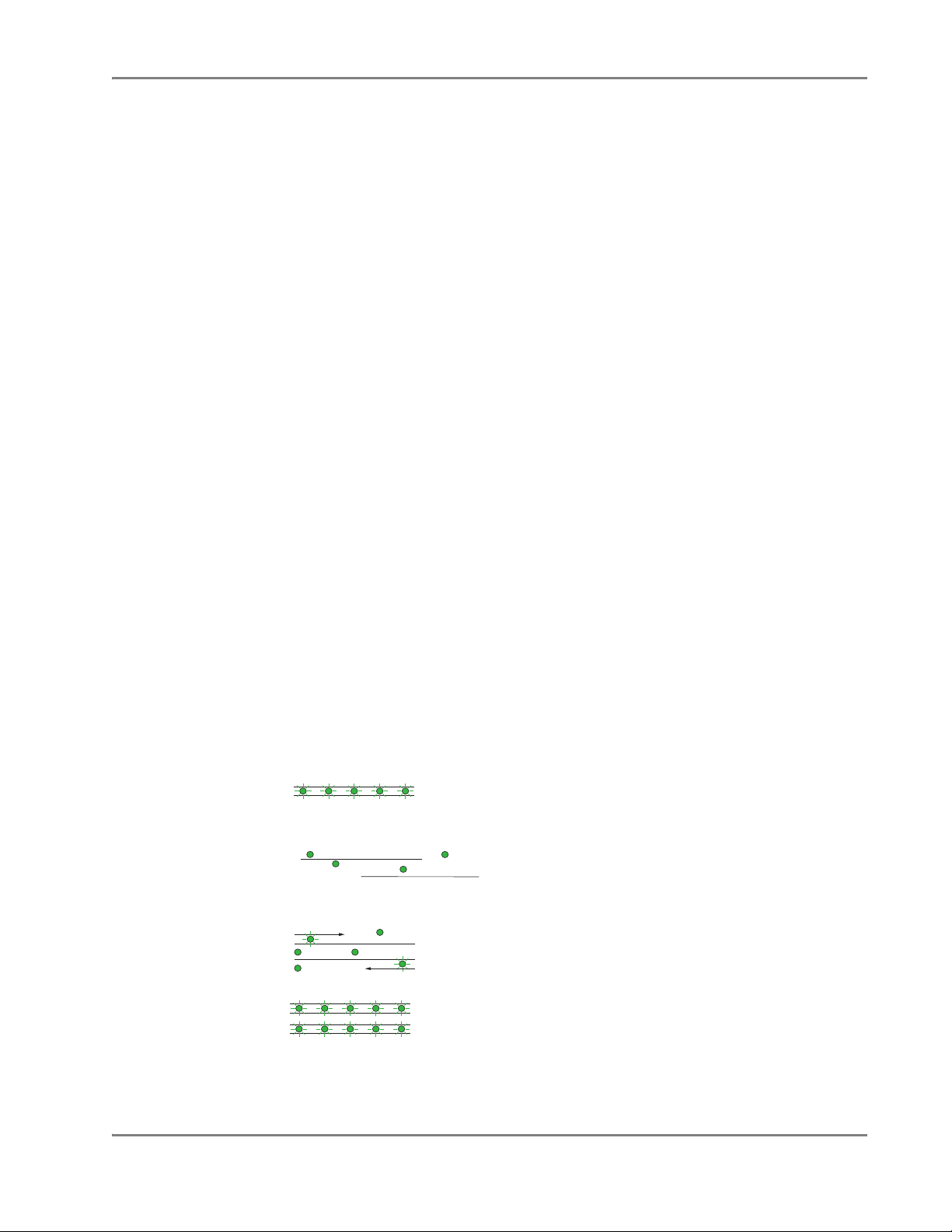
The SYBR Green reagents use the SYBR Green I dye to detect PCR products by
binding to double-stranded DNA formed during the PCR. Here is how it works:
Step 1 – When added to a sample, SYBR Green I dye immediately binds to all
double-stranded DNA.
®
Step 2 – During the PCR, AmpliTaq Gold
DNA Polymerase amplifies the target,
which creates the PCR product, or “amplicon.” The double-stranded DNA is
denatured to single-stranded molecules and the SYBR Green I dye is released.
Step 3 – The primers anneal to the single-stranded DNA and the Amplitaq Gold
DNA Polymerase amplifies the target, creating more double stranded DNA. As the
PCR progresses, more amplicon is created.
Step 4 – The SYBR Green I dye then binds to each new copy of double-stranded
DNA that is generated during each PCR cycle. Since the SYBR Green I dye binds to
all double-stranded DNA, the result is an increase in fluorescence intensity
proportional to the quantity of double-stranded PCR product produced.
Figures 2-2 below illustrates this process.
Step 1: Reaction setup
The SYBR® Green I dye
fluoresces when bound to
double-stranded DNA.
Step 2: Denaturation
When the DNA is denatured into
single-stranded DNA, the
®
SYBR Green I dye is released and
the fluorescence is drastically reduced.
FORWARD
PRIMER
REVERSE
PRIMER
Step 3: Polymerization
During extension, primers
anneal and PCR product
is generated.
Step 4: Polymerization completed
SYBR® Green I dye binds to the
double-stranded product,
resulting in a net increase in
fluorescence detected by the
instrument.
Figure 2-2 How the SYBR Green reagents work
2-5Applied Biosystems StepOne™ and StepOnePlus™ Real-Time PCR Systems Reagent Guide
Page 30

Chapter 2 Reagent Overview
Selecting the Appropriate Reagent Type
The TaqMan and SYBR Green reagents can be used for the experiment types listed
below.
Experiment Type
Reagent Type
®
SYBR
Green reagents Yes Not
®
Ta q Ma n
‡ Includes standard curve, relative standard curve, and comparative C
reagents Yes Yes Yes
Quantitation
(Chapter 3)
‡
Genotyping
(Chapter 4)
recommended
Presence/
Absence
(Chapter 5)
recommended
experiments.
T
IMPORTANT! Applied Biosystems does not recommend the use of TAMRA
as a reporter or quencher with the StepOne system. TAMRA dye may be used as a
reporter or quencher with the StepOnePlus system.
Considerations
for Quantitation
Quantitation experiments can be performed with either TaqMan or SYBR Green
reagents. Consider the following when choosing between the two reagent types:
Experiments
Reagent Type Description Advantage Limitation
Ta q Ma n®
reagents
®
Green
SYBR
reagents
TaqMan reagents use a
fluorogenic probe to enable
detection of a specific PCR
product as it accumulates
during PCR cycles.
SYBR Green reagents use
SYBR® Green I dye, a doublestranded DNA binding dye, to
detect PCR products as they
accumulate during PCR
cycles.
• Provides increased
specificity with the addition
of a fluorogenic probe.
• Provides multiplex
capability.
• Includes preformulated
assays, optimized to run
under universal thermal
cycling conditions.
• Can be used for either 1- or
2-step RT-PCR.
• Is economical (no probe
needed).
• Allows for melt curve
analysis to measure the Tm
of all PCR products.
• Can be used for either 1- or
2-step RT-PCR.
Requires synthesis of a unique
fluorogenic probe.
Binds nonspecifically to all
double-stranded DNA
sequences. To avoid false
positive signals, check for
nonspecific product formation
using melt curve or gel
analysis.
Not
™
dye
2-6 Applied Biosystems StepOne™ and StepOnePlus™ Real-Time PCR Systems Reagent Guide
Page 31

Minimizing DNA Contaminants
The DNA amplification capability of the PCR process makes special laboratory
practices necessary when you perform experiments using TaqMan or SYBR Green
reagents. Potential contamination can be introduced by samples with high DNA
concentrations, either from the DNA template controls or from PCR carryover.
In addition, due to the nonspecific nature of the SYBR Green I dye, any doublestranded DNA will be detected. When using SYBR Green reagents, check for
nonspecific product formation by using melt curve or gel analysis. Take care to avoid
contamination with target DNA. Gene expression assays that span exon-exon
junctions minimize the effect of gDNA (genomic DNA) contaminants.
Chapter 2 Reagent Overview
Using UNG to
Minimize
Reamplification
of Carryover
Products
AmpErase® uracil-N-glycosylase (UNG) is a 26-kDa recombinant enzyme encoded
by the Escherichia coli uracil-N-glycosylase gene. This gene has been inserted into
an E. coli host to direct expression of the native form of the enzyme (Kwok and
Higuchi, 1989).
UNG acts on single- and double-stranded dU-containing DNA. It acts by
hydrolyzing uracil-glycosidic bonds at dU-containing DNA sites. The enzyme
causes the release of uracil, thereby creating an alkali-sensitive apyrimidic site in the
DNA. The enzyme has no activity on RNA or dT-containing DNA (Longo et al.,
1990).
TaqMan Assays
For TaqMan® assays, AmpErase®UNG treatment can prevent the reamplification of
carryover PCR products from previous PCR reactions. When dUTP replaces dTTP in
PCR amplification, AmpErase UNG treatment can remove up to 200,000 copies of
amplicon per 50-μL reaction.
Note: AmpErase UNG (also abbreviated as UDG for uracil-DNA-glycosylase) is
included in some Applied Biosystems TaqMan master mix formulations and can also
be purchased individually. When purchasing TaqMan master mixes, check the
product information to see if the master mix contains AmpErase UNG.
SYBR Green I Dye Assays
For SYBR Green I dye assays, AmpErase UNG treatment can prevent the
reamplification of carryover PCR products from previous PCR reactions. Although
Powe r SYBR
®
Green PCR Master Mix and SYBR® Green PCR Master Mix do not
contain AmpErase UNG, they contain dUTP and are thus compatible with
AmpErase UNG. If contamination from PCR carryover is suspected, use
AmpErase UNG to troubleshoot the problem.
Note: AmpErase UNG can be purchased individually or as part of the
®
SYBR
Green PCR Core Reagents kit.
2-7Applied Biosystems StepOne™ and StepOnePlus™ Real-Time PCR Systems Reagent Guide
Page 32

Chapter 2 Reagent Overview
General PCR
Practices
Use the following precautions to minimize sample contamination and PCR product
carryover:
• Wear a clean lab coat (not previously worn while handling amplified PCR
products or used during sample preparation) and clean gloves when preparing
samples for PCR amplification. Change gloves whenever you suspect that they
are contaminated.
• Maintain separate areas, dedicated equipment, and supplies for:
– Sample preparation.
– PCR setup. Never bring amplified PCR products into the PCR setup area.
– PCR amplification.
– Analysis of PCR products.
• Open and close all sample tubes carefully. Avoid splashing or spraying PCR
samples.
• Use positive-displacement or air-displacement pipettors with filter-plugged tips.
Change tips after each use.
• Keep reactions and components capped as much as possible.
• Clean lab benches and equipment periodically with 10% bleach solution or 70%
ethanol.
2-8 Applied Biosystems StepOne™ and StepOnePlus™ Real-Time PCR Systems Reagent Guide
Page 33

Quantitation Experiments 3
This chapter covers:
Section 3.1 About Quantitation Experiments . . . . . . . . . . . . . . . . . . . . . . . . . . . . . 3-3
Section 3.2 Design Guidelines . . . . . . . . . . . . . . . . . . . . . . . . . . . . . . . . . . . . . . . 3-15
3
3-1Applied Biosystems StepOne™ and StepOnePlus™ Real-Time PCR Systems Reagent Guide
Page 34

Chapter 3 Quantitation Experiments
3-2 Applied Biosystems StepOne™ and StepOnePlus™ Real-Time PCR Systems Reagent Guide
Page 35

Chapter 3 Quantitation Experiments
Section 3.1 About Quantitation Experiments
This section covers:
Overview . . . . . . . . . . . . . . . . . . . . . . . . . . . . . . . . . . . . . . . . . . . . . . . . . . . . . . . . . 3-4
Select a Quantitation Method . . . . . . . . . . . . . . . . . . . . . . . . . . . . . . . . . . . . . . . . . 3-5
Select 1-Step or 2-Step RT-PCR . . . . . . . . . . . . . . . . . . . . . . . . . . . . . . . . . . . . . . . 3-8
Select Singleplex or Multiplex PCR . . . . . . . . . . . . . . . . . . . . . . . . . . . . . . . . . . . 3-10
Select the Reagent Type . . . . . . . . . . . . . . . . . . . . . . . . . . . . . . . . . . . . . . . . . . . . 3-12
Select the Assay Type . . . . . . . . . . . . . . . . . . . . . . . . . . . . . . . . . . . . . . . . . . . . . . 3-12
3-3Applied Biosystems StepOne™ and StepOnePlus™ Real-Time PCR Systems Reagent Guide
Page 36

Chapter 3 Quantitation Experiments
Overview
What Is a
Quantitation
Experiment?
How Quantitation
Experiments
Work
A quantitation experiment is a real-time experiment that measures the quantity of a
target nucleic acid sequence (target) during each amplification cycle of the
polymerase chain reaction (PCR). The target can be DNA, cDNA, or RNA.
Three types of quantitation experiments are discussed in this guide:
• Standard curve (page 3-5)
• Relative standard curve (page 3-5)
• Comparative C
In real-time quantitation experiments, the reactions are characterized by the point in
time during cycling when amplification of a PCR product achieves a fixed level of
fluorescence, rather than the final quantity of PCR product accumulated after a fixed
number of cycles. An amplification plot graphically displays the fluorescence
detected over the number of cycles that were performed.
In the initial cycles of PCR, there is no significant change in fluorescence signal.
This predefined range of PCR cycles is called the baseline. First, the software
generates a baseline-subtracted amplification plot by calculating a mathematical
trend of the normalized fluorescent reporter signal (Rn values corresponding to the
baseline cycles). Then, an algorithm searches for the point on the amplification plot
at which the baseline-corrected normalized fluorescent reporter signal (delta Rn
[ΔRn] value) crosses a set threshold. The cycle at which the ΔRn value crosses the
threshold is defined as the C
(ΔΔCT) (page 3-6)
T
.
T
Workflow
Before performing quantitation experiments on the Applied Biosystems StepOne and
StepOnePlus
1. Select a quantitation method (page 3-5).
2. Select 1- or 2-step RT-PCR (page 3-8).
3. Select singleplex or multiplex PCR reactions (page 3-10).
4. Select the reagent type (page 3-12).
5. Select the assay type (page 3-12).
6. Review the design guidelines for the assay type you selected (Section 3.2 on
page 3-15).
™
Real-Time PCR Systems, prepare for the experiment as follows:
3-4 Applied Biosystems StepOne™ and StepOnePlus™ Real-Time PCR Systems Reagent Guide
Page 37

Select a Quantitation Method
Chapter 3 Quantitation Experiments
About Standard
Curve
Experiments
About Relative
Standard Curve
Experiments
The standard curve method is used to determine the absolute target quantity in
samples. With the standard curve method, the StepOne software measures
amplification of the target in samples and in a standard dilution series. Data from the
standard dilution series are used to generate the standard curve. Using the standard
curve, the software interpolates the absolute quantity of target in the samples.
Components
The following components are required when setting up PCR reactions for standard
curve experiments:
• Sample – The sample in which the quantity of the target is unknown.
• Standard – A sample that contains known standard quantities; used in
quantitation experiments to generate standard curves.
• Standard dilution series – A set of standards containing a range of known
quantities. The standard dilution series is prepared by serially diluting
standards.
• Replicates – The total number of identical reactions containing identical
samples, components, and volumes.
• Negative Controls – Wells that contain water or buffer instead of sample
template. No amplification of the target should occur in negative control wells.
The relative standard curve method is used to determine relative target quantity in
samples. With the relative standard curve method, the StepOne software measures
amplification of the target and of the endogenous control in samples, in a reference
sample, and in a standard dilution series. Measurements are normalized using the
endogenous control. Data from the standard dilution series are used to generate the
standard curve. Using the standard curve, the software interpolates target quantity in
the samples and in the reference sample. The software determines the relative
quantity of target in each sample by comparing target quantity in each sample to
target quantity in the reference sample.
Relative standard curve experiments are commonly used to:
• Compare expression levels of a gene in different tissues.
• Compare expression levels of a gene in a treated sample vs. an untreated
sample.
• Compare expression levels of wild-type alleles vs. mutated alleles.
Components
The following components are required when setting up PCR reactions for relative
standard curve experiments:
• Sample – The sample in which the quantity of the target is unknown.
• Reference sample – The sample used as the basis for relative quantitation
results. For example, in a study of drug effects on gene expression, an untreated
control would be an appropriate reference sample. Also called calibrator.
3-5Applied Biosystems StepOne™ and StepOnePlus™ Real-Time PCR Systems Reagent Guide
Page 38

Chapter 3 Quantitation Experiments
• Standard – A sample that contains known standard quantities; used in
quantitation experiments to generate standard curves.
• Standard dilution series – A set of standards containing a range of known
quantities. The standard dilution series is prepared by serially diluting
standards.
• Endogenous control – A target or gene that should be expressed at similar
levels in all samples you are testing. The endogenous control is used to
normalize fluorescence signals for the target you are quantifying. Housekeeping
genes can be used as endogenous controls.
• Replicates – The total number of identical reactions containing identical
samples, components, and volumes.
• Negative Controls – Wells that contain water or buffer instead of sample
template. No amplification of the target should occur in negative control wells.
About
Comparative C
Experiments
The comparative CT (ΔΔCT) method is used to determine the relative target quantity
in samples. With the comparative C
T
method, the StepOne software measures
T
amplification of the target and of the endogenous control in samples and in a
reference sample. Measurements are normalized using the endogenous control. The
software determines the relative quantity of target in each sample by comparing
normalized target quantity in each sample to normalized target quantity in the
reference sample.
Comparative C
experiments are commonly used to:
T
• Compare expression levels of a gene in different tissues.
• Compare expression levels of a gene in a treated sample vs. an untreated
sample.
• Compare expression levels of wild-type alleles vs. mutated alleles.
Components
The following components are required when setting up PCR reactions for
comparative C
experiments:
T
• Sample – The sample in which the quantity of the target is unknown.
• Reference sample – The sample used as the basis for relative quantitation
results. For example, in a study of drug effects on gene expression, an untreated
control would be an appropriate reference sample. Also called calibrator.
• Endogenous control – A target or gene that should be expressed at similar
levels in all samples you are testing. The endogenous control is used to
normalize fluorescence signals for the target you are quantifying. Housekeeping
genes can be used as endogenous controls.
• Replicates – The total number of identical reactions containing identical
samples, components, and volumes.
• Negative Controls – Wells that contain water or buffer instead of sample
template. No amplification of the target should occur in negative control wells.
3-6 Applied Biosystems StepOne™ and StepOnePlus™ Real-Time PCR Systems Reagent Guide
Page 39

Chapter 3 Quantitation Experiments
Comparison of
Quantitation
Consider the following when choosing between standard curve, relative standard
curve, and comparative C
Methods
Experiment
Ty pe
Standard curve Uses a standard curve to
Relative
standard curve
Comparative
(ΔΔCT)
C
T
determine the absolute
quantity of a target in a
sample. Typically used for
quantifying viral load.
Uses a standard curve to
determine the change in
expression of a target in a
sample relative to the same
target in a reference sample.
Best for assays that have
suboptimal PCR efficiency.
Uses arithmetic formulas to
determine the change in
expression of a target in a
sample relative to the same
target in a reference sample.
Best for high-throughput
measurements of relative gene
expression of many genes in
many samples.
Description Advantage Limitation
experiments:
T
Allows comparisons against
known standard quantities.
Requires the least amount of
validation because the PCR
efficiencies of the target and
endogenous control do not
need to be equivalent.
• Relative levels of target in
samples can be determined
without the use of a
standard curve, provided
that the PCR efficiencies of
the target and endogenous
control are relatively
equivalent.
• Reduced reagent usage.
• More space is available in
the reaction plate.
Because a standard curve
must be constructed for each
target, standard curve
experiments require more
reagents and more space in
the reaction plate.
Because a standard curve
must be constructed for each
target, relative standard curve
experiments require more
reagents and more space in
the reaction plate.
• Suboptimal (low PCR
efficiency) assays may
produce inaccurate results.
• Before you use the
comparative C
Applied Biosystems
recommends that you
determine that the PCR
efficiencies for the target
assay and the endogenous
control assay are
approximately equal.
method,
T
For More
Information
For more information on quantitation methods, refer to User Bulletin #2: Relative
Quantitation of Gene Expression.
3-7Applied Biosystems StepOne™ and StepOnePlus™ Real-Time PCR Systems Reagent Guide
Page 40

Chapter 3 Quantitation Experiments
Single
Tu be
Select 1-Step or 2-Step RT-PCR
Reverse transcription-polymerase chain reaction (RT-PCR) is used to quantify RNA.
RT-PCR can be performed as a 1-step or 2-step procedure.
About 1-Step
RT-PCR
In 1-step RT-PCR, you perform reverse transcription and the PCR in a single buffer
system (Figure 3-1). The reaction proceeds without the addition of reagents between
the RT and PCR steps. 1-step RT-PCR offers the convenience of a single-tube
preparation for RT and PCR amplification. However, the carryover prevention
enzyme, AmpErase
®
uracil-N-glycosylase (UNG), cannot be used with 1-step RTPCR. In 1-step RT-PCR, the presence of UNG would destroy the cDNA as it is being
made. For information about UNG, see “Using UNG to Minimize Reamplif ication of
Carryover Products” on page 2-7.
Figure 3-1 Schematic representation of 1-step RT-PCR
About 2-Step
RT-PCR
In 2-step RT-PCR, you perform two separate reactions: one for RT and one for PCR
(Figure 3-2). 2-step RT-PCR is useful when detecting multiple transcripts from a
single cDNA reaction, or when storing a portion of the cDNA for later use. When
you perform PCR using dUTP as one of the bases, you can use AmpErase
®
UNG
enzyme to prevent carryover contamination. For information about UNG, see “Using
UNG to Minimize Reamplification of Carryover Products” on page 2-7.
3-8 Applied Biosystems StepOne™ and StepOnePlus™ Real-Time PCR Systems Reagent Guide
Page 41

Chapter 3 Quantitation Experiments
Tube 1
Tube 2
PCR Step
Oligo d(T) or random hexamer
Figure 3-2 Schematic representation of 2-step RT-PCR
Primers Used for
cDNA Synthesis
For 1-step RT-PCR, sequence-specific reverse primers can be used for cDNA
synthesis.
For 2-step RT-PCR, the following primers can be used for cDNA synthesis:
• Oligo d(T)
16
• Random primers
• Sequence-specific reverse primers
The choice of primers for reverse transcription is best made after experimentally
evaluating all three priming systems. For short RNA sequences containing no hairpin
loops, any of the three priming systems works equally well. For longer RNA
transcripts or sequences containing hairpin loops, consider the following guidelines:.
Primers Selection Guidelines
Oligo d(T)
Random primers • Try first for use with long reverse transcripts or reverse
Sequence-specific
reverse primers
16
• Use to reverse transcribe only eukaryotic mRNAs and
retroviruses with poly-A tails
• Avoid long mRNA transcripts or amplicons greater than
2 kilobases upstream from the poly-A site
transcripts containing hairpin loops
• Use to transcribe all RNA (rRNA, mRNA, and tRNA)
• Use to reverse transcribe RNA-containing complementary
sequences only
•Use in 1-step RT-PCR
Comparison of
RT-PCR Methods
Method Primers for cDNA Synthesis Comments
1-step
RT-PCR
2-step
RT-PCR
Sequence-specific reverse primer Requires single reaction mix
AmpErase
Random hexamers cDNA can be stored for later use
Oligo d(T)
Sequence-specific reverse primers
16
AmpErase
Requires two reaction mixes
®
UNG cannot be used
®
UNG can be used
3-9Applied Biosystems StepOne™ and StepOnePlus™ Real-Time PCR Systems Reagent Guide
Page 42

Chapter 3 Quantitation Experiments
Select Singleplex or Multiplex PCR
You can perform a PCR reaction using either:
• Singleplex PCR – In singleplex PCR a single primer set is present in the
reaction tube or well. Only one target or endogenous control can be amplified
per reaction.
or
• Multiplex PCR – In multiplex PCR, two or more primer sets are present in the
reaction tube or well. Each set amplifies a specific target or endogenous control.
Typically, a probe labeled with FAM
labeled with VIC
IMPORTANT! SYBR
IMPORTANT! Applied Biosystems does not recommend the use of TAMRA
dye as a reporter or quencher with the StepOne system. TAMRA dye may be
used as a reporter or quencher with the StepOnePlus system.
Singleplex PCR
Singleplex PCR
®
dye detects the endogenous control.
®
Green reagents cannot be used for multiplex PCR.
Multiplex PCR
Multiplex PCR
™
dye detects the target and a probe
Target Primer Set
Target Primer Set
Endogenous Control
Endogenous Control
Primer Set
Primer Set
cDNA
cDNA
GR2331
GR2331
™
About Multiplex
PCR
Figure 3-3 Singleplex vs. multiplex PCR
In order to perform multiplex PCR you must:
• Ensure that the endogenous control you have selected is more abundant (lower
value) than all of the targets that you are trying to quantify under all
C
T
conditions.
• Run the endogenous control assay as a primer-limited assay. The endogenous
control assay (for the more abundant template) in each reaction must be primerlimited to avoid competitive PCR that may alter the C
of the less abundant
T
template.
Primer Limiting in Multiplex PCR
To generate an accurate multiplex assay, it is important that the amplification of one
species does not dominate amplification of the other species. Otherwise, the
amplification of a highly abundant species can prevent the less-abundant species
from amplifying eff iciently.
If the less-abundant species does not amplify efficiently, your experiment may
produce inaccurate results or, in severe cases, detection of the less-abundant species
may be inhibited completely. You can avoid this situation by limiting the
concentrations of the primers used to amplify the more abundant species, thereby
“turning off” the amplification soon after the C
has been established. However, a
T
primer-limited assay may be more susceptible to fluctuations in reaction conditions
than the primer non-limited target assay that it is normalizing. For more information,
see Appendix B, “Primer Limiting in Multiplex PCR.”
3-10 Applied Biosystems StepOne™ and StepOnePlus™ Real-Time PCR Systems Reagent Guide
Page 43

Chapter 3 Quantitation Experiments
Singleplex vs.
Multiplex PCR
Primer limiting in multiplex PCR becomes increasingly more complex as the number
of targets you quantify increases. When you analyze multiple numbers of targets, it
may be more effective to use singleplex PCR for the following reasons:
• In multiplex PCR, it may be difficult to find a suitable endogenous control, one
that:
– Is more abundant than all of the targets you are quantifying.
– Does not change expression levels with experimental conditions or across
different samples.
You would first have to run all of your target assays and endogenous control
assays in both the multiplex and singleplex formats, then compare C
from both formats to determine if there are any effects of the multiplexing on
your C
values.
T
• In singleplex PCR, any target that does not change expression levels with
experimental conditions or across samples may serve as an endogenous control.
Therefore, the more targets you have in a singleplex format, the higher the
probability that you will have one or more suitable endogenous controls against
which to normalize your remaining targets.
Consider the following when choosing between multiplex and singleplex PCR:
PCR Description Advantage Limitation
Singleplex A reaction in which a
single target or
endogenous control is
amplified in the reaction
tube or well.
• No optimization is required for
Ta qM an
• Any target that does not change
expression levels with
experimental conditions or across
samples may serve as an
endogenous control.
• Flexibility to use TaqMan
SYBR® Green reagents.
®
assays.
®
or
• Requires sample for both the
target and the endogenous
control.
values
T
Multiplex A reaction in which
more than one target or
endogenous control is
amplified in the reaction
tube or well.
• Reduces both the running costs
and the dependence on accurate
pipetting when splitting a sample
into two separate tubes.
• The endogenous control assay
must be run as a primer-limited
assay.
• Requires validation and
optimization.
• May not be as effective as
singleplex PCR when analyzing
multiple numbers of targets.
• You cannot use SYBR
reagents.
®
Green
3-11Applied Biosystems StepOne™ and StepOnePlus™ Real-Time PCR Systems Reagent Guide
Page 44

Chapter 3 Quantitation Experiments
Select the Reagent Type
TaqMan vs.
SYBR Green
Reagents
You can perform quantitation experiments on the StepOne and StepOnePlus systems
with:
•TaqMan
• SYBR
For information on choosing between TaqMan and SYBR Green reagents, see
“Considerations for Quantitation Experiments” on page 2-6.
®
®
Green reagents
Select the Assay Type
When you design your experiments with the StepOne software, you can select the
following assay types for quantitation experiments:
• Inventoried/Made to Order (page 3-13)
•Custom (page 3-14)
This section lists the products available for each assay type.
Note: The assays are specific to the target of interest. The master mixes contain the
remaining components needed for the PCR reaction.
reagents
3-12 Applied Biosystems StepOne™ and StepOnePlus™ Real-Time PCR Systems Reagent Guide
Page 45

Chapter 3 Quantitation Experiments
Inventoried/Made
to Order Assays
Product Attributes
Ta q Ma n
®
Gene
Expression Assays
®
Ta q Ma n
Endogenous
Control Assays
Note: FAM
™
dyelabeled TaqMan®
Endogenous Control
Assays are included as
Inventoried TaqMan
Gene Expression Assays.
Custom TaqMan
®
Gene
Expression Assays
Ta q Ma n
®
Gene
Expression Master Mix
®
Ta q Ma n
2✕ Universal
PCR Master Mix
(with or without
AmpErase
Ta q Ma n
PCR Master Mix (2✕), No
AmpErase
®
UNG)
®
Fast Universal
®
UNG
• Predesigned, gene-specific primer and probe sets for
human, mouse, rat, Arabidopsis, Drosophila, C. elegans,
C. familiares (dog), and M. mulatta (Rhesus) genes.
™
•Probe is a FAM
dye-labeled MGB probe.
• Provided in a convenient, single, 20✕ tube.
• Available as Inventoried or Made to Order assays.
• Optimized, preformulated, ready-to-use endogenous
control assays.
• Cost-effective gene expression quantitation for human,
mouse, rat, Arabidopsis, Drosophila, and any eukaryotic
species.
™
•Choice of FAM
dye or VIC® dye labels (primer-limited).
• Any species or organism.
• Target of your choice.
•Probe is a FAM™ dye-labeled MGB probe.
• Provided in a convenient, single, 205 tube.
Tailored for precise quantitation by real-time PCR for routine
and challenging experiments:
• Sensitive detection down to 1 copy of target.
• Multiplex PCR for co-amplifying two targets in a single
reaction.
• Specificity for differentiation between gene family
members.
®
• Validated with TaqMan
Gene Expression Assays.
• Simplifies assay implementation by using one reagent for
all assays.
®
• Provides optimal performance for TaqMan
assays that
use cDNA or DNA as a template.
• Contains components that ensure excellent assay
performance.
• The use of one reagent for all assays simplifies the process
of assay implementation.
• Provides the same attributes listed above for TaqMan
®
2✕
Universal PCR Master Mix.
• Allows you to run quantitation experiments on the
StepOne
™
and StepOnePlus™ systems in about 35 min.
IMPORTANT! Applied Biosystems does not recommend the use of TAMRA
™
dye as
a reporter or quencher with the StepOne system. TAMRA dye may be used as a
reporter or quencher with the StepOnePlus system.
For guidelines on designing your experiments with Inventoried/Made to Order
assays, see page 3-16.
3-13Applied Biosystems StepOne™ and StepOnePlus™ Real-Time PCR Systems Reagent Guide
Page 46

Chapter 3 Quantitation Experiments
Custom Assays
Product Attributes
Custom TaqMan
®
Probes
and Primers
Primer Express
®
Software
Ta q Ma n
®
Gene
Expression Master Mix
®
Ta q Ma n
2✕ Universal
PCR Master Mix
(with or without
AmpErase
Ta q Ma n
PCR Master Mix (2✕), No
AmpErase
Power SYBR
®
UNG)
®
Fast Universal
®
UNG
®
Green
PCR Master Mix
®
Green PCR
SYBR
Master Mix
• Any species or organism.
• Choice of dye labels, quenchers, and synthesis scales.
• For use with the Primer Express® Software and Applied
Biosystems Assay Design Guidelines.
Software that designs primers and probes for real-time PCR.
Tailored for precise quantitation by real-time PCR for routine
and challenging experiments:
• Sensitive detection down to 1 copy of target.
• Multiplex PCR for co-amplifying two targets in a single
reaction.
• Specificity for differentiation between gene family
members.
®
• Validated with TaqMan
Gene Expression Assays.
• Simplifies assay implementation by using one reagent for
all assays.
®
• Provides optimal performance for TaqMan
assays that
use cDNA or DNA as a template.
• Contains components that ensure excellent assay
performance.
• The use of one reagent for all assays simplifies the process
of assay implementation.
• Provides the same attributes listed above for TaqMan
®
2✕
Universal PCR Master Mix.
• Allows you to run quantitation experiments on the
StepOne
™
and StepOnePlus™ systems in about 35 min.
• Highly sensitive quantitation enables low-copy-number
detection (as few as two copies of a target gene).
• Detects double-stranded DNA, so specific probes are not
required.
®
• Contains highly purified AmpliTaq Gold
DNA polymerase
LD to minimize nonspecific product formation (including
primer-dimer).
®
• For use with the Primer Express
Software and Applied
Biosystems Assay Design Guidelines.
• Detects double-stranded DNA, so specific probes are not
required.
• For standard applications when high sensitivity is not
required.
®
• Contains AmpliTaq Gold
DNA polymerase to minimize
nonspecific product formation (including primer-dimer).
• For use with the Primer Express
®
Software and Applied
Biosystems Assay Design Guidelines.
IMPORTANT! Applied Biosystems does not recommend the use of TAMRA
™
dye as
a reporter or quencher with the StepOne system. TAMRA dye may be used as a
reporter or quencher with the StepOnePlus system.
For guidelines on designing your experiments with Custom assays, see page 3-21.
3-14 Applied Biosystems StepOne™ and StepOnePlus™ Real-Time PCR Systems Reagent Guide
Page 47

Section 3.2 Design Guidelines
This section covers:
Inventoried/Made to Order Assays . . . . . . . . . . . . . . . . . . . . . . . . . . . . . . . . . . . . 3-16
TaqMa n
Custom TaqMan
Select the Master Mix . . . . . . . . . . . . . . . . . . . . . . . . . . . . . . . . . . . . . . . . . 3-19
Design the Experiment . . . . . . . . . . . . . . . . . . . . . . . . . . . . . . . . . . . . . . . . 3-20
Custom Assays . . . . . . . . . . . . . . . . . . . . . . . . . . . . . . . . . . . . . . . . . . . . . . . . . . . 3-21
Design Primers and Probes Using Primer Express
Select the Reagents . . . . . . . . . . . . . . . . . . . . . . . . . . . . . . . . . . . . . . . . . . . 3-24
Use the Recommended Thermal Cycling Conditions . . . . . . . . . . . . . . . . . 3-27
Optimize Primer Concentrations . . . . . . . . . . . . . . . . . . . . . . . . . . . . . . . . . 3-30
Optimize the Probe Concentration . . . . . . . . . . . . . . . . . . . . . . . . . . . . . . . 3-33
For More Information . . . . . . . . . . . . . . . . . . . . . . . . . . . . . . . . . . . . . . . . . 3-35
®
Gene Expression Assays . . . . . . . . . . . . . . . . . . . . . . . . . . . . . . . 3-16
®
Gene Expression Assays . . . . . . . . . . . . . . . . . . . . . . . . 3-18
Chapter 3 Quantitation Experiments
®
Software . . . . . . . . . . 3-21
3-15Applied Biosystems StepOne™ and StepOnePlus™ Real-Time PCR Systems Reagent Guide
Page 48

Chapter 3 Quantitation Experiments
Inventoried/Made to Order Assays
Workflow
If you select the Inventoried/Made to Order assay type in the StepOne™ software,
Applied Biosystems recommends that you follow the workflow below:
1. Select the assay:
•TaqMan
®
Gene Expression Assays (below).
• Custom TaqMan
2. Select the master mix (page 3-19).
3. Design the experiment using the StepOne software (page 3-20).
TaqM an® Gene Expression Assays
Product
Description
TaqMan® Gene Expression Assays are a comprehensive collection of Inventoried
and Made to Order probe and primer sets for performing quantitation experiments on
human, mouse, rat, Arabidopsis, Drosophila, C. elegans, C. familiares (dog), and
M. mulatta (Rhesus) genes.
The assays:
•Use TaqMan
®
reagents to amplify and detect the target in cDNA samples.
• Are designed using an automated design and quality-controlled pipeline.
Inventoried assays are manufactured and placed in inventory; Made to Order
assays are predesigned and manufactured when ordered.
• Are designed and optimized to work with an Applied Biosystems TaqMan
master mix, using universal thermal cycling conditions.
• When possible, amplify target cDNA without amplifying genomic DNA
(m suffix in assay ID) by designing probes that cross exon-exon junctions.
®
Gene Expression Assays (page 3-18).
®
Product
Requirements
All TaqMan Gene Expression Assays require:
• Three components:
– 1 to 100 ng of cDNA sample (converted from RNA) per well, with all wells
in a study having the same amount of cDNA.
–20✕ Gene Expression Assay Mix (specific for each target). Each assay mix
consists of two unlabeled PCR primers and a FAM
™
dye-labeled TaqMan®
MGB (minor groove binder) probe in a preformulated 20✕ mix. 1✕ final
concentrations are 250 nM for the probe and 900 nM for each primer.
–TaqMan
Mix (with or without AmpErase
Master Mix, No AmpErase
®
Gene Expression Master Mix, TaqMan® Universal PCR Master
®
UNG), or TaqMan® Fast Universal PCR
®
UNG.
• Only one PCR amplification step during each PCR cycle and a simultaneous
real-time reading to obtain results.
3-16 Applied Biosystems StepOne™ and StepOnePlus™ Real-Time PCR Systems Reagent Guide
Page 49

Chapter 3 Quantitation Experiments
Available Assays
TaqMan Gene Expression Assays are available for human, mouse, rat, Arabidopsis,
Drosophila, C. elegans, C. familiares (dog), and M. mulatta (Rhesus) genes. The part
numbers are:
• PN 4331182 for Inventoried assays
• PN 4351372 for Made to Order assays
The prefix of the assay name indicates the species for which the assay was designed:
Hs for Homo sapiens (human), Mm for Mus musculus (mouse), Rn for Rattus
norvegicus (rat), At for Arabidopsis thaliana, Dm for Drosophila melanogaster,
Ce for C. elegans, Cf for C. familiares (dog), and Rh for M. mulatta (Rhesus).
The suffix of the assay name indicates the assay placement, as described in the table
below.
Suffix Description
_m The assay’s probe spans an exon junction; the assay does not detect
genomic DNA.
_s The assay’s primers and probes are designed within a single exon; the assay
does detect genomic DNA.
_g The assay may detect genomic DNA; the assay’s primers and probes may be
within a single exon.
_mH The assay was designed to a transcript belonging to a gene family with high
_sH
_gH
_u The assay’s amplicon spans an exon junction and the probe sits completely in
sequence homology. The assay provides between 10 C
between the target gene and the gene with the closest sequence homology.
Therefore, the assay detects the target transcript with 1000- to 30,000-fold
greater discrimination (sensitivity) than the closest homologous transcript, if
they are present at the same copy number in a sample.
one of the spanned exons.
and 15 CT difference
T
Taq Ma n® Endogenous Control Assays
TaqMa n® Endogenous Control Assays are available as:
• Inventoried TaqMan Gene Expression Assays (PN 4331182) – Each assay
™
contains a FAM
dye-labeled TaqMan® MGB probe in a single, preformulated
20✕ tube.
• Individual control assays for all human, mouse, and rat species (various part
numbers) – Each assay contains either a FAM
probe, a VIC
®
dye-labeled TaqMan® MGB probe, or a TAMRA™ dye-labeled
™
dye-labeled TaqMan® MGB
probe. TaqMan Endogenous Controls with VIC dye labels are primer-limited.
IMPORTANT! Applied Biosystems does not recommend the use of TAMRA
™
dye as
a reporter or quencher with the StepOne system. TAMRA dye may be used as a
reporter or quencher with the StepOnePlus system.
3-17Applied Biosystems StepOne™ and StepOnePlus™ Real-Time PCR Systems Reagent Guide
Page 50

Chapter 3 Quantitation Experiments
For More
Information
• For information on the latest available products and specific product uses, refer
to the Applied Biosystems Web site:
http://www.appliedbiosystems.com/
a. On the Home page, under TaqMan
®
Products, select Taq Ma n® Gene
Expression Assays.
b. On the Gene Expression Assays & Arrays page:
• Under Individual Assays, select Taq Ma n
®
Gene Expression Assays.
This option links to all TaqMan Gene Expression Assays, including
TaqMan Endogenous Control Assays that contain FAM dye-labeled
probes.
or
• Under Individual Control Assays, select Ta qM a n
®
Endogenous
Control Assays. This option links to the individual TaqMan
Endogenous Control Assays (that contain FAM dye-labeled TaqMan
MGB probes, VIC dye-labeled TaqMan MGB probes, or TAMRA
dye-labeled probes).
• For information on Custom TaqMan Endogenous Control Assays, refer to the
Using TaqMan
®
Endogenous Control Assays to Select an Endogenous Control
for Experimental Studies Application Note.
• For information on preparing PCR reactions using the TaqMan Gene Expression
Assays, refer to the TaqMan
®
Gene Expression Assays Protocol.
Custom TaqMan® Gene Expression Assays
Product
Description
Product
Requirements
Custom TaqMan® Gene Expression Assays are TaqMan probe and primer sets that
are designed, synthesized, and formulated by the Custom TaqMan
service based on sequence information that you submit. Custom TaqMan Gene
Expression Assays allow you to perform quantitation experiments on any gene or
splice variant in any organism.
The assays:
®
•Use TaqMan
reagents to amplify and detect the target in cDNA samples.
• Are developed using proprietary assay-design software.
• Are designed and optimized to work with an Applied Biosystems TaqMan
master mix, using universal thermal cycling conditions.
All Custom TaqMan Gene Expression Assays require:
• A submission file that includes your target sequence. You create the submission
file using free File Builder software, then submit the file to the Custom
®
Taq Ma n
Genomic Assays service.
• Three components:
– 1 to 100 ng of cDNA sample (converted from RNA) per well, with all wells
in a study having the same amount of cDNA.
–20✕ Gene Expression Assay or 60✕ Gene Expression Assay (specific for
each target). Each assay consists of two target-specific primers and a FAM
dye-labeled TaqMan MGB probe in a preformulated 20✕ or 60✕ mix. 1✕
final concentrations are 250 nM for the probe and 900 nM for each primer.
®
Genomic Assays
®
™
3-18 Applied Biosystems StepOne™ and StepOnePlus™ Real-Time PCR Systems Reagent Guide
Page 51

Chapter 3 Quantitation Experiments
• Only one PCR amplification step during each PCR cycle and a simultaneous
For More
• For information on the latest available products and specific product uses, refer
Information
• For information on ordering Custom TaqMan Gene Expression Assays, refer to
• For information on preparing PCR reactions using the Custom TaqMan Gene
Select the Master Mix
–TaqMan® Gene Expression Master Mix, TaqMan® Universal PCR Master
Mix (with or without AmpErase
Master Mix, No AmpErase
®
UNG), or TaqMan® Fast Universal PCR
®
UNG.
real-time reading to obtain results.
to the Applied Biosystems Web site:
http://www.appliedbiosystems.com/
a. On the Home page, under TaqMan
®
Products, select TaqM an® Gene
Expression Assays.
b. On the Gene Expression Assays & Arrays page, under Individual Assays,
select Custom TaqMan
the Custom TaqMan
®
Genomic Assays Protocol: Submission Guidelines.
Expression Assays, refer to the Custom TaqMan
®
Gene Expression Assays.
®
Gene Expression Assays
Protocol.
Available Master
Mixes
Applied Biosystems Inventoried/Made to Order assays for quantitation experiments
are designed to work with the following TaqMan
Master Mix Part Number
Ta q Ma n
200 reactions
Ta q Ma n
2000 reactions
Ta q Ma n
250 Reactions
Ta q Ma n
Ta q Ma n
10-Pack, TaqMan
Ta q Ma n
Reactions
Ta q Ma n
Reactions
10-Pack, TaqMan
UNG
®
Gene Expression Master Mix, 1-Pack (1 × 5 mL),
®
Gene Expression Master Mix, 10-Pack (10 × 5 mL),
®
Fast Universal PCR Master Mix (2✕), No AmpErase® UNG,
®
2✕ Universal PCR Master Mix, 200 Reactions 4304437
®
2✕ Universal PCR Master Mix, 2000 Reactions 4326708
®
2✕ Universal PCR Master Mix 4305719
®
2✕ Universal PCR Master Mix, No AmpErase® UNG, 200
®
2✕ Universal PCR Master Mix, No AmpErase® UNG, 2000
®
2✕ Universal PCR Master Mix, No AmpErase®
®
master mixes:
4369016
4369542
4352042
4324018
4326614
4324020
3-19Applied Biosystems StepOne™ and StepOnePlus™ Real-Time PCR Systems Reagent Guide
Page 52

Chapter 3 Quantitation Experiments
For More
Information
For information on using the TaqMan reagents, refer to:
• TaqMan
• TaqMan
• TaqMan
Design the Experiment
Use the StepOne
Software
For More
Information
For Applied Biosystems Inventoried/Made to Order assays, use the StepOne
software to design your quantitation experiments. The StepOne software
automatically calculates volumes for the:
• Reaction mix components
• Sample dilutions
• (Standard curve and relative standard curve experiments only) Standard
dilution series
Note: To select the Inventoried/Made to Order assay type in the StepOne software,
go to the Reaction Setup screen in either the Design Wizard or Advanced Setup, then
select Inventoried/Made to Order from the Assay Type dropdown menu.
For information on designing and performing quantitation experiments on the
StepOne and StepOnePlus systems, refer to:
• Applied Biosystems StepOne
Getting Started Guide for Standard Curve Experiments
• Applied Biosystems StepOne
Getting Started Guide for Relative Standard Curve and Comparative C
Experiments
®
Fast Universal PCR Master Mix (2✕) Protocol
®
Gene Expression Master Mix Protocol
®
Universal PCR Master Mix Protocol
™
and StepOnePlus™ Real-Time PCR Systems
™
and StepOnePlus™ Real-Time PCR Systems
T
3-20 Applied Biosystems StepOne™ and StepOnePlus™ Real-Time PCR Systems Reagent Guide
Page 53

Custom Assays
Chapter 3 Quantitation Experiments
Workflow
If you select the Custom assay type in the StepOne™ software for a quantitation
experiment (that is, you are designing your own primers and probes), Applied
Biosystems recommends that you follow the workflow for the Applied Biosystems
Assay Design Guidelines:
1. Design primers and probes using Primer Express
®
Software (below).
2. Select the appropriate reagents (page 3-24).
IMPORTANT! Applied Biosystems does not recommend the use of TAMRA
™
dye as a reporter or quencher with the StepOne system. TAMRA dye may be
used as a reporter or quencher with the StepOnePlus system.
3. Use the recommended thermal cycling conditions (page 3-27).
4. Begin with default primer and probe concentrations. If needed, optimize the
primer concentrations (page 3-30) and probe concentrations (page 3-33).
IMPORTANT! These steps provide a rapid and reliable system for assay design and
optimization only when used in their entirety. Adopt the system as a whole to
achieve the highest level of success. For a more detailed description of Applied
Biosystems Assay Design Guidelines, see Appendix C.
Note: To select the Custom assay type in the StepOne software, go to the Reaction
Setup screen in either the Design Wizard or Advanced Setup, then select Custom
from the Assay Type dropdown menu.
Design Primers and Probes Using Primer Express® Software
The Primer Express® Software uses recommended parameters to select primers and
probes based on the DNA sequence that you provide.
If you are designing your own assay, follow the summary of the primer and probe
design guidelines for quantitation experiments on page 3-23. For a detailed
discussion of these guidelines see “About the Primer and Probe Design Guidelines”
on page 3-22.
IMPORTANT! Applied Biosystems does not recommend the use of TAMRA
as a reporter or quencher with the StepOne system. TAMRA dye may be used as a
reporter or quencher with the StepOnePlus system.
®
Green I dye detection, it is
Selecting an
Amplicon Site for
Quantitation
Assays
Note: Even though a probe is not required for SYBR
still a good idea to use Primer Express software to select a primer and probe set when
you design an assay for SYBR
®
Green reagents. Although no probe will be used, the
primers will meet all required criteria; if you need to convert the assay to TaqMan
reagents to obtain higher specificity, you can find the probe immediately in the
original Primer Express software document.
Selecting a good amplicon site ensures amplification of the target mRNA/cDNA
without co-amplifying the genomic sequence, pseudogenes, and other related genes.
SYBR Green reagents can be useful for screening amplicon sites for gene
expression.
™
dye
3-21Applied Biosystems StepOne™ and StepOnePlus™ Real-Time PCR Systems Reagent Guide
Page 54

Chapter 3 Quantitation Experiments
Guidelines
• The amplicon should span one or more introns to avoid amplification of the
target gene in genomic DNA.
• The primer pair should be specific to the target gene to avoid amplification of
pseudogenes or other related genes.
• When designing primers, use Primer Express software guidelines.
• If no good sequence is found, it may be necessary to examine the sequence and
redesign the amplicon or simply screen for more sites.
If the gene you are studying does not have introns, it is not possible to design an
amplicon that will amplify the mRNA sequence without amplifying the genomic
sequence. In this case, run a control of your RNA sample that has not been reversetranscribed (RT minus controls).
About the Primer
and Probe Design
Guidelines
Selection of Small Amplicons
An important default parameter in Primer Express software is the selection of
amplicons in the 50- to 150-basepair range. Small amplicons are favored because
they promote high-efficiency amplification.
In addition, high-efficiency assays enable relative quantitation to be performed using
the comparative C
(ΔΔCT) method (Livak and Schmittgen, 2001). This method
T
increases sample throughput by eliminating the need for standard curves.
G/C Content
Whenever possible, select primers and probes in a region with a G/C content of
30 to 80%. Regions with a G/C content >80% may not denature well during thermal
cycling, leading to a less efficient reaction. G/C-rich sequences are susceptible to
nonspecific interactions that may reduce reaction efficiency and produce nonspecific
signal in assays using SYBR Green reagents. Avoid primer and probe sequences
containing runs of four or more G bases.
Melting Temperature
When you select primers and probes with the recommended melting temperature
(Tm), you can use universal thermal cycling conditions. Applied Biosystems
recommends that the probe Tm be 10 °C higher than that of the primers.
5′ End of Probes
Primer Express software does not select probes with a G on the 5′ end. The
quenching effect of a G base in this position will be present even after probe
cleavage. The presence of a G base can result in reduced fluorescence values (ΔRn)
that can negatively affect assay performance. G bases in positions close to the 5′ end,
but not on it, have not been shown to compromise assay performance.
3-22 Applied Biosystems StepOne™ and StepOnePlus™ Real-Time PCR Systems Reagent Guide
Page 55

Chapter 3 Quantitation Experiments
3′ End of Primers
To reduce the possibility of nonspecific product formation, ensure that the last five
bases on the 3′ end of the primers do not contain more than two C and/or G bases.
Under certain circumstances, such as a G/C-rich template sequence, you may have to
relax this recommendation to keep the amplicon under 150 basepairs in length. In
general, avoid primer 3′ ends extremely rich in G and/or C bases.
Summary of
Primer and MGB
Probe Design
Guidelines
Probe Guidelines Primer Guidelines
Select the probe first, then design the primers as close as possible to the probe without
overlapping the probe (amplicons of 50 to 150 basepairs are strongly recommended).
Keep the G/C content in the 30 to 80% range.
Avoid runs of an identical nucleotide, especially guanine, where runs of four or more Gs
should be avoided.
®
When using Primer Express
Tm should be 68 to 70 °C.
No G on the 5
Make TaqMan
possible without being shorter than
13 nucleotides.
′ end. The five nucleotides at the 3′ end should
®
MGB probes as short as
Software, the
When using Primer Express® Software, the
Tm should be 58 to 60 °C.
have no more than two G and/or C bases.
3-23Applied Biosystems StepOne™ and StepOnePlus™ Real-Time PCR Systems Reagent Guide
Page 56

Chapter 3 Quantitation Experiments
Select the Reagents
Several TaqMan and SYBR Green reagents are available for quantitation
experiments. The reagents you use depend on your target:
• DNA or cDNA (below).
• RNA using 1-step RT-PCR (page 3-25).
• RNA using 2-step RT-PCR (page 3-26).
Note: If you are using SYBR Green reagents, Applied Biosystems highly
recommends the Power SYBR Green reagents.
DNA or cDNA
Quantitation
Reagent Kit Part Number
Ta q Ma n® reagents TaqMan® Gene Expression Master Mix, 1-Pack
(1 × 5 mL), 200 reactions
Ta qM an
®
Gene Expression Master Mix, 10-Pack
(10 × 5 mL), 2000 reactions
Ta qM an
AmpErase
Ta qM an
®
Fast Universal PCR Master Mix (2✕), No
®
UNG, 250 Reactions
®
2✕ Universal PCR Master Mix, 200
Reactions
Ta qM an
®
2✕ Universal PCR Master Mix, 2000
Reactions
10-Pack, TaqMan
®
Ta qM an
2✕ Universal PCR Master Mix, No
AmpErase
Ta qM an
®
2✕ Universal PCR Master Mix, No
AmpErase
10-Pack, TaqMan
No AmpErase
Ta qM an
®
PCR Core Reagents Kit, 200 Reactions N808-0228
®
2✕ Universal PCR Master Mix 4305719
®
UNG, 200 Reactions
®
UNG, 2000 Reactions
®
2✕ Universal PCR Master Mix,
®
UNG
4369016
4369542
4352042
4304437
4326708
4324018
4326614
4324020
3-24 Applied Biosystems StepOne™ and StepOnePlus™ Real-Time PCR Systems Reagent Guide
Page 57

Chapter 3 Quantitation Experiments
Reagent Kit Part Number
RNA Quantitation
Using 1-Step
RT-PCR
SYBR® Green
reagents
Power SYBR® Green PCR Master Mix (1 mL),
40 reactions
Power SYBR
®
Green PCR Master Mix (5-mL),
200 reactions
Power SYBR
®
Green PCR Master Mix
(10 × 5-mL), 2000 reactions
Power SYBR
®
Green PCR Master Mix (50 mL),
2000 reactions
®
SYBR
Green PCR Master Mix (1-mL),
40 reactions
®
SYBR
Green PCR Master Mix (5-mL),
200 reactions
®
SYBR
Green PCR Master Mix (50-mL),
2000 reactions
®
SYBR
Green PCR Core Reagents, 200 Reactions 4304886
Reagent Kit Part Number
Ta q Ma n® reagents TaqMan® One-Step RT-PCR Master Mix
Reagents Kit
Ta qM an
Note: Use the TaqMan
®
EZ RT-PCR Core Reagents
®
EZ RT-PCR Core
N808-0236
Reagents when a high-temperature RT step is
required.
®
SYBR
reagents
Green
Power SYBR® Green RT-PCR Reagents Kit 4368711
®
SYBR
Green RT-PCR Reagents 4310179
4368577
4367659
4368708
4367660
4344463
4309155
4334973
4309169
3-25Applied Biosystems StepOne™ and StepOnePlus™ Real-Time PCR Systems Reagent Guide
Page 58

Chapter 3 Quantitation Experiments
RNA Quantitation
Using 2-Step
RT-PCR
Reagent Step Kit Part Number
Ta q Ma n
reagents
SYBR
reagents
®
®
Green
PCR step only TaqMan® Gene Expression Master
RT step only High-Capacity cDNA Reverse
Both RT and
PCR steps
PCR step only Power SYBR® Green PCR Master
Mix, 1-Pack (1 × 5 mL),
200 reactions
®
Ta q Ma n
Mix, 10-Pack (10 × 5 mL),
2000 reactions
Ta q Ma n® 2✕ Universal PCR Master
Mix
Ta q Ma n
Mix (2✕), No AmpErase® UNG
Tran s c ri pt i on Ki t
Ta q Ma n
Reagents
Ta q Ma n
Mix
SYBR
Gene Expression Master
®
Fast Universal PCR Master
®
Reverse Transcription
®
Gold RT PCR kit N808-232
®
Green PCR Master Mix 4309155
4369016
4369542
4304437
4352042
4374966
N808-234
4367659
About AmpliTaq
Gold DNA
Polymerase
About
MultiScribe
Reverse
Transcriptase
RT step only High-Capacity cDNA Reverse
Both RT and
PCR steps
Tran s c ri pt i on Ki t
Ta q Ma n® Reverse Transcription
Reagents
Power SYBR
Reagents Kit
SYBR
®
Green RT-PCR
®
Green RT-PCR Reagents 4310179
4374966
N808-234
4368711
The use of the hot-start enzyme AmpliTaq Gold® DNA Polymerase is an integral
part of Applied Biosystems Assay Design Guidelines for both TaqMan and SYBR
Green reagents. AmpliTaq Gold DNA Polymerase ensures a robust reaction and it
can dramatically reduce the amount of nonspecific product formation. A further
benefit is the simplification of assay setup, which can be performed at room
temperature.
Note: The DNA polymerase included in the TaqMan Fast Universal PCR Master
Mix (2✕), No AmpErase UNG, is capable of very fast hot-start PCR. The
performance is similar to that of the AmpliTaq Gold DNA Polymerase.
MultiScribe™ Reverse Transcriptase is a recombinant Moloney Murine Leukemia
Virus (MuLV) Reverse Transcriptase that reverse transcribes RNA into
complimentary DNA (cDNA).
3-26 Applied Biosystems StepOne™ and StepOnePlus™ Real-Time PCR Systems Reagent Guide
Page 59

Use the Recommended Thermal Cycling Conditions
Use the thermal cycling conditions recommended for your sample:
• DNA or cDNA (page 3-28).
• RNA using 1-step RT-PCR (page 3-28).
• RNA using 2-step RT-PCR (page 3-29).
Note: Thermal cycling conditions for Fast reagents differ from thermal cycling
conditions for standard reagents.
Chapter 3 Quantitation Experiments
About the
VeriFlex
Te ch no lo gy
The StepOnePlus instrument contains six independently thermally regulated
™
Ve ri Fl ex
™
blocks to help you optimize your thermal cycling conditions.
If you are running your experiment on a StepOnePlus instrument, you can set a
different temperature for one or more of the VeriFlex blocks, creating up to six
different zones for samples, or you can set the same temperature for each of the
VeriFlex blocks.
For more information on using the VeriFlex sample blocks, access the Help from
within the StepOne software by clicking in the toolbar or pressing F1.
3-27Applied Biosystems StepOne™ and StepOnePlus™ Real-Time PCR Systems Reagent Guide
Page 60

Chapter 3 Quantitation Experiments
DNA or cDNA
Quantitation
For TaqMan Fast Universal PCR Master Mix (2✕), No AmpErase UNG, follow
these conditions:
Times and Temperatures
Initial Steps PCR (40 Cycles)
®
AmpErase
Activation
2 min @ 50 °C 20 sec @ 95 °C 1 sec @ 95 °C 20 sec @ 60 °C
‡ Required only if AmpErase® UNG is added to the reactions.
UNG
‡
HOLD HOLD CYCLE
Activation Melt Anneal/Extend
For TaqMan Gene Expression Master Mix, TaqMan 2✕ Universal PCR Master Mix,
and Power SYBR Green PCR Master Mix, follow these conditions:
Times and Temperatures
Initial Steps PCR (40 Cycles)
AmpErase
Activation
®
UNG
‡
AmpliTaq Gold®
DNA Polymerase
Activation
Melt Anneal/Extend
RNA Quantitation
Using 1-Step
RT-PCR
HOLD HOLD CYCLE
2 min @ 50 °C 10 min @ 95 °C 15 sec @ 95 °C 1 min @ 60 °C
‡ Required only if AmpErase® UNG is added to the reactions or is included in the master mix.
For the TaqMan One-Step RT-PCR Master Mix Reagents Kit and Power SYBR
Green RT-PCR Reagents Kit, follow these conditions:
Times and Temperatures
Initial Steps PCR (40 Cycles)
Reverse
Tr an sc r ip ti o n
HOLD HOLD 40 CYCLES
30 min @ 48 °C 10 min @ 95 °C 15 sec @ 95 °C 1 min @ 60 °C
Note:
TaqMan
These conditions do not apply to the TaqMan EZ RT-PCR Kit. See the
®
EZ RT-PCR Kit Protocol for the appropriate conditions.
AmpliTaq Gold
DNA Polymerase
Activation
®
Melt Anneal/Extend
3-28 Applied Biosystems StepOne™ and StepOnePlus™ Real-Time PCR Systems Reagent Guide
Page 61

Chapter 3 Quantitation Experiments
RNA Quantitation
Using 2-Step
RT-PCR
For the High-Capacity cDNA Reverse Transcription Kit, follow these conditions:
Step Times and Temperatures
Step 1 Step 2
1. RT Step
After reverse-transcribing the RNA into cDNA (RT step), samples can be stored or used for
the subsequent PCR step described below.
IMPORTANT!
For most applications and when large amounts of cDNA are required,
HOLD HOLD
10 min @ 25 °C 120 min @ 37 °C
Applied Biosystems recommends 120 minutes at 37 °C for reverse transcription to
achieve optimal conversion.
For TaqMan Fast Universal PCR Master Mix (2✕), No AmpErase UNG, follow
these conditions:
Step Times and Temperatures
Initial Steps PCR (40 Cycles)
AmpliTaq
®
DNA
Gold
Polymerase
Activation
Melt
Anneal/
Extend
2. PCR Step
AmpErase
UNG
Activation
®
‡
HOLD HOLD CYCLE
2 min @ 50 °C 20 sec @ 95 °C 1 sec @ 95 °C 20 sec @ 60 °C
‡ Required only if AmpErase® UNG is added to the reactions.
For TaqMan Gene Expression Master Mix, TaqMan 2✕ Universal PCR Master Mix
(with AmpErase UNG), and Power SYBR Green PCR Master Mix, follow these
conditions:
Step Times and Temperatures
Initial Steps PCR (40 Cycles)
AmpliTaq
®
DNA
Gold
Polymerase
Activation
Melt
Anneal/
Extend
2. PCR Step
AmpErase
UNG
Activation
HOLD HOLD CYCLE
2 min @ 50 °C 10 min @ 95 °C 15 sec @ 95 °C 1 min @ 60 °C
®
3-29Applied Biosystems StepOne™ and StepOnePlus™ Real-Time PCR Systems Reagent Guide
Page 62

Chapter 3 Quantitation Experiments
Optimize Primer Concentrations
By independently varying forward and reverse primer concentrations, you can
identify the concentrations that provide optimal assay performance. Primers are
always in large molar excess during the exponential phase of PCR amplification.
When you use TaqMan Gene Expression Master Mix or TaqMan 2✕ Universal PCR
Master Mix, Applied Biosystems recommends the primer concentrations listed in
“Default Primer Concentrations” below. Detailed discussions follow for the:
• Primer optimization matrix (below)
• TaqMan reagents (below)
• SYBR Green reagents (page 3-31)
Default Primer
Concentrations
Primer
Optimization
Matrix
Taq Ma n
Reagents
The recommended starting primer concentrations listed in the table below are for
DNA and cDNA quantitation assays.
Concentrations (nM)
Reagent
Forward Primer Reverse Primer
®
Ta q Ma n
SYBR
reagents 900 900
®
Green reagents 50 50
A primer optimization matrix allows you to determine that the minimum primer
concentration yields the minimum C
and maximum ΔRn.
T
A primer optimization matrix can help to compensate for nonspecific primer binding,
which can reduce the amount of primer available to bind at its specific site.
For quantitation assays using TaqMan reagents, you can achieve optimal
performance by selecting the primer concentrations that provide the lowest C
and
T
highest ΔRn for a fixed quantity of target template.
Note: Although C
values are the parameter by which quantitative values are
T
assigned in a real-time quantitation assays, ΔRn values can also be important when
you are trying to obtain maximum sensitivity and reproducibility.
The results of a typical TaqMan reagent primer optimization matrix experiment are
shown in Figure 3-4 on page 3-31:
• Figure 3-4a shows the amplification plots for all primer concentration
combinations in linear view.
• Figure 3-4b shows the same data in log view format.
The combination of 50-nM forward and reverse primer (Plot group C) gives both the
lowest ΔRn and highest C
. All other primer combinations that contain a 150-nM
T
concentration of either the forward or reverse primer (Plot group B) give a reduced
ΔRn. All primer combinations that contain at least 300-nM forward and reverse
primer (Plot group A) give both the highest ΔRn and the lowest C
; as a result, any of
T
the plot group A or B provides optimal performance.
3-30 Applied Biosystems StepOne™ and StepOnePlus™ Real-Time PCR Systems Reagent Guide
Page 63

Chapter 3 Quantitation Experiments
a) Linear view
b) Log view
SYBR Green
Reagents
Figure 3-4 Primer optimization experimental results showing amplification plots
(linear and log views) of primer combinations
Plot group key:
A: Combinations that contain at least 300 nM of forward and reverse primer
B: Combinations that contain at least 150 nM of forward and reverse primer
C: Combinations that contain at least 50 nM of forward and reverse primer
Optimizing primer concentrations is slightly more complex for quantitation assays
using SYBR Green reagents. You should perform the same primer optimization
matrix as for TaqMan reagents; however, you must include negative controls for
SYBR Green reagents. The primer concentrations you select should provide a low
C
and high ΔRn when run against the target template, but should not produce
T
nonspecific product formation with negative controls.
3-31Applied Biosystems StepOne™ and StepOnePlus™ Real-Time PCR Systems Reagent Guide
Page 64
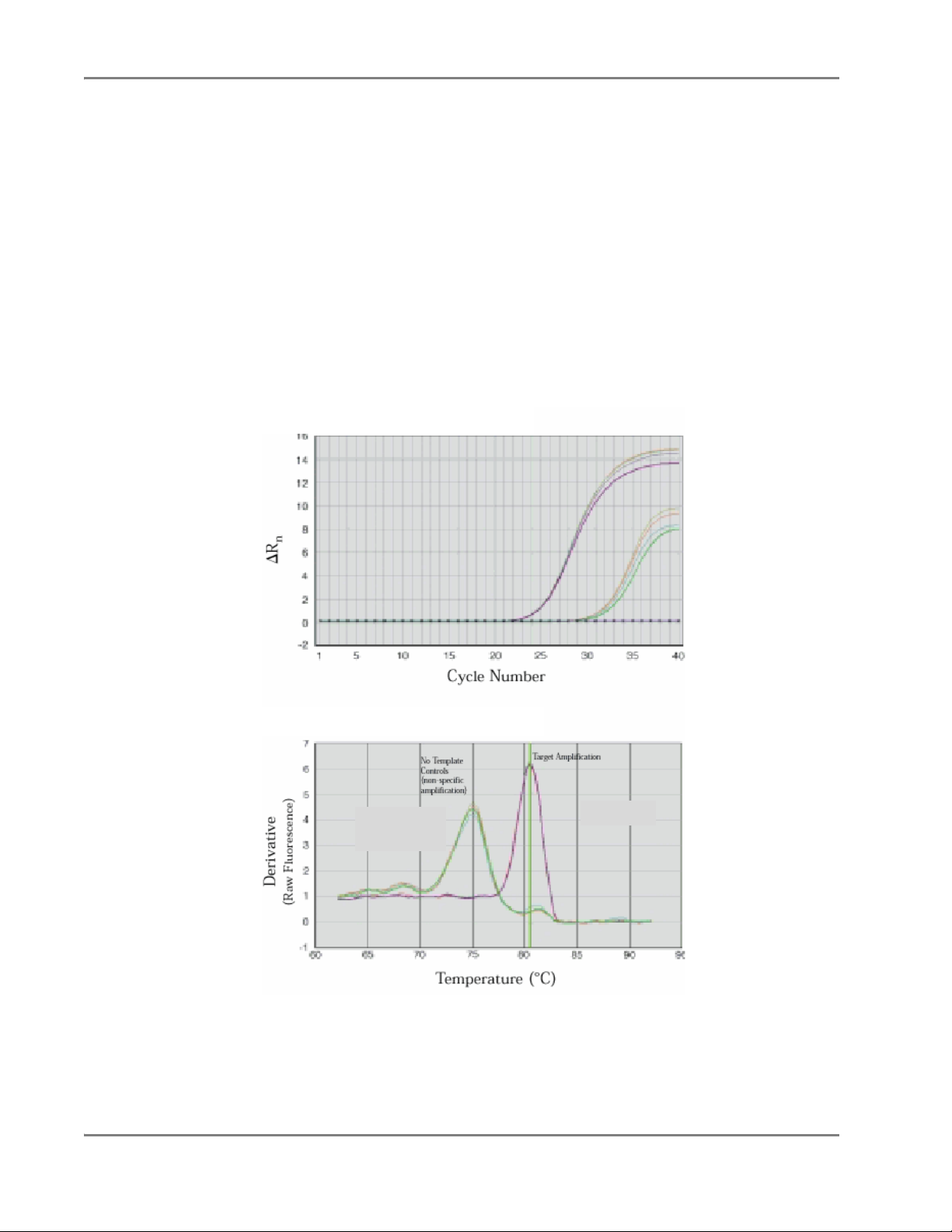
Chapter 3 Quantitation Experiments
Ta rg e t
Amplification
Target Amplification
NC (nonspecific
amplification)
NC
(non-specific
amplification)
a) Amplification plot, linear view
b) Melt curve analysis
Melt curves or gel analysis can be extremely useful when you select optimal primer
concentrations for quantitation assays using SYBR Green reagents. Figure 3-5 on
page 3-32 shows the results from a primer optimization matrix at primer
concentrations of 900-nM forward and reverse primers:
• Figure 3-5a shows strong amplification of the negative control wells, which
indicates that significant nonspecific amplification is occurring.
• Figure 3-5b shows that the melting temperature of the product generated in the
absence of template is lower than the melting temperature of the specific
product generated with template, indicating that significant nonspecific
amplification is occurring.
The results shown in Figure 3-5 are typical of primer-dimer formation. These results
indicate that lower primer concentrations may provide more optimal results.
Additionally, you can redesign another set of primers to the target of interest.
Figure 3-5 Amplification data using SYBR® Green reagents
(a) Amplification plot (linear view) demonstrating suspected nonspecific
amplification in negative control (NC) wells
(b) Melt curve analysis confirming that product in NC wells has a different melting
temperature from the specific product
3-32 Applied Biosystems StepOne™ and StepOnePlus™ Real-Time PCR Systems Reagent Guide
Page 65

Optimize the Probe Concentration
For detection by TaqMan® probes, the recommended probe concentration of 250 nM
ensures excellent assay performance. However, depending on the requirements of the
assay, a probe optimization experiment can prove useful.
Note: No probe is required for SYBR Green I dye detection.
Chapter 3 Quantitation Experiments
Recommended
Probe
Concentrations
The recommended probe concentrations for DNA and cDNA quantitation assays
using TaqMan reagents is 250 nM. Figure 3-6 shows the results of a probe
optimization experiment in which the probe concentration is varied from
50 to 250 nM:
• Figure 3-6a shows an increase in ΔRn as the probe concentration is increased.
• Figure 3-6b shows that the C
value changes with sufficient probe
T
concentrations.
To ensure the best reproducibility, especially when you want to detect low copy
numbers of a target, avoid probe limiting concentrations. Run the assay at a probe
concentration of 250 nM. Using a 250-nM concentration, you avoid probe limitation
and ensure large ΔRn values. Large ΔRn values indicate a robust assay that is
performing at high eff iciency, giving high product yield and allowing accurate peak
measurement.
3-33Applied Biosystems StepOne™ and StepOnePlus™ Real-Time PCR Systems Reagent Guide
Page 66

a) Linear view
b) Log view
Chapter 3 Quantitation Experiments
Figure 3-6 Amplification plot (linear and log views) of probe concentration
titration from 50 to 250 nM
3-34 Applied Biosystems StepOne™ and StepOnePlus™ Real-Time PCR Systems Reagent Guide
Page 67

For More Information
For information on:
• Using the TaqMan reagents, refer to:
• Using the SYBR Green reagents, refer to:
• Performing quantitation experiments on the StepOne and StepOnePlus systems,
• Performing presence/absence experiments on the StepOne and StepOnePlus
Chapter 3 Quantitation Experiments
®
– TaqMan
–TaqMan
–TaqMan
– Power SYBR
– SYBR
– SYBR
Fast Universal PCR Master Mix (2✕) Protocol
®
Gene Expression Master Mix Protocol
®
Universal PCR Master Mix Protocol
®
Green PCR Master Mix and RT-PCR Protocol
®
Green PCR Master Mix and RT-PCR Reagents Protocol
®
Green PCR and RT-PCR Reagents Protocol
refer to:
– Applied Biosystems StepOne
™
and StepOnePlus™ Real-Time PCR Systems
Getting Started Guide for Standard Curve Experiments
– Applied Biosystems StepOne
™
and StepOnePlus™ Real-Time PCR Systems
Getting Started Guide for Relative Standard Curve and Comparative C
Experiments
systems, refer to the Applied Biosystems StepOne
™
and StepOnePlus™
Real-Time PCR Systems Getting Started Guide for Presence/Absence
Experiments.
T
3-35Applied Biosystems StepOne™ and StepOnePlus™ Real-Time PCR Systems Reagent Guide
Page 68

Chapter 3 Quantitation Experiments
3-36 Applied Biosystems StepOne™ and StepOnePlus™ Real-Time PCR Systems Reagent Guide
Page 69

Genotyping Experiments 4
This chapter covers:
Section 4.1 About Genotyping Experiments. . . . . . . . . . . . . . . . . . . . . . . . . . . . . . 4-3
Section 4.2 Design Guidelines . . . . . . . . . . . . . . . . . . . . . . . . . . . . . . . . . . . . . . . . 4-9
4
4-1Applied Biosystems StepOne™ and StepOnePlus™ Real-Time PCR Systems Reagent Guide
Page 70

Chapter 4 Genotyping Experiments
4-2 Applied Biosystems StepOne™ and StepOnePlus™ Real-Time PCR Systems Reagent Guide
Page 71

Chapter 4 Genotyping Experiments
Section 4.1 About Genotyping Experiments
This section covers:
Overview . . . . . . . . . . . . . . . . . . . . . . . . . . . . . . . . . . . . . . . . . . . . . . . . . . . . . . . . . 4-4
Select the Assay Type . . . . . . . . . . . . . . . . . . . . . . . . . . . . . . . . . . . . . . . . . . . . . . . 4-6
4-3Applied Biosystems StepOne™ and StepOnePlus™ Real-Time PCR Systems Reagent Guide
Page 72

Chapter 4 Genotyping Experiments
Overview
What Is a
Genotyping
Experiment?
A genotyping experiment is an endpoint experiment used to determine the genotype
of unknown samples. With this experiment type, you can differentiate a single
nucleotide polymorphism (SNP).
A genotyping experiment determines if unknown samples are:
• Homozygotes (samples having only allele 1)
• Homozygotes (samples having only allele 2)
• Heterozygotes (samples having both allele 1 and allele 2)
Components
PCR reactions for genotyping experiments include the following components:
• Sample – The sample in which the genotype of the target is unknown.
• (Optional) Replicates – Identical reactions containing identical components
and volumes.
• Negative Controls – Samples that contain water or buffer instead of template;
also known as no template controls (NTCs). Negative controls should not
amplify.
• (Optional) Positive controls – Samples that contain known genotypes
(homozygotes for allele 1, homozygotes for allele 2, and heterozygotes for
alleles 1 and 2).
Instruments
How Genotyping
Experiments
Work
Genotyping experiments require two steps: thermal cycling (PCR amplification)
followed by endpoint detection of the resulting fluorescent signals. You can perform
the thermal cycling step (PCR amplification) on the Applied Biosystems StepOne
and StepOnePlus
If you use the StepOne
™
Real-Time PCR Systems or on a standalone thermal cycler.
™
and StepOnePlus™ systems:
™
• You can analyze the PCR, which is helpful for troubleshooting.
• Perform the endpoint plate read separately.
In genotyping experiments, the PCR includes a specific fluorescent-dye-labeled
probe for each allele. The probes contain different fluorescent reporter dyes to
differentiate each allele.
®
You can use TaqMan
StepOnePlus systems. Each TaqMan
minor groove binder (MGB) probes on the StepOne and
®
MGB probe contains:
• A reporter dye at the 5′ end of each probe
®
–VIC
–FAM
dye is linked to the 5′ end of the Allele 1 probe
™
dye is linked to the 5′ end of the Allele 2 probe
• A minor groove binder (MGB)
This modification increases the melting temperature (Tm) of probes without
increasing probe length (Afonina et al., 1997; Kutyavin et al., 1997), thereby
allowing the design of shorter probes. Consequently, the TaqMan MGB probes
exhibit greater differences in Tm values between matched and mismatched
probes; greater differences in Tm values provide accurate genotyping.
4-4 Applied Biosystems StepOne™ and StepOnePlus™ Real-Time PCR Systems Reagent Guide
Page 73
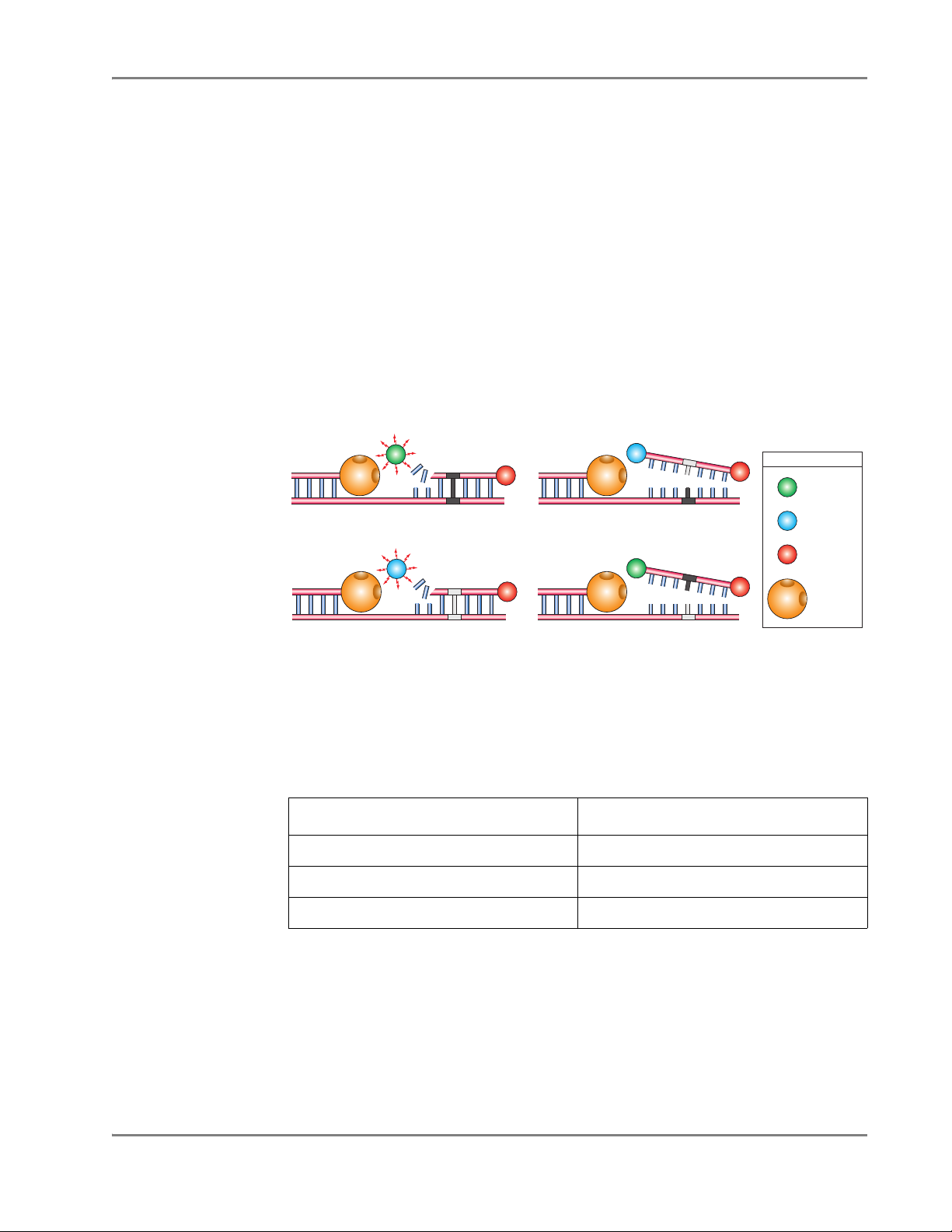
Chapter 4 Genotyping Experiments
• A nonfluorescent quencher (NFQ) at the 3′ end of the probe
Because the quencher does not fluoresce, real-time PCR systems can measure
reporter dye contributions more accurately.
During PCR, each probe anneals specifically to its complementary sequence between
the forward and reverse primer sites. AmpliTaq Gold
®
DNA polymerase can cleave
only probes that hybridize to the allele sequence (match). Cleavage separates the
reporter dye from the quencher dye, increasing fluorescence of the reporter dye.
Thus, the fluorescence signals generated during PCR amplification indicate the
alleles that are present in the sample.
Mismatches Between Probe and Allele Sequences
Mismatches between a probe and allele (Figure 4-1) reduce the efficiency of probe
hybridization. Furthermore, AmpliTaq Gold DNA polymerase is likely to displace
the mismatched probe rather than to cleave it to release reporter dye.
Allele
1
Allele
2
V
Q
Match
F
Q
Match
F
V
Mismatch
Mismatch
Q
Q
Legend
V
F
Q
VIC® dye
FAM ™ dye
Quencher
AmpliTaq
®
Gold
DNA
Polymerase
GR1556
Workflow
Figure 4-1 Results from matches and mismatches between allele and probe
sequences in genotyping experiments
Tabl e 4- 1 summarizes the possible results of the genotyping experiment example
shown above.
Table 4-1 Genotyping experiment results
A substantial increase in… Indicates…
VIC® dye fluorescence only homozygosity for Allele 1.
™
dye fluorescence only homozygosity for Allele 2.
FAM
both fluorescent signals heterozygosity.
Before performing genotyping experiments on the StepOne and StepOnePlus
systems, prepare for the experiment as follows:
1. Select the assay type (below).
2. Review the design guidelines for the assay type you selected (Section 4.2 on
page 4-9).
4-5Applied Biosystems StepOne™ and StepOnePlus™ Real-Time PCR Systems Reagent Guide
Page 74

Chapter 4 Genotyping Experiments
Select the Assay Type
When you design your experiments with the StepOne software, you can select the
following assay types for genotyping experiments:
• Pre-Designed/Validated (below)
•Custom (page 4-7)
This section lists the products available for each assay type.
Note: The assays are specific to the target of interest. The master mixes contain the
remaining components needed for the PCR reaction.
Pre-Designed/
Validated Assays
Product Attributes
Ta q Ma n
Genotyping Assays
Ta q Ma n
Metabolism Genotyping
Assays
Pre-Developed TaqMan
Assay Reagents for
Allelic Discrimination
Ta q Ma n
Master Mix
Ta q Ma n
PCR Master Mix
(with or without
AmpErase
®
SNP
®
Drug
®
Genotyping
®
2✕ Universal
®
UNG)
• Predesigned assays for high-density, genome-wide
marker coverage.
• For screening, association, candidate region, candidate
gene, or fine-mapping studies.
• Convenient single-tube format.
• Detect polymorphisms in 220 genes that code for various
drug metabolism enzymes and drug transporters.
• For studying single-nucleotide polymorphisms (SNPs),
insertions/deletions (in/dels), and multinucleotide
polymorphisms (MNPs).
®
• Genotype purified DNA samples for specific mutations;
most assays discriminate between two alleles of singlenucleotide polymorphisms (SNPs).
• Minor groove binder (MGB) added for better genotyping.
• Allele 1 and 2 control DNA included to allow each
homozygote signal to be generated on each run.
• Closed-tube system requires no post-PCR manipulation or
gels.
Optimized for endpoint fluorescence detection in SNP
genotyping applications:
• Distinct clusters and high call rates for unambiguous allelic
discrimination.
• Excellent pre- and post-PCR stability for high-throughput
setup and analysis.
• Validated with TaqMan
• Simplifies assay implementation by using one reagent for
all assays.
• Provides optimal performance for TaqMan
use cDNA or DNA as a template.
• Contains components that ensure excellent assay
performance.
• Simplifies assay implementation by using one reagent for
all assays.
®
SNP Genotyping Assays.
®
assays that
Note: Genotyping experiments are not supported for Fast or SYBR
®
Green master
mixes and protocols.
4-6 Applied Biosystems StepOne™ and StepOnePlus™ Real-Time PCR Systems Reagent Guide
Page 75

Chapter 4 Genotyping Experiments
For guidelines on designing your experiments with Pre-Designed/Validated assays,
see page 4-10.
Custom Assays
Product Attributes
Custom TaqMan
®
SNP
Genotyping Assays
®
Ta q Ma n
Genotyping
Master Mix
®
Ta q Ma n
2✕ Universal
PCR Master Mix
(with or without
AmpErase
®
UNG)
• Any possible single-nucleotide polymorphism (SNP) in any
organism.
• Detect insertions/deletions (in/dels) of up to six bases.
• Detect multiple nucleotide polymorphisms (MNPs) of up to
six bases.
• Convenient single-tube format.
Optimized for endpoint fluorescence detection in SNP
genotyping applications:
• Distinct clusters and high call rates for unambiguous allelic
discrimination.
• Excellent pre- and post-PCR stability for high-throughput
setup and analysis.
®
• Validated with TaqMan
SNP Genotyping Assays.
• Simplifies assay implementation by using one reagent for
all assays.
®
• Provides optimal performance for TaqMan
assays that
use cDNA or DNA as a template.
• Contains components that ensure excellent assay
performance.
• Simplifies assay implementation by using one reagent for
all assays.
Note: Genotyping experiments are not supported for Fast or SYBR
®
Green master
mixes and protocols.
For guidelines on designing your experiments with Custom assays, see page 4-14.
4-7Applied Biosystems StepOne™ and StepOnePlus™ Real-Time PCR Systems Reagent Guide
Page 76

Chapter 4 Genotyping Experiments
4-8 Applied Biosystems StepOne™ and StepOnePlus™ Real-Time PCR Systems Reagent Guide
Page 77

Section 4.2 Design Guidelines
This section covers:
Pre-Designed/Validated Assays. . . . . . . . . . . . . . . . . . . . . . . . . . . . . . . . . . . . . . . 4-10
Taq Ma n
TaqMa n
Pre-Developed TaqMan
Select the Master Mix . . . . . . . . . . . . . . . . . . . . . . . . . . . . . . . . . . . . . . . . . 4-13
Design the Experiment . . . . . . . . . . . . . . . . . . . . . . . . . . . . . . . . . . . . . . . . 4-14
Custom Assays . . . . . . . . . . . . . . . . . . . . . . . . . . . . . . . . . . . . . . . . . . . . . . . . . . . 4-14
Custom TaqMan
Select the Master Mix . . . . . . . . . . . . . . . . . . . . . . . . . . . . . . . . . . . . . . . . . 4-16
Design the Experiment . . . . . . . . . . . . . . . . . . . . . . . . . . . . . . . . . . . . . . . . 4-16
®
SNP Genotyping Assays . . . . . . . . . . . . . . . . . . . . . . . . . . . . . . . 4-10
®
Drug Metabolism Genotyping Assays . . . . . . . . . . . . . . . . . . . . 4-11
®
Assay Reagents for Allelic Discrimination . . . . 4-12
®
SNP Genotyping Assays . . . . . . . . . . . . . . . . . . . . . . . . 4-14
Chapter 4 Genotyping Experiments
4-9Applied Biosystems StepOne™ and StepOnePlus™ Real-Time PCR Systems Reagent Guide
Page 78

Chapter 4 Genotyping Experiments
Pre-Designed/Validated Assays
Workflow
If you are designing a genotyping experiment using Applied Biosystems PreDesigned/Validated assays, Applied Biosystems recommends that you follow the
workflow below:
1. Select the assay:
•TaqMan
•TaqMan
•TaqMan
®
SNP Genotyping Assays (below).
®
Drug Metabolism Genotyping Assays (page 4-11).
®
Pre-Developed Assays Reagents for Allelic Discrimination
(page 4-12).
2. Select the master mix (page 4-13).
3. Design the experiment using the StepOne
TaqM an® SNP Genotyping Assays
Product
Description
Taq Ma n® SNP Genotyping Assays are a comprehensive collection of primer and
probe sets for genotyping single nucleotide polymorphisms (SNPs) for human
studies.
The assays:
®
•Use TaqMan
reagents to amplify and detect specific SNP alleles in purif ied
genomic DNA samples.
• Are designed using Applied Biosystems bioinformatics pipeline and software,
as well as genomic information from Celera Genomics and public databases.
• Are designed and optimized to work with an Applied Biosystems TaqMan®
master mix, using universal thermal cycling conditions.
™
software (page 4-14).
Product
Requirements
All TaqMan SNP Genotyping Assays require:
• Three components:
– 1 to 20 ng of purified genomic DNA sample.
–20✕, 40✕, or 80✕ SNP Genotyping Assay Mix (specific for each
polymorphism). Each assay consists of sequence-specific forward and
reverse primers to amplify the SNP of interest and two TaqMan MGB
probes: One probe labeled with VIC
probe labeled with FAM
–TaqMan
®
Genotyping Master Mix or TaqMan® 2✕ Universal PCR Master
™
dye detects the Allele 2 sequence.
Mix (with or without AmpErase
®
dye detects the Allele 1 sequence; one
®
UNG).
• PCR amplification and an endpoint read to obtain results.
4-10 Applied Biosystems StepOne™ and StepOnePlus™ Real-Time PCR Systems Reagent Guide
Page 79

Chapter 4 Genotyping Experiments
Available Assays
For More
Information
TaqMan SNP Genotyping Assays are available as TaqMan® Pre-Designed SNP
Genotyping Assays:
• Over 4.5 million predesigned genome-wide assays, including 3.5 million human
HapMap SNPs, 70,000 human cSNPs, 160,000 human validated, and 10,000
mouse assays.
• Available in small, medium, and large scale.
• Made to Order (that is, manufactured at the time of order).
• For information on the latest available products and specific product uses, refer
to the Applied Biosystems Web sites:
http://www.allsnps.com/
and/or
http://www.appliedbiosystems.com/
a. On the Home page, under TaqMan
®
Products, select TaqM an® SNP
Genotyping Assays.
b. On the SNP Genotyping Assays page, under Pre-Designed/Validated
Assays, select Ta qM an
®
SNP Genotyping Assays.
• For information on preparing PCR reactions using the TaqMan SNP Genotyping
Assays, refer to the TaqMan
®
SNP Genotyping Assays Protocol.
TaqM an® Drug Metabolism Genotyping Assays
Product
Description
Product
Requirements
Taq Ma n® Drug Metabolism Genotyping Assays are a comprehensive collection of
Inventoried primer and probe sets for genotyping SNPs, insertions and deletions
(indels), and multiple nucleotide polymorphisms (MNPs) in drug metabolism related
genes.
The assays:
• Use TaqMan reagents to amplify and detect specific polymorphisms in purified
genomic DNA samples.
• Are designed using Applied Biosystems bioinformatics pipeline and software,
as well as genomic information from public SNP databases and public genome
assemblies.
• Are designed and optimized to work with Applied Biosystems TaqMan
mixes.
All TaqMan Drug Metabolism Genotyping Assays require:
• Three components:
– 3 to 30 ng of purified genomic DNA sample.
–20✕ Drug Metabolism Genotyping Assay Mix (specific for each
polymorphism). Each assay consists of sequence-specific forward and
reverse primers to amplify the polymorphic sequence of interest and two
TaqMan MGB probes: One probe labeled with VIC dye detects the Allele 1
sequence; one probe labeled with FAM dye detects the Allele 2 sequence.
–TaqMan
Mix (with or without AmpErase
®
Genotyping Master Mix or TaqMan® 2✕ Universal PCR Master
®
UNG).
®
master
4-11Applied Biosystems StepOne™ and StepOnePlus™ Real-Time PCR Systems Reagent Guide
Page 80

Chapter 4 Genotyping Experiments
• PCR amplification and an endpoint read to obtain results.
For More
Information
• For information on the latest available products and specific product uses, refer
to the Applied Biosystems Web sites:
http://www.allsnps.com/
and/or
http://www.appliedbiosystems.com/
a. On the Home page, under TaqMan
®
Products, select Taq Ma n® SNP
Genotyping Assays.
b. On the SNP Genotyping Assays page, under Pre-Designed/Validated
Assays, select Ta qM an
®
Drug Metabolism Genotyping Assays.
• For information on preparing PCR reactions using the TaqMan SNP Genotyping
Assays, refer to the TaqMan
®
Drug Metabolism Genotyping Assays Protocol.
Pre-Developed TaqMan® Assay Reagents for Allelic Discrimination
Product
Description
Pre-Developed TaqMan® Assay Reagents for Allelic Discrimination (TaqMan®
PDARs for AD) are Inventoried assays optimized for the discrimination of specific
alleles.
The assays:
• Use TaqMan reagents to amplify and detect specific polymorphisms in purified
genomic DNA samples.
• Are designed and optimized to work with an Applied Biosystems TaqMan
master mix, using universal thermal cycling conditions.
®
Product
Requirements
For More
Information
TaqMan PDARs for AD require three components:
• 2 to 20 ng of purified genomic DNA sample.
•10✕ Allelic Discrimination Assay Mix (specific for each polymorphism). Each
assay consists of sequence-specific forward and reverse primers to amplify the
polymorphic sequence of interest and two TaqMan MGB probes: One probe
labeled with VIC dye detects the Allele 1 sequence; one probe labeled with
FAM dye detects the Allele 2 sequence.
•TaqMan
(with or without AmpErase
Note: Allele 1 and 2 control DNA is included with each assay to allow each
®
Genotyping Master Mix or TaqMan® 2✕ Universal PCR Master Mix
®
UNG).
homozygote signal to be generated on each run.
• For information on the latest available products and specific product uses, refer
to the Applied Biosystems Web sites:
http://www.allsnps.com/
and/or
http://www.appliedbiosystems.com/
a. On the Home page, under TaqMan
®
Products, select Taq Ma n® SNP
Genotyping Assays.
4-12 Applied Biosystems StepOne™ and StepOnePlus™ Real-Time PCR Systems Reagent Guide
Page 81

Chapter 4 Genotyping Experiments
• For information on preparing PCR reactions using the TaqMan PDARs for
Select the Master Mix
Available Master
Mixes
Applied Biosystems Pre-Designed/Validated assays for genotyping experiments are
designed to work with the following master mixes:
• TaqMan PDARs for AD contain TaqMan
• TaqMan SNP Genotyping Assays and Custom TaqMan SNP Genotyping
b. On the SNP Genotyping Assays page, under Pre-Designed/Validated
Assays, select Ta qM an
Discrimination (TaqMan
Allelic Discrimination, refer to the Pre-Developed TaqMan
®
Pre-Developed Assay Reagents for Allelic
®
PDARs for AD).
®
Assay Reagents
Allelic Discrimination Protocol.
®
2✕ Universal PCR Master Mix
(with AmpErase
®
UNG).
Assays can be used with:
Master Mix Part Number
Ta qM an
400 reactions
Ta qM an
2000 reactions
Ta qM an
Ta qM an
10-Pack, TaqMan
Ta qM an
UNG, 200 Reactions
Ta qM an
UNG, 2000 Reactions
10-Pack, TaqMan
AmpErase
®
Genotyping Master Mix, 1-Pack (1 × 10 mL),
®
Genotyping Master Mix, 1 Bulk Pack (1 × 50 mL),
®
2✕ Universal PCR Master Mix, 200 Reactions 4304437
®
2✕ Universal PCR Master Mix, 2000 Reactions 4326708
®
2✕ Universal PCR Master Mix 4305719
®
2✕ Universal PCR Master Mix, No AmpErase®
®
2✕ Universal PCR Master Mix, No AmpErase®
®
®
2✕ Universal PCR Master Mix, No
UNG
4371355
4371357
4324018
4326614
4324020
For More
Information
Note: Genotyping experiments are not supported for Fast or SYBR
mixes and protocols.
For information on using the TaqMan master mixes, refer to the:
®
• TaqMan
• TaqMan
Genotyping Master Mix Protocol
®
Universal PCR Master Mix Protocol
®
Green master
4-13Applied Biosystems StepOne™ and StepOnePlus™ Real-Time PCR Systems Reagent Guide
Page 82

Chapter 4 Genotyping Experiments
Design the Experiment
Use the StepOne
Software
For Applied Biosystems Pre-Designed/Validated assays, use the StepOne software to
design your genotyping experiments. The StepOne software automatically calculates
volumes for the:
Note: To select a SNP assay in the StepOne software, go to the SNP Assays screen in
the Design Wizard or to the Plate Setup screen in Advanced Setup. In the SNP
Assays screen or Plate Setup screen, you can select an assay from the library or
create a new assay.
For More
Information
For information on designing and performing genotyping experiments on the
StepOne and StepOnePlus systems, refer to Applied Biosystems StepOne
StepOnePlus
Experiments.
Custom Assays
Workflow
If you are designing a genotyping experiment using Applied Biosystems Custom
assays, Applied Biosystems recommends that you follow the workflow below:
1. Order the assay: Custom TaqMan
• Reaction mix components
• Sample dilutions
™
Real-Time PCR Systems Getting Started Guide for Genotyping
®
SNP Genotyping Assays (below).
™
and
2. Select the master mix (page 4-16).
3. Design the experiment using the StepOne software (page 4-16).
Custom TaqMan® SNP Genotyping Assays
Product
Description
Custom TaqMan® SNP Genotyping Assays are TaqMan probe and primer sets that
are designed, synthesized, and formulated by the Custom TaqMan
service based on sequence information that you submit. Custom TaqMan SNP
Genotyping Assays allow you to:
Action Example
Perform genotyping studies with any
possible single-nucleotide polymorphism
(SNP) in any organism
Detect insertions/deletions (in/dels) of up to
six bases for genotyping studies
Detect multiple nucleotide polymorphisms
(MNPs) of up to six bases for genotyping
studies
®
Genomic Assays
AGTTCATCCATGGTCA -->
AGTTCATACATGGTCA
Annotated as: AGTTCAT[C/A]CATGGTCA
AGTTCATCCATGGTCA -->
AGTTCATGGTCA
Annotated as: AGTTCAT[CCAT/*]GGTCA
AGTTCATCCGGTCA -->
AGTTCATATGGTCA
Annotated as: AGTTCAT[CC/AT]GGTCA
4-14 Applied Biosystems StepOne™ and StepOnePlus™ Real-Time PCR Systems Reagent Guide
Page 83

Chapter 4 Genotyping Experiments
The assays:
• Use TaqMan reagents to amplify and detect specific polymorphisms in purified
genomic DNA (gDNA).
• Are developed using proprietary assay-design software.
• Are designed and optimized to work with an Applied Biosystems TaqMan
master mix, using universal thermal cycling conditions.
®
Product
Requirements
For More
Information
All Custom TaqMan SNP Genotyping Assays require:
• A submission file that includes your target SNP sequence. You create the
submission file using free File Builder software, then submit the file to the
Custom TaqMan
®
Genomic Assays service.
• Three components:
– 1 to 20 ng of purified gDNA sample per well.
–40✕ SNP Genotyping Assay or 80✕ SNP Genotyping Assay (specific for
each polymorphism). Each assay consists of sequence-specific forward and
reverse primers to amplify the SNP of interest and two TaqMan MGB
probes: One probe labeled with VIC dye detects the Allele 1 sequence; one
probe labeled with FAM dye detects the Allele 2 sequence.
–TaqMan
(with or without AmpErase
®
Genotyping Master Mix or TaqMan® Universal PCR Master Mix
®
UNG).
• PCR amplification and an endpoint read to obtain results.
• For information on the latest available products and specific product uses, refer
to the Applied Biosystems Web sites:
http://www.allsnps.com/
and/or
http://www.appliedbiosystems.com/
a. On the Home page, under TaqMan
®
Products, select TaqM an® SNP
Genotyping Assays.
b. On the SNP Genotyping Assays page, under Custom Assays, select
Custom TaqMan
®
SNP Genotyping Assays.
• For information on ordering Custom TaqMan SNP Genotyping Assays, refer to
the Custom TaqMan
®
Genomic Assays Protocol: Submission Guidelines.
• For information on preparing PCR reactions using the Custom TaqMan SNP
Genotyping Assays, refer to the Custom TaqMan
®
SNP Genotyping Assays
Protocol.
4-15Applied Biosystems StepOne™ and StepOnePlus™ Real-Time PCR Systems Reagent Guide
Page 84

Chapter 4 Genotyping Experiments
Select the Master Mix
Available Master
Mixes
Applied Biosystems Made to Order assays for genotyping experiments are designed
to work with the following master mixes:
Master Mix Part Number
Ta q Ma n® Genotyping Master Mix, 1-Pack (1 × 10 mL), 400 reactions 4371355
®
Ta q Ma n
2000 reactions
Ta q Ma n
Ta q Ma n
10-Pack, TaqMan
Ta q Ma n
Reactions
Ta q Ma n
Reactions
10-Pack, TaqMan
UNG
Genotyping Master Mix, 1 Bulk Pack (1 × 50 mL),
®
2✕ Universal PCR Master Mix, 200 Reactions 4304437
®
2✕ Universal PCR Master Mix, 2000 Reactions 4326708
®
2✕ Universal PCR Master Mix 4305719
®
2✕ Universal PCR Master Mix, No AmpErase® UNG, 200
®
2✕ Universal PCR Master Mix, No AmpErase® UNG, 2000
®
2✕ Universal PCR Master Mix, No AmpErase®
Note: Genotyping experiments are not supported for Fast or SYBR
4371357
4324018
4326614
4324020
®
Green master
mixes and protocols.
For More
Information
For information on using the TaqMan master mixes, refer to the:
• TaqMan
• TaqMan
Design the Experiment
Use the StepOne
Software
For More
Information
For Applied Biosystems Custom assays, use the StepOne software to design your
genotyping experiments. The StepOne software automatically calculates volumes for
the:
• Reaction mix components
• Sample dilutions
Note: To select a SNP assay in the StepOne software, go to the SNP Assays screen
in the Design Wizard or to the Plate Setup screen in Advanced Setup. In the SNP
Assays screen or Plate Setup screen, you can select an assay from the library or
create a new assay.
For information on designing and performing genotyping experiments on the
StepOne and StepOnePlus systems, refer to Applied Biosystems StepOne
StepOnePlus
Experiments.
®
Genotyping Master Mix Protocol
®
Universal PCR Master Mix Protocol
™
™
Real-Time PCR Systems Getting Started Guide for Genotyping
and
4-16 Applied Biosystems StepOne™ and StepOnePlus™ Real-Time PCR Systems Reagent Guide
Page 85

Presence/Absence Experiments 5
This chapter covers:
Section 5.1 About Presence/Absence Experiments. . . . . . . . . . . . . . . . . . . . . . . . . 5-3
Section 5.2 Design Guidelines . . . . . . . . . . . . . . . . . . . . . . . . . . . . . . . . . . . . . . . . 5-9
5
5-1Applied Biosystems StepOne™ and StepOnePlus™ Real-Time PCR Systems Reagent Guide
Page 86

Chapter 5 Presence/Absence Experiments
5-2 Applied Biosystems StepOne™ and StepOnePlus™ Real-Time PCR Systems Reagent Guide
Page 87

Chapter 5 Presence/Absence Experiments
Section 5.1 About Presence/Absence Experiments
This section covers:
Overview . . . . . . . . . . . . . . . . . . . . . . . . . . . . . . . . . . . . . . . . . . . . . . . . . . . . . . . . . 5-4
Select the Assay Type . . . . . . . . . . . . . . . . . . . . . . . . . . . . . . . . . . . . . . . . . . . . . . . 5-6
5-3Applied Biosystems StepOne™ and StepOnePlus™ Real-Time PCR Systems Reagent Guide
Page 88

Chapter 5 Presence/Absence Experiments
Overview
What Is a
Presence/
Absence
Experiment?
A presence/absence experiment is an endpoint experiment that indicates the presence
or absence of a specific nucleic acid sequence (target) in a sample. The actual
quantity of target is not determined.
Presence/absence experiments are commonly used to detect the presence or absence
of a pathogen, such as a viral or bacterial pathogen. For example, a presence/absence
experiment might be used to determine if Salmonella bacteria are present in
hamburger meat. The results will show if Salmonella bacteria are present or are not
present; the quantity of bacteria is not determined.
Components
PCR reactions for presence/absence experiments include the following components:
• Sample – The sample in which the presence of a target is unknown.
• Replicates – Identical reactions containing identical components and volumes.
• Internal positive control (IPC) – A short synthetic DNA template that is added
to PCR reactions. You can use the IPC to distinguish between true negative
results and reactions affected by PCR inhibitors, incorrect assay setup, or a
reagent or instrument failure.
Note: Presence/absence experiments can be performed without an IPC;
however, the IPC ensures that a failed PCR is not mistaken for a negative test
result.
• Negative Controls – Wells that contain water or buffer instead of sample
template. No amplification of the target should occur in negative control wells.
In the StepOne software, you can set up the PCR reactions for the presence/absence
experiments three different ways:
Setup Well Types
IPC setup There are three types of wells:
• Unknown-IPC wells – Wells contain sample template and IPC
template; the presence of the target is not known.
• Negative control-IPC wells – Wells contain IPC template and water
or buffer instead of sample template in the PCR reaction. Only the
IPC template should amplify in negative control-IPC wells because
the reaction contains no sample template. Also called IPC+.
• Negative control-blocked IPC wells – Wells contain IPC blocking
agent instead of sample template in the PCR reaction. No
amplification should occur in negative control-blocked IPC wells
because the reaction contains no sample template and amplification
of the IPC is blocked. Also called no amplification control (NAC).
No IPC,
singleplex
setup
There are two types of wells:
• Unknown wells – Wells contain sample template; the presence of
the target is not known.
• Negative controls –Wells contain water or buffer instead of sample
template.
5-4 Applied Biosystems StepOne™ and StepOnePlus™ Real-Time PCR Systems Reagent Guide
Page 89

Chapter 5 Presence/Absence Experiments
Setup Well Types
Endpoint
Detection and
Post-PCR Plate
Read
How Presence/
Absence
Experiments
Work
No IPC,
multiplex
setup
There are two types of wells:
• Unknown-Unknown wells – Wells contain sample template; the
presence of the target is not known.
• Negative control-Negative control wells – Wells contain water or
buffer instead of sample template.
Presence/absence experiments are endpoint experiments in which fluorescence data
are collected after the PCR is complete.
To aid in troubleshooting presence/absence experiments, you can use the Applied
™
Biosystems StepOne
time PCR. If you use the StepOne
and StepOnePlus™ Real-Time PCR Systems to perform real-
™
and StepOnePlus™ systems for PCR
amplification, perform the pre-PCR read and post-PCR read runs separately.
During the PCR, the fluorogenic probes anneal specifically to the complementary
target between the forward and reverse primer sites on the template DNA. Then
during extension, AmpliTaq Gold
®
DNA polymerase cleaves the hybridized probes
in each sample containing the target. The cleavage of each matched probe separates
the reporter dye from the quencher dye, resulting in increased fluorescence by the
reporter.
™
After PCR cycling, the StepOne
and StepOnePlus™ instruments read the
fluorescence generated during the PCR amplification. The fluorescent signals are
used to determine the presence or absence of the target in each sample. Reporter
signals are normalized to the emission of a passive reference, as follows:
R
R
Incorporating an IPC
= Emission Intensity of Target Template Sequence
n (TT)
Emission Intensity of Passive Reference
= Emission Intensity of Internal Positive Control
n (IPC)
Emission Intensity of Passive Reference
An IPC is a second TaqMan® probe and primer set added to the reaction plate to
detect a low-copy, constitutive nucleic acid. The IPC and the target are amplified
simultaneously in the same reaction well. If a well does not exhibit amplification, the
StepOne
™
software uses the positive signal from the IPC to confirm that the well
failed to amplify because of a lack of target template, rather than because of a
pipetting error or inhibition.
Note: Presence/absence experiments can be performed without an IPC; however, the
IPC ensures that a failed PCR is not mistaken for a negative test result.
5-5Applied Biosystems StepOne™ and StepOnePlus™ Real-Time PCR Systems Reagent Guide
Page 90

Chapter 5 Presence/Absence Experiments
Workflow
Before performing presence/absence experiments on the StepOne and StepOnePlus
systems, prepare for the experiment as follows:
1. Select the assay type (below).
2. Review the design guidelines for the assay type you selected (Section 5.2 on
page 5-9).
Select the Assay Type
When you design your experiments with the StepOne software, you can select the
following assay types for presence/absence experiments:
• Inventoried/Made to Order (page 5-7)
•Custom (page 5-8)
This section lists the products available for each assay type.
Note: The assays are specific to the target of interest. The master mixes contain the
remaining components needed for the PCR reaction.
5-6 Applied Biosystems StepOne™ and StepOnePlus™ Real-Time PCR Systems Reagent Guide
Page 91

Chapter 5 Presence/Absence Experiments
Inventoried/Made
to Order Assays
Product Attributes
Ta q Ma n
®
Gene
Expression Assays
®
Ta q Ma n
Endogenous
Control Assays
Note: FAM
™
dyelabeled TaqMan®
Endogenous Control
Assays are included as
Inventoried TaqMan
Gene Expression Assays.
Custom TaqMan
®
Gene
Expression Assays
Ta q Ma n
®
Gene
Expression Master Mix
®
Ta q Ma n
2✕ Universal
PCR Master Mix
(with or without
AmpErase
®
UNG)
• Predesigned, gene-specific primer and probe sets for
human, mouse, rat, Arabidopsis, Drosophila, C. elegans,
C. familiares (dog), and M. mulatta (Rhesus) genes.
™
•Probe is a FAM
dye-labeled MGB probe.
• Provided in a convenient, single, 205 tube.
• Available as Inventoried or Made to Order assays.
• Optimized, preformulated, ready-to-use endogenous
control assays.
• Cost-effective gene expression quantitation for human,
mouse, rat, Arabidopsis, Drosophila, and any eukaryotic
species.
™
•Choice of FAM
dye or VIC® dye labels (primer-limited).
• Any species or organism.
• Target of your choice.
•Probe is a FAM™ dye-labeled MGB probe.
• Provided in a convenient, single, 205 tube.
Tailored for precise quantitation by real-time PCR for routine
and challenging experiments:
• Sensitive detection down to 1 copy of target.
• Multiplex PCR for co-amplifying two targets in a single
reaction.
• Specificity for differentiation between gene family
members.
®
• Validated with TaqMan
Gene Expression Assays.
• Simplifies assay implementation by using one reagent for
all assays.
®
• Provides optimal performance for TaqMan
assays that
use cDNA or DNA as a template.
• Contains components that ensure excellent assay
performance.
• Simplifies assay implementation by using one reagent for
all assays.
IMPORTANT! Applied Biosystems does not recommend the use of TAMRA
™
dye as
a reporter or quencher with the StepOne system. TAMRA dye may be used as a
reporter or quencher with the StepOnePlus system.
Note: Presence/absence experiments are not supported for Fast or SYBR
®
Green
master mixes and protocols.
For guidelines on designing your experiments with Inventoried/Made to Order
assays, see page 5-10.
5-7Applied Biosystems StepOne™ and StepOnePlus™ Real-Time PCR Systems Reagent Guide
Page 92

Chapter 5 Presence/Absence Experiments
Custom Assays
Product Attributes
Custom TaqMan
®
Probes
and Primers
Primer Express
®
Software
Ta q Ma n
®
Gene
Expression Master Mix
®
Ta q Ma n
2✕ Universal
PCR Master Mix
(with or without
AmpErase
®
UNG)
• Any species or organism.
• Choice of dye labels, quenchers, and synthesis scales.
• For use with the Primer Express® Software and Applied
Biosystems Assay Design Guidelines.
Software that designs primers and probes for real-time PCR.
Tailored for precise quantitation by real-time PCR for routine
and challenging experiments:
• Sensitive detection down to 1 copy of target.
• Multiplex PCR for co-amplifying two targets in a single
reaction.
• Specificity for differentiation between gene family
members.
®
• Validated with TaqMan
Gene Expression Assays.
• Simplifies assay implementation by using one reagent for
all assays.
®
• Provides optimal performance for TaqMan
assays that
use cDNA or DNA as a template.
• Contains components that ensure excellent assay
performance.
• Simplifies assay implementation by using one reagent for
all assays.
IMPORTANT! Applied Biosystems does not recommend the use of TAMRA
™
dye as
a reporter or quencher with the StepOne system. TAMRA dye may be used as a
reporter or quencher with the StepOnePlus system.
Note: Presence/absence experiments are not supported for Fast or SYBR
®
Green
master mixes and protocols.
For guidelines on designing your experiments with Custom assays, see page 5-16.
5-8 Applied Biosystems StepOne™ and StepOnePlus™ Real-Time PCR Systems Reagent Guide
Page 93

Section 5.2 Design Guidelines
This section covers:
Inventoried/Made to Order Assays . . . . . . . . . . . . . . . . . . . . . . . . . . . . . . . . . . . . 5-10
Taq Ma n
Custom TaqMan
Taq Ma n
Select the Master Mix . . . . . . . . . . . . . . . . . . . . . . . . . . . . . . . . . . . . . . . . . 5-15
Design the Experiment . . . . . . . . . . . . . . . . . . . . . . . . . . . . . . . . . . . . . . . . 5-16
Custom Assays . . . . . . . . . . . . . . . . . . . . . . . . . . . . . . . . . . . . . . . . . . . . . . . . . . . 5-16
®
Gene Expression Assays . . . . . . . . . . . . . . . . . . . . . . . . . . . . . . . 5-10
®
Gene Expression Assays . . . . . . . . . . . . . . . . . . . . . . . . 5-12
®
Exogenous Internal Positive Control Reagents. . . . . . . . . . . . . . 5-13
Chapter 5 Presence/Absence Experiments
5-9Applied Biosystems StepOne™ and StepOnePlus™ Real-Time PCR Systems Reagent Guide
Page 94

Chapter 5 Presence/Absence Experiments
Inventoried/Made to Order Assays
Workflow
If you select the Inventoried/Made to Order assay type in the StepOne™ software,
Applied Biosystems recommends that you follow the workflow below:
1. Select the assay:
•TaqMan
®
Gene Expression Assays (below).
• Custom TaqMan
®
2. Use the TaqMan
Note: Presence/absence experiments can be performed without an IPC;
Exogenous Internal Positive Control Reagents (page 5-13).
however, the IPC ensures that a failed PCR is not mistaken for a negative test
result.
3. Select the master mix (page 5-15).
4. Design the experiment using the StepOne software (page 5-16).
TaqM an® Gene Expression Assays
Product
Description
Taq Ma n® Gene Expression Assays are a comprehensive collection of Inventoried
and Made to Order probe and primer sets that you can use to perform
presence/absence experiments on human, mouse, rat, Arabidopsis, Drosophila, C.
elegans, C. familiares (dog), and M. mulatta (Rhesus) genes.
The assays:
•Use TaqMan
®
reagents to amplify and detect the target in cDNA samples.
• Are designed using an automated design and quality-controlled pipeline.
Inventoried assays are manufactured and placed in inventory; Made to Order
assays are predesigned and manufactured when ordered.
• Are designed and optimized to work with an Applied Biosystems TaqMan
master mix, using universal thermal cycling conditions.
• When possible, amplify target cDNA without amplifying genomic DNA
(m suffix in assay ID) by designing probes that cross exon-exon junctions.
®
Gene Expression Assays (page 5-12).
®
Product
Requirements
All TaqMan Gene Expression Assays require:
• Three components:
– 1 to 100 ng of cDNA sample (converted from RNA) per well, with all wells
in a study having the same amount of cDNA.
–20✕ Gene Expression Assay Mix (specific for each target). Each assay mix
consists of two unlabeled PCR primers and a FAM
™
dye-labeled TaqMan®
MGB (minor groove binder) probe in a preformulated 20✕ mix. 1✕ final
concentrations are 250 nM for the probe and 900 nM for each primer.
–TaqMan
®
Gene Expression Master Mix or TaqMan Universal PCR Master
Mix (with or without AmpErase UNG).
5-10 Applied Biosystems StepOne™ and StepOnePlus™ Real-Time PCR Systems Reagent Guide
Page 95

Chapter 5 Presence/Absence Experiments
Available Assays
TaqMan Gene Expression Assays are available for human, mouse, rat, Arabidopsis,
Drosophila, C. elegans, C. familiares (dog), and M. mulatta (Rhesus) genes. The part
numbers are:
• PN 4331182 for Inventoried assays
• PN 4351372 for Made to Order assays
The prefix of the assay name indicates the species for which the assay was designed:
Hs for Homo sapiens (human), Mm for Mus musculus (mouse), Rn for Rattus
norvegicus (rat), At for Arabidopsis thaliana, Dm for Drosophila melanogaster,
Ce for C. elegans, Cf for C. familiares (dog), and Rh for M. mulatta (Rhesus).
The suffix of the assay name indicates the assay placement, as described in the table
below.
Suffix Description
_m The assay’s probe spans an exon junction; the assay does not detect
genomic DNA.
_s The assay’s primers and probes are designed within a single exon; the assay
does detect genomic DNA.
_g The assay may detect genomic DNA; the assay’s primers and probes may be
within a single exon.
_mH The assay was designed to a transcript belonging to a gene family with high
_sH
_gH
_u The assay’s amplicon spans an exon junction and the probe sits completely in
sequence homology. The assay provides between 10 C
between the target gene and the gene with the closest sequence homology.
Therefore, the assay detects the target transcript with 1000- to 30,000-fold
greater discrimination (sensitivity) than the closest homologous transcript, if
they are present at the same copy number in a sample.
one of the spanned exons.
and 15 CT difference
T
Taq Ma n® Endogenous Control Assays
TaqMa n® Endogenous Control Assays are available as:
• Inventoried TaqMan Gene Expression Assays (PN 4331182) – Each assay
™
contains a FAM
dye-labeled TaqMan® MGB probe in a single, preformulated
20✕ tube.
• Individual control assays for all human, mouse, and rat species (various part
numbers) – Each assay contains either a FAM
probe, a VIC
®
dye-labeled TaqMan® MGB probe, or a TAMRA™ dye-labeled
™
dye-labeled TaqMan® MGB
probe. TaqMan Endogenous Controls with VIC dye labels are primer-limited.
IMPORTANT! Applied Biosystems does not recommend the use of TAMRA
™
dye as
a reporter or quencher with the StepOne system. TAMRA dye may be used as a
reporter or quencher with the StepOnePlus system.
5-11Applied Biosystems StepOne™ and StepOnePlus™ Real-Time PCR Systems Reagent Guide
Page 96

Chapter 5 Presence/Absence Experiments
For More
Information
• For information on the latest available products and specific product uses, refer
to the Applied Biosystems Web site:
http://www.appliedbiosystems.com/
a. On the Home page, under TaqMan
®
Products, select Taq Ma n® Gene
Expression Assays.
b. On the Gene Expression Assays & Arrays page:
• Under Individual Assays, select Taq Man
®
Gene Expression Assays.
This option links to all TaqMan Gene Expression Assays, including
TaqMan Endogenous Control Assays that contain FAM dye-labeled
probes.
or
• Under Individual Control Assays, select Ta qM a n
®
Endogenous
Control Assays. This option links to the individual TaqMan
Endogenous Control Assays (that contain FAM dye-labeled TaqMan
MGB probes, VIC dye-labeled TaqMan MGB probes, or TAMRA
dye-labeled probes).
• For information on Custom TaqMan Endogenous Control Assays, refer to the
Using TaqMan
®
Endogenous Control Assays to Select an Endogenous Control
for Experimental Studies Application Note.
• For information on preparing PCR reactions using the TaqMan Gene Expression
Assays, refer to the TaqMan
®
Gene Expression Assays Protocol.
Custom TaqMan® Gene Expression Assays
Product
Description
Product
Requirements
Custom TaqMan® Gene Expression Assays are TaqMan probe and primer sets that
are designed, synthesized, and formulated by the Custom TaqMan
service based on sequence information that you submit. Custom TaqMan Gene
Expression Assays allow you to perform presence/absence experiments on any gene
or splice variant in any organism.
The assays:
•Use TaqMan
®
reagents to amplify and detect the target in cDNA samples.
• Are developed using proprietary assay-design software.
• Are designed and optimized to work with an Applied Biosystems TaqMan
master mix, using universal thermal cycling conditions.
All Custom TaqMan Gene Expression Assays require:
• A submission file that includes your target sequence. You create the submission
file using free File Builder software, then submit the file to the Custom
®
Taq Ma n
Genomic Assays service.
• Three components:
– 1 to 100 ng of cDNA sample (converted from RNA) per well, with all wells
in a study having the same amount of cDNA.
–20✕ Gene Expression Assay or 60✕ Gene Expression Assay (specific for
each target). Each assay consists of two target-specific primers and a FAM
dye-labeled TaqMan MGB probe in a preformulated 20✕ or 60✕ mix. 1✕
final concentrations are 250 nM for the probe and 900 nM for each primer.
®
Genomic Assays
®
™
5-12 Applied Biosystems StepOne™ and StepOnePlus™ Real-Time PCR Systems Reagent Guide
Page 97

Chapter 5 Presence/Absence Experiments
–TaqMan® Gene Expression Master Mix or TaqMan Universal PCR Master
Mix (with or without AmpErase UNG).
For More
Information
• For information on the latest available products and specific product uses, refer
to the Applied Biosystems Web site:
http://www.appliedbiosystems.com/
a. On the Home page, under TaqMan
®
Products, select TaqM an® Gene
Expression Assays.
b. On the Gene Expression Assays & Arrays page, under Individual Assays,
select Custom TaqMan
®
Gene Expression Assays.
• For information on ordering Custom TaqMan Gene Expression Assays, refer to
the Custom TaqMan
®
Genomic Assays Protocol: Submission Guidelines.
• For information on preparing PCR reactions using the Custom TaqMan Gene
Expression Assays, refer to the Custom TaqMan
®
Protocol.
TaqM an® Exogenous Internal Positive Control Reagents
Product
Description
The Applied Biosystems TaqMan® Exogenous Internal Positive Control Reagents
contain:
• An internal positive control (IPC) with predesigned primers and probe
• IPC DNA template
• IPC blocking control
Gene Expression Assays
Product
Requirements
The reagents are designed to:
• Distinguish types of negative results:
– A negative call for the target and positive call for the IPC indicates that no
target is present.
– A negative call for the target and negative call for the IPC suggests PCR
inhibition.
• Avoid amplification of endogenous controls.
• Permit co-amplification of the IPC and the target without compromising
amplification of the target.
• Detect the IPC using a VIC
• Detect the target using a FAM
• Work with the TaqMan
AmpErase
®
UNG), using universal thermal cycling conditions.
®
dye-labeled probe.
™
dye-labeled probe.
®
2✕ Universal PCR Master Mix (with or without
The TaqMan Exogenous Internal Positive Control Reagents kits require the
following components:
•DNA sample
• TaqMan assay for your target of interest
•TaqMan 2✕ Universal PCR Master Mix (with or without AmpErase UNG)
5-13Applied Biosystems StepOne™ and StepOnePlus™ Real-Time PCR Systems Reagent Guide
Page 98

Chapter 5 Presence/Absence Experiments
Available Kits
The following TaqMan Exogenous Internal Positive Control Reagents kits are
available from Applied Biosystems:
Kits Part Number
Ta q Ma n® Exogenous Internal Positive Control Reagents with
Ta q Ma n
Ta q Ma n
Note: If you are using this kit, you will need to purchase one of these
Ta q Ma n
•TaqMan
•TaqMan
®
2✕ Universal PCR Master Mix (with VIC® dye)
®
Exogenous Internal Positive Control Reagents
®
reagents separately:
®
2✕ Universal PCR Master Mix (PN 4304437)
®
PCR Core Reagents Kit (PN N808-0228)
4308320
4308323
IMPORTANT! The kits listed above contain TAMRA™ dye-labeled probes; Applied
Biosystems does not recommend the use of TAMRA dye as a reporter or quencher
with the StepOne system. The kits may be used with the StepOnePlus system;
TAMRA dye may be used as a reporter or quencher with the StepOnePlus system.
5-14 Applied Biosystems StepOne™ and StepOnePlus™ Real-Time PCR Systems Reagent Guide
Page 99

Chapter 5 Presence/Absence Experiments
For More
Information
For information on preparing PCR reactions using the TaqMan Exogenous Internal
Positive Control Reagents, refer to the TaqMan
Reagents Protocol.
Select the Master Mix
Available Master
Mixes
Applied Biosystems Inventoried/Made to Order assays for presence/absence
experiments are designed to work with the following master mixes:
Ta q Ma n® Gene Expression Master Mix, 1-Pack (1 × 5 mL),
200 reactions
Ta q Ma n
2000 reactions
Ta q Ma n
Ta q Ma n
10-Pack, TaqMan
Ta q Ma n
Reactions
Ta q Ma n
Reactions
10-Pack, TaqMan
UNG
Ta q Ma n
®
Exogenous Internal Positive Control
Master Mix Part Number
4369016
®
Gene Expression Master Mix, 10-Pack (10 × 5 mL),
®
2✕ Universal PCR Master Mix, 200 Reactions 4304437
®
2✕ Universal PCR Master Mix, 2000 Reactions 4326708
®
2✕ Universal PCR Master Mix 4305719
®
2✕ Universal PCR Master Mix, No AmpErase® UNG, 200
®
2✕ Universal PCR Master Mix, No AmpErase® UNG, 2000
®
2✕ Universal PCR Master Mix, No AmpErase®
®
PCR Core Reagents Kit N808-0228
4369542
4324018
4326614
4324020
For More
Information
Note: If you purchase the TaqMan
with TaqMan
®
2✕ Universal PCR Master Mix kit (PN 4308320), you do not need to
®
Exogenous Internal Positive Control Reagents
purchase the master mix separately.
Note: Presence/absence experiments are not supported for Fast or SYBR
master mixes and protocols.
For information on using the TaqMan reagents, refer to the:
®
• TaqMan
• TaqMan
Gene Expression Master Mix Protocol
®
Universal PCR Master Mix Protocol
®
Green
5-15Applied Biosystems StepOne™ and StepOnePlus™ Real-Time PCR Systems Reagent Guide
Page 100

Chapter 5 Presence/Absence Experiments
Design the Experiment
Use the StepOne
Software
For Applied Biosystems Inventoried/Made to Order assays, use the StepOne software
to design your presence/absence experiments. The StepOne software automatically
calculates volumes for the:
Note: To select the Inventoried/Made to Order assay type in the StepOne software,
go to the Reaction Setup screen in either the Design Wizard or Advanced Setup, then
select Inventoried/Made to Order from the Assay Type dropdown menu.
For More
Information
For information on designing and performing presence/absence experiments on the
StepOne and StepOnePlus systems, refer to the Applied Biosystems StepOne
StepOnePlus
Experiments.
Custom Assays
Workflow
If you select the Custom assay type in the StepOne™ software for a presence/absence
experiment (that is, you are designing your own primers and probes), Applied
Biosystems recommends that you follow the workflow for the Applied Biosystems
Assay Design Guidelines:
1. Design primers and probes using Primer Express
• Reaction mix components
• Controls and samples
• Sample dilutions
™
Real-Time PCR Systems Getting Started Guide for Presence/Absence
®
Software (page 3-21).
™
and
2. Select the appropriate reagents (page 3-24).
IMPORTANT! Applied Biosystems does not recommend the use of TAMRA
™
dye as a reporter or quencher with the StepOne system. TAMRA dye may be
used as a reporter or quencher with the StepOnePlus system.
®
Presence/absence experiments are not supported for Fast or SYBR
Green
master mixes and protocols.
3. Use the recommended thermal cycling conditions (page 3-27).
4. Begin with default primer and probe concentrations. If needed, optimize the
primer concentrations (page 3-30) and probe concentrations (page 3-33).
IMPORTANT! These steps provide a rapid and reliable system for assay design and
optimization only when used in their entirety. Adopt the system as a whole to
achieve the highest level of success. For a more detailed description of Applied
Biosystems Assay Design Guidelines, see Appendix C.
Note: To select the Custom assay type in the StepOne software, go to the Reaction
Setup screen in either the Design Wizard or Advanced Setup, then select Custom
from the Assay Type dropdown menu.
5-16 Applied Biosystems StepOne™ and StepOnePlus™ Real-Time PCR Systems Reagent Guide
 Loading...