

Page 1
iPad 3G Teardown
iPad 3G Teardown
Step 1 -
The much awaited iPad 3G is finally in the hands of
iFixit!
The Wi-Fi + 3G iPad. We got a sneak peak of the
internals of this tablet a month ago by poking around on
the FCC's database.
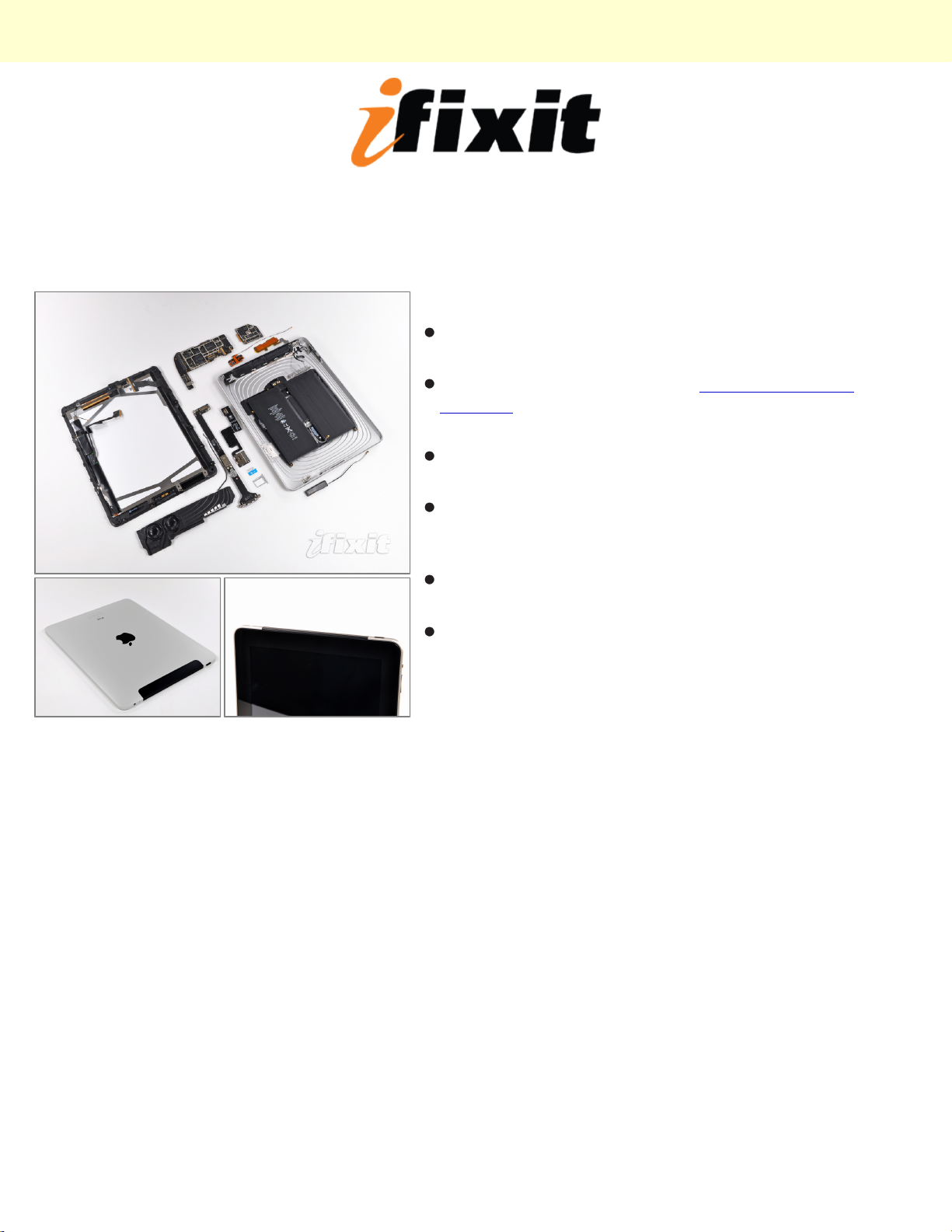
The 3G iPad is visually distinguished from its Wi-Fi-only
sibling by a black plastic RF window.
The 3G iPad supports UMTS/HSDPA on 850, 1900,
and 2100 MHz and GSM/EDGE on 850, 900, 1800, and
1900 MHz.
In a dramatic shift for Apple, the iPad is unlocked, and
not tied down to a specific carrier.
Alas, in the US, AT&T is the only carrier that operates
3G on frequencies the iPad supports. T-Mobile should
work, but only on the slower EDGE network.
© 2010 iFixit — CC BY-NC-SA www.iFixit.com Page 1 of 9
Page 2
iPad 3G Teardown
Step 2
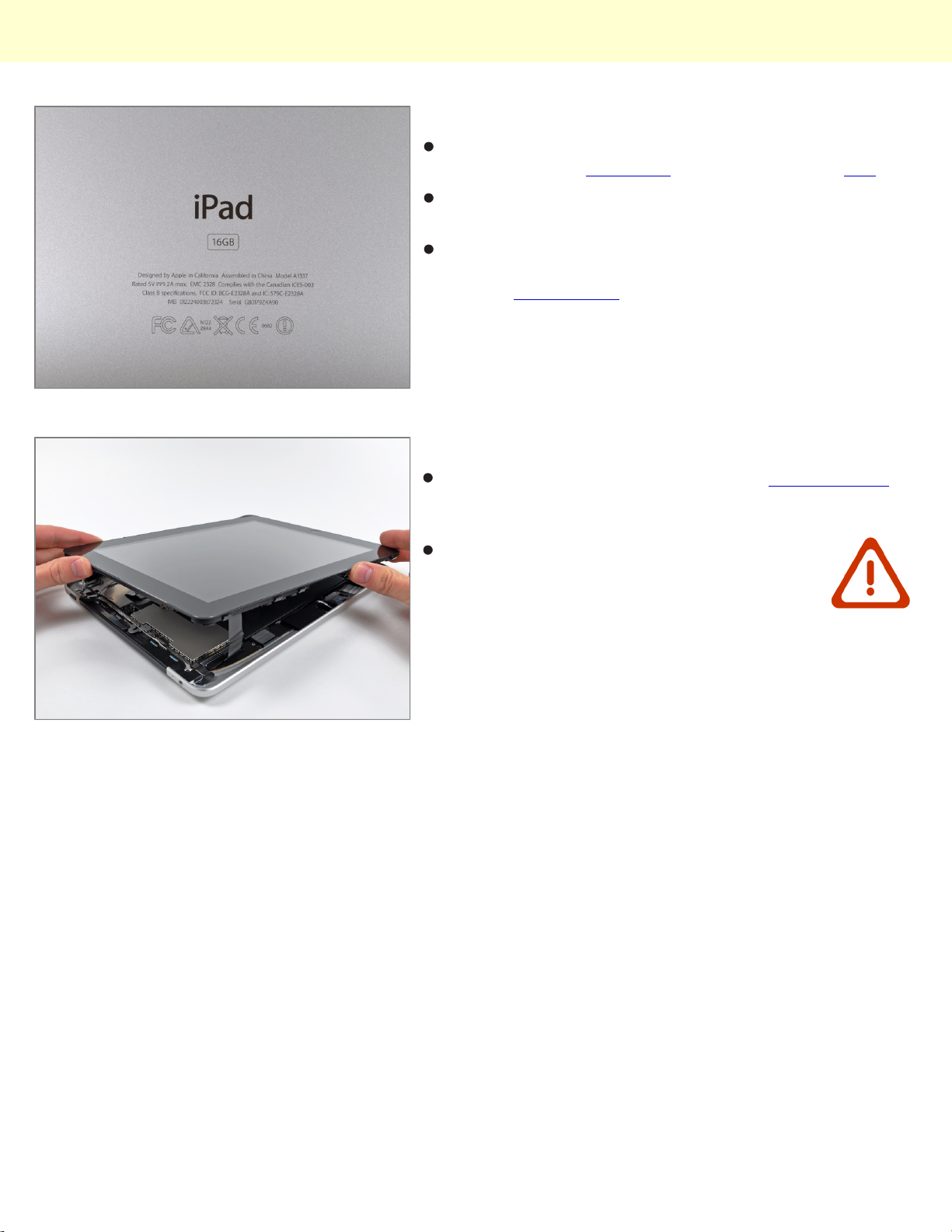
The iPad's model number is A1337 as previously
suggested by the FCC filing. Yes, we think that's l33t.
There's no use wasting anymore time, let's see what
makes this puppy growl.
We'll be comparing the internals of this production unit
to the preproduction FCC photos we exclusively
unveiled a month ago.
Step 3
After some careful prying around with a metal spudger,
the display assembly can be removed from the rear
case.
Due to the addition of 3G connectivity,
there's an extra antenna cable that must be
disconnected before the two halves are free.
© 2010 iFixit — CC BY-NC-SA www.iFixit.com Page 2 of 9
Page 3
iPad 3G Teardown
Step 4
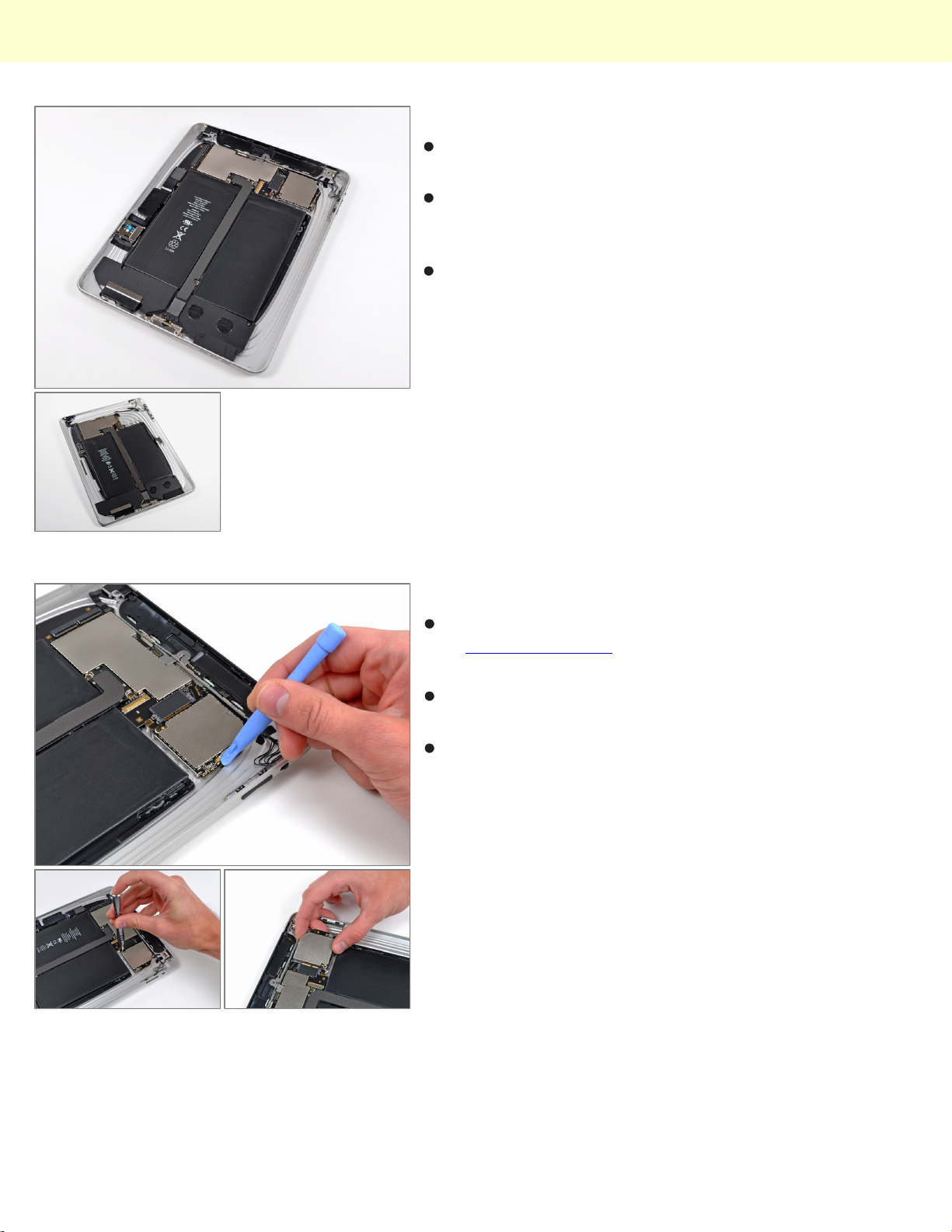
The innards of the iPad 3G (left) and the iPad Wi-Fi
(right).
Some major differences include the 3G chip, SIM card
board, and the plastic antenna cover at the top of the
case.
The 3G iPad is not nearly as barren as the Wi-Fi-only
iPad, but it's still not jam-packed.
Step 5
Pry up the antenna on the communications board with
an iPod opening tool. This is one of two antennas on
the communications board.
The communications board is secured by T4 Torx
screws.
Upon removing the screws, the communications board
slides out of its socket on the logic board. The
connection socket style is similar to a Mini PCI Express
card.
© 2010 iFixit — CC BY-NC-SA www.iFixit.com Page 3 of 9
Page 4
iPad 3G Teardown
Step 6
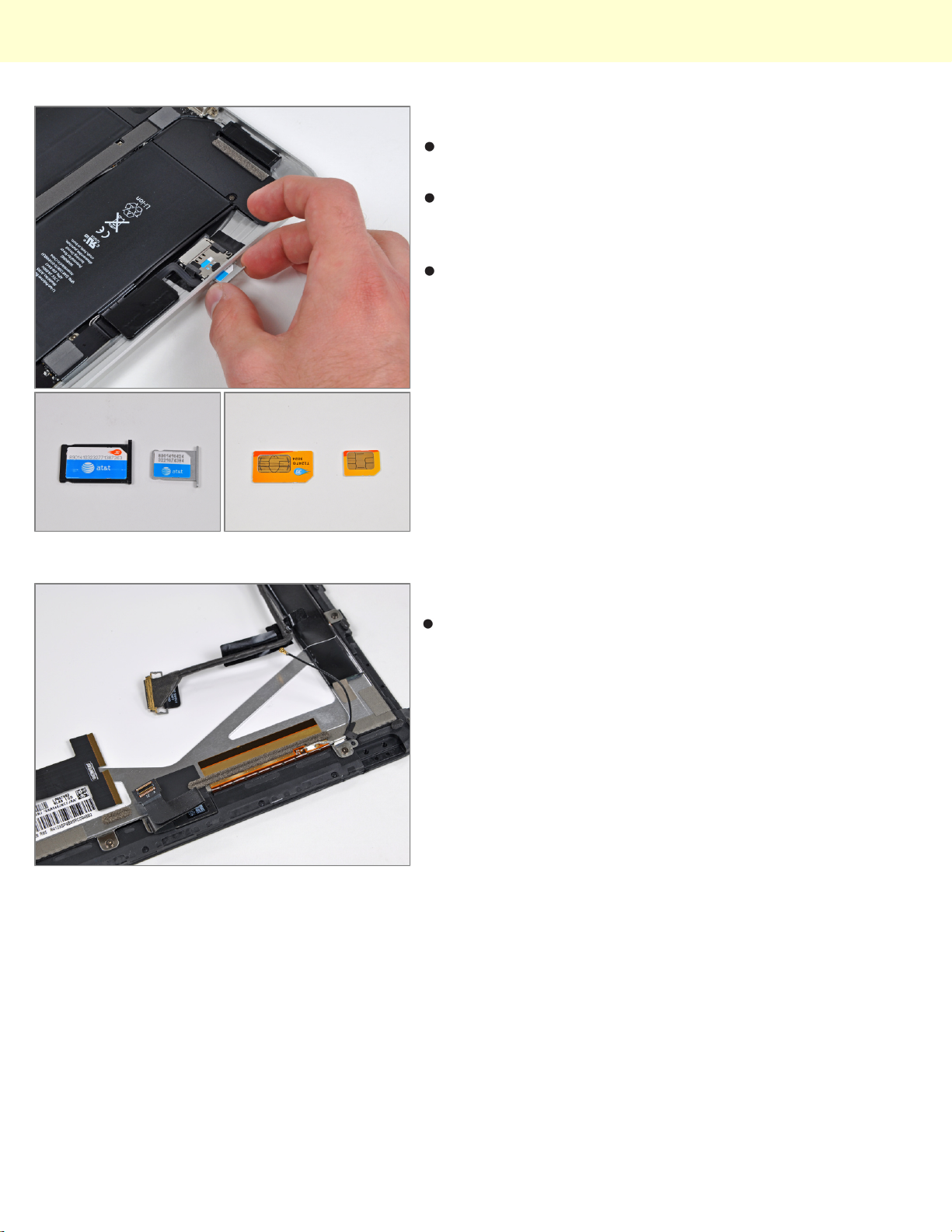
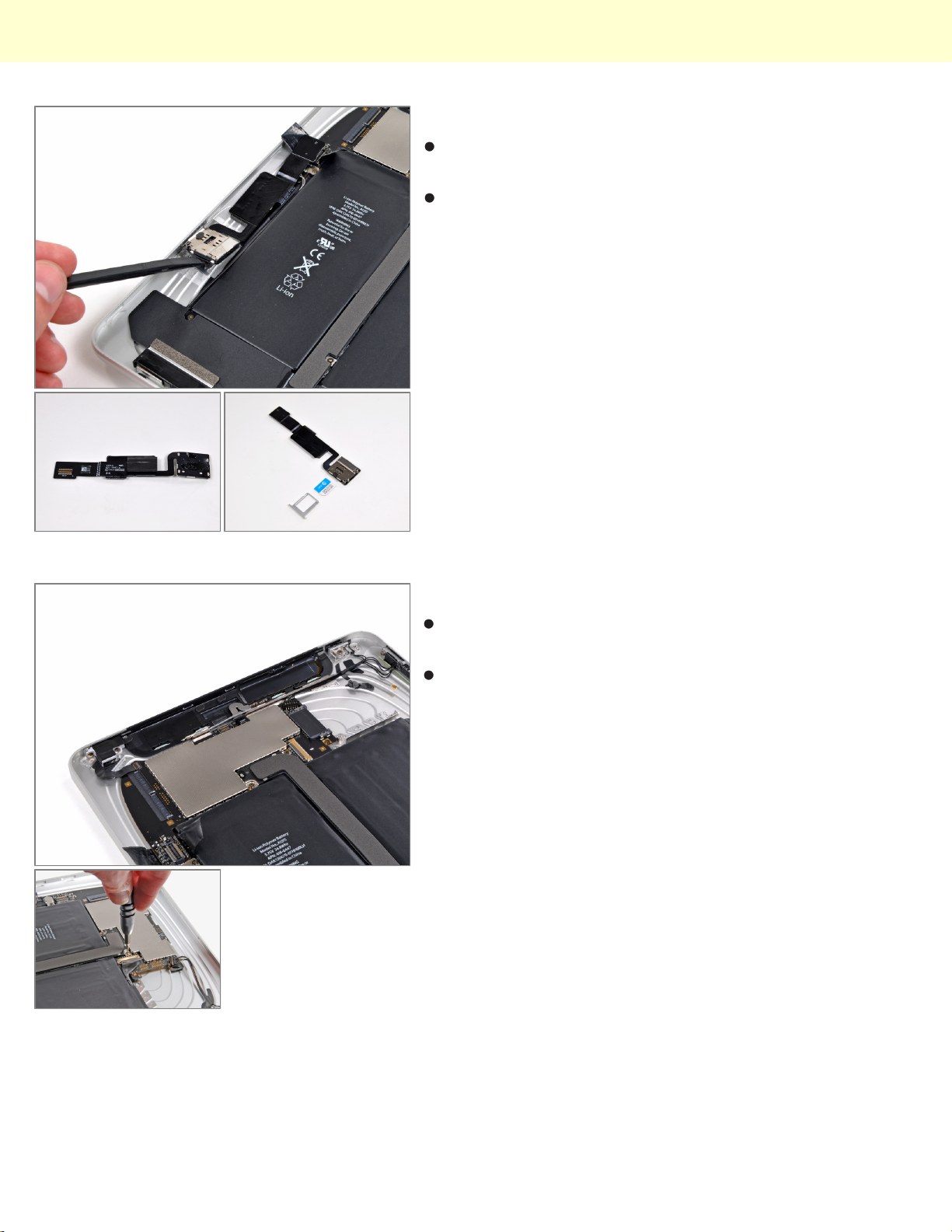
Removing the micro-SIM card. That's a really small SIM
card!
The iPad's SIM card measures 12mm x 15mm. That's
just under half the size of the standard size SIM card
from an iPhone 3GS.
You could cut up a full-size SIM card and turn it into a
Micro-SIM. The contacts are fully compatible.
Step 7
New to the 3G iPad, there's an antenna attached to the
backside of the display assembly. The copper foil piece
seen in the picture connects to the silver metal LCD
frame. Apple has cleverly used this same piece of
metal for both structural and electrical purposes.
© 2010 iFixit — CC BY-NC-SA www.iFixit.com Page 4 of 9
Page 5
iPad 3G Teardown
Step 8
Use the flat end of a spudger to pry the SIM card slot
off the rear case.
It sure doesn't look like Apple was tight on space. As far
as we know, the only purpose of this board is to
connect the SIM card to the logic board.
Step 9
Comparison between the iPad 3G's (left) and the iPad
Wi-Fi's (right) logic board.
When comparing the two models, the top half of the WiFi's rear case has copious amounts of open space.
© 2010 iFixit — CC BY-NC-SA www.iFixit.com Page 5 of 9
Page 6
iPad 3G Teardown
Step 10
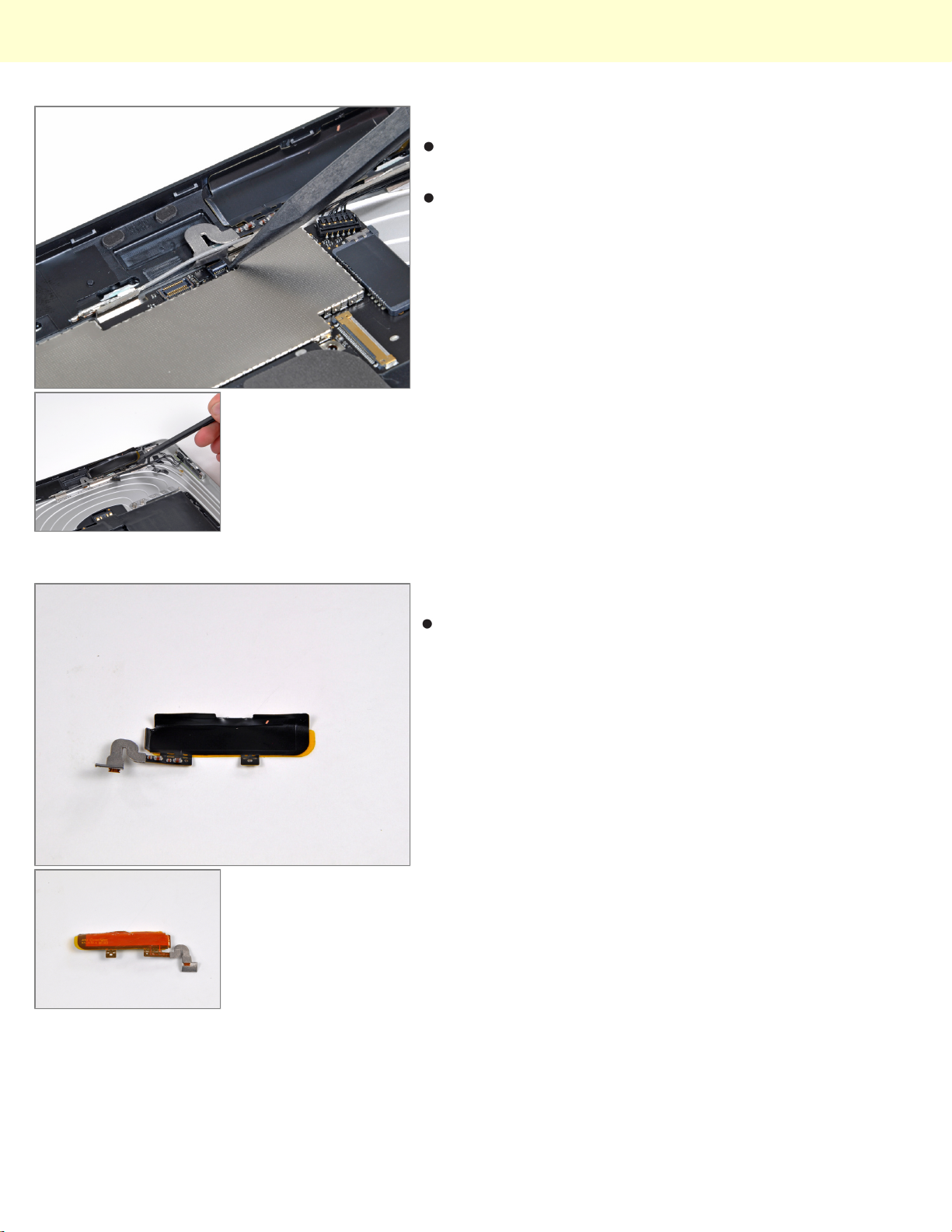
Use the tip of a spudger to disconnect the GPS
antenna ZIF cable connector.
The GPS antenna assembly can be pried off the plastic
antenna cover with the flat end of a spudger.
Step 11
The front and back of the GPS antenna assembly.
© 2010 iFixit — CC BY-NC-SA www.iFixit.com Page 6 of 9
Page 7
iPad 3G Teardown
Step 12
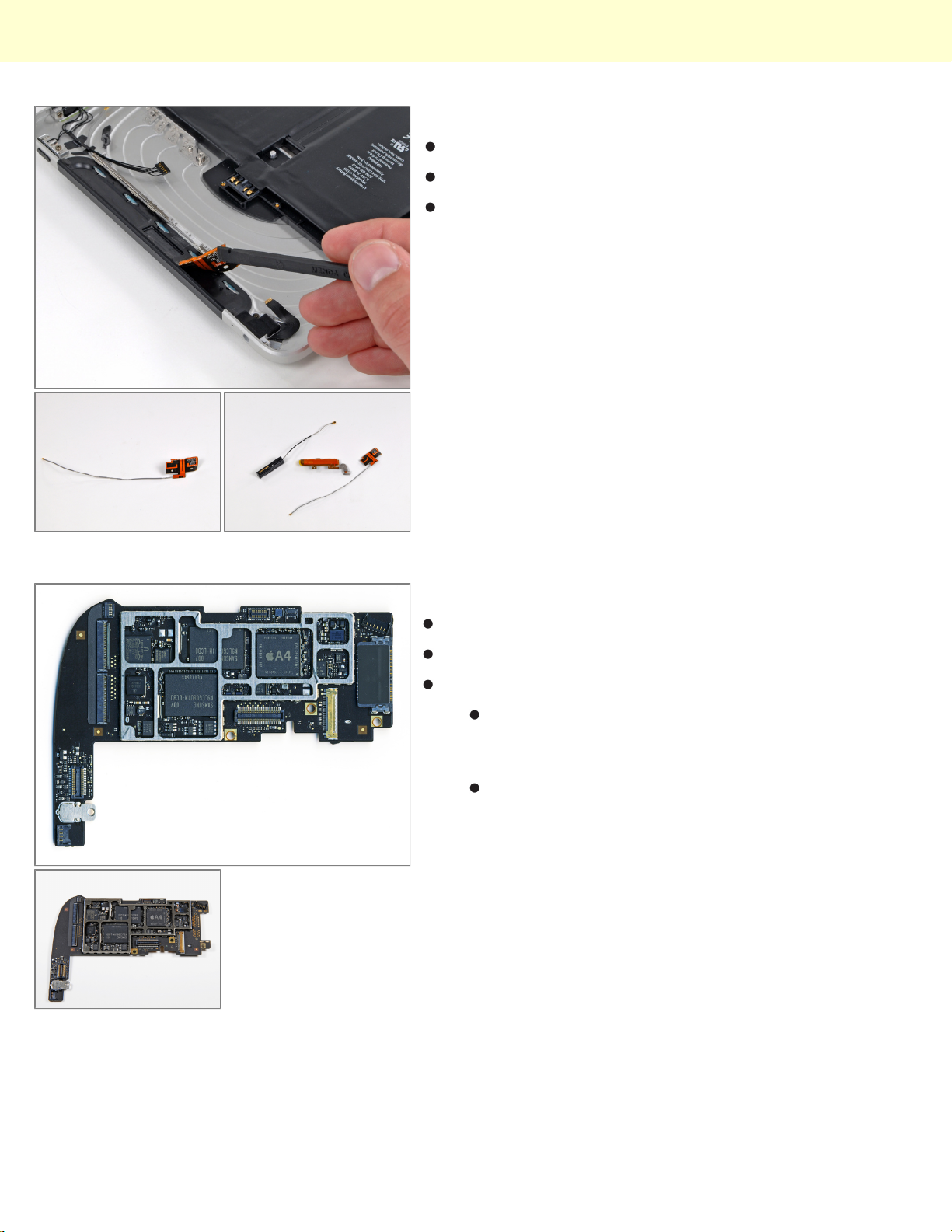
Lift the cellular antenna from its housing.
The cellular antenna remains.
From left to right: the Wi-Fi/Bluetooth, GPS, and 3G
antennas, respectively.
Step 13
The 3G board with A4 processor.
The second shot is the main board from the Wi-Fi iPad.
Key differences?
The most obvious change is the addition of the
connector on the right side of the board for the
communications board.
More subtle is an additional small IC above the
A4 chip next to the connector for the GPS
antenna. This may be a signal processor, but we
can't firmly identify it: T3J 927 632567.
© 2010 iFixit — CC BY-NC-SA www.iFixit.com Page 7 of 9
Page 8
iPad 3G Teardown
Step 14
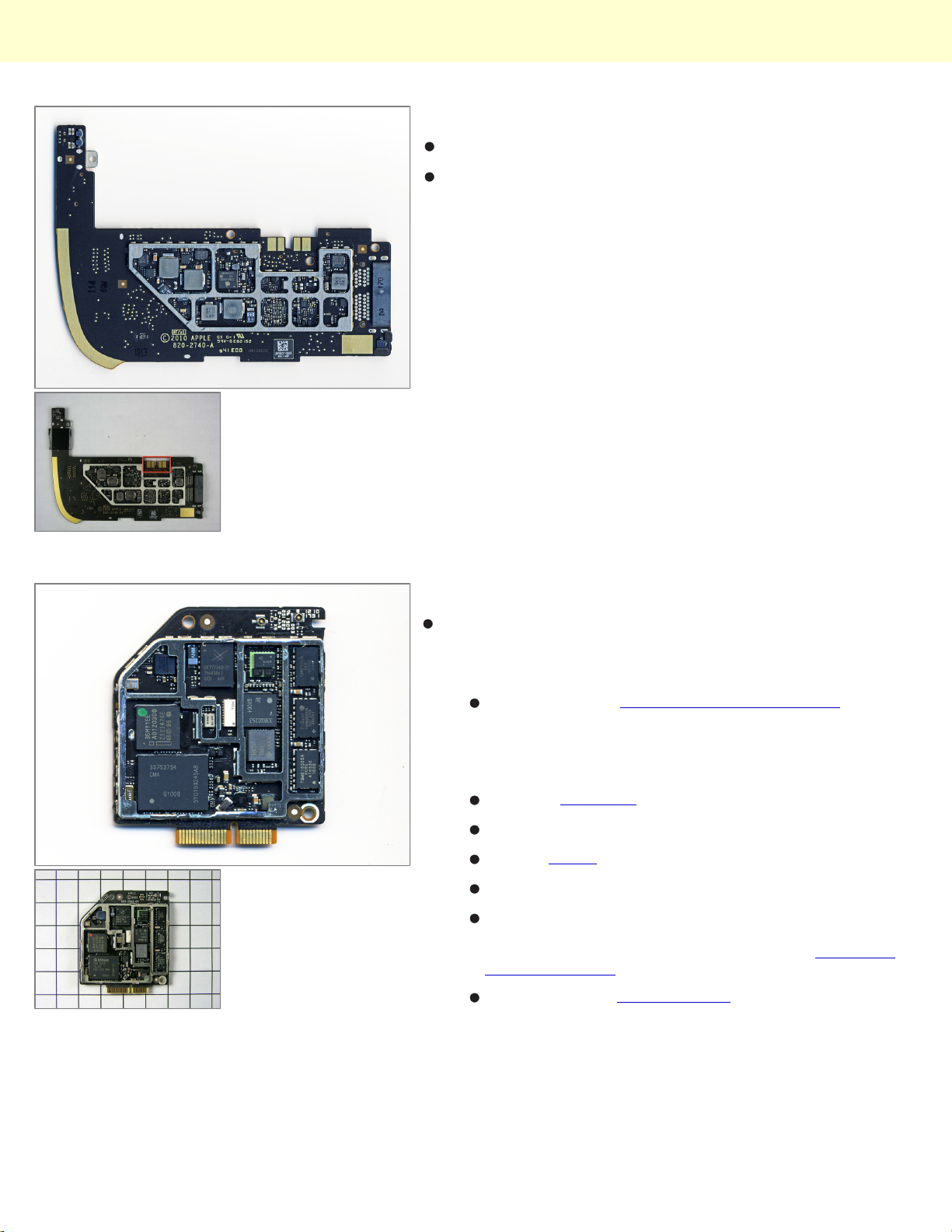
Bottom of the main board.
Nothing much to see here, it's exactly the same as the
Wi-Fi board.
Step 15
Apple soldered the EMI shield onto the communications board,
making it challenging for us to show you the chips. Despite this
adversity, we pressed forward undaunted, fearlessly unsoldering
the board to reveal to you:
Infineon 337S3754 PMB 8878 X-Gold baseband IC
5Y06115. This part had the Infineon logo in the preproduction unit, but Apple has white-labeled it to obscure
the manufacturer. This is the exact same baseband
processor as the iPhone 3GS.
Skyworks SKY77340 Power Amplifier Module
Three Triquint power amplifier / filters.
Infineon U6952
Numonyx 36MY1EE
Along the right are three TriQuint power amplifiers:
TQM616035A, TQM666032B, and TQM676031A. These
are the same three chips that Apple used in the iPhone 3G
nearly 2 years ago.
Broadcom A-GPS BCM47501UBG F01003 P11 949871 SN
© 2010 iFixit — CC BY-NC-SA www.iFixit.com Page 8 of 9
Page 9
iPad 3G Teardown
Step 16
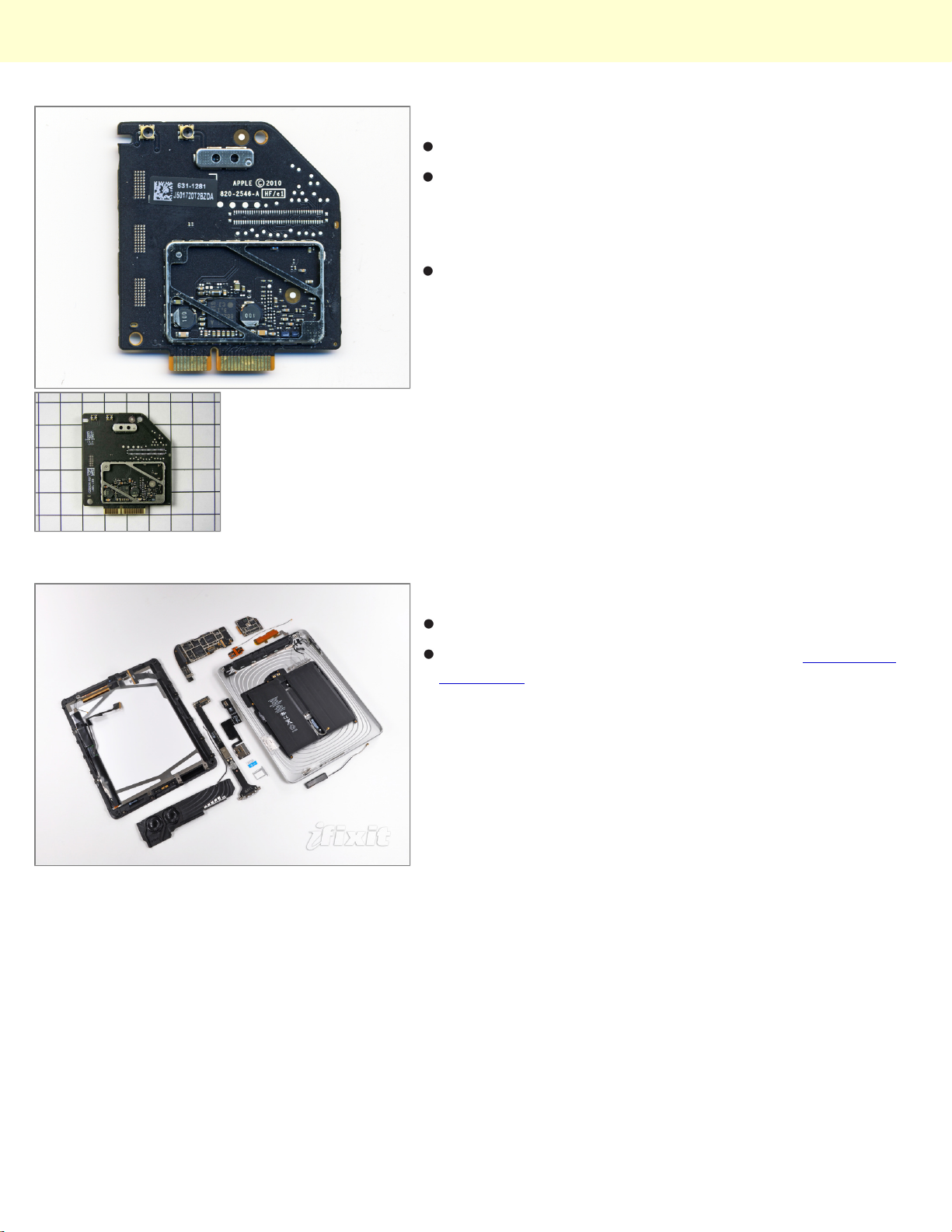
Bottom of communications board.
The second photo is from the pre-release FCC unit.
The bottom of our board has additional part number
markings, but is otherwise identical to the preproduction unit.
It's important to note that the Broadcom A-GPS
package is on the communications board, explaining
why the Wi-Fi-only iPad does not have GPS.
Step 17
That wraps up this teardown of the iPad 3G.
Don't forget to take a peek at its cousin, the iPad Wi-Fi
Teardown for more iPad related mayhem.
© 2010 iFixit — CC BY-NC-SA www.iFixit.com Page 9 of 9
 Loading...