

Page 1
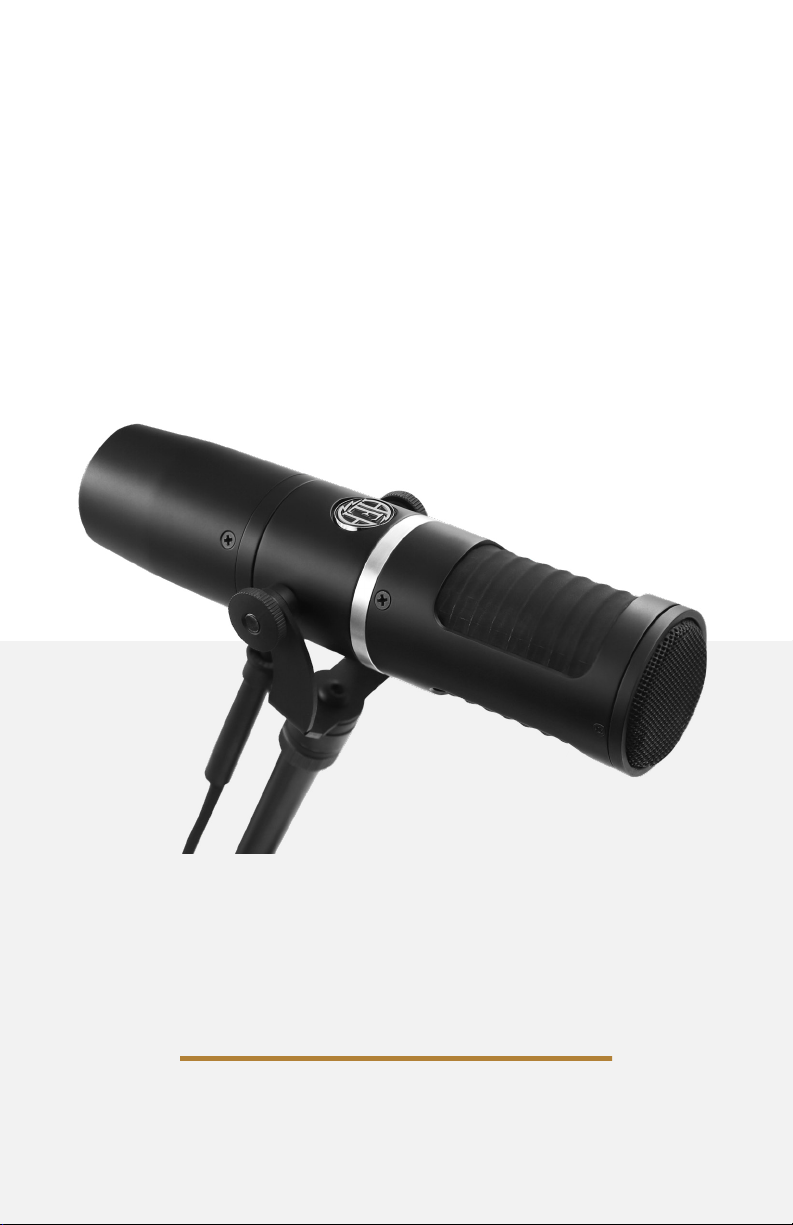
AEA KU5A
OWNER’S MANUAL
ACTIVE CARDIOID END-ADDRESS RIBBON MIC
Page 2

WELCOME
We congratulate you on your purchase of the AEA KU5A ribbon
microphone and welcome you to the AEA family. Never before has a
ribbon mic delivered such directionality and uncompromised tonality
in a package so t for both studio and live settings. The KU5A
is ideal for studio and live applications where both superior rejection
and classic ribbon tonality are paramount. Whether recording a vocal,
guitar, or even a snare drum, the KU5A delivers brilliant, focused sound
where other conventional ribbons can’t. From close range the KU5A
retains the hefty low end and pronounced midrange one expects of
AEA ribbons and with manageable proximity effect. Vocalists can sing
directly into the grille of the KU5A because its interior components are
the most protected of any in the AEA lineup. The rugged KU5A is
equipped with active electronics, so it’s suited or any preamp in the
studio and on the road.
Your KU5A microphone is 100% handcrafted in Pasadena, CA. AEA
is an independent, family owned company with a small crew of
skilled technicians – many of whom are themselves, musicians. We
manufacture all our ribbon microphones and preamps with
locally sourced parts.
We hope your microphone will capture many magical performances
that touch the heart. This manual will help ensure that you get the best
sound and longevity from your new microphone. Please become part
of the AEA community by sharing your experiences via e-mail, phone
or social media.
Wes Dooley
President of AEA
2
Page 3

CONTENTS
2
4
4
5
7
10
WELCOME
INTRODUCTION
SUPPORT
GENERAL GUIDELINES
APPLICATION ADVICE
SPECIFICATIONS
3
Page 4

INTRODUCTION
The KU5A is an end-address, phantom-powered, supercardioid
ribbon microphone. It is equipped with active circuitry and a
custom transformer optimized for all preamps. The reduced
rear-lobe of the supercardioid pattern lends to greater rejection
of ambient noise and other sound from behind. Sources within
3 inches of the KU5A will benefit from the warm tonality of its
proximity effect, and it can handle 141+ dB SPL at 1kHz. The KU5A's
integrated electronic high-pass filter smoothly rolls off low end with
a 6dB/octave shelf at 283Hz. It's supremely durable in close range,
outdoor, and live applications and can handle direct blasts of air
from loud singers and other instruments that move air.
WARRANTY
Your KU5A comes with a one-year limited warranty on
parts and labor, shipping not included. Registering
your product with AEA will extend the warranty to a
full three years.
Register your microphone at AEAribbonmics.com/
register-your-aea.
SUPPORT
If you should encounter any problems with your microphone
or have questions regarding the use of your KU5A series mic in
specific applications, please contact our customer support team at
To talk to a live human being, call +1 (800) 798-9127, between 9:00
A.M.- 5:00 P.M. PT Monday through Friday. AEA's repair center is
located at 1029 N. Allen Ave, Pasadena, CA 91104, U.S.A.
4
Page 5

GENERAL GUIDELINES
Your microphone is a valuable and important investment. Like most
recording equipment and musical instrument, it requires common
sense and basic care to keep it functioning properly. Given care,
your new microphone will perform dependably for decades.
PHANTOM POWER
The KU5A needs a standard 48V phantom-power source to operate,
but ensure that phantom power is disengaged before plugging
and unplugging the microphones. The loud 'pops' that occur when
the microphone is plugged in with phantom power engaged can
damage speakers, headphones, and ears.
The phantom current draw for active AEA ribbon mics is 7
milliamps. IEC specifies P48 power should be able to deliver
10 milliamps per input. Some USB and battery-powered audio
interfaces won’t deliver this. Please check the current values
available on your unit to ensure peak performance.
MICROPHONE STORAGE
Keep the microphone covered when it is not in use. This will
reduce the damage that may result from a gust of air. Place the
supplied protective bag over the microphone when it is not in
use. For long term storage, keep the microphone in its protective
case. An unprotected ribbon microphone can attract minute iron
particles, sometimes known as “tramp iron”. If allowed, tramp iron
can penetrate the screen of a ribbon mic, sufficiently build up in
the magnetic gap and rub against the ribbon, causing distortion,
electrical shorts or tearing of the ribbon.
5
Page 6

AIR TURBULENCE
Avoid exposing the microphone to strong air turbulence. Ribbon
microphones can withstand very high SPL (Sound Pressure Level),
but can be damaged by strong gust of air or high levels of very low
frequency sound waves (from a kick drum or bass cabinet). This can
stretch the ribbon, causing excessive low-end output that obscures
high frequencies.
Take precautions when recording any source that moves air. To
avoid damage, follow "The Hand Test": put the back of your hand
where the mic will be positioned; if you can feel the moving air,
place a pop-filter between the microphone and the source or
simply pull the mic farther back. When recording kick drums or
bass guitar cabinets, angle the microphone so that no air blasts the
microphone directly on-axis from the front or back.
Never blow directly into any microphone to test it. Not only can
this force moisture and dirt into the microphone, but strong air
movement can stretch the ribbon degrade the microphone’s
performance. The ribbon in the KU5A integrates multiple layers of
wind protection, but take care to avoid high-wind outdoor
environments.
STRAY MAGNETIC FIELDS
Ribbon microphones are fundamentally prone to picking up strong
external magnetic fields generated by light dimmers or nearby
power transformers. Though AEA designers paid much attention
to suppressing such sensitivity, it is still possible that you might
encounter this problem. If you should pick up a hum, try rotating or
moving the microphone to find a spot where the hum disappears,
and try eliminating potential sources of stray magnetic fields. You
can use the microphone to locate the origin of the interference by
rotating or moving the mic to find the point of peak interference.
The high-performance magnets used in AEA microphones are
incredibly strong, and a significant amount of stray magnetic field
lines surround the microphone. To prevent data loss caused by
magnetic fields, avoid placing the microphone in close proximity
to hard drives, credit cards, analog tape, or any other magnetically
sensitive items.
6
Page 7

MICROPHONE POSITIONING
Mounting the KU5A on a strong, sturdy microphone stand with
a heavy base (or tripod) is encouraged. If you are using a boom,
make sure that it is properly balanced and that the tripod legs are
appropriately positioned to prevent tipping.
APPLICATIONS ADVICE
We actively encourage users to visit AEAribbonmics.com to
access our comprehensive collection of in-depth articles and
tutorials featuring the KU5A microphone, along with a library of
audio and video demonstrations of the KU5A in action.
END-ADDRESS DIRECTIONALITY
The reduced rear-lobe of the supercardioid pattern lends to
ambient noise rejection far superior to that of a conventional
bidirectional ribbon mic. It has nulls at approximately ±135° from
the principal (front) axis. Projected in three dimensions, these
nulls produce a “cone of rejection” to the rear of the microphone
that can be use effectively to reduce leakage. Simply arrange the
musicians so that nearby instruments are placed in the “null” of the
nearby microphone, and vice versa.
ACTIVE ELECTRONICS
The KU5A is an active microphone complete with a custom
transformer and JFET electronics. It features the same custom
transformer used in the A440, R84A, and NUVO microphones.
This circuitry grants more output, less audible noise, and a stable
impedance. Stable impedance allows for a consistent frequency
response and greater flexibility with different preamps, including
those found in audio interfaces. The boosted output is a vital
when recording quiet sources like vocals and soft acoustic
7
Page 8
guitars. Additionally, the active circuitry also prevents noise, and
interference on long cable runs and when operating large lighting
rigs. The KU5A requires standard 48-volt phantom power.
The phantom current draw for active AEA ribbon mics is 7
milliamps. IEC specifies P48 power should be able to deliver
10 milliamps per input. Some USB and battery-powered audio
interfaces won’t deliver this. Please check the current values
available on your unit to ensure the best performance.
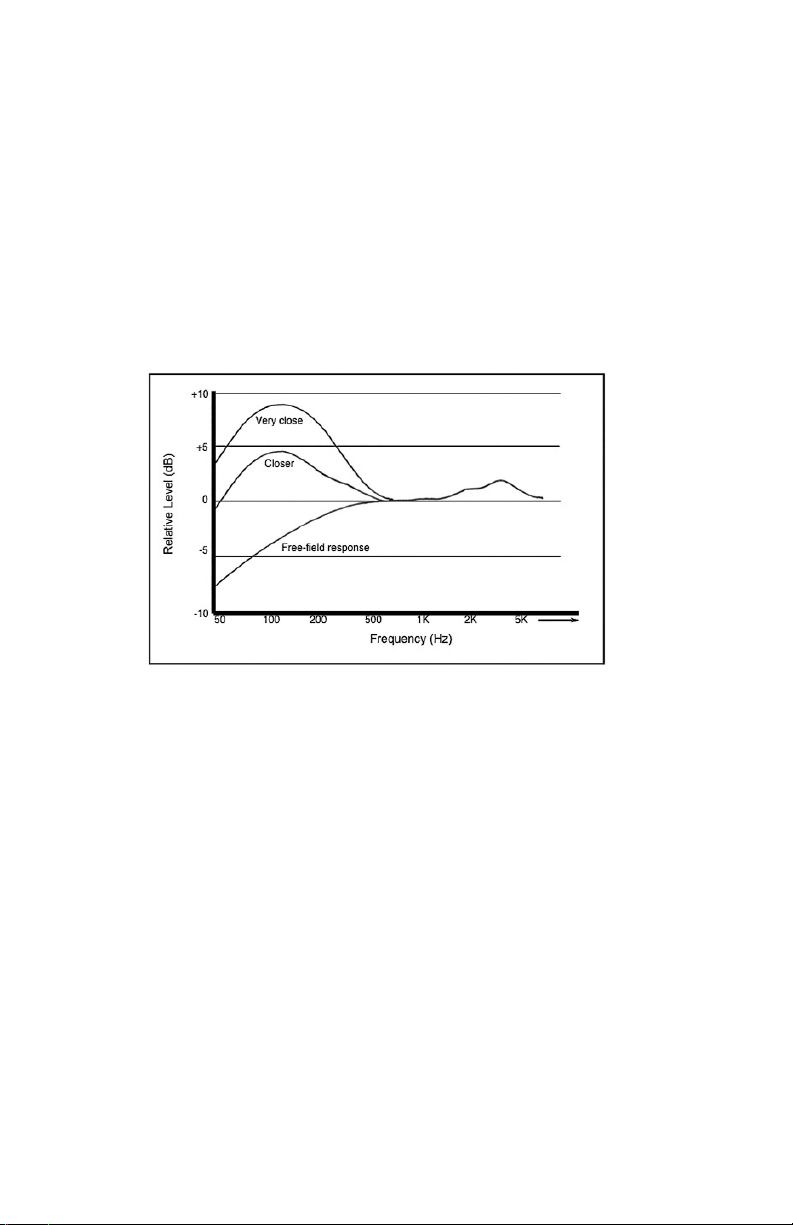
PROXIMITY EFFECT
Proximity effect, a characteristic of all directional microphones, is a
rise in low-frequency response when recording at closer working
distances. While this can be used to superb effect, particularly with
deeper vocals to enhance richness and depth. A potential trade-off
is reduced articulation resultant of the masking effect on the treble
due to “excessive” bass boost.
The KU5A, a near-field ribbon microphone, was designed to
minimize proximity effect to allow for close-range recording.
Sources within 3 inches of the mic will benefit from the warmth of
its proximity effect.
INTEGRATED HIGH-PASS
The KU5A’s smooth ribbon midrange softens the sibilance that a
condenser often accentuates, and its extended top end alleviates
the need to blend it with other microphones for more bite.
8
Page 9

The KU5A has an integrated electronic high-pass filter that can be
engaged by an external pushbutton switch. This filter smoothly rolls
off the low end with a 6db/octave shelf at 283hz. This high-pass
filter was designed specifically for singers who use the KU5A on
the road and in the studio, and allows you to position the mic right
up against the source without capturing overwhelming proximity
effect.
KU5A ACCESSORIES
The superior windscreen protection of the KU5A can be
supplemented by the AEA custom pop screen, which fits securely
over its front grille. The pop screen is advantageous in outdoor,
high-wind environments or when vocal plosives move too much air.
KU5A pop screens are available for purchase from the accessories
section of the AEA website at AEARibbonMics.com.
9
Page 10

SPECIFICATIONS
Operating Principle:
Directional Pattern:
Frequency Range:
Maximum SPL:
Sensitivity:
Output Impedance:
Load Impedance:
Phantom power:
Polarity:
High-Pass Filter:
Off Axis Response:
Relative Output at 180°:
Angle of Maximum Rejection:
Transducer Element
Material:
Thickness:
Width:
Length:
Microphone Dimensions:
Height:
Width:
Weight:
Shipping weight:
Connector:
Pressure gradient transducer
Supercardioid
< 20 Hz to >20 kHz
135 dB SPL (1% third harmonic > 1 kHz)
-43dBv (at 1 kHz, no load)
92 Ω broadband
1.0 kΩ or greater
Not required or recommended
Pin 2 high for positive pressure at the front
of the microphone.
6dB/Octave Shelf at 283hz
12dB
135°
Pure aluminum corrugated ribbon
1.8 µm
0.55 in (1.4 cm)
1.175 in (2.9 cm)
15 in (38.1 cm)
3.9 in (9.9 cm)
2 lb 9.8 oz (1.19 kg)
4 lb (1.8 kg)
XLR-3M wired to a 3 meter captive cable
Accessories Included:
Storage case, user manual
KU5A Pop Screens are available for purchase on AEARibbonMics.com.
10
Page 11
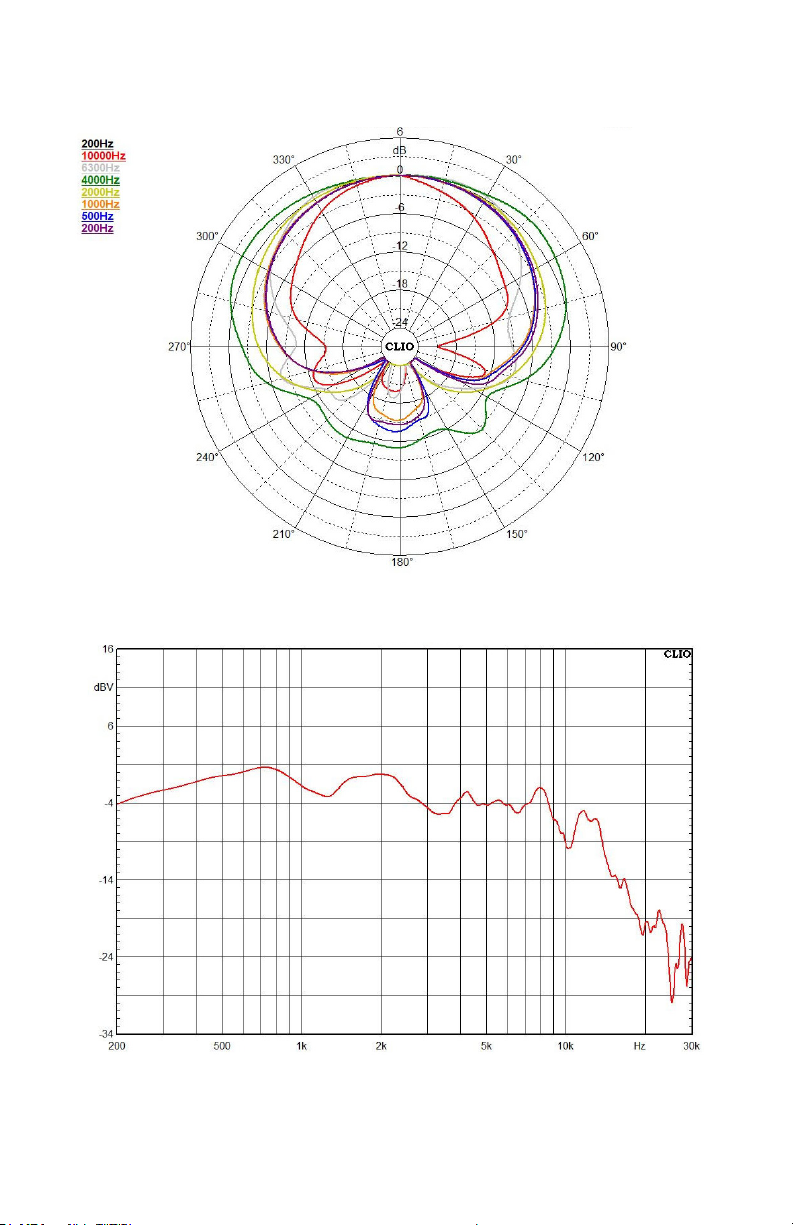
POLAR PATTERN
FREQUENCY RESPONSE
0 dB = -55dBV referenced to one Pascal (94 dV SPL).
11
Page 12

AEARIBBONMICS.COM | @RIBBONMICS | [email protected] | (800) 798-9127
 Loading...