

Page 1

Aspire 9800 Series
User's Guide
Page 2

Copyright © 2006. Acer Incorporated.
All Rights Reserved.
Aspire 9800 Series User's Guide
Original Issue: 03/2006
Changes may be made periodically to the information in this publication without obligation
to notify any person of such revisions or changes. Such changes will be incorporated in new
editions of this manual or supplementary documents and publications. This company makes
no representations or warranties, either expressed or implied, with respect to the contents
hereof and specifically disclaims the implied warranties of merchantability or fitness for a
particular purpose.
Record the model number, serial number, purchase date and place of purchase information in
the space provided below. The serial number and model number are recorded on the label
affixed to your computer. All correspondence concerning your unit should include the serial
number, model number and purchase information.
No part of this publication may be reproduced, stored in a retrieval system, or transmitted, in
any form or by any means, electronically, mechanically, by photocopy, recording or otherwise,
without the prior written permission of Acer Incorporated.
Aspire 9800 Series Notebook PC
Model number: __________________________________
Serial number: ___________________________________
Date of purchase: ________________________________
Place of purchase: ________________________________
Acer and the Acer logo are registered trademarks of Acer Incorporated. Other companies'
product names or trademarks are used herein for identification purposes only and belong to
their respective companies.
Page 3

Information for your safety and comfort
Safety instructions
Read these instructions carefully. Keep this document for future reference.
Follow all warnings and instructions marked on the product.
Turning the product off before cleaning
Unplug this product from the wall outlet before cleaning. Do not use liquid
cleaners or aerosol cleaners. Use a damp cloth for cleaning.
Warnings
• Do not use this product near water.
• Do not place this product on an unstable cart, stand or table. If the product
falls, it could be seriously damaged.
• Slots and openings are provided for ventilation to ensure reliable
operation of the product and to protect it from overheating. These
openings must not be blocked or covered. The openings should never be
blocked by placing the product on a bed, sofa, rug or other similar surface.
This product should never be placed near or over a radiator or heat
register, or in a built-in installation unless proper ventilation is provided.
• Never push objects of any kind into this product through cabinet slots as
they may touch dangerous voltage points or short-out parts that could
result in a fire or electric shock. Never spill liquid of any kind onto or into
the product.
• To avoid damage of internal components and to prevent battery leakage,
do not place the product on a vibrating surface.
iii
Using electrical power
• This product should be operated from the type of power indicated on the
marking label. If you are not sure of the type of power available, consult
your dealer or local power company.
• Do not allow anything to rest on the power cord. Do not locate this
product where people will walk on the cord.
• If an extension cord is used with this product, make sure that the total
ampere rating of the equipment plugged into the extension cord does not
exceed the extension cord ampere rating. Also, make sure that the total
rating of all products plugged into the wall outlet does not exceed the fuse
rating.
• Do not overload a power outlet, strip or receptacle by plugging in too
many devices. The overall system load must not exceed 80% of the branch
circuit rating. If power strips are used, the load should not exceed 80% of
the power strip's input rating.
Page 4

iv
This product's AC adapter is equipped with a three-wire grounded plug.
•
The plug only fits in a grounded power outlet. Make sure the power outlet
is properly grounded before inserting the AC adapter plug. Do not insert
the plug into a non-grounded power outlet. Contact your electrician for
details.
Warning! The grounding pin is a safety feature. Using a power
outlet that is not properly grounded may result in electric shock
and/or injury.
Note: The grounding pin also provides good protection from
unexpected noise produced by other nearby electrical devices that
may interfere with the performance of this product.
• Use the product only with the supplied power supply cord set. If you need
to replace the power cord set, make sure that the new power cord meets
the following requirements: detachable type, UL listed/CSA certified, type
SPT-2, rated 7 A 125 V minimum, VDE approved or its equivalent, 4.6
meters (15 feet) maximum length.
Product servicing
Do not attempt to service this product yourself, as opening or removing covers
may expose you to dangerous voltage points or other risks. Refer all servicing to
qualified service personnel.
Unplug this product from the wall outlet and refer servicing to qualified service
personnel when:
• the power cord or plug is damaged, cut or frayed
• liquid was spilled into the product
• the product was exposed to rain or water
• the product has been dropped or the case has been damaged
• the product exhibits a distinct change in performance, indicating a need
for service
• the product does not operate normally after following the operating
instructions
Note: Adjust only those controls that are covered by the operating
instructions, since improper adjustment of other controls may
result in damage and will often require extensive work by a
qualified technician to restore the product to normal condition.
Page 5
Replacing the battery pack
The notebook uses lithium batteries. Replace the battery with the same type as
that which came bundled with your product. Use of another battery may
present a risk of fire or explosion.
Warning! Batteries may explode if not handled properly. Do not
disassemble or dispose of them in fire. Keep them away from
children. Follow local regulations when disposing of used
batteries.
Telephone line safety
• Disconnect all telephone lines from the equipment when not in use and/or
before servicing.
• To avoid the remote risk of electric shock from lightning, do not connect
the telephone line to this equipment during lightning or thunderstorms.
Warning! For safety reasons, do not use non-compliant parts
when adding or changing components. Consult your reseller for
purchase options.
Disposal instructions
Do not throw this electronic device into the trash when discarding.
To minimize pollution and ensure utmost protection of the global environment,
please recycle. For more information on the Waste from Electrical and
Electronics Equipment (WEEE) regulations, visit
http://global.acer.com/about/environmental.htm
.
v
Mercury advisory
For projectors or electronic products containing an LCD/CRT monitor or display:
Lamp(s) inside this product contain mercury and must be recycled or disposed of
according to local, state or federal laws. For more information, contact the
Electronic Industries Alliance at www.eiae.org
information, check www.lamprecycle.org
. For lamp-specific disposal
.
Page 6

vi
Tips and information for comfortable use
Computer users may complain of eyestrain and headaches after prolonged use.
Users are also at risk of physical injury after long hours of working in front of a
computer. Long work periods, bad posture, poor work habits, stress,
inadequate working conditions, personal health and other factors greatly
increase the risk of physical injury.
Incorrect computer usage may lead to carpal tunnel syndrome, tendonitis,
tenosynovitis or other musculoskeletal disorders. The following symptoms may
appear in the hands, wrists, arms, shoulders, neck or back:
• numbness, or a burning or tingling sensation
• aching, soreness or tenderness
• pain, swelling or throbbing
• stiffness or tightness
• coldness or weakness
If you have these symptoms, or any other recurring or persistent discomfort
and/or pain related to computer use, consult a physician immediately and
inform your company's health and safety department.
The following section provides tips for more comfortable computer use.
Finding your comfort zone
Find your comfort zone by adjusting the viewing angle of the monitor, using a
footrest, or raising your sitting height to achieve maximum comfort. Observe
the following tips:
• refrain from staying too long in one fixed posture
• avoid slouching forward and/or leaning backward
• stand up and walk around regularly to remove the strain on your leg
muscles
• take short rests to relax your neck and shoulders
• avoid tensing your muscles or shrugging your shoulders
• install the external display, keyboard and mouse properly and within
comfortable reach
• if you view your monitor more than your documents, place the display at
the center of your desk to minimize neck strain
Taking care of your vision
Long viewing hours, wearing incorrect glasses or contact lenses, glare, excessive
room lighting, poorly focused screens, very small typefaces and low-contrast
displays could stress your eyes. The following sections provide suggestions on
how to reduce eyestrain.
Page 7

vii
Eyes
• Rest your eyes frequently.
• Give your eyes regular breaks by looking away from the monitor and
focusing on a distant point.
• Blink frequently to keep your eyes from drying out.
Display
• Keep your display clean.
• Keep your head at a higher level than the top edge of the display so your
eyes point downward when looking at the middle of the display.
• Adjust the display brightness and/or contrast to a comfortable level for
enhanced text readability and graphics clarity.
• Eliminate glare and reflections by:
• placing your display in such a way that the side faces the window or
any light source
• minimizing room light by using drapes, shades or blinds
• using a task light
• changing the display's viewing angle
• using a glare-reduction filter
• using a display visor, such as a piece of cardboard extended from the
display's top front edge
• Avoid adjusting your display to an awkward viewing angle.
• Avoid looking at bright light sources, such as open windows, for extended
periods of time.
Developing good work habits
Develop the following work habits to make your computer use more relaxing
and productive:
• Take short breaks regularly and often.
• Perform some stretching exercises.
• Breathe fresh air as often as possible.
• Exercise regularly and maintain a healthy body.
Warning! We do not recommend using the computer on a couch
or bed. If this is unavoidable, work for only short periods, take
breaks regularly, and do some stretching exercises.
Note: For more information, please refer to "Regulations and
safety notices" on page 90 in the AcerSystem User's Guide.
Page 8
viii
First things first
We would like to thank you for making an Acer notebook your choice for
meeting your mobile computing needs.
Your guides
To help you use your Acer notebook, we have designed a set of guides:
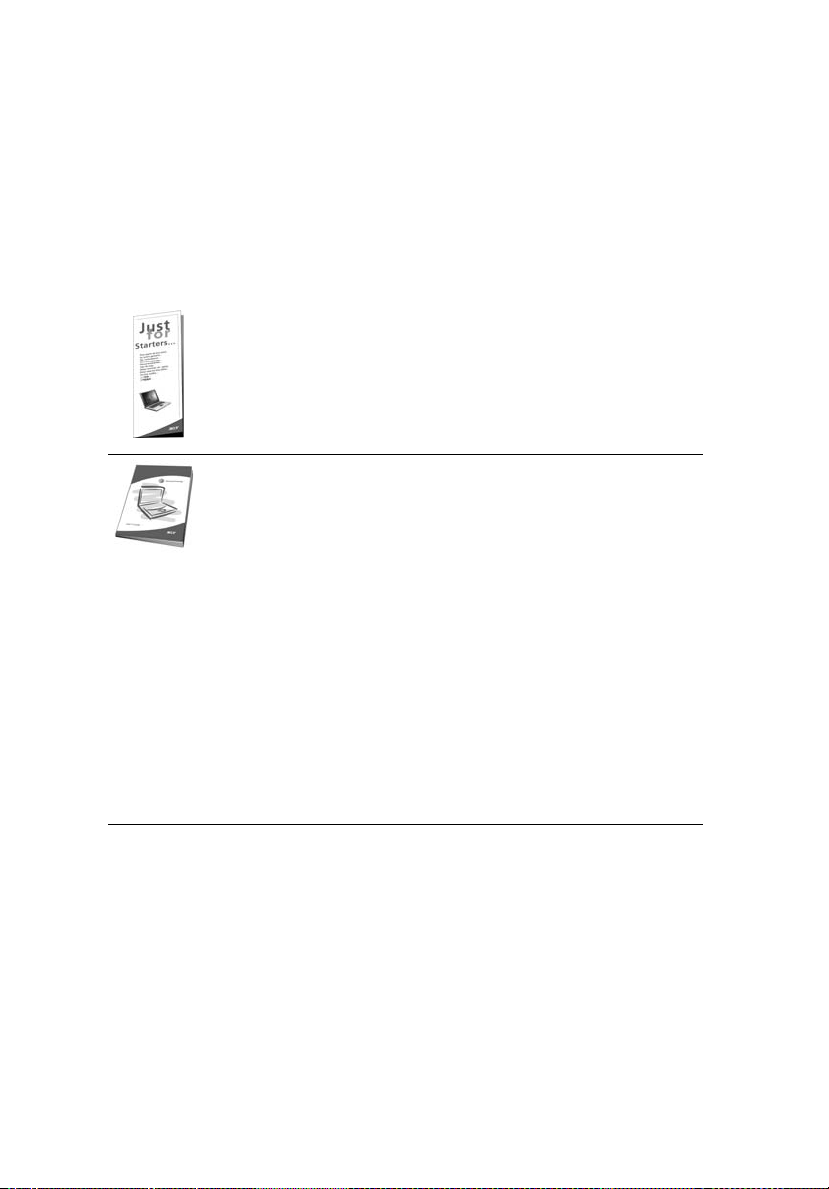
First off, the Just for Starters... poster helps you get started with
setting up your computer.
The printed User's Guide introduces you to the basic features and
functions of your new computer. For more on how your computer
can help you to be more productive, please refer to the
AcerSystem User's Guide. This guide contains detailed
information on such subjects as system utilities, data recovery,
expansion options and troubleshooting. In addition it contains
warranty information and the general regulations and safety
notices for your notebook. It is available in Portable Document
Format (PDF) and comes preloaded on your notebook. Follow
these steps to access it:
1 Click on Start, All Programs, AcerSystem.
2 Click on AcerSystem User's Guide.
Note: Viewing the file requires Adobe Reader. If Adobe Reader is
not installed on your computer, clicking on AcerSystem User's
Guide will run the Adobe Reader setup program first. Follow the
instructions on the screen to complete the installation. For
instructions on how to use Adobe Reader, access the Help and
Support menu.
Basic care and tips for using your computer
Turning your computer on and off
To turn on the computer, simply press and release the power button below the
LCD screen beside the easy-launch buttons. See "Front view" on page 15 for the
location of the power button.
Page 9

To turn the power off, do any of the following:
• Use the Windows shutdown command
Click on Start, Turn Off Computer, then click on Turn Off.
• Use the power button
You can also shut down the computer by closing the display cover, or by
pressing the sleep hotkey <Fn> + <F4>.
Note: If you cannot power off the computer normally, press and
hold the power button for more than four seconds to shut down
the computer. If you turn off the computer and want to turn it on
again, wait at least two seconds before powering up.
Taking care of your computer
Your computer will serve you well if you take care of it.
• Do not expose the computer to direct sunlight. Do not place it near sources
of heat, such as a radiator.
• Do not expose the computer to temperatures below 0 ºC (32 ºF) or above
50 ºC (122 ºF).
• Do not subject the computer to magnetic fields.
• Do not expose the computer to rain or moisture.
• Do not spill water or any liquid on the computer.
• Do not subject the computer to heavy shock or vibration.
• Do not expose the computer to dust or dirt.
• Never place objects on top of the computer.
• Do not slam the computer display when you close it.
• Never place the computer on uneven surfaces.
ix
Taking care of your AC adapter
Here are some ways to take care of your AC adapter:
• Do not connect the adapter to any other device.
• Do not step on the power cord or place heavy objects on top of it.
Carefully route the power cord and any cables away from foot traffic.
• When unplugging the power cord, do not pull on the cord itself but pull
on the plug.
• The total ampere ratings of the equipment plugged in should not exceed
the ampere rating of the cord if you are using an extension cord. Also, the
total current rating of all equipment plugged into a single wall outlet
should not exceed the fuse rating.
Page 10

x
Taking care of your battery pack
Here are some ways to take care of your battery pack:
• Use only batteries of the same kind as replacements. Turn the power off
before removing or replacing batteries.
• Do not tamper with batteries. Keep them away from children.
• Dispose of used batteries according to local regulations. Recycle if possible.
Cleaning and servicing
When cleaning the computer, follow these steps:
1 Turn off the computer and remove the battery pack.
2 Disconnect the AC adapter.
3 Use a soft, moist cloth. Do not use liquid or aerosol cleaners.
If either of the following occurs:
• the computer has been dropped or the body has been damaged;
• the computer does not operate normally
please refer to "Frequently asked questions" on page 49.
Page 11

Information for your safety and comfort iii
Safety instructions iii
Disposal instructions v
Tips and information for comfortable use vi
First things first viii
Your guides viii
Basic care and tips for using your computer viii
Turning your computer on and off viii
Taking care of your computer ix
Taking care of your AC adapter ix
Taking care of your battery pack x
Cleaning and servicing x
Acer Empowering Technology 1
Empowering Technology password 1
Acer eNet Management 2
Acer ePower Management 4
Acer ePresentation Management 7
Acer eDataSecurity Management 8
Acer eLock Management 9
Acer eRecovery Management 11
Acer eSettings Management 13
Acer ePerformance Management 14
Your Acer notebook tour 15
Front view 15
Closed front view 16
Left view 18
Right view 19
Rear view 20
Base view 21
Specifications 22
Indicators 29
Easy-launch buttons 30
Touchpad 31
Touchpad basics 31
Using the keyboard 33
Lock keys and embedded numeric keypad 33
Windows keys 34
Hotkeys 34
Special keys 36
Ejecting the optical (CD or DVD) disk 37
Using a computer security lock 37
Audio 38
Adjusting the volume 38
Acer OrbiCam 39
Launching the Acer OrbiCam 40
Changing the Acer OrbiCam settings 40
Capturing photos/videos 42
Contents
Page 12

Using the Acer OrbiCam as webcam 42
Enabling the Acer VisageON 43
Using the system utilities 46
Acer GridVista (dual-display compatible) 46
Launch Manager 47
Norton AntiVirus 48
Frequently asked questions 49
Requesting service 52
International Travelers Warranty (ITW) 52
Before you call 52
Page 13

Acer Arcade 53
48-button remote control 54
Remote functions 55
Finding and playing content 56
Settings 56
Arcade controls 57
Navigation controls 57
Player controls 57
Virtual keyboard 58
Background mode 58
Cinema 59
Settings 59
Album 60
Editing Pictures 60
Slide Show settings 60
Video 61
Playing a video file 61
Capturing video (TV models only) 61
Snapshot 61
Editing video 62
Music 62
TV (for selected models) 63
Time-shift functionality 63
Recorded TV 64
Scheduling recordings 64
Program guide 64
Find program 64
TV settings 64
Using TeleText functions 65
Make DVDs 66
Authoring CD/DVDs 66
Taking your notebook PC with you 67
Disconnecting from the desktop 67
Moving around 67
Preparing the computer 67
What to bring to meetings 68
Taking the computer home 68
Preparing the computer 68
What to take with you 68
Special considerations 69
Setting up a home office 69
Traveling with the computer 69
Preparing the computer 69
What to take with you 69
Special considerations 70
Traveling internationally with the computer 70
Preparing the computer 70
Page 14

What to bring with you 70
Special considerations 70
Securing your computer 71
Using a computer security lock 71
Using passwords 71
Entering passwords 72
Setting passwords 72
Expanding through options 73
Connectivity options 73
Fax/data modem 73
Built-in network feature 74
Fast Infrared (FIR) 74
Universal Serial Bus (USB) 75
IEEE 1394 port 75
PC Card slot 76
ExpressCard 77
Installing memory 78
Connecting your TV and AV-in cables 79
Acer Arcade TV set-up wizard
(Windows XP Home and Professional) 81
BIOS utility 82
Boot sequence 82
Enable disk-to-disk recovery 82
Password 82
Using software 83
Playing DVD movies 83
Power management 84
Acer eRecovery Management 84
Create backup 85
Restore from backup 85
Create factory default image CD 86
Re-install bundled software without CD 86
Change password 87
Troubleshooting 88
Troubleshooting tips 88
Error messages 88
Regulations and safety notices 90
ENERGY STAR guidelines compliance 90
FCC notice 90
Modem notices 91
Laser compliance statement 94
LCD pixel statement 94
Macrovision copyright protection notice 94
Radio device regulatory notice 95
General 95
European Union (EU) 95
The FCC RF safety requirement 96
Page 15

Canada — Low-power license-exempt radio
communication devices (RSS-210) 97
Federal Communications Comission
Declaration of Conformity 98
Declaration of Conformity for CE Marking 99
LCD panel ergonomic specifications 100
Index 101
Page 16
1
Acer Empowering Technology
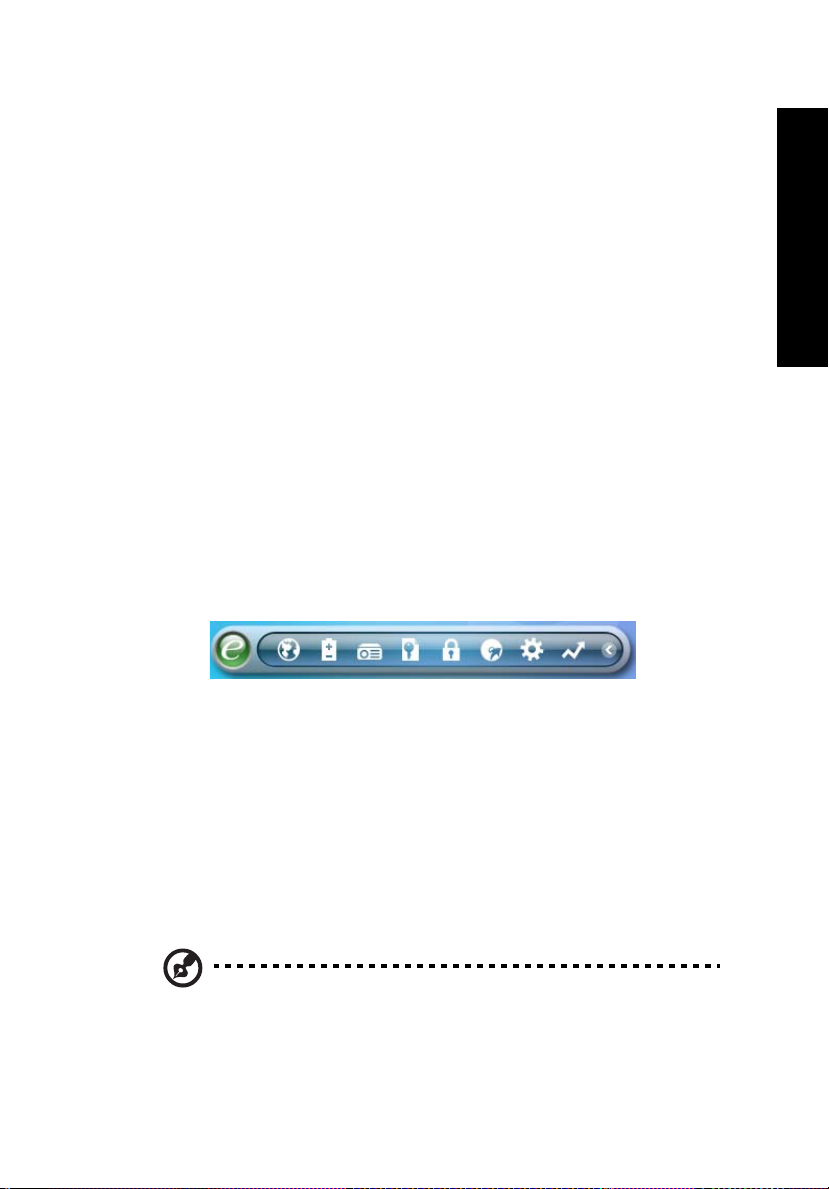
Acer's innovative Empowering Technology toolbar makes it easy for you to
access frequently used functions and manage your new Acer computer.
Displayed by default in the upper-right corner of your screen, it features the
following handy utilities:
• Acer eNet Management hooks up to location-based networks intelligently.
• Acer ePower Management extends battery power via versatile usage
profiles.
• Acer ePresentation Management connects to a projector and adjusts
display settings conveniently.
• Acer eDataSecurity Management protects data with passwords and
advanced encryption algorithms.
• Acer eLock Management limits access to external storage media and
interfaces.
• Acer eRecovery Management backs up and recovers data flexibly, reliably
and completely.
• Acer eSettings Management accesses system information and adjusts
settings easily
• Acer ePerformance Management improves system performance by
optimizing disk space, memory and registry settings..
Empowering Technology
For more information, right click on the Empowering Technology toolbar, then
select the Help or Tutorial function.
Empowering Technology password
Before using Acer eLock Management and Acer eRecovery Management, you
must initialize the Empowering Technology password. Right-click on the
Empowering Technology toolbar and select "Password Setup" to do so. If you
do not initialize the Empowering Technology password, you will be prompted
to do so when running Acer eLock Management or Acer eRecovery
Management for the first time.
If you lose your password, there is no method to reset it except by
reformatting your notebook or taking your notebook
to an Acer Customer Service Center. Be sure to remember or write
down your password.
Page 17
2
Acer eNet Management
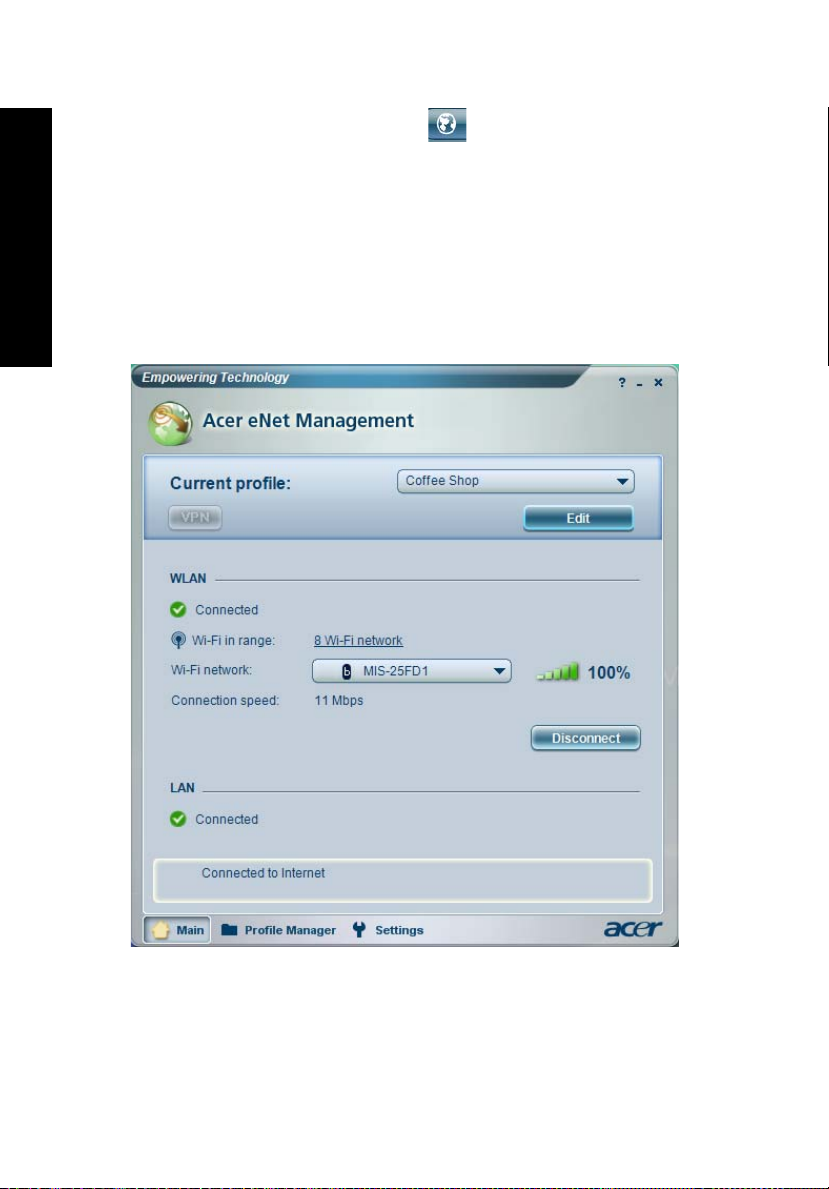
Acer eNet Management helps you to quickly and easily connect to both wired
and wireless networks in a variety of locations. To access this utility, either click
on the "Acer eNet Management" icon on your notebook, or start the program
from the Start menu. You also have the option to set Acer eNet Management to
start automatically when you boot up your PC.
Acer eNet Management automatically detects the best settings for a new
location, while offering you the freedom to manually adjust the settings to
match your needs.
Empowering Technology
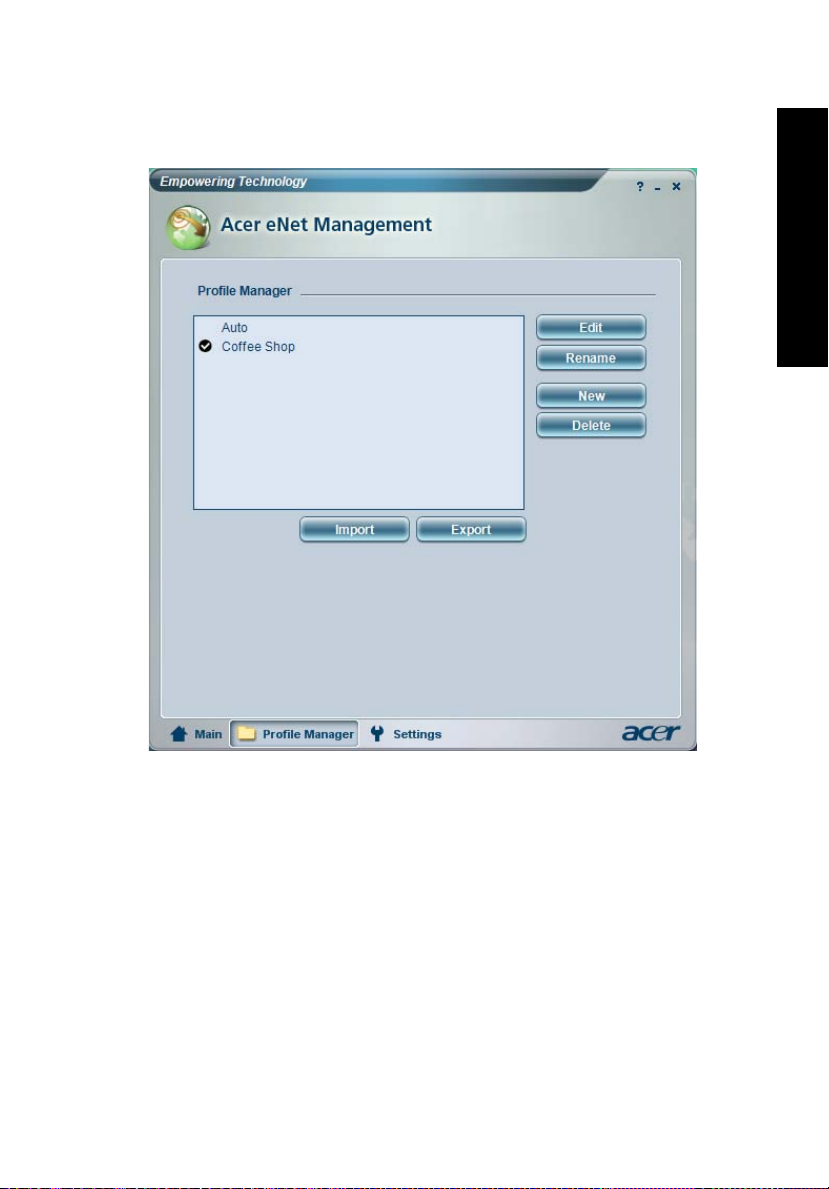
Acer eNet Management can save network settings for a location to a profile,
and automatically switch to the appropriate profile when you move from one
location to another. Settings stored include network connection settings (IP and
DNS settings, wireless AP details, etc.), as well as default printer settings.
Page 18
3
Security and safety concerns mean that Acer eNet Management does not store
username and password information.
Empowering Technology
Page 19

4
Acer ePower Management
Acer ePower Management features a straightforward user interface. To launch
it, select Acer ePower Management from the Empowering Technology
interface.
AC mode (Adapter mode)
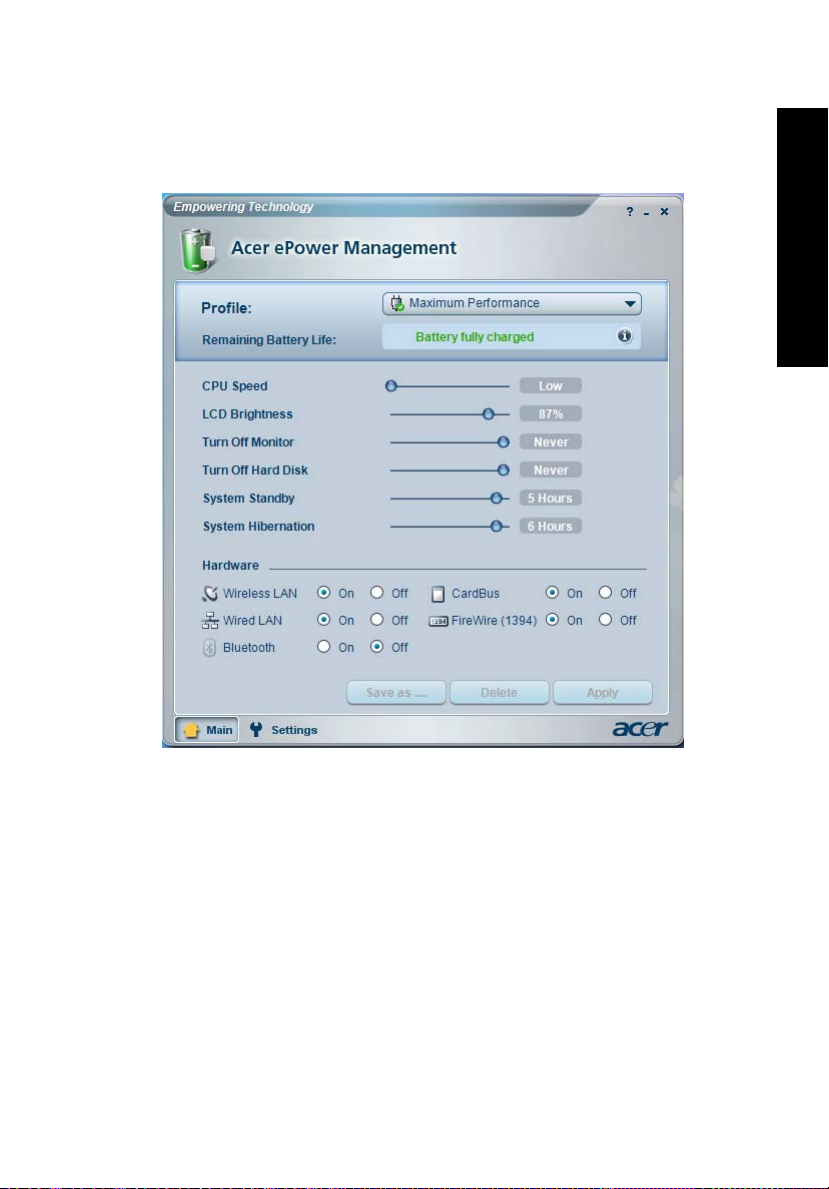
The default setting is "Maximum Performance." You can adjust CPU speed, LCD
brightness and other settings, or click on buttons to turn the following
functions on/off: Wireless LAN, Bluetooth, CardBus, FireWire(1394), Wired LAN
Empowering Technology
and Optical Device if supported.
DC mode (Battery mode)
There are four pre-defined profiles — Entertainment, Presentation, Word
Processing, and Battery Life. You can also define up to three of your own.
To create a new power profile:
1 Change power settings as desired.
2 Click "Save as ..." to save to a new power profile.
3 Name the newly created profile.
4 Select whether this profile is for Adapter or Battery mode, then click OK.
5 The new profile will appear in the profile list.
Page 20
5
Battery status
For real-time battery life estimates based on current usage, refer to the panel in
the upper half of the window..
Empowering Technology
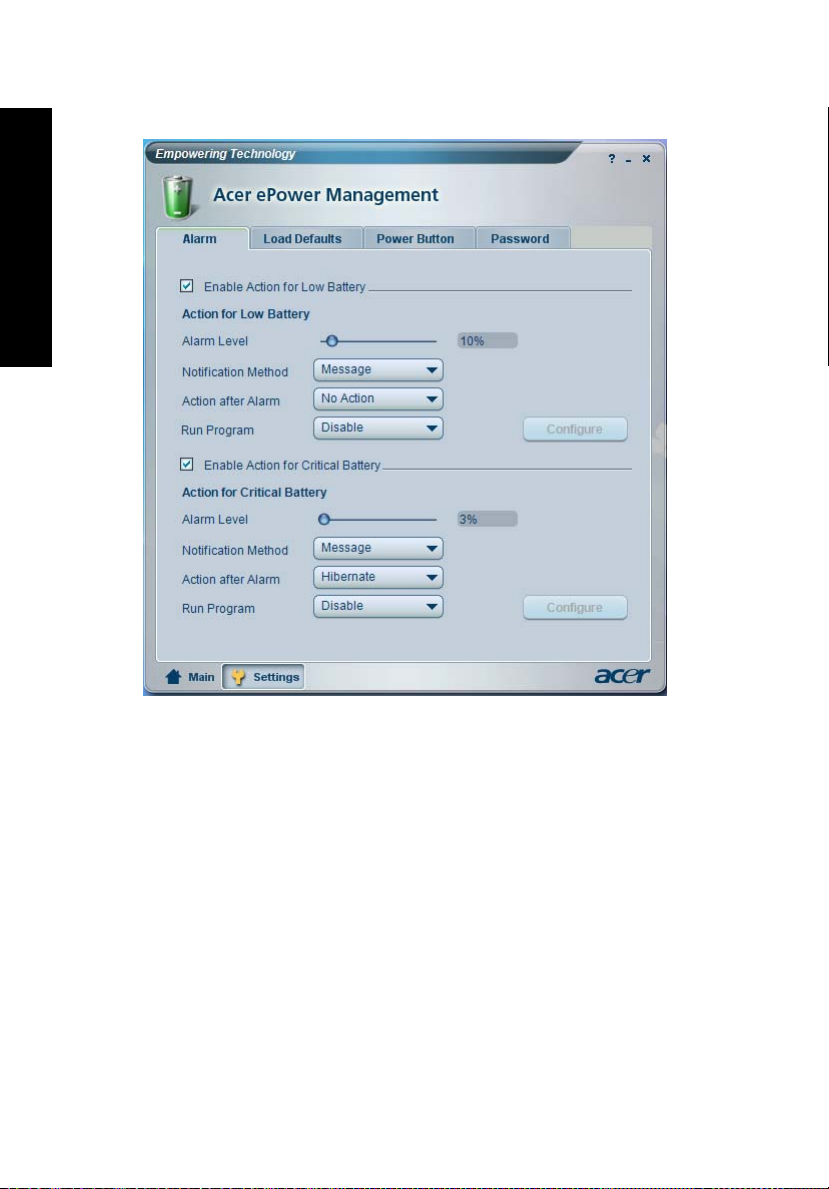
For additional options, click "Settings" to:
• Set alarms.
• Re-load factory defaults.
• Select what actions to be taken when the cover is closed or the power
button is pressed.
• Set passwords for accessing the system after Hibernation or Standby.
• View information about Acer ePower Management.
Page 21
6
Empowering Technology
Page 22
7
Acer ePresentation Management
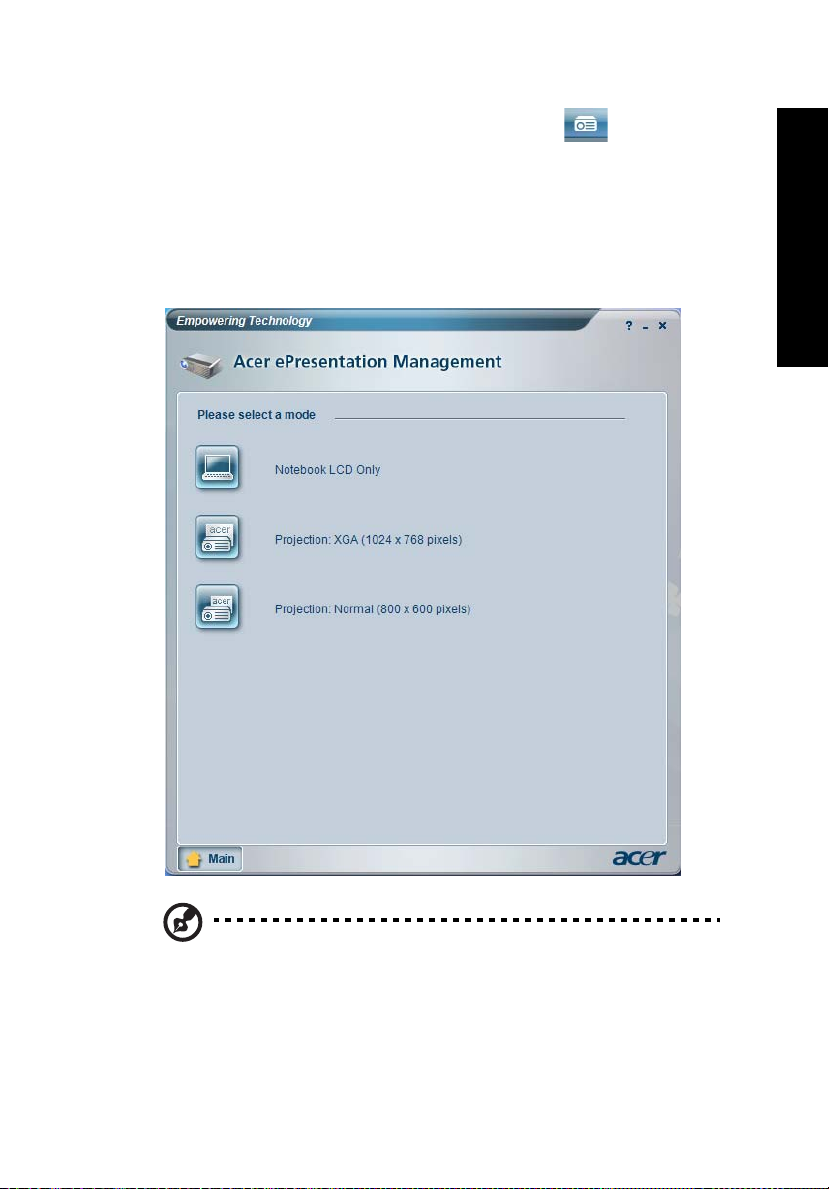
Acer ePresentation Management lets you project your computer's display to an
external device or projector using the hot key: Fn + F5. If auto-detection
hardware is implemented in the system and the external display supports it,
your system display will be automatically switched out when an external display
is connected to the system. For projectors and external devices that are not
auto-detected, launch Acer ePresentation Management to choose an
appropriate display setting.
Empowering Technology
Note: If the restored resolution is not correct after disconnecting a
projector, or you need to use an external resolution that is not
supported by Acer ePresentation Management, adjust your
display settings using Display Properties or the utility provided by
the graphics vendor.
Page 23
8
Acer eDataSecurity Management
Acer eDataSecurity Management is a handy file encryption utility that protects
your files from being accessed by unauthorized persons. It is conveniently
integrated with Windows Explorer as a shell extension for quick and easy data
encryption/decryption and also supports on-the-fly file encryption for MSN
Messenger and Microsoft Outlook.
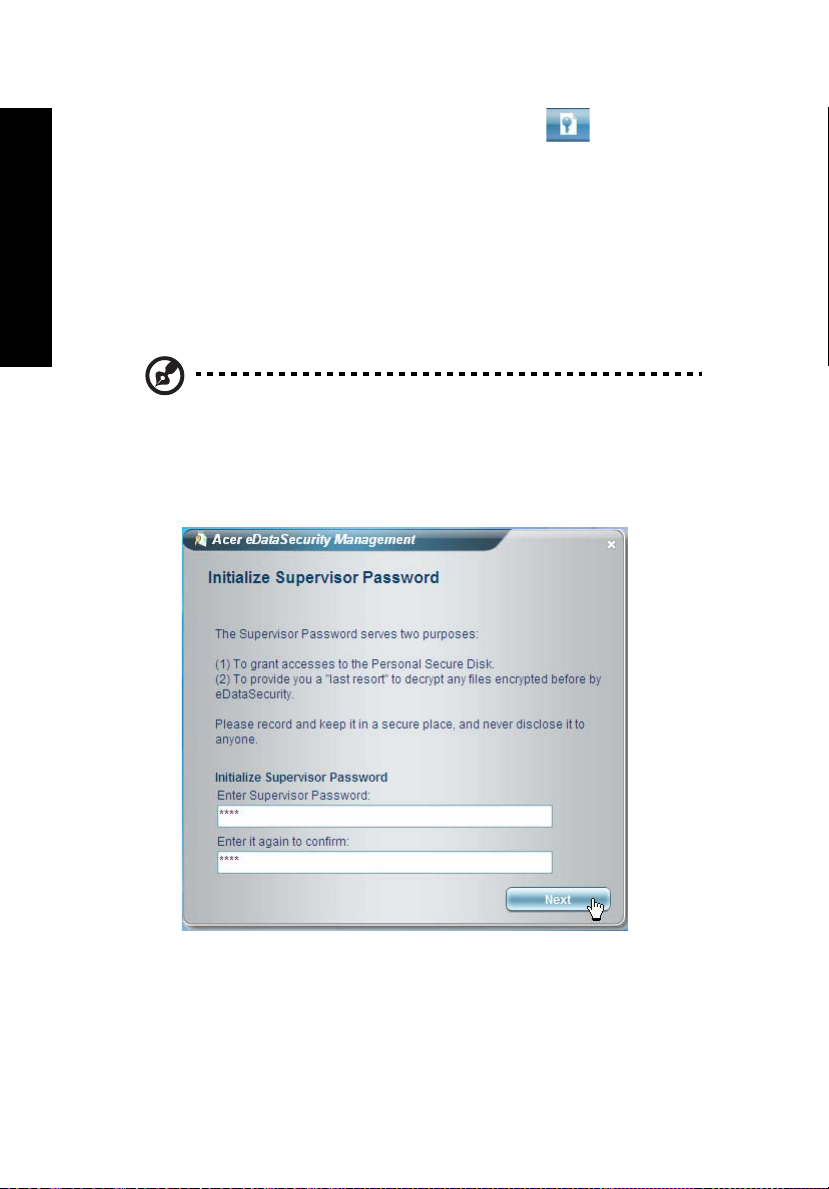
The Acer eDataSecurity Management setup wizard will prompt you for a
supervisor password and default encryption. This encryption will be used to
encrypt files by default, or you can choose to enter your own file-specific
Empowering Technology
password when encrypting a file.
Note: The password used to encrypt a file is the unique key that
the system needs to decrypt it. If you lose the password, the
supervisor password is the only other key capable of decrypting
the file. If you lose both passwords, there will be no way to
decrypt your encrypted file! Be sure to safeguard all related
passwords!
Page 24
Acer eLock Management
9
Empowering Technology
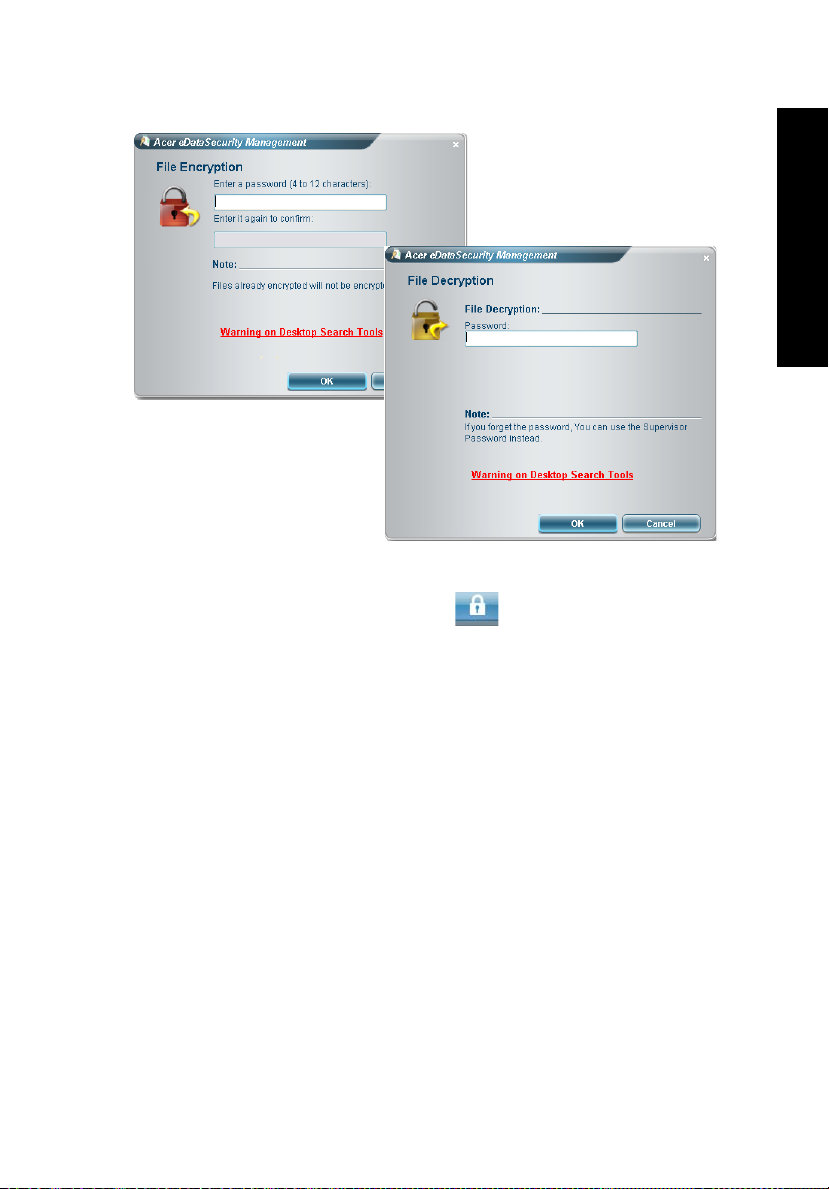
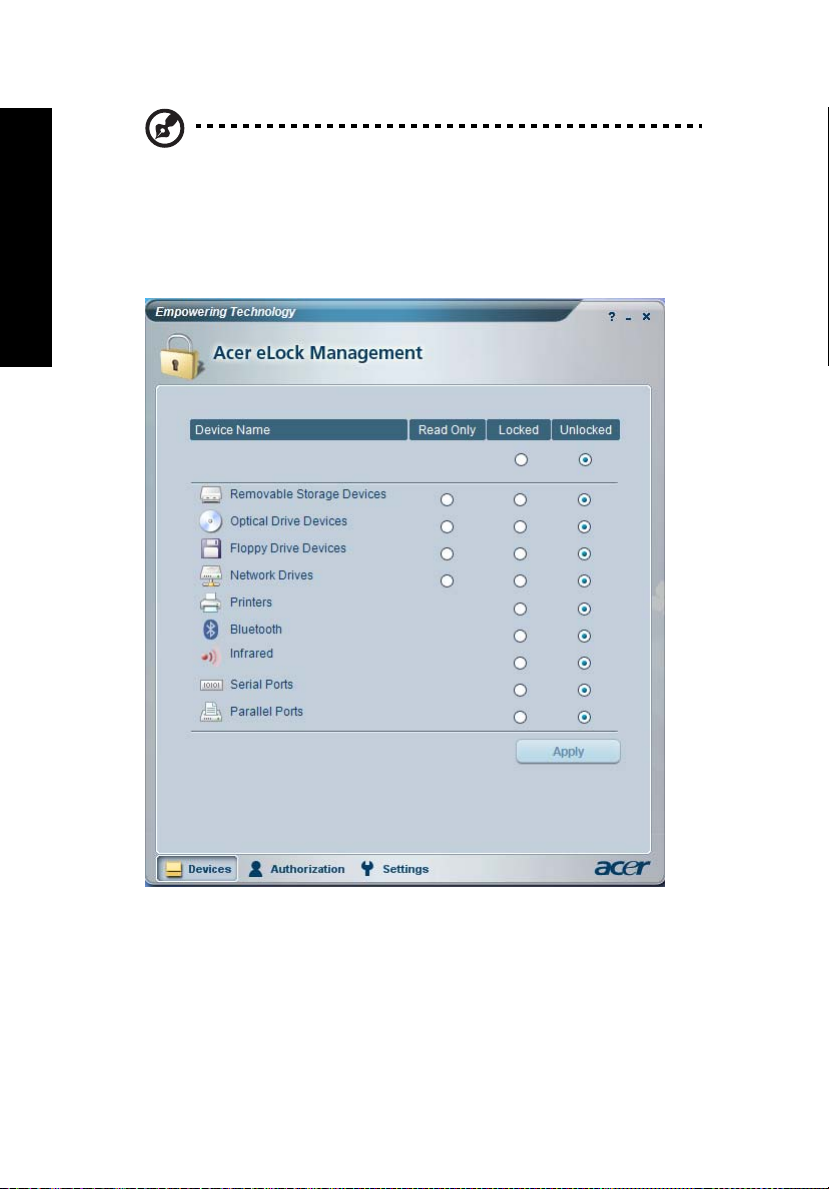
Acer eLock Management is a security utility that allows you to lock your
removable data, optical and floppy drives to ensure that data can't be stolen
while your notebook is unattended.
• Removable data devices — includes USB disk drives, USB pen drives, USB
flash drives, USB MP3 drives, USB memory card readers, IEEE 1394 disk
drives and any other removable disk drives that can be mounted as a file
system when plugged into the system.
• Optical drive devices — includes any kind of CD-ROM or DVD-ROM drives.
• Floppy disk drives — 3.5-inch disks only.
• Interfaces — includes serial port, parallel port, infrared (IR), and Bluetooth.
To activate Acer eLock Management, a password must be set first. Once set, you
can apply locks to any of the devices types. Lock(s) will immediately
be set without any reboot necessary, and will remain locked after rebooting,
until unlocked.
Page 25
10
Note: If you lose your password, there is no method to reset it
except by reformatting your notebook or taking your notebook
to an Acer Customer Service Center. Be sure to remember or write
down your password.
Empowering Technology
Page 26

11
Acer eRecovery Management
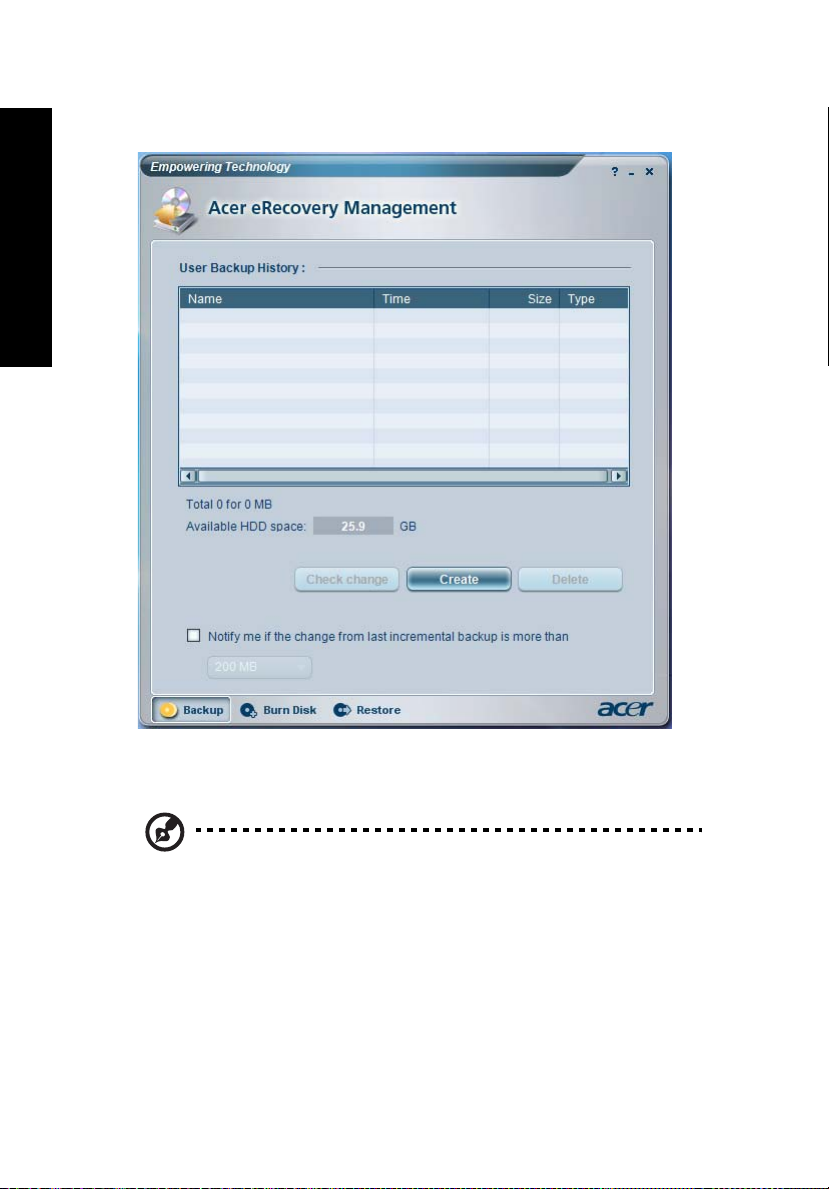
Acer eRecovery Management is a powerful utility that does away with the need
for recovery disks provided by the manufacturer. The Acer eRecovery
Management utility occupies space in a hidden partition on your system's hard
drive. By default, user-created backups are stored on the D:\ drive.
Acer eRecovery Management provides you with:
• Password protection.
• Recovery of applications and drivers.
• Image/data backup:
• Back up to HDD (set recovery point).
• Back up to CD/DVD.
• Image/data recovery tools:
• Recover from a hidden partition (factory defaults).
• Recover from the HDD (most recent user-defined recovery point).
• Recover from CD/DVD.
Empowering Technology
Page 27
12
Empowering Technology
For more information, please refer to "Acer eRecovery Management" on page
84 in the AcerSystem User's Guide.
Note: If your computer did not come with a Recovery CD or
System CD, please use Acer eRecovery Management's "System
backup to optical disk" feature to burn a backup image to CD or
DVD. To ensure the best results when recovering your system
using a CD or Acer eRecovery Management, detach all peripherals
(except the external Acer ODD, if your computer has one),
including your Acer ezDock.
Page 28
13
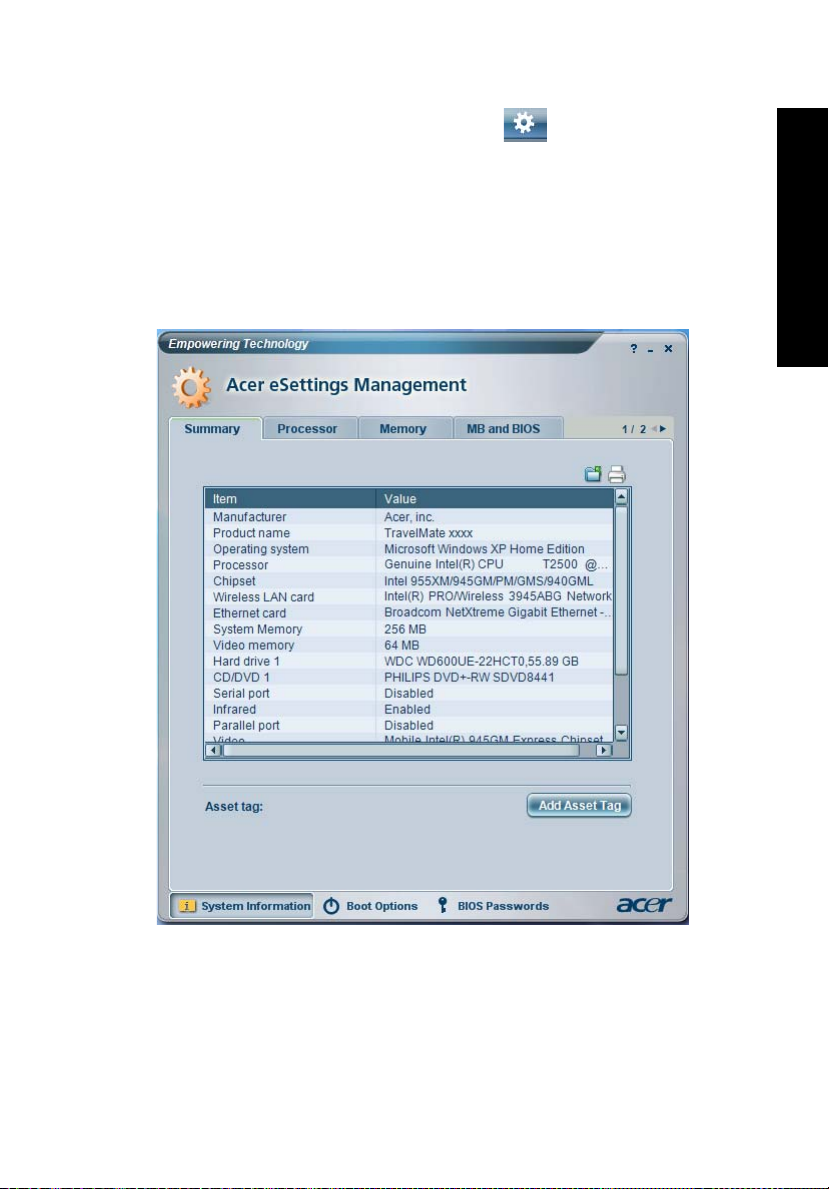
Acer eSettings Management
Acer eSettings Management allows you to inspect hardware specifications,
change BIOS passwords or other Windows settings, and to monitor the system
health status.
Acer eSettings Management also:
• Provides a simple graphical user interface for navigation.
• Displays general system status and advanced monitoring for power users
on Acer computer.
Empowering Technology
Page 29

14
Acer ePerformance Management
Acer ePerformance Management is a system optimization tool that boosts the
performance of your Acer computer. It provides an express optimization
method to release unused memory and disk space quickly. The user can also
enable advanced options for full control over the following options:
• Memory optimization — releases unused memory and check usage.
• Disk optimization — removes unneeded items and files.
• Speed optimization — improves the usability and performance of your
Empowering Technology
Windows XP system.
Page 30
15
Your Acer notebook tour
After setting up your computer as illustrated in the Just for Starters... poster,
let us show you around your new Acer notebook.
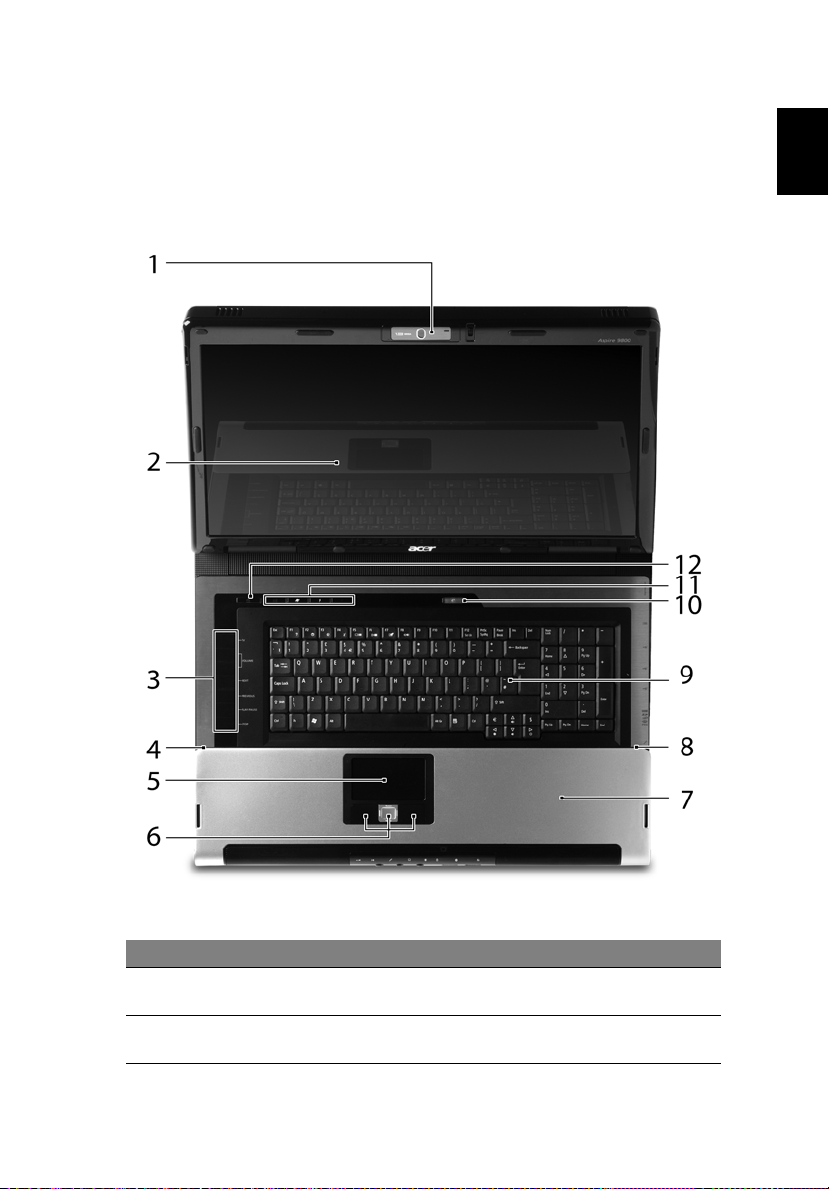
Front view
English
# Item Description
1 Built-in camera 1.3 megapixel web camera for video
communication.
2 Display screen Also called Liquid-Crystal Display (LCD), displays
computer output.
Page 31

English
16
# Item Description
3Media/
volume buttons
4/8 Microphone Internal microphone for sound recording.
5 Touchpad Touch-sensitive pointing device which functions
6 Click buttons (left,
center and right)
7 Palmrest Comfortable support area for your hands when
9 Keyboard For entering data into your computer.
10/11 Easy-launch buttons Buttons for launching frequently used
12 Power button Turns the computer on and off.
For use with Acer Arcade and other media
playing programs.
like a computer mouse.
The left and right buttons function like the left
and right mouse buttons; the center button
serves as a 4-way scroll button.
you use the computer.
programs.
See "Easy-launch buttons" on page 30 for more
details.
Closed front view
# Icon Item Description
1 Speakers Left and right speakers deliver stereo
audio output.
2 Infrared port/
CIR receiver
3 Line-in jack Accepts audio line-in devices (e.g., audio
4 Microphone-in jack Accepts input from external
Interfaces with infrared devices (e.g.,
infrared printer and IR-aware computer)/
Receives signals from a remote control.
CD player, stereo walkman).
microphones.
Page 32

17
# Icon Item Description
5 Headphones/speaker/
line-out jack with
S/PDIF support
6 Power indicator Indicates the computer's power status.
7 Battery indicator Indicates the computer's batttery status.
8Bluetooth
communication
switch/indicator
9 Wireless
communication
switch/indicator
Connects to audio line-out devices (e.g.,
speakers, headphones).
Enables/disables the Bluetooth function.
Indicates the status of Bluetooth
communication.
Enables/disables the wireless function.
Indicates the status of wireless LAN
communication.
English
Page 33

English
18
Left view
# Icon Item Description
1 USB 2.0 port Connect to USB 2.0 devices (e.g., USB
mouse, USB camera).
2 Modem (RJ-11)
port
Connects to a phone line.
3 Optical drive Internal optical drive; accepts CDs or DVDs
4 Optical disk access
indicator
5 Optical drive eject
button
6 Emergency eject
hole
7 Latch Locks and releases the lid.
(slot-load or tray-load depending on
model).
Lights up when the optical drive is active.
Ejects the optical disk from the drive.
Ejects the optical drive tray when the
computer is turned off.
Page 34

19
Right view
# Item Description
1 Latch Locks and releases the lid.
2 5-in-1 card reader Accepts Secure Digital (SD),
MultiMediaCard (MMC), Memory Stick
(MS), Memory Stick PRO (MS PRO), xDPicture Card (xD).
3 3 USB 2.0 ports Connect to USB 2.0 devices (e.g., USB
4 4-pin IEEE 1394 port Connects to IEEE 1394 devices.
5 PC Card slot eject
button
6 PC Card slot Accepts one Type II PC Card.
mouse, USB camera).
Ejects the PC Card from the slot.
English
7 ExpressCard/54 slot Accepts one ExpressCard/54 module.
Page 35

English
20
Rear view
# Icon Item Description
1 DC-in jack Connects to an AC adapter.
2 TV-in port Accepts input signals from analog/digital
3 AV-in port Accepts input signals from audio/video (AV)
4 Kensington lock slot Connects to a Kensington-compatible
5 Ventilation slots Enable the computer to stay cool, even after
6 S-video/TV-out
(NTSC/PAL) port
7 External display
(VGA) port
8 DVI-D port Supports digital video connections.
9 Ethernet (RJ-45)
port
10 Parallel port Connects to a printer.
11 Serial port Connects to a serial device.
TV-tuner devices (for selected models).
devices (manufacturing option).
computer security lock.
prolonged use.
Connects to a television or display device
with S-video input.
Connects to a display device
(e.g., external monitor, LCD projector).
Connects to an Ethernet 10/100/1000-based
network (for selected models).
Page 36

21
Base view
# Item Description
1 Ventilation slots and
cooling fan
2 Memory compartment Houses the computer's main memory.
3 Battery lock Locks the battery in position.
4 Battery release latch Releases the battery for removal.
5 Battery bay Houses the computer's battery pack.
6 Hard disk bay Houses the computer's hard disk (secured with
7 Sub woofer Emits low frequency sound output.
Enable the computer to stay cool, even after
prolonged use.
Note: Do not cover or obstruct the opening of
the fan.
screws).
English
Page 37

22
Specifications
English
Operating
system
• Windows
• Genuine Windows
• Genuine Windows
®
Vista Capable
®
®
XP Home Edition (Service Pack 2)
XP Media Center Edition 2005
(Rollup 2)
Windows® Vista ™Capable PCs come with
®
Windows
upgraded to Windows
information on Windows
XP installed, and can be
®
Vista™. For more
®
Vista™ and how
to upgrade, go to: Microsoft.com/
windowsvista.
Platform
• Intel
®
Centrino® Duo mobile technology, featuring:
•Intel
®
Core™ Duo processor T2300/T2400/T2500/
T2600 (2 MB L2 cache, 1.66/1.83/2/2.16 GHz, 667
MHz FSB)
•Intel
•Intel
®
945PM Express chipset
®
PRO/Wireless 3945ABG network
connection (dual-band tri-mode 802.11a/b/g) Wi-
Fi CERTIFIED
SignalUp
™
solution, supporting Acer
™
wireless technology
System memory Up to 2 GB of DDR2 667 MHz memory, upgradeable to 4
GB using two soDIMM modules (dual-channel support)
Display
• 20.1" WSXGA+ high-brightness (200 nit) Acer
CrystalBrite
™
TFT LCD, 1680 x 1050 pixel resolution, 6
lamps
• 19" WXGA+ high-brightness (200 nit) Acer
CrystalBrite
lamps
™
TFT LCD, 1440 x 900 pixel resolution, 4
• 16 ms typical on/off and 8 ms average gray-to-gray
response time
• Simultaneous multi-window viewing via Acer
GridVista
™
supported
Page 38

23
TV-tuner Acer TV-tuner options:
• Analog TV-tuner supporting hardware MPEG-2
stream encoding
• Digital and analog hybrid TV-tuner supporting
hardware MPEG-2 stream encoding
• Digital and analog hybrid TV-tuner supporting
software MPEG-2 stream encoding
Analog TV-tuner supporting international analog TV
standards (NTSC/PAL/SECAM)
Digital TV-tuner supporting DVB-T (Digital Video
Broadcasting Terrestrial) standard (6 MHz to 8 MHz)
TV-tuner I/O:
• RF jack for digital/analog TV antenna cable input
• AV-in port for composite/S-video/line-in audio/
video input
TV-tuner cables:
• PAL cable for digital/analog TV input, PAL/
SECAM to NTSC port converter
• Mini DIN cable: RCA jack and S-video port for
audio/video input
Acer DVB-T antenna (UHF/VHF reception) supporting Acer
SignalUp
™
wireless technology
English
Page 39

24
English
Graphics
Audio
Storage
subsystem
• NVIDIA
®
GeForce® Go 7600 with up to 512 MB
TurboCache
™
(256 MB of dedicated GDDR2 VRAM
and up to 256 MB of shared system memory), or
• NVIDIA
®
GeForce® Go 7300 with up to 256MB
TurboCache
™
(128 MB of dedicated GDDR2 VRAM
and up to 128 MB of shared system memory)
• Supporting NVIDIA
®
PureVideo™ technology (WMV
HD, High-Definition MPEG-2 Hardware Acceleration,
integrated HDTV encoder) dual-link DVI, Microsoft
®
DirectX
Dynamic Range (HDR) technology, NVIDIA
PowerMizer
9.0, Shader Model 3.0, OpenEXR High
®
®
6.0 and PCI Express
®
®
• Dual independent display
• 16.7 million colors (20.1" LCD model)
• 16.2 million colors (19" LCD model)
• MPEG-2/DVD hardware-assisted capability
• S-video/TV-out (NTSC/PAL) support
• DVI-D (true digital video interface) with HDCP (High-
bandwidth Digital Content Protection) support
• Acer Arcade
Acer ClearVision
™
featuring Acer CinemaVision™ and
™
technologies
• Audio system with two built-in Acer 3DSonic (1.5 W )
stereo speakers and one Acer BasSonic subwoofer
• Dolby
• Intel
®
Digital Live and DTS Neo: PC support
®
High Definition audio support
• S/PDIF (Sony/Philips Digital Interface) support for
digital speakers
• Sound Blaster Pro
™
and MS Sound compatible
• Two built-in stereo microphones
• One or two 80/100/120 GB Serial ATA hard disk drives,
supporting software RAID 0/1
• Optical drive options:
• DVD-Super Multi double-layer drive (slot-load)
• 5-in-1 card reader, supporting Secure Digital (SD),
MultiMediaCard (MMC), Memory Stick
™
Memory Stick PRO
(MS PRO), xD-Picture Card™ (xD)
®
(MS),
Page 40

25
Communication
Dimensions
and weight
Power
subsystem
• Acer Video Conference, featuring Voice and Video
over Internet Protocol (VVoIP) support via Acer
OrbiCam
• Acer OrbiCam
featuring:
• 30 degree ergonomic rotation
• Acer VisageON
• Acer PrimaLite
• WLAN: Intel
connection (dual-band tri-mode 802.11a/b/g) Wi-Fi
CERTIFIED
wireless technology
• WPAN: Bluetooth
™
and optional Acer Bluetooth® VoIP phone
™
1.3 megapixel CMOS camera,
™
technology
™
technology
®
PRO/Wireless 3945ABG network
™
solution supporting Acer SignalUp™
®
2.0+EDR (Enhanced Data Rate)
• LAN: gigabit Ethernet; Wake-on-LAN ready
• Modem: 56K ITU V.92 with PTT approval;
Wake-on-Ring ready
• 475 (W) x 352 (D) x 61.8 (H) mm (18.7 x 13.9 x 2.4
inche)s
• 20.1" LCD model:
• 7.8 kg (17.19 lbs.) with TV-tuner and 2nd hard
disk drive
• 7.7 kg (16.9 lbs.) without TV-tuner and 2nd hard
disk drive
• 19" LCD model:
• 7.5 kg (16.5 lbs.) with TV-tuner and 2nd hard
disk drive
• 7.4 kg (16.3 lbs.) without TV-tuner and 2nd hard
disk drive
• ACPI 2.0 CPU power management standard: supports
Standby and Hibernation power-saving modes
• 71 W 4800 mAh Li-ion battery pack (8-cell)
• Acer QuicCharge
• 80% charge in 1 hour
• 2-hour rapid charge system-off
• 2.5-hour charge-in-use
™
technology:
• 3-pin 135 W AC adapter ( 811 g with power cord)
English
Page 41

26
English
Special keys and
controls
• 105-/106-key keyboard, with inverted "T" cursor
layout; 2.5 mm (minimum) key travel
• Touchpad with 4-way scroll button
• 12 function keys, four cursor keys, two Windows
keys, hotkey controls, embedded numeric keypad,
international language support
®
• Four easy-launch buttons: Empowering Key, email,
Internet, user-programmable button
• Seven media keys: Acer Arcade, volume up/down,
previous, next, play/pause, stop
• Four front-panel LED indicators: power, battery,
WLAN, Bluetooth
®
• Two communication LED switches: WLAN,
Bluetooth
®
• Acer remote controls:
• Acer Arcade
•Windows
external USB CIR receiver)
™
(48 keys)
®
Media Center Edition (uses an
Page 42

27
I/O interface
• ExpressCard
™
/54 slot
• PC Card slot (one Type II)
• 5-in-1 card reader (SD/MMC/MS/MS PRO/xD)
• Four USB 2.0 ports
• DVI-D port with HDCP support
• IEEE 1394 port
• Consumer infrared (CIR) port
• Fast infrared (FIR) port
• External display (VGA) port
• S-video/TV-out (NTSC/PAL) port
• AV-in port
• TV-tuner antenna-in port
• Headphones/speaker/line-out port with S/PDIF
support
• Microphone-in jack
• Line-in jack
• Parallel port
• Serial port
• Ethernet (RJ-45) port
• Modem (RJ-11) port
• DC-in jack for AC adapter
English
Page 43

28
English
Software
• Acer Empowering Technology
• Acer eNet Management
• Acer ePower Management
• Acer ePresentation Management
• Acer eDataSecurity Management
• Acer eLock Management
• Acer eRecovery Management
• Acer eSettings Management
• Acer ePerformance Management
• Acer GridVista
• Acer Arcade
™
™
• Acer Launch Manager
™
®
®
Power Producer
™
™
Security
• Norton AntiVirus
• Adobe
®
Reader
• CyberLink
• NTI CD-Maker
• Kensington lock slot
• BIOS user and supervisor passwords
Options and
accessories
• Acer Bluetooth
• 512 MB, 1 GB or 2GB DDR2 667 MHz soDIMM
modules
®
VoIP phone
• 8-cell Li-ion battery pack
• 3-pin 135 W AC adapter
• External USB floppy disk drive
Environment
• Temperature:
• Operating: 5 °C to 35 °C
• Non-operating: -20 °C to 65 °C
• Humidity (non-condensing):
• Operating: 20% to 80%
• Non-operating: 20% to 80%
System
compliance
• Wi-Fi
• ACPI
®
• Mobile PC 2002
• DMI 2.0
Warranty One-year International Travelers Warranty (ITW)
Note: The specifications listed above are for reference only. The
exact configuration of your PC depends on the model purchased.
Page 44

29
Indicators
The computer has serveral easy-to-read status indicators.
The front panel indicators are visible even when the computer cover is closed
up.
Icon Function Description
Standby Indicates the computer's standby status.
HDD Indicates when the hard disk drive is active.
English
Caps Lock Lights up when Caps Lock is activated.
Num Lock Lights up when Num Lock is activated.
Power Indicates the computer's power status.
Battery Indicates the computer's batttery status.
Bluetooth Indicates the status of Bluetooth communication.
Wireless LAN Indicates the status of wireless LAN communication.
Page 45

English
30
1. Charging: The light shows amber when the battery is charging.
2. Fully charged: The light shows green when in AC mode.
Easy-launch buttons
Located above the keyboard are four buttons. These buttons are called
easy-launch buttons. They are: mail, Web browser, Empowering Key < > and
one user-programmable button.
Press < > to run the Acer Empowering Technology. Please see "Acer
Empowering Technology" on page 1. The mail and Web browser buttons are
pre-set to email and Internet programs, but can be reset by users. To set the
Web browser, mail and programmable buttons, run the Acer Launch Manager.
See "Launch Manager" on page 47.
Easy-launch button Default application
Acer Empowering Technology (user-programmable)
P
Web browser Internet browser (user-programmable)
Mail Email application (user-programmable)
User-programmable
Page 46

31
Touchpad
The built-in touchpad is a pointing device that senses movement on its surface.
This means the cursor responds as you move your finger across the surface of
the touchpad. The central location on the palmrest provides optimum comfort
and support.
Touchpad basics
The following items show you how to use the touchpad:
English
• Move your finger across the touchpad (2) to move the cursor.
• Press the left (1) and right (4) buttons located beneath the touchpad to
perform selection and execution functions. These two buttons are similar
to the left and right buttons on a mouse. Tapping on the touchpad is the
same as clicking the left button.
• Use the 4-way scroll (3) button to scroll up or down and move left or right
a page. This button mimics your cursor pressing on the right scroll bar of
Windows applications.
Page 47

32
English
Function Left button (1)
Execute Quickly click
twice.
Select Click once. Tap once.
Drag Click and hold,
then use
finger on the
touchpad to
drag the
cursor.
Access
context
menu
Scroll Click and
Note: When using the touchpad, keep it — and your fingers — dry
and clean. The touchpad is sensitive to finger movement; hence,
the lighter the touch, the better the response. Tapping harder will
not increase the touchpad's responsiveness.
Right
button (4)
Click
once.
Main touchpad (2)
Tap twice (at the same
speed as double-clicking
a mouse button).
Tap twice (at the same
speed as double-clicking
a mouse button); rest
your finger on the
touchpad on the second
tap and drag the cursor.
Center
button (3)
hold to
move up/
down/left/
right.
Note: By default, vertical and horizontal scrolling is enabled on
your touchpad. It can be disabled under Mouse settings in
Windows Control Panel.
Page 48

33
Using the keyboard
The keyboard has full-sized keys and an embedded numeric keypad, separate
cursor, lock, Windows, function and special keys.
Lock keys and embedded numeric keypad
The keyboard has three lock keys which you can toggle on and off.
Lock key Description
Caps Lock When Caps Lock is on, all alphabetic characters typed are
Num Lock
<Fn> + <F11>
Scroll Lock
<Fn> + <F12>
in uppercase.
When Num Lock is on, the embedded keypad is in numeric
mode. The keys function as a calculator (complete with the
arithmetic operators +, -, *, and /). Use this mode when you
need to do a lot of numeric data entry. A better solution
would be to connect an external keypad.
When Scroll Lock is on, the screen moves one line up or down
when you press the up or down arrow keys respectively.
Scroll Lock does not work with some applications.
English
The embedded numeric keypad functions like a desktop numeric keypad. It is
indicated by small characters located on the upper right corner of the keycaps.
To simplify the keyboard legend, cursor-control key symbols are not printed on
the keys.
Desired access Num Lock on Num Lock off
Number keys on
embedded keypad
Cursor-control keys
on embedded keypad
Main keyboard keys Hold <Fn> while typing
Type numbers in a normal
manner.
Hold <Shift> while using
cursor-control keys.
letters on embedded keypad.
Hold <Fn> while using
cursor-control keys.
Type the letters in a
normal manner.
Page 49

English
34
Windows keys
The keyboard has two keys that perform Windows-specific functions.
Key Description
Windows key Pressed alone, this key has the same effect as clicking on
Application
key
the Windows Start button; it launches the Start menu.
It can also be used with other keys to provide a variety
of functions:
< > + <Tab>: Activates the next Taskbar button.
< > + <E>: Opens the My Computer window.
< > + <F1>: Opens Help and Support Center.
< > + <F>: Opens the Search Results window.
<> + <R>: Opens the Run dialog box.
< > + <M>: Minimizes all windows.
<Shift> + < > + <M>: Undoes the minimize all
windows action.
This key has the same effect as clicking the right mouse
button; it opens the application's context menu.
Hotkeys
The computer employs hotkeys or key combinations to access most of the
computer's controls like screen brightness, volume output and the BIOS utility.
To activate hotkeys, press and hold the <Fn> key before pressing the other key
in the hotkey combination.
Page 50

Hotkey Icon Function Description
<Fn> + <F1> Hotkey help Displays help on hotkeys.
<Fn> + <F2> Acer eSettings Launches Acer eSettings in Acer
Empowering Technology. See
"Acer Empowering
Technology" on page 1.
<Fn> + <F3> Acer ePower
Management
<Fn> + <F4> Sleep Puts the computer in Sleep
<Fn> + <F5> Display toggle Switches display output
<Fn> + <F6> Screen blank Turns the display screen
<Fn> + <F7> Touchpad toggle Turns the internal touchpad on
<Fn> + <F8> Speaker toggle Turns the speakers on and off.
Launches Acer ePower
Management in Acer
Empowering Technology. See
"Acer Empowering
Technology" on page 1.
mode.
between the display screen,
external monitor (if connected)
and both.
backlight off to save power.
Press any key to return.
and off.
35
English
<Fn> + <↑> Volume up Increases the sound volume.
<Fn> + <↓> Volume down Decreases the sound volume.
<Fn> + <→> Brightness up Increases the screen brightness.
<Fn> + <←> Brightness down Decreases the screen brightness.
Page 51

English
36
Special keys
You can locate the Euro symbol and the US dollar sign at the upper-center
and/or bottom-right of your keyboard.
The Euro symbol
1 Open a text editor or word processor.
2 Either press < > at the bottom-right of the keyboard, or hold <Alt Gr>
and then press the <5> key at the upper-center of the keyboard.
Note: Some fonts and software do not support the Euro symbol.
Please refer to www.microsoft.com/typography/faq/faq12.htm
more information.
for
The US dollar sign
1 Open a text editor or word processor.
2 Either press < > at the bottom-right of the keyboard, or hold <Shift>
and then press the <4> key at the upper-center of the keyboard.
Note: This function varies according to the language settings.
Page 52

37
Ejecting the optical (CD or DVD) drive tray
Press the drive eject button to eject the optical drive tray when the computer is
on.
Insert a paper clip to the emergency eject hole to eject the optical drive tray
when the computer is off.
Using a computer security lock
The notebook comes with a Kensington-compatible security slot for a security
lock.
Note: Slot-load or tray-load depending on model.
English
Wrap the computer security lock cable around an immovable object such as a
table or handle of a locked drawer. Insert the lock into the notch and turn the
key to secure the lock. Some keyless models are also available.
Page 53

38
Audio
English
The computer comes with 32-bit Intel High-Definition audio, and built-in stereo
speakers.
Adjusting the volume
Adjusting the volume on the computer is as easy as pressing some buttons. See
"Hotkeys" on page 34 for more information on adjusting the speaker volume.
Page 54

39
Acer OrbiCam
The Acer OrbiCam is a 1.3 megapixel CMOS camera mounted on top of the LCD
panel. The camera's 30-degree rotation allows you to capture high-resolution
photos or video at different angles without needing to move the LCD panel.
The Acer OrbiCam fully supports Acer Video Conference technology for high
quality video conference quality using Instant Messenger services.
Getting to know your Acer OrbiCam
123
# Item
1Lens
2 Power indicator
3 Rubber grip (selected models only)
Rotating the Acer OrbiCam
Use the built-in rubber grip to rotate the Acer OrbiCam. Refer to the illustration
below.
English
30º
Page 55

40
Launching the Acer OrbiCam
English
To launch the Acer OrbiCam, double-click on the Acer OrbiCam logo in the
desktop.
OR
Click Start > All Programs > Acer > Acer OrbiCam. The Acer OrbiCam capture
window appears.
Changing the Acer OrbiCam settings
Resolution
To change the capture resolution, click the displayed resolution at the bottom
right corner of the capture window, then select the desired resolution.
Note: Setting the camera resolution to 640 x 480 or larger does
not change the capture window size.
Page 56

41
Options
Click Options to display the Window, Preview, and Folder tabs. Use the options
to change the capture window size, preview settings, and the folder for
captured photos or videos.
Camera Settings
Basic settings
Click the Camera Settings icon on the bottom right corner of the capture
display, then select Camera Settings from the pop-up menu. You can adjust the
Video, Audio, and Zoom/Face tracking options from this window.
English
Page 57

English
42
Capture settings
From the Camera Settings window, click the Driver Settings button. The
Properties window appears.
Device Settings allows you to change the camera brightness, contrast, hue,
saturation, sharpness, etc.
Advanced Settings allows you to activate gain control, implement image mirror,
select image enhancements and anti-flicker settings, and turn on/off the camera
indicator.
Zoom/Face Track Settings allows you to adjust the zoom level and turn the
face-tracking feature on or off.
Capturing photos/videos
To capture a photo or a video clip, rotate the Acer OrbiCam to get the desired
angle, then click the Take a Picture or Record a Video button. The Windows
Picture and Fax Viewer or the Windows Media Player automatically launches to
display/play a preview of the photo/video clip.
Note: By default, all photos and videos are saved in the My
Pictures and My Videos folder.
Using the Acer OrbiCam as webcam
The Acer OrbiCam is automatically selected as the capture device of any Instant
Messenger (IM) application. To use the Acer OrbiCam as a webcam, open the IM
service, then select the video/webcam feature. You can now broadcast from
your location to an IM partner anywhere in the world.
Page 58

43
Enabling the Acer VisageON
The Acer VisageON technology comes with two features: Face tracking and
Video effects (selected models only). The face tracking feature tracks your head
movement and automatically centers your face in the capture window. The
video effects feature allows you to select and apply an effect to your video
transmissions.
Note: The face tracking feature is not capable of centering your
face beyond the capture window frame. Minimal head
movements are tracked more efficiently.
To enable the Acer VisageON:
1 Right-click on this icon, then select VisageON from the pop-up menu.
English
The VisageON window appears.
2 Select and apply a video effect from the left section of the VisageON
window. Change the face tracking settings and options from the right
section.
Page 59

English
44
Using the face tracking feature
To use the face tracking feature:
1 Click the left icon down arrow button, then select Single User or Multiple
Users from the pop-up menu. For multiple users, the face tracking feature
automatically centers all the users' face in the capture window, otherwise
the utility centers the face of the user closest to the camera.
2 Click the right icon to zoom in/out or reset the current view.
3 Click VisageON to display a pop-menu that allows configuration of the
camera, face tracking and video effects settings.
Page 60

45
Using video effects (selected models only)
The Video Settings section allows you to select an avatar or accessory video
effect from the list. To select an effect:
1 Click the encircled icon to display the available video effects. The Video
Effect Selection window appears.
2 Click on a video effect to use. The selected effect appears in the video
effects section of the VisageON window.
English
Note:
1. When using avatars, you may have to calibrate the face points
to achieve better tracking. Follow screen instructions from the
VisageON window to continue.
2. You may use video effects when using the camera for IM chat/
video sessions or call conferences.
Page 61

English
46
Using the system utilities
Note: The system utilities work under Microsoft Windows XP only.
Acer GridVista (dual-display compatible)
Note: This feature is only available on certain models.
To enable the dual monitor feature of your notebook, first ensure that the
second monitor is connected, then, select Start, Control Panel, Display and click
on Settings. Select the secondary monitor (2) icon in the display box and then
click the check box Extend my Windows desktop onto this monitor. Finally, click
Apply to confirm the new settings and click OK to complete the process.
Acer GridVista is a handy utility that offers four pre-defined display settings so
you can view multiple windows on the same screen. To access this function,
please go to Start, All Programs and click on Acer GridVista. You may choose
any one of the four display settings indicated below:
12
Double (vertical), Triple (primary at left), Triple (primary at right), or Quad
Acer Gridvista is dual-display compatible, allowing two displays to be
partitioned independently.
1
3
2
1
3
2
3
1
4
2
Page 62

47
Acer GridVista is simple to set up:
1 Run Acer GridVista and select your preferred screen configuration for each
display from the taskbar.
2 Drag and drop each window into the appropriate grid.
3 Enjoy the convenience of a well-organized desktop.
Note: Please ensure that the resolution setting of your second
monitor is set to the manufacturer's recommended value.
Launch Manager
English
Launch Manager allows you to set the four easy-launch buttons located above
the keyboard. "Easy-launch buttons" on page 30 for the location of the easylaunch buttons.
You can access the Launch Manager by clicking on Start, All Programs, and then
Launch Manager to start the application.
Page 63

English
48
Norton AntiVirus
Norton AntiVirus is an anti-virus software that finds and repairs infected files,
and protects against viruses to keep your computer data safe and secure.
How do I check for viruses?
A Full System Scan scans all files on your computer. To perform a system scan:
1 Start Norton AntiVirus.
Double click on the Norton AntiVirus Icon on the desktop or click on the
Start menu in the Windows taskbar, highlight Programs, and select
Norton AntiVirus.
2 In the Norton AntiVirus main window, click Scans.
3In the Scans panel, click Run Full System Scan.
4 When the scan is complete, a scan summary appears. Click Finished.
You can schedule customized virus scans that run unattended on specific dates
and times or at periodic intervals. If you are using the computer when the
scheduled scan begins, it runs in the background so that you do not have to
stop working.
For more information refer to the Norton AntiVirus Help menu.
Page 64

49
Frequently asked questions
The following is a list of possible situations that may arise during the use of
your computer. Easy solutions are provided for each one.
I turned on the power, but the computer does not start or
boot up.
Look at the power indicator:
• If it is not lit, no power is being supplied to the computer. Check the
following:
• If you are using on the battery, it may be low and unable to power
the computer. Connect the AC adapter to recharge the battery pack.
• Make sure that the AC adapter is properly plugged into the computer
and to the power outlet.
• If it is lit, check the following:
• Is a non-bootable (non-system) disk in the external USB floppy drive?
Remove or replace it with a system disk and press <Ctrl> + <Alt> +
<Del> to restart the system.
Nothing appears on the screen.
The computer's power management system automatically blanks the screen to
save power. Press any key to turn the display back on.
If pressing a key does not turn the display back on, three things might be
the cause:
• The brightness level might be too low. Press <Fn> + <→> (increase) to
adjust the brightness level.
• The display device might be set to an external monitor. Press the display
toggle hotkey <Fn> + <F5> to toggle the display back to the computer.
• If the Sleep indicator is lit, the computer is in Sleep mode. Press and release
the power button to resume.
English
Image is not full-screen.
Each computer display has a different native resolution depending on the
screen. If you set the resolution lower than this native resoution, the screen
expands to fill the computer display. Right-click on your Windows desktop and
select Properties to bring up the "Display Properties" dialog box. Then click on
the Settings tab to make sure that the resolution is set to the appropriate
resolution. Resolutions lower than the specified resolution are not full-screen
on the computer or on an external monitor.
Page 65

English
50
No audio is heard from the computer.
Check the following:
• The volume may be muted. In Windows, look at the volume control
(speaker) icon on the taskbar. If it is crossed-out, click on the icon and
deselect the Mute all option.
• The volume level may be too low. In Windows, look at the volume control
icon on the taskbar. You can also use the volume control buttons to adjust
the volume. See "Hotkeys" on page 34 for more detail.
• If headphones, earphones or external speakers are connected to the line-
out port on the computer, the internal speakers automatically turn off.
I want to eject the optical drive tray without turning on the
power.
There is a mechanical eject hole on the optical drive. Simply insert the tip of a
pen or paperclip into the hole and push to eject the tray. (If your computer's
optical drive is a slot-load model, it will not have an eject hole.)
The keyboard does not respond.
Try attaching an external keyboard to a USB port on the computer. If it works,
contact your dealer or an authorized service center as the internal keyboard
cable may be loose.
The infrared port does not work.
Check the following:
• Make sure that the infrared ports of the two devices are facing each other
(+/- 15 degrees) a maximum of 1 meter apart.
• Make sure there is a clear path between the two infrared ports. Nothing
should be blocking the ports.
• Make sure you have the appropriate software running on both devices (for
file transfers) or you have the appropriate drivers (for printing to an
infrared printer).
• During the POST, press <F2> to access the BIOS utility and verify that the
infrared port is enabled.
• Make sure both devices are IrDA-compliant.
The printer does not work.
Check the following:
Page 66

51
• Make sure that the printer is connected to a power outlet and that it is
turned on.
• Make sure that the printer cable is connected securely to the computer's
parallel port or a USB port and the corresponding port on the printer.
I want to set up my location to use the internal modem.
To properly use your communication software (e.g. HyperTerminal), you need
to set up your location:
1 Click on Start, Settings, Control Panel.
2 Double-click on Phone and Modem Options.
3 Click on Dialing Rules and begin setting up your location.
Refer to the Windows manual.
Note: Please note, on first booting your notebook, that you can
skip the Internet Connection setup, as it is not necessary to
complete the installation of your Operating System. After the
Operating System is set up, you can proceed with the Internet
Connection setup.
I want to restore my computer to its original settings without
recovery CDs.
Note: If your system is the multilingual version, the operating
system and language you choose when you first turn on the
system will be the only option for future recovery operations.
English
This recovery process helps you restore the C: drive with the original software
content that is installed when you purchase your notebook. Follow the steps
below to rebuild your C: drive. (Your C: drive will be reformatted and all data
will be erased.) It is important to back up all data files before using this option.
Before performing a restore operation, please check the BIOS settings.
1 Check to see if Acer disk-to-disk recovery is enabled or not.
2 Make sure the D2D Recovery setting in Main is Enabled.
3 Exit the BIOS utility and save changes. The system will reboot.
Note: To activate the BIOS utility, press <F2> during POST.
Page 67

English
52
To start the recovery process:
1 Restart the system.
2 While the Acer logo is showing, press <Alt> + <F10> at the same time to
enter the recovery process.
3 Refer to the onscreen instructions to perform system recovery.
Important! This feature occupies 3 to 4 GB in a hidden partition
on your hard disk.
Requesting service
International Travelers Warranty (ITW)
Your computer is backed by an International Travelers Warranty (ITW) that
gives you security and peace of mind when traveling. Our worldwide network
of service centers are there to give you a helping hand.
An ITW passport comes with your computer. This passport contains all you need
to know about the ITW program. A list of available, authorized service centers is
in this handy booklet. Read this passport thoroughly.
Always have your ITW passport on hand, especially when you travel, to receive
the benefits from our support centers. Place your proof-of-purchase in the flap
located inside the front cover of the ITW passport.
If the country you are traveling in does not have an Acer-authorized ITW service
site, you can still get in contact with our offices worldwide. Please consult
http://global.acer.com
.
Before you call
Please have the following information available when you call Acer for online
service, and please be at your computer when you call. With your support, we
can reduce the amount of time a call takes and help solve your problems
efficiently. If there are error messages or beeps reported by your computer,
write them down as they appear on the screen (or the number and sequence in
the case of beeps).
You are required to provide the following information:
Name: _____________________________________________
Address: ___________________________________________
Telephone number: _________________________________
Machine and model type: ____________________________
Serial number: ______________________________________
Date of purchase: ___________________________________
Page 68

53
Acer Arcade
Acer Arcade is an integrated player for music, photos, TV, DVD movies and
videos. It can be operated using your pointing device or remote control.
To watch or listen, click or select a content button (e.g., Music, Video, etc.)
on the Arcade home page.
• Music — listen to music files in a variety of formats
• TV — watch and record digital or analog TV programs (for selected
models)
• Cinema — watch DVDs or VCDs
• Video — watch and/or edit video clips
• Album — view photos stored on your hard disk or removable media
English
Note: While watching videos, DVDs or slide shows, your
screensaver and power-saving features are unavailable.
Page 69

English
54
48-button remote control
If your Aspire is bundled with a TV-tuner card, a 48-button remote control is
included for use with the Acer Arcade software. The table below explains the
functions for this controller.
Warning! The Arcade and Power buttons have different functions
depending on the current mode. See below for details. Button
functions may change depending on your power option settings.
To access Arcade in Windows mode, push the Arcade button to start Arcade.
Push it again at any time to return to the main menu. Pushing the Arcade
button again will close Arcade mode. Pushing the Power button will put your
notebook into Standby mode. Push it again to resume.
Page 70

55
Remote functions
# Item Description
1 Live TV Launch Live TV mode
2 Power Turn off; sleep (depending on mode)
3 Menu Launch DVD menu screen
4 Language Open DVD language menu**
5 Record Record TV
6 Rewind Rewind through media
7 Play Play selection
8 Previous Skip back one music track, DVD chapter, or photo
9 Pause Pause audio, video, slide shows, live or recorded TV
10 SAP Toggle between sound modes (mono, stereo, etc.)
11 Full Screen Toggle between full screen and window view
12 Back Back to previous page
13 Navigation/
OK buttons
14 Mute Toggle audio on/off
15 VOL + / - Increase or decrease the audio playback level
16 0-9 buttons Enter TV channel numbers
17 TeleText/CC Launch TeleText*/ closed captions
18 Color buttons Teletext shortcut functions*
19 TV/AV Toggle between TV-in and AV-in
20 Arcade Launch/quit Acer Arcade; return to Arcade main page
21 Angle Toggle between different viewing angles**
22 Subtitle Open subtitles menu**
23 Stop Stop current playing or recording operation
24 Fast Forward Fast forward through media
25 Next Skip ahead one music track, DVD chapter, or photo
26 Capture Capture the current TV/Video screen
27 Info/EPG Show DVD or TV listings information
28 Last Ch Return to previous channel
29 Channel Change channels up and down
30 Ch scan Shortcut to scan channel page; scan TV channels
Navigate between selections and menu items, OK to
select option, enter, play and pause.
English
*TeleText regions only. **Dependent on individual DVD content.
Page 71

English
56
Finding and playing content
Clicking a button on the Arcade home page opens the corresponding feature's
home page. The content pages have buttons on the left and a content browsing
area on the right. If a button shows one of several choices, such as sort order,
the current setting is shown by a brightly colored ball on the button.
To pick content, click an item in the content area. When there is more than one
CD or DVD drive, all drives will be shown. Pictures and videos are shown as files
(with thumbnails) and organized into folders.
To browse a folder, click to open it. To go back up to the folder above it, click
the Up one level button. If there is more content than will fit on a page, use the
buttons at the lower right to scroll through the pages.
Note: For more detailed information on the features of Acer
Arcade, please refer to the Arcade Help menu. This can be
accessed from the Arcade home page by selecting Help .
Settings
There are settings in Acer Arcade that allow you to fine-tune its performance to
suit your machine and your personal preferences. To access Settings, click on
this icon located on the upper-right hand corner of the main page.
Click Acer Arcade Help for comprehensive help on each Arcade mode.
In Display Settings:
Use the "Screen Ratio" option to choose between standard (4:3) or
widescreen (16:9) display when watching movies.
The "4:3 Movie Display Type" option allows you to select between
"CinemaVision
• Acer CinemaVision
produces minimal distortion in the center of the picture.
• The Letterbox option displays widescreen movie content in its original
aspect ratio and adds black bars at the top and bottom of the screen.
"Color profile" allows you to choose between "Original" or "ClearVision
• Acer ClearVision
content and dynamically adjusts the brightness/contrast/saturation levels
so that you do not need to change the color settings if the movie you are
watching contains scenes that are overly dark or too bright.
™
" or "Letterbox" mode.
™
is a nonlinear video stretching technology that
™
is a video enhancement technology that detects video
™
."
Page 72

57
In Audio Settings:
Use "Speaker Environment" to choose between "Headphones," "SPDIF," "2" or
more speakers depending on your audio equipment.
"Output Mode" should be set to "Stereo" if you are listening to speakers,
"Dolby Surround," or "Virtual Surround Sound" if you are using headphones.
Note: If your speakers are not capable of outputting
low-frequency signals, it is recommended that you do not select
Virtual Surround Sound, in order to avoid damaging your
speakers.
Click Run Setup Wizard to change your original startup settings.
Click About Acer Arcade to open a page with version and copyright
information.
Click Restore Default Settings to return the Acer Arcade settings to their
default values.
Arcade controls
When watching video clips, movies or slide shows at full screen, two pop-up
control panels are shown when you move the pointer. They automatically
disappear after several seconds. The "Navigation Controls" panel appears at the
top and the "Player Controls" panel appears at the bottom of the screen.
Navigation controls
To return to the Arcade home page, click the Home button in the upper-left
corner of the window. To go up one folder level while searching for content,
click Up one level. To return to the previous screen, click the red arrow. The
buttons in the upper right (minimize, maximize, close) have standard PC
behaviors.
To quit Arcade, click the Close button in the upper right corner of the window.
English
Player controls
At the bottom of the window, the player controls — used for video, slide shows,
TV, movies and music — are shown. The group on the left provides standard
playback controls (play, pause, stop, etc.). The group on the right controls
volume (mute and volume up/down).
Page 73

English
58
Note: When playing DVDs and watching TV, there are additional
controls added to the right of the volume controls. These are
discussed in more detail in the Cinema and TV sections of this
guide.
Virtual keyboard
Whenever you are required to enter search information, or name a file, DVD or
folder, you can use the onscreen virtual keyboard. You can quickly enter the
information you need using the mouse, cursor keys or keyboard.
Background mode
With Acer Arcade you can continue listening to music or watching Live TV
while you perform certain other functions. TV, video and music will continue
playing in a small window located in the bottom left-hand corner of the screen.
You can press the stop button on the remote or click the onscreen stop icon to
stop the playback at anytime.
Page 74

59
Cinema
If your computer came with a DVD drive, you can play movies from DVDs and
video CDs (VCDs) with the Cinema function of Acer Arcade. This player has the
features and controls of a typical DVD player.
When you insert a disk into the DVD drive, the movie begins playing
automatically. To control the movie, the pop-up player control panel appears at
the bottom of the window when you move the pointer.
If more than one optical drive contains a playable disk, click the Cinema button
on the Home page to open the Cinema content page, then select the disk you'd
like to watch from the list on the right.
When viewing DVDs, the following special controls are added to the pop-up
panel:
• DVD Menu
• Subtitles
• Language
• Snapshot
• Angle
The disk currently playing will be shown in the area above the list of drives. This
page is also displayed when you press the Stop button during a movie. The
buttons on the left side allow you to resume the movie from the point it was
stopped, restart the movie from the beginning, jump to the DVD menu, eject
the disk, or go to the "DVD Settings" page.
Settings
To access the settings for Cinema, first click the "Settings" button on the main
menu, and then click on Cinema. This allows you to change "Video" and
"Language"settings.
The "Settings" control the audio and subtitle output of DVDs.
"Subtitles" selects the default subtitle language for DVDs when available. The
factory setting is "Off."
"Closed Captions" turns on the closed captions on DVDs. This function displays
captions encoded in the video signal that describe onscreen action and dialog
for the hearing impaired. The factory setting is "Off."
"Audio" selects the default language for DVD titles.
"Display Upon Mute" lets you choose whether to turn on the subtitles or
captions when you mute the sound for any reason.
English
Page 75

English
60
Album
Acer Arcade lets you view digital photos individually or as a slide show, from
any available drive on your computer. Click the Album button on the Arcade
Home page to show the Album main page.
The content area on the right shows both individual pictures and folders.
Click on a folder to open it.
To view a slide show, open the folder containing the pictures you wish to view,
then click Play Slide Show. The slide show is played at full screen. Use the
pop-up control panel to control the slide show.
You can also view a single picture by clicking on it. This opens the picture at
full screen.
You can then use the onscreen player controls to zoom in and out, and to pan
in four directions.
Editing Pictures
Choose "Edit," and you can "Rotate," "Remove Red Eye," and "Auto Fix"
(optimize the brightness and contrast) pictures to improve the appearance of
your images.
Slide Show settings
To change Slide Show settings, click the Advanced button on the Album page
and select "Settings."
"Slide Duration" determines how long each slide is shown before automatically
advancing to the next picture in the slide show.
"Slide Show Transition" sets the style of transition used between pictures; you
can choose between Motion, Cell, Fade, Random, Wipe, Slide, Page and None
modes.
Page 76

61
To add background music to a slide show, click on the "Slide Show Music"
option. The Slide Show Music page will ask you to choose music from your
personal music library.
Click Load Default Settings to return your settings to their default values.
Video
To open the Video function, click Video on the Arcade Home page.
Note: The Video feature is designed to play back many different
kinds of video formats. Refer to the Video help section for a full
list of compatible formats. If you want to watch a DVD or VCD, use
the "Cinema" function.
Playing a video file
Click Play to watch video files. The Video page shows the video files in the
content area on the right side. They are organized by folders and a thumbnail
image shows the first frame of each video.
To play a video file, click on it. The video will play at full screen. The pop-up
control panel will appear at the bottom of the screen when you move the
mouse. To return to the Video page, click Stop.
Capturing video (TV models only)
Acer Arcade allows you to capture and record video clips from other external
devices, such as a DVD player or camcorder.
Click Capture Device on the video page and then select the source you are using
for your video input. There is a choice between "S-video" and "Composite."
To capture a video clip, you then need to click the red record button in the
onscreen controls.
The destination folder can be set from the "Settings" menu.
Clicking on Advanced and selecting Settings allows you to set the quality of the
video captured. You can choose from "Good," "Better" or "Best." Selecting a
higher quality results in a larger file when capturing video clips.
English
Snapshot
Snapshot mode is available in Cinema, Video and TV modes. This function can
be used to capture the onscreen image at any time.
A single frame image will be captured and stored in a user designated directory.
The destination directory can be changed from the "Settings"menu.
Page 77

English
62
Editing video
Acer Arcade offers the capability to edit captured video clips, photos and
footage from a camcorder into a movie. You can also select a movie style, and
add special transition effects and music to create the perfect home movie.
To edit a movie, click Advanced, and then select "Edit Video." Then select the
clips you wish to edit from your folders. To complete your movie, you may also
choose a "Movie Style," "Background Music," the perfect ratio of music and
audio, as well as the length of the movie.
"Select Scenes" can be used to include your favorite or the most important
scenes, or the editing decisions can be left to the editing program.
Once compiled, the final movie can then be burned to disk to share with family
and friends.
Note: For more details on editing video and all the associated
features, please refer to the Acer Arcade help menu.
Music
For convenient access to your music collection, click Music on the Arcade
homepage to open the Music homepage.
Select the folder, CD or category that contains the music you want to listen to.
Click Play to listen to the entire content from the beginning, or select the song
that you want to hear from the list in the content area.
The songs in the folder are shown in the content area, while the left side has
controls for "Play," "Shuffle" and "Repeat All." The "Visualize" option allows
you to watch computer-generated visuals while you listen to music. When
playing music, the control panel at the bottom of the page makes it easy to
adjust the volume and control playback.
To rip music from an audio CD, after you have inserted the CD, click Rip CD. In
the page that opens, select the songs you would like to rip (or click Select or
Clear All), then click Start Ripping.
The progress of the ripping operation will be displayed on screen.
You can change the file quality of the ripped tracks by clicking Settings.
Page 78

63
TV (for selected models)
Arcade allows you to watch TV from your computer. Click the TV button on the
home page to show the TV main page.
The Live TV option plays TV on screen. Press Escape at any time to return to
Arcade.
When you watch TV, additional buttons appear on the playback controls:
Channel Up (switches up one channel), Channel Down (switches down one
channel), Snapshot (takes a snapshot of the current frame of video), TeleText
(opens the TeleText function), and Record (records TV content as a video file).
The Recorded TV option allows you to view files that you have recorded from
the TV. See Recorded TV.
The Schedule option lets you set TV recording schedules for later viewing. See
Scheduling Recordings.
The Program Guide option lets you view program information for all channels.
See Program Guide.
The Find Program option enables you to search for a specific kind of program.
The Settings button opens a page containing TV settings. See TV settings for
more information.
Note: For information on setting up and operating the TV mode
of Arcade please refer to the separate TV booklet.
Time-shift functionality
Arcade also has a time-shift function that can be enabled. To create an instant
replay, Arcade records the TV broadcast as a file, creating a slight lag between
the live broadcast and the TV content that you watch. (The instant replay file
cannot be saved, however, and you cannot watch this file in the Recorded TV
window.) You can navigate forward and backward within the file to create an
instant replay or to skip over commercials.
English
Note: One of your local drives must contain at least 2 GB of free
space in order to enable the instant replay function.
Click " " to pause playback or " " to continue watching. Click " " to
rewind or " " to fast forward. Click " " to go to the start of the instant
replay recording or click " " to go to the end of the instant replay recording.
Page 79

English
64
Note: Since the TV content you watch always lags slightly behind
the live TV broadcast, going to the end of the instant replay
recording is as close to watching live TV as Arcade permits.
Recorded TV
The "Recorded TV" page shows recorded TV files. A thumbnail image shows the
first frame of each file. To play a recorded TV file, click it. The video will play at
full screen. To return to the TV page, click Stop.
For a description of the options on this page, see Videos.
Scheduling recordings
To set a TV recording schedule, click Schedule, then New Schedule. In the page
that opens, select the Channel you want to record and the scheduling Interval.
Set the Starting Date, Starting Time, and Ending Time of the program you want
to record. Click Confirm Schedule to activate the recording schedule, or Cancel
to quit without accepting the schedule. Select Delete Schedule to remove a
recording schedule you have previously created.
Click an existing recording schedule to open it for modification. To change the
order in which schedules are displayed, click Sort by Channel or Sort by Date.
Program guide
Click the Program Guide button to view program listing details for each
channel. These listings and information are provided by the Electronic Program
Guide.
Find program
Clicking the Find Program button allows you to search for programs by channel
number or category.
TV settings
To change picture settings, click the TV button on the "Settings" page or the
Settings button on the main TV page. There are four types of TV settings:
"Signal," "Channel," "Recording" and "Guide" settings.
Page 80

65
Signal settings
Click on Capture Device to select between an analog or digital input for your TV
signal.
Select TV Source to choose the source of the signal.
The Region option allows you to select the country or region where your cable
provider is located.
You can also enable and disable the time-shift function.
Channel settings
If no channel list exists, click Scan Channels. Your computer will scan and list the
available TV channels. Click Scan Channels to rescan and replace your existing
channel line-up.
Recording settings
The Recording Quality option allows you to set the quality of video recorded
from the TV. Selecting a higher quality results in a larger recorded file when
recording TV shows.
You can also select the destination for any recorded TV.
Guide settings
Click on EPG Source to select the source for your EPG program listings. This will
differ depending on your region.
Click Restore Default Settings to return your settings to their default values.
English
Using TeleText functions
For regions with the TeleText service, TeleText can be activated by using the
onscreen controller or the remote control.
Pressing the TeleText button on the remote will bring up TeleText; press again
to bring up transparent mode (the text will have TV pictures in the
background), and press once more to return to TV only.
To navigate within the TeleText function, you can:
• Click the color buttons to follow the onscreen color shortcuts.
• Click an onscreen page number to jump to that page.
• Use the number buttons to enter a page number directly.
• Use the up/down buttons on the remote to navigate page numbers,
followed by OK to select.
• Use the left and right buttons to browse sub-pages.
Page 81

English
66
Note: The snapshot function is available when TeleText is running.
Make DVDs
Acer Arcade provides an easy and complete solution for recording data, audio,
photos or videos. You can burn and share any combination of data, music,
photos or videos onto a CD or DVD — direct from Make DVD mode or some of
the other Acer Arcade media modes.
Authoring CD/DVDs
With Acer Arcade it is possible to create CD or DVDs directly from the main
menu, or from whichever media mode you may be using. The burn DVD option
can be found in the "Advanced" or "Main" menu of Video, Album and Music
media modes.
You can burn your favorite songs to a CD or convert songs from your music
collection to MP3 and other popular audio formats. You can even create MP3
CDs with over 100 of your favorite songs and listen to them on your PC or MP3
CD player.
With Arcade, you can also turn digital photos into a slide show with
background music, or burn TV and film clips into an amateur movie. You can
share any event with your friends and family for playback on most DVD players.
You can even add customized theme menus and menu music.
It is also possible to burn combo CD/DVDs with music, photos, film and TV clips
all in one. The possibilities are endless!
For specific details about each of these options, click the Help button to open
the Arcade help menu.
File type compatibility
For details on file compatibility, please refer to the first page of the Arcade
online help menu for each media mode.
Page 82

67
Taking your notebook PC with you
This section gives you tips and hints to consider when moving around or
traveling with your computer.
Disconnecting from the desktop
Follow these steps to disconnect your computer from external accessories:
1 Save any open files.
2 Remove any media, floppy disks or compact disks from the drive(s).
3 Shut down the computer.
4 Close the display cover.
5 Disconnect the cord from the AC adapter.
6 Disconnect the keyboard, pointing device, printer, external monitor and
other external devices.
7 Disconnect the Kensington lock if you are using one to secure the
computer.
Moving around
When you are just moving within short distances, for example, from your office
desk to a meeting room.
English
Preparing the computer
Before moving the computer, close and latch the display cover to place it in
Sleep mode. You can now safely take the computer anywhere you go within
the building. To bring the computer out of Sleep mode, open the display; then
press and release the power button.
If you are taking the computer to a client's office or a different building, you
may choose to shut down the computer:
Click on Start, Turn Off Computer, then click on Turn Off (Windows XP).
Or:
You can put the computer in Sleep mode by pressing <Fn> + <F4>. Then close
and latch the display.
When you are ready to use the computer again, unlatch and open the display;
then press and release the power button.
Page 83

English
68
Note: If the Sleep indicator is off, the computer has entered
Hibernation mode and is turned off. If the power indicator is off
but the Sleep indicator is on, the computer has entered Sleep
mode. In both cases, press and release the power button to turn
the computer back on. Note that the computer may enter
Hibernation mode after being in Sleep mode for a period of time.
What to bring to meetings
If your meeting is relatively short, you probably do not need to bring anything
with you other than your computer. If your meeting will be longer, or if your
battery is not fully charged, you may want to bring the AC adapter with you to
plug in your computer in the meeting room.
If the meeting room does not have an electrical outlet, reduce the drain on the
battery by putting the computer in Sleep mode. Press <Fn> + <F4> or close the
display cover whenever you are not actively using the computer. To resume,
open the display (if closed), then press and release the power button.
Taking the computer home
When you are moving from your office to your home or vice versa.
Preparing the computer
After disconnecting the computer from your desktop, follow these steps to
prepare the computer for the trip home:
• Check that you have removed all media and compact disks from the
drive(s). Failure to remove the media can damage the drive head.
• Pack the computer in a protective case that can prevent the computer from
sliding around and cushion it if it should fall.
Caution: Avoid packing items next to the top cover of the
computer. Pressure against the top cover can damage the screen.
What to take with you
Unless you have some items at home, take the following items with you:
• AC adapter and power cord
• The printed User's Guide
Page 84

69
Special considerations
Follow these guidelines to protect your computer while traveling to and
from work:
• Minimize the effects of temperature changes by keeping the computer
with you.
• If you need to stop for an extended period of time and cannot carry the
computer with you, leave the computer in the trunk of the car to avoid
exposing the computer to excessive heat.
• Changes in temperature and humidity can cause condensation. Allow the
computer to return to room temperature, and inspect the screen for
condensation before turning on the computer. If the temperature change
is greater than 10 °C (18 °F), allow the computer to come to room
temperature slowly. If possible, leave the computer for 30 minutes in an
environment with a temperature between outside and room temperature.
Setting up a home office
If you frequently work on your computer at home, you may want to purchase a
second AC adapter for use at home. With a second AC adapter, you can avoid
carrying the extra weight to and from home.
If you use your computer at home for significant periods of time, you might also
want to add an external keyboard, monitor or mouse.
Traveling with the computer
English
When you are moving within a larger distance, for instance, from your office
building to a client's office building or traveling locally.
Preparing the computer
Prepare the computer as if you were taking it home. Make sure that the battery
in the computer is charged. Airport security may require you to turn on your
computer when carrying it into the gate area.
What to take with you
Take the following items with you:
• AC adapter
• Spare, fully-charged battery pack(s)
• Additional printer driver files if you plan to use another printer
Page 85

English
70
Special considerations
In addition to the guidelines for taking the computer home, follow these
guidelines to protect your computer while traveling:
• Always take the computer as carry-on luggage.
• If possible, have the computer inspected by hand. Airport security X-ray
machines are safe, but do not put the computer through a metal detector.
• Avoid exposing floppy disks to hand-held metal detectors.
Traveling internationally with the computer
When you are moving from country to country.
Preparing the computer
Prepare the computer as you would normally prepare it for traveling.
What to bring with you
Bring the following items with you:
• AC adapter
• Power cords that are appropriate for the country to which you
are traveling
• Spare, fully-charged battery packs
• Additional printer driver files if you plan to use another printer
• Proof of purchase, in case you need to show it to customs officials
• International Travelers Warranty passport
Special considerations
Follow the same special considerations as when traveling with the computer. In
addition, these tips are useful when traveling internationally:
• When traveling in another country, check that the local AC voltage and the
AC adapter power cord specifications are compatible. If not, purchase a
power cord that is compatible with the local AC voltage. Do not use
converter kits sold for appliances to power the computer.
• If you are using the modem, check if the modem and connector is
compatible with the telecommunications system of the country you are
traveling in.
Page 86

71
Securing your computer
Your computer is a valuable investment that you need to take care of. Learn
how to protect and take care of your computer.
Security features include hardware and software locks — a security notch
and passwords.
Using a computer security lock
The notebook comes with a Kensington-compatible security slot for a security
lock.
Wrap a computer security lock cable around an immovable object such as a
table or handle of a locked drawer. Insert the lock into the notch and turn the
key to secure the lock. Some keyless models are also available.
Using passwords
Passwords protect your computer from unauthorized access. Setting these
passwords creates several different levels of protection for your computer
and data:
• Supervisor Password prevents unauthorized entry into the BIOS utility.
Once set, you must enter this password to gain access to the BIOS utility.
See "BIOS utility" on page 82.
• User Password secures your computer against unauthorized use. Combine
the use of this password with password checkpoints on boot-up and
resume from Hibernation for maximum security.
• Password on Boot secures your computer against unauthorized use.
Combine the use of this password with password checkpoints on boot-up
and resume from Hibernation for maximum security.
English
Important! Do not forget your Supervisor Password! If you forget
your password, please get in touch with your dealer or an
authorized service center.
Page 87

English
72
Entering passwords
When a password is set, a password prompt appears in the center of the
display screen.
• When the Supervisor Password is set, a prompt appears when you press
<F2> to enter the BIOS utility at boot-up.
• Type the Supervisor Password and press <Enter> to access the BIOS utility.
If you enter the password incorrectly, a warning message appears. Try
again and press <Enter>.
• When the User Password is set and the password on boot parameter is
enabled, a prompt appears at boot-up.
• Type the User Password and press <Enter> to use the computer. If you
enter the password incorrectly, a warning message appears. Try again and
press <Enter>.
Important! You have three chances to enter a password. If you fail
to enter the password correctly after three tries, the system halts.
Press and hold the power button for four seconds to shut down
the computer. Then turn on the computer again, and try again.
Setting passwords
You can set passwords using the BIOS utility.
Page 88

73
Expanding through options
Your notebook PC offers you a complete mobile computing experience.
Connectivity options
Ports allow you to connect peripheral devices to your computer as you would
with a desktop PC. For instructions on how to connect different external devices
to the computer, read the following section.
Fax/data modem
Your computer has a built-in V.92 56 Kbps fax/data modem.
Warning! This modem port is not compatible with digital phone
lines. Plugging this modem into a digital phone line will damage
the modem.
To use the fax/data modem port, connect a phone cable from the modem port
to a telephone jack.
English
Warning! Please make sure that the cable you use is appropriate
for the country in which you are working.
Page 89

English
74
Built-in network feature
The built-in network feature allows you to connect your computer to an
Ethernet-based network.
To use the network feature, connect an Ethernet cable from the Ethernet
(RJ-45) port on the chassis of the computer to a network jack or hub on
your network.
Fast Infrared (FIR)
The computer's Fast Infrared (FIR) port allows you to do wireless data transfer
with other IR-aware computers and peripherals such as PDAs, mobile phones,
and infrared printers. The infrared port can transfer data at speeds of up to 4
Mbps at a distance of up to one meter.
Page 90

75
Universal Serial Bus (USB)
The USB 2.0 port is a high-speed serial bus which allows you to connect USB
peripherals without taking up precious system resources.
IEEE 1394 port
The computer's IEEE 1394 port allows you to connect to an IEEE 1394compatible device like a video camera or digital camera. See your video or
digital camera's documentation for details.
English
Page 91

English
76
PC Card slot
The Type II PC Card slot of the computer accepts PC Cards that enhance the
usability and expandability of the computer. These cards should have a PC Card
logo on them.
PC Cards (formerly PCMCIA) are add-on cards for portable computers, giving
you expansion possibilities long afforded by desktop PCs. Popular PC Cards
include flash, fax/data modem, wireless LAN and SCSI cards. CardBus improves
on the 16-bit PC card technology by expanding the bandwidth to 32 bits.
Note: Refer to your card's manual for details on how to install and
use the card, and its functions.
Inserting a PC Card
Insert the card into the slot and make the proper connections (e.g., network
cable), if necessary. See your card manual for details.
Ejecting a PC Card
Before ejecting a PC Card:
1 Exit the application using the card.
2 Left-click on the PC Card icon on the taskbar and stop the card operation.
3 Press the slot eject button to pop out the eject button; then press it again
to eject the card.
Page 92

77
ExpressCard
The ExpressCard is the newest version of the PC Card. It is a smaller and faster
interface that further enhances the usability and expandability of your
computer.
ExpressCards support a vast number of expansion options, including flash
memory card adapters, TV-tuners, Bluetooth connectivity and IEEE 1394B
adapters. ExpressCards support USB 2.0 and PCI Express applications.
Important! There are two types, ExpressCard/54 and ExpressCard/
34 (54mm and 34mm), each with different functions. Not all
ExpressCard slots will support both types. Please refer to your
card's manual for details on how to install and use the card, and
its functions.
Inserting an ExpressCard
Insert the card into the slot and push gently until it clicks into position.
EXPRESS CARD
English
Ejecting an ExpressCard
Before ejecting an ExpressCard:
1 Exit the application using the card.
2 Left-click on the remove hardware icon on the taskbar and stop the card
operation.
3 Push the card gently into the slot and release to pop out the card. Then
pull the card free from the slot.
Page 93

English
78
Installing memory
Follow these steps to install memory:
1 Turn off the computer, unplug the AC adapter (if connected) and remove
the battery pack. Then turn the computer over to access its base.
2 Remove the screws from the memory cover; then lift up and remove the
memory cover.
3 (a) Insert the memory module diagonally into the slot, then (b) gently press
it down until it clicks into place.
4 Replace the memory cover and secure it with the screw.
5 Reinstall the battery pack, and reconnect the AC adapter.
6 Turn on the computer.
The computer automatically detects and reconfigures the total memory size.
Please consult a qualified technician or contact your local Acer dealer.
Page 94

79
Connecting your TV and AV-in cables
Follow the instructions below to set up the TV function of your Acer notebook.
PAL/SECAM and NTSC systems
1 Plug the PAL/SECAM cable’s RF plug into your notebook’s RF jack.
2 Connect the other end to your TV antenna cable, using the NTSC converter
if necessary.
PAL/SECAM
or
NTSC
RF Home antenna
Important! Please ensure you use the correct cable system for your
region before attempting to connect the antenna cable.
Acer DVB-T digital antenna
To connect the antenna:
Plug the antenna cable into the RF jack of your notebook.
Converter
English
RF
Note: All diagrams are for reference purposes only. Actual
equipment may differ in appearance.
Page 95

English
80
To set up the antenna:
1 Push gently at the top until the bottom section pops out.
2 Pull the bottom up until it is positioned at 90 degrees to the antenna body.
1
2
3
3 To ensure good reception, the antenna can be positioned on top of your
notebook display using the special clip, as shown below.
4 Extend the antenna to improve the quality of the reception.
Note: The antenna is only compatible with DVB-T digital TV
systems.
A magnet located on the base of the antenna unit also allows you to fix it firmly
onto a metal surface for better stability and reception.
Warning! Do not place the magnet near the hard disk drive of
your computer. Doing so may damage the drive and/or data.
Page 96

81
AV-in cable
The AV-in cable can be used to connect your notebook to a VHS player or
camcorder for viewing, capturing and recording video clips.
1 Plug the single end of the cable into the AV-input port of your notebook.
2 Connect the other ends to the S-video or composite audio/video jacks on
your VHS player, camcorder or other compatible device.
Video
Audio
Camcorder
L
R
VHS
Notebook
AV-in
Y
AV-in
W
R
S
YR
Y
W
W
R
S
S
Note: Extension cables may not be necessary. For more details on
how to capture TV or video clips please refer to the Acer Arcade
help file.
Acer Arcade TV set-up wizard
(Windows XP Home and Professional)
The first time you open Acer Arcade you will need to run the Set-up Wizard. Use
the following steps to complete the TV function set-up:
1 Open Acer Arcade from the Start, All Programs menu. This will bring up
the Arcade welcome screen.
2 Click Next to exit the welcome screen, then choose your screen size and
speaker environment.
English
Page 97

82
BIOS utility
English
The BIOS utility is a hardware configuration program built into your
computer's BIOS.
Your computer is already properly configured and optimized, and you do not
need to run this utility. However, if you encounter configuration problems, you
may need to run it.
To activate the BIOS utility, press <F2> during the POST; while the notebook PC
logo is being displayed.
Boot sequence
To set the boot sequence in the BIOS utility, activate the BIOS utility, then select
Boot from the categories listed at the top of the screen.
Enable disk-to-disk recovery
To enable disk-to-disk recovery (hard disk recovery), activate the BIOS utility,
then select Main from the categories listed at the top of the screen. Find D2D
Recovery at the bottom of the screen and use the <F5> and <F6> keys to set this
value to Enabled.
Password
To set a password on boot, activate the BIOS utility, then select Security from
the categories listed at the top of the screen. Find Password on boot: and use
the <F5> and <F6> keys to enable this feature.
Page 98

83
Using software
Playing DVD movies
When the DVD drive module is installed in the optical drive bay, you can play
DVD movies on your computer.
1 Eject the DVD disk.
Important! When you launch the DVD player for the first time, the
program asks you to enter the region code. DVD disks are divided
into 6 regions. Once your DVD drive is set to a region code, it will
play DVD disks of that region only. You can set the region code a
maximum of five times (including the first time), after which the
last region code set will remain permanent. Recovering your hard
disk does not reset the number of times the region code has been
set. Refer to the table below for DVD movie region code
information.
2 The DVD movie will automatically play after a few seconds.
Region code Country or region
1 USA, Canada
2 Europe, Middle East, South Africa, Japan
3 Southeast Asia, Taiwan, South Korea
4 Latin America, Australia, New Zealand
5 Former USSR, parts of Africa, India
6 People's Republic of China
English
Note: To change the region code, insert a DVD movie of a
different region into the DVD drive. Please refer to the online
help for more information.
Page 99

84
Power management
English
This computer has a built-in power management unit that monitors system
activity. System activity refers to any activity involving one or more of the
following devices: keyboard, mouse, hard disk, peripherals connected to the
computer, and video memory. If no activity is detected for a period of time
(called an inactivity timeout), the computer stops some or all of these devices in
order to conserve energy.
This computer employs a power management scheme that supports the
advanced configuration and power interface (ACPI), which allows for maximum
power conservation and maximum performance at the same time. Windows
handles all power-saving chores for your computer.
Acer eRecovery Management
Acer eRecovery Management is a tool to quickly backup and restore the system.
You can create and save a backup of the current system configuration to hard
disk, CD or DVD.
Acer eRecovery Management consists of the following functions:
1 Create backup
2 Restore from backup
3 Create factory default image CD, or burn bundled software to an
application CD
4 Re-install bundled software without CD
5 Change Acer eRecovery Management password
This chapter will guide you through each process.
Note: This feature is only available on certain models. For systems
that do not have a built-in optical disk burner, plug in an external
USB or IEEE 1394-compatible optical disk burner before entering
Acer eRecovery Management for optical disk-related tasks.
Acer eRecovery Management requires a specific hard disk
partitioning structure to function. If the system detects that the
hard disk does not use this structure, Acer eRecovery Management
functionality will be disabled.
Page 100

85
Create backup
You can create and save backup images to hard disk, CD or DVD.
1 Boot to Windows XP
2 Press <Alt> + <F10> to open the Acer eRecovery Management utility.
3 Enter the password to proceed. The default password is six zeros.
4 In the Acer eRecovery Management window, select Recovery settings and
click Next.
5 In the Recovery settings window, select Backup snapshot image and
click Next.
6 Select the backup method.
aUse Backup to HDD to store the backup disk image on drive D:.
b Backup to optical device to store the backup image on CD or DVD.
7 After choosing the backup method, click Next.
Follow the instructions on screen to complete the process.
Restore from backup
You can restore backups previously created (as stated in the Create backup
section) from hard disk, CD or DVD.
1 Boot to Windows XP.
2 Press <Alt> + <F10> to open the Acer eRecovery Management utility.
3 Enter the password to proceed. The default password is six zeros.
4 In the Acer eRecovery Management window, select Recovery actions and
click Next.
5 Select the desired restore action and follow the onscreen instructions to
complete the restore process.
English
Note: The "Restore C:" item is enabled only if there is a user
backup stored on the hard disk (D:\). Please refer to the Create
backup section.
 Loading...