

Page 1
Page 2
Sid Meier’s Pirates!
®
Sid Meier’s Pirates!
®
Epilepsy warning
A very small percentage of individuals may experience epileptic
seizures when exposed to certain light patterns or flashing lights.
Exposure to certain patterns or backgrounds on a television screen or
while playing video games may induce an epileptic seizure in these
individuals. Certain conditions may induce previously undetected
epileptic symptoms even in persons who have no history of prior
seizures or epilepsy. If you, or anyone in your family, has an epileptic
condition, consult your physician prior to playing. If you experience
any of the following while playing a video game – dizziness, altered
vision, eye or muscle twitches, loss of awareness, disorientation,
any involuntary movement, or convulsions – IMMEDIATELY
discontinue use and consult a physician before resuming play.
Precautions to take during use
This game disc is intended for use exclusively on Macintosh computers
with the minimum configurations specified on the system requirements
of the game purchased.
Sit a good distance away from the monitor.
Avoid playing if you are tired or have not had much sleep.
Make sure that the room in which you are playing is well lit.
Rest for at least 10 to 15 minutes per hour while playing a video game.
Page 3
Book One: Getting Started .....4
Introduction ..............................5
Installing the Game ..................6
Playing the Game for the
First Time .................................6
Saving and Loading Games .....7
Options Screen .........................8
Book Two: The Basics ............11
A Word About Your Goals .....12
The Main Menu .....................13
Useful Game Information ......14
Book Three: The Rules ..........15
Creating Your Pirate ...............16
At Sea ......................................19
How to Sail ..............................21
Information Screens ...............25
Sea Battles ...............................34
Fencing and Swordplay .........42
In Town ..................................47
Treasure Maps ........................53
On Land ..................................55
Land Battles ............................58
Sneaking About Town ...........64
Dancing with the Governor’s
Daughter .................................68
Promotions ..............................72
Missions and Quests ..............75
Pirates of the Caribbean ........78
Dividing the Plunder .............81
Aging........................................83
The End ..................................85
Book Four: The Reference
Pages ................................................86
Game Eras ...............................87
Merchants and Smugglers
– 1600 ......................................87
The New Colonists – 1620 ....90
War for Profit – 1640 ..............92
The Buccaneer Heroes
– 1660 ......................................94
Pirates’ Sunset – 1680 ............96
Gazetteer of Sailing
Vessels .....................................99
Ship Upgrades ......................110
Roster of Crew Specialists ...111
Catalog of Commodities ......113
Special Items ........................115
Ports of Call ..........................118
Top Ten Pirates ...................131
Game Controls .....................136
Index......................................138
Book 5: The Captain’s
Supplemental ............................ 139
Credits ...................................140
Warranty ................................141
Technical Support ................142
Contact Us ............................143
Sid Meier’s Pirates!
®
T A B L E O F C O N T E N T S
Page 4

BO O K O n e :
Ge t ti ng S ta rt e d
Page 5
I n t r o d u c t i o n
Welcome to Sid Meier’s Pirates!
®
Welcome to the Caribbean, Captain! There’s a whole new world
here, a world full of adventure and ripe with plunder. Rich, treasureladen ships carry South American silver and gold back to Spain, whilst
French, Dutch and English vessels carry booty only slightly less
valuable. The boisterous buccaneer towns teem with lusty pirates
seeking a bold commander to lead them to wealth untold. Constantly
at war with one another, the Great Powers are always in search of
doughty privateers to take to the seas and do their fighting for them.
Yes, it’s a world of high adventure, where brave and skilled men
battle for treasure and glory. Those who succeed achieve great fame
and personal wealth – and the bones of those who fail forever lay in
Davy Jones’ locker.
Book One
Sid Meier’s Pirates!
®
Page 6
I N S T A L L i n g t h e g a m e
1. Insert the Sid Meier’s Pirates!® DVD into the DVD drive and wait for
the Sid Meier’s Pirates!® DVD icon to appear on your desktop.
2. Double click on the Sid Meier’s Pirates!® DVD icon to open it.
3. Before doing anything else, read the file called ReadMe found in
the EN folder.
4. Drag the Sid Meier’s Pirates!® folder from the DVD to the Applications
folder on your computer’s hard drive. It will start to copy across.
5. Once the copy has finished, the Sid Meier’s Pirates!® installation is
complete.
Installation is a one-time process that will only take a few minutes.
P l a y i n g T h e g a m e f o r
t h e f i r s t t i m e
1. Insert the Sid Meier’s Pirates!® DVD into your computer’s DVD
drive and wait for its icon to appear on the desktop.
2. Double-click on the Sid Meier’s Pirates!® application icon. By default
this is to be found in the Sid Meier’s Pirates!® folder within the
Applications folder on your computer’s hard drive.
3. The pre-game Options screen will appear. Click on the Play button.
The game will launch.
4. After the loading screens , the Main Menu screen will appear. Click
on Play Sid Meier’s Pirates!
5. The introductory movie will play, giving you the background to
your quest.
6. The Crew Signup screen will appear. Enter the name you wish to
use in the game and click on continue (the dagger icon in the bottom
right-hand corner).
7. You will now be asked to choose a nationality, French, Dutch,
Spanish or English. Once you have done so another movie will play
setting the scene for your pirate adventures.
8. When the movie finishes the game will start as you sail into port.
Book OneSid Meier’s Pirates!
®
Page 7
S A V I N G A N D
L O A D I N G G A M E S
Saving a Game
You can save a game while at sea or on land – but not while in town,
during a conversation, or during a battle. Press (� S) to Quick save or
hit (Esc) to open the Information Screens and then navigate to the
Save/Load menu.
Auto-Save
Pirates! saves your game automatically each time you enter a town,
get involved in a battle, or quit the game.
Loading a Game
You can load a game while at sea or on land. Press (� L) to load your
last Quick Save or hit (Esc) to open the Information Screens and then
navigate to the Save/Load menu.
Book One
Sid Meier’s Pirates!
®
Page 8
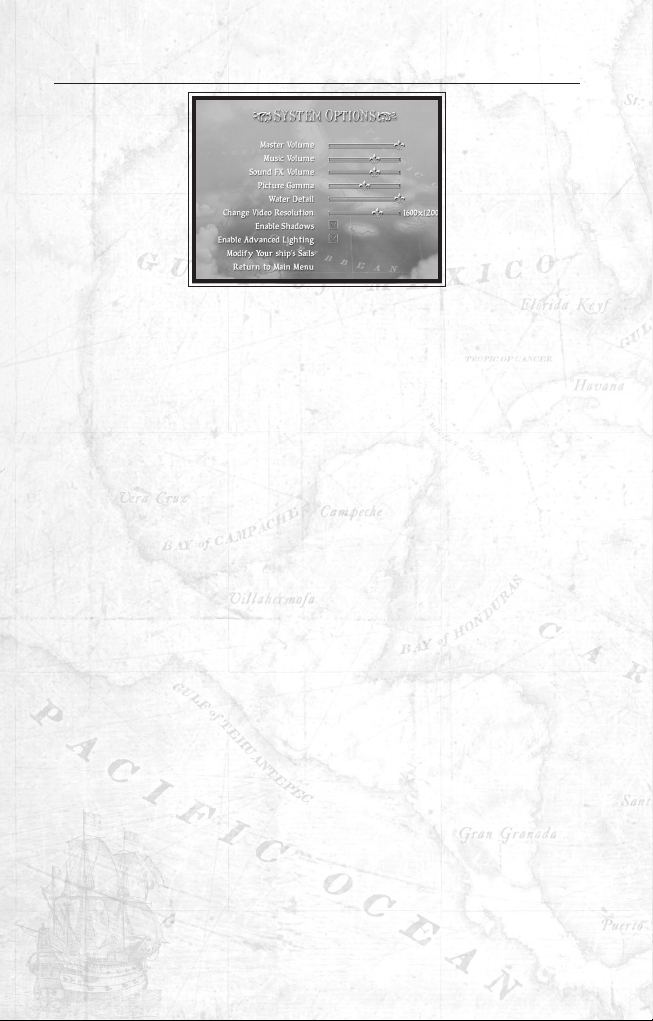
O p t i o n s S c r e e n
Getting There
See the “Game Controls” section on pages 136-137 to learn how to
get to the Options screen.
What it Contains
Master Volume: Move this slider to control the overall volume of
the game.
Music Volume: Move this slider to control the volume of the music
in the game.
Dance Music Volume: Move this slider to control the volume of
music in the dancing sequences independent of the other music in
the game.
Sound FX Volume: Move this slider to control the special effects
volume in the game.
Picture Gamma: Move this slider to adjust the game’s brightness
and contrast.
Water Detail: Move this slider to adjust the level of detail for the
water including movement and reflections.
Object Detail: Move this slider to adjust the level of detail for
3D objects (mostly affects ship detail).
World Detail: Move this slider to adjust the level of detail for
the world.
Change Video Resolution: You can choose the screen resolution in
which you want to play Pirates!.
Enable Shadows: Defaults to ON. Turning shadows OFF may
enhance performance on lower level computers.
Book OneSid Meier’s Pirates!
®
Page 9
Enable Advanced Lighting: Defaults to OFF. Certain higher-level
video cards will be able to display advanced lighting effects and
softer shadows, with a possible reduction in performance.
Enable Trilinear Filtering: Turning trilinear filtering OFF may
enhance performance on lower level computers.
Disable Shaders: Turning pixel and vertex shaders OFF may
enhance performance on lower level computers.
Modify your Ship’s Sails and Flags: Displays a screen that allows you
to choose your fleet’s sail emblem and flag.
Abandon Game: Quits the current game and returns you to the
Main Menu.
Quit Game: Click on this to exit the game.
A f e w u s e f u l t i p s
Multi-Ship Combat: Occasionally you’ll encounter two ships sailing
together in formation, typically a merchantman and an escorting war
vessel. If you attack either of these vessels, your flagship has to fight
both of them at the same time.
Sneaking In and Out of Cities: The original game’s “die-roll” sneak has
been replaced by an action sequence. If you attempt to sneak into an
unfriendly city, the scene changes to display an overhead view of the
city. You then have to guide your pirate through the streets, avoiding or
knocking out the patrolling guards until you reach your destination.
Dancing: To impress a governor’s daughter these days, a pirate must
not only be wealthy and successful, but he must also be light on his
feet. As you romance her, a governor’s daughter might invite your
pirate to a ball. You then have to move your pirate around the dance
floor, matching your partner’s movements in time with the music.
Note: There are various “game items” available to assist those who
are rhythmically challenged in this sequence. Speaking of which…
Game Items: During the game, your pirate may receive or purchase
a number of special items that assist with certain tasks – e.g., jewelry
helps the pirate win the heart of a beautiful maiden, a fine sword
improves his dueling, and so forth. There are many such items
available and you may collect them all.
Crew Specialists: You may encounter various “crew specialists”
during play. These include cooks, gunners, sail-makers, and more.
Book One
Sid Meier’s Pirates!
®
Page 10
Book OneSid Meier’s Pirates!
®
Each specialist assists you in important ways: the cook keeps your
men happier during long journeys at sea; the sail-maker repairs sail
damage after a battle; and so forth.
About this Manual
This manual is divided into five “books.” You are presently reading
Book One: Getting Started. Book Two: The Basics, tells you how to start a
new game. The third book, Book Three: The Rules, describes in detail
how to play the game. Book Four: The Reference Pages contains historical
materials, ship descriptions, the index, and so forth. Book Five: The
Captain’s Supplemental contains the game credits, technical support
contacts and more.
Page 11

B O O K T w O :
Th e Ba si c s
Page 12
Book TwoSid Meier’s Pirates!
®
A W o r d A b o u t
Y o u r G o a l s
Sid Meier’s Pirates! is an open-ended game, which means you can
pretty much do what you want. If you want to be a peaceful trader
and not fight with anyone, you can do so. If you want to be a reckless
pirate and take on everybody, you can do that too. Or you can be a
romantic hero, seeking to sweep every governor’s daughter off of her
feet. You control your own destiny – do what you will with it.
Your pirate is not immortal. However, as he ages, some of his skills
will begin to diminish. At some point he’ll find it harder to recruit
crewmen, who are interested in a young, healthy captain to lead them.
Eventually you’ll need to consider retiring this pirate and starting anew
with another captain.
When your pirate retires, the game examines his piratical career, and,
based upon what he has accomplished, assigns him a final ranking.
If he’s been extremely successful, he earns himself a place in the Hall
of Fame, and he may retire to become a governor himself. If he’s less
successful, he may end his days as a lowly barkeep or street-cleaner.
Page 13
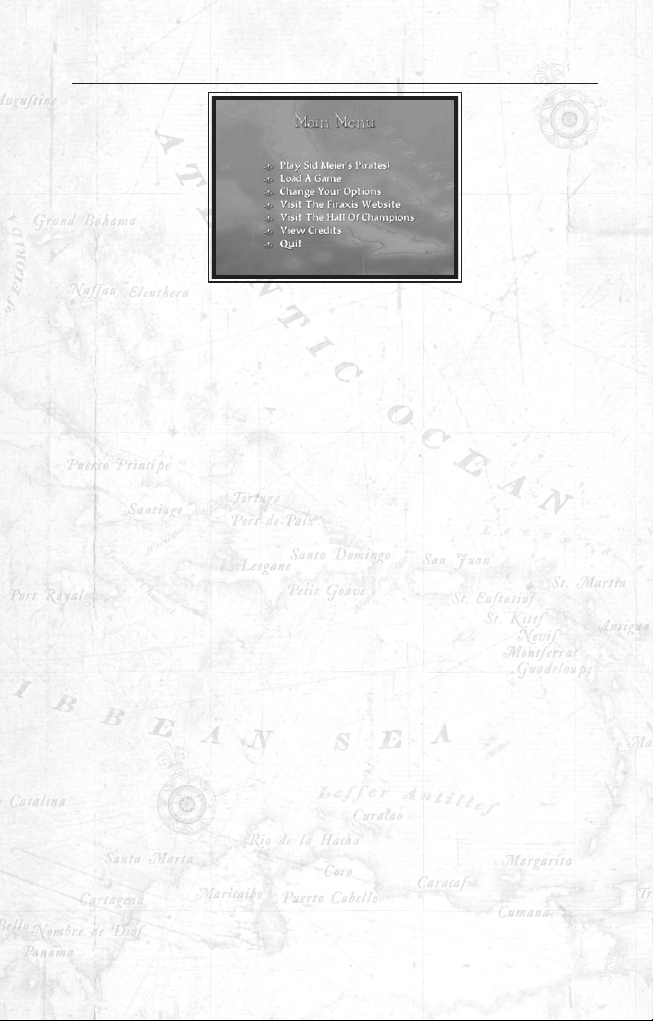
T h e M a i n M e n u
The Main Menu contains the following entries. You can select an
entry by using your mouse or keyboard.
Play Sid Meier’s Pirates!
®
Choose this to begin a new game of Pirates! from scratch.
Load A Game
Choose this to resume a game that you began earlier. You can access
games that you saved manually as well as auto-saved games.
Change Your Options
Choose this to change the game’s default audio and video settings, and
game controls. See “Options Screen” on page 8 for details.
Visit the Firaxis Website
Choose this to visit the Firaxis web site. You will find an exciting
community of fellow pirates as well as player-generated content,
game hints and tips, and other cool Pirates! stuff.
Visit The Hall Of Champions
Choose this to view the Pirates! Hall of Fame, where your top game
scores are recorded.
View Credits
Choose this to view credits for Sid Meier’s Pirates!®.
Quit
Choose this to exit Pirates! and return to the Finder.
Book Two
Sid Meier’s Pirates!
®
Page 14
U s e f u l G a m e
I n f o r m a t i o n
Pausing the Game
You can press (Shift-P) or (number pad 7) when in sea or land
navigation to pause the game. Time is already frozen while you’re on an
information screen, at a menu, or in a conversation, so you don’t need
to pause at those times.
The Reference Pages
Book Four contains the following reference sections:
Game Eras
Descriptions of the time periods in which you can set your game.
Gazetteer of Sailing Vessels
Descriptions and statistics for the ships in the game.
Ship Upgrades
Descriptions of the vessel upgrades that you can purchase.
Roster of Crew Specialists
A listing of the ship specialists.
Special Items
A listing of the special items.
Ports of Call
Details on each of the major cities in the game.
Catalogue of Commodities
A listing of the trade goods.
Top Ten Pirates
A listing of the top ten pirates in the Caribbean.
Game Controls
Keyboard and mouse controls.
Game Index
Where to find specific instructions in this manual.
Book TwoSid Meier’s Pirates!
®
Page 15

B O O K T H R e e :
Th e Ru le s
Page 16
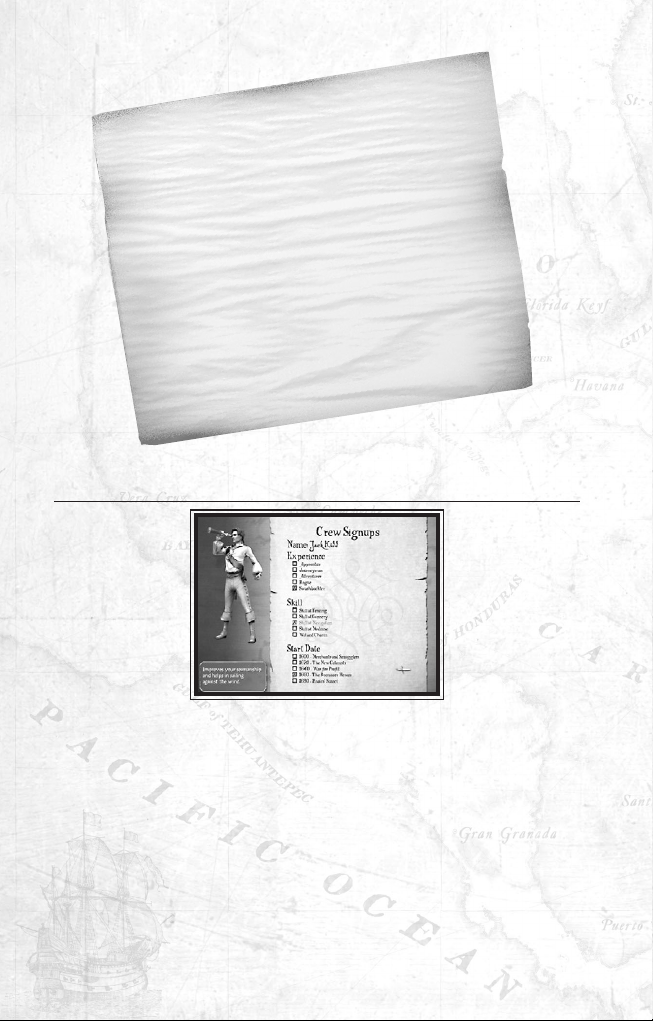
C r e a t i n g Y o u r P i r a t e
Game Era
You can choose from several historical game-eras. For your first few
games we suggest that you choose the default era, “The Buccaneer
Heroes – 1660.” Note: 1660 is the only era available on Apprentice
difficulty.
Your Name
Enter your pirate’s name in the space indicated.
Book ThreeSid Meier’s Pirates!
®
The Memoirs of Captain Sydney
There be only three rules that ye must follow if ye
wants to be a pirate.
First, always keep your crew happy. A happy crew
will take on the world, if ye ask ’em, while an unhappy
crew will fall apart fightin’ a Dutch herring boat.
Second, always hit ’em from windward. If ye got the
weather gauge ye can beat almost anyone – and if ye be
losin’ ye can run away a lot easier.
Third, never trust a man named “Raymondo.” He’ll
kidnap yer family as soon as look at ye!
Page 17
Difficulty
Choose one of five difficulty levels:
Apprentice (the easiest level)
Journeyman
Adventurer
Rogue
Swashbuckler
The difficulty level affects a number of aspects of the game. The
higher the difficulty level, the tougher your opponents in action
sequences – ship battles, dueling, and so forth. In addition, it is
harder to recruit crewmen and keep them happy at the higher levels.
On the other hand, as the difficulty level rises you get to keep a
larger portion of the booty when you divide the plunder.
Note: Your first game after a new install of the game will default to
Apprentice difficulty, 1660, and skill at fencing. Once you have a save
game, any new games started will allow the full range of choices.
Also Note: During a game you can raise or lower the difficulty level
only when you divide the plunder.
Skill
The following skills are available to you:
Fencing
This helps your pirate in one-on-one duels against enemy swordsmen.
Gunnery
This helps your pirate defeat enemy ships in sea combat.
Navigation
This helps you get better speed at all points of sailing.
Wit and Charm
This helps you impress your partner on the dance floor.
Medicine
This skill delays the effects of aging on your pirate.
Nationality
There are four nationalities to choose from. You begin with a “Letter of
Marque” from your chosen nation, making you a legitimate privateer
in its interest. This is important in the early portion of the game, as
all of your nation’s cities are open and friendly to you. As the game
progresses, you can purchase or receive Letters of Marque from other
nations – it is not unknown for a pirate to turn on his own nation if he
gets a better offer from somebody else!
Book Three
Sid Meier’s Pirates!
®
Page 18
The strengths and weaknesses of the nationalities are discussed in
Book Four, but here’s a quick overview.
English
English is one of the easiest nationalities to play in the default era
(“The Buccaneer Heroes – 1660”). You start the game with friendly
ports in highly useful locations, and since England is almost always
at war with Spain, you can usually gain quick English promotions by
attacking Spanish vessels and cities.
French
France too has a number of strategic ports – Tortuga is a great place from
which to harass southern Cuba – and she’s often at war with Spain.
Dutch
This is not the easiest nation to play. The Dutch have far fewer ports
than the other nations (though Curacao makes a fine base for trading
with or attacking Spanish cities on the Spanish Main). Furthermore,
the Dutch are not quite as often at war with their neighbors, so Dutch
promotions can be hard to come by.
Spanish
This may be the toughest nationality to start with. Spain has by far
the most ports on the game, which leaves you fewer targets to attack
(a problem only if you wish to remain loyal to Holy Spain). Likewise,
the best target vessels in the Caribbean are often Spanish: if you
want to remain loyal, you’ll have to make your fortune attacking the
less wealthy English, French, and Dutch ships. On the other hand,
Spain is nearly always at war with somebody and privateering can be
extremely profitable.
Book ThreeSid Meier’s Pirates!
®
The Memoirs of Captain Sydney
The Caribbean is like one of them highborn Spanish
ladies: ye can love her, but ye can’t trust her. One minute
she’s as placid as a sea-cow and yer sailin’ along as easy as
kiss-my-hand, everybody leanin’ on the rail and spittin’ to lee
-
ward; the next she throws a hurricane at ye, and yer runnin’
as if all the hounds of hell was on your trail, swearin’ that if
ye gets out of this alive ye’ll never set foot on a boat again.
But ye always do go back to her, see? Because, despite
her bein’ an untrustworthy, ungrateful, murderous wench and
all, ye bloody well do love her, more than ye love life itself.
Argh. And that’s all the bloody poetry ye’ll be gettin’
out of me today, cully.
Page 19
A t S e a
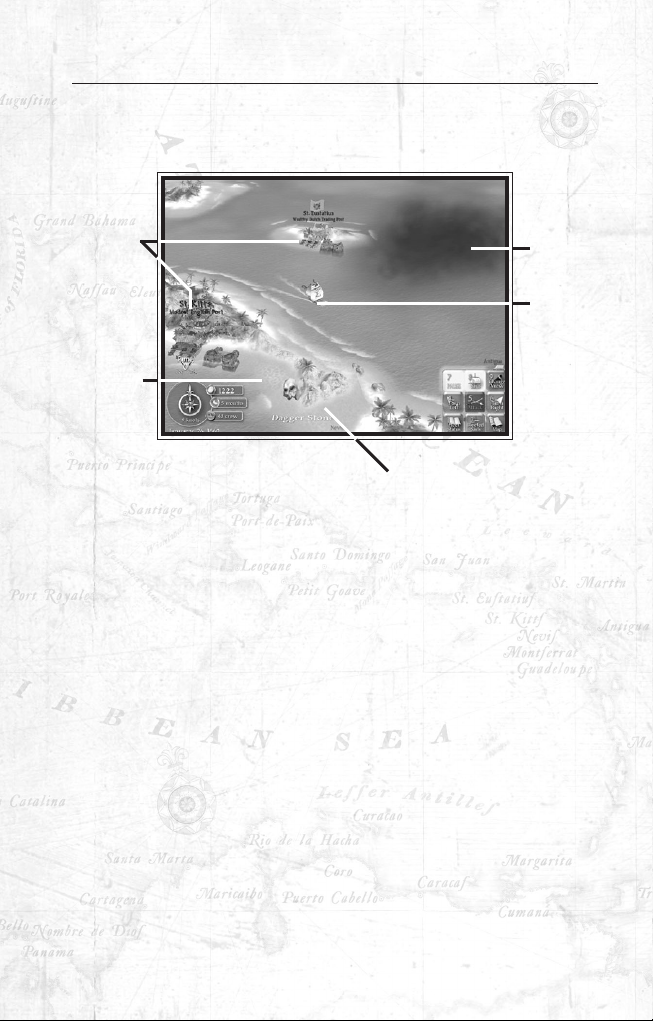
The Navigation Screen
This screen displays a portion of the Caribbean. The view remains
centered on your ship at all times.
What’s on the Navigation Screen
Your Ship: Your ship appears in the center of the map. If you have
more than one ship, your “flagship” is in the lead and the other
vessels are following her.
Other Ships: Other ships appear on the map when they get within
sight of your vessel. Each ship has a colored stripe, sail emblem,
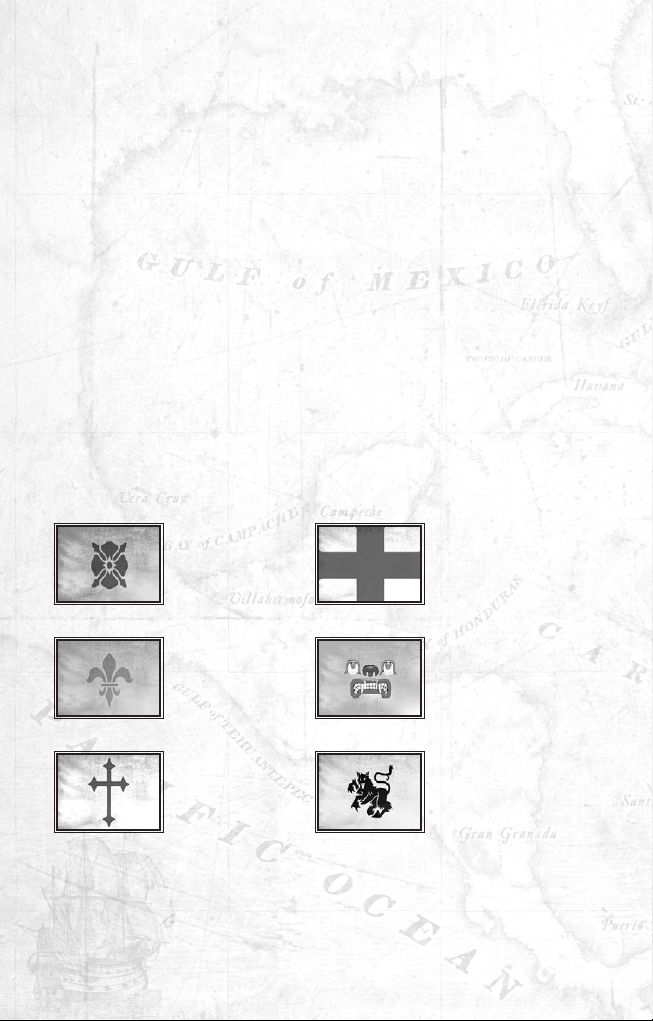
and flag denoting it’s nationality: black for Pirates, yellow for Spain,
green for Dutch, red for England, blue for France. If unsure, you
can determine a ship’s nationality and type by approaching the other
vessel or by moving your cursor over it.
Land: The islands and continents in the Caribbean.
Cities: The navigation screen displays the cities currently in sight.
The name and nationality appear above the city, and you can get
an idea of the city’s military strength by the size of the fortifications
guarding it.
White Clouds: These indicate heavy winds. You can use them to speed
your journey.
Balck Clouds: These dangerous storms frequently appear in the
Caribbean, particularly during hurricane season. A clever sailor can
use their heavier winds to speed his journey; however, if you get too
close, you risk serious sail damage to your vessel.
Book Three
Sid Meier’s Pirates!
®
Black Clouds
Land
Cities
Your Ship
Landmark
Page 20
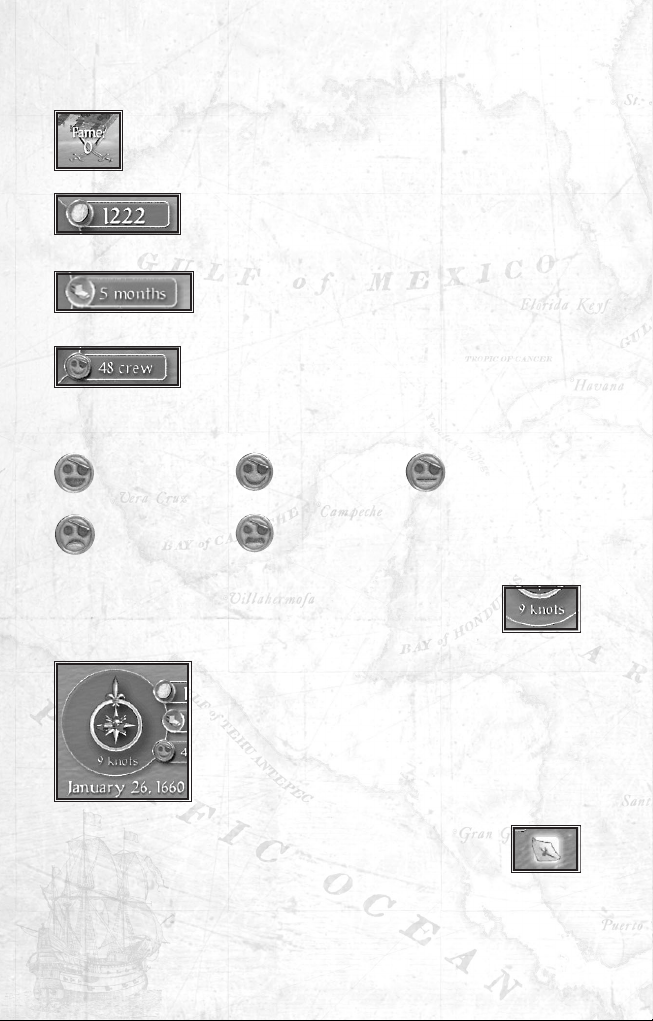
Landmarks: Pirates often refer to landmarks when drawing treasure
maps. Certain landmarks are visible only by land parties on shore.
Fame Counter: This displays your pirate’s current Fame
score. The higher the Fame score, the more successful
the pirate.
Gold Indicator: This displays your current gold
amount.
Food Indicator: This displays how much food
your crew has remaining.
Crew Size Indicator: This tells you how many
men you have in your crew.
Morale Indicator: This displays your crew’s current morale:
Wind Speed Indicator: This indicates how fast the wind
is blowing.
Wind Direction: This shows you the wind’s
current direction.
Quest Icons: These provide links to any current quests,
missions, and treasure maps you have.
Book ThreeSid Meier’s Pirates!
®
Very Happy
Happy Content
Unhappy
Mutinous
Page 21
H o w t o S a i l
Steering Your Ship
The ship’s helmsman steers the vessel by turning the ship’s wheel,
which is attached to the ship’s rudder by a series of rope pulleys
(some smaller ships are steered by wooden tillers). Use the Helm
Control keys (number pad 4 and 6) to steer your vessel.
Change Sail
You can sail with your canvas in one of two configurations: full sails
or reefed sails. A ship with full sails has spread as much canvas as
possible to move as quickly as possible; reefed sails slow the ship
down but improve her handling in tight waters.
Press the Full Sail (number pad 8) and Reefed Sail (number pad 2)
keys to switch between the two configurations.
Manning Your Ship
You need a certain minimum number of sailors to man your ship at peak
effectiveness. If you have fewer than that number of crew, your ship is
slower and your crew takes longer to reload cannon during combat.
If you have multiple ships in your fleet, you need enough crew to
meet the crew requirements for all ships. If you don’t have enough,
your fleet sails slower and your flagship is less effective in combat. See
Book Four for a list of ships and their minimum crew requirements.
Note: You usually begin a game of Pirates! aboard a sloop. You need
eight crewmen to sail and fight with this ship effectively.
Book Three
Sid Meier’s Pirates!
®
Port and Starboard
As every pirate knows, port is to your left when you are standing on a
vessel facing forward. Starboard is to your right. (An easy way to remember this
is that the words “left” and “port” both have four letters in them.)
Page 22
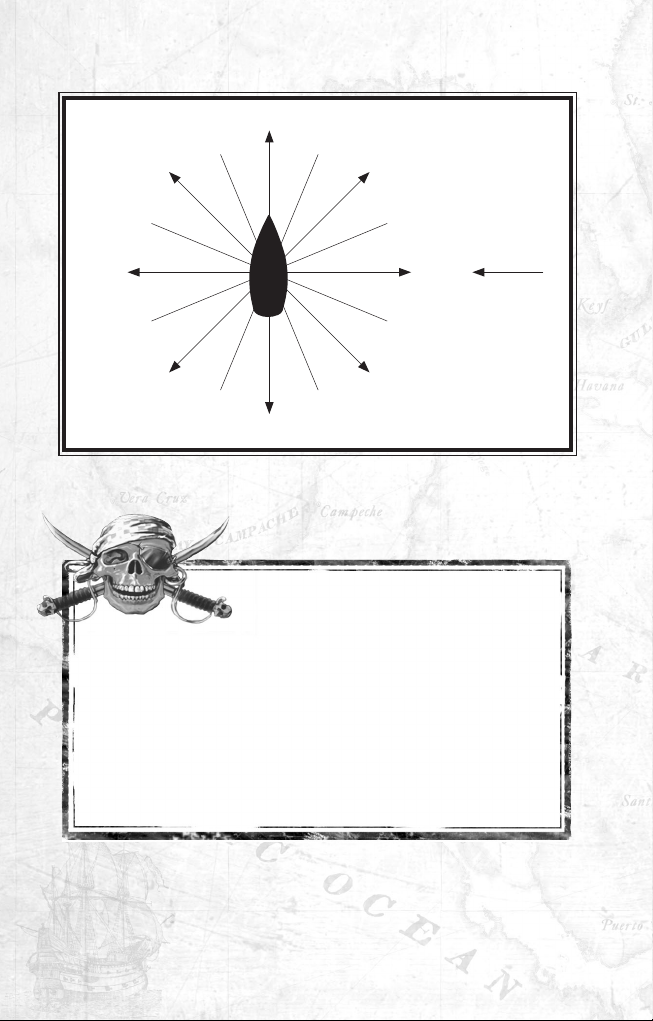
Points of Sailing
Book ThreeSid Meier’s Pirates!
®
Using the Wind
A vessel’s hull design and sail configuration determines its sailing
characteristics. In general, ships with square sails such as the frigate or merchantman tend to perform best when sailing “large” – that is, running before the wind
(for instance, in a running broad reach). Ships with triangular sails such as the
pinnace or barque tend to perform best when sailing “by the wind” – that is,
running roughly perpendicular to the wind (say, in a broad beam reach).
The “Ship Statistics” table on page 106 lists each vessel’s best points of
sailing and additional details.
Beam reach
Closed-hauled beam reach
Close-hauled
Closed-hauled
into the eye
Into
the eye
of the
wind
Wind blows
from this
direction
Closed-hauled
into the eye
Close-hauled
Closed-hauled beam reach
Beam reach
Broad beam reach
Broad reach
Running
broad reach
Running
before
the
wind
Running
broad reach
Broad reach
Broad beam reach
Page 23
Enter City
To enter a port city just steer your ship into the city. Depending
upon conditions you might sail right in and anchor peacefully at
harbor, or if the town is hostile, the city’s forts may open fire on you.
You then have the option to sail away, attack the town, or sneak in.
Note: Press the Spacebar, when moving past hostile ports, to fire on
them. They will become increasingly hostile toward you the more
you fire.
Disembark onto Land
Steer your ship into a point on the shoreline where you want to
disembark. The game prompts you to confirm that you want to go
ashore, and your crew then form a landing party. See “On Land” on
pages 55-57 for details).
Attack Ship
This is what being a pirate is all about! Over the course of the game
you’ll often find yourself wanting to launch an attack against some
other ship you encounter at sea (see “Sea Battles on pages 34-41
for details).
Press the Attack key (number pad 5) or run into a ship to initiate an
attack against a nearby vessel.
Pause
Press the Pause key (Shift-P) to pause the game. Note that no time
passes when a menu is on-screen, when you’re in a city, and when
you’re viewing an information screen. You only need to pause the
game when you’re at sea, on land, or engaged in an action sequence
(ship battle, dueling, dancing, or in a land battle).
Zoom
You can zoom in to get a closer view of your ship, or zoom out to see
a larger expanse of the Caribbean.
Use the mouse wheel to zoom in and out, or hit (+) to zoom in and
(-) to zoom out.
Chase View
In “chase” view, the camera changes from the standard overhead
view to a position behind and just slightly above your ship.
Press the Change View key (number pad 9) to toggle between chase
and regular views.
Book Three
Sid Meier’s Pirates!
®
Page 24
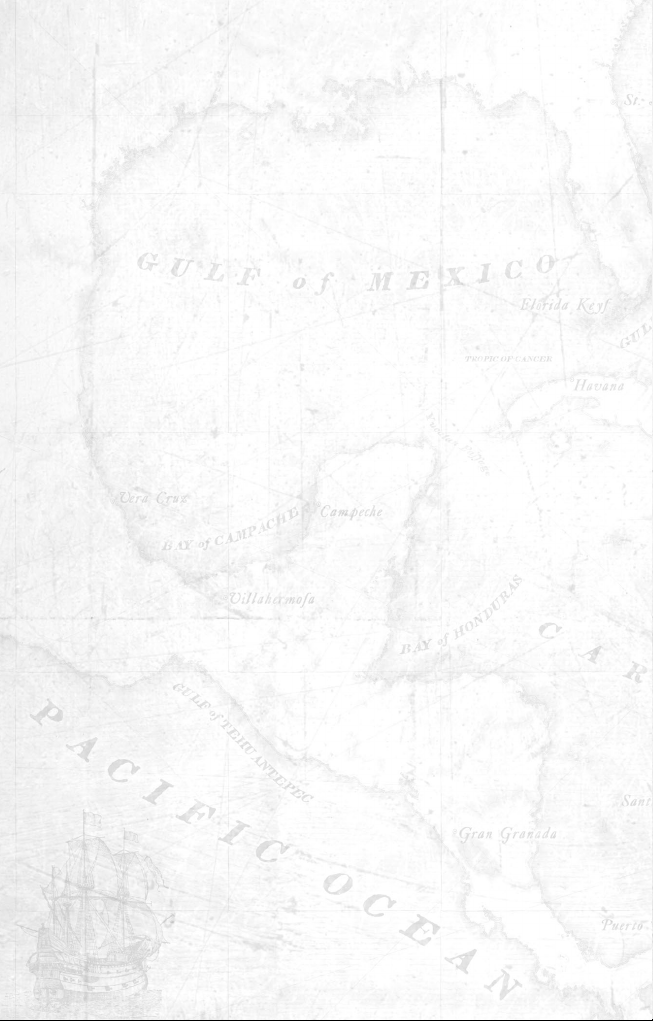
Change Your Flagship
When you begin a game of Pirates!, you have just one ship. Once you
capture another vessel, you can choose to add it to your fleet. Your
original vessel is designated your “flagship” and all other vessels trail
behind her. You can change flagship by pressing the Change Flagship
key (Tab) or by going to the Fleet Status screen (see next page).
Maximum Fleet Size
You can have up to eight ships in your fleet, including your flagship.
If you defeat an additional ship, you will not have the option to keep
the new ship.
Crew Requirements
Each vessel in your fleet requires a minimum number of crewmen to
sail at peak performance. If you have fewer than that number, your
sailing speed and combat performance suffer. If you have more than
the minimum number of crewmen, the additional sailors take part in
sea battles.
Fleet Speed
In general, your fleet sails approximately as fast as your flagship in
the present wind conditions. However, undermanned vessels reduce
your fleet’s overall speed.
Abandoning Ships
The best way to get rid of a ship is sail into port and sell it to a
shipwright. However, you may sometimes find it necessary to
abandon a ship while at sea – because you have insufficient crew or
because you’re being chased by a faster and stronger opponent, for
example. You can abandon ships only from the Fleet Status screen.
Book ThreeSid Meier’s Pirates!
®
Page 25
I n f o r m a t i o n S c r e e n s
There are a variety of information screens available to you while at sea.
See the “Game Controls” section to learn how to access them.
Fleet Status
On this screen you can view all of the ships in your fleet as well as
their upgrades, crew size, and damage status. You can also change
flagships, rename your ships, and abandon unwanted vessels.
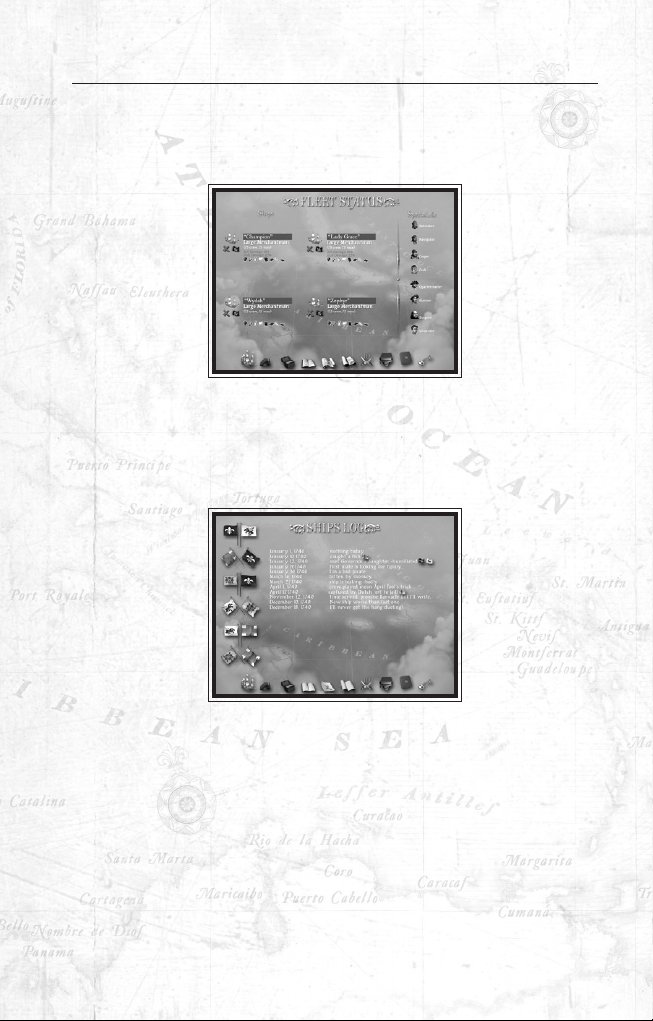
Captain’s Log
This screen stores a running list of your actions and accomplishments
as well as other events happening in the world, including which
nations are currently at war.
Book Three
Sid Meier’s Pirates!
®
Page 26
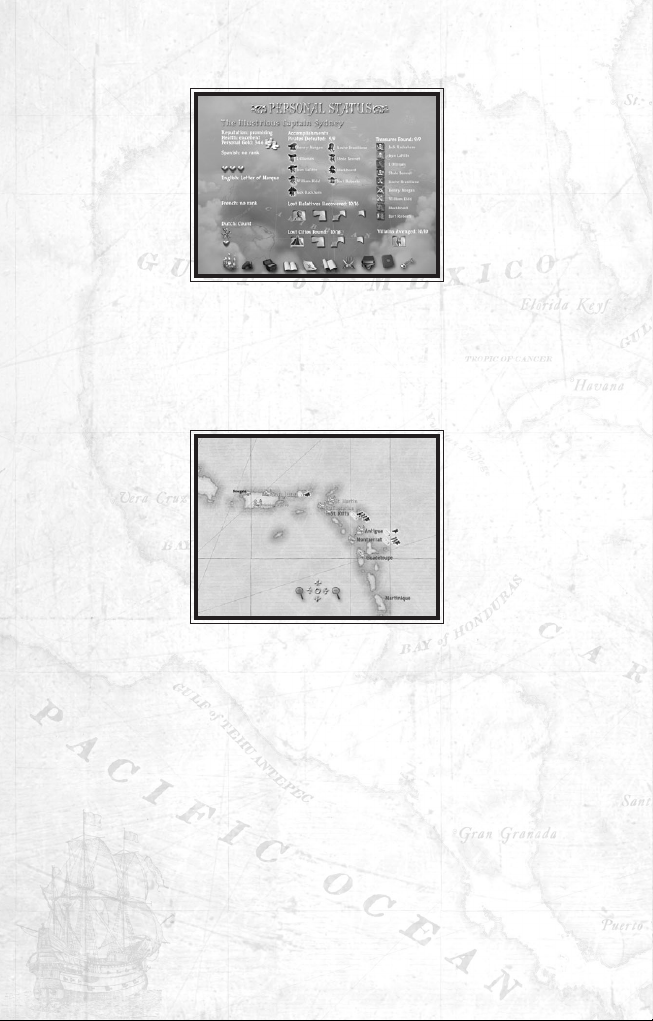
Personal Status
This screen displays your accomplishments, including how many
promotions you’ve received, how many Top Ten Pirates you’ve
defeated, how many buried treasures you’ve discovered, your
personal wealth, and more.
World Map
This map displays your fleet’s current location in the Caribbean. You
can zoom the map with the mouse wheel and scroll by moving the
mouse to the edge of the screen. You can click on city names to find
out what you know about the cities. (You can sometimes purchase
information about cities from mysterious travelers in taverns, or you
can always visit them yourself.)
Book ThreeSid Meier’s Pirates!
®
Page 27
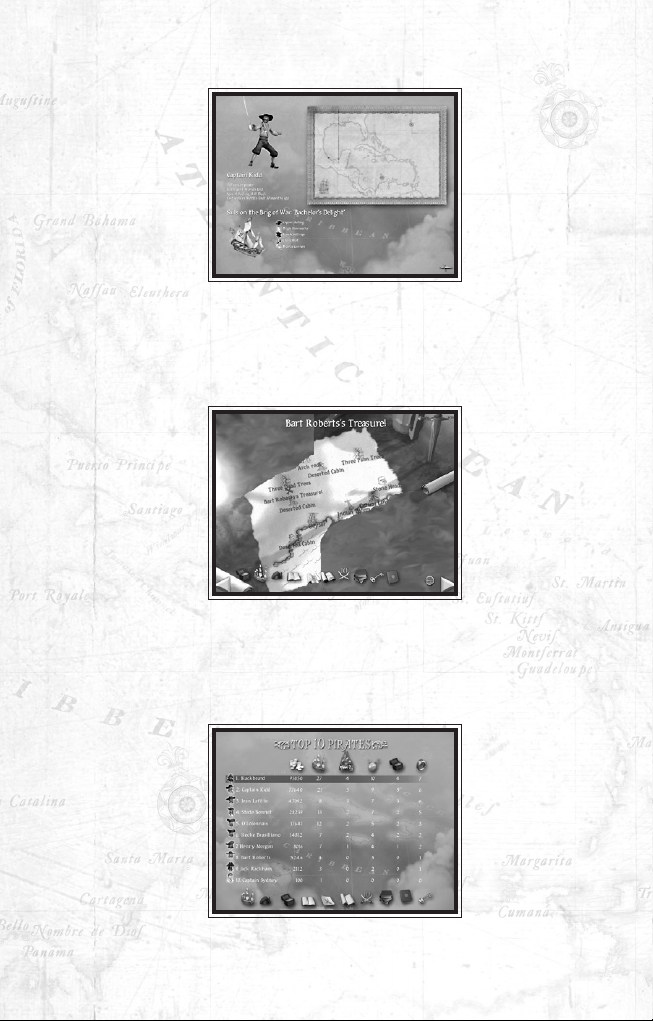
Quest Log
The Quest Log shows the name of any villain you might be pursuing,
what he did to you (e.g., kidnapped your sister), plus any other
information you might have on him.
Treasure Map
You may acquire one or more treasure maps during the game. You can
view them on this screen. See “Treasure Maps” on pages 53-54 for
details.
Top 10 Pirates
This displays the ranking of the ten most dangerous pirates in
the Caribbean.
Book Three
Sid Meier’s Pirates!
®
Page 28

Perils of the Sea
Crew Unrest
Pirates are a fickle lot. In the beginning of a voyage they’re fairly
easy to please as long as you keep them fed and keep bringing in
the treasure. Sooner or later, depending upon your success and the
difficulty level of the game, they’ll become restless. They’ll start
thinking that it is time for you to go to a city and divide the plunder
(see “Dividing the Plunder” on pages 81-83), so that they can
squander all of their loot in the nearest tavern.
You can prolong a voyage for quite a long time by keeping the booty
flowing in fast and furious, but no matter how successful you are, the
crew will eventually want to go home. Your first mate takes you aside
and tells you that it might be time to divide the plunder.
If you ignore this advice and continue the voyage, your crew’s morale
begins to fall. (The Morale Indicator on the Navigation screen
displays the crew’s current morale.) Eventually they’ll begin to
Book ThreeSid Meier’s Pirates!
®
The Memoirs of Captain Sydney
I remember once we was fightin’ this French frigate
– heh, running for our lives from this French frigate is more
like the truth. We was in my brig,
Happy Reaper
, and the
winds was light and steady from the southeast. I had just
bought me a set of those new cotton sails and we was doin’
fine – stayin’ ahead and maybe even gainin’ a few yards on
her, when my lubber of a helmsman Blind Johnson ran us
right into the nastiest storm I’ve ever seen. We lost over half
our sails, and now the big Frenchman was gainin’ on us.
Fortunately, we was able to keep ahead of her for
another hour, just long enough for the sun to set. By the
Grace of Providence we lost her in the darkness.
What did we do then? Well, first thing I did was to
change course and head for Nevis, where we could get our
sails repaired right and proper. And then I had me kind of a
private discussion with Blind Johnson.
But that’s another story.
Page 29
desert. If you are at sea and have multiple ships in your fleet, they
may steal one of the extra ships. Or they might run off the next time
you go to port.
Morale Boosters
Some ship’s officers and special items help you keep your crew’s
morale high and allow you to lengthen your voyage. See Book Four
for details.
Hunger
Your crew needs to eat. Food is readily available for purchase at
a merchant’s warehouse, or you can take it from a captured vessel.
The Food Indicator on the Navigation screen shows how many
months of food you carry, and you can look at the cargo section of the
Fleet Status screen to see your exact food tonnage.
When you run out of food, your crew begins to starve. They’ll put up
with this for a short while, but soon their morale starts to plummet. If
left unchecked, they will begin to desert your command.
Once you acquire more food your crew’s morale stops its decline.
Their morale may rise once the treasure begins flowing in again.
Ship’s Cook: A ship’s cook can stretch the crew’s rations, keeping
them fed on a smaller portion of your food cargo. You can sometimes
capture cooks from defeated ships.
Storms at Sea
The Caribbean is an unpredictable sea. The sky may be clear and the
winds moderate at one moment, while in the next a sudden tropical
storm might appear, ripping your sails apart. This is especially true
during hurricane season, which runs from around June to November.
White Clouds: White clouds represent small squalls or storms that
are not especially perilous and that are accompanied by strong gusts
of wind. Good sailors can “ride” these clouds to gain a temporary
increase in speed at little risk.
Black Clouds: These represent full-blown tempests. Any ship caught
within a black cloud risks serious damage to both her sails and hull.
These major storms are accompanied by heavy winds. A careful
captain can gain a temporary increase in speed by moving alongside
the clouds and being careful not to blunder inside.
Book Three
Sid Meier’s Pirates!
®
Page 30
Weather Glass and Barometer
These special items can help you avoid storm damage while sailing
near or through storms. From time to time, you might be able to
purchase one of these from a mysterious traveler.
Ship Encounters
There are many ships sailing on the Caribbean – merchantmen
bringing goods to wealthy cities, treasure ships carrying wealth
untold back to Europe, fishing vessels loaded with cargo, mighty
warships looking for the enemy, and of course pirates and privateers.
As you travel about, you will inevitably encounter other vessels; how
you interact with them in large part determines your ultimate success
or failure.
Seeing Other Vessels
A lookout atop a ship’s mast can see a surprising distance – sometimes
for miles, depending upon time of day and weather conditions.
Whenever a vessel comes within your lookout’s sight range it appears
on the map. You can tell quite a lot about a ship by its appearance.
Each ship displays a colored stripe and flag showing its nationality:
In addition, a vessel’s hull-type tells you something of its purpose.
The dark hulled vessels are warships, while lighter-hulled vessels are
merchants. Each vessel-type has its own unique model (see “Gazetteer
of Sailing Vessels” on pages 99-109). Note that the ship’s nationality
and type are also displayed when you roll your cursor over the vessel.
Book ThreeSid Meier’s Pirates!
®
Dutch English
French
Indian
Missionary
Spanish
Page 31
Communicating with Other Vessels
Some vessels may have messages for you as you approach. Enemy
vessels might order you to stand clear, or they might demand that
you stand and fight. Neutral or friendly vessels might pass along the
latest news or gossip.
If a ship has anything to say, the message appears once the vessel has
gotten fairly close to your fleet. The message is also displayed when
you roll your cursor over the other ship.
Attacking Other Vessels
Once you are close enough to initiate an attack against another ship,
you can press the Attack key (number pad 5) or run into ship to begin
the battle.
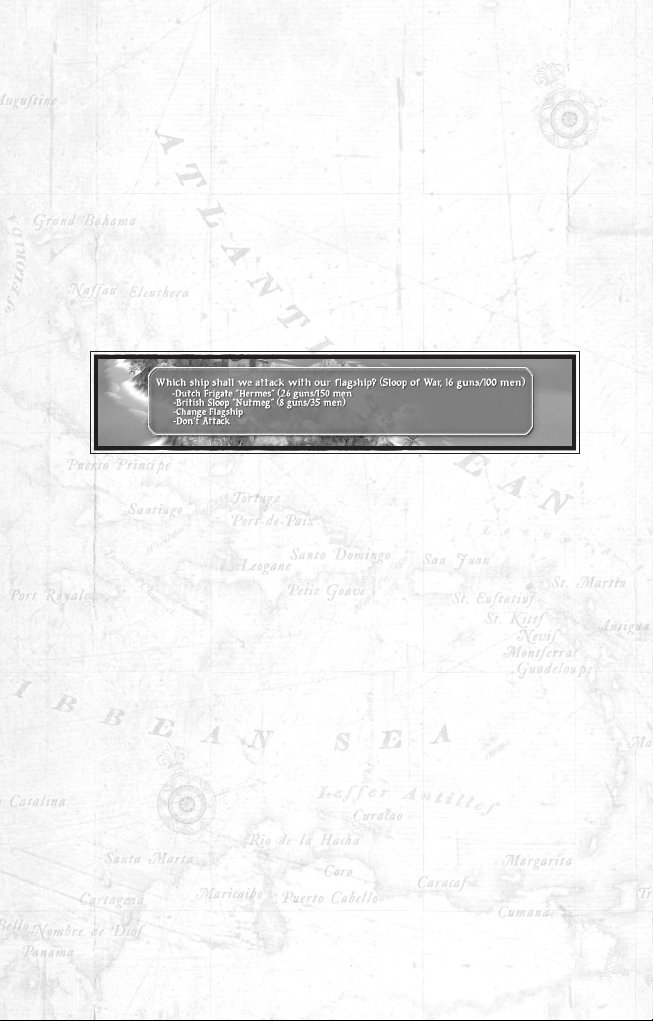
Attack Confirmation Pop-up
The Attack Confirmation pop-up allows you to specify which ship
you are attacking, if multiple targets are within attack range. It also
allows you to change your flagship (if you are sailing with two or more
vessels). Additionally, the Attack Confirmation pop-up allows you to
cancel the attack if you’ve thought better of things.
Being Attacked by Other Vessels
It is quite likely that you will make more than a few enemies during
your career. If you attack a nation’s shipping, that nation may send
out a warship to put an end to your depredations. If you’re carrying
enough loot, any pirate passing by might decide that you’re a prime
target. And if you steal a pirate’s buried treasure, he’ll attack you on
general principles.
Book Three
Sid Meier’s Pirates!
®
Page 32

Warning Notice
As a ship seeking to fight you approaches, it sometimes announces its
intentions. This gives you the opportunity to try to gain an advantageous
position for the upcoming combat, or to turn around and run
to safety.
The warning notice appears once the ship is close enough or when
you roll your mouse cursor over the enemy.
Book ThreeSid Meier’s Pirates!
®
The Memoirs of Captain Sydney
It must have been in ’65, or maybe ’66, me ’n’ crusty old Cap’n
Briggs were jawin’ about which ship was best for piratin’ in.
“A royal sloop,” sez I. “The bugger’s fast in light airs, can turn
on a farthing, and carries enough guns to put the fear o’ heaven in
them fat trade galleons the Dons carry their gold in.”
“Sydney,” sez he, “you’re mad. A brig o’ war is more like it.
Maybe it isn’t as fast as your sloop, but it carries near’ twice as many
men and cannon. And cargo too,” he added. “What’s the point o’
gettin’ plunder if you can’t carry it back home with you?”
“It’s ye who are pig-bitin’ mad,” sez I. “The brig’s a good ship,
I’ll warrant, but what in blazes do you want all them guns fer? The
whole purpose o’ piratin’ is to run yer ship alongside the enemy and
capture her with as little fuss as possible. Oh ye may need to put a
couple o’ balls in her to make her come to her senses, I warrant, but a
great 16-gun broadside from yer precious brig is as like to sink her as
it is to make her surrender. Where’s yer profit then, ye daft fool?”
Well, then he called me a senile old son of a farmer and I
called him a poxy, grass-eatin’ butterball, and the discussion became
sort o’ animated. We didn’t solve the question then, and we ain’t
since, neither.
In the end, I guess a good pirate picks a ship what matches his
strengths: if ye be a good sailor, pick a ship that’s fast and nimble;
and if ye be a strong gunner, pick a ship that carries enough guns
to make ’em count.
Page 33
Cannon-Fire
When an enemy ship gets within range, it may begin firing its
cannon at you. This cannon-fire can damage your flagship and the
other ships in your fleet. The pursuer then continues to fire at you
until you sail out of range or into a harbor – or until you choose to
fight back.
Fighting Back
If you wish to fight your pursuer, press the Attack key (number pad 5)
or run into the ship. See the “Attacking Other Vessels” section on
page 31 for details.
Book Three
Sid Meier’s Pirates!
®
Fight or Flight
There is no law that says that you have to fight anybody who wants to take you
on: If your ship is damaged or you’re badly outmanned or outgunned or you’re carrying a treasure that you don’t want to risk losing, by all means run away!
If you can find a “point of sailing” (see “Best Point of Sailing” diagram on
page 20) in which you’re faster than your opponent, you can simply outdistance
him. Once you are well far away he may lose your trail or simply give up the chase.
Alternatively, you can duck into a city: chances are that he’ll be gone when you
next leave port. But then again, he may not be. So it might be a good idea to repair
your ship and recruit extra crew before you leave.
Page 34
S e a B a t t l e s
Overview
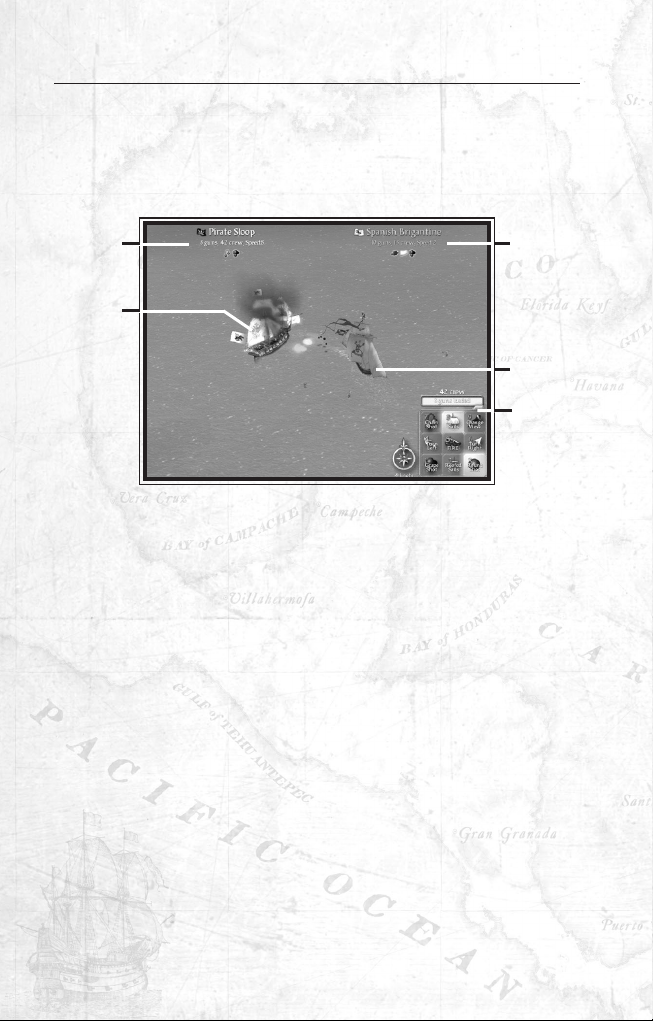
The game mechanics of ship battles are quite simple: you steer your
ship, you raise or lower your sails, and you fire off broadsides. The
challenge lies in learning how to use these simple tools to their best
advantage in the ever-changing sea.
Controlling Your Ship
See the “Game Controls” section for a complete list of keys and
mouse commands used to control your ship in battle.
Steering Your Ship
You steer your vessel with the Helm Control keys (number pad 4 and
6) the same as you do when you are at sea.
Change Sails
Your sails can be in one of two configurations: full sails or reefed sails.
Press the Full Sails key (number pad 8) or the Reefed Sails key
(number pad 2) to switch between those sail configurations.
Full Sails: A ship with full sails has spread as much canvas as possible
to move as quickly as possible. Ships with full sails tend to suffer
more sail damage during combat, particularly when the opponent is
using chain shot.
Reefed Sails: A ship with reefed sails has lowered some of her sails to
protect them from enemy cannon-fire, particularly from broadsides of
chain shot. In addition, ships with reefed sails have a tighter turning
radius than ships with full sails. However, ships carrying reefed sails
move significantly slower than do ships under full sails.
Book ThreeSid Meier’s Pirates!
®
Enemy Vessel
Your Ship
Your Ship’s
Statistics
Enemy Vessel’s
Statistics
Cannon Status
Indicator
Page 35
Fire a Broadside
Ships of this era are armed with rows of cannon along either side of
the hull. The placement of the cannon means that ships cannot fire at
targets directly forward or aft, but only at targets to either side.
When you order your ship to fire, your men check to see if there is
a target available in either of your broadsides and then fire off the
appropriate port or starboard cannon. If there are several targets in
your broadsides, your men fire at the closest opponent. Incidentally,
a ship’s cannon are evenly split between her port and starboard
broadsides. That means that she can fire no more than half of them
in any one broadside.
Press the Fire Broadside key (number pad 5 or Spacebar) to fire your
loaded cannon.
Raking Shots
A “raking shot” occurs when cannon balls hit the target’s bow or stern
and travel along the ship’s fore and aft axis. Raking shots do more
damage than do shots hitting a ship’s side.
Reloading the Cannon
Your crew automatically reloads the ship’s cannon after firing a
broadside. The crew reloads with the same type of ammunition as the
cannon had before, unless you instruct them to do otherwise
(see below).
The time it takes to reload is determined by the number of crew
onboard. More crew means faster reloads – less crew means it’s time
for evasive maneuvers.
The Cannon Status indicator tells you how many of your ship’s guns
are presently loaded. You don’t have to wait for all of your cannons to
be reloaded to fire.
Cannon Ammunition
There are three primary types of ammunition available for your
cannon: round shot, chain shot, and grape shot.
Round Shot: This is a standard cannon ball. When you begin a
battle, your cannon are loaded with round shot. Round shot has the
longest range of any of the ammunition-types. While it can hit any
portion of a vessel, it tends to do most of its damage to the enemy’s
hull or cannon.
Book Three
Sid Meier’s Pirates!
®
Page 36
Chain Shot: Chain shot consists of two smaller balls linked together by
a chain. When fired, the balls separate and begin spinning, primarily
doing damage to the enemy’s sails. Chain shot has a medium range: it
fires a shorter distance than round shot, but longer than grape shot.
Grape Shot: Grape shot is the classic anti-personnel load. Basically
the crew loads the cannon with musket-balls, iron filings, silverware
and anything else they can find, turning the weapon into a massive
shotgun. Grape shot is particularly effective at injuring the enemy’s
crewmen. Grape shot has a very short range.
Changing Cannon Ammunition
When the battle begins, your ship’s cannon are loaded with round
shot. If you have the other ammo-types available, you can switch
between them at will.
Press the Round Shot key (number pad 3); Grape Shot key (number
pad 1); or Chain Shot key (number pad 7) to load your cannon with
the appropriate kind of ammunition. Note: Press (Enter) to cycle
through the available types of shot.
Damage Effects
A ship struck by enemy cannon fire takes damage to one of the
following: its hull, sails, crew, or cannon. The part of the ship
damaged is determined by a damage algorithm: certain ammo-types
have a greater chance of damaging specific parts, though collateral
damage to other parts of the vessel are possible no matter what shot
is used.
Hull Damage: As a ship takes damage to its hull, the ship’s speed and
maneuverability degrade. If the hull is destroyed, the ship sinks.
Book ThreeSid Meier’s Pirates!
®
Ammunition Availability
All ships are equipped with round shot, but some lack either or both of
the other two types of ammo. If you find yourself in a vessel lacking a particular
type of ammunition, you might be able to find a shipwright who can upgrade
your ship with the missing ordnance.
Page 37

Sail Damage: As a ship takes sail damage, its speed and maneuverability
decline. If the sails are destroyed, the vessel is no longer under any
control, and it may surrender at your next approach.
Losing Crew: As crewmen are knocked out, it takes the surviving
crew longer to reload the ship’s cannon after firing a broadside.
Losing Cannon: As a ship loses cannon, she’ll have less of them to
fire at the enemy (but you probably guessed that).
Grappling and Boarding Actions
When a ship rams another vessel, the ramming ship’s crew rushes
aboard the enemy ship to battle her crew. While they battle it out, you
take on the enemy captain in a daring swordfight. The battle ends
when you or the enemy captain surrender.
See the next section, “Fencing and Swordplay”, for details on this
heroic conflict.
Book Three
Sid Meier’s Pirates!
®
The Memoirs of Captain Sydney
I said it before: a good pirate fights only when there’s profit in
it, or when he’s not got no other choice.
When a pirate’s fightin’ fer a profit, he’s got to remember
that every ball he puts into the other ship lowers her resale value,
and that a single lucky shot can sink even the strongest hull. Me,
I always liked to put a couple of long-range rounds into the enemy,
for to put the fear o’ heaven in the crew, then range in close off her
bow or stern, cut her crew down with grape, then board and take
her at sword-point.
Exchangin’ manly broadsides with a merchant ship might
make fer a good song or legend, but I prefers money in the bank.
Now when fightin’ fer survival, on the other hand, the
situation’s exactly the opposite. If I been chased down and forced
into a fight with some blasted pirate hunter in a beastly huge
warship, my job is to disable or sink her – be darned to the value o’
her hull. I gets treasure off of merchant ships – I fights warships
fer to live to enjoy that treasure.
Page 38
Rescuing Crew
When a ship loses crew, some of them may be blown overboard
where they cling to wreckage and plead to be rescued. You can
retrieve floundering crewmen by running your vessel over their
location.
Picking up Cargo
A ship that takes an especially hard shot may have some of its
cargo blown right overboard into the sea. You can retrieve lost cargo
by running over the barrels. Each retrieved barrel adds 50 gold to
your treasury.
How the Battle Ends
A sea battle can end in victory, defeat, or a draw.
A Draw
The contest ends indecisively when the opponents are too far away
to see each other. Generally, this means that the weaker ship has
successfully outrun its pursuer.
In addition, nightfall might end the battle (if the battle goes on for too
long without decisive results).
Defeat
You can lose a battle in two ways: your ship sinks, or you are captured
during a duel with the enemy captain. Both results are unfortunate.
Going Down with the Ship: If you have only one ship and it is sunk
in battle, you will find yourself marooned without your ship, gold, or
crew. A passing ship will eventually pick you up and you will be able
to start anew with a fresh ship and crew. You’ll still have any treasure
maps and specialists you’ve acquired, but that’s all.
If your f lagship is sunk but you have additional vessels in your fleet,
one of them will pick you up out of the water (becoming your new
flagship). You’ll lose a portion of your crew, cargo and treasure, but
you’ll keep all of your specialists, special items, and treasure maps.
You cannot lose money that you previously banked while dividing the
plunder. You can lose only the money currently with your fleet.
Being Captured: If captured during a boarding action, you’re thrown
into jail until you escape or are ransomed. Once out of prison, you
reunite with your surviving crewmen and any ships and treasure they
managed to salvage from the catastrophe.
Book ThreeSid Meier’s Pirates!
®
Page 39
Victory
You win a ship battle by sinking or capturing the enemy ship. Any
victory enhances your reputation as a fierce and dangerous pirate;
however it is by far more profitable to capture an enemy vessel than
it is to sink her. When you sink an enemy vessel, everything she
carries goes to the bottom with her. When you capture her, you
acquire the ship’s cargo, any gold aboard or specialty crewmen she
carries, plus the ship itself.
Enemy Sailors Volunteer to Join Your Crew: Depending upon your
reputation and current wealth (and upon the difficulty of the game),
several crewmen from the captured vessel may volunteer to join your
crew. If you accept them, your crew-size increases accordingly. If
not, they get put ashore with all of the other captured sailors. (This
happens automatically.)
Specialists Join Your Crew: If the captured vessel happens to be
carrying a specialist that you don’t currently possess, he is quickly
“persuaded” to join your crew.
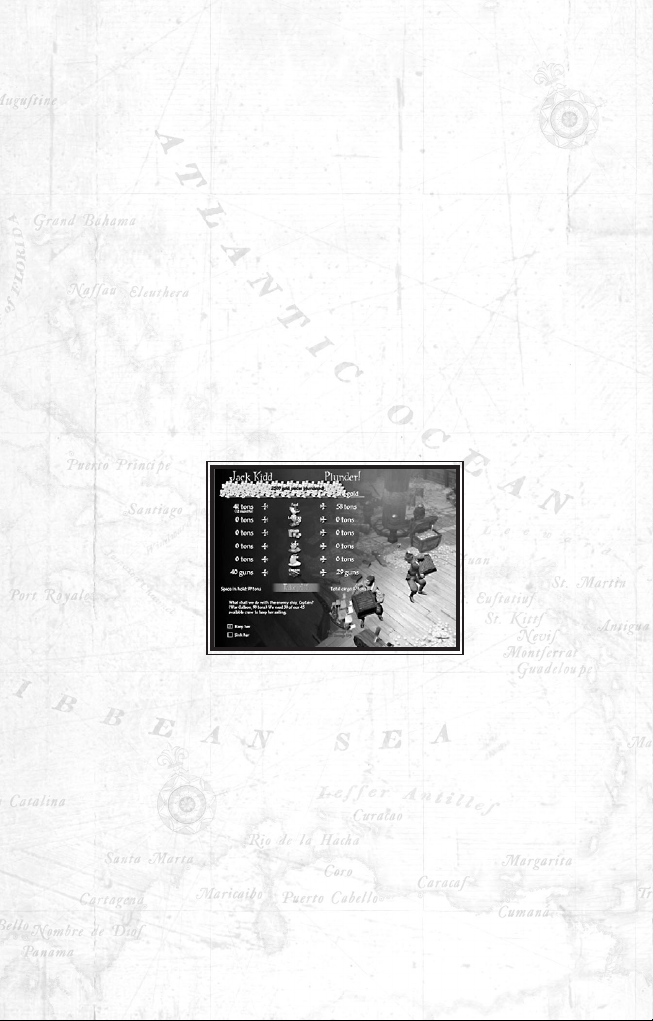
The Plunder Screen
On the plunder screen you can choose to keep the captured vessel
or abandon her. You can also take some or all of the prize’s cargo.
You get all of the ship’s gold automatically.
Once you have finished plundering your victim, you return to the
Navigation screen. If you have chosen to take the captured vessel as
a prize, she will take up station behind you.
Book Three
Sid Meier’s Pirates!
®
Page 40
Ship Battles and World Opinion
The Caribbean Sea is fairly small and pretty much everyone knows
what everyone else is up to. The various nations – Spain, France,
England, and The Netherlands – watch your actions with great
interest. If your actions further their objectives, they tend to look
upon you more favorably. If, on the other hand, you attack their
interests, their opinion of you drops.
The effects are fairly obvious. A nation that likes you will let you
enter their ports, buy and sell goods, recruit crewmen, and so forth.
You might receive job opportunities, promotions, and introductions
to eligible young women. If a nation dislikes you, they bar you from
entering their cities. Their ships will fire upon yours when you
approach, and they may even send pirate hunters out after you.
If You Lose a Ship Battle
If you lose a ship battle, nobody much cares. There is no effect upon
world opinion one way or another.
If the Battle Ends in a Draw
If nightfall or distance ends the battle and you did not damage the
other vessel, the battle has no effect upon world opinion. If you did
damage the other vessel, the effects are the same as if you won the
battle.
If You Win a Ship Battle
Against Pirates or Indians: If you defeat a pirate vessel, everybody
else’s opinion of you rises. Other pirates like you less, however. The
same goes for defeating Indian ships.
Against a National Trade Vessel: If you defeat a nation’s trade vessel,
that nation, and any it has a peace treaty with, like you less. Nations
at war with that nation like you more. Neutral nations don’t care.
Against a National Warship: Nations and their allies really dislike
you when you defeat one of their warships. Countries at war with that
nation really approve of your actions. Neutral nations really don’t care.
Book ThreeSid Meier’s Pirates!
®
Page 41

Fighting Near a City
Not only do nations have an opinion of your actions, but so too do
individual cities. If you attack shipping originating at or headed
towards a city, that city’s opinion of you declines. Cities particularly
dislike it if you attack shipping right outside their harbors.
It is possible that your relations with a city could be far different than
your relations with that city’s country, so much so that you could
be welcome at all other cities of that nation, but fired upon if you
attempt to enter the offended city’s harbor.
Book Three
Sid Meier’s Pirates!
®
The Memoirs of Captain Sydney
A pirate cap’n has gots to lead by example. You try tellin’
a crew o’ rowdy buccaneers to board an enemy ship while ye stay
behind hidin’ in the bread room, and see what it gets ye.
No sir, if ye wants to be a proper cap’n, ye’ve got to be the
first man over the side and on the enemy deck. Buccaneers’ll follow
a brave man anywhere, a cowardly dog nowhere.
That’s why ye’ve got to be handy with a sword, by the Powers!
More often ’n not, in a boardin’ action ye’ll find yerself facin’ the
enemy cap’n. If ye beat him, his crew will lose heart and surrender.
If he beats ye, yer crew’ll do the same.
Page 42
F e n c i n g a n d S w o r d p l a y
Overview
The 17th century was a violent age. Highwaymen, armed militia, and
roving bands of hungry ex-soldiers infested “Civilized” Europe. Most
men carried swords and had at least rudimentary training in how to
use them.
As a pirate, you can expect to engage in a lot of swordplay. In ship
combat your objective is usually to capture ships without damaging or
sinking them. Thus you board them and try to take them by storm.
You’ll meet the enemy captain in one-on-one combat, and your
success or failure as a pirate, to a large degree, will be determined by
your handiness with a sword. Prior to beginning a duel, you will be
asked to choose a sword type. The Rapier is faster on attacks and
slower on defense, the Cutlass is the opposite, and the Longsword is
balanced.
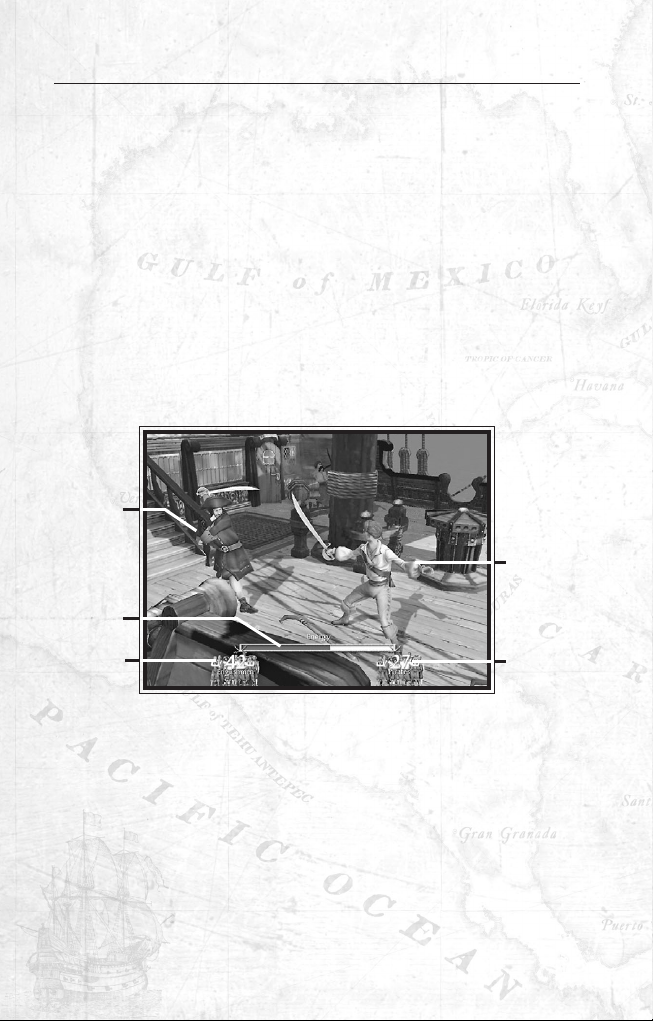
The Dueling Screen
The dueling screen shows a typical duel, taking place after you
rammed an enemy vessel in a ship battle. The dueling screen
contains the following elements:
You: Your character.
Your Opponent: The enemy captain.
The Advantage Bar: This shows which duelist has the advantage (or,
“initiative”). When the bar is left of center, you have the advantage.
When right of center, your opponent has the advantage. The duelist
with the advantage moves faster than normal; the duelist without
Book ThreeSid Meier’s Pirates!
®
Enemy Crew
Advantage Bar
Your Crew
You
Your Opponent
Page 43
the advantage moves slower. You can move the advantage bar away
from you by taunting your opponent, or by ducking a chop, parrying
a thrust, or jumping over a slash.
The Crew Battle
While you are dueling the enemy captain, your crew is fighting the
enemy crew. Every few moments, one side or the other loses some
men, depending upon the current state of the duel and the size, skill,
and morale of the opposing forces.
The Enemy Crew: How many enemy crewmen remain in the battle.
Your Crew: How many of your pirates remain in the battle.
The Keypad Control Diagram: This shows you how to control your
pirate by using the keys on the number pad.
An Overview of Dueling
In a duel, you are leading your men in a fight against the enemy forces
(sometimes you’re fighting alone; we’ll discuss that later). You engage
the enemy captain in a one-on-one swordfight while your crew fights
the enemy crew.
You attempt to hit your opponent with your sword while avoiding
his attacks. A successful hit drives the victim back one or two paces;
the battle is over when one duelist is pushed back into a wall, falls
overboard, or is otherwise dispatched.
While your individual duel is progressing, your crew is battling the
enemy forces. Every few moments, one side or the other loses some
men, depending upon the current state of the duel and the size, skill,
and morale of the opposing forces. If your crew is reduced to one and
you are hit again, you are forced to surrender; if your opponent’s crew
is reduced to one and you hit him again, your opponent surrenders.
Attacks
You have three attacks available to you: chop, thrust, and slash.
Chop
The chop is a high attack. You draw your sword back and up, and then
swing at the enemy’s head or neck. This attack takes a long time to
develop, but is quite deadly when it lands. To execute a chop attack,
press the Chop key (number pad 7).
Book Three
Sid Meier’s Pirates!
®
Page 44
Chop, cont.
Hit Result: Opponent is driven back two spaces.
Counter: Duck
Thrust
The thrust is a quick, straight attack, aimed at your opponent’s torso.
This attack takes little time to develop, but does less damage than
the chop or slash. To execute a thrust attack, press the Thrust key
(number pad 4).
Hit Result: Opponent is driven back one space.
Counter: Parry
Slash
This is a low attack, aimed at your opponent’s legs. The slash takes
some time to develop, but is quite deadly when it lands. To execute
a slash attack, press the Slash key (number pad 1).
Hit Result: Opponent is driven back two spaces.
Counter: Jump
Defensive Maneuvers
You also have three defensive maneuvers available to you: duck,
parry, and jump.
Duck
In this maneuver you duck underneath your opponent’s chop attack.
To duck, press the Duck key (number pad 2).
Duck vs. a Chop: When you successfully duck under an enemy’s
chop, your enemy is momentarily disoriented, possibly allowing you
to get in a quick attack before he recovers.
Duck vs. a Thrust or Slash: The enemy hits you.
Parry
In this maneuver you block your enemy’s attack with your sword.
This defensive maneuver is somewhat successful against any attack.
To parry, press the Parry key (number pad 5).
Parry vs. a Thrust: Your enemy’s blow is completely blocked.
Parry vs. a Chop or Slash: You manage to partially intercept the
attack: you are pushed back one space instead of two.
Book ThreeSid Meier’s Pirates!
®
Page 45
Jump
In this maneuver you jump over your opponent’s slash attack.
To jump, press the Jump key (number pad 8).
Jump vs. a Slash: When you successfully jump over your opponent’s
slash, your opponent is momentarily disoriented, possibly allowing
you to get in a quick attack before he recovers.
Jump vs. a Thrust or Chop: The enemy hits you.
Taunt
When you taunt your opponent, you’re trying to demoralize him with
a cunning verbal attack. A successful taunt moves the advantage in
your favor. There is no specific counter to a taunt; however, your
enemy can shut you up by hitting you while you’re talking. To taunt
your opponent, press the Taunt key (number pad 6).
The Crew Battle
While you are dueling the enemy captain, your crew is fighting the
enemy crew. Every few moments, one side or the other loses some
men, depending upon the current state of the duel and the size, skill,
and morale of the opposing forces.
Effects of Morale on Battle
Your crew’s morale at the time they entered the battle affects their
performance in combat. If they are happy they fight like lions and
can defeat an enemy much bigger than they; if unhappy they fight
much less successfully.
The enemy forces also have a morale rating. In general, crewmen
aboard warships or pirate vessels have higher morale, while the crew
from merchant vessels have lower morale.
Effects of Your Duel on the Crew Battle
The crew’s morale is heavily dependent upon your success in your
fight against the enemy captain. If you are doing well and have
pushed your opponent back, your crew’s morale is raised. If your
enemy is pushing you back, your crew’s morale is lowered.
The importance of this cannot be overstated. If you are winning, your
crew can take on and defeat an enemy force far greater than they;
however, if you are losing the duel, an inferior force can cut them
to pieces.
Book Three
Sid Meier’s Pirates!
®
Page 46
How the Crew’s Battle Affects Your Duel
When the enemy crew loses men, the advantage bar moves in your
favor. When your crew loses men, the bar moves in your opponent’s
favor. Certain factors such as consecutive successful blocks, taunts,
or crew losses can cause a duelist to become disoriented. This is
characterized by a “dizzy” symbol over their head and drastically
reduced speed.
The End of the Crew Battle
The crew battle continues until you or your opponent wins the duel
or until one side or the other has been reduced to one man.
Victory or Defeat
The duel ends when one duelist is pushed overboard (or up against a
wall) or when a duelist surrenders.
Nowhere to Run
When the battle begins, both duelists are in the middle of the dueling
“stage” (typically in the middle of a ship’s main deck). Each duelist is
pushed back by his enemy’s successful hits; if hit enough, a duelist is
pushed back to the very edge of the stage. If he is hit again, he loses
the duel and must surrender (or fall overboard).
Losing the Crew Battle
When a duelist’s crew has been knocked down to one man, he
automatically surrenders the very next time he is hit in the duel.
Note: You can still win a duel even if your crew has been reduced to
one man: you just have to avoid all enemy attacks until you’ve pushed
your opponent off the stage.
Book ThreeSid Meier’s Pirates!
®
Page 47

I n T o w n
Ports of Call
By the 17th century, there are dozens of European settlements on
the islands and continents bordering the Caribbean. Some are old,
established cities boasting thousands of citizens. Others are tiny
settlements clinging to a precarious existence in the face of
hostile natives, predacious pirates, and enemy religious fanatics
– not to mention the many deadly perils that nature herself provides.
Some are temporary hideouts where buccaneers come to plan their
next exploits; others are religious establishments where dedicated
missionaries seek to convert the natives to Christianity. And in
addition to the European settlements, some few native villages still
cling to survival here and there, despite the odds.
You spend much of your time in one or another of these ports –
buying and selling goods, repairing your vessels, recruiting crewmen,
purchasing treasure maps from shady characters, taking assignments
from desperate governors, putting the moves on those governors’
daughters, fighting evil foreigners, and the like.
Book Three
Sid Meier’s Pirates!
®
The Memoirs of Captain Sydney
I think I loved Tortuga the best o’ all cities in the Caribbean. The
shipwright was fast ’n’ mostly honest; the merchants never asked ye
where ye got the cargo from; and the tavern was always crawlin’ with
buccaneers lookin’ fer work.
I remembers I had me a good relationship with the governor, too,
even though Tortuga was a French city and I was an English cap’n, and
France ’n’ England was pretty nearly always at war with each other.
See, France was usually fightin’ Spain at the same time, and as long
as I kept capturin’ Spanish ships ’n’ leavin’ the French alone, he didn’t
care where I came from.
Do ye know that man promoted me to admiral? Me, an admiral in
the bloomin’ French navy! I nearly busted out laughin’ when he told me!
The governor also introduced me to his daughter, which was right
polite o’ him, if ye asks me. Nothin’ ever came o’ it, though: she was
kinda plain-lookin’ and I already had me heart set on this beautiful lass
in Saint Kitts...
Page 48
Cities
Cities are the major permanent European settlements in the
Caribbean. Cities’ names, locations, and nationalities remain constant
from game to game in a single era.
City Types
There are several types of cities in the game, each with certain basic
characteristics:
Capital: A capital is a large and rich city with strong defenses.
Port: A large and rich city with weak defenses.
Town: A large and poor city with strong defenses.
Colony: A large and poor city with weak defenses.
Trading Post: A small and rich city with strong defenses.
Stronghold: A small and poor city with strong defenses.
Village: A small and rich city with poor defenses.
Outpost: A small and poor city with poor defenses.
Book ThreeSid Meier’s Pirates!
®
Talk is Cheap in the Caribbean
And it’s easy, too. When you encounter someone who has something to
say, he or she will greet you with a short statement. If the statement is purely
informational and requires no response from you, the statement will end with
an “Exit” button.
Click on the button when you’ve finished reading the statement and you’re
ready to move on. If the statement requires a response, your possible replies
are listed below the statement. Just click whichever reply you want to give to
continue the conversation.
Page 49
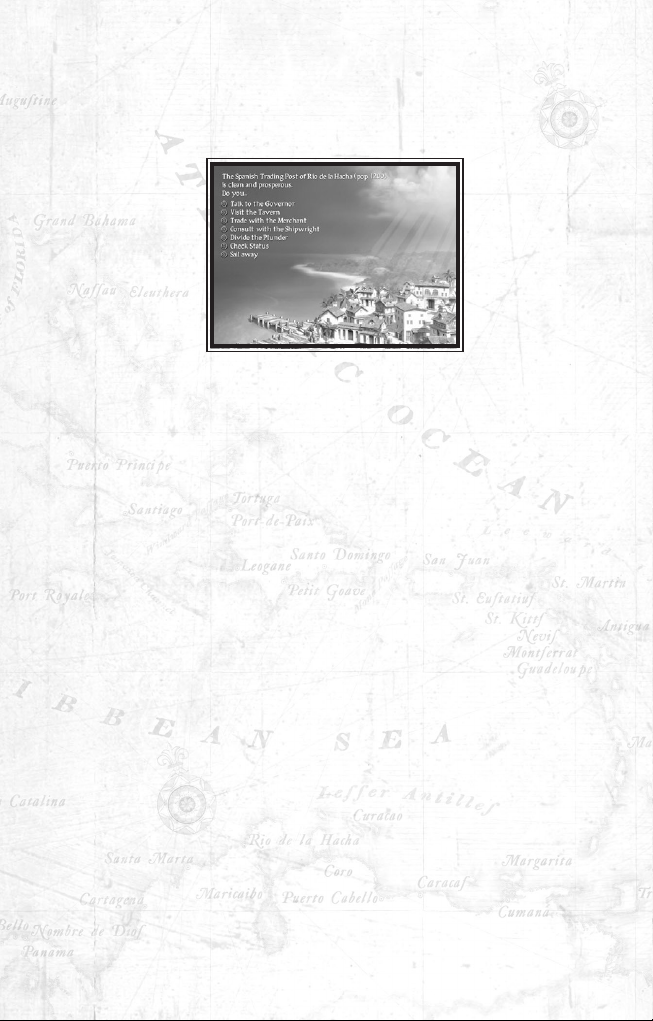
The City Menu
There are a variety of places you can visit in a city. Use your mouse
(or keyboard) to navigate this menu and carry on conversations with
people in town.
The Governor’s Mansion
Enter here to speak to the man in charge of the port. He may give
you political or military assignments. He can also reward you for
successes. Once you are successful enough, you may get a chance to
meet his lovely daughter (if he has one).
The Governor: Governors are the most important and powerful
people in cities. It’s extremely useful for you to be on good terms with
at least a couple of governors throughout the Caribbean:
• They can provide you with Letters of Marque, making you a legal
privateer for their nations.
• If you have a Letter of Marque, they can reward you with
promotions for attacking their enemies.
• If you have been attacking their shipping, the governors can offer
you amnesty (for a price), allowing you to once again receive
Letters of Marque, and thus promotions.
• They can ask you to perform special missions, which, if successful,
will result in further promotions and national good will.
• They can provide you with information on your enemies.
• Finally, they can introduce you to their daughters.
Governors’ Daughters: Some governors have young, unmarried
daughters, eager to meet a dashing and valiant scoundrel such as you.
If you can manage to win her heart, a governor’s daughter can provide
you with valuable information about your enemies and your lost
Book Three
Sid Meier’s Pirates!
®
Page 50
relatives. Furthermore, they may have valuable special items or maps
to lost cities for you, if they think you are worthy. If you persist long
enough, a governor’s daughter may agree to marry you – providing
you with a great deal of prestige in Caribbean society.
You can impress a governor’s daughter by gaining high rank (but only
from her nationality). You can also win her heart by skillful dancing
and by presenting her with jewelry she covets.
By the way, not all governors’ daughters are alike. Some are rather
plain in looks, some are attractive, and a few are quite beautiful. Not
surprisingly, the better looking a daughter is, the harder she is to
impress – go figure.
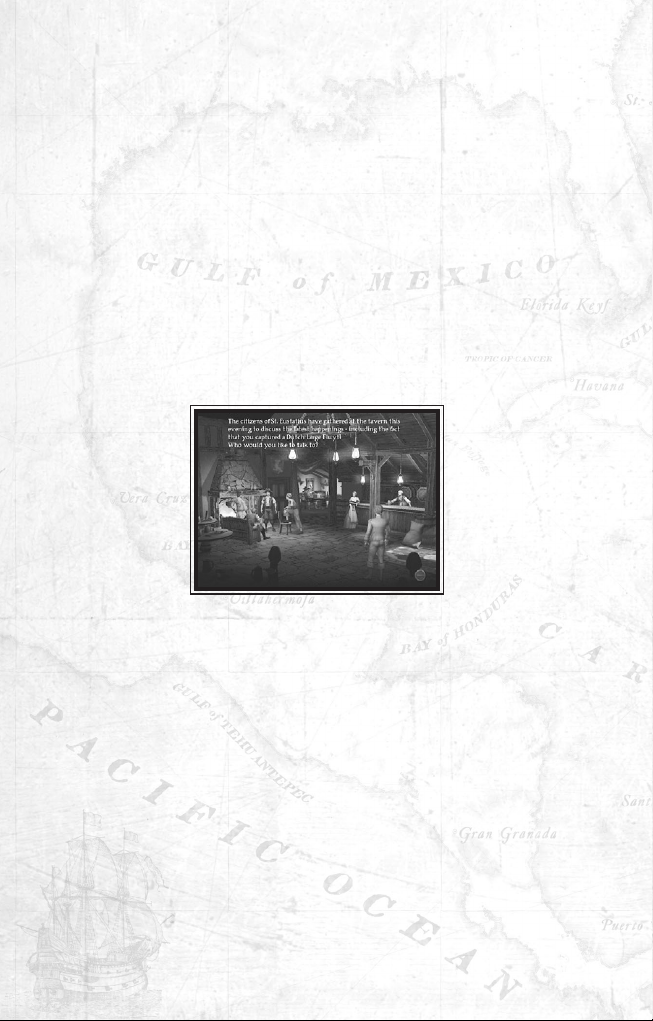
The Tavern
Visit here to recruit men, pick up local gossip, purchase treasure
maps, and so forth.
The People: Your pirate appears in the center of the room, surrounded
by a number of different characters. Each person may have something
to tell (or sell) you. Click on the person you wish to speak with.
The Bartender: The bartender usually knows where to find upgrades
for your vessel. Further, he often knows the movements of prominent
(or notorious) people in the Caribbean. Finally, he shows a disturbingly
thorough knowledge of the whereabouts of attractive women.
The Barmaid: The barmaid can tell you about pirates and villains in
the area. She often knows about fat prizes sailing nearby.
The Mysterious Traveler: This shady character can tell you about
cities he’s recently visited or heard about. He might also have treasure
map fragments or special items available – for the right price.
Crewmen: Unemployed sailors are often found hanging about in
taverns, looking for work. (Not all taverns have work-hungry sailors,
Book ThreeSid Meier’s Pirates!
®
Page 51
and once you’ve hired men from a tavern, it might take a while for
more jobless sailors to show up.) You can’t exceed your maximum
crew capacity, so you may find that not all the men you thought you
recruited “fit” in your available space when you set sail.
The Merchant
Visit here to buy and sell goods and cannon. Use your mouse to make
selections, buy and sell cargo, and so on.
The Shipwright
Go to the shipwright’s establishment to have your ship repaired or
upgraded and to sell any excess ships you possess.
Divide the Plunder
Go here at the end of a long voyage to split the loot between you and
your anxious crew. See “Dividing the Plunder” on pages 81-83 for
more details.
Check Status
Examine your ships, cargo, crew, missions, and so forth. You can
access all information screens from here.
Sail Away
Click here to leave town and return to the sea.
Other Settlement Types
Cities are not the only human habitations in the Caribbean. There
are other, smaller enclaves, as well. These smaller places change
location from game to game.
Settlement
These are smaller, newer towns, often with very few people in them,
often on the brink of extinction. Occasionally a settlement’s mayor
may have a job for you.
Settlements may have some or all of the same locations found in cities
– Tavern, Merchant, Shipwright, and so on. However, these places
are usually quite poor and primitive: don’t expect to find the same
quality of goods and services.
Jesuit Mission
Missions are places where members of the Jesuit religious order try to
convert the natives to Christianity. Jesuit priests often have influence
with nearby cities: they may be willing to intercede with enemy
governors on your behalf. Like settlements, missions have merchants
but they are usually poor and understocked.
Book Three
Sid Meier’s Pirates!
®
Page 52

Pirate Haven
These are temporary settlements where pirates gather to recruit
crewmen and plot their next missions. If you’re villainous enough,
you may be able to convince the pirate captain to launch an assault
upon a nearby city.
Pirate Havens contain poor and primitive taverns, shipwrights,
merchants, and so on. The “top ten” pirates are each based in a
different pirate haven.
Indian Village
These places are where the remaining native people try to survive
the European onslaught. Indian villages are generally not too fond of
their non-native neighbors: you may be able to convince their chief to
attack a nearby European city – ye ruthless scoundrel!
Indian villages may contain merchants willing to sell you whatever
few supplies they possess.
Book ThreeSid Meier’s Pirates!
®
The Memoirs of Captain Sydney
I never understand what them famous pirates
was thinkin’ about, buryin’ their treasure all over the
Caribbean like that. Me, I spent every last shillin’ I ever
got, or I put it in a right, proper bank for safekeepin.’
Seems to me that every time they buried their
treasure, along’d come some blasted thief to dig it up and
steal it. What’s the sense of it, I asks ye?
Course it takes some guts to steal another pirate’s
booty – particularly if the pirate in question happens to
be Blackbeard or Kidd or one of them boys. Those lads
really know how to hold a grudge.
Page 53
T r e a s u r e M a p s
Overview
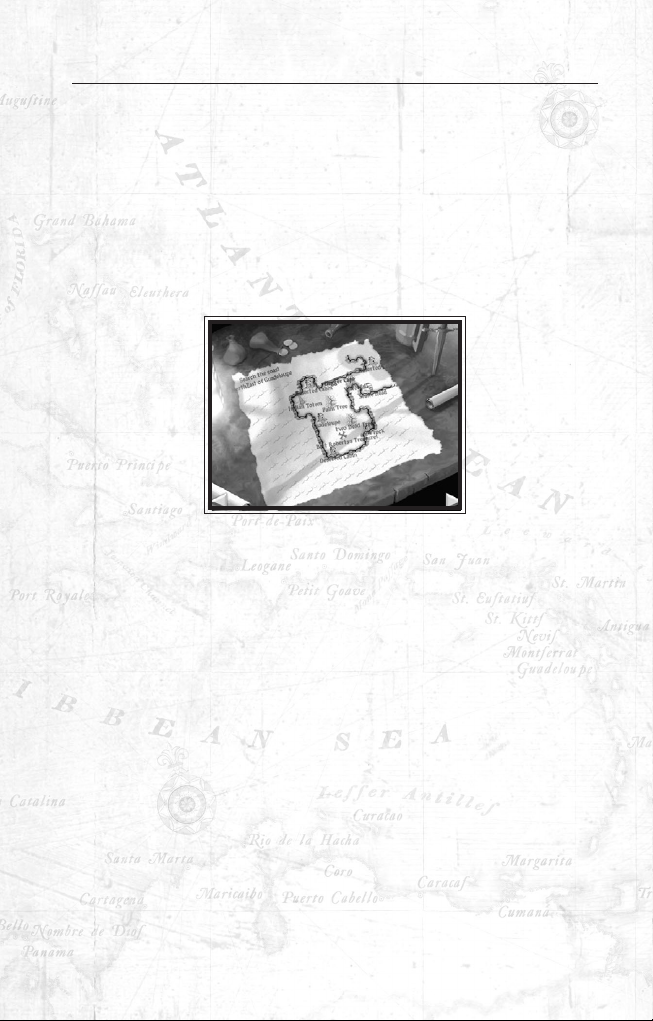
There’s nothing a famous pirate likes to do more than to hide a bunch
of his loot in a secret location, murder all of the folks who helped him
bury it, create a cryptic map showing where the treasure is hidden
– and then promptly lose the map.
During your journeys you may discover pieces of these maps. Once
you collect enough fragments, you may be able to follow the map’s
clues to the buried treasure, making you much richer – and, not
surprisingly, also really annoying to the pirate whose loot you stole.
Getting Map Pieces
You may occasionally find a mysterious traveler willing to sell you a
piece of a treasure map. Mysterious travelers are found in taverns.
Governors’ daughters may possess pieces of maps leading to lost
cities of gold. They are found in governors’ mansions.
Looking at Your Map
Once you acquire a map piece, it is stored in the Treasure Map
information screen. If you acquire additional pieces of that map, they
are automatically put together on one page in the correct position. If
you have more than one map, each map appears on a separate page.
Once you have found a treasure, the associated map is removed.
Map Clues
Pirates use a variety of clues to indicate the locations of their
treasures. Some of these are visible from the sea. These include
human habitations – cities, settlements, villages, missions and pirate
havens. Pirates also use named landmarks – Dagger Falls, Skull
Shallows, Prisoners’ Rock, and so on, which are also visible from
aboard your boat.
Book Three
Sid Meier’s Pirates!
®
Page 54
Other map clues are smaller and visible only once you form a landing
party and go ashore. You must disembark your vessel in order to see
arched rocks, Indian totems, dead trees, etc.
In order to find a treasure, you need to spot a visible landmark on
the treasure map and then disembark nearby. You can then follow
the other clues until you reach the treasure. See “On Land”, on the
next page, for details on how to move about once ashore, and how to
retrieve the treasure.
By the way, landmarks and settlements change location from game to
game. Just because you found Dagger Point on the southern coast of
Cuba in one game doesn’t mean that’s where it will be the next time
you play...
Other Sorts of Maps
During your journey you may encounter other maps, leading to lost
relatives, hidden cities of gold, and so on. You usually acquire these
maps from governors’ daughters, though they may be available from
other sources.
These maps function just like treasure maps. They too are stored on
the Treasure Map screen, and you use the process outlined above to
reach the hidden location.
Book ThreeSid Meier’s Pirates!
®
Robert Lewis Stevenson Has a Lot to Answer For
As far as we can tell, only one pirate ever actually buried his treasure, and
that was under unusual circumstances. The privateer Captain William Kidd was
heading back to New York, where he knew he might face charges of piracy. He
hid a portion of his treasure on Long Island to give himself a bargaining chip
in the upcoming negotiations. It didn’t work. Kidd was promptly imprisoned,
forced to reveal the location of his treasure, and then sent off to England to be
tried and hanged as a pirate.
In fact, the buried treasure myth appears to have originated in Robert
Lewis Stevenson’s thriller, “Treasure Island.” Written in 1881, the extremely
popular book featured a hunt for buried pirate treasure. Though the story
was totally fictitious, people ever since have remained convinced that pirates
routinely buried portions of their plunder.
Mostly, pirates squandered their treasure on gambling or on “fancy
ladies” in town. A few men sensibly banked their gold or expended it
purchasing pardons and titles of nobility, but most spent it as soon as they got it.
Page 55
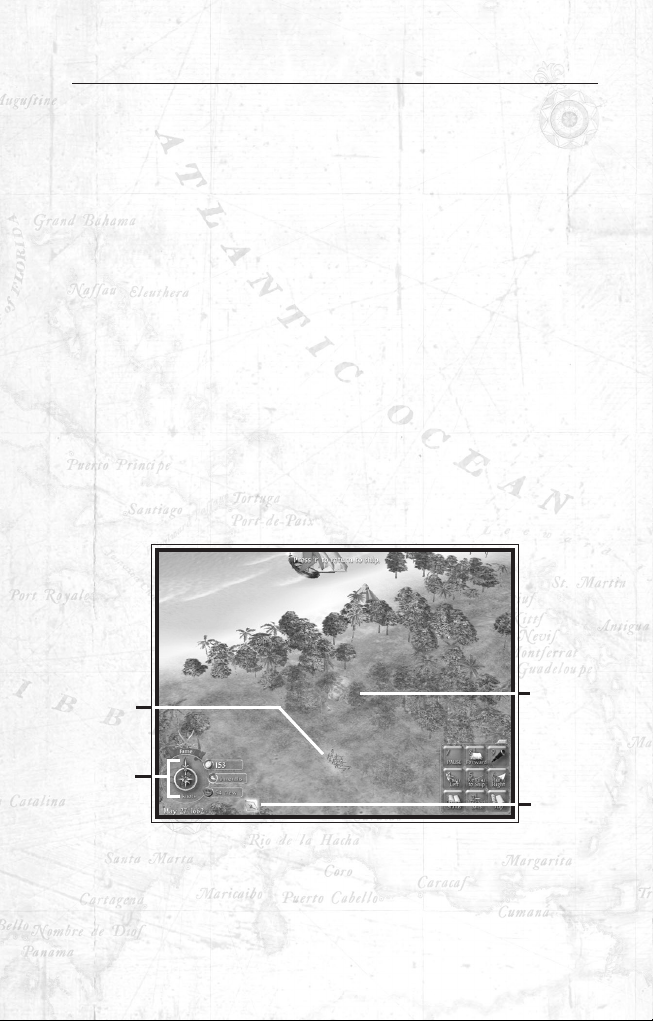
O n L a n d
Overview
Pirates don’t have much luck with the land. It’s a nasty place, full of
snakes, alligators, farmers, and other nuisances. In general, pirates
stick to the ocean or to the cities. If they decide to venture out
into the wilderness, it’s usually because they’re after one thing –
buried treasure.
Disembarking
When you want to go ashore, steer your ship into the land. When
you reach your target, a pop-up appears, asking if you really want to
disembark. If you answer in the affirmative, a landing party forms
ashore from your anchored vessel. You, of course, are in the lead.
Embarking
When it is time to return to your vessel, press the Return to Your Ship
key (R). Your crew immediately boards your ship and heads out to
sea. Note that you can use this to board your crew from far inland.
Alternatively, you can manually direct your landing party aboard your
ship. In a moment, the scene changes and you’re back at sea.
The On Land Screen
These are the elements that appear when your crew is on land.
Your Men: Your landing party, with you at the lead.
Landmark: A clue leading to the buried treasure.
Book Three
Sid Meier’s Pirates!
®
Your men
Landmark
Compass
Food
Crew
Treasure Maps
Quests
Page 56

Months of Food Remaining: Once you run out of food, your men
will begin to starve.
Crew Size and Current Morale: How many crewmen are in your
landing party and the state of their morale.
Compass: Helps you figure out which direction you’re going.
Current Quests: Info on people you’re trying to track down.
Current Treasure Maps: A shortcut to your treasure maps.
“X” Marks the Spot
When you get near to the correct spot, an “X” appears on the screen.
Move your men atop the blinking mark, and they will uncover the
hidden goodies. Once you’ve got the loot, you can use the Return to
Your Ship key (R) to get back to sea.
Book ThreeSid Meier’s Pirates!
®
The Memoirs of Captain Sydney
Land is fer lubbers, hear me? And fer crazy old dogs
like Cap’n Briggs. He used to buy them maps and then
drag his poor crew all over creation lookin’ fer buried
treasure. Heh. Half the time he’d run out o’ food in
some godforsaken mountains and half his men would
desert him.
Course he did find treasure a couple o’ times – they
was worth a pretty penny too. But as fer me, I’ll stick to
the high seas, thank you very much. Marchin’ around on
land just ain’t natural fer a pirate, sez I. I heard tell how
there be monstrous great spiders in them jungles, and
huge, bloodsucking wombats, so they say.
No sir. I’ll go ashore fer somethin’ reasonable
– for to attack a Spanish city, or the like. As for buried
treasure, I leaves it fer them who likes it. Me, I’ll take
me a fat Spanish treasure galleon any day o’ the week.
Page 57
Perils Ashore
When you’re leading a landing party, there are two things you have
to worry about: your crew’s morale and their food supply. As time
passes your crew eats, and if they run out of food, they’ll become
really unhappy. You’ll need to get them some food, quick, or they’ll
start to desert.
Mind you, even a well-fed crew may begin to complain if the search
takes too much time. It’s a good idea to begin any land adventure
with loads of food and a happy crew.
Entering a City or Settlement
If you wish to lead your landing party into a city or settlement,
simply move toward the buildings on the map. Once you have gotten
close to the habitation, a menu appears asking what your intentions
are. Depending upon circumstances you may be able to stroll right in
to the place, or you may have to sneak or fight your way in.
Book Three
Sid Meier’s Pirates!
®
Page 58

L a n d B a t t l e s
Book ThreeSid Meier’s Pirates!
®
The Memoirs of Captain Sydney
It was back in the spring o’ ’65, or maybe ’66, me ’n’ the
boys decided it was time to teach them Dutchmen a lesson. We
heard that the Indians had attacked Curacao, see, and we figured
that maybe they had softened the place up enough fer us to be
able to take it. There was about 250 of us, I recollect, and we
reached Curacao some time in May. We put ashore ’n’ formed
ourselves into four or five brigades – a couple with boys armed
with cutlasses, a couple with buccaneers armed with muskets, and
one with us officers in the lead.
Well, them Dutchmen hid themselves in the tree line and
ambushed us as we moved for’ard. Their infantry weren’t much
good with their muskets, but they had the cover and we was in the
open, and they gave as good as they got. They held on until we was
able to hit ’em in the flank, then they broke and ran fer the city.
By then the Dutchmen had some artillery on the field, but
with the infantry gone, it was dead meat. It got off one good shot
at the buccaneers, and then us officers ran up ’n’ spiked the guns.
Then some cavalry showed up on our flank. “Boys,” sez
I,“this is gettin’ right tedious. I thinks we should leave some
buccaneers behind to keep them horsemen busy, and the rest o’ us
should run fer the city walls. What say ye?” The boys agreed and
we moved for’ard.
Well, to make a long story short, it worked. Some o’ us ran
into another ambuscade, but more o’ us made it over the walls.
The Dutchmen kind o’ lost heart and surrendered.
So we won in the end, I warrant, but it weren’t no picnic. If
them Dutch infantry had looked after their flanks properly and the
cavalry had got up faster, it mighta had a very different ending.
Page 59
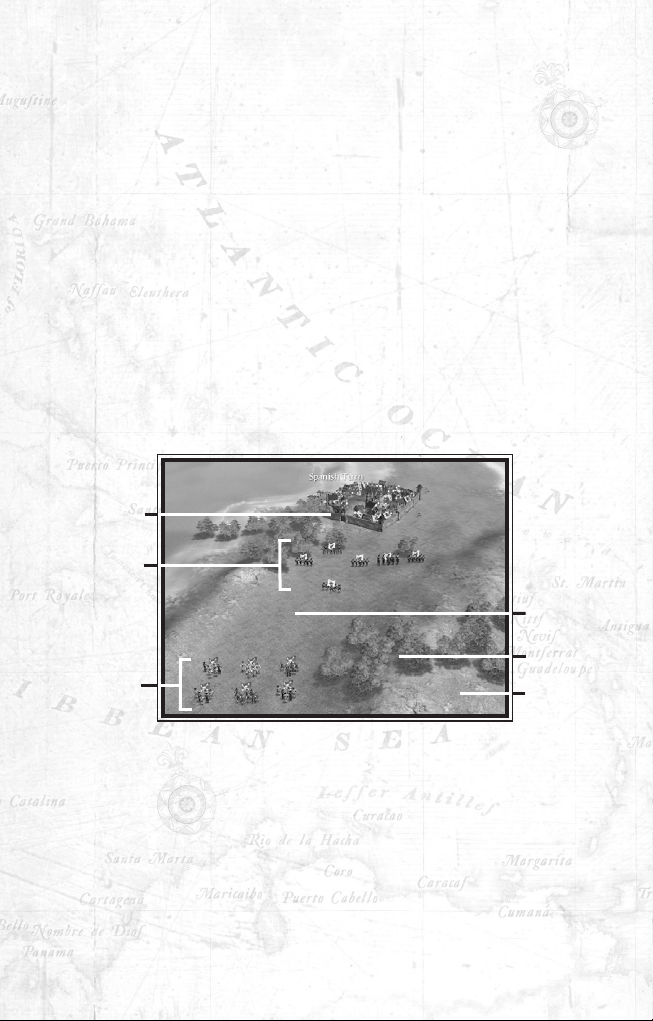
Overview
As captain of a pirate vessel, not only are you expected to lead your
men to victory at sea, you must also be able to take them ashore
to attack enemy cities. Here you may face enemy militia, infantry,
cavalry, native warriors, and guards. Your men are not especially
adept at shouldering muskets, saluting, and marching in line – but
they still fight like demons when facing the enemy.
In a land battle, you control several “units” of pirates, buccaneers,
and officers. Your opponent controls infantry, cavalry, and native
warriors. Your objective is to reach the enemy city with one or more
of your units.
Remember that your goal isn’t to defeat or destroy the enemy units
– all you want to do is get men into the city. If you have to destroy
every enemy unit on the map, so be it. If you can circle around them
and get inside without firing a shot, that’s fine too. Note: You cannot
initiate a land battle with less than 50 men.
The Land Battles Screen
Your Troops: These are your forces.
Enemy Troops: These are the enemy’s forces.
Trees: Light jungle forest.
Clear: Clear terrain.
Hills: High ground.
Enemy City: Your objective.
Book Three
Sid Meier’s Pirates!
®
Your Troops
Enemy City
Enemy Troops
Hills
Clear
Trees
Page 60
Unit Types
Your Forces
You have three different kinds of units at your command.
Pirates: Armed with cutlasses and boarding axes, pirates are very
good at close (hand-to-hand) combat. Pirates cannot make ranged
attacks.
Buccaneers: Buccaneers are armed with muskets and very good at
ranged attacks. They can fire at enemy units within four spaces but
are not good at close combat.
Officers: These elite pirates excel at close combat, but cannot make
ranged attacks.
Enemy Forces
These are the types of units you may face during land combat:
Infantry: Armed with muskets and swords, these are the local militia.
They can make both ranged and close-combat attacks, but they’re
not especially powerful. Infantry can fire at enemy units within three
spaces.
Guards: These professional soldiers are armed with light muskets
and swords. They are good at close combat, and they can make
ranged attacks against enemies within two spaces.
Cavalry: Like Guards, these are professional soldiers but are on
horseback, armed with lances and swords. They move quickly and
are particularly dangerous when charging an enemy unit in clear
terrain. They are not effective against targets in trees and cannot
make ranged attacks.
Neutral Forces
These units may appear as enemies:
Native Bowmen: Armed with bows and arrows, these warriors are
very good at ranged combat and can attack an enemy within two
spaces. They are vulnerable in close combat.
Native Spearmen: Fierce fighters armed with spears and stone axes,
spearmen are extremely proficient at close combat, but unable to
perform ranged attacks.
Book ThreeSid Meier’s Pirates!
®
Page 61
How to Play
During a battle the units in the game – both yours and the enemy’s
– are “activated” one at a time. When a unit is activated, its
commander orders it to move, fire, attack or hold. Once a unit has
completed its orders, another unit is activated. Only one unit is active
at a time.
At the start of a battle you can choose between three starting locations
by pressing the Change Target key (Tab). Once you have selected
a starting location, hit (Enter) to continue. Battles are played out in a
turn-based format with each side moving in turn.
Orders
When one of your units is active, you can give it one of the following
orders:
Move: Order a unit to move into an empty adjacent space on the map
but not into a space occupied by another friendly unit. Order a unit
to move by right-clicking on the space you want it to move to, or by
pressing one of the Move keys (on the number pad; see the “Game
Controls” section for details).
Turn: Order a unit to turn to face any direction (see “Flank Attacks”
on page 63). Press one of the Turn keys (Ctrl-number pad 1, 2, 3, 4,
6, 7, 8 or 9) to order the unit to turn.
Attack in Close Combat: If you order a unit to move into a space
occupied by an enemy unit, your unit attacks that unit in hand-tohand combat in an attempt to drive it away. If it is successful, your
unit can move into the enemy’s vacated space.
Make a Ranged Attack: You can order a unit with ranged combat
ability to fire at any enemy unit with sight and firing range. Potential
targets are highlighted with a red circle. The target your unit is
currently aiming at flashes. Press the Change Target key (Tab) to
aim at another available target. Press the Fire key (number pad 5)
to fire.
Hold: Do nothing. In effect, the unit skips its move. Press the Hold
key (Spacebar) to order a unit to hold. You may select another unit
to move without losing the currently active unit’s movement this
turn. Simply select another unit with the mouse or choose the Next
Unit command.
Book Three
Sid Meier’s Pirates!
®
Page 62
Terrain
There are four basic types of terrain in Pirates!
Clear Terrain: Open country. Units attacked while in clear terrain
get no defensive bonus. Cavalry units get an attack bonus when
attacking enemy units in clear terrain.
Trees: Trees provide a defensive bonus. Units in trees are invisible
until an enemy unit moves adjacent to them. Cavalry units are
penalized when attacking units in trees.
Hills: Units on hills (elevated terrain) gain a bonus when engaged in
close combat against units that are lower than they.
Impassable Terrain: This rocky terrain is impassable for units but
ranged units can fire through it.
Hidden Units
Units in trees or behind hills remain invisible until an enemy unit
“sees” them by climbing the hill or moving next to the unit in
the trees.
Combat
Close Combat
Close combat occurs when one unit attempts to enter a space
occupied by an enemy unit. The attacker’s close combat strength
is used against the defender’s defensive strength (modified by the
terrain, each unit’s morale, and whether it is a “flank” attack) and a
result is determined. Each unit may take casualties and lose morale.
If the defender wins the combat, he holds the position; if the attacker
wins, he takes the position and sends the defender fleeing.
Ranged Combat
Only buccaneers, infantry, artillery and native bowmen engage in
ranged combat. In ranged combat, the attacker fires his weapons at
an enemy unit within sight and his ranged attack range. Effects of
the fire are determined as in close combat, but only the defender’s
terrain is considered important. The defender may lose men and /
or morale from the attack. The attacker doesn’t suffer any ill effects
from making a ranged combat attack.
Book ThreeSid Meier’s Pirates!
®
Page 63
Flank Attacks
When a unit is attacked from the rear or side, the attacker receives a
“flank-attack” bonus. This applies in both close and ranged combat.
Panic
As a unit takes damage, its morale deteriorates. If the unit’s morale
reaches “panic,” it breaks and flees from the battle the very next time
it takes casualties.
Victory
If your men reach the city walls, the defenders scatter and run,
and the local citizens pay you a ransom to vacate the premises (the
ransom can be quite large, depending upon the city’s wealth and
how badly beaten the defenders). It is possible to use feints and
sneak units close to the city for an easier victory but your plunder
will be less than that of a complete victory. An overwhelming victory
could also give you the opportunity to place a new governor into the
conquered town. This will make the new governor’s country very
happy and the old governor’s country rather upset!
Capturing a City
If your attack is enormously successful, the local people may revolt
against their current inept rulers. This allows you to determine their
future national allegiance.
Defeat
If you are defeated in battle, you return to your fleet to lick your
wounds and plot your next move, minus a portion of your crew.
Book Three
Sid Meier’s Pirates!
®
Page 64

S n e a k i n g A b o u t T o w n
Overview
From time to time you may find it necessary to get in or out of a town
unnoticed. Perhaps you’ve been making war on the Spanish and have
discovered that your archenemy is hiding in the tavern in Cartagena.
Lacking the manpower to take the city by storm, your only alternative
is to sneak into the city, find the tavern and confront your foe.
Or perhaps you’ve been fighting the perfidious English and had the
misfortune of being captured and imprisoned in Barbados. One night
Book ThreeSid Meier’s Pirates!
®
The Memoirs of Captain Sydney
I’d been chasin’ Baron Raymondo for nigh on six months,
because I’d been told he knew where my long-lost sister was bein’
held. I finally heard tell he was holed up in Saint Martin, which
was sort of a problem, because them Dutchmen hadn’t liked me
much since I sacked Curacao. Sure enough, when I approached the
harbor Saint Martin’s guns opened up on my ship. So I made fer to
sneak into town on me own.
It were late at night and the city streets were dark ’n’ quiet.
The only people out were me ’n’ them Dutch guardsmen. But they
was slow and easy to spot, and I figured that I was safe as long
as I stayed out of sight.
Then I walked down this street ’n’ realized it were a dead
end, and that a guardsman was about to come around the corner
behind me. There was nowhere to run: the houses were locked up
tight, and I knew it’d make too much noise if I were to kick in a
door or window. So I figures I’m trapped.
Then I spots these hay bales, and I ducks behind ’em just as the
guard comes around the corner. As he walks past I slips out behind
him and kind o’ taps him on the headbone with this cudgel I’m
carryin’. He slumps over and I slips away down the street and over
a wall before anybody spots me.
Not too long after that I sees the tavern and makes my way
inside. Baron Raymondo weren’t too happy to see me – and he was
a lot less happy after I got through with him, by the Powers!
Page 65
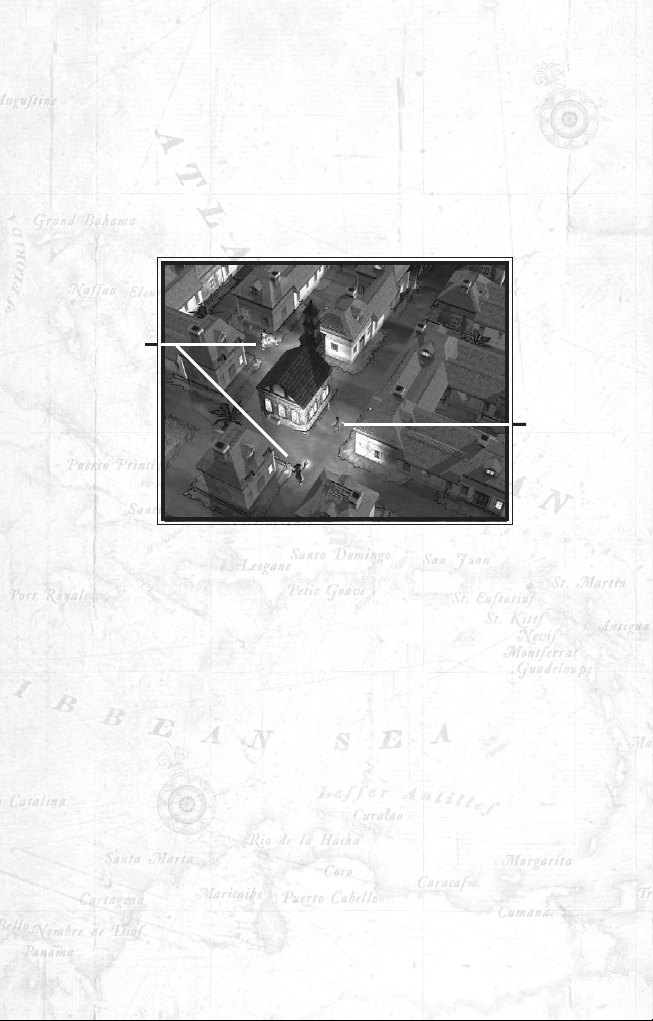
you manage to slip out of your prison; now all you have to do is make
it out of the city without being captured.
As you move about an enemy city, you’ll see a number of guards on
routine patrol. If you sneak up behind a guard you can knock him out.
However, you’re much better off keeping out of his way altogether. If
a guard sees you he’ll raise the alarm and dozens of guards converge
on your position. Then it’s back to the hoosegow for you, unless you
outrun them!
The Town Sneak Screen
You: Your character, that handsome devil!
City Guard: The enemy. Keep out of his way.
Building: A dwelling. You can’t enter any of these buildings. Neither
can the guards. They can’t see through them, either.
Objective Buildings: These are the marked locations in town:
Governor’s mansion, tavern, and so forth.
Your Men: Your faithful crew, waiting for you on the edge of town.
You need to reach them if you’re heading out of town.
Fence: A fence. You can climb over fences, but the city guards are too
fat and lazy to do so. They can’t see through fences, either.
Hay Bales: You can hide behind hay bales and the guardsmen can’t
spot you.
Book Three
Sid Meier’s Pirates!
®
City Guards
You
Page 66
Moving Around
Walking
This is your regular pace. You’re moving slowly and quietly, paying
close attention to your surroundings. Guards cannot hear your
movements. They see you if they’re looking in your direction, of
course.
Running
Use the Run key (Shift) to run. You move far more rapidly when
running, but you make a lot more noise that may alert nearby guards.
Furthermore, you can’t pay as much attention to your surroundings
when running – the view closes in so you can’t see much of what’s
around. You’re in danger of running smack into a guardsman.
Climbing Fences
Move into the fence to climb it. Once you touch the fence you’ll
automatically climb over it. This is a good way to evade pursuit, since
guardsmen can’t climb fences and can’t see through them.
Hiding
To hide, move into a hay bale and the guardsmen will not see you.
Knocking Out a Guardsman
Walk up behind a guardsman to knock him out. You can’t knock out
a guardsman if he’s facing you: he’ll see your approach and raise the
alarm.
Getting Caught
If a guardsman sees you and gets within touching distance, you’re
caught and thrown into jail. Here you’ll sit and rot until the authorities
are good and ready to release you.
Entering an Objective Building
When you reach an objective building, you will have access to that
location (Governor’s Mansion or Tavern). When you leave that
location, you are returned to your fleet.
Book ThreeSid Meier’s Pirates!
®
Page 67

Escaping from Town
To walk out of town, keep moving until you reach the edge of town.
Here you’ll see your waiting crewmen. When you reach your crew,
you have escaped and return to the Navigation screen.
Book Three
Sid Meier’s Pirates!
®
The Memoirs of Captain Sydney
Ye may not know it to look at me now, Laddy, but at one
time the old Cap’n cut quite a dashing figure on the dance floor.
That was before I got me this peg-leg, o’ course. And I was
younger then, ’n’ I had more teeth in me head. And two eyes ’n’
both hands, as well.
Them was great days. I’d be out at sea fer weeks, takin’
Spanish ships in the waters south o’ Santiago, ’n’ when things got
too hot out there I’d put into Tortuga fer to sell my prizes and see
the governor’s daughter.
The times we had! I’d take her out on the dance floor ’n’ twirl
her around a couple hunnert times, ’n’ she’d be the envy o’ all the
other high-born ladies with their fat, lazy ’n’ cowardly beaus.
I admit she weren’t the prettiest lass in the world: Nancy, my
intended, were much prettier than her – so were Simone and Inga,
my other intendeds, come to think of it – but she was kind of nice
to be around. And every once in a while she’d give me a present: a
new shirt or fancy hat or some-such high-born gee-gaw.
Yes, she were a nice kid. I heard tell she took it badly when
Theodora ’n’ me got married in Saint Kitts.
Page 68
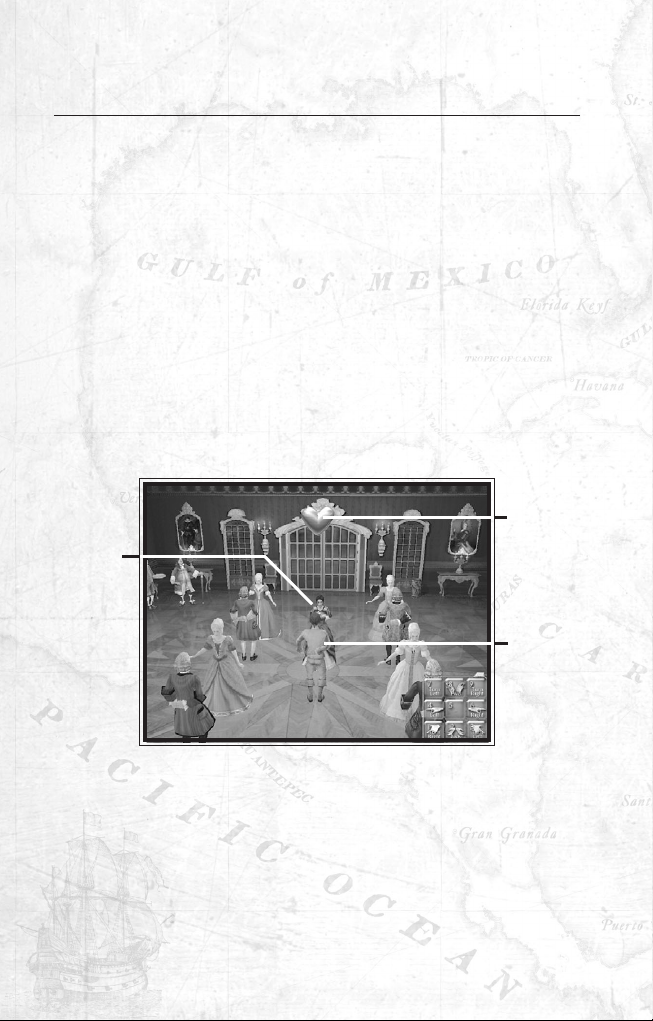
D a n c i n g w i t h t h e
G o v e r n o r ’ s D a u g h t e r
Overview
In the 17th century, balls (hifalutin’ dance parties) were the primary
form of entertainment for the upper class. Everybody who was
anybody was there, dressed in their finest clothing and flaunting
their best jewelry. The men wore powdered wigs, the women sported
towering hairstyles that were in constant danger of catching fire from
the candle chandeliers. Gossip was exchanged. Discrete romantic
meetings were arranged.
Young gentlemen and ladies were expected to be competent dancers
– especially if they were looking for a mate. One could not attain the
highest rungs on the social ladder if one did not cut a fine figure on
the dance floor.
No matter how dashing, no matter how handsome – if a pirate wishes
to win the heart of a governor’s daughter, he’d better learn to dance.
The Dance Screen
You: Your character.
Your Partner: The governor’s daughter. The young lady you’re
hoping to impress.
Other Dancers: Important members of the city. They’ll be watching
you closely to see if you mess up.
Heart Monitor: This tracks the state of your partner’s feelings for
you. The bigger the heart, the more she likes you.
Book ThreeSid Meier’s Pirates!
®
Your
Partner
Heart Monitor
You
Page 69
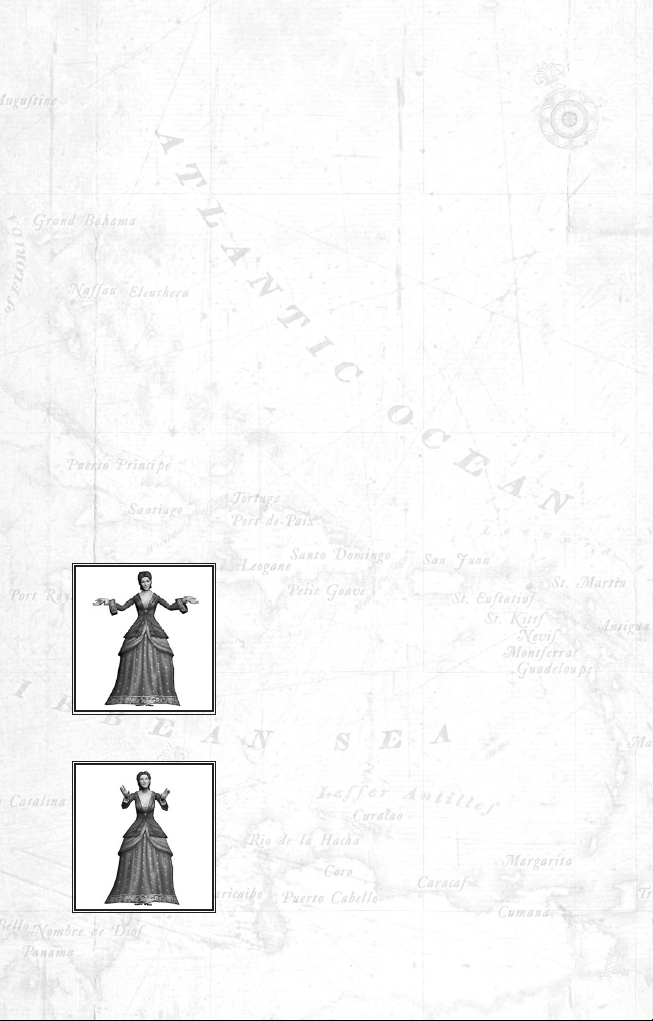
Flourish Counters: The little hearts surrounding the heart monitor
represent the number of “flourishes” (moves made in time with the
music; see below) you have performed in a row. Governors’ daughters
are really impressed by f lourishes.
The Music
The couples dance to music in 3/4 time – ONE, two, three, ONE,
two, three, etc. They also dance to music in 4/4 time – ONE, two,
three, four, ONE, two, three, four, etc...
How to Dance
In a dance, the partners perform an intricate series of dance
maneuvers, one moving smoothly into the next, in time with the
music. Your partner indicates the upcoming maneuver with a gesture.
You then attempt the maneuver in time with the music. If you pick
the appropriate maneuver, your partner is happy. If you pick an
incorrect maneuver – or don’t pick a maneuver at all – you stumble,
and your partner is annoyed and embarrassed. Try not to embarrass
the young lady.
The Maneuvers
Following is a list of the six dance maneuvers and the accompanying
gestures.
Marche Forward: You move forward (away
from the screen). Your partner backs up. Press
(number pad 8).
Marche Backward: You move backward (toward
the screen) while your partner moves forward.
Press (number pad 2).
Book Three
Sid Meier’s Pirates!
®
Page 70
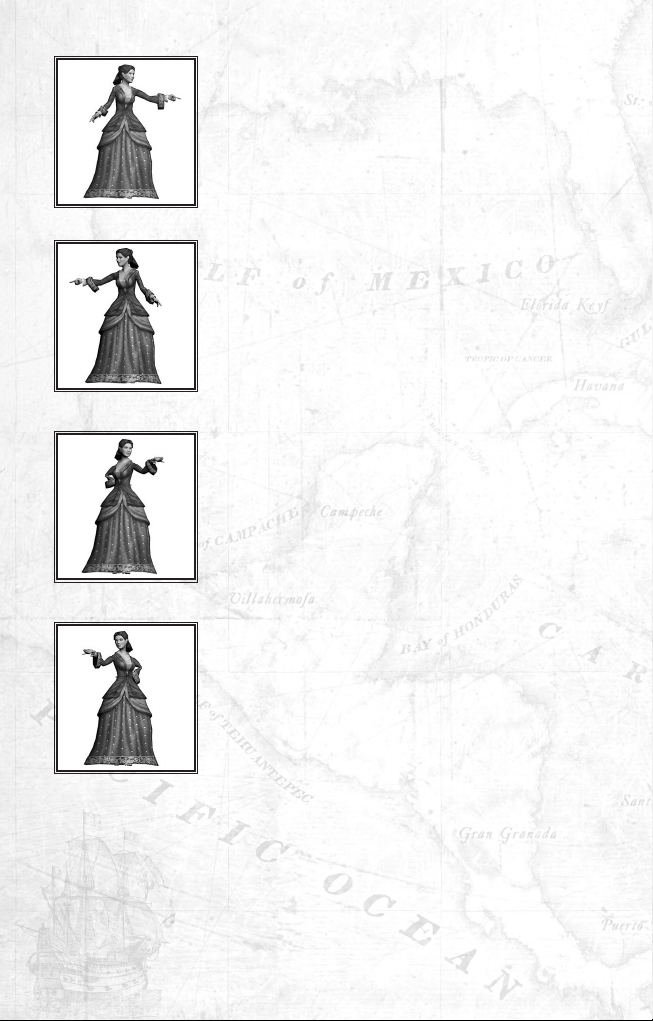
Glisse Right: You and your partner move
toward the right edge of the screen. Press
(number pad 6).
Glisse Left: You and your partner move
toward the left edge of the screen. Press
(number pad 4).
Pirouette Right: You and your partner both
spin counterclockwise. Press (number pad 3).
Pirouette Left: You and your partner perform
a clockwise spin. Press (number pad 1).
Book ThreeSid Meier’s Pirates!
®
Page 71
Missteps
If you make an incorrect maneuver or don’t make a maneuver in time,
you stumble and she frowns.
Dancing Shoes
If you possess the Calfskin Boots special item, there’s a chance that
you’ll perform the correct maneuver even if you make a mistake.
Dancing Slippers give you an even better chance.
Flourishes
Perform the correct maneuver in time with the beat of the music
(on the count of ONE in ONE, two, three; or ONE in ONE, two,
three, four) and you and your partner perform a “f lourish” – a fancier
version of the standard dance maneuver. Flourishes can help win
the heart of the daughter faster and can aid in recovering from
early mistakes.
The Heart Monitor
The heart in the upper-center of the screen is the heart monitor.
The monitor tracks your success in dancing by growing in size each
time you perform a correct dance step. Flourishes cause the monitor
to grow at an accelerated pace: The more flourishes you perform
in a row, the faster it grows. The heart monitor shrinks with each
misstep.
The End of the Dance
Your success depends on the size of the heart monitor at the end
of the dance. If the heart monitor is small, you didn’t impress the
governor’s daughter very much, and she’ll let you know it. If the heart
monitor is huge, you danced like a true gentleman and the governor’s
daughter will look upon you with great approval. You’re well on your
way to winning the young lady’s heart!
Book Three
Sid Meier’s Pirates!
®
Page 72

P r o m o t i o n s
Overview
You earn promotions from governors by performing valuable services
for their nations. Each promotion marks an increase in the nation’s
esteem and favor. Each promotion also earns you a benefit from that
nation. In order to get promoted, you first need a Letter of Marque
from that nation.
In addition to the in-game benefits of rank, promotions also feed
into your overall Fame score, which helps determine your final score
when you retire.
How to Gain Promotions
City governors issue promotions. You earn promotions by doing
services for a nation – attacking enemy shipping and cities, escorting
ships carrying emissaries, soldiers or immigrants, capturing pirates or
fugitives wanted for crimes against the state, and so forth.
Book ThreeSid Meier’s Pirates!
®
The Memoirs of Captain Sydney
Now me old mate Cap’n Briggs, he was a man fer collectin’
titles, by the Powers! By the time he retired he was an English
Duke, a French Baron, and a Dutch Admiral.
Me, farthest I got was English Colonel and French Admiral.
I never could stay friendly enough with them Dutch to get any
promotions. Briggs had a stronger stomach, the sly dog.
Them titles weren’t just fer show, neither. Shipwrights
would fix yer ship fer nearly nuthin’ once ye was a Colonel, and
once ye made Baron, men would fall all over themselves to join yer
crew. Sailors love a lord, so they say. The daft fools.
Spanish title? No, I never got me one o’ them. Didn’t want
one, neither. But one day this barmaid told me that the Dons had
put a 10,000 doubloon reward on me head – and that, my lad, is
better ’n any title you may care to mention.
Briggs was never worth more ’n’ 8,000 doubloons to the
Spanish, and I never let him forget it.
Page 73
If you are on friendly (or at worst, neutral) terms with a nation,
the governor will issue you a Letter of Marque as a matter of form,
although you can bypass this simple step with enough good deeds.
If the nation dislikes you because of your actions against their
interests, then you may need to pay the governor a hefty bribe. If the
nation really hates you, you may need to find a Jesuit monk willing to
intercede on you behalf.
Promotions From Different Nations
Each nation in the game has its own opinion of you. You may be
a French Marquis while remaining a lowly English Captain (and a
Spanish Outlaw!). You only get rank-related benefits from the nation
that has given you the rank: being a Dutch Admiral does you no
good in non-Dutch ports. It’s possible to gain promotions from two or
more nations at the same time, if you do deeds they all approve of. If
France and England are both at war with Spain, for example, and you
have Letters of Marque from both nations, both will promote you for
attacking Spanish shipping or cities.
Losing Favor
If you have been promoted by a nation and then act against
that nation’s interests (say, by attacking their shipping), you will
eventually lose favor with that nation. You keep your current rank,
but lose all benefits associated with it. The rank still counts toward
your Fame score, however. If you have behaved badly enough, the
nation may even view you as their enemy, denying you access to their
cities, sending pirate hunters after you, and so forth.
In order to once again receive the benefits of your rank with a
nation, you must regain that nation’s favor – through bribes, Jesuit
intercession, or through really impressive acts that further their
interests. Once you have regained a nation’s favor, you regain the
benefits associated with your rank and you become eligible for
further promotion.
The Ranks
Captain
In naval parlance of the day, a captain is the lowest ranking officer
who would be given an independent command.
Benefit: It is easier to recruit crewmen in that nation’s cities.
Book Three
Sid Meier’s Pirates!
®
Page 74
Major
A major is an officer of some importance in an army. When given to a
naval officer, the title is mostly honorary.
Benefit: Ship repairs are cheaper in that nation’s shipyards.
Colonel
A colonel is an officer of importance in an army. When given to
a naval officer, the title is mostly honorary.
Benefit: That nation’s merchants have more goods available to trade
with you.
Admiral
An admiral is deemed competent to command an entire fleet in
battle. This is the highest military rank available to a naval officer.
Benefit: Ship upgrades are cheaper.
Baron
A nobleman of the lowest rank.
Benefit: Sailors love a lord! It is easier for a baron to recruit crewmen
in that nation’s taverns.
Count
A nobleman of the fourth rank, a count is superior to all commoners
and barons, but inferior to marquises and dukes.
Benefit: Ship repairs are free for counts in that nation’s shipyards.
Marquis
A nobleman of the third rank, the marquis is superior to all
commoners, barons and counts, but inferior to dukes.
Benef it: That nation’s merchants will have many more goods
available to trade with a marquis.
Duke
A nobleman of the second rank, the duke is superior to all commoners,
barons, counts and marquises, and inferior only to kings and princes.
A duke is addressed as “Your grace” by his inferiors (which includes
just about everybody).
Benefit: Ship upgrades are free for dukes.
Book ThreeSid Meier’s Pirates!
®
Page 75

M i s s i o n s a n d Q u e s t s
Overview
A mission or quest is a series of linked game challenges leading
to a big reward. For instance, you may learn that a certain Baron
Raymondo has knowledge of your long-lost sister, brought in chains
to the Caribbean so many years ago. Raymondo was last seen heading
in the direction of San Juan. Your new quest: rescue your sister. Your
first step: go to San Juan and confront the evil Spaniard.
How you go about accomplishing your quest depends upon your
present circumstances. If you’re on good terms with the Spanish, you
might just sail openly into port and visit the tavern. If you’re on bad
terms with Spain, you might sail to San Juan and attempt to sneak
into town. Or, if you’re mighty enough, you might sail an armada over
to the city and attempt to capture it by force of arms.
Book Three
Sid Meier’s Pirates!
®
The Memoirs of Captain Sydney
Aye, I did me a couple o’ quests in my day. I rescued
me sister, who was bein’ held captive on some plantation
somewhere – in Honduras, it was, I recollect. Then I
found me brother, who was locked up just south o’ Saint
Augustine in Florida. Then I learned that me old Aunt
was bein’ held in Hispaniola, and well, I had to save her,
didn’t I? Then there was me Uncle, who was imprisoned
on a plantation somewheres in Jamaica... It got so it
seemed like I was rescuin’ them every blasted day o’ the
week , and twice on Sundays.
And when poor old Sydney gets locked up just once
in Campeche, do ye think that even one o’ them could be
bothered to come rescue him? Hah! Don’t make me laugh!
I had to do me own rescuin’, same as always.
Now I knows why so many pirates have false
names – to escape their blasted families! Wisht I’d a
thought o’ that years ago – would have saved me a mort
of trouble, by the Powers!
Page 76
Quests
Generally, quests involve rescuing a lost member of your family or
righting some other wrong someone has done to you or yours. Quests
tend to be long multi-step challenges, involving travel, sneaking
about, fighting ships and dueling evil villains. Typically, quests come
with no time limit. You may complete a quest in a single voyage, or it
might take you years.
Learning of Quests
Bartenders, barmaids, governors and governors’ daughters can provide
you with new quests, as well as information regarding ongoing ones.
Completing Quests
When you complete a quest, your Fame score increases and you often
get a large monetary reward. Ignoring or failing to complete a quest
has no ill effects, except perhaps for the burning shame of knowing
that you’ve let down the family honor.
Missions
Missions generally involve escorting a vessel to another city through
hostile waters, or going to another city to capture a wanted criminal.
Usually missions have only one or two steps to them. You often must
have a Letter of Marque from a nation to be given a mission by
officials of that nation. Some missions have time limits in which you
must complete them; others have no time limits whatsoever.
Learning of Missions
Only governors, mayors, and their daughters can give you new
missions or provide you with information on ongoing missions.
Completing Missions
When you complete a mission, you gain that nation’s gratitude, which
might result in an immediate promotion or at least several steps
toward your next promotion. You gain Fame points, as well.
There is no penalty for failing to complete a mission.
Villains
There are many villains wandering the Caribbean. A surprisingly
large number of them have done you or your family wrong. Others
are wanted by the State.
Some villains are sedentary and stay in one place until you get
around to dealing with them. Others move from city to city across the
Caribbean at whim. If you take too long to reach a villain’s last known
Book ThreeSid Meier’s Pirates!
®
Page 77
location, you may discover that he has long since moved on. You may
chase a villain halfway around the Caribbean before you catch him.
When in town, villains are most often found in or around taverns.
The bartender will know where to find him.
You don’t have to go to a city to encounter your villain, by the way.
You might catch him between cities, traveling aboard a powerful
warship. If you defeat his ship in battle you then get a chance to
confront him right then and there.
If you lose a duel against the villain, he mocks you and moves on to a
new city and you must begin yet again. If you defeat the villain, he’ll
surrender and tell you what he knows.
Keeping Track of Your Quests
You can find out about your active quests / missions by going to the
Quest Log in the information screens, or by clicking on the quest
icons on the Navigation screen.
Once you have completed a quest, it disappears from your log and
from the Navigation screen.
Book Three
Sid Meier’s Pirates!
®
Page 78

P i r a t e s o f t h e
C a r i b b e a n
Overview
You are not the only pirate in the Caribbean, cully. Not by a long shot.
There are other pirates out there – mess around with them and they’ll
use you for shark bait.
There are two different classes of pirates in the Caribbean. There
are generic (unnamed) pirates who sail about, attacking ships and
cities. Then there are nine named pirates, who are competing with
Book ThreeSid Meier’s Pirates!
®
The Memoirs of Captain Sydney
Them famous pirates? Yeah, I did tangle with ’em, now and
again. It would be hard fer a fellow not to – they was always out
lookin’ fer someone to gobble up.
I remember back in ’22, I think it was, I ran into Blackbeard
off of Puerto Rico. Well, there I was with me royal sloop Bernice
and 75 o’ the toughest pirates this side o’ Barbados. Bein’ proud as
Lucifer ’n’ as dumb as a barnacle, instead o’ turning tail and runnin’
I puts me helm over to engage the enemy and make my reputation.
Fer the record, the fight lasted less than one quarter of an hour.
Blackbeard let me approach to within a hunnert yards, then turned
his frigate hard a-port, bringing his broadside o’ forty guns to bear.
Ten seconds later I’m in the water watchin’ me ship set course
straight fer Davey Jones’ locker.
Well, Blackbeard didn’t hang me – which was decent o’ him, I
thought – instead he laughed and dumped me in jail fer six months,
“fer to learn respect fer my betters.”
I did, too. Next time we met I was in a brand-new frigate
– which I upgraded with every improvement on the market. And I
made darn sure I had the weather-gauge.
I didn’t win that battle, neither – it kind of ended in a tie
at nightfall, both our ships afire, masts fallen, fifty men or so
overboard. No sir: I didn’t win, but he dint neither and I don’t think
old Blackbeard was laughin’ at me any more.
Page 79
you for supremacy on the Top Ten Pirates list. The top ten pirates
are extremely dangerous. None of them like you much – especially if
you’ve dug up their buried treasure!
Unnamed Pirates
Unnamed pirates originate at pirate havens. They act about as
one would expect pirates to – they attack cities, they lurk in welltraveled sea lanes seeking unarmed prey. At the start of the game they
are neutral to you and leave you alone for the most part (unless you’re
a particularly juicy target, of course). If you begin attacking them,
they’ll become hostile and react accordingly when they see you.
Named Pirates
There are nine named pirates in the game, each representing an
actual historical pirate. They are listed on the Top Ten Pirates
list, available in your information screens. All of these villains are
dangerous, and the ones at the top of the list extremely so. See Book
Four for details on each of the Top Ten Pirates.
Each Top Ten Pirate sails out of a specific pirate haven; you can find
them cruising the waters around their haven or in the haven itself.
Top Ten Pirates attack just about anything that moves.
Arms and Armament
The top ten pirates usually sail around in captured warships
– anything from a sloop of war to a frigate. Their vessels tend to
be loaded with upgrades and carry a full complement of crew. The
crew’s morale is usually very high.
If you face a Top Ten Pirate in a duel, you can assume that he’ll have
one or more special moves at his disposal.
You would be well-advised to wait until you have upgraded your
ship and acquired a number of combat-related special items before
challenging one of these super-villains.
The Top Ten Pirates List
The Top Ten Pirates List can be found in the information screens or
by pressing (F7). At the start of the game your name is at the bottom
of the list; as you gain fame and fortune you’ll move up.
Book Three
Sid Meier’s Pirates!
®
Page 80
One of your game objectives is to reach the top of the list before you
retire. Doing so requires the utmost effort, plus a good deal of luck.
There is one extremely dangerous shortcut available to you: when
you defeat a Top Ten Pirate in battle, he immediately falls to the
bottom of the list.
Pirate Havens
Pirate Havens are small temporary settlements scattered in outof-the-way corners of the Caribbean. Like other settlements, you
can get ships repaired and buy or sell goods. Most pirate merchants
usually don’t have much to sell, or much money to buy your goods.
You can go to the tavern to collect gossip and perhaps acquire a
special item or map fragment, and you can divide the plunder.
Visiting the Captain
Instead of a mayor or governor, pirate havens are run by a captain.
When you visit a pirate captain, he may offer to attack a nearby city
for you. The pirate attack may reduce the city’s defenses – making it
easier for you to conquer later on – or perhaps even capture and sack
the city. This offer is only available if you are on fairly good terms
with the pirates.
Book ThreeSid Meier’s Pirates!
®
Page 81

D i v i d i n g t h e P l u n d e r
Overview
Pirate crews are rarely paid wages. Instead, they sign on for a share
of any treasure acquired during the voyage. The crew stays with you
for a long time if you keep bringing in the loot, but sooner or later
they expect you to divide the plunder and give them their share. As
captain, you get a larger share of the plunder.
You can divide the plunder in any city or pirate haven.
When to Divide the Plunder
There are two conditions under which it is advisable to divide the
plunder: first, when your crew begins to demand it and you can no
longer get enough treasure to keep them happy, and second, when
you’ve acquired a huge amount of loot and want to “bank” your
portion before you lose it in combat.
Book Three
Sid Meier’s Pirates!
®
The Memoirs of Captain Sydney
A lot o’ pirate cap’ns wait as long as possible to divide
the plunder. I knows why they try to delay the payoff – all
of yer lads head off fer the nearest tavern to spend their
gold ’n’ it takes ye near’ six months to get enough o’ the
sluggards back to start yer next voyage. What sensible cap’n
wouldn’t want to delay that fer as long as possible?
That’s all true enough, sez I, but that’s not the whole
o’ the story.
Once yer men get it in their heads that it’s time to
divide up the loot, their usefulness as fightin’ men goes
way down. And the longer the delay, the worse it gets. Soon
their morale is in the scuppers, they grumbles all the time,
and they deserts in droves every time ye leaves port.
No, sez I. Ye can delay the inevitable fer quite a
while, but it ain’t worth it. No man in his right mind
wants to go into battle with a mutinous crew. When yer
crew tells ye it’s time to divide the plunder, ye should bloody
well listen to ’em.
Page 82
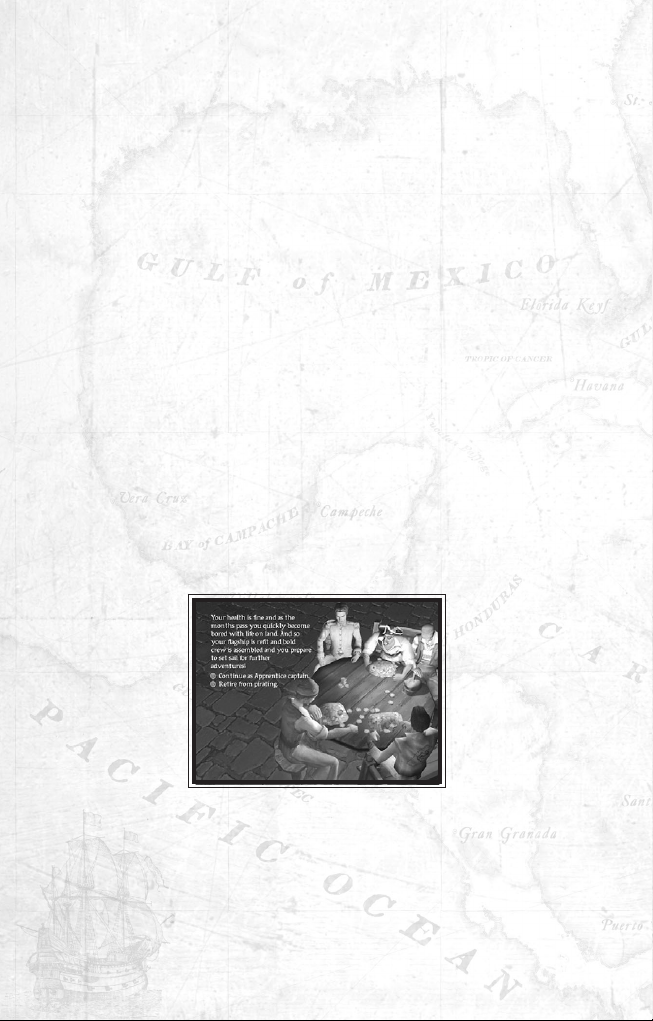
How to Divide the Plunder
To divide the plunder, click on the “Divide the Plunder” entry in any
city or settlement’s main menu.
The Division of Spoils
When you divide the plunder, the voyage’s gold is handed out to you
and the crewmen.
Captain’s Share
As captain, you get a fixed percentage of the loot. The percentage
varies depending upon the difficulty level you’ve chosen:
Apprentice: 5%
Journeyman: 10%
Adventurer: 20%
Rogue: 30%
Swashbuckler: 50%
The Crew’s Share
The remainder of the money is divided equally among the crew. The
crew’s reaction to the size of their share is dependent upon the game
difficulty, the length of the cruise and the size of their portion. They
may be anything from very angry to ecstatic with their booty.
The crew’s opinion of their share determines your next crew’s starting
morale if you choose to start another voyage.
After the Division
After you have divided the plunder, you are given the options of
retiring or plotting another voyage. You may also be given a chance to
change the game’s difficulty level.
Retirement
If you choose to retire, the game is over for that character. See “The
End”on page 85.
Book ThreeSid Meier’s Pirates!
®
Page 83

Starting Another Voyage
If you choose to begin another voyage, several months pass while you
recruit crewmen and gather supplies. Eventually all is ready, and you
return to the game.
You start your new voyage with a small crew and gold equal to your
portion of the plunder.
Changing the Difficulty Level
If you have had a particularly successful cruise, you may be offered
a chance to raise the current difficulty level. Obviously, this option
is not available if you are already playing at “Swashbuckler,” the
highest difficulty level of the game. If you have had a particularly
unsuccessful cruise, you may be offered the chance to lower the
current difficulty. This is not available if you are presently playing at
“Apprentice” level.
If you choose to change the difficulty level, you then begin another
voyage as above, but at the new difficulty level.
A g i n g
Overview
It’s hard to be a pirate. Piracy requires strength, stamina, coordination
and charisma. Unfortunately, these attributes tend to fade as one
grows older. To reflect this, as your pirate ages, certain portions of
the game become more difficult for him. You can continue to play
your pirate as long as you like, but the game becomes harder as the
years pass.
The date and time are displayed on the Navigation screen.
Book Three
Sid Meier’s Pirates!
®
The Memoirs of Captain Sydney
A few words of wisdom on aging:
It ain’t no fun growin’ old, laddie. Ye lose yer looks, yer
strength, yer stamina, and sooner or later, yer mind.
No, son, takes it from old Cap’n Sydney: just don’t grow old.
There’s no future in it!
Page 84
How Time Passes
The following lists the amount of time that each game activity takes.
At Sea or On Land: Time passes at a steady pace, with a day passing
every few seconds.
Sea Combat: Time passes slower during sea combat, with a day
taking several minutes to pass.
Pausing the Game; Fighting a Duel; Land Combat; Checking Info
Screens; Buying, Selling, or Plundering Goods: Time stands still
during these activities.
Starting a New Voyage after Dividing the Plunder: It takes about
six months to refit your ships for a new voyage.
In Prison or Marooned: You can be imprisoned for anywhere from
three to twelve months, with six months being about average. You can
cut the prison time in half if you sneak out of town successfully.
Clearly, dividing the plunder and being marooned or imprisoned
take the most time. Your pirate ages quickly if you engage in these
activities too often.
Effects of Aging
When your pirate reaches certain ages – 30, 35, 40, 50, etc. – the game
determines if his powers have diminished. If so, one game action
becomes more difficult for him.
From then on, the affected action will be just a bit tougher – dueling
opponents will be a little faster, flourishes in dancing will require more
exact timing, fewer crewmen will want to join your crew, and so forth.
Delaying the Inevitable
If you chose the “Medicine” skill for your pirate, he won’t begin to
feel the effects of aging until he is a good bit older.
Book ThreeSid Meier’s Pirates!
®
The Memoirs of Captain Sydney
Retire? Me? Who said anythin’ about retirin’? I been on a hiatus
this past twenty-five years is all – I ain’t bloody retired, by the Powers,
and I’ll keelhaul the lubber who sez I’m too bloody old to take to the seas
again. I’ll show the lot o’ ye!
“Avast, boys! Cap’n Sydney’s settin’ sail once more! Now who’s
with me?”
Page 85
Book Three
Sid Meier’s Pirates!
®
T h e E n d
Overview
All good things must eventually come to an end, and sooner or later
you will want to retire from the buccaneer’s life to enjoy the fruits of
your adventures.
After a pirate retires, he’s no longer available for play. You can then
begin anew with a brand new character.
When to Retire
You can continue to play with a character nearly as long as you want.
However, as time passes that character’s life will become more
difficult as old age sets in (see the previous section).
You might also choose to retire a character because you want to try
a different game strategy. Maybe you want to try to operate only as
a pirate-hunter, refusing to attack anybody’s legitimate shipping,
and only going after buccaneers. Or perhaps you want to play as a
peaceful trader, fighting only those who attack you. Or perhaps you
want to try for total Netherlands world domination, capturing every
city on the map and turning it Dutch. Or perhaps you simply want to
try another game era.
You are offered the chance to retire after you divide the plunder.
The Retirement Screen
When your character retires, the game checks his Fame score
and assigns him a post-piratical job based upon his performance.
The more Fame points he has, the better his new career. A bad pirate
may end his days as a lowly pickpocket, while a really successful
buccaneer may become a city governor!
The Pirates Hall of Fame
If your character is extremely successful, he may earn himself a place
on the Pirates! Hall of Fame.
Page 86

B O O K 4 :
Th e Re fe r en ce P ag e s
Page 87
G a m e E r a s
Each game era provides a different set of challenges to master. We
recommend that you choose the default era, “The Buccaneer Heroes
– 1660,” for your first few games. This time period is the most
advantageous for pirates, and it provides a rich “target environment”
(i.e., ships you can attack) almost everywhere on the map. The other
eras are more difficult, and it may take some time for your pirate to
get into the action.
M e r c h a n t s a n d
S m u g g l e r s – 1 6 0 0
Introduction
After the 1590s, the Spanish Empire begins a slow slide into decay
and chaos, both militarily and economically. Misguided economic
policies, combined with a shortsighted aristocracy, redoubled by a
powerful and restrictive church, doom Spain for centuries to come.
In the Americas, expensive fortifications and garrisons have increased,
but silver shipments and Spanish-owned merchant ships are fewer.
Most astoundingly, the empire in America is literally an empty one:
diseases brought by Europeans to the New World have inflicted
a century of horrifying plagues. The Caribbean basin has been
depopulated. In New Spain (Mexico), the Indian population plunges
from 25 million in 1500 (before the conquest) to less than two million
in 1600. Food supplies are short for lack of farmers, and mine output
falls for lack of workers.
Spaniards in New Spain total no more than 100,000 by 1600. Worse,
virtually no Spaniards are productive members of society – they
expect to enjoy lives of ease, with slaves and peons serving them.
This holds true throughout the Caribbean and along the Spanish
Main.
Conversely, England and France are growing, vital nations. In this
era, both have new kings who seek peaceful relations with Spain.
Although this reduces the opportunity for privateering and piracy,
neither monarch discourages colonization. The reputed riches,
pleasant climate, and emptiness of the Americas all beckon, and a
miscellaneous assortment of Frenchmen and Englishmen start new
colonial ventures.
Book Four
Sid Meier’s Pirates!
®
Page 88
The Netherlands, after decades of rebellion against Spain, have all
but secured their independence, and Holland is an economic miracle.
Out of war, peaceful and profitable enterprises spring. With new ship
designs (the fluyt), joint-stock companies, and the twelve-years’ truce,
Dutch commercial interests are exploding world wide. However, the
big Dutch companies are mainly interested in Indonesia and Asia,
leaving the West Indies to smaller operators.
Cities and Trade
Spanish Colonies
The cities of Cartagena, Havana, Panama, Santo Domingo and
Santiago are the capital cities of the West Indies. Each is populous,
rich, well-fortified, heavily garrisoned and intolerant of foreigners.
Here tobacco and European goods command premium prices.
Puerto Bello has replaced Nombre de Dios as Panama’s Caribbean
port for the Silver Train and Treasure Fleet. Vera Cruz continues
to serve the vast inland areas of New Spain. Both cities are still
unhealthy, which limits their growth and economic success.
The majority of the Spanish Main and inland Central America is now
economically viable. The smaller towns of the Main frequently grow
tobacco and welcome smugglers. The hinterlands of Hispaniola are
another area where tobacco smugglers are welcome.
Trinidad is in its heyday as a wide-open smuggler’s port. Local
Caribbean smugglers can sell their tobacco for decent prices and then
buy European goods from Atlantic traders in reasonable quantities.
The Spanish governor, without harbor forts and served by a laughably
small garrison, can do little but take lucrative bribes and look the
other way.
English Colonies
Early colonies exist on Barbados and Grenada, although at considerable
risk from the cannibalistic Caribe Indians. Both need regular imports
of food. No large tobacco plantations or organized defenses exist yet.
French Colonies
No French colonies exist, but old privateering anchorages with small
“tent camp” towns can be found in the Bahamas. Here there is no
local agriculture. Food costs are dear; precious little is available to
supply a ship.
Dutch Colonies
Although Dutch fluyts are common traders in these waters, no
Dutch ports (“factories”) yet exist. The Dutch spend most of their
Book FourSid Meier’s Pirates!
®
Page 89
time trading in smuggled goods with the smaller Spanish colonies.
Trinidad is their unofficial home port in the New World.
Prospects for Success
With virtually no successful French, English or Dutch colonies on
the map, the Spanish cities are the only game in town. Furthermore,
Europe is tending toward peace, dimming the prospect for
privateering profits. With the dearth of friendly ports and peace in
the offing, your best hope lies in searching for friendly Spanish ports
and smuggling goods between them and Trinidad, with occasional
trips to the new English colonies or the old French privateering
anchorages to the north.
However, this tactic is self-limiting: It is possible for non-Spaniards
to trade with the poorer Spanish settlements, but your very success
in trading will make these settlements rich, and thus more likely to
follow Spanish trade laws and shut you out!
The English Explorer
You have a number of options: Do you settle into a life of peaceful
trade and smuggling, or do you seek out a war and go on privateering
expeditions? Your large crew suggests privateering, but the capacious
merchantman with its sluggish sailing qualities and weak armament
makes trading attractive, too.
The French Adventurer
Your ship and crew are well suited to privateering. However, the
lack of strong, friendly ports is a serious handicap when recruiting
men or selling captured goods. Conquering a few Spanish ports and
installing friendly administrations should be a high priority.
The Dutch Trader
Your ship is admirably suited to mercantile endeavor, but sluggish
and underarmed for battle. While trading, keep the crew as small
as possible. Pay them off and recruit new ones periodically to keep
morale high. Use Trinidad as a base and discover which Spanish
governors are tolerant of smuggling, and which will open fire.
Privateering against the Spanish is tricky business – and you will lose
trading privileges until you can get yourself an amnesty.
The Spanish Renegade
The renegade’s life, never easy, is quite difficult in this era. Only the
most courageous should undertake this course.
Book Four
Sid Meier’s Pirates!
®
Page 90
T h e N e w
C o l o n i s t s – 1 6 2 0
Introduction
Europe is ablaze with a new and bloody war between Protestant
and Catholic (the Thirty Years War). The decay of Spain’s American
empire continues. Towns and cities are financially weaker, with fewer
troops than ever. The economy and culture is stagnant. Spanish
ranches, plantations and mines are increasingly dependent on slave
labor imported from Africa.
Holland is now the world’s leader in mercantile shipping, and Dutch
companies finally turn their attention to the West Indies. The
renewed war with Spain offers many opportunities for the large jointstock companies to finance military expeditions against the Spanish.
The old English and French privateering anchorages swarm with
Dutch warships.
In England, a new round of colonial ventures is fueled by declining
economic opportunity at home and growing intolerance for radical
Protestants (such as the Puritans). After the demise of St. Lucia and
Grenada colonies, and the near death of Virginia, new and stronger
colonies are being founded. These colonies will persevere.
France, in the grip of Cardinal Richelieu, is slipping once more
into civil war between the Protestant Huguenots and the Catholic
government. Throughout the 1620s, French Huguenots f lee France
and found colonies in the New World. Then, in the 1630s, France
enters the cataclysm in Germany: The Thirty Years War.
Cities and Trade
Spanish Colonies
The cities of Cartagena, Havana, and Panama remain the capital
cities of the West Indies. Santiago and Santo Domingo, the old
capitals, have declined to a secondary position, though each is still
rich by American standards.
Many cities on the Main are economically viable, but few are
prosperous. Tobacco is a cheap export crop at some towns. The more
backward towns in the hinterlands of Jamaica and Hispaniola are
primarily victualling and watering ports.
Trinidad remains a popular smuggling port where European goods
are plentiful and fairly cheap, while good prices are paid for tobacco.
Book FourSid Meier’s Pirates!
®
Page 91
However, this port is being overshadowed by the new English
colonies to the north.
English Colonies
Barbados, the first successful English colony in the West Indies, is
growing fast. Increasingly, English ships use it as their home port in
the Caribbean. As at Trinidad, merchants serving the trans-Atlantic
trade will pay good prices for tobacco. The colony on Nevis is newer
and smaller. The new venture on Providence Island off the Mosquito
Coast, deep in the heart of the Spanish Empire, is the premier base
for privateers and pirates raiding the Main.
French Colonies
On the shared island of St. Christophe (“St. Kitts” to the English),
the French have the upper hand. This colony is largely Catholic, while
the unofficial but growing French presence in northeast Hispaniola
is largely Protestant. These enterprising Huguenots have already
claimed Tortuga off the coast, as well as establishing Petit Goave.
Dutch Colonies
Fully f ledged Dutch colonies are sparse. Along with the traditional
Bahama and Florida privateering anchorages, the Dutch have begun
a “factory” (trading town) on Curacao, an island positioned right in
the center of the Spanish Main.
Prospects for Success
The new colonial ports are a godsend to privateers, who now have
legal employ thanks to renewed warfare in Europe. Pinnaces and
barques with piratical intent are everywhere in the Caribbean.
Spanish strength continues to wane, especially at sea. A welloutfitted force can even attempt to capture the treasure fleet on the
high seas.
Still, one must watch political developments closely. Spain is quite
capable of mounting periodic counterattacks to wipe out intrusive
colonies or troublesome privateer bases.
The English Adventurer
Don’t be shy about privateering against the Spanish. After building
your reputation, fortune, and fleet, you can venture ashore and try
your hand at plundering the smaller towns and cities. Opportunities
abound for a man of boldness.
Book Four
Sid Meier’s Pirates!
®
Page 92
The French Huguenot
Your barque is a handy vessel for the Caribbean, and well-suited to
privateering against Catholic Spain and its hated Inquisition. Tortuga
and Petit Goave are ideal bases, deep in Spanish territory and only a
short sail from the Florida Channel and its yearly treasure fleet.
The Dutch Privateer
You have a very powerful force, but there is a lack of Dutch bases for
you to operate from. Therefore, cultivate friendship with the French
and English (regardless of your government’s official position),
if possible. Can you duplicate Piet Heyn’s feat of 1628 and capture the
Spanish treasure fleet?
The Spanish Renegade
As in 1600, the life of a renegade is unenviable, but conditions are
somewhat improved. The non-Spanish colonies are few, so it’s wise
to remain friendly with England, France and Holland.
W a r f o r P r o f i t – 1 6 4 0
Introduction
In Holland, Germany and France, the last great religious war of
Europe (the Thirty Years War), begun in 1618, is degenerating into
famine, plague and starvation across a landscape of ruins. England,
having avoided previous European disasters, is on the brink of its
own ruinous civil war that will result in a short but brutal military
dictatorship by Oliver Cromwell and his Protestant armies. Of all the
European nations, Spain is in the worst shape. Economic and political
conditions in the homeland are so bad that provinces are revolting
against the bankrupt and ineffective government.
Disasters in Europe breed new opportunities in the West Indies.
Spain’s colonies are at their military and economic nadir. Freebooters
and privateers, trained in the many European conf licts, can pillage
and plunder the helpless Spanish with ease, and with precious little
interference from European governments. Non-Spanish colonies are
growing everywhere, fueled by boatloads of refugees. While some
of these immigrants settle into the plantation economy, others take
to the buccaneering life. Meanwhile, the crafty Dutch are making
a fortune by carrying the trade goods among these new colonies.
Peaceful trading may not be as profitable as privateering, but it’s a
safer business.
Book FourSid Meier’s Pirates!
®
Page 93
Cities and Trade
Spanish Colonies
The richest Spanish cities remain the great capitals of the region:
Panama, Cartagena, Havana, and Santiago. These continue to have
wealthy economies and high prices. San Juan and Santo Domingo
are prospering, but remain populated by old, aristocratic families
with expensive tastes. Both cities are well fortified and garrisoned.
All other Spanish cities are barely breaking even. Towns in the
hinterlands are on the verge of disappearing under the tidal wave of
immigration from England, France and Holland.
English Colonies
Barbados is the unofficial capital of the English West Indies. It is
a trader’s dream. European goods are freely available, sugar sells
for premium prices, and the local merchants are wealthy and wellstocked. The colonies on St. Kitts and Nevis are economically
strong and well-populated, while Antigua, Montserrat, Bermuda,
and Eleuthera are newer, smaller colonies with little population, low
prices, and tiny warehouses.
French Colonies
Guadeloupe and Martinique are the major colonies in the Caribbee
Islands (Lesser Antilles). However, all eyes are drawn to Tortuga,
that well-fortified haven of privateers, buccaneers and outright
pirates. Mainland Hispaniola French colonies are developing slowly
at Petit Goave. French privateers still use anchorages in the Florida
Keys to plunder Spaniards in the Florida Channel, as well to descend
upon the north coast of Cuba.
Dutch Colonies
Curacao is the Dutch equivalent of Barbados. This large, rich, welldefended free port offers good prices for sugar and sells quantities
of European goods in return. A second international free port is
developing at St. Eustatius, while sleepy St. Martin is a placid home
for sugar planters and other lubbers.
Prospects for Success
Opportunities abound and success awaits. Spain is almost always at
war with somebody, and not uncommonly with everybody! Since
Spanish military power is a joke, the opportunities for plunder are
legion. After a rich cruise against the hapless Spanish, no voyage is
complete without a wild party at Tortuga, Barbados, or Curacao.
Book Four
Sid Meier’s Pirates!
®
Page 94
The English Adventurer
As a privateer, everything is in your favor. A plethora of friendly
English colonies are ready and willing to buy your plundered goods,
while the taverns are brimming with sailors seeking a berth with
a successful captain. Smiling governors will shake your hand and
bestow promotions for your efforts. Isn’t life grand?
The French Privateer
As with the English, privateering is a growth industry with great
profits for the French. Tortuga is the ideal base for such activities,
sitting between Santo Domingo, the great cities of Cuba, and the
rich fleets passing outbound through the Florida Channel. Down a
pleasant beam reach to the south lies the heartland of the Spanish
Main and the usually friendly port of Curacao.
The Dutch Trader
Tired of war, many Dutchmen prefer the peaceful role of trading.
The new and growing French and English colonies offer many
opportunities to a savvy merchant. Trade routes between the large,
rich colonies and the new, small ones yield easy profits. One can also
trade with the poorer Spanish cities, which have cheap sugar and food
that sells for premier prices on Curacao or Barbados. Of course, the
lure of privateering for the English or French remains strong!
The Spanish Renegade
This is one of the two eras (the other is 1660) where the life of a
renegade can be fairly pleasant. Turning traitor and attacking the
Spanish is a rewarding occupation, war or no war.
T h e B u c c a n e e r
H e r o e s – 1 6 6 0
This is the default era. It is highly recommended for new players.
Introduction
The military decline of the Spanish Empire continues when senile
King Phillip IV is succeeded by the lax and inept regency for Charles
(Carlos) II, who in 1665 becomes King at age four.
Although Spanish America is left without military protection,
bureaucratic interference in its economic affairs also diminishes. This,
combined with renewed output from the silver mines, starts an
upswing in the Spanish-American economy.
Book FourSid Meier’s Pirates!
®
Page 95
England, France and Holland are now strong colonial powers. Jealous
of Holland’s commercial success, England begins economic war
against Holland with the Navigation Act (1651) and the Staple Act
(1663), legislating trade limits that would ruin the free-trade Dutch
merchants. This causes three shooting wars within twenty years.
Meanwhile, Louis XIV has finally taken control of France with the
death of Cardinal Mazarin in 1661. The “Sun King’s” aggressive
foreign policy sparks almost constant warfare with England, Holland,
and Spain. In short, Europe is in a dogfight of international intrigue
and warfare, with enemies and allies changing as frequently as
partners at a court dance.
In the Caribbean, governors face new threats from all directions. St.
Eustatius changes hands ten times between 1664 and 1674. The home
governments provide virtually no military forces, so the governors
ask buccaneers, privateers and pirates to guard their colonies
and carry the fight to the enemy. These sensible, profit-oriented
warriors are often difficult to control.
Cities and Trade
Spanish Colonies
Panama, Havana, and Cartagena endure as the three greatest Spanish
cities, rich, well-fortified, and well-garrisoned. Still sizeable but of
declining importance are Santiago, Santo Domingo, and San Juan.
The remaining Spanish towns are beginning to prosper again, but are
so weak militarily that all are prey to buccaneers and pirates.
English Colonies
Barbados remains the greatest English colony, with St. Kitts close
behind. Captured from Spain in 1655, Jamaica is the home of Port
Royale, the new English buccaneer haven in the midst of the Spanish
empire, only a short voyage downwind from the French colonies on
Hispaniola.
French Colonies
In the Caribbee Islands (Lesser Antilles), Guadeloupe and Martinique
are the main bastions of French power, while around western
Hispaniola, Tortuga, Port-de-Paix, Petit Goave, and Leogane are
buccaneering strongholds.
Dutch Colonies
Curacao remains the premier Dutch colony and one of the greatest
free ports in the world. St. Eustatius almost surpasses it, but conquest
and reconquest by numerous expeditions has damaged its economy.
Book Four
Sid Meier’s Pirates!
®
Page 96
Prospects for Success
This era is sometimes called the “Golden Age of Buccaneering.”
There’s plenty of warfare to legalize your actions, and a plethora of
rich Spanish and non-Spanish ports to either raid or use as bases, as
you prefer. Because of her military weakness, Spain’s ships and towns
are popular targets for buccaneers and pirates of all nationalities.
The English Buccaneer
Port Royale makes an excellent base of operations, while Barbados
is still the best place to dispose of large amounts of loot at very good
prices. The main disadvantage of Port Royale is that recruiting a
large crew often requires side-trips to the French buccaneer towns on
Hispaniola, while a base in the Caribbees gives you access to many
English ports for quick, easy recruiting.
The French Buccaneer
Privateer or pirate, it is wise to leave one or two nations alone, so you
have potential trading partners in case an unexpected peace breaks
out. You’ll find recruiting especially easy in the vicinity of Hispaniola,
with four separate French buccaneer ports within a short journey.
The Dutch Adventurer
Dutchmen of this period aren’t shy about offering their services
to other nations, and they are always looking for the main chance
– any venture with profit, be it peaceful or warlike. Don’t ignore
the excellent prospects for peaceful trade. Above all, remember
that Barbados and Curacao are the two richest ports in non-Spanish
America, good for either trading or disposing of looted cargo.
The Spanish Renegade
Although a renegade’s life is never easy, this era is a bright spot on a
dark sea of danger. Privateering or piracy against Spain is, of course,
the recommended course.
P i r a t e s ’ S u n s e t – 1 6 8 0
Introduction
Europe is as full as ever of tumult and warfare, rapidly shifting
alliances, and strange political bedfellows. But the depredations of
the buccaneers in the Americas have taught politicians and military
men an important lesson: warriors who fight for profit can ruin the
local economy. Meanwhile, nations have more powerful f leets and
armies, big enough so troops can be spared to protect important
colonies in the West Indies.
Book ThreeSid Meier’s Pirates!
®
Page 97
All of this spells the doom of privateering and the buccaneers.
Though Spain remains weak and indecisive, pirates disappear,
chased from the seas by an English naval squadron based in Port
Royale. Letters of Marque are harder and harder to get. Buccaneers of
all nationalities flock to the French flag in 1684 when it offers Letters
of Marque again.
Economically, this is an era of rising wealth and trade for all nations in
the Caribbean. Although some piracy remains, the road to the future
is one of peaceful trade and smuggling.
Cities and Trade
Spanish Colonies
Havana, Panama, Cartagena, and Santiago are still important cities,
despite the raids and misfortunes of the last century. Caracas has
risen to prominence as the main harbor serving inland Terra Firma
(South America), while Santo Domingo and San Juan have slipped
to the second rank, isolated among the growing French and English
island wealth.
English Colonies
Port Royale, Barbados, and St. Kitts are the great English ports, with
the other English Caribbees cities remaining sound and healthy
trading posts. The Bahamas are the new colonial frontier. Nassau,
for example, is a wide-open pirate haven. A small English colony has
even sprung up at Belize in Honduras.
French Colonies
The French colonial empire has not changed its shape greatly in two
decades. Guadeloupe and Martinique remain the twin economic
capitals, now equal to the largest English ports. Tortuga is declining
but the Hispaniolan towns of Port-de-Paix, Petit Goave, and Leogane
are all thriving.
Dutch Colonies
As with the French empire, the shape of the Dutch dominions
also is constant: Curacao is the great free port, and St. Eustatius is
recovering from wartime disasters and trying to live on trade with
the recalcitrant English nearby. St. Martin, the northerly satellite,
continues to quietly expand its plantation economy.
Book Four
Sid Meier’s Pirates!
®
Page 98
Prospects for Success
Prospects in this era appear as good as the 1660s and 1670s. However
pirate-hunting warships appear more frequently, while the nonSpanish ports are larger and better fortified. Indeed, the fairly equal
distribution of strong and weak ports throughout the Caribbean
means the prospects for trading are the best in fifty years. If you do
pursue a bellicose path, take advantage of pirate amnesties when
offered, so you are prepared for a sudden outbreak of peace.
The English Pirate
Well, mate, ye always wanted a life of piracy. Try it on for size now!
Novices are encouraged to try a voyage or two in the 1660s first, to
get the feel of privateering, before embarking on a career of high seas
crime in this law-abiding era. Beware the navy pirate hunters!
The French Buccaneer
Privateering commissions are legally available still. Take advantage
of them to raid the Spanish. Of course, it pays to beware of the Costa
Garda pirate hunters.
The Dutch Adventurer
As a peace-loving free-trade Dutchman, you should think long on
the advantages of trading and smuggling. Dutch ports are few, and
although England and France have laws prohibiting trade with you,
in reality the laws are ignored. Even the Spanish can be coaxed into
trading more often than not. Of course, some of your compatriots
make their reputation by sailing as privateers for France. In fact, two
admirals of the French privateers in 1685 are Dutchmen!
The Spanish Costa Garda (Coast Guard)
Now that the English and French colonies are as rich as the Spanish,
it’s only appropriate that they taste some of their own medicine! The
only difficulty is evading those French, English and Dutch warships
that so inconveniently clutter up the seascape.
Book FourSid Meier’s Pirates!
®
Page 99
G a z e t t e e r o f
S a i l i n g V e s s e l s
War Canoe
The native peoples of the Caribbean go to war in these heavy canoes.
Equipped with a mast, the war canoe carries a single fore-and-aft
rigged sail. The native canoe also is equipped with oars, allowing it
to move directly into the wind.
Pinnace
Until the advent of the sloop, pinnaces
were the primary small craft of the
Caribbean. Like a sloop, a pinnace is
very fast, very maneuverable, and has a
shallow draft that permits sailing in shoal
waters. The fore-and-aft rigged pinnace
carries oars, allowing it to move directly
into the wind.
Pinnaces have made extremely successful pirate craft in the Caribbean.
Though small in size and unable to stand much pounding in battle,
the pinnace’s speed and maneuverability (particularly in light winds)
allows them to sail rings around stronger opponents, and their shallow
draft lets them sail into places where larger ships dare not follow.
Mail Runner
Mail runners are small, fast and maneuverable ships, built along the
same general lines as the pinnace, but larger and better-armed. Like
the pinnace, the mail runner has a shallow draft, permitting it to
operate safely in shoal waters. The fore-and-aft rigged mail runner
carries oars, allowing it to move directly into the wind.
Mail runners can be very credible pirate vessels in the right hands.
They are often employed as pirate hunters.
Book Four
Sid Meier’s Pirates!
®
Page 100
Sloop
The sloop is a Dutch designed small,
fore-and-aft-rigged vessel equipped with
one or two square sails before the mast.
This vessel becomes very popular in the
Caribbean during the 1630s and 1640s.
It is extremely fast and exceptionally
maneuverable – better than almost any
other ship in light winds. (In strong
winds, though, a sloop can be considerably slower than a larger ship.)
Under oars, the sloop can move directly into the wind. A sloop has a
shallow draft, allowing it to sail over shoals with no risk.
Despite its modest size and cargo capacity, a sloop’s maneuverability
is so great that many buccaneers prefer it to larger, more powerful
craft. Indeed, the English Royal Navy has built a number of sloops
for its own use as pirate hunters.
The sloop of war and royal sloop are larger variations of this vessel.
Sloop of War
The sloop of war is a Dutch-designed fore-and-aft-rigged vessel
equipped with one or two square sails before the mast. Essentially a
slightly larger version of the sloop, the sloop of war is extremely fast
and exceptionally maneuverable – better than almost any other ship
in light winds. Under oars it can move directly into the wind. A sloop
of war has a shallow draft, allowing it to sail over shoals with no risk.
Like its smaller cousin the sloop, the sloop of war makes an excellent
pirate vessel. Many Royal navies deploy these vessels as escort ships
and pirate hunters.
Royal Sloop
This is a larger and much tougher version of the sloop and the sloop of
war. Like its smaller cousins, the royal sloop is fast and maneuverable,
particularly in light winds. It too is equipped with oars, allowing some
movement directly into the wind.
The royal sloop is a military upgrade of the standard sloop design.
It is significantly larger and carries a heavier weight of broadside.
The royal sloop makes an extremely powerful light pirate vessel.
However, royal sloops are produced only for military use: if a pirate
wants to get one, he’ll have to take it from some navy.
Book FourSid Meier’s Pirates!
®
 Loading...