

Page 1
Document: SDS 01
Yuasa Battery Europe Ltd
SAFETY DATA SHEET
In accordance with REACH Regulation EC No. 1907/2006
Issue No:
Issue Date: 16-May-2014
Page 1 of 11
SECTION 1: IDENTIFICATION OF THE PRODUCT AND OF THE MANUFACTURER/SUPPLIER
1.1 Product Identifier:
Classification:
Product Codes:
1.2 Relevant Identified Uses Of The
Product And Uses Advised
Against
1.3 Details Of The Supplier Of The
Safety Date Sheet
National Contacts:
1.4 Emergency telephone number: Contact: Mike TAYLOR (Product Manager)
Valve Regulated Lead-Acid (VRLA) Industrial Battery
Battery, wet, non-spillable, electric storage
Substance classification: UN 2800
EN & ENL, NP, NPC, NPH, NPL, NPW, RE, REC, REW, SWL, TEV, FXH, UXH, UXL,
Yucel, YPC and YFT Series of Industrial VRLA Batteries
Relevant identified uses:
Standby: Telecoms; UPS; alarm and security systems; emergency lighting; utility switching
Cyclic: Golf Trolleys, portable tools, portable lighting, wheelchairs, remote telemetry
Energy storage: Photovoltaic energy systems (PVES); wind turbines
Uses advised against:
Automotive, commercial, and agricultural SLI applications
Reason why uses advised against:
High starting and ignition current demands beyond the design of internal and external current
carrying components
Supplier: Yuasa Battery Europe Ltd,
Address: Unit 22, Rassau Industrial Estate,
Ebbw Vale, NP23 5SD
United Kingdom
Contact: Peter HOLLINGWORTH (Technical Support Manager)
Tel: (+44) 01495 354 062
e-mail: [email protected]
Language: English language only
Available: Office hours only: 8am to 4:30pm (08:00 to 16:30)
France:
Contact: Christian RAYNAUD (Technical Manager)
Tel: (+33) 0474-95-90-95
e-mail: [email protected]
Language: French & English
Germany:
Contact: Joachim HEER (UPS / Project Manager)
Tel: (+49) 0211-41790-15
e-mail: [email protected]
Language: German & English
Iberia:
Contact: Antonio PULIDO MARTINEZ (Director Commercial Industrial)
Tel: (+34) 091-748-89-19
e-mail: [email protected]
Language: Spanish & English
Italy:
Contact: Marco FILIPPI (Technical Manager)
Tel: (+39) 02-3800-91-08
e-mail: [email protected]
Language: Italian & English
UK:
Contact: Matt JORDAN (Technical Services Manager)
Tel: (+44) 01793-833-562
e-mail [email protected]
Language: English language only
Tel: (+44) 07733 302 242
Opening Hours: Only available during office hours, 8am to 4pm (08:00 to 16:00)
Language: English language only
Available: Office hours only: 8am to 4:30pm (08:00 to 16:30)
6
If this document is printed, it is to be considered uncontrolled and for reference only.
Page 2
Document: SDS 01
Yuasa Battery Europe Ltd
SAFETY DATA SHEET
In accordance with REACH Regulation EC No. 1907/2006
Issue No:
Issue Date: 16-May-2014
Page 2 of 11
SECTION 2: HAZARDS IDENTIFICATION
VRLA Battery Mechanical
Electrical
Chemical
Plate Grids and
Active materials
Battery Electrolyte
Case Material
Separator Material
• Metallic Lead, Lead alloys and Lead inorganic compounds:
• Lead poisoning is usually caused by inhalation of minute particles of Lead fume and dust, which are
absorbed by the blood stream from the lungs and deposited in the bone marrow.
• Lead is only slowly released from the bones and thus has an accumulative effect causing chronic
poisoning.
• TOXIC by ingestion or inhalation of dust, vapour or fume
• May cause harm to the unborn child
• Harmful by inhalation and if swallowed
• Danger of cumulative effects
Severe IRRITATION and DAMAGE to internal tissues if swallowed,
IRRITATION of eyes and skin and may cause BURNS and DERMATITIS.
Standard Grade, UL94:HB & Flame Retardant (FR) Grade, UL94:V0.
No hazard in normal use.
Material can burn in a fire with toxic smoke and decomposition products.
The fibres may cause IRRITATION to skin or eyes upon exposure, and to internal tissues if
inhaled or swallowed
VRLA Batteries can be heavy. Correct manual handling techniques and/or
mechanical lifting aides (e.g. Fork Lift Truck) must be used.
VRLA Batteries can contain large amounts of electrical energy which can give very
high discharge currents and severe electrical shock if the terminals are short
circuited.
• The VRLA Battery presents no chemical hazards during the normal operation
provided the recommendations for handling, storage, transport and usage are
observed.
• VRLA Batteries emit hydrogen gas which is highly flammable and will form
explosive mixtures in air from approx. 4% to 76%. This can be ignited by a spark
at any voltage, naked flames or other sources of ignition.
• If the battery is broken and the internal components exposed, hazards may exist
which require careful attention.
SECTION 3: COMPOSITION / INFORMATION ON INGREDIENTS
3.1 Substances present in the product
Components Risk
Plate Grid
Active
Materials
Battery
Electrolyte
Case
Material
Separator
Material
Inorganic lead and battery electrolyte (Dilute Sulphuric Acid) are the main components of VRLA batteries. Other substances may be
present but in small amounts dependant on battery type. Contact Yuasa Battery UK Ltd for further information.
Phrases1
R23
R25
R23
R24
R25
R21 R22
R35 R36
R37 R38
R49
Substances Approximate
Metallic Lead 30 to 40 Pb 7439-92-1
Calcium < 0.1 Ca 7440-70-2
Tin < 2 Sn 7440-31-5
Lead Monoxide < 0.1 PbO 1317-36-8
Lead Dioxide (Lead IV Oxide) 35 to 45 PbO2 1309-60-0
Barium compound < 1.5 Ba 7440-39-3
Dilute Sulphuric Acid 10 to 20 H2SO4 7664-93-9
Standard Grade, UL94:HB
• ABS (Acrylonitrile-Butadiene-Styrene
Copolymer)
Flame Retardant (FR) Grade, UL94:V0
• ABS (Acrylonitrile-Butadiene-Styrene
Copolymer)
• Tetrabromobisphenol-A-diglycygilether, with
tribromophenol
• Antimony trioxide
Absorbent Glass Matt (AGM) Separator
(100% Borosilicate Glass Microfibre)
%
W
(
/
W
5 to 10 9003-56-9
5 to 10
< 0.1
< 0.01
2 to 5 65997-17-3
Chemical
Symbol
)
6
CAS No.
9003-56-9
40039-98-8
1309-64-4
1
For full text of R-phrases see SECTION 16
If this document is printed, it is to be considered uncontrolled and for reference only.
Page 3
Document: SDS 01
Yuasa Battery Europe Ltd
SAFETY DATA SHEET
In accordance with REACH Regulation EC No. 1907/2006
Issue No:
Issue Date: 16-May-2014
Page 3 of 11
6
SECTION 4: FIRST AID MEASURES FOR ACUTE EXPOSURE
This information is of relevance only if the VRLA Battery has suffered damage, is broken and persons have direct contact with the internal
components.
4.1 Description of first aid measures
Components Action
Plate Grids and
Active materials
Battery Electrolyte
Case Material
Separator Material
Inhalation: Remove the person from exposure to fresh air.
Ingestion Wash out mouth with water and give plenty of water to drink. Do not induce vomiting.
Skin Contact: Wash off with plenty of water and soap to prevent accidental ingestion or inhalation
Eye Contact:
Self-protection
for the first aider
Inhalation: Remove the person from exposure to fresh air.
Ingestion Wash out mouth with water and give plenty of water to drink.
Skin Contact: Drench with large quantities of water.
Eye Contact:
Self-protection
for the first aider
Inhalation: Material can burn in a fire with toxic smoke and decomposition products.
Ingestion Wash out mouth with water and give plenty of water to drink. Do not induce vomiting.
Skin Contact: Areas affected by molten material should be quickly placed under cold running water and a
Eye Contact: May cause irritation or injury due to mechanical action and traces of Battery Electrolyte.
Self-protection
for the first aider
Inhalation: Remove patient from exposure to fresh air. If irritation persists, seek advice from a medical
Ingestion Wash out mouth with water and give plenty of water to drink. Do not induce vomiting. If the
Skin Contact: After contact with skin, wash immediately with plenty of soap and water. If irritation
Eye Contact: May cause irritation or injury due to mechanical action and traces of Battery Electrolyte.
Self-protection
for the first aider
Seek advice from a medical doctor
Seek advice from a medical doctor
Seek medical advice if pain or rash does not reduce
Immediately irrigate with eyewash solution or clean water for at least 10 minutes, holding
the eyelids apart. Then take the person to hospital without further delay
Eye protection (safety glasses or face shield), and heavy-duty gloves are required.
In case of inhalation, a face mask or respirator may be required.
SPEED IS ESSENTIAL - OBTAIN IMMEDIATE MEDICAL ATTENTION.
If the person continues to feel unwell seek advice from a medical doctor.
Do not induce vomiting.
If the person continues to feel unwell seek advice from a medical doctor.
Remove contaminated clothing and place in water to dilute the acid
Continue to wash the affected area for at least 10 minutes.
Seek advice from a medical doctor
SPEED IS ESSENTIAL - OBTAIN IMMEDIATE MEDICAL ATTENTION
Immediately irrigate with eyewash solution or clean water for at least 10 minutes, holding
the eyelids apart. Then take the person to hospital without further delay
Eye protection (safety glasses or face shield), and heavy-duty gloves are required.
In case of inhalation, a face mask or respirator may be required.
Upon inhalation of decomposition products, keep patient calm, remove to fresh air, and
seek advice from a medical doctor. If a large quantity is inhaled take the person to
hospital.
Note to physician: Treat according to symptoms (decontamination, vital functions), no
known specific antidote.
If the person continues to feel unwell seek advice from a medical doctor.
sterile protective dressing applied.
Seek advice from a medical doctor.
Immediately irrigate with eyewash solution or clean water for at least 10 minutes, holding
the eyelids apart. Then take the person to hospital without further delay
Eye protection (safety glasses or face shield), and disposable gloves are required.
In case of inhalation, a face mask or respirator may be required.
doctor
person continues to feel unwell seek advice from a medical doctor.
persists, seek advice from a medical doctor
Immediately irrigate with eyewash solution or clean water for at least 10 minutes, holding
the eyelids apart. Then take the person to hospital without further delay
Eye protection (safety glasses or face shield), and disposable gloves are required.
In case of inhalation, a face mask or respirator may be required.
If this document is printed, it is to be considered uncontrolled and for reference only.
Page 4
Yuasa Battery Europe Ltd
SAFETY DATA SHEET
SECTION 5: FIRE-FIGHTING AND EXPLOSION HAZARD MEASURES
5 VRLA Battery
In accordance with REACH Regulation EC No. 1907/2006
General Information
• VRLA Batteries emit hydrogen gas which is highly flammable and will form
explosive mixtures in air from approx. 4% to 76%. This can be ignited by a
spark at any voltage, naked flames or other sources of ignition.
• Batteries in use will be part of an electrical circuit and must be isolated from
the power source before attempting to put out a fire. Switch the power OFF
before disconnecting the batteries from the power source.
• Damaged batteries may expose negative plates, grey in colour, which may
ignite if allowed to dry out. These plates may be wetted down with water
after the battery has been removed from all electrical circuits.
Document: SDS 01
Issue No:
Issue Date: 16-May-2014
Page 4 of 11
6
5.1
5.2
5.3
Suitable Extinguisher types: CO2; Foam; Dry Powder.
Unsuitable Extinguisher
types
Hazardous combustion &
decomposition products:
Advice for fire-fighters Full face visor or safety goggles;
Water extinguishers must never be used to put out an electrical fire.
Carbon monoxide, Sulphur Dioxide, Sulphur Trioxide, Lead fume and vapour,
toxic fumes from decomposition of battery case materials.
Respiratory equipment or self-contained breathing apparatus (SCBA);
Full acid resistant protective clothing must be worn in fire-fighting conditions.
SECTION 6: ACCIDENTAL RELEASE MEASURES
This information is of relevance only if the VRLA Battery has suffered damage and is broken.
Components
6
VRLA Battery
Plate Grids and
Active Materials
Battery Electrolyte:
Case Material:
Separator Material:
Note: If appropriate refer to 8 and 13
VRLA batteries are designed to be safe to handle and not to leak battery
Personal Precautions: Eye protection (safety glasses or face shield), and heavy-duty gloves are
Clean-up Methods: Large, solid pieces may be picked up and bagged for recycling.
Environmental Precautions: Do not allow material to enter a watercourse. Exposed Lead materials must be
Personal Precautions: Ensure suitable, acid resistant personal protective clothing (including heavy-
Clean-up Methods:
Environmental Precautions: Battery electrolyte must not be allowed to enter any drains or sewage system
Clean-up Methods:
Clean-up Methods:
Small spillages:
Large spillages: Large amounts of electrolyte spillage are unlikely with VRLA batteries since the
electrolyte under normal conditions.
In case of accidental damage heavy-duty gloves are required to pick-up the
battery to protect against unseen electrolyte leakage
required.
If the material is wet, a face mask or respirator is not required
If the material is dry, a face mask or respirator is required
Never use a brush to sweep up debris; it may create Lead-dust in the air.
Wet clean the spill area to remove all traces of debris. Battery debris and
cleaning materials must be collected and placed in an inert sealed container
(e.g. self-seal plastic bag or bucket) for disposal, see Section 13.
placed in an inert sealed container (e.g. self-seal plastic bag or bucket) for
disposal, see Section 13.
duty gloves, safety glasses and respiratory protection) is worn during removal
and clean-up of spillages.
Neutralise and absorb the spillage using soda ash, sodium bicarbonate
(available from supermarkets), sodium carbonate or calcium carbonate
powder.
Wet clean the spill area to remove all traces of debris. Battery debris and
cleaning materials must be collected and placed in an inert sealed container
(e.g. self-seal plastic bag or bucket) for disposal, see Section 13.
electrolyte is fully absorbed in the active materials and separator.
Bund the spillage area using dry sand, earth, sawdust or other inert material.
Neutralise the electrolyte using soda ash, sodium bicarbonate (available from
supermarkets), sodium carbonate or calcium carbonate powder.
Wet clean the spill area to remove all traces of debris and electrolyte.
Cleaning materials must be collected and placed in an inert sealed container
(e.g. self-seal plastic bag or bucket) for disposal, see Section 13.
or water course.
Assume battery case material is contaminated and proceed as for Plate Grids
and Active Materials above.
Assume battery case material is contaminated and proceed as for Plate Grids
and Active Materials above.
If this document is printed, it is to be considered uncontrolled and for reference only.
Page 5
Yuasa Battery Europe Ltd
SAFETY DATA SHEET
SECTION 7: HANDLING AND STORAGE
Component:
7.1
VRLA Battery
7.2
7.3
In accordance with REACH Regulation EC No. 1907/2006
Precautions For Safe
Handling:
Conditions For Safe
Storage, Including Any
Incompatibilities:
End-of-Life
(EC WEEE Regulations)
Specific End Uses:
Installation:
Document: SDS 01
Issue No:
Issue Date: 16-May-2014
Page 5 of 11
6
Only trained operators should be allowed to handle VRLA batteries.
PPE: No specialist protective clothing or equipment is required, except that for
handling heavy weights.
Hygiene: There are no specialist requirements beyond good, standard
workplace practices,
Mechanical lifting aides: (e.g. FLT and pallet trucks) will be required to move
pallets of batteries. Weight approximately 1 tonne
Mechanical handling aides: (e.g. trucks and lifters) will be required to handle
individual batteries over 25 kg in weight.
General Safety Considerations:
Do not drop batteries: dents and deformation of the case may be an indication
of internal damage to the battery. Cracks will allow electrolyte to escape.
Do not place VRLA Batteries lid-to-lid so that terminals will short-circuit.
Store VRLA Batteries in a cool, well-ventilated area with a solid, impervious
surface, and adequate containment in the event of accidental acid spillage.
Store under a roof and protect against direct sunlight and adverse weather
conditions including rain, snow and other sources of water.
Storage of large quantities of VRLA batteries may require approval from local
environmental protection agency and/or local water authorities.
Pallets of VRLA Batteries are heavy. Store at ground level or in lower levels of
storage systems (e.g. racking).
Take special care in dry conditions to avoid the risk of electrostatic discharges.
Protect against physical damage and exposure to organic solvents and other
incompatible materials.
Do not store VRLA batteries close to sources of heat, naked flames and
sparks.
Store batteries in their original packaging wherever possible. When batteries
are removed from their original packaging (e.g. for transportation of small
quantities), ensure new packaging protects the batteries from damage and the
risk of short-circuit of the terminals.
Ensure batteries are removed from equipment at the end of life and are
collected for recycling by an approved contractor.
1. Refer to EN 50272-1:2010, Safety requirements for secondary batteries
and battery installations – Part 1 General safety information.
2. Refer to EN 50272-2:2001, Safety requirements for secondary batteries
and battery installations – Part 2 Stationary batteries.
If this document is printed, it is to be considered uncontrolled and for reference only.
Page 6
Document: SDS 01
Yuasa Battery Europe Ltd
SAFETY DATA SHEET
In accordance with REACH Regulation EC No. 1907/2006
Issue No:
Issue Date: 16-May-2014
Page 6 of 11
6
SECTION 8: EXPOSURE CONTROL / PERSONAL PROTECTION
Components
8.1
VRLA Battery
8.2
8.3
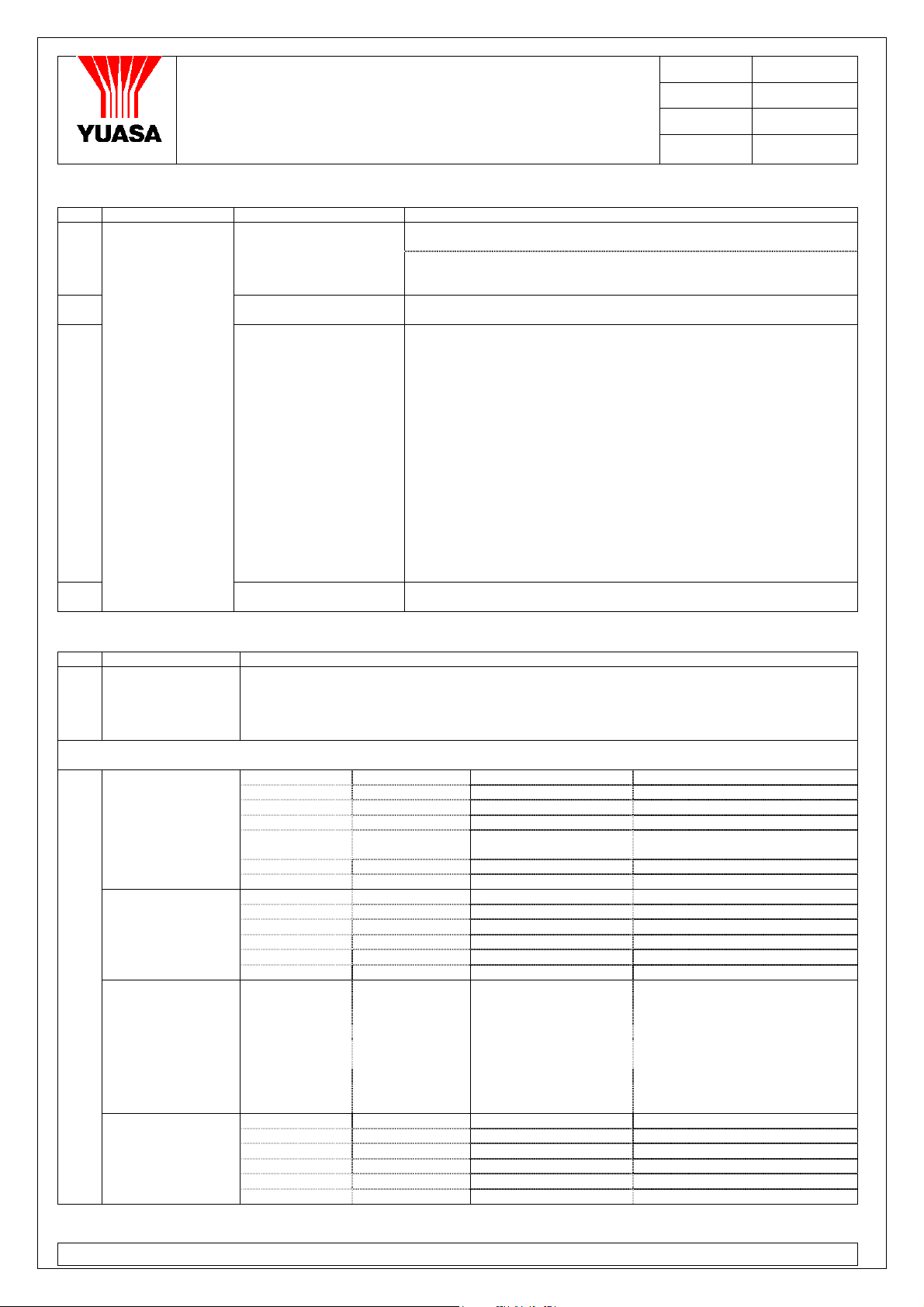
Control Parameters:
Exposure Control: There are no special exposure controls for the handling, storage, installation or
Personal Protection:
UL CAUTIONARY
STATEMENT:
There are no special control parameters for the handling, storage, installation of
VRLA Batteries.
VRLA Batteries emit hydrogen gas which is highly flammable and will form
explosive mixtures in air from approximately 4% to 76%. Never install VLRA
Batteries in a gas-tight enclosure during storage, transport or usage.
use of VRLA Batteries.
When there is no evidence of damage or visible traces of liquid (electrolyte) or
solid deposits on the batteries they may be handled safely without extra
personal protective equipment.
Ensure electrical insulation equipment is used when installing batteries.
(e.g. insulated mats and covers; insulated tools)
Remove ALL metallic objects from the person when working with VRLA
Batteries: e.g. Jewellery (rings, watches, bracelets, necklaces), pens, torches,
etc.
Where there are signs of damage or liquid (electrolyte) or solid deposits, rubber
gloves and acid resistant clothing must be worn when handling the batteries
and affected packaging to protect against the effects of any electrolyte that may
be present.
If it is suspected that free electrolyte is present, then safety glasses must be
worn, and if large amounts are present, chemical goggles or face shield should
be used.
“Warning: Risk of fire, explosion, or burns. Do not disassemble; heat above
50°C; or incinerate”.
SECTION 9: PHYSICAL AND CHEMICAL PROPERTIES
Components
9.1 VRLA Battery
The information below refers to the physical and chemical properties of the main VRLA Battery components and substances. This information
is published for reference only.
Plate Grids and
Active materials
Battery Electrolyte:
Case Material:
Separator Material:
• The main components are listed in SECTION 2 above.
• The undamaged product is a manufactured article in an inert plastic (ABS) case, which will burn if
subjected to high temperatures or sources of ignition. Some battery types are made with Flame Retardant
ABS cases, see technical specification. These batteries carry the suffix ‘FR’ after the battery type; e.g.
NP24-12IFR
Appearance
Form Solid Solidification point 327 °C
Colour Grey or brown Boiling point 1740 °C
Odour Odourless Solubility in water Very low (0.15mg/l)
Form Liquid Solidification point -35 to -60 °C
Colour Colourless Boiling point Approx 108 to 114 °C
Odour Odourless Solubility in water Complete
Appearance
Form Solid Softening point > 100 °C (DIN 53460)
Colour Grey or black Flash Point >330 °C
Odour Slight Odour Solubility in water Insoluble
Form Fibrous material Solidification point N/A
Colour White Boiling point N/A
Odour Odourless Solubility in water Insoluble
Safety-related data
Solubility in acid or
alkaline solutions
Density (at 20°C) 11.35 g/cm3
Vapour pressure (at 20°C) N.A.
Density (at 20°C) Variable up to 1.350 g/cm3
Vapour pressure (at 20°C) N.A.
Safety-related data
Solubility in other solvents Soluble in polar solvents, aromatic
Density (at 20°C) 1.07-1.4 g/cm3 (DIN 53479)
Vapour pressure
(at 973°C)
Density (at 20°C) N/A
Vapour pressure (at 20°C) N/A
Yes, dependant on the strength of
solution.
solvents, chlorinated hydrocarbons.
1mm Hg
If this document is printed, it is to be considered uncontrolled and for reference only.
Page 7
Yuasa Battery Europe Ltd
SAFETY DATA SHEET
SECTION 10: STABILITY AND REACTIVITY
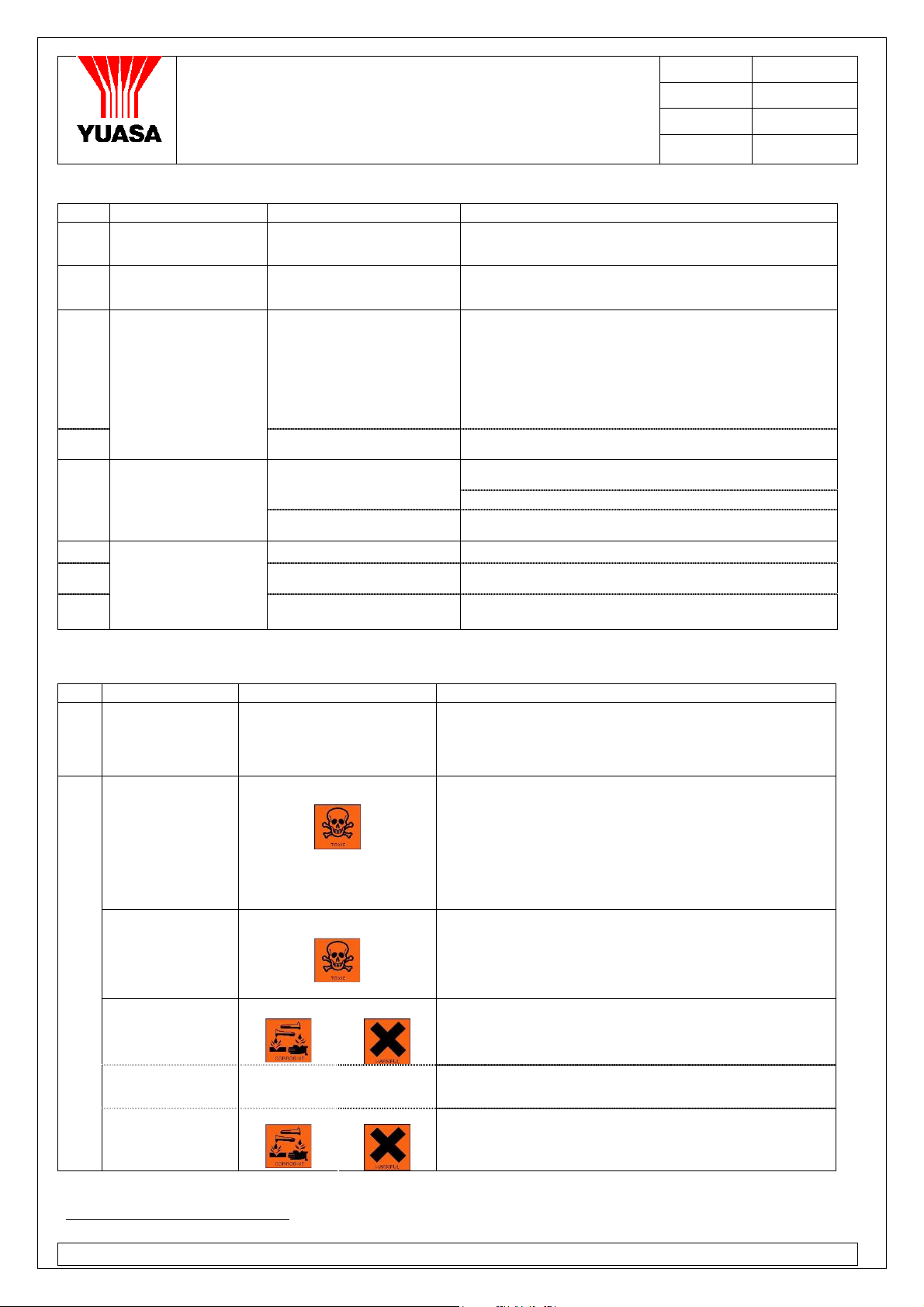
Components
10.1 VRLA Battery
10.4 Plate Grids and
10.3
10.6
10.1
10.6
10.1
10.4
10.6
Active materials:
Battery Electrolyte:
Case Material:
Separator Material:
In accordance with REACH Regulation EC No. 1907/2006
Stability: Within the operational temperature range -20 to +50 °C the
Materials & Conditions to
Avoid:
Possibility of Hazardous
Reactions
Hazardous Decomposition
Product(s):
Materials & Conditions to
Avoid:
Hazardous decomposition
products:
Stability:
Materials & Conditions to
Avoid:
Hazardous decomposition
products:
Document: SDS 01
Issue No:
Issue Date: 16-May-2014
Page 7 of 11
undamaged product is stable.
Powdered Lead reacts violently with fused ammonium nitrate and
sodium acetylide. Reacts violently when in contact with chlorine
trifluoride.
• Dilution of the higher concentrated grades with water may
liberate excessive heat.
• Highly reactive with metals and organic materials.
• On contact with metals, may generate hydrogen which forms
explosive mixtures with air.
• Destroys organic materials such as cardboard, wood, textiles,
etc.
• Vigorous reaction with sodium hydroxide and alkalis.
• Sulphur oxides
• To avoid thermal decomposition, do not overheat.
• Starts to decompose at temperatures >275’C.
• Powerful oxidising agents.
• Monomers, other degradation products, traces of hydrogen
cyanide.
• Stable material.
• Incompatible with Hydrofluoric acid and concentrated Sodium
Hydroxide.
• No hazardous polymerisation expected.
6
SECTION 11: TOXICOLOGICAL INFORMATION
This information is of relevance only if the VRLA Battery has suffered damage and is broken.
Components
11 VRLA Battery
Plate Grids:
11.1
Metallic Lead,
Lead alloys.
Active materials:
Lead dioxide.
Battery Electrolyte:
Toxicity
Toxicity
Dilute Sulphuric Acid
Inhalation:
Ingestion:
• This information does not apply to the undamaged VRLA Battery.
It is of relevance if the battery is broken and the components are
released to the environment.
• Exposure limits may vary according to national law and
regulations.
• Toxic by ingestion or inhalation
• Chronic poison
• Lead is a poison that affects virtually every system in the body
• Symptoms include fatigue, headaches, constipation, aching bones
and muscles, gastrointestinal tract disturbances and reduced
appetite
• Blood Lead levels of 80 µg/dl and above have been associated
with both acute and chronic effects of Lead poisoning
• Toxic by ingestion or inhalation
• Chronic poison
• Chronic exposure to Lead compounds may lead to a build-up of
Lead in the body, giving rise to a variety of health problems,
including anaemia, kidney and liver damage, impaired eyesight,
memory loss and CNS2 damage
Corrosive, the more concentrated solutions can cause serious burns
to the mouth, eyes and skin
Harmful by ingestion and through skin contact
Mist is a severe irritant to the respiratory tract. Fluid build up on the
lung (pulmonary oedema) may occur up to 48 hours after exposure
and could prove fatal
Will immediately cause severe corrosion of and damage to the
gastrointestinal tract
2
CNS = Central Nervous System
If this document is printed, it is to be considered uncontrolled and for reference only.
Page 8
Battery Electrolyte:
11.1
Yuasa Battery Europe Ltd
SAFETY DATA SHEET
In accordance with REACH Regulation EC No. 1907/2006
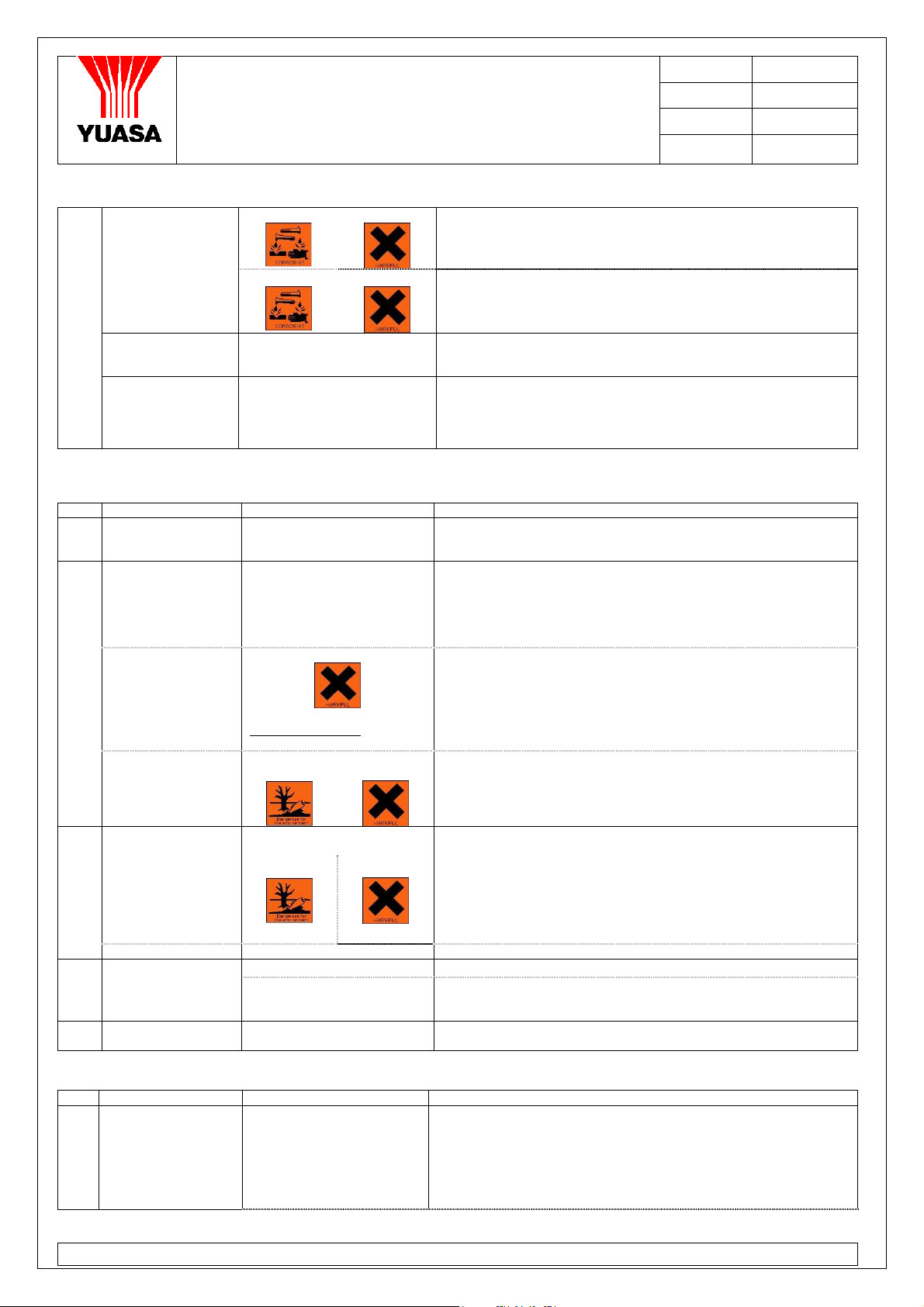
Skin Contact: Causes severe chemical burns
Document: SDS 01
Issue No:
Issue Date: 16-May-2014
Page 8 of 11
6
Case Material:
Separator Material:
Eye Contact:
According to information available the product is not harmful to health
Based on animal implantation and epidemiologic studies glass
Risk of serious damage to eyes. Causes severe burns. May cause
prolonged or permanent damage or even total loss of sight. Mist will
cause irritation
provided it is correctly handled and processed according to the given
recommendations.
microfibers are thought to have some limited carcinogenic potential and
as such are designated as Group 2B materials (IARC, US). The material
should be treated as a category 3 carcinogen (Europe).
Limited evidence of carcinogenic effect.
SECTION 12: ECOLOGICAL INFORMATION
This information is of relevance only if the VRLA Battery has suffered damage and is broken.
Components
12.1 VRLA Battery
Plate Grids and
12.2
Active materials:
Ecotoxicity:
This information does not apply to the undamaged VRLA Battery. It is of
Metallic Lead, Lead alloys and
Lead dioxide.
Risk Phrase R52/53
Effect in the aquatic
environment:
relevance if the battery is broken and the components are released to the
environment.
Chemical and physical treatment is required for the elimination of Lead
from water. Waste water containing Lead must not be disposed of in an
untreated condition.
• The general classification for Lead compounds, R50/53 does not apply
to Battery Lead Oxide
• Tests in 2001 and 2005 have concluded that Battery Lead Oxide is
NOT toxic for the environment; neither R50 nor R50/53 nor R51/53.
• Risk Phrase R52/53 (Harmful to aquatic organisms, may cause longterm adverse effects in the aquatic environment) applies to Battery
Lead Oxide.
• Toxicity for fish: 96 h LC 50 > 100 mg/l
• Toxicity for daphnia: 48 h EC 50 > 100 mg/l
• Toxicity for alga: 72 h IC 50 > 10 mg/l
Battery Electrolyte:
12.3
12.4 Case Material:
12.5 Separator Material:
Ecotoxicity:
Persistence and Degradation: Remains indefinitely in the environment as sulphate.
Elimination information: No data available: insoluble in water
Behaviour and environmental
fate:
No data available: insoluble in water
SECTION 13: DISPOSAL CONSIDERATIONS
Components
13.1 VRLA Battery
Europe:
If this document is printed, it is to be considered uncontrolled and for reference only.
• In order to avoid damage to the sewerage system, the acid has to be
neutralised by means of soda ash, sodium bicarbonate or sodium
carbonate before disposal.
• Ecological damage is possible by change of pH. The electrolyte
solution reacts with water and organic substances, causing damage to
flora and fauna.
• The electrolyte may also contain components of Lead that can be toxic
to aquatic environments.
Due to the consistency of the product, and its insolubility in water, it will
apparently not be bio-available.
Not thought to pose any risk to the environment.
• Spent (used) VRLA Batteries are subject to the requirements of the
Batteries Directive 2006/66/EC on batteries and accumulators and
waste batteries and accumulators. Spent (used) VRLA Batteries MUST
be sent for recycling through an authorised contractor at the end-of-life.
• The WEEE Directive 2002/96/EC (Waste Electrical and Electronic
Equipment) applies. Spent (used) VRLA Batteries MUST be removed
from electrical and electronic equipment at the end-of-life.
Page 9
Yuasa Battery Europe Ltd
SAFETY DATA SHEET
13.2 Plate Grids and
Active materials:
13.3 Battery Electrolyte:
13.3 Case Material:
13.4 Separator Material:
SECTION 14: TRANSPORT INFORMATION
Components
14.1
VRLA Battery
In accordance with REACH Regulation EC No. 1907/2006
Worldwide:
Europe
Worldwide
Europe
Worldwide
General
Land Transport Land Transport (ADR / RID)
Sea Transport
Air Transport
Document: SDS 01
Issue No:
Issue Date: 16-May-2014
Page 9 of 11
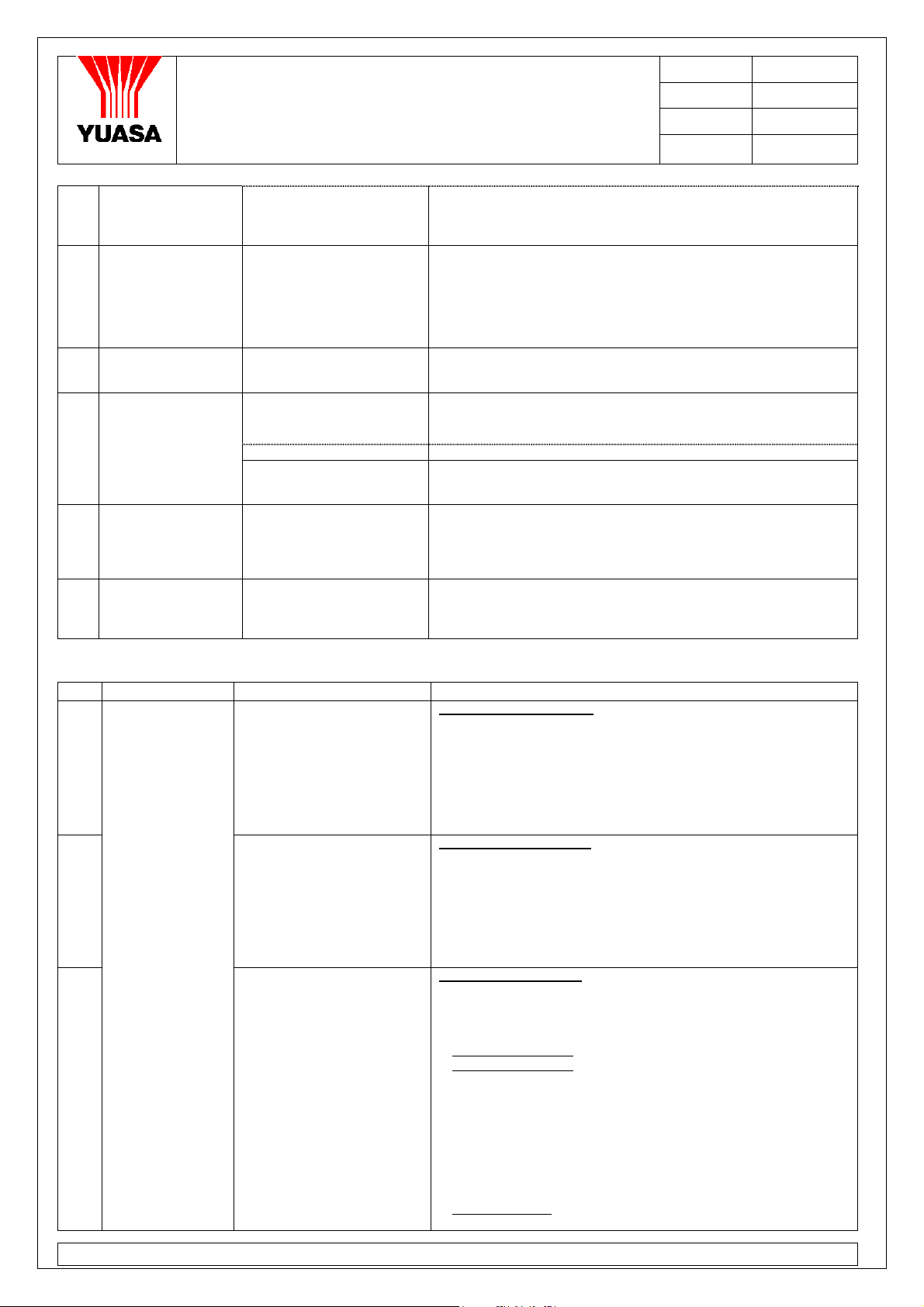
• VRLA batteries contain inorganic Lead compounds and Sulphuric Acid
which are damaging to the environment.
• Spent (used) batteries must be disposed of in an environmentally
friendly manner in accordance with local national laws and regulations.
• VRLA batteries must not be dismantled, burnt or incinerated as a means
of disposal.
• At the end of life VRLA batteries may still be electrically ‘live’ and contain
a large amount of electrical energy. The same care and attention to
safe handling should be taken as when handling new batteries.
Particular care must be taken to avoid short-circuiting the battery
terminals.
• Metallic Lead and active materials (Lead Oxides) must be recycled.
• Disposal must be carried out in accordance with the European
Hazardous Waste Directive 2008/98/EC
• Disposal must be carried out in accordance with the European
Hazardous Waste Directive 2008/98/EC on the protection of the
environment through criminal law
• Disposal should be in accordance with local, state or national legislation.
• Battery electrolyte is dilute Sulphuric Acid, the strength of which
depends on the state of charge of the batteries. It must be neutralised
before disposal. See SECTION 6 for clean-up and disposal advice.
• Do not dispose of this product into sewers, any ocean or water course in
order to prevent marine animals and birds from ingesting.
• Recycling is encouraged.
• Disposal by controlled incineration or source landfill in accordance with
local national laws and regulations may be acceptable.
• Constitutes a special waste by virtue of hazardous substance content.
• Dispose of via approved landfill site. Disposal by controlled source
landfill in accordance with local national laws and regulations may be
acceptable.
• UN No: UN2800
• Classification ADR / RID: Class 8
• Proper Shipping Name: BATTERIES, WET, NON-SPILLABLE electric
storage
• Packing Group ADR: not assigned
• Tunnel code: E
• ADR / RID: New and spent (used) batteries are exempt from all ADR /
RID (special provision 598)
Sea transport (IMDG Code)
• UN No: UN2800
• Classification: Class 8
• Proper Shipping Name: BATTERIES, WET, NON-SPILLABLE electric
storage
• EmS: F-A, S-B
Non-Spillable batteries meet the requirements of Special Provision 238;
they are therefore exempt from all IMDG codes and are not subject to
special regulation for sea transport
Air Transport (IATA-DGR)
• UN No: 2800
• Classification: Class 8
• Proper Shipping Name: BATTERIES, WET, NON-SPILLABLE electric
storage
• Special Provision A48: Packaging test are not considered necessary
• Special Provision A67: Yuasa’s VRLA batteries meet the requirements
of Packing Instruction 872.
The battery has been prepared for transport so as to prevent:
a) A short-circuit of the battery’s terminals by packaging in a strong and
sturdy carton box; AND/OR
b) The battery has been fitted with an insulating cover (made from ABS)
which prevents contact with the terminals.
c) Unintentional activation is thus prevented
The words “NOT RESTRICTED” and the Special Provision (SP) number
must be indicated on all shipping documents
• Special Provision:
as to prevent:
A164: The battery has been prepared for transport so
6
If this document is printed, it is to be considered uncontrolled and for reference only.
Page 10
Yuasa Battery Europe Ltd
SAFETY DATA SHEET
SECTION 15: REGULATORY INFORMATION
Components
15.1 VRLA Battery
SECTION 16: OTHER INFORMATION
Components
16 (a) Revision Information
16 (b) Abbreviations Pb – The chemical symbol for Lead
16 (c) Key literature
references and
sources of data
16 (d) CLP Regulations
16 (e) Risk Phrases
In accordance with REACH Regulation EC No. 1907/2006
a) Short-circuit of the battery’s terminals by packaging in a strong and
b) The battery has been fitted with a cover (made from ABS) which
c) Unintentional activation is thus prevented
All methods of transport
DO NOT PLACE VRLA BATTERIES INSIDE SEALED OR GAS-TIGHT
ENCLOSURES.
VRLA Batteries emit hydrogen gas which is highly flammable and will form
explosive mixtures in air from approximately 4% to 76%. This can be
ignited by a spark at any voltage, naked flames or other sources of
ignition.
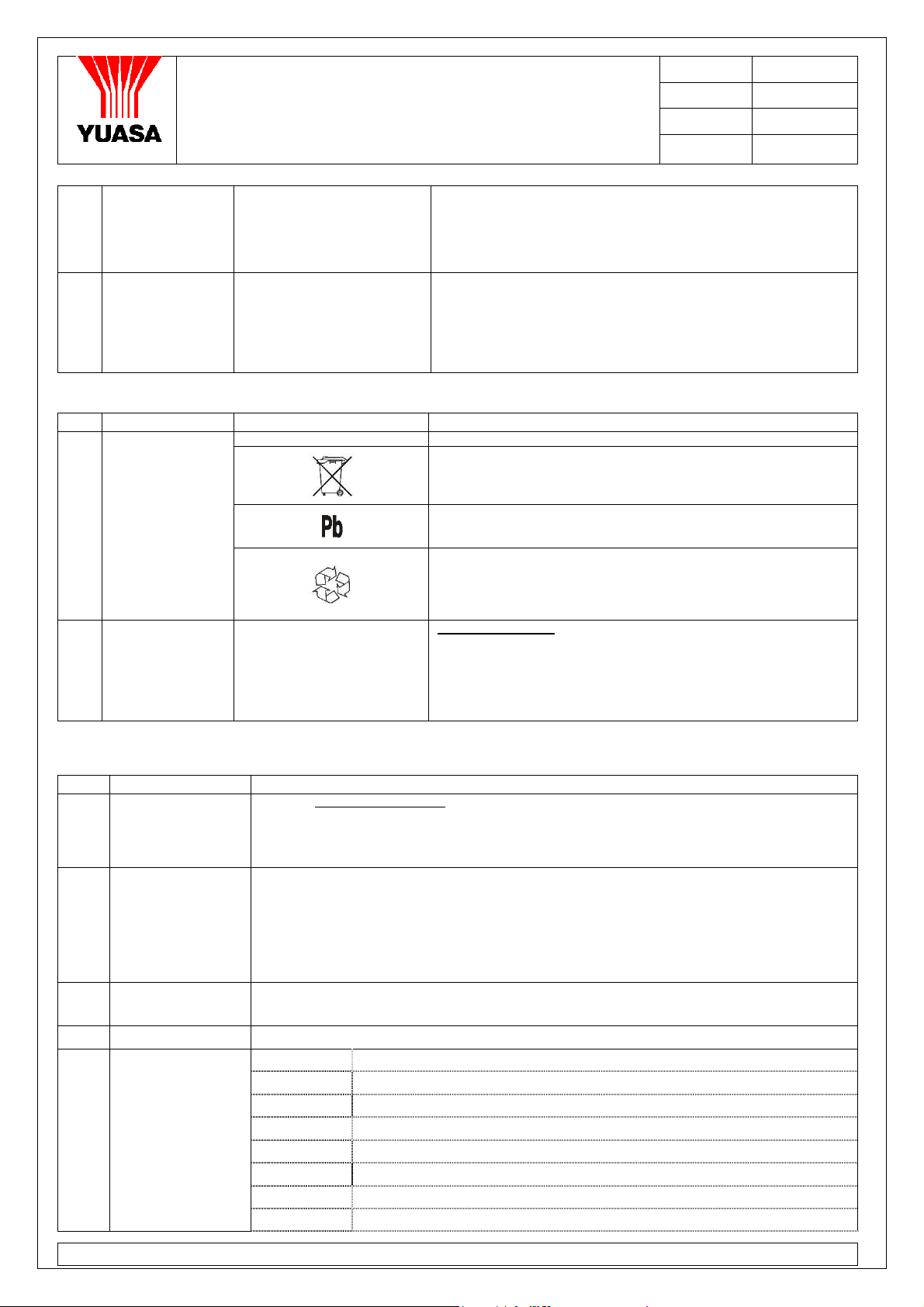
Required Markings:
EC Directives Directive 2006/66/EC, on batteries and accumulators and waste batteries
Crossed-out wheeled bin indicating “SEPARATE COLLECTION” for all
batteries and accumulators. Not to be disposed of with general domestic,
commercial or industrial waste.
Ref: The Batteries Directive 2006/66/EC
The Pb symbol indicates the heavy metal content of the battery and
enables the Lead-Acid battery to be sorted for recycling.
Ref: The Batteries Directive 2006/66/EC.
The International Recycling Symbol, required by law in many countries
world-wide to facilitate the identification of secondary batteries and
accumulators for recycling.
Ref: IEC 61429 : 1995, Marking of secondary cells and batteries with the
International Recycling Symbol ISO 7000-1135.
and accumulators
Paragraph (Recital) 29 states:
“Directive 2002/95/EC of the European Parliament and of the Council of 27
January 2003 on the restriction of the use of certain hazardous substances
in electrical and electronic equipment does not apply to batteries and
accumulators used in electrical and electronic equipment.”
• Correction: Section 1.3- Details Of The Supplier Of The Safety Date Sheet. Change office hours
Section 14-Transport Information- Delete “Packing Group: III” in both Sea and Air Transport information
Ba – the chemical symbol for Barium
Ca – the chemical symbol for Calcium
Sn – the chemical symbol for Tin
PbO2 – the chemical formulae for Lead Dioxide
H2SO4 – the chemical formulae for Sulphuric Acid
VRLA – Valve Regulated Lead-Acid battery
SDS documents from suppliers for components and raw materials
Not Applicable
R21 Harmful in contact with skin
R22 Harmful if swallowed
R23 Toxic by inhalation
R24 Toxic in contact with skin
R25 Toxic if swallowed
R35 Causes severe burns
R36 Irritating to eyes
R37 Irritating to respiratory system
Version 6 : 16-05-2014
from “08:00 to 4:00” to “08:00 to 4:30” for Peter Hollingworth and Mike Taylor
sturdy carton box; AND/OR
prevents contact with the terminals
Document: SDS 01
Issue No:
Issue Date: 16-May-2014
Page 10 of 11
6
If this document is printed, it is to be considered uncontrolled and for reference only.
Page 11
Document: SDS 01
Yuasa Battery Europe Ltd
SAFETY DATA SHEET
In accordance with REACH Regulation EC No. 1907/2006
Issue No:
Issue Date: 16-May-2014
Page 11 of 11
6
R38 Irritating to skin
R49 May cause cancer by inhalation
R52 Harmful to aquatic organisms
R53 May cause long-term adverse effects in the aquatic environment
16 (f) Training Advice
16 (g) Further Information To ensure the safe use of VRLA Industrial Batteries supplied by YUASA, the following precautions must be
• Only trained, competent personnel, who have received special instructions for the hazards and risks,
should be allowed to handle VRLA Batteries.
• See Section 7.1 for general advice
observed:
• Never short-circuit battery terminals, since sparks and arcs produced can injure personnel and are a fire
and explosion hazard.
• Batteries must always be charged on a voltage-regulated charging system with adequate ventilation
provided to avoid the build-up of ignitable gases and to promote good heat dissipation.
• Do not charge VLRA Batteries above + 50 ºC, discharge or store above + 60 ºC.
• Under extreme conditions of charging equipment malfunction and/or battery failure, high voltage and high
temperature conditions may occur causing the evolution of Hydrogen Sulphide (H2S) gas, which is toxic.
If detected by its odour of rotten eggs (at extremely low concentrations), switch off the charging
equipment, evacuate all personnel from the area and ventilate well. Seek advice before attempting to restart charging.
If this document is printed, it is to be considered uncontrolled and for reference only.
 Loading...