

Page 1
X-TREME
X-TREME Classic Line
X-TREME
via Monti Urali, 31 - 42029 Reggio Emilia (Italy) • ph. +39 - 0522 - 557735 • fax +39 - 0522 - 393733 • e-mail: [email protected]
User’s Guide
Page 2
X-TREME
OVERVIEW
The X-Treme Classic Line loudspeakers are highly efficient
touring products suitable for a wide variety of medium and large
scale live sound applications.
user’s guide
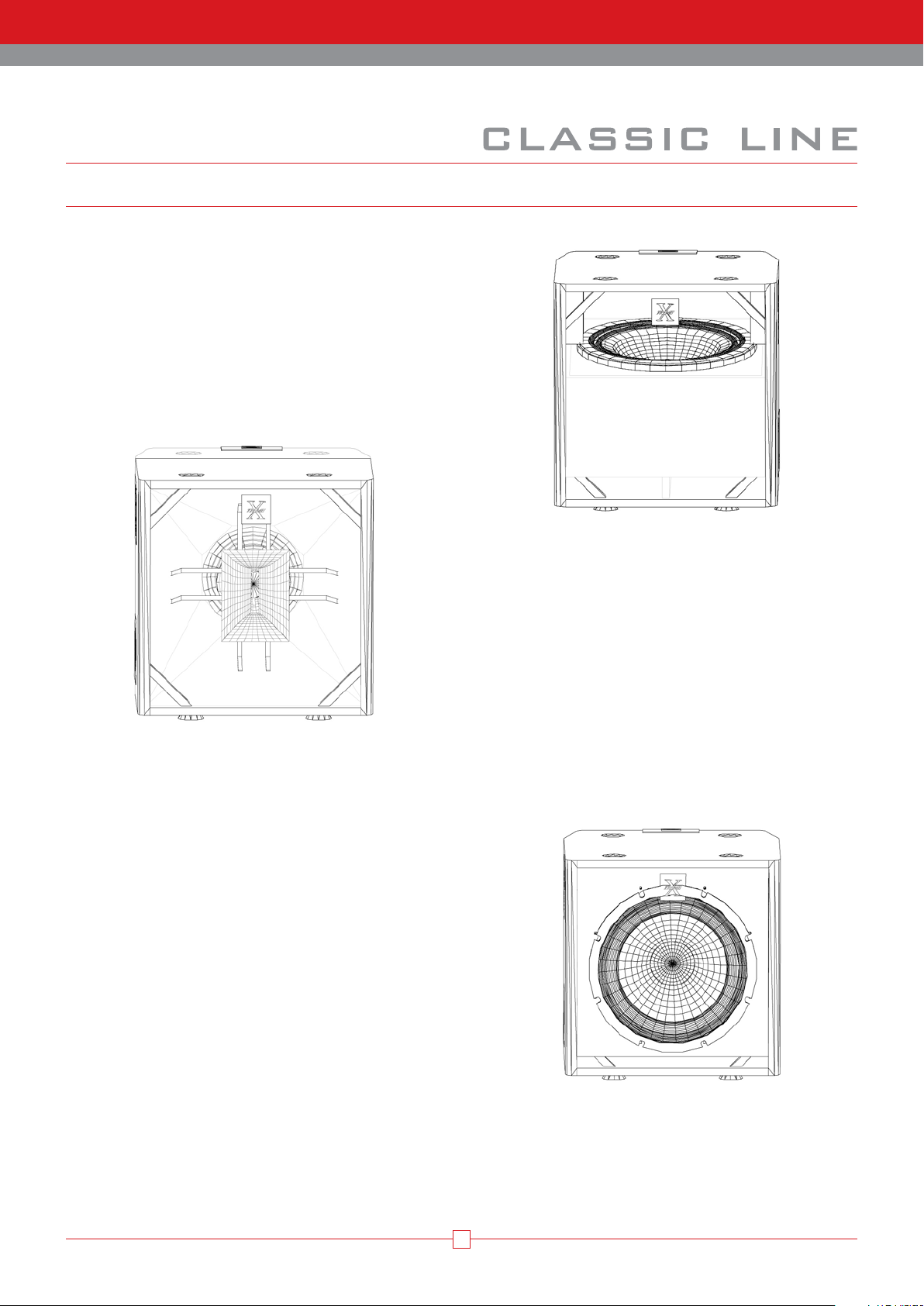
Figure 1: XTH speaker
XTH speaker is an highly efficient two-way touring sound enclosure
with a 12” midrange horn loaded and 2” compression driver.
The coaxial structure of the two medium-high sections allows
an extraordinary degree of freedom from phase distortions and
also controls the polar diagram perfectly. The compact design
and the angular response free from noisy side lobes make the
arrangement of both simple as well as complex horizontal and
vertical array possible.
Originally conceived for live concerts applications it can equally
well be used wherever the best reproduction of the voice, the
songs and the solo musical instruments is requested.
The cabinet is made of 3/4” (19 mm) thick birch wood able to
resist to any kind of mechanical stress without vibrations; properly
designed to make the arrangement of array from different systems
easier in accordance with the sound dispersion angles in the
horizontal plane.
Being the XTH system conceived to reproduce the frequency
range between 150 and 18K Hz, we recommend to employ a
woofer-type acoustic speaker, such as the XTL, to make the
extension of the frequency response on the grave notes.
Figure 2: XTL speaker
Purposely designed to reproduce the first octave of the band,
the XTL is the natural complementary system of the XTH
loudspeakers. Its overall dimensions were designed to make the
arrangement of array set up with the other loudspeakers of the
series easier. The XTL is fitted with 18” woofer with high standard
dynamics able to support even 1500 Watt acoustic power.
XTL cabinet is made of very high structural density and rigidity
wood. The development and the section of the loading were
designed as a function of the loudspeaker parameters in order
to guarantee the best response total efficiency and extension.
Finally, in order to complete the series with a subwoofer able to
grant a reinforcement on the deeper low frequencies, it has been
developed the XTS loudspeaker.
Figure 3: XTS woofer
XTS is equipped with a 18” high dynamics woofer mounted in
direct radiation in order to reproduce the frequency range
between 30 and 80 Hz.
Cabinet dimensions are same the ones of the other loudspeaker
of the series, so as to facilitate the stack use.
X-TREME
1
via Monti Urali, 31 - 42029 Reggio Emilia (Italy) • ph. +39 - 0522 - 557735 • fax +39 - 0522 - 393733 • e-mail: [email protected]
Page 3
X-TREME
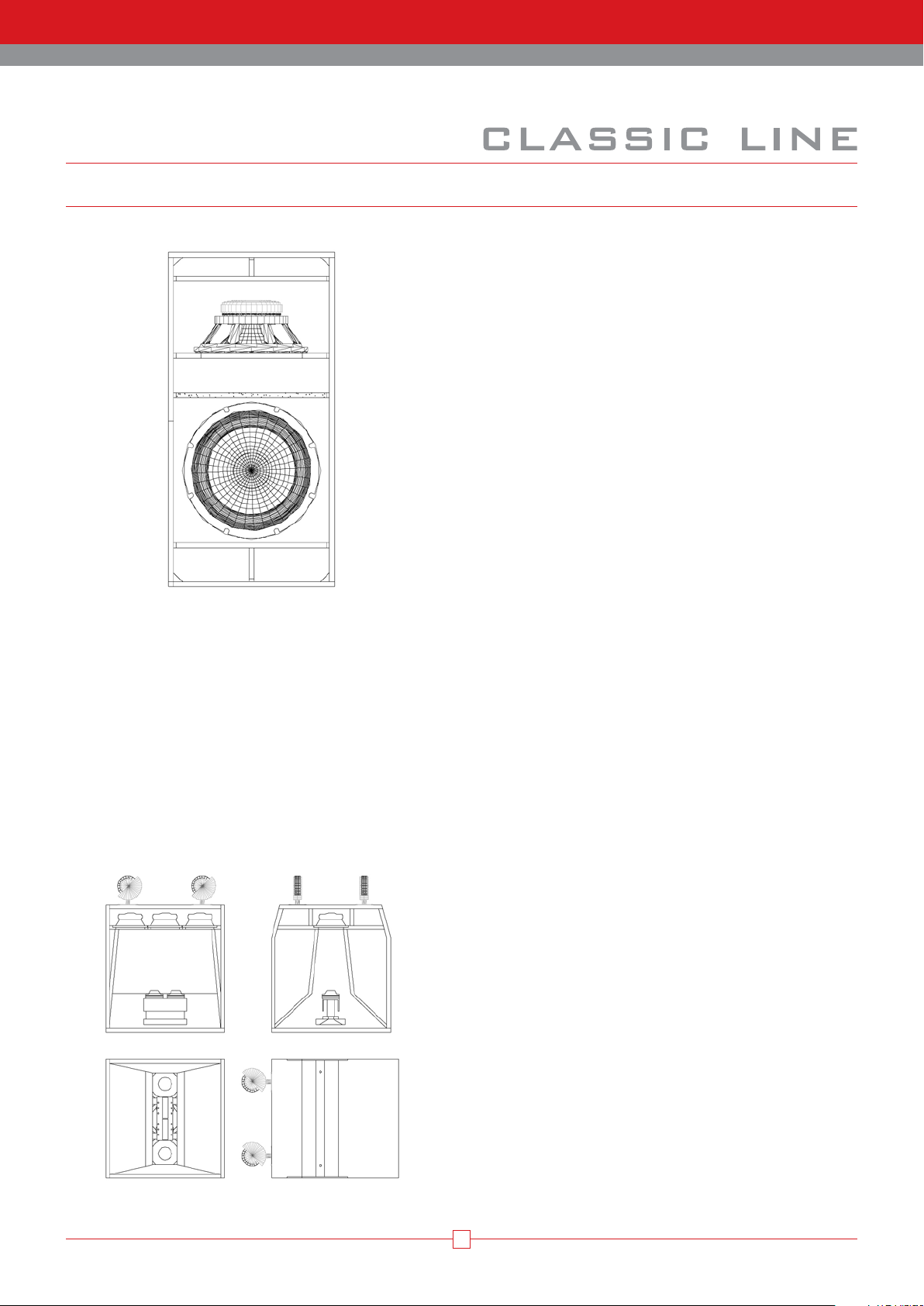
Figure 4: XTDS subwoofer
XTDS is a double speaker subwoofer with a 18” in reflex
configuration and a 15” in pass band system. The 18” is dedicated
to the lowest frequency range while 15” works more in higher
octave. In this way the sound is well balanced at mid and long
distances. All is made to increase the efficiency, to reduce the
distortion, to get a good "punch" effect without renouncing to
the range of frequency response. The correct use is with electronic
crossover set at 150 Hz with 24 dB/oct slope. The best
performance is with an amplifier able to deliver power in 4 ohm
with high current capability. Its size corresponds exactly to two
XTH and XTL stacked speakers.
user’s guide
XTLT is an extremely efficient 2 way system with a horn midrange
with three 6" driver and a tweeter with two 1" throat diameter
compression drivers.
The system is a hybrid mid-high frequency line array transducer,
designed to produce a planar wave front from a 8”x1” rectangular
throat. It employs a pair of compression drivers and three midrange speakers coupled to a special dual wave guide containing
a common vertical slot to radiate a coherent planar wave front.
It can be used as long throw module for traditional “Classic Line”
arrays. The main advantage of these type of system is the energy
savings arising from the narrowing of the vertical directivity and
having highly directive sources that, in addition, generate sound
waves that attenuate only 3 dB for every doubling of distance
as opposed to 6 dB for conventional systems.
The XTLT neodymium drivers are mounted on a mutual aluminium
heat sink for increased power handling and reduced power
compression. While the CSMB201 planar wave driver is a
distinctive new transducer engineered to radiate a coherent
planar wave front from a rectangular piston without internal
diffraction the XTLT horn loading system use more conventional
wave guide design techniques to reshape the compression
driver’s spherical wave front into planar wave front.
Instructions for use
The “Classic” configuration consists of the XTH, XTL, and XTS
speakers which can be employed both at floor level as well as
suspended.
The back angle of the cabinets allows the correct arrangement
of the speakers thus the nominal scattering values in the horizontal
plane are respected. An homogenous horizontal covering without
any phase interference is made possible by the application of
the configuration formed by the two XTH and XTL systems.
Floor Stacks are generally made by locating the loudspeakers
directly one upon the other. Specifically, as there is no angulations
in the vertical plane among the different XTH speakers, what
you will obtain is a coupling effect on the medium-high frequencies
that will increase the vertical directivity allowing the achievement
of an extraordinary covering even at a long distance.
Figure 5: XTLT - Long Throw Module
X-TREME
via Monti Urali, 31 - 42029 Reggio Emilia (Italy) • ph. +39 - 0522 - 557735 • fax +39 - 0522 - 393733 • e-mail: [email protected]
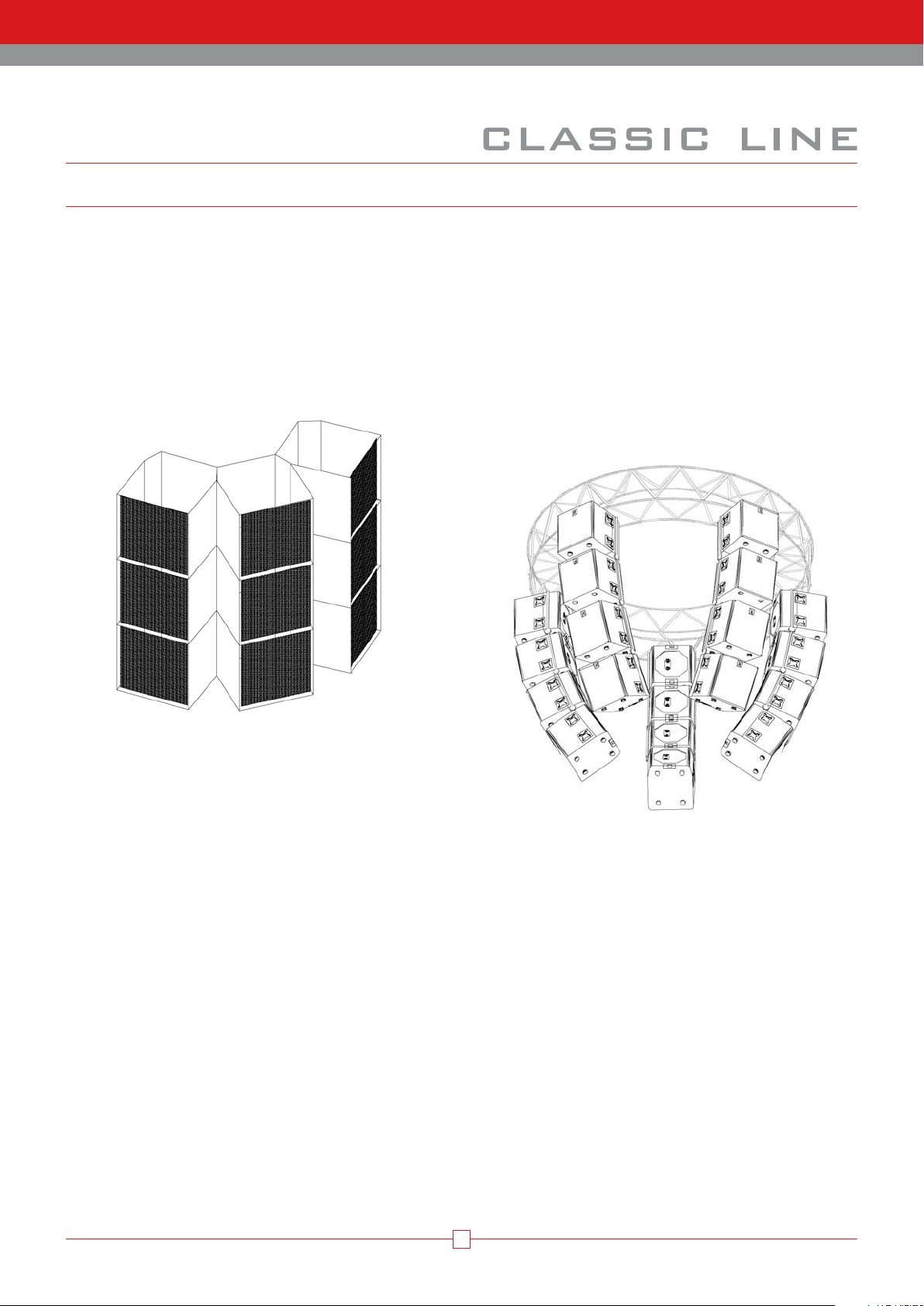
“Classic Line” systems array can be realised by placing different
XTH speakers side by side, with angles between twenty and
thirty degree in the horizontal plane.
In case of angles of lower degree between cabinets, you will get
a lower horizontal covering and a higher acoustic pressure level
in the central axis of the array.
In any case the horizontal plane covering should not exceed the
listening area in order not to send out emissions to premises
that might create undesired sound reverberation and interference
2
Page 4
X-TREME
user’s guide
or that may not be interested in the listening of music.
The positioning of an array speakers in a vertical plane depends
both on the height of the systems from the floor and on the
required covering area as well. We generally recommend you to
employ an angle of five degree between the cabinets adjacent
series in a hanging array.
SAFETY INSTRUCTIONS
It is important that loudspeakers systems are used in a safe
manner. Professional loudspeakers are capable of producing
extremely high sound levels and should be used with care.
Hearing loss is cumulative and can result from levels above 90dB
if people are exposed for a long period. Never stand close to
loudspeakers driven at high level.
X-TREME
For stacking, ensure that the floor or stage is level and solid.
Do not stack speakers too high outdoors where winds could
topple the stack.
Flying systems should only be assembled from trained and
experienced crew, working in association with professional
riggers. All array must be flown from secure and appropriately
load rated rigging points.
STACKED OR FLOWN?
Although flown systems are generally preferred by most sound
engineers, there are good arguments to support both solutions.
In many cases the answer is dictated by logistics that are venuespecific, i.e., sometimes it simply isn’t possible to fly PA.
Stacking onstage lowers the perceived sound image to stage level
which is beneficial in small venues. Stacking also offers more low
frequency SPL due to enhanced floor coupling and since XTH has
less SPL attenuation from the front to the back of the audience
3
via Monti Urali, 31 - 42029 Reggio Emilia (Italy) • ph. +39 - 0522 - 557735 • fax +39 - 0522 - 393733 • e-mail: [email protected]
Page 5

X-TREME
user’s guide
than traditional systems, this allows a stacked system to project
further. In addition, for geometric reasons a stacked array can
provide more extended vertical coverage than a flown one.
For these reasons, stacking makes sense in small configurations
where only a few elements can optimize audience coverage.
Flying is the best solution to achieve uniform sound pressure
level and even tonal balance over the entire audience provided
that the number of elements arrayed is sufficient to provide the
necessary front to rear coverage. Flying is also an excellent
solution for sightline problems that commonly occur and provides
better high frequency penetration into the audience with reduced
shadowing effects. For flown configurations, additional speakers
are added to cover center or front-fill requirements and to help
pull the localization image down towards the stage for the first
10-20 rows of the audience.
Stacking Guidelines
The designer must know if the audience is standing or seated - the
bottom of the array should always be higher than the ears of the first
rows of the audience and the lowest element tilted downwards.
Note: for extended bandwidth applications, a vertical stack of
two XTDS subwoofers provides a convenient stacking platform
at a height of 2 m above ground level.
If the bottom of the array is too low, the first rows receive too
much SPL and audience members directly in front of the system
behave as an acoustic screen for the following rows (shadowing).
Ideally, the bottom of the array should be slightly above the
audience (not lower than 2 m or 6.5 ft above floor level), with
the lowest element tilted downwards as necessary.
SUBWOOFERS
Subwoofers are used to extend the frequency response of the
XTH - XTL system down to 25-30 Hz and to increase the overall
SPL without increasing the potential for audience hearing loss.
General Guidelines for the use of subwoofers
The number of subwoofers to be used depends on 3 parameters:
1) Number of XTH-XTL elements
The standard number of XTS subwoofers recommended is
a 1:1 ratio.
2) Type of program material
Standard subwoofer ratios are recommended for classical music
or corporate events. For these applications, subwoofers act as
a low frequency extension for XTH-XTL and provide approximately
6 dB of low frequency contour. In this case, the overall system
functions as an extended bandwidth 3- way system.
For more demanding rock music applications, a ratio of 2:1
(XTS) or 1,5:1 (XTDS) is recommended to provide a more suitable
low frequency contour (e.g., 3:2, 6:4, 9:6, 12:8 for XTDS).
3) Type of venue or installation
In open-air, when subs are ground stacked the quantity remains
standard.
AMPLIFICATION
X-Treme Classic Line loudspeakers are designed to be used
with professional power amplifiers capable of producing the
following outputs into 8 ohms:
XTH: 550 W
XTL: 850 W
XTS: 900 W
and into 4 Ohm:
XTDS: 1600 W
XTLT: 460 W
Care should be taken to avoid amplifier clipping. It is important
to understand that a low power amplifier driven into clipping is
more likely to damage a loudspeaker then a higher power
amplifier used within its ratings. This is because music signals
have a high peak-to-average “crest” factor.
When an amplifier is severally overdriven, its output waveform
is clipped (its peak are squared off) – reducing the crest factor.
In extreme cases, the waveform can approach that of a square
wave. An amplifier is normally capable of producing far more
power under these conditions than its undistorted rated power
output. The use of very high power amplifiers with output greater
than those recommended is discouraged.
Care should be taken to avoid switch-on surges, which can
result in momentary power peaks in excess of specified ratings.
When powering up a sound system it is important to switch on
the amplifiers after the mixer and control electronics have
stabilised. When powering down the system, reverse the
sequence and switch off the amplifiers first.
CONNECTIONS
The rear panel of X-Treme loudspeakers are fitted with two
Neutrik Speakon NL4 connectors.
All four pins of both connectors are wired in parallel. The XTH
and XTLT uses the pin assignments 2+/2-. Pins 1+/1- are
designed to XTL, XTS and XTDS subwoofers. Using the male
connector as the input, the female connector allows for direct
connection to additional speakers.
Pins 1+
LF+
NL4
(XTL)
(XTS)
(XTDS)
1-
LF(XTL)
(XTS)
(XTDS)
2+
HF+
(XTH)
(XTLT)
2-
HF-
(XTH)
(XTLT)
X-TREME
4
via Monti Urali, 31 - 42029 Reggio Emilia (Italy) • ph. +39 - 0522 - 557735 • fax +39 - 0522 - 393733 • e-mail: [email protected]
Page 6
X-TREME
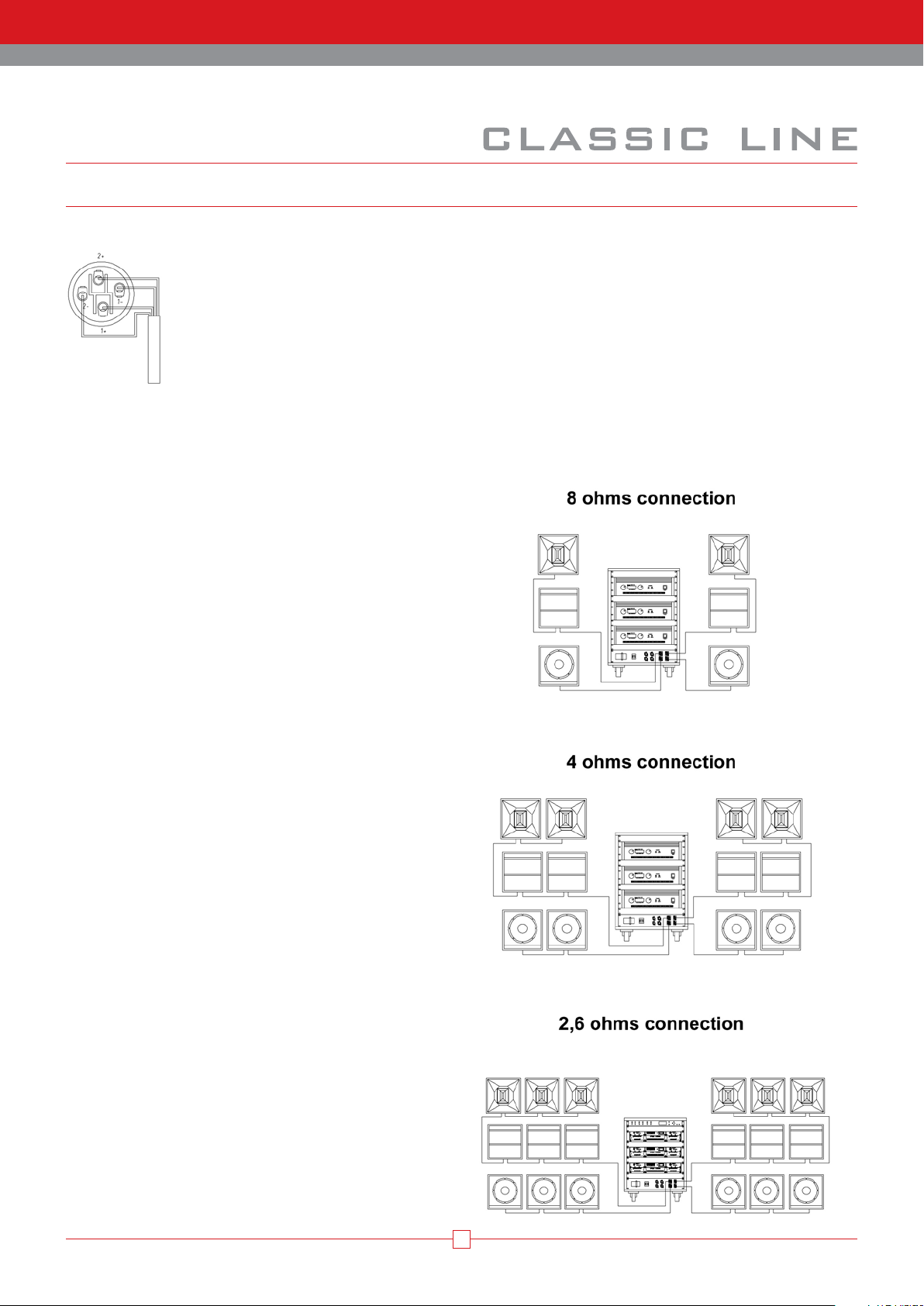
4 pins Speakon connector:
1+: Positive (+) woofer - XTL, XTS, XTDS
1-: Negative (-) woofer - XTL, XTS, XTDS
2+: Positive (+) satellite - XTH, XTLT
2-: Negative (-) satellite - XTH, XTLT
CABLE LENGTH
When connecting loudspeaker system to an amplifier, it is
recommended that the return resistance of the cable used is
less than one tenth of the nominal impedance of the system or
systems in parallel.
The table below gives an indication of the maximum permissible
cable runs for various conductor cross-sectional areas.
user’s guide
Hz, but it is suggested to use a LPF on XTH set at 200 Hz and
a HPF on XTL at 150 Hz.
Suggested crossover point for subwoofers is 120 Hz.
X-Treme Classic Line systems combined with the appropriately
configured controller exhibit an essentially flat on-axis frequency
response. Equalization to compensate for a particular acoustic
environment mat be performed where required. When loudspeakers
are arrayed, they may benefit from a degree of equalization to
reduce the effect of the low/mid build up and tilting of the response
inherent in the use of multiple arrayed enclosures.
Examples:
XTH
Maximum Cable Run
Conductor CSA
1.0 mm
1.5 mm
2.0 mm
2.5 mm
4.0 mm
6.0 mm
2
2
2
2
2
2
4 ohms
11 m
17 m
22 m
29 m
44 m
66 m
8 ohms
22 m
34 m
44 m
58 m
88 m
132 m
SYSTEM CONFIGURATIONS
X-Treme Classic Line enclosures can be used with analogue
controllers which performs system specific equalization, crossover
and limiter functions.
More complex set-ups will benefit from the use of XT amplifiers
provided with a digital DSP.
X-Treme Classic systems can also be used with XT266 and any
other professional digital controllers.
Whichever controller is used, it is important that it has fast attack
limiters to prevent amplifiers from clipping. This requires that the
controller’s limiter thresholds be set to match the sensitivity of
the amplifier. A system operated in this way with amplifiers having
a power rating as recommended and used by experienced
professional sound engineers should be sufficiently protected
from overdriving. It is suggested that you refer to the controller’s
user guide for further information on how to set limiter thresholds.
The nominal horizontal coverage pattern of XTH is 60 degrees.
This has been found to be the optimum figure to meet the
requirements of both small scale and larger scale use. With the
rear edges touching, the inter-cabinet angle between enclosures
is the right for having a correct overall dispersion.
The nominal crossover point between the XTH and XTL is 200
XTL
XTS
XTH
XTL
XTS
XTH
XTL
XTS
5
X-TREME
via Monti Urali, 31 - 42029 Reggio Emilia (Italy) • ph. +39 - 0522 - 557735 • fax +39 - 0522 - 393733 • e-mail: [email protected]
 Loading...