

Page 1
X-TREME
User’s Manual
via Monti Urali, 31 - 42029 Reggio Emilia (Italia) • tel. +39 - 0522 - 557735 • fax. +39 - 0522 - 393733 • e-mail: [email protected]
Page 2
x-one
u s e r ’ s m a n u a l
OVERVIEW
X-ONE is a new generation of flexible professional speaker systems suitable for a wide range of applications. The line features
3 models providing a solution for different uses. These lightweight and totally modular systems can meet any performance need
both in fixed and mobile installations.
They offer the same quality and reliability of all X-Treme products
for achieving highly professional performances.
They include top-quality components such as neodymium loudspeakers with a kapton wound coil and a titanium driver.
The internal crossover grids are extremely selective to obtain a
more natural timbre feature in medium frequencies, which play an
important role in improving the voice scattering and in achieving
an excellent musical clarity.
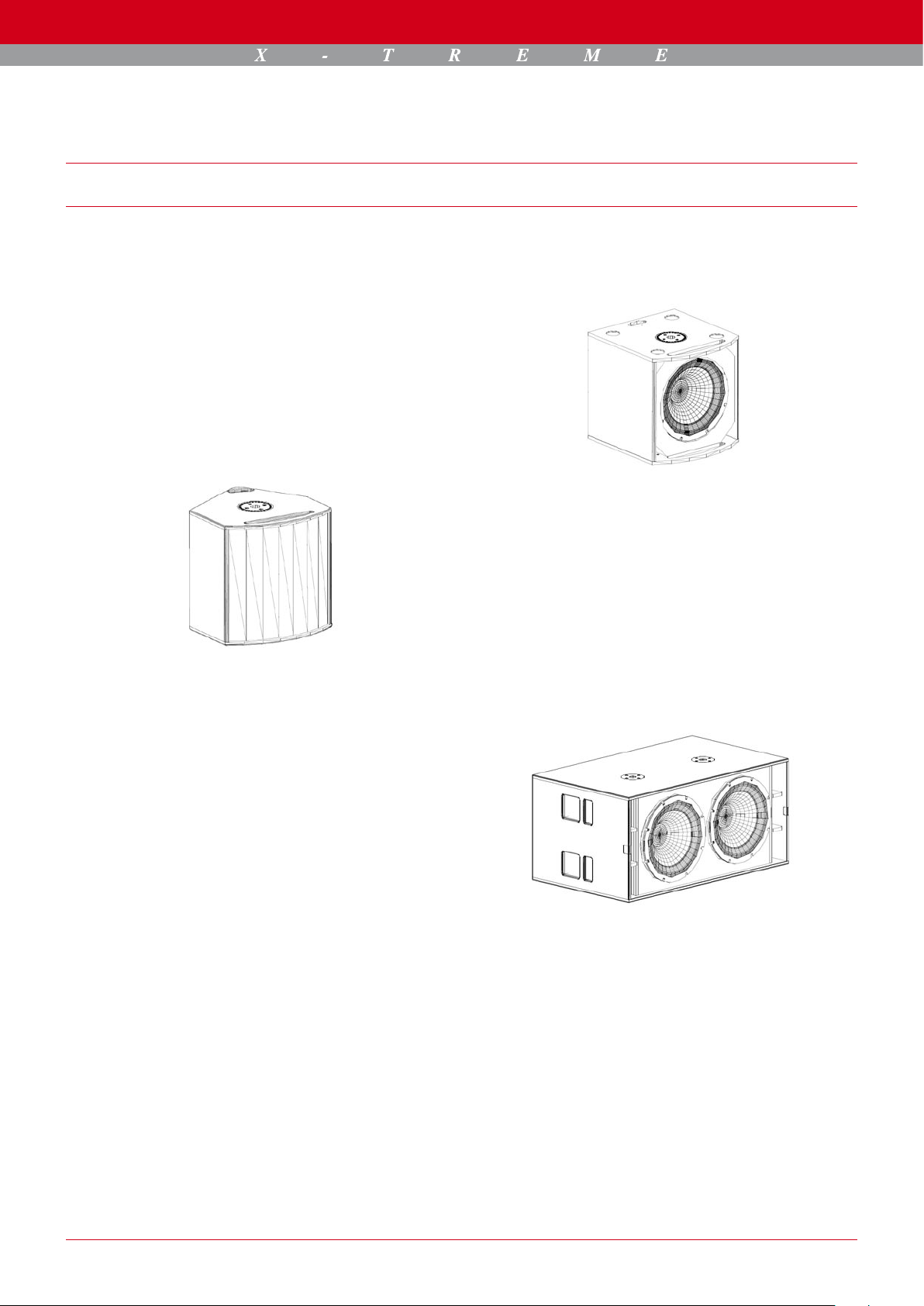
Fig.1 XTO speaker
XTO is a two-way speaker system with a 15’’ woofer and a 1,4’’
driver within a coaxial structure. This system is advantageous as
it allows the same sound diffusion of a point source which generates a clear and transparent sound by creating a coherent
wavefront, while limiting the phenomena resulting from secondary
lobes. Moreover, the “point source” system - with a single sound
source - ensures an extremely linear frequency response all over
the space around the speaker because the paths between the
sound source and the listening point always maintain the same
distance. As a result, the so-called “holes” in the frequency response are completely avoided in all listening points. Another original and innovative element of this speaker system is the horn
designed by X-Treme and provided with a neodymium 1,4’’ driver
and a neodymium mouth coaxially fitted on a 15’’ loudspeaker.
The system allows for a coverage with a 60-degree scattering
angle both on horizontally and vertically.
The small-sized and light cabinet is constructed from a 3/4’’ (19
mm) birch multiply painted with a special hot-applied bi-component scratch-resistant paint which makes the system highly resistant to weather conditions.
The cabinet is equipped with Fly Points so that the system can
be used in not less than 12 different positions. This is X-Treme’s
philosophy: offering users a product easy to be managed thanks
to a quick and safe installation.
The system can reproduce a frequency range from 60 to 20k
Hz, it shows 8 Ohm nominal impedance and it is able to support
musical powers up to 1200 Watt.
It can be used alone in a Full-Range Speaker configuration which
allows for a 60° X 60° coverage, or as a stage monitor both in
near-field and far-field configurations thanks to the different orientations of the cabinet and a wide frequency response.
By matching different speakers, both simple and more complex
arrays can be created, whether horizontally or vertically arranged.
This is made easier by the extremely simple geometry of the cabinet. If used within an array, the scattering angle increases by 60°
for each element which is added both horizontally and vertically.
Fig. 2 XTOS subwoofer
In order to achieve a more “musical” sound diffusion, a XTOS
speaker can be added to the XTO system to achieve a further
enhancement at low frequencies.
XTOS is equipped with a high-dynamic 15” woofer with a direct
radiation configuration which is able to reproduce a frequency
range from 45 to 200Hz and a musical power up to 2000W with
8 Ohm nominal impedance. The cabinet has been designed to
make the combination with other speakers of the same line as
easier as possible. It can be easily arrayed with a XTO speaker
both in horizontal and vertical arrangements. By using specific
accessories, a “sat+sub” configuration can be made between the
XTO and XTOS systems to obtain a sound scattering free of any
distortion and enriched at low frequencies.
Fig. 3 double subwoofer XTODS
XTODS is a double subwoofer included in the X-ONE line to
achieve a high enhancement at low frequencies while maintaining
an excellent efficiency and a reduced distortion. It is equipped
with two 15” woofers arranged in a reflex configuration with 4
Ohm nominal impedance and it is able to reproduce a musical
power up to 4000 Watt. The casing has been designed to make
the matching with the other speakers of the same line as easier
as possible. It is built in birch covered with a special scratch and
weather-resistant paint. The front panel is provided with a sturdy
metal grid covered by an acoustic transparent sponge material.
It can be arranged both horizontally or vertically on the floor or, by
using specific accessories, it can hold one or two satellites. The
double subwoofer XTODS can offer a significant enhancement
at low frequencies and an excellent “punch” effect. Moreover, in
combination with other components, it makes the line complete,
flexible and suitable for a wide range of applications.
X-TREME
via Monti Urali, 31 - 42029 Reggio Emilia (Italia) • tel. +39 - 0522 - 557735 • fax. +39 - 0522 - 393733 • e-mail: [email protected]
Page 3
Instructions for use
The X-ONE speaker systems can be used both at floor level as
well as suspended. The double subwoofer XTODS is available for
the floor installation only, and it can be arranged both horizontally
and vertically.
A homogenous horizontal coverage without any phase interference is made possible by choosing a configuration comprised of
XTO and XTOS systems.
Floor stacks are generally arranged by positioning the loudspeakers directly one on top of the other. In this way a coupling
effect is produced at medium-high frequencies that increases
the vertical directivity and allows an extraordinary coverage, even
over long distances.
By means of a flying system, vertical suspended arrays made of
two or more XTO speakers can be created. If XTOS systems are
added to the array, a further enhancement at low frequencies will
be achieved.
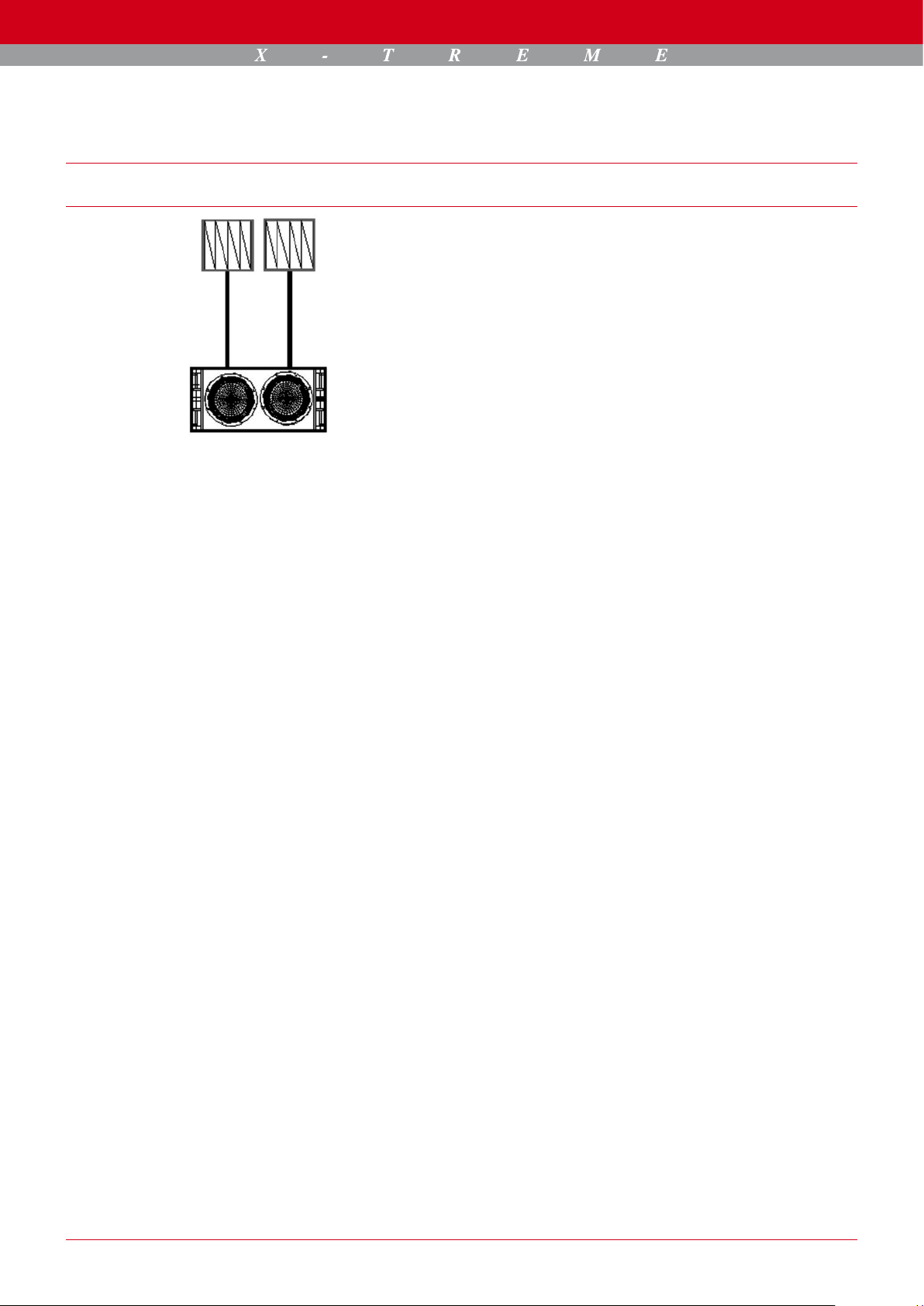
The high flexibility of the X-ONE line allows to create “Sat-Sub”
configurations using either a XTO speaker and a XTOS subwoofer or two XTO speakers and a double subwoofer XTODS. By
matching different X-ONE speakers, horizontal arrays can be
created in order to extend diffusion to a larger area compared to
that covered by a single element. The cabinet suits perfectly this
purpose. Generally speaking, the X-ONE line offers a wide range
of configurations which can be adjusted to any environment involved in the sound event .
SAFETY INSTRUCTIONS
x-one
u s e r ’ s m a n u a l
In many cases the answer is dictated by logistics that are venuespecific, i.e., sometimes it isn’t simply possible to fly PA.
Stacking onstage lowers the perceived sound image to stage level which is beneficial in small venues. Stacking also offers more
low frequency SPL due to enhanced floor coupling. In addition,
for geometric reasons a stacked array can provide more extended vertical coverage than a flown one.
For these reasons, stacking makes sense in small configurations
where only a few elements can optimize audience coverage.
Flying is the best solution to achieve uniform sound pressure level
and even tonal balance over the entire audience provided that the
number of elements arrayed is sufficient to provide the necessary
front to rear coverage. Flying is also an excellent solution for sightline problems that commonly occur and provides better high
frequency penetration into the audience with reduced shadowing
effects. For flown configurations, additional speakers are added
to cover center or front-fill requirements and to help pull the localization image down towards the stage for the first 10-20 rows
of the audience.
Stacking Guidelines
The designer must know if the audience is standing or seated
- the bottom of the array shall always be higher than the ears
of the first rows of the audience and the lowest element tilted
downwards.
Note: for extended bandwidth applications, a vertical stack of
XTOS subwoofers provides a convenient stacking platform at a
height of 1,05 m above ground level.
If the bottom of the array (composed of XTO loudspeakers)
is too low, the first rows could receive a too-high level of SPL
and audience members directly in front of the system behave
as an acoustic screen for the following rows (shadowing).
Ideally, the loudspeakers of the lower row of the array should be
positioned slightly above the audience (in any case not lower than
2 m or 6.5 ft above floor level), with the lowest element tilted
downwards as necessary.
Subwoofers
Subwoofers are used to extend the frequency response of
the XTO system down to 40 Hz and to increase the overall SPL
without worsening the potential audience hearing loss.
It is really important to use the speaker systems in compliance
with safety rules.
The professional loudspeakers produce extremely high sound levels and therefore they have to be used with care. Hearing loss is
cumulative and can be a consequence of prolonged exposure to
sound pressure levels higher than 90 dB.. Never stand close to
loudspeakers operating at high volume.
For stacking, ensure that the floor or stage is level and solid. Do
not stack too-high speakers outdoors where winds could topple
the stack.
Flying systems shall only be assembled by trained and skilled personnel, working in cooperation with professional riggers. All array systems must be flown to safe and properly load rated rigging points.
STACKED OR FLOWN SYSTEM?
Although flown systems are generally preferred by most sound
engineers, there are good arguments to support both solutions.
X-TREME
via Monti Urali, 31 - 42029 Reggio Emilia (Italia) • tel. +39 - 0522 - 557735 • fax. +39 - 0522 - 393733 • e-mail: [email protected]
General Guidelines for the Use of Subwoofers
The number of subwoofers to be used depends on 3 parameters:
1) Number of XTO Elements
The standard number of XTOS subwoofers recommended is a
1:1 ratio and for XTODS subwoofers is a 1:2 ratio
2) Type of program being reproduced.
Standard subwoofer ratios are recommended for classical music
or corporate events. For these applications, subwoofers act as
a low frequency extension for XTO and provide approximately
6 dB of low frequency contour. In this case, the overall system will
function as a 3-way extended bandwidth in bi-or tri-amplification.
For more demanding rock music applications, a ratio of 2:1
(XTOS) is recommended to provide a more suitable low frequency contour (e.g., 4:2, 8:4, 16:8).
3) Type of Venue or Installation
The number of subwoofers is standard when installed groundstacked in open-air places.
Page 4
x-one
u s e r ’ s m a n u a l
Amplification
X-ONE loudspeakers are designed to be used with professional
amplifiers able to produce the following outputs:
XTO Mid-Hi: 600 W (@ 8 Ohm)
XTOS Low: 1000 W (@ 4 Ohm)
XTODS Low: 2000 W (@4 Ohm)
Care should be taken to avoid amplifiers clipping. It is important
to understand that a low power amplifier driven into clipping is
more likely to damage a loudspeaker than a higher power amplifier used within its ratings. This is because music signals have a
high peak-to-average “crest” factor. When an amplifier is severally
overdriven, its output waveform is clipped (its peaks are squared
off) - reducing the crest factor. In extreme cases, the waveform
can approach that of a square wave. An amplifier is normally able
to produce far more power under these conditions than its undistorted rated power output. The use of very high power amplifiers
with output greater than those recommended is discouraged.
Care should be taken to avoid switch-on surges, which can result
in momentary power peaks in excess of specified ratings. When
powering up a sound system it is important to switch on the amplifiers only after the feeding and stabilising of the mixer and the
control electronics. For the system powering down reverse the
sequence by switching off the power amplifiers first.
Connectors
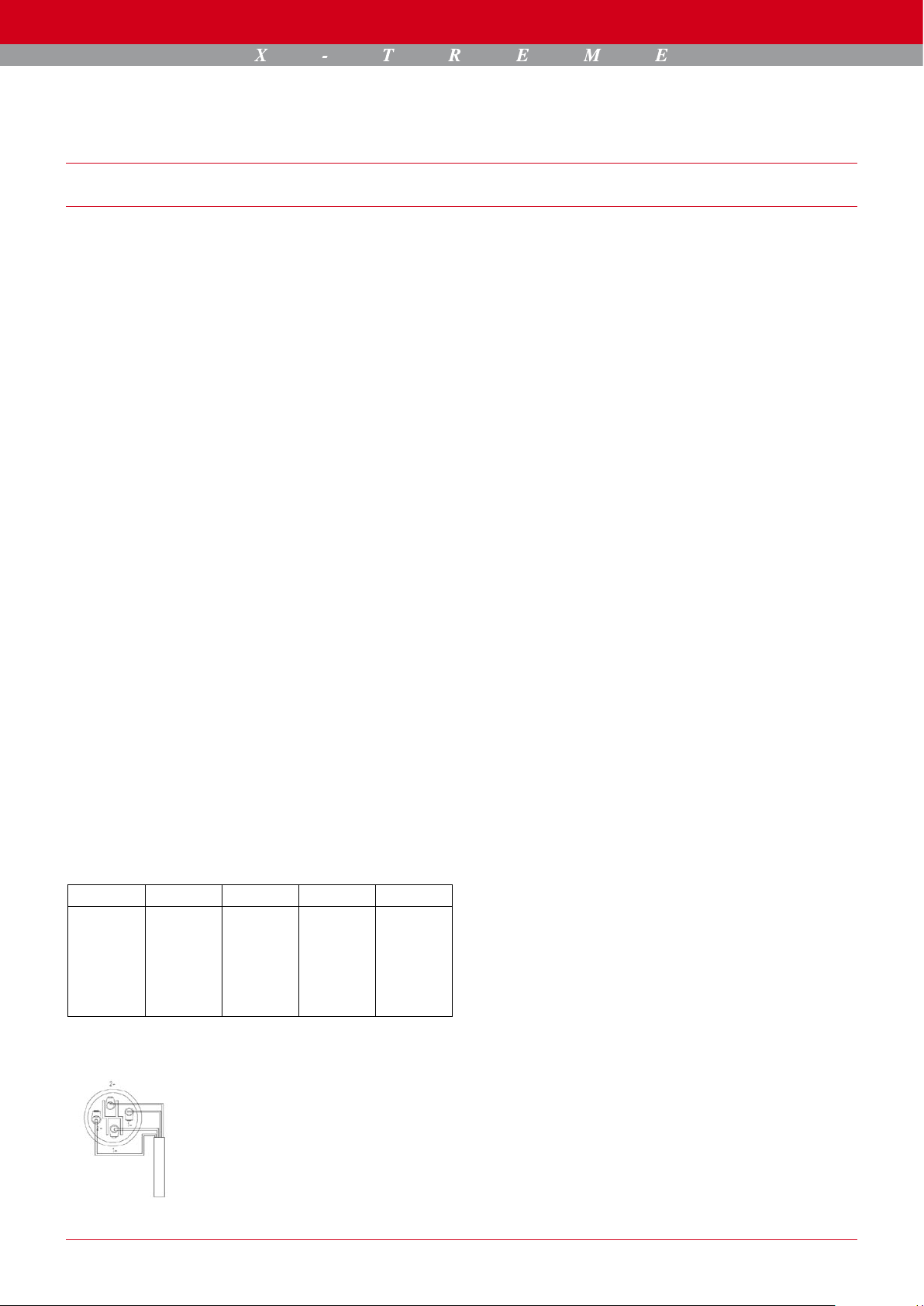
The rear panel of XTO, XTOS and XTODS loudspeakers are fitted with two Neutrik Speakon NL4 connectors.
All four pins of each connector are wired in parallel. The XTO uses
the poles 2+/2- for mid-hi section in double amplification. The
1+/1- poles are designed for woofer in biamp. or for the full range
system with passive filter, and for XTOS subwoofer and XTODS
double subwoofers. Using the male connector as input, the female connector allows a direct connection to additional speakers.
Pins 1+ 1- 2+ 2-
NL4
LF+
(XTO
LF biamp)
(XTO
full range)
(XTOS)
(XTOSDS)
LF-
(XTO
LF biamp)
(XTO
full range)
(XTOS)
(XTOSDS)
HF+
(XTO
HF biamp)
HF-
(XTO
HF biamp)
Cable lengths
When connecting loudspeakers to an amplifier, it is recommended
that the return resistance of the cable used is lower than one tenth of
the nominal impedance of the loudspeaker or systems in parallel.
The table below gives an indication of the maximum admissible
cable run for various cross-sectional conductors
Maximum Cable Run
Conductor CSA 4 ohm 8 ohm
1.0 mm
1.5 mm
2.0 mm
2.5 mm
4.0 mm
6.0 mm
2
2
2
2
2
2
11 m 22 m
17 m 34 m
22 m 44 m
29 m 58 m
44 m 88 m
66 m 132 m
SYSTEM CONFIGURATIONS
X-ONE loudspeakers can be used with analogue controllers which performs system specific equalization, crossover and limiter
functions. More complex set-ups will benefit from the use of XT
amplifiers provided with a digital DSP. X-ONE systems can also
be used with XT266 Digital Speaker Management system and
any other professional digital controllers.
It is important that the controller has fast attack limiters in order to
prevent amplifiers from clipping.
This requires that the controller’s limiter thresholds is set to match
the sensitivity of the amplifier. A system operating with amplifiers having the power rating suggested and used by experienced
professional sound engineers is sufficiently protected from overdriving. For further information about limiters threshold setting
please refer to the controller’s user guide.
The nominal horizontal coverage pattern of XTO is 60 degrees.
This value is considered to be the optimum one in order to meet
the requirements of both small-and-medium size installations.
The crossover frequency recommended for XTOS subwoofer is
lower than 100 Hz.
X-ONE systems driven by a properly configured controller, provide an essentially flat on-axis frequency response. Equalizations
to compensate particular acoustic conditions of the environment
can be used if required. If the loudspeakers are arrayed it is possible to obtain benefits from equalization correction that reduces
the effect of the sum of the mid-low frequencies determined by
the use of many loudspeakers.
X-TREME
4 pins Speakon connector:
1+: Positive (+) woofer, XTO full range, XTOS, XTODS
1-: Negative (-) woofer, XTO full range, XTOS, XTODS
2+: Positive (+) high, XTO high
2-: Negative (-) high, XTO high
via Monti Urali, 31 - 42029 Reggio Emilia (Italia) • tel. +39 - 0522 - 557735 • fax. +39 - 0522 - 393733 • e-mail: [email protected]
Page 5
X-TREME
u s e r ’ s m a n u a l
x-one
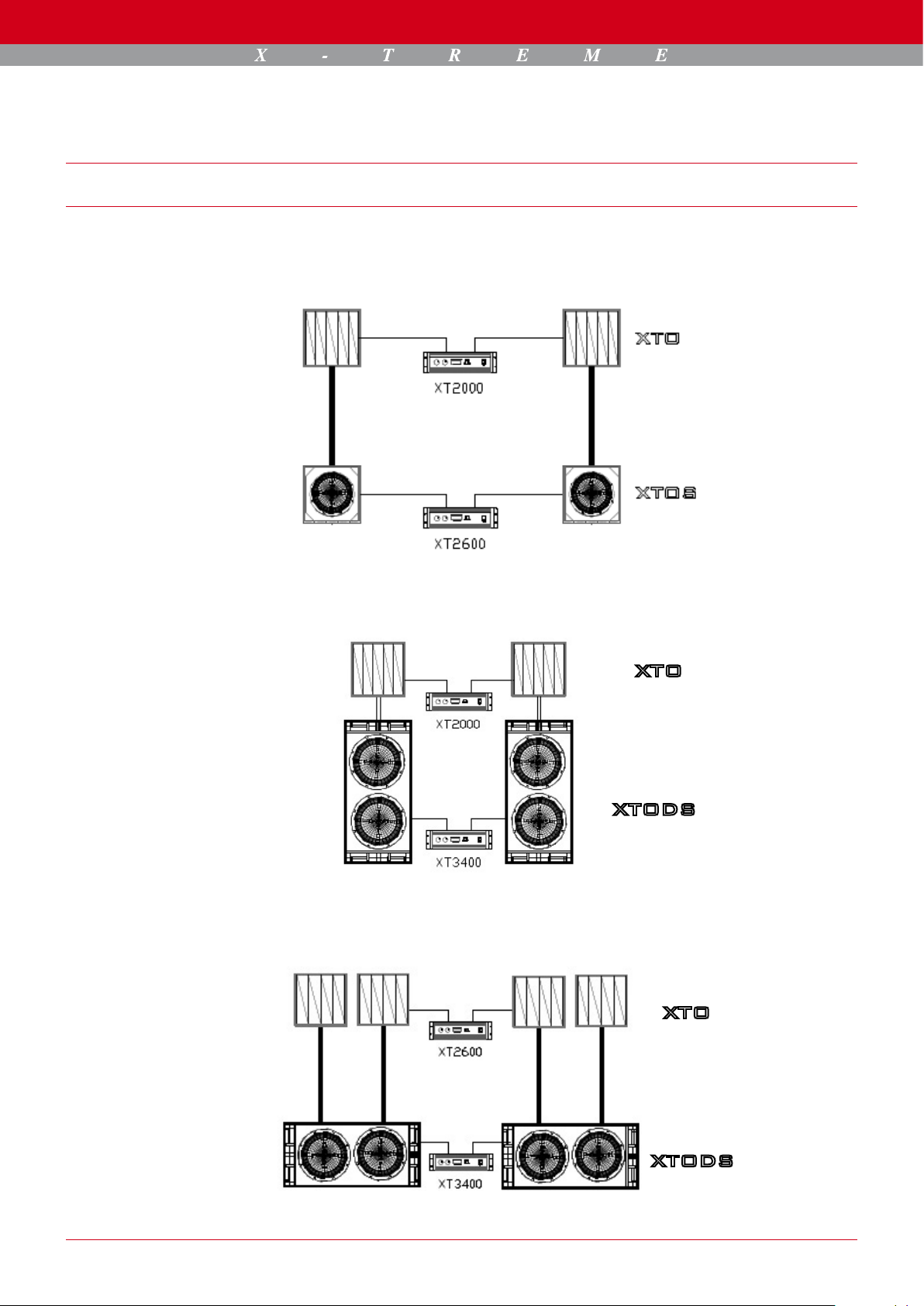
8 ohm connection
4 - 8 ohm connection
4 ohm connection
XTO
XTODS
XTO
XTODS
via Monti Urali, 31 - 42029 Reggio Emilia (Italia) • tel. +39 - 0522 - 557735 • fax. +39 - 0522 - 393733 • e-mail: [email protected]
Examples:
 Loading...