

Page 1
APPLICANT
:
ADDRESS
:
SAMPLE DESCRIPTION
:
ITEM NO.
:
COUNTRY OF ORIGIN
:
S
AMPLE RECEIVED DATE
:
S
AMPLE
RESUBMISSION
DATE
:
TURN AROUND TIME
:
TEST REQUESTED
TEST METHOD/REGULATION
RESULT
TEST REPORT
Report No. : EFHZ20041222-CG-01
Date : 11-May-2020
Page : 1 of 7
Ningbo Wentai Sports Equipment Co.,Ltd
No.601 Chang Baishan Road Industry Zone Xin Qi Town
Ningbo, Zhejiang, China
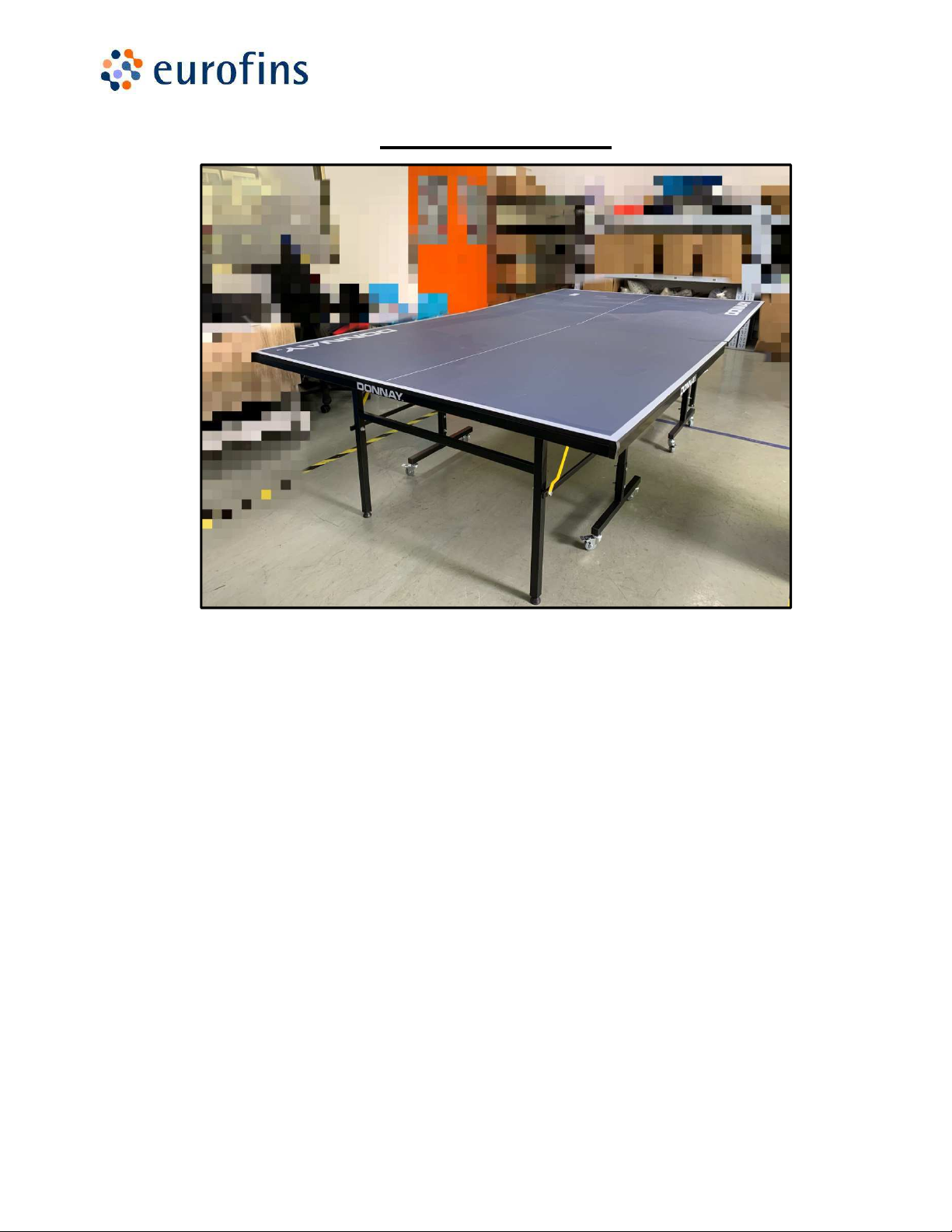
Table tennis table
770220/GA281100
China
16-Apr-2020
06-May-2020
16-Apr-2020 to 11-May-2020
The following test item(s) was/were performed on submitted sample(s) and/or component(s) confirmed by applicant
Table tennis — Part 1: Table tennis tables, functional
and and safety requirements, test methods
EN 14468-1:2015
Pass
(Except clause 5.3.4,6.5,9
and 10)
Samples are obtained by express delivery, Results obtained refer only to samples, products or material received in Laboratory, as described in point related to sample
description, and tested in conditions shown in present report. Eurofins Product Testing Service (Shanghai) Co., Ltd ensures that this job has been performed according
to our Quality System and complying contract and legal conditions. If you happen to have any comments, please do it by sending email to
referring to this report number. Reproduction of this document is only valid if it is done completely and under the written permission of Eurofins Product Testing Service
(Shanghai) Co., Ltd. If you happen to have any complaints, please do it by sending email to [email protected] and referring to this report number.
Eurofins Product Testing Service (Shanghai) Co., Ltd. Hangzhou Branch
Room 301-307, 3/F, 1st Building, Huaye Hi-Tech Industrial Park, No.1180, Bin'an Road, Binjiang District, Hangzhou, Zhejiang Province, China, 310052
Page 2
Report No. : EFHZ20041222-CG-01
Date : 11-May-2020
Page : 2 of 7
Eurofins(Hangzhou)contact information
Customer service: [email protected] / +86 571 81907031
Sales specialist: [email protected]/ +86 13817926847
************ FOR FURTHER DETAILS, PLEASE REFER TO THE FOLLOWING PAGE(S) *************
Signed for and on behalf of
Eurofins Product Testing Service (Shanghai) Co., Ltd Hangzhou Branch
Jack Ma
Lab Manager of HZ Hardline Laboratory
Eurofins Product Testing Service (Shanghai) Co., Ltd. Hangzhou Branch
Room 301-307, 3/F, 1st Building, Huaye Hi-Tech Industrial Park, No.1180, Bin'an Road, Binjiang District, Hangzhou, Zhejiang Province, China, 310052
Page 3
Report No. : EFHZ20041222-CG-01
Date : 11-May-2020
Page : 3 of 7
SAMPLE PHOTO(S)
EFHZ20041222-CG-01
***TO BE CONTINUED***
Eurofins Product Testing Service (Shanghai) Co., Ltd. Hangzhou Branch
Room 301-307, 3/F, 1st Building, Huaye Hi-Tech Industrial Park, No.1180, Bin'an Road, Binjiang District, Hangzhou, Zhejiang Province, China, 310052
Page 4
Report No. : EFHZ20041222-CG-01
Date : 11-May-2020
Page : 4 of 7
TEST RESULT
EN 14468-1:2015 Table tennis — Part 1: Table tennis tables, functional and safety requirements, test
methods
1. Number of Tested Sample: 1 Piece
2. Classification: Class D, type 3 (indoor use)
3. Test Result:
Clause Requirement/test method Rating
5
5.1
5.2
5.3
5.3.1
5.3.2
5.3.3
5.3.4
5.3.5
5.3.6
5.3.6.1
5.3.6.2
5.3.7
5.3.8
Eurofins Product Testing Service (Shanghai) Co., Ltd. Hangzhou Branch
Room 301-307, 3/F, 1st Building, Huaye Hi-Tech Industrial Park, No.1180, Bin'an Road, Binjiang District, Hangzhou, Zhejiang Province, China, 310052
Functional requirements
Dimensions
Tables shall comply with the dimensions shown in Table 3 and Figures 7 and 8 of this
standard
Weight
Where the table weight exceeds 200 kg, the table should be carried using a lifting
device. An appropriate notice should be put on the underside of the table and on the
outer packaging.
Playing surface
Material
Any material that fulfils the requirements
a) Ball bounce
b) Climatic stresses
c) Environmental aspects
Flatness
The flatness tolerances for half the playing surface shall be:
Class A 4 mm;
Class B 7 mm;
Class C 10 mm;
Class D 15 mm.
Testing in accordance with 7.2.
Colour of playing surface
Classes A, B: Green or blue, of any degree of darkness having a Y-value under
illuminant D651) of not more
than 30 % (CIE system).
The colour of lines for Classes A and B shall be white.
Classes C, D: Optional
Degree of gloss and regularity N/C
Ball bounce Pass
Side and ends of the tabletop
Edges
The playing surface shall have rectangular but not sharp edges, all the other edges shall
be blunt. If there is a side protection for Class A the side of the playing top shall be
covered with a max. thickness of 1 mm
Frame reinforcements
The height of the frame reinforcement plus the top may be no more than 100 mm (see
Figure 7). The thickness of the lower frame shall be ≥ 3 mm and the edge of the frame
has to be rounded with a radius of min. 1 mm. The frame of Class A shall be flush with
the side edge of the tabletop.
.
Area for attaching a net assembly
If the table is not supplied with a permanent net assembly a gap is needed between the
two halves of the tabletop as shown in Figure 10.
Climatic stresses for outdoor tables
Outdoor tables shall show no movement out of the tolerance as to dimensions, flatness
and surface finish after the test in accordance with 7.5.
Pass
N/A
Pass
Pass
Pass
Pass
Pass
Pass
N/A
Page 5
Report No. : EFHZ20041222-CG-01
Date : 11-May-2020
Page : 5 of 7
TEST RESULT
Clause Requirement/test method Rating
5.4
5.4.1
5.4.2
5.4.2.1
5.4.2.2
5.4.2.3
5.4.3
5.5
5.6
5.7
5.8
6
6.1
6.1.1
Undercarriage
Colours
Day-glow and fluorescent paints are excluded for Classes A to C.
Wheels
General
For Classes A and B tables the wheels shall have no sharp edges and shall not be
abrasive.
Dimensions
The diameter of wheels shall be at least 75 mm for all classes.
If a Type 2 table Class A is moved on castor wheels, the minimum distance of the
tabletop to the floor shall be 50 mm.
Swiveling
For each undercarriage with four wheels, at least two shall swivel. For each
undercarriage with three wheels not inline, at least one shall swivel. If a table Type 2 has
one wheel, or two or more wheels inline they shall not swivel.
Climatic stresses on locking devices for outdoor tables
The locking devices shall be made of materials that are resistant to corrosion and light
exposure
Horizontal deviation
The table shall be so stable that during the test in accordance with 7.6 the horizontal
deviation measured on the surface of the table in the direction of the force does not
exceed
for Class A: 10 mm,
for Class B: 20 mm,
for Class C: 40 mm.
Tables of Class D shall not collapse
Residual height reduction
After completion of the loading test in 7.7.1 and after allowing 5 min±5s for recovery,
the height of the corners of the table halves(Net and end) of classes A,B,C and D tables
shall not be reduced by more than the value shown in table as below:
Class Residual height reduction
A and B 5
C 10
D 15
Unfolding of a tabletop of a rollaway table
Legs that are intended to extend during the folding down of a raised tabletop shall
extend automatically, without needing to be pulled forwards.
Additional requirements and recommendations for tables for wheelchair play
Type 2 and Type 3 tables are normally not intended for use by wheelchair player
To allow access to wheel chair, the table legs shall be set back not less than l3 from the
table end
For wheel chair table tennis h6 is recommended to be maximum of 80mm in the player’s
safety area
Each rollaway table half shall have a brake on at least one wheel
Safety requirements
Table in playing and in playback position
General
N/A
N/A
Pass
Pass
N/A
Pass
Pass
Pass
N/A
Pass
Eurofins Product Testing Service (Shanghai) Co., Ltd. Hangzhou Branch
Room 301-307, 3/F, 1st Building, Huaye Hi-Tech Industrial Park, No.1180, Bin'an Road, Binjiang District, Hangzhou, Zhejiang Province, China, 310052
Page 6
Report No. : EFHZ20041222-CG-01
Date : 11-May-2020
Page : 6 of 7
TEST RESULT
Clause Requirement/test method Rating
6.1.2
6.1.3
6.1.3.1
6.1.3.2
6.1.3.3
6.1.4
6.2
6.3
6.3.1
6.3.1.1
6.3.1.2
6.3.2
6.3.3
6.4
6.5
Loading capacity
The table or table halves shall be designed so that in its playing position it withstand
the imposed loads without collapsing or sustaining any damage prejudicial to safety
after the test in accordance with 7.7.1.
Stability
Longitudinal direction
The table shall not collapse after the test in accordance with 7.7.2.1.
Lateral direction
The table shall not collapse or sustain any damage prejudicial to safety after the test in
accordance with 7.7.2.2.
Balance
The table shall not topple over, collapse or sustain damage prejudicial to safety after the
test in accordance with 7.7.3.
Safety area
The safety area is defined by the following dimensions according to table3 and Figure 8
of this standard
- l2 or l3
- l4
-b2
-h2
-h
3
In case of an undercarriage whose side and ends touch or nearly touch the floor , the
requirements of Table 3 and Figure 9 shall be observed below the heights h3 and h2
respectively
Table in storage position
Rollaway tables shall not topple over when tested in accordance with 7.8.
Locking systems
General
Storage position of the tabletop Pass
Playing position of the tabletop
If a locking device is needed to give the table the requested rigidity and stability in the
playing position (see 6.1.2) this locking device shall lock automatically and safely when
the tabletops are unfolded on a flat horizontal ground. The unlocking shall require at
least one manual action.
Functioning of the locking systems
The solidity, the durability and the proper operation of the locking devices are checked
during and after testing in accordance with 7.9.1 and 7.9.2.
Fitting of the locking devices
It is strongly recommended to assemble and fit the locking devices on site, at the
factory, as far as it is possible to ensure safe transportation.
If it is not possible, then locking devices shall be delivered apart and complete. In this
case the locking device shall be designed in such a way that it can be mounted without
any doubt by the customer.
Functioning of the rolling devices
The rolling devices shall not be damaged and shall operate correctly after the test in
accordance with 7.9.1.
Construction of the permanent net post
For tables of Classes A and B no part that is supporting the net post shall be more than
60 mm outside the tabletop side. There shall be no edge that could hurt the player , in
accordance with EN 14468-2.
Pass
Pass
Pass
N/A
Pass
Pass
Pass
Pass
Pass
Pass
N/C
Eurofins Product Testing Service (Shanghai) Co., Ltd. Hangzhou Branch
Room 301-307, 3/F, 1st Building, Huaye Hi-Tech Industrial Park, No.1180, Bin'an Road, Binjiang District, Hangzhou, Zhejiang Province, China, 310052
Page 7
Report No. : EFHZ20041222-CG-01
Date : 11-May-2020
Page : 7 of 7
TEST RESULT
Clause Requirement/test method Rating
6.6
6.7
6.8
6.9
9 Information supplied by the manufacturer N/C
10 Marking N/C
Note:
N/A = not applicable.
N/C =Not conducted as per client’s request
Mobile parts and fixations
The mobile parts and the fixations of a table shall be strong and durable. These features
will be checked after testing in accordance with 7.9.1 and 7.9.2
Table Type 4 in storage and playback position
If the gap between the tabletops up to the height of 760 mm from the floor in the storage
or in the playback position is more than 110 mm, the table shall be equipped with a
device preventing the intrusion of a child into this gap and avoiding that the head or
trunk of the child can be squashed by an opening tabletop.
Table finish
There shall be no protruding points or pointed or sharp-edged components or no rough
surfaces, which may hurt a user, when playing on the table, moving it or attaching the
net. Within these accessible areas, bolt threads protruding by more than 8 mm shall be
permanently covered e. g. dome headed nuts, protected or shielded by other means or
rounded off by a minimum radius by a curve of 3 mm, so there is no risk of injury
through unintended contact.
The materials used shall be sturdy and durable. The design of all parts and their fixing
systems shall be resistant to the typical impacts that can occur during normal use of the
table. This shall be without affecting the function of the table or creating a hazard
Additional parts
If there are any additional parts attached to the table ,(e.g. skirts, ball boxes, racket
holders) the requirements according to 6.8 shall be met, if there is a removable skirt
attached to the under carriage, the skirted table shall comply with all dimensions given in
table 3
Adding parts to the table shall not compromise its functionality
***END OF THE REPORT***
Pass
N/A
Pass
N/A
Eurofins Product Testing Service (Shanghai) Co., Ltd. Hangzhou Branch
Room 301-307, 3/F, 1st Building, Huaye Hi-Tech Industrial Park, No.1180, Bin'an Road, Binjiang District, Hangzhou, Zhejiang Province, China, 310052
 Loading...