

Page 1

1
Class-D Audio Amplifier, 2 Channel, 125W/Channel
Model XAMP-D2
Operator’s Manual
Rev 2.4
Xkitz.com
Features
• Uses Texas Instruments TAS5611A chip in bridged configuration to produce 125W RMS per channel
• Plate mount with integrated heat sink, No fan required
• Small, compact design for use in small spaces
• Supports both balanced and unbalanced signal inputs
• Silent power ON/OFF
• Self protections: Over-Temperature, Under-Voltage, Clipping, Short Circuit
• Specifications:
• Applications:
• Low power consumption and no negative supply needed - perfect for portable battery powered speakers
• Plate Dimensions: 4.625” x 3.25” x 1.5” High (117mm x 81mm x 38mm)
• Made in USA
Frequency Response Linear from 20Hz – 80KHz
Distortion Ultra low 0.03% THD at 1W into 4 ohms
Signal-to-Noise Ratio > 100dB
Power Supply Noise Rejection 80dB
Input Impedance 20K ohms unbalanced, 40K balanced
Input Overload: 3.8V peak-to-peak
Voltage Gain: 20dB
Power Output 125W RMS per channel into 4 ohms
Amplifier Type: Class D, Stereo Bridge Tied Load (BTL)
Power supply: 24V–32V DC, Single positive DC rail (no negative supply required)
• Active speakers, sound bars and subwoofers
• Portable boom-box
• Portable guitar amplifier
• Custom speaker systems
10/28/2017 XKITZ XAMP-D2
Page 2
2
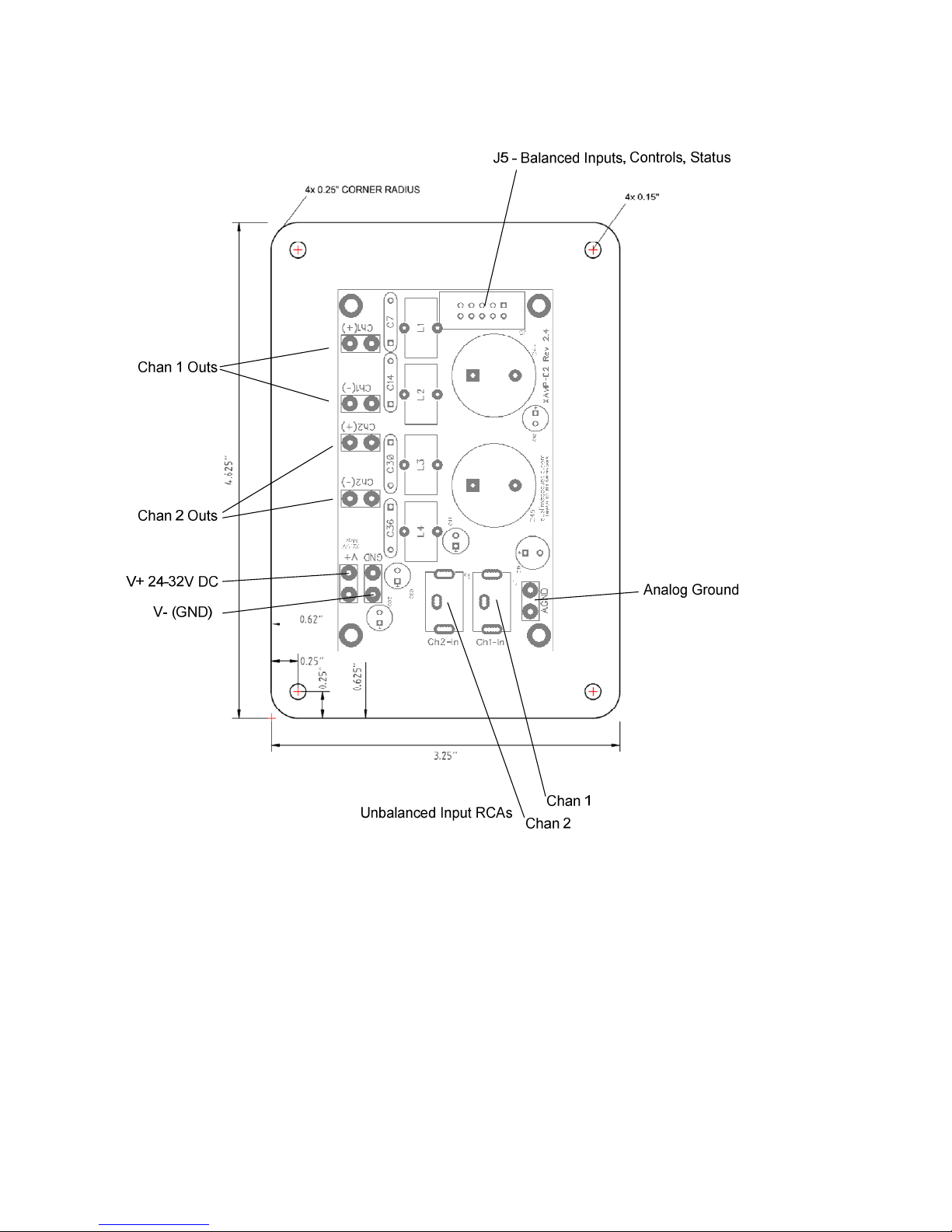
Figure 1. Connector Placement and Dimensions
10/28/2017 XKITZ XAMP-D2
Page 3
3
Input Signals – Balanced or Unbalanced
There are two basic systems used to connect the audio signal on consumer and pro audio equipment;
unbalanced lines and balanced lines. Unbalanced lines use one wire for signal and the other for ground.
Balanced lines, on the other hand, have two signal wires and a shield ground wire.
Unbalanced lines are most common in consumer grade audio, and are generally much more susceptible to audio
noise like 50/60Hz hum. Unbalanced lines will also pick up any electro-magnetic noise in the nearby
environment (such as computers, cell phones, microwaves, etc.) and adds it to your audio signal, making it
audible in your speakers. Unbalanced lines can also lead to ground loops, which are the major source of
50/60Hz hum in your sound system. Ground loops arise whenever there is more than one path from any piece of
audio equipment to earth ground. Your equipment will always be grounded through your AC line. Adding
another path to ground through your unbalanced audio cable adds a second path to ground, and this can cause
audible 50/60Hz hum.
Balanced signals are more common in high end consumer and professional audio systems and are much less
susceptible to noise. Balanced lines allow you to run very long audio cables without allowing electro-magnetic
noise to couple into your signal. They’re also not susceptible to 50/60Hz hum; there is no connection to ground
in the audio signal cable, so they can’t create ground loops in your sound system.
For unbalanced signal input, connect your signals to the RCA jacks.
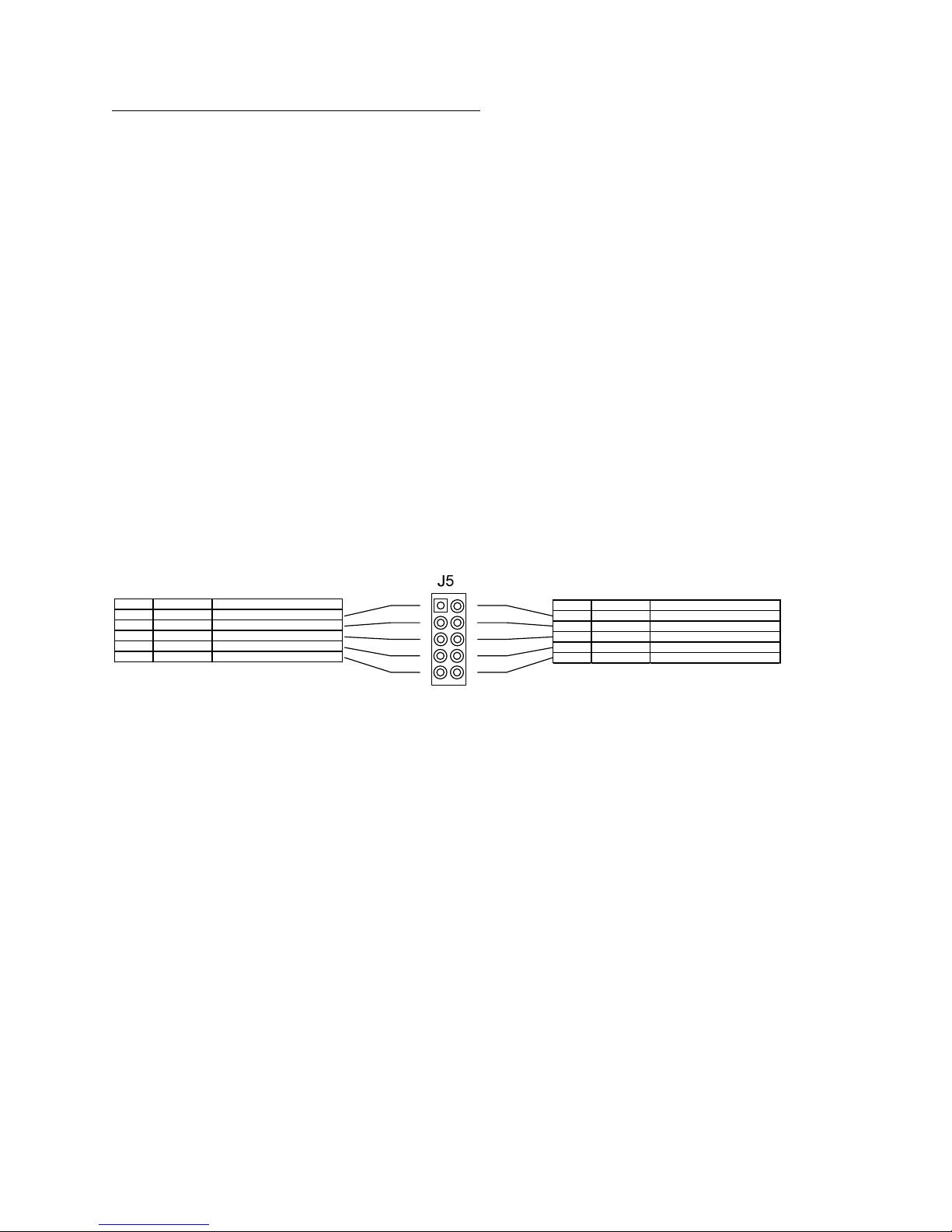
The figure below shows the wiring of 2x5 connector J5, which has the balanced (+) and (-) inputs, and controls
and status flags.
Figure 2. J5 Connector - Balanced signal Inputs, and controls
Pi n Si gnal D escr ipt i on
1 RESET_N Connect t o GND to M ute Amp
3 CH1_IN(+) Channel 1 Balanced Input (+)
5 N/ C Not Used
7 CH2_ IN(+) Channel 2 Balanced Input (+)
9 GND Connect t o Power Supp ly GND
Pi n Si gnal D escr ipt i on
2 CLIP_N Clip Indicator
4 CH1_IN(- ) Channel 1 Balanced In(-)
6 N/ C Not Used
8 CH2_ IN(-) Channel 2 Balanced In(-)
10 OTW_N Over-Temp Warning
10/28/2017 XKITZ XAMP-D2
Page 4

4
Important Note! Differential Speaker Outputs!!!
The speaker outputs of the XAMP-D2 are differential. In other words both the (+) and (-) speaker outputs
are actively driven by the amplifier chip, and neither is connected to ground. This means that if you
measure the voltage of the (+) and (-) speakers outputs, you’ll see that each will be sitting at about ½ of
your power supply voltage with respect to the power supply ground. This is due to the fact that there is
just a single positive power supply, not (+) and (–) supply like some other power amplifiers. But the speaker
drivers don’t care about this DC offset, they only care about the differential voltage between the (+) and (-)
terminals.
When scoping the speaker outputs, be sure to ground the scope to the power supply ground (NOT the
(-) speaker output!), and probe the speaker (+) and (-) outputs with separate scope channels. You’ll see
that the (+) and (-) speaker outputs are 180 degrees out of phase. You’ll also want to put your scope in AC
mode, since the baseline quiescent voltage levels of the speaker outputs will be sitting at ½ of your supply
voltage.
Power Supply
The XAMP-D2 requires only a single positive DC voltage from 24V to 32V. The amplifier will only operate properly
in this voltage range. The higher the voltage, the more audio power the amp can produce. Higher supply voltages
will also produce cleaner audio, even if you’re not running it loud, but it will consume more power.
For portable applications, consider our XRPS-250W Lithium-Ion Battery Power supply, or our XDC-250W
DC/DC converter to boost 12V DC to the required 24V-32V. Either of these power supplies will supply the
required 250W DC voltage.
If you plan to run the amplifier from AC mains voltage, either 120V or 240V AC, consider our Audio Grade 200W
DC power supply: the XAPS-200W. It takes in AC from a power transformer and creates very clean, well
regulated DC voltage for your amplifier.
10/28/2017 XKITZ XAMP-D2
 Loading...