

Page 1

GRAVITY
Titanium Suture Anchor System
SURGICAL TECHNIQUE
®
Page 2

Contents
Chapter 1 3
Chapter 2 4
Chapter 3 5
7
7
7
Introduction
Intended Use
Surgical Technique
Explant Information
Postoperative Care
Ordering Information
Proper surgical procedures and techniques are the responsibility of the medical professional. The following
guidelines are furnished for information purposes only as techniques used by the design surgeons. Each
surgeon must evaluate the appropriateness of the procedures based on his or her personal medical
training and experience. Prior to use of the system, the surgeon should refer to the product package
insert for complete warnings, precautions, indications, contraindications and adverse eects. Package
inserts are also available by contacting Wright Medical Technology, Inc. Contact information can be
found on the back of this surgical technique, and the package insert is available at www.wmt.com.
Please contact your local Wright representative for product availability.
Page 3
Headline
Introduction
1
Headline
GRAVITY® Titanium Suture Anchors are designed to provide optimal stability,
while reducing the number of steps required for implantation. All anchors
feature an internal square drive and suture eyelet, allowing for pre-loaded
suture that is protected during insertion. GRAVITY® Titanium Suture Anchors
are available in 2.7, 3.5, and 5.5mm diameters. GRAVITY® Titanium Suture
Anchors may be used to address a variety of applications that span the
forefoot, midfoot, and hindfoot.
1
chapter
System Benefits
» High-strength Force Fiber® surgical suture maximizes construct stability
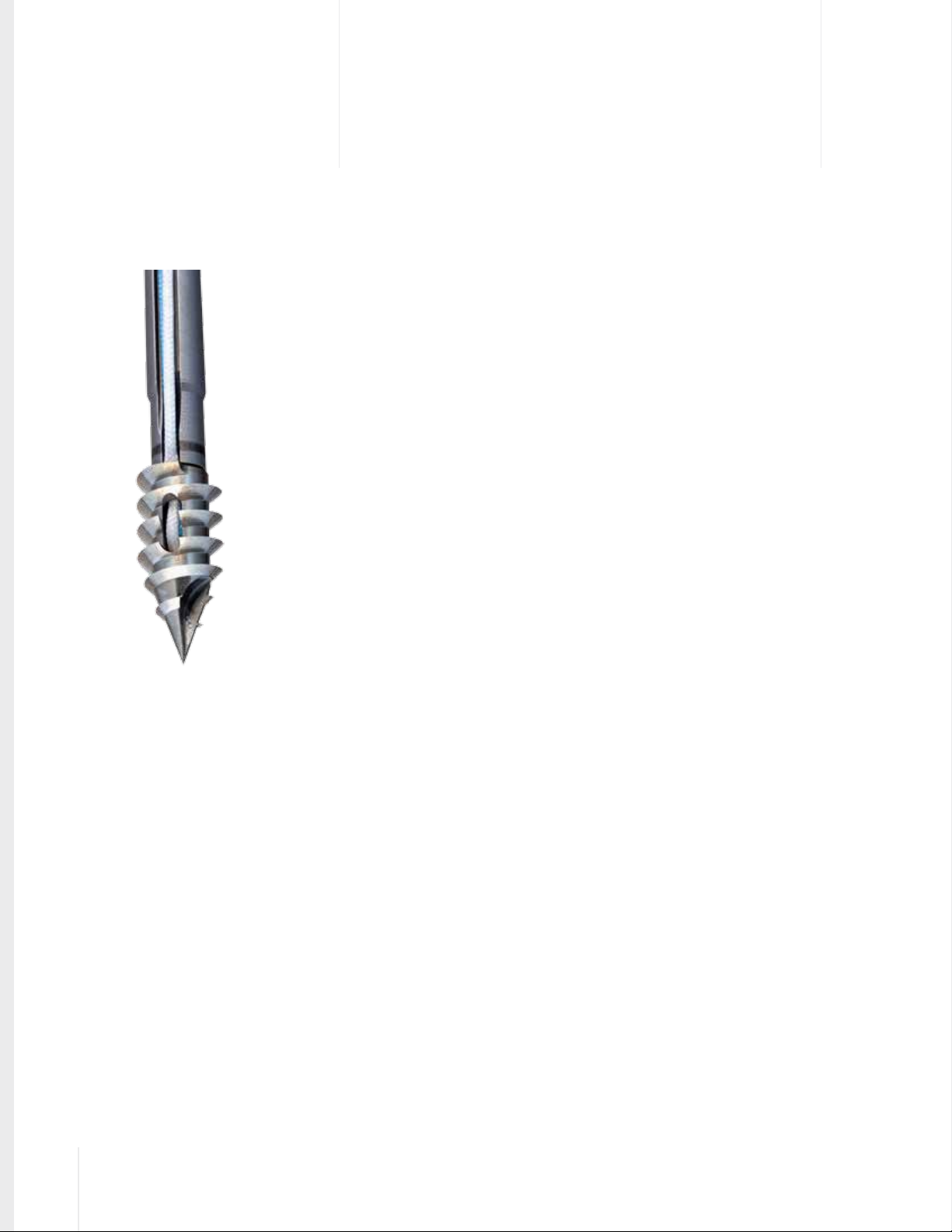
» Fully-threaded titanium anchor design increases pull-out strength
» Aggressive, self-tapping cutting flutes ease anchor insertion
» Silicone-Free Force Fiber® suture features a low-profile design, minimizing
soft-tissue irritation by reducing knot size and allowing for contiguous
placement of multiple knots*
» Suture organization helps save time and streamlines the procedure
» Pre-loaded anchor design eliminates the need for intraoperatively threading
suture through the anchor eyelet or needle, reducing the number of
procedural steps
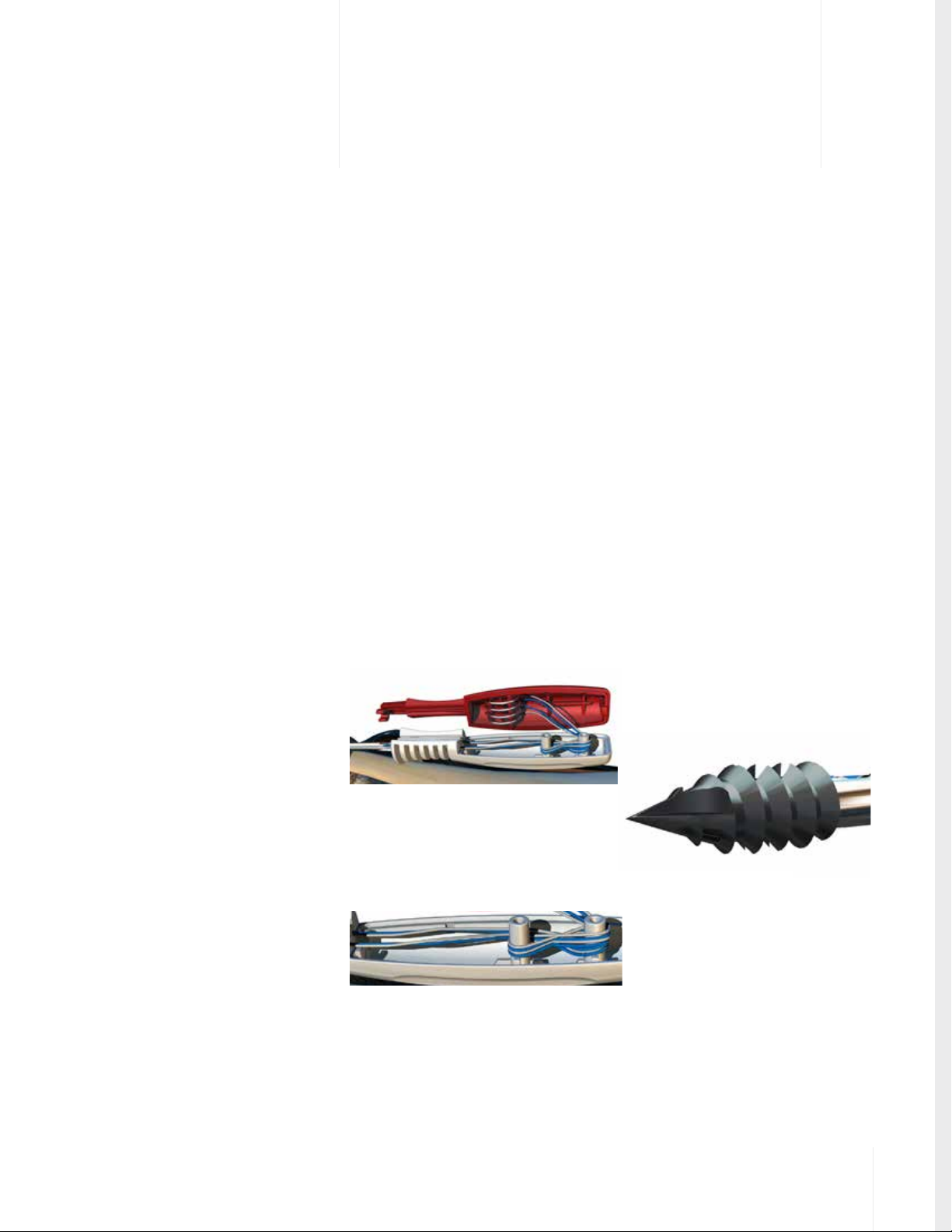
Modular handle design allows for organized
suture & needle deployment.
Silicone-free Force Fiber® braid configuration
enhances suture strength and handling
characteristics.
*Force Fiber® is a registered tradmark of Teleflex
* Data on file at Teleflex
Chapter 1 Description of ChapterChapter 1 Introduction
Self-tapping and self-drilling
cutting flutes ease anchor insertion.
3
Page 4
Headline
Intended Use
Headline
Description
The GRAVITY® Titanium Suture Anchor System features sterile, single-use
devices for use in soft tissue fixation procedures. The implants are available in a
range of sizes and feature anchors threaded with braided polyethylene sutures.
Indications
The GRAVITY® Titanium Suture Anchor System is indicated for use:
» In the repair of shoulder instability, secondary to Bankart lesion, rotator cu
tear, slap lesion, acromioclavicular separation, biceps tenodesis, deltoid tear/
separation, or capsular shift or capsulolabral reconstruction
» In the repair of elbow instability, secondary to biceps tendon detachment,
tennis elbow, or tear. Separation or tear of the ulnar collateral ligament, or
radial collateral ligament.
» In the repair of hand/wrist instability, secondary to tear or separation of the
scapholunate ligament, ulnar collateral ligament, or radial collateral ligament
» In the repair of knee instability, secondary to tear or separation of the medial
collateral ligament, lateral collateral ligament, patellar tendon, or posterior
oblique ligament, or secondary to iliotibial band tenodesis
» In the repair of foot/ankle instability, secondary to tear or separation
of the Achilles tendon, lateral stabilization tendons/ligaments, medial
stabilization tendons/ligaments, midfoot tendons/ligaments,or metatarsal
tendons/ligaments, tendon transfers, tendon reattachments, and ligament
reconstructions of the midfoot, forefoot, and hindfoot procedures associated
with flatfoot reconstruction, hindfoot deformity, midfoot reconstruction,
lateral/medial ankle reconstruction or instability, Hallux Valgus or Varus, and
MTP instability including:
» Achilles reattachment/reconstruction
» Flexor digitorum longus transfer
» Flexor hallucis longus transfer
» Extensor hallucis longus transfer
» Brostrom procedures
» Peroneal tendon relocation
» Capsule repair
» Deltoid reconstruction / reattachment
» Plantar plate repair
» Spring ligament repair
2
chapter
4
Chapter 2 Intended Use
Chapter 1 Description of Chapter
Page 5

Surgical
Technique
GRAVITY® Titanium Suture Anchor Size Assessment
The GRAVITY® Titanium Suture Anchor System features multiple anchor
diameters and suture options. The surgeon’s final decision on anchor size and
suture should be based on the procedure’s requirement of the device, the
degree of soft-tissue tension involved, and the patient’s anatomy.
Suture Anchor Sizing Matrix
Part Number
86TA2027 2.7 x 7.6mm 2-0 Force Fiber® 1
86TAN035 3.5 x 9.6mm #0 Force Fiber® 2
86TAN255 5.5 x 12.7mm #2 Force Fiber® 2
Pre-Drilling
In most cases, the design of the GRAVITY® Titanium Suture Anchor allows it
to be inserted without tapping or pre-drilling. The surgeon may choose to use
a pre-drill to ease the insertion torque required to insert the anchor. When
needed, choose the appropriate drill as indicated below.
Anchor Size
(Diameter/Length)
Suture Size / Type Suture Quantity
3
chapter
Part Number Description Pre-drill Diameter
86TA2027 2.7mm Anchor 2.0mm 58850020
86TAN035 3.5mm Anchor 2.5mm 58850025
86TAN255 5.5mm Anchor 3.5mm 58850035
Note: GRAVITY® Titanium Suture Anchors do not come with pre-drills. If a pre-drill is requested,
the sales representative is responsible for suppling the appropriate size.
Drill Bit Part
Number
Chapter 3 Surgical Technique
5
Page 6
GRAVITY® Titanium Suture Anchor 5.5mm
(P/N 86TAN255)
Anchor Positioning
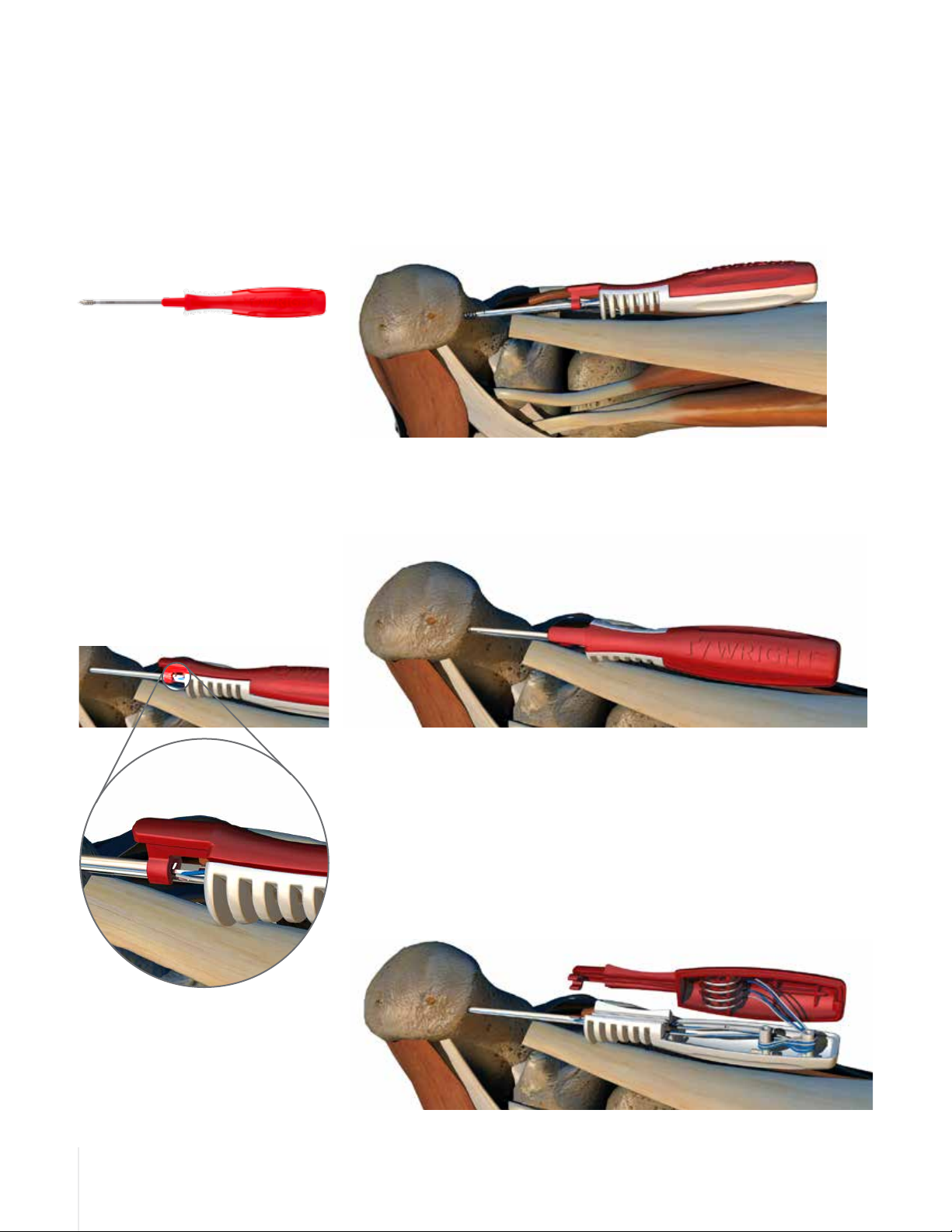
Prior to insertion, position the driver tip to achieve the desired trajectory. While
maintaining slight pressure and ensuring that the anchor is free of soft-tissue,
rotate the handle clockwise to begin advancement.
Anchor Seating
Advance the anchor until the optimal depth has been reached. A driver shaft
depth marker is located 1mm above the anchor and may be used as a reference
during insertion.
| Figure 1
Suture Deployment
All anchors are loaded with ForceFiber® sutures which pass through the anchor,
up the driver shaft, and wrap inside the suture cartridge. Upon final seating of
the anchor, release the suture cartridge by pulling back on the cartridge’s driver
shaft clasp and disengaging it from the driver shaft. | Figure 1 When the suture
cartridge is fully disengaged from the handle, gently pull back on the driver
handle to release the driver tip from the suture anchor. | Figure 2
Set aside the driver handle and maintain possession of the suture cartridge.
| Figure 2
6 CROSSCHECK® Plating System
Chapter 3 Surgical Technique
Page 7
Soft-tissue Fixation
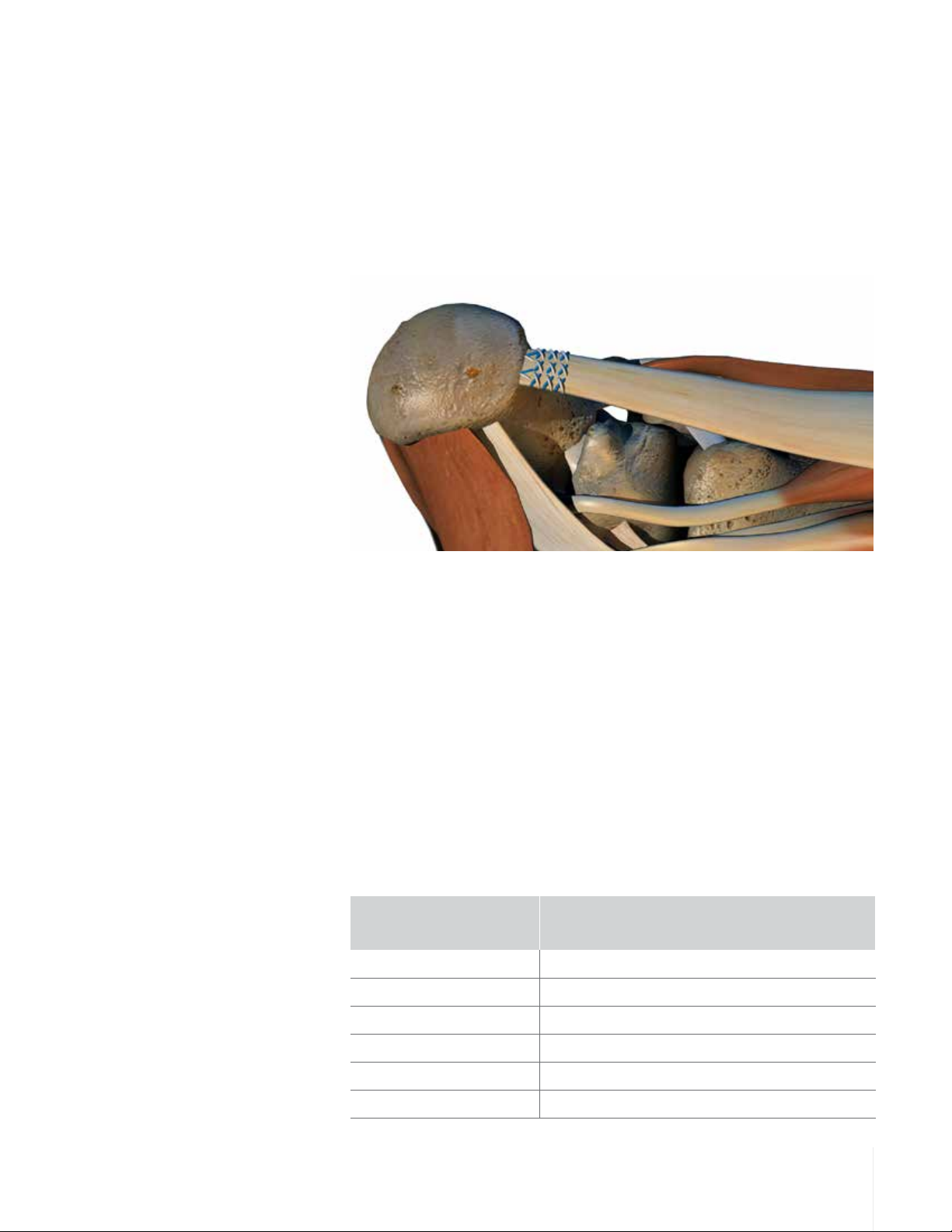
Using a needle driver, hemostat, or forceps, remove each needle from the
cartridge and drive them through the desired soft-tissue, tensioning the tissue
as needed. Secure the soft-tissue to the bone by tying knots with the suture. It
may be helpful to use the suture cartridge to organize the needles and suture
during soft-tissue fixation.
Explant Information
The implant can be removed if needed. To re-engage the anchor, utilize the
handle and driver shaft of the appropriate size driver (see sizing chart). Insert
the driver tip into the anchor and rotate the handle counterclockwise to
remove the implant.
Postoperative Management
If the removal of the implant is required due to revision or failure of the device,
the surgeon should contact the manufacturer using the contact information
located on the back cover of this surgical technique to receive instructions for
returning the explanted device to the manufacturer for investigation.
Postoperative Care
Postoperative care is the responsibility of the medical professional.
Ordering Information
Part Number Description
86TA2027 2.7mm TI ANCHOR WITH 2-0 SUTURE
86TAN035 3.5mm TI ANCHOR WITH #0 SUTURE
86TAN255 5.5mm TI ANCHOR WITH #2 SUTURE
58850020 2.0mm Drill
58850025 2.5mm Drill
58850035 3.5mm Drill
7Chapter 3 Surgical Technique
Page 8

Wright Medical Technology, Inc.
1023 Cherry Road
Memphis, TN 38117
800 238 7117
901 867 9971
www.wmt.com
Wright Medical EMEA
Atlas Arena, Australia Building
Hoogoorddreef 7
1101 BA Amsterdam
the Netherlands
011 31 20 565 9060
Wright Medical UK Ltd.
Unit 1, Campus Five
Letchworth Garden City
Hertfordshire SG6 2JF
United Kingdom
011 44 (0)845 833 4435
™Trademarks and ®Registered marks of
Wright Medical Technology, Inc.
©2015 Wright Medical Technology, Inc.
All Rights Reserved. 012790A_29-Jul-2015
 Loading...