

Page 1
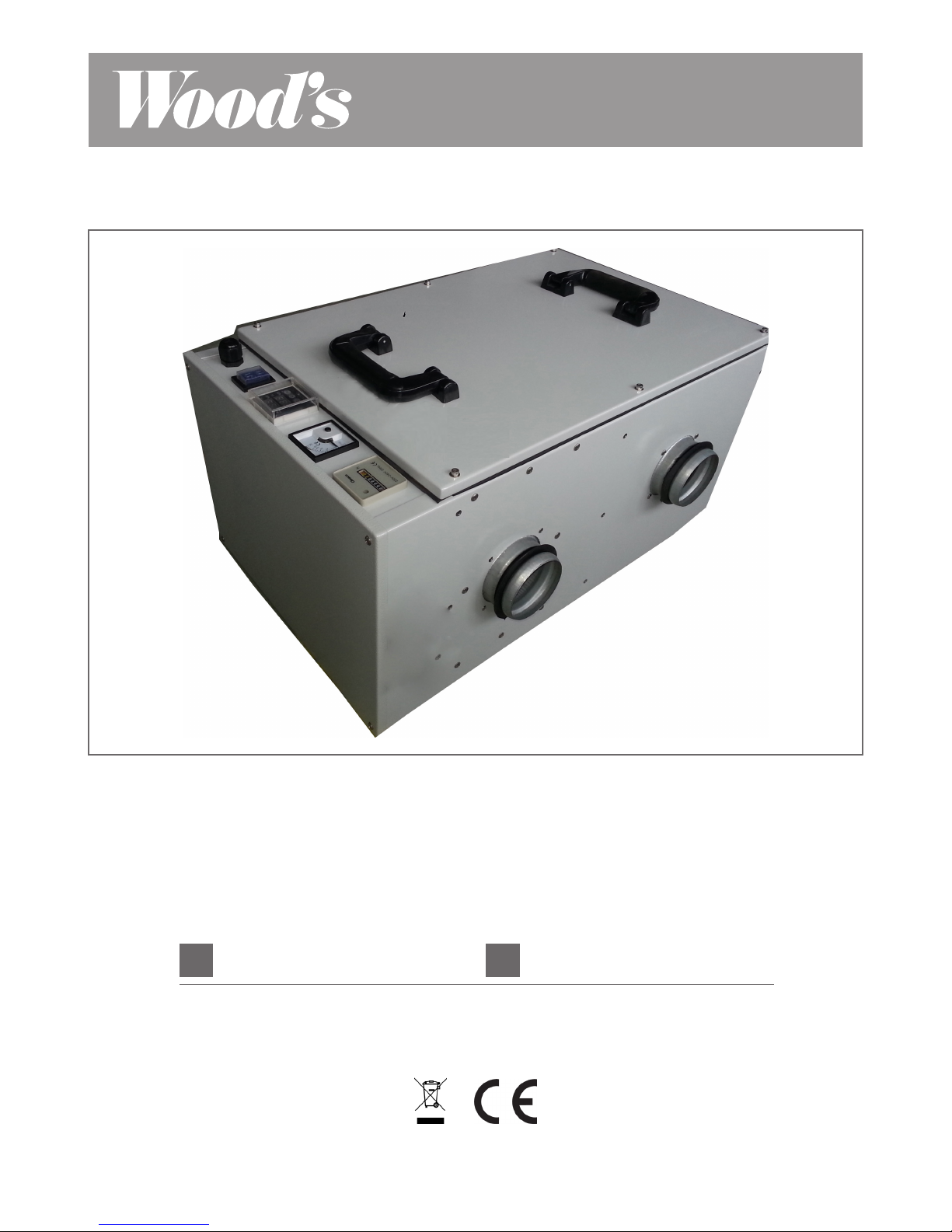
DESICCANT DEHUMIDIFIER
Users manual Wood’s WP-200AP
GB S
Operating instructions
Bruksanvisning
Please read this manual carefully before installing and save
the manual for future reference and product warranty.
Page 2

THANK YOU!
Thank you for choosing a Wood’s dehumidier. In this manual you’ll
nd everything you need to know about your Wood’s dehumidier.
Please keep this manual in a safe place for future reference.
Wood’s WP-200AP
2.
Page 3
TECHNICAL DATA
Technical data
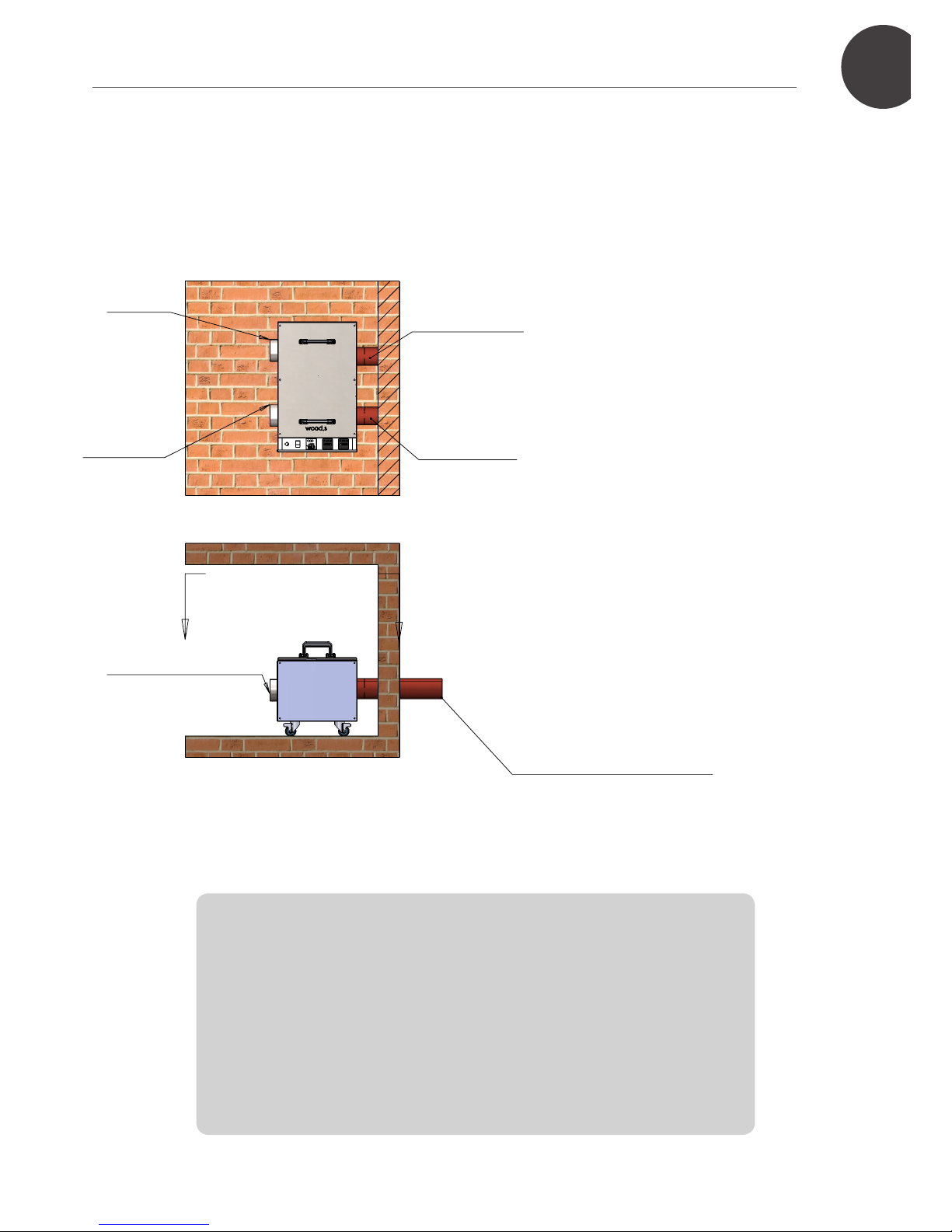
A
A
Reactivation Air inlet
Process Air Inlet
Wet Air Outlet
Reactivation
Air inlet
Dry Air Outlet
Process
Air Inlet
Indoor installing.
Install in a well ventilated space
INDOOR INSTALLING
The Reactivation Air Inlet and Wet Air Inlet must be
installed outside. The ideal distance between the
pipes is 2m. No pipe is needed for the Process Air Inlet.
OUTDOOR INSTALLING
The pipes for Dry Air Outlet and Process Air Inlet
should be set in the moist area indoors. No pipes are
needed for the remaing holes.
INDUSTRY INSTALLING
The Dry Air Outlet and Process Air Inlet should be set
in the moist area inside. The remaining pipes should
be set inside.
3.
The Reactivation Air outlet
Max. working area 180m²
Recommended working area 10-140m²
Air ow 220 m³/h
Capacity at 20ºC & 60% RH 14,4 litres
Power at 20ºC & 70% RH 1,2 kW
Power at 35ºC & 80% RH 1,5 kW
Fan speeds 1
Dims LxWxH 440x300x678 mm
Weight 30 kg
Sound level 51 dB
IP rating IPX2
Page 4

Operating instructions
GB
1. INSTALLATION
The WP-200AP dehumidiers are suitable for indoor & outdoor installation. To ensure the quality and reliability
of the dehumidier, each machine has passed inspection tests before delivery. If the machine will be stored for
a long time before being used, please comply with notes as below:
• Do not abandon or destroy the original package.
• Avoid any physical damage.
• Prevent dust, frost and rain.
1.1 Inspection
First, check if there has occurred any damages during the transportation. Open the package, and connect the
power cord to test the product. If any damage is found, please contact the manufacturer.
Secondly, connect the pipes to the machine, and check if the layout of the pipes is appropriate. If environmental
and installation conditions are not satisfactory, please contact the manufacturer for help.
1.2 Safe Operation
Warning! Use a carrying & lifting device to carry the unit to prevent any injury or damage as the dehumidier weighs
more than 30 kg. Avoid turning the unit upside down.
Warning! Please read the nameplate data before electrical works. Local professionals must do all electrical connecting
works. Ensure that the machine is connected to the specied voltage and frequency of power supply.
Be careful! To prevent damage, Never connect the dehumidier direclty to an air conditioning system.
1.3 Location requirements
The dehumidier is suitable for indoor & outdoor use. For the convenience of maintenance and inspection,
some space around the machine should be retained. In order to prevent condensation inside the machine, it
should not be placed in conditions in which the air temperature is below the dew point. In addition, if the ma-
chine is installed outdoors, some protective measures should be done to prevent rain, snow and dust and etc.
1.4 Installation base
The dehumidier must be installed on at a ground or platform of which the capacity is enough to bear the total
weight of the dehumidier. After installation works, re-check that the dehumidier is placed at and continue
the installation. If the dehumidier requires a xed installation, the mounting holes should be done in the prefabricated steel feet.
WOOD’S - THE WORLD’S LEADING DEHUMIDIFIERS
Wood’s dehumidiers have been known as market leaders for many years. Wood’s dehumidiers are suitable
for use in the most demanding climates, and have high dehumidifying capacity even at lower temperatures and
humidity levels. They are used with good results in premises that become damp such as cellars, garages or summer-houses. They are also excellent for drying washing, attics, pool rooms and laundry, being ecient and low
on energy consumption. Wood’s dehumidiers will dry your clothes eciently without wearing them out.
The amount of humidity that the dehumidier removes depends on temperature, humidity level and placement.
External weather conditions may also aect the performance of the dehumidier. In cold weather the actual
humidity, (in grams per cubic meter air) decreases and thus the extraction of humidity from the air by the dehumidier is reduced. The dehumidier is suitable for use in the temperature range -20˚C to +35˚C. Wood’s dehumidiers are safe in operation and intended for continuous use over many years.
EXCESSIVE AIR HUMIDITY - A DANGER
Condensation occurs when water vapour in the air comes into contact with a cold roof, window or wall. When
water vapour is cooled down, condensation occurs, and water-drops are formed. In high air humidity, the air
may get musty and mould is formed, causing damage to a house and its furnishings. This environment may
even cause illness for the residents, since mites and other creatures thrive in a damp environment. A dehumidier with high performance creates a good, healthy humidity level, and for greatest eciency the doors and
windows of rooms that are being dehumidied should be kept closed. Wood’s dehumidiers remove odours,
dries wood and remove moisture from sportswear outdoors equipment. A dehumidier may be used in cellars,
washrooms, garages, crawl spaces, caravans, summer-houses and on boats.
IMPORTANT :
Wood’s dehumidiers must be connected
to an earthed power source.
5.
Page 5

Operating instructions
GB
1.5 Pipe Connection
The dimension of pipes for processing air and reactivation air should be in line with ISO7807 recommended
values. Pipes should be connected with the connection part on the ange; meanwhile, the screw bolt is limited
to within 20mm. While connecting the input and out pipes, please follow the notes below:
• In order to reduce loss of static pressure, shorten the length of the pipe if possible.
• To ensure the performance of the machine, all rigid (galvanized) pipe ttings are required to have
air-tightness.
• The pipes should have a good capacity of thermal insulation, then the phenomenon of moisture condensation inside pipe wall will be avoided, and the pipeline won’t be corroded.
• To reduce noise and vibration transmitted along the pipes, good quality, soft and strong airtight adapting
pieces should be used in the joint parts.
• If needed, install air valves in the pipes of processing air and reactivation air.
• If the reactivation air is introduced from outdoor dehumidier, the terminal of reactivation air pipe
should be high enough o the ground to prevent inhaling dust and debris, meanwhile, it must be far
away from sources of pollution such as energy emissions, steam and gases. In order to prevent wet air
being inhaled into the machine, the distance should be at least one meter between wet air pipe terminal
and reactivation air pipe terminal. In addition, the pipe should be designed to prevent snow and rain
intrusion.
• It is very wet in the wet air pipe. You should therefore make sure that the wet air pipe is installed in a
downward slope so that no water runs back into the dehumidier.
Be careful! As it is very wet in the wet air pipe, condensation water is easily formed on the inner wall of the pipe. If
there is danger of freezing, thermal insulation measures must be taken while the temperature is low. Sucient support
is needed under the pipes.
1.6 Electrical connection
Be careful! All electrical connection works must obey local electrical equipment installation standards, and be done by
qualied professionals. The machine needs three-phase AC power supply. Voltage and frequency are recorded in the
nameplate.
• It is forbidden to connect the power supply beyond the specied voltage and frequency.
• Before the three-phase AC power is supplied, its real status should be checked to ensure that its voltage
and frequency uctuation does not go beyond ±10%.
• Unit must be grounded. Set the power isolation switch to ensure the machine is totally shut o during
checking work. The main switch should be directly connected with the main power devices.
1.7 Inspection works before starting the dehumidier
Warning! All electrical works must be done by professionals who know the potential hazards during work, such as high
pressure, high temperature. Before the initial start, some inspection works is needed, and the power must be o during
the inspecting. The works includes:
• Check and ensure that the switch is placed into the “o” (OFF) position.
• Check and ensure that the air inlet lter is intact and that the various parts of the equipment is clean.
• Check and ensure that all of the air hoses are undamaged, and that the air hose is smooth.
• Switch the unit on, and place it into “Manual (MAN)” position, an indication light is illuminated.
• Check the blower, ensure that the rotation direction is correct. The correct direction of rotation is
• indicated by the arrow on the fan casing. If the fan’s rotation is incorrect, the dehumidier is provided a
reversed phase sequence.
• Check and ensure that the desiccant wheel rotation direction is consistent with the direction of the
• arrow, and conrm that there is no skidding between the wheel and belt.
• Switch to “o” (OFF) position, the machine should stop running.
NOTE :
If the supply cord is damaged, it
must be replaced by the manufacturer,
its service agent or similarly qualied
persons in order to avoid hazard.
NOTE :
Always disconnect the cord
before cleaning or maintenace.
6.
Page 6
2. CONTROL PANEL OVERVIEW
The standard control orders of WP-200AP dehumidiers have been set well before delivery if no special requirements from customers. The WP-200AP is easy to operate. Before operation, please read the technical manuals
and other related equipment information.
Warning! Please read this Manual carefully before using the machine, the manufacturer and seller won’t bear the loss
caused by wrong operation
Warning! If the electronic control system fails, please turn o the power immediately, and carry out the general inspec-
tion and maintenance. Never arbitrarily modify the circuit and related settings before the cause is found out. Other the
manufacturer or seller won’t bear the loss.
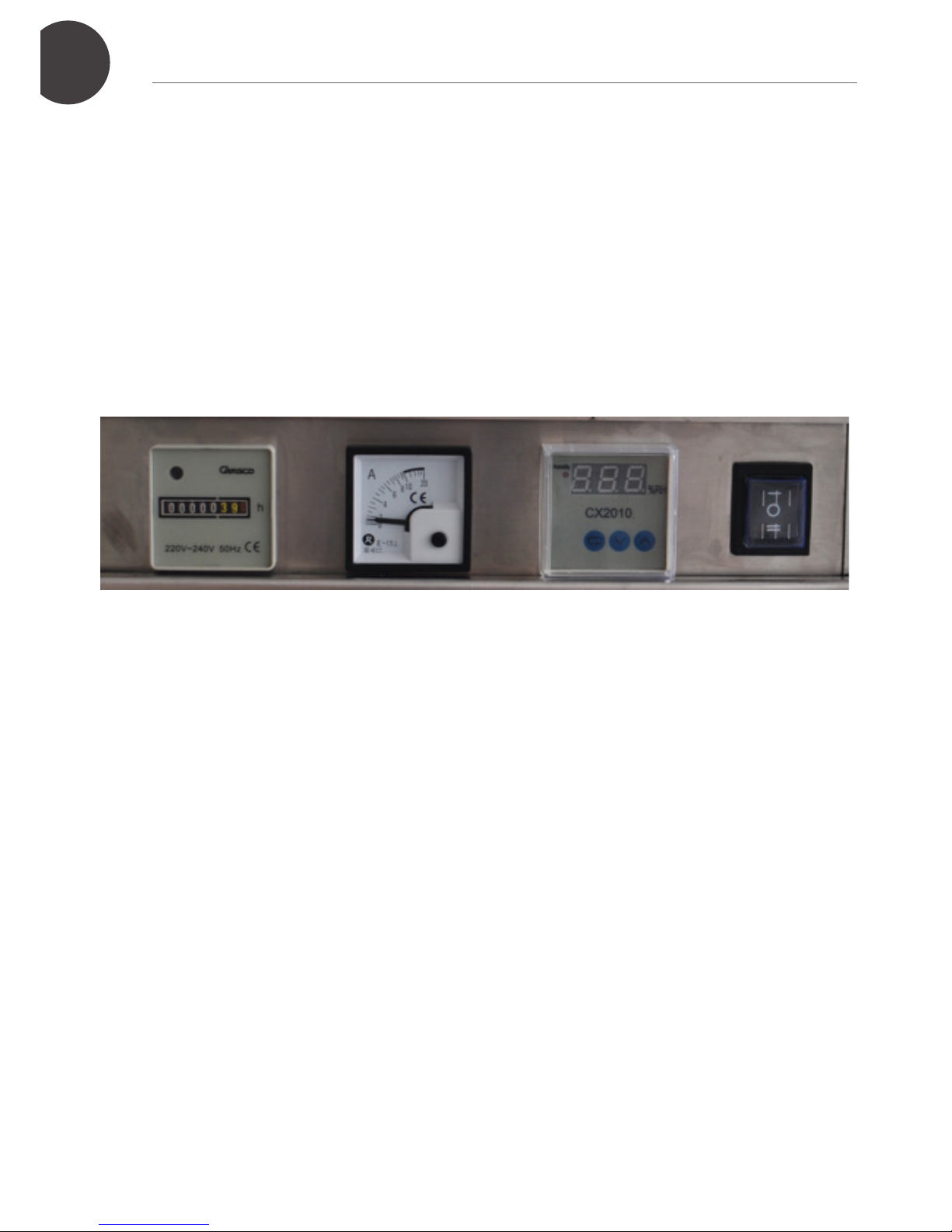
2.1 Control panel
Timer: showing the cumulative working time
Ammeter: Showing the current of the reactivation heater
Humidometer: The humidometer has three buttons; “mode”, “down” and “up”
Power switch:
O: O mode; —- 1 = Manual (MAN) working model, 2 = Automatic (AUT) working mode
MAN: The unit will run continuously until it is turned o.
AUT (Automatic running): The unit will run until set humidity level is reached and then shut o. When the ambient humidity rises above set humidity level, the machine will automatically restart.
Be careful! When switched on (MAN or AUT position), the blowers, wheel and heater will run simultaneously, the ammeter will show the current of reactivation heater while it becomes stable, in addition, the timer will begin to accumulate
the total cumulative working time.
When set in MAN position, the dehumidiers fan wheel and heater will run continuously. No controls can be set
by the user. When set in AUT position, the desired humidty level must be set through the control panel. Switch
OFF, all parts will stop working.
2.2 Set steps:
While the machine is on “MAN working mode”, the humidometer light is o, user can not set it either, and the
machine will keep working continuously in the area until shut o.
While the machine is in “Auto working mode”, the humidometer light is on, it will show the current RH level, and
is set as below:
A:Press the “mode” button one time to enter the setting mode, press “down” or “up” until the humidometer shows the
desired RH level. The setting range is 1%-99%;
B:Press the “mode” button a second time, the humidometer will show the current RH level again;
C: Press the “mode” button a third time, the setting work is nished.
During the setting process, the power must be on
CONTROLS
Operating instructions
GB
7.
Page 7

Bruksanvisning
SE
1. INSTALLATION
WP-seriens avfuktare passar för såväl inomhus- som utomhusbruk. Varje avfuktare har genomgått inspektionstester innan leverans för att säkerställa dess kvalitet och pålitlighet. Om avfuktaren förvaras under en längre tid
innan användning rekommenderar vi att du följer instruktionerna nedan:
• Släng eller förstör inte originalemballaget.
• Undvik att avfuktaren skadas.
• Skydda avfuktaren från damm, vatten och kyla.
1.1 Inspektion
Det är viktigt att du först säkerställer att avfuktaren inte har skadats under transporten. Packa upp avfuktaren
och koppla in den för att se att den fungerar. Om du upptäcker någon skada ska du kontakta leverantören.
Koppla in rören och säkerställ att de passar avfuktarens dimensioner. Kontakta leverantören om de inte passar.
1.2 Säkerhetsföreskrifter
Varning! Avfuktaren väger över 30 kg. Undvik skador när du lyfter eller yttar avfuktaren. Undvik att vända avfuktaren
upp och ned.
Varning! Studera avfuktarens märketikett innan du kopplar in den till ett eluttag. All elektrisk installation måste skötas
av tekniskt kunnig personal.
Var försiktig! Koppla aldrig avfuktaren direkt till ett luftkonditioneringssystem.
1.3 Placering
Avfuktaren går att använda såväl inomhus som utomhus. För att enkelt komma åt avfuktaren bör avfuktaren
inte placeras direkt mot en vägg. För att förhindra kondens inuti avfuktaren bör den inte placeras i utrymmen
med en temperatur under daggpunkten. Om avfuktaren används utomhus bör den täckas över för att skyddas
mot regn, snö, smuts och dylikt.
1.4 Installation
Avfuktaren måste installeras på ett plant underlag som klarar av att bära avfuktaren vikt. Kontrollera efter installationen att avfuktaren verkligen står plant. Fortsätt att ställa in avfuktaren efter att du kontrollerat att den står
på ett plant underlag. Om du behöver fästa avfuktaren på en yta ska fästhålen göras i avfuktaren stålfötter.
WOOD’S, VÄRLDENS LEDANDE AVFUKTARE
Wood’s avfuktarprodukter har i många år varit kända som marknadsledande. De lämpar sig för användning i de
mest krävande klimat och har en bra kapacitet även vid lägre temperaturer och fuktighetsnivåer. Wood’s används med gott resultat i utrymmen med hög luftfuktighet källare, krypgrunder, garage eller fritidshus. Wood’s
avfuktare är också utmärkta för att torka tvätten, på vinden, pool-rum och tvättstuga. De är eektiva och energisnåla och torkar kläder utan slitage.
Mängden fukt som avfuktaren samlar upp beror på rumstemperatur, fuktighetsnivå och placering. Även vädret
utomhus påverkar avfuktarens prestanda. Vid kallt väder sjunker den relativa fuktigheten (i gram per kubikmeter luft) och minskar därmed avfuktarens fuktuttag ur luften. Wood’s WP-200AP är lämplig för användning vid
temperaturer från -20˚C till +35˚C. Wood’s avfuktare är säkra vid drift och är avsedda att fungera kontinuerligt
under många år.
HÖG LUFTFUKTIGHET - EN FARA
Kondens uppstår när luftens vattenånga kommer i kontakt t.ex. med kalla tak, fönster eller väggar. När vatten
ångan kyls ner sker en kondensering varvid vattendroppar bildas. Vid hög luftfuktighet kan luften bli unken
mögel uppstå, vilket gör att huset och dess inredning tar skada. En sådan miljö kan leda till sjukdomar hos dem
som bor i huset då bl. a. kvalster trivs i en fuktig miljö. En avfuktare med hög prestanda skapar en bra och hälsosam fuktighetsnivå och för att nå bästa eekt ska dörrar och fönster i de rum som avfuktas vara stängda.
Wood’s avfuktare avlägsnar lukter, torkar trä och ger dig ett mer hälsosamt inomhusklimat. En avfuktare kan användas i källare, tvättrum, garage, krypgrunder, husvagnar, fritidshus och båtar. Wood’s avfuktare torkar kläder
utan slitage.
VIKTIGT!
Wood’s avfuktare måste anslutas till ett
jordat eluttag.
8.
Page 8

1.5 Röranslutning
Dimensionen för rören som går till och från avfuktaren skall vara i linje med rekommenderade värden enligt
ISO7807. Rören skall anslutas till änskopplingarna på avfuktaren. Tänk på följande när du ansluter rören till
avfuktaren:
• För att undvika att tappa tryck, använd så korta rör som möjligt.
• För bästa kapacitet bör alla röranslutningar tätas.
• Rören skall ha god värmeisolering för att undvika kondens och korrosion.
• För att undvika oljud och vibrationer i rören bör du använda packningar av hög kvalitet.
• Vid behov, installera en luftventil vid tilluft och frånluft.
• Om luften hämtas utifrån måste insuget hållas fritt från smuts och skräp och samtidigt hålla ett säkert
avstånd från avgaser, ånga och luftföroreningar. För att undvika att fuktig luft sugs in i maskinen bör
röret som tar in fuktig luft vara minst 2 meter långt. Dessutom bör röret vara skyddat mot snö och regn.
• Då det är mycket fukt i utblåsröret bör det placeras i en nedåtlutning så att fukten försvinner ut från
maskinen.
Var försiktig! Då det är väldigt fuktigt i utblåsröret bör röret isoleras om det nns risk för frost. Säkerställ att rören har
ordentligt stöd.
1.6 Elektrisk installation
Var försiktig! All elektrisk installation måste följa lokala föreskrifter och utföras av kvalicerad personal. Enheten kräver
trefas växelström. Spänning och frekvens är angivet på enheten.
• Kontrollera att dina lokala ström- och spänningsförhållanden överensstämmer med avfuktarens.
• Före trefas växelström ansluts bör den kontrolleras för att säkerställa att dess spänning och frekvens
inte har en variation som överstiger ±10%.
• Avfuktaren måste anslutas till ett jordat uttag. Se till att avfuktaren är ordentligt avstängd innan du installerar den. Avfuktaren bör kopplas till en huvudströmbrytare.
1.7 Innan du startar avfuktaren
Varning! All installation måste göras av kvalicerad personal som känner till de potentiella risker inblandade i arbetet,
exempelvis högt tryck och hög temperatur. Innan du använder avfuktaren för första gången bör du göra visst inspektionsarbete. Detta innefattar:
• Kontrollera att avfuktaren är avstängd. (OFF)
• Kontrollera att luftltret är intakt och att avfuktarens delar inte är smutsiga.
• Kontrollera att alla slangar är intakta och att de inte har skadats vid transporten.
• Sätt på avfuktaren och sätt den i position “Manual (MAN)”. En lampa lyser på kontrollpanelen.
• Kontrolla äkten och säkerställ att rotationen går i rätt riktning. Den ska rotera enligt pilen på äkt-
kåpan. Om äkten roterar i fel riktning tyder det på att avfuktaren är felaktigt inkopplad.
• Kontrollera att torkhjulet roterar i enlighet med pilen på hjulet och att det inte uppstår något glapp
mellan hjulet och remmen.
• Stäng av avfuktaren. Avfuktaren slutar arbeta.
Bruksanvisning
SE
OBS:
Dra alltid ut strömsladden innan
rengöring och underhåll.
OBS :
Om strömkabeln är skadad
måste den bytas ut av tillverkaren, dess
serviceagentur eller liknande kvalicerade personer för att undvika skada.
9.
Page 9
Bruksanvisning
SE
2. ÖVERSIKT
WC-serien levereras med standardinställningar om inga speciella önskemål gjorts. WP-200AP är enkel att hantera, det är dock viktigt att du noggrant läser manualen och annan teknisk information innan du först använder
avfuktaren.
Varning! Läs manualen noggrant innan du använder avfuktaren. Skador orsakde av handhavandefel täcks inte av
garantin.
Varning! Om kontrollsystemet slutar att fungera, stäng omedelbart av strömmen till avfuktaren och utför en noggrann
inspektion av avfuktaren. Modiera aldrig själv avfuktarens elektronik då det kan göra garantin ogiltig.
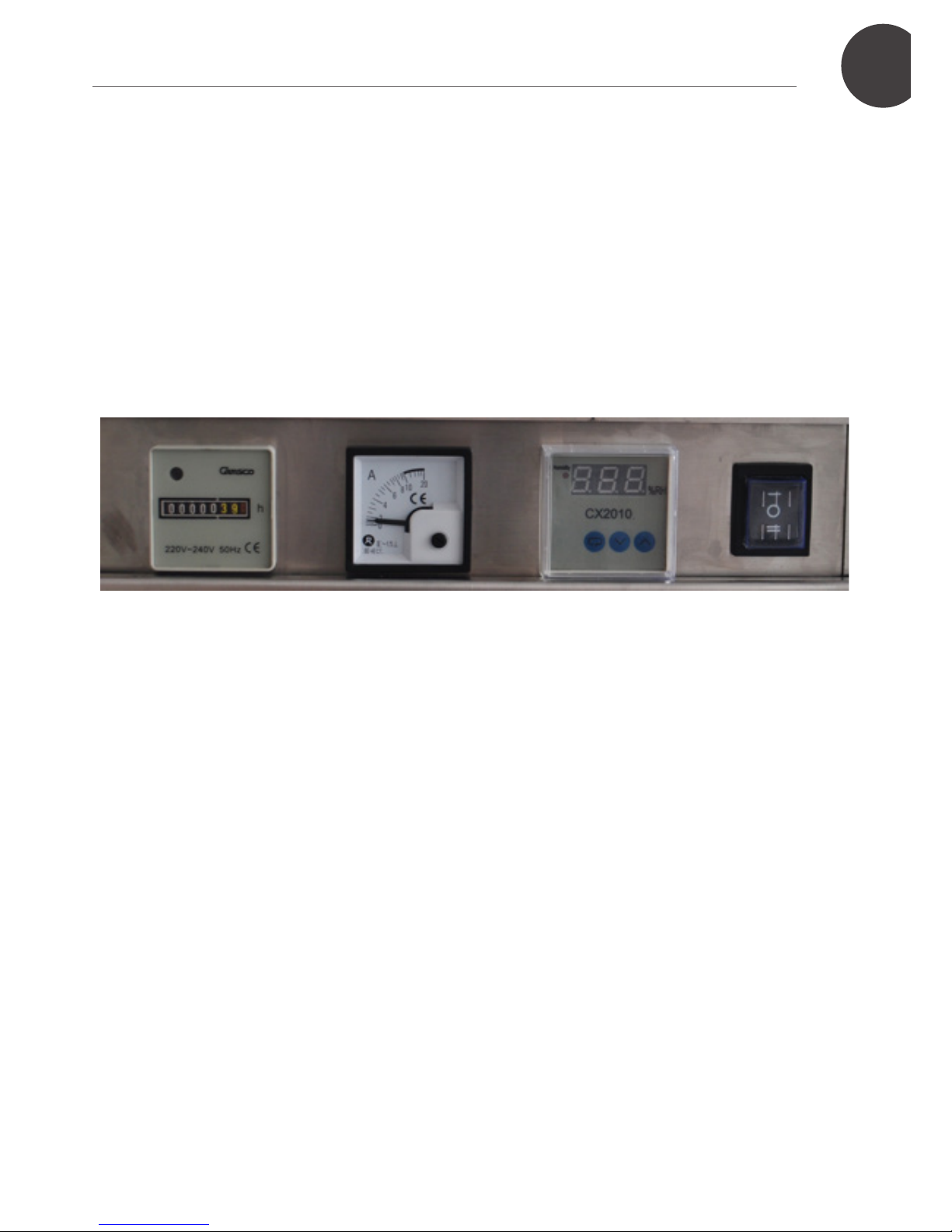
2.1 Kontrollpanel
Timer: visar den totala arbetstiden
Ammeter: Visar värmarens spänning
Hygrostat: Hygrostaten har tre knappar: “mode”, “ner”, “upp”
Brytare:
O: OFF , maskinen är avstängd; 1: Manuellt läge (MAN), 2: Automatiskt läge (AUT)
MAN: Innebär att maskinen arbetar kontinuerligt tills den stängs av.
AUT: Avfuktaren arbetar tills önskad fuktighetsnivå är uppnådd och stänger sedan av sig. När fuktighetsnivån
stiger startar maskinen automatiskt igen.
Var försiktig! När maskinen körs i manuellt eller automatiskt läge arbetar äkten, hjulet och värmaren samtidigt. Ammetern visar värmaren spänning och timern börjar räkna. Då avfuktaren körs i manuellt läge arbetar äkthjulet och
värmaren kontinuerligt. Inga inställningar kan göras i manuellt läge. Då avfuktaren körs i automatiskt läge måste du
först göra inställningar på kontrollpanelen eller via en extern hygrostat.
2.2 Inställningar:
När avfuktaren körs i manuellt läge är hygrostatlampan släkt och inga hygrostatinställningar kan göras. Avfuktaren fortsätter att arbeta tills den stängs av.
När avfuktaren körs i automatiskt läge lyser hygrostatlampan och aktuell fuktighetsnivå visas. Önskad fuktighetsnivå ställs in enligt följande:
A: Tryck på MODE en gång för att för att gå in i inställningsläge. Tryck på knapparna UPP och NER för att ställa in önskad luftfuktighetsnivå mellan 1-99% RF (relativ fuktighetsnivå).
B: Tryck på MODE en gång till för att gå ur inställningsläget. Avfuktaren återgår till att visa aktuell fuktighetsnivå.
C: Tryck på MODE en tredje gång för att slutföra inställningarna.
Avfuktaren måste vara igång för att du ska kunna göra några inställningar.
KONTROLLPANEL
10.
Page 10

Contact:
Wood’s is marketed and distributed by TES Scandinavia AB
Krokslätts fabriker 30
431 37 – Mölndal, Sweden
+46(0)31-761 36 10
www.woodseurope.com
11.
 Loading...