

Page 1
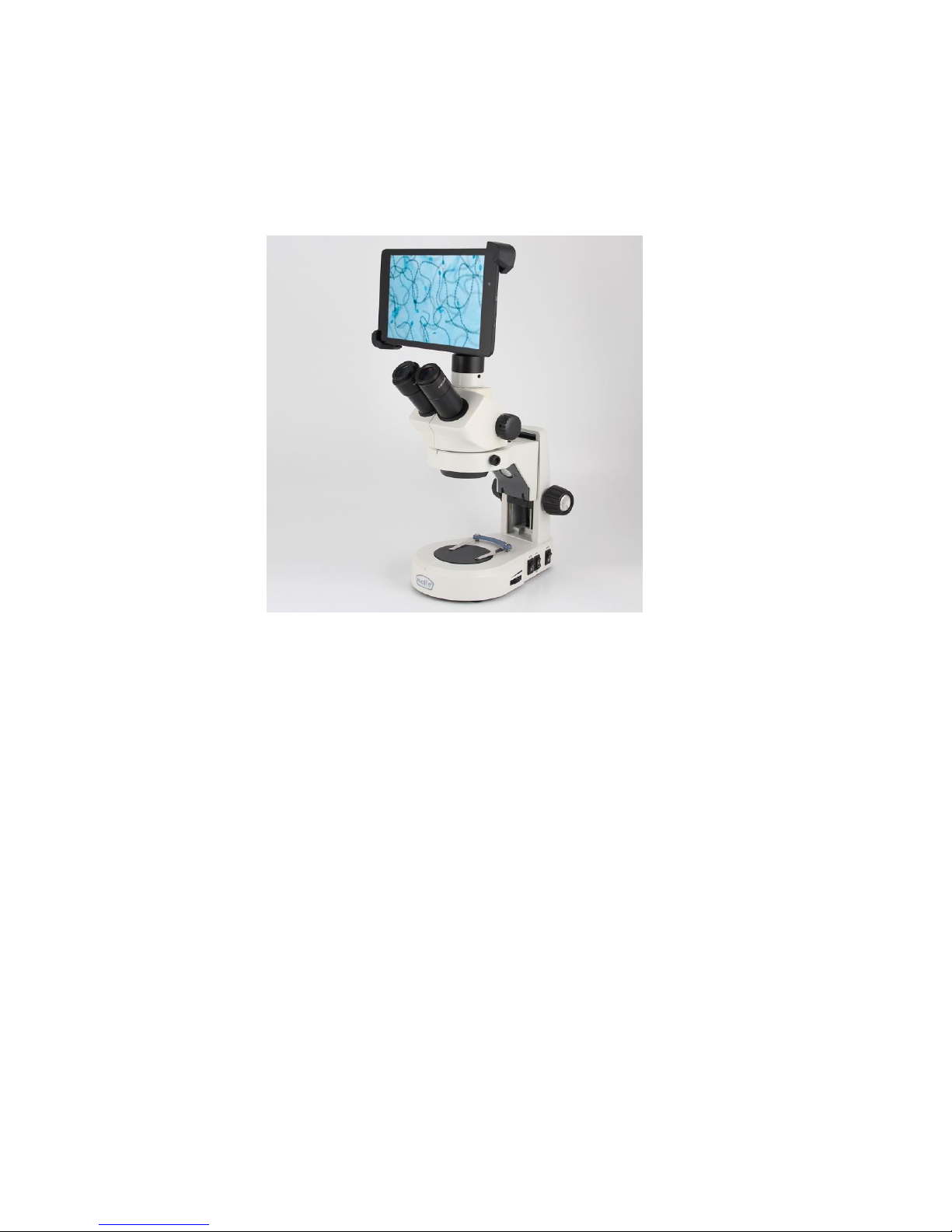
Wolfe® DigiVu™ DVM 5.0 Digital Stereomicroscope
# 592018
The 592018 is a hybrid scope containing the stereomicroscope 591832 Trinocular head and the 591426 Motic Tablet.
Your purchase of a Wolfe Intermediate LED Stereomicroscope represents an investment. Properly
used and cared for, it will provide years of uncompromising service. While this manual assumes a basic
understanding of the stereomicroscope, it highlights and reemphasizes key attributes and procedures to
ensure the greatest benefit from its design. Be sure to read and understand this guide before and after
setting up your microscope to maximize the usefulness and ease in interpreting the information it
provides. If, on any point, these features or techniques seem unclear, the Microscope Department of
Carolina Biological Supply Company stands committed to answer your technical concerns and
suggestions.
In order to properly use the microscope, an outlined series of steps follows, which will become
routine as they are repeated:
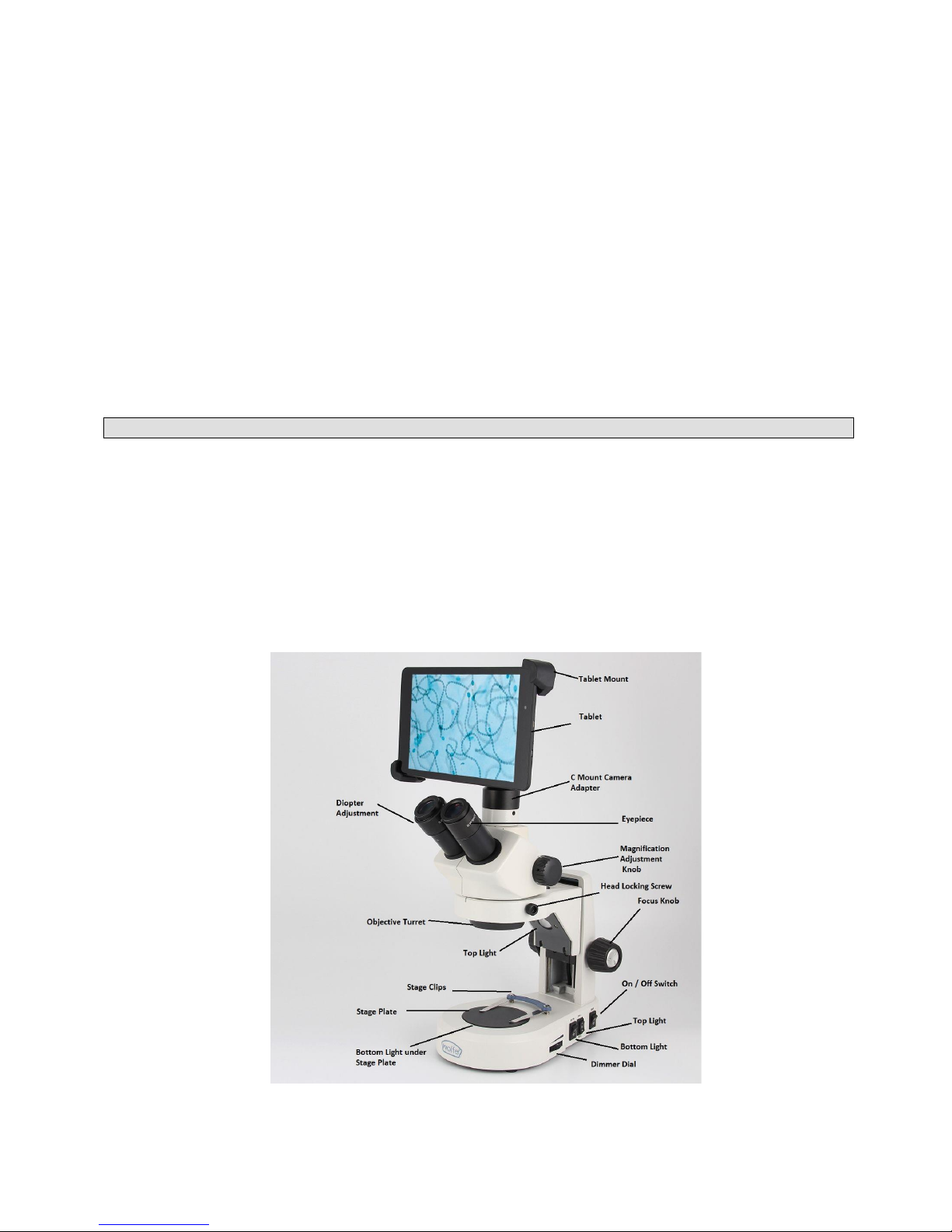
▪ Familiarize yourself with the various components of the stereomicroscope by comparing your
instrument with the labeled picture.
▪ After unpacking your stereomicroscope, mount the Head assembly onto the base unit. The black
locking screw will allow the head to be locked in position.
▪ Locate the stage plates that are packaged in the foam. Your unit will have a frosted glass plate for
bottom light illumination, black plastic and white plastic stage plates for top light illumination only.
Make sure that the frosted glass plate is mounted with the frosted side down towards the light.
▪ Plug the Power cord into a grounded electrical outlet and connect the cord to the scope in the input
connection port. Switch on the main power supply located at the base of the unit and labeled “MAIN”.
▪ Locate the lamp controls on the base labeled Bottom and Top A and Top B. Switch on the Top A Lamp
for flat lighting of the subject. For side directional light use the Top B light. Both Top A & B are for
Page 2

lighting the specimen from above. For viewing macro/translucent specimens, the Bottom lamp is,
generally, the most useful. You can use both Top and Bottom lights together if desired.
▪ When using the Wolfe Intermediate LED stereomicroscope, select either the 2X / 4X paired objectives
by rotating the black plastic, knurled objective knob located on both sides of the head. It is important to
ensure the objectives are fully engaged to avoid split or double images. The manufacturer has made
provision that the objectives engage in a positive, ball bearing click stop.
▪ Adjust the interpupillary distance between the eyepieces by either separating or integrating the large
prism barrels, below the eyepiece tubes and above the stereomicroscope head, until one image is
viewed through the eyepieces.
▪ While looking through the eyepieces and using the focus control knobs, located on both sides of the
arm of the scope, focus the specimen image by racking the head holder AWAY from the specimen until
details are clear. You will notice the great depth-of-field in the observed specimen. This results from
the stereomicroscope’s combination of low magnification and true stereo image. Refer to the “Features”
section for further explanation and detailed procedures for properly setting the eyepiece diopter(s) for
optimum performance.
If, at any or all magnifications, it is not possible to obtain a clear image verify: that the specimen is properly illuminated;
the interpupillary distance is properly set; and that the diopter(s) are correctly adjusted according to the procedure
outlined further in this manual.
FEATURES
WIDEFIELD 10X EYEPIECES
The 10X widefield eyepieces, furnished with this stereomicroscope, may be removed by pulling straight up
very gently
on the eyepiece.
ADJUSTABLE DIOPTER EYEPIECE TUBE
You will notice one or both of the eyepiece tubes of your Intermediate LED or Intermediate LED Zoom stereomicroscope
is capable of being lengthened or shortened by rotating the upper portion of the tube below the eyepiece. This
adjustment allows the user to compensate for individual differences between the right and left eye.
At the mid range of rotation of the diopter(s), you should observe a line engraved around the smaller portion of the
eyepiece tube. Initially, the base of the rotating upper portion should be even with this engraved reference. If your
stereomicroscope is equipped with only one diopter tube, focus a specimen, using the focus controls, while viewing
through the stationary (non diopter) tube, keeping the other eye covered or closed. Next, close the eye over the
stationary tube and focus while viewing through the diopter tube, and clearly focus the specimen by rotating the diopter
only. The stereomicroscope is now properly set to compensate for the difference between both eyes. If your
stereomicroscope is equipped with two diopter tubes, leave one tube set to the engraved reference mark to act as the
stationary tube per the previous procedure.
FOCUSING
The microscope has a 77mm working distance from the stage plate to the lens turret. The maximum specimen height is
36 mm. If you exceed the 36 mm specimen height, your item can not be focused. The focus control is made by rotating
either side or both of the focus knobs located on the support arm of the scope.
INCLINED TRINOCULAR HEAD
Your stereomicroscope is equipped with an angled head. The 45 angle will promote user comfort when viewing
specimens for extended periods. The head should be mounted onto the base and held tight with the head locking
thumb screw. The camera port is supplied with a C mount camera adapter so that the Motic Tablet can be mounted.
REFLECTED AND TRANSMITTED ILUMINATION
The built-in illuminators provide both “incident” (reflected), and “transmitted” light independently or simultaneously.
The “ Main ” power switch must be in the up position ( I ) for the illuminators to work. The main power switch in the ( 0 )
position turns all power and lights off. The scope has a choice of Directional Light with the Top B light ( switch in the
down position) or the Top A light( switch in the up position) is a Flat Light from an array of six LED bulbs on the
objective turret. With the switch in the center position the top light is off. To control the bottom light the ( I ) for on and
the ( 0 ) for off. All three choices can be adjusted with the dimmer dial. The dimmer is set in light increments from “ 0 “
Page 3
to “ 10 “. If no light comes from the scope, check the dimmer for setting at “ 0 “ or that the “ MAIN “ power switch is not
on.
In most instances, the stereomicroscope is used for viewing macro specimens such as intact plant or rock samples,
coins, and stamps, as a few examples. Because of this, the incident illuminator will generally prove more useful for
stereomicroscopic examination since, by their nature, these materials are usually opaque.
The lower (in-base) illuminator is particularly convenient when handling or processing small pond samples in culture
dishes and for viewing and manipulating transparent and translucent objects but again, will not be beneficial for viewing
opaque materials since these specimens do not allow the light to “transmit” to the objectives.
Use of the illuminators will require experience. In some instances, the most dramatic details will only reveal themselves
after trying different combinations of illumination. Because the Wolfe Intermediate LED and Intermediate LED Zoom
stereomicroscopes feature the provision to use the illuminators simultaneously, independently, or not at all, you should
experiment until the desired detail is observed.
Because your stereomicroscope features new LED built-in illumination, you will not need the lamps replaced for many
years. These LED lamps are rated at up to 50,000 hours. When the LED lamps are not working, contact Carolina
Biological Supply for replacement instructions.
CARE AND STORAGE OF THE STEREOMICROSCOPE
One of the worst enemies of optical instruments is dust. A dust cover has been provided with your stereomicroscope
and should be utilized whenever the instrument is not in use.
If possible, avoid removing the eyepieces from your stereomicroscope since this only invites dust and contamination to
enter the internal optics of the head. The eyepieces and objectives should only be cleaned with optical/lens tissue or
pure cotton. For stubborn fingerprints or smudges, breathe against the lens surface and wipe gently with lens tissue.
AVOID THE USE OF SOLVENTS OR CLEANING SOLUTIONS AS THESE AGENTS MAY ADVERSELY AFFECT LENS COATINGS
AND MOUNTS.
Wolfe Intermediate LED and Intermediate LED Zoom stereomicroscopes are packed in form-fitted Styrofoam cartons
specifically designed for each model. This packaging should be preserved for long-term storage and, should the need
arise, as a shipping/packing carton.
Identification of Parts
Page 4
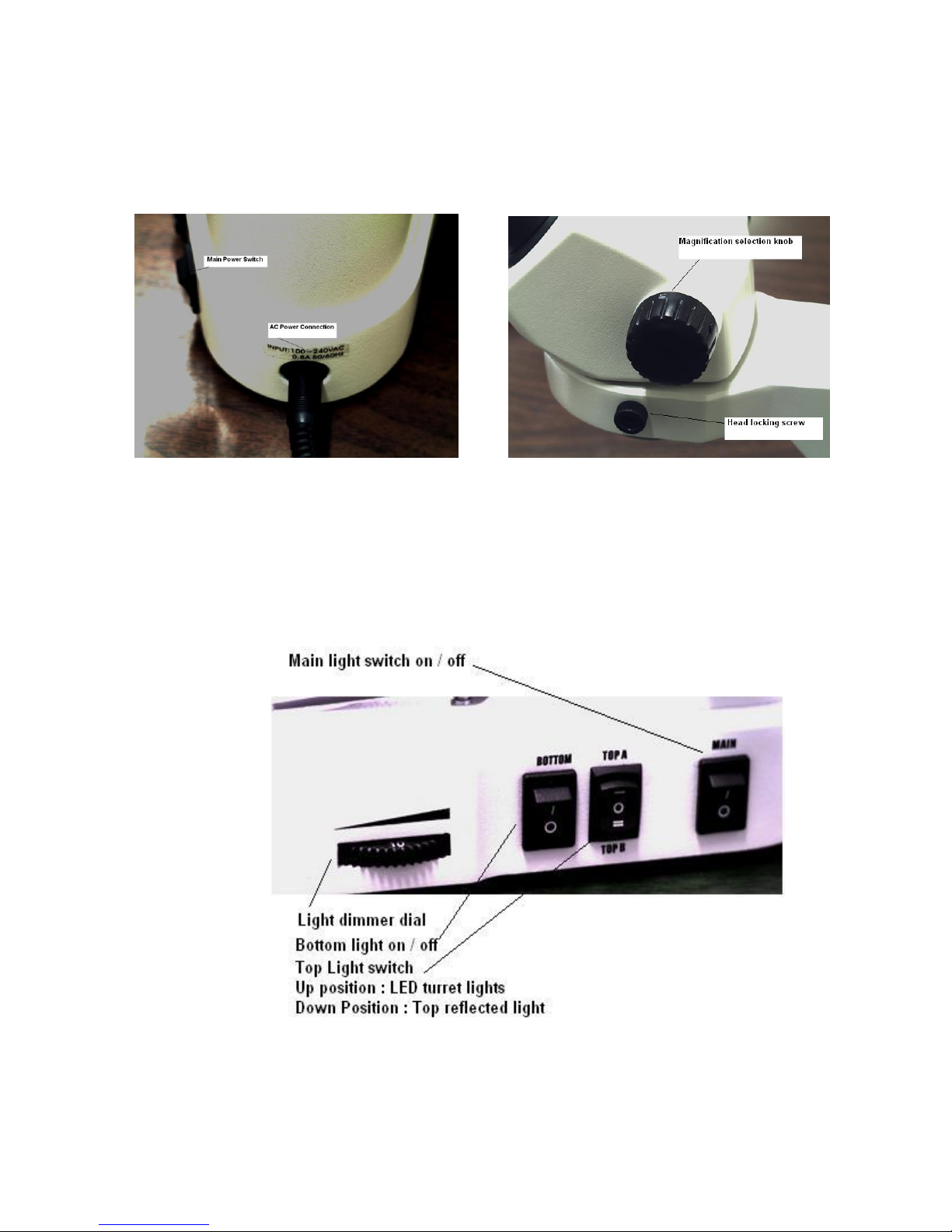
Detailed Features
Power Supply connection Magnification Knob
Main power switch Head Locking Screw
Main power switch, light selection switches, dimmer control
Page 5
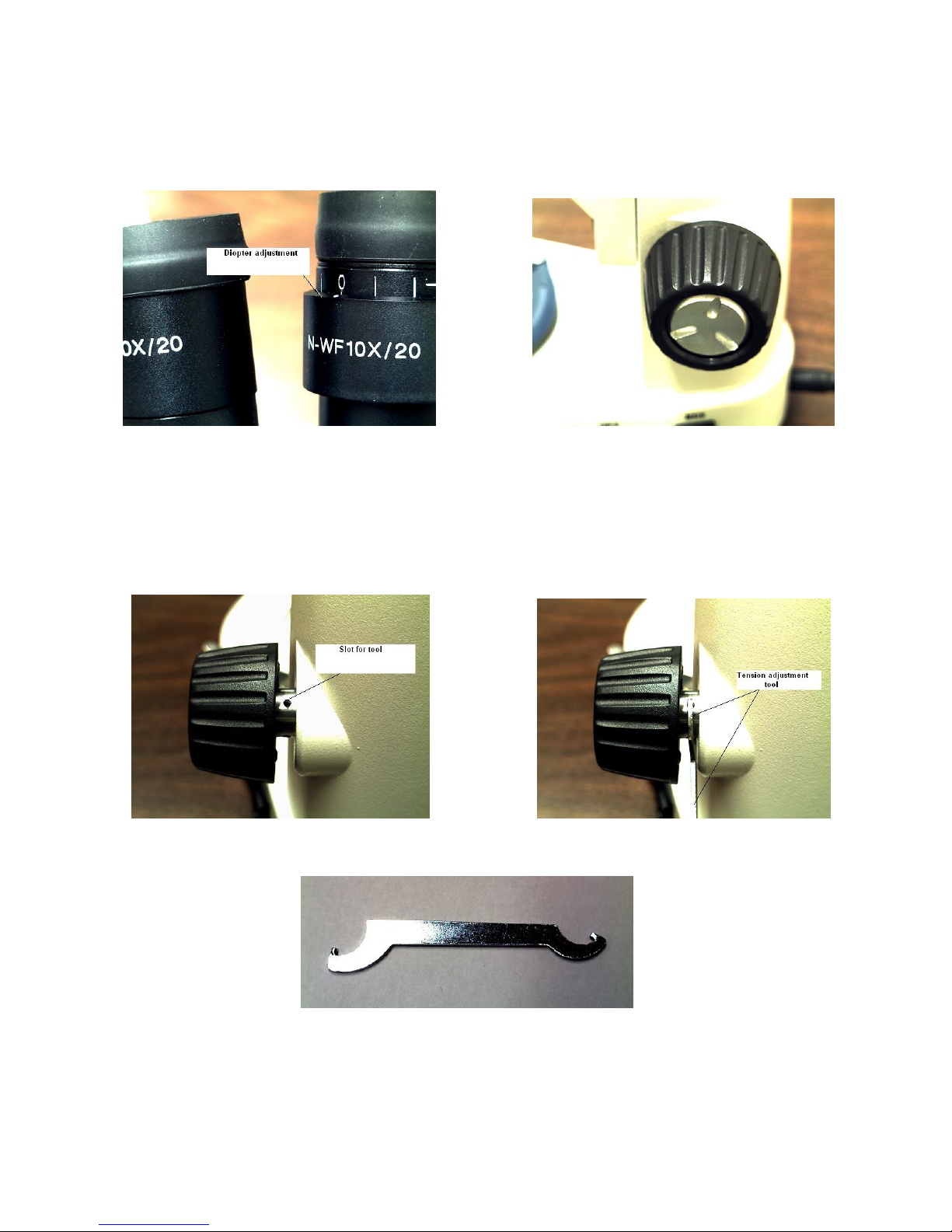
Eyepiece Diopter Adjustment Focus Control Knob
Tension Adjustment: If the focusing becomes loose or too tight, you can adjust the tension on the
scope by locating the tension adjustment control rod. See image below. Use the tension adjustment
tool supplied with the scope to loosen or tighten the rod. You will most likely only need to turn the
rod ¼ turn or less.
Tension Adjustment Tool
Page 6
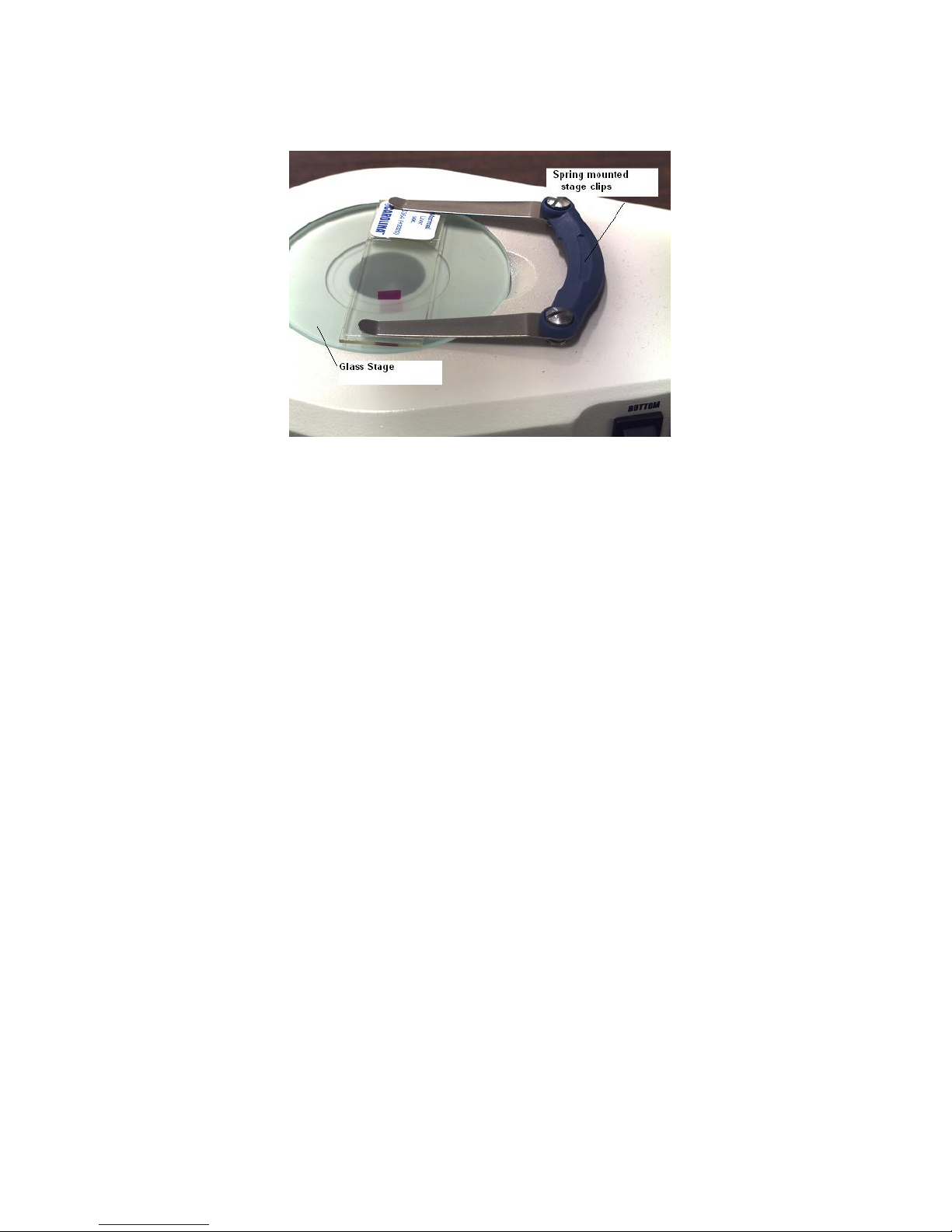
Stage Clips: Push down on the spring loaded clip center to raise the stage clips.
Wolfe Limited Lifetime Warranty
The Wolfe Intermediate LED Stereomicroscope is warranted against any manufacturing defect with a Limited Lifetime Warranty.
Damage occurring by any unauthorized repair work, or occurring through misuse or modification of the microscope will not be
included under the conditions of the warranty. Bulbs and fuses are not under warranty. The Motic camera and tablet assembly is
warranted for one year only. The warranty service is provided by Wolfe or Carolina Biological Supply. Defective products will be
repaired free of charge when returned to Carolina Biological Supply. Transport costs will be covered by the purchaser after the first
year of ownership.
OWING TO POSSIBLE MODIFICATIONS AND IMPROVEMENTS IN THEIR MANUFACTURE, CHANGES MAY OCCUR TO
MICROSCOPES WITHOUT PRIOR NOTICE
 Loading...