

Page 1

Ammonia Gas Sensor
(Model:MQ137)
Manual
Version: 1.4
Valid from: 2015-03-10
Zhengzhou Winsen Electronics Technology Co., Ltd
Page 2

Statement
This manual copyright belongs to Zhengzhou Winsen Electronics Technology Co., LTD. Without the
written permission, any part of this manual shall not be copied, translated, stored in database or
retrieval system, also can’t spread through electronic, copying, record ways.
Thanks for purchasing our product. In order to let customers use it better and reduce the faults
caused by misuse, please read the manual carefully and operate it correctly in accordance with the
instructions. If users disobey the terms or remove, disassemble, change the components inside of
the sensor, we shall not be responsible for the loss.
The specific such as color, appearance, sizes &etc, please in kind prevail.
We are devoting ourselves to products development and technical innovation, so we reserve the
right to improve the products without notice. Please confirm it is the valid version before using this
manual. At the same time, users’ comments on optimized using way are welcome.
Please keep the manual properly, in order to get help if you have questions during the usage in the
future.
Zhengzhou Winsen Electronics Technology CO., LTD
Page 3
Zhengzhou Winsen Electronics Technology Co., Ltd www.winsen-sensor.com
Profile
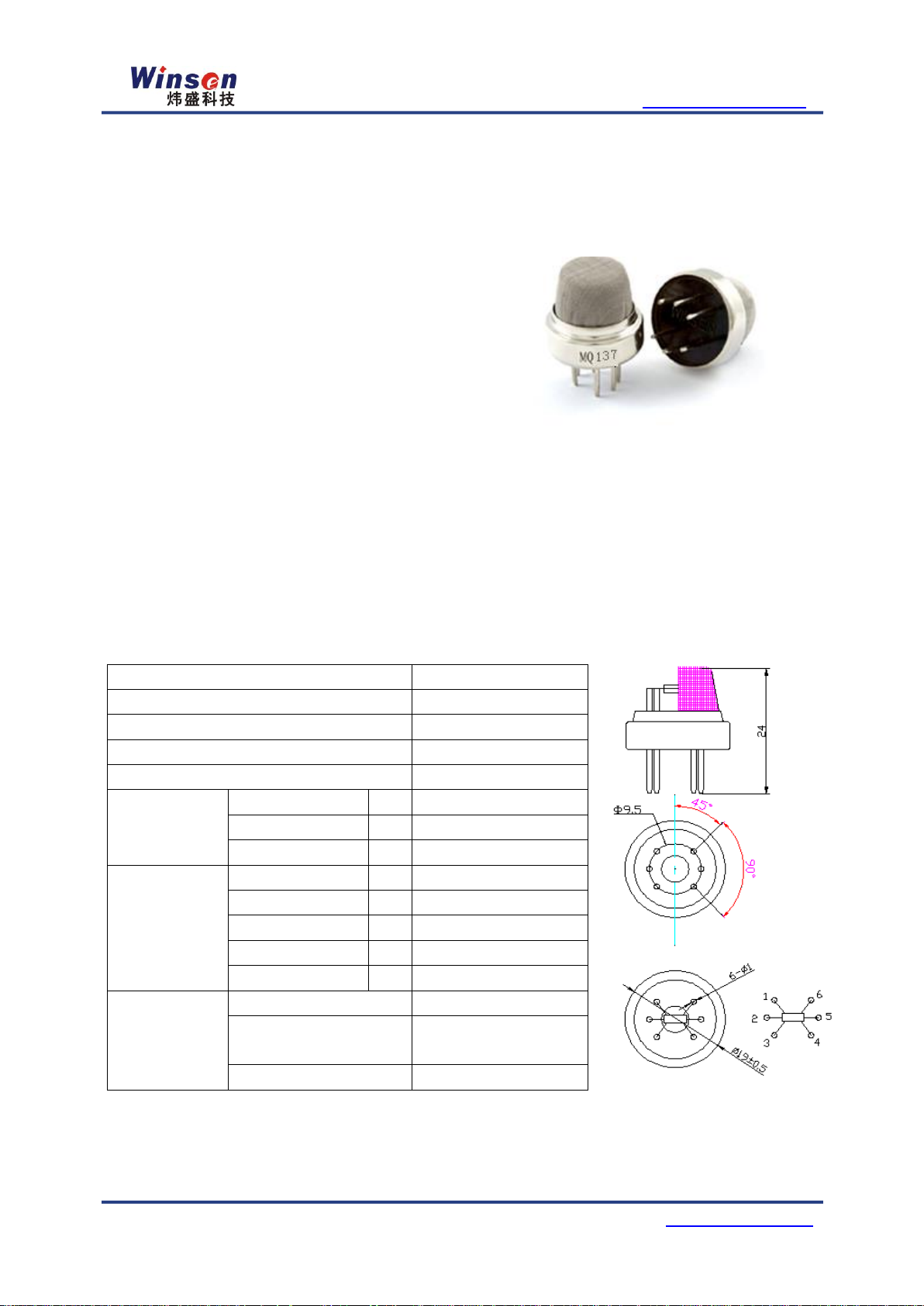
Sensitive material of MQ137 gas sensor is SnO
2,
which with lower conductivity in clean air. When NH3
gas exists, the sensor’s conductivity gets higher along
with the gas concentration rising. Users can convert
the change of conductivity to correspond output
signal of gas concentration through a simple circuit.
MQ137 gas sensor has high sensitivity to NH3 gas,
also can monitor organic amine such as
trimethylamine, cholamine well. It can detect kinds
of gases including ammonia and is a kind of low-cost
sensor for kinds of applications.
Model
MQ137
Sensor Type
Semiconductor
Standard Encapsulation
Bakelite, Metal cap
Target Gas
Ammonia Gas(NH3)
Detection range
5~500ppm NH3
Standard Circuit
Conditions
Loop Voltage
Vc
≤24V DC
Heater Voltage
VH 5.0V±0.1V AC or DC
Load Resistance
R
L
Adjustable
Sensor character
under standard
test conditions
Heater Resistance
RH 29Ω±3Ω(room tem.)
Heater consumption
P
H
≤900mW
Sensitivity
S
Rs(in air)/Rs(50ppmNH3)≥2
Output Voltage
△Vs
≥0.5V (in 50ppm NH3)
Concentration Slope
α
≤0.6(R
200ppm/R50ppm NH3
)
Standard test
conditions
Tem. Humidity
20℃±2℃;55%±5%RH
Standard test circuit
Vc:5.0V±0.1V;
VH: 5.0V±0.1V
Preheat time
Over 48 hours
NOTE: The change of Output voltage(△ Vs) is the
difference value between V
RL
in test environment and
Fig1.Sensor Structure
Unit: mm
MQ137 Ammonia Gas Sensor
Features
It has good sensitivity to NH3 gas in wide range, and has advantages such as long lifespan, low cost and
simple drive circuit &etc.
Main Applications
It is widely used in domestic NH3 gas alarm, industrial NH3 gas leakage alarm, portable NH3 gas detector.
Technical Parameters Stable.1
Tel: 86-371-67169097/67169670 Fax: 86-371-60932988 Email: [email protected]
Page 4
Zhengzhou Winsen Electronics Technology Co., Ltd www.winsen-sensor.com
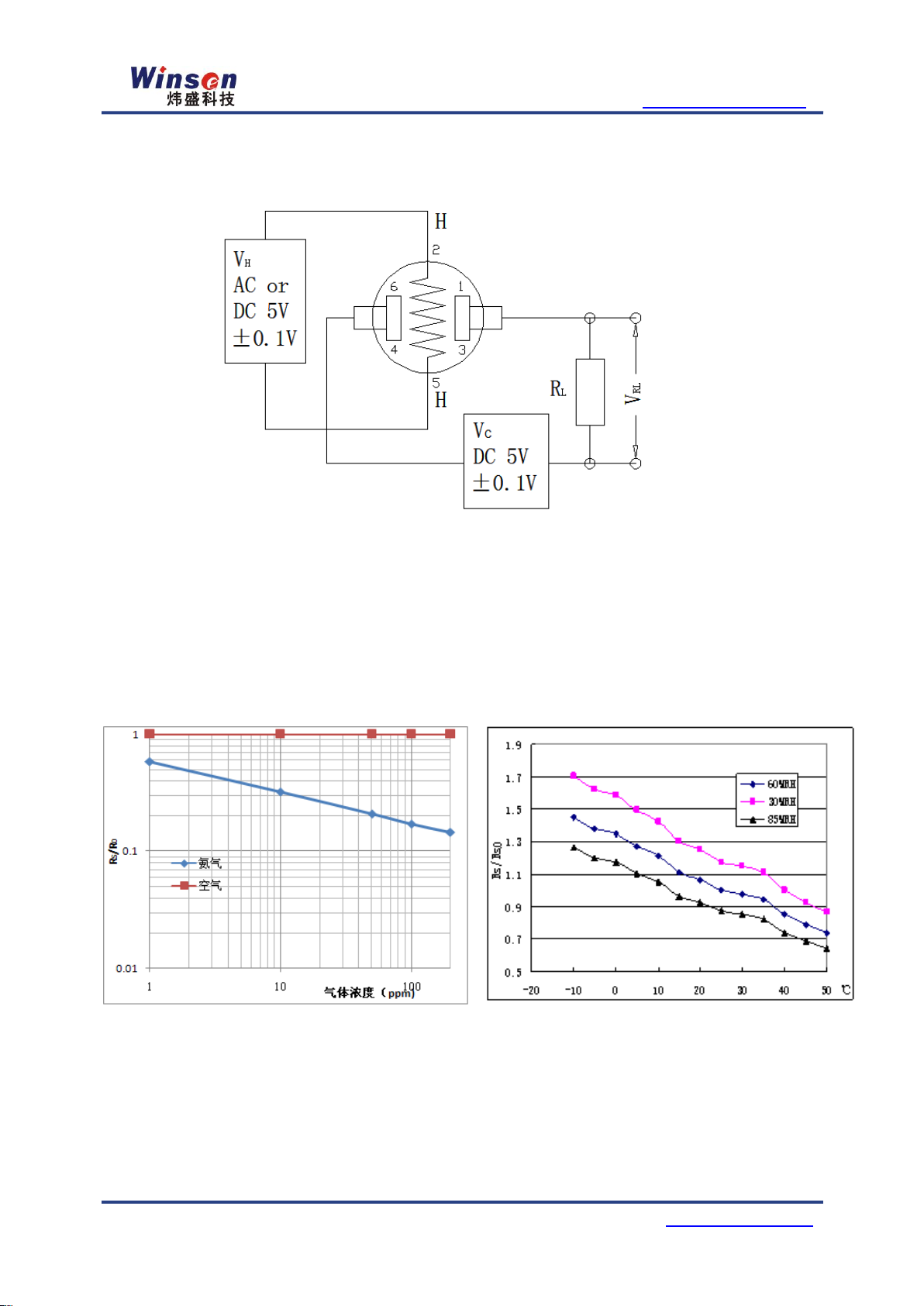
Fig3.Typical Sensitivity Curve
The ordinate is resistance ratio of the sensor (Rs/R0), the
abscissa is concentration of gases. Rs means resistance in
target gas with different concentration, R0 means
resistance of sensor in clean air. All tests are finished
under standard test conditions.
Fig4.Typical temperature/humidity characteristics
The ordinate is resistance ratio of the sensor (Rs/Rso). Rs
means resistance of sensor in 50ppm NH3 gas under different
tem. and humidity. Rso means resistance of the sensor in
50ppm NH3 gas under 20℃/55%RH.
NH3
Air
Concentration (ppm)
Basic Circuit
Fig2. MQ137 Test Circuit
Instructions: The above fig is the basic test circuit of MQ137.The sensor requires two voltage inputs:
heater voltage (VH) and circuit voltage(VC). VH is used to supply standard working temperature to the
sensor and it can adopt DC or AC power, while VRL is the voltage of load resistance RL which is in series with
sensor. Vc supplies the detect voltage to load resistance RL and it should adopts DC power.
Description of Sensor Characters
Tel: 86-371-67169097/67169670 Fax: 86-371-60932988 Email: [email protected]
Page 5
Zhengzhou Winsen Electronics Technology Co., Ltd www.winsen-sensor.com
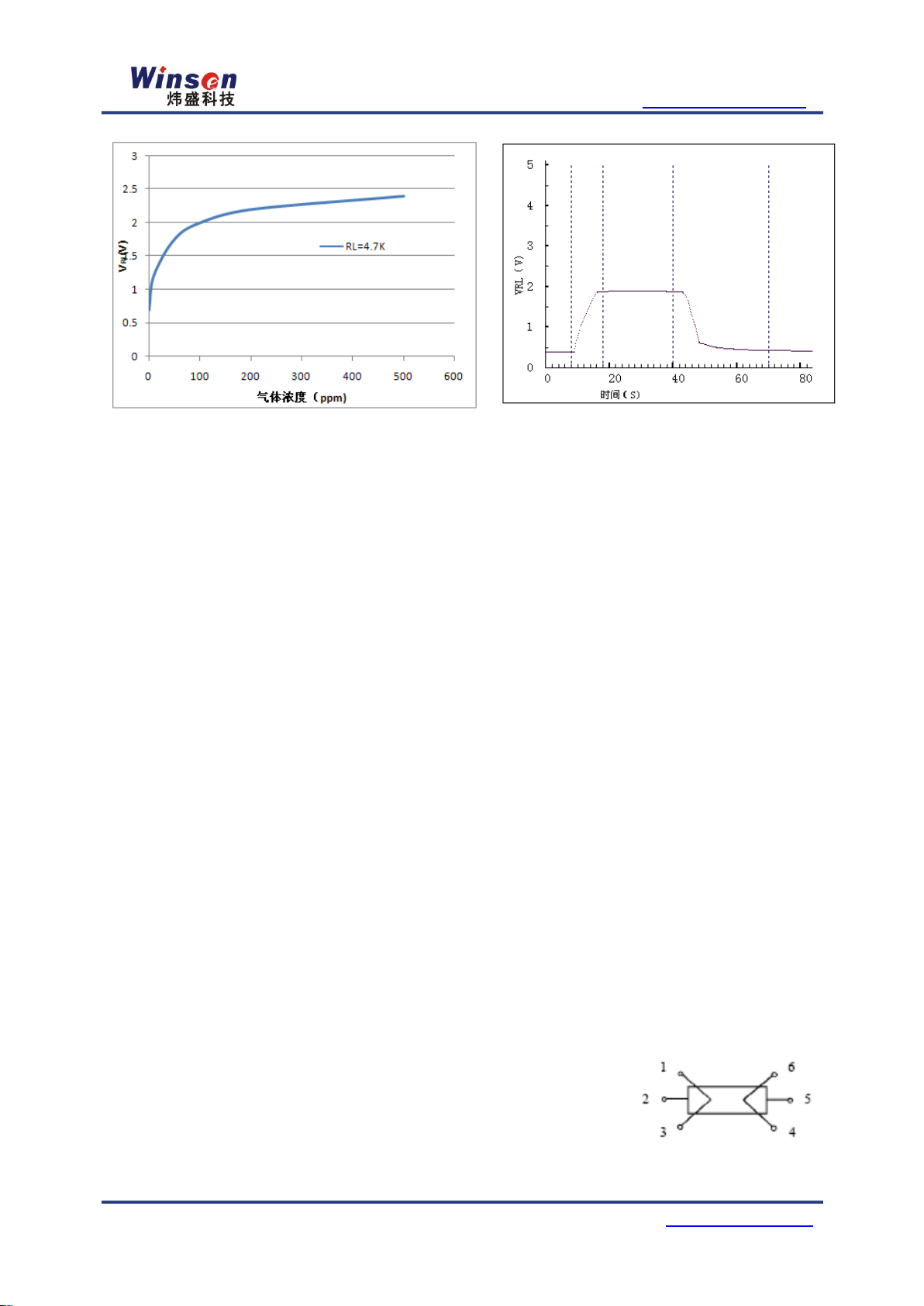
Fig6.Responce and Resume
Fig5 shows the changing of V
RL
in the process of putting
the sensor into target gas and removing it out.
Fig5.Sensitity Curve
Fig5 shows the VRL in NH3 with different concentration. The
resistance load RL is 4.7 KΩ and the test is finished in
standard test conditions.
Concentration (ppm)
Time (s)
Cautions
1 .Following conditions must be prohibited
1.1 Exposed to organic silicon steam
Sensing material will lose sensitivity and never recover if the sensor absorbs organic silicon steam.
Sensors must avoid exposing to silicon bond, fixature, silicon latex, putty or plastic contain silicon
environment.
1.2 High Corrosive gas
If the sensors are exposed to high concentration corrosive gas (such as H2S, SOX, Cl2, HCl etc.), it will
not only result in corrosion of sensors structure, also it cause sincere sensitivity attenuation.
1.3 Alkali, Alkali metals salt, halogen pollution
The sensors performance will be changed badly if sensors be sprayed polluted by alkali metals salt
especially brine, or be exposed to halogen such as fluorine.
1.4 Touch water
Sensitivity of the sensors will be reduced when spattered or dipped in water.
1.5 Freezing
Do avoid icing on sensor’s surface, otherwise sensing material will be broken and lost sensitivity.
1.6 Applied higher voltage
Applied voltage on sensor should not be higher than stipulated value, even if the sensor is not
physically damaged or broken, it causes down-line or heater damaged, and bring on sensors’
sensitivity characteristic changed badly.
1.7 Voltage on wrong pins
For 6 pins sensor, Pin 2&5 is heating electrodes, Pin (1,3)/(4,6) are testing
electrodes (Pin 1 connects with Pin 3, while Pin 4 connects with Pin 6).If
apply voltage on Pin 1&3 or 4&6, it will make lead broken; and no signal
putout if apply on pins 2&4.
Fig7. Lead sketch
Tel: 86-371-67169097/67169670 Fax: 86-371-60932988 Email: [email protected]
Page 6
Zhengzhou Winsen Electronics Technology Co., Ltd www.winsen-sensor.com
Storage Time
Suggested aging time
Less than one month
No less than 48 hours
1 ~ 6 months
No less than 72 hours
More than six months
No less than 168 hours
Zhengzhou Winsen Electronics Technology Co., Ltd
Add: No.299, Jinsuo Road, National Hi-Tech Zone,
Zhengzhou 450001 China
Tel: +86-371-67169097/67169670
Fax: +86-371-60932988
E-mail: [email protected]
Website: www.winsen-sensor.com
2 .Following conditions must be avoided
2.1 Water Condensation
Indoor conditions, slight water condensation will influence sensors’ performance lightly. However, if
water condensation on sensors surface and keep a certain period, sensors’ sensitive will be decreased.
2.2 Used in high gas concentration
No matter the sensor is electrified or not, if it is placed in high gas concentration for long time, sensors
characteristic will be affected. If lighter gas sprays the sensor, it will cause extremely damage.
2.3 Long time storage
The sensors resistance will drift reversibly if it’s stored for long time without electrify, this drift is
related with storage conditions. Sensors should be stored in airproof bag without volatile silicon
compound. For the sensors with long time storage but no electrify, they need long galvanical aging
time for stability before using. The suggested aging time as follow:
Stable2.
2.4 Long time exposed to adverse environment
No matter the sensors electrified or not, if exposed to adverse environment for long time, such as high
humidity, high temperature, or high pollution etc., it will influence the sensors’ performance badly.
2.5 Vibration
Continual vibration will result in sensors down-lead response then break. In transportation or
assembling line, pneumatic screwdriver/ultrasonic welding machine can lead this vibration.
2.6 Concussion
If sensors meet strong concussion, it may lead its lead wire disconnected.
2.7 Usage Conditions
2.7.1For sensor, handmade welding is optimal way. The welding conditions as follow:
Soldering flux: Rosin soldering flux contains least chlorine
homothermal soldering iron
Temperature: 250℃
Time:less than 3 seconds
2.7.1If users choose wave-soldering, the following conditions should be obey:
Soldering flux: Rosin soldering flux contains least chlorine
Speed: 1-2 Meter/ Minute
Warm-up temperature:100±20℃
Welding temperature:250±10℃
One time pass wave crest welding machine
If disobey the above using terms, sensors sensitivity will reduce.
Tel: 86-371-67169097/67169670 Fax: 86-371-60932988 Email: [email protected]
 Loading...