

Page 1

Air-Quality Gas Sensor
(Model: MP901)
Manual
Version:1.1
Valid From:2014.08.10
Zhengzhou Winsen Electronics Technology Co., Ltd
Page 2

Statement
This manual copyright belongs to Zhengzhou Winsen Electronics Technology Co., LTD. Without the
written permission, any part of this manual shall not be copied, translated, stored in database or
retrieval system, also can’t spread through electronic, copying, record ways.
Thanks for purchasing our product. In order to let customers use it better and reduce the faults
caused by misuse, please read the manual carefully and operate it correctly in accordance with the
instructions. If users disobey the terms or remove, disassemble, change the components inside of
the sensor, we shall not be responsible for the loss.
The specific such as color, appearance, sizes &etc, please in kind prevail.
We are devoting ourselves to products development and technical innovation, so we reserve the
right to improve the products without notice. Please confirm it is the valid version before using this
manual. At the same time, users’ comments on optimized using way are welcome.
Please keep the manual properly, in order to get help if you have questions during the usage in the
future.
Zhengzhou Winsen Electronics Technology CO., LTD
Page 3
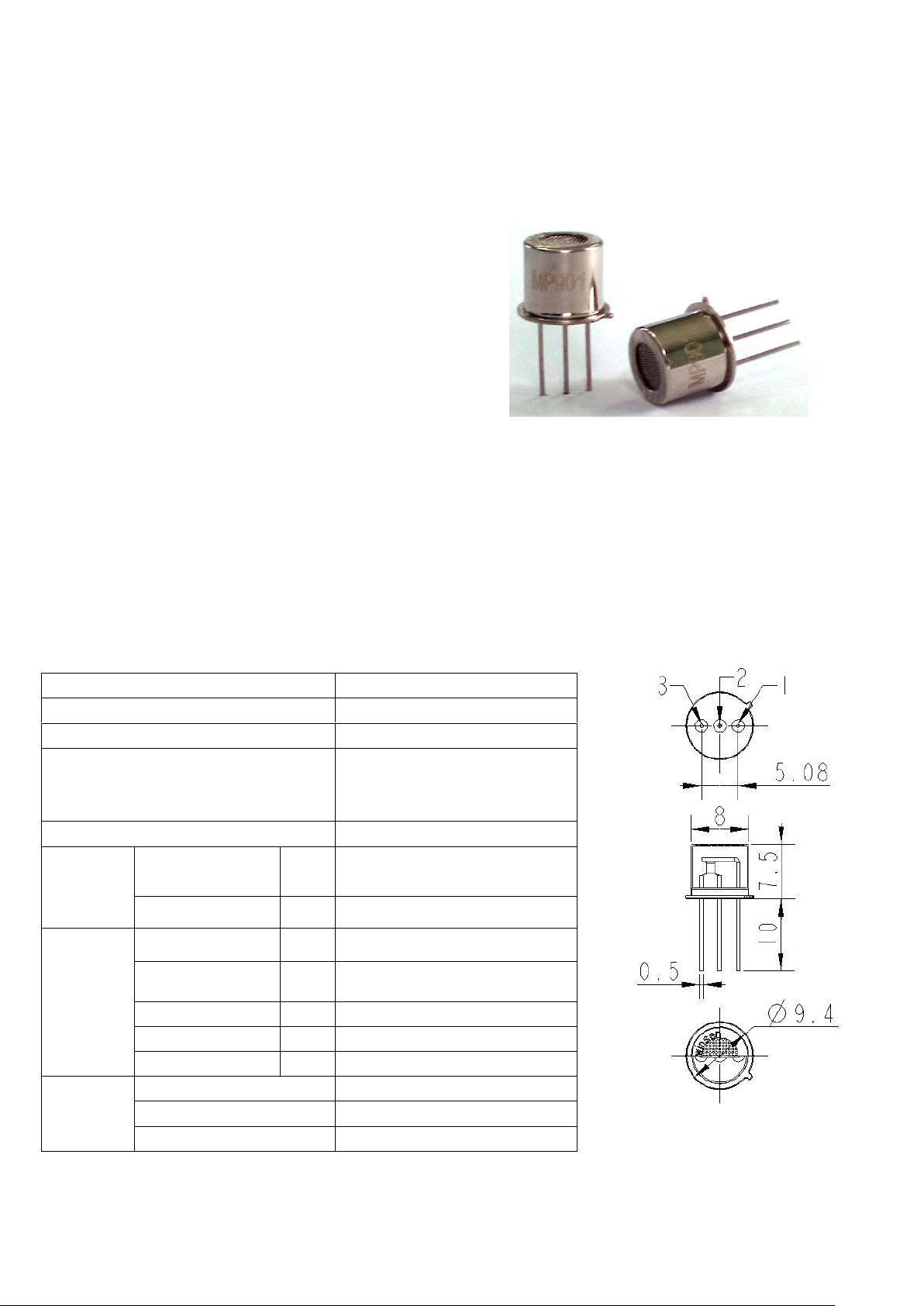
MP901 Air-Quality Gas Sensor
Profile
MP901 gas sensor is for air quality. It adopts multilayer thick
film manufacturing technology. The heater and metal oxide
semiconductor material on the ceramic substrate of
subminiature Al2O3 are fetched out by electrode down-lead,
encapsulated in metal socket and cap. Conductivity of the
sensor is affected by the concentration of target gas. The
higher the concentration is, the higher conductivity of sensor
gets. Users can adopt simple circuit to convert variation of
conductivity into output signal corresponding to gas
concentration.
Model
MP901
Sensor Type
Semiconductor flat surfaced sensor
Standard Encapsulation
Metal Cap
Detection Gas
alcohol, smoke, formaldehyde,
toluene, acetone, benzene,
lighter gas, paint &etc.
Detection range
1~50ppm
Standard
circuit
Loop voltage
VC /
VH
5.0V±0.1V DC
Load resistance
RL
Adjustable
sensor
features in
standard test
condition
Heating resistance
RH
95Ω±10Ω(Room Tem.)
Heating consumption
PH
≤300mW
Surface resistance
RS
5KΩ~60KΩ(in 10ppm alcohol)
Sensitivity
S
Rs(in air)/Rs(in 10ppm alcohol)≥3
Concentration slope
α
≤0.6(R 50ppm/R 5ppm alcohol)
Standard
condition of
test
Temperature, humidity
20℃±2℃;65%±5%RH
Standard test circuit
VC/VH :5.0V±0.1V
Warm-up time
More than 48 hours
Features
High sensitivity to alcohol, smoke, formaldehyde, toluene, acetone, benzene, lighter gas, paint; quick response
and resume; low power consumption, simple detection circuit, good stability and long life.
Main Application
It is used in occasions such as household and office for harmful gas detection, automatic exhaust device, air
cleaner&etc.
Technical Parameters Stable1.
Fig1. Sensor Structure
Page 4

Basic Circuit
图 2
Rs/R
0
Rs/Rs0
RH
VC/VH
MP901 measure 10ppmAlcohol
Concentration (ppm)
Acetone
Alcohol
H2
Methanal
Toluene
Iso-butane
Smoke
Fig3.Typical Sensitivity Curve
Rs means resistance in target gas with different
concentration, R0 means resistance of sensor in clean air.
All tests are finished under standard test conditions.
Fig4.Typical temperature/humidity characteristics
Rs means resistance of sensor in 10ppm alcohol under
different tem. and humidity. Rso means resistance of the
sensor in 50ppm alcohol under 20℃/55%RH.
Acetone
Alcohol
H2
Methanal
Toluene
Iso-butane
Concentration (ppm)
Voltage Output(V)
Fig2. MP901 Test Circuit
Instructions: The above fig is the basic test circuit of MP901.The sensor requires heater voltage (VH) and circuit
voltage (VC) which share one source. They must adopt DC power. VRL is the voltage of load resistance RL which is
in series with sensor.
Description of Sensor Characters
Fig5.Responce and Resume Fig6.Linearity curve
Page 5
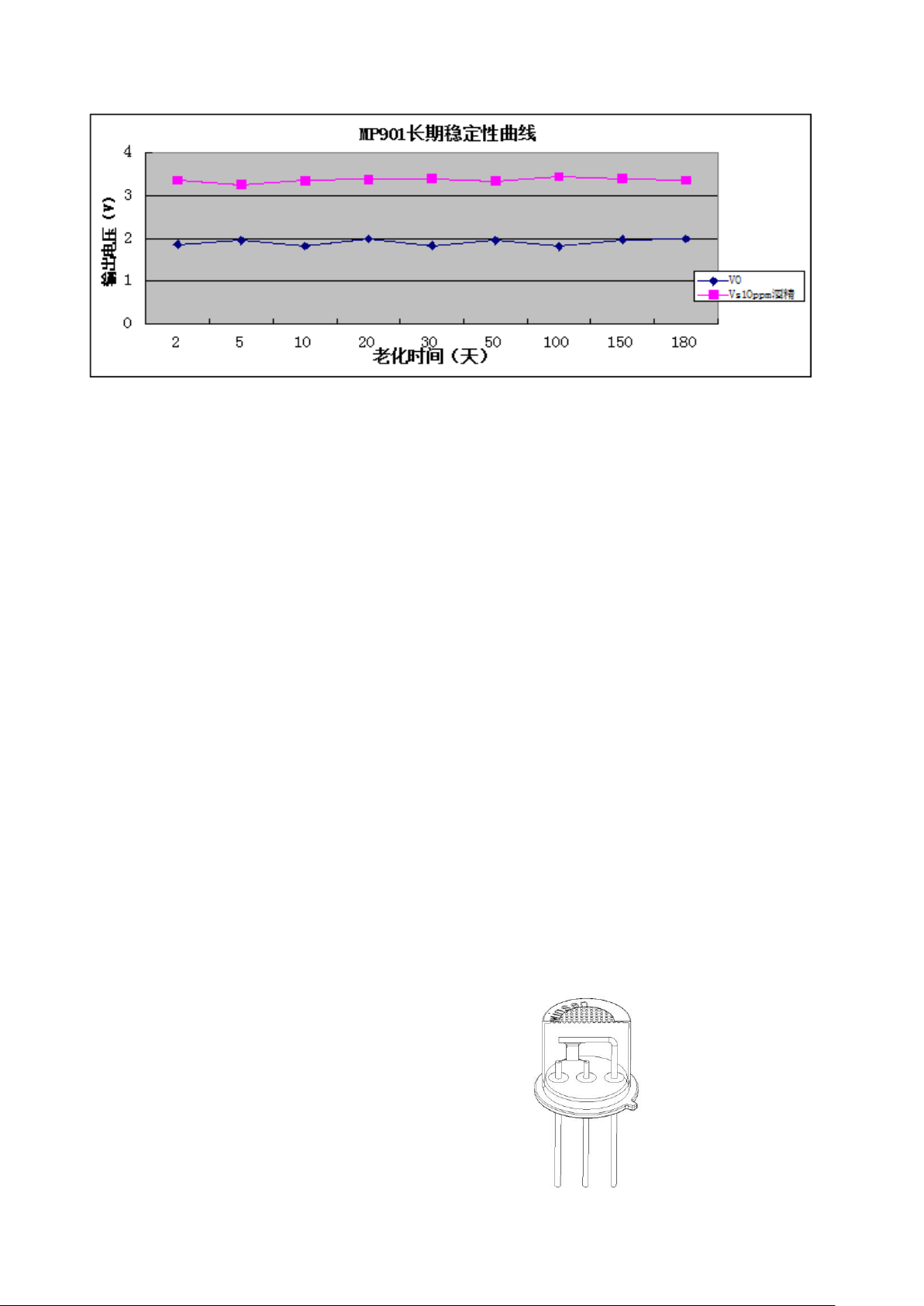
Fig7.long-term Stability of MP901
3 2 1
Time (day)
Output Voltage (V)
NOTE: Test is finished in standard test conditions, the abscissa is observing time and the ordinate is VRL.
Cautions
1 .Following conditions must be prohibited
1.1 Exposed to volatilizable organic silicon steam
Sensing material will lose sensitivity and never recover if the sensor absorbs organic silicon steam. Sensors
must avoid exposing to silicon bond, fixature, silicon latex, putty or plastic contain silicon environment.
1.2 High Corrosive gas
If the sensors are exposed to high concentration corrosive gas (such as H2S, SOX, Cl2, HCl etc.), it will not only
result in corrosion of sensors structure, also it cause sincere sensitivity attenuation.
1.3 Alkali, Alkali metals salt, halogen pollution
The sensors performance will be changed badly if sensors be sprayed polluted by alkali metals salt especially
brine, or be exposed to halogen such as fluorine.
1.4 Touch water
Sensitivity of the sensors will be reduced when spattered or dipped in water.
1.5 Freezing
Do avoid icing on sensor’s surface, otherwise sensing material will be broken and lost sensitivity.
1.6 Applied higher voltage
Applied voltage on sensor should not be higher than stipulated value, even if the sensor is not physically
damaged or broken, it causes down-line or heater damaged, and bring on sensors’ sensitivity characteristic
changed badly.
1.7 Voltage on wrong pins
As Fig8,Pin 1connects to heater(or test) power supply, Pin 2 connects to load resistance, Pin 3 connects
ground.;
Fig8. Pins Schematic Diagram
Page 6

Storage Time
Suggested aging time
Less than one month
No less than 48 hours
1 ~ 6 months
No less than 72 hours
More than six months
No less than 168 hours
2 .Following conditions should be avoided
2.1 Water Condensation
Indoor conditions, slight water condensation will influence sensors’ performance lightly. However, if water
condensation on sensors surface and keep a certain period, sensors’ sensitive will be decreased.
2.2 Used in high gas concentration
No matter the sensor is electrified or not, if it is placed in high gas concentration for long time, sensors
characteristic will be affected. If lighter gas sprays the sensor, it will cause extremely damage.
2.3 Long time storage
The sensors resistance will drift reversibly if it’s stored for long time without electrify, this drift is related with
storage conditions. Sensors should be stored in airproof bag without volatile silicon compound. For the
sensors with long time storage but no electrify, they need long galvanical aging time for stability before using.
The suggested aging time as follow:
Stable2.
2.4 Long time exposed to adverse environment
No matter the sensors electrified or not, if exposed to adverse environment for long time, such as high
humidity, high temperature, or high pollution etc., it will influence the sensors’ performance badly.
2.5 Vibration
Continual vibration will result in sensors down-lead response then break. In transportation or assembling line,
pneumatic screwdriver/ultrasonic welding machine can lead this vibration.
2.6 Concussion
If sensors meet strong concussion, it may lead its lead wire disconnected.
2.7 Usage Conditions
2.7.1For sensor, handmade welding is optimal way. The welding conditions as follow:
Soldering flux: Rosin soldering flux contains least chlorine
homothermal soldering iron
Temperature: 250℃
Time:less than 3 seconds
2.7.2If users choose wave-soldering, the following conditions should be obey:
Soldering flux: Rosin soldering flux contains least chlorine
Speed: 1-2 Meter/ Minute
Warm-up temperature:100±20℃
Welding temperature:250±10℃
One time pass wave crest welding machine
If disobey the above using terms, sensors sensitivity will reduce.
 Loading...