

Page 1
www.willi a m-opti c s.com
William Optics Corp.
WILLIAM OPTICS USA
Crafting the Earth's Finest Astronomical Instruments
CONTACT US
WILLIAM OPTICS USA
Toll Free: +1-866-918-6888 (For USA only)
Tel: +1-714-898-7989
Fax: +1-714-892-6067
web: www.william-optics.com
e-mail: [email protected]
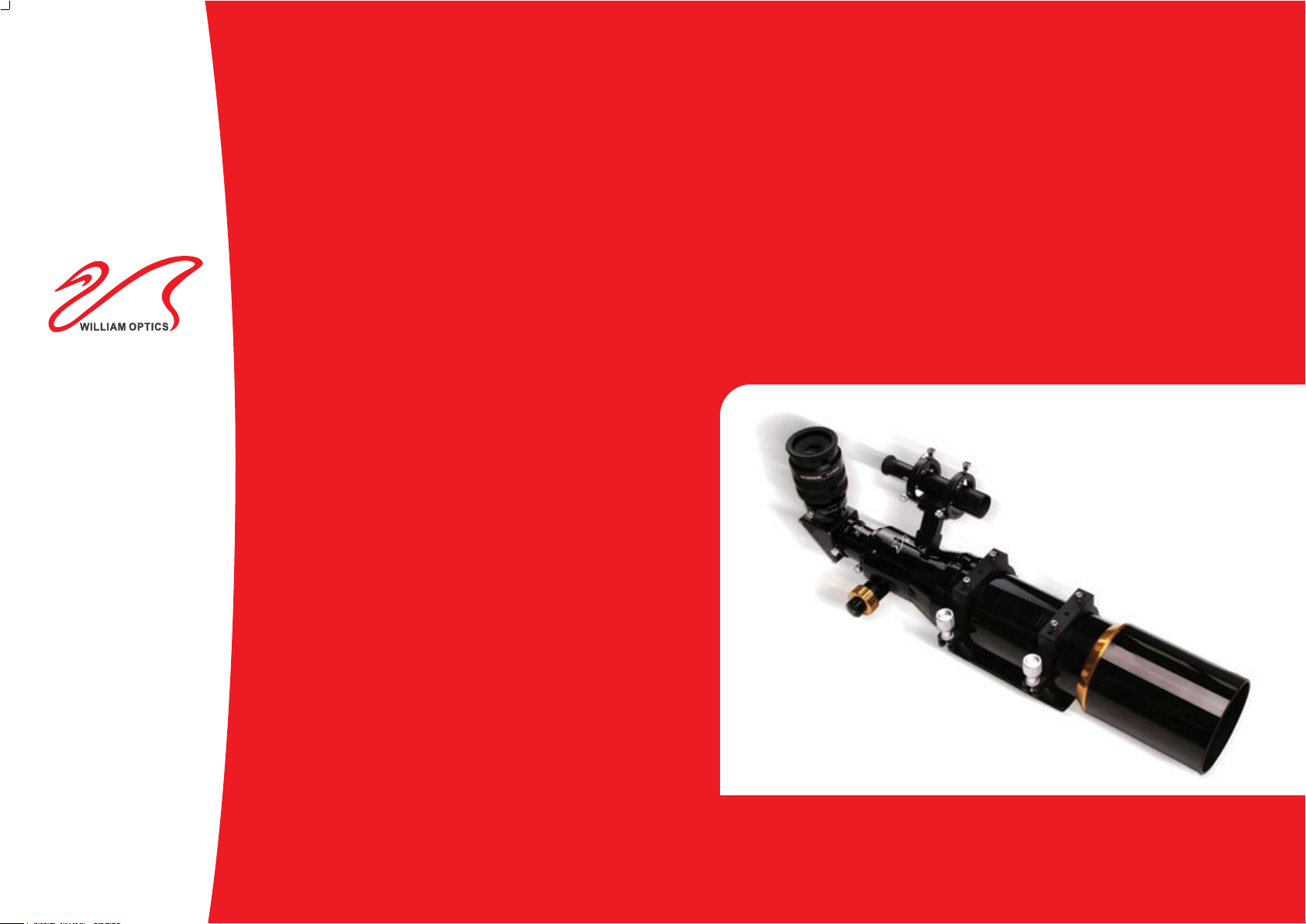
ZenithStar
INSTRUCTION MANUAL
110
Crafting the Earth's Finest Astronomical Instruments
Page 2
Thank you for choosing a William Optics ZenithStar 110,
William Optics flagship refractor.
www.william-optics.com
w w w . w i l l i a m - o p t i c s . c o m
This simple step-by-step instruction manual is designed to provide
ZenithStar 110 owners with a better understanding of how to operate
their new telescope by providing precise, updated information.
These instructions will also guide you through how to properly
maintain the ZenithStar 110, and how to operate it at its maximum
capabilities.
Please carefully familiarize yourself with your telescope's parts
and functions before operating it for the first time.
WARNING!
DO NOT USE THIS TELESCOPE UND ER ANY
CIRCUMSTANCES TO DIRECTLY VIEW THE SUN.
It could easily cause instant blindness or serious damage to your eyes.
To view the sun, use only appropriately designed solar filters that will reject
99.96% of the sun light and heat. Educate your family on how to use this
telescope properly during day and night time observations. For further
information please contact your local dealer.
CONTENTS
Getting to know your telescope
ZenithStar 110 Specifications
ZenithStar 110 Acessories Chart
Connection Instructions (Mounting Rings)
Connection Instructions (Aligning Finderscope)
Usage
Important Notice
Storage and Cleaning
Caution for Safety
Bundled Equipment
Optional Equipment
Recommended for This Scope
01
02
03
04
05
06
07
08
08
08
09
10-14
Cra f t i n g the E a r t h's F i n e s t A s t r o n omi c a l I n str u m e n t s
Page 3
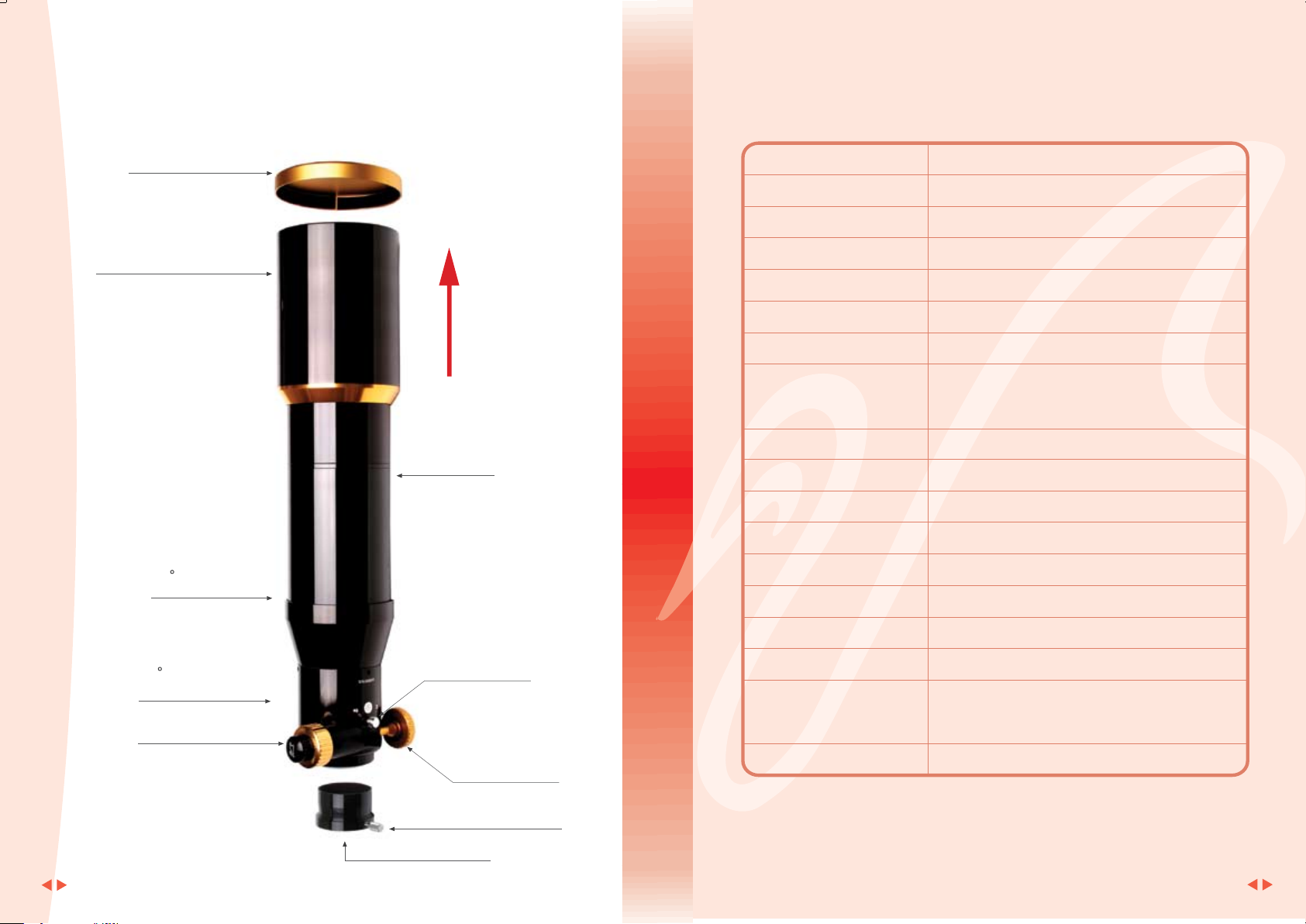
Ge t ti ng t o k n o w y ou r t el e s c op e
Ze n it hs t a r 110 Tri p le t A P O S p e ci fi c at io n s
w w w . w i l l i a m - o p t i c s . c o m
Dew shield cover
Retractable dew shield
360 rotatable
focuser lock
360 rotatable
2" nosepiece lock
2" lock screw
Extend
Main tube
Tension adjustment
The focuser drawtube
Focuser knob
Aper ture
Foca l Ratio
Foca l Lengt h
Obje ctive Type
Reso lving P ower
Limi ting Ma gnitude
Lens Shade
Focu ser
1.25 " Adapter
L- t ype Mou nt
Fiel d Stops
Dew Shield O.D.
Tube Diame ter
Tube Lengt h
Tube Weight
Case
Case Dimens ions
(WxH xD)
Case Wei ght
110 mm
F/7
770m m
Triple t APO De sign, Ai r Space d, TMB design,
STM Fully M ulti-Coated
1.05 "
12.0
Retr actable
2.5" (63.5 m m)Crayford Focuse r
77 m m (3.0" )Focuser Tra vel Len gth
360° Rotata ble Design, 1:10 dual sp eed
Bras s Compr ession Rings
Moun ting Ri ngs
6 Ba ffles
5.3" (135 m m)
4.5" (114 mm)
22.8 " (580 mm) Fully Retract ed
25.6 " (650 mm) Fully Extende d
9.5 lbs.( 4 .3 kg) OTA
High Qualit y Alumin um Case
28" x 9.1" x 8.9"
(70c m x 24c m x 22cm)
(Total int erior length 630m m)
8.1 lbs. (3 .7 kg )
P01
1.25" adapter lock screw
2" to 1.25" adapter
P02
Page 4
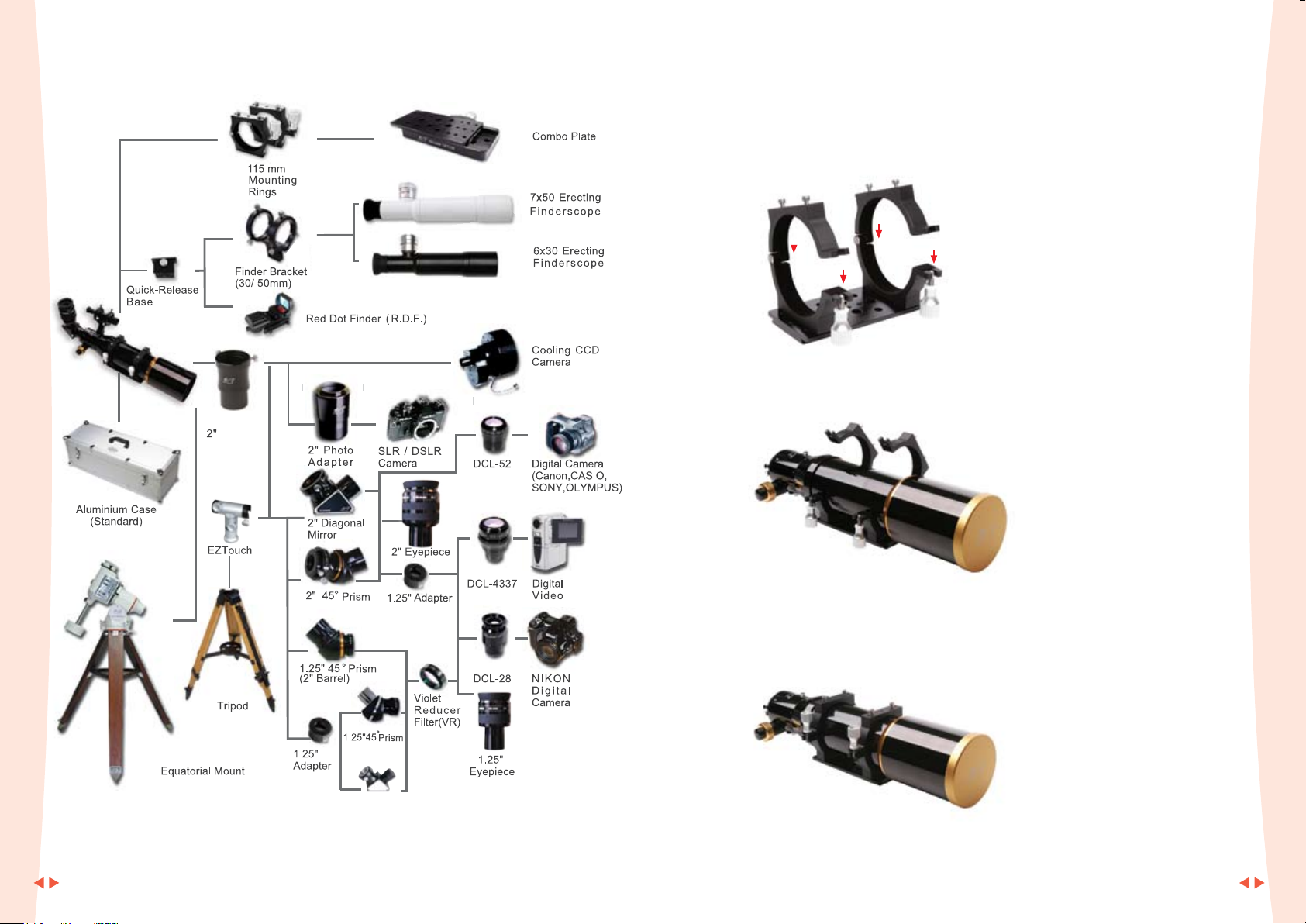
ZenithStar Accessories Chart
Extender
Connection Instructions
( Mounting Rings )
Step-1
Safely secure the 115mm mounting rings to the WO
dovetail.
Step-2
w w w . w i l l i a m - o p t i c s . c o m
Above diagram is only for future connectivity purposes.
Please contact our Authorized Dealers for accessories purchase.
P03
Fully extend the dewshield cover before
placing the OTA in the rings.
Step-3
C r a f t i n g t h e E a r t h ' s F i n e s t A s t r o n o m i c a l I n s t r u m e n t s
Remember to insure that the mounting rings
knobs are tight before operations.
P04
Page 5
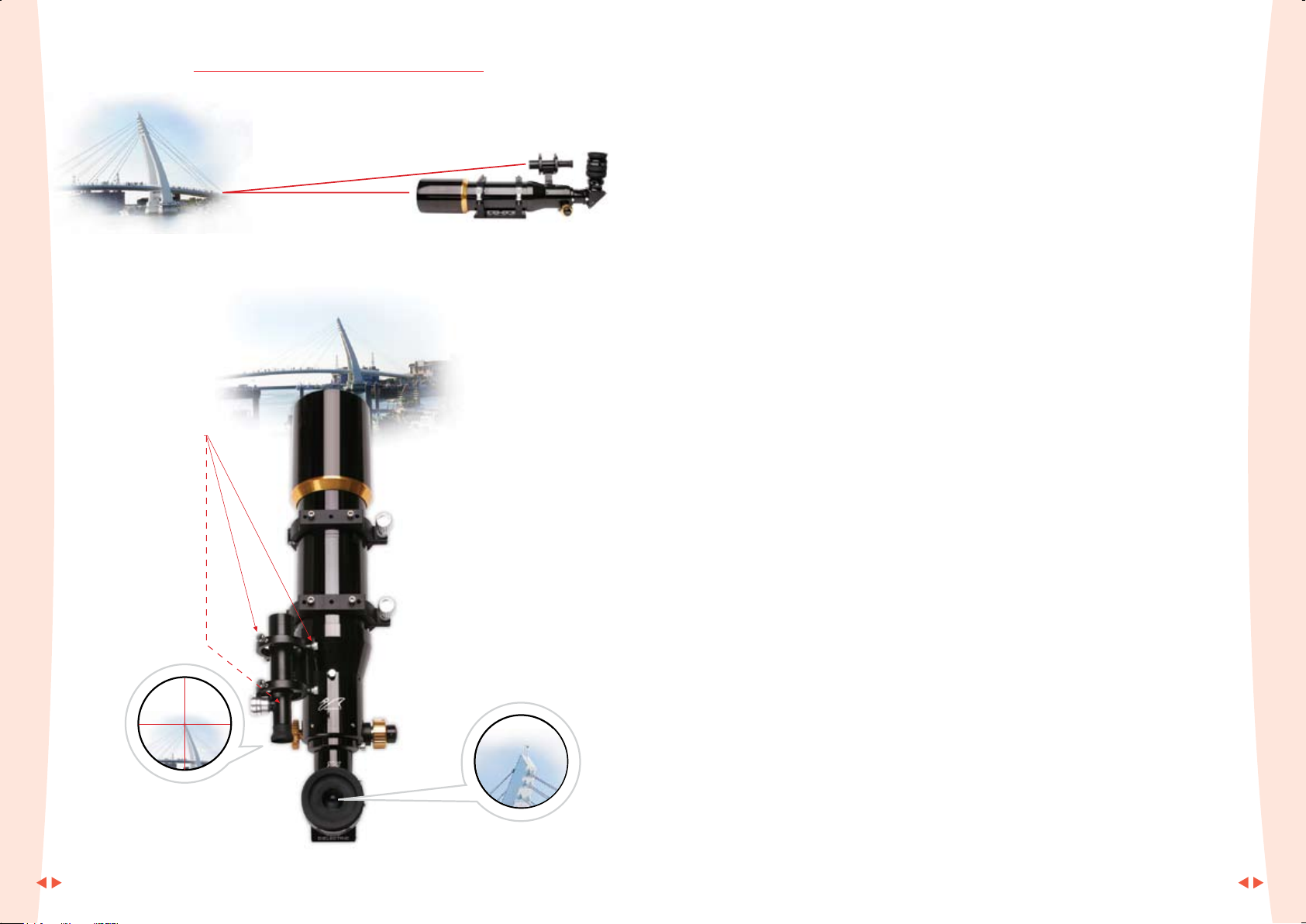
Connection Instructions
( Aligning Finderscope )
Usage
The Zenithstar 110 is designed to work with both 1 1/4 inch and 2 inch diameter eyepieces in
various focal lengths, for both daytime and nighttime viewing. Because the Zenithstar 110 is well
suited to viewing nebulae, clusters, large galaxies and comets, we recommend the use of high
quality wide angle eyepieces. The WO SWAN ( 72 ) and UWAN ( 82 ) series eyepieces are
available in a variety of focal lengths. Viewing the moon and planets is also impressive at
magnifications of 120X when seeing conditions permit.
o
o
w w w . w i l l i a m - o p t i c s . c o m
Align the finderscope pointing at the same object as the telescope.
Step -1
Find a distant object in the
telescope with a low
Alig nment S crews.
power eyepiece.
Step -2
Align the finderscope by
pointing at the same
object, then loosen or
tighten the alignment
screws.
Step -3
Use a high power
eyepiece and repeat this
procedure.
View Field of Finderscope.
(with WO Erecting Illuminated
Finderscope)
View Field of Telescope.
This telescope is also well suited for higher power observations with planetary eyepieces.
To calculate the magnification of your telescope and eyepiece combination, divide the telescope
focal length in mm by the eyepiece focal length in mm.
Keep in mind that the atmosphere plays an important role in seeing conditions, and only the
best seeing conditions will support high power viewing. Additional power under less than ideal
seeing conditions will not result in an increase in viewable details, and lower powered eyepieces
should there be used under those conditions. It's easiest to locate objects using low power
eyepieces (20X magnification) and then zoom in by switching to higher powered eyepieces. The
largest field of view will be seen using a 12X low power-wide field of view eyepiece. Also
remember to let the telescope reach thermal stability for optimal results. A triplet lens takes
longer than a doublet to cool down. A stable tripod or mount is recommended for optimal
viewing. This includes high quality photography tripods, and German Equatorial mounts, which
are designed for astronomical use and include precise tracking of celestial objects. William
Optics is marketing a very practical Alt-Az mount too, which will perfectly complement any of its
refractors.
The Zenithstar 110 has been specifically designed for astrophotography; it will produce excellent
results when used with the proper equipment. Being this a high-end astrophotography
telescope, it should be mounted on a good mount. Please see our website for examples of
photos taken with these telescopes. The Accessories Chart on page 3 provides additional
details on photographic accessories for various CCD, digital and film cameras.
Optional accessories from WO include mounting rings and plates, super high-quality 2" Quartz
star diagonals, and 2" Erecting Prisms (45 and 90 ), all of which provide for superior viewing
and high quality images.
Never aim your telescope or finderscope at the Sun without proper Solar filters installed on the
front of the telescope. Doing so for even a moment may permanently damage your vision.
Proper Solar filters consist of a filters made by reputable manufacturers, designed to fit tightly
over the front of the dew shield. Solar eyepiece filters are not considered safe, and should not
be used. With proper front mounted Solar filters, the telescope will not be harmed by viewing the
Sun. Contact your Authorized WO Dealer for further information on the brands, sizes, and prices
of proper solar filters.
oo
A s t r o n o m i c a l I n s t r u m e n t s
C r a f t i n g t h e E a r t h ' s F i n e s t
P05
P06
Page 6
Important Notice
Caution for Safety
Caution! Never directly view the Sun with your telescope!
Do not aim your telescope at the Sun without a front mounted high quality
professionally manufactured solar filter. Viewing the Sun without the proper protection
may result in permanent severe damage to your eyes, and even cause blindness.
Contact your Authorized WO Dealer if you are interested in purchasing a compatible
and proper solar filter.
Always place the telescope on a flat surface, to prevent it from falling and injuring
yourself or others.
w w w . w i l l i a m - o p t i c s . c o m
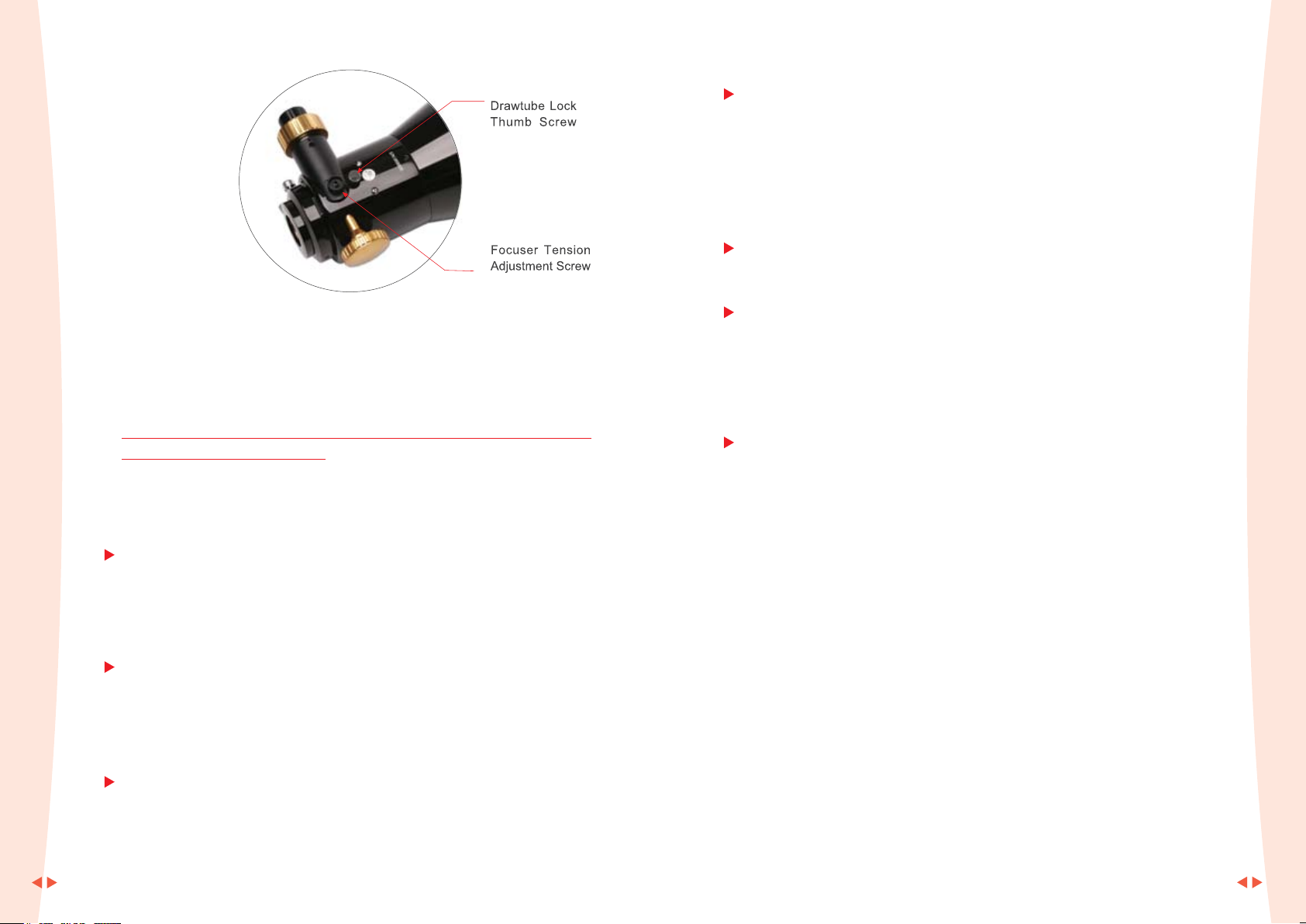
William Optics warranty does not cover damage to the focuser due to inappropriate tension setting.
This focuser is designed to hold many pounds without problems. If nonetheless your setup
requires additional tension adjustment, please use the tension allen screw under the focuser.
In order to avoid sagging or denting of the focuser steel reinforcement, it is necessary to adjust
tension ONLY when the drawtube is FULLY EXTENDED.
Extend the focuser drawtube to its full 115 mm as in the picture here above
before performing adjustment.
Storage and Cleaning
We suggest placing all accessories inside an airtight container with desiccative control.
Secondly, remember to store the telescope in a non-humid environment, never leave it in
a hot heated environment. If not properly stored, it may develop mildew growth and other
preventable build up.
Be particularly careful after a night observation that the lens has no dew on it before
storing the telescope away.
In case the lens surface becomes dusty, smeared, or gets fingerprints or fungus build-up
on it, first of all, remove any surface particle by using an air blower, then carefully proceed
to wiping the lens gently with a lint-free proper soft cloth. Use a lens liquid cleaner to get
the best cleaning result. Make sure you change your cloth to a new one from time to time.
The above-mentioned indications are not necessary if you carefully protect your
telescope.
The multi-layer paint white finish of your Fluorostar 110 is easy to ruin. Please take care
of the exterior body tube by wiping it down with a slightly damp soft cloth from time to
time. Water should be enough to do the job. Please do not use any organic solvent on
your telescope, for example alcohol, benzene and other hazardous chemical as this
might ruin it.
Never use the telescope in the rain or in conditions where it may get wet. The
telescope is not designed to be waterproof. If the telescope accidentally gets caught
in the rain, immediately wipe off all water using a clean dry soft cloth. If the telescope
gets totally soaked in water, immediately contact your Authorized WO Dealer for
service instructions.
Do not disassemble or attempt to repair your telescope without a written authorization
from William Optics Corp., as this violates the warranty terms under the limited
product warranty, and negates any guarantee.
Bundle Equipment
1. Aluminum carrying case.
2. Gold plated dew shield cover.
3. 115mm mounting rings.
4. 2" to 1.25" adapter.
5. Various accessories depending on the package.
6. 2" extender
C r a f t i n g t h e E a r t h ' s F i n e s t A s t r o n o m i c a l I n s t r u m e n t s
P07
P08
Page 7
Optional Equipment
A sturdy tripod for astronomical or spotting scope usage, or a telescope tripod and mount
(Equatorial or Alt-Az).
A mirror diagonal or erecting prism (The 2" WO Dielectric model is strongly recommended
for high quality astronomical viewing. A top quality Dielectric Quartz model is now also
available from WO).
At least one or two high quality eyepieces (9mm to 40mm wide-field recommended)
depending on the application.
For astrophotography, a photo adapter plus a T-Mount connection are necessary.
William Optics offers a TMB-designed reducer / field flattener optimized for the 110mm TMB
Triplet APO lens.
Recommended for This Scope
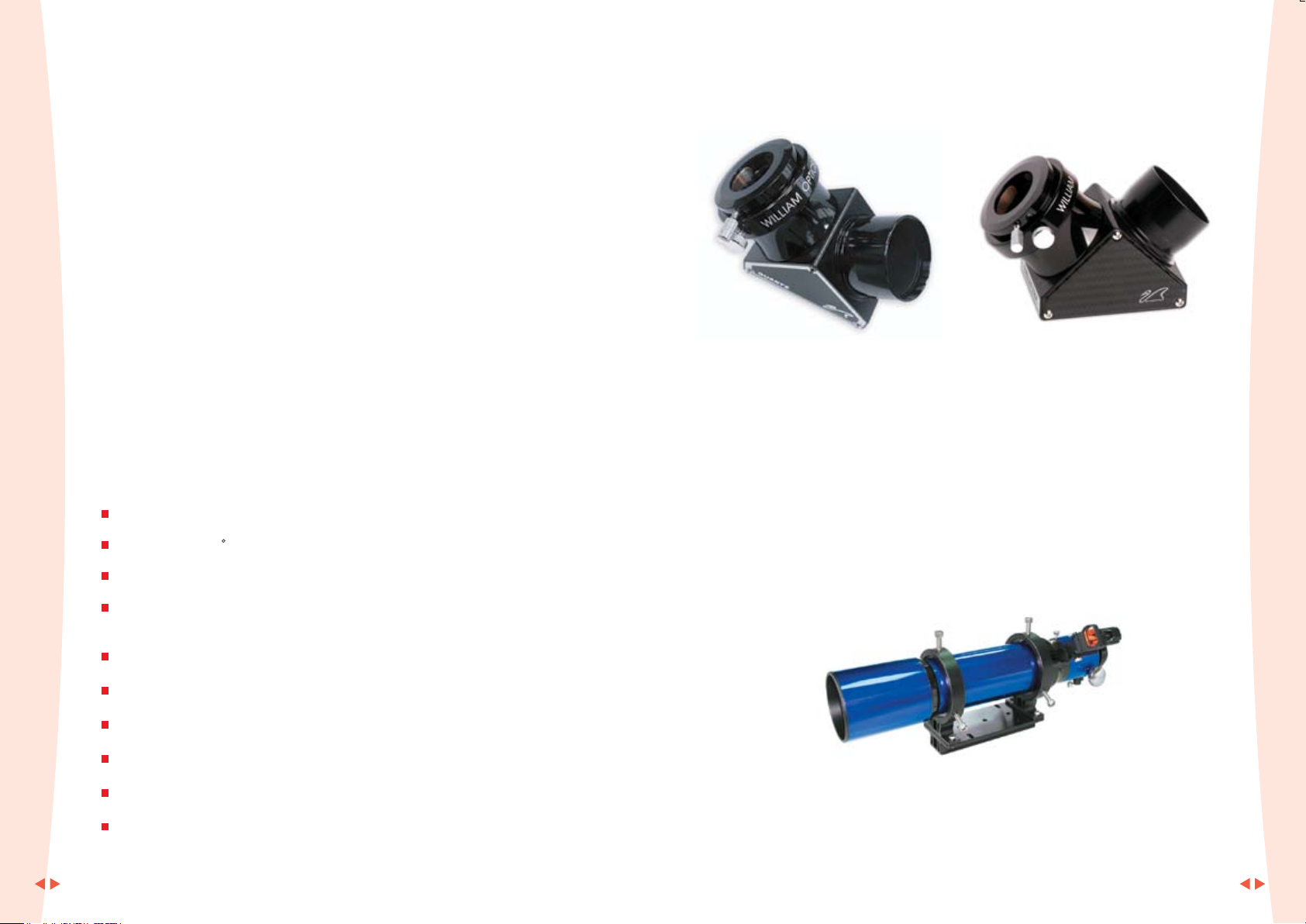
D i a g o n a l M i r r o r s
w w w . w i l l i a m - o p t i c s . c o m
Also available from WO:
WO 2" Star Mirror Diagonals.
WO 2" and 1.25" 45 Erecting prisms.
2.5x Apochromatic Barlow lens.
0.8x Reducer / Field Flattener with CCD camera adapter (will work ok, but we recommend the
FLT field flattener instead).
Super wide angle SWAN / UWAN Eyepieces, 1.25" or 2" versions.
DCL 52, 28, 4337 series "Digital Camera adapter Lens for Digital Cameras and Digital Video".
Digiscoping adapter: universal adapter for any type of digital camera.
WO 2" VR-1 filter improves seeing on bright objects like the Moon.
WO 115 mm mounting rings, saddle plate, dovetail plate combo for equatorial mounting.
WO 2" Extension Tube.
2" Quartz
Dielectric Diagonal
High-quality dielectric coating (99% reflectivity),
precision-polished quartz flat in our much-admired,
patented mechanics.
Our 2" Diagonals are what you need for your best
observing sessions. Only from William Optics.
2" Dielectric
Carbon Fiber Diagonal
99% reflectivity with 1/10 lambda highprecision mirror surface, with elegant
exterior design, with 1.25" adapter.
Ze n it hS t a r 8 0 I I ED Do ub l e t AP O
The newest ZenithStar II generation Doublet APO is a 80mm ED refractor ideal for everyone who
needs an excellent back-up scope / guiding scope at an excellent price, or a great first APO refractor,
which you can use for planetary work, wide-field imaging, and crisp, high power observations.
C r a f t i n g t h e E a r t h ' s F i n e s t A s t r o n m i c a l I n s t r u m e n t s
P09
P10
Page 8
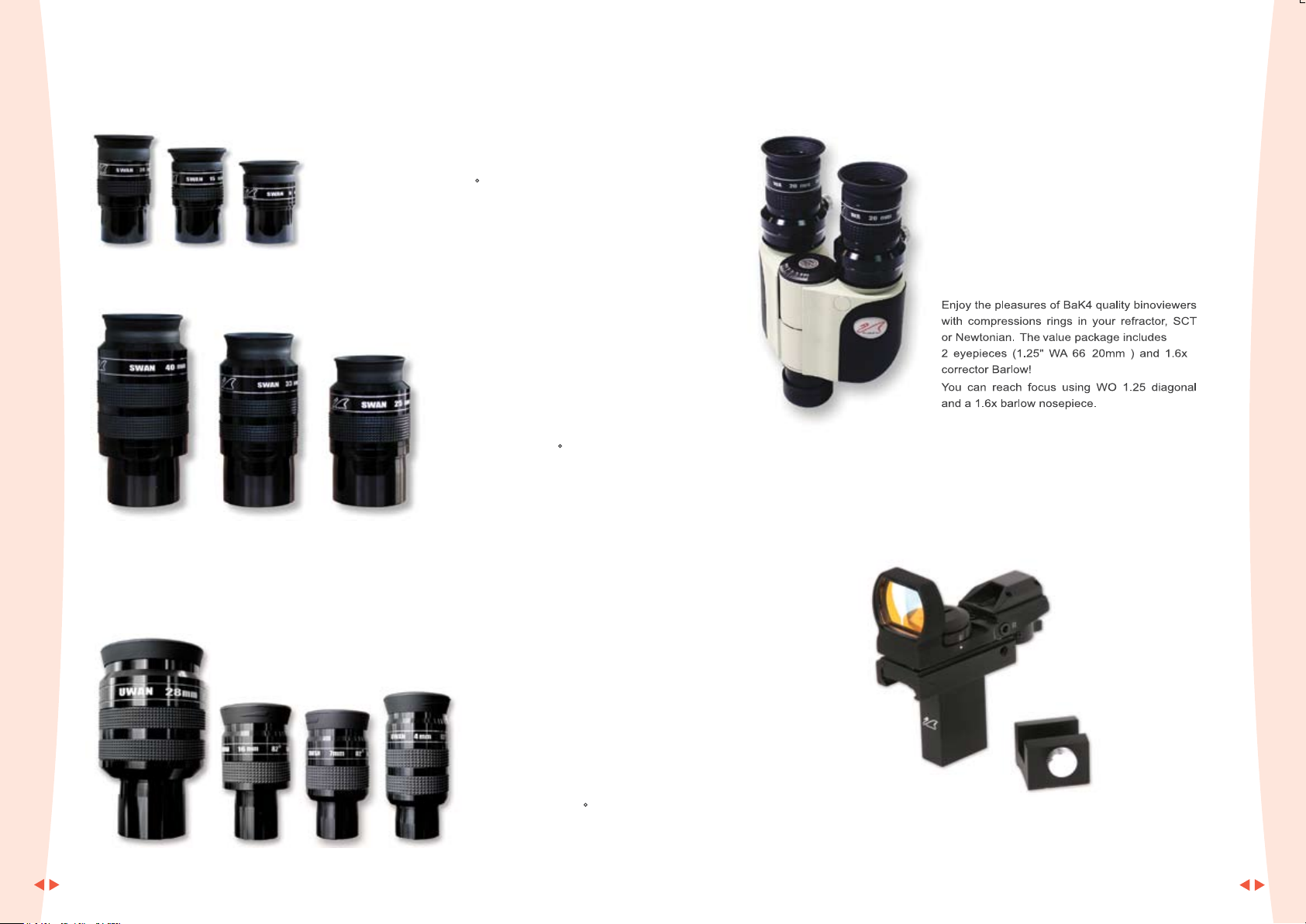
S W A N E y e p i e c e s
1.25" Eyepieces
Super Wide Angle (72 ).
9mm, 15mm, 20mm focal lengths.
5 elements in 4 groups, fully multi coated.
Parfocal.
B i n o v i e w e r
2" Eyepieces
Super Wide Angle (72 ).
25mm, 33mm, 40mm focal
lengths, FMC.
Generous eye-relief.
R e d D o t F i n d e r ( R . D . F . )
w w w . w i l l i a m - o p t i c s . c o m
P11
U W A N E y e p i e c e s
Ultra Wide Angle (82 ),
28mm (2"), 16mm (1.25"),
7mm (1.25"), 4mm (1.25").
C r a f t i n g t h e E a r t h ' s F i n e s t A s t r o n m i c a l I n s t r u m e n t s
This very practical r.d.f. comes with a handy, quick-release bracket included
in the price. Centering your objects in the sky has never been easier!
P12
Page 9
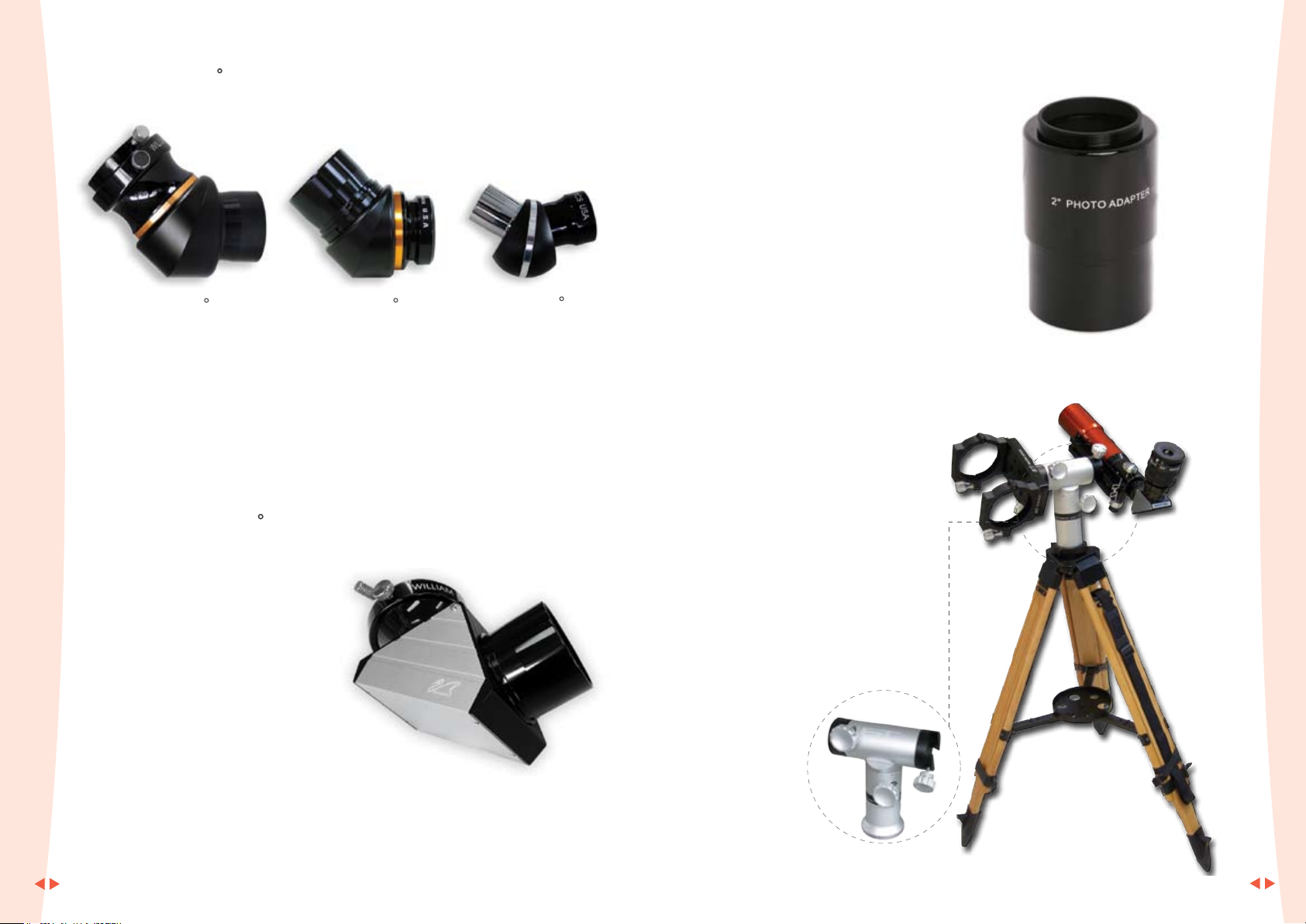
4 5 E r e c t i n g P r i s m s
P h o t o A d a p t e r
Anodized 2" camera adapter for prime focus
photography. Standard T ring thread.
w w w . w i l l i a m - o p t i c s . c o m
2" 45 1.25" 45
with 2" Barrel
Perfect both for astronomical and terrestrial observations.
Revolutionary and sophisticated design, extra-smooth feel.
2 " 9 0 E r e c t i n g P r i s m
1.25" 45
E A Z Y - T o u c h A l t - A z M o u n t
What is that you prize the most for
your wide-field refractor? It's ease
of use: EAZY TOUCH is the mount
you need, without sacrificing
stability, looks and portability. Made
in Switzerland by our partner
company AOK, this mount allows
you to be ready to go in 5 minutes
even with a 4" telescope!
C r a f t i n g t h e E a r t h ' s F i n e s t A s t r o n m i c a l I n s t r u m e n t s
P13
High quality prism, coating and finish, for
High quality prism, coating and finish, for
good correct- image view s of celesti al
good correct- image view s of celesti al
objects. Perfect in daylight too.
objects. Perfect in daylight too.
P14
 Loading...