

Page 1
T4/A4
Original™ Series PLASTIC Pumps
Simplify your process
EOM
Engineering
Operation &
Maintenance
REPLACES EOM T4/A4P 5/05
WIL-10220-E-02
Page 2
TABLE OF CONTENTS
PAGE #
SECTION 1 — CAUTIONS ............................................................................................ 1
SECTION 2 — PUMP DESIGNATION SYSTEM ......................................... 2
SECTION 3 — HOW IT WORKS (PUMP & AIR SYSTEMS) ............ 3
SECTION 4 — DIMENSIONAL DRAWINGS
A. T4 PLASTIC and UItrapure Air-Operated........................................................................... 4
B. A4 PLASTIC Accu-Flo™ .................................................................................................... 4
SECTION 5 — PERFORMANCE CURVES
A. T4 PLASTIC Rubber-Fitted ................................................................................................ 5
B. T4 PLASTIC Ultra-Flex™-Fitted ......................................................................................... 5
C. T4 PLASTIC TPE-Fitted ..................................................................................................... 6
D. T4 PLASTIC PTFE-Fitted ................................................................................................... 6
E. A4 PLASTIC Accu-Flo™ TPE-Fitted .................................................................................. 7
F. A4 PLASTIC Accu-Flo™ TPE-Fitted 70/30 Operating Condition ...................................... 7
G. A4 PLASTIC Accu-Flo™ PTFE-Fitted ................................................................................ 8
H. A4 PLASTIC Accu-Flo™ PTFE-Fitted 70/30 Operating Condition .................................... 8
SECTION 6 — SUCTION LIFT CURVES & DATA
A. T4 PLASTIC Air-Operated .................................................................................................. 9
B. A4 PLASTIC Accu-Flo™ .................................................................................................... 9
SECTION 7 — INSTALLATION & OPERATION
A. Installation — Turbo-Flo™ Suggested Installation Drawing .............................................. 10
B. Air-Controlled Operation & Maintenance ........................................................................... 11
C. Principles Behind Accu-Flo™ Pumps................................................................................ 12
D. Installation — Accu-Flo™ Pumps ...................................................................................... 12
E. Accu-Flo™ Operation & Maintenance ............................................................................... 13
F. Troubleshooting — Turbo-Flo™ Pumps ............................................................................ 14
G. Troubleshooting — Accu-Flo™ Pumps ............................................................................. 14
SECTION 8 — DIRECTIONS FOR DISASSEMBLY/REASSEMBLY
A. T4 PLASTIC Wetted Path — Tools Required, Torque Specs, Cautions ............................ 15
B. Turbo-Flo™ Air Valve — Disassembly, Cleaning, Inspection ............................................ 18
C. Reassembly Hints & Tips ................................................................................................... 20
D. Gasket Kit Installation ........................................................................................................ 21
SECTION 9 — EXPLODED VIEW/PARTS LISTING
A. T4 PLASTIC Rubber/TPE-Fitted ........................................................................................ 22
B. T4 PLASTIC and Ultrapure PTFE-Fitted ............................................................................ 24
C. A4 PLASTIC Accu-Flo™ .................................................................................................... 26
SECTION 10 — REFERENCE
A. Air-Operated Elastomer Options ........................................................................................ 28
B. Accu-Flo™ Electrical Reference ........................................................................................ 28
O
I
I
&
I
s
s
a
l
C
NON
U.S. Clean Air Act
Amendm
D
USE
e
p
l
e
t
i
z
o
n
e
ents of 1990
b
u
S
n
g
s
e
c
n
a
t
s
Page 3
SECTION 1
T4 PLASTIC
CAUTIONS – READ FIRST!
TEMPERATURE LIMITS:
Polypropylene 0°C to 79°C 32°F to 175°F
PVDF –12°C to 107°C 10°F to 225°F
PTFE PFA –28.9°C to 107°C –20°F to 225°F
Neoprene –17.8°C to 93.3°C 0°F to 200°F
Buna-N
EPDM –51.1°C to 137.8°C –60°F to 280°F
Viton
Wil-Flex™ –40°C to 107.2°C –40°F to 225°F
Polyurethane 12.2°C to 65.6°C 10°F to 150°F
Saniflex™ –28.9°C to 104.4°C –20°F to 220°F
PTFE 4.4°C to 104.4°C 40°F to 220°F
CAUTION: When choosing pump materials, be sure
to check the temperature limits for all wetted components. Example: Viton
(350°F) but polypropylene has a maximum limit of only
79°C (175°F).
CAUTION: Maximum temperature limits are based
upon mechanical stress only. Certain chemicals will
significantly reduce maximum safe operating temperatures. Consult engineering guide for chemical compatibility and temperature limits.
CAUTION: Always wear safety glasses when operating pump. If diaphragm rupture occurs, material being
pumped may be forced out air exhaust.
WARNING: Prevention of static sparking — If static
sparking occurs, fire or explosion could result. Pump,
valves, and containers must be properly grounded when
handling flammable fluids and whenever discharge of
static electricity is a hazard.
CAUTION: Do not exceed 8.6 bar (125 psig) air supply
pressure.
CAUTION: “Champ” series pumps are made of virgin
plastic and are not UV stabilized. Direct sunlight for
prolonged periods can cause deterioration of plastics.
®
–12.2°C to 82.2°C 10°F to 180°F
®
–40°C to 176.7°C –40°F to 350°F
®
has a maximum limit of 176.7°C
CAUTION: Before any maintenance or repair is
attempted, the compressed air line to the pump should
be disconnected and all air pressure allowed to bleed
from pump. Disconnect all intake, discharge and air
lines. Drain the pump by turning it upside down and
allowing any fluid to flow into a suitable container.
CAUTION: Blow out air line for 10 to 20 seconds
before attaching to pump to make sure all pipe line
debris is clear. Use an in-line air filter. A 5µ (micron) air
filter is recommended.
NOTE: Tighten clamp bands and retainers prior to
installation. Fittings may loosen during transportation.
NOTE: When installing PTFE diaphragms, it is important to tighten outer pistons simultaneously (turning in
opposite directions) to ensure tight fit.
NOTE: Before starting disassembly, mark a line from
each liquid chamber to its corresponding air chamber.
This line will assist in proper alignment during reassembly.
CAUTION: Verify the chemical compatibility of the
process and cleaning fluid to the pump’s component
materials in the Chemical Resistance Guide (see E4).
CAUTION: When removing the end cap using
compressed air, the air valve end cap may come out
with considerable force. Hand protection such as a
padded glove or rag should be used to capture the
end cap.
NOTE: Non lube-free pumps must be lubricated.
Wilden suggests an arctic 5 weight oil (ISO grade 15).
Do not over-lubricate air supply. Over-lubrication will
reduce pump performance.
CAUTION: Only explosion proof (NEMA 7) solenoid
valves should be used in areas where explosion proof
equipment is required.
1
WILDEN PUMP & ENGINEERING, LLCWIL-10220-E-02
Page 4

SECTION 2
WILDEN PUMP DESIGNATION SYSTEM
T or A4X /XXXXX / XXX /XX/ XXX/ XXXX
MODEL
VALVE BALLS
DIAPHRAGMS
AIR VALVE
CENTER SECTION
WETTED PARTS & OUTER PISTON
AIR SYSTEM BASE TYPE
O-RINGS
VALVE SEAT
SPECIALTY
CODE
(if applicable)
T4 OR A4 PLASTIC MATERIAL CODES
AIR SYSTEM BASE TYPE
A = ACCU-FLO™
T = TURBO-FLO™
WETTED PARTS & OUTER PISTON
KK = PVDF / PVDF
PP = POLYPROPYLENE /
POLYPROPYLENE
TT = PTFE / PTFE
CENTER SECTION
PP = POLYPROPYLENE
AIR VALVE
A = ALUMINUM
B = BRASS
C = PTFE COATED
D = BRASS W/OIL BOTTLE
N = NICKEL PLATED
S = STAINLESS STEEL
DIAPHRAGMS
BNS = BUNA-N (Red Dot)
BNU = BUNA-N, ULTRA-FLEX™ (Red
Dot)
EPS = EPDM (Blue Dot)
EPU = EPDM, ULTRA-FLEX™ (Blue Dot)
FSS = SANIFLEX™
[Hytrel
®
(Cream)]
NES = NEOPRENE (Green Dot)
NEU = NEOPRENE, ULTRA-FLEX™
(Green Dot)
PUS = POLYURETHANE (Clear)
TEU = PTFE W/EPDM
BACK-UP (White)
TNU = PTFE W/NEOPRENE
BACK-UP (White)
TSU = PTFE W/SANIFLEX™ BACK-UP
(White)
®
VTS = VITON
VTU = VITON
Dot)
WFS = WIL-FLEX™ [Santoprene
(White Dot)
®
, ULTRA-FLEX™ (White
®
(Orange Dot)]
VALVE BALL
BN = BUNA-N (Red Dot)
EP = EPDM (Blue Dot)
FS = SANIFLEX™
[Hytrel
®
(Cream)]
NE = NEOPRENE (Green Dot)
PU = POLYURETHANE (Brown)
TF = PTFE (White)
VT = VITON
®
(White Dot)
WF = WIL-FLEX™ [Santoprene
Dot)]
VALVE SEAT
K = PVDF
P = POLYPROPYLENE
T = PTFE PFA
VALVE SEAT O-RING
BN = BUNA-N
PU = POLYURETHANE (Brown)
TV = PTFE ENCAP. VITON
®
®
(Orange
SPECIALTY CODES
0100 Wil-Gard II™ 110V
0102 Wil-Gard II™ sensor wires ONLY
0103 Wil-Gard II™ 220V
0145 Accu-Flo™, 110V AC x-proof coil, Wil-Gard II™ 110V
0150 Accu-Flo™, 24V DC coil
0151 Accu-Flo™, 24V AC / 12V DC coil
0153 Accu-Flo™, 24V AC / 12V DC x-proof coil
0154 Accu-Flo™, 24V DC x-proof coil
0155 Accu-Flo™, 110V coil
0156 Accu-Flo™, 110V AC x-proof coil
0157 Accu-Flo™, 24 V DC x-proof coil, Intl. PTB approved
0159 Accu-Flo™, 24V DC coil, Intl. PTB approved, DIN flange
0164 Accu-Flo™, 110V AC coil, Wil-Gard II™ sensor wires ONLY
0166 Accu-Flo™, 24V DC coil, Wil-Gard II™ 110V
0167 Accu-Flo™, 24V AC / 12V DC coil, Wil-Gard II™ 110V
0168 Accu-Flo™, 110V AC coil, Wil-Gard II™ 110V
0169 Accu-Flo™, 110V AC coil, PFA coated hardware
0170 Accu-Flo™, 110V AC x-proof coil, PFA coated hardware
0180 Accu-Flo™, 24V AC / 12V DC coil, PFA coated hardware
0181 Accu-Flo™, 24V AC / 12V DC x-proof coil, PFA coated hardware
0183 Accu-Flo™, 24V AC / 12V DC x-proof coil, Wil-Gard II™ 110V
NOTE: MOST ELASTOMERIC MATERIALS USE COLORED DOTS FOR IDENTIFICATION.
Viton is a registered trademarks of DuPont Dow Elastomers.
WILDEN PUMP & ENGINEERING, LLC WIL-10220-E-02
0184 Accu-Flo™, 24V DC coil, PFA coated hardware
0185 Accu-Flo™, 24V DC x-proof coil, PFA coated hardware
0206 PFA coated hardware, Wil-Gard II™ sensor wires ONLY
0360 Accu-Flo™, 24V DC coil, DIN flange
0362 Accu-Flo™, 110V AC coil, PFA coated hardware, Wil-Gard II™ 110V
0502 PFA coated hardware
0504 DIN flange
0506 DIN flange, PFA coated hardware
0564 Split manifold, inlet ONLY
0567 Split manifold, Accu-Flo™ 24V DC coil
0570 Split manifold, Accu-Flo™, 24V AC / 12V DC coil
0603 PFA coated hardware, Wil-Gard II™ 110V
0604 DIN flange, Wil-Gard II™ 220V
0606 DIN flange, PFA coated hardware, Wil-Gard II™ 220V
0608 PFA coated hardware, Wil-Gard II™ 220V
0612 Ultrapure, PFA coated hardware, male connections
0618 Ultrapure, PFA coated hardware, Wil-Gard II™ 110V, male connections
0622 Ultrapure, male connections
0624 Ultrapure, Wil-Gard II™ 110V, male connections
0660 Split manifold, Wil-Gard II™ 110V
0661 Split manifold PFA coated hardware, Wil-Gard II™ 110V
2
Page 5
SECTION 3
THE WILDEN PUMP — HOW IT WORKS
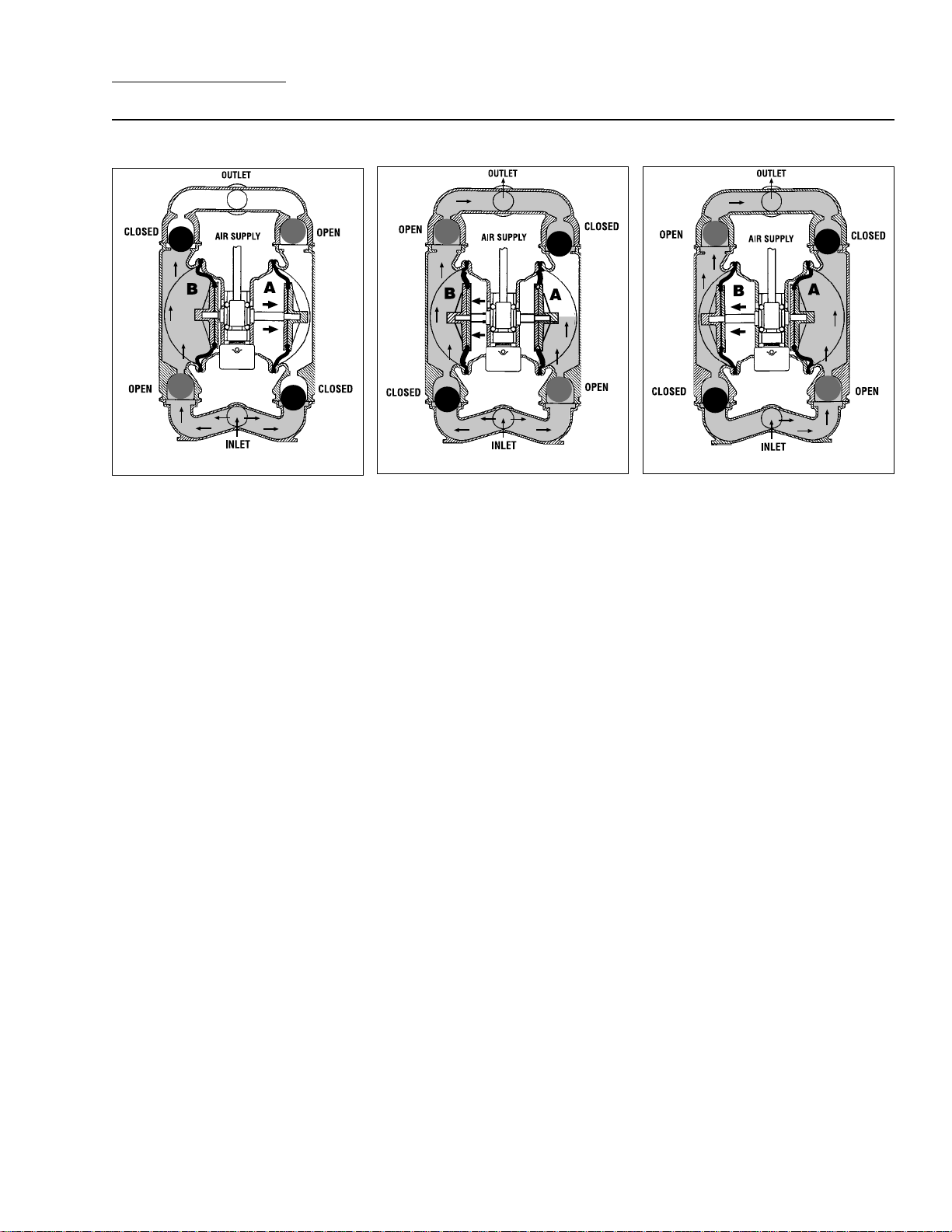
The Wilden diaphragm pump is an air-operated, positive displacement, self-priming pump. These drawings show the flow
pattern through the pump upon its initial stroke. It is assumed the pump has no fluid in it prior to its initial stroke.
RIGHT STROKE MID STROKE LEFT STROKE
FIGURE 1 The air valve directs pressurized air to the back side of diaphragm A.
The compressed air is applied directly to
the liquid column separated by elastomeric diaphragms. The diaphragm acts
as a separation membrane between the
compressed air and liquid, balancing the
load and removing mechanical stress
from the diaphragm. The compressed
air moves the diaphragm away from the
center block of the pump. The opposite diaphragm is pulled in by the shaft
connected to the pressurized diaphragm.
Diaphragm B is on its suction stroke;
air behind the diaphragm has been
forced out to the atmosphere through the
exhaust port of the pump. The movement
of diaphragm B toward the center block
of the pump creates a vacuum within
chamber B. Atmospheric pressure forces
fluid into the inlet manifold forcing the
inlet valve ball off its seat. Liquid is free to
move past the inlet valve ball and fill the
liquid chamber (see shaded area).
FIGURE 2 When the pressurized
diaphragm, diaphragm A, reaches the
limit of its discharge stroke, the air valve
redirects pressurized air to the back
side of diaphragm B. The pressurized
air forces diaphragm B away from the
center block while pulling diaphragm A
to the center block. Diaphragm B is now
on its discharge stroke. Diaphragm B
forces the inlet valve ball onto its seat
due to the hydraulic forces developed in
the liquid chamber and manifold of the
pump. These same hydraulic forces lift
the discharge valve ball off its seat, while
the opposite discharge valve ball is forced
onto its seat, forcing fluid to flow through
the pump discharge. The movement of
diaphragm A toward the center block of
the pump creates a vacuum within liquid
chamber A. Atmospheric pressure forces
fluid into the inlet manifold of the pump.
The inlet valve ball is forced off its seat
allowing the fluid being pumped to fill the
liquid chamber.
FIGURE 3 At completion of the stroke,
the air valve again redirects air to the
back side of diaphragm A, which starts
diaphragm B on its exhaust stroke. As
the pump reaches its original starting
point, each diaphragm has gone through
one exhaust and one discharge stroke.
This constitutes one complete pumping
cycle. The pump may take several cycles
to completely prime depending on the
conditions of the application.
3
WILDEN PUMP & ENGINEERING, LLCWIL-10220-E-02
Page 6
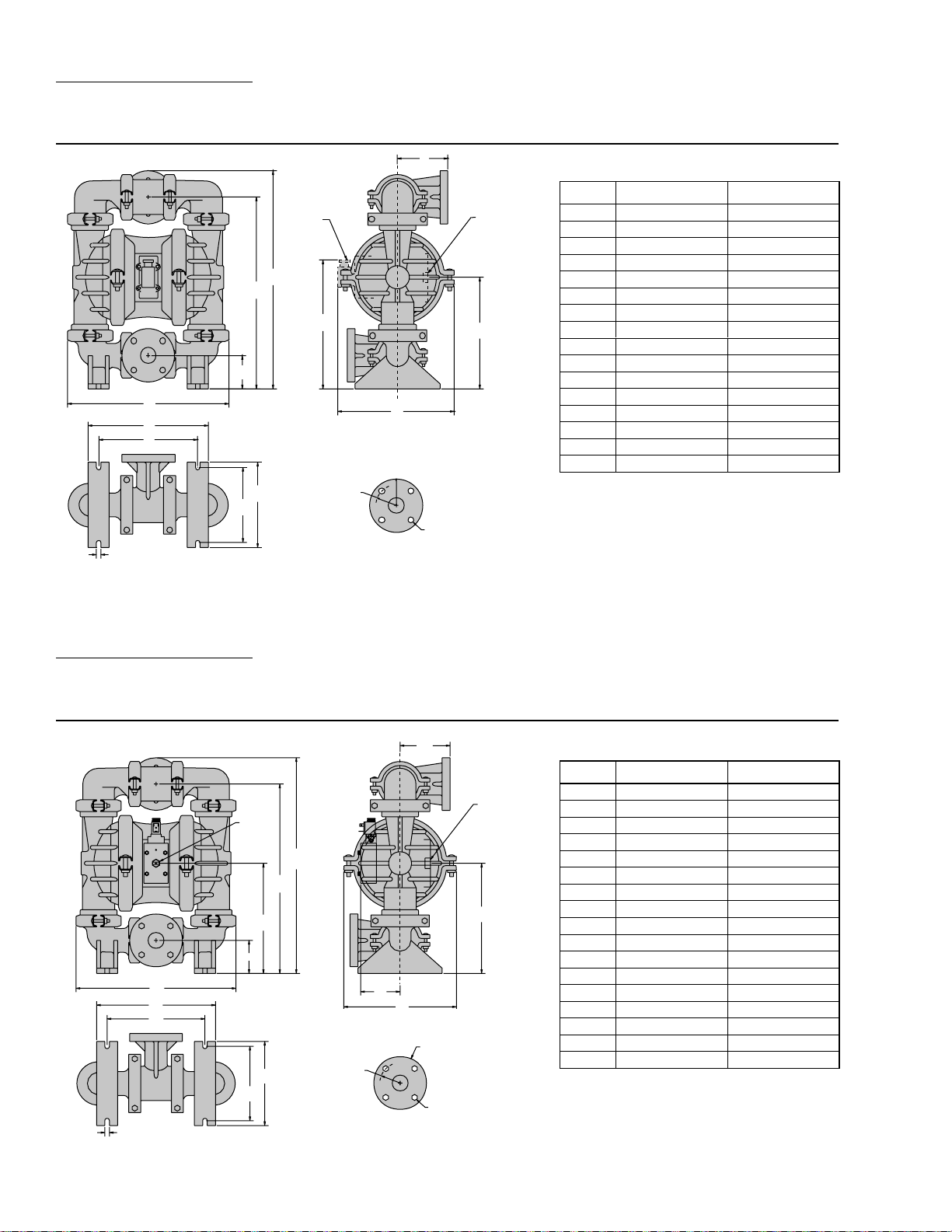
SECTION 4A
4
DIMENSIONAL DRAWING
T4 PLASTIC CHAMP AND ULTRAPURE
&
MM
&.04
!)2).,%4
$
#
%
"
!
*
+
-
,
.
(
2
0
0/5.$#,!33
3
MM
&.04
%8(!534
'
&,!.'%
MM
)$
DIMENSIONS
ITEM METRIC (mm) STANDARD (inch)
A 394 15.5
B 79 3.1
C 465 18.3
D 528 20.8
E 305 12.0
F 122 4.8
G 269 10.6
H 284 11.2
J 287 11.3
K 236 9.3
L 180 7.1
M 206 8.1
N 13 0.5
P 48 RAD. 1.9 RAD.
R 64 RAD. 2.5 RAD.
S 15 DIA. 0.6 DIA.
SECTION 4B
DIMENSIONAL DRAWING
A4 PLASTIC ACCU-FLO™
'
MM
&,!.'%
4
&.0
%8(!534
(
MM
&.04
!)2).,%4
0 1
%
$
##
"
!
+
,
.
-
&
*
3
2
DIMENSIONS
ITEM METRIC (mm) STANDARD (inch)
A 394 15.5
B 79 3.1
C 269 10.6
D 465 18.3
E 528 20.8
F 97 3.8
G 122 4.8
H 269 10.6
J 284 11.2
K 287 11.3
L 236 9.3
M 180 7.1
N 206 8.1
P 13 0.5
R 48 RAD. 1.9 RAD.
S 64 RAD. 2.5 RAD.
T 15 DIA. 0.6 DIA.
0
WILDEN PUMP & ENGINEERING, LLC WIL-10220-E-02
4
Page 7
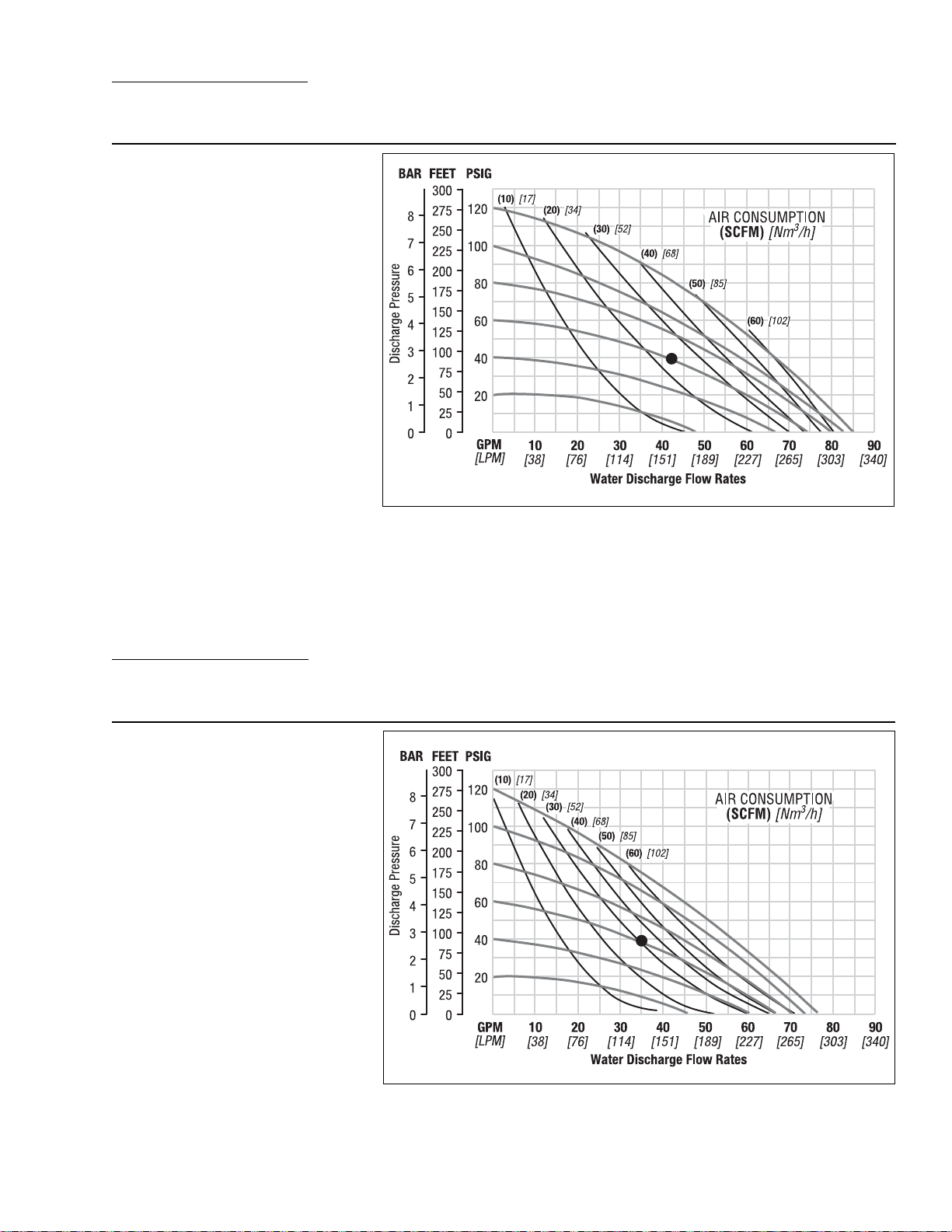
SECTION 5A
PERFORMANCE CURVES
T4 PLASTIC RUBBER-FITTED
Height .................................. 528 mm (20.8")
Width ................................... 394 mm (15.5")
Depth ..................................284 mm (11.2")
Est. Ship Weight ........Polypropylene 17 kg (38 lbs)
Air Inlet .................................... 10 mm (3/8")
Inlet ..................................... 38 mm (1-1/2")
Outlet .................................. 38 mm (1-1/2")
Suction Lift ......................... 5.49 m Dry (18')
8.53 m Wet (28')
Displacement per
Stroke ........................... 1.02 l (0.27 gal.)
Max. Flow Rate ................. 288 lpm (76 gpm)
Max. Size Solids ...................4.8 mm (3/16")
1
Displacement per stroke was calculated at 4.8 bar
(70 psig) air inlet pressure against a 2 bar (30 psig)
head pressure.
Example: To pump 159 lpm (42 gpm) against
a discharge pressure head of 2.7 bar (40
psig) requires 4.1 bar (60 psig) and 40.8
3
Nm
/h (24 scfm) air consumption. (See dot
on chart.)
Caution: Do not exceed 8.6 bar (125 psig) air
supply pressure.
1
Flow rates indicated on chart were determined by pumping water.
For optimum life and performance, pumps should be specified so that daily operation parameters
will fall in the center of the pump performance curve.
SECTION 5B
PERFORMANCE CURVES
T4 PLASTIC ULTRA-FLEX™-FITTED
Height .................................. 528 mm (20.8")
Width ................................... 394 mm (15.5")
Depth ..................................284 mm (11.2")
Est. Ship Weight ........Polypropylene 17 kg (38 lbs)
Air Inlet .................................... 10 mm (3/8")
Inlet ..................................... 38 mm (1-1/2")
Outlet .................................. 38 mm (1-1/2")
Suction Lift ......................... 4.88 m Dry (16')
8.23 m Wet (27')
Displacement per
Stroke ........................... 0.68 l (0.18 gal.)
Max. Flow Rate ................. 235 lpm (62 gpm)
Max. Size Solids ...................4.8 mm (3/16")
1
Displacement per stroke was calculated at 4.8 bar
(70 psig) air inlet pressure against a 2 bar (30 psig)
head pressure.
Example: To pump 132.5 lpm (35 gpm)
against a discharge pressure head of 2.7 bar
(40 psig) requires 4.1 bar (60 psig) and 51
3
Nm
/h (30 scfm) air consumption. (See dot
on chart.)
Caution: Do not exceed 8.6 bar (125 psig) air
supply pressure.
1
Flow rates indicated on chart were determined by pumping water.
For optimum life and performance, pumps should be specified so that daily operation parameters
will fall in the center of the pump performance curve.
5
WILDEN PUMP & ENGINEERING, LLCWIL-10220-E-02
Page 8
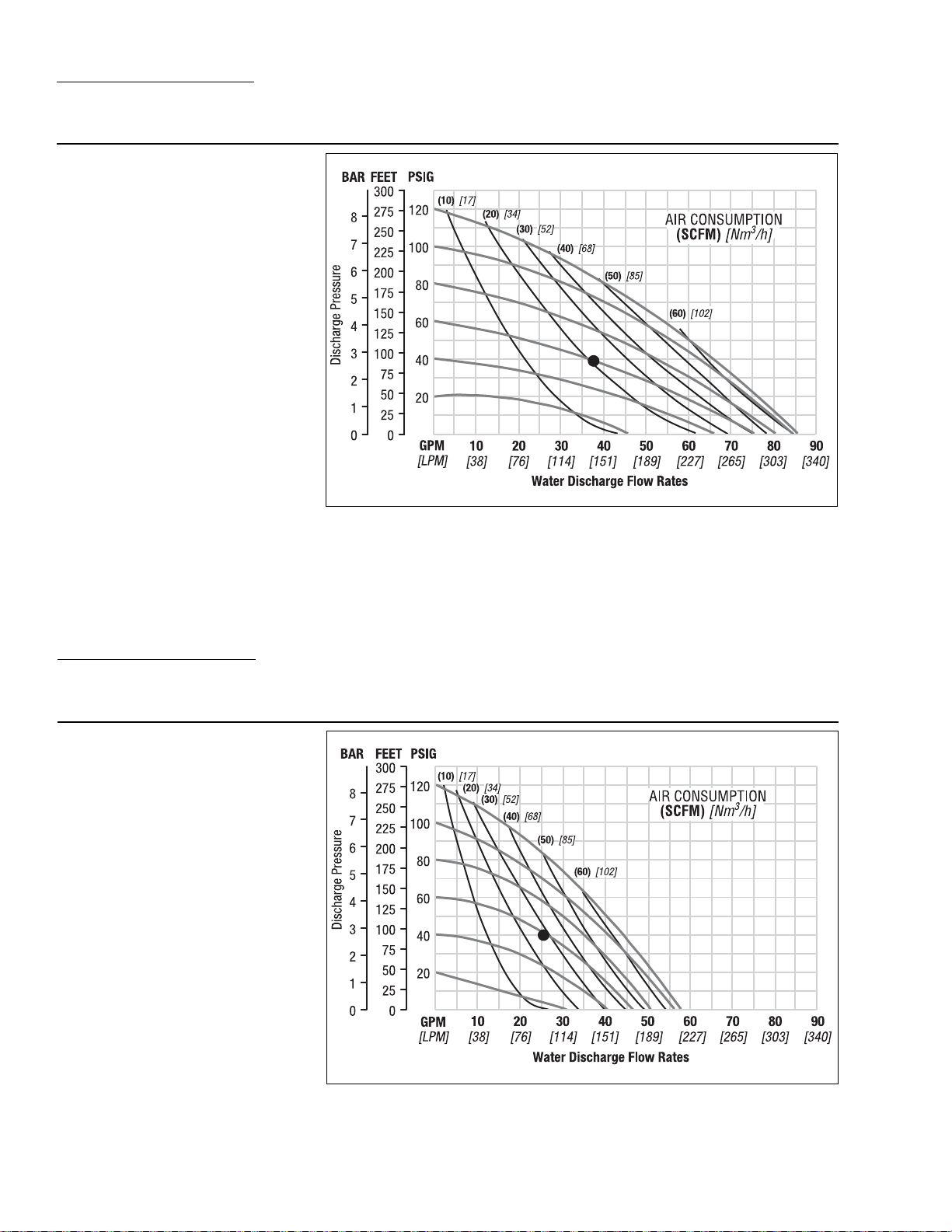
SECTION 5C
PERFORMANCE CURVES
T4 PLASTIC TPE-FITTED
Height .................................. 528 mm (20.8")
Width ................................... 394 mm (15.5")
Depth ..................................284 mm (11.2")
Est. Ship Weight ........Polypropylene 17 kg (38 lbs)
Air Inlet .................................... 10 mm (3/8")
Inlet ..................................... 38 mm (1-1/2")
Outlet .................................. 38 mm (1-1/2")
Suction Lift ......................... 4.27 m Dry (14')
8.23 m Wet (27')
Displacement per
Stroke ......................... 1.17 l (0.31 gal.)
Max. Flow Rate ................. 307 lpm (81 gpm)
Max. Size Solids ...................4.8 mm (3/16")
1
Displacement per stroke was calculated at 4.8 bar
(70 psig) air inlet pressure against a 2 bar (30 psig)
head pressure.
Example: To pump 143.9 lpm (38 gpm)
against a discharge pressure head of 2.7
bar (40 psig) requires 4.1 bar (60 psig) and
3
35.7 Nm
dot on chart.)
Caution: Do not exceed 8.6 bar (125 psig) air
supply pressure.
/h (21 scfm) air consumption. (See
1
Flow rates indicated on chart were determined by pumping water.
For optimum life and performance, pumps should be specified so that daily operation parameters
will fall in the center of the pump performance curve.
SECTION 5D
PERFORMANCE CURVES
T4 PLASTIC PTFE-FITTED
Height .................................. 528 mm (20.8")
Width ................................... 394 mm (15.5")
Depth ..................................284 mm (11.2")
Est. Ship Weight ........Polypropylene 17 kg (38 lbs)
Air Inlet .................................... 10 mm (3/8")
Inlet ..................................... 38 mm (1-1/2")
Outlet .................................. 38 mm (1-1/2")
Suction Lift ........................... 2.74 m Dry (9')
8.53 m Wet (28')
Displacement per
Stroke ........................... 0.53 l (0.14 gal.)
Max. Flow Rate ................. 235 lpm (62 gpm)
Max. Size Solids ...................4.8 mm (3/16")
1
Displacement per stroke was calculated at 4.8 bar
(70 psig) air inlet pressure against a 2 bar (30 psig)
head pressure.
Example: To pump 94.6 lpm (25 gpm)
against a discharge pressure head of 2.7 bar
(40 psig) requires 4.1 bar (60 psig) and 51
3
Nm
/h (30 scfm) air consumption. (See dot
on chart.)
Caution: Do not exceed 8.6 bar (125 psig) air
supply pressure.
1
Flow rates indicated on chart were determined by pumping water.
For optimum life and performance, pumps should be specified so that daily operation parameters
will fall in the center of the pump performance curve.
WILDEN PUMP & ENGINEERING, LLC WIL-10220-E-02
6
Page 9
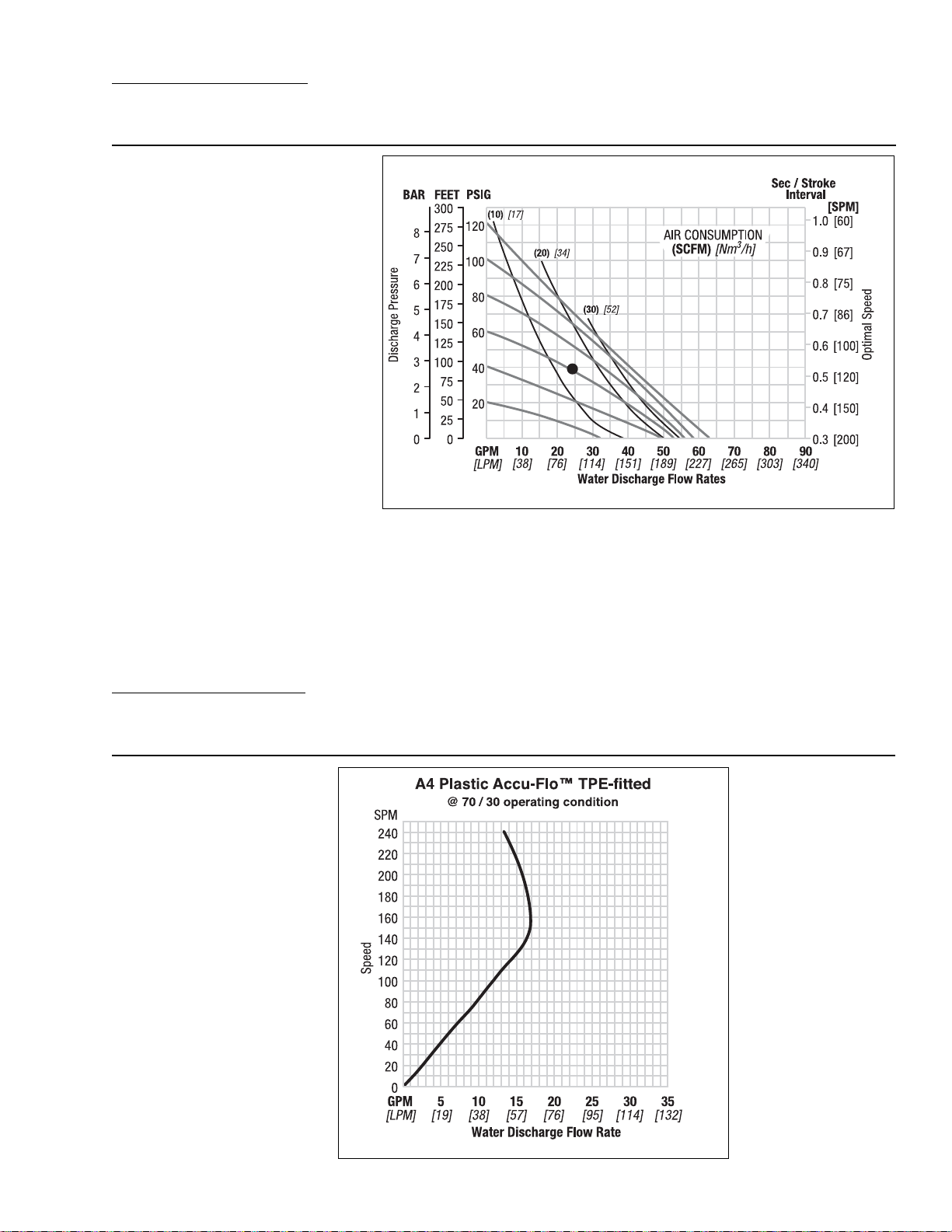
SECTION 5E
PERFORMANCE CURVES
A4 PLASTIC ACCU-FLO™ TPE-FITTED
Height .................................. 528 mm (20.8")
Width ................................... 394 mm (15.5")
Depth ..................................284 mm (11.2")
Est. Ship Weight ........Polypropylene 16 kg (36 lbs)
PVDF 21 kg (47 lbs)
PTFE PFA 23 kg (50 lbs)
Air Inlet .................................... 10 mm (3/8")
Inlet ..................................... 38 mm (1-1/2")
Outlet .................................. 38 mm (1-1/2")
Suction Lift ......................... 3.66 m Dry (12')
8.84 m Wet (29')
Displacement per
Stroke ........................... 0.87 l (0.23 gal.)
Max. Flow Rate ................. 235 lpm (62 gpm)
Max. Size Solids .....................6.4 mm (1/4")
1
Displacement per stroke was calculated at 4.8 bar
(70 psig) air inlet pressure against a 2 bar (30 psig)
head pressure.
Example: To pump 90.85 lpm (24 gpm)
against a discharge pressure head of 2.7 bar
(40 psig) requires 4.1 bar (60 psig), 17 Nm
(14 scfm) air consumption, and a pump speed
of 120 strokes/minute. (See dot on chart.)
Caution: Do not exceed 8.6 bar (125 psig) air
supply pressure.
1
3
/h
Flow curves are for “optimal speed” conditions only. The “optimal speed” is that speed which
provides the maximum flow under a particular air and fluid pressure condition. The optimal speed
varies for different fluid and air pressures. Recommendations for optimal speed can be found on
the right side of the flow curve.
Flow rates indicated on chart were determined by pumping water.
For optimum life and performance, pumps should be specified so that daily operation parameters
will fall in the center of the pump performance curve.
SECTION 5F
70/30 OPERATING CONDITION
A4 PLASTIC ACCU-FLO™ TPE-FITTED
This curve demonstrates the flow
created when the stroke rate is modified under a static air and fluid pressure condition. This curve can be
applied to different pressure conditions
to estimate the change in flow due to
stroke rate.
7
WILDEN PUMP & ENGINEERING, LLCWIL-10220-E-02
Page 10

SECTION 5G
PERFORMANCE CURVES
A4 PLASTIC ACCU-FLO™ PTFE-FITTED
Height .................................. 528 mm (20.8")
Width ................................... 394 mm (15.5")
Depth ..................................284 mm (11.2")
Est. Ship Weight ........Polypropylene 16 kg (36 lbs)
PVDF 21 kg (47 lbs)
PTFE PFA 23 kg (50 lbs)
Air Inlet .................................... 10 mm (3/8")
Inlet ..................................... 38 mm (1-1/2")
Outlet .................................. 38 mm (1-1/2")
Suction Lift ........................... 2.13 m Dry (7')
8.84 m Wet (29')
Displacement per
Stroke ........................... 0.42 l (0.11 gal.)
Max. Flow Rate ................. 144 lpm (38 gpm)
Max. Size Solids ...................4.8 mm (3/16")
1
Displacement per stroke was calculated at 4.8 bar
(70 psig) air inlet pressure against a 2 bar (30 psig)
head pressure.
Example: To pump 38 lpm (10 gpm) against
a discharge pressure head of 2.7 bar (40
psig) requires 4.1 bar (60 psig), 17 Nm
scfm) air consumption, and a pump speed of
115 strokes/minute. (See dot on chart.)
Caution: Do not exceed 8.6 bar (125 psig) air
supply pressure.
3
/h (10
1
Flow curves are for “optimal speed” conditions only. The “optimal speed” is that speed which
provides the maximum flow under a particular air and fluid pressure condition. The optimal speed
varies for different fluid and air pressures. Recommendations for optimal speed can be found on
the right side of the flow curve.
Flow rates indicated on chart were determined by pumping water.
For optimum life and performance, pumps should be specified so that daily operation parameters
will fall in the center of the pump performance curve.
SECTION 5H
70/30 OPERATING CONDITION
A4 PLASTIC ACCU-FLO™ PTFE-FITTED
This curve demonstrates the flow
created when the stroke rate is modified under a static air and fluid pressure condition. This curve can be
applied to different pressure conditions
to estimate the change in flow due to
stroke rate.
WILDEN PUMP & ENGINEERING, LLC WIL-10220-E-02
8
Page 11

SECTION 6A – AIR-CONTROLLED
SUCTION LIFT CURVES & DATA
Suction lift curves are calibrated for pumps operating at
305 m (1,000') above sea level. This chart is meant to be
a guide only. There are many variables which can affect
your pump’s operating characteristics. The number of intake
and discharge elbows, viscosity of pumping fluid, elevation
(atmospheric pressure) and pipe friction loss all affect the
amount of suction lift your pump will attain.
SECTION 6B – ACCU-FLO™
SUCTION LIFT CURVES & DATA
Suction lift curves are calibrated for pumps operating at
305 m (1,000') above sea level. This chart is meant to be
a guide only. There are many variables which can affect
your pump’s operating characteristics. The number of intake
and discharge elbows, viscosity of pumping fluid, elevation
(atmospheric pressure) and pipe friction loss all affect the
amount of suction lift your pump will attain.
9
WILDEN PUMP & ENGINEERING, LLCWIL-10220-E-02
Page 12

SECTION 7A
INSTALLATION – T4 PLASTIC
AIR-OPERATED PUMPS
The Model T4 Plastic pump has a 38 mm (1-1/2") inlet and
38 mm (1-1/2") outlet and is designed for flows to 307 lpm
(81 gpm). A variety of diaphragms, valve balls, valve seats,
and o-rings are available to satisfy temperature, chemical
compatibility, abrasion and flex concerns.
The suction pipe size should be at least 38 mm (1-1/2")
diameter or larger if highly viscous material is being pumped.
The suction hose must be non-collapsible, reinforced type
as the T4 is capable of pulling a high vacuum. Discharge
piping should be at least 38 mm (1-1/2"); larger diameter can
be used to reduce friction losses. It is critical that all fittings
and connections are airtight or a reduction or loss of pump
suction capability will result.
For T4 Champ models, Wilden offers 150 lb. standard or
metric flanges. The following details should be noted when
mating these to pipe works:
• A 60–80 shore gasket that covers the entire flange face
should be used.
• The gasket should be between .075" and .175" thickness.
• Mating flanges with flat as opposed to raised surfaces
should be used for proper mechanical sealing.
• The flanges should be tightened to a minimum of 6.8 N·m
(5 ft-lbs) but no more than 13.5 N·m (10 ft-lbs).
A non-raised surfaced-flange adapter should be utilized when
mating to the pump’s inlet and discharge manifolds for proper
sealing.
INSTALLATION: Months of careful planning, study, and selection efforts can result in unsatisfactory pump performance if
installation details are left to chance.
Premature failure and long term dissatisfaction can be avoided
if reasonable care is exercised throughout the installation
process.
LOCATION: Noise, safety, and other logistical factors usually
dictate that “utility” equipment be situated away from the
production floor. Multiple installations with conflicting requirements can result in congestion of utility areas, leaving few
choices for siting of additional pumps.
Within the framework of these and other existing conditions, every
pump should be located in such a way that four key factors are
balanced against each other to maximum advantage.
1. ACCESS: First of all, the location should be accessible. If
it’s easy to reach the pump, maintenance personnel will have
an easier time carrying out routine inspections and adjustments. Should major repairs become necessary, ease of
access can play a key role in speeding the repair process and
reducing total downtime.
2. AIR SUPPLY: Every pump location should have an air line
large enough to supply the volume of air necessary to achieve
the desired pumping rate (see pump performance chart). Use
air pressure up to a maximum of 8.6 bar (125 psig) depending
upon pumping requirements.The use of an air filter before the
pump will ensure that the majority of any pipeline contaminants
will be eliminated. For best results, the pumps should use an
air filter, regulator, and lubricator system.
3. ELEVATION: Selecting a site that is well within the pump’s
suction lift capability will assure that loss-of-prime troubles will
be eliminated. In addition, pump efficiency can be adversely
WILDEN PUMP & ENGINEERING, LLC WIL-10220-E-02
affected if proper attention is not given to elevation (see pump
performance chart).
4. PIPING: Final determination of the pump site should not be
made until the piping problems of each possible location have
been evaluated. The impact of current and future installations
should be considered ahead of time to make sure that inadvertent restrictions are not created for any remaining sites.
The best choice possible will be a site involving the shortest
and the straightest hook-up of suction and discharge piping.
Unnecessary elbows, bends, and fittings should be avoided.
Pipe sizes should be selected so as to keep friction losses
within practical limits. All piping should be supported independently of the pump. In addition, it should line up without
placing stress on the pump fittings.
Expansion joints can be installed to aid in absorbing the
forces created by the natural reciprocating action of the
pump. If the pump is to be bolted down to a solid foundation,
a mounting pad placed between the pump and foundation
will assist in minimizing pump vibration. Flexible connections
between the pump and rigid piping will also assist in minimizing pump vibration. If quick-closing valves are installed at any
point in the discharge system, or if pulsation within a system
becomes a problem, a surge suppressor should be installed
to protect the pump, piping and gauges from surges and
water hammer.
When pumps are installed in applications involving flooded
suction or suction head pressures, a gate valve should be
installed in the suction line to permit closing of the line for
pump service.
The T4 can be used in submersible applications only when both
wetted and non-wetted portions are com patible with the material being pumped. If the pump is to be used in a submersible
application, a hose should be attached to the pump’s air exhaust
and the exhaust air piped above the liquid level.
If the pump is to be used in a self-priming application, be
sure that all connections are airtight and that the suction lift is
within the pump’s ability. Note: Materials of construction and
elastomer material have an effect on suction lift parameters.
Please refer to pump performance data.
Pumps in service with a positive suction head are most efficient when inlet pressure is limited to 0.5–0.7 bar (7–10 psig).
Premature diaphragm failure may occur if positive suction is
0.8 bar (11 psig) and higher.
THE MODEL T4 WILL PASS 4.8 mm (3/16") SOLIDS. WHENEVER THE POSSIBILITY EXISTS THAT LARGER SOLID
OBJECTS MAY BE SUCKED INTO THE PUMP, A STRAINER
SHOULD BE USED ON THE SUCTION LINE.
CAUTION: DO NOT EXCEED 8.6 BAR (125 PSIG) AIR
SUPPLY PRESSURE.
PUMPS SHOULD BE THOROUGHLY FLUSHED WITH
WATER BEFORE INSTALLING INTO PROCESS LINES.
FDA AND USDA PUMPS SHOULD BE CLEANED AND/OR
SANITIZED BEFORE USE ON EDIBLE PRODUCTS.
BLOW OUT AIR LINE FOR 10 TO 20 SECONDS BEFORE
ATTACHING TO PUMP TO MAKE SURE ALL PIPE LINE
DEBRIS IS CLEAR. ALWAYS USE AN IN-LINE AIR
FILTER.
10
Page 13

SUGGESTED INSTALLATION
#/-").!4)/.
&),4%2
2%'5,!4/2
,5"2)#!4/2
!)2
3(54
/&&
6!,6%
35#4)/.
NOTE: In the event of a power failure, the shutoff
valve should be closed, if the restarting of the
pump is not desireable once power is regained.
.%%$,%
6!,6%
&,%8)",%
#/..%#4)/.3
'!5'%
/04)/.!,
&,%8)",%
#/..%#4)/.
%15!,):%2
352'%$!-0%.%2
0)0%#/..%#4)/.
349,%/04)/.!,
-5&&,%2
AIR OPERATED PUMPS: To stop the pump from operating in an emergency
situation, simply close the shut-off valve (user supplied) installed in the air
supply line. A properly functioning valve will stop the air supply to the pump,
therefore stopping output. This shut-off valve should be located far enough
away from the pumping equipment such that it can be reached safely in an
emergency situation.
ACCU-FLO™ PUMPS: Accu-Flo™ pumps function with solenoid valves and
require an electrical control circuit to supply pulses. Under normal operating
conditions, the control circuit is sufficient for starting and stopping the pump.
However, the shut-off valve (user supplied) installed in the air supply line
can be used to stop the pump if necessary. Therefore, it should be located
far enough away from the pumping equipment such that it can be reached
safely in an emergency situation.
/04)/.!,
3(54/&&
6!,6%
$)3#(!2'%
§
SECTION 7B – AIR OPERATION
SUGGESTED OPERATION AND
MAINTENANCE INSTRUCTIONS
OPERATION: Pump discharge rate can be controlled by
limiting the volume and/or pressure of the air supply to the
pump (preferred method). An air regulator is used to regulate
air pressure. A needle valve is used to regulate volume. Pump
discharge rate can also be controlled by throttling the pump
discharge by partially closing a valve in the discharge line of
the pump. This action increases friction loss which reduces
flow rate. This is useful when the need exists to control the
pump from a remote location. When the pump discharge
pressure equals or exceeds the air supply pressure, the
pump will stop; no bypass or pressure relief valve is needed,
and pump damage will not occur. The pump has reached
a “deadhead” situation and can be restarted by reducing
the fluid discharge pressure or increasing the air inlet pressure. The Wilden T4 pump runs solely on compressed air
and does not generate heat, therefore your process fluid
temperature will not be affected.
RECORDS: When service is required, a record should be
made of all necessary repairs and replacements. Over a
period of time, such records can become a valuable tool for
predicting and preventing future maintenance problems and
unscheduled downtime. In addition, accurate records make
it possible to identify pumps that are poorly suited to their
applications.
MAINTENANCE AND INSPECTIONS: Since each application is unique, maintenance schedules may be different
for every pump. Frequency of use, line pressure, viscosity
and abrasiveness of process fluid all affect the parts life
of a Wilden pump. Periodic inspections have been found
to offer the best means for preventing unscheduled pump
downtime. Personnel familiar with the pump’s construction
and service should be informed of any abnormalities that are
detected during operation.
11
WILDEN PUMP & ENGINEERING, LLCWIL-10220-E-02
Page 14

SECTION 7C
OPERATING PRINCIPLES BEHIND
ACCU-FLO™ PUMPS
In Accu-Flo™ pump models, the standard air valve is replaced
with a two position, four-way solenoid valve that has a single
operator and spring return. The valve is internally air piloted for
longer coil and operator life.
When the solenoid is unpowered, one air chamber is pressurized with air, while the opposite chamber is exhausted. When
electric power is applied, the solenoid shifts, and the pressurized air chamber is exhausted while the opposite chamber is
pressurized. By alternately applying and removing power, the
solenoid-operated pump runs like a standard Wilden pump.
The speed of the pump is controlled electrically. Since each
stroke is controlled by an electrical signal, the pump is ideal for
batching and other electrically controlled dispensing applications.
Although the speed of the pump is controlled electrically, the
air pressure is important. Air pressure displaces the fluid, and
if the pressure is insufficient to complete the physical stroke
before an electronic impulse signals the pump to shift, the
stroke will not be completed, and the displacement per stroke
will be reduced. This does not harm the unit in any way, but
it may cause inaccuracy when attempting to batch specific
quantities with high precision if this effect is not taken into
account.
There are three coil voltage options available. One coil allows
for 24V DC operation. The second coil option allows for
operation with either 12V DC or 24V AC at 60 Hz and the third
coil option allows for 110V AC operation.
SECTION 7D
INSTALLATION – A4 PLASTIC
ACCU-FLO™ PUMPS
Before installing your A4 Accu-Flo™ pump, review Section
7A for general installation suggestions including Location,
Access, Air Supply, Elevation, and Piping.
The Accu-Flo™ Model A4 has a 38 mm (1-1/2") inlet and 38
mm (1-1/2") outlet and is designed for flow to 235 lpm (62
gpm). This maximum flow rate was calculated at 300 strokes
per minute with 100 psig air inlet against 0 psig discharge
head. The A4 Plastic pump is manufactured with wetted
parts of polypropylene or PVDF. The center section of the A4
Plastic pump is of aluminum or polypropylene construction.
A variety of diaphragms, valve balls, and o-rings are available
to satisfy temperature, chemical compatibility, abrasion and
flex concerns.
All wiring used to operate the pump should be placed and
connected according to the proper electrical codes. It is
important that the wiring is of adequate gauge to carry
the current required to operate the pump. In addition, it is
necessary that the electrical power supply is large enough
to supply the current required to operate the pump. Wiring
should be above ground level if possible (in case of fluid
spill or leakage), and all wiring and connections which could
become wet or damp should be made watertight.
If the pump is to be used in a self-priming application, be
sure that all connections are airtight and that the suction lift is
within the pump’s ability. Note: Materials of construction and
elastomer material have an effect on suction lift parameters.
Please refer to pump performance data.
Pumps in service with a positive suction head are most efficient when inlet pressure is limited to 0.5–0.7 bar (7–10 psig).
Premature diaphragm failure may occur if positive suction
head is 0.8 bar (11 psig) and higher.
The solenoid valve is rated for continuous duty; however,
stopping on an even number stroke count insures that the
electrical power is off when pump is stopped. This practice is
safer and also eliminates unwanted strokes when the system
is shut down and electrical power is off.
THE MODEL A4 WILL PASS 4.8 mm (3/16") SOLIDS. WHENEVER THE POSSIBILITY EXISTS THAT LARGER SOLID
OBJECTS MAY BE SUCKED INTO THE PUMP, A STRAINER
SHOULD BE USED ON THE SUCTION LINE.
WARNING: Before installation, consult chart in Section
10B to ensure proper electrical connection.
WARNING: The solenoid valve should not be used in
an area where explosion proof equipment is required
unless NEMA 7 valve is specified.
There are three coil options available in both NEMA 4 and
NEMA 7 ratings. One coil allows for 110V AC operation, one
allows for 24V DC operation, and the third allows for either
24V AC or 12V DC operation. See Section 10B for options
and part numbers.
WILDEN PUMP & ENGINEERING, LLC WIL-10220-E-02
12
Page 15

ACCU-FLO™ ELECTRICAL
CONNECTIONS
ACCU-FLO™ PLUMBING
CONNECTIONS
SECTION 7E – ACCU-FLO™
SUGGESTED OPERATION AND
MAINTENANCE INSTRUCTIONS
OPERATION: The speed of the pump is controlled electrically.
Since each stroke is controlled by an electrical signal, the
pump is ideal for batching and other electrically controlled
dispensing applications.
Although the speed of the pump is controlled electrically, the
air pressure is important. Air pressure displaces the fluid, and
if the pressure is insufficient to complete the physical stroke
before an electronic impulse signals the pump to shift, the
stroke will not be completed, and the displacement per stroke
will be reduced. This does not harm the unit in any way, but
it may cause inaccuracy when attempting to batch specific
quantities with high precision.
The solenoid operated pump is permanently lubricated during
assembly, and requires no additional lubrication under normal
operation. If the unit runs under extreme conditions (continuous operation at high speeds), it may be necessary to relubricate the center block with a Buna-N compatible NLGI
Grade 2 white EP bearing grease every 50 million cycles.
Continuous lubrication with a compatible oil is not harmful,
and will provide longer seal life, but it may flush all grease out
of the unit.
A red button on the side of the air valve is a manual override;
when actuated it will shift the valve as if an electric current
had actuated the solenoid.
RECORDS: When service is required, a record should be
made of all necessary repairs and replacements. Over a
period of time, such records can become a valuable tool for
predicting and preventing future maintenance problems and
unscheduled downtime. In addition, accurate records make
it possible to identify pumps that are poorly suited to their
applications.
MAINTENANCE AND INSPECTIONS: Since each application is unique, maintenance schedules may be different for
every pump. Frequency of use, line pressure, viscosity and
abrasiveness of process fluid all affect the parts life of a
Wilden pump. Periodic inspections have been found to offer
the best means for preventing unscheduled pump downtime.
Personnel familiar with the pump’s construction and service
should be informed of any abnormalities that are detected
during operation. Internal maintenance is not recommended
for Accu-Flo™ solenoid air valves. When worn or damaged,
a new air valve body, coil or terminal connector must be
purchased. Please consult section 9C for part numbers
13
WILDEN PUMP & ENGINEERING, LLCWIL-10220-E-02
Page 16

SECTION 7F – AIR-CONTROLLED
TROUBLESHOOTING
Pump will not run or runs slowly.
1. Check air inlet screen and air filter for debris.
2. Check for sticking air valve, flush air valve in solvent.
3. Check for worn out air valve. If piston face in air valve is
shiny instead of dull, air valve is probably worn beyond
working tolerances and must be replaced.
4. Check center block Glyd™ rings. If worn excessively,
they will not seal and air will simply flow through pump
and out air exhaust. Use only Wilden Glyd™ rings as they
are of special construction.
5. Check for rotating piston in air valve.
6. Check type of lubricant being used. A higher viscosity
oil than suggested may cause the piston to stick or run
erratically. Wilden suggests the use of an oil with arctic
characteristics (ISO 15-5 wt.).
Pump runs but little or no product flows.
1. Check for pump cavitation; slow pump speed down to
match thickness of material being pumped.
2. Check for sticking ball check valves. If material being
pumped is not compatible with pump elastomers, swell-
SECTION 7G – ACCU-FLO™
TROUBLESHOOTING
ing may occur. Replace ball check valves and o-rings
with the proper elastomers.
3. Check to make sure all suction connections are air tight,
especially clamp bands around intake balls.
Pump air valve freezes.
Check for excessive moisture in compressed air. Either
install dryer or hot air generator for compressed air.
Air bubbles in pump discharge.
1. Check for ruptured diaphragm.
2. Check tightness of clamp bands, especially at intake
manifold.
Product comes out air exhaust.
1. Check for diaphragm rupture.
2. Check tightness of piston plates to shaft.
Pump rattles.
1. See E9 Troubleshooting Guide.
2. Create false discharge head or suction lift.
Pump will not run.
1. Check for pressurized air at the inlet. (Min. 3.1 bar [45
psig].)
2. Check air inlet and filter for debris.
3. Connect a test lamp to the two wires which run to pump
and ensure that the lamp cycles on and off.
4. Make sure that the air valve manual override (small red
knob on front of valve) is switched to the “0” position.
5. Check pilot pressure vent at the top of the operator/coil
assembly to ensure that it is not clogged.
6. Check for a worn out air valve. If air continually blows out
the exhaust in very large quantities, the air valve seals
may be worn beyond their ability to function. In this case,
the valve must be replaced.
NOTE: Before the valve is scrapped, it is possible that it may
be saved by completely disassembling the valve, cleaning all
components and relubricating the valve.
Pump runs but little or no fluid comes out.
1. Check that the discharge isolation valve is not closed.
2. Check that the electronic signal is slow enough that the
pump is able to complete each physical stroke before
it is signaled to change direction. The time required to
complete the stroke is determined by a variety of factors
which include fluid viscosity and head pressure. The
shaft can be viewed if the muffler is removed to verify
that the pump is stroking.
3. Check for pump cavitation; slow pump speed down to
match the thickness of the material being pumped.
4. Check for sticking ball check valves. If the material being
pumped is not compatible with the pump elastomers,
swelling may occur. Replace ball check valves and o-ring
with the proper elastomers.
5. Check to make sure that all suction connections are air
tight, and that the clamp bands are properly tightened.
WILDEN PUMP & ENGINEERING, LLC WIL-10220-E-02
Pump air passages blocked with ice.
Check for excessive moisture in compressed air line. As
the air expands out the exhaust during the operation of the
pump, water vapor entrapped in the compressed air can
freeze and block the air passageways in the pump. If this
occurs, it may be necessary to install a coalescing filter, an
air dryer, or a hot air generator for the compressed air.
Air bubbles in pump discharge.
1. Check for ruptured diaphragm.
2. Check tightness of clamp bands, and the integrity of the
o-rings, especially at intake manifold.
Product comes out air exhaust.
1. Check for diaphragm rupture.
2. Check tightness of piston plates to shaft.
Pump rattles.
1. See E9 Troubleshooting Guide.
2. Create false discharge head or suction lift.
Solenoid buzzes or solenoid burnout.
1. Incorrect voltage, faulty or dirty solenoid.
Solenoid valve fails to shift electrically but shifts with
manual override.
1. Incorrect voltage, defective coil or wiring.
Solenoid valve fails to shift electrically or with manual
override.
1. Inadequate air supply, contamination, inadequate or
improper lubrication, mechanical binding in the valve.
Valve shifts but fails to return.
1. Broken spring, mechanical binding.
Excessive leaking from air valve vent.
1. Worn seals in air valve.
14
Page 17

SECTION 8A
T4 PLASTIC
DIRECTIONS FOR DISASSEMBLY/REASSEMBLY
CAUTION: Before any maintenance or repair is attempted,
the compressed air line to the pump should be disconnected
and all air pressure allowed to bleed from the pump. Disconnect all intake, discharge, and air lines. Drain the pump by
turning it upside down and allowing any fluid to flow into
a suitable container. Be aware of any hazardous effects of
contact with your process fluid.
The Wilden model T4 has a 38 mm (1-1/2") inlet and outlet
and is designed for flows up to 307 lpm (81 gpm). The model
T4 plastic is available in polypropylene wetted parts. The air
valve is manufactured of brass, PTFE-coated brass, nickelplated brass or stainless steel. All o-rings used in the pump
are of a special material and shore hardness which should
only be replaced with factory-supplied parts.
TOOLS REQUIRED:
1/2" Wrench
3/16" Allen Wrench
Adjustable Wrench
Vise equipped with soft jaws (such as plywood, plastic
or other suitable material)
NOTE: The model used for these instructions incorporates
rubber diaphragms, balls, and seats. Models with PTFE
diaphragms, balls and seats are the same except where
noted. The procedures for A4 Accu-Flo™ pumps are the
same except for the air distribution system.
DISASSEMBLY:
Step 1.
Before starting disassembly, mark a line from each liquid
chamber to its corresponding air chamber. This line will
assist in proper alignment during reassembly.
Figure 1
Step 2. Figure 2
Utilizing a 1/2" wrench, remove the two small clamp bands
that fasten the discharge manifold to the liquid chambers.
Step 3. Figure 3
Lift away the discharge manifold to expose the valve balls
and seats.
15
WILDEN PUMP & ENGINEERING, LLCWIL-10220-E-02
Page 18

Step 4. Figure 4
Remove the discharge valve balls, o-rings and seats from
the liquid chambers and inspect for nicks, gouges, chemical attack or abrasive wear. Replace worn parts with genuine Wilden parts for reliable performance.
Step 5. Figure 5
Remove the two small clamp bands which fasten the intake
manifold to the liquid chambers.
Step 6. Figure 6
Lift liquid chambers and center section
from intake manifold to expose intake
valve balls and seats.
WILDEN PUMP & ENGINEERING, LLC WIL-10220-E-02
Step 7. Figure 7
Remove the discharge valve balls, orings and seats from the liquid chambers
and inspect for nicks, gouges, chemical
attack or abrasive wear. Replace worn
parts with genuine Wilden parts for reliable performance.
16
Step 8. Figure 8
Normally inlet and discharge manifolds
should not be disassembled during
regular pump maintenance. Should this
be necessary, completely remove clamp
bands and inspect o-rings for nicks, cuts
and chemical attack.
Page 19

Step 9. Figure 9
Remove one set of large clamp bands,
which secure one liquid chamber to the
center section.
Step 10. Figure 10
Lift liquid chamber away from center
section to expose diaphragm and outer
piston.
Step 11. Figure 11
Using an adjustable wrench, or by rotating the diaphragm by hand, remove the
diaphragm assembly.
Step 12. Figure 12
Figure 13 Step 13. Figure 14
NOTE: Due to varying torque values, one of the following two situations may occur:
1) The outer piston, diaphragm and inner piston remain attached to the shaft and
the entire assembly can be removed from the center section (Figure 12). 2) The
outer piston, diaphragm and inner piston separate from the shaft which remains
connected to the opposite side diaphragm assembly (Figure 13). Repeat disassembly instructions for the opposite liquid chamber. Inspect diaphragm assembly
and shaft for signs of wear or chemical attack. Replace all worn parts with genuine
Wilden parts for reliable performance.
17
To remove diaphragm assembly from
shaft, secure shaft with soft jaws (a
vise fitted with plywood or other suitable material) to ensure shaft is not
nicked, scratched, or gouged. Using an
adjustable wrench or by hand, remove
diaphragm assembly from shaft. Inspect
all parts for wear and replace with genuine Wilden parts if necessary.
WILDEN PUMP & ENGINEERING, LLCWIL-10220-E-02
Page 20

SECTION 8B
AIR VALVE / CENTER BLOCK
DISASSEMBLY
The air valve assembly consists of both the air valve body and
piston and the center block. The unique design of the air valve
relies only on differential pressure to effect the diaphragm shift.
It is reliable and simple to maintain. The bushing in the center
block, along with the diaphragm shaft, provides the “trigger”
to tell the air valve to shift. The following procedure will ensure
that the air valve on your Wilden pump will provide long
trouble-free service.
AIR VALVE DISASSEMBLY:
The air valve (P/N 04-2000-07) can be disconnected from
the pump by removing the four socket head cap screws
which attach it to the center block. The piston should move
freely and the ports in the piston should line up with the
ports on the face of the air valve body (see Figure D). The
piston should also appear to be dull, dark gray in color. If the
piston appears to be a shiny aluminum color, the air valve
is probably worn beyond working tolerances and should be
replaced.
AIR FILTER
SCREEN
AIR INLET
AIR VALVE
PISTON
CENTER BLOCK
BUSHING
CENTER
BLOCK
AIR VALVE
BODY
Figure A
AIR VALVE ASSEMBLY
If the piston does not move freely in the air valve, the entire
air valve should be immersed in a cleaning solution. [NOTE:
Do not force the piston by inserting a metal object.] This
soaking should remove any accumulation of sludge and
grit which is preventing the air valve piston from moving
freely. Also, remove and clean the air valve screen (P/N 042500-03). If the air valve piston does not move freely after
the above cleaning, the air valve should be disassembled
as follows: Remove the snap ring from the top end of the
air valve cylinder and apply an air jet to the 3/16-inch hole
on the opposite end of the air valve face (see Figure C).
CAUTION: The air valve end cap may come out with considerable force. Inspect the piston and cylinder bore for nicks
and scoring.
Figure B
END CAP
Figure C
Figure D
WILDEN PUMP & ENGINEERING, LLC WIL-10220-E-02
18
Page 21

Small nicks can usually be dressed out and the piston returned
to service. Inspect the cylinder end caps (P/N 04-2300-23 has
the piston guide pin and P/N 04-2330-23 does not.) Make
sure that the guide pin is straight and smooth or the piston will
not move freely in the cylinder. Inspect the anti-centering pin
holes found at the ends of the air valve piston and ensure they
are free of debris. New o-rings (P/N 04-2390-52) should be
installed on the end caps. Lubricate the o-rings with an arctic
5 weight hydraulic oil (ISO grade 15) and install the end caps,
assuring that proper alignment of the piston and cylinder
ports is maintained (see Figure D). Reinstall air valve to center
block of pump. Tighten per the torque specification.*
GLYD™ RING REPLACEMENT:
When the Glyd™ rings become worn, they will no longer seal
and must be replaced. Due to the design characteristics of
the Glyd™ rings, it is suggested that you use the ringer seal
installation kit when replacing Glyd™ rings.
CENTER BLOCK ASSEMBLY
(P/N 04-3100-01):
The pump’s center block (P/N 04-3100-01) consists of a die
cast housing with a cast-in-bronze bushing (Figure G). Figure
H shows T4 injection-molded polypropylene center section
(P/N 04-3150-20) and alignment with air valve. The bushing
has eleven grooves cut on the inside diameter. There are
seven Glyd™ rings (P/N 08-3210-55-225) that fit in these
grooves (see Figure E). Since these Glyd™ rings form a
part of the shifting function of the pump, it is necessary that
they be located in the proper grooves. The bronze bushing
is replaceable in cast iron center block only. When bushing wear becomes excessive, a new center block must be
used.
Grooves In
Bushing Which
Contain Glyd™ Rings
Figure B
Figure F (Side View)
DRILL
ALIGNMENT
DRILL
ALIGNMENT
Figure G
Center Block
(Front View)
P/N 08-3210-55-225
Figure E
*Refer to Section 8C for torque specifications.
P/N 04-3800-09-07
AIR FILTER
SCREEN
19
AIR VALVE
AIR INLET
PISTON
P/U from#71477 EOM M4P
Page 19 Same Figure
END CAP
WILDEN PUMP & ENGINEERING, LLCWIL-10220-E-02
CENTER BLOCK
Figure H
Page 22

SECTION 8C
REASSEMBLY HINTS & TIPS
ASSEMBLY:
Upon performing applicable maintenance to the air distribution system, the pump can now be reassembled. Please
refer to the disassembly instructions for photos and parts
placement. To reassemble the pump, follow the disassembly instructions in reverse order. The air distribution system
needs to be assembled first, then the diaphragms and finally
the wetted path. Please find the applicable torque specifications on this page. The following tips will assist in the
assembly process.
• Clean the inside of the center section shaft bushing to
ensure no damage is done to new seals.
• Stainless bolts should be lubed to reduce the possibility
of seizing during tightening.
• Ensure proper alignment on the sealing surfaces of intake
and discharge manifolds.
• Liquid chambers are easier to attach when the diaphragm
is inverted. Prior to attaching the second water chamber,
push diaphragm assembly so that it is as close as possible to the center section.
• PVDF and PFA pumps require PTFE gasket kits for
improved sealing. Gasket kits may be installed on other
pumps where sealing is an issue.
• When assembling PTFE-coated hardware, care should
be taken to keep the coating intact.
• When installing Glyd™ rings, the use of the Wilden Ringer
tool simplifies seal installation.
MAXIMUM TORQUE SPECIFICATIONS
Description of Part Plastic Pumps
Air Valve 3.4 N·m [30 in-lbs]
Outer Piston 47.5 N·m [35 ft-lbs]
Small Clamp Band 9.6 N·m [85 in-lbs]
Large Clamp Band (Rubber-fi tted) 18.6 N·m [165 in-lbs]
Large Clamp Band (PTFE-fi tted) 18.6 N·m [165 in-lbs]
WILDEN PUMP & ENGINEERING, LLC WIL-10220-E-02
20
Page 23

SECTION 8D
GASKET KIT INSTALLATION
PTFE Gasket Kits (04-9501-99) are available for A4 and T4 plastic pumps. Carefully prepare sealing surfaces by removing all
debris and foreign matter from diaphragm bead and all mating
Step 1. Figure 1
Gently remove the adhesive covering
from the back of the PTFE tape. Ensure
that the adhesive strip remains attached
to the PTFE tape.
Step 2. Figure 2
Starting at any point, place the PTFE
tape in the center of the diaphragm bead
groove on the liquid chamber and press
lightly on the tape to ensure that the adhesive holds it in place during assembly. Do
not stretch the tape during placement in
center of diaphragm bead groove.
surfaces. If necessary, smooth or deburr all sealing surfaces.
Mating surfaces must be properly aligned in order to ensure
positive sealing characteristics.
Step 3. Figure 3
The ends of the tape should overlap
approximately 13 mm (1/2”). Proceed to
install the PTFE tape on the remaining
liquid chamber.
Step 4. Figure 4
Carefully remove the protective covering from the back of the
PTFE gasket attached to tape.
Step 6. Figure 6
Center the gasket so that it evenly covers the o-ring and seat
areas.
Step 5. Figure 5
Install the valve ball, valve seat and o-ring.
Step 7. Figure 7
Gently apply pressure to gasket to ensure the adhesive
maintains a positive seal to stay in place during pump
assembly.
21
WILDEN PUMP & ENGINEERING, LLCWIL-10220-E-02
Page 24

SECTION 9A
EXPLODED VIEW/PARTS LISTING
T4
PLASTIC
AIR-
OPERATED
2
3
1
10
27
322832
29
34
24
33
11
14
12
13
9
16
23
26
25
22
20
35
18
Standard
Assembly
4
35
19
Ultra-Flex™
Outer
Diaphragm
Piston
5
8
7
WILDEN PUMP & ENGINEERING, LLC WIL-10220-E-02
21
39
Inner
Ultra-Flex™
Piston
Spacer
16
15
17
Shaft
Ultra-Flex™
Assembly
36
37
™
31
30
22
Page 25

T4 PLASTIC RUBBER-FITTED
Rubber-Fitted
Qty.
Per
Part Description
1 Air Valve Assembly
1
Pump
1 04-2000-07 04-2000-05
2 Air Valve Bushing 1⁄2" x 3⁄8" (Optional) 1 04-6950-07 04-6950-05
3 Air Valve Screen 1 04-2500-07 04-2500-07
4 Air Valve with Guide (Top) 1 04-2300-23 04-2300-23
5 Air Valve Cap without End Guide (Bottom) 1 04-2330-23 04-2330-23
6 End Cap Cover (Not shown)
2
2 N/A 04-2420-55
7 Air Valve Snap Ring 2 04-2650-03 04-2650-03
8 Air Valve Cap O-Ring 2 04-2390-52 04-2390-52
9 Air Valve Gasket — Buna-N 1 04-2600-52 04-2600-52
10 Air Valve Cap Screw 1⁄4"-20 x 6-11⁄16" 4 04-6000-03-500 04-6000-05-500
11 Air Valve Hex Nut 1⁄4"-20 4 04-6400-03 04-6400-05
12 Muffler Plate 1 04-3180-20 04-3180-20
13 Muffler Plate Gasket — Buna-N 1 04-3500-52 04-3500-52
14 Center Section 1 04-3150-20-225 04-3150-20-225
15 Center Section Glyd™ Ring 7 08-3210-55-225 08-3210-55-225
16 Shaft 1 04-3800-09-07 04-3800-09-07
17 Shaft, Ultra-Flex™ 1 04-3830-09-700 04-3830-09-700
18 Piston, Outer 2 04-4550-20-500 04-4550-20-500
19 Piston, Outer, Ultra-Flex™ 2 04-4560-21 04-4560-21
20 Piston, Inner 2 04-3700-08 04-3700-08
21 Piston, Inner, Ultra-Flex™ 2 04-3760-01-700 04-3760-01-700
22 Liquid Chamber 2 04-5000-20 04-5000-20
23 Large Clamp Band 2 04-7300-03-500 04-7300-05-500
24 Large Carriage Bolt 5⁄16"-18 x 2-1⁄4" 4 04-6070-03 04-6070-05
25 Hex Nut 5⁄16"-18 4 08-6400-03 08-6400-05
26 Small Clamp Band 8 04-7100-03-500 04-7100-05-500
27 Small Carriage Bolt 5⁄16"-18 x 1-3⁄4" 16 08-6050-03-500 08-6050-05-500
28 Hex Nut 5⁄16"-18 16 08-6400-03 08-6400-05
29 Discharge Elbow 2 04-5230-20 04-5230-20
30 Inlet Elbow 2 04-5220-20 04-5220-20
31 Manifold Tee Section
3
2 04-5160-20 04-5160-20
32 Tee-Section O-Ring 4 * *
33 Muffler (Consult factory) 1 04-3510-99 04-3510-99
34 Valve Seat O-Ring 4 * *
35 Diaphragm 2 * *
36 Valve Ball 4 * *
37 Valve Seat 4 04-1120-20-500 04-1120-20-500
38 PTFE Gasket Kit (Not shown) 1 N/R N/R
39 Spacer, Ultra-Flex™ 2 04-3860-08 04-3860-08
1Air Valve Assembly includes items 2 through 8.
2End Cap Cover (P/N 04-2420-55) requires End Cap Bolt (P/N 04-2450-22).
3Metric Flange: Polypropylene = 04-5160-20-504
0502 Specialty Code = PFA-Coated Hardware
All boldface items are primary wear parts.
T4/
PPPPB
P/N
T4/
PPPPC/0502
P/N
23
WILDEN PUMP & ENGINEERING, LLCWIL-10220-E-02
Page 26

SECTION 9B
EXPLODED VIEW/PARTS LISTING
T4
PLASTIC
PTFE-
FITTED
./4%04&%DIAPHRAGMMODELSASSEMBLEDWITH
04&%GASKETKITATFACTORYNOTSHOWN
WILDEN PUMP & ENGINEERING, LLC WIL-10220-E-02
24
Page 27

T4 PLASTIC PTFE AND ULTRAPURE-FITTED
PTFE-Fitted
Qty.
Per
Part Description
1 Air Valve Assembly
1
Pump
1 04-2000-07 04-2000-05
2 Air Valve Bushing 1⁄2" x 3⁄8" (optional) 1 04-6950-07 04-6950-05
3 Air Valve Screen 1 04-2500-07 04-2500-07
4 Air Valve with Guide (Top) 1 04-2300-23 04-2300-23
5 Air Valve Cap without End Guide (Bottom) 1 04-2330-23 04-2330-23
6 End Cap Cover (Not shown)
2
2 N/A 04-2420-55
7 Air Valve Snap Ring 2 04-2650-03 04-2650-03
8 Air Valve Cap O-Ring 2 04-2390-52 04-2390-52
9 Air Valve Gasket — Buna-N 1 04-2600-52 04-2600-52
10 Air Valve Cap Screw 1⁄4"-20 x 6-11⁄16" 4 04-6000-03-500 04-6000-05-500
11 Air Valve Hex Nut 1⁄4"-20 4 04-6400-03 04-6400-05
12 Muffler Plate 1 04-3180-20 04-3180-20
13 Muffler Plate Gasket — Buna-N 1 04-3500-52 04-3500-52
14 Center Section 1 04-3150-20-225 04-3150-20-225
15 Center Section Glyd™ Ring 7 08-3210-55-225 08-3210-55-225
16 Shaft 1 04-3820-09-07 04-3820-09-07
17 Piston, Outer 2 04-4600-20-500 04-4600-20-500
18 Piston, Inner 2 04-3750-01 04-3750-01
19 Liquid Chamber 2 04-5000-20 04-5000-20
20 Large Clamp Band 2 04-7300-03-500 04-7300-05-500
21 Large Carriage Bolt 5⁄16"-18 x 2-1⁄4" 4 04-6070-03 04-6070-05
22 Hex Nut 5⁄16"-18 4 08-6400-03 08-6400-05
23 Small Clamp Band 8 04-7100-03-500 04-7100-05-500
24 Small Carriage Bolt 5⁄16"-18 x 1-3⁄4" 16 08-6050-03-500 08-6050-05-500
25 Hex Nut 5⁄16"-18 16 08-6400-03 08-6400-05
26 Discharge Elbow 2 04-5230-20 04-5230-20
27 Inlet Elbow 2 04-5220-20 04-5220-20
28 Manifold Tee Section
3
2 04-5160-20 04-5160-20
29 Tee-Section O-Ring 4 04-1300-59-500 04-1300-59-500
30 Muffler (Consult factory) 1 04-3510-99 04-3510-99
31 Valve Seat O-Ring 4 04-1200-59-500 04-1200-59-500
32 Back-up Diaphragm* 2 04-1060-51 04-1060-51
33 Diaphragm 2 04-1010-55 04-1010-55
34 Valve Ball 4 04-1080-55 04-1080-55
35 Valve Seat 4 04-1120-20-500 04-1120-20-500
36 PTFE Gasket Kit (Not shown) 1 04-9501-99 04-9501-99
*Back-up Diaphragm for PTFE-fi tted pump: P/N 04-1060-51. Sanifl ex™ Back-up Diaphragm, P/N 04-1060-56, is
available upon request for PTFE-fi tted pumps. Please consult your local distributor.
1
Air Valve Assembly includes items 2 through 8.
2
End Cap Cover (P/N 04-2420-55) requires End Cap Bolt (P/N 04-2450-22).
3
Metric Flange: Polypropylene = 04-5160-20-504
0502 Specialty Code = PFA-Coated Hardware
0612 Specialty Code = Ultrapure, Male Connection, PFA-Coated
0622 Specialty Code = Ultrapure w/Male Connection
NOTE: Models T4/TTPPB/0622 and T4/TTPPC/0612 incorporate 1" male non-threaded inlet/discharge bondable
connections.
All boldface items are primary wear parts.
T4/
PPPPB
P/N
T4/
PPPPC/0502
P/N
25
WILDEN PUMP & ENGINEERING, LLCWIL-10220-E-02
Page 28

SECTION 9C
EXPLODED VIEW/PARTS LISTING
A4
PLASTIC
ACCU-FLO™
WILDEN PUMP & ENGINEERING, LLC WIL-10220-E-02
26
Page 29

A4 PLASTIC ACCU-FLO™
Rubber-Fitted PTFE-Fitted
Qty.
Per
Part Description
Pump
1 Solenoid Valve Assembly 1 04-2000-99-150 04-2000-99-150 04-2000-99-150 04-2000-99-150
2 Main Valve Body 1 04-2000-01-150 04-2000-01-150 04-2000-01-150 04-2000-01-150
3 Coil 1 00-2110-99-150 00-2110-99-150 00-2110-99-150 00-2110-99-150
4 Terminal Connector 1 00-2130-99 00-2130-99 00-2130-99 00-2130-99
5 Air Valve Gasket — Buna-N 1 04-2600-52 04-2600-52 04-2600-52 04-2600-52
6 Air Valve Screw 4 04-6000-08 04-6000-08 04-6000-08 04-6000-08
7 Air Valve Hex Nut 1⁄4"-20 4 04-6400-03 04-6400-03 04-6400-03 04-6400-03
8 Muffler Plate 1 04-3180-20 04-3180-20 04-3180-20 04-3180-20
9 Muffler Plate Gasket — Buna-N 1 04-3500-52 04-3500-52 04-3500-52 04-3500-52
10 Center Section 1 04-3150-20-225 04-3150-20-225 04-3150-20-225 04-3150-20-225
11 Center Section Glyd™ Ring 7 08-3210-55-255 08-3210-55-255 08-3210-55-255 08-3210-55-255
12 Shaft, Rubber/TPE 1 08-3840-09 08-3840-09 N/A N/A
Shaft, PTFE 1 N/A N/A 04-3825-09 04-3825-09
13 Shaft, Ultra-Flex™ 1 04-3835-09 04-3835-09 N/A N/A
14 Piston, Outer 2 04-4550-20-500 04-4550-21-500 04-4600-21-500 04-4600-21-500
15 Piston, Outer, Ultra-Flex™ 2 04-4560-21 04-4560-21 N/A N/A
16 Piston, Inner 2 04-3700-08 04-3700-08 04-3750-01 04-3750-01
17 Piston, Inner, Ultra-Flex™ 2 04-3760-01-700 04-3760-01-700 N/A N/A
18 Liquid Chamber 2 04-5000-20 04-5000-21 04-5000-20 04-5000-21
19 Large Clamp Band 2 04-7300-03-500 04-7300-03-500 04-7300-03-500 04-7300-03-500
20 Large Carriage Bolt 5⁄16"-18 x 2-1⁄4" 4 04-6070-03 04-6070-03 04-6070-03 04-6070-03
21 Hex Nut 5⁄16"-18 4 08-6400-03 08-6400-03 08-6400-03 08-6400-03
22 Small Clamp Band 8 04-7100-03-500 04-7100-03-500 04-7100-03-500 04-7100-03-500
23 Small Carriage Bolt 5⁄16"-18 x 1-3⁄4" 16 08-6050-03-500 08-6050-03-500 08-6050-03-500 08-6050-03-500
24 Hex Nut 5⁄16"-18 16 08-6400-03 08-6400-03 08-6400-03 08-6400-03
25 Discharge Elbow 2 04-5230-20 04-5230-21 04-5230-20 04-5230-21
26 Inlet Elbow 2 04-5220-20 04-5220-21 04-5220-20 04-5220-21
27 Manifold Tee Section
3
2 04-5160-20 04-5160-21 04-5160-20 04-5160-21
28 Tee-Section O-Ring 4 * * 04-1300-60-500 04-1300-60-500
29 Muffler (Consult factory) 1 04-3510-99 04-3510-99 04-3510-99 04-3510-99
30 Valve Seat O-Ring 4 * * 04-1200-60-500 04-1200-60-500
31 Diaphragm 2 * * 04-1010-55 04-1010-55
32 Valve Ball 4 * * 04-1080-55 04-1080-55
33 Valve Seat 4 04-1120-20-500 04-1120-21-500 04-1120-20-500 04-1120-21-500
34 PTFE Gasket Kit (Not shown) 1 N/R N/R 04-9501-99 04-9501-99
35 Bumper Pad 2 08-6900-23-50 08-6900-23-50 08-6900-23-50 08-6900-23-50
36 Spacer, Ultra-Flex™ 2 04-3860-08 04-3860-08 04-3860-08 04-3860-08
1
Solenoid Valve Assembly includes items 2 through 4.
3
Metric Flange: Polypropylene = 04-5160-20/0504 PVDF = 04-5160-21/0504
NOTE: Additional solenoid options are available. Please consult Section 10B for further information.
0150 Specialty Code = Solenoid Operated, 24V DC
All boldface items are primary wear parts.
A4/
PPPPA/0150
P/N
A4/
KKPPA/0150
P/N
A4/
PPPPA/0150
P/N
A4/
KKPPA/0150
P/N
27
WILDEN PUMP & ENGINEERING, LLCWIL-10220-E-02
Page 30

SECTION 10A – AIR-OPERATED
ELASTOMER OPTIONS
T4 PLASTIC
MATERIAL
Neoprene 04-1010-51 04-1020-51 04-1080-51 N/A N/A N/A
Buna-N 04-1010-52 04-1020-52 04-1080-52 N/A 04-1200-52-500 04-1300-52-500
®
Viton
EPDM 04-1010-54 04-1020-54 04-1080-54 N/A N/A N/A
PTFE 04-1010-55 N/A 04-1080-55 N/A N/A N/A
PTFE PFA N/A N/A N/A 04-1120-22-50 N/A N/A
PTFE Encap. (Viton®)
Polyurethan
Sanifl ex™ 04-1010-56 N/A 04-1080-56 N/A N/A N/A
Wil-Flex™ 04-1010-58 N/A 04-1080-58 N/A N/A N/A
Polypropylene N/A N/A N/A 04-1120-20-500 N/A N/A
PVDF N/A N/A N/A 04-1120-21-500 N/A N/A
NOTE: Rubber valve seats do not require an o-ring.
e
TRADITIONAL
DIAPHRAGMS (2)
04-1010-53 04-1020-53 04-1080-53 N/A N/A N/A
N/A N/A N/A N/A 04-1200-60-500 04-1300-60-500
04-1010-50 N/A 04-1080-50 N/A 04-1200-50-500 04-1300-50-500
ULTRA-FLEX™
DIAPHRAGMS (2) VALVE BALLS (4) VALVE SEATS (4)
VALVE SEAT* O-
RINGS (4)
T-SECTION O-
RINGS (4)
SECTION 10B – ACCU-FLO™
ELECTRICAL REFERENCE
NEMA 4 / UL / CSA
Voltage ±10% Current (A)
AC AC
DC Power (W) DC Resistivity
Part Number 60 Hz 50 Hz ±10% Inrush Holding (Ω)
00-2110-99-150 24 48 44 4.8 .20 .20 .20 121
00-2110-99-151 12 24 22 4.8 .40 .40 .40 32
00-2110-99-155 60 120 110 4.8 .08 .08 .06 840
NEMA 7 / UL / CSA
Voltage ±10% Current (A)
AC AC
DC Power (W) DC Resistivity
Part Number 60 Hz 50 Hz ±10% Inrush Holding (Ω)
00-2110-99-153 12 24 22 7 .60 .55 .32 19
00-2110-99-154 24 48 44 7 .30 .30 .18 75
00-2110-99-156 60 120 110 7 .12 .13 .06 475
INTERNATIONAL EXPLOSION PROOF / CENELEC / PTB FILE # EX-91.C.2027
Current (A)
DC Voltage ±10% Power (W) Resistivity
Part Number ±10% Inrush Holding (Ω)
00-2110-99-157 24 3.3 .135 .135 177
WILDEN PUMP & ENGINEERING, LLC WIL-10220-E-02
28
Page 31

WARRANTY
Each and every product manufactured by Wilden Pump and Engineering, LLC is built to meet the highest
standards of quality. Every pump is functionally tested to insure integrity of operation.
Wilden Pump and Engineering, LLC warrants that pumps, accessories and parts manufactured or supplied by
it to be free from defects in material and workmanship for a period of five (5) years from date of installation or
six (6) years from date of manufacture, whichever comes first. Failure due to normal wear, misapplication, or
abuse is, of course, excluded from this warranty.
Since the use of Wilden pumps and parts is beyond our control, we cannot guarantee the suitability of any pump
or part for a particular application and Wilden Pump and Engineering, LLC shall not be liable for any consequential
damage or expense arising from the use or misuse of its products on any application. Responsibility is limited
solely to replacement or repair of defective Wilden pumps and parts.
All decisions as to the cause of failure are the sole determination of Wilden Pump and Engineering, LLC.
Prior approval must be obtained from Wilden for return of any items for warranty consideration and must be
accompanied by the appropriate MSDS for the product(s) involved. A Return Goods Tag, obtained from an
authorized Wilden distributor, must be included with the items which must be shipped freight prepaid.
The foregoing warranty is exclusive and in lieu of all other warranties expressed or implied (whether written or oral)
including all implied warranties of merchantability and fitness for any particular purpose. No distributor or other
person is authorized to assume any liability or obligation for Wilden Pump and Engineering, LLC other than expressly
provided herein.
PLEASE PRINT OR TYPE AND FAX TO WILDEN
PUMP INFORMATION
Item # Serial #
Company Where Purchased
YOUR INFORMATION
Company Name
Industry
Name Title
Street Address
City State Postal Code Country
Telephone Fax E-mail Web Address
Number of pumps in facility? Number of Wilden pumps?
Types of pumps in facility (check all that apply):
Other
Media being pumped?
Diaphragm Centrifugal Gear Submersible Lobe
How did you hear of Wilden Pump?
Other
NOTE: WARRANTY VOID IF PAGE IS NOT FAXED TO WILDEN
Trade Journal Tr ade Sho w Internet/E-mail Distributor
ONCE COMPLETE, FAX TO (909) 783-3440
WILDEN PUMP & ENGINEERING, LLC
 Loading...