

Page 1

User’s instructions
m-series (Micro)
AK-m
Behind-the-ear
Page 2

2 3
The hearing aid, ear-set and accessories shown in these
instructions may not look the same as the ones you
have. We furthermore reserve the right to make any
changes considered necessary.
Hearing aids and their accessories should
not be disposed of with normal household
waste. Please consult your national Widex
distributor for advice on how to dispose of
your hearing aid.
Page 3

4 5
Contents
Your new hearing aid . . . . . . . . . . . . . . . . . . . . . . . . . . . . . . . . . . 6
Ear-set solutions. . . . . . . . . . . . . . . . . . . . . . . . . . . . . . . . . . . . . . . 7
The hearing aid . . . . . . . . . . . . . . . . . . . . . . . . . . . . . . . . . . . . . . . . 8
The battery. . . . . . . . . . . . . . . . . . . . . . . . . . . . . . . . . . . . . . . . . . . . 9
Inserting the battery. . . . . . . . . . . . . . . . . . . . . . . . . . . . . . . 10
Changing the battery. . . . . . . . . . . . . . . . . . . . . . . . . . . . . . 12
Turning the hearing aid on and off . . . . . . . . . . . . . . . . . . . . 14
Possible settings. . . . . . . . . . . . . . . . . . . . . . . . . . . . . . . . . . . . . . 15
Automatic adjustment of loudness. . . . . . . . . . . . . . . . . . . . 16
Listening programs. . . . . . . . . . . . . . . . . . . . . . . . . . . . . . . . . . . 17
Switching between the available
listening programs . . . . . . . . . . . . . . . . . . . . . . . . . . . . . . . . 19
Hearing aid with an earmold . . . . . . . . . . . . . . . . . . . . . . . . . . 21
Placement in/on the ear . . . . . . . . . . . . . . . . . . . . . . . . . . . . . . 22
Removal . . . . . . . . . . . . . . . . . . . . . . . . . . . . . . . . . . . . . . . . . . . . . 24
Cleaning . . . . . . . . . . . . . . . . . . . . . . . . . . . . . . . . . . . . . . . . . . . . . 25
The hearing aid. . . . . . . . . . . . . . . . . . . . . . . . . . . . . . . . . . . . 26
The microphone openings. . . . . . . . . . . . . . . . . . . . . . . . . 26
The earmold . . . . . . . . . . . . . . . . . . . . . . . . . . . . . . . . . . . . . . 27
In case of malfunction . . . . . . . . . . . . . . . . . . . . . . . . . . . . . . . . 29
Hearing aid with an Instant ear-tip . . . . . . . . . . . . . . . . . . . . 31
Right/left identification . . . . . . . . . . . . . . . . . . . . . . . . . . . . . . . 32
Placement on/in the ear . . . . . . . . . . . . . . . . . . . . . . . . . . . . . . 33
Removal . . . . . . . . . . . . . . . . . . . . . . . . . . . . . . . . . . . . . . . . . . . . . 34
Cleaning . . . . . . . . . . . . . . . . . . . . . . . . . . . . . . . . . . . . . . . . . . . . . 35
The hearing aid. . . . . . . . . . . . . . . . . . . . . . . . . . . . . . . . . . . . 36
The microphone openings. . . . . . . . . . . . . . . . . . . . . . . . . 36
The ear-set . . . . . . . . . . . . . . . . . . . . . . . . . . . . . . . . . . . . . . . . 37
Changing the ear-set . . . . . . . . . . . . . . . . . . . . . . . . . . . . . . . . . 39
Individualizing the ear-set and ear-tip: . . . . . . . . . . . . . . . . 41
The anchor . . . . . . . . . . . . . . . . . . . . . . . . . . . . . . . . . . . . . . . . . . . 42
In case of malfunction . . . . . . . . . . . . . . . . . . . . . . . . . . . . . . . . 45
Hearing aid with a Custom ear-tip . . . . . . . . . . . . . . . . . . . . . 48
Right/left identification . . . . . . . . . . . . . . . . . . . . . . . . . . . . . . . 49
Placement in/on the ear . . . . . . . . . . . . . . . . . . . . . . . . . . . . . . 50
Removal . . . . . . . . . . . . . . . . . . . . . . . . . . . . . . . . . . . . . . . . . . . . . 51
Cleaning . . . . . . . . . . . . . . . . . . . . . . . . . . . . . . . . . . . . . . . . . . . . . 52
The hearing aid. . . . . . . . . . . . . . . . . . . . . . . . . . . . . . . . . . . . 53
The microphone openings. . . . . . . . . . . . . . . . . . . . . . . . . 53
The ear-set . . . . . . . . . . . . . . . . . . . . . . . . . . . . . . . . . . . . . . . . 54
If the tubing needs to be changed . . . . . . . . . . . . . . . . . . . . 55
In case of malfunction . . . . . . . . . . . . . . . . . . . . . . . . . . . . . . . . 56
Caring for your hearing aid. . . . . . . . . . . . . . . . . . . . . . . . . . . . 58
Good advice . . . . . . . . . . . . . . . . . . . . . . . . . . . . . . . . . . . . . . . . . . 62
Page 4
6
7
General
Your new hearing aid
Thank you for choosing a Widex hearing aid. This is a
hearing aid that allows you to be part of the process of
tailoring the sound to your individual hearing loss and
lifestyle requirements.
We hope you will be pleased with your new Widex
hearing aid.
All illustrations in this booklet
show a right-ear hearing aid.
Unless otherwise stated, the
same principles apply to the left
ear.
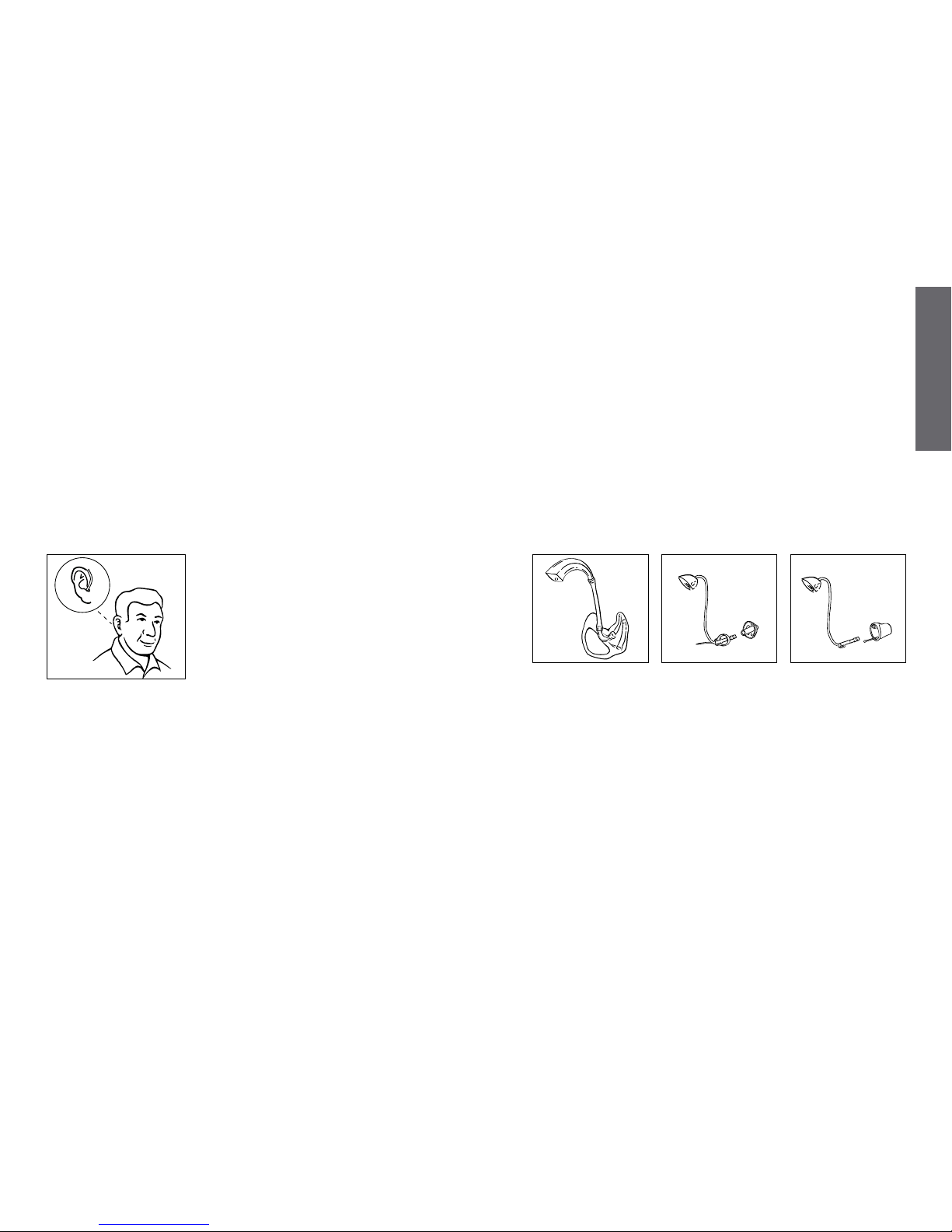
Ear-set solutions
Several ear-set solutions are available for your hearing
aid. Below, your hearing care professional can check off
the type of ear-set tip chosen for you.
Unless otherwise indicated, the information provided
in this booklet applies to all three types of ear-set solution. In addition to the general instructions, please be
sure to read the sections that apply to your specific earset solution.
Earmold Instant ear-tip Custom ear-tip
Page 5
8
9
General
The hearing aid
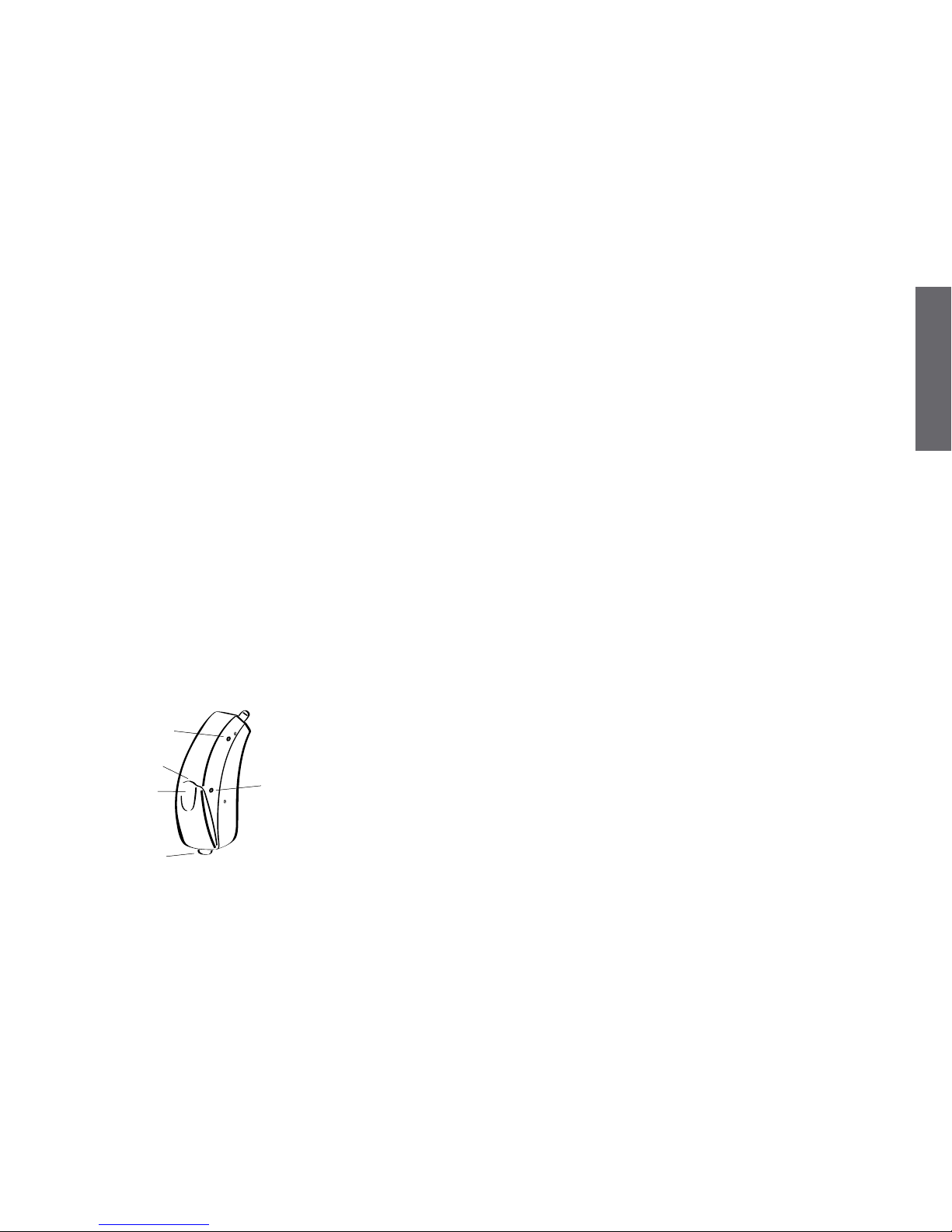
The illustration below shows the hearing aid without
any of its other parts (for example tubing and tip).
1. Microphone openings, where the sound enters the
hearing aid.
2.
Program button is available on some models. It
allows you to choose between different listening
programs. If you have a remote control for your
hearing aid, the hearing aid does not include a
program button.
3.
On/off function, which is integrated into the
battery drawer (see page 14).
4.
Nail grip on the battery drawer for easy opening.
1.
2.
3.
4.
1.
The battery
The recommended battery type for your hearing aid is:
Zinc Air battery type 10
To obtain replacement batteries, please consult your
hearing care professional. It is important to take note
of the expiration date and the recommendations regarding disposal of used batteries on the battery pack.
To ensure proper battery function, do not use batteries
past the expiration date. The battery life will depend
on a number of factors, such as the setting of your
hearing aid, how many hours you use it daily and the
listening environments in which you use it.
Page 6

10
11
General
Inserting the battery
Before inserting a new battery in your
hearing aid, remember to remove the
adhesive tab. Once the tab has been
removed, the battery will start func-
tioning after a few seconds. Do not
use batteries on which there is a sticky residue from the
tab or other unwanted substance.
Use the nail grip to gently swing the
battery drawer outwards. Do not
press the battery drawer beyond the
open position.
Place the battery in the drawer so that the small plus (+)
sign on the battery is facing in the direction indicated
by the small plus (+) sign printed on the round battery
holder. You can use the provided battery magnet to
steer the battery into place. If the battery drawer does
not close easily, the battery is incorrectly inserted.
Always place the battery in the actual battery
drawer as illustrated and not in the open space
inside the hearing aid.
Page 7
12
13
General
Changing the battery
If you hear four beep-tones from your hearing aid, it is
an indication that the battery is nearly exhausted. Once
the battery is totally exhausted, the hearing aid will be
completely silent. Exactly how long the hearing aid will
function after the beep-tones varies from one case to
another. We recommend that you always have a spare
battery with you.
For adjustment of the beep-tone level or disabling of
the function, please consult your hearing care professional.
Never leave an exhausted battery in the hearing aid.
Exhausted batteries may leak, which could damage the
hearing aid. When changing batteries, it is a good idea
to hold the hearing aid over a table or a carpet, in case
you drop the hearing aid or battery.
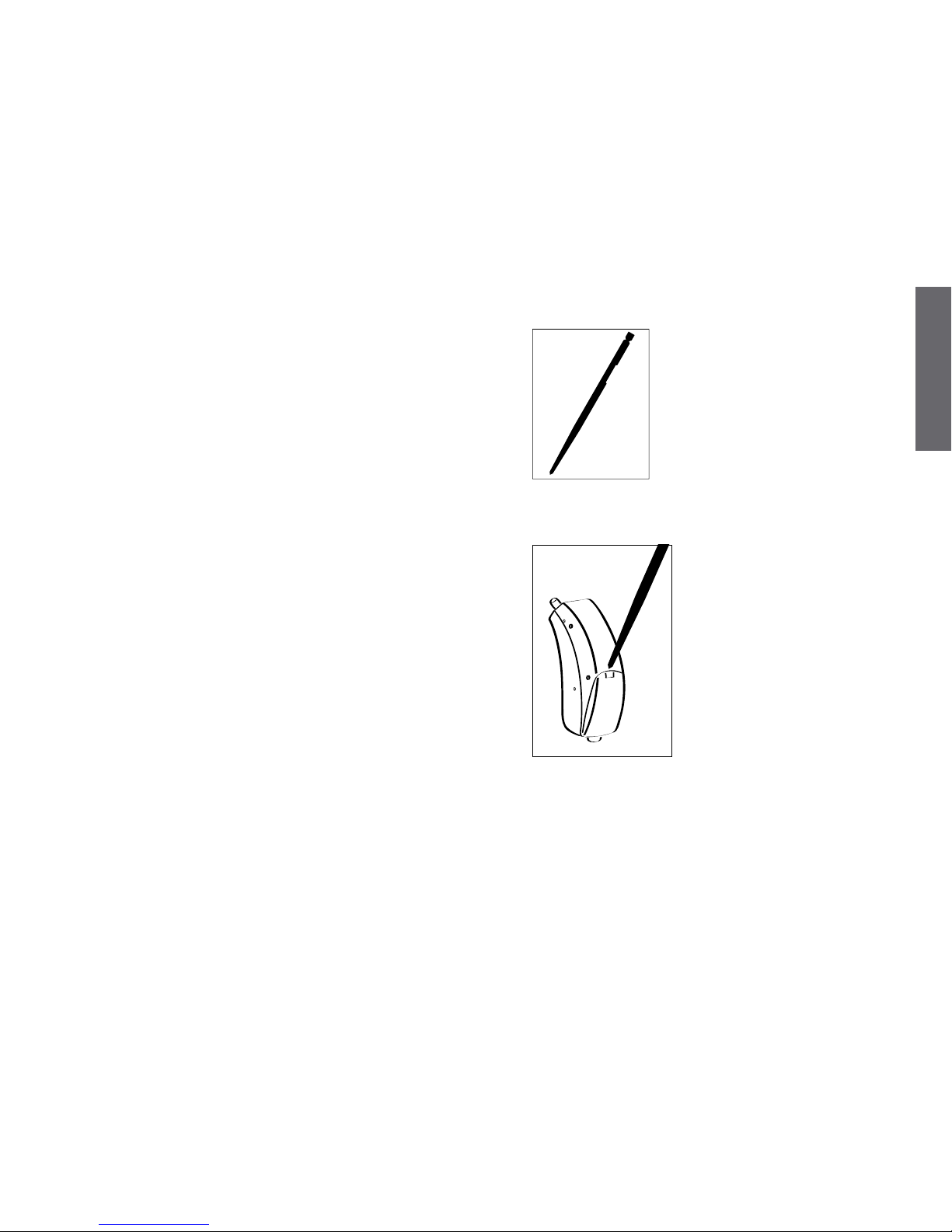
Your hearing aid may be provided
with a battery drawer without a nail
grip, which means that you need a
tool to open the battery drawer.
This type of drawer can be a good
choice if the hearing aid is worn by
a child. A special tool for opening
the drawer will be included with
this drawer (see the illustration).
Open the battery drawer as illustrated.
Page 8
14
15
General
Turning the hearing aid on and off
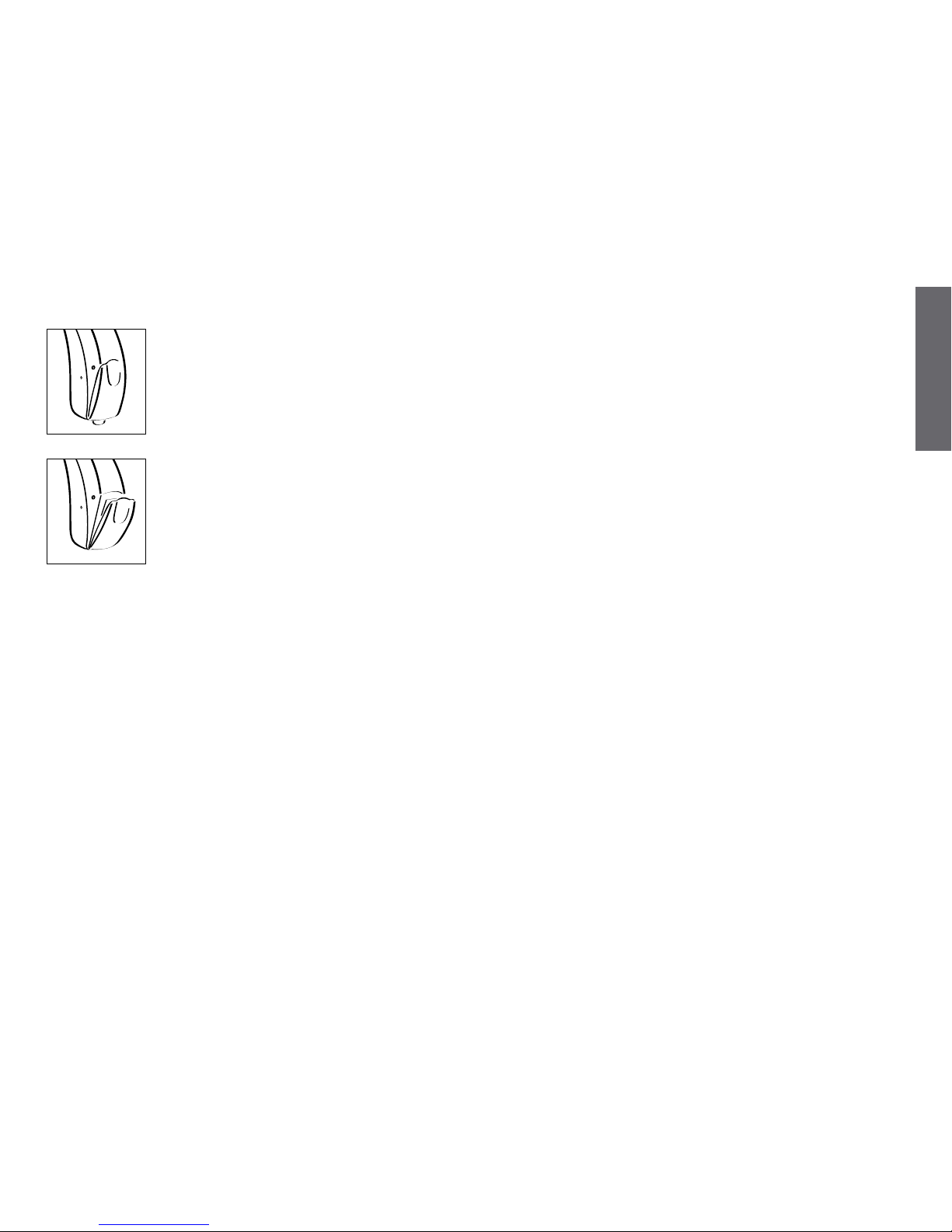
The battery drawer of your hearing
aid also functions as the on/off switch.
The hearing aid is turned on when a
battery is inserted correctly and the
battery drawer is completely closed.
The hearing aid is turned off when
the battery drawer is open.
Please remember to switch the hearing aid off when it is not in use. Remove the battery if the hearing aid
will not be used for several days.
Possible settings
Your hearing aid can be set to start up in two different
ways: In the standard start-up setting your hearing aid
may whistle slightly while you place it on the ear. An alternative is a setting where the hearing aid actively
suppresses whistling while it is being placed on the ear.
Together with your hearing care professional you can
choose the start-up setting that suits your needs best.
Page 9

16
17
General
Automatic adjustment of loudness
The hearing aid adjusts loudness automatically in accordance with your sound environment. You do not
have to think about adjusting the volume – it happens
quite automatically.
Important: If the volume in your hearing aid is too loud
or too weak, or if the reproduced sounds are distorted,
or you would like any further information, consult your
hearing care professional.
Listening programs
Your hearing aid may be provided with several listening programs optimized for different listening situations. Your hearing care professional can help you select the programs that are of use to you. If your needs
change over time, the combination of listening programs can be changed. In these user’s instructions, the
hearing care professional should list the listening programs that are available in your hearing aid (see next
page).
Page 10
18
19
General
Listening
programs
Description Chosen
program
position:
Master Standard program
Acclimatization
Acclimatization program
Music Music program
TV TV program
Comfort Attenuates background
noise
Audibility
Extender
Makes high-frequency
sounds audible
Switching between the available listening programs
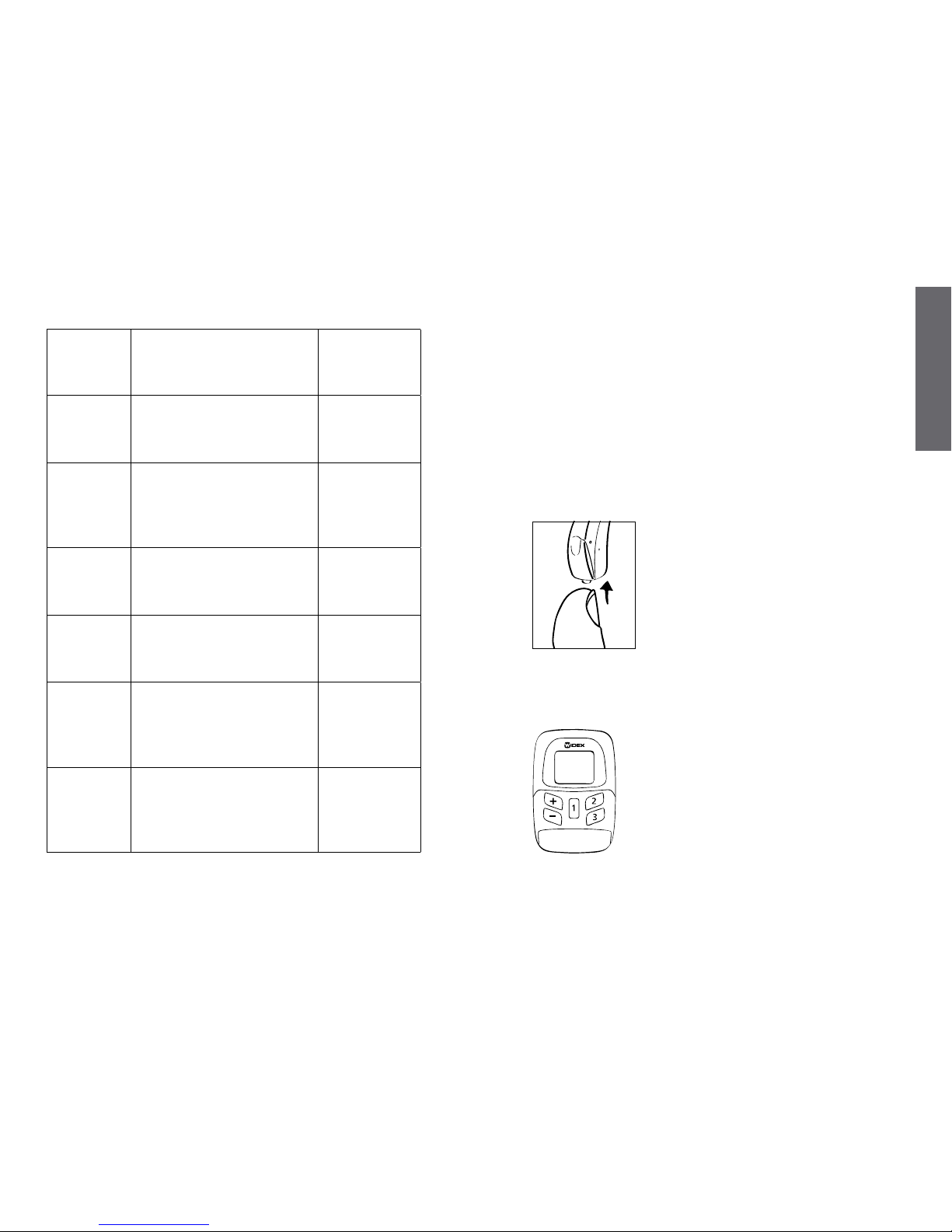
If the hearing aid is provided with a program button,
you can switch between the programs by pressing this
button at the bottom of the hearing aid.
Each time you switch to another program, you will hear
beep-tones. The beeps tell you which program you
have chosen:
Program 1: One brief beep
Program 2: Two brief beeps
Program 3: Three brief beeps
(depending on hearing aid model)
Some hearing aid models may be provided with a remote control. If your
hearing aid has a remote control, please
refer to the user’s instructions for the remote control.
Page 11
20
21
General
The number of different beeps depends on how many
programs you - together with your hearing care professional - have chosen to have in your hearing aid. The selected listening programs are numbered 1-3.
If you – in consultation with your hearing care professional – decide on other combinations of programs later, these can be written on the blank forms found at
the back of these instructions.
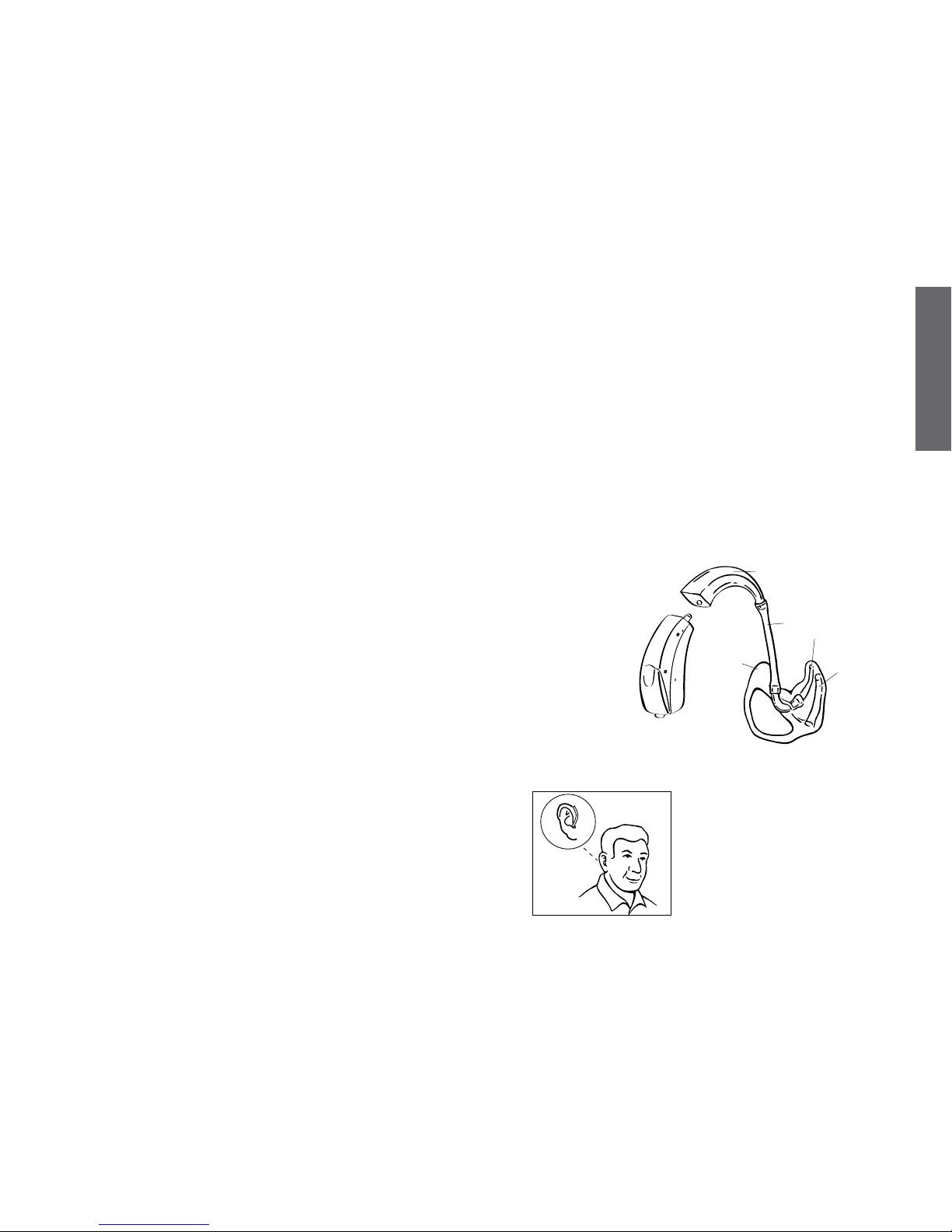
Hearing aid with an earmold
An ear-set consists of three parts:
1. Earhook
2.
Tubing
3. Earmold
3a. Sound bore
3b. Vent
1.
2.
3.
3a.
3b.
Page 12

22 23
Earmold
Placement in/on the ear
First insert the earmold in the ear canal while holding
the lower part of the tubing. It may help to pull the outer ear backwards and upwards with the opposite
hand.
Right ear seen from behind.
Right ear seen from the side. The
arrows show where to hold the earmold and pull the ear.
Once the earmold has been inserted, place the hearing
aid itself behind the ear, so that the hook rests comfortably on the ear, close to your head.
Page 13

24 25
Earmold
Removal
First remove the hearing aid itself from its position behind the ear. Carefully pull the earmold out of the ear
canal, while holding the lower part of the tubing. If it is
difficult, it may help to try to move the earmold carefully from side to side while pulling it out. It may also
help to pull the outer ear backwards and upwards with
the opposite hand.
The arrow shows where to
hold the tubing.
Cleaning
The following cleaning accessories are available for
your hearing aid:
1. Wax removing tool
2. Soft cloth
Contact your hearing care professional if you need additional supplies of cleaning accessories.
1.
2.
Page 14

26 27
Earmold
The hearing aid
Never clean your hearing aid with
water or cleaning solutions. Instead, clean your hearing aid with
the soft cloth (no. 2) after use.
The microphone openings
Use the wax removing tool (no.1)
to clean the microphone openings. Pass the wax removing tool
straight through the openings. If
you feel resistance, withdraw the
tool and try again. Use only the
recommended wax removing
tool.
When the hearing aid is not in use, it is a good idea to
leave the battery drawer open, so as to ventilate the
hearing aid and allow it to dry.
The earmold
Make sure that the earmold is
clean and free of earwax and
moisture. If it is plugged, clear
the openings with the wax removing tool.
Disconnect the earmold and
tubing from the hearing aid at
least once a week and wash
thoroughly in lukewarm water.
Allow the earmold and tubing
to dry overnight. Never use alcohol or other cleaning solutions to clean your earmold.
Page 15

28 29
Earmold
If there is still moisture in
the earmold and/or tubing, use a blower or the
like, as illustrated, to blow
it dry prior to re-connecting to your hearing aid for
use.
Please note:
To replace the tubing if it becomes slack, stiff, yellow
or cracked, consult your hearing care professional.
If the earmold no longer fits your ear, contact your
hearing care professional. The earmold may need to
be changed or adjusted.
•
•
In case of malfunction
If the hearing aid is dead, it could be because:
The hearing aid is not turned on. Make sure that the
battery drawer is closed.
The battery is dead or does not work. Insert a new battery. Make sure the battery is placed correctly.
The sound bore of the earmold is blocked. Clean the
blocked sound bore.
If the hearing aid volume is not powerful enough, it
could be because:
The battery is nearly exhausted. Insert a new battery.
The sound bore of the earmold is blocked. Clean the
blocked sound bore.
Your ear is blocked by earwax. Contact your ENT doctor/physician.
Your hearing may have changed. Contact your hearing care professional.
•
•
•
•
•
•
•
Page 16

30 31
Earmold
If the hearing aid whistles continuously, it could be
because:
Your ear is blocked by earwax. Contact your ENT doctor/physician.
The tubing is broken or is yellow and stiff. Contact your
hearing care professional.
The tubing often comes off the hearing aid hook. Contact your hearing care professional.
The hook is cracked. Contact your hearing care professional.
The earmold is not correctly placed in your ear canal.
Take the earmold out and reinsert it.
The earmold fit is too loose. Contact your hearing care
professional.
•
•
•
•
•
•
Hearing aid with an Instant ear-tip
An ear-set consists of three parts:
1. Hook with tubing
2.
Anchor
3.
Instant ear-tip
Page 17

32 33
Instant ear-tip
Right/left identification
The ear-set is available in five different lengths for the
right and left ear, respectively. The individual size is
printed on the ear-set. Red print indicates that it is for
the right ear and blue print that it is for the left ear.
Placement on/in the ear
First place the hearing aid behind the ear, so that the
hook and tubing rest comfortably on the ear, close to
your head. Then insert the ear-tip in the ear canal while
holding the lower part of the tubing. Lastly, make sure
that the anchor is positioned correctly. It should rest at
the opening of the ear canal and secure the position of
the ear-tip as well as the entire ear-set. Remember to
check at regular intervals that the hearing aid and the
ear-set are positioned correctly.
Page 18

34 35
Instant ear-tip
We do not recommend wearing the hearing aid without the anchor for the Instant ear-tip solution. If the
hearing aid is not secured with the anchor, there is a
risk of loosing the hearing aid.
Removal
First remove the hearing aid itself
from its position behind the ear.
Carefully pull the ear-tip out of the
ear canal, while holding the lower
part of the tubing.
Cleaning
The following cleaning accessories are available for
your hearing aid:
1. Wax removing tool
2. Soft cloth
3.
Cleaning thread
Contact your hearing care professional if you need additional supplies of cleaning accessories.
1.
2.
3.
Page 19

36 37
Instant ear-tip
The ear-set
Make sure that the ear-set is clean and free of earwax
and moisture. If the ear-set tubing becomes plugged, it
must be cleaned. Remove the ear-set from the hearing
aid. Remove the ear-tip from the coupling. Then clean
the tubing with the cleaning thread (no. 3). Never use
alcohol or other cleaning solutions to clean the earset.
Holding the hearing aid
securely at the neck as
shown in the diagram, pull
the ear-set off the hearing
aid.
Pull off the ear-tip
The hearing aid
Never clean your hearing aid with
water or cleaning solutions. Instead, clean your hearing aid with
the soft cloth (no. 2) after use.
The microphone openings
Use the wax removing tool (no.1)
to clean the microphone openings. Pass the wax removing tool
straight through the openings. If
you feel resistance, withdraw the
tool and try again. Use only the
recommended wax removing
tool.
When the hearing aid is not in use, it is a good idea to
leave the battery drawer open, so as to ventilate the
hearing aid and allow it to dry.
Page 20

38 39
Instant ear-tip
Pass the cleaning thread
through the tubing until
the end of the thread
comes out at the other
end.
Clean the ear-tip under running water.
If necessary, the ear-tip can be washed in lukewarm
water. Remove the ear-tip from the ear-set and wash
the ear-tip thoroughly. Allow it to dry overnight.
Changing the ear-set
The life of an ear-set is individual and depends on a
number of factors, such as how much the hearing aid is
used and the type of earwax produced in the ear. Consult your hearing care professional regarding a schedule of replacement/maintenance.
When replacing either the
earset and/or ear-tip, it is
very important to ensure
that each are firmly secured.
Page 21

40 41
Instant ear-tip
In order to properly use the
ear-set, it must be adjusted
to fit your ear exactly. This
adjustment can be complicated. Therefore, we recommend that you and your
hearing care professional go
through the following instructions together and arrange future delivery of new
ear-sets.
Individualizing the ear-set and ear-tip:
The ear-set can be adjusted to fit your ear exactly. Your
hearing care professional will choose the correct size
for you, and provide instructions regarding adjustment
and future replacements. In these user’s instructions,
your hearing care professional can circle the sizes selected for you (see page 43).
Choice of tubing: The tubing is available in five different lengths for the right and left ear, respectively. It is
important to choose the correct one in order to ensure
a good and comfortable fit. The tubing must not be
uncomfortably short or so long that it is too loose.
Choice of ear-tip: The ear-tip is available in four sizes. It
is important to choose the correct one in order to ensure a good and comfortable fit. The ear-tip must be
positioned comfortably in the ear canal.
Page 22

42 43
Instant ear-tip
The anchor
To secure the position of the ear-tip in your ear canal,
we have made a loose anchor to be adjusted to your
ear.
The anchor loop has the correct size when it supports
the position of the ear-tip in the ear canal, and the earset sits securely in and on the ear.
Your hearing care professional should provide the necessary instruction if this is indicated.
Circle the sizes selected for your ear-set.
Left ear (blue) Right ear (red)
ear-tip tubing ear-tip tubing
1S 1L 1 1S 1L 1
2S 2L
2 2S 2L 2
3 3
4 4
5 5
Page 23

44 45
Instant ear-tip
Please note:
It is important to wipe the ear-set thoroughly with a
soft cloth and keep it clean of wax, etc. Otherwise,
the ear-tip may come off.
To replace the ear-set if one of the ear-set elements
becomes slack, stiff, yellow or cracked, consult your
hearing care professional.
Have the ear-tip replaced if it no longer fits your ear,
for example if your ear canal size has changed or the
ear-tip becomes broken.
•
•
•
In case of malfunction
If the hearing aid is dead, it could be because:
The hearing aid is not turned on. Make sure that the
battery drawer is closed.
The battery is dead or does not work. Insert a new battery. Make sure the battery is placed correctly.
The sound outlet of the ear-tip is blocked. Clean/ or replace the ear-tip. If necessary, replace the entire earset.
•
•
•
Page 24

46 47
Instant ear-tip
If the hearing aid volume is not powerful enough, it
could be because:
The battery is nearly exhausted. Insert a new battery.
The sound outlet of the ear-tip is blocked. Clean/ have
the ear-tip, or if necessary, the entire ear-set replaced.
Clean or replace the ear-tip. If necessary, replace the
entire ear-set.
Your ear is blocked by earwax. Contact your ENT doctor/physician.
Your hearing may have changed. Contact your hearing care professional.
•
•
•
•
•
If the hearing aid whistles continuously, it could be
because:
Your ear is blocked by earwax. Contact your ENT doctor/physician.
The tubing is broken or is yellow and stiff. Contact your
hearing care professional for replacement.
The hook is cracked. Contact your hearing care professional for replacement.
The ear-tip is not correctly placed in your ear canal. Take
the ear-tip out and reinsert it.
•
•
•
•
Page 25

48 49
Instant ear-tip
Hearing aid with a Custom ear-tip
An ear-set consists of two parts:
1.
Hook with tubing
2.
Custom ear-tip with an extraction cord
Right/left identification
The ear-set is marked with red or blue print. Be sure to
use the ear-set with red print with the right-ear hearing
aid and the ear-set with blue print with the left-ear
hearing aid.
The ear-tip has ”Widex” printed on it.
Red print indicates that it is for the right
ear and blue print that it is for the left
ear.
2.
Page 26

50 51
Instant ear-tip
Placement in/on the ear
First insert the Custom ear-tip in the ear canal while
holding the lower part of the tubing. It may help to pull
the outer ear backwards and upwards with the opposite hand.
Once the Custom ear-tip has been inserted, place the
hearing aid itself behind the ear, so that the hook and
tubing rest comfortably on the ear, close to your head.
Removal
First remove the hearing aid itself
from its position behind the ear.
Then, carefully pull the Custom eartip out of the ear canal by means of
the extraction cord. Do not pull the
tubing to remove your hearing aid
or ear-tip.
Page 27

52 53
Custom ear-tip
Cleaning
The following cleaning accessories are available for
your hearing aid:
1. Wax removing tool
2. Soft cloth
3.
Cleaning thread
Contact your hearing care professional if you need additional supplies of cleaning accessories.
The hearing aid
Never clean your hearing aid with
water or cleaning solutions. Instead, clean your hearing aid with
the soft cloth (no. 2) after use.
The microphone openings
Use the wax removing tool (no.1)
to clean the microphone openings. Pass the wax removing tool
straight through the openings. If
you feel resistance, withdraw the
tool and try again. Use only the
recommended wax removing
tool.
When the hearing aid is not in use, it is a good idea to
leave the battery drawer open, so as to ventilate the
hearing aid and allow it to dry.
1.
2.
3.
Page 28

54 55
Custom ear-tip
The ear-set
Make sure that your ear-set is clean and free of earwax
and moisture. Use a soft cloth to wipe the ear-set at
regular intervals. If the ear-set tubing is plugged, it
must be cleaned. Remove the ear-set from the hearing
aid. Then clean the ear-set with the cleaning thread
(no. 3). Consult your hearing care professional. Never
attempt to disconnect the ear-tip from the tubing. Never use alcohol or other cleaning solutions to clean the
ear-set.
Holding the hearing aid
securely at the neck as
shown in the diagram,
pull the tubing and hook
off the hearing aid.
Pass the cleaning thread
through the ear-set until
the end of the thread is
visible at the sound outlet
of the Custom ear-tip.
If the tubing needs to be changed
The process involved in changing the tubing for Custom ear-tip solutions requires experience and the appropriate tools. Therefore we recommend that you
contact your hearing care professional if the tubing
needs replacement. Do not attempt to make any
changes on your own.
Please note:
If the ear-set tubing becomes slack, stiff, yellow or
cracked, it must be replaced. Please contact your
hearing care professional for help with this. Never attempt to exchange any part of the ear-set yourself.
If the Custom ear-tip no longer fits your ear, contact
your hearing care professional. The Custom ear-tip
may need to be changed or adjusted.
•
•
Page 29

56 57
Custom ear-tip
In case of malfunction
If the hearing aid is dead, it could be because:
The hearing aid is not turned on. Make sure that the
battery drawer is closed.
The battery is dead or does not work. Insert a new battery. Make sure the battery is placed correctly.
The sound outlet of the ear-tip is blocked. Clean the eartip and tubing. See page 58 for detailed instructions.
If the hearing aid volume is not powerful enough, it
could be because:
The battery is nearly exhausted. Insert a new battery.
The sound outlet of the ear-tip is blocked. Clean the ear-
tip and tubing. See page 58 for detailed instructions.
Your ear is blocked by earwax. Contact your ENT doctor/physician.
Your hearing may have changed. Contact your hearing care professional.
•
•
•
•
•
•
•
If the hearing aid whistles continuously, it could be
because:
Your ear is blocked by earwax. Contact your ENT doctor/physician.
The tubing is broken. Contact your hearing care professional to have the tubing replaced.
The tubing is yellow and stiff. Contact your hearing
care professional to have the tubing replaced.
The hook is cracked. Contact your hearing care professional to have the tubing replaced.
The ear-tip is not correctly placed in your ear canal. Take
the ear-tip out and reinsert it.
The ear-tip fit is too loose. Contact your hearing care
professional.
•
•
•
•
•
•
Page 30

58 59
Custom ear-tip
Caring for your hearing aid
With proper care, your hearing aid will give you years
of reliable service. Here are some things you can do to
prolong the life of your hearing aid:
Switch your hearing aid off when it is not in use.
Should you not use it for several days, take out the
battery to avoid battery leakage.
Treat your hearing aid as the valuable object it is:
with care. When your hearing aid is not in use, keep it
in its case in a cool, dry location where it cannot be
reached by children or pets.
When not in use, do not expose your hearing aid to
extreme temperatures or high humidity.
In environments with high humidity (including that
created by heavy perspiration), a drying kit may be
used daily to reduce the amount of moisture inside
the hearing aid. See the instructions enclosed with
the drying kit.
•
•
•
•
Page 31

60 61
Custom ear-tip
Do not wear your hearing aid in the shower or swimming, or when using a hair dryer, hair spray, or other
sprays or gels such as suntanning crème/lotion.
Never try to open or repair the hearing aid yourself.
Do not wear your hearing aid during x-ray, MRI scans,
CT scans, short-wave diathermy, or similar radiation
treatments and never place your hearing aid in a microwave oven. These are some of the types of radiation that can damage your hearing aid. Radiation
from, for example, room surveillance equipment,
burglar alarms and cellular telephones is weaker and
will not damage your hearing aid but may create interference.
Widex hearing aids are not certified for use in mines
or other areas with explosive gases.
•
•
•
•
To maintain the proper shape of the ear-set, be careful not to twist or squeeze it out of shape when your
hearing aid is placed in the case. The below illustration shows two hearing aids with Instant ear-tips.
•
Page 32

62
63
General
Good advice
You may notice increased accumulation of earwax
with hearing aid usage. Contact your physician/ENT
doctor if you suspect that a plug of earwax has accumulated in your ear. Earwax may not only reduce
your own hearing but also the effect of the hearing
aid considerably. It is a good idea to ask your physician to clean your ears a couple of times a year.
Please be sure to keep the hearing aid and its parts
and accessories out of the reach of children, who
might place them in their mouths. Also keep batteries out of children’s reach and discard used batteries
carefully. Do not change batteries in front of children
and do not let them see where you keep your supply.
•
•
Never put a battery in your mouth for any reason as
you may risk swallowing it. In case of ingestion, contact your physician immediately and the 24 Hour National Battery Hotline at: 1-202-625-3333.The hearing
aid is made of modern non-allergenic materials. Still,
in rare cases skin irritation can occur. If you notice
skin irritation in or around your ear or ear canal, contact your hearing care professional.
Please be aware that the use of any type of hearing
aid may involve a slightly increased risk of infection
in the ear canal. An infection can arise as a result of
inadequate ventilation of the ear. Therefore, we recommend that you remove the entire hearing aid
from your ear at night to allow the ear canal to be
ventilated. Make sure that you clean and inspect your
hearing aid and all its parts as required. If an infection occurs, you should seek medical attention and
contact your hearing care professional for advice on
how to disinfect the various hearing aid parts. Do not
under any circumstances use alcohol, chlorine or
similar substances to clean your hearing aid and its
parts.
•
•
Page 33

64
65
General
Listening
programs
Description Chosen
program
position:
Master Standard program
Acclimatization
Acclimatization program
Music Music program
TV TV program
Comfort Attenuates background
noise
Audibility
Extender
Makes high-frequency
sounds audible
Listening
programs
Description Chosen
program
position:
Master Standard program
Acclimatization
Acclimatization program
Music Music program
TV TV program
Comfort Attenuates background
noise
Audibility
Extender
Makes high-frequency
sounds audible
Page 34

66
67
General
Page 35

Widex,
DK-3500 Vaerloese
Denmark
•
www.widexusa.com
¡9 514 0096 041v¤
Printed by FB / 06-07
9 514 0096 041 #01
¡#01v¤
Reorder # CIB115/0607
 Loading...