

Page 1
Wiard Model GR-371 Woggle Bug
out tone and CV.
SMOOTH TONE out (1-6 octaves).
off when the woggle PLL is in lock.
Woggle Bugs. Audio is output when B LED is lit.
LFO [out] 0-10v square wave from 0.05-50 Hz.
[out].
SMOOTH RANGE knob.
Woggle Bug and 2 goes to right.
TONE [outs] of each Woggle Bug. Sound affected by all 10 knobs.
Wiard GR-371 Woggle Bug
Rev: 031001
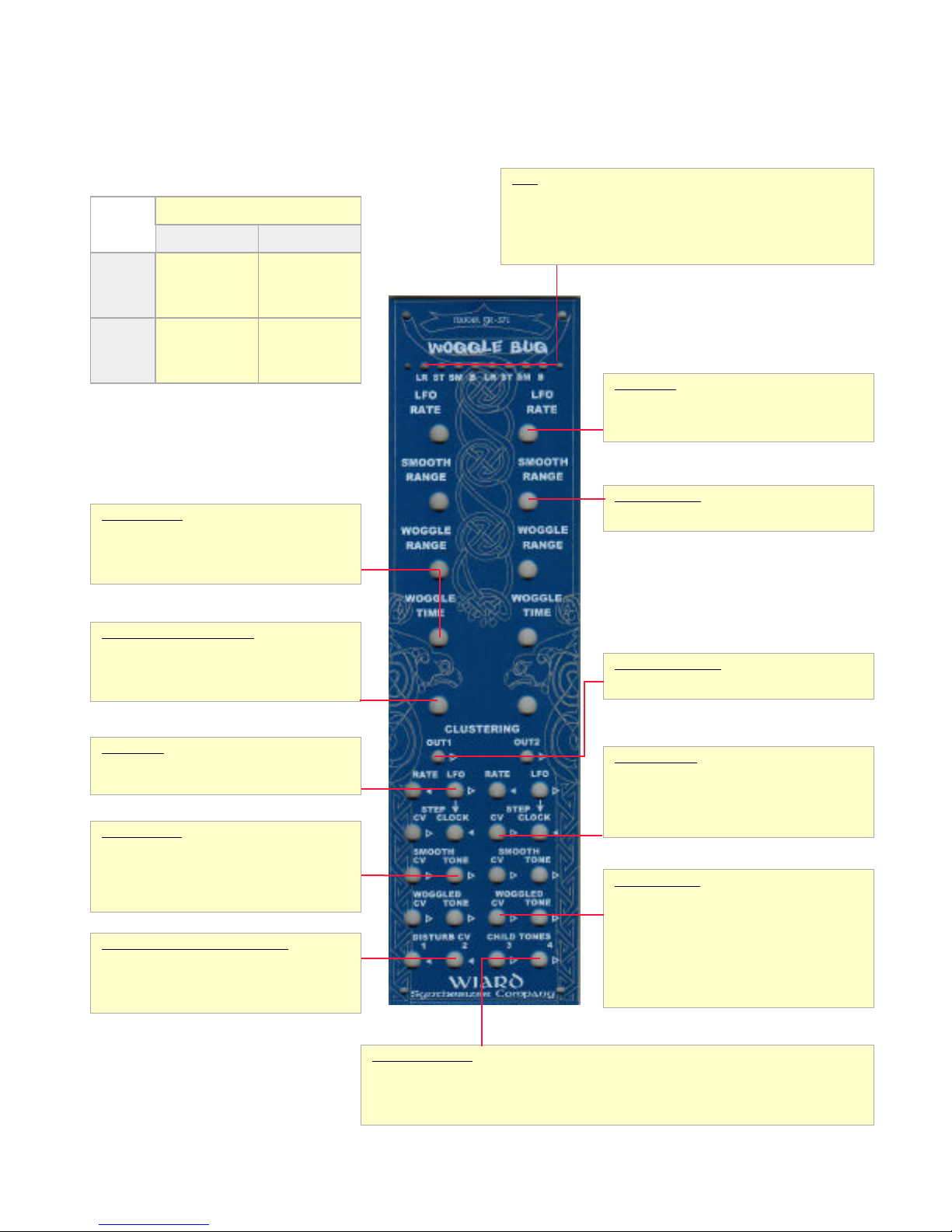
LEDs
LR (LFO Rate) Green, lit when LFO [out] is at 10v.
Woggle
Bug
Audio
Two circuits - WOG1, WOG2
Generator Processor
Out1, Out2
Smooth Tone
Woggle Tone
Child Tones
None
ST (Stepped Voltage) Red/orange, indicates voltage at STEPPED CV
[out].
SM (Smooth Voltage) Red/orange, indicates voltage at SMOOTH CV [out]
B (Bug Light) Yellow, indicates audio pulse rates at OUT1 [out] and OUT2
[out]
Control
Voltage
Woggle Control
WOGGLE RANGE [knob] Sets the range of
WOOGLED TONE [out] (1-6 octaves).
WOGGLE TIME [knob] Sets the lock in time of the
woggle oscillator phase locked loop. The B lamp is
Step and Tone Range Setting
CLUSTERING [knob] Sets the range of probable
values for the STEP CV [out]. At minimum, equal
probability of voltage from 0 – 10 V at STEP CV
[out]. At maximum, limits change to next value samples tend to cluster.
LFO Section
RATE [in] 0-10v added to LFO RATE to vary LFO
rate from 0.05-50 Hz.
Smooth Output
SMOOTH CV [out] 0-8v smooth random voltage.
Probable rate of change set by LFO RATE knob
added with RATE [in].
SMOOTH TONE [out] 0-10v audio rate square
wave, the frequency range of which is set by the
Woggle PLL/VCO Disturb CV Inputs
DISTURB CV 1, DISTURB CV 2 [in] 0-10v control
voltage added to STEP CV out at the WOGGLE TONE
in. WOGGLE RANGE knob must be set to less than
maximum for this input to work, 1 goes to left
Step CV
Smooth CV
Woggled CV
LFO (SQR)
None
LFO Control
LFO RATE [knob] Value added to voltage at RATE
[in], controls LFO rate linearly (1 cycle / 20 sec to
50 cycles / sec). Sets rate of change of SMOOTH
Oscillator Range
SMOOTH RANGE [knob] Sets the range of
Main Output Section
OUT1, OUT2 [out] Primary audio outs for the
Stepped Output
STEP CV [out] 0 – 10V stepped random voltage. A
new voltage is selected at each positive going clock
pulse at STEP CLOCK [in].
STEP CLOCK [in] New voltage selected each time a
positive clock pulse crosses 1.5V. Normalized to LFO
Woggled Output
WOGGLED CV [out] 0 – 8V product of the smooth
and stepped random voltages. The demodulated
output of a phase locked loop frequency modulation
detector tracking the smooth tone and being
disturbed by the step control voltage. PLL loop lockin time is set by WOGGLE TIME knob. When the PLL
is in lock, the B LED is off.
WOGGLED TONE [out] 0 – 10V audio rate square
wave, the frequency range of which is set by the
WOGGLE RANGE knob.
© 1996-2003 Wiard Synthesizer Company – design by Bill Sequeira/Axon Hillock Source of Uncertainty
Child Tone Outputs
Child tones are the XOR (ring mod) product of the two Woggle Bug parents.
CHILD TONES 3 [out] – 0 – 10V pulse wave which is the audio XOR product of the SMOOTH TONE
[out] of each Woggle Bug. Sound changed by both SMOOTH TONE controls.
CHILD TONES 4 [out] – 0 – 10V pulse wave which is the audio rate XOR product of the WOGGLE
Page 2
Wiard Model GR-371 Woggle Bug
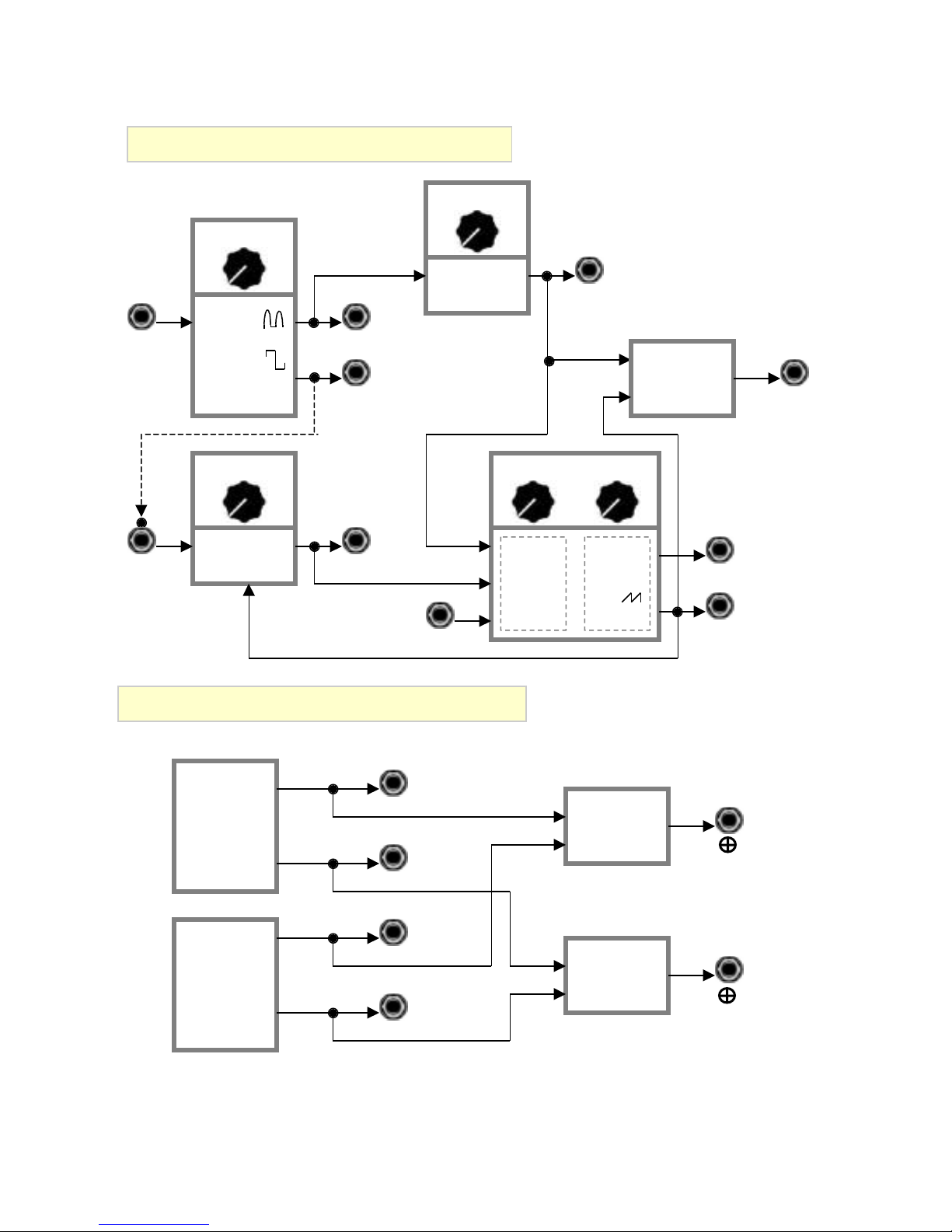
Woggle Bug First Order Units
SMOOTH
RANGE
RATE
LFO
Square
LFO RATE
Smooth
Random
Square
LFO
CLUSTERING
S&HCLOCK
Woggle
Saw
SMOOTH CV
LFO
STEP CV
DISTURB CV 1
VCO
Freq
Cv
WOGGLE
TIME
PLL
SMOOTH TONE
WOGGLE
RANGE
Saw
VCO
RING
MOD
(XOR GATE)
OUT1
WOGGLED CV
WOGGLED TONE
Woggle Bug Second Order Units
SMOOTH TONE
WOGGLED TONE
WOG1
SMOOTH TONE
WOGGLED TONE
WOG2
RING
MOD
(XOR GATE)
RING
MOD
(XOR GATE)
CHILD TONES
OUT3
Smooth Smooth
OUT4
Woggle Woggle
© 1996-2003 Wiard Synthesizer Company – design by Bill Sequeira/Axon Hillock Source of Uncertainty
Page 3
Wiard Model GR-371 Woggle Bug
Woggle Bug Module Description
The newest module in the Wiard system is the Woggle Bug.
The Woggle Bug is an utterly unique module that produces
complex random voltages and tones. It reproduces the set of
random voltages available from the original Buchla Model 265
"Source of Uncertainty" module. This long out of production
module is representative of the most musical random voltage
generators produced in the first "Golden Age" of modular
synthesizers. The design has been enhanced with the
addition of 4 audio rate oscillators and 4 XOR gates which
produce the effect of ring modulation or “klang” tones.
The Woggle Bug adds 4 permanently coupled audio VCOs to
the random voltage outputs. Through a design trick, the
single mechanical module contains the equivalent
functionality of 18 electrical modules. Obviously, all the patch
points cannot be brought out to the front panel.
From a philosophical perspective, the Woggle Bug was
designed to “replace” the control voltages produced by a
keyboard during performance. Thus the Woggle Bug replaces
the output signals generated by modulation wheels, key CV,
and gate with smooth, stepped, and stepped plus LFO control
signals (respectively), generated by the module.
The modules are permanently patched into a unique
arrangement of two identical "Woggle Bugs" and their "Child
Tones". Each Woggle Bug has 3 control voltage inputs, 4
control voltage outputs and 5 audio outputs. Child tones are
the ring modulated outputs of the two Woggle Bug "parents".
The control voltage outputs are the reason for the module
and correspond to the more traditional sample and hold units
with lag processors as found in other modulars. The module
produces stepped, smoothed (lag processed) and "woggled"
(stepped voltages with decaying sinusoids at the edges)
control voltages in the range of 0 to 10 volts. These voltages
are usable with any other brand of voltage controlled
modular. The audio tones are essentially a "free" add-on due
to the design trick. The smooth voltages are produced by
cascaded lag processors which produce a "very" smooth
voltage that produces natural sounding wind and surf
patches.
The module as a whole produces 8 simultaneously available
electronic tonalities. The tonalities are deliberately very raw in
nature. Part of the 1950's sound is the simple square and
sawtooth waveforms output by electronic test equipment.
Mixed together and put through a tape delay, well, you'll be
doing battle with your Id monster in no time! Certain sets of
tones are reminiscent of the “cybernetic circuitry” used to
produce the electronic tonalities for the movie “Forbidden
Planet”. The module is produced with fine “Cold War” silicon
which is thematically consistent with a tribute to 50s and 60s
electronic music.
This applies to only some settings of the 10 controls and
some of the 8 outputs. Other settings produce the sound of
very large insects, or swarms of large insects. It can not
make keyboard sounds and can not be controlled by a
keyboard. Hooray!
Each Woggle Bug purchaser gets a free lifetime membership
in "The Loyal Order of the Woggle Bug", an imaginary
fraternal order with the privilege of displaying this fine
emblem upon your Fez.
There are two circuits in the module, see block diagram
below.
The Woggle Bug module contains:
• 2 Voltage Controlled Low Frequency Oscillators
• 4 Sample and Hold Units
• 4 Lag Processors
• 4 Audio Rate Voltage Controlled Oscillators
• 4 Balanced Modulators ("ring modulators")
Or the contents of a somewhat large modular, in a single
module size, for the price of a single module!
The Woggle Bug is useful both as an alien sound source and
as a source of random voltages for aleatoric composition and
to add automatic articulation to static sequencer and
keyboard patches. The STEP CV out is most musical when
quantized with a Mini-Wave in 0-10 volt range. The
CLUSTERING knob will limit step-to-step excursions inside the
5 octave quantization range of the Mini-Wave.
© 1996-2003 Wiard Synthesizer Company – design by Bill Sequeira/Axon Hillock Source of Uncertainty
Page 4

Wiard Model GR-371 Woggle Bug
Woggle Bug Example Patches
Assumptions
o Notation used: MPN (see Modular Patch Notation (MPN)
Explained for a discussion on MPN)
o Only one module: WoggleBug.
o Two woggle circuits in a Woggle Bug module: WOG1,
WOG2.
Hello World
Top Wog2
Controls
[(LFO RATE, WOGGLE TIME)=9,
(SMOOTH RANGE, WOGGLE RANGE)=5,
CLUSTERING=7]
Connect
[OUT2 -> +MON]
Comment
Good starting point for experiments. Adjust the knobs
and note their effect on the tone. It is recommended
that you listen to the tonalities with and without delay
effects.
Tone Shaping
Top Woggle Bug
Wog1.Controls
[(LFO RATE, CLUSTERING)=7,
(SMOOTH RANGE, WOGGLE RANGE, WOGGLE
TIME)=5]
Wog2.Controls
[(LFO RATE, WOGGLE TIME)=9,
(SMOOTH RANGE, WOGGLE RANGE)=5,
CLUSTERING=7]
Connect
[CHILD TONES 4 -> +MON]
Comment
All controls will affect tone.
Disturbing the Oscillator
Top Woggle Bug
Wog1.Controls
[LFO RATE=12]
Wog2.Controls
[(LFO RATE, WOGGLE TIME)=9,
(SMOOTH RANGE, WOGGLE RANGE)=12,
CLUSTERING=7]
Connect
[Wog1.LFO -> Wog2.DISTURB CV 2,
Wog2.OUT2 -> +MON]
Self Modulation
Comment
Self-modulating its own clock, random voltages at
random times. An external attenuator (such as the
VCA on a Wiard Classic VCO module) will be useful to
control the range of time variation. Patch STEPPED CV
[out] to +ATTENUATOR [in], and +ATTENUATOR [out]
to RATE [in].
Fast Disturbance
Top Woggle Bug
Wog1.Controls
[LFO RATE=9]
Wog2.Controls
[(LFO RATE, CLUSTERING)=7,
(SMOOTH RANGE, WOGGLE RANGE)=5,
WOGGLE TIME=9]
Connect
[Wog1.LFO -> Wog2.CLOCK,
Wog2.OUT2 -> +MON]
Comment
Slow smooth tone with fast disturbance. Smooth and
stepped CV clocked at different rates.
More Disturbing the Oscillator
Top Woggle Bug
Wog1.Controls
[(LFO RATE, SMOOTH RANGE)=5,
WOGGLE RANGE=12,
WOGGLE TIME=9,
CLUSTERING=7]
Wog2.Controls
[(LFO RATE, WOGGLE TIME)=9,
(SMOOTH RANGE, WOGGLE RANGE)=12,
CLUSTERING=7]
Connect
[Wog1.WOGGLED CV -> Wog2.DISTURB CV 2,
Wog2.OUT2 -> +MON]
Experimental Suggestions
o The two smooth CV outputs when run to filter frequency
(FC1) and bandwidth (QMOD) produce natural sounding
wind and surf when the filter is processing white or pink
noise.
o The WOGGLED TONE output can directly drive a Mini-Wave
in the 0-10v range, this will give 256 waveforms to
“woggle”. It is also useful as a FM modulation source for
klangorous sequencer patches.
o The DISTURB CV inputs will accept audio rate signals and
produce klangorous FM directly at the WOGGLE TONE
outputs.
Top Wog2
Controls
[(LFO RATE, CLUSTERING)=7,
(SMOOTH RANGE, WOGGLE RANGE)=5,
WOGGLE TIME=9]
Connect
[STEP CV -> RATE,
OUT2 -> +MON]
© 1996-2003 Wiard Synthesizer Company – design by Bill Sequeira/Axon Hillock Source of Uncertainty
o The OUT1 and OUT2 signals can be patched to an envelope
follower to produce interesting DC envelopes for other
tones. The ATTACK-RELEASE envelopes in the Classic VCO
and Waveform City will act as envelope followers with fast
attack and medium decay settings.
 Loading...