

Page 1
QUICK REFERENCE GUIDE GB
BEFORE USING THE APPLIANCE FOR THE FIRST TIME:
• IMPORTANT: MAKE SURE YOU HAVE READ THE INSTALLATION INSTRUCTIONS.
•IMPORTANT:
• First wash cycle without laundry:
Open the tap(s).
1.
Close the drum flaps.
2.
Pour a small amount of detergent (about 30 ml) into the detergent dispenser
3.
compartment .
Close the lid.
4.
Select a short wash programme and a low spin speed (see programme chart).
5.
Switch on the appliance.
6.
This will remove any water remaining in the machine from the manufacturer’s test ru n.
NORMAL DAILY USE:
Open the tap(s).
1.
Sort the laundry according to fabric type and colour and load the machine.
2.
Close the drum flaps.
3.
Add detergent and any additives required into the dispenser.
4.
Close the lid.
5.
Select the programme, temperature, spin speed and special options.
6.
Switch on the appliance.
7.
Read these user instructions carefully to learn about all the functions of your washing
machine.
REMOVE THE TRANSPORT SCREWS AND THE TRANSPORT BRACKET.
3
Page 2
GB CONTENTS
INSTALLATION INSTRUCTIONS
WASHING MACHINE AND ACCESSORIES
PROTECTING THE ENVIRONMENT
SAFETY INSTRUCTIONS
TRANSPORT / HANDLING
PREPARING THE WASH
DETERGENT AND ADDITIVES
DYEING AND BLEACHING
STARCHING
REMOVING THE FOREIGN BODY TRAP
PAGE
PAGE
PAGE
PAGE
PAGE
PAGE
PAGE
PAGE
PAGE
PAGE
5
8
9
9
9
10
11
11
11
12
DRAINING RESIDUAL WATER
MAINTENANCE AND CLEANING
TROUBLESHOOTING GUIDE
AFTER-SALES SERVICE
PAGE
PAGE
PAGE
PAGE
12
13
15
16
4
Page 3
INSTALLATION INSTRUCTIONS
HOW TO UNPACK THE APPLIANCE
1.
Cut and remove the shrink-wrap.
2.
Remove the top protection and the protection corners.
3.
Remove the bottom protection by tilting and
turning the appliance on one rear bottom corner.
4.
Open the lid while pressing it slightly down and at
the same time operate the handle. Remove the
polystyrene cushion.
5.
Peel off the light blue protective film from the panel
(depending on model).
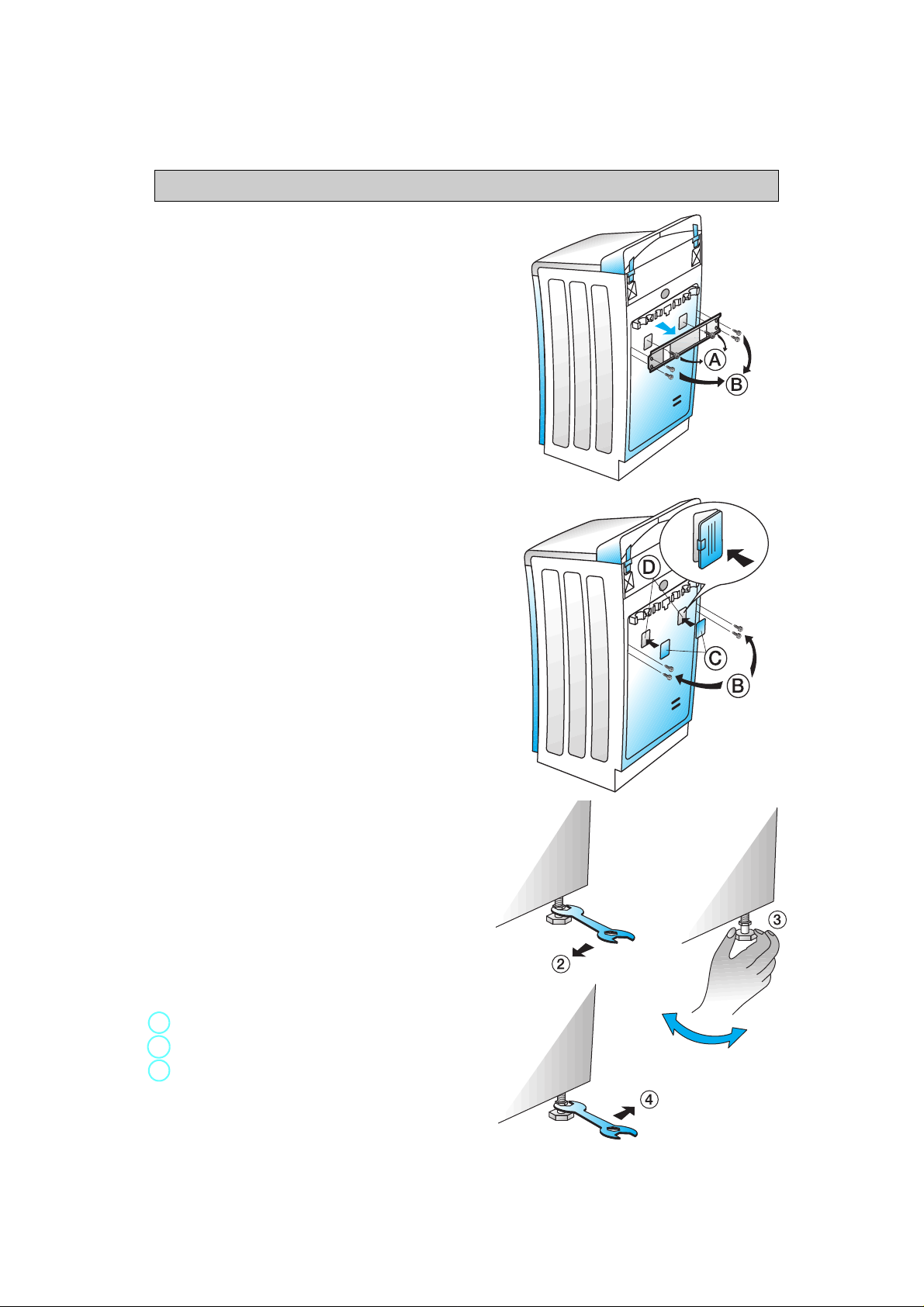
HOW TO REMOVE THE TRANSPORT
SCREWS AND THE TRANSPORT BRACKET
The appliance is fitted with the transport screws and
the transport bracket to prevent internal damage while
being moved.
Before using the appliance, the transport bracket
at the back MUST be removed.
1.
Unscrew the two screws A and the four screws B with
a flat screwdriver or a N° 8 hex nut screwdriver.
2.
Remove the transport bracket.
3.
Replace the four outer screws B into the machine
again and tighten.
4.
Tear off the two stop plugs C from the hose holder
and clip them into the openings of the machine D.
Note:
In case of future moves, always transport the
washing machine upright.
INSTALLATION
•
Install the appliance on a solid and level floor surface
close to electrical, water and drain connections.
•
Make sure that all feet are stable and resting on
the floor and then check that the appliance is
perfectly level (use a spirit level).
•
If the floor is uneven, adjust the levelling feet as
required (do not insert pieces of wood, cardboard
etc. under the feet).
•
The appliance can be installed in a 40 cm width
and 63 cm depth space.
Note:
It is important to avoid blocking the openings on
the underside of the appliance when installing on a
carpet floor.
ADJUSTMENT OF THE APPLIANCE
1.
To move the appliance into its operat ing position :
Pull the handle situated on the bottom of the front
(optional on certain models) a little bit by hand and
pull it in the final driving position by foot. Afterwards
push the handle back into the original, stable position.
The front feet can be adjusted in o rder to level t he
appliance.
2.
Loosen the locknut using a wrench.
3.
Adjust the height of the foot, turning it by hand.
4.
Tighten the locknut by turning it anti-clockwise
towards the appliance casing.
IMPORTANT:
standing on the trolleys.
Do not run the appliance while it is
5
Page 4
INSTALLATION INSTRUCTIONS
WATER SUPPLY
•
Water supply: cold water only
•
Tap: 3/4” threaded hose connection
•
Pressure: 10-100 N/cm² (1-10 bar).
Should the appliance be installed in a room
which is subject to extremely low temperatures,
you need to empty water at the end of each wash
programme. Please follow the instructions given
in the chapter titled “Draining Residual Water”
and disconnect the water inlet hose.
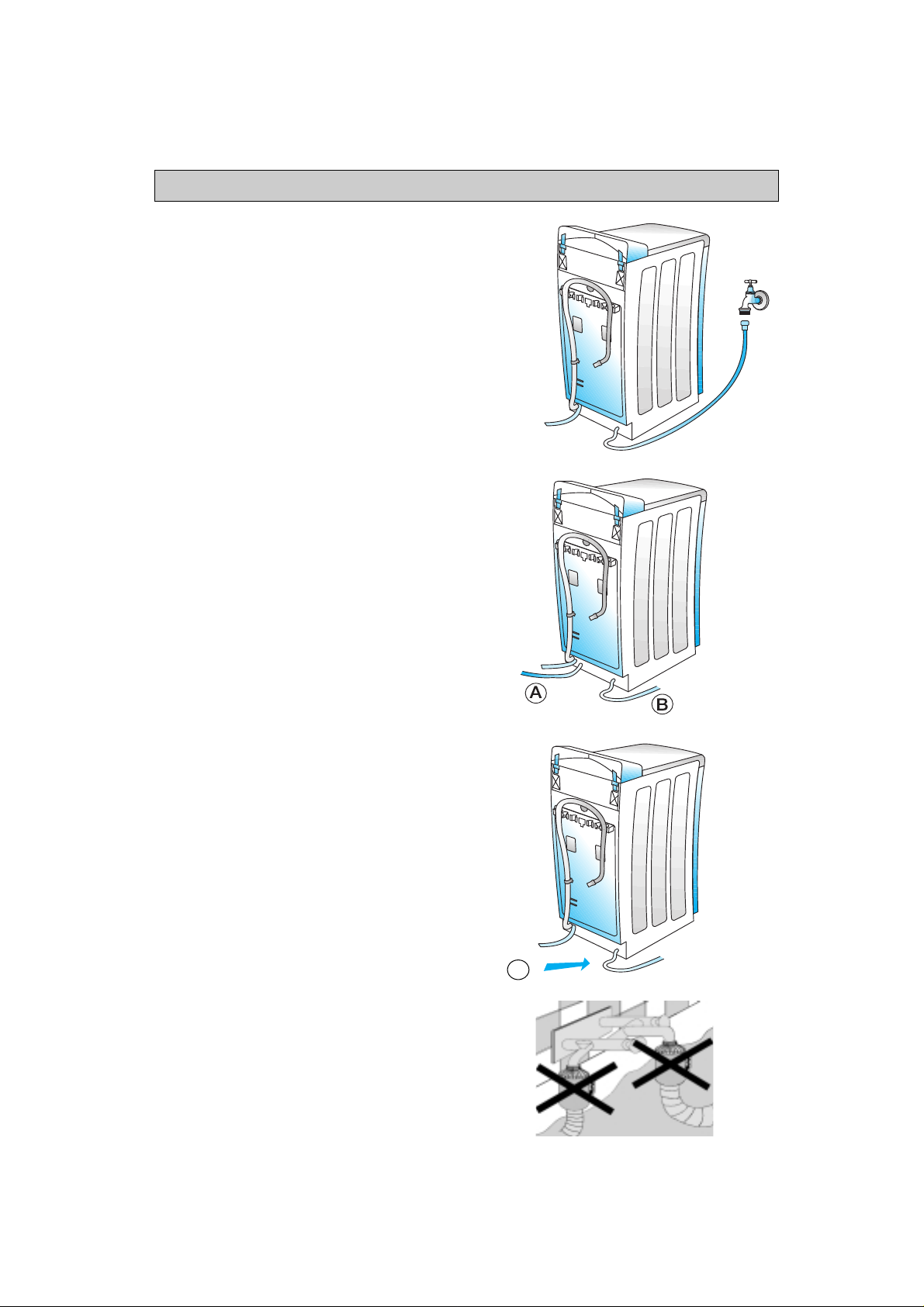
WATER INLET HOSE(S)
1.
The mesh filter supplied with the appliance
must be inserted in the connection between
the supply hose and the tap.
2.
Carefully screw the hose connection to the
tap preferably by hand. Make sure there are
no kinks in the hose and that it is not crushed.
3.
Check water-tightness of tap and appliance
connections by turning the tap completely on.
•
If the hose is too short, replace it with a
suitable length of pressure resistant hose
(10 bar min., EN 50065 approved type).
•
The appliance can be connected without a
non-return valve.
•
Install the appliance in accordance wit h
regulations of your local water company.
For Great Britain & Ireland only:
Water inlet:
- hot (see A) fill hose;
- and cold (see B) fill hose.
The warm water inlet temperature must not
exceed 60° C.
WATER STOP ANTI-FLOODING SYSTEM
(depending on model)
•
Screw the threaded connection with t he fi lt er
into the union nut on the wa te r ta p. Open the
water tap fully and check the w ate r t ig htn es s
of the connection point.
•
The appliance must not be connected to the
mixing tap of a non-pressurized wate r he at er!
•
The inlet hose (see arrow C) and the plastic
enclosure at the tap connection contain
electrical components.
•
Do not cut the hose and do not immerse the
plastic enclosure in water.
•
If the flexible hose is damaged, unplug th e
appliance from the mains immediately.
If the hose is too short, replace it with a 3 m Water
Stop hose (available from After-Sales Service or
from your dealer). This operation must be carried
out exclusively by a licensed electrician.
:
C
6
Page 5
INSTALLATION INSTRUCTIONS
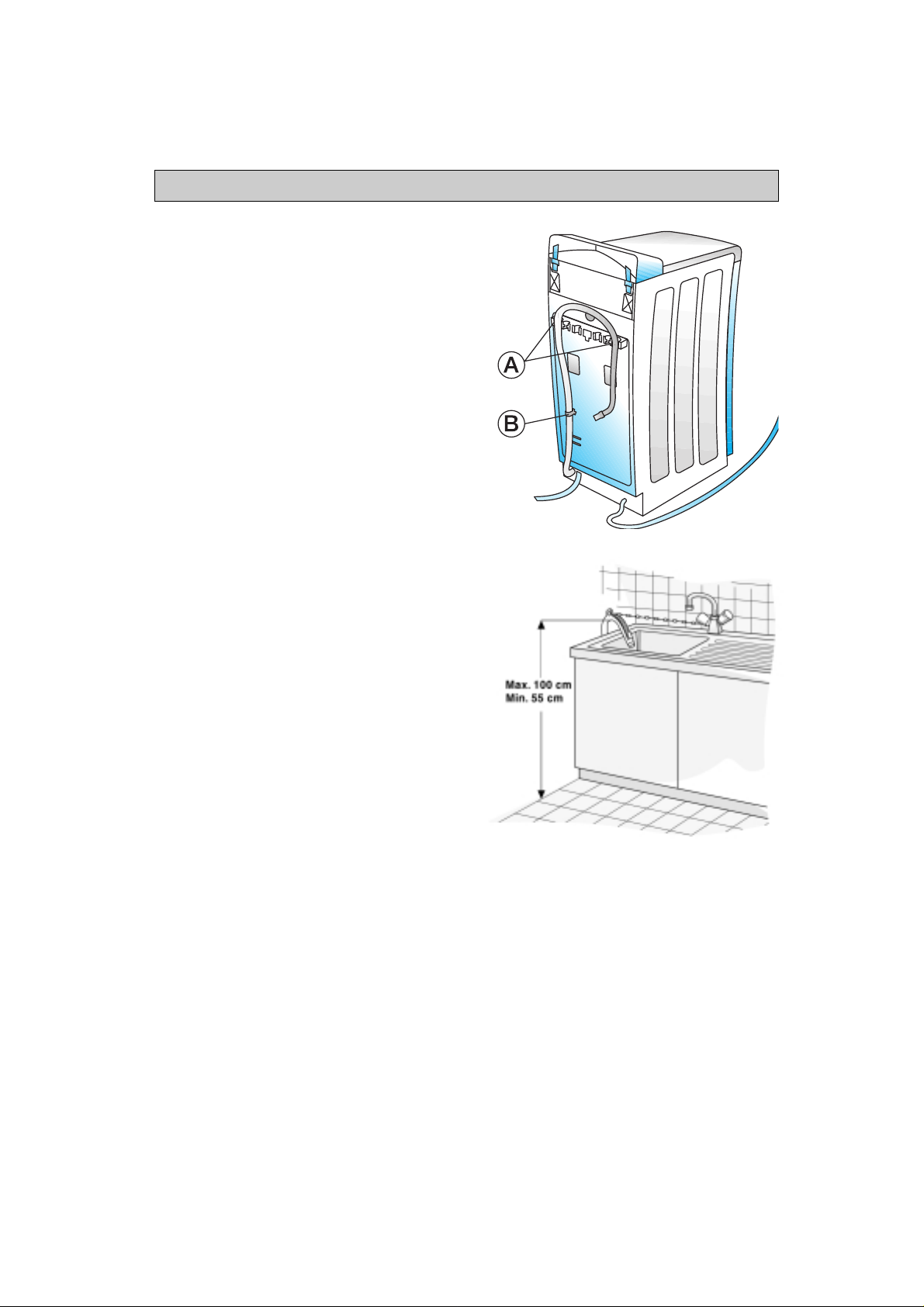
DRAIN HOSE
•
Drain hose connection to water outlet.
1.
Unhook the drain hose from the right and left hose
connection, see A in figure.
Important:
Do NOT loosen the drain hose connection from the
clip on the left side, see B in figure, otherwise there is
the risk of leakage (danger of scalding with hot water).
2.
Fix the “U” bend supplied (inside the drum) to the
free end of the drain hose.
3.
Fit the drain hose either to the siphon or hook it over
the edge of a sink or bath tub with the “U” bend.
Small hand basins are not suitable.
The edge of the tub must be no higher than 100
cm above the floor.
4.
If you need to add an extension, use a flexible
hose of the same type and secure the unions with
screw-on hose clips.
Maximum overall drain hose length: 2.50 m.
Maximum drain height (“U” bend): 100 cm.
Minimum drain height: 55 cm.
Important:
Make sure there are no kinks in the d rain hose an d
take precautions against it falling while the
appliance is running.
ELECTRICAL CONNECTIONS
•
Electrical connections must be made in accordance
with local regulations.
•
The appliance must be connected t o th e ma ins
exclusively by means of a socket with an earth
connection in accordance with establi shed
regulations. The appliance must be earthed b y law.
The manufacturer declines all liability for damage to
property or injury to persons or animals deriving
either directly or indirectly from failure t o obs erve
the above directions.
•
The data of voltage, power consumption and the
required electrical protection are supplied on the
rear of the appliance.
•
The electrical power cable must be replaced, if
necessary, exclusively by a licensed electrician.
• The appliance conforms to European safety
regulations, EC directive 93/68/EEC and
standard EN 60555.
•
Do not use extension leads or multisockets.
7
Page 6

WASHING MACHINE AND ACCESSORIES
Lid
1.
Detergent dispenser
2.
Drum flaps
3.
Pump and foreign body trap
4.
Mobility lever (depending on model)
5.
After-Sales Service sticker (behind the foreign body trap cover).
6.
8
Page 7

PROTECTING THE ENVIRONMENT
• Packing
The packing material is 100% recyclable a s
indicated by the recycling symbol.
• Appliance
The appliance is built from recyclable
materials. If you decide to scrap the
appliance ensure you observe local waste
disposal by-laws.
Before scrapping, cut off the plug and the
power cable so the appliance cannot be
connected to the mains.
• Environmental tips
If possible, always wash with a full load
-
(depending on the programme) to save water
and energy.
SAFETY INSTRUCTIONS
The appliance conforms to European safety
•
regulations and to Directive n. 93/68/EEC
and standard EN 60555.
Use the appliance only for domestic washing
•
and for its intended applications.
Ensure the installation and the electrical and
•
water connections have been carried out in
accordance with the manufacturer’s
instructions and in observance of local safety
regulations (refer to “Installation
instructions”).
For lightly to averagely soiled laundry, use a
-
programme without a prewash cycle.
Use low temperatures or short programmes
-
for lightly soiled laundry.
Use a saving option (see programme chart)
-
for small and lightly soiled loads and reduce
the amount of detergent.
If you intend to dry the washing in a dryer,
-
select maximum spin speed (according to the
type of laundry) to reduce the energy
consumption of the dryer.
Do not exceed the detergent measures
-
indicated in the manufacturer’s instructions.
Use stain removal products only when strictly
-
necessary.
Unplug the appliance before cleaning or
•
maintaining the appliance.
When the appliance is not in use switch it off
•
and turn off the tap(s).
Do not attempt to force the lid open.
•
Do not allow children to play with the
•
appliance or enter the drum.
Packing materials can be dangerous for
•
children: keep all packing materials (plastic
bags, polystyrene, etc.) well out of their reach.
TRANSPORT / HANDLING
Unplug the appliance.
1.
Turn off the tap(s).
2.
Remove the water supply and drain hose.
3.
Eliminate all water from the hoses and from the
4.
appliance (see “Draining Residual Water”).
Be careful that the water is sufficiently cooled
so as to avoid any accidents.
Transport the washing machine upright.
5.
9
Page 8

PREPARING THE WASH
1. Sort the laundry according to:
• Type of fabric / Care label symbol
Cottons, mixed fibres, synthetics, wool,
handwashable textiles.
• Colour
Separate whites and coloured items. Wash
new coloured items separately.
• Size
Wash items of different sizes in the same load
to improve washing efficiency and distribute
the load more evenly inside the drum.
• Fabric delicacy
Wash delicate articles separately: use a
special programme for Pure New Wool ,
curtains and other delicates. Always remove
curtain glides or wash curtains with the glides
inside a cotton bag. Use the special
programme for handwash fabrics.
Wash stockings, belts and other small items
or articles with hooks (e.g. bras) in special
cotton bags for washing machines or in
zipped pillow cases.
2. Empty pockets
Coins, safety pins and similar can damage
your laundry and the appliance drum and tub.
3. Fasteners
Close zips and fasten buttons or hooks; loose
belts or ribbons should be tied together.
WASHING AND CARING FOR SILK AND
OTHER HANDWASHABLE ARTICLES
.
Washing
To ensure correct care of delicate articles this
•
programme has no spin cycle.
If you select the special option Rinse Hold,
•
don’t leave garments to soak for too long, it is
recommended not to use this function with
this programme.
(depending on model)
:
Drying and ironing:
Open the garment out on a towel to absorb
•
excess water without wringing (pat the
garment lightly against the towel).
Never dry silk garments in direct sunlight.
•
Iron from the reverse side when the fabric is
•
still slightly damp.
To avoid water marks, do not spray with
•
water and do not use a steam iron.
STAIN REMOVAL
Blood, milk, egg and other organic
•
substances are generally removed by the
enzyme phase of the programme.
To remove red wine, coffee, tea, grass and
•
fruit stains etc. add a stain removing agent or
a chlorine bleach.
Particularly stubborn stains should be treated
•
before the wash.
10
LOADING THE LAUNDRY
Lift the machine lid.
1.
Open the drum by pressing the small flap and
2.
holding the large flap.
Unfold the laundry and place it loosely in the
3.
drum.
Close the drum flaps carefully and check if
4.
they are properly locked.
LOAD CAPACITY
See the maximum load on the programme chart.
Overloading will lead to unsatisfactory
Note:
washing results and creased laundry.
Page 9

DETERGENT AND ADDITIVES
CHOOSING THE RIGHT DETERGENT
The type of detergent depends on:
•
type of fabric (cottons, synthetics, delicate items,
wool). You can use any make or type of
detergent recommended for domestic washing
machines.
Note
: Use only specific detergents for wool.
•
colour;
•
washing temperature;
•
degree and type of soiling.
Notes:
•
Whitish residues on dark fabrics are caused
by insoluble water softeners used in modern
phosphate-free powder detergents.
If you notice this problem, shake or brush the
affected items or use a liquid detergent.
•
Keep detergents and additives in a dry place
and out of reach of children.
•
Use only detergents and additives specifically
produced for domestic appliances.
If you use water softeners, descaling agents and
dyes, make sure they are suitable for washing
machine use.
•
Do not use solvents (turpentine, benzine, etc.).
Do not wash fabrics that have been treated
with solvents or flammable liquids.
DOSAGE
Follow the instructions on the detergent pack in
relation to:
•
the degree and type of soiling;
•
the size of the load;
-
full load: follow the detergent
manufacturer’s instructions;
-
half load: 3/4 the amount used for a full load;
-
minimum load (about 1 kg): half the
amount used for a full load;
•
water hardness in your area (ask for
information from your water company): soft
water requires less detergent than hard water.
Notes:
•
Too much detergent can result in excess
foam formation, which reduces washing
efficiency. If the appliance detects excessive
foam it may prevent spinning.
•
The laundry will become grey if you use too
little detergent. Too little detergent will also
lead to increased scale deposits on the
heating element and drum.
•
If using chlorine bleach, follow the bleach
instructions carefully. Overdosing the bleach
can damage the wash.
•
If the water pressure in your household is
extremely low it is recommended to pour the
detergent for the main wash directly on the drum.
WATER HARDNESS
Water hardness
class
1
2
3
4
Characteristics German scale
soft
average
hard
very hard
DYEING AND BLEACHING
Dyeing:
consist of a dye colour, fixing agent and salt. For
the effective use of the dye please follow strictly the
manufacturer’s instructions.
Commercially available products usually
STARCHING
Dissolve / dilute the starch, powder or liquid, in
approximately 1 litre water outside of the
washing machine in a small container.
French scale
°dH
0-7
7-14
14-21
over 21
•
Only use products recommended for
washing machines.
•
Plastic and rubber parts of the machine may
be stained by dyes or bleaches.
Load the washing machine, close the drum flaps
and pour the dissolved starch directly on the
drum. Then close the lid, select the programme
“Rinse and Spin” and start.
°fH
0-12
12-25
25-37
over 37
Clarke scale
°eH
0-9
9-17
17-26
over 26
11
Page 10

REMOVING THE FOREIGN BODY TRAP
WHEN SHOULD THE FOREIGN BODY
TRAP BE EMPTIED?
The appliance is provided with a self-cleaning
pump. The foreign body trap keeps objects like
buttons, coins, safety pins, etc. which have been
left in the laundry.
•
Check the foreign body trap if the appliance
is not draining properly or if it fails to perform
spin cycles.
•
Check the foreign body trap regularly, t wo or
three times a year and clean it if nec essary.
IMPORTANT:
before draining.
REMOVING THE FOREIGN BODY TRAP
1.
Unplug the appliance.
2.
Open the foreign body trap cover with a coin.
3.
Place a bowl beneath it.
4.
Turn the foreign body trap slowly
anti-clockwise until the grip is vertical;
do not remove it as yet.
5.
Wait until all the water has drained out.
6.
Now unscrew the foreign body trap
completely and extract it.
7.
Remove any foreign items from the foreign
body trap.
Make sure the water has cooled
8.
Make sure the pump impeller (in the housing
behind the foreign body trap) is not
obstructed.
9.
Insert the foreign body trap and screw it fully
down in a clockwise direction (until the grip is
horizontal).
10.
Pour 0.5 litres of water into the machine via
the drum and check that water does not leak
from the foreign body trap.
11.
Close the cover.
12.
Plug in the appliance to the electrical outlet.
2
4
6
DRAINING RESIDUAL WATER
WHEN SHOULD THE RESIDUAL WATER
BE DRAINED?
•
Before transporting the machine.
•
If the appliance is installed in a roo m subject to
sub-zero temperatures. It is advisable to drain
residual water from the machine, the drain
hose and the inlet hose after each wash cy cle.
DRAINING RESIDUAL WATER
1.
Switch off the appliance.
2.
Unplug the machine from the mains.
3.
Close the tap(s), loosen the inlet hose(s)
from the machine and let the water drain out.
4.
Remove the foreign body trap, let the water
drain out and close it again.
5.
Open the clip for the drain hose fixation on
the rear part of the machine (see B in figure).
6.
Lower the drain hose into a bowl and let the
water drain.
7.
Wait until the flow stops.
8.
Fix the drain hose again to the clip.
9.
Plug in the appliance to the electrical outlet.
Important:
•
Before using the machine again, pour about
1 litre of water into the drum to reactivate the
“Eco system” (depending on model).
•
Before starting a new wash cycle screw the inlet
hose(s) to the machine by hand. Check watertightness of washing machine connections by
turning the tap(s) completely on.
•
Replace the drain hose with the “U” bend
and fix it.
B
12
Page 11

MAINTENANCE AND CLEANING
APPLIANCE EXTERIOR AND CONTROL PANEL
•
Clean using normal household cleaner (do not use
abrasive products).
•
Dry with a soft cloth.
DOOR SEAL
•
Clean with a damp cloth when necessary.
DISPENSER CLEANING INSTRUCTIONS
1.
Push in the buttons on each side of the dispenser.
2.
Pull the dispenser toward you and remove.
A small quantity of water can remain in the soap
dispenser. It is advisable to carry the dispenser in
an upright position.
3.
Wash the dispenser using running water.
Note:
The siphon caps in the dispenser are also
removable for cleaning.
4.
Replace the siphon caps in the dispenser (if removed).
Make sure that they lock in place.
5.
Replace the dispenser by locating the bottom tabs
in the door holes and pivot until both of the upper
buttons lock.
WATER INLET HOSE(S)
•
Periodically check the hose for brittleness and
cracks and replace if necessary.
WATER HOSE MESH FILTERS
•
Check and clean regularly.
For appliances with safety hose
1.
Unplug the appliance.
2.
Turn off the tap.
3.
Unscrew the hose from the tap.
4.
Clean the mesh filter carefully under running water
without removing it.
5.
Screw the hose connection back onto the tap by hand.
6.
Unscrew the hose from the appliance.
7.
Remove the filter from the appliance connection
with pliers and clean it.
8.
Refit the filter and screw the hose connection to
the appliance.
9. Turn on the tap to check that the connections
are completely watertight
10.
Plug in the appliance to the electrical outlet.
For appliances with Water Stop hose
1.
Unplug the appliance.
2.
Turn off the tap.
3.
Unscrew the hose from the tap.
4.
Remove the loose mesh filter only and clean it.
5.
Refit the filter and screw the Water Stop hose
connection to the tap.
6. Turn on the tap to check that the connections
are completely watertight
7.
Plug in the appliance to the electrical outlet.
.
.
13
Page 12

MAINTENANCE AND CLEANING
RECOVERING AN OBJECT THAT FALLS
BETWEEN THE DRUM AND THE TUB
If accidentally an object falls between the drum
and the tub you can recover it thanks to a
removable plastic lifter:
1.
Unplug the appliance.
2.
Remove the laundry from the drum.
3.
Close the drum flaps and turn the drum to the
opposite of the flaps.
4.
Press the plastic tip while sliding the plastic
lifter from left to right.
The plastic lifter will fall into the drum.
5.
Open the drum: through the hole inside the
drum you can recover the object.
6.
Refit the plastic lifter from inside the drum:
Position the plastic tip above the hole on the
right side of the drum.
Then slide the plastic lifter from right to left
until it clips.
7.
Plug in the appliance to the electrical outlet.
14
Page 13

TROUBLESHOOTING GUIDE
This appliance is equipped with safety functions
which detect faults at an early stage and react
appropriately.
Often, however, the faults detected are small
enough to be solved in a matter of minutes.
The appliance will not start, no lamp
lights up.
Check whether:
•
the appliance is plugged in;
•
the wall socket is functioning correctly (use a
table lamp or similar).
The appliance will not start, but the pilot
light is on.
Check whether:
•
the appliance lid is properly closed;
•
a programme has been selected;
•
the programme is started;
•
the water tap is open.
The appliance stops during the
programme.
Check whether:
•
the “Rinse Hold” button is pressed: terminate
this option;
•
the water tap is open;
•
the pump / foreign body trap are blocked (see
“Removing the Foreign Body Trap”);
•
the Water stop could be activated (see
“Water stop fault”).
Insufficient or no water supply.
Check whether:
•
the water tap is completely open, and the
water supply pressure is sufficient;
•
the water inlet hose is kinked;
•
the mesh filters are clogged (see
“Maintenance and Cleaning” / “Water Hose
Mesh Filters”);
•
the water inlet hose is frozen.
Reselect the desired programme and start again
to continue with the programme (do not add
detergent for this programme).
The appliance does not drain out the water.
Check whether:
•
drain hose is kinked (see “Installation
Instructions”);
•
the pump/ foreign body trap are blocked (see
“Removing the Foreign Body Trap”);
IMPORTANT:
water to cool down.
•
the drain hose is frozen.
Reselect the desired programme and start again
to continue with the programme (do not add
detergent for this programme).
If the fault re-occurs, contact After-Sales Service
(see “After-Sales Service”).
•
the “Rinse Hold” button is pressed: terminate
this option.
Before draining, allow the wash
Detergent and additive product residues
in dispenser at end of wash.
Check whether:
•
the siphon is correctly installed and clean
(see “Maintenance and Cleaning” /
“Dispenser Cleaning Instructions”);
•
enough water is being supplied. The mesh
filters could be clogged (see “Maintenance
and Cleaning” / “Water Hose Mesh Filters”).
The appliance vibrates during the spin
cycle.
Check whether:
•
the appliance is level and solidly installed on
all feet (see “Installation instructions”);
•
the transport screws and transport bar have
been removed. Before starting up the
appliance, the transport screws and the
transport bracket must be removed
(see “Installation instructions”).
Final spin results are poor.
•
the appliance has an imbalance detection and
correction system. If individual heavy articles
are loaded (bathmat, bathrobe, etc.) this
system may reduce the spin speed
automatically to protect the appliance. It may
even interrupt the spin cycle altogether, if the
imbalance is too great after several spin starts;
•
if the laundry is too humid at the end of the
cycle, add more articles of laundry to balance
the load and repeat the spin cycle;
•
excessive foam formation may prevent
spinning. Use less detergent.
Check whether:
•
the pump impeller is obstructed (see
“Removing the Foreign Body Trap”);
•
the lid was opened during the delicate or
wool programme. Close the lid and select a
spin programme.
Water stop fault (depending on model).
•
The Water stop can be released by:
1.
too much foam;
2.
a leak in the water hose or appliance.
•
Close the tap, switch off the appliance and
unplug it.
•
Evacuate water from the bottom tray by tilting
the appliance to the front.
Then:
•
Turn on the tap, plug in the appliance to the
electrical outlet and start again.
The programme will continue (do not add
detergent for this programme).
If the fault recurs, carry out the above steps again
and contact After-Sales Service (see “After-Sales
Service”).
15
Page 14

AFTER-SALES SERVICE
Before contacting After-Sales Service:
Try to solve the problem
1.
(see “Troubleshooting Guide”).
Restart the programme to see if the fault is
2.
repeated.
If after the above checks the appliance does
not work properly, get in touch with the
nearest After-Sales Service Centre.
Please give:
a short description of the fault,
•
the exact type and model of the appliance,
•
the number after the word SERVICE of the
•
After-Sales Service sticker behind the foreign
body trap cover,
Your complete address (including postal
•
code) and telephone number.
16
 Loading...