

Page 1

6gb33004.fm5 Page 7 Monday, March 26, 2001 11:49 AM
INSTRUCTIONS FOR USE
INSTALLATION
BEFORE USING THE FREEZER
SAFEGUARDING THE ENVIRONMENT AND
CHILDREN
PRECAUTIONS AND GENERAL
RECOMMENDATIONS
TEMPERATURE CONTROL
DEFROSTING
FREEZER BREAKDOWN
FAILURES
TECHNICAL DATA
7
Page 2

6gb33004.fm5 Page 8 Monday, March 26, 2001 11:49 AM
INSTALLATION
The freezer should be installed on a good firm
level surface and providing adequate air
Any floor unevenness should be corrected at
the time of installation.
circulation at the sides and rear of the cabinet.
BEFORE USING THE FREEZER
This information is provided in the interest of your
safety.
• Before operating the appliance, please read the
following instructions carefully, as they cover the
basic information for safety of installation,
operation and maintenance.
• Before using the freezer for the first time it is
recommended that you clean both the inside and
outside. Use luke warm water and a little
bicarbonate of soda. 1 teaspoon to 1.2 litres of
water.
• This appliance must only be used for its intended
purpose i.e. the storing and freezing of domestic
edible foodstuffs.
SAFEGUARDING THE ENVIRONMENT AND
CHILDREN
If you are discarding an old refrigeration product
with a lock or catch fitted to the lid/door, do not
allow young children to play or hide inside, ensure
that the appliance is left in a safe condition to
prevent them becoming trapped inside and
suffocating.
1.
Packing
The packing material is entirely recyclable, and
marked with the recyclable symbol. Follow local
regulations for disposal.
Keep the packaging materials (plastic bags,
polystyrene parts, etc.) out of reach of children, as
they are potentially dangerous.
2.
Appliance
The freezer is made of recyclable material. Dispose
of the appliance in conformity with local
environmental regulations.
Make the appliance unusable by cutting off the
mains lead. The appliance must be delivered to an
authorised collection centre for the recovery of the
refrigerant gas.
This appliance does not contain CFC’s but R600a
Isobutane.
Isobutane is a natural gas having low environmental
impact. Caution is required, however, since
Isobutane is flammable. Therefore, it is essential to
ensure that refrigerant pipelines are not damaged.
PRECAUTIONS AND GENERAL
RECOMMENDATIONS
Only use the freezer for storing frozen food,
freezing fresh food and production of ice
cubes.
• Do not cover or obstruct the condenser which
is situated on the rear of the appliance.
• Do not freeze / store liquids in glass containers
in the freezer as there is a risk of bursting.
• Do not consume ice cubes or ice lollies
immediately after taking them out of the
freezer as there is a risk of freeze burn and
they should be allowed to warm slightly before
consumption.
8
• Do not store effervescent drinks in the
freezer.
• Before servicing or cleaning the appliance,
disconnect from the mains supply.
• Should the power supply cable become
damaged, it should be replaced by a qualified
service engineer as it is a special type.
Page 3

6gb33004.fm5 Page 9 Monday, March 26, 2001 11:49 AM
TEMPERATURE CONTROL
The thermostat maintains a constant temperature
in a chosen position. A normal temperature of 18°C is obtained by turning the thermostat control
knob to number 3.
However, it should be noted that if the thermostat
control knob is set to the fast freeze position. The
compressor will not stop running.
Fast freeze
• The chest freezer will fast freezer your
produce successfully but for the best results
you are advised to follow these instructions
carefully.
• Only use top quality products freezing
preserves their quality but cannot improve it.
• Carefully clean and prepare each item and
wrap in polythene or place in waxed cartons.
• Keep down the size of each package to a
minimum, do not forget that a square packages
will utilise more effectively the storage space in
your freezer.
DEFROSTING
Small amounts of frost will accumulate inside the
freezer depending upon the length of time during
which the lid is left open or the amount of moisture
introduced. It is essential to ensure that no frost or
ice is allowed to form at places where it will affect
the close fitting of the lid gasket. This might allow
air to penetrate the cabinet, thus encouraging
continuous running of the compressor. Thin frost
formation is quite soft and can be removed with a
brush or plastic scraper. Do not use metal or sharp
scrapers, mechanical devices or other means to
accelerate the defrosting process. Remove all
dislodged frost from the cabinet floor. For the
removal of light frosting it is not necessary to switch
off the freezer.
For the removal of heavy ice deposits disconnect
the freezer from the power supply and empty the
contents into cardboard boxes and wrap in thick
blankets or layers of paper to keep them cold.
Defrosting will be most effective if carried out when
the freezer is nearly empty, and it should be carried
out as quickly as possible to prevent undue increase
in temperature of the contents. Do not use metal
or sharp scrapers, mechanical devices or other
means to accelerate the defrosting process.
Increase in temperature of frozen food packages
during defrosting may shorten the storage life.
• Freeze each package as quickly as possible.
Produce to be frozen should be placed in as
much contact as possible with the sides in the
freezer.
• Avoid placing unfrozen food in contact with
food previously frozen.
• Do not overload the freezer with fresh
produce. The maximum amount of fresh
produce that can be frozen in 24 hours is 10
kilograms. Frozen food should be used in
rotation and therefore packages should be
carefully labelled.
• Turn the thermostat control knob to number
6 (fast freeze position) 24 hours before the
desired freezing is to be effected. After this
period of time the appliance will be ready to
freeze the fresh produce.
• 24 hours after putting in the fresh produce the
freezing operation should be completed and
the thermostat control knob returned by to it's
normal position.
• Commercially frozen pre-packed food should
be stored in accordance with the frozen food
manufacturers instructions.
Provided that the contents are well wrapped and
placed in a cool area they should keep for several
hours. Examine the contents when replacing them
in the freezer and if some of the packages have
thawed out it should be eaten within 24 hours or be
cooked and re-frozen.
Draining the defrost water is done by removing the 2
drain plugs which are situated one at the front of the
appliance and one inside the appliance.
Before doing so do not forget to place a dish or plastic
container under the outlet to collect the water.
Clean the inside with a solution of warm wa ter with
a little bicarbonate of soda and then dry thorough ly.
Wash all removable parts in the same way and
reassemble.
2 DRAIN PLUGS.
Reconnect the freezer to the power supply and
allow to run for 30 minutes before reloading with
produce.
The outside of the freezer can be cleaned in this
way too, also remove any dust from the condenser
on the rear of the appliance. At least once a year
this thorough cleaning routine is recommended in
order to maintain a good standard and hygiene.
If after defrosting, the freezer is not going to be
used for a long period of time, then it must be
cleaned and dried and the lid propped ajar.
DO NOT FORGET TO REFIT THE
9
Page 4
6gb33004.fm5 Page 10 Monday, March 26, 2001 11:49 AM
FREEZER BREAKDOWN
In the event of the freezer failing to operate
because of a power failure, do not worry unduly.
Providing care is taken to ensure that the lid is kept
closed, frozen food will keep within the freezer for
at least 24 hours. Extra protection can be given by
covering the freezer with two or three thick
blankets. If a long breakdown is anticipated, try to
get the produce into another freezer or cold store,
if possible, a supply of Dry Ice to place within the
cabinet.
FAILURES
If the temperature in your freezer exceeds -15°C
please check the following points.
• Is the green pilot lamp on.
• Has the fuse blown.
• Has too much fresh food been placed in the
freezer at the same time.
• Has the lid been correctly closed.
• Is the formation of ice too thick.
• Check the thermostat setting.
• Is the mains plug in the mains wall socket.
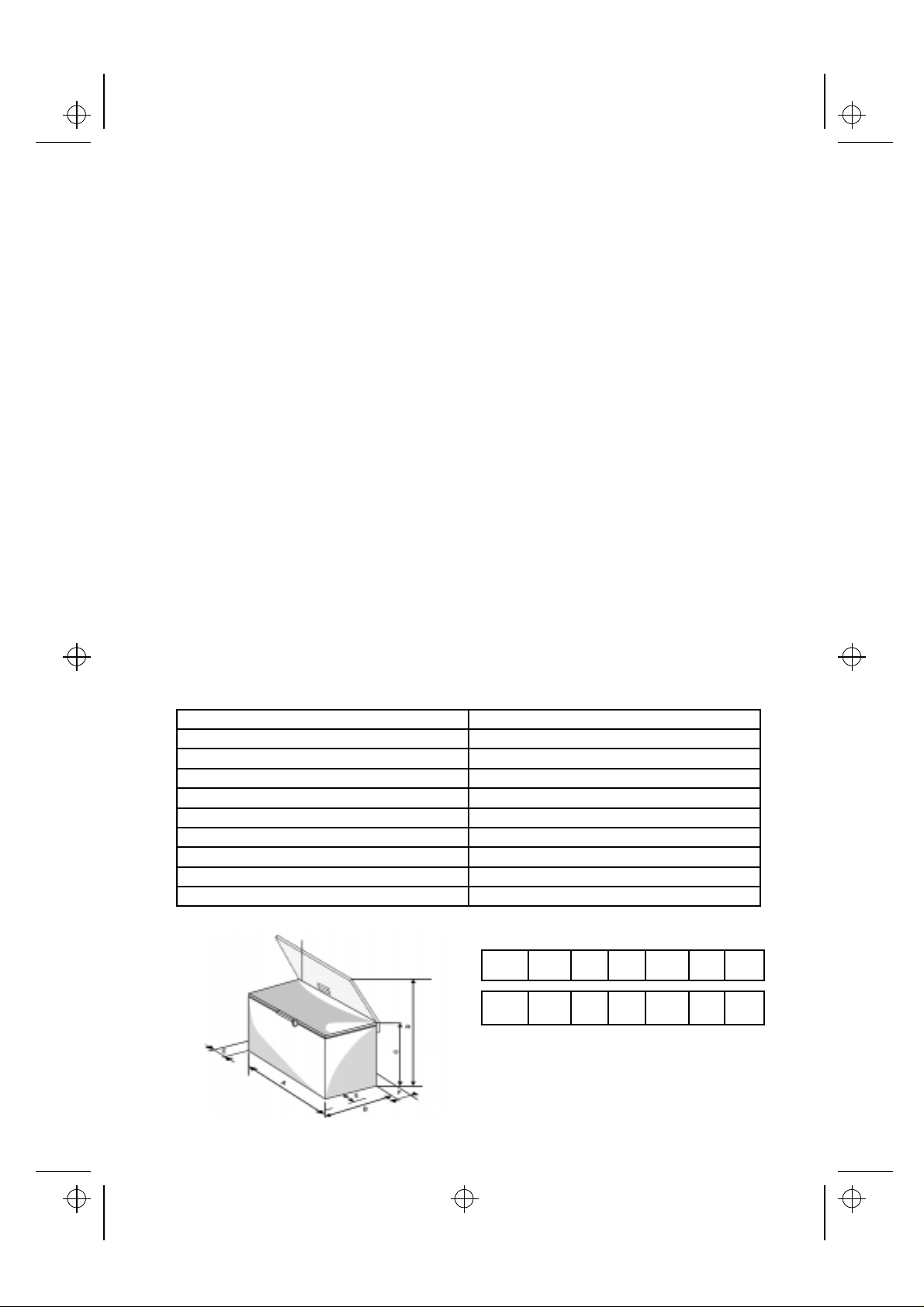
TECHNICAL DATA
Gross volume 208 litres
Net volume 205 litres
Class N
Star rating 4
Rated freezing capacity 10 kg/24h
Power supply 220/240volts a.c. 50 cycles
Amperage 0.3A
Power consumption 1.03 kwh/24h
Rated input 75w
Refrigerant charge 46grams R600a
If the breakdown is with the cabinet and not a
blown fuse or power failure (do not forget that the
temperature control regulates the amount of time
during which the compressor operates, a silent
compressor does not necessarily mean a
breakdown), contact your local Retail Store or
After Sales Service
When you have checked these things and the
temperature of the chest freezer is still
unsatisfactory, contact your local Retail Store or
After Sales Service
.
.
10
Mod.
Lt.
215 806 600 857 1470 70 70
A
mmBmmCmmDmmEmmFmm
 Loading...