

Page 1

INSTRUCTIONS FOR USE
PRODUCT DESCRIPTION
CONTROLS
BEFORE USING THE APPLIANCE
SAFEGUARDING THE ENVIRONMENT
PRECAUTIONS AND GENERAL
RECOMMENDATIONS
ORGANISING THE INTERNAL SPACE
HOW TO OPERATE THE REFRIGERATOR
COMPARTMENT
HOW TO DEFROST AND CLEAN THE
APPLIANCE
TROUBLESHOOTING GUIDE
AFTER-SALES SERVICE
INSTALLATION
67
Page 2

PRODUCT DESCRIPTION
1. Crisper shelf
2. Rating plate
3. Inner door bottom door tray
4. Removable shelves
CONTROLS
Knob set to O: Stop
Knob set to 1: Minimum
Knob set to 4: Max
5. Drip tray
6. Thermostat adjustment knob
7. Ice cube tray
68
Page 3
BEFORE USING THE APPLIANCE
• Your new appliance is designed to be used in
the household and similar applications such as:
- kitchen areas in shops, offices and other
working environments
- farm houses
- by clients in hotels, motels, residences, bed
& breakfasts.
To ensure best use of your appliance,
carefully read the operating instructions
which contain a description of the product
and useful advice.
Keep these instructions for future
reference.
1. After unpacking the appliance, make sure it is
not damaged and that the door closes
properly.
Any damage must be reported to the dealer
within 24 hours of delivery of the appliance.
2. Wait at least two hours before switching the
appliance on in order to ensure that the
refrigerant circuit is fully efficient.
3. Installation and electrical connection must be
carried out by a qualified technician according
to the manufacturer’s instructions and in
compliance with local safety regulations.
4. Clean the inside of the appliance before using it.
SAFEGUARDING THE ENVIRONMENT
1. Packaging
The packing material is 100% recyclable and
bears the recycling symbol. For disposal, comply
with local regulations. Keep the packing
materials (plastic bags, polystyrene parts, etc.)
out of the reach of children, as they are a
potential source of danger.
2. Scrapping/Disposal
The appliance is manufactured using recyclable
material.
This appliance is marked in compliance with
European Directive 2002/96/EC on Waste
Electrical and Electronic Equipment (WEEE).
By ensuring the correct disposal of this
appliance, you can help prevent potentially
negative consequences for the environment and
health.
The symbol on the appliance, or on the
accompanying documents, indicates that this
appliance should not be treated as domestic
waste but must be taken to a special collection
centre for the recycling of electrical and
electronic equipment.
When scrapping the appliance, make it unusable
by cutting off the power cable and removing the
doors and shelves so that children cannot easily
climb inside and become trapped.
Scrap the appliance in compliance with local
regulations on waste disposal, taking it to a
special collection centre; do not leave the
appliance unattended even for a few days, since
it is a potential source of danger for children.
For further information on the treatment,
recovery and recycling of this product, contact
your competent local office, the household
waste collection service or the shop where you
purchased the appliance.
Information:
This appliance does not contain CFCs.
The refrigerant circuit contains R134a (HFC) or
R600a (HC) (see the rating plate inside the
appliance).
Appliances with Isobutane (R600a): isobutane is
a natural gas with low environmental. Caution is
required, however, since isobutane is
flammable. Therefore, it is essential to ensure
that refrigerant pipelines are not damaged.
This product may contain Fluorinated
Greenhouse Gases covered by the Kyoto
Protocol; the refrigerant gas is inside a
hermetically sealed system.
Refrigerant gas: R134a has a Global Warming
Potential of (GWP) 1300.
Declaration of conformity
This appliance has been designed for preserving
food and is manufactured in compliance with
Regulation (CE) No. 1935/2004.
This appliance has been designed, manufactured
and marketed in compliance with:
• safety objectives of the “Low Voltage”
Directive 2006/95/CE (which replaces
73/23/CEE and subsequent amendments);
• the protection requirements of Directive
“EMC” 2004/108/CE.
Electrical safety of the appliance can only be
guaranteed if it is correctly connected to an
approved earthing system.
69
Page 4
HOW TO OPERATE THE REFRIGERATOR
COMPARTMENT
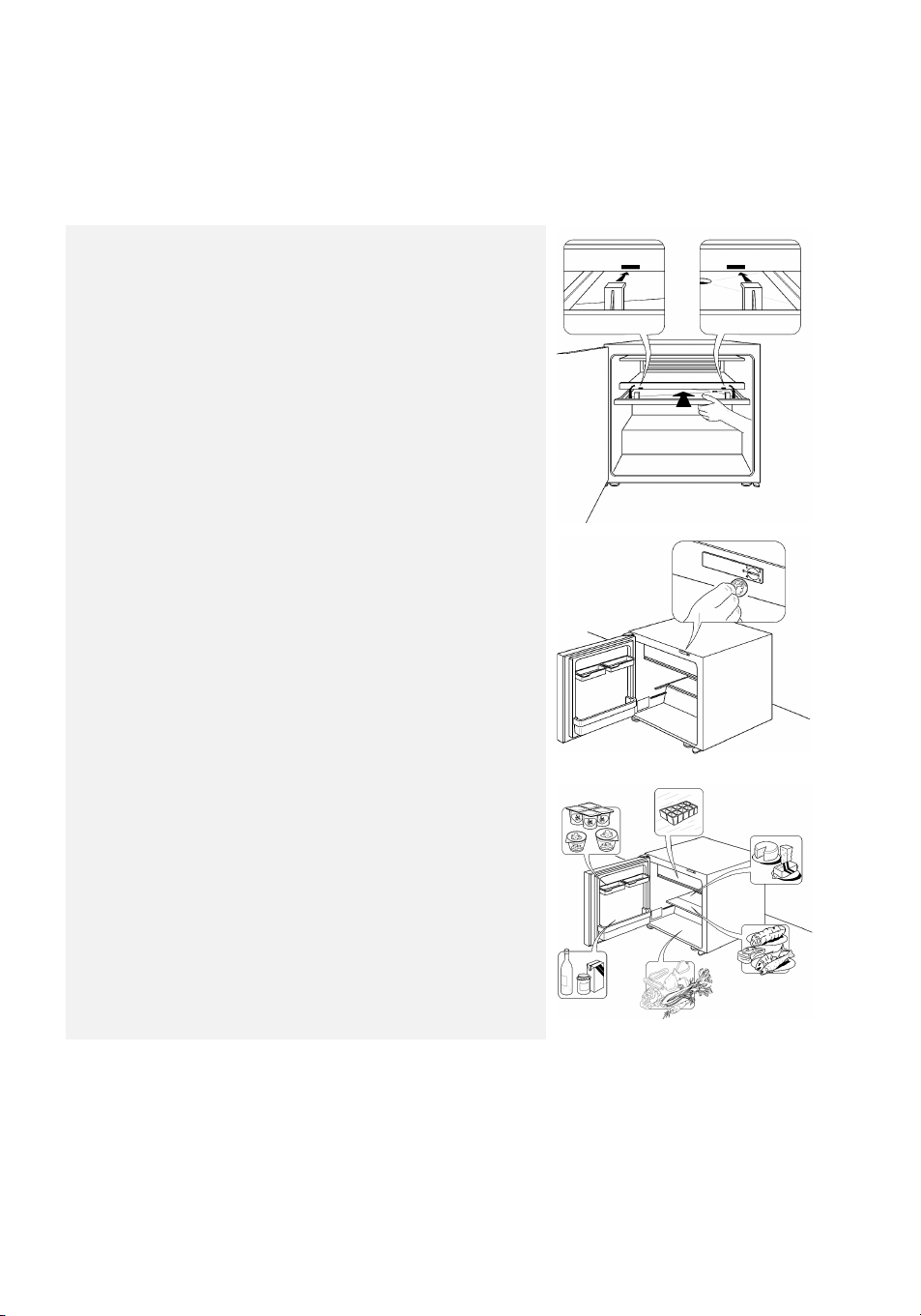
Positioning the drip tray
Before switching on the appliance, position the drip tray supplied.
This appliance is a refrigerator with a low temperature
compartment.
Optimal appliance performance is obtained at ambient
temperatures between +16° C and +32°C.
Starting the appliance up
Insert the plug into the mains socket and set the thermostat knob
to any position other than 0.
Once the temperature has been set - see next chapter - the
appliance is ready for use.
To adjust the temperature
• thermostat set to 0: appliance OFF.
• thermostat set to 1: minimum refrigeration.
• thermostat set to 2-3: medium refrigeration.
• thermostat set to 4: maximum refrigeration.
Important
• Thermostat adjustment will depend on where the appliance is
installed, ambient temperature and frequency of door
opening.
How to use the refrigerator compartment
Position the food as illustrated in the figure.
Note:
• Cover food to prevent it drying out.
• Hot food must be allowed to cool properly before being
placed in the refrigerator.
• Make sure sufficient space is left for air to circulate around the
food.
Making ice cubes
Fill the ice cube tray 3/4 with water and place it at the bottom of
the low temperature compartment.
Use a spoon handle to remove ice cube trays which stick to the
compartment.
Do not use sharp or pointed instruments.
72
Page 5
HOW TO DEFROST AND CLEAN THE
APPLIANCE
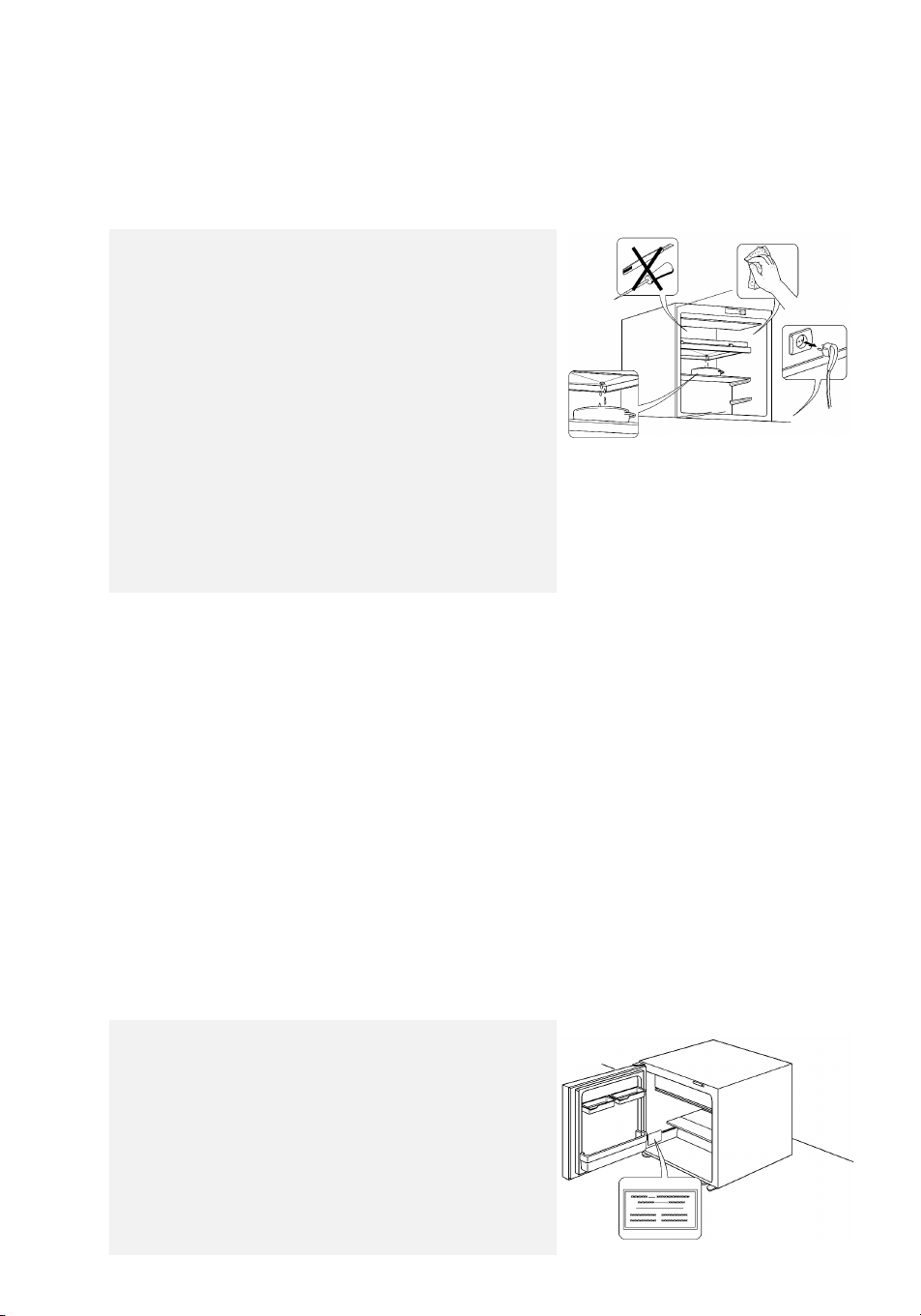
Before any maintenance or cleaning, make sure to unplug the
appliance from the mains socket. Defrost the low
temperature compartment when the ice on the walls reaches
a thickness of 3 mm.
• Remove foodstuffs from the low temperature
compartment and set the thermostat to 0.
• Clean the freezer compartment using a sponge
dampened in a solution of lukewarm water and/or neutral
detergent.
• Rinse and dry carefully.
After cleaning, reconnect the appliance to the power supply.
Do not use abrasive products.
For long vacations.
• Empty the compartments.
• Disconnect the appliance from the mains power supply.
• Defrost and clean.
• Leave the doors open to prevent formation of unpleasant
odours.
TROUBLESHOOTING GUIDE
1. Temperature inside the compartments is
not low enough.
• Is food preventing the doors from closing
properly?
• Is the thermostat setting correct?
• Are the air circulation vents blocked?
2. Temperature inside the refrigerator
compartment is too low.
• Is the thermostat setting correct?
3. The refrigerator is excessively noisy.
• Has the appliance been installed correctly?
• It is normal to hear the noise of the refrigerant
liquid in circulation.
AFTER-SALES SERVICE
Before contacting the After-Sales Service:
1. Carefully read through the “Troubleshooting guide” to
see if you can solve the problem yourself.
2. Switch the appliance on again to see if the problem has
been solved.
If the appliance is still not working, contact After-sales
Service.
You will find the appliance service number on the data
plate (located inside the appliance at the bottom left hand
side).
4. The appliance is not working.
• Is there a power failure?
• Is the plug properly inserted in the socket?
• Has the fuse blown?
• Is the power cord damaged?
5. Water collects at the bottom of the
refrigerator compartment.
• Is the thermostat setting correct?
• Is the defrost water drain blocked?
73
Page 6

INSTALLATION
Install the appliance away from heat sources.
• Position the appliance in a dry, well ventilated
place.
• Clean the inside (see chapter “How to defrost
and clean the appliance”).
• Fit the accessories.
• Check the door seal is not damaged.
Electrical connection
Ensure that the voltage indicated on the appliance
data plate corresponds to the domestic supply
voltage.
• Earthing of the appliance is compulsory by law.
The Manufacturer declines all liabilities for
injury to persons or animals or damage to
property resulting from failure to observe these
regulations.
• If the plug and socket are not of the same type,
have the socket replaced by a qualified
electrician.
• Do not use extension cables, multiple sockets
or adapters.
74
 Loading...