

Page 1
6gb33111.fm Page 2 Monday, May 31, 2004 4:26 PM
INSTRUCTIONS FOR USE
BEFORE USING THE REFRIGERATOR
SAFEGUARDING THE ENVIRONMENT
PRECAUTIONS AND GENERAL
RECOMMENDATIONS
HOW TO OPERATE THE REFRIGERATOR
COMPARTMENT
HOW TO OPERATE THE FREEZER
COMPARTMENT
HOW TO DEFROST AND CLEAN THE
FREEZER
HOW TO CLEAN THE REFRIGERATOR
COMPARTMENT
CARE AND MAINTENANCE
TROUBLESHOOTING GUIDE
AFTER-SALES SERVICE
INSTALLATION
ELECTRICAL CONNECTION
2
Page 2
6gb33111.fm Page 3 Monday, May 31, 2004 4:26 PM
BEFORE USING THE REFRIGERATOR
Your new appliance is exclusively for domestic
•
use.
The
freezer compartment
used for freezing fresh and cooked food,
making ice cubes, and storing frozen and deepfrozen food;
procedure
The refrigerator compartment, which has
an automatic defrost feature,
storage of fresh food and beverages.
To get the most out of your new appliance,
read the user handbook thoroughly. The
handbook contains a description of the
appliance and useful tips for storing food.
defrosting is a manual
.
SAFEGUARDING THE ENVIRONMENT
can be
is used for the
Keep this handbook for future
consultation.
After unpacking the appliance, check for
1.
damage and make sure that the door shuts
properly. Any damage must be reported to
your dealer within 24 hours after delivery of the
appliance.
2. Wait at least two hours without moving
the appliance before switching on. This will
give the refrigerant circuit time to settle
and operate efficiently.
Installation of the appliance and electrical
3.
connections must be carried out by a qualified
electrician, in accordance with the
manufacturer's instructions and local
regulations.
1. Packing
The packaging material is entirely recyclable, and
marked with the recycling symbol. Follow local
regulations for scrapping. Keep the packaging
materials (plastic bags, polystyrene parts, etc.) out
of reach of children, as they are potentially
dangerous.
2. Appliance
The appliance is made using recyclable
materials. Disposal must be carried out in
accordance with local environmental
regulations for waste disposal. Make the
appliance unusable by cutting off the power
cord. The appliance must be delivered to an
authorised collection centre for the recovery of
refrigerant gas.
Information:
This appliance does not contain CFCs (replaced
with R134a) or HFCs (replaced with R600a –
Isobutane). For more information, refer to the
identification data plate affixed to the ap pliance
PRECAUTIONS AND GENERAL
RECOMMENDATIONS
Use the
•
•
•
•
•
refrigerator compartment
storing fresh food and beverages and use the
freezer compartment
food, freezing fresh food and making ice cubes.
Do not cover or obstruct the air vents of the
appliance.
Do not store liquids in glass containers in the
freezer compartment - danger of bursting.
Do not eat ice cubes or ice lollies immediately
after taking them out of the freezer
compartment - risk of “cold” burns.
Do not allow children to play or hide inside the
appliance - risk of becoming trapped and
suffocating.
only for storing frozen
only for
• Before servicing or cleaning the appliance,
unplug it from the mains or disconnect the
electrical power supply.
The power cable may only be replaced by an
•
authorised person.
Declaration of conformity
This appliance is intended to come into contact
with foodstuffs and conforms to D.L. 108 of
25.01.1992 (European Directive 89/109/EEC)
Appliances with Isobutane (R600a)
Isobutane is a natural gas with low environmental
impact. Caution is required, however, since
isobutane is flammable. Therefore, it is essential to
ensure that refrigerant pipelines are not damaged.
.
.
3
Page 3
6gb33111.fm Page 4 Monday, May 31, 2004 4:26 PM
HOW TO OPERATE THE REFRIGERATOR
COMPARTMENT
This appliance is a refrigerator with a start freezer
compartment.
Defrosting of the refrigerator compartment is completely
automatic.
The refrigerator can operate at ambient temperatures between
+10°C and +38°C. Optimal performance is obtained at
temperatures between +16°C and +32°C.
Switching on the refrigerator for the first time
Insert the plug into the mains socket.
The thermostat is used to adjust the temperature of both
compartments: refrigerator and freezer.
How to adjust the temperature of the compartments:
For correct operation and optimum storage of food,
1.
instructions given in the enclosed product sheet for
thermostat adjustment.
To adjust the temperature in the refrigerator compartment,
2.
turn the thermostat control knob:
• lowest/MIN
temperatures;
• highest/MAX
temperatures.
Thermostat set to ●: no operation, no light.
Note:
The ambient air temperature, frequency of door opening and the
position of the appliance can affect internal temperatures. These
factors must be taken into account when setting the thermostat.
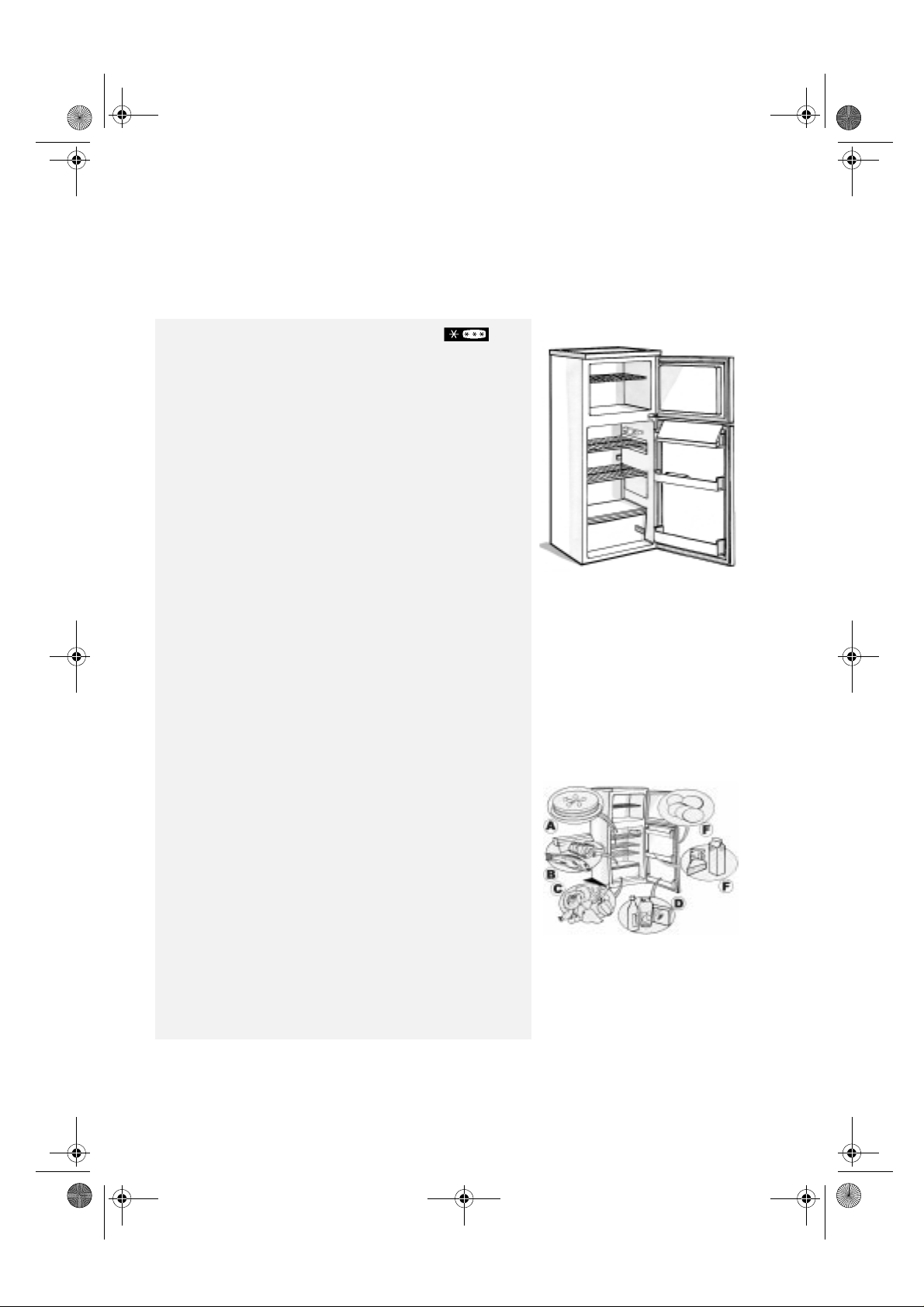
How to use the refrigerator compartment
Position the food as illustrated in the figure.
A. Cooked food
B. Fish, meat
C. Fruit and vegetables
D. Bottles
E. Eggs
F. Butter, cheese and dairy products
Notes:
The space between the shelves and the rear wall of the
•
refrigerator compartment must be unobstructed to allow
circulation of air.
Do not place food in direct contact with the rear wall of the
•
refrigerator compartment.
Do not place hot food in the refrigerator or freezer.
•
Store liquids in closed containers.
•
Storing vegetables with a high water content can result in
•
condensation in the crisper drawer: this will not affect the
correct operation of the appliance.
numbers for the
numbers for the
LEAST COLD
COLDEST
internal
follow
internal
4
Page 4
6gb33111.fm Page 5 Monday, May 31, 2004 4:26 PM
HOW TO OPERATE THE FREEZER
COMPARTMENT
The freezer is a star
This compartment can be used to store frozen foods for the
period of time indicated on packaging. The freezer can also
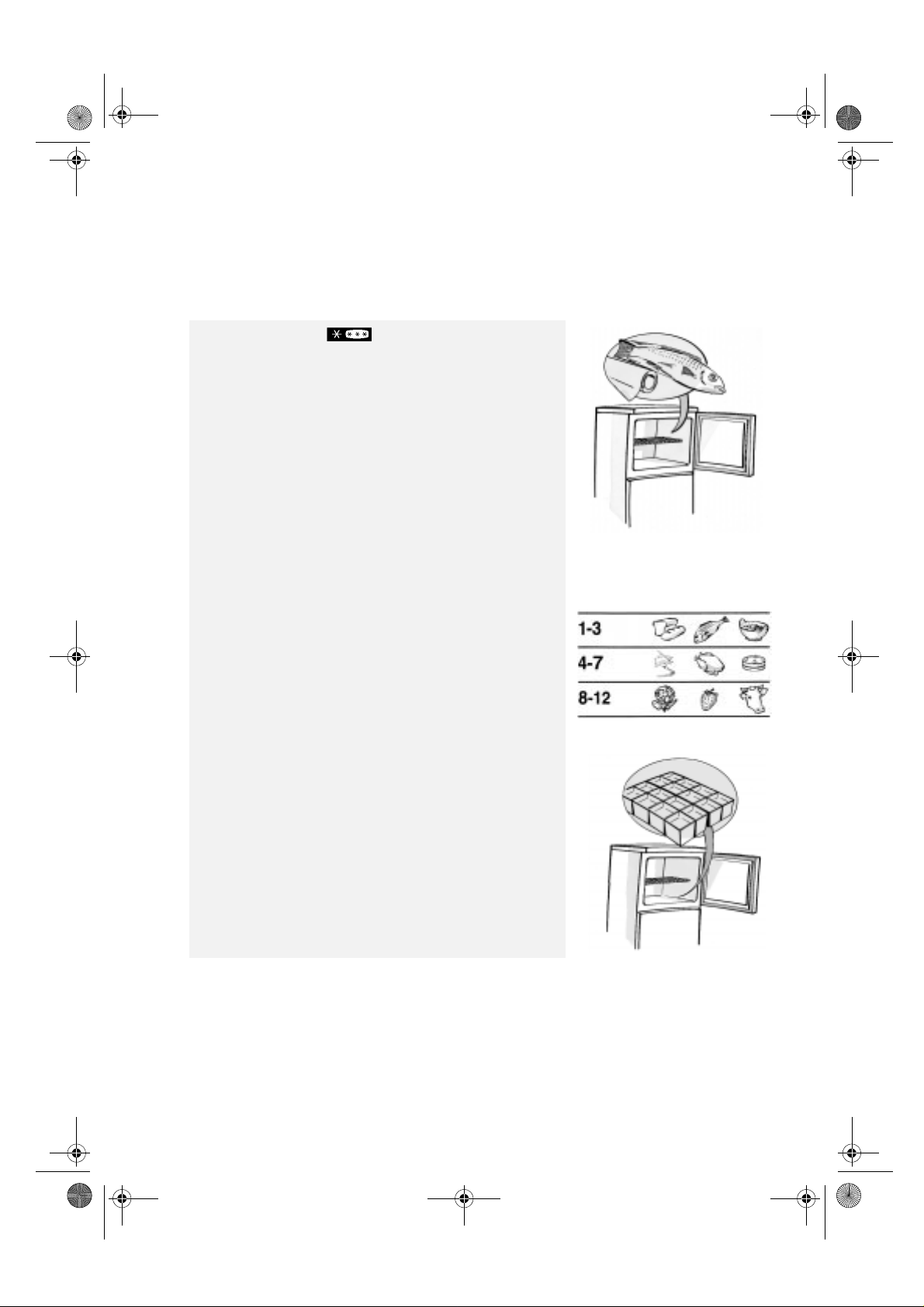
be used to freeze fresh food by positioning it on the rack;
place frozen food in the lower part of the compartment so
that there is no contact with fresh food that has yet to be
frozen.
The quantity of fresh food that can be frozen in 24 hours is
shown on the rating plate.
Important:
Before freezing, wrap and seal fresh food in:
aluminium foil, cling film, air and water-tight plastic bags,
•
polythene containers with lids or freezer containers suitable
for freezing fresh food.
In the event of a power cut, the freezer compartment will
•
maintain a sufficiently low temperature for food storage.
However, it is advisable to avoid opening the compartment
door during such periods.
Important:
The table alongside shows the recommended maximum
storage time for frozen fresh foods.
When purchasing frozen food products:
Ensure that the packaging is not damaged (frozen food in
•
damaged packaging may have deteriorated). If the package is
swollen or has damp patches, it may not have been stored
under optimal conditions and defrosting may have already
begun.
When shopping, leave frozen food purchases until last and
•
transport the products in a thermally insulated cool bag.
Place the items in the freezer compartment as soon as you get
•
home.
If food has defrosted even partially, do not re-freeze it.
•
Consume within 24 hours.
Avoid, or reduce temperature variations to the minimum.
•
Respect the best-before date on the package.
Always observe the storage information on the package.
•
Making ice cubes
Fill the ice cube tray 3/4 with water and place it at the bottom
•
of the freezer compartment.
Do not use sharp or pointed instruments to detach the tray if
it is stuck to the compartment bottom.
compartment.
MONTHS
FOOD
5
Page 5
6gb33111.fm Page 6 Monday, May 31, 2004 4:26 PM
HOW TO DEFROST AND CLEAN THE
FREEZER
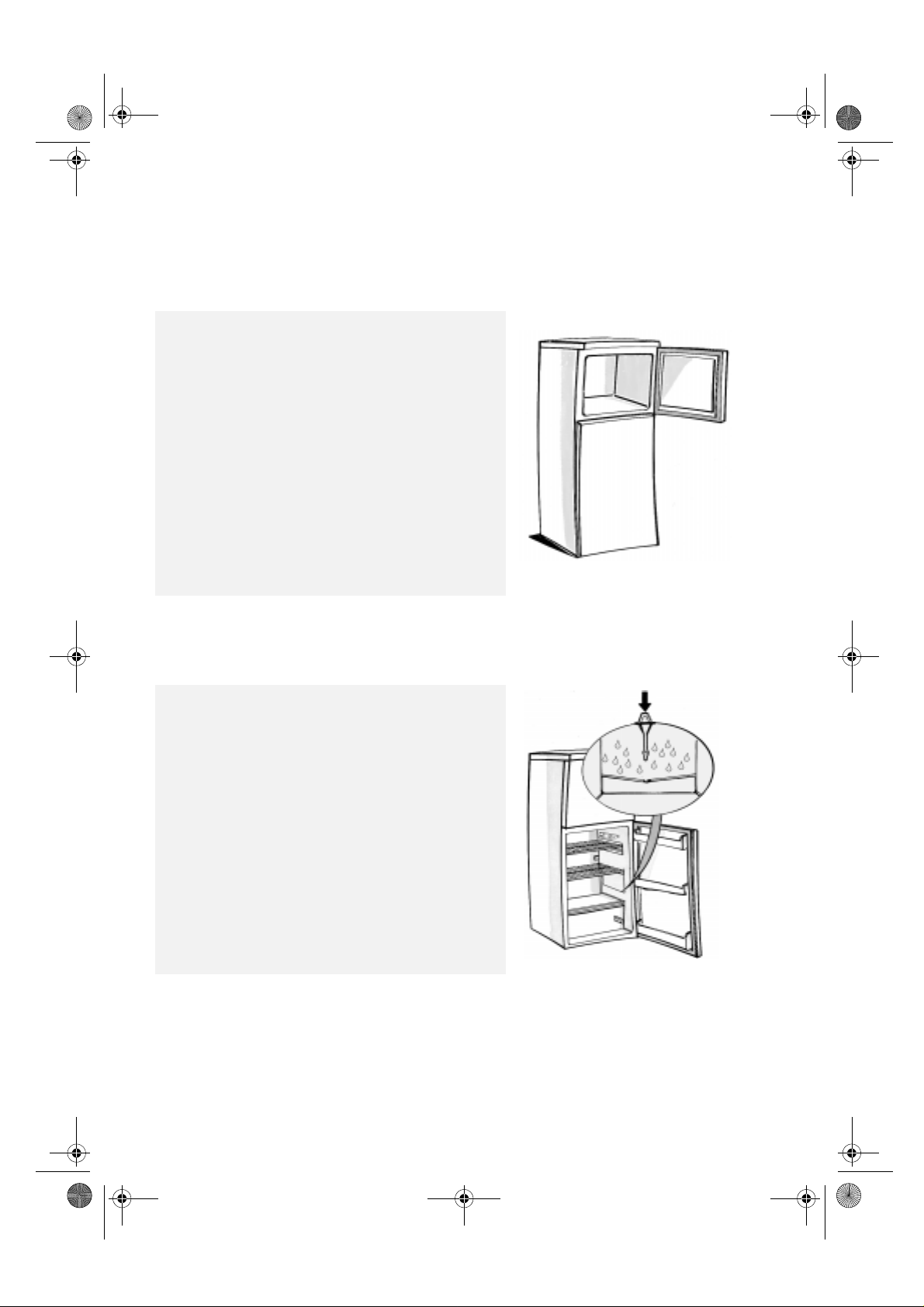
Defrost the freezer compartment once or twice a year,
or when the ice on the walls reaches a thickness of
about 3 mm. If possible, defrost the freezer when it is
nearly empty.
Remove the food from the freezer, wrap in a newspaper
1.
and group together in a cool place or in a portable cooler.
2. Disconnect the appliance from the mains power
3.
4.
5.
6.
Note: Do not use sharp or pointed metal instruments
to scrape off ice; do not heat the freezer compartment
artificially.
.
supply
Leave the door open to allow the frost to melt.
Remove the defrost water from the compartment
bottom.
Clean the interior using a sponge dampened in a solution
of warm water and neutral detergent.
Do not use abrasive products.
Rinse the interior and dry thoroughly.
HOW TO CLEAN THE REFRIGERATOR
COMPARTMENT
Periodically clean the inside of the refrigerator
compartment.
Defrosting of the refrigerator compartment is
completely automatic.
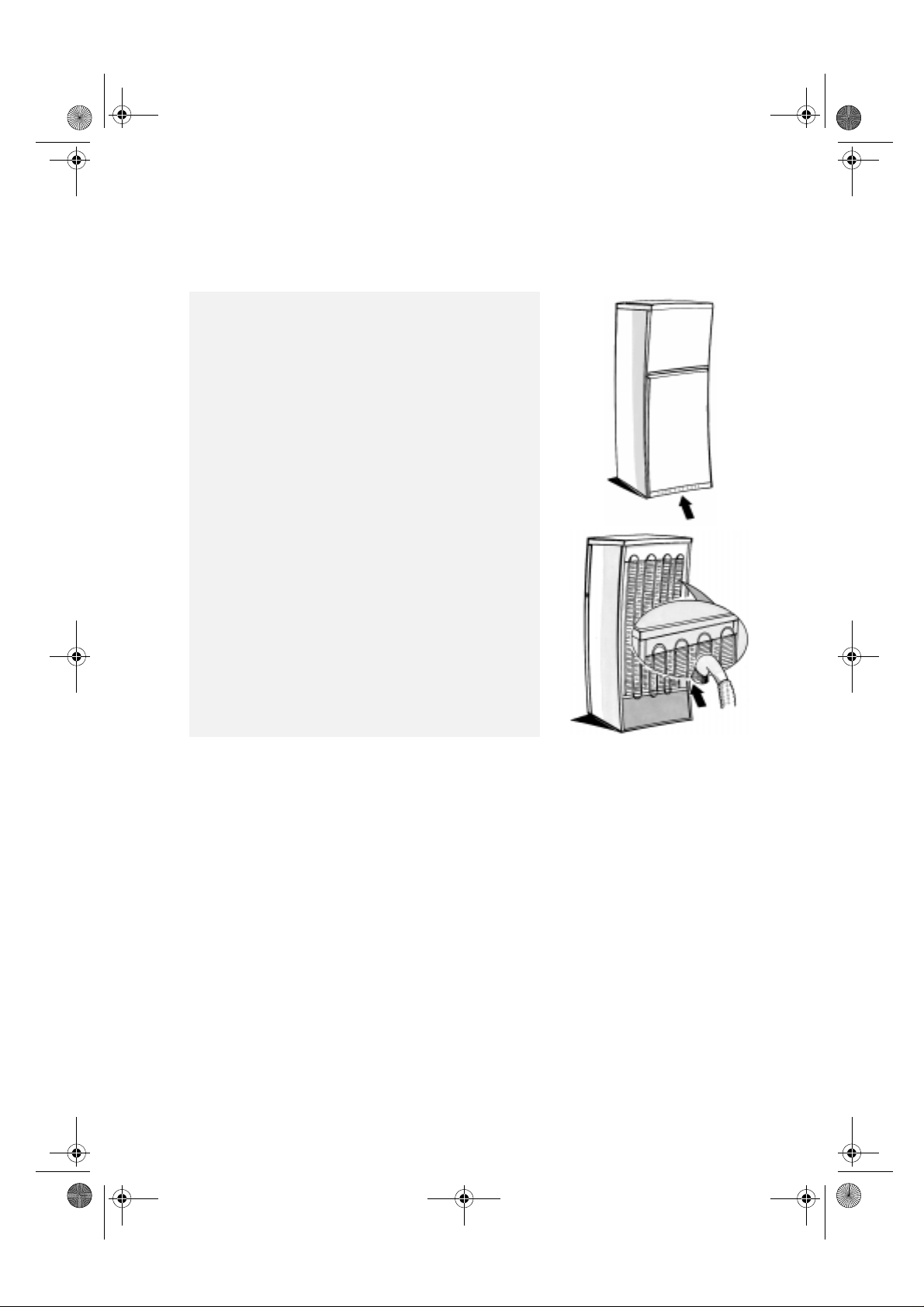
Droplets of water on the rear wall of the refrigerator
compartment indicate that the periodic automatic defrost
cycle is in progress.
The defrost water is automatically routed to a drain outlet
and into a container from which it evaporates.
Clean the defrost water drain outlet regularly using the tool
supplied with the appliance in order to ensure defrost water
is removed correctly.
Before carrying out any cleaning operations, disconnect the
appliance from the power supply.
Use a sponge dampened in lukewarm water and/or
•
neutral detergent.
Rinse the interior and dry with a soft cloth.
•
Do not use abrasive products.
6
Page 6
6gb33111.fm Page 7 Monday, May 31, 2004 4:26 PM
CARE AND MAINTENANCE
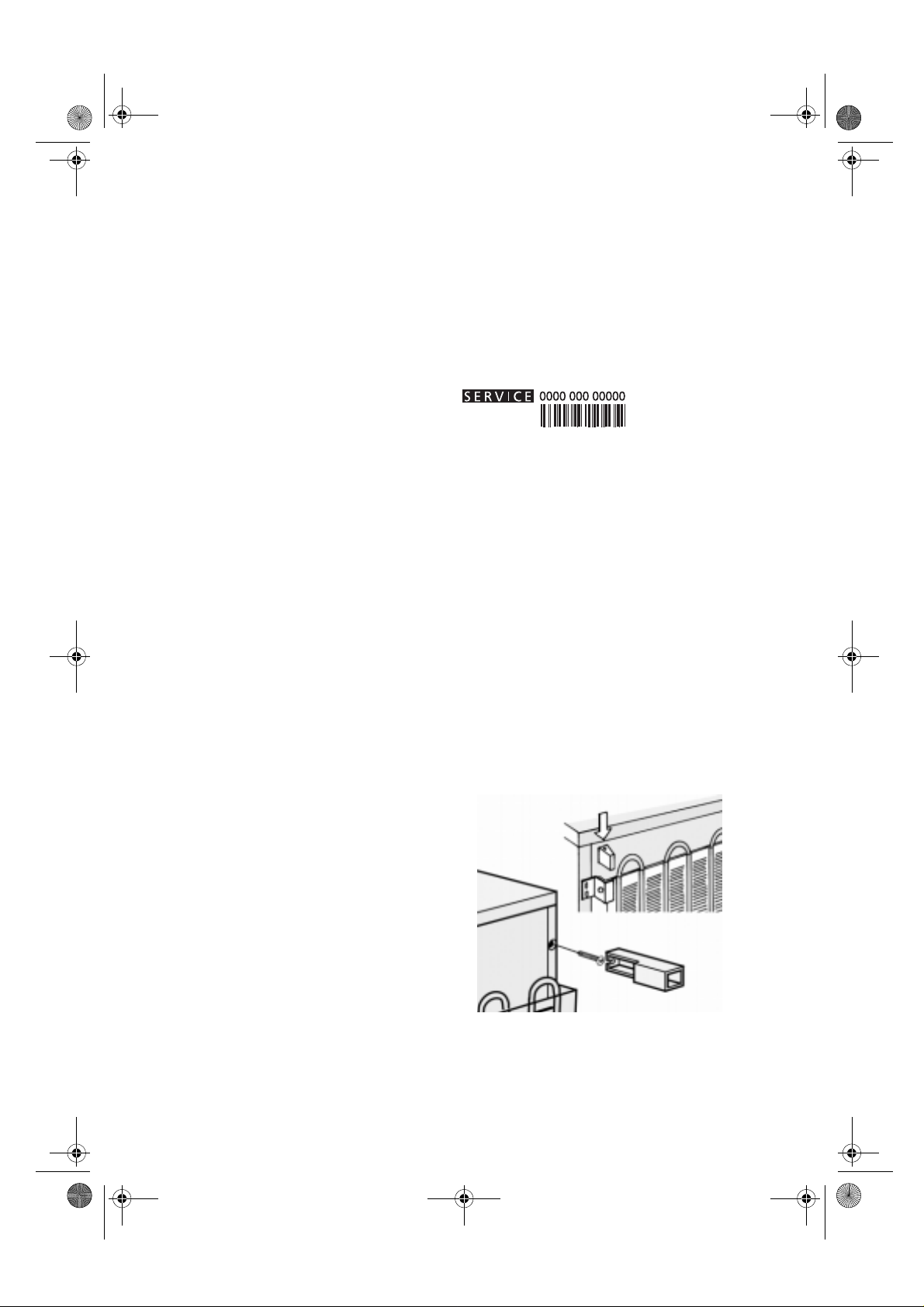
For built-in appliances
Periodically clean air vents with a vacuum cleaner or a
•
brush (see
Clean the outside using a soft cloth.
•
figure A
Freestanding appliances
Periodically clean the condenser at the rear of the
•
appliance with a vacuum cleaner or a brush (see
).
figure B
).
Fig. A
Long vacation
Empty the refrigerator and freezer compartments.
1.
Disconnect the appliance from the mains power supply.
2.
Defrost the freezer compartment, and clean and dry both
3.
compartments.
Leave the doors open to prevent formation of unpleasant
4.
odours.
TROUBLESHOOTING GUIDE
1. The appliance is not working.
Is there a power failure?
•
Is the plug properly inserted in the socket?
•
Is the double-pole switch on?
•
Has the fuse blown?
•
Is the power cord in perfect condition?
•
Is the thermostat set to ● (Stop)?
•
2. Temperature inside the compartments is
not low enough.
Is the door shut properly?
•
Is the appliance installed near a heat source?
•
Is the thermostat setting correct?
•
Are the air circulation grilles blocked?
•
3. Temperature inside the refrigerator
compartment is too low.
Is the thermostat setting correct?
•
4. Water collects at the bottom of the
refrigerator compartment.
Is the defrost water drain blocked?
•
5. The inside light is not working.
Perform the checks for problem 1, then:
Disconnect the appliance from the mains
•
power supply.
To inspect the bulb, refer to the instructions
and illustration on the attached table.
Check the bulb and if necessary replace it.
•
Replace using maximum 15W bulb.
6. Excessive frost build-up in the freezer
compartment
Is the door shut properly?
•
Is food obstructing proper door closure?
•
Notes:
• The front edge of the appliance may be
hot. This prevents the formation of
condensation and is not a defect.
• Gurgling and hissing noises due to
expansion in the refrigerant circuit are
normal.
Fig. B
7
Page 7
6gb33111.fm Page 8 Monday, May 31, 2004 4:26 PM
AFTER-SALES SERVICE
Before contacting After-Sales Service:
See if you can solve the problem yourself with
1.
the help of the “Troubleshooting guide”).
Switch the appliance on again to see if the
2.
problem persists.
If it does, switch off and wait for about an hour
before switching on.
If the problem persists after this course of
3.
action, contact After-sales Service.
Specify:
the nature of the problem,
•
the model,
•
INSTALLATION
Install the appliance away from heat sources.
•
Install the appliance in a dry, well-ventilated
•
place.
Do not obstruct the top and bottom vent
•
zones.
Clean the inside (see chapter “How to clean the
•
refrigerator compartment”).
Fit the accessories supplied.
•
Electrical Connection
• Electrical connections must be made in
accordance with local regulations.
Voltage and power consumption are indicated
•
on the rating plate (at the side of the crispers).
Freestanding appliances (not built-in)
Fit the spacers (if supplied) on the rear of the
•
condenser positioned at the back of the
appliance (see figure).
To optimize appliance efficiency, leave a 5 cm
•
gap above the appliance and make sure that
adjacent kitchen units are sufficiently distanced
to allow air circulation.
Ensure that the appliance is level, using the
•
front adjustment feet if necessary.
the Service number (the number after the word
•
SERVICE on the data plate on the inside of the
appliance),
your full address,
•
your telephone number and area code.
•
Note: The direction of door opening can be
changed. If this operation is performed by
After-sales Service it is not covered by the
warranty.
• Regulations require that the appliance is
earthed. The manufacturer declines all
liability for injury to persons or animals
and for damage to property resulting from
failure to observe the above procedures
and reminders.
If the plug and socket are not of the same type,
•
have the socket replaced by a qualified
electrician.
Do not use extension leads or adapters.
•
Disconnecting the appliance
It must be possible to disconnect the appliance
•
by unplugging it or by means of a two-pole
switch fitted upline of the socket.
8
Page 8
6gb33111.fm Page 9 Monday, May 31, 2004 4:26 PM
ELECTRICAL CONNECTION
For Great Britain only
Warning - this appliance must be earthed
Fuse replacement
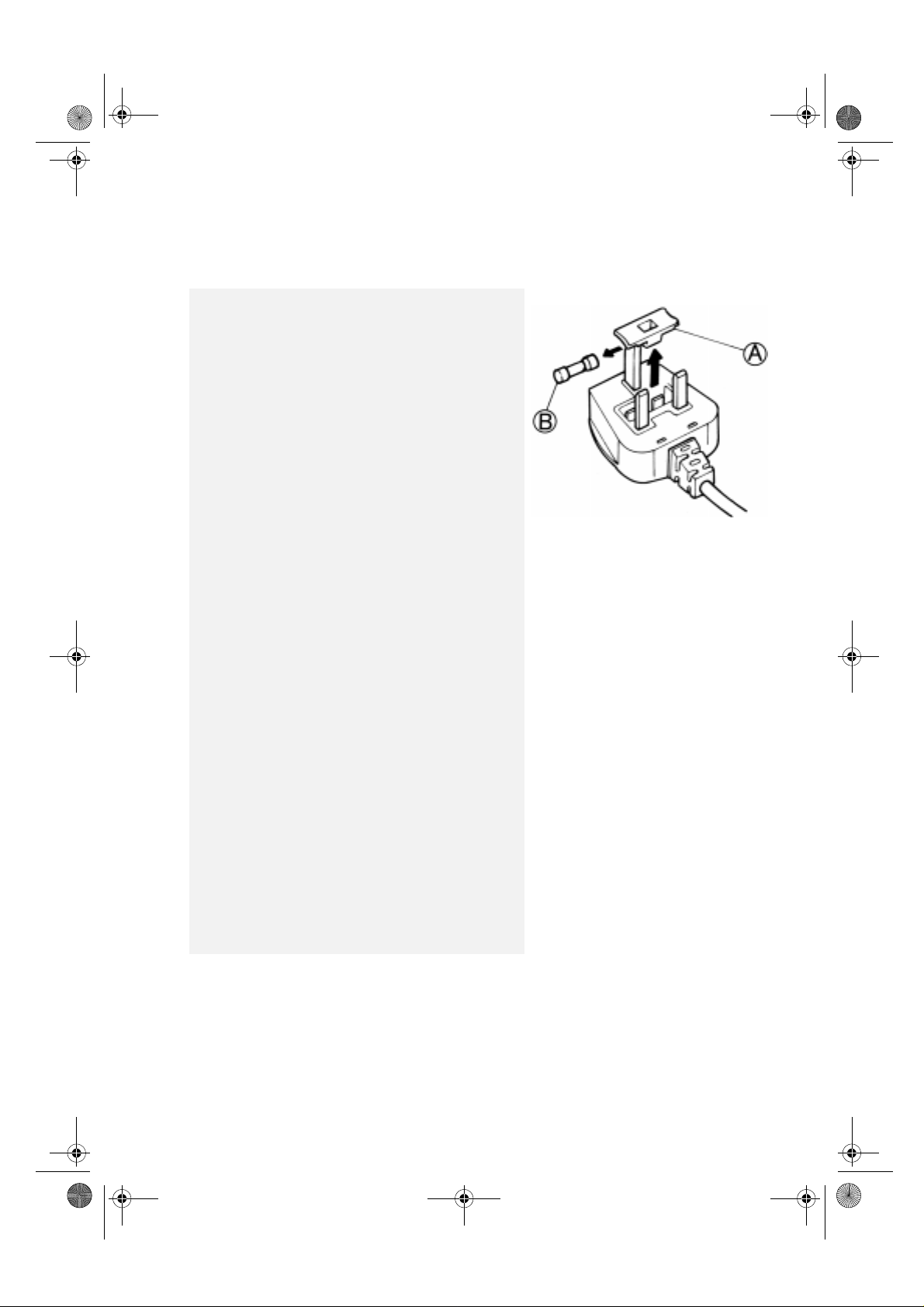
If the mains lead of this appliance is fitted with a BS 1363A
13amp fused plug, to change a fuse in this type of plug use
an A.S.T.A. approved fuse to BS 1362 type and proceed as
follows:
Remove the fuse cover (A) and fuse (B).
1.
Fit replacement 13A fuse into fuse cover.
2.
Refit both into plug.
3.
Important:
The fuse cover must be refitted when changing a fuse and
if the fuse cover is lost the plug must not be used until a
correct replacement is fitted.
Correct replacement are identified by the colour insert or
the colour embossed in words on the base of the plug.
Replacement fuse covers are available from your local
electrical store.
Socket outlet / plug
If the fitted plug is not suitable for your socket outlet,
please contact Whirlpool Service on 0870 600 8989 for
further instruction. Please do not attempt to change plug
yourself. This procedure needs to be carried out by a
qualified Whirlpool technician in compliance with the
manufactures instructions and current standard safety
regulations.
For the Republic of Ireland only
The information given in respect of Great Britain will
frequently apply, but a third type of plug and socket is also
used, the
2-pin, side earth type. In this case, the wire which is
coloured GREEN AND YELLOW must be connected to
the EARTH contact, and the two wires to the two pins,
irrespective of colour. The supply to the socket must be
fitted with a 16 amp fuse.
9
 Loading...