

Page 1
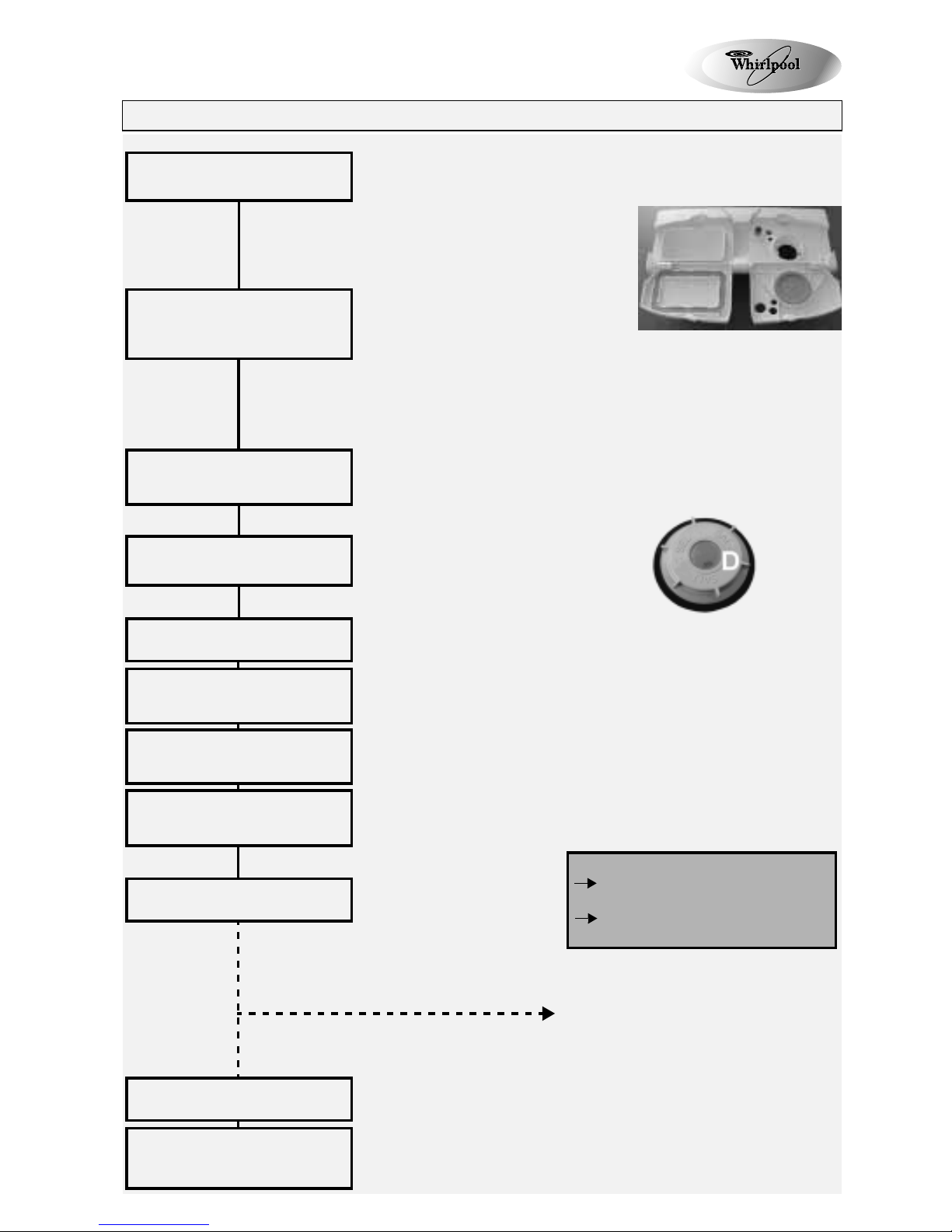
How to use the appliance
Further indications are given in the single chapters and in the user instructions.
Press the ON / OFF button.
(The first time you use the appliance
and when using a different type of
detergent)
1. Select the third programme from the
top in the relative table.
2. Press the Start button for about 7
seconds until the display changes.
3. Select the required detergent with
the Start button (OFF = powder
detergent, 2 in 1, 3 in 1, 4 in 1) (shown on the display).
4. Switch the appliance off and then switch it on again. The selected
detergent type will be shown on the display for approximately 3
seconds after switching on.
For dosage of powder detergent in compartment A and B refer to the
programmes table.
Mechanical indicator lamp C.
Electric indicator on control panel (if provided).
On models with water softener
system only.
Mechanical indicator lamp D. Electric
indicator on control panel (if provided).
Refer to the dishwasher loading instructions.
The last programme selected will light up.
Select the desired programme (using the specific button or knob).
The corresponding indicator lamp lights up.
If necessary (and if provided).
The corresponding indicator lamp lights up.
The selected programme is
then memorised (even in the
event of power failure).
- Only open the dishwasher if necessary
(Warning: beware of hot steam).
- If the appliance is switched off during a
wash cycle, when switched on again it
will resume the cycle from where it was
interrupted.
Only after the ST ART button has switched off: Press the ON /
OFF
button.
All the indicator lamps switch off.
Warning: When the door is opened steam comes out!
Unload the appliance, starting from the lower rack.
Switch on the appliance
Select, save, and
supply the detergent
ABC
Check the rinse aid level
Check the
regeneration salt level
Load the racks
Close the dishwasher door,
turn on the water tap
Select a programme
Select additional options
Press the Start button
“Change programme in progress”
Press the START button for 2 sec. until the
Start indicator lamp switches off.
Select another programme and press the
START button again.
Wash cycle
Switch off the appliance
Turn off the water tap,
unload the racks
Page 2
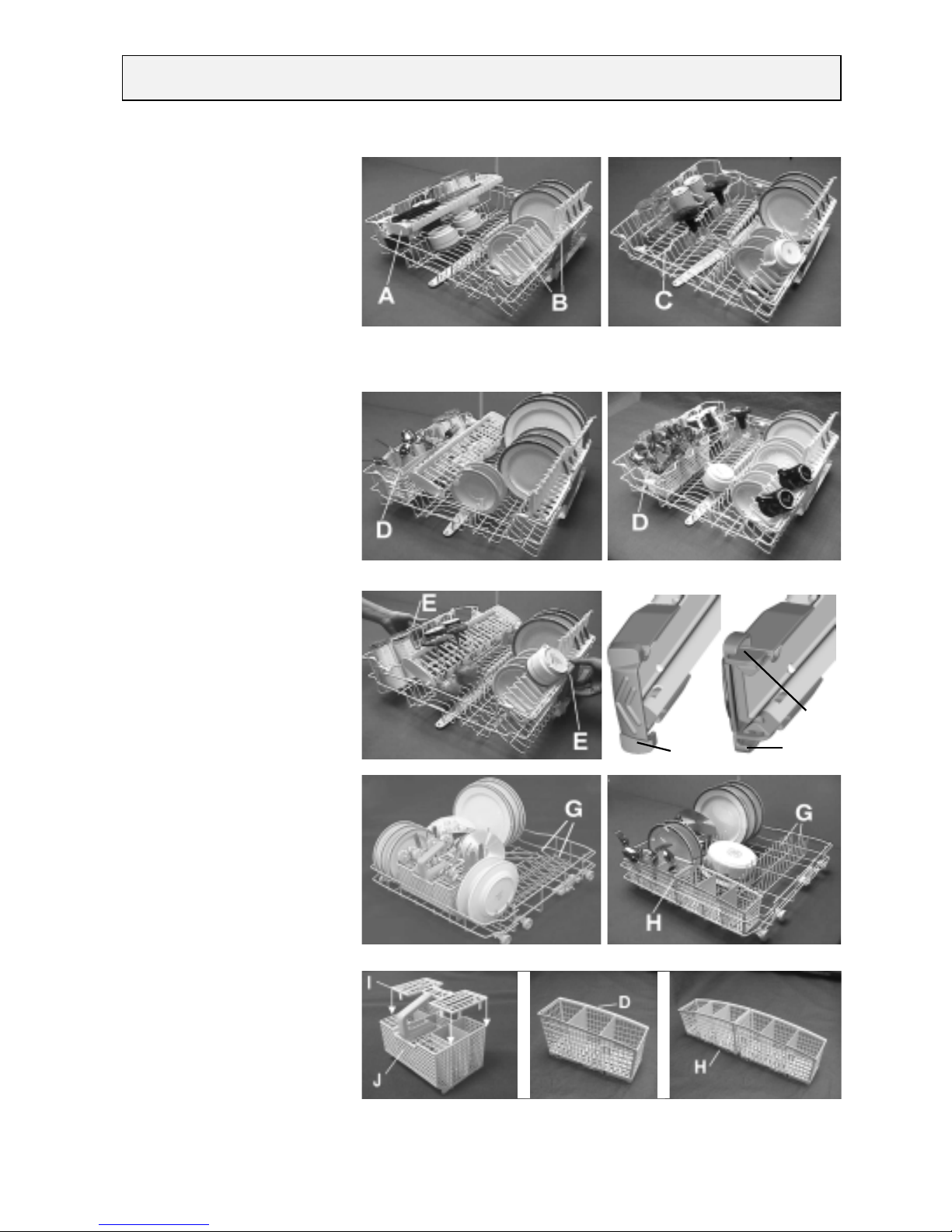
Dishwasher loading instructions and racks provided
Upper rack:
depending on the model
Multi-purpose support (A):
1)
Depending on the position, for longhandles utensils, cups and glasses. May
be used in three different positions.
Crockery holders (B):
Depending on the position, for example
plates, cups and long-stemmed glasses.
Revolving glass support (C):
2)
Depending on the position, for example
small or long-stemmed glasses.
Long-handled utensils (e.g.
carving forks, knives) must be
arranged with the sharp end
facing in towards the appliance
.
Half Load:
Load the upper rack (see description
of Options).
Place the cutlery basket (D) in the
upper rack.
Rack height adjustment
(also when loaded):
• Lower adjustment: pull out the
two rack handles outwards (E)
and lower the rack.
• Upper adjustment: pull the two
handles (E) upwards until the rack
clicks into place (Factory setting).
The rack must be level on both
sides.
Removing the top rack to provide
clearance for large items of
crockery in the bottom rack:
Open the rack guide retainers (F) on
the right and left and remove the top
rack.
When the upper rack is in place the
retainers must always be closed.
Lower rack:
Depending on the model with fixed or
tilting plate holders (G).
Half Load:
Load the lower rack (see description
of Options).
Greater washing power, particularly
for plates and saucepans.
Cutlery basket (J) or (H):
Some models are provided with a grid
(I) that can be fitted onto the cutlery
basket to keep items separated.
Cutlery basket (D), if provided, for
appliances with half load only.
Sharp knives and forks that might
cause injury must be placed in the
cutlery basket with the sharp end
facing downwards.
Only use dishwasher-proof crockery and dishes. Do not use the appliance for items not suitable for washing in a
dishwasher , for e xample wooden items, aluminium, plastic utensils, tin, hand-decorated crockery (unglazed), silver cutlery.
Spare parts which are sold separately:
1)
Multi-purpose support (A) - N. AMH 369 series.
2)
Revolving glass support (C) - N. WGH 1000 series.
F
F
Retainer
closed
Retainer
open
Page 3

What to do if...
If a fault occurs, before contacting our After-Sales Service, make the following checks to try and remedy the problem (* see
also the corresponding chapter in the user instructions).
Problem Cause Remedy
The appliance is not
working
• No water supply. • Open the tap.
• The appliance does not load sufficient
water.
• Clean the water supply tap filter.
• Ensure there are no kinks in the water hose.
• There is a power failure. • Insert the plug into the mains socket.
• Press the Start button.
• Close the door.
• Check the safety circuit breaker.
• Starting the selected programme. • The programme can be set to “0” to start.
If crockery is not
perfectly dry
• Insufficient rinse aid. •Increase dosage *.
• Residual water in cavities. • Load crockery at an angle.
If crockery is not
perfectly clean
• The water jet does not reach the
crockery.
• Arrange crockery so that items do not touch each
other. Load crockery upside down.
• Insufficient detergent. • Follow recommended detergent dosage.
• Unsuitable programme. • Select a more intense wash cycle.
• Spray arms blocked. • The spray arms must be able to turn freely.
• Spray arm nozzles clogged. • Remove any impurities obstructing the water flow *.
• Incorrect detergent/detergent too old. • Use a good quality detergent.
Sandy or grainy
residues
• Clogged filters. • Check filters regularly/if necessary clean *.
• Filters incorrectly assembled. • Insert the filter correctly *.
Colour of plastic parts
faded
• Tomato/carrot juice, ... • Depending on the material, if necessary use a
detergent with a greater whitening power.
Deposits on crockery
•Removable • Streaks on the crockery/glasses. • Increase the rinse aid dosage *.
• Streaks on glasses. • Reduce the rinse aid dosage *.
• Layer of salt on crockery/glasses. • Close the salt container lid properly *.
• Not removable • Insufficient water softening, calcium
deposits.
• Change water hardness setting, if necessary add salt *.
Opaque glasses/ glasses
not sparkling
• Cannot be washed in the dishwasher. • Use suitable glasses.
Rust on cutlery
• Not made of stainless steel. •Use suitable cutlery.
Identifying appliance
faults
• The START indicator lamp flashes.
• Indicator F... (if provided).
• Ensure the filter assembly is not clogged and that
there is no interruption to the water supply
(if necessary, clean the filters *). Start the programme
again. Press the START button for 2 seconds, until the
START indicator lamp switches off. Select a new
programme and press the Start button again.
If after carrying out the above checks the malfunction persists or appears again, turn the appliance off and turn off the water
supply tap, then call our After-Sales Service (see guarantee).
Before contacting our After-Sales Service, take note of the following:
• The nature of the fault
• The appliance type and model
• The service code (the number indicated on the adhesive rating plate)
inside the door on the right-hand side.
Page 4
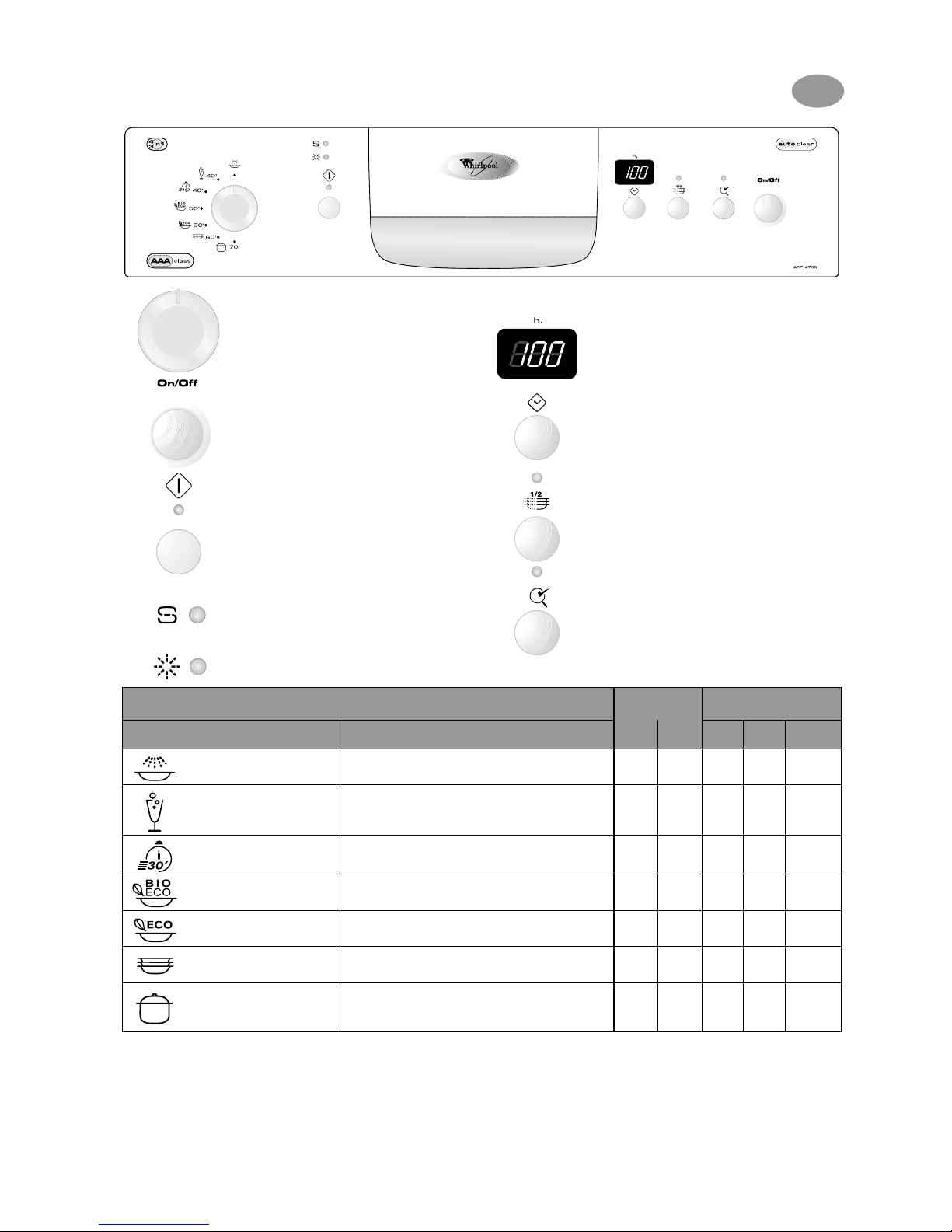
Whirlpool is a registered trademark of Whirlpool USA
5019 396 98152
GB
ADP 4736
Quick Reference Guide
Before using the dishwasher, read the user instructions!
(We reserve the right to make technical modifications)
Add regeneration salt
Only add regeneration salt immediately
before starting a wash programme.
Add rinse aid
Time and failure display
Indicates in hours the time remaining until the start
of the wash cycle. Switches off when the
programme starts and indicates the time remaining
in hours and minutes.
“F....” Identification of faults for service technician
“Delayed start” button
The wash cycle can be programmed to start after 1 -
24 hours. With each successive touch of the button,
the delayed start indicator increases by 1 hour, and
after 24 returns to 00. Then press the Start button.
The dishwasher will start at the set time.
“Half Load” button
Possibility of only half loading the top and bottom
racks. Select the required programme then press
the “Half Load” button. The light comes on and
goes off at the end of the programme.
The “Half Load” function can be used with
programmes marked with an *.
Antibacterial rinse
4) 5)
This function adds an antibacterial rinse at the end of
the wash cycle, thereby guaranteeing a perfectly
clean and sanitized load. The lamp will light up when
the function is activated. If the temperature is not
maintained during the antibacterial cycle (e.g. if the
door is opened and remains open for a long time),
the lamp will start blinking to indicate that sanitation
is not guaranteed.
1) Reference programme for energy label in compliance with
EN 50242 regulations;
2) Refer to “User instructions“;
3) The data relevant to programmes are values obtained in the
laboratory in conformity with Standard EN 50242. In practical
use there may be time variations or leaps depending on
different loads, function options, water temperatures or
hardness and different power supply voltages.
4) The bacteria removal efficiency has been tested by the
Institut Pasteur de Lille (France), based on the NF EN
13697 standard of November 2001.
5) These programmes can be used with the Antibacterial
rinse option.
Programme selector knob
ON / OFF button
Start button
Switches “on” when the dishwasher is
operating. Flashes when a fault occurs. Switches
off at the end of the programme.
Indicators
Options
3)
Programme chart
Detergent
2)
Consumption
3)
Programmes Loading instructions A B
Litres kWh Minutes
Pre-Rinse cold
Crockery to be washed later. - - 5.0 0.02 10
Party Glass 40°C
Light soiling, for example glasses and cups. X - 13.0 0.90 97
Quickwash 40°C
Lightly soiled crockery with no dried-on food. X - 13.0 0.70 30
Bio/Eco
5) *)
50°C
Normally soiled crockery. X - 13.0 1.35 90
Eco
1) 5) *)
50°C
Normally soiled crockery. X X 16.0 1.05 170
Daily
5) *)
60°C
Normally or heavily soiled crockery. X X 16.0 1.35 120
Intensive
5)
70°C
Recommended programme for heavily soiled
crockery, especially suitable for pans and
saucepans.
X X 17.0 1.65 145
Important information for Test Laboratories:
For detailed information on the EN comparison test and other tests, contact the following address: “[email protected]”.
 Loading...