

Page 1

WATLOW IND. FIREBAR
®
Screw Plug Installation & Maintenance Manual
I&M NUMBER: 316-42-3-1 Page: 1
Date: 6/11/2008 Rev: 2.00
________________________________________________________________________________________________________________________________________________________________________________________________________________________
Pre Installation
• Check to make sure that heater received is the same as that ordered.
• Elements may come in contact with each other during shipment. Minor adjustments to elements may be
required prior to installation to separate them. Extensive bending of elements should be avoided since
dielectric strength between coil and sheath may be compromised.
• Watlow heaters are built to comply with UL and CSA dielectric requirements, it may be necessary due to
atmospheric conditions / humidity, to perform a dielectric test prior to startup. (Refer to megohm test
under Installation section)
Safety
Electric heaters are inherently dangerous!! Care should be taken to read and completely understand the
Installation and Maintenance manual before installing and wiring the heater. Any installation and
maintenance performed on the heater shall be done by a qualified electrician, in accordance with the
"National Electric Code" and other electrical codes as they apply. It is the users responsibility to ensure that
the heater being used is properly selected and installed in the application.
!
The Caution Symbol (exclamation point) alerts you to a "CAUTION", a safety or
functional hazard which could affect your equipment or its performance.
The warning symbol (lightning bolt) alerts you to a "WARNING", a safety hazard which
Installation
Proper heater selection and installation will result in efficient heat transfer, safe operation, and long heater
life.
1. Megohm precheck
During shipping and/or storage, the possibility of moisture absorption by the insulation material within the
element is possible. To ensure proper megohm values a minimum 500 VDC megohm meter (Megger)
should be used to ensure that the megohm reading between the heater terminal and the heater sheath is
more than 10 megohms when the unit is at room temperature.
If several units are interconnected, the megohm of the heater is obtained by taking the reading and
dividing by the number of interconnected elements. This reading should be greater than 10 megohms.
If a low megohm value exists, two alternative methods can be used to remedy the situation. The best
method is to remove all terminal hardware including thermostat if provided, and bake out the heater at no
higher than 250°F (120°C) overnight or until an acceptable reading is reached.The second method is to
energize the unit at low voltage in air until the megohm is at an acceptable reading. Care should be
taken to prevent the heater sheath from exceeding 750°F (398°C) for Incoloy® and Stainless Steel
elements.
2. Protection of heater elements from over temperature
The use of temperature controls to regulate heating process and prevent heater over temperature is
highly recommended to ensure safe heater operation. It is the users responsibility to ensure safety of
the installation.
WARNING: Install high temperature control protection in systems where an over temperature
fault condition could present a fire hazard or other hazard. Failure to install temperature control
WATLOW IND.n # 6 INDUSTRIAL LOOP RD. n HANNIBAL MO, 63401n PHONE 573-221-2816 n FAX 573-221-3723
could affect you and the equipment
Page 2

WATLOW IND. FIREBAR
®
Screw Plug Installation & Maintenance Manual
I&M NUMBER: 316-42-3-1 Page: 2
Date: 6/11/2008 Rev: 2.00
________________________________________________________________________________________________________________________________________________________________________________________________________________________
protection where a potential hazard exists could result in damage to equipment and property,
and injury to personnel.
Failure of components in a temperature control loop, such as the sensor, heater control relay or main
temperature control, can result in damage to a product in process, a melt down of a heater, and / or
damaging fire.
To protect against this possibility, over temperature protection must be provided to interrupt or remove
power from the heater circuit. A bulb and capillary thermostat is not recommended for this function
since it may not respond quickly enough to adequately protect the heater. In cases where the
thermostat bulb gets too hot before the system is turned off, the thermostat bulb could rupture.
This could result in the thermostat remaining in the "ON" condition since there is insufficient
fluid to move contacts apart. We recommend the temperature protection have appropriate third party
approval, and be applied in the classification for which it was tested and approved.
In order to help prevent premature failure and a potentially hazardous condition in cases where
consequences of failure may be severe, use an appropriate third party approved liquid level protection
device. The liquid level should be such that the entire heater is fully submerged with enough liquid above
the heater to adequately dissipate heat from itself as under normal operating conditions. Consult your
local authorized sales representative for specific recommendations for your application.
3. Terminal Enclosures
Terminal enclosures should be selected to be compatible with the environment in which the heater will
be located. It is the users responsibility to determine the need for correct rating of the electrical housing.
This should be based on appropriate national and local electrical codes. Failure to use a compatible
enclosure could result in heater damage and personnel danger.
Standard terminal enclosures are designed for general purpose use and are rated NEMA 1. These
enclosures should be applied where there will be no danger of spilled liquids, dampness, dirt, and
gaseous conditions. Enclosures for wet or hazardous locations are also available, but must be installed
at the factory. One 3/4" conduit entry is supplied as standard on all NEMA 1 enclosures. Location of
conduit entry can be rotated to different positions by removing enclosure base from screw plug for NEMA
1 enclosures.
Although enclosures are supplied over the terminals, units should be located in an area that will minimize
the chance of being hit by falling or moving objects. The terminals must be protected at all times from
moisture or vapor.
In hazardous locations, (as defined in NFPA 70 NEC, Article 501) explosion resistant housings must be
used.
In order to maintain termination integrity, the terminal enclosure should be kept below 400°F
(204°C).
4. Orientation / Mounting
Proper installation and orientation of the FIREBAR® Screw Plug Heater is important to insure maximum
efficiency and minimum sheath temperatures. The unique shape of this flat element offers many
advantages, but they can only be realized if the heater is properly oriented. Every effort should be made
to position the heater as recommended.
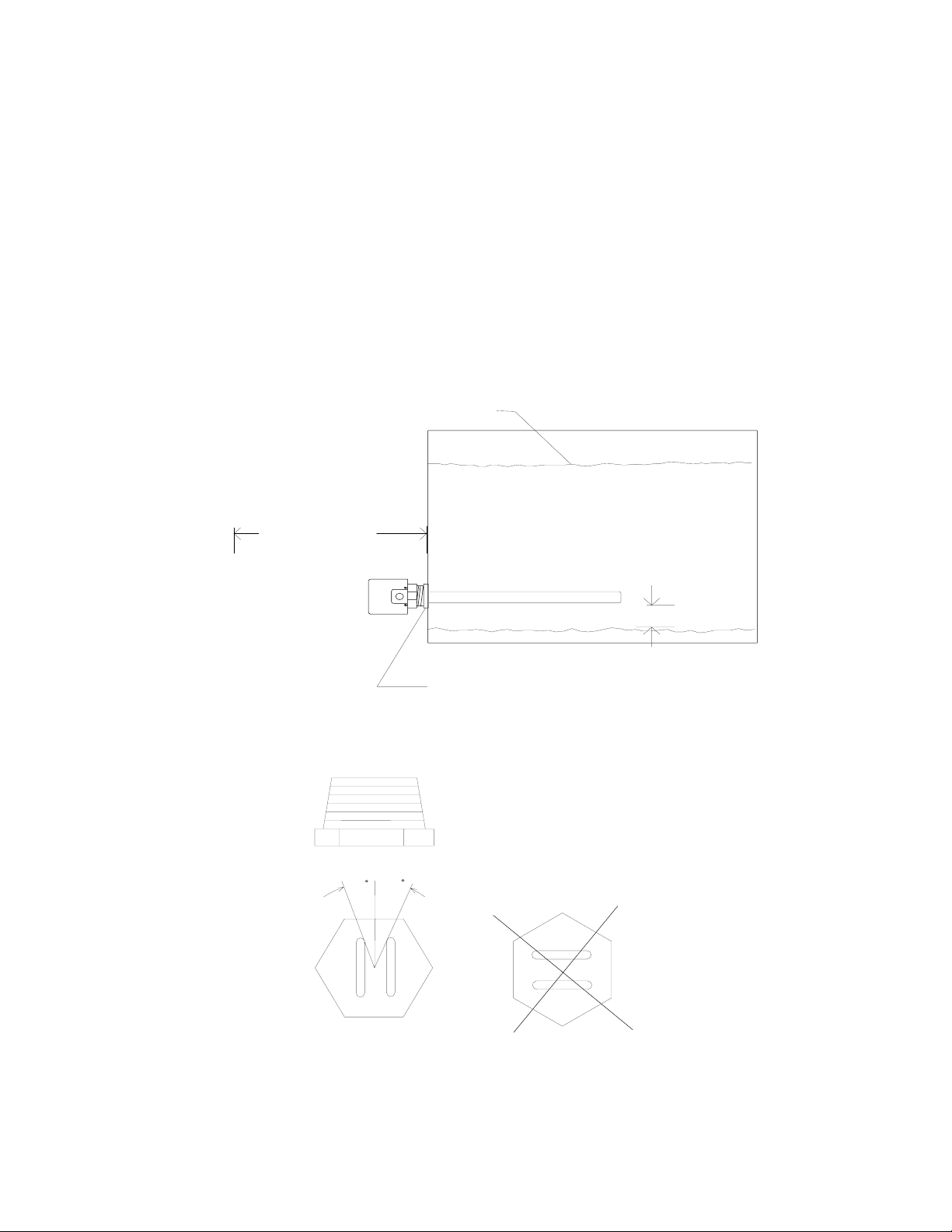
The recommended location for open tank heating is shown in Figure #1. The heater should be installed
as low as possible in the tank to take advantage of natural convection. Attention should be given to
sludge build-up and low liquid level. Location in either of these situations could cause premature failure.
WATLOW IND.n # 6 INDUSTRIAL LOOP RD. n HANNIBAL MO, 63401n PHONE 573-221-2816 n FAX 573-221-3723
Page 3
WATLOW IND. FIREBAR
L
®
Screw Plug Installation & Maintenance Manual
I&M NUMBER: 316-42-3-1 Page: 3
Date: 6/11/2008 Rev: 2.00
________________________________________________________________________________________________________________________________________________________________________________________________________________________
During installation of the heater it is important that special attention be given to the final orientation of the
element. The flat side of the element must be positioned vertically as shown in Figure #2. Maximum
advantages are realized when the element is within +/- 25° of vertical. Positions outside this range are
not recommended, and 90° from vertical should always be avoided.
Each plug is marked with "TOP" to help clarify the preferred orientation. For open tank heating, this
marking should normally be on top of the final plug position. If this is not practical, it may be positioned
on the bottom, which will also orient the flat element vertical.
If heater is being installed in customer supplied circulation tank, a FIREBAR® Circulation I&M manual
should be obtained from the factory to ensure safe installation of heater in tank. Failure to do this could
result in premature heater failure due to improper fluid flow over elements
LIQUID LEVE
ALLOWANCE FOR
HEATER REMOVAL
"X" POSITION
2" MIN
SLUDGE
FEMALE PIPE COUPLING TO MATCH
SCREW PLUG SIZE
Figure # 1
TOP
25
25
CORRECT ORIENTATION
INCORRECT ORIENTATION
Remove terminal enclosure to see element position
Figure # 2
WATLOW IND.n # 6 INDUSTRIAL LOOP RD. n HANNIBAL MO, 63401n PHONE 573-221-2816 n FAX 573-221-3723
Page 4

WATLOW IND. FIREBAR
®
Screw Plug Installation & Maintenance Manual
I&M NUMBER: 316-42-3-1 Page: 4
Date: 6/11/2008 Rev: 2.00
________________________________________________________________________________________________________________________________________________________________________________________________________________________
DANGER: HAZARD OF FIRE. Electric heaters are capable of developing high temperatures so extreme
care should be taken to locate heaters in safe environments. Mounting heaters in atmospheres
containing combustible gases and vapors should be avoided. According to article 501 of the NEC, the
maximum surface temperature of the heater shall not exceed 80 % of the auto-ignition of the surrounding
atmosphere when the heater is continuously energized. Care should also be taken to keep combustible
materials far enough away to be free of the effects of high temperatures.
5. Wiring
WARNING;
grounded to earth to eliminate shock hazard.
Electrical wiring to the heaters must be installed in accordance with the National Electric Code and any
state and local electrical code by qualified personnel.
Consult wiring diagram supplied with the unit for correct feeder or leadwire connections. If wiring
diagram is not supplied, the factory should be consulted for the appropriate wiring diagram. Feeder wire
should be properly selected based on amperage, electrical power rating, ambient temperature, and type
of environment. Feeder wire should also be housed in either rigid or flexible conduit which carries the
same classification as the heater enclosure. It is the users responsibility to properly size and install
feeder wire.
Feeder wire line connections are to be made directly to stud terminals where terminals are supplied. Use
a ring terminal (T&B, Amp, etc.) for making these connections. It is essential that these connections be
tight. When tightening termination, the bottom nut should be supported while applying a maximum torque
of 20 in-lbs to the top nut. In some cases leadwires may be provided. Ground connection (color coded
"green") is supplied inside the housing for ground wire.
Line voltage must be equal to or less than rating stamped on the heater assembly. Some units are
supplied as dual voltage . Example: 240V / 480V, check wiring diagram supplied with the unit to make
sure which scheme was used. In most cases (unless specified by customer) units are wired for the
higher voltage.
Thermostats can be supplied with Screw Plug heaters. Consult the wiring diagram supplied with the
heater for the suggested wiring of thermostats. For safe operation of thermostats, consult Installation and
Maintenance manual for thermostats that is attached.
Thermostats should not be used as an "OFF" device; the use of a disconnect switch or circuit breaker is
recommended. The disconnect switch will allow isolation of the heater when maintenance of the heater
is required.
HAZARD OF ELECTRIC SHOCK. Any installation involving electric heaters must be
Start Up
Before energizing the heater the following items should have been checked with the heater power
disconnected:
1. Immersed section of heater is completely covered by liquid
2. Electrical termination is tight and wiring is per wiring diagram supplied with heater
3. Proper disconnecting means and fusing have been installed
4. The voltage rating of the heater is the same as that being applied
5. Megohm is within acceptable limits
6. Proper temperature controls and safety limiting devices are in place
7. Heater is securely installed in tank header and no leaks are visible
WATLOW IND.n # 6 INDUSTRIAL LOOP RD. n HANNIBAL MO, 63401n PHONE 573-221-2816 n FAX 573-221-3723
Page 5

WATLOW IND. FIREBAR
®
Screw Plug Installation & Maintenance Manual
I&M NUMBER: 316-42-3-1 Page: 5
Date: 6/11/2008 Rev: 2.00
________________________________________________________________________________________________________________________________________________________________________________________________________________________
After applying power to the heater make sure that the system is being controlled properly before leaving it to
run unattended. Failure to do this could result in overheating resulting in personnel danger and fire.
Troubleshooting
PROBLEM Cause / Correction
No power available to heater Check disconnect switch to ensure it is in the "ON" position
Fuses blowing Check heater electrical rating. Applied voltage may be wrong
Not enough power Check line voltage to ensure it is within specification
Fluid not heating to desired Not enough Kw
temperature Too much heat loss
High limit tripping / alarm Not enough fluid flow
and that fuses are not blown. Replace fuses if they are blown
Check fuse rating. Fuses should be at least 25% more than full
load amperage.
Disconnect heater power source. Check the heater resistance
to ground. This should be no less than 1 Megohm. Refer to
Megohm checking.
Check full line current if voltage is correct. If line current is lower,
the heater may be wired wrong or has open elements
Too much Kw
Line voltage higher than designed / allowable
Preventative Maintenan c e
CAUTION: HAZARD OF ELECTRIC SHOCK. TURN ALL POWER TO HEATER OFF, USE
!
APPROPRIATE DISCONNECT LOCKOUTS AND ALLOW SYSTEM/HEATER TO COOL BEFORE
PERFORMING ANY MAINTENANCE
Check line connections to make sure they are tight, free of oxide build-up, and that no dust or dirt build-up is
present. Retighten to 20 in-lbs as necessary.
Check enclosure (inside) for rust, dirt or dust. Remove rust if present, with steel wool (or equal) and
thoroughly blow clean with dry, oil-free air.
If enclosure is moisture resistant, check condition of cover gasket. A replacement can be obtained from the
factory.
Liquid immersed units should be removed from tank and checked periodically for scale build-up. Clean as
required. Scale can cause high sheath temperature and result in inefficiency and shortened life.
Thermal cycling may cause sealed joints to relax causing a leak. Tightening of heater plug should stop leak.
Replacement Parts
Reference the Screw Plug heater part number on the nameplate when ordering replacement parts.
Recommended spare parts would be : a Screw Plug Heater and thermostat (if supplied).
WATLOW IND.n # 6 INDUSTRIAL LOOP RD. n HANNIBAL MO, 63401n PHONE 573-221-2816 n FAX 573-221-3723
Page 6

WATLOW IND. FIREBAR
®
Screw Plug Installation & Maintenance Manual
I&M NUMBER: 316-42-3-1 Page: 6
Date: 6/11/2008 Rev: 2.00
________________________________________________________________________________________________________________________________________________________________________________________________________________________
Contact your local Watlow distributor for ordering replacement parts. Check the Yellow Pages under
"Electrical Heating Elements" in the largest industrial area nearest you.
Warranty
Watlow warrants its products against defects in material and workmanship for 12 months from the date of
delivery for custom products and 18 months for stock products providing such products are properly applied,
used and maintained. Watlow does not warrant any product against damage from corrosion, contamination,
misapplication, improper specification or operating conditions beyond our control. The terms of this warranty
are the exclusive terms available to any person. No person has authority to bind the Company to
representation or warranty other than this warranty. Watlow is not liable for incidental or consequential
damages resulting from use of the product whether a claim for such damages is based upon warranty,
contract, negligence or other fault. Should any product fail under these warranty conditions it will be repaired
or replaced at no charge. Advanced authorization must be obtained within 30 days of failure.
Return Policy
1. Call Watlow Industries at 573-221-2816, for a Return Material Authorization (RMA) number before
returning any item for repair or replacement. The following information is needed to process a returned
heater expeditiously:
• Customer name • Customer account number
• Contact Name • Phone Number
• Part number • P.O. number
• Quantity
• Reason for return
• Application information
• MSDS sheet of material(s) that came in contact with heater, if used.
2. Prior approval and an RMA number is needed when returning any unused product for credit. Make
sure the RMA number is on the outside of the carton, and on all paperwork. Return all material
Freight Prepaid basis.
3. Stock heaters and accessories which have not been used or modified can be returned to the plant
for a 20% restocking charge. Modified stock units can only be returned, if they are not permanently
modified, for a minimum 30% restocking charge.
4. All stock and modified stock must have a date code no later than 2 years from the date of shipment.
WATLOW IND.n # 6 INDUSTRIAL LOOP RD. n HANNIBAL MO, 63401n PHONE 573-221-2816 n FAX 573-221-3723
Page 7

WATLOW IND. FIREBAR
®
Screw Plug Installation & Maintenance Manual
I&M NUMBER: 316-42-3-1 Page: 7
Date: 6/11/2008 Rev: 2.00
________________________________________________________________________________________________________________________________________________________________________________________________________________________
REVISIONS
LEVEL DESCRIPTION INITIALS DATE
1.00 Created Document
2.00 HAN2838 TBR 06-11-08
WATLOW IND.n # 6 INDUSTRIAL LOOP RD. n HANNIBAL MO, 63401n PHONE 573-221-2816 n FAX 573-221-3723
 Loading...