

Page 1
2
MBW
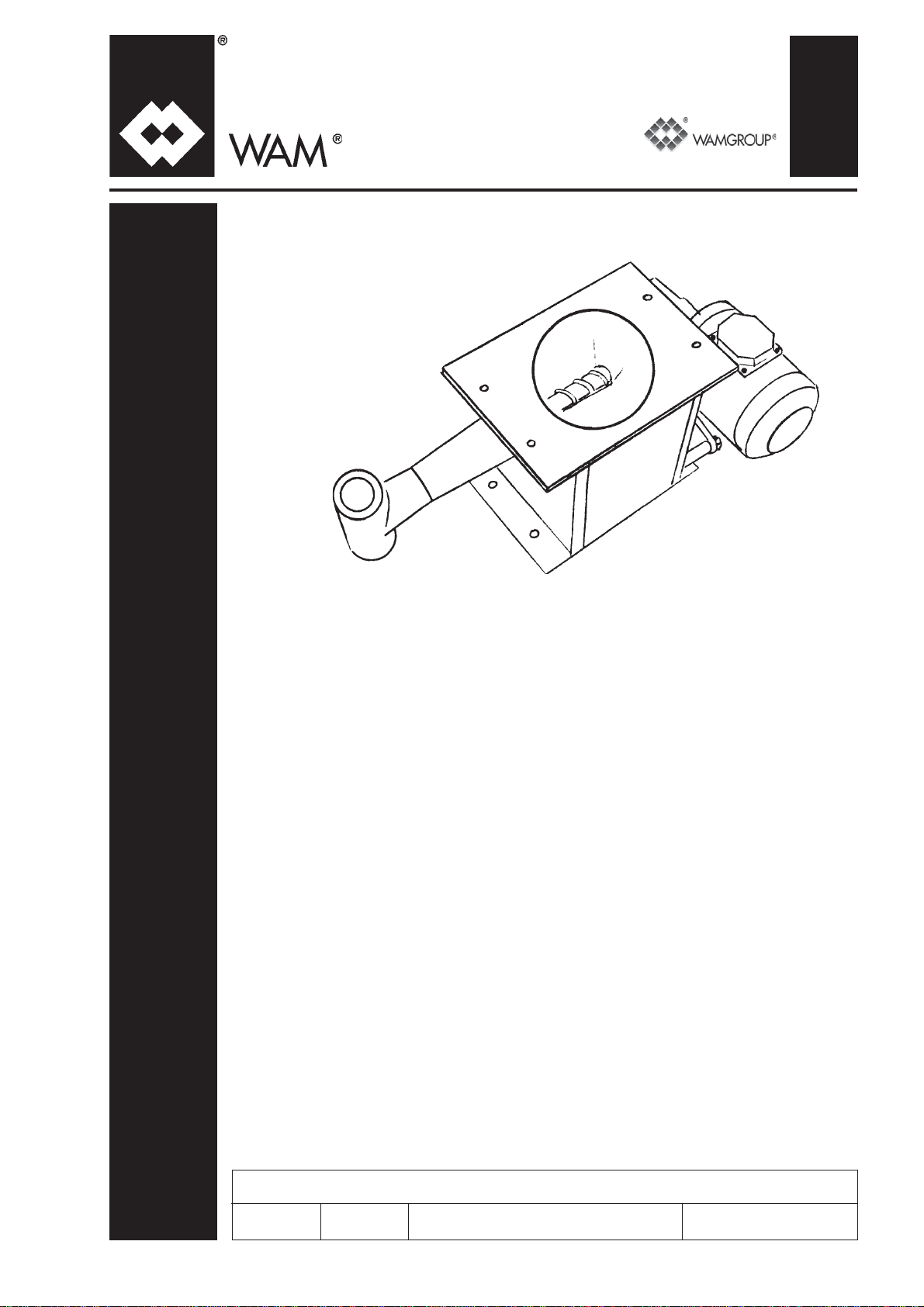
• “FLEXFLO” MICRO-BATCH FEEDERS
INSTALLATION, OPERATION AND MAINTENANCE
• MIKRODOSIERER MIT “ FLEXFLO “- GLEITTROG
EINBAU-, BETRIEBS- UND WARTUNGSANLEITUNG
• MICRODOSEURS A DESCENTE FACILITEE “FLEXFLO”
MAINTENANCE
INSTALLATION, UTILISATION ET ENTRETIEN
• MICRODOSATORI A DISCESA AGEVOLATA “FLEXFLO”
INSTALLAZIONE, USO E MANUTENZIONE
ISSUE
A9
All rights reserved © WAMGROUP S.p.A.
CIRCULATION
100
CATALOGUE No. VAL.064.--.M.4L
LATEST UPDATE
01.10
Page 2

All the products described in this catalogue are manufactured according to WAMGROUP S.p.A. Quality System
procedures.
The Company’s Quality System, certified in July 1994 according to International Standards UNI EN ISO 9002-94 and
extended to UNI EN ISO 9001-2000 in October, 2002, ensures that the entire production process, starting from the
processing of the order to the technical service after delivery, is carried out in a controlled manner that guarantees
the quality standard of the product.
Alle in diesem Katalog beschriebenen Erzeugnisse werden in Konformität mit dem Qualitätssystem der
WAMGROUP S.p.A. hergestellt.
Das im Juli 1994 zertifizierte Qualitätssystem entspricht der Norm UNI EN ISO 9002-94 (im Oktober 2002 auf
UNI EN ISO 9001-2000 erweitert) und gewährleistet dem Kunden eine strenge Qualitätskontrolle in jeder Phase
des Produktionprozesses bis hin zum Kundendienst nach Auslieferung der Ware.
Tous les produits décrits dans ce catalogue ont été réalisé selon les modalités opérationnelles définies Système
de Qualité de WAMGROUP S.p.A.
Le système de Qualité de l’entreprise, certifié au mois de juillet 1994 en conformité aux Normes Internationales UNI
EN ISO 9002-94 et successivement étendu à UNI EN ISO 9001-2000 au mois de octobre 2002, est en mesure
d’assurer que le procédé entier de production, à partir de la formulation de la commande jusqu’au service technique
après la livraison, soit effectué de manière contrôlée et appropriée afin de garantir le standard de qualité du produit.
Tutti i prodotti descritti in questo catalogo sono stati realizzati secondo modalità operative definite Sistema
Qualità di WAMGROUP S.p.A.
Il Sistema Qualità aziendale, certificato dal luglio 1994 in conformità alle Normative Internazionali UNI EN ISO
9002-94 e successivamente esteso alle Normative Internazionali UNI EN ISO 9001-2000 nell’ottobre 2002, è in
grado di assicurare che l’intero processo produttivo, dalla formulazione dell’ordine fino all’assistenza tecnica
successiva alla consegna, venga effettuato in modo controllato ed adeguato a garantire lo standard qualitativo
del prodotto.
This publication cancels and replaces any previous edition and revision.
We reserve the right to implement midifications without notice.
This catalogue cannot be reproduced, even partially, without prior consent.
Diese Veröffentlichung annuliert und ersetzt jeder hergehende Edition oder Revision.
WAM® behält sich das Recht vor, Anderungen ohne vorherige Informationen durchzuführen.
Cette publication annule et remplace toutes les autres précédentes.
La reproduction et la publication partielle ou totale de ce catalogue est interdite sans notre autorisation.
Nous nous réservons le droit d’apporter toutes modifications à nos produits.
Questa pubblicazione annulla e sostituisce ogni precedente edizione o revisione.
Ci riserviamo il diritto di apportare modifiche senza preavviso.
E’ vietata la riproduzione anche parziale senza autorizzazione.
Page 3

1
TECHNICAL CA TALOGUE
MBW
-
INDEX
-
INHALTSVERZEICHNIS
-
INDEX
-
INDICE
01.10
VAL.064.--.M.4L INDEX
TECHNISCHER KAT ALOG
DESCRIPTION AND TECHNICAL CHARACTERISTICS...................
ORDER CODES............................................................................
ACCESSORIES............................................................................
OPERATION AND MAINTENANCE................................................
ACCESSORIES............................................................................
INQUIRY AND ORDER FORM.......................................................
1
CAT ALOGUE TECNIQUE
DESCRIPTION ET CARACTERISTIQUES TECHNIQUES ................
CODES DE COMMANDE..............................................................
ACCESSOIRES............................................................................
UTILISATION ET ENTRETIEN........................................................
ACCESSOIRES............................................................................
QUESTIONNAIRE.........................................................................
2
MAINTENANCE CATALOGUE
OPERATION AND MAINTENANCE................................................
DECLARATION OF CONFORMITY................................................
2
CA TALOGUE D’ENTRETIEN
UTILISATION ET ENTRETIEN........................................................
DECLARATION DE CONFORMITE.................................................
BESCHREIBUNG UND TECHNISCE MERKMALE.................
BESTELLCODES..................................................................
ZUBEHÖR............................................................................
BETRIEBS- UND WARTUNGSANLEITUNG...........................
ZUBEHÖR............................................................................
ANFRAGE- UND BESTELLBLATT........................................
CATALOGO TECNICO
DESCRIZIONE E CARATTERISTICHE TECNICHE.................
CODICI DI ORDINAZIONE....................................................
ACCESSORI........................................................................
USO E MANUTENZIONE......................................................
ACCESSORI........................................................................
MODULO DI RICHIESTA.......................................................
WARTUNGSKATALOG
BETRIEBS- UND WARTUNGSANLEITUNG.........................
KONFORMITÄTSERKLÄRUNG.............................................
CA TALOGO DI MANUTENZIONE
USO E MANUTENZIONE....................................................
DICHIARAZIONE DI CONFORMITA’.......................................
T. 6 .23
. 24 .27
. 28 .32
. 33
. 34
. 35
T. 6 .23
. 24 .27
. 28 .32
. 33
. 34
. 35
M. 4 .22
23 .26
M. 4 .22
23 .26
3
SPARE PARTS CAT ALOGUE
SPARE PARTS............................................................................
3
CAT ALOGUE PIECES DE RECHANGE
PIECES DE RECHANGE...............................................................
ERSAITZTEILKA TALOG
ERSATZTEIL......................................................................
CATALOGO RICAMBI
PEZZI DI RICAMBIO...........................................................
R. 4 .7
R. 4 .7
Page 4

MBW
-
OPERATION AND MAINTENANCE
BETRIEBS- UND WARTUNGSANLEITUNG
-
-
UTILISATION ET ENTRETIEN
-
USO E MANUTENZIONE
01.10
VAL.064.--.M.4L
2
4
A) ADDRESS OF
LOCALDEALER OR LOCAL
SERVICE POINT
B) EQUIPMENT
IDENTIFICATION
Refer to order code in acknowledgement of order, in invoice and on packaging to identify equipment.
C) CONTRA-INDICATIONS
If the user observes normal precaution (typical of this type of machine) together with the indications
of this manual, work is safe.
NOTE FOR FOOD GRADE MICROFEEDERS:
Clean micro-batch feeder with water from time to time. Cleaning frequency depends on type of product and plant.
In cleaning certain feeder parts
such as the body, the metering
screw, the outlet pipe and the protections, special care must be taken.
Before using any other than water
for cleaning, contact a WAM sales
office.
If material is acid or temperature
is extremelyhigh or low also contact a WAM sales office.
The equipment must not be put
into service before the machine or
plant it has been fitted to has been
declared in conformity with the regulations of the directive 14/06/1982
(89/392/ECC).
It is the plant designer’s / plant fitter’s responsibility to design and
install all necessary protection in
order to avoid that breaking and/or
yielding of the quipment or of parts
of it might damage people and/or
parts of the plant (e.g. adequate
protection against falling down of
the motor etc.).
For dangerous materials, i.e. those that must not get in contact with
the human body or be inhaled, for
flammable, explosive and bacteriologically dangerous materials the
plant manufacturer or fitter must
provide for the required safety devices and measures.
A) ANSCHRIFT DES HÄNDLERS
ODER DES KUNDENDIENSTES
B) IDENTIFIKATION
Zur korrekten ldentifìkation auf den
Bestellcode in der Auftragsbestätigung, in der Rechnung und auf der
Verpackung Bezug nehmen.
C) KONTRA-INDIKATIONEN
Sofern der Betreiber die für Geräte
dieser Art typischen Vorsichtsmaßnahmen zusammen mit den in dieser Dokumentation enthaltenen Vorschriften beachtet, ist die Betriebssicherheit gewährleistet.
BETRIFFT MIKRODOSIERER FÜR
NAHRUNGSMITTEL:
Dosierer regelmäßig mit Wasser
abwaschen (Häufigkeit abhän-gig
von Produkt und Anlagentyp). Besonders bei der Reinigung von
Gehäuse, Dosierwerkzeug, Ablaufrohr und Schutzvorrichtungen mit
Vorsicht vorgehen. Bevor Reinigungsmittel egal welcher Art verwendet werden, bei einem WAMVerkaufsbüro Informationen in bezug auf die Verträglichkeit einholen. Ist das Produkt säurehaltig
oder dessen Temperatur entweder
sehr hoch oder sehr niedrig, ebenfalls mit einem WAM-Verkaufsbüro
Kontakt aufnehmen.
Das Gerät darf nicht in Betrieb genommen werden, bevor die Anlage
oder Maschine, in die er eingebaut
wurde mit den Vorschriften der Bestimmungen vom 14.06.1982 (89/
392/ECC) als konform erklärt wurden.
Es liegt in der Verantwortung des
Anlagenplaners bzw. –aufstellers,
alle notwendigen Schutzvorrichtungen vorzusehen, welche es verhindern, dass durch einen Geräteoder Teiledefekt Personen- und/
oder Sachschäden verursacht werden (z.B. geeigneter Schutz gegen
das Herunterfallen des Motors
etc.).
Für Gefahrenprodukte, bzw. solche,
die nicht mit dem menschlichen
Körper in Kontakt geraten oder eingeatmet werden dürfen, für leicht
entzündbare, explosive sowie bakteriologisch gefährliche Medien
muß der Anlagenbauer bzw. –errichter die für die Sicherheit erforderlichen Vorrichtungen vorsehen
und Maßnahmen treffen.
A) ADRESSE DU REVENDEUR
OU DU SERVICE APRES-VENTE
LOCAL
B) PLAQUE
D’IDENTIFICATION
Pour identifier correctement l’équipement, vous devez vous référer
au code qui se trouve sur la confirmation de commande, sur la facture et sur la plaque qui se trouve
sur l’emballage.
C) CONTRE-INDICATIONS
Si l’utilisateur observe les précautions normales pour ce type de
machine et les instructions contenues dans ce catalogue l’utilisation est sûre.
NOTE POUR MICRODOSEURS
ALIMENTAIRES.
Nettoyer le microdoseur périodiquement avec de l’eau (fréquence
dépend du type de matériau et du
type d’installation).
Utilisez du soin particulier pour le
corps, l’outil de dosage, la sortie
verticale et les protections. Avant
d’utiliser des autres produits au
lieu de l’eau contactez un bureau
de vente WAM. Le même vaut si le
matériau est acide ou sa température est trop élevée ou trop basse.
ll est interdit de mettre en fonction
la machine avant que l’installation
dans laquelle elle doit etre installée soit déclarée conforme aux dispositions de la directive 14/06/
1982 (89/392/ECC).
Dans ce cadre il est la responsabilité du constructeur de l’installation ou de l’installateur de projeter
et d’installer tout équipement de
protection nécessaire afin d’éviter
que des ruptures et/ou des tassements de la machine et/ou des
parties d’elle puissent causer de
dégâts à des personnes et/ou des
choses (par ex.: des protections
appropriées contre la chute du moteur etc.).
Pour des produits dangereux, nuisibles au contact et/ou à l’inhalation, inflammables, explosifs et
dangereux du point de vue bactériologique et/ou viral, le constructeur de l’installation ou l’installateur devront prévoir des dispositifs
appropriés au besoin.
A) INDIRIZZO RIVENDITORE O
PUNTO DI ASSISTENZA LOCALE
B) INTERPRETAZIONE DELLA T ARGHETTA
Per una corretta identificazione della macchina, bisogna fare riferimento al codice che si trova sulla conferma d’ordine, sulla fattura e sulla targhetta posta sull’imballo.
C) CONTROINDICAZIONE
Se l’utilizzatore osserva le precauzioni normali tipiche per questo tipo
di macchina insieme alle indicazioni date in questo catalogo l’utilizzo
è sicuro.
NOTE PER MICRODOSATORI PER
USO ALIMENTARE:
Lavare il microdosatore periodicamente con acqua. La frequenza dipende dal tipo di materiale e della
natura dell’impianto. Certe parti
come il corpo, l’utensile di dosaggio, lo scarico verticale e le protezioni vanno puliti con particolare
cura. Prima di utilizzare altri prodotti per la pulizia contattare il ns. Ufficio Vendite. Anche se il materiale
da dosare fosse acido o avesse
una temperatura troppo alta o troppo bassa, contattare il ns. Ufficio
Vendite.
E’ inoltre vietato mettere in funzione la macchina prima che la macchina/impianto nel quale devono
essere installate sia dichiarato conforme alle disposizioni della direttiva 14/06/1982 (89/392/EEC).
In quest’ambito è cura dell’impiantista / installatore predisporre ed installare tutti gli accorgimenti / protezioni al fine di evitare danni a cose
o persone in caso di rotture e conseguente caduta di pezzi della macchina (ad es: rottura del motore).
Per prodotti pericolosi, nocivi al contatto e/o all’inalazione, infiammabili, esplosivi e pericolosi dal punto
di vista batteriologico e/o virale, l’impiantista e/o l’installatore, dovranno prevedere idonei dispositivi all’uopo.
Page 5
MBW
OPERA TION AND MAINTENANCE
-
-
BETRIEBS- UND W ARTUNGSANLEITUNG
UTILISA TION ET ENTRETIEN
-
-
USO E MANUTENZIONE
01.10
2
VAL.064.--.M.4L 5
D) RECEIPT OF GOODS / PACKAGING DAT A
On arrival, prior to unloading,
check if nature and quantity of
the goods comply with the contents of the delivery note, the
invoice and the acknowledgement of order.
If any parts are damaged
through transport immediately
state your claims in writing on
the consignment note (waybill).
The driver is obliged to accept
this and to leave you a copy.
Send off your claims without
hesitation to us if you received
goods free destination or to
your shipping agent. Failure to
state your claims on arrival of
the goods may later invalidate
your claim.
Avoid any kind of damage to
goods during unloading and
handling.
Always handle goods with care.
D) KOLLIMASSE UND
GEWICHTE
Bei Wareneingang vor dem Abladen prüfen, ob Ware in Beschaffenheit und Menge mit den
Angaben auf Lieferschein,
Rechnung und Auftragsbestätigung übereinstimmt. Eventuelle
Schäden sofort schriftlich im
Frachtbrief reklamieren, da spätere Ansprüche nicht mehr geltend gemacht werden können.
Der Fahrer ist dazu verpflichtet,
die Reklamation entgegen zu
nehmen und dem Empfänger eine
Kopie dieser zu überlassen. Bei
Lieferung frei Haus Reklamation
an den Lieferanten schicken, in
allen anderen Fällen an den Spediteur. Beim Abladen Ware nicht
beschädigen. Berücksichtigen,
daß es sich um mechanische
Teile handelt, die mit Vorsicht zu
behandeln sind.
D) EMBALLAGES - POIDS
Au moment où Vous recevez la
marchandise, vérifiez bien que
le modèle et la quantité correspondent aux données indiquées
sur le bulletin de livraison, sur la
facture et sur la confirmation de
commande.
Si vous constatez des dommages, vous devez immédiatement
le faire savoir en l'écrivant dans
l'emplacement prévu à cet effet
sur la lettre de voiture. Le chauffeur a l'obligation d'accepter
votre réclamation et de vous en
laisser une copie. Si la fourniture a été livrée franco destination, envoyez-nous votre réclamation, sinon, envoyez-la directement au transporteur. Si vous
ne réclamez les dommages immédiatement après avoir reçu la
marchandise, votre réclamation
risque de ne pas être acceptée.
Veillez à ne pas endommager la
marchandise durant le déchargement et la manutention. Faites
toujours extrèmement attention
quand vous la deplacez.
D) TRASPORTO
E RICEVIMENTO
Al ricevimento della merce controllare se la tipologia e la quantità corrispondono con i dati di
bolla di consegna, fattura e conferma d’ordine.
Eventuali danni devono essere
fatti presenti immediatamente per
iscritto nell’apposito spazio della
lettera di vettura. L’autista è obbligato ad accettare un tale reclamo e lasciarne una copia a
Voi.
Se la fornitura è franco destino,
inviate il Vs. reclamo a noi, altrimenti direttamente allo spedizioniere.
Se non richiederete i danni immediatatamente all’arrivo della
merce, la vostra richiesta potrebbe non essere accolta.
Evitate ogni tipo di danneggiamento durante lo scarico e le
movi-mentazioni.
Movimentate sempre la merce
con cura.
N. B.: The weights given below
do not include any additional
packaging such as pallets or
similar.
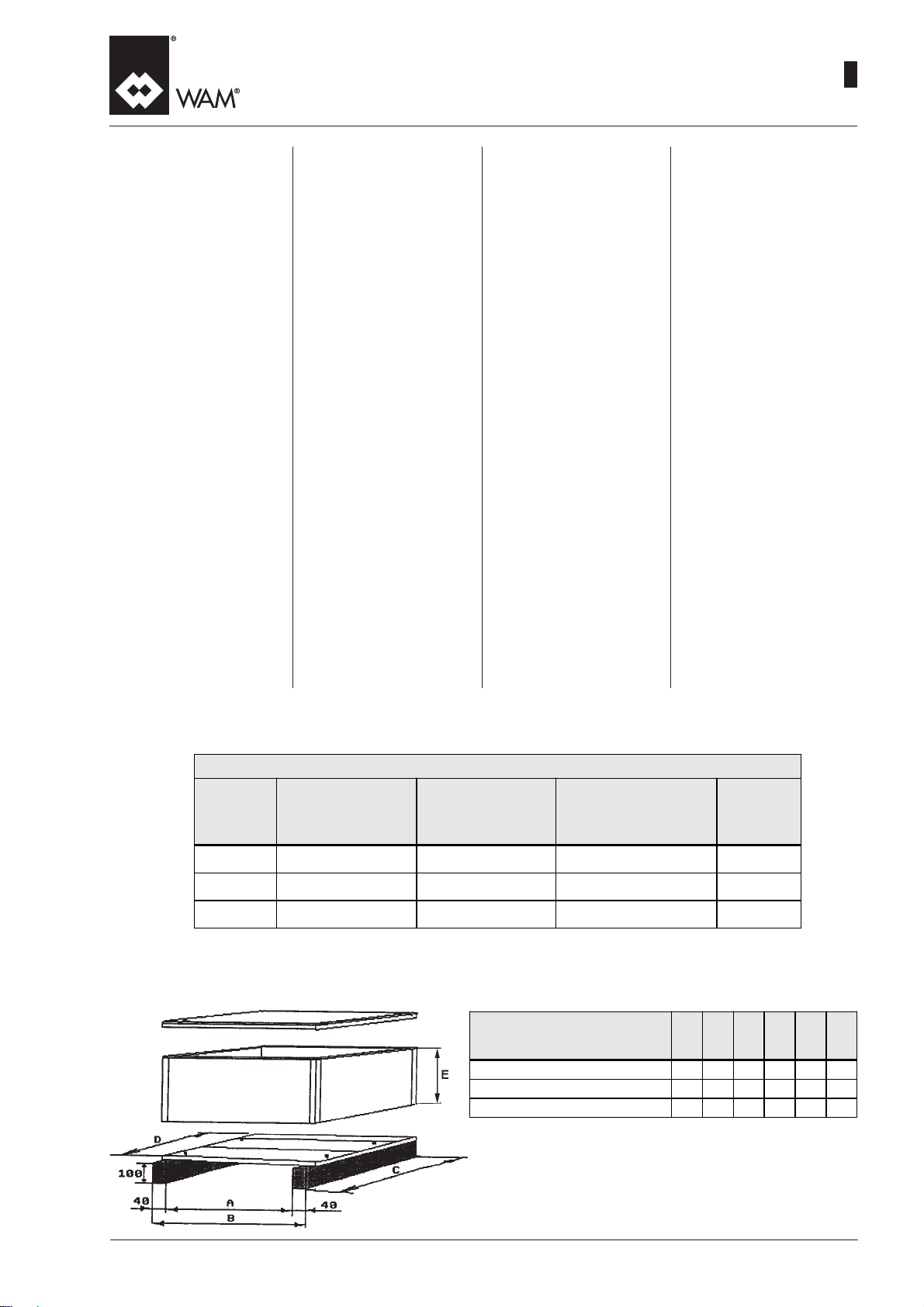
Type
MBW 0 15
MBW 0 42
MBW 0 73
N.B.: Gewichte beinhalten kei-
ne zusätzlichen Verpackungen
wie Paletten o.ä.
WEIGHT - GEWICHTE - POIDS - PESI (kg )
Without speed variator
Ohne Regelgetriebe
Sans variateur
Sen za moto r izza zion e
20 26 25 20
60 80 50 30
With speed variator
N.B.: Les données ci-dessous
ne comprennent pas le poids
d'un éventuel emballage supplémentaire (palette ou autre).
Mit Regelgetriebe
Avec variateur
Con motovariatore
Suitab le for - P assend zu
Pour type - Idoneo
N.B. :I dati riportati non compren-
dono il peso di un eventuale imballo cumulativo (pallet o altro).
Max. weight of accessories
Maximalgewi cht Zubehör
Poids max. accessoires
Peso max. accessori
MBW
15
42
73
A B C D E kg*
570 650 450 440 350 50
820 900 600 590 600 125
(*) Gross weight including standard MBW
Packing
Verpackung
Emballage
Imballo
Bruttogewicht inkl. Standard-MBW
Poids brut avec MBW standard
Peso lordo con MBW standard
Page 6
MBW
-
OPERATION AND MAINTENANCE
BETRIEBS- UND WARTUNGSANLEITUNG
-
-
UTILISATION ET ENTRETIEN
-
USO E MANUTENZIONE
01.10
04.00 /
VAL.064.--.M.4L
2
6
E) INSTALLATION
The micro-batch feeder is ready
for operation. Prior to delivery, it
has been tested at the factory.
E1) PREPARA TION
Remove equipment from packaging.
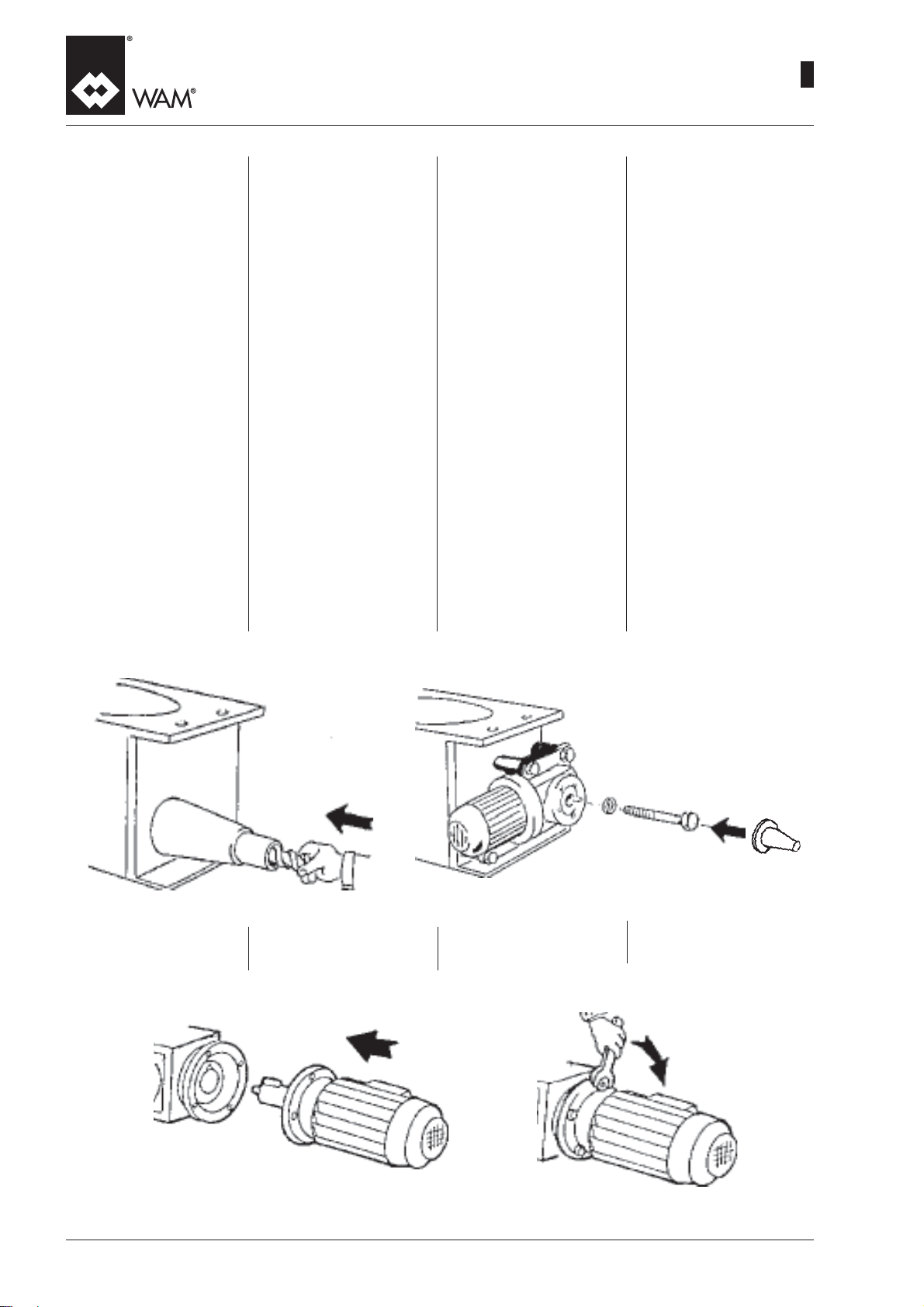
ASSEMBLY
MBW feeders are shipped with
the following parts not assembled:
- electric motor
- metering screw
- accessories
PROCEDURE:
• Unpack
• Check supply is complete and
in compliance with the order
ASSEMBLE METERING SCREW
E) EINBAU
Der Dosierer ist bereits betriebsbereit und wurde vor der
Auslieferung im Werk einem vollständigen Funktionstest unterzogen.
E1) VORBEREITUNG
Gerät auspacken und zusammenbauen.
MONTAGE
Folgende Teile werden unmontiert geliefert:
- E-Motor
- Dosierwerkzeug
- Zubehör
VORGEHENSWEISE:
• Gerät auspacken
• Sicherstellen, daß
Lieferung vollständing ist
DOSIERWERKZEUG MONTIEREN
E) INSTALLATION
Le doseur ne nécessite d’aucun
contrôle particulier puisqu’il est
fourni déjà complet et testé dans
l’usine.
E1) PREPARA TION
Enlevez le doseur de l’emballage
et commencez l’assemblage.
ASSEMBLAGE
Les microdoseurs sont fournis
avec les éléments suivants non
assemblés:
- moteur électrique
- outil de dosage
- accessoires
OPÉRATIONS À EFFECTUER:
• enlever le microdoseur de
l’emballage
• vérifier et contrôler la correspondance de tous les composants commandés
MONTER L’OUTIL DE DOSAGE
E) INSTALLAZIONE
I dosatori non richiedono particolari accorgimenti, in quanto la
macchina viene fornita già completa e collaudata prima della consegna
E1) PREPARAZIONE
Togliere il dosatore dall’imballo e
provvedere all’assemblaggio
ASSEMBLAGGIO
I dosatori vengono consegnati
con le seguenti parti non montate:
- motore
- utensile dosaggio
- accessori
OPERAZIONI DA EFFETTUARSI PER UN CORRETTO ASSEMBLAGGIO
• togliere il dosatore dall’imballo
• verificare presenza e corrispondenza di tutti i componenti
ordinati.
MONTAGGIO UTENSILE DOSAGGIO
ASSEMBLE ELECTRIC MOTOR
AND SPEED VARIA TOR IF SUPPLIED
E-MOTOR UND, SOFERN VORHANDEN, REGELANTRIEB
MONTIEREN.
MONTER LE MOTEUR ÉLECTRIQUE ET LE VARIATEUR SI
FOURNI.
MONT AGGIO MOTORE
(EVENTUALE VARIATORE)
Page 7

MBW
OPERA TION AND MAINTENANCE
-
-
BETRIEBS- UND W ARTUNGSANLEITUNG
UTILISA TION ET ENTRETIEN
-
-
USO E MANUTENZIONE
01.10
2
VAL.064.--.M.4L 7
ASSEMBLE ACCESSORIES
- Fix micro-batch feeder to the
ground or to a support structure using bolts.ssare
- Check metering screw has
been assembled correctly.
- Connect motor with mains.
- Check sense of rotation of
metering screw is ANTICLOCKWISE seen from behind the drive unit.
- Once carried out the abovementioned steps, the microbatch feeder is ready for the
final check.
E2) ELECTRICAL
CONNECTION
IConnection between the feeder motor and mains supply, as
well as all work on the open terminal box must be carried out by
qualified personnel only.
PRIOR TO ANY KIND OF MAINTENANCE OR REPAIR WORK,
DISCONNECT FEEDER MOTOR
FROM THE MAINS!
Prior to connection ensure voltage supply and motor plate data
match.
Pay attention to safety regulations.
E3) SAFETY NOTICE
Never introduce hands into a
running micro-batch feeder.
Provide for a saftey grille or a
hopper above the machine in
order to avoid harm to extremities.
To avoid harm also at the outlet
side, provide a vertical outlet
spout or an equivalent system.
F) START-UP
Check whether foreign substances or water have entered
the micro-batch feeder. In such
a case clean thoroughly.
IAvoid any friction between the
metering screw and the body.
Check sense of rotation of metering screw is ANTICLOCKWISE seen from behind the drive
unit.
Check oil level in gear reducer is
correct.
First start-up must be carried out
with empty micro-batch feeder.
If feeder operates correctly add
material and proceed with regular operation.
ZUBEHÖR MONTIEREN
- Den Dosierer am Boden oder
an der Rahmenkonstruktion
mittels Schrauben befestigen.
- Prüfen, ob Dosierwerkzeug
ordnungsgemäß montiert ist.
- Netzanschluß vornehmen.
- Sicherstellen, daß sich von
hinter dem Antrieb stehend
gesehen das Dosierwerkzeug GEGEN DEN UHRZEIGERSINN dreht.
- Nach erfolgter Durchführung
der vorgenannten Arbeiten
ist der Dosierer bereit für
eine letzte Kontrolle.
E2) ELEKTRISCHER ANSCHLUSS
Der Anschluß des Dosierermotors an das Netz sowie Arbeiten am Klemmenkasten des Dosierermotors im allgemeinen dürfen nur vom Elektriker ausgeführt werden.
VOR WARTUNGS- UND REPARATURARBEITEN IMMER DIE
HAUPTSTROMZUFUHR UNTERBRECHEN!
Vor dem elektrischen Anschluß
sicherstellen, daß die Netzspannung mit den Typenschildangaben des Dosierermotors
übereinstimmen.
In jedem Fall die Allgemeinen
Arbeitssicherheitsbestimmungen befolgen.
E3) SICHERHEITSHINWEIS
Niemals mit den Händen in den
laufenden Mikrodosierer greifen.
Über dem Gerät ein fest montiertes Schutzgitter oder einen
Trichter vorsehen, der so hoch
ist, daß die Verletzung von Körperextremitäten ausgeschlossen ist.
Ebenfalls zur Ausschließung
der Verletzungsgefahr am Auslauf einen vertikalen Aufsteckstutzen oder ein gleichwertiges
System vorsehen.
F) INBETRIEBNAHME
Prüfen, ob Fremdkörper oder
Wasser ins Innere des Dosierers gedrungen sind. Ist dem so,
gründlich säubern.
Jede übermäßige Reibung zwischen Dosierwerkzeug und
Gehäuse vermeiden.
Sicherstellen, daß sich das Dosierwerkzeug gegen den Uhrzeigersinn dreht (aus der Sicht
hinter dem Antrieb). Bei falscher
Drehrichtung Kabeldrähte umklemmen.
Ölstand im Getriebe prüfen.
Probelauf mit leerem Dosierer
durchführen. Material zugeben
und regulären Betrieb aufnehmen.
MONTER LES ACCESSOIRES
- Fixez le doseur à la structure
de soutien au moyen de boulons à travers les trous prévus à ce propos.
- Contrôlez l’assemblage de
l’outil de dosage.
- Connecter les parties électriques au pupitre.
- Contrôlez que vu de derrière
la motorisation l’outil de dosage tourne AU SENS INVERSE DES AIGUILLES D’UNE
MONTRE.
- Exécutées les opérations indiquées ci-dessus, le microdoseur est prêt pour le contrôle final.
E2) BRANCHEMENTS
ILa connexion entre le moteur
et le réseau et, en tout cas, tout
travail sur la boîte à bornes du
moteur doit être effectué par du
personnel spécialisé.
AVANT DE CHAQUE INTERVENTION DETACHER L’ALIMENTATION DE COURRANT!
Avant le branchement s’assurer que le voltage du réseau
coïncide avec celui indiqué sur
la plaquete du moteur.
Faire toujours attention aux normes de sécurité.
E3) PRECAUTIONS
GENERALES
Jamais mettre les mains à l’intérieur du microdoseur pendant
qu’il est en fonction.
Monter au-dessus de la machine une grille de sécurité fixe ou
une trémie d’une hauteur suffisante pour empêcher des dommages les membres d’une personne.
Pour la même raison il est nécessaire d’utiliser à la décharge un raccordement vertical ou
un système équivalent.
F) MISE EN MARCHE
Vérifiez qu’aucune substance
externe ou de l’eau ne soient
entrées dans le microdoseur. S’il
y en a, nettoyez.
Evitez absolument toute friction
entre l’outil de dosage et le
corps.
Contrôlez le sens de rotation de
l’outil de dosage (sens inverse
de celui des aiguilles d’une montre); si erronné, invertir le branchement des fils dans la boîte à
bornes du moteur.
S’assurer que le niveau d’huile
dans le réducteur soit correct.
La première épreuve de mise en
marche doit être faite à microdoseur vide. Si tout fonctionne
régulièrement, alimenter le doseur avec du matériau et procéder normalement.
MONT AGGIO ACCESSORI
- Fissare il dosatore alla struttura di sostegno mediante viti
da apllicarsi nelle apposite
sedi
- Controllare il montaggio dell’utensile omogeneizzatore e
dell’utensile dosaggio
- Collegare le parti elettriche al
quadro
- Controllare che, rispetto ad un
osservatore posto al lato del
carico della macchina (retro),
l’utensile di dosaggio ruoti in
senso ANTIORARIO
- Eseguite le suddette operazioni, il dosatore è pronto per il
collaudo finale
E2) COLLEGAMENTI
Il collegamento tra i motori del microdosatore e la rete elettrica e
in ogni caso qualsiasi lavoro sulla scatola morsettiera dei motori,
devono essere eseguiti da personale specializzato.
PRIMA DI QUALSIASI OPERAZIONE STACCARE L’ALIMENTAZIONE DI CORRENTE!
Prima del collegamento assicurarsi che il voltaggio di rete coincida con quello indicato sulla targhetta del motore.
Fare sempre attenzione alle norme di sicurezza.
E3) PRECAUZIONE GENERALI
Mai mettere le mani all’interno del
microdosatore mentre è in funzione.
In ogni caso é necessario che
sopra la macchina venga montata una griglia di sicurezza fissa o una tramoggia che sia di
altezza sufficiente ad impedire
che gli arti di una persona vengano danneggiati.
Lo stesso discorso vale per lo
scarico: é necessario usare lo
scarico verticale o un sistema
equivalente.
F) AVVIAMENTO
Verificare se sostanze esterne o
acqua sono entrate nel microdosatore. Se così fosse, pulire.
Evitate assolutamente ogni frizione tra spirale e dosatrice e dell’omogeneizzatore contro la parte esterna.
Controllare il senso di rotazione
dell’utensile di dosaggio (antiorario visto dal carico); se errato,
invertire i poli del motore.
Assicurarsi che l’olio del riduttore sia al livello giusto.
La prima prova di avviamento
deve essere fatta a microdosatore vuoto; se tutto funziona regolarmente, alimentare con il materiale e procedere normalmenete.
Page 8

MBW
-
OPERATION AND MAINTENANCE
BETRIEBS- UND WARTUNGSANLEITUNG
-
-
UTILISATION ET ENTRETIEN
-
USO E MANUTENZIONE
01.10
VAL.064.--.M.4L
2
8
G) OPERA TION
Depending on the type of plant,
operation of the micro-feeder is
controlled by a central control
panel or by a local starter.
It is very important to know the
weight of the material column
weighing on the feeder trough
which must never be higher
than the maximum resistance of
the internal trough.
Since it is very difficult to to
establish this weight the rule of
thumb is that with a standard
hopper there is no problem with
materials having bulk density of
less than 1 t/m³. In all other cases contact a WAM Sales Office.
N.B.: Life of the micro-batch feeder increases considerably if it is
emptied at the end of each working day. This becomes even more
important with materials which,
through longer storage, tend to
harden or pack.
G) BETRIEB
Je nach Anlagentyp wird der
Mikrodosierer über eine zentrale Steuerung oder einen Vor-OrtSchaltlasten in Betrieb genommen.
Das Produktgewicht, das auf
dem Dosierergehäuse lastet,
muß bekannt sein und darf den
Materialwiderstand des Gehäuseinnerens nicht übersteigen.
Da sich dieses Gewicht aufgrund unterschiedlicher Produkteigenschaften nur schwer ermitteln läßt, darf davon ausgegangen werden, daß Produkte
mit einem Schüttgewicht kleiner
1 t/m³ problemlos sind. In allen
anderen Fällen mit einem unserer Verkaufsbüros Kontakt aufnehmen.
N.B.: Die Lebensdauer des Mikrodosierers erhöht sich merklich, wenn er täglich nach Feierabend geleert wird.
Besonders wichtig ist dies bei
der Dosierung von Medien, die
nach längerer Lagerung zum
Aushärten oder Anbacken neigen.
G) FONCTIONNEMENT
Selon le type d’installation, le
fonctionnement du microdoseur
est contrôlé ou par un pupitre de
commande ou par starter sur
place.
Il est très important de connaître le poids du produit qui grave
sur le corps du microdoseur. Le
poids ne doit jamais être supérieur à la résistance maxi de la
caisse intéreiure.
Comme il est très difficile de
quantifier le poids que réallement grave à cause de l’imprévidibilité du comportement des
divers matériaux, il faut considérer qu’avec nos trémies standard il n’y a pas de problèmes
s’il s’agit de matériaux avec
poids spécifique plus petits que
1 t/m³. Au cas contraire contactez notre Bureau de Vente.
N.B.: La durée du microdoseur
augmente sensiblement si on le
vide à la fin de la journée.
Ceci est particulièrement important quand le matériau dosé tend
à durcir ou à se compacter s’il
reste ferme pour une certaine
période de temos.
G) FUNZIONAMENTO
In base al tipo di impianto, il funzionamento del microdosatore è
controllato o da un quadro centrale di comando o da un comando in loco.
E molto importante conoscere il
peso del prodotto che grava sul
corpo del microdosatore: esso
non deve mai superare la massima resistenza della cassa interna.
Poichè è molto difficile quantificare il peso che realmente viene
a gravare a causa della imprevedibilità del comportamento dei
vari prodotti, riteniamo che con
le nostre tramogge standard con
prodotti di peso specifico inferiore a 1 t/m³ non abbiano problemi, in caso contrario consultare il ns. Uff. Tecnico Comm.le.
N.B.: Si aumenta notevolmente la
durata del microdosatore svuotandolo al termine di ogni giorno lavorativo.
Questo è particolarmente importante quando il materiale trasportato tende ad indurirsi o a compattarsi se rimane fermo per un
certo periodo di tempo.
Page 9
MBW
OPERA TION AND MAINTENANCE
-
-
BETRIEBS- UND W ARTUNGSANLEITUNG
UTILISA TION ET ENTRETIEN
-
-
USO E MANUTENZIONE
01.10
2
VAL.064.--.M.4L 9
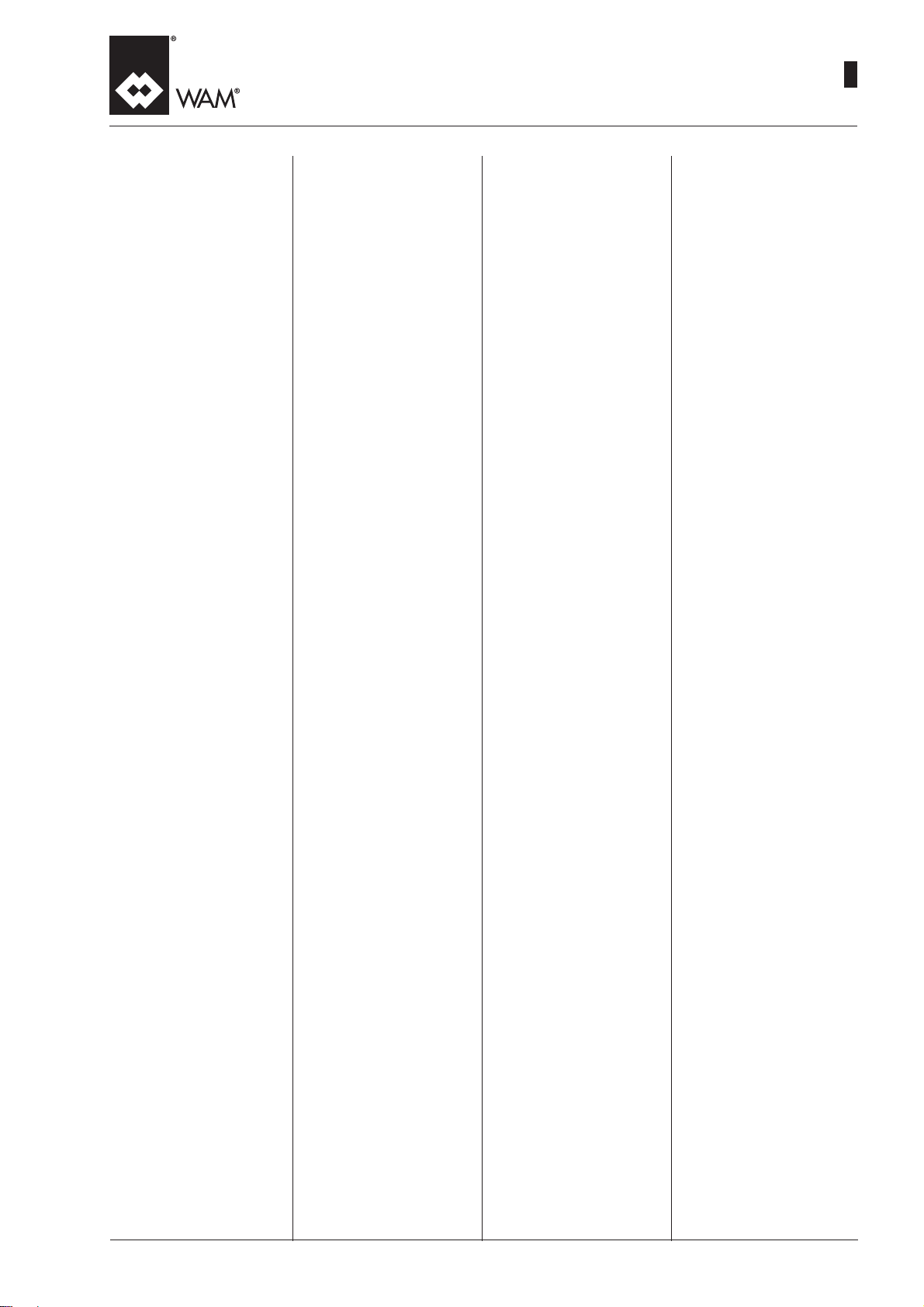
H) ASSEMBLY / DISMALTING
H1) FASTENING
The bottom part of the microbatch feeder must be firmly fastened to the ground or to a support structure using nuts and
bolts.
If on top of the standard hopper
another loading system is installed the connection must be
flexible in order to avoid vibrations.
In any case, vibrations must be
avoided.
IMPORTANT: to prevent accidents it is necessary that
the hopper for manual loading is equipped with fixed
(bolted) protection grille.
Standard manual loading hoppers
are always supplied complete with
a protection grille. Accident prevention laws require that this
grille is correctly assembled and
that the user does not remove it.
If the user provides a different
loading system or different types
of mobile protection the protection must be able to stop the
feeder instantaneously if protection is removed or opened. Furthermore, it must be impossible
to start the feeder before the protection is back in place or closed.
Particular attention must be paid
to the feeder outlet. either a
vertical outlet must be fitted (see
catalogue chapter on “accesso-ries”) or the area around the
outlet must be made inaccessible to the operator because the
metering screw runs freely.
H) MONT AGE / DEMONT AGE
H1) BEFESTIGUNG
Der Mikrodosierer muß an seiner Unterseite bündig am Boden
oder auf einem Rahmen mittels
Schrauben befestigt werden.
Falls über dem Trichter ein weiteres Befüllsystem vorgesehen
ist, muß zwischen diesem und
dem Trichter des Dosierers eine
flexible Verbindung vorgesehen
werden, um zu verhindern, daß
sich Vibrationen übertragen.
Vibrationen sind im allgemeinen
zu vermeiden.
WICHTIG: zur Unfallverhütung muß der Trichter zur
manuellen Aufgabe mit einem fest installierten (verschraubten) Schutzgitter
versehen werden.
WAM-Sackaufgabetrichter werden immer mit Schutzgitter geliefert. Im Interesse der Unfallverhütung ist es wichtig, daß das
Schutzgitter ordnungsgemäß
montiert ist und vom Betreiber
nicht entfernt wird. Falls der Betreiber ein anderes Befüllsystem
oder bewegliche Schutzvorrichtungen vorsieht, so müssen diese Schutzvorrichtungen so ausgeführt sein, daß das Gerät augenblicklich abschaltet, sobald
die Schutzvorrichtung entfernt
oder geöffnet wird. Des weiteren
muß ein neuerliches Einschalten
des Geräts unmöglich sein, solange die Schutzvorrichtung nicht
wirksam ist.
Am Auslauf des Dosierers besteht besondere Verletzungsgefahr. Entweder muß ein vertikales Ablaufrohr verwendet
werden (siehe Katalog “Zubehör”) oder der gesamte Bereich
muß dem Bedienungspersonal
wegen der sich frei drehenden
Dosierspirale unzugänglich gemacht werden.
H) MONT AGE / DEMONT AGE
H1) FIXAGE
Le microdoseur doit être bien
fixé dans la partie inférieure à
une structure de support au
moyen de boulons dans les
trous prévus à ce propos.
Si au-dessus de la trémie est
prévu un autre système de chargement, la connexion doit être
flexible afin d’éviter des vibrations.
En tout cas il faut éviter toute
vibration.
IMPORTANT: pour respecter
les dispositions en vigueur
en ce qui concerne la prévention d’accidents, il est nécessaire que la trémie de
chargement manuel soit
toujours munie d’une protection fixe (boulonnée).
Les trémies à chargement manuel sont toujours fournies
complètes de grille de protection. Il est d’une importance fondamentale que, pour le respect
des normes de sécurité, telle
protection soit montée correctement et qu’elle ne soit pas enlevée. Si le client utilisait un autre
système de chargement ou s’il a
prévu des protections du type
mobile, il est obligatoire de munir l’appareil d’un dispositif qui en
provoque l’arrêt immédiat au moment du démontage ou de
l’ouverture du dispositif-même.
Il faut faire attention particulière à
la sortie du microdoseur: ou il faut
utiliser la sortie verticale (v. catalogue “accessoires”, ou cette partie doit être inaccessible au personnel parceque dans ce point la
spire peut tourner librement.
H) FISSAGGIO / SMONTAGGIO
H1) FISSAGGIO
Il microdosatore deve essere fissato saldamente nella parte inferiore a una struttura di sostegno mediante viti da applicarsi
nelle apposite sedi.
Se sopra una tramoggia viene
posto un altro sistema di carico
questa connessione deve essere flessibile per evitare la propagazione di vibrazioni.
In ogni caso l’importante è che
siano evitate vibrazioni.
IMPORTANTE: per rispettare le
vígenti disposizioni in materia
di prevenzione, è necessario
che l’eventuale tramoggia di
carico manuale sia sempre
munita di protezione fissa (imbullonata).
Le tramogge a caricamento manuale sono fornite sempre complete di griglia di protezione, è di
fondamentale importanza, per il
rispetto delle norme antinfortunistiche, che tale protezione sia
correttamente assemblata, e non
venga rimossa. Qualora il cliente usi un altro sistema di carico o
preveda protezioni. di tipo mobile, è obbligatorio dotare l’apparecchiatura di un dispositivo che
ne provochi l’arresto immediato
all’atto della rimozione o apertura della protezione. Tale dispositivo, inoltre, non deve consentire l’avviamento della macchina se
la protezione non è nella posizione di chiusura.
Particolare attenzione deve poi
essere posta al lato uscita del
microdosatore: o si deve usare
lo scarico verticale (vedi catalogo accessori) oppure questa
parte del microdosatore deve
essere inaccessibile al personale, in quanto in quel punto la spirale può ruotare a ciclo libero.
H2) DISMANTLING
ATTENTION:
PRIOR TO DISASSEMBLING
ANY PART OF THE MICROBATCH FEEDER, ENSURE FEEDER MOTOR IS DISCONNECTED FROM MAINS SUPPLY.
H2) DEMONT AGE
ACHTUNG:
VOR DEM AUSBAU IRGENDWELCHER TEILE AUS DEM DOSIERER SICHERSTELLEN, DASS
DIE HAUPTSTROMZUFUHR
ZUM MOTOR DES DOSIERERS
UNTERBROCHEN IST.
H2) DEMONT AGE
ATTENTION:
AVANT DE DEMONTER DES
PIECES DU MICRODOSEUR
S’ASSURER QUE L’ALIMENTATION DE COURANT AU MOTEUR ELECTRIQUE SOIT DETACHE!
H2) SMONTAGGIO
ATTENZIONE:
PRIMA DI SMONTARE QUALSIASI PEZZO DEL MICRODOSATORE, ASSICURARSI CHE L’ALIMENTAZIONE DI CORRENTE AL
MOTORE ELETTRICO SIA STACCATA!
Page 10

MBW
-
OPERATION AND MAINTENANCE
BETRIEBS- UND WARTUNGSANLEITUNG
-
-
UTILISATION ET ENTRETIEN
-
USO E MANUTENZIONE
01.10
VAL.064.--.M.4L
2
10
I) MAINTENANCE
Failure to follow the following
instructions may cause problems and invalidate the waranty
on the supplied equipment.
Once every day, when operation finishes, empty the microbatch feeder.
Once every week check outlet
is free from material residues.
If not clean thoroughly to avoid
any kind of obstruction to material flow.
Obviously lubrication and maintenance intervals depend on the
use and on the type of metered
material.
PRIOR TO ANY INTERVENTION,
DISCONNECT FEEDER MOTOR
FROM MAINS SUPPLY.
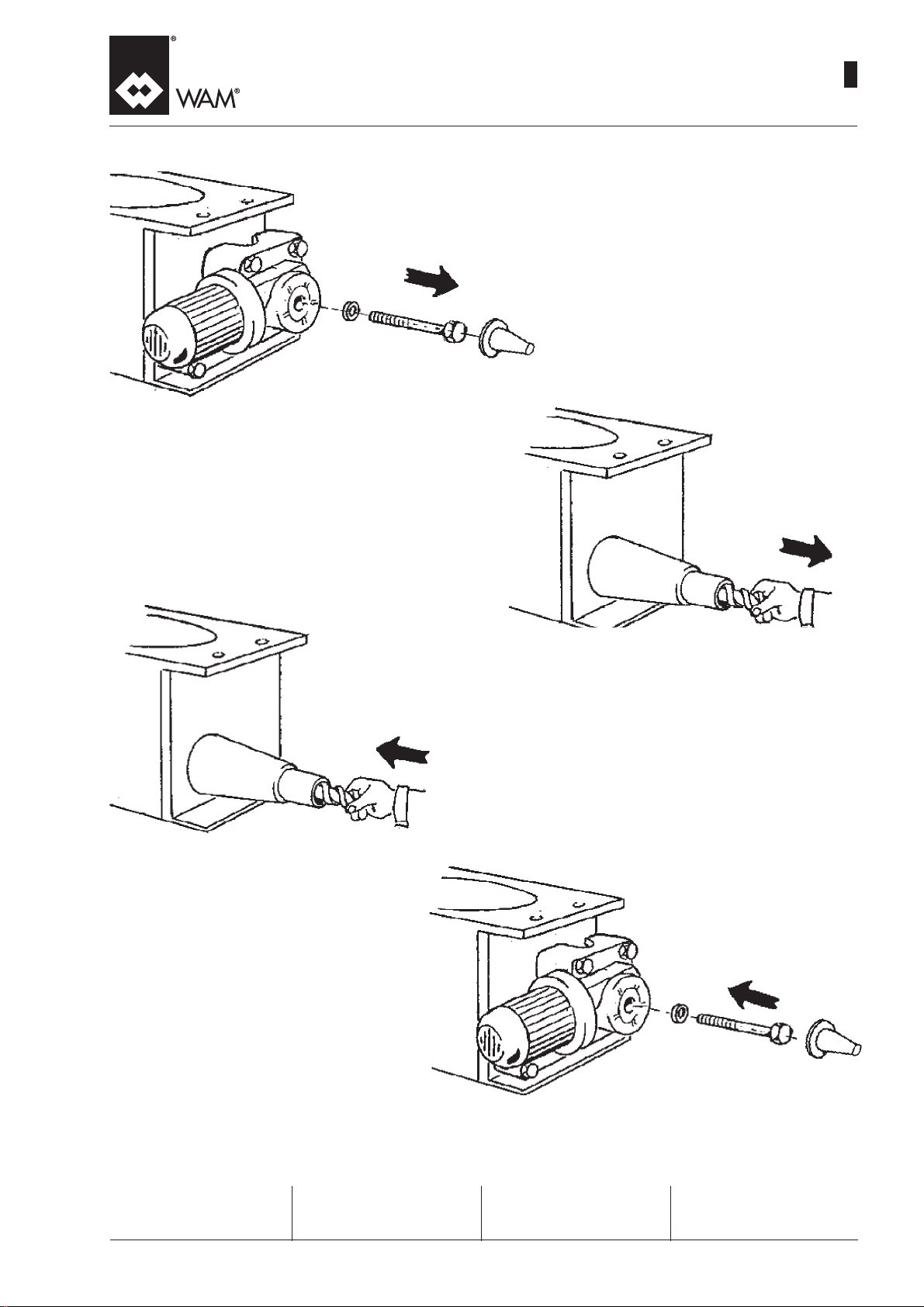
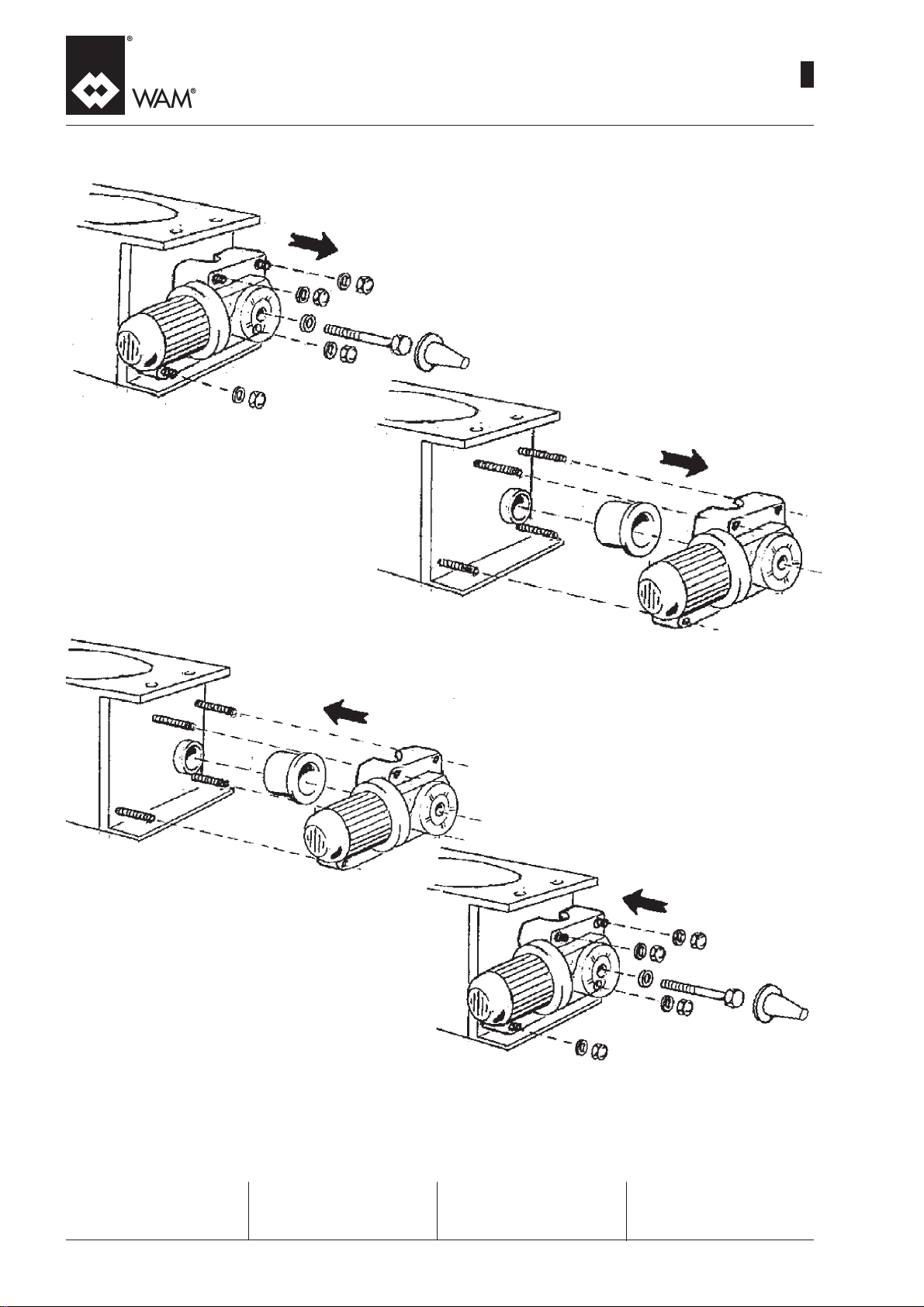
I1) SUBSTITUTION OF WEAR
PARTS
Follow the following instructions
(see appendix).
I) WARTUNG
Das Nichtbefolgen der nachfolgenden Vorschriften kann zu
Störungen führen und die Gewährleistung auf das gelieferte
Gerät außer kraft setzen.
Jeden Tag nach Feierabend den
Mikrodosierer leer fahren.
Einmal die Woche prüfen, ob
Auslauf frei von Materialrückständen ist und ggfls. gründlich
säubern, um einen freien Produktfluß zu gewährleisten.
Es ist klar, daß die Schmier- und
Wartungsintervalle sowohl von
der Betriebsart, als auch vom
Dosiergut abhängen.
VOR WARTUNGS- UND REPARATURARBEITEN IMMER DIE
HAUPTSTROMZUFUHR ZUM
DOSIERERMOTOR UNTERBRECHEN!
I1) AUSTAUSCH DER VERSCHLEISSTEILE
Nachfolgende Anleitungen befolgen (siehe Anhang).
I) ENTRETIEN
Le ne pas respecter rigoreusement les instructions suivantes
peut causer des problèmes et
peut invalider la garantie sur les
machines fournies.
Tous les jours, à la fin du travail, vider le microdoseur.
Toutes les semaines vérifier si
la sortie est libre de résidus de
matériau; sinon, la nettoyer soigneusement afin d’éviter toute
obstruction au passage du matériau.
Il est évident que les intervalles
de lubrification et de remplacement des pièces dépend et de
l’utilisation et du type de matériau dosé.
AVANT D’EFFECTUER DES OPERATIONS DETACHER L’ALIMENTATION DE COURANT!
I1) SUBSTITUTION DES PIECES D’USURE
Suivez les instructions suivantes
(Voir annexe).
I) MANUTENZIONE
Il non attenersi strettamente alle
seguenti istruzioni può causare
problemi ed invalidare la garanzia
sulle macchine fornite.
Ogni giorno, alla fine del lavoro
vuotare il microdosatore.
Ogni settimana, verificare se lo
scarico è libero da residui di materiale: se non lo è pulire accuratamente per evitare ogni ostruzione al passaggio di materiale.
E’chiaro che il tempo di Iubrificazione e di sostituzione dei pezzi
dipende sia dall’uso del dosatore
che dal tipo di prodotto trasportato.
PRIMA DI ESEGUIRE OPERAZIONI STACCARE L’ALIMENTAZIONE DI CORRENTE!
I1) SOSTITUZIONE DEI PEZZI DI
USURA
Seguire le seguenti istruzioni.
(Vedi allegati).
Page 11
MBW
OPERA TION AND MAINTENANCE
-
-
BETRIEBS- UND W ARTUNGSANLEITUNG
UTILISA TION ET ENTRETIEN
-
-
USO E MANUTENZIONE
04.00 /
01.10
2
VAL.064.--.M.4L 11
N.B.: DISCONNECT MOTOR
FROM MAINS SUPPL Y
N.B.: HAUPTSTROMZUFUHR
ZUM DOSIERERMOTOR
UNTERBRECHEN
N.B.: DEBRANCHER LES
CONNEXIONS ELECTRIQUES !
N.B.: DISINSERIRE I COLLEGAMENTI ELETTRICI !
Page 12
MBW
-
OPERATION AND MAINTENANCE
BETRIEBS- UND WARTUNGSANLEITUNG
-
-
UTILISATION ET ENTRETIEN
-
USO E MANUTENZIONE
01.10
04.00 /
VAL.064.--.M.4L
2
12
N.B.: DISCONNECT MOTOR
FROM MAINS SUPPL Y
N.B.: HAUPTSTROMZUFUHR
ZUM DOSIERERMOTOR UNTERBRECHEN
N.B.: DEBRANCHER LES CONNEXIONS ELECTRIQUES !
N.B.: DISINSERIRE I
COLLEGAMENTI ELETTRICI !
Page 13
MBW
OPERA TION AND MAINTENANCE
-
-
BETRIEBS- UND W ARTUNGSANLEITUNG
UTILISA TION ET ENTRETIEN
-
-
USO E MANUTENZIONE
01.10
2
VAL.064.--.M.4L 13
I2) LUBRICATION
Micro-batch feeder MBW
015
The installed gear reducer is
filled with long life grease and
does, therefore, not require any
maintenance.
Micro-batch feeders MBW
042-073
VARVEL REDUCERS
Are sealed for life and, therefore, need no extra lubrification.
SPEED VARIATOR (MOTOVARIO)
Oil splash lubricated. For this
reason it is particularly important to perform the following
checks before starting them up:
- ensure that oil plugs are in
right place and tight;
- ensure unit is topped up with
oil to the, correct level. Oil must
come up to about mid-point of
the oil level plug according to
mounting position.
Units are supplied without
breather plugs.
Use only reccomended oils
(see lable).
I2) SCHMIERUNG
Mikrodosierer MBW 015
Das installierte Getriebe ist
wartungsfrei dank einer Lebensdauer-Fettschmierung.
Mikrodosierer MBW 042-073
VARVEL-GETRIEBE
Erfordern keinerlei Wartung
dank einer Lebensdauer-Fettschmierung.
REGELGETRIEBE (MOTOVARIO)
Da spritzgeschmiert, vor Inbetriebnahme unbedingt folgende
Kontrollen vornehmen:
- Lage der Ölschrauben muß
der jeweiligen Bauform entsprechen;
- Den ordnungsgemäßen Füllstand überprüfen; Am Schauglas muß ca. halber Füllstand
anstehen. Regelgetriebe werden ohne Entlüftungsschrauben geliefert. Zum Nachfüllen
die in der Tabelle genannten
Ölsorten verwenden.
I2) LUBRIFICATION
Microdoseur MBW 015
Le réducteur monté sur ce type
de doseur est muni d’une graisse spéciale à vie.
Microdoseur MBW 042-073
REDUCTEURS VARVEL
Aucune intervention nécessaire (lubrification à vie).
La lubrification du VARIATEUR
(MOTOVARIO) se faisant par
barbotage, on ne saurait trop
recommander avant la mise en
marche:
- de s'assurer de la position
correcte des bouchons;
- de s'assurer du bon niveau du
lubrifiant: l'huile doit être visible approximativement à miindicateur du niveau. Ils sont
fournis sans bouchons de
soupirail. Pour les appoints
éventuels, utiliser uniquement
les lubrifiants préconisés (voir
tableau).
I2) LUBRIFICAZIONE
Microdosatore MBW 015
Il riduttore montato con questo
tipo di macchina è dotato di uno
speciale grasso che ne mantiene la lubrificazione a vita.
Microdosatore MBW 042-073
RIDUTTORI VARVEL
Non necessitano di alcun intervento essendo lubrificati a vita.
La lubrificazione del VARIATORE
(MOTOVARIO) avviene per sbattimento, quindi è molto importante, prima della messa in opera,
eseguire le seguenti verifiche:
- assicurarsi che la posizione dei
tappi olio sia corretta;
- verificare che il livello dell'olio
sia corretto: olio visibile a circa
metà della spia di livello. Sono
forniti senza tappo di sfiato. Per
gli eventuali rabbocchi attenersi ai tipi di olio raccommandati
nella tabella.
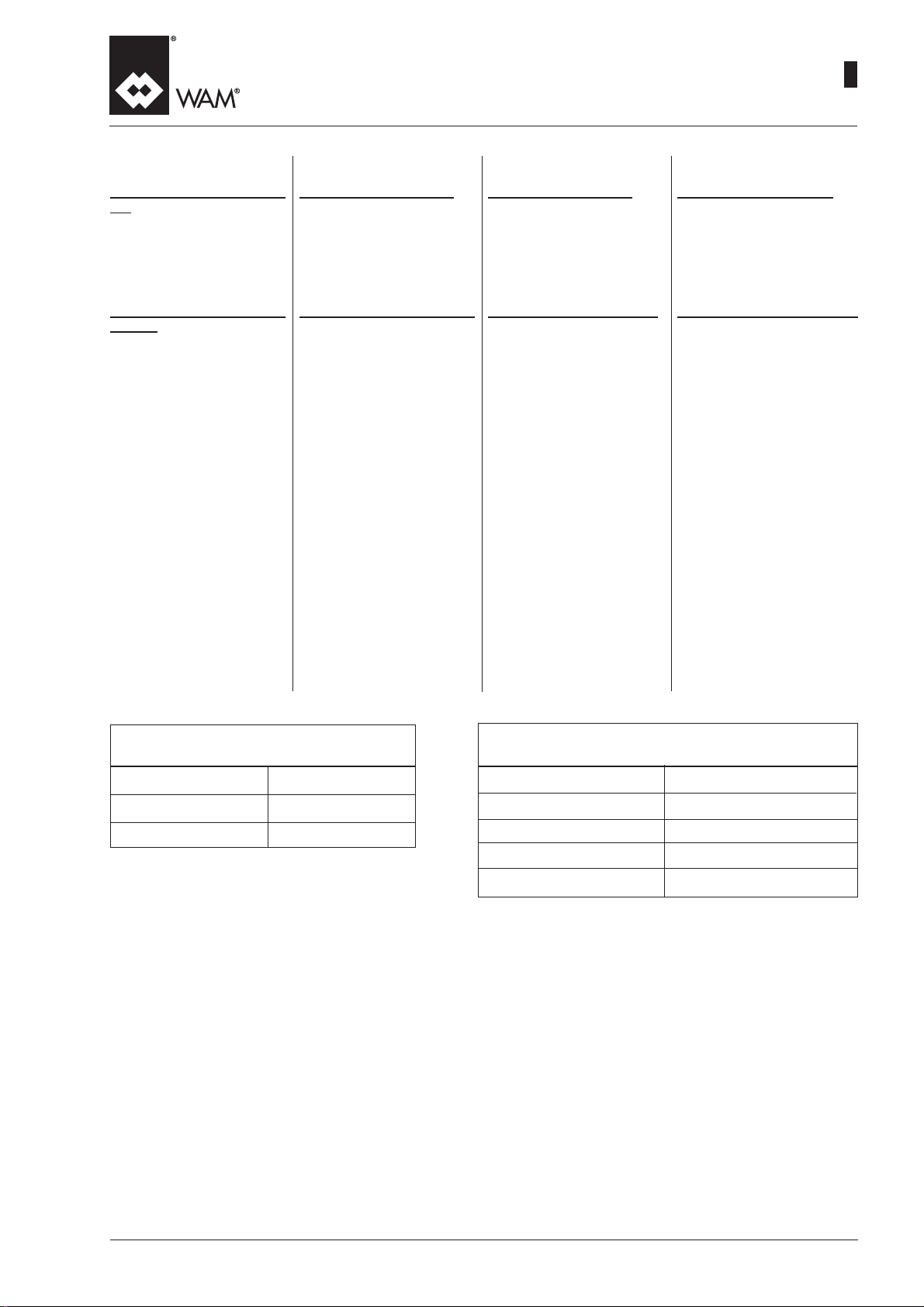
OIL QUANTITY - ÖLMENGE
QUANTITE D’HUILE - QUANTITA’ D’OLIO
TKF l
002 0.12
005 0.15
N.B.: The trade marks of lubrificants are in alphabetic order which does not refer to the quality of the products.
N.B.: Die Reihenfolge der Marken ist alphabetisch und sagt nichts über die Qualität der Produkte aus.
N.B.: Les marques de lubrificants sont par ordre alphabétique sans aucune référence en ce qui concerne la qualité du produit.
N.B.: Le marche di lubrificanti sono in ordine alfabetico senza alcun riferimento alla qualità del prodotto.
Type de lubrificants préconisés - Tipi di olio raccomandati
Reccomended oils - Empfohlene Ölsorten
AGIP A.T.F. DEXRON FINA A .T.F. DEXRON
BP BP AUTRAN DX I P IP DEXRON
CHEVRON A .T.F. DEXRON MOBIL A. T. F. 22 0
ELF MATIC G2 SHELL A.T.F. DEXRON
ESSO A.T.F. DEX RON
Page 14
MBW
-
OPERATION AND MAINTENANCE
BETRIEBS- UND WARTUNGSANLEITUNG
-
-
UTILISATION ET ENTRETIEN
-
USO E MANUTENZIONE
01.10
07.03 /
VAL.064.--.M.4L
2
14
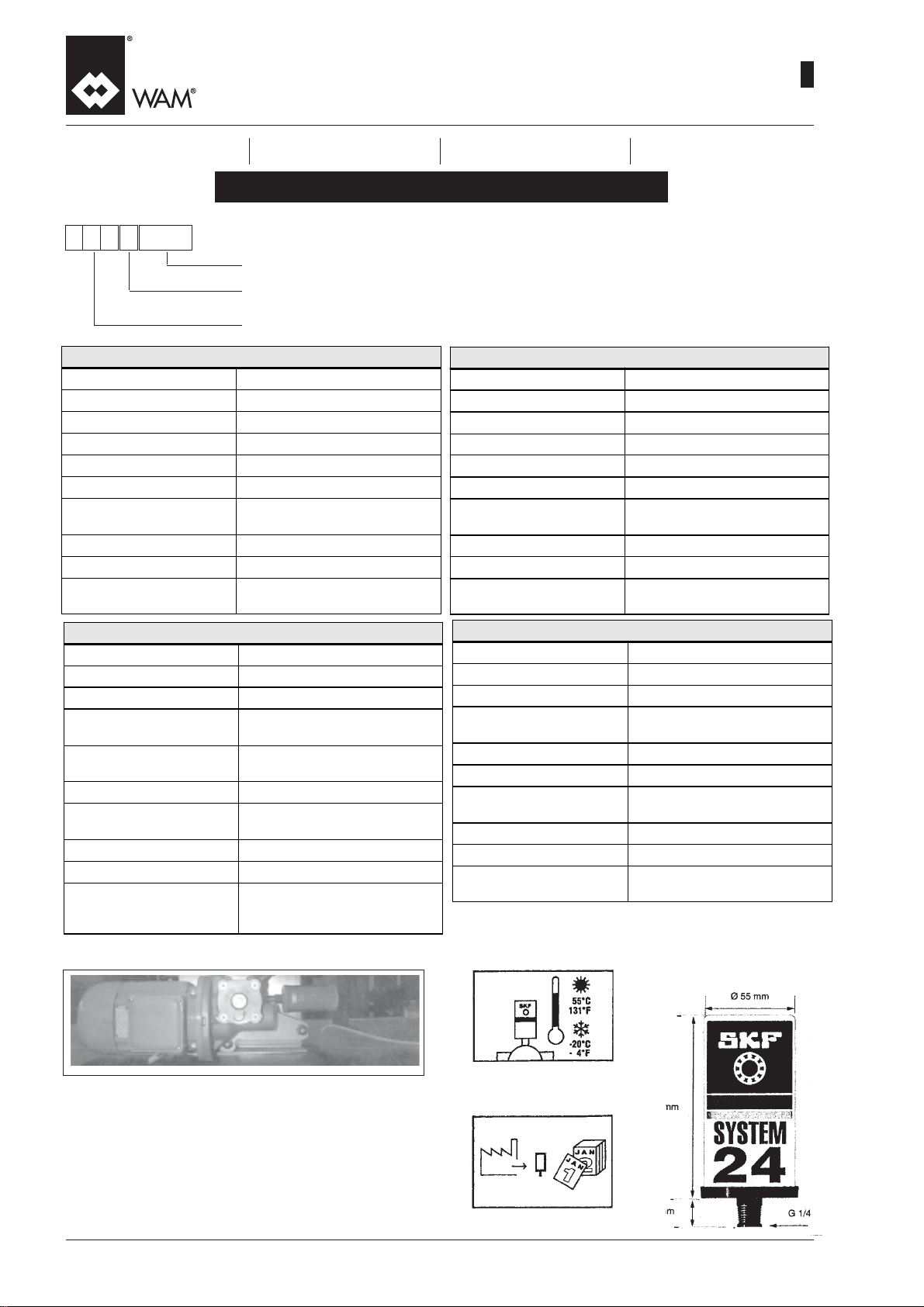
AUTOMATIC
LUBRICA T OR
AUTOMATISCHE
SCHMIERVORRICHTUNG
CARTRIDGE GREASE NIPPLE LIT - SCHMIERPATRONENSATZ
KIT GRAISSEUR CARTOUCHE - KIT INGRASSATORE CARTUCCIA
MDX I 125
Capacity - Kapazität - Capacité - Capacità
Grease nipple - Schmiernippel - Graisseur - Ingrassatore
Micro-batch feeders accessories - Mikrodosierer zubehör
Accessoires microdoseurs - Accessori microdosatore
TECHNICAL SPECIFICATIONS
Capacity
Operating period
Operating temperature
Max. operating pressure 5 bar**
Activation mechanism
Threading
Recommended storage
temperature
Storage period 2 years***
Weight
Appellative
125 ml
Adjustable at 1-12 months
-20°C a + 55°C°
Hydrogen gas release battery (H2)
G 1/4
+20°C
Approx. 190g (including grease)
LAGD 125/WA (filled with SKF LGWA 2
grease) LAGD 125/"lubricant"
GRAISSEUR
AUTOMATIQUE
TECHNISCHE DATEN
Kapazität
Betriebsdauer
Betriebstemperatur
Max. Betriebsdruck 5 bar**
Einschaltmechanismus
Gewinde
Empfohlene
Lagerhaltungstemperatur
Lagerzeit 2 Jahre ***
Gewicht
Bezeichnung
LUBRIFICAT ORE
AUTOMATICO
125 ml
Von 1 bis 12 Monate einstellbar
-20°C bis + 55°C°
Wasserstoff freisetzende Batterie (H2)
G 1/4
+20°C
circa 190 g (Fett inbegriffen)
LAGD 125/WA (mit Fett SKF LGWA 2
gefüllt) LAGD 125/"S chmierstoff"
CARACTÉRISTIQUES TECHNIQUES
Capacité
Période de fonctionnement
Température de fonctionnement
Pression max. de
fonctionnement
Mécanisme d'a ctivat ion
Filetage
Température conseillée pour le
stockage
Période de stockage
Poids
Désignation
125 ml
Réglable de 1 à 12 mois
-20°C a + 55°C°
5 bar**
Batterie à dégagement de gaz
hydrogène (H2)
G 1/4
+20°C
2 ans***
Env. 190jj (graisse incluse)
LAGD 125/WA (avec le plein de graisse
SKF LGWA 2 grease) LAGD
125/"lubrifiant"
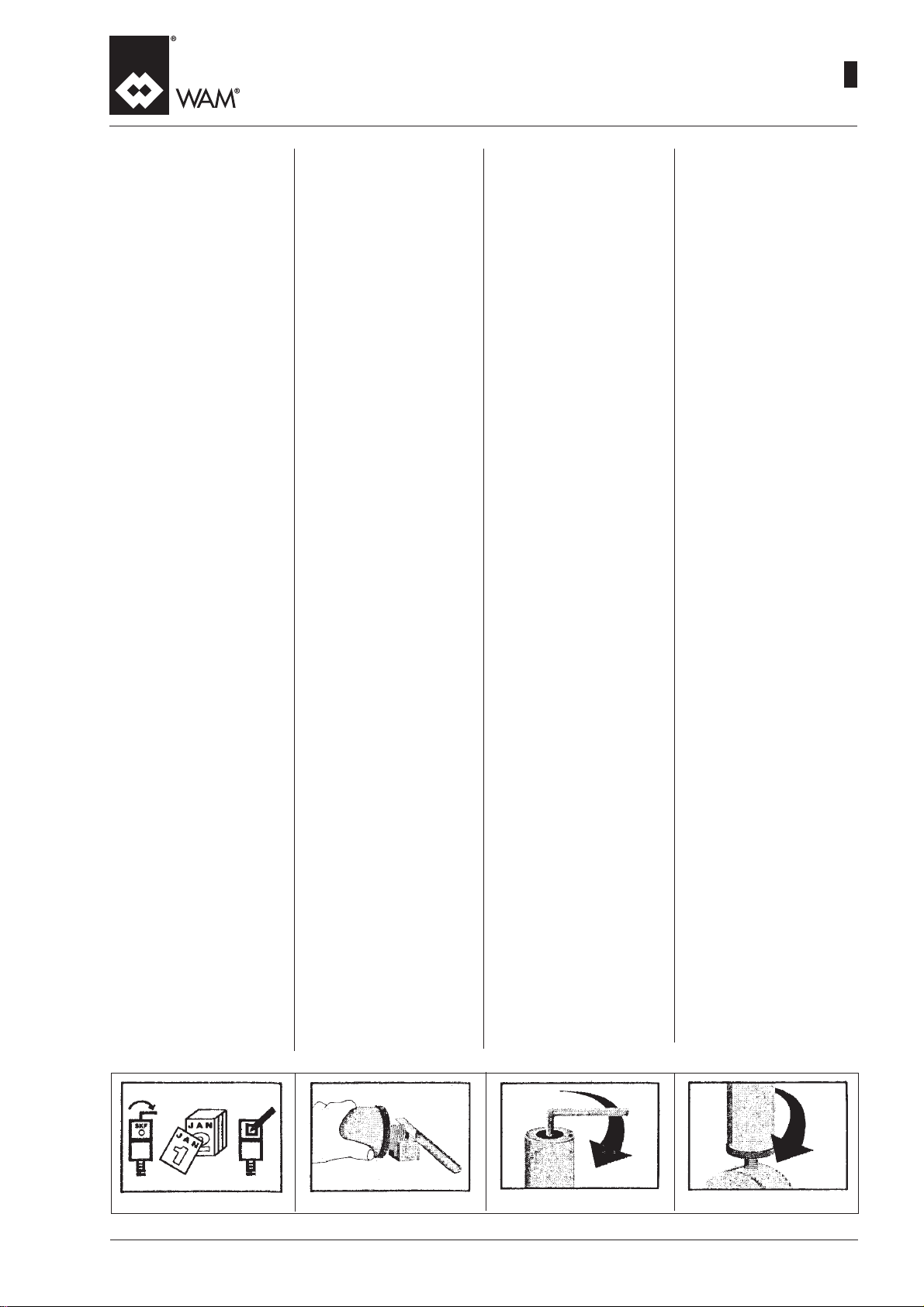
Fig.- Abb. 1
SKF assembly on Batch feeder - Montage SKF auf Dosierer
Montage SKF sur doseur - Montaggio SKF su dosatore
DATI TECNICI
Capacità
Periodo di funzionamento Regolabile da 1 a 12 mesi
Temperatura di funzionamento
Pressione max. di
funzionamento
Meccanismo di attivazione
Filettatura
Temperatura co ns igliata per lo
stoccaggio
Periodo di stoccaggio
Peso
Appellativo
Operatin temperature - Betriebstemperatur
Température de fonctionnement - - Temperatura di funzionamento
125 ml
-20°C a + 55°C°
5 bar**
Batteria a sviluppo di gas idrogeno (H
G 1/4
+20°C
2 anni***
Circa 190g (grasso incluso)
LAGD 125/WA (riempito con grasso
SKF LGWA 2) LAGD 125/"lubrificante"
)
2
Production date - Produktionsdatum
Date de production - Data di produzione
Page 15
MBW
OPERA TION AND MAINTENANCE
-
-
BETRIEBS- UND W ARTUNGSANLEITUNG
UTILISA TION ET ENTRETIEN
-
-
USO E MANUTENZIONE
01.10
07.03 /
2
VAL.064.--.M.4L 15
Code MDXI125 grease nipple
kit with 125 ml cartridge for
greased MBTT seals
For assembly on new plants:
1. Make sure the grease used
in System 24 is of the right
type.
2. Make sure the grease supplied can be used with the
one already present.
3. Check to ensure that the environmental temperature remains constant between 20ºC and + 55ºC.
4. Check to make sure the
grease reaches the components to be lubricated.
5. Protect the unit from heat and
temperature variations.
Note:
- The lubricator can be tempo-
rarily made inactive by setting
the selector on 0.
- The unit can be mounted any-
where; it is airtight and can
therefore also be installed immersed inside water.
- The oil lubricators are provid-
ed with a connector fitted with
a check valve. Cut the tip before installation. Do not remove
the connector.
Bestell-Nr.MDXI125 Schmierpatronensatz 125 ml für mit
MBTT geschmierte Dichtungen
Für die Montage auf neuen Anlagen:
1. Sicherstellen, dass das im
System 24 benutzte Fett der
richtigen Sorte entspricht.
2. Sicherstellen, dass das Fett,
das man benutzt, zusammen
mit dem vorher vorhandenen
benutzt werden kann.
3. Sicherstellen, ob die Umgebungstemperatur konstant
zwischen -20°C und +55°C
liegt.
4. Sicherstellen, dass das Fett
die zu schmierenden Bestandteile erreicht.
5. Die Einheit vor Hitze und Temperatursprüngen schützen.
Anm.:
- Die Schmiervorrichtung kann
vorübergehend abgestellt werden, wenn man den Schalthebel auf die Stellung 0 bringt.
- Das Gerät ist wasserdicht und
kann daher überall installiert
werden, auch in Wasser eingetaucht.
- Die Schmiervorrichtungen mit
Öl werden mit einem Anschluss geliefert, der mit einem
Rückschlagventil versehen ist.
Vor der Installation das Ende
absägen. Den Stutzen nicht
entfernen.
Code MDXI125 kit graisseur
à cartouche 125 ml pour étanchéités MBTT graissées
Pour le montage sur installations
neuves:
1. S’assurer que la graisse utilisée dans le System 24 est
du type approprié.
2. S’assurer que la graisse administrée peut être utilisée
ensemble à celle existante.
3. Contrôle que la température
ambiante se maintient constante entre -20°C et +55°C.
4. Vérifier que la graisse atteint
les composants à lubrifier.
5. Protéger l’unité contre la chaleur et les écarts de température.
Remarques:
- Le graisseur peut temporaire-
ment être rendu inactif en tournant le sélecteur sur la position 0.
- L’unité peut être montée de par-
tout, elle est étanche et peut
donc être aussi installée immergée dans l’eau.
- Les graisseur à huile sont four-
nis avec un raccord doté de
clapet antiretour. Avant de les
monter couper l’extrémité. Ne
pas enlever le raccord.
Codice MDXI125 kit ingrassatore a cartuccia 125 ml per
tenute MBTT ingrassate
Per il montaggio su impianti nuovi:
1- Assicurarsi che il grasso
usato nel System 24 sia del
tipo adatto.
2- Assicurarsi che il grasso
somministrato possa essere
usato insieme a quello preesistente.
3- Controllare se la temperatura
ambientale si mantiene costante tra -20°C e +55°C.
4- Verificare che il grasso rag-
giunga i componenti da lubrificare.
5- Proteggere l’unità dal calore
e dagli sbalzi di temperatura
Note:
- il lubrificatore può essere temporaneamente inattivato settando il selettore sulla posizione 0.
- L’unità può essere montata
ovunque, è a tenuta stagna e
può quindi essere installata
anche sommersa in acqua.
- I lubrificatori ad olio sono forniti con un raccordo dotato di
valvola di non ritorno. Prima di
installarli tagliare l’estremità.
Non rimuovere il raccordo.
Installation
1- Mark the installation date on
the unit with an indelible ink
marker pen.
2- Open the lubricant intake by
cutting the tip or removing the
cap (Fig. 3).
3- To activate the lubricator, turn
the selector using a 3mm Allen wrench (Fig. 4).
4- Clean the area around the lu-
brication point.
5- Fit the new unit with the con-
nector ready and tighten
manually (Fig.6 - Fig.1).
Installation
1- Das Installationsdatum mit ei-
nem unauslöschlichen Filzstift auf der Einheit vermerken (Abb. 2).
2- Die Schmierstoffabgabe öff-
nen, indem man die Versiegelung durchschneidet oder
den Stopfen abnimmt (Abb.
3).
3- Zum Aktivieren der Schmier-
vorrichtung den Wahlschalter um 3 mm drehen, und
zwar mit einem Steckschlüssel (Abb. 4).
4- Den Bereich rings um die
Schmierstelle reinigen.
5- Die neue Einheit mit dem vor-
handenen Anschluss montieren und von Hand anziehen
(Abb. 6 - Abb. 1)
Mise en place
1- Marquer la date de mise en
place sur l’unité avec un marqueur à encre indélébile (fig.
2).
2- Ouvrir la prise du lubrifiant en
coupant le sceau ou en enlevant le bouchon (Fig. 3).
3- Pour activer le graisseur tour-
ner le sélecteur de 3 mm en
utilisant une clé d’Allen (Fig.
4).
4- Nettoyer toute la partie autour
du point de lubrification.
5- Monter la nouvelle unité avec
le raccord prévu et serrer à
la main (Fig.6 - Fig.1).
Installazione
1- Marcare la data di installazio-
ne sull’unità con un pennarello ad inchiostro indelebile
(fig.2).
2- Aprire la presa del lubrifican-
te tagliando il sigillo o estraendo il tappo. (fig.3)
3- Per attivare il lubrificatore gi-
rare il selettore di 3 mm usando una chiave a brugola (fig.
4).
4- Pulire l’area intorno al punto
di lubrificazione.
5- Montare la nuova unità con il
raccordo predisposto e stringerla a mano (Fig.6 - Fig.1)
Fig.- Abb. 2
Fig.- Abb. 3
Fig.- Abb. 4 Fig.- Abb. 5
Page 16

MBW
-
OPERATION AND MAINTENANCE
BETRIEBS- UND WARTUNGSANLEITUNG
-
-
UTILISATION ET ENTRETIEN
-
USO E MANUTENZIONE
01.10
VAL.064.--.M.4L
2
16
Selection on the basis of experience
If the previous results acquired
on the basis of experience have
been satisfactory, retain the
same criteria.
Selection on the basis of lubrication using manual
grease nipple
Set the lubricator emptying period in such a way as to guarantee the same quantity of lubricant as that supplied using a
manual grease nipple.
For example:
- Bearing “X” receives 10 grease
pump cycles by means of the
grease injector (SKF 1077600)
per month.
- The quantity of grease per
pump cycle is 2.0 cm3.
LAGD 125
- The quantity of grease inside
the LAGD 125 lubricator is 125
cm³.
- Therefore 125 cm³/2.0 cm³ =
62 pump cycles.
- 62/10 (pump cycles per month)
equivalent to 6.2 months.
Position the selector on 6 months
using the 3mm Allen wrench.
Wahl aufgrund der Erfahrung
Wenn die vorher erhaltenen Resultate aufgrund der Erfahrung
zufriedenstellend waren, die gleichen Kriterien beibehalten.
Wahl aufgrund der Neuschmierung mit Schmieren
von Hand
Den Zeitraum für die Entleerung
des Schmierstoffvorrats so einstellen, dass die gleiche Menge
der vorher von Hand verabreichten Schmierstoffmenge gewährleistet wird. z.B.:
- Das Lager „X” erhält 10 Einspritzungen Fett pro Monat mittels des Schmiernippels (SKF
1077600).
- Die Fettmenge jeder einzelnen
Einspritzung beträgt 2,0 cm3.
LAGD 125
- Die Fettmenge, die sich innerhalb der Schmiervorrichtung
LAGD befindet, beträgt 125
cm3.
- Also 125 cm3/2,0 cm3=62 Einspritzungen.
- 62/10 (Einspritzungen pro Monat) entspricht 6,2 Monaten.
Den Wahlschalter daher auf 6
Montage stellen, wozu man die
Inbusschraube von 3 mm benutzt.
Sélection en fonction de l’expérience
Si les résultats acquis en fonction de l’expérience sont satisfaisants, maintenir les mêmes
critères.
Sélection en fonction de la
lubrification effectuée par
graisseur manuel
Régler la période de vidage du
graisseur de manière à garantir
la même quantité de lubrifiant
fourni précédemment avec un
graisseur manuel.
Par exemple:
- Le roulement “X” reçoit 10
coups de pompe à travers l’injecteur de graisse (SKF
1077600) par mois.
- La quantité de graisse pour
chaque coup de pompe est de
2,0 cm3.
LAGD 125
- La quantité de graisse à l’intérieur du graisseur LAGD 125
est de 125 cm³.
- Donc 125 cm³/2,0 cm³ = 62
coups de pompe.
- 62/10 (coups de pompe par
mois) équivaut à 6,2 mois.
Placer le sélecteur sur 6 mois à
l’aide de la clé d’Allen de 3 mm.
Selezione in base all’esperienza
Se i precedenti risultati acquisiti
in base all’esperienza sono soddisfacenti, mantenere gli stessi
criteri.
Selezione in base alla rilubrificazione effettuata tramite
ingrassatore manuale
Settare il periodo di svuotamento del lubrificatore in modo da
garantire lo stesso quantitativo
di lubrificante precedentemente
fornito con un ingrassatore manuale.
es.:
- il cuscinetto”X” riceve 10 pompate tramite l’iniettore di grasso (SKF 1077600) al mese.
- Il quantitativo di grasso per ogni
pompata è di 2.0 cm
LAGD 125
- Il quantitativo di grasso all’interno del lubrificatore LAGD
125 è di 125 cm3.
- Dunque 125 cm3/2.0 cm3=62
pompate.
- 62/10 (pompate per mese) equivale a 6.2 mesi.
Posizionare allora il selettore su
6 mesi con l’ausilio della brugola
da 3 mm.
3.
Activation period
A period of activation is necessary before the lubricator can
start supplying grease. This period is variable, depending on the
selected emptying time and the
temperature. At normal room temperatures, the grease delivery
will start within a week. Two
weeks are required for temperatures of -20ºC. Therefore,
check the bearing to make sure
it has enough grease to last this
period.
Influence on selection of duration
The emptying time can be influenced by the resistance offered
by the lubrication channels and
the room temperature. If the temperature is less than -10ºC, the
emptying time will be approximately double that indicated on
the lubricator.
On the other hand, if the room
temperature is over 40ºC, the
time will be halved.
Aktivierungszeit
Bevor die Schmiervorrichtung in
der Lage ist, Fett abzugeben,
braucht sie eine Aktivierungszeit. Diese Zeit hängt von der
gewählten Entleerungszeit und
der Temperatur ab. Bei normaler Umgebungstemperatur beginnt die Fettabgabe innerhalb
einer Woche. Bei -20°C sind
zwei Wochen erforderlich. Sicherstellen, dass das Lager ausreichend mit Schmierstoff versehen ist, um diese Zeit zu überstehen.
Einfluss auf der Wahl der
Dauer
Die Entleerungszeit kann durch
den Widerstand beeinflusst
werden, den die Schmierkanäle
bieten, wie auch die durch Umgebungstemperatur. Bei Temperaturen unter -10°C beträgt die
Entleerungszeit circa das doppelte im Bezug zu der Abgabe
auf der Schmiervorrichtung. Bei
Umgebungstemperaturen über
40°C wird die Zeit dagegen halbiert.
Période d’activation
Une période d’activation est nécessaire avant que le lubrificateur ne soit en mesure de fournir la graisse. Cette période est
variable selon la période de vidage choisie et de la température. A une température ambiante
normale, la graisse sera débitée
au bout d’une semaine. Deux
semaines sont nécessaires à la
température de -20ºC. Vérifier
donc que le roulement a suffisamment de lubrifiant pour couvrir cette période.
Influence sur la sélection de
la durée
Le temps de vidage peut être influencé par la résistance offerte par les canaux de lubrification et par la température ambiante. Si la température ambiante est
inférieure à -10ºC, le temps de
vidage sera approximativement
le double par rapport à ce qui
est indiqué sur le graisseur.
Au contraire avec une température ambiante de plus de 40ºC,
le temps sera diminué de moitié.
Periodo di attivazione
Prima che il lubrificatore sia in
grado di fornire il grasso è necessario un periodo di attivazione. Questo tempo è variabile a
seconda del periodo di svuotamento prescelto e della temperatura. A temperatura ambiente
normale comincerà ad erogare il
grasso entro una settimana. A 20°C necessiteranno due settimane. Verificare quindi che il
cuscinetto abbia lubrificante a
sufficienza per coprire questo
periodo.
Influenza sulla selezione
della durata
Il tempo di svuotamento può essere influenzato dalla resistenza offerta dai canali di lubrificazione e dalla temperatura ambiente. Se la temperatura è inferiore a -10°C il tempo di svuotamento sarà approssimativamente il doppio rispetto a quanto indicato sul lubrificatore.
Al contrario con temperatura
ambiente di oltre 40°C il tempo
sarà dimezzato.
Page 17

MBW
OPERA TION AND MAINTENANCE
-
-
BETRIEBS- UND W ARTUNGSANLEITUNG
UTILISA TION ET ENTRETIEN
-
-
USO E MANUTENZIONE
01.10
2
VAL.064.--.M.4L 17
I3) NOISE
Operation noise depends on
different factors. The most important ones are material properties and the application.The
noise values in the following
table were measured in one
metre distance in the worst possible position.
I3) BETRIEBSGERÄUSCHE
Betriebsgeräusche sind von
verschiedenen Faktoren abhängig. Davon sind die wichtigsten die Produkteigenschaften
und die Anwendung.
Die Geräuschwerte in der nachstehenden Tabelle wurden in
einem Meter Entfernung in der
ungünstigsten Position gemessen.
Type
MBW 015
MBW 042
MBW 073
I3) BRUIT
Le niveau de bruit des appareils
dépend de différents facteurs.
Les plus importants sont les
caractéristiques du matériau
dosé et l’application.
La valeur de bruit dans le tableau ci-dessous est mesurée
à la distance de 1 m, dans la
position plus défavoravble.
dB(A)
56
60
I3) RUMORE
Il livello di rumorosità delle macchine dipende da diversi fattori
tra cui principalmente natura del
materiale dosato e applicazione.
Il valore di rumorosità riportato
nella tabella sottostante, è misurato alla distanza di 1 m, nella
posizione più sfavorevole.
K) DISAMNTLING AND
DISPOSAL
Storage of equipment for longer
periods.
Clean the equipment thoroughly.
Store the equipment in a container.
Scrapping.
Recycle plastic materials (e.g.
seals, coatings etc.) and dispose
according to regulations.
Dispose of metal parts at the
scrap yard.
L) FAUL T FINDING
Minor problems can be resolved
without consulting a specialist.
Here are a few examples of possibles causes and solutions.
K) DEMONTAGE UND
VERSCHROTTUNG
Lagerung des Geräts über längere Zeiträume.
Gerät gründlich säubern.
Gerät in einem Behälter lagern.
Verschrottung Kunststoffteile
(z.B. Dichtungen, Beschichtungen etc.) gemäß den Vorschriften recyclen. Metallteile beim
Schrotthändler abgeben.
L) BETRIEBSSTÖRUNGEN UND
ABHILFE
Kleinere Störungen können ohne
die Einschaltung eines Fachmanns behoben werden. Im folgenden einige Beispiele möglicher
Ursachen und Abhilfen.
K) DEMONT AGE ET
DEMOLITION
Mise en entrepôt de la machine
pendant une longue période:
nettoyez soigneusement la machine;
protégez-la en la mettant dans
un conteneur.
Démolition:
récupérez les pièces en matière
plastique (par ex. revêtements,
joints, etc.) et remettez-les aux
centres de récolte spécialisés;
remettez les autres pièces en
acier aux centres de récupération des métaux.
L) PROBLEMES EVENTUELS
Vous pouvez résoudre vousmême les petits problèmes sans
devoir consulter un spécialiste.
De suite on donne quelques
exemples des cuses éventuelles et des solutions possibles.
K) SMANTELLAMENTO E DEMOLIZIONE
Immagazzinaggio della macchina
per periodo prolungato.
Pulire accuratamente la macchina.
Immagazzinare la macchina dentro un contenitore.
Rottamazione:
Riciclare i pezzi in plastica (per
es. guarnizioni, rivestimenti etc.)
a norma di legge.
Consegnare i pezzi in metallo ai
centri di raccolta.
L) POSSIBILI INCONVENIENTI
I problemi minori possono essere
risolti senza consultare uno specialista. Diamo qui di seguito un
elenco degli incovenienti più comuni con le eventuali cause e possibili rimedi.
Page 18
MBW
-
OPERATION AND MAINTENANCE
BETRIEBS- UND WARTUNGSANLEITUNG
-
-
UTILISATION ET ENTRETIEN
-
USO E MANUTENZIONE
01.10
VAL.064.--.M.4L
2
18
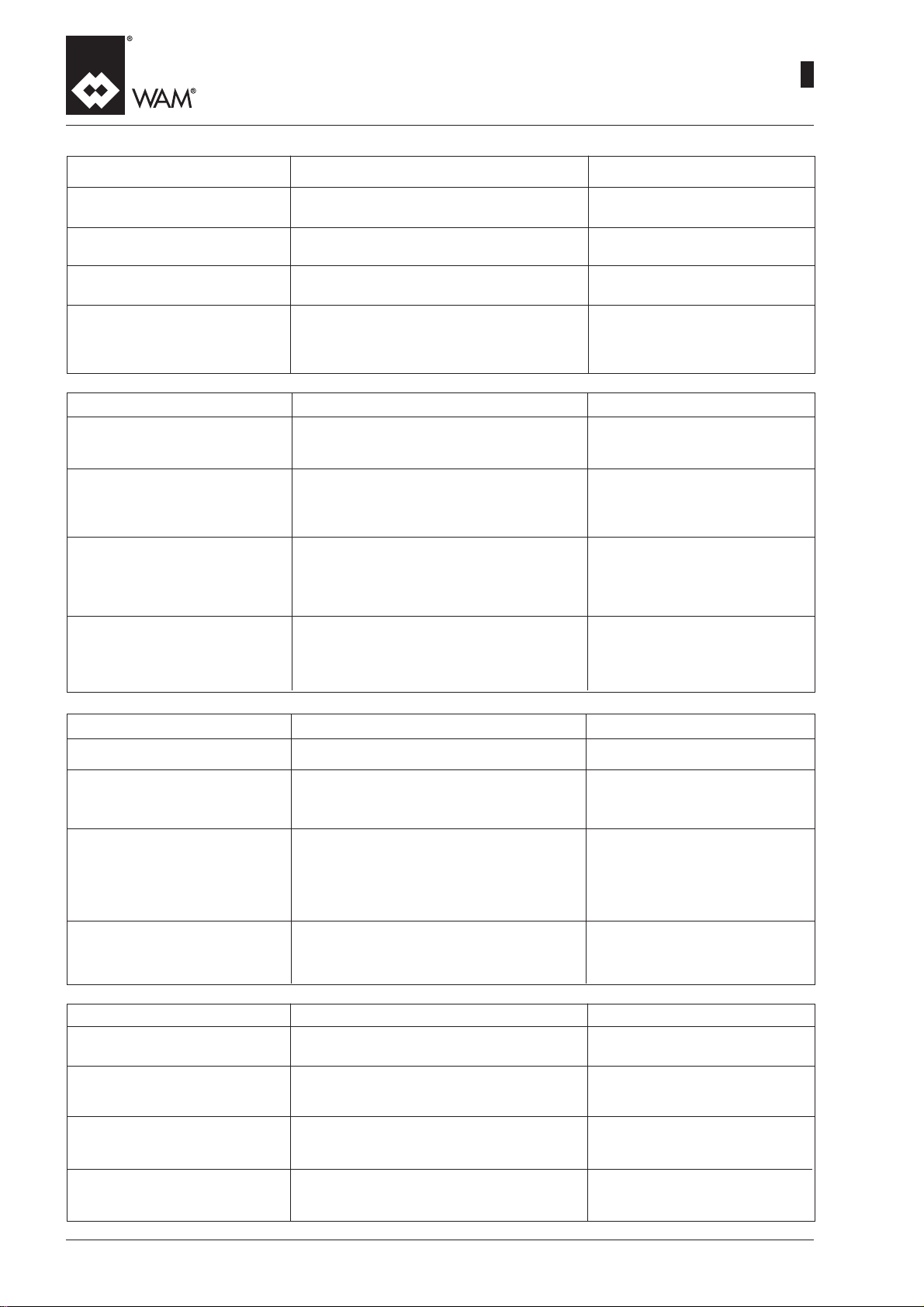
FAULT
Metering screw damaged
Metering screw stops
Rotating components unscrewed (no
material flow)
Sticking of higroscopic products
Agglomeration of viscose materials
Contamination of the product
STÖRUNG
Beschádigung des
Dosierwerkzeugs
Blockierung des
Dosierwerkzeugs
Dosierwerkzeug hat sich
gelöst, keine Dosierung
POSSIBLE REASON
Foreign body entered
Hygroscopic material inside feeder has absorbed humidity
Faulty motor wiring
Long period of inactivity.
MÖGLICHE URSACHE
Eindringen von Fremdkörpern.
Verkleben von hygroskopischen Produkten bei längerer
Verweilzeit.
Viskose oder zum Anbacken neigende Medien mit hierfür
ungeeigneten Werkzeugen.
E-Motor falsch angeschlossen.
ACTION
Remove foreign body and replace damaged
components.
Use ribbon flight with internal pipe.
Rewire (metering screw must turn
anticlockwise viewed from behind drive unit)
Unload feeder completely when not used for
longer periods
ABHILFE
Fremdkörper entfernen und beschädigte Teile
austauschen.
Bei längeren Stilistandzeiten Gerät leeren.
Geeignetes Dosierwerkzeug mit Innenrohr
verwenden.
E - Motor umklemmen; stellt man sich hinter
den Antrieb, muß sich das Dosierwerkzeug
gegen den Uhrzeigersinn drehen.
Kompression hygroskopischer Medien
Verklumpen viskoser Medien
Produktkontamination
PROBLEME
Défaut sur hélice ou rotor
Blocage des hélices ou rotor
Dévissage organes roulants
Absence de flux
Compression de produits hygroscopiques
Colmatage de produits visqueux
Contamination de produits périssables
PROBLEMA
Attorcigliamento elica
Blocco elica
Svitamento organi rotanti, assenza di
flusso.
Impaccamento prodotti igroscopici.
Solidificazione prodotti viscosi.
Contaminazione prodotti deperibili
Längere Stillstandzeiten.
CAUSE POSSIBLE
Pénétration de corps étrangers dans la machine.
Empàtement de produits hygroscopiques
demeurant dans la machine en milieux humides.
Produits visqueux ou compressés traités au
moyen de doseurs non adaptés.
Connexion erronée des moteurs électriques.
Périodes d’inactivité.
POSSIBILE MOTIVO
Penetrazioni di corpi estranei entro la macchina.
Appesantimento dei materiali igroscopici che permangono
entro la macchina in ambienti umidi.
Prodotti viscosi e impaccanti.
Erroneo collegamento delle fasi dei motori elettrici.
Periodi di inattività.
Bei längeren Stilistandzeiten das Gerät
leeren.
SOLUTION
Retirer le corps étranger, remplacer
les éléments endommagés.
Toujours vider la machine en cas
de longues périodes de non utilisation
Utiliser des doseurs adaptés avec tube
interne.
Inversion de phases des moteurs
: un observateur au chargement voit
l’instrument de dosage tourner dans le
sens trigonométrique.
Vider la machine en prévision de longues
périodes d’inactivité.
SOLUZIONE
Rimuovere il corpo estraneo; sostituire gli
elementi danneggiati.
Svuotare sempre la macchina in caso di
lunghi periodi di non utilizzo.
Utilizzare utensili idonei.
Inversioni fasi dei motori: un osservatore al
carico vede l’utensile di dosaggio ruotare in
senso antiorario.
Svuotare la macchina in previsione di lunghi
periodi di inattività.
Page 19

MBW
OPERA TION AND MAINTENANCE
-
-
BETRIEBS- UND W ARTUNGSANLEITUNG
UTILISA TION ET ENTRETIEN
-
-
USO E MANUTENZIONE
02.01 /
01.10
2
VAL.064.--.M.4L 19
List of hazards
Gefährdungsliste
Liste des risques
Lista dei rischi
Safety Measures
Sicherheitsmaßnahmen
Consignes de sécurité
Misur e di sicu rezza
Norm Reference
Bezugsnormen
Normes d e réfé renc e
Norme di Riferimento
Operating Instruction Ref.
Bez. Betr iebs an leitung
Réf. instructions de
fonctionnement
Rif. istruzioni op e r a t iv e
1. Mechanical Hazards - Mechanische Gefährdungenen - Risques mécaniques - Rischi meccanici
Protection (grid, robust flexible sock...) to
Crushing - Quetschen
1.1
Ecrasement - Schiacciamento
Sheari ng - Scheren
1.2
Troncature - Troncamento
Cutting - Schneiden
1.3
Coupe - Taglio
En tang lem ent
1.4
Erfassen - Aufwickeln
Entortillement Attorcigliamento
Drawing-in - Trapping
Einziehen - Fangen
1.5
Entra înement - E nca strement
Trascinamento - Intrappolamento
Impa c t - Stoß
1.6
Impa c t - Impatto
keep the valve out of reach of the
personnel.
If the protection is movable a limit switch
has to be fi tte d to st op the valve i f the
protection is removed.
Sch utzvorrich tunge n (Gitter, robus te
Verbindungsmanschetten etc.) um zu
verhindern, daß das
Bedienungspersonal mit beweglichen
Klappenteilen in Kontakt kommt. Bei
beweglichen Schutzvorrichtungen ist ein
Endschalter vorzusehen, der die Klappe
abschaltet, sobald die
Schutzvorrichtung entfernt wird.
Protection (grille, manchon flexible
robuste etc.) pour éviter que le personnel
entre en contact avec les pièces mobiles
de la vanne. Si la protection est mobile,
un dispositif de fin de course doit être
installé qui arrête la vanne au moment où
la protection est enlevée.
Protezione (griglia, robusto calzone
fless ibi le ecc...) onde evi tare che il
personale entri in co ntatto con le parti
mobi li dell a valvol a. Con protezioni
mobili occorre installare un dispositivo
fi n e co r sa c h e ar r es ti l a v a l vo l a a l
mom ento in cui la prote zione vien e
rimossa.
EN 292 - 1
EN 294
EN 349
02520 M.7
Stabbing - puncture
Stich
1.7
Perforation - perçage
Perfo r azi one - fo rat ura
Friction - abrasion
Rei bu ng - Abr ieb
1.8
Frottement - abrasion
Fri zio ne - ab ra s i one
Not applicable - Nicht anwendbar
Non applicable - Non applicabile
High pressure fluid injection
Flüssigkeiten u nte r Druck
1.9
Injection de fluide à haute pression
Iniezione fluido ad alta pressione
Ejection of parts
Ausstoßung von Teilen
1.10
Ejection des pièces
Espul si one di pezzi
Fix correctly the machine to the
ground or to a strong structure
Di e ma schin e am Bod en oder an
Loss of stability
Stabilitätsverlust
1.11
Perte de stabilité
Perdita di stabilità
einer soliden Struktur richtig
verankern
EN 292-1 02520 M.7
Ancrer correctement la machine au
sol ou à une structure solide
Anc orare correttamente la
macchina al suolo o a una
struttu ra s o li da
Slip Trip and fall
Rutschen od er Fa l le n
1.12
Glissement et chute
Not applicable - Nicht anwendbar
Non applicable - Non applicabile
Scivolamento e caduta
Residual Risk
Restrisiken
Risque résiduel
Rischio residuo
NO - NEIN
NON - NO
NO - NEIN
NON - NO
Page 20
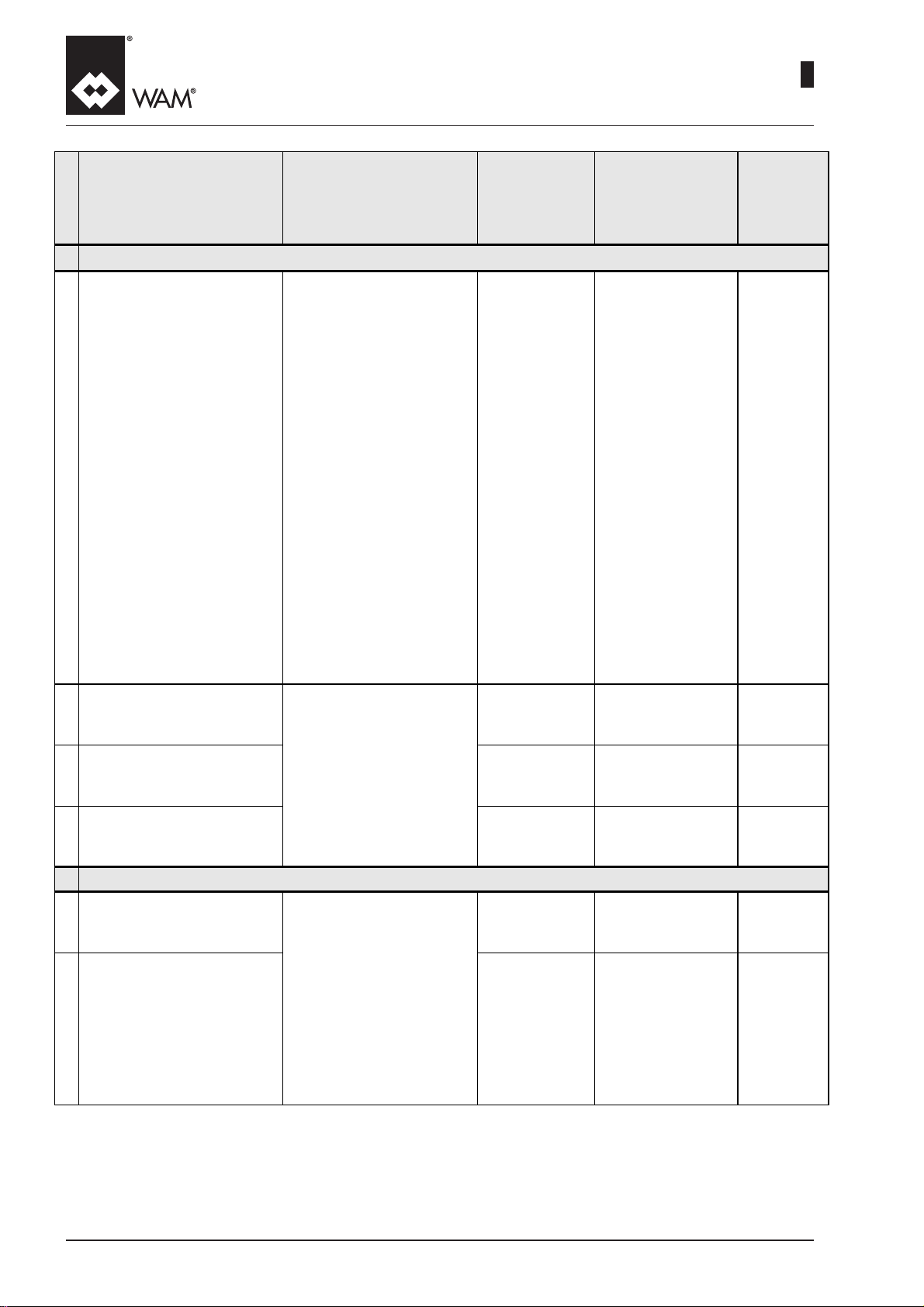
MBW
-
OPERATION AND MAINTENANCE
BETRIEBS- UND WARTUNGSANLEITUNG
-
-
UTILISATION ET ENTRETIEN
-
USO E MANUTENZIONE
01.10
02.01 /
VAL.064.--.M.4L
2
20
Norm Reference
List of hazards
Gefährdungsliste
Liste des risques
Lista dei rischi
2. Electrical Hazard - Elektrisch e Gefährdungen - Risques électriques - Risch i elettrici
Minimum protection of terminal box is IP
55 and suitable thermal fuse for the
electrical motors has to be fitted.
Only qualified personnel has to work on
electrical connections.
Die kleinste Schutzart der
Abzwe igd ose be trägt IP 55 und für die
Elektromotoren sind geeignete
thermosicherungen zu installieren.
Die elektrischen Arbeiten dürfen
ausschließlich durch qualifiziertes
Personal a us ge führt werden.
Electrical contact
Elektrischer Kontakt
2.1
Contact électrique
Contatto e l ettr ico
Electrostatic phenomena
Elektrostatische Erscheinungen
2.2
Phénomènes électrostatiques
Fenomeni elettrostatici
Thermal radi ation
Wärmestrahlung
2.3
Radiation thermique
Radiazione termica
External influence on equipment
Äußere E i n wirkungen auf die Geräte
2.4
Influence extérieure sur les appareillages
Influenza esterna sul le apparecchiature
3. Thermal H azard s - Thermische Gefährdungen - Risqu e s the rmique s - Rischi termici
Burns and scalds
Verbrennunge n un d Bra nwunden
3.1
Brûlures et lésions
Brucia ture e us tio ni
Health -damaging effects by hot/cold
environment
Gesundhe i tsschä dl iche Aus wirkungen
infolg e warmer/kalter Um ge bu ng en
3.2
Effe ts nocifs pour la santé dus a ux
environnement chauds/froids
Effetti dannosi pe r la sal u te dov uti ad
ambienti caldi/freddi
La protection minimum du boîtier de
dérivation est IP 55 et il faut prévoir des
fusibles thermiques appopriés pour les
mo te ur s élect riques.
Les opérations concernant les
raccordements électriques doivent être
réalisés exclusivement par du
personnel qualifié.
La protezione m ini m a de ll a s catola d i
derivazione è IP 55 ed è necessario
installare adeguati fusibili termici per i
motor i el ettr ici.
Le operazi oni riguardanti i
collegamenti elettrici devono essere
esegu ite esc lusiv ament e da pers onale
qualificato.
Not applicable - Ni ch t anwendbar
Non applicable - Non applicabilee
Not applicable - Ni ch t anwendbar
Non applicable - Non applicabile
Safety Measures
Sicherheitsmaßnahmen
Consignes de sécurité
Misure di sicurezza
Bezugsnormen
Normes de
référence
Norme di
Riferimento
EN 292-1
Operating Instruction Ref.
Bez. Betriebsanleitung
Réf. instructions d e
fonctionnement
Rif. istruzioni operative
02520 M.8
02520 M.9
Residual Risk
Restrisiken
Risqu e rés idu el
Rischio residuo
NO - NEIN
NON - NO
Page 21
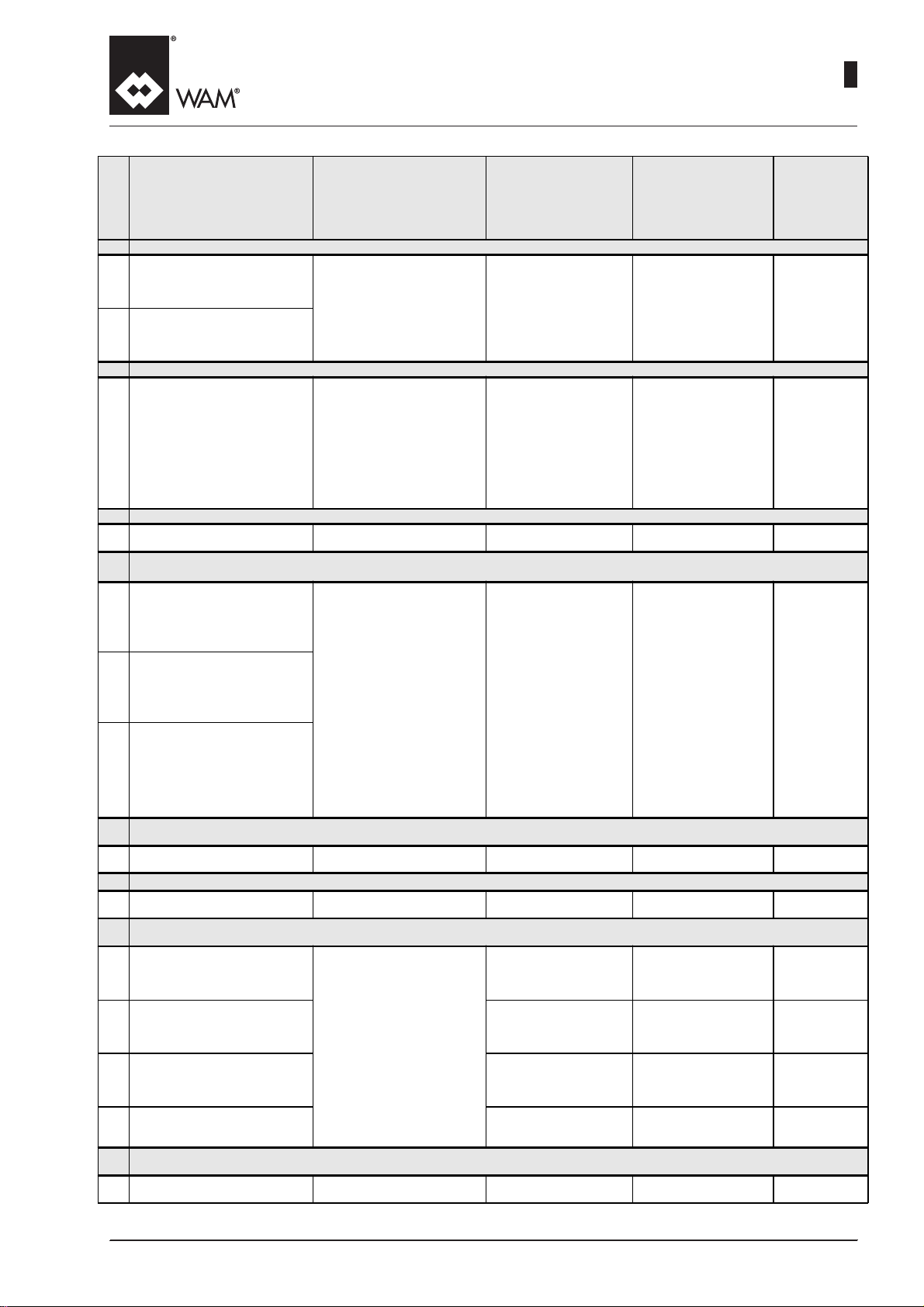
MBW
OPERA TION AND MAINTENANCE
-
-
BETRIEBS- UND W ARTUNGSANLEITUNG
UTILISA TION ET ENTRETIEN
-
-
USO E MANUTENZIONE
02.01 /
01.10
2
VAL.064.--.M.4L 21
List of hazards
Gefährdungsliste
Liste des risques
Lista dei rischi
4. Hazard generated by noise - Gefährdungen durch Lärm - Risque dérivant de la pollution acoustique - - Rischio da inquinamento acustico
Hearing losses
Gehörverlust
4.1
Pertes de l'ouïe
Perdi te dell'udi to
Interference with speech
Verständigungsschwierigkeiten
4.2
Difficulté de communication
Difficoltà di com u nicazione
5. Hazard generated by vibration - Gefährdungen durch Schwingungen - Risque dû aux vibrations - Rischio dovuto alle vibrazioni
6. Radiation Hazard s - Gefährdungen durch Strahlung - Risques de radiation - Risch i di ra dia zi one
7.
Conta c t o r inha la tion
Berühren od er E inatme n
7.1
Contact ou inhalation
Contatto o in al a zione
Fire and explosion
Brand od er Ex pl o s i on
7.2
Incendie et explosion
Incendio ed esplosione
Biological (viral/bacterial)
Biol o gisch (durch V iren/Bakterie n)
7.3
Biologique (viral/bactérien)
Biol o gico (virale/batterico)
8.
9. Hazards combinatio n - Kombination der Gefährdungen - Combinaison de risques - Co mbinazio ne di r is ch i
10.
Failure of energy supply
Störung im Versorgungs ne tz
10.1
Panne dans le secteur d'alimentation
Guasto nella rete di al ime ntazione
Unexpected ejection of parts
Unerwartetes Ausstoße n v on Teil en
10.2
Ejection inattendue de pièces
Espul s ion e i n as pe ttata di pe zzi
Failure of control system
Störung des Steuersystems
10.3
Avarie du système de contrôle
Avaria de l sistema di controllo
Errors of fitting - Passungsfehler
10.4
Erreurs d'accouplement - E rrori di
accoppiamento
11.
H.generated by neglecting ergonomic principles - Gefährdungen durch die Nichtbeachtung der ergonomischen Richtlinien
Risqu es d u s à l'inob s erv ation d e s p rinc ipes er g onomiques - Rischi dovu t i a ll'inos se rvanza dei princi pi er gonom ic i
Risques produits par une panne du secteur d'alimentation - Rischi generat i da un guasto ne lla rete di alimentazione
H. generated by missing of safety related measures - Gefährdungen durch die Nichtbeachtung der entsprechenden Sicherheitsnaßnahmen
Risques dus à l'absence de mesures concernant la sécurité - Rischi dovuti alla mancanza di misure legate alla sicurezza
Hazards generat ed b y materials processe d - Gefähr dungen duch die behandelten Materialien
H. generated by failure of energy supply - Gefährdungen durch eine Störung der Energieversorgung
Safety Me a s ures
Sicherheitsmaßnahmen
Consignes de sécurité
Misure di sicurezza
Not applicable - Ni c ht anwendbar
Non applicable - Non applica bile
Fix correctly the machine to a
strong structure
Die maschine am Boden oder an
einer sol i de n Struktur richtig
verankern
Ancrer correctement la machine au
sol ou à une structure solide
Ancora re corre ttame n te la
macchina al suolo o a una
struttura so lid a
Not applicable - Ni c ht anwendbar
Non applicable - Non applica bile
Risques dus aux matériaux traités - Rischi dovu t i ai m at e ria li trattati
For such a kind of materials the
plant manufacturer and/or the
installator has to fit suitable special
device
Für diese Art Material ist der
Anla ge nherstelle r ode r de r
Installateurangehalten, passende
Spezialeinrichtungen
bereitzustellen.
Pour ce type de matériaux le
constructeur de l'insta lla tion ou le
personnel responsable est tenu de
prévoir des dispositifs spéciaux.
Per questo tipo di materiali i l
costruttore dell'i mpia nto o
l'addetto al l 'install a zione è te nu to
a predisp orre op po rtuni d i sp os i tivi
speciali
Not applicable - Ni c ht anwendbar
Non applicable - Non applica bile
Not applicable - Ni c ht anwendbar
Non applicable - Non applica bile
Not applicable - Ni c ht anwendbar
Non applicable - Non applica bile
Not applicable - Ni c ht anwendbar
Non applicable - Non applica bile
Norm Reference
Bezugsnormen
Normes d e réfé rence
Norme di Riferimento
EN 292-1 02520 M.9
EN 292-1
Operating Instruction Ref.
Bez. Betr i e b sanle i tun g
Réf. instructions d e
fonctionnement
Rif. istruzioni operative
02520 T.6
02520 M.4
Residual Risk
Restrisiken
Risque résiduel
Rischio residuo
NO - NEIN
NON - NO
NO - NEIN
NON - NO
Page 22

MBW
-
OPERATION AND MAINTENANCE
BETRIEBS- UND WARTUNGSANLEITUNG
-
-
UTILISATION ET ENTRETIEN
-
USO E MANUTENZIONE
01.10
VAL.064.--.M.4L
2
22
M) CHECK LIST IN CASE OF
TROUBLE
GENERAL QUESTIONS
a) Does metering screw start
without pronblems even after longer down periods?
b) Does it seem that atmospheric
conditions contribute to malfunctioning?
c) Feeder must work in per-
fectly horizontal position.
d) Outlet must be free.
HOPPER CHECK
a) Hopper capacity must be
less than 100 litres.
b) Is hopper equipped with
bridge breaking deflector?
c) Is hopper equipped with flu-
idization, vibrator or knocker?
ELECTRIC MOTOR CHECK
a) Are voltage drops possible
due to contemperary starting of different machines ?
b) Is the plant equipped with a
power generator ?
c) Check if motor receives
power.
d) Check motor is correctly con-
nected and wires are fixed
properly to terminals.
e) Check power cut-out in main
controls is correctly set and
compare to motor plate data.
f) Check correct sense of ro-
tation of electric motor.
MICRO-BATCH FEEDER CHECK
a) Does material stick to meter-
ing screw?
b) Are there any lumps of mate-
rial hindering material transport?
c) Is the tecnopolymer body
damaged?
d) Ensure shaft seals do not
loose material.
e) During transport metering
screw must not touch feeder pipe.
MATERIAL CHECK
a) Material description?
b) Bulk density? (kg/dm3)
c) Particle size? (μm/mm)
d) Humidity? (%)
e) Flowability? (make material
slide down a metal plate by
varying the angle from low
to steep)
f ) Compressible material? (can
you make a “snowball”?)
g) Abrasive material? (does it
hurt when rubbing it between fingers?).
M) CHECKLISTE BEI
BETRIEBSSTÖRUNGEN
ALLGEMEINE FRAGEN
a) Läuft Dosierwerkzeug auch
nach längeren Betriebsunterbrechungen problemlos
an?
b) Scheint Fehlfunktion durch
Witterung begünstigt?
c) Gerät muß sich in exakt ho-
rizontaler Lage befinden.
d) Auslauf muß frei sein.
KONTROLLE DES TRICHTERS
a) Trichterinhalt muß weniger
als 100 l betragen.
b) Ist Trichter mit Entlastungs-
vorrichtung ausgestattet?
c) Ist Trichter mit Luftauflocke-
rung, Rüttler oder Klopfer
ausgestattet?
KONTROLLE E-MOTOR
a) Sind aufgrund gleichzeitigen
Einschaltens mehrerer Geräte Spannungsschwankungen möglich?
b) Ist Anlage mit einem Strom-
generator ausgerüstet?
c) Prüfen, ob am Motor Strom
anliegt.
d) Prüfen, ob Motor korrekt ange-
schlossen ist und ob Klemmenmuttern fest angezogen sind.
e) Prüfen, ob Überstromschal-
ter des Motors in der Hauptsteuerung richtig eingestellt ist
und mit Typenschilddaten
vergleichen.
f) Motordrehrichtung prüfen.
KONTROLLE DES MIKRO-DOSIERERS
a) Haftet Dosiergut am Dosier-
werkzeug?
b) Behindern Produktklumpen
die Dosierung?
c) Ist der polymerverkleidung
beschädigt?
d) Sicherstellen, daß durch die
Wellenabdichtungen kein
Produkt austritt.
e) Während der Dosierung darf
das Dosierwerkzeug das
Förderrohr nicht berühren.
PRÜFUNG DES DOSIERGUTS
a) Materialbezeichnung?
b) Schüttgewicht? (kg/dm3)
c) Körnung? (μm/mm)
d) Feuchte? (%)e)
Fließfähigkeit?(Materialprobe
auf einem geneigten Blech
zum Fließen bringen)
f ) Komprimierbarkeit? (Kann ein
“Schneeball” geformt werden?)
g) Abrasivität? (Schmerzt es,
wenn man Material zwischen
den Fingern reibt?)
M) CHECK-LIST EN CAS DE VIS
EN PANNE
DEMANDES GENERALES
a) L’outil de dosage démarre sans
problèmes même après des
longues périodes d’inactivité?
b) Il semble que les conditions
atmosphériques contribuisent
au malfonctionnement?
c) Il faut que le doseur travaille
de manière parfaitement horizontal.
d) Il faut que la bouche de sortie
soit libre.
CONTROLE DE LA TREMIE
a) La trémie doit être plus petite
que 100 litres.
b) La trémie est équipée d’un
déflecteur casse-voûte?
c) La trémie est équipée d’un sys-
tème de fluidification, d’un vibrateur ou d’un percuteur?
CONTROLE MOTEUR ELECTRIQUE
a) Est-ce qu’il y a la possibilité de
variations de courant d’alimentation à cause d’un démarrage
de divers appareils au même
temps?
b) L’installation est équipée d’un
générateur de courant?
c) Contrôler si le moteur reçoit
du courant!
d) Contrôler si le moteur est con-
necté correctement et si les fils
sont fixés bien aux bornes.
e) Contrôler le réglage thermi-
que du moteur dans le pupitre général et le confronter
avec les données sur la plaque du moteur.
f) Vérifier que le sens de rota-
tion du moteur électrique soit
correct!
CONTROLE DU MICRODOSEUR
a) Le matériau a adhéré à l’outil
de dosage?
b) Est-ce qu’il y a des blocs de
matériau qui obstruisent le dosage?
c) Est-ce que le corps en poly-
mèr technique est ruiné?
d) S’assurer que les joints d’étan-
chéité ne perdent pas de matériau.
e) Durant le transport l’outil de
dosage ne doit pas toucher le
tube de décharge
3) CONTROLE DU MATERIAU
a) Désignation du matériau
b) Densité? (kg/dm
c) Granulométrie? (μm/mm)
d) Humidité? (%)
e) Fluidité? (faites couler le ma-
tériau sur une tôle en augmentant l’inclinaison de lamême)
f) Compressibilité? (est-il possible
de faire une “boule de neige”?)
g) Abrasivité? (est ce qu’il fait
mal quand on frotte le matériau dans les doigts?).
3
)
M) CHECK-LIST IN CASO DI
GUASTO
DOMANDE GENERALI
a) L’utensile di dosaggio parte
senza problemi anche dopo
lunghi periodi di sosta?
b) Pare che le condizioni atmo-
sferiche contribuiscano al
malfunzionamento?
c) La macchina deve lavorare
in modo perfettamente orizzontale.
d) La bocca di scarico deve es-
sere libera.
CONTROLLO
DELLA TRAMOGGIA
a) La tramoggia deve essere in-
feriore a 100 litri.
b) La tramoggia è equipaggiata
con un deflettore rompiponte?
c) La tramoggia è equipaggiata
con un impianto di fluidificazione, di un vibratore o martellatore?
CONTROLLO MOTORE ELETTRICO
a) Sono possibili sbalzi di cor-
rente di alimentazione a causa dell’avviamento contemporaneo di diverse macchine?
b) L’impianto è equipaggiato con
un generatore di corrente?
c) Controllare se il motore rice-
ve corrente!
d) Controllare se il motore è col-
legato correttamente e se i fili
sono fissati bene ai morsetti!
e) Controllare la regolazione della
termica del motore nel quadro
generale e confrontarla con i
dati sulla targhetta del motore!
f ) Verificare il giusto senso di ro-
tazione del motore elettrico!
CONTROLLO DEL MICRODOSATORE
a) Il materiale si è attaccato al-
l’elica di dosaggio?
b) Ci sono dei blocchi di materiale
che ostruiscono il trasporto?
c) Il corpo in tecnopolimero si è
rovinato?
d )Accertarsi che le tenute non
perdano materiale.
e) Durante il trasporto l’elica non
deve toccare il tubo di scarico
CONTROLLO DEL PRODOTTO
a) denominazione del prodotto?
b) densità? (kg/dm3)
c) granulometria? (μm/mm)
d) umidità? (%)
e) scorrevolezza?
(fare scorrere il materiale su
una lamiera aumentando lentamente l’inclinazione!)
f) comprimibilità ( è possibile
fare una “palla di neve”?)
g) abrasività ? (fa male quando si
sfrega il prodotto tra le dita?).
Page 23
DECLARATION OF CONFORMITY
OPERA TION AND MAINTENANCE
-
KONFORMITÄTSERKLÄRUNG
-
MBW
Powder Handling - Dust Filtration - Flow Control - Components
BETRIEBS- UND W ARTUNGSANLEITUNG
DECLARA TION DE CONFORMITE
UTILISA TION ET ENTRETIEN
-
-
DICHIARAZIONE DI CONFORMIT A’
USO E MANUTENZIONE
The manufacturer:
WAMGROUP S.p.A.
located in
Strada degli Schiocchi, 12 - I-41100 Modena (Mo) - Italy
under its own responsibility declares that:
MBW
Declaration Of Incorporation Of Partly Completed Machinery Annex II B 2006/42/CE Directive
01.10
2
VAL.064.--.M.4L 23
comply with the RES Directive 2006/42/EC
of the European Parliament and the Council of 17 May 2006 on machinery
1.1.1. - Defi nitions
1.1.2. - Principles of safety integration
1.1.3. - Materials and products
1.1.5. - Design of machinery to facilitate its handling
1.3.1. - Risk of loss of stability
1.3.2. - Risk of break-up during operation
1.3.3. - Risks due to falling or ejected objects
1.3.4. - Risks due to surfaces, edges or angles
1.3.7. - Risks related to moving parts
1.3.8. - Choice of protection against risks arising from moving parts
1.3.9. - Risks of uncontrolled movements
1.5.4. - Errors of fi tting
1.5.5. - Extreme temperatures
1.5.6. - Fire
1.5.7. - Explosion
1.5.8. - Noise
1.5.9. - Vibrations
1.5.13. - Emissions of hazardous materials and substances
1.5.15. - Risk of slipping, tripping or falling
1.6.1. - Machinery maintenance
1.6.2. - Access to operating positions and servicing points
1.6.4. - Operator intervention
1.6.5. - Cleaning of internal parts
1.7.1. - Information and warnings on the machinery
1.7.2. - Warning of residual risks
1.7.4. - Instructions
and, where applicable, the requirements imposed by the following EC Directives
Directive 2004/108/EC of the European Parliament and the Council of 15 December 2004 on the approximation of the laws
of the Member States relating to electromagnetic compatibility.
Directive 2006/95/EC of the European Parliament and the Council of 12 December 2006 on the approximation of the laws
of the Member States relating to electrical equipment designed for use within certain voltage limits
The relevant technical documentation is compiled in accordance with Annex VII B
of the Machinery Directive 2006/42/EC
Harmonized standards, national standards and technical regulations in question:
EN ISO 12100-1: 2005 EN ISO 12100-2: 2005
.
The signing company is committed to provide, in response to a reasoned request by national authorities, relevant information on products covered by this declaration, without prejudice to the rights of intellectual property of the manufacturer. The
information will be transmitted directly to the national authorities having requested.
It’s forbidden to operate all these products before the machine, in which they will be installed, is declared in conformity with 2006/42/EEC AND SUBSEQUENT AMENDMENTS
Strada degli Schiocchi, 12 - I-41100 Modena (Mo) - Italy, 01.01.2010
The person authorized to provide
the technical documentation:
Vainer Marchesini
WAMGROUP S.p.A. - Strada degli Schiocchi, 12 - I-41100 Modena (Mo) - Italy
The legal representative:
Vainer Marchesini
Page 24

MBW
r
r
Powder Handling - Dust Filtration - Flow Control - Components
Strada degli Schiocchi, 12 - I-41100 Modena (Mo) - Italien
erklärt unter eigener Verantwortung wie folgt:
EINBAUERKLÄRUNG für unvollständige Maschinen gem. Anhang II B der MRL 2006/42/EG
DECLARATION OF CONFORMITY
-
OPERATION AND MAINTENANCE
KONFORMITÄTSERKLÄRUNG
BETRIEBS- UND WARTUNGSANLEITUNG
-
DECLARA TION DE CONFORMITE
-
UTILISATION ET ENTRETIEN
-
DICHIARAZIONE DI CONFORMITA ’
USO E MANUTENZIONE
Der Hersteller:
WAMGROUP S.p.A.
mit Sitz in
MBW
01.10
VAL.064.--.M.4L
2
24
Diese Produkte entsprechen den Anforderungen der Maschinenrichtlinie 2006/42/EG
des europäischen Parlamentes und des Rates vom 17. Mai 2006
1.1.1. - Begriffsbestimmungen
1.1.2. - Grundsätze für die Integration der Sicherheit
1.1.3. - Materialien und Produkte
1.1.5. - Konstruktion der Maschine im Hinblick auf die Hanhabung
1.3.1. - Risiko des Verlustes der Standsicherheit
1.3.2. - Bruchrisiko beim Betrieb
1.3.3. - Risiken durch herabfallende oder herausgeschleuderte Gegenstände
1.3.4. - Risiken durch Oberfl ächen, Kanten und Ecken
1.3.7. - Risiken durch bewegliche Teile
1.3.8. - Wahl der Schutzeinrichtungen gegen Risiken durch bewegliche Teile
1.3.9. - Risiko unkontrollierter Bewegungen
1.5.4. - Montagefehler
1.5.5. - Extreme Temperaturen
1.5.6. - Brand
1.5.7. - Explosion
1.5.8. - Lärm
1.5.9. - Vibrationen
1.5.13. - Emission gefährlicher Werkstoffe und Substanzen
1.5.15. - Ausrutsch-, Stolper- und Sturzrisiko
1.6.1. - Wartung der Maschine
1.6.2. - Zugang zu den Bedienungsständen und den Eingriffspunkten für die
Instandhaltung
1.6.4. - Eingriffe des Bedienungspersonals
1.6.5. - Reinigen innen liegender Maschinenteile
1.7.1. - Informationen und Warnhinweise an der Maschine
1.7.2. - Warnung vor Restrisiken
1.7.4. - Betriebsanleitung
Wo anwendbar wurden die Anforderungen folgender EG Richtlinien erfüllt
Richtlinie 2004/108/EG des Europäischen Parlaments und des Rates vom 15. Dezember 2004 zur Angleichung de
Rechtsvorschriften der Mitgliedstaaten über die elektromagnetische Verträglichkeit.
Richtlinie 2006/95/EG des Europäischen Parlaments und des Rates vom 12. Dezember 2006 zur Angleichung de
Rechtsvorschriften der Mitgliedstaaten betreffend elektrische Betriebsmittel zur Verwendung innerhalb bestimmter Spannungsgrenzen.
Die speziellen technischen Unterlagen gem. Anhang VII B der MRL 2006/42/EG wurden erstellt.
Folgende harmonisierte Normen, nationale Normen und technische Vorschriften fanden Anwendung:
EN ISO 12100-1: 2005 EN ISO 12100-2: 2005
Das ausstellende Unternehmen ist verpfl ichtet, die technischen Unterlagen für diese Produkte auf begründetes Verlangen
den Marktaufsichtsbehörden, unbeschadet der Rechte am geistigen Eigentum des Herstellers, zur Verfügung zu stellen.
Die Unterlagen werden direkt an die anfordernde Behörde gesandt.
Es ist verboten diese Produkte in Betrieb zu nehmen, bevor die Maschine, in welche diese eingebaut werden, den
Anforderungen der MRL entspricht und die EG Konformitätserklärung gem. MRL 2006/42/EG und nachfolgenden
Änderungen vorliegt.
Strada degli Schiocchi, 12 - I-41100 Modena (Mo) - Italien, 01.01.2010
Bevollmächtigter für die Zusammenstellung
der relevanten Technischen Unterlagen:
Vainer Marchesini
WAMGROUP S.p.A. - Strada degli Schiocchi, 12 - I-41100 Modena (Mo) - Italien
Für den Hersteller:
Vainer Marchesini
Page 25

01.10
MBW
Powder Handling - Dust Filtration - Flow Control - Components
DECLARATION OF CONFORMITY
OPERA TION AND MAINTENANCE
-
KONFORMITÄTSERKLÄRUNG
-
BETRIEBS- UND W ARTUNGSANLEITUNG
DECLARATION DE CONFORMITE
UTILISA TION ET ENTRETIEN
-
-
DICHIARAZIONE DI CONFORMITA ’
USO E MANUTENZIONE
VAL.064.--.M.4L 25
Le fabricant:
WAMGROUP S.p.A.
son siège social à
Strada degli Schiocchi, 12 - I-41100 Modena (Mo) - Italie
déclare sous sa propre responsabilité que
les machines type MBW
Déclaration d’Incorporation des machines partiellement construites - Directive 2006/42/CE Annexe II B
2
sont en conformité avec la Directive RES 2006/42/EC
du Parlement Européen et du conseil du 17 mai 2006 sur les machines
1.1.1. - Defi nitions
1.1.2. - Principes d’intégration en sécurité
1.1.3. – Matériels et produits
1.1.5. – Conception des machines pour faciliter leur manipulation
1.3.1. – Risque de perte de stabilité
1.3.2. – Risque de casse pendant fonctionnement
1.3.3. – Risques causés par la chute ou l’éjection d’objets
1.3.4. – Risques liés aux surfaces, aux bords et aux angles
1.3.7. – Risques liés aux pièces en mouvement
1.3.8. – Choix de protection contre les risques résultant de pièces mobiles
1.3.9. – Risques de mouvements non désirés
1.5.4. – Erreurs de montage
1.5.5. – Températures extrêmes
1.5.6. – Feu
1.5.7. – Explosion
1.5.8. – Bruit
1.5.9. – Vibrations
1.5.13. – Emission de matières et substances dangereuses
1.5.15. – Risque de glisser, trébucher ou tomber
1.6.1. – Maintenance des machines
1.6.2. – Accès aux postes de travail et aux points d’intervention
1.6.4. – Intervention de l’opérateur
1.6.5. – Nettoyage des parties internes
1.7.1. – Informations et avertissements sur la machine
1.7.2. – Avertissements sur les risques résiduels
1.7.4. – Notices de fonctionnement
et, quand applicable, avec les exigences imposées par les directives européennes suivantes
La Directive 2004/108/CE du Parlement européen et du Conseil du 15 Décembre 2004 sur le rapprochement des législations des États membres concernant la compatibilité électromagnétique.
La Directive 2006/95/CE du Parlement européen et du Conseil du 12 Décembre 2006 sur le rapprochement des législations
des États membres concernant le matériel électrique destiné à être employé dans certaines limites de tension.
La documentation technique appropriée est constituée conformément à l’annexe
VII B de la Directive Machines 2006/42/CE
Les normes harmonisées, les normes et règles techniques nationales en question:
EN ISO 12100-1: 2005 EN ISO 12100-2: 2005
La société signataire s’engage à fournir, en réponse à une demande motivée par les autorités nationales, toute information sur les produits couverts par cette déclaration, sans préjudice des droits de propriété intellectuelle du fabricant. Les
informations seront transmises directement aux autorités nationales demanderesses.
Il est interdit d’utiliser tous ces produits avant que la machine, dans laquelle ils seront installés, soit déclarée
conforme à la Directive 2006/42/CEE et ses amendements successifs.
Strada degli Schiocchi, 12 - I-41100 Modena (Mo) - Italie, 01.01.2010
La personne autorisée à fournir
la documentation technique:
Vainer Marchesini
WAMGROUP S.p.A. - Strada degli Schiocchi, 12 - I-41100 Modena (Mo) - Italie
Le représentant légal:
Vainer Marchesini
Page 26

01.10
2
26
MBW
Powder Handling - Dust Filtration - Flow Control - Components
-
OPERATION AND MAINTENANCE
DECLARATION OF CONFORMITY
BETRIEBS- UND WARTUNGSANLEITUNG
-
KONFORMITÄTSERKLÄRUNG
-
UTILISATION ET ENTRETIEN
DECLARA TION DE CONFORMITE
-
USO E MANUTENZIONE
DICHIARAZIONE DI CONFORMIT A ’
VAL.064.--.M.4L
Il sottoscritto fabbricante:
WAMGROUP S.p.A.
con sede legale in
Strada degli Schiocchi, 12 - I-41100 Modena (Mo) - Italia
dichiara sotto la propria responsabilità che:
le quasi macchine serie MBW
ai sensi dell’Allegato II B della Direttiva Macchine 2006/42/CE (DICHIARAZIONE DI INCORPORAZIONE)
risultano conformi ai RES della Direttiva 2006/42/CE
del Parlamento Europeo e del Consiglio del 17 maggio 2006 relativa alle macchine
1.1.1. - Defi nizioni
1.1.2. - Principi di integrazione della sicurezza
1.1.3. - Materiali e prodotti
1.1.5. - Progettazione della macchina ai fi ni della movimentazione
1.3.1. - Rischio di perdita di stabilità
1.3.2. - Rischio di rottura durante il funzionamento
1.3.3. - Rischi dovuti alla caduta o alla proiezione di oggetti
1.3.4. - Rischi dovuti a superfi ci, spigoli ed angoli
1.3.7. - Rischi dovuti agli elementi mobili
1.3.8. - Scelta di una protezione contro i rischi dovuti agli elementi mobili
1.3.9. - Rischi di movimenti incontrollati
1.5.4. - Errori di montaggio
1.5.5. - Temperature estreme
1.5.6. - Incendio
e, qualora applicabili, alle esigenze imposte dalle seguenti Direttive Comunitarie
Direttiva 2004/108/CE del Parlamento Europeo e del Consiglio del 15 dicembre 2004 concernente il riavvicinamento delle
legislazioni degli Stati membri relative alla compatibilità elettromagnetica.
Direttiva 2006/95/CE del Parlamento Europeo e del Consiglio del 12 dicembre 2006 concernente il riavvicinamento delle
legislazioni degli Stati membri relative al materiale elettrico destinato ad essere adoperato entro taluni limiti di tensione.
La documentazione tecnica pertinente è stata compilata in conformità dell’Allegato VII B
della Direttiva Macchine 2006/42/CE
Norme armonizzate, norme nazionali e regole tecniche considerate:
UNI EN ISO 12100-1: 2005 UNI EN ISO 12100-2: 2005
L’azienda fi rmataria della presente si impegna a trasmettere, in risposta a una richiesta adeguatamente motivata delle
autorità nazionali, informazioni pertinenti sui prodotti oggetto della presente dichiarazione, fatti salvi i diritti di proprietà
intellettuale del fabbricante. Le informazioni verranno trasmesse direttamente all’autorità nazionale che le ha richieste.
1.5.7. - Esplosione
1.5.8. - Rumore
1.5.9. - Vibrazioni
1.5.13. - Emissioni di materie e sostanze pericolose
1.5.15. - Rischio di scivolamento, inciampo o caduta
1.6.1. - Manutenzione della macchina
1.6.2. - Accesso ai posti di lavoro e ai punti d’intervento utilizzati per la manutenzione
1.6.4. - Intervento dell’operatore
1.6.5. - Pulitura delle parti interne
1.7.1. - Informazioni e avvertenze sulla macchina
1.7.2. - Avvertenze in merito ai rischi residui
1.7.4. - Istruzioni
AVVERTENZA IMPORTANTE. E’ vietato mettere in servizio la quasi macchina oggetto della presente dichiarazione
fi nché la macchina fi nale in cui deve essere incorporata non è stata dichiarata conforme, se del caso, alle dispo-
sizioni della Direttiva Macchine 2006/42/CE.
Strada degli Schiocchi, 12 - I-41100 Modena (MO) - Italia, 01.01.2010
La persona autorizzata
Il rappresentante legale:
a costituire il fascicolo tecnico:
Vainer Marchesini
WAMGROUP S.p.A. - Strada degli Schiocchi, 12 - I-41100 Modena (MO) - Italia
Vainer Marchesini
Page 27

Page 28

N.B. Rights reserved to modify technical specifications
N.B. Angaben ohne Gewähr. Änderungen können ohne Vorankündigung vorgenommen werden.
N.B. Toutes données portées dans le présent cat alogue n’engagent pas le fabricant. Elles peuvent être modifiéès à tout moment.
N.B. Tutti i dati riportati nel presente catalogo non sono impegnativi e possono subire variazioni in qualsiasi momento.
WAMGROUP S.p.A.
Via Cavour, 338
I - 41030 Ponte Motta
Cavezzo (MO) - ITALY
videoconferenze
fax
e-mail
internet
+39 / 0535 / 618111
+39 / 0535 / 618226
[email protected]
www.wamgroup.com
+ 39 / 0535 / 49032
 Loading...