

Page 1
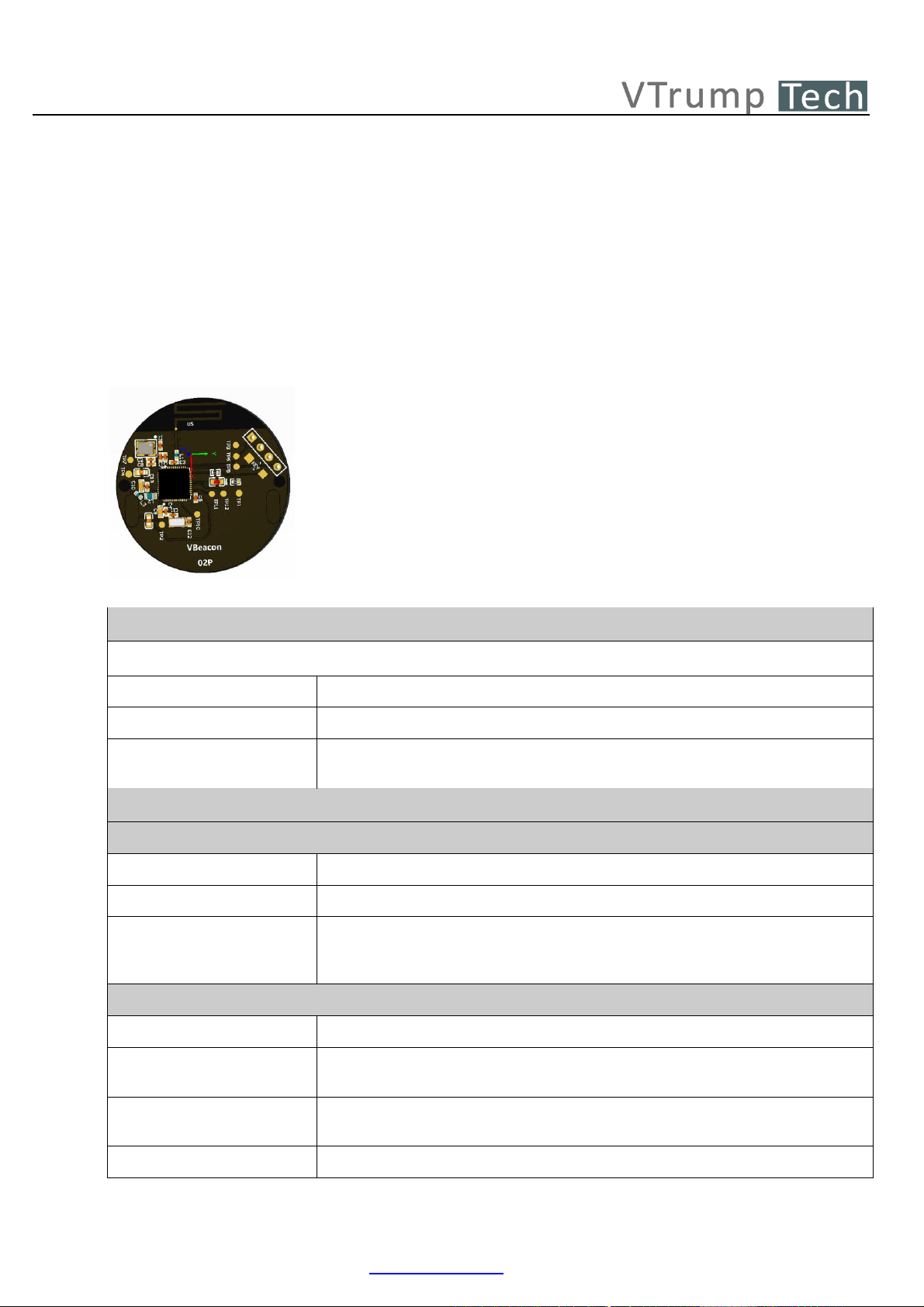
Vibeacon
Advertising
configurable for the following frame types: iBeacon
TX power
up to 4dBm Programmable
Advertising interval
Configurable. default 1s.
Global configuration
options
connectable mode, programmable major minor tx power time period,
change password
Device specifications
Electrical specifications
Core module
nRF 52810
MCU core
ARM Cortex-M
Current consumption
Radio TX: 4.6mA (@ 0dBm)
Radio RX: 4.6 mA
Sleep mode: 2 uA
Radio specifications
Standard
Bluetooth 5. 0 (Bluetooth Low Energy or Bluetooth Smart)
Frequency band
2.402 to 2.480 GHz
(according Bluetooth 5.0 specifications, worldwide ISM band)
Advertising channels
CH37 (2.402 GHz), CH38 (2.426 GHz), CH39 (2.480 GHz)
(according Bluetooth 5.0 specifications)
Channel spacing
2 MHz (according Bluetooth 5.0 specifications)
VTM
Bluetooth Low Energy proximity-beacon
Data sheet v. 1.0
ViBeacon 02P is a small device that transmits a Bluetooth signal
at regular intervals. This signal is broadcast in a certain format,
a communication protocol that describes the string of
characters and numbers that make up the signal. It supports
advertising of multiple frames with iBeacon, Eddystone format.
With its small form factor, low power, high economic Bluetooth
radio, ViBeacon 02P can easily be added in your system and help to
promote the design process.
Address: Rm 508, 1888 YiShan Road Shanghai
Tel: +86 021 6405 2517
Email: [email protected]
www.vtrump.com
Page 2
Address: Rm 508, 1888 YiShan Road Shanghai
Tel: +86 021 6405 2517
Email: [email protected]
www.vtrump.com
TX power
Conducted: +4 dBm (max)
EIRP (Equivalent Isotropic Radiated Power): +7 dBm (max)
Antenna
Type
Mono Pole
Gain
3dB (max.)
Radiation diagram
Omnidirectional
Power
Power supply
3V
Type
CR2450
Expected life
Upon system.
Mechanical specifications
Material
PCB Module
Size
34 x 34 x 8 mm
Opening
SMD
Protection
Upon system
Flammability
UL 94 HB
Environmental specifications
Operating temperature
-40°C to +85°C
Storage temperature
-40°C to +85°C
Certifications
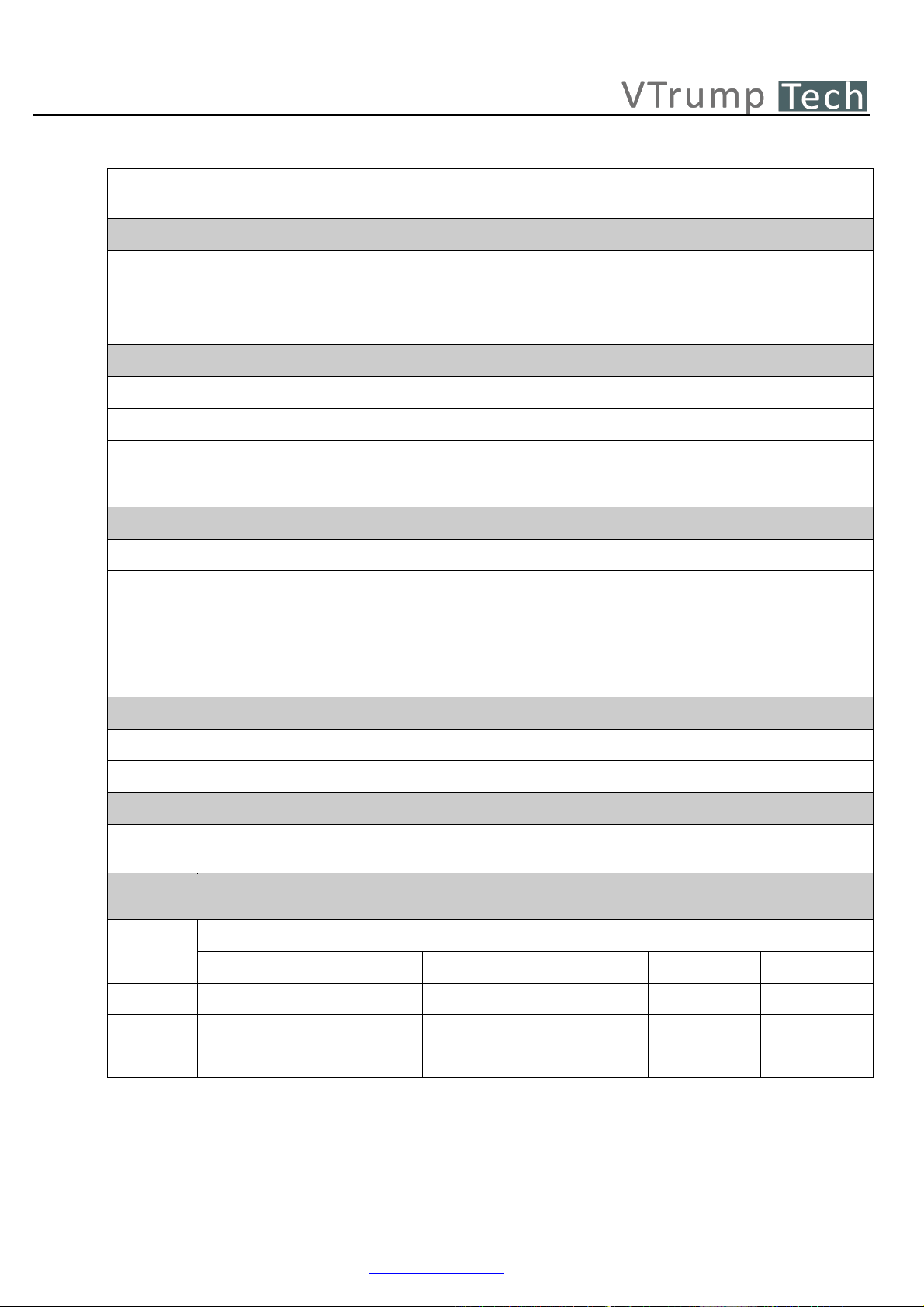
Expected battery life-time (in
months,400mah,module only)
TX power
Advertising interval
100 msec
300 msec
500 msec
700 msec
1000 msec
5000 msec
0 dBm
2.5 7 10
12
15
25
-8 dBm 3 7.5
11
13
16
26
-20 dBm 3 8
11.5
14
17
27
Expected battery life-time is estimated assuming nominal battery capacity, self-discharge and ambient
operating temperature.
Batteries from different manufacturers can have different operating lives.
Vtrump reserves the right to change product specifications at any time without prior notice.
iBeacon is a trademark of Apple Inc.,
Page 3
Address: Rm 508, 1888 YiShan Road Shanghai
Tel: +86 021 6405 2517
Email: [email protected]
www.vtrump.com
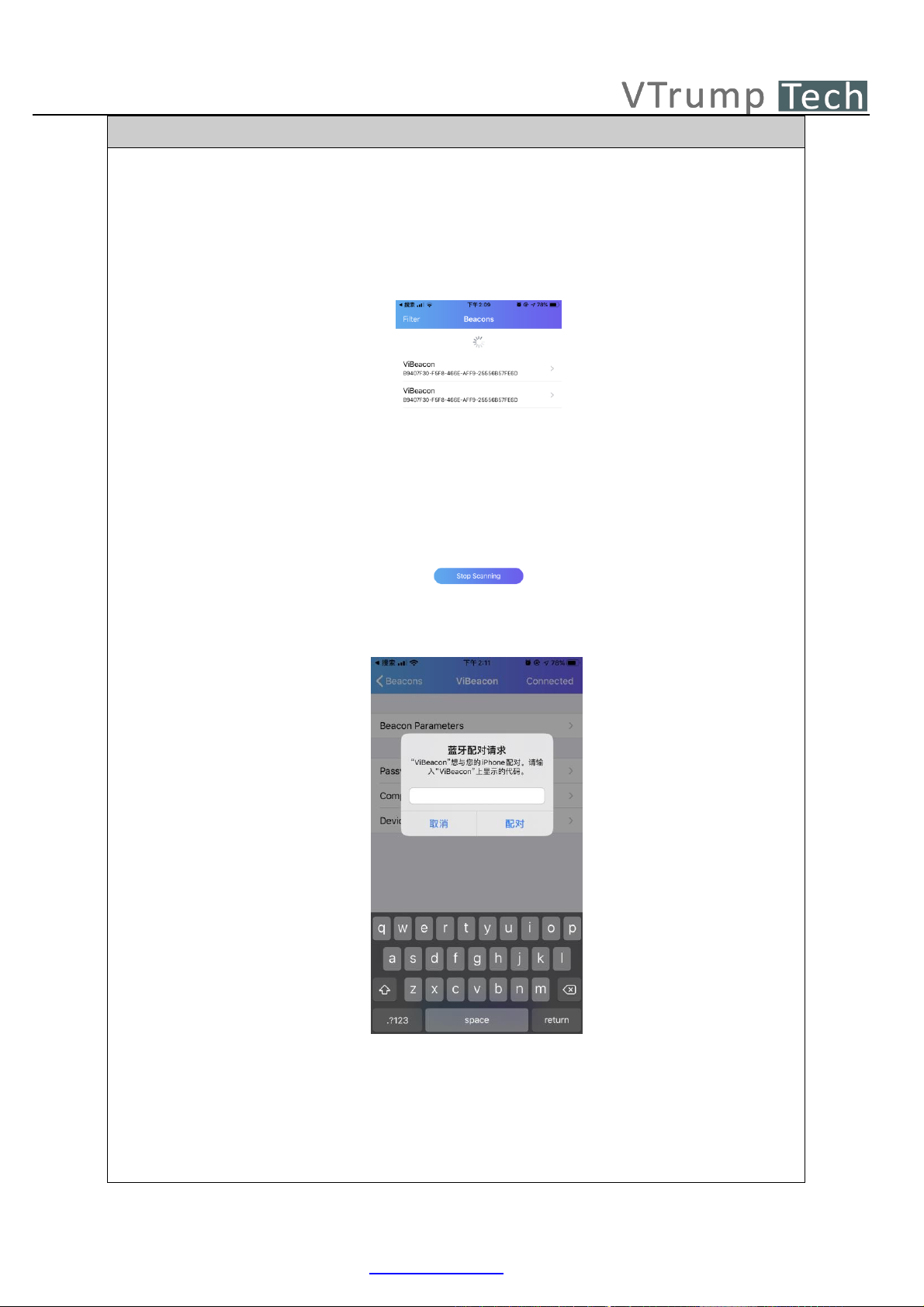
Install & how to use
Install battery:
Insert the CR2450 into battery slot with the corrected direction.
How to configuration
1、 downlodad and install configuration app.
2、 Search Vibeacon device.
3、 Selected device to connected
4、 Input password to access device
5、 Setup parameters.
Page 4

FCC Regulatory notices
Modification statement
VTrump Tech (Shanghai) Co., Ltd has not approved any changes or modifications to this device by
the user. Any changes or modifications could void the user’s authority to operate the equipment.
Interference statement
This device complies with Part 15 of the FCC Rules and Industry Canada licence-exempt RSS
standard(s). Operation is subject to the following two conditions: (1) this device may not cause
interference, and (2) this device must accept any interference, including interference that may cause
undesired operation of the device.
RF exposure
This equipment complies with FCC and ISED radiation exposure limits set forth for an uncontrolled
environment. The antenna should be installed and operated with minimum distance of 20 cm between
the radiator and your body. Antenna gain must be below 3 dBi.
This transmitter must not be co-loc
The host end product must include a user manual that clearly defines operating requirements and
conditions that must be observed to ensure compliance with current FCC RF exposure guidelines.
For portable devices, in addition to above, a separate approval is required to satisfy the SAR
requirements of FCC Part 2.1093.
If the device is used for other equipment that separate approval is required for all other operating
configurations, including portable configurations with respect to 2.1093 and different antenna
configurations.
FCC Class B digital device notice
This equipment has been tested and found to comply with the limits for a Class B digital device, pursuant
to part 15 of the FCC Rules. These limits are designed to provide reasonable protection against harmful
interference in a residential installation. This equipment generates, uses and can radiate radio frequency
energy and, if not installed and used in accordance with the instructions, may cause harmful interference
to radio communications. However, there is no guarantee that interference will not occur in a particular
installation. If this equipment does cause harmful interference to radio or television reception, which can
be determined by turning the equipment off and on, the user is encouraged to try to correct the
interference by one or more of the following measures:
• Reorient or relocate the receiving antenna.
ated or operating in conjunction with any other antenna or transmitter.
• Increase the separation between the equipment and receiver.
• Connect the equipment into an outlet on a circuit different from that to which the receiver is connected.
• Consult the dealer or an experienced radio/TV technician for help.
Labelling Requirements for the Host device
The host device shall be properly labelled to identify the modules within the host device. The certification
label of the module shall be clearly visible at all times when installed in the host device, otherwise the
host device must be labelled to display the FCC ID and ISED of the module, preceded by the words
"Contains transmitter module", or the word "Contains", or similar wording expressing the same meaning,
as follows:
Page 5

Model: VTM
Contains FCC ID:2ARV3-VTM
The host OEM user manual must also contain clear instructions on how end users canfind and/or access
the module and the FCC ID and ISED.
Model: VTM
Contains FCC ID:2ARV3-VTM
OEM Statement
a. The module manufacturer must show how compliance can be demonstrated only for a
specific host or hosts
b. The module manufacturer must limit the applicable operating conditions in which the
transmitter will be used, and
c. The module manufacturer must disclose that only the module grantee can make the test
evaluation that the module is compliant in the host. When the module grantee either refuses to
make this evaluation, or does not think it is necessary, the module certification is rendered
invalid for use in the host, and the host manufacturer has no choice other than to use a different
module, or take responsibility (§ 2.929) and obtain a new FCC ID for the product.
d. The module manufacturer must provide the host manufacturer with the following
requirements:
i. The host manufacturer is responsible for additional testing to verify compliance as a
composite system. When testing the host device for compliance with Part 15 Subpart B, the host
manufacturer is required to show compliance with Part 15 Subpart B while the transmitter
module(s) are installed and operating. The modules should be transmitting and the evaluation
should confirm that the module’s intentional emissions are compliant (i.e. fundamental and out of
band emissions).
 Loading...