

Page 1
Page 2

The Federal Communication Commission Statement
This equipment has been tested and found to comply with the limits for a Class B Digital Device, pursuant to
Part 15 of the FCC rules. These limits are designed to provide reasonable protection against harmful
interference in a residential installation. This equipment generates, uses and can radiate radio frequency
energy and, if not installed and used in accordance with the instruction, may cause harmful interference to
radio communication. However, there is no guarantee that interference will not occur in a particular
installation. If this equipment does cause harmful interference to radio or television reception, which can be
determined by turning the equipment off and on, the user is encouraged to try to correct the interference
by one of more of the following measures: -
- Reorient or relocate the receiving antenna.
- Increase the separation between the equipment and receiver.
- Connect the equipment into an outlet on a circuit different from that to which the receiver is
connected.
- Consult the dealer or an experienced Radio/TV technician for help.
Use only shielded cables to connect I/O devices to this equipment. You are cautioned that change or
modifications not expressly approved by the party responsible for compliance could void your authority to
operate the equipment.
THIS DEVICE COMPLIES WITH PART 15 OF FCC RULES. OPERATION IS SUBJECT TO THE
FOLLOWING TWO CONDITIONS:
1 This device may not cause harmful interference and
2 This device must accept any interference received, including interference that may cause undesired
operation.
The antenna used for this transmitter must not be collocated or operation in conjunction
with any other antenna or transmitter.
Noce : The changes or modicaons not expressly approved by the party responsible
for compliance could void the user’s authority to operate the equipment.
IMPORTANT NOTE: To comply with the FCC RF exposure compliance requirements, no change
to the antenna or the device is permi)ed. Any change to the antenna or the device could result
in the device exceeding the RF exposure requirements and void user’s authority to operate
the device.
Page 3

I. General Description
Bluetooth 3.0 HID Module is a Bluetooth module using Broadcom BCM20730 Bluetooth
controller. This module is ideal for wireless input device applications including 3D
glasses, remote controls, keyboard, joystick and gamepad.
Build-in firmware adheres to Bluetooth HID profile and Bluetooth Device ID profile
specifications. This module is integrated with PCB antenna, crystal, EEPROM to reduce
the external BOM cost. It has been designed to provide ultra-low power, low cost and
robust communications and fully compliant with Bluetooth radio specification V 3.0.
II. Application:
• Wireless mouse, trackball, pointing device.
• Wireless keyboard, keypad.
• 3D glasses
• Remote controls
• Game controllers
• POS (point of sale) input devices
• Remote sensors
• Home automation
• Personal health and fitness monitoring
III. Features:
• Bluetooth V 3.0 specification compliant.
• Bluetooth HID profile V 1.0 compliant.
• Bluetooth Device ID profile version 1.3 compliant.
• Bluetooth AVRCP-CT profile version 1.3 compliant.
• Programmable output power control meets Bluetooth Class 2 and Class 3
• On-chip support for common keyboard interface eliminates external processor.
• Support AFH (Adaptive Frequency Hopping).
• Supports Serial Peripheral Interface (SPI), master and slave modes.
• Built-in regulator to reduce external BOM
• On module EEPROM and crystal and PCB Antenna..
• Excellent Receiver Sensitivity.
•
Programmable keyscan matrix interface, up to 8x18 key-scanning matrix.
•
We can provide the custom-made firmware of HID application.
Page 4
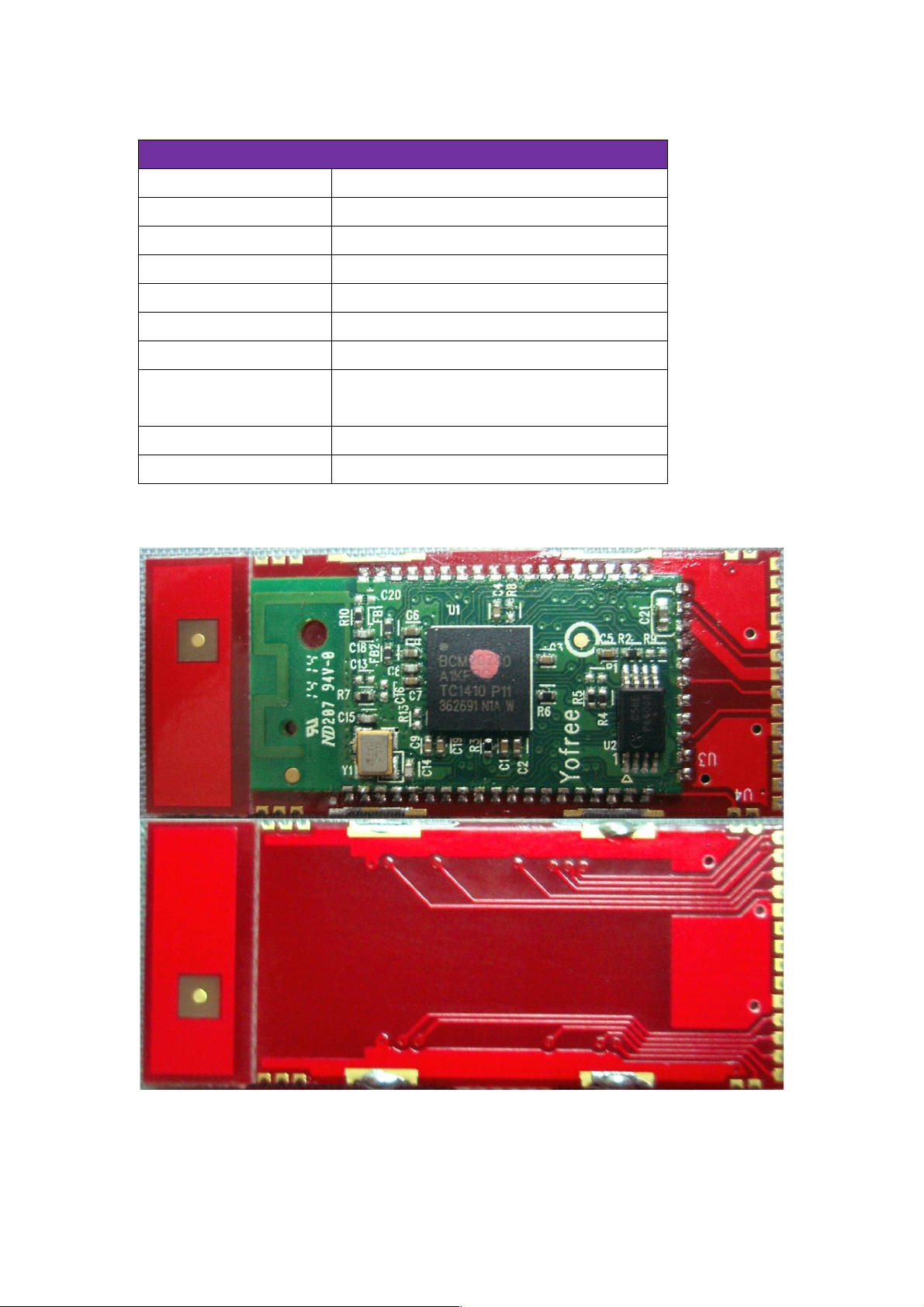
IV. Specification
Bluetooth Spec
Operating Frequency: 2402MHz~2480MHz
Modulation Type: GFSK
Transmitter Power: -2 ~ 4 dBm
Chanel Number: 78 Channel
Antenna Type: Internal (PCB Antenna)
Antenna Gain: 2.78 dBi
Operating temperature: 0 ~ 40 °C
EUT Power Rating: 5VDC form Host PC Power Supply
3.7VDC, 480mAh form Lithium Battery
Operation Distance: 10 Meter
Storage Temperature: -10 ~ 60 °C
V. Module Photo
Page 5

VI. Module Outline. (Unit: mm)
 Loading...