

Page 1
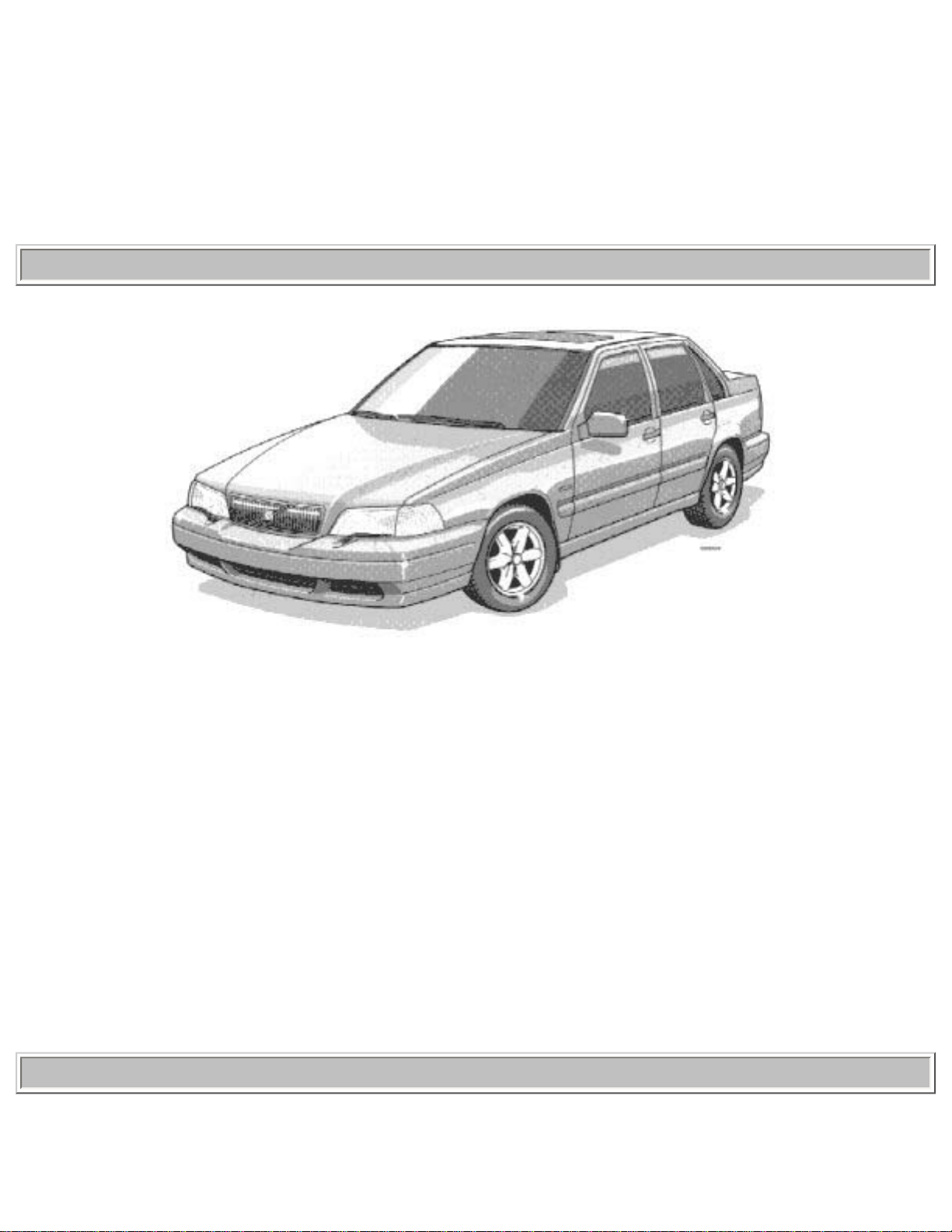
1998 S70 & V70
VOLVO
S70 & V70
1 9 9 8
VOLVO
This manual deals with the operation and care of your Volvo.
Welcome to the world-wide family of Volvo owners. We trust that you will enjoy many years of safe
driving in your Volvo, an automobile designed with your safety and comfort in mind. To help ensure
your satisfaction with this vehicle, we encourage you to familiarize yourself with the equipment
descriptions, operating instructions and maintenance requirements/recommendations in this manual. We
also urge you and your passengers to wear seat belts at all times in this (or any other) automobile. And,
of course, please do not operate a vehicle if you may be affected by alcohol, medication or any
impairment that could hinder your ability to drive.
Your Volvo is designed to meet all applicable safety and emission standards, as evidenced by the
certification labels attached to the driver's door opening and on the left wheel housing in the engine
compartment.
Volvo and the environment
Volvo is committed to the well being of our customers. As a natural part of this commitment, we care
about the environment in which we all live. Caring for the environment means an everyday involvement
file:///K|/ownersdocs/1998/1998_SV70/98sv70_000.htm (1 of 4)12/30/2006 1:51:22 PM
Page 2

1998 S70 & V70
in reducing our environmental impact.
Volvo's environmental activities are based on a holistic view, which means we consider the overall
environmental impact of a product throughout its complete life cycle. In this context, design, production,
product use, and recycling are all important considerations.
In production, Volvo has partly or completely phased out several chemicals including freons, lead
chromates, naphtanates, asbestos, mercury and cadmium; and reduced the amount of chemicals used in
our plants 50% since 1991.
In use, Volvo was the first in the world to introduce into production a three-way catalytic converter with
a Lambda sond, now called oxygen sensor, in 1976. The current version of this highly efficient system
reduces emissions of harmful substances (CO, HC, NOx) from the exhaust pipe by approximately 95%
and the search to eliminate the remaining emissions continues. Volvo is the only automobile
manufacturer to offer CFC-free retrofit kits for the air conditioning system for all models back to the M/
Y 1975 240. Advanced electronic engine controls, refined purification systems and cleaner fuels are
bringing us closer to our goal.
After Volvo cars and parts have fulfilled their use, recycling is the next critical step in completing the
life cycle. The metal content is about 75% of the total weight of the car, which makes the car among the
most recycled industrial products. In order to have efficient and well controlled recycling, many Volvo
variants have printed dismantling manuals indication the weight and material of individual components.
For Volvo, all homogeneous plastic parts weighing more than 1.7 oz. (50 grams)are marked with
international symbols that indicate how the component is to be sorted for recycling.
In addition to continuous environmental refinement of conventional gasoline-powered internal
combustion engines, Volvo is actively looking at advanced technology alternative-fuel vehicles.
When you drive a Volvo, you become our partner in the work to lessen the car's impact on the
environment. To reduce your vehicle's environmental impact, you can:
● Maintain proper air pressure in your tires. Tests have shown decreased fuel economy with
improperly inflated tires Follow the recommended maintenance schedule
● Drive at a constant speed
● See an authorized Volvo retailer as soon as possible for inspection if the check engine
(malfunction indicator) lamp illuminates, or stays on after the vehicle has started
● Properly dispose of any vehicle related waste such as used motor oil, used batteries, brake pads,
file:///K|/ownersdocs/1998/1998_SV70/98sv70_000.htm (2 of 4)12/30/2006 1:51:22 PM
Page 3

1998 S70 & V70
etc.
● When cleaning your car, use Volvo's own car care products, all of which have systematically
been adapted to the environment.
Contents
Important
Before you operate your car for the first time, please familiarize yourself with the BREAK-IN
information on page 66. You should also be familiar with the information in the first three chapters of
this manual.
Information contained in the balance of the manual is extremely useful and should be studied after
operating the vehicle for the first time.
This manual is structured so that it can be used for reference. It should thus be kept in the car for ready
access.
Do not export your Volvo to another country before investigating the country's applicable safety and
exhaust emission requirements. In some cases it may be difficult or impossible to comply with these
requirements. Modifications to the emission control system(s) may render your Volvo not certifiable for
legal operation in the U.S., Canada or other countries.
Table of Contents
Page No. Chapter and Subject
pg. 1
Chapter 1 - Occupant safety
pg. 16
Chapter 2 - Instruments and controls
pg. 41
Chapter 3 - Body and interior
pg. 65
Chapter 4 - Starting and driving
pg. 85
Chapter 5 - Wheels and tires
pg. 91
Chapter 6 - In case of emergency
pg. 109
Chapter 7 - Car care
pg. 115
Chapter 8 - Volvo Service
pg. 133
Chapter 9 - Specifications
pg. 141
Chapter 10 - Audio systems
All information, illustrations and specifications contained in this manual are based on the latest product
information available at the time of publication. Volvo reserves the right to make model changes at any
time, or to change specifications or design, without notice and without incurring obligation.
file:///K|/ownersdocs/1998/1998_SV70/98sv70_000.htm (3 of 4)12/30/2006 1:51:22 PM
Page 4

1998 S70 & V70
CAUTION: Certain models have reduced ground clearance due to the design of the front spoiler.
Please observe caution when e.g., driving onto garage hoists, through drifted snow or when other road
debris is encountered, or when parking near curbs.
©1997 Volvo Cars of North America Inc.
Contents | Top of Page
file:///K|/ownersdocs/1998/1998_SV70/98sv70_000.htm (4 of 4)12/30/2006 1:51:22 PM
Page 5
1998 S70 & V70
Chapter 1 - Occupant safety
pg. 1 Occupant safety
Occupant safety
Despite our strongest recommendations, and your best intentions, not wearing a seat belt is like
believing "It'll never happen to me!". Volvo urges you and all adult occupants of your car to wear seat
belts and ensure that children are properly restrained, using an infant, car or booster seat determined by
age, weight and height.
Fact: In every state and province, some type of child-restraint legislation has been passed. Additionally,
most states and provinces have already made it mandatory for occupants of a car to use seat belts.
So, urging you to "buckle up" is not just our recommendation - legislation in your state or province may
mandate seat belt usage. The few seconds it takes to buckle up may one day allow you to say, "It's a
good thing I was wearing my seat belt".
Chapter Contents
Page No. Subject
pg. 2
Seat belts
pg. 4
Volvo SRS
pg. 8
Side Impact Protection System - (SIPS) air
bag
pg. 9
Child safety
pg. 14
Occupant safety
pg. 14
Reporting Safety Defects
pg. 2 Seat belts
Seat belts
Always fasten the seat belts before you drive or ride.
file:///K|/ownersdocs/1998/1998_SV70/98sv70_001.htm (1 of 4)12/30/2006 1:51:22 PM
Page 6
1998 S70 & V70
Two lights above the rear view mirror will be illuminated for 4-8 seconds after the starting (ignition) key
is turned to the driving position. A chime will sound at the same time if the driver has not fastened his
seat belt. The rear seats are provided with self-retracting inertia reel belts. The front seats are provided
with single roller belts with tensioners.
To buckle:
Pull the belt out far enough to insert the latch plate into the receptacle (buckle for rear seats) until a
distinct snapping sound is heard. The seat belt retractor is normally "unlocked" and you can move freely,
provided that the shoulder belt is not pulled out too far. The retractor will lock up as follows:
● if the belt is pulled out rapidly
● during braking and acceleration
● if the vehicle is leaning excessively
● when driving in turns
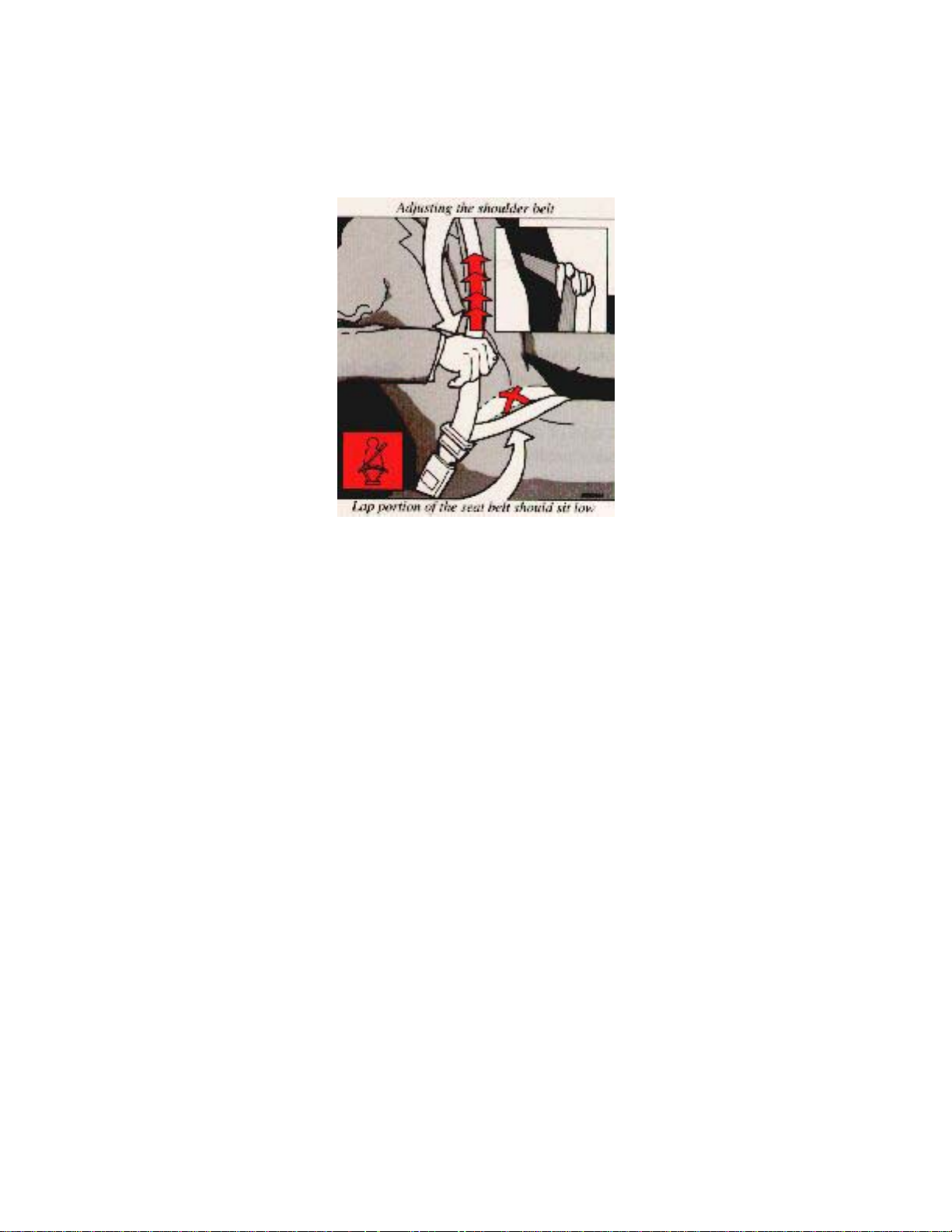
For the seat belt to provide maximum protection in the event of an accident, it must be worn correctly.
When wearing the seat belt remember:
● The belt should not be twisted or turned.
● The lap belt must be positioned low on the hips (not pressing against the abdomen).
● The shoulder section of the front seat belts adjusts automatically to the driver's height.
Make sure that the shoulder belt is rolled up into its retractor and that the shoulder and lap belts are taut.
Before exiting the car, check that the seat belt retracts fully after being unbuckled.
If necessary, guide the belt back into the retractor slot.
NOTE: Legislation in your state or province may mandate seat belt usage.
file:///K|/ownersdocs/1998/1998_SV70/98sv70_001.htm (2 of 4)12/30/2006 1:51:22 PM
Page 7
1998 S70 & V70
WARNING! Any device used to induce slack into the shoulder belt portion of the three-point belt
system will have a detrimental effect on the amount of protection available to you in the event of a
collision. The seat back should not be tilted too far back. The shoulder belt must be taut in order to
function properly.
Spool-out
To make child seat installation easier, each seat belt buckle (except for the driver's belt) is equipped with
a locking mechanism to help keep the lap section of the seat belt taut. Please refer to page 12 for more
information on this function.
WARNING! Do not use child safety seats or child booster cushions/backrests in the front passenger's
seat. We also recommend that children who have outgrown these devices sit in the rear with the seat
belt properly fastened.
pg. 3 Seat belts, Center head restraint
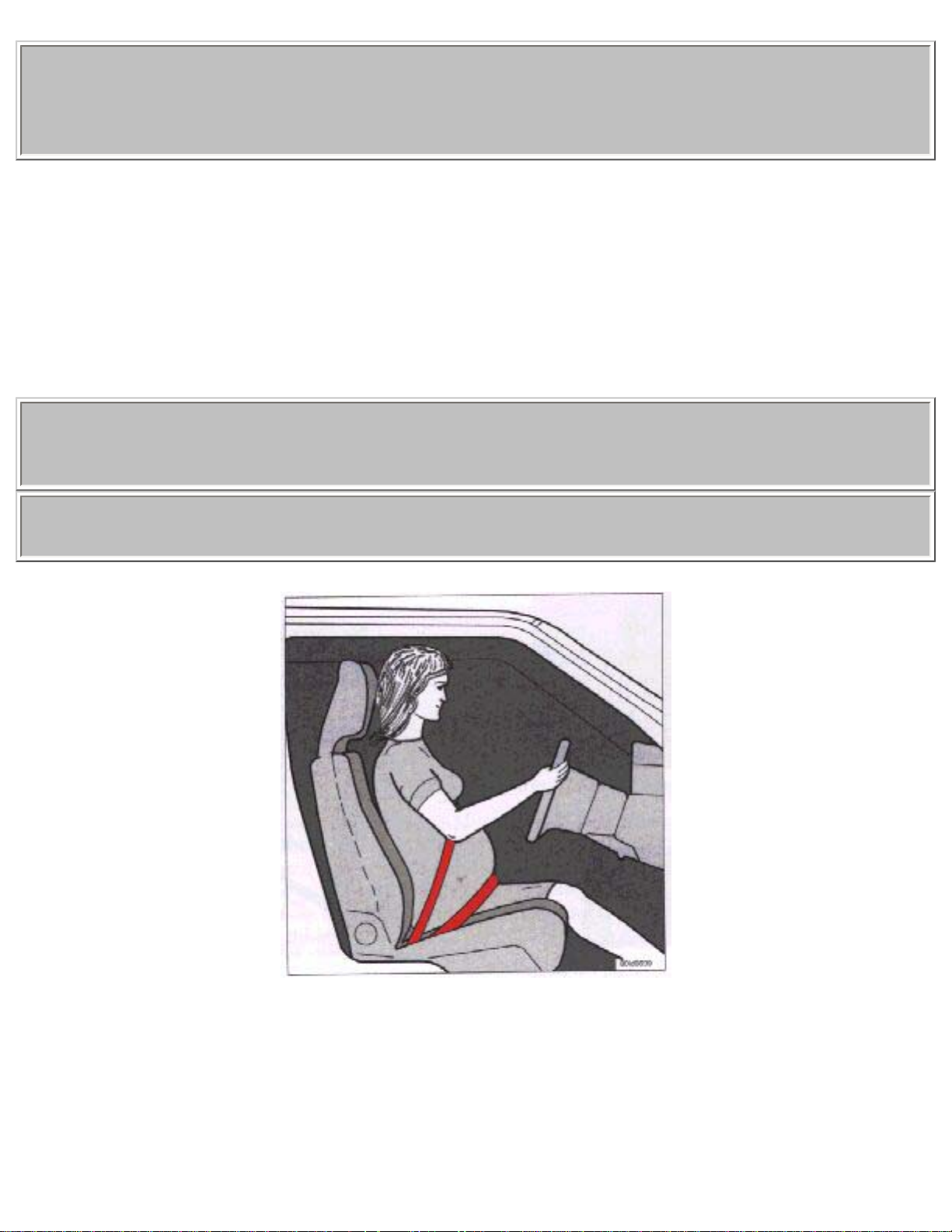
During pregnancy
Pregnant women should always wear seat belts. Remember that the belt should always be positioned in
such a way as to avoid any possible pressure on the abdomen. The lap portion of the belt should be
file:///K|/ownersdocs/1998/1998_SV70/98sv70_001.htm (3 of 4)12/30/2006 1:51:22 PM
Page 8
1998 S70 & V70
located low, as shown in the above illustration.
WARNING! Never use a seat belt for more than one occupant. Never wear the shoulder portion of the
belt under the arm, behind the back or otherwise out of position. Such use could cause injury in event
of accident. As the seat belts lose much of theirstrength when exposed to violent stretching, they
should be replaced after any collision, even if they may appear to be undamaged. Never repair the belt
on your own; have this done by an authorized Volvo retailer only.
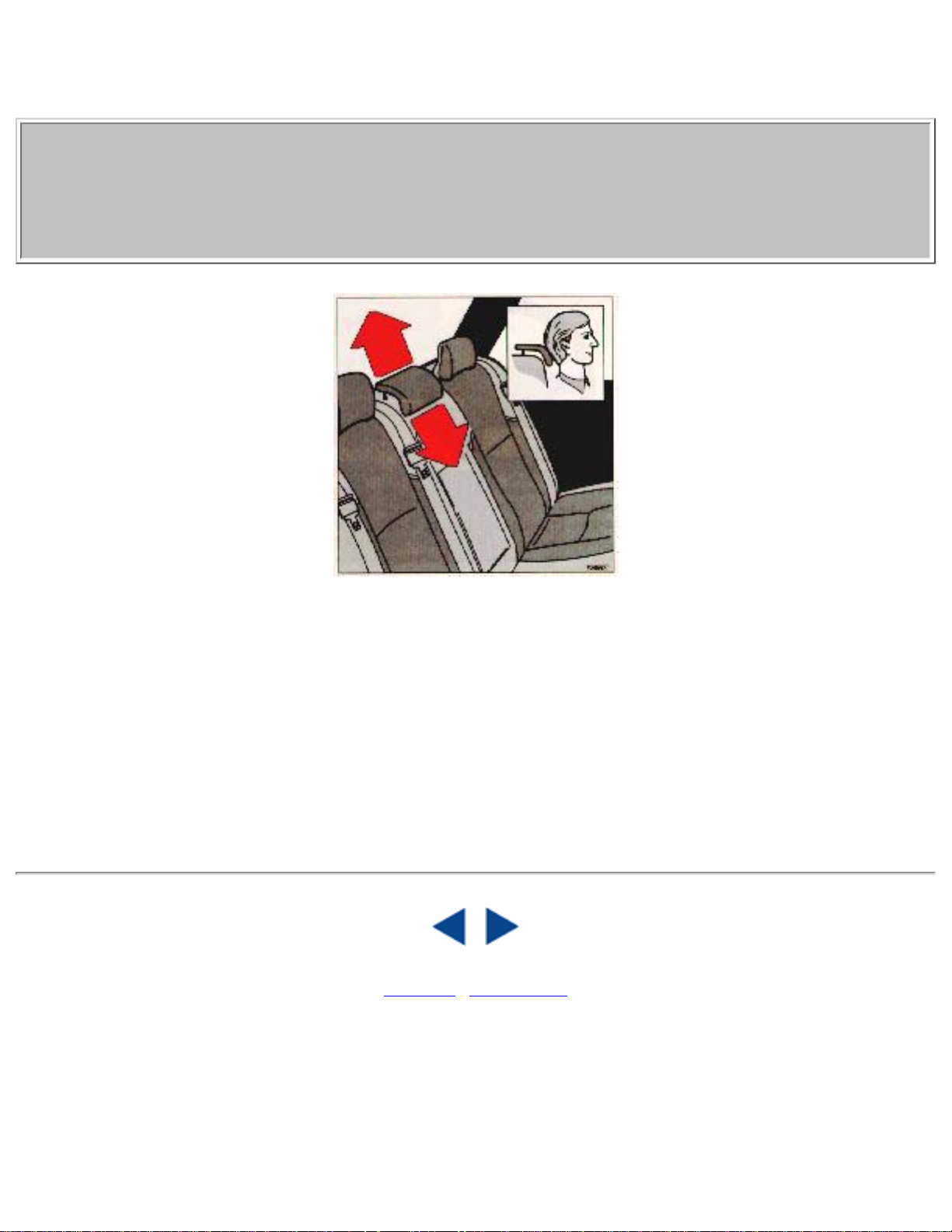
Center head restraint
The center head restraint can be adjusted according to the passenger's height. The restraint should be
carefully adjusted to support the occupant's head.
To raise: Pull straight up
To lower: Pull forward and push down
Contents | Top of Page
file:///K|/ownersdocs/1998/1998_SV70/98sv70_001.htm (4 of 4)12/30/2006 1:51:22 PM
Page 9
1998 S70 & V70
pg. 4 Volvo SRS
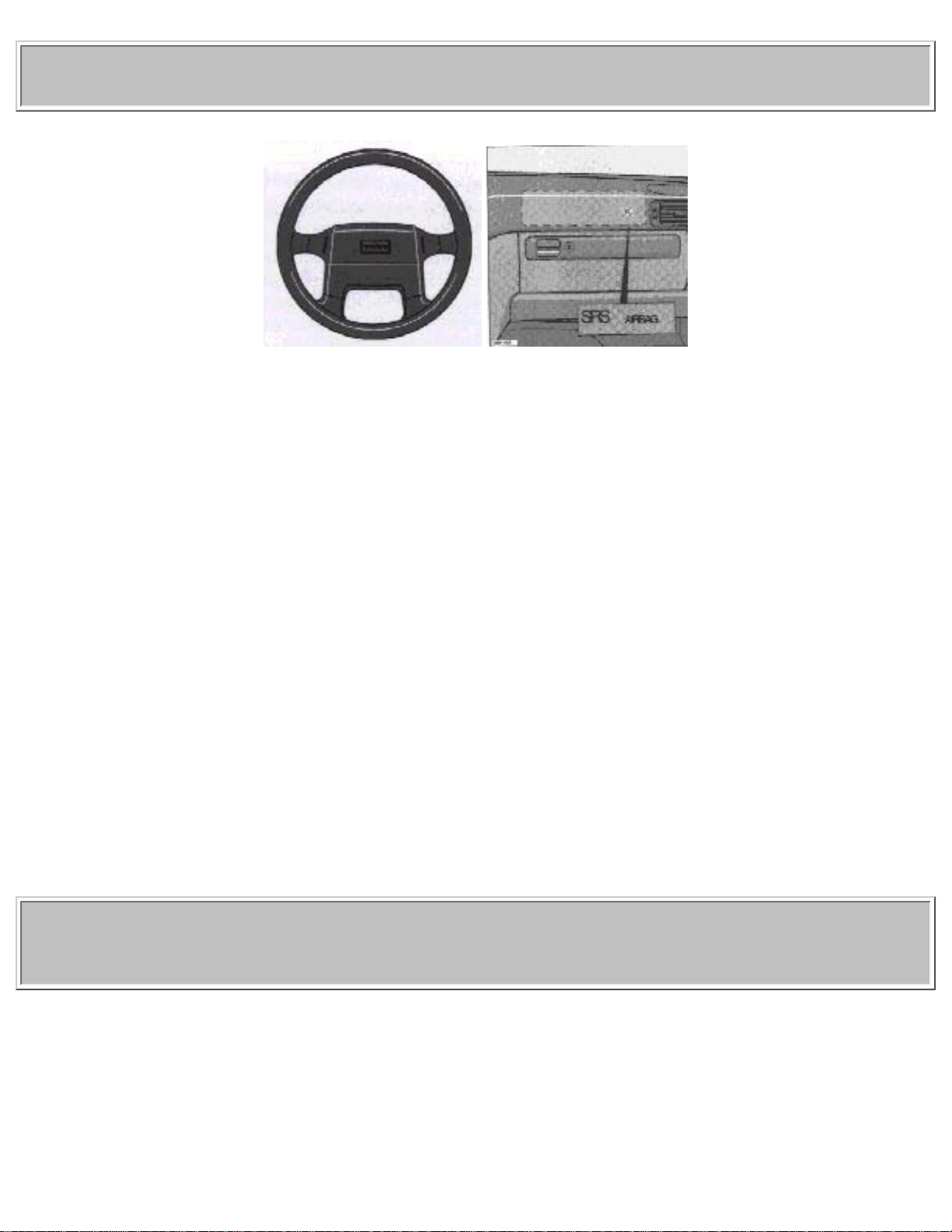
Passenger side SRS hatch
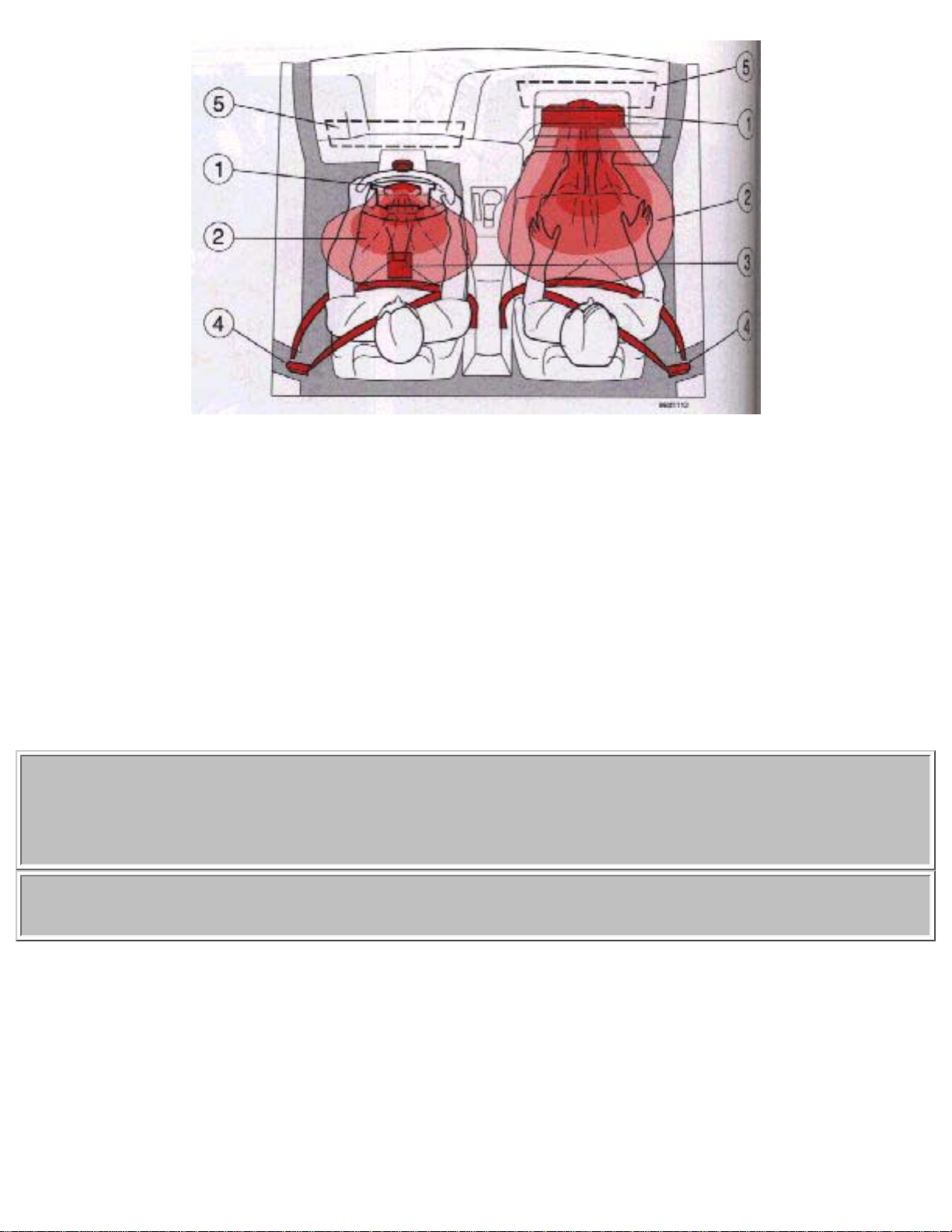
As an enhancement to the three-point seat belt system, your Volvo is equipped with a Supplemental
Restraint System (SRS). The Volvo SRS consists of an airbag (2) and knee bolster (5) on both the
driver's and passenger's sides and seat belt tensioners in both front door pillars (4). The system is
designed to supplement the protection provided by the three-point seat belt system.
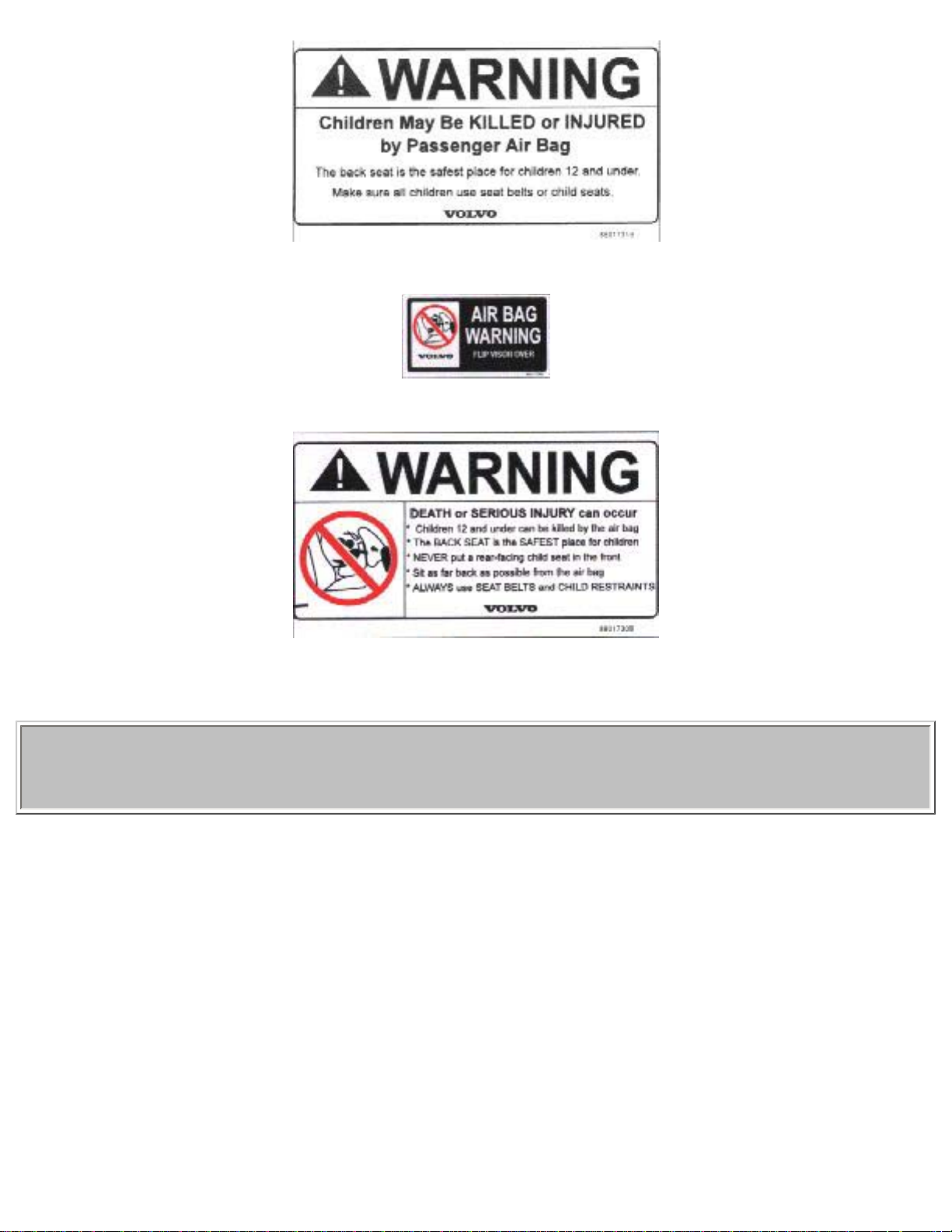
The SRS system is indicated by the "SRS" embossed on the steering wheel pad and above the glove
compartment, the knee bolsters beneath the steering column and the glove compartment and decals on
both sun visors and on the far right side of the dash.
The airbags are folded and located in the center of the steering wheel and above the glove compartment.
They are designed to deploy during certain frontal-angular collisions, impacts, or decelerations,
depending on the crash severity, angle, speed and object impacted. The airbags may also deploy in
certain non-frontal collisions where rapid deceleration occurs. Both airbags and seat belt tensioners will
deploy, even if the passenger seat is not occupied.
WARNING! As its name implies, SRS is designed to be a SUPPLEMENT to - not a replacement for the three-point belt system. For maximum protection, wear seat belts at all times. Be aware that no
system can prevent all possible injuries that may occur in an accident.
file:///K|/ownersdocs/1998/1998_SV70/98sv70_004.htm (1 of 8)12/30/2006 1:51:23 PM
Page 10
1998 S70 & V70
The airbag system includes gas generators (1) surrounded by the airbags (2) and front seat belt
tensioners for both of the front seats (4). To deploy the system, the sensor (3) activates the gas
generators causing the airbags to be inflated withnitrogen gas. As the movement of the seat's occupants
compresses the airbags, some of the gas is expelled at a controlled rate to provide better cushioning.
Both seat belt tensioners also deploy, minimizing any seat belt slack.
The entire process, including inflation and deflation of the airbags, takes approximately two-tenths of a
second.
WARNING! When installing any optional equipment, make sure that the SRS system is not damaged.
Do not attempt to service any component of the SRS yourself. Attempting to do so may result in
serious personal injury. If a problem arises, take your car tothe nearest authorized Volvo retailer for
inspection as soon as possible.
pg. 5 Volvo SRS (cont.)
file:///K|/ownersdocs/1998/1998_SV70/98sv70_004.htm (2 of 8)12/30/2006 1:51:23 PM
Page 11
1998 S70 & V70
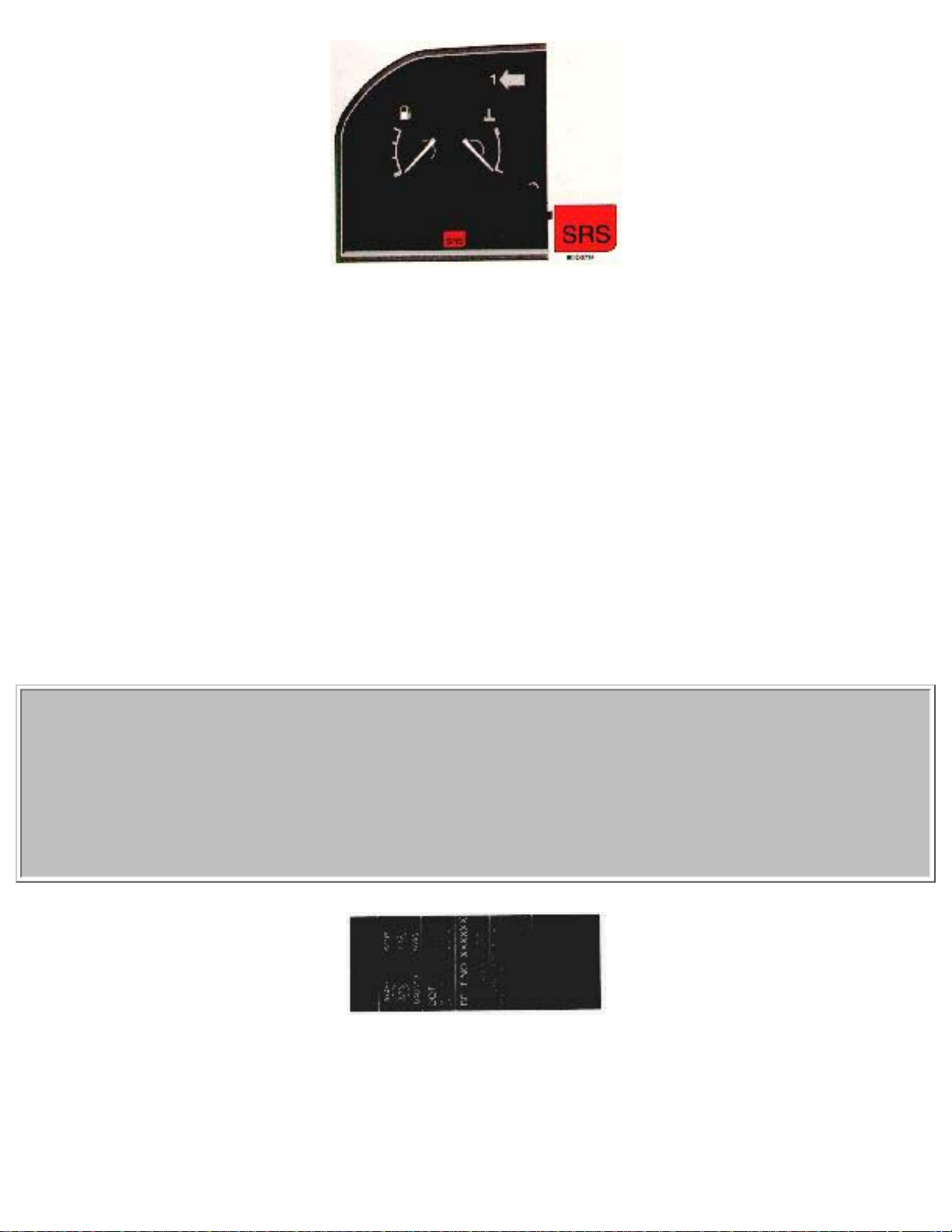
A self-diagnostic system incorporated in the sensor monitors the SRS. This system does not, however,
monitor the SIPS airbags. If a fault is detected, the "SRS" warning light will illuminate. The light is
included in the warning/indicator light cluster in the instrument panel. Normally, the SRS warning lamp
should light up when the ignition is switched on and should go out after 10 seconds or when the engine
is started. Check that this light is functioning properly every time the car is start ed.
The following items are monitored by all the self-diagnostic system:
● Sensor unit
● Cable harness
● Gas generator ignitors
WARNING!
Never drive an SRS equipped car with your hands on the steering wheel pad/airbag housing.
No objects, accessory equipment or stickers may be placed on, attached to or installed near the SRS
cover in the center of the steering wheel, the SRS cover above the glove compartment or the area
affected by the airbag deployment.
If the SRS warning light stays on after the engine has started or if it comes on while you are driving,
drive the car to the nearest authorized Volvo retailer for inspection as soon as possible.
The above is a sample of the label found on all seat belts equipped with tensioners, located on the front
seat belts near the lower anchorage point.
file:///K|/ownersdocs/1998/1998_SV70/98sv70_004.htm (3 of 8)12/30/2006 1:51:23 PM
Page 12
1998 S70 & V70
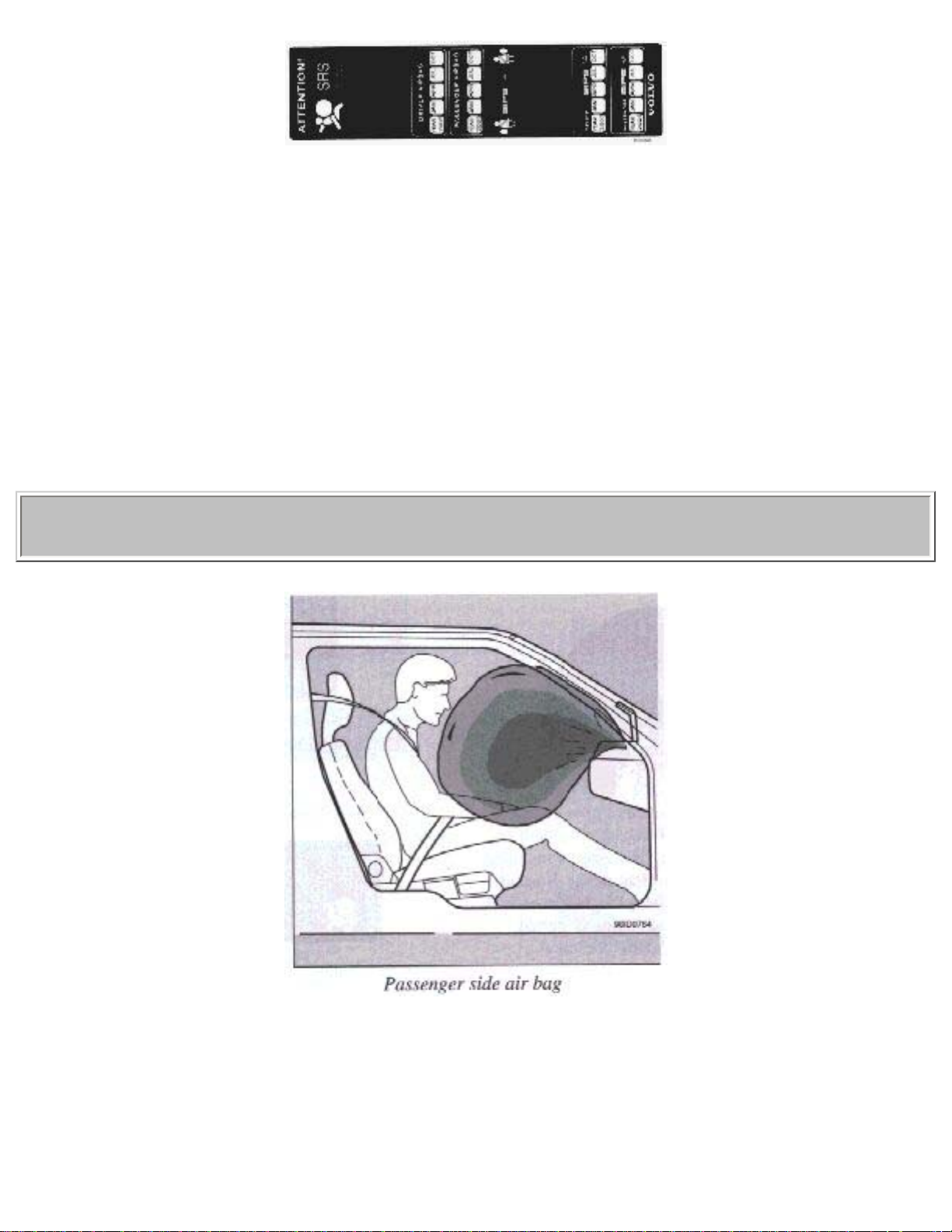
The above is a sample of the decal which can be found on the driver's door pillar.
There is no maintenance to perform on the SRS yourself. The only periodic maintenance recommended
on the SRS is that the air bag modules and front seat belts (including tensioners) should be replaced
approximately every ten years and that the other components in the system (wiring, connectors, etc.)
should also be inspected at this time. The SRS decal on your car shows the month and year servicing is
due. This service must be performed by an authorized Volvo retailer.
Should you have any questions about the SRS system, please contact your authorized Volvo retailer or
Volvo Customer Support.
pg. 6 Volvo SRS (cont.)
file:///K|/ownersdocs/1998/1998_SV70/98sv70_004.htm (4 of 8)12/30/2006 1:51:23 PM
Page 13
1998 S70 & V70
SRS texts on inside of both sun visors
SRS texts on outside of both sun visors
SRS text at far right of instrument panel
WARNING! Do not use child safety seats or child boosters cushions/backrests in the front passenger's
seat. We also recommend that children who have outgrown these devices sit in the rear seat with the
seat belt properly fastened.
NOTE: Deployment of SRS components occurs only one time during an accident. In a collision where
deployment occurs, the air bags and seat belt tensioners activate. Some noise occurs and a small amount
of powder is released. The release of the powdermay appear as smoke-like matter. This is a normal
characteristic and does not indicate fire.
file:///K|/ownersdocs/1998/1998_SV70/98sv70_004.htm (5 of 8)12/30/2006 1:51:23 PM
Page 14

1998 S70 & V70
WARNING!
● Children must never be allowed in the front passenger seat. Volvo recommends that ALL occupants
(adults and children) shorter than four feet seven inches (140 cm) be seated in the back seat of the
vehicle with a front passenger side airbag. See page 12 for guidelines.
● Occupants in the front passenger's seat must never sit on the edge of the seat, sit leaning toward the
instrument panel or otherwise sit out of position. The occupant's back must be as upright as comfort
allows and be against the seat back with the seat belt properly fastened.
● Feet must be on the floor, e.g. not on the dash, seat or out of the window.
● No objects or accessory equipment, e.g. dash covers, may be placed on, attached to or installed near
the SRS hatch (the area above the glove compartment) or the area affected by airbag deployment (see
illustration).
● There should be no loose articles, e.g. coffee cups, on the floor, seat or dash area.
● Never try to open the SRS cover on the steering wheel or the passenger side SRS hatch. This should
only be done by an authorized Volvo service technician.
● Failure to follow these instructions can result in injury to the vehicle occupants in an accident.
pg. 7 Volvo SRS (cont.)
NOTE: The information on this page does not pertain to the Side Impact protection System airbags.
When are the airbags deployed?
The SRS system is designed to deploy during certain frontal or front-angular collisions, impacts, or
decelerations, depending in the crash severity, angle, speed, and object impacted. The SRS sensor is
designed to react to both the impact of thecollision and the inertial forces generated by it and to
determine if the intensity of the collision is sufficient for the airbags to be deployed.
WARNING! The SRS is designed to help prevent serious injury. Deployment occurs very quickly and
with considerable force. During normal deployment and depending on variables such as seating
position, one may experience abrasions, bruises, swellings, orother injuries as a result of airbag(s)
deployment.
If the airbags have been deployed, we recommend the following:
● Have the car towed to an authorized Volvo retailer. Never drive with the airbags deployed.
● Have an authorized Volvo retailer replace the SRS system components.
file:///K|/ownersdocs/1998/1998_SV70/98sv70_004.htm (6 of 8)12/30/2006 1:51:23 PM
Page 15

1998 S70 & V70
● Use only new, Genuine Volvo Parts when replacing SRS components (airbags, seat belts, tensioners,
etc.)
When are the airbags NOT deployed?
Not all frontal collisions activate the SRS system. If the collision involves a non-rigid object (e.g., a
snow drift or bush), or a rigid, fixed object at a low speed, the SRS system will not necessarily deploy.
Airbags do not normally deploy in a side impact collision, in a collision from the rear or in a rollover
situation. The amount of damage to the bodywork does not reliably indicate if the airbags should have
deployed or not.
Seat belts - the heart of the Volvo safety system
The heart of the Volvo safety system is the three-point seat belt (a Volvo invention)! In order for the
SRS system to provide the protection intended, seat belts must be worn at all times by everyone in the
car. The SRS system is a supplement to the seat belts.
WARNING! If your car has been subjected to flood conditions (e.g. soaked carpeting/standing water
on the floor of the vehicle) or if your car has become flood-damaged in any way, do not attempt to
start the vehicle or put the key in the ignition before disconnecting the battery (see below). This may
cause airbag deployment which could result in personal injury. Have the car towed to an authorized
Volvo retailer for repairs.
Automatic transmission only:
Before attempting to tow the car, use the following procedure to override the shiftlock system to move
the gear selector to the neutral position.
● Disconnect the battery
● Wait at least one minute
● Insert the key in the ignition and turn it to position 1
● Press firmly on the shiftlock override button (located near the base of the gear selector).
● While holding the override button down, move the gear selector from the park position.
WARNING! Never drive with the airbags deployed. The fact that they hang out can impair the
steering of your car. Other safety systems can also be damaged. The smoke and dust formed when the
airbags are deployed can cause skin and eye irritation in the event of prolonged exposure.
file:///K|/ownersdocs/1998/1998_SV70/98sv70_004.htm (7 of 8)12/30/2006 1:51:23 PM
Page 16

1998 S70 & V70
Contents | Top of Page
file:///K|/ownersdocs/1998/1998_SV70/98sv70_004.htm (8 of 8)12/30/2006 1:51:23 PM
Page 17
1998 S70 & V70
pg. 8 Volvo Side Impact Protection System (SIPS) airbag
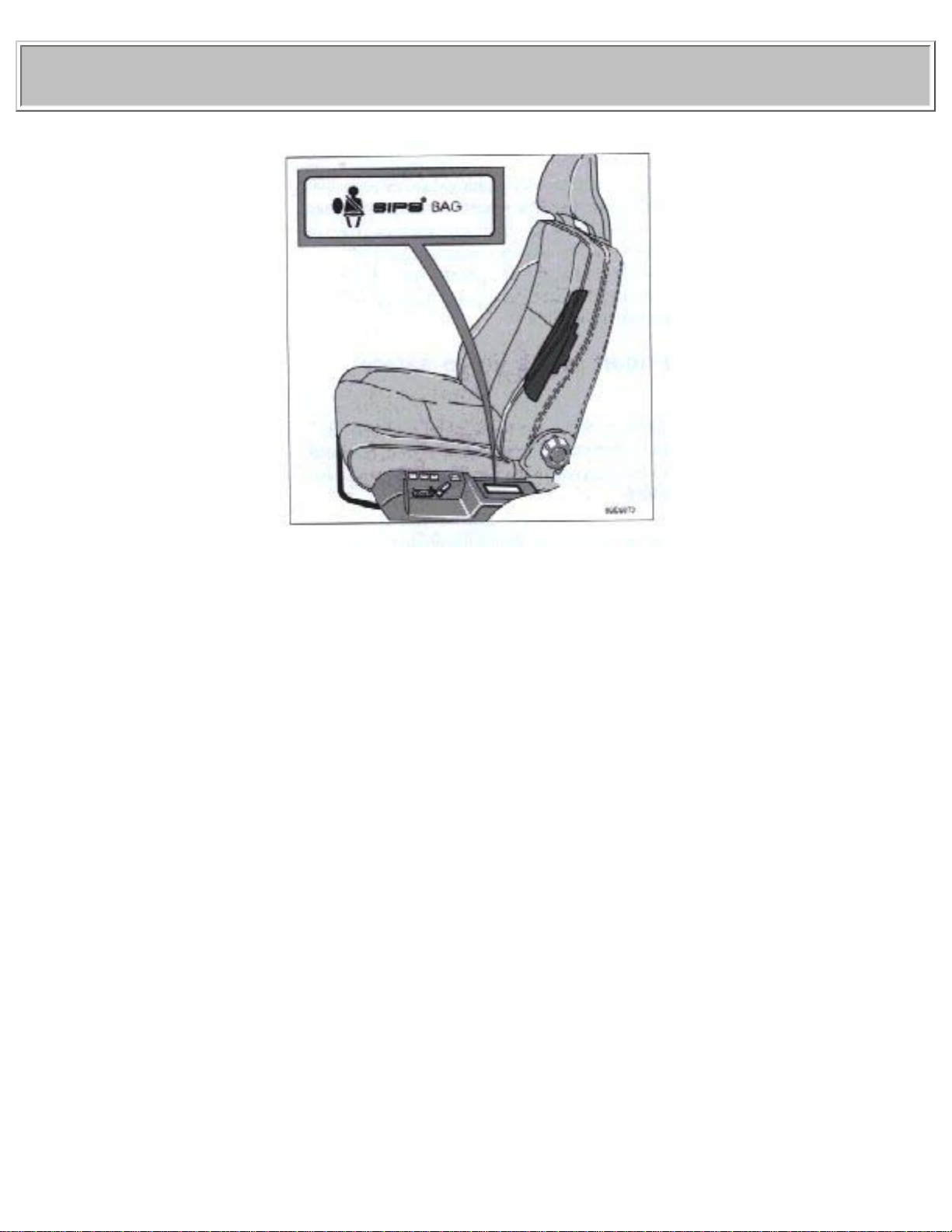
SIPS airbag decal *
SIPS airbag (front seats only)
As an enhancement to the structural Side Impact Protection System built into your car, your car is also
equipped with Side Impact Protection System (SIPS) airbags. The SIPS airbag system consists of airbag
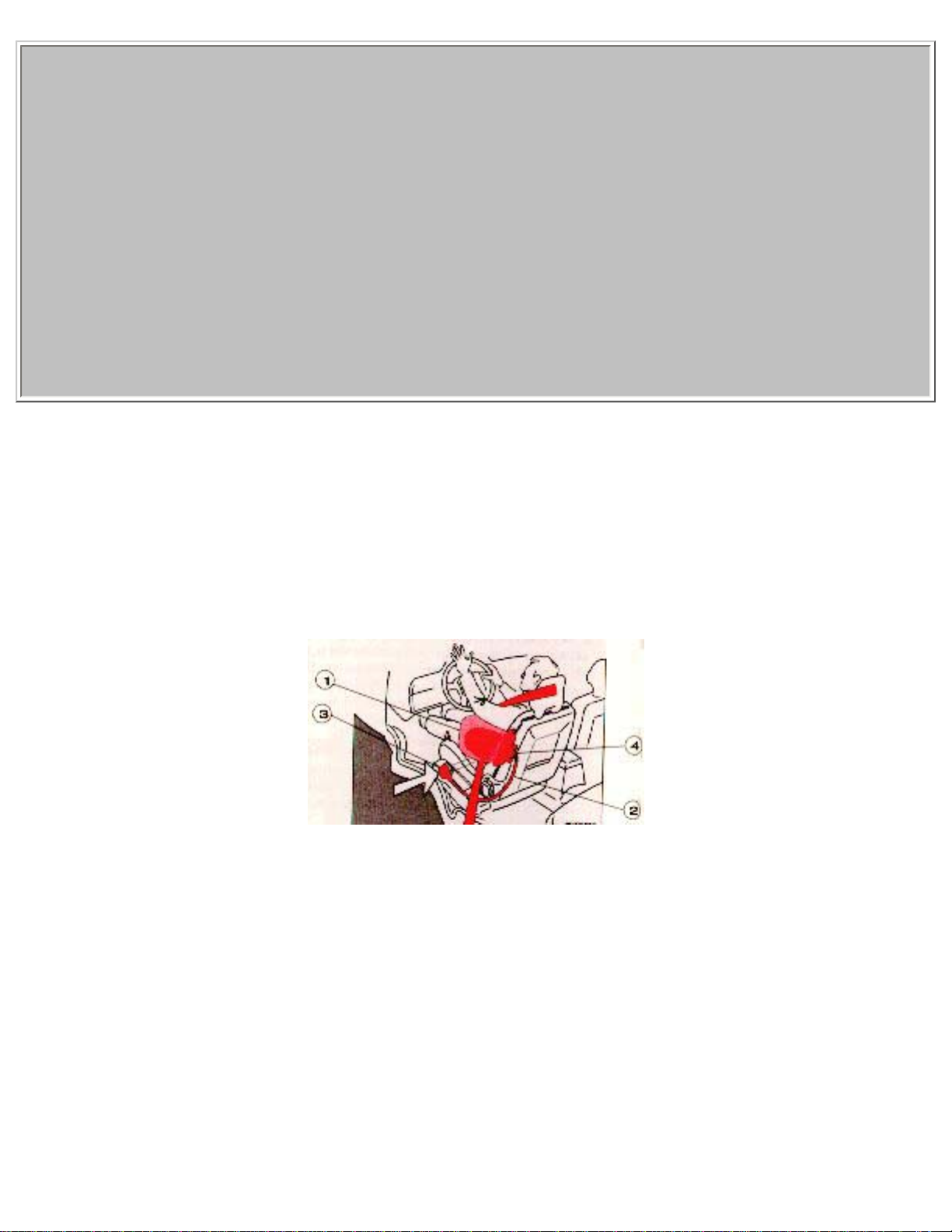
modules built into the sides of both front seat backrests (1), cables (2) from these modules to the
mechanical sensor units (3) and gas generators (4). The SIPS airbag system is designed to help increase
occupant protection in the event of certain side impact collisions. The SIPS airbags aredesigned to
deploy only during certain side-impact collisions, depending on the crash severity, angle, speed, and
point of impact. The airbags are not designed to deploy in all side impact situations.
file:///K|/ownersdocs/1998/1998_SV70/98sv70_008.htm (1 of 10)12/30/2006 1:51:23 PM
Page 18
1998 S70 & V70
WARNING!
● The SIPS airbag system is a supplement to the Side Impact Protection System and the three-point
seat belt system. It is not designed to deploy during collisions from the front or rear of the car or in
rollover situations.
● The use of seat covers on the front seats may impede SIPS airbag deployment.
● No objects, accessory equipment or stickers may be placed on, attached to or installed near the SIPS
airbag system or in the area affected by SIPS airbag deployment (see illustration to the right above).
● Never try to open or repair any components of the SIPS airbag system. This should only be done by
an authorized Volvo service technician.
● For best protection from the SIPS airbag system, both front seat occupants should sit in an upright
position with the seat belt properly fastened.
NOTE: SIPS airbag deployment (one airbag) occurs only on the side of the vehicle affected by the
impact.
* A SIPS airbag warning decal is located at the end of the instrument panel on the driver's side of the
car.
1 - Airbag, 2 - cable, 3 - sensor unit, 4 - gas generator
file:///K|/ownersdocs/1998/1998_SV70/98sv70_008.htm (2 of 10)12/30/2006 1:51:23 PM
Page 19
1998 S70 & V70
WARNING!
● Never drive with the airbags deployed. The fact that they hang out can impair the steering of your
car. Other safety systems can also be damaged. The smoke and dust formed when the airbags are
deployed can cause skin and eye irritation in the event of prolonged exposure.
● If your car has been subjected to flood conditions (e.g. soaked carpeting/standing water on the floor
of the vehicle) or if your car has become flood-damaged in any way, do not attempt to start the vehicle
or put the key in the ignition beforedisconnecting the battery. This may cause airbag deployment
which could result in personal injury. Have the car towed to an authorized Volvo retailer for repairs.
pg. 9 Child safety
Sedan
Child Restraint Anchorages
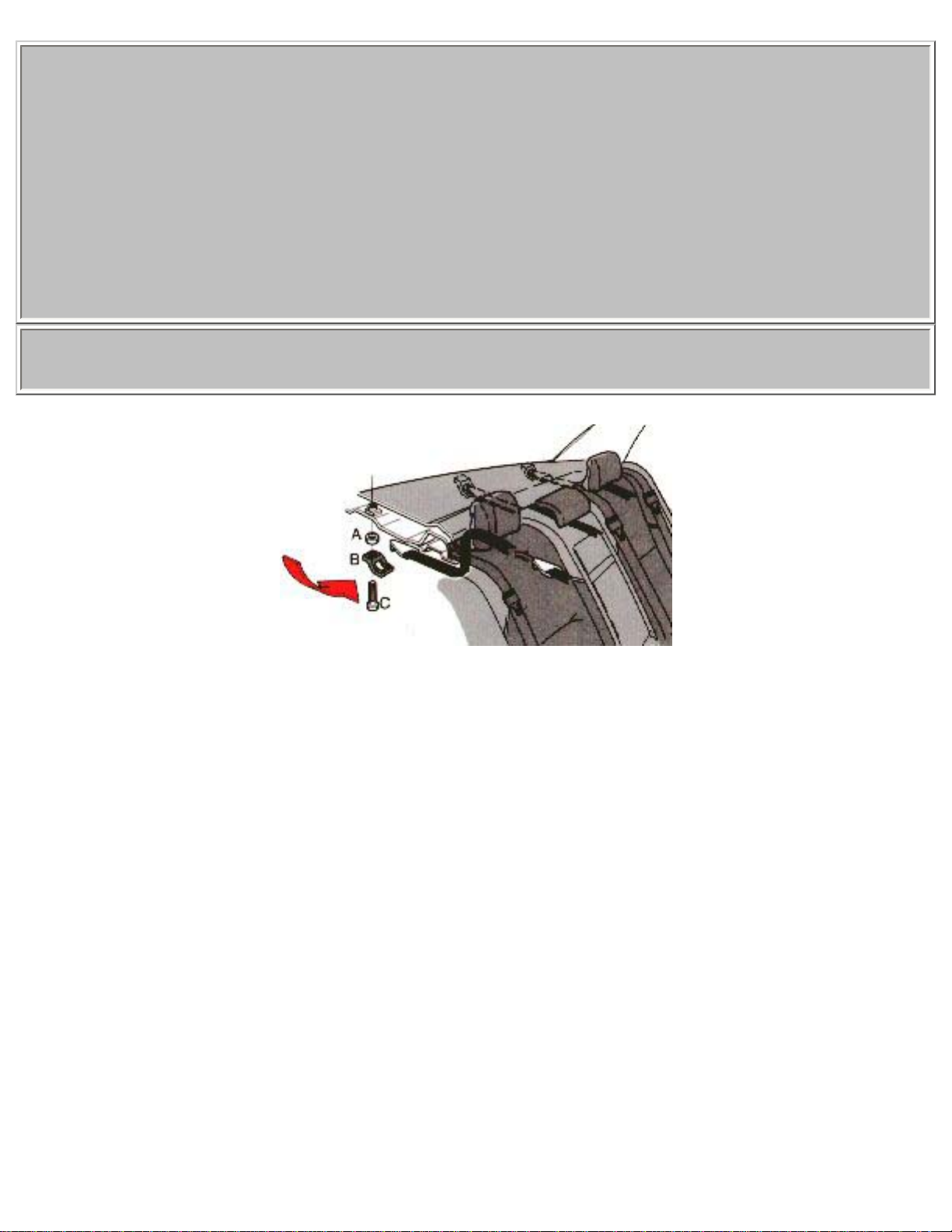
Volvo cars are fitted with Child Restraint Top Tether Anchorages in the rear seat.
Sedans: There are three pre-drilled anchorage points under the rear window shelf which are not visible
from the passenger compartment.
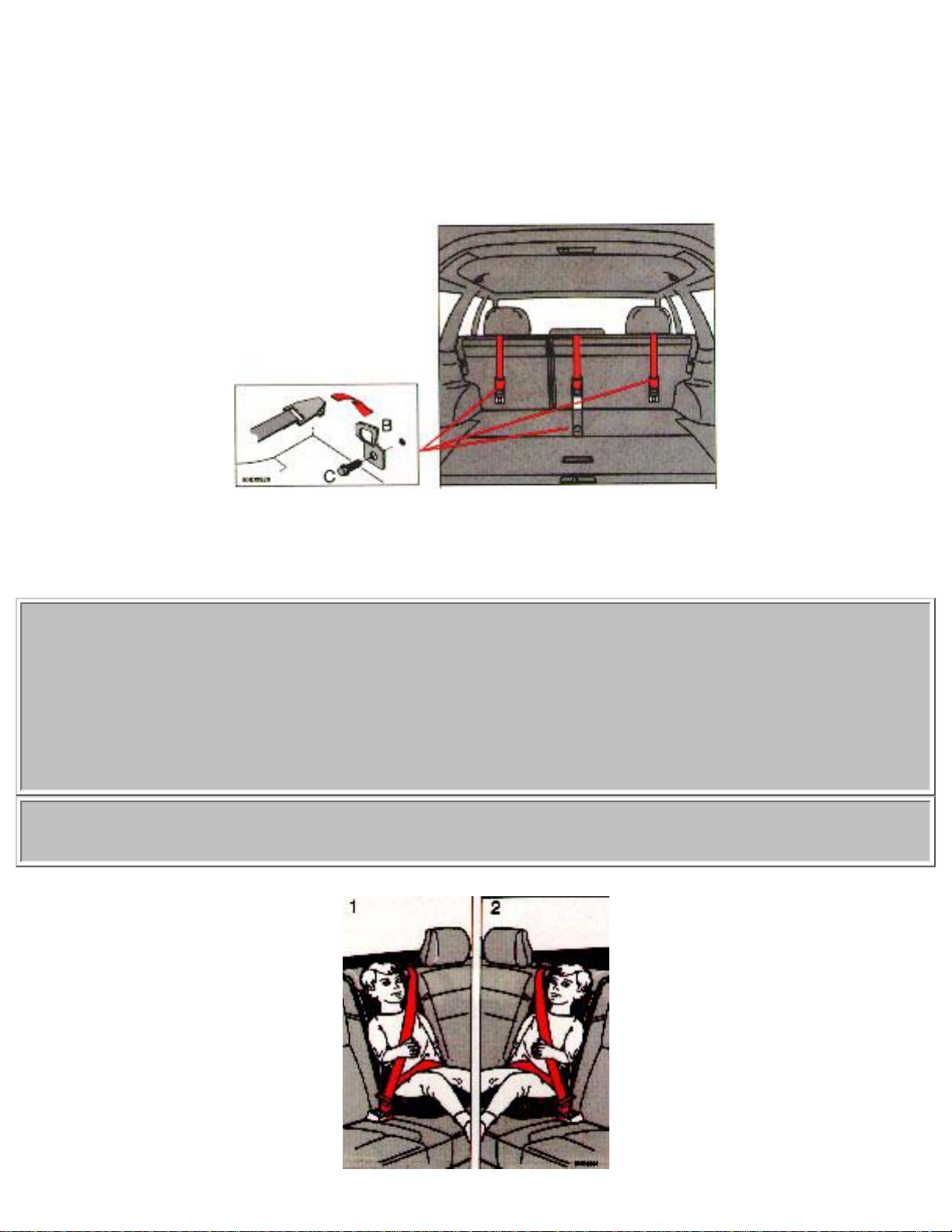
Wagons: The anchorage points are on the rear seat backrest and are hidden by plastic covers. The
backrest must be folded down to access the center anchorage point.
In cars designed for Canada, one top tether anchorage set will be in the glove box.
Installing the top tether
Sedans: The pre-drilled holes for the child restraint anchorages are underneath the rear window shelf and
file:///K|/ownersdocs/1998/1998_SV70/98sv70_008.htm (3 of 10)12/30/2006 1:51:23 PM
Page 20
1998 S70 & V70
can be accessed from the trunk or by lowering the rear seat backrests.
Wagons: Remove the plastic cover from the anchorage point you intend to use.
On either model, refer to the child seat manufacturer's instructions for securing the seat.
Wagon
A - 10 mm spacer, B - anchorage plate, C - 5/16" UNC bolt
WARNING! Child Restraint Anchorages are designed to withstand only those loads imposed by
correctly fitted Child Restraints. Under no circumstances are they to be used for adult seat belts or
harnesses. The anchorages are not able to withstand excessiveforces on them in the event of collision if
full harness seat belts or adult seat belts are installed to them. An adult who uses a belt anchored in a
Child Restraint Anchorage runs a great risk of suffering severe injuries should a collision occur. Do
not install rear speakers which would require the removal of the top tether anchors or interfere with the
proper use of the top tether strap.
pg. 10 Child safety (cont.)
file:///K|/ownersdocs/1998/1998_SV70/98sv70_008.htm (4 of 10)12/30/2006 1:51:23 PM
Page 21
1998 S70 & V70
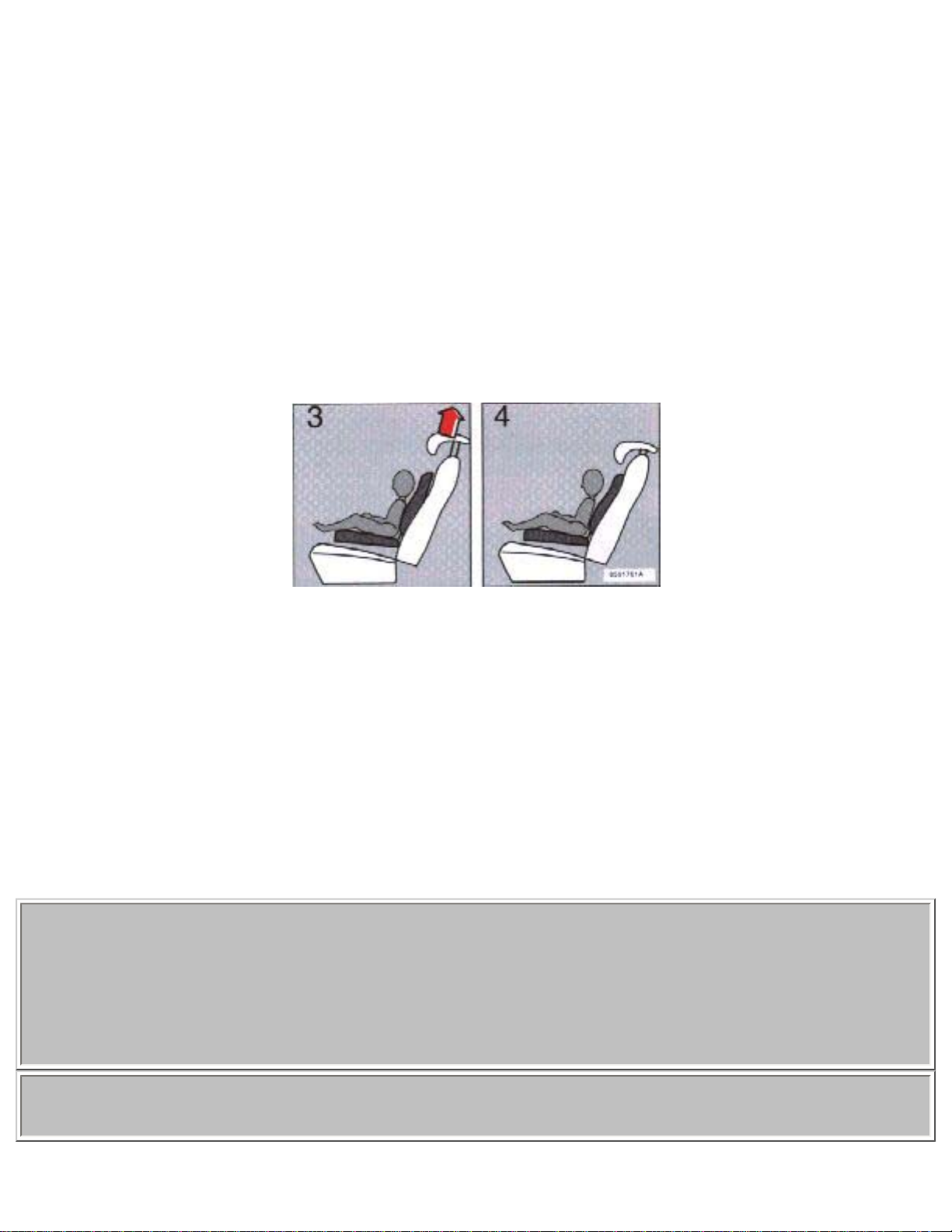
Integrated booster cushion:
1 - Sedan 2 - Wagon
Integrated booster cushion (optional)
Volvo's own integrated booster cushion has been specially designed to help safeguard a child seated in
the center position of the rear seat. When using the integrated booster cushion, the child must be secured
with the vehicle's three-point seatbelt. The booster cushion is approved for children weighing between
15 and 36 kg (33 and 80 lbs) and between 97 and 137 cm (38 and 54 in ) in height. It is not intended for
children under 3 years of age.
The child should be properly seated on the booster cushion (see illustrations 1 and 2 in left column). For
small children, the booster cushion backrest can be tilted back slightly by raising the center head
restraint above the upper edge of the booster cushion backrest (3) and tilting the backrest (4). For taller
children, it is essential that the head restraint be adjusted properly to help support the child's head (see
page 3).
The hip section of the three-point seat belt must fit snugly across the child's hips, not across the stomach.
The shoulder section of the three-point seat belt should be positioned across the chest and shoulder (see
illustration). The shoulder belt must never be placed behind the child's back or under the arm.
WARNING! Failure to follow the instructions on this page will increase the risk of your child being
injured during a sudden stop or collision. In the event of a collision while the integrated booster
cushion was occupied, the entire booster cushion and center seat belt must be replaced. The booster
cushion should also be replaced if it is badly worn or damaged in any way. This work should be
performed by an authorized Volvo retailer only. The booster cushion should be cleaned while in place
in the vehicle if possible. If not, please consult your Volvo retailer.
pg. 11 Child safety (cont.)
file:///K|/ownersdocs/1998/1998_SV70/98sv70_008.htm (5 of 10)12/30/2006 1:51:23 PM
Page 22
1998 S70 & V70
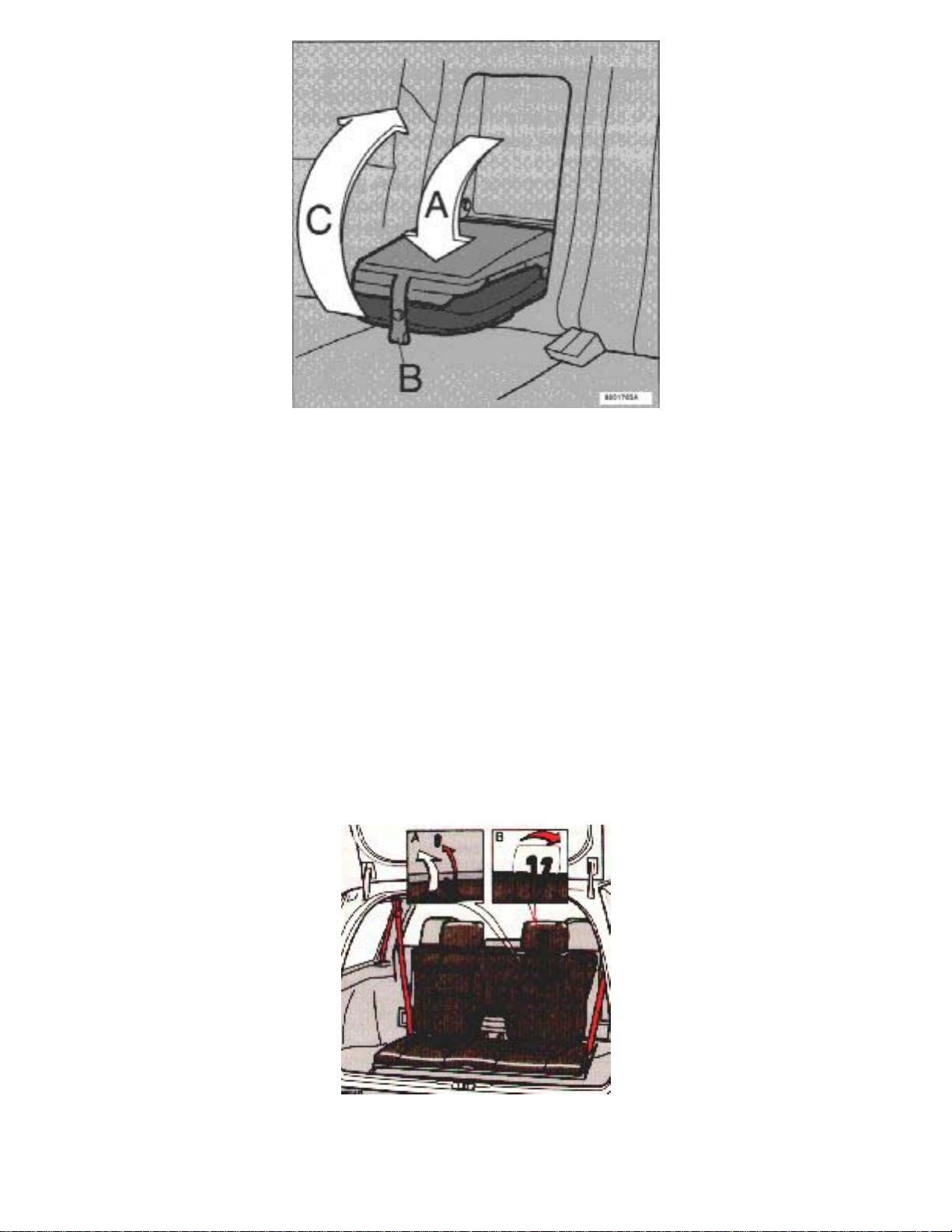
Storing the booster cushion
To store (fold up):
● Fold down the booster cushion backrest to the seat section (A)
● Snap the backrest snap to the fastener on the seat (B)
● Fold up the booster cushion unit (C)
NOTE: The booster cushion must be folded down as one unit. If the backrest is not strapped to the seat
section of the cushion, the backrest hinges may lock.
Auxiliary seat - A-Fold up, B-Fold down
file:///K|/ownersdocs/1998/1998_SV70/98sv70_008.htm (6 of 10)12/30/2006 1:51:23 PM
Page 23
1998 S70 & V70
Auxiliary seat (optional)
If all the seats are occupied, a rear-facing auxiliary seat in the cargo area of the wagon models can be
used. This seat is designed for two children, each weighing between 23 - 40 kg (50 - 88 lbs.) and up to
150 cm (59 inches) in height.
WARNING! Both rear seat backrests must be up when the auxiliary seat is being used.
Do not use a booster cushion or child seat in conjunction with the auxiliary seat. The luggage net
should be retracted and the child safety lock in the tailgate should be open to allow access to the cargo
area.
pg. 12 Child safety (cont.)
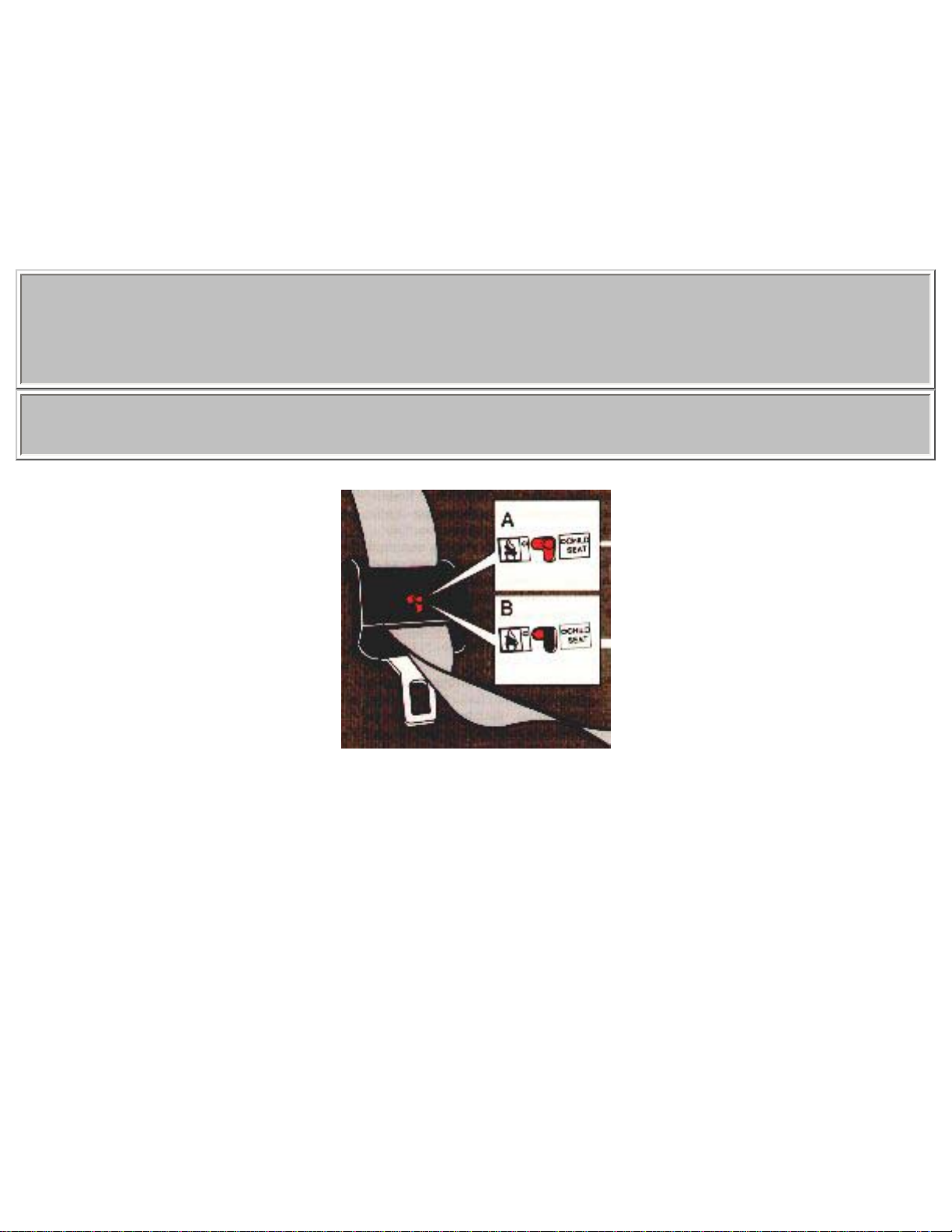
A-Lap section of belt locked in place, B-Lap section functions normally
Keeping child seats in place (spool-out)
To make child restraint installation easier, each seat belt buckle (except for the driver's belt) is equipped
with a locking mechanism to help keep the lap section of the seat belt taut.
When attaching the seat belt to a child restraint:
● Make sure the red lock button is moved to the right (see illustration A). A coin, etc.. can be used to
move the button.
● Attach the seat belt to the child restraint according to the child seat manufacturer's instructions.
● Pull the lap section of the seat belt taut.
The lap section of the seat belt cannot be loosened as long as the red lock button is in the right position.
file:///K|/ownersdocs/1998/1998_SV70/98sv70_008.htm (7 of 10)12/30/2006 1:51:23 PM
Page 24

1998 S70 & V70
The lap section of the seat belt can be adjusted when the lock button is in the left position (see
illustration B).
NOTE: Before exiting the car, check that the seat belt retracts fully after being unbuckled. If necessary,
guide the belt back into the retractor slot. When not in use, the child restraint should be secured with the
seat belt to help prevent movementduring a sudden stop.
WARNING! Do not use child safety seats or child booster cushions/backrests in the front passenger's
seat. We also recommend that children who have outgrown these devices sit in the rear seat with the
seat belt properly fastened.
Important!
Why Volvo believes no child should sit in the front seat of a car.
It's quite simple really. A front air bag is a very powerful device designed, by law, to help protect an
adult. Because of the size of the air bag and its speed of inflation, a child should never be placed in the
front seat, even if he or shed is properly belted or strapped into a child safety seat. Volvo has been an
innovator in safety for over fifty years, and we'll continue to do our part. But we need your children in
the back seat, and buckle them up.
Volvo has some very specific recommendations:
● Always wear your seat belt.
● Air bags are a SUPPLEMENTAL safety device which when used in conjunction with a three-point
seat belt can help reduce serious injuries during certain types of severe accidents. Please do not
disconnect the air bag system in your vehicle.
● Volvo strongly recommends that ALL children sit in the rear seat of any vehicle and that they be
properly restrained.
● A child should NEVER sit in the front passenger seat of any vehicle equipped with a front passenger
side airbag.
● Volvo recommends that ALL occupants (adults and children) shorter than four feet seven inches (140
cm) be seated in the back seat of any vehicle with a front passenger side airbag.
Drive safely!
pg. 13 Child safety (cont.)
Child safety
Volvo recommends the proper use of restraint systems for all occupants including children. Remember
file:///K|/ownersdocs/1998/1998_SV70/98sv70_008.htm (8 of 10)12/30/2006 1:51:23 PM
Page 25

1998 S70 & V70
that, regardless of age and size, a child should always be properly restrained in a car.
Restraint systems for children are designed to be secured in the vehicle by lap belts or the lap portion of
a lap-shoulder belt. Such child restraint systems can help protect children in cars in the event of an
accident only if they are used properly. However, children could be endangered in a crash if the child
restraints are not properly secured in the vehicle. Failure to follow the installation instructions for your
child restraint can result in your child striking the vehicle's interior in a sudden stop.
Holding a child in your arms is NOT a suitable substitute for a child restraint system. In an accident, a
child held in a person's arms can be crushed between the vehicle's interior and an unrestrained person.
The child could also be injured bystriking the interior, or by being ejected from the vehicle during a
sudden maneuver or impact. The same can also happen if the infant or child rides unrestrained on the
seat. Other occupants should also be properly restrained to help reduce the chanceof injuries or
increasing the injury of a child.
All states and provinces have legislation governing how and where children should be carried in a car.
Find out the regulations existing in your state or province. Recent accident statistics have shown that
children are safer in rear seating positions than front seating positions when properly restrained. A child
restraint system can help protect a child in a vehicle. Here's what to look for when selecting a child
restraint system:
● It should have a label certifying that it meets applicable Federal Motor Vehicle Safety Standards
(FMVSS 213-80) - or in Canada, CMVSS 213.
● Make sure the child restraint system is approved for the child's height, weight and development - the
label required by the standard or regulation, or instructions for infant restraints, typically provide this
information.
● In using any child restraint system, we urge you to look carefully over the instructions that are
provided with the restraint. Be sure you understand them and can use the device properly and safely in
this vehicle. A misused child restraint system can result in increased injuries for both the infant or child
and other occupants in the vehicle.
● If your child restraint requires a top tether strap, consult your authorized Volvo retailer for top tether
anchorage and installation information.
When a child has outgrown the child safety seat, you should use the rear seat with the standard seat belt
fastened. The best way to help protect the child here is to place the child on a cushion so that the seat
belt is properly located on the hips (see page 10).
A specially designed and tested booster (not available in Canada) cushion for children between 22.7 - 36
kg (50 - 80 lbs) and 117 - 137 cm (46 - 54") can be obtained from your Volvo retailer.
If necessary, an auxiliary seat for children is available for use in the luggage compartment of station
wagon models. This seat is designed for two children, each weighing between 23 - 40 kg (50 - 88 lbs.)
file:///K|/ownersdocs/1998/1998_SV70/98sv70_008.htm (9 of 10)12/30/2006 1:51:23 PM
Page 26

1998 S70 & V70
and up to 150 cm (59 inches) in height.
WARNING!
● When using the auxiliary seat for children, both sections of the rear seat backrest must be secured in
the upright position
● Do not use a booster cushion or child seat in conjunction with the auxiliary seat.
Contents | Top of Page
file:///K|/ownersdocs/1998/1998_SV70/98sv70_008.htm (10 of 10)12/30/2006 1:51:23 PM
Page 27

1998 S70 & V70
pg. 14 Occupant safety
Seat belt maintenance
Check periodically that the anchor bolts are secure and that the belts are in good condition. Use water
and a mild detergent for cleaning. Check seat belt mechanism function as follows: Attach the seat belt
and pull rapidly on the strap.
Volvo Concern for Safety
Safety is the cornerstone for Volvo. Our concern dates back to 1927 when the first Volvo rolled off the
production line. Three-point seat belts (a Volvo invention), safety cages, and energy-absorbing impact
zones were designed into Volvo cars long before it was fashionable or required by government
regulation. We will not compromise our commitment to safety. We continue to seek out new safety
features and to refine those already in our cars. You can help. We would appreciate hearing your
suggestions about improving automobile safety. We also want to know if you ever have a safety concern
with your car.
Occupant safety
How safely you drive doesn't depend on how old you are but rather on:
● how well you see
● your ability to concentrate
● how quickly you make decisions under stress to avoid an accident.
The tips listed below are suggestions to help you cope with the ever changing traffic environment.
● Never drink and driver.
● If you are taking any medication, consult your physician about its potential effects on your driving
abilities.
● Take a driver-retaining course
● Have your eyes checked regularly
● Keep your windshield and headlamps clean.
● Replace wiper blades when they start to leave streaks.
● Take into account the traffic, road, and water conditions, particularly with regard to stopping distance.
file:///K|/ownersdocs/1998/1998_SV70/98sv70_014.htm (1 of 2)12/30/2006 1:51:24 PM
Page 28

1998 S70 & V70
Reporting Safety Defects in the U.S.
If you believe that your vehicle has a defect which could cause a crash or could cause injury or death,
you should immediately inform the National Highway Traffic Safety Administration (NHTSA) in
addition to notifying Volvo Cars of North America. If NHTSA receives similar complaints, it may open
an investigation, and if it finds that a safety defect exists in a group of vehicles, it may order a recall and
remedy campaign. However, NHTSA cannot become involved in individual problems between you,your
retailer, or Volvo Cars of North America. To contact NHTSA, you may either call the Auto Safety
Hotline toll-free at 1-800-424-9393 (or 366-0123 in Washington, D.C. area) or write to: NHSTA, U.S.
Department of Transportation, Washington D.C. 20590. You can also obtain other information about
motor vehicle safety from the Hotline.
Contents | Top of Page
file:///K|/ownersdocs/1998/1998_SV70/98sv70_014.htm (2 of 2)12/30/2006 1:51:24 PM
Page 29
1998 S70 & V70
Chapter 2 - Instruments and controls
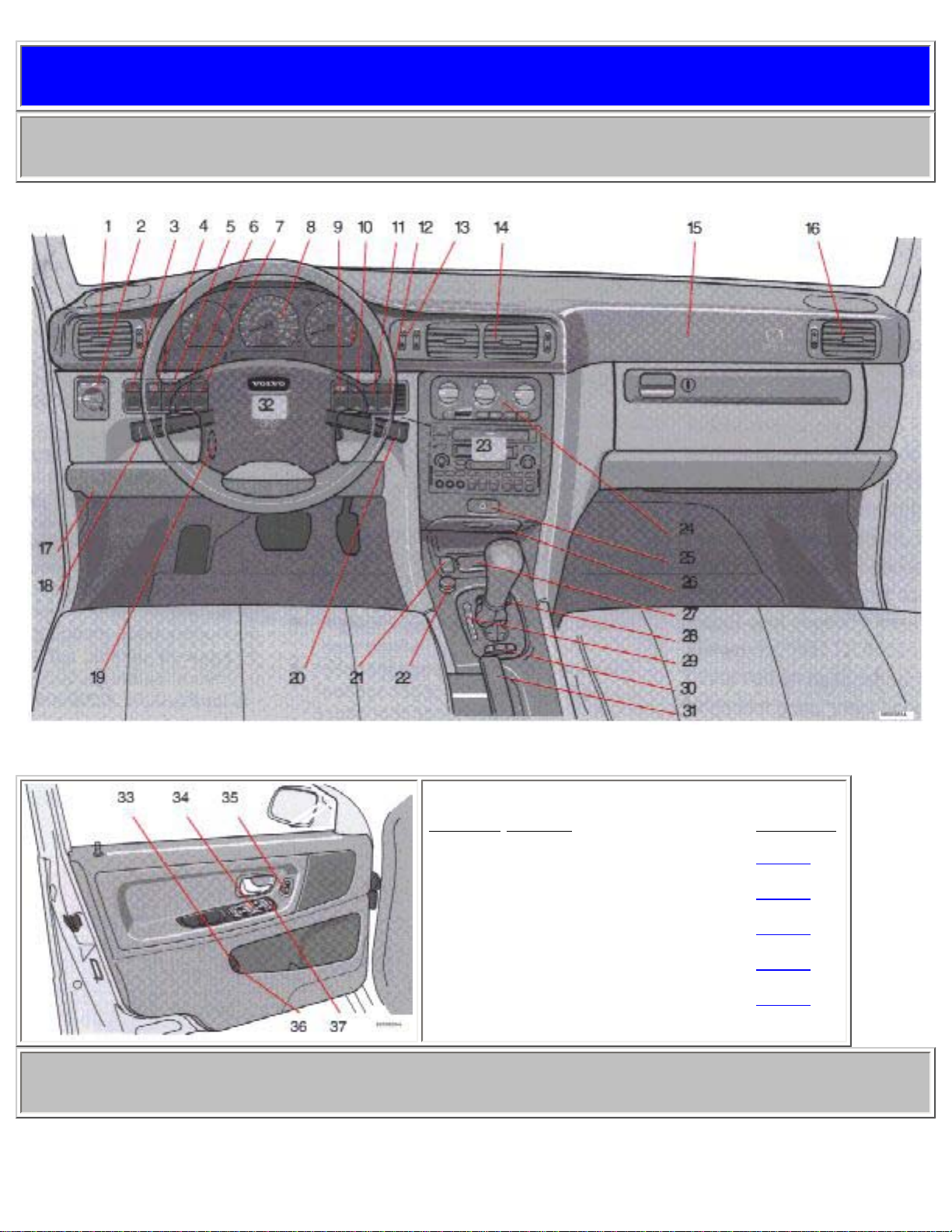
pg. 16 Instruments, switches and controls
Number Subject Page No.
33 Trunk/ tailgate open control
pg. 47
34 Power window controls
pg. 40
35 Power mirror control
pg. 50
36 Fuel tank open control
pg. 67
37 Central locking button
pg. 43
pg. 17 Instruments, switches and controls (cont.)
Shiftlock (automatic transmission only)
file:///K|/ownersdocs/1998/1998_SV70/98sv70_016.htm (1 of 5)12/30/2006 1:51:24 PM
Page 30

1998 S70 & V70
When your car is parked, the gear selector is locked in the (P)ark position. To release the selector from
this position, turn the ignition key to position II (or start the engine), depress the brake pedal, press the
button on the front side of th e gear selector and move the selector from (P)ark.
If it is necessary to manually override the shiftlock system:
● Turn the starting (ignition) key to position I
● Press firmly on the "SHIFTLOCK OVERRIDE" button located near the base of the gear selector.
● While holding the override button down, press the button on the front of the gear selector.
● Move the gear selector from the ( P )ark position.
Keylock (automatic transmission only)
This means that when you switch off the ignition, the gear selector must be in the (P)ark position before
the starting (ignition) key can be removed from the ignition switch.
Anti-lock Brake System (ABS)
The ABS system in your car performs a self-diagnostic test when the vehicle first reaches the speed of
approximately 12 mph (20 km/h). The brake pedal will pulsate several times and a sound may be audible
from the ABS control module. This is normal.
Fuel tank cover
The fuel tank cover is locked and must be popped open using the control on the driver's door (see
illustration on page 16).
The pages in this section provide detailed descriptions of the vehicle's instruments and controls. Note
that vehicles may be equipped differently, depending on special legal requirements.
Chart for Picture of Instruments and Controls
Number Page No. Subject
1
pg. 35
Air vents
file:///K|/ownersdocs/1998/1998_SV70/98sv70_016.htm (2 of 5)12/30/2006 1:51:24 PM
Page 31

1998 S70 & V70
2
pg. 22
Headlights, parking lights
3
pg. 24
Instrument illumination
4
pg. 24
Rear fog light
5
pg. 24
Front fog lights
6 Space for additional equipment
7 Space for additional equipment
8
pg. 6-17
Instruments
9
pg. 25
Traction control system (optional)
10
pg. 2830
Trip computer (optional)
11
pg. 52
Electrically operated sun roof (optional)
12
pg. 25
Rear window demister/heated door mirrors
13
pg. 35
Air mix
14
pg. 35
Air vents
15
pg. 4-6
Passenger side SRS (air bag) hatch
16
pg. 35
Air vents
17
pg. 53
Hood release
18
pg. 22
Turn signals, high/low beams
pg. 31
Cruise control
19
pg. 34
Adjustable steering wheel
20
pg. 23
Windshield wiper/washer
pg. 26
Tailgate wiper/washer (wagons)
21
pg. 32
Heated front seats (optional)
22
pg. 33
Auxiliary socket
23
pg. 141
Audio system
24
pg. 35-39
Heating and ventilation controls
25
pg. 25
Hazard warning flashers
26
pg. 33
Ash tray
27 Coin holder
28
pg. 108
Shiftlock release button (automatic transmission only)
29
pg. 70-71
Gear selector shift positions
30
pg. 72
Transmission mode selectors
file:///K|/ownersdocs/1998/1998_SV70/98sv70_016.htm (3 of 5)12/30/2006 1:51:24 PM
Page 32
1998 S70 & V70
31
pg. 32
Parking brake
32
pg. 4-6
Horn/SRS
Some of the items above are available on certain models only.
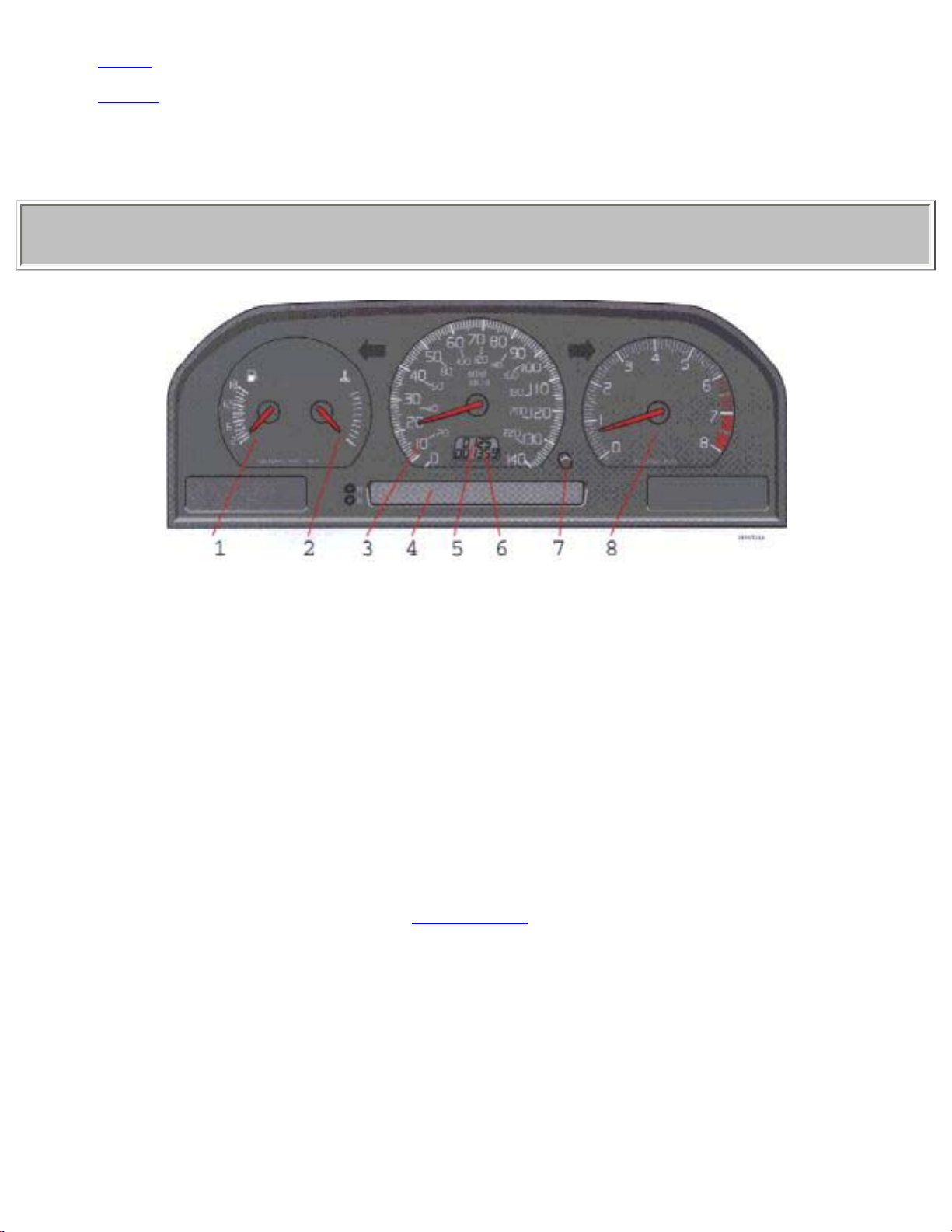
pg. 18 Instruments
1 Fuel gauge
The fuel tank holds approximately 18.4 US gals. (70 liters). When the warning light comes on there is
approximately 1.8 US gals. (8 liters) of fuel remaining. See "Refueling" for further information.
2 Temperature gauge
Do not drive the car with the pointer in the red range. The pointer should be
approximately midway on the gauge face when driving. If the pointer approaches the red
range repeatedly, check coolant level.
See page 130.
3 Speedometer
4 Clock, ambient temperature sensor, trip computer (certain models)
5 Trip odometer
file:///K|/ownersdocs/1998/1998_SV70/98sv70_016.htm (4 of 5)12/30/2006 1:51:24 PM
Page 33

1998 S70 & V70
Used for measuring shorter distances. The last digit indicates 1/10 mile/kilometer.
6 Odometer
7 Trip odometer reset button
8 Tachometer
Reads thousands of engine rpm. The engine should not be operated in red range. The
highest permitted constant engine speed is 6,200 rpm.
Contents | Top of Page
file:///K|/ownersdocs/1998/1998_SV70/98sv70_016.htm (5 of 5)12/30/2006 1:51:24 PM
Page 34
1998 S70 & V70
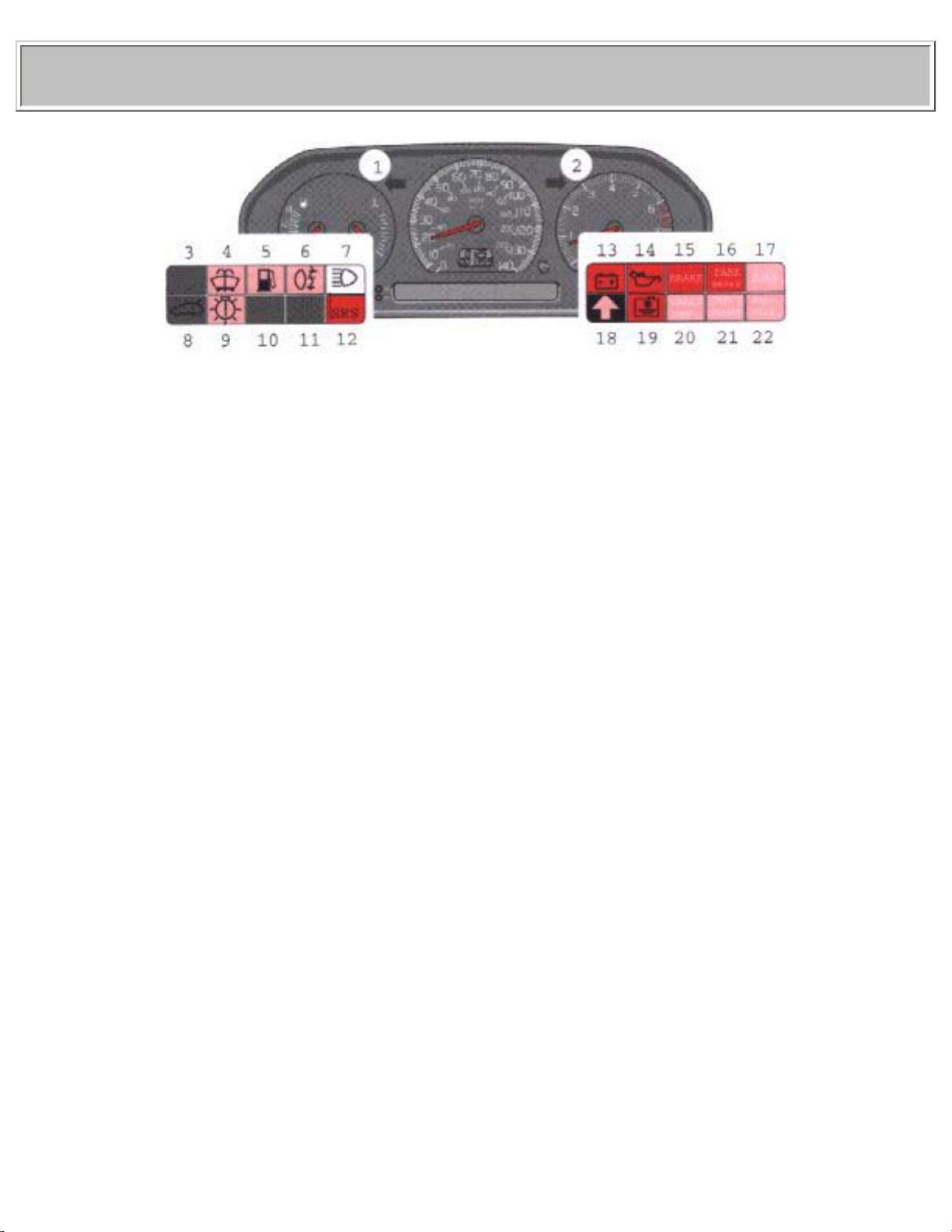
pg. 19 Indicator and warning lights
1 Turn signal, left
2 Turn signal , right
3 (Not in use)
4 Low washer fluid level
If the lamp glows continuously when the engine is running, there is only about 1/2 - 1 US
qt. remaining in the washer fluid reservoir.
5 Low fuel level
When the lamp glows, only about 1.8 US gals. (8 liters) of fuel remain. If the ignition is
switched on while refueling, the gauge may read inaccurately for up to 45 minutes.
6 Rear fog light
7 High beams
8 Trunk/tailgate open
9 Bulb failure warning sensor
10 (Not in use)
11 (Not in use)
12 SRS
13 Generator not charging
14 Low engine oil pressure
15 Brake warning light
16 Parking brake applied
17 ABS-system
18 Transmission mode "W", or gear positions 3 or L engaged (automatic transmissions)
19 Low coolant level
file:///K|/ownersdocs/1998/1998_SV70/98sv70_019.htm (1 of 5)12/30/2006 1:51:24 PM
Page 35

1998 S70 & V70
20 Traction Control System (option)
21 Malfunction indicator lamp
(See
page 20 for more information)
22 Service reminder indicator
pg. 20 Warning lights
The warning lights described on
pages 20 and 21 should never stay on when driving
When the ignition key is turned on, and before the engine starts, all of the warning lights should be on to
test the function of the bulbs. Should a light not go off after the engine has started, the system indicated
should be inspected. However, the parking brake reminder light will not go off until the parking brake is
fully released.
Generator warning light
If the light comes on while the engine is running, have the charging system checked.
Malfunction indicator lamp
If the lamp comes on (or stays on after the vehicle has started), the engine diagnostic system has
detected a possible fault in the emission control system. Although driveability may not be affected, see
an authorized Volvo retailer as soon as possible for inspection.
NOTE: If the fuel filler cap is not closed tightly or if the engine is running when the car is refueled, the
Malfunction Indicator Lamp may indicate a fault. Use only Volvo original or approved fuel filler caps.
Oil pressure warning light
If the light comes on while driving, stop the car and then stop the engine immediately and check the
file:///K|/ownersdocs/1998/1998_SV70/98sv70_019.htm (2 of 5)12/30/2006 1:51:24 PM
Page 36
1998 S70 & V70
engine oil level. See page 124. If the light stays on after restart, have the car towed to the nearest
authorized Volvo retailer. After hard driving, the light may come on occasionally when the engine is
idling. This is normal, provided it goes off when the engine speed is increased.
Parking brake reminder light
This light will be on when the parking brake (hand brake) is applied. The parking brake lever is situated
between the front seats. Canadian models are equipped with this warning light:
Brake fluid warning light
If the light comes on while driving or braking, stop immediately, open the hood and check the brake
fluid level in the reservoir.
See page 131 for reservoir position.
Canadian models are equipped with this warning light:
WARNING! If the fluid level is below the MIN mark in either section of the reservoir: DO NOT
DRIVE. Tow the car to a Volvo retailer and have the brake system checked and any leakage repaired.
pg. 21 Warning lights (cont.)
TRACS disengaged (option)
If the TRACS (TRAction Control System) is manually disengaged with the switch on the dashboard, the
warning light will come on. This will also come on to indicate a TRACS malfunction, and when the
brakes overheat, although it goes out again at the normal temperature level. If the lamp remains on, the
system should be checked by an authorized Volvo retailer. This lamp should not be confused with the
ON/OFF indicator lamp above the switch.
See page 25 for additional information.
Anti-lock Brake System (ABS)
file:///K|/ownersdocs/1998/1998_SV70/98sv70_019.htm (3 of 5)12/30/2006 1:51:24 PM
Page 37

1998 S70 & V70
If the warning lamp lights up there is a malfunction of the ABS system (the standard braking system will
however function). The vehicle should be driven to a Volvo retailer for inspection.
See page 80 for additional information.
Canadian models are equipped with this warning light:
Coolant level sensor
If the light comes on while driving, the coolant level is low. The coolant level in the expansion tank
should be checked immediately and topped up if necessary. The cooling system should be inspected by
an authorized Volvo retailer.
Mode "W" engaged
The lamp will light up when the Winter/Wet starting mode is engaged or if gears "3" or "L" are selected.
If the warning lamp begins to flash , this means that there is a fault in the automatic gearbox. Contact
your Volvo retailer.
Supplemental Restraint System (SRS)
If the light comes on (or stays on after the vehicle has started), the SRS diagnostic system has detected a
fault. Drive to an authorized Volvo retailer for an inspection of the system. See the SRS section for more
information.
Service reminder indicator
This light will come on at 10,000 mile (16,000 km) intervals*, after 750 hours of driving or after 12
months, whichever occurs first. It is a reminder to the driver that the service interval has been exceeded.
The light will stay on for2 minutes after the start until reset by the servicing retailer.
* Turbo-charged model intervals: 5,000 miles (8,000 km), 500 hours of driving or after 12 months,
file:///K|/ownersdocs/1998/1998_SV70/98sv70_019.htm (4 of 5)12/30/2006 1:51:24 PM
Page 38

1998 S70 & V70
whichever occurs first.
Bulb failure warning light
The light will come on if any of the following bulbs are defective:
● one of the low beam headlights
● one of the tail lights
● one of the brake lights when the brake pedal is depressed.
Check the fuse and bulb. See sections "Replacing bulbs" and "fuses".
Should the warning light come on after a defective outside bulb has been replaced, the corresponding
bulb on the other side of the car should also be replaced.
Contents | Top of Page
file:///K|/ownersdocs/1998/1998_SV70/98sv70_019.htm (5 of 5)12/30/2006 1:51:24 PM
Page 39
1998 S70 & V70
pg. 22 Headlights, Parking lights, Turn signals
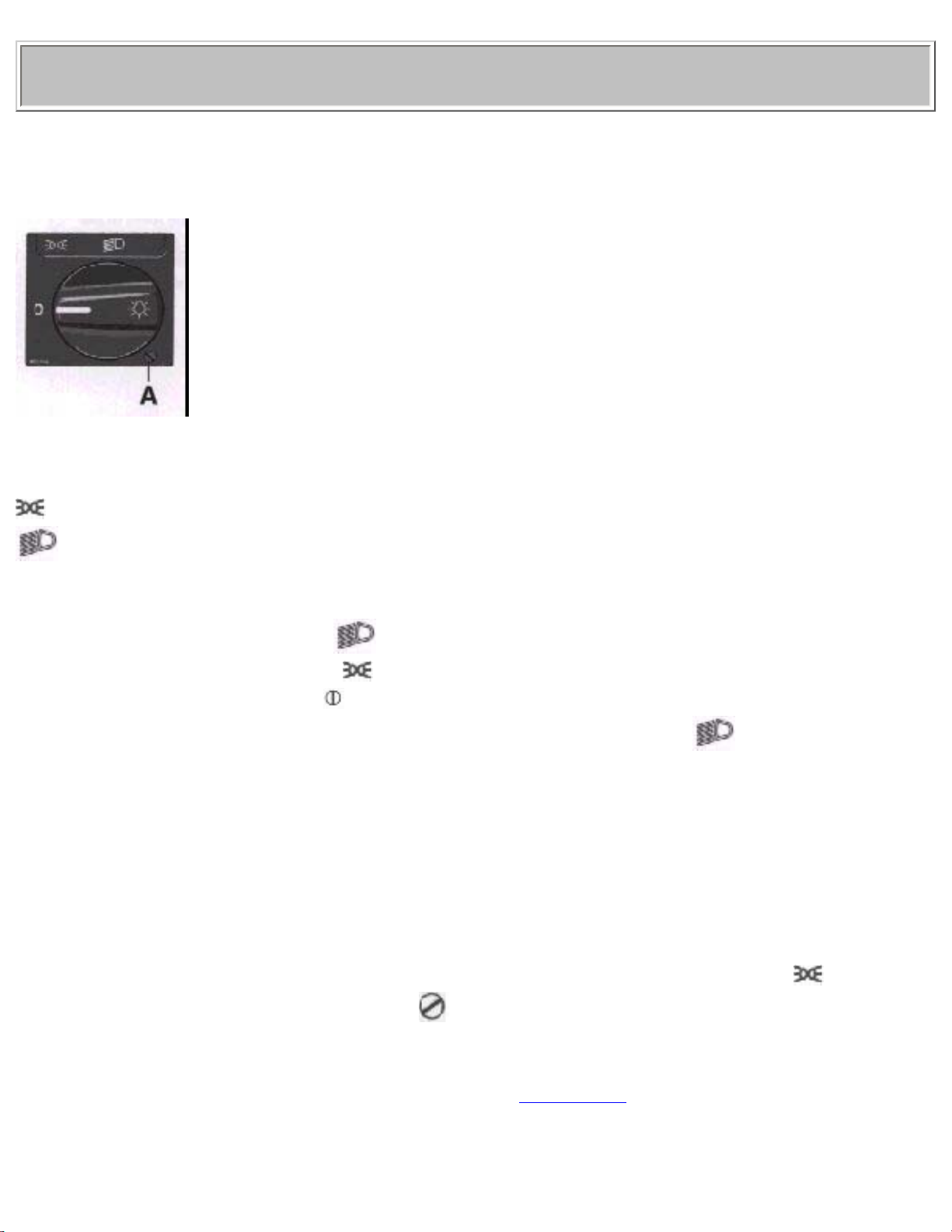
Headlights and parking lights
O All lights off *
Parking lights on **
Headlights and parking lights are on if starting (ignition) switch is in positions I or II.
If the headlight switch is in position
all lights will go out when starting switch is switched off.
With the headlight switch in position
the parking lights will stay on (headlights off) with the daytime
running light screw (A) in position
.
The high beams can only be switched on if the headlight switch is in position
.
Switch from high to low beams and vice versa by moving the turn signal switch lever on the left side of
the steering column towards the steering wheel.
* Models equipped with daytime running lights: The low beams, tail lights, parking lights and license
plate lights will come on automatically when the ignition is switched on.
** The daytime running lights will also function when the headlight switch is in position
and the
daytime running light screw (A) is in position
.
For additional information on the daytime running lights,
see page 26.
file:///K|/ownersdocs/1998/1998_SV70/98sv70_022.htm (1 of 8)12/30/2006 1:51:25 PM
Page 40
1998 S70 & V70
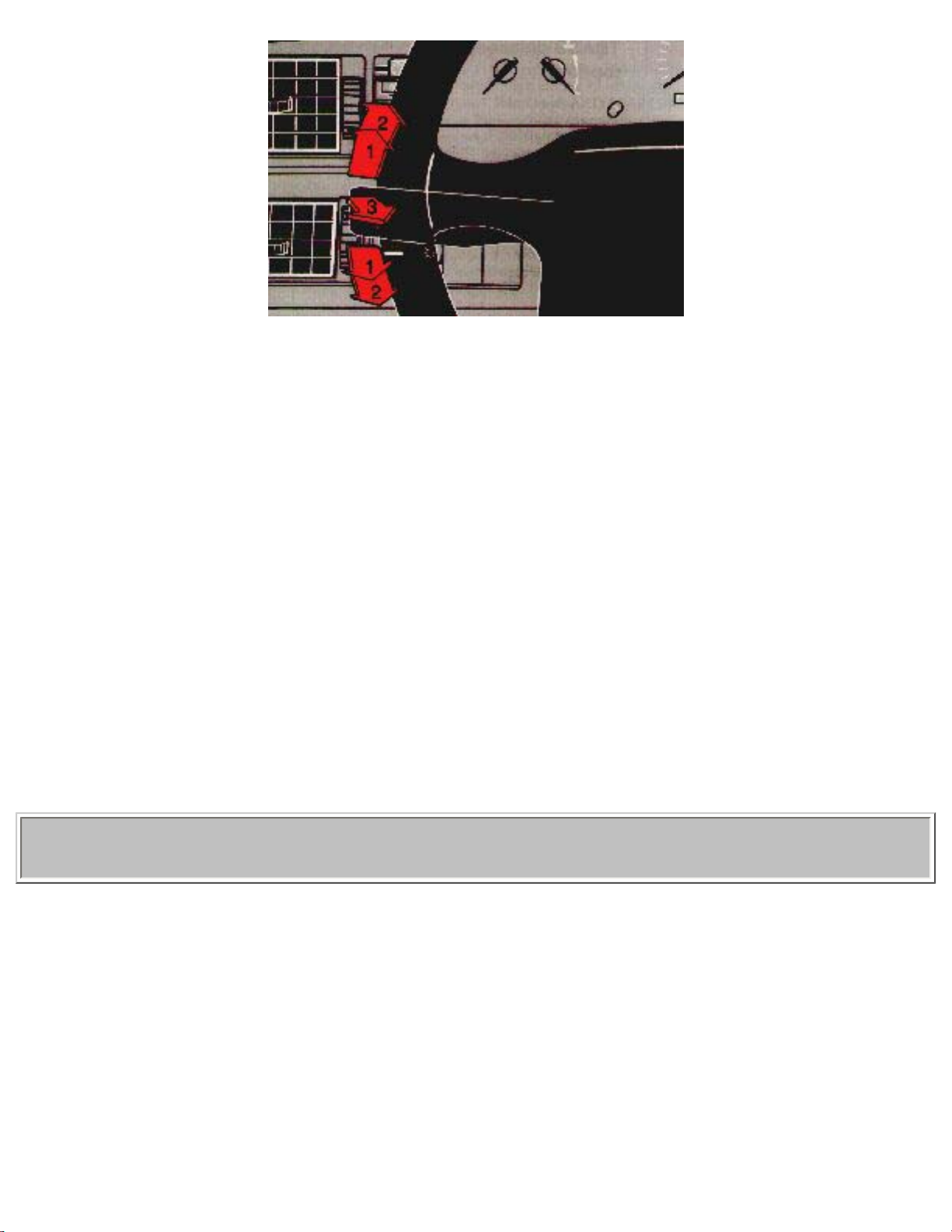
Turn signals
1 Lane change position : In maneuvers such as lane changing, the driver can flash the turn signals by
moving the turn signal lever to the first stop and holding it there. The lever will return to the neutral
position when released.
2 Signal lever engaged for normal turns
3 High beam/low beam switch (headlights on)
Move the lever towards the steering wheel and release it.
Headlight flasher (headlights off)
Move the lever towards the steering wheel. The headlight high beam will be on until the lever is
released.
NOTE: A defective turn signal bulb will cause the turn signal indicator and remaining signal lights to
flash more rapidly than normal.
pg. 23 Windshield wipers/washers, Ignition switch
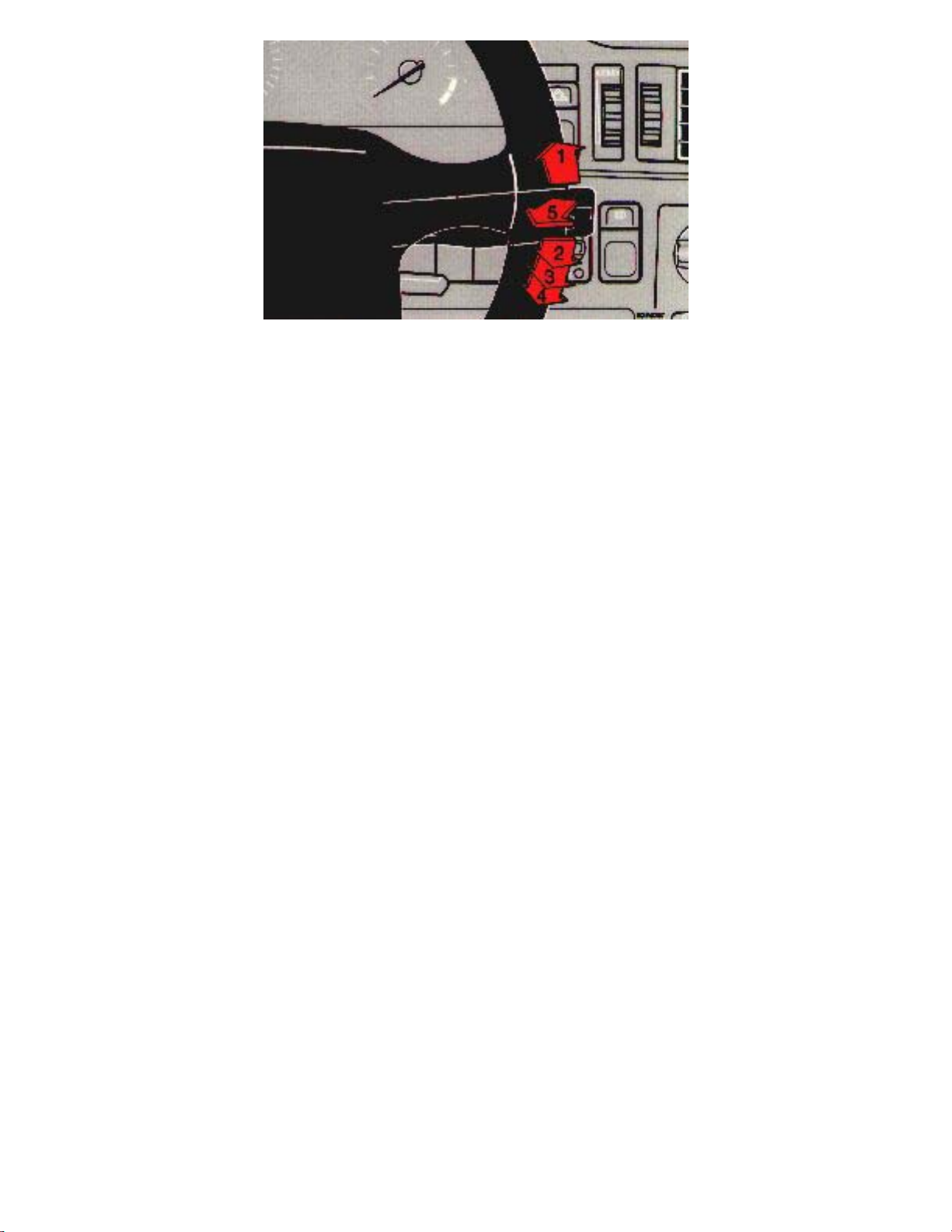
Windshield wipers/washers
file:///K|/ownersdocs/1998/1998_SV70/98sv70_022.htm (2 of 8)12/30/2006 1:51:25 PM
Page 41
1998 S70 & V70
1 Intermittent wiper
With switch in this position, the wipers will sweep approximately every seventh second.
2 "Single sweep" position.
The switch returns automatically when released
3 Wipers, normal speed.
4 Wipers, high speed
5 Windshield wiper/washer, headlight wiper/washer (certain models)
The wiper will make 2-3 complete sweeps across the windshield and headlights after the lever is
released.
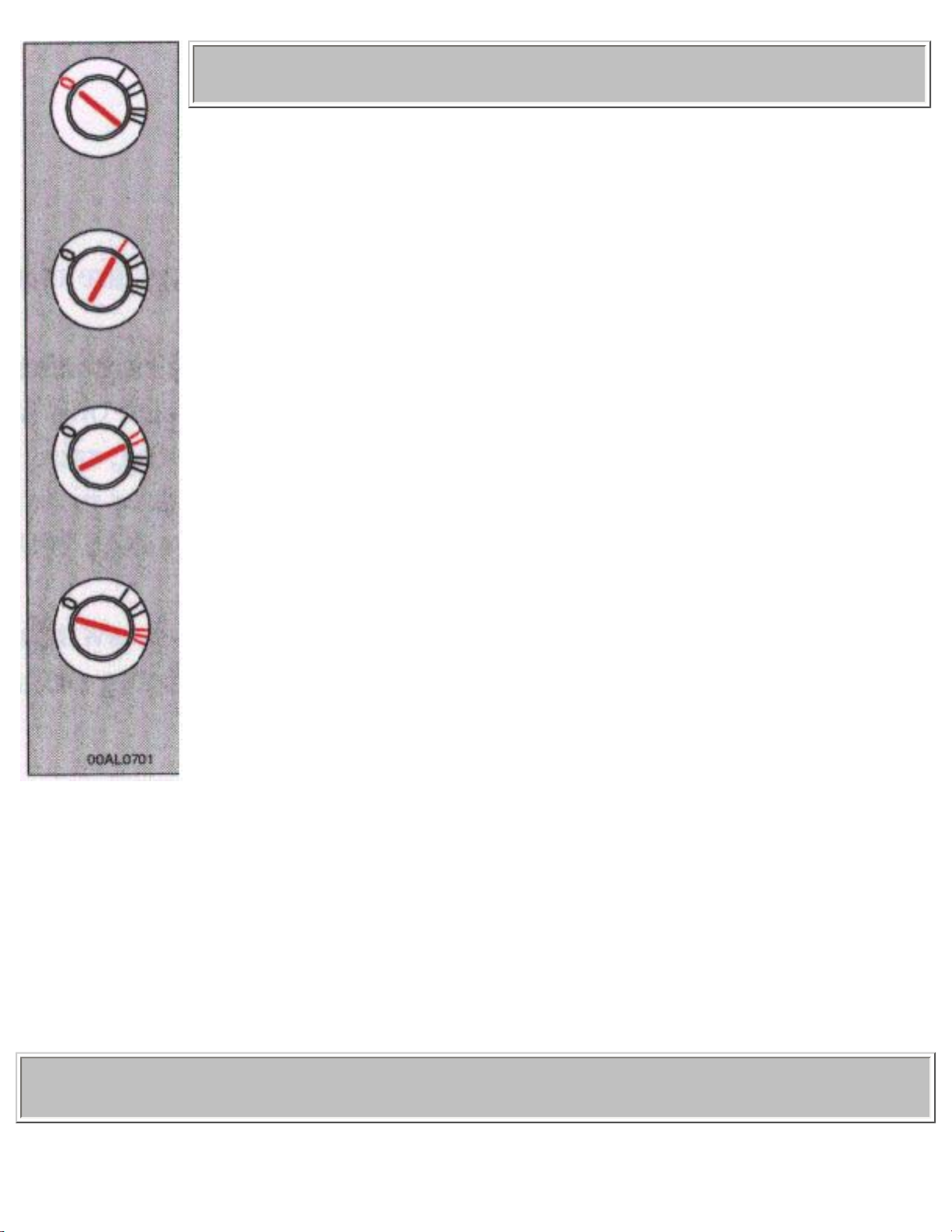
O Locked position:
Remove the key to lock the steering wheel*
file:///K|/ownersdocs/1998/1998_SV70/98sv70_022.htm (3 of 8)12/30/2006 1:51:25 PM
Page 42
1998 S70 & V70
WARNING: Never turn the key to position O while driving or when the car is
being towed.
I Intermediate position:
Certain accessories, radio, etc. on, daytime running lights off.
II Drive position:
Key position when engine is running.
III Starting position:
Release the key when the engine starts. The key returns automatically to the Drive
position.
* On cars equipped with an automatic transmission the gear selector must also be in
the (P)ark position.
Starting (ignition) switch/steering wheel lock
The steering wheel lock might be under tension when the car is parked. Turn the steering wheel slightly
to free the ignition key.
In order to reduce car theft, make sure the steering wheel lock is engaged before leaving the car.
A chime will sound if the starting key is left in the ignition lock and the front door on the driver's side is
opened.
pg. 24 Instrument illumination, Fog lights
file:///K|/ownersdocs/1998/1998_SV70/98sv70_022.htm (4 of 8)12/30/2006 1:51:25 PM
Page 43
1998 S70 & V70
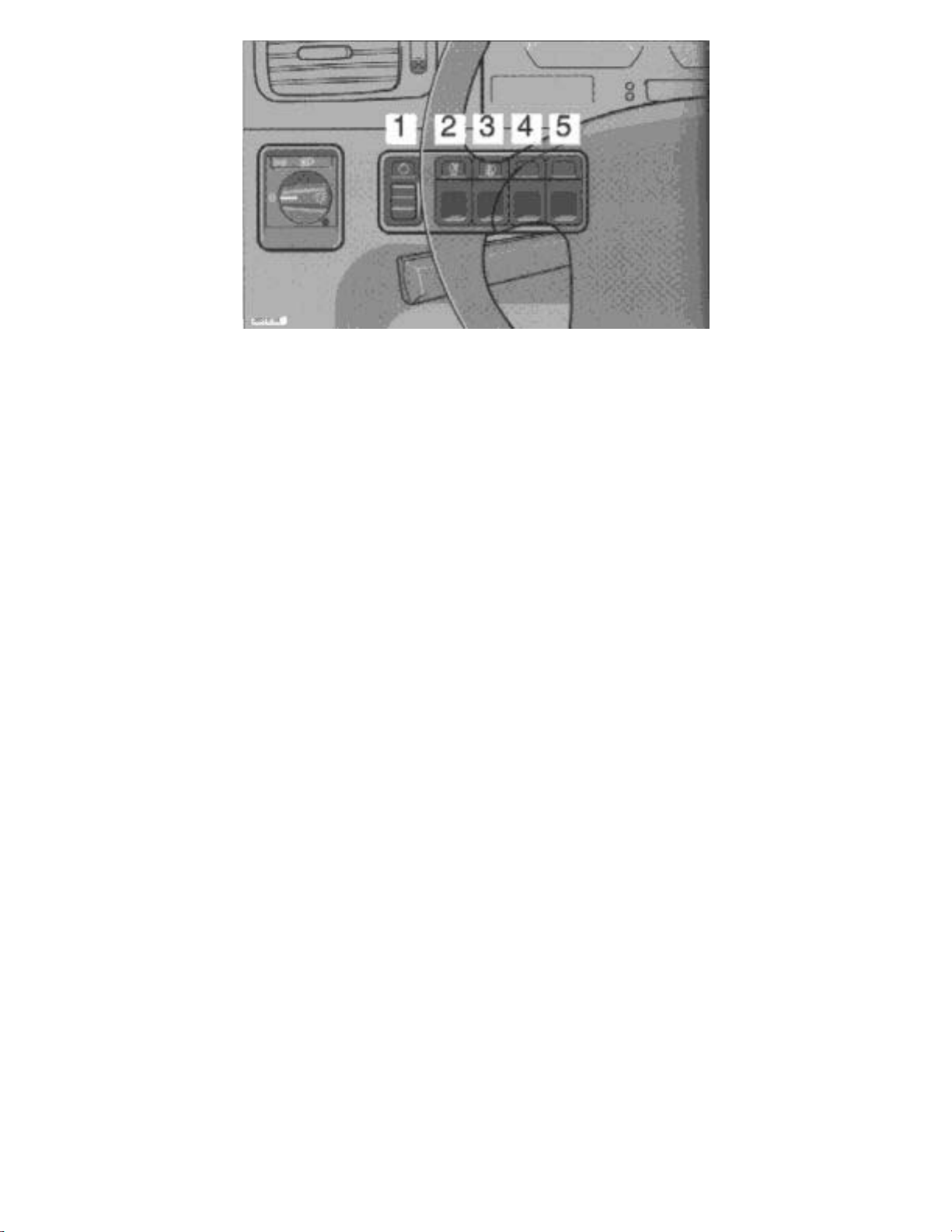
1 - Instrument illumination
To increase the brightness: move the thumbwheel up.
To decrease the brightness: move the thumbwheel down.
2 - Rear foglight *
The rear fog light (located in the driver's side tail light cluster) is considerably brighter than the normal
tail lights and should be used only when the atmospheric conditions, such as fog, rain, snow, smoke or
dust reduce the daytime or nighttime visibility of other vehicles to less than 500 ft (150 meters).
For the rear fog light to function, the low beam headlights must be switched on.
* By design, there is one rear foglight only, located in the driver's side tail light cluster.
3 - Front fog lights (option)
The front fog lights, located in the front spoiler, will only function in combination with the low beam
headlights.
4 - Space for optional equipment
5 - Space for optional equipment
file:///K|/ownersdocs/1998/1998_SV70/98sv70_022.htm (5 of 8)12/30/2006 1:51:25 PM
Page 44
1998 S70 & V70
pg. 25 TRACS, Sun roof, Trip computer, Hazard warning flashers, Demister
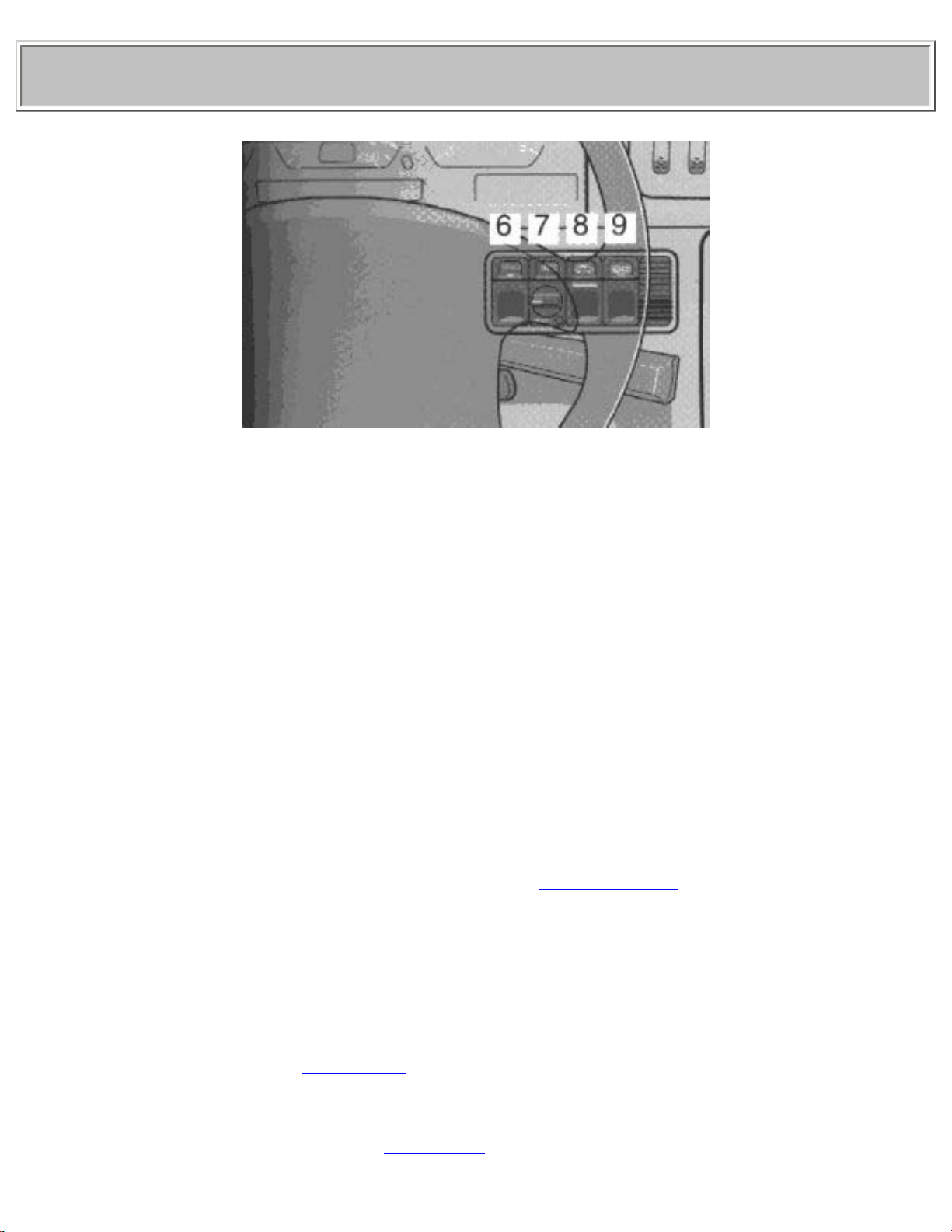
6 - TRAction Control System (TRACS) - option
TRACS is a system designed as an aid when starting/driving off if one of the drive wheels has poor
traction due to weather conditions or the road surface and is connected to the ABS control module.
TRACS engages automatically at speeds below 25 mph (40 km/h) when one of the drive wheels loses
traction. It disengages automatically when speed exceeds 25 mph (40 km/h). The sound which can be
heard when the system is operating comes from the ABS system.
TRACS can be disengaged manually using the switch on the dashboard. The indicator light will come
on.
7 - Trip computer - option
Turn the dial to the desired function. For more information,
see pages 28-30.
8 - Electrically operated sun roof - option
The sun roof can be operated in two ways; as a conventional sliding roof or the rear edge can be raised
to provide increased ventilation.
See page 52 for operating instructions.
NOTE: In case of a sun roof malfunction, see page 52.
file:///K|/ownersdocs/1998/1998_SV70/98sv70_022.htm (6 of 8)12/30/2006 1:51:25 PM
Page 45
1998 S70 & V70
9 - Rear window demister, heated side-view mirrors
Press the switch to start heating the rear window and side-view mirrors. The control light in the switch
will illuminate.
A timer switches off the system after approximately 12 minutes. The control light will go out
correspondingly.
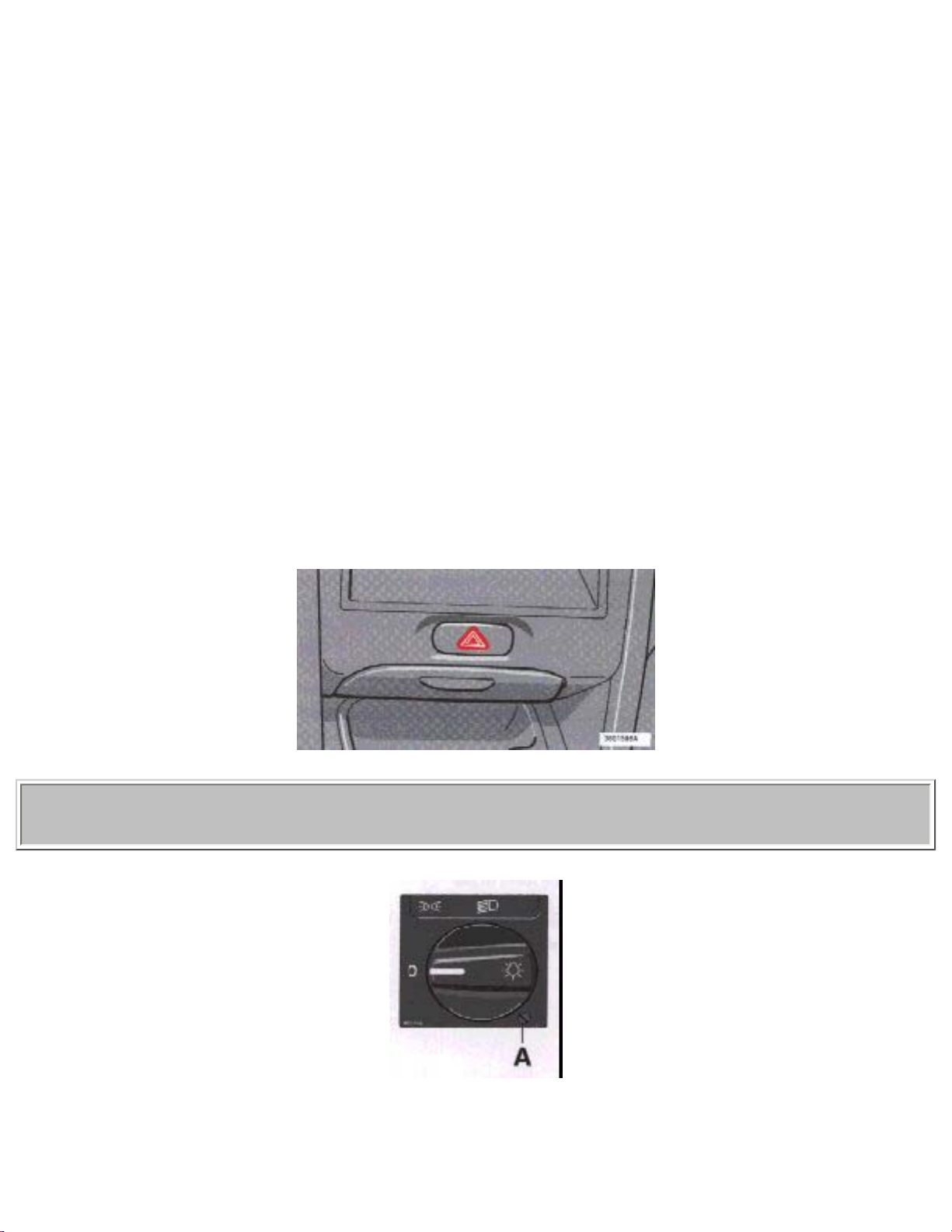
Hazard warning flashers
The four-way flasher (located above the ashtray) should be used to indicate that the vehicle has become
a traffic hazard.
NOTE: Regulations regarding the use of the hazard warning flasher may vary from state to state.
pg. 26 Daytime running lights, Tailgate wiper/washer (wagons)
Automatic daytime running lights
file:///K|/ownersdocs/1998/1998_SV70/98sv70_022.htm (7 of 8)12/30/2006 1:51:25 PM
Page 46
1998 S70 & V70
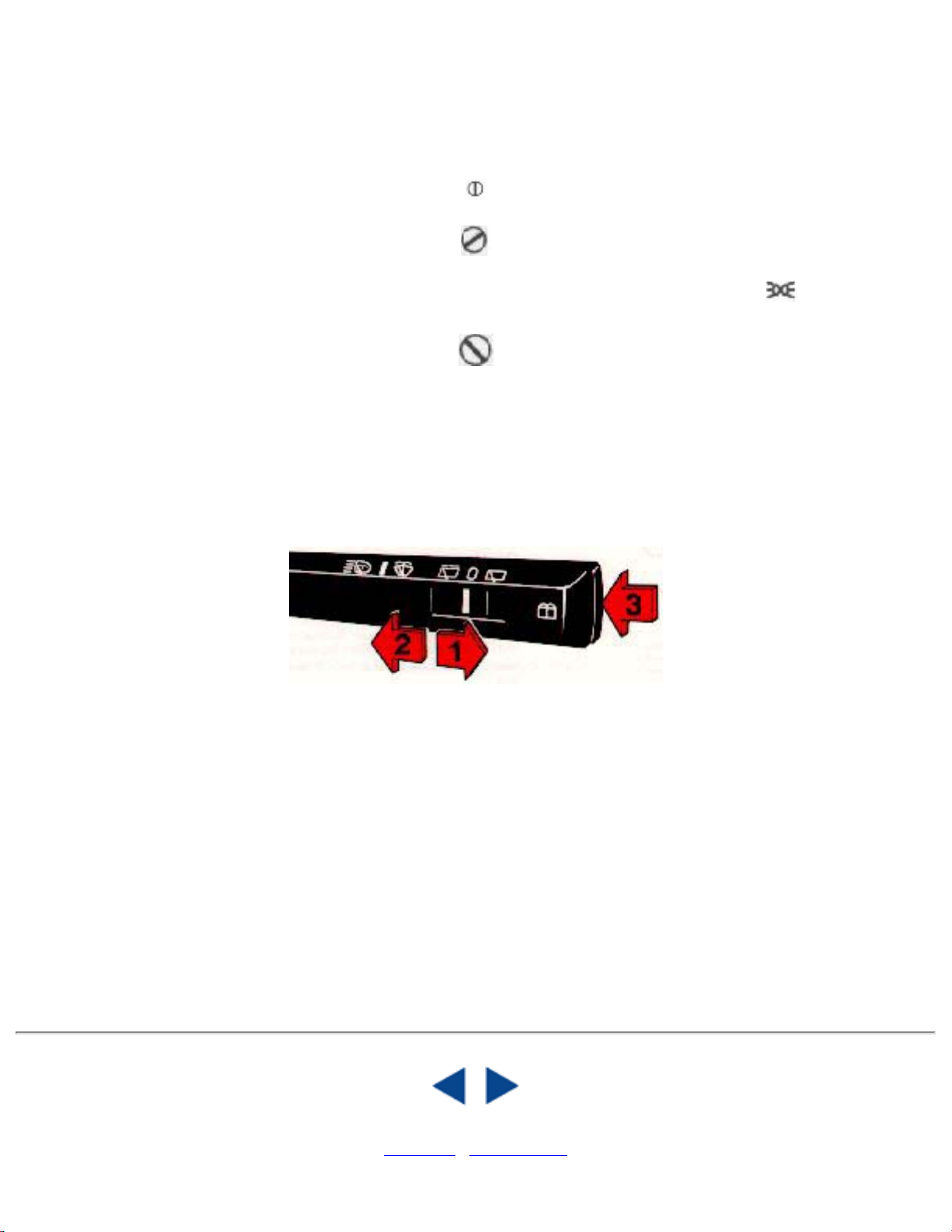
Screw A in the illustration (available on U.S. models only) is used to control the automatic daytime
running lights when the headlight switch is in position 0.
To adjust, press in the screw with a small screwdriver and turn to one of the following positions:
Automatic daytime running lights
Automatic daytime running lights
The daytime running lights will also function when the headlight switch is in position
and switch A
is in this position.
All lights off (daytime running light function disabled)
NOTE: The daytime running light function may only be disabled (turned off) in the U.S. - Canadian law
mandates the use of daytime running lights.
Tailgate wiper/washer (wagons)
Tailgate window wiper/washer The tailgate window wiper/washer is operated by a switch at the end of
the wiper level.
1. The wiper operates continuously.
2. Intermittent position: the wiper strokes approximately every 10 seconds.
3. Tailgate washer (note that the wiper also operates when this button is depressed): after the button is
released the wiper strokes 2-3 additional times before stopping.
Contents | Top of Page
file:///K|/ownersdocs/1998/1998_SV70/98sv70_022.htm (8 of 8)12/30/2006 1:51:25 PM
Page 47
1998 S70 & V70
pg. 27 Clock, Ambient temperature sensor (certain models)
Resetting the clock
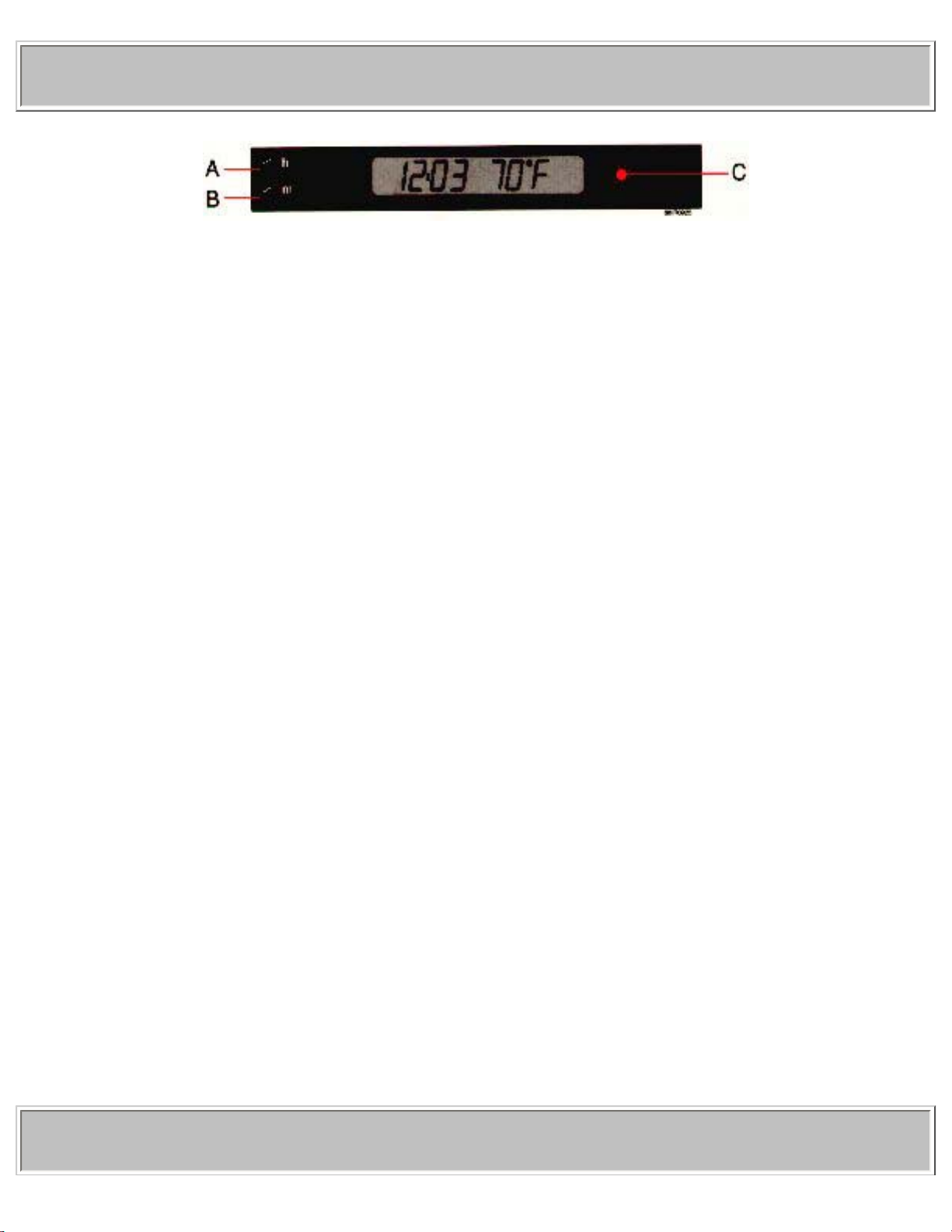
The digital clock can be reset by pressing one of the two buttons (A and B) with a pointed object such as
the tip of a pen.
h = hours
m = minutes
Maintain the pressure on the buttons for more than four seconds to change the time more quickly.
Ambient temperature sensor
This sensor indicates the temperature slightly above the road surface and represents air temperature
where road icing may occur. An amber warning lamp (C) lights up when the temperature is in the range
of 23 - 36° F (-5 - +2° C). Please note that this lamp does not indicate a fault with your car.
At low speeds or when the car is not moving, the temperature readings may be slightly higher than the
actual ambient temperature due to the heat generated by the engine.
Display alternatives
If buttons A and B are pressed down simultaneously, it is possible to shift between four different display
alternatives:
Press 1st time: 12 hour clock and °F
Press 2nd time: 24 hour clock and °F
Press 3rd time: 12 hour clock and °C
Press 4th time: 24 hour clock and °C
pg. 28 Trip computer (certain models)
file:///K|/ownersdocs/1998/1998_SV70/98sv70_027.htm (1 of 5)12/30/2006 1:51:25 PM
Page 48
1998 S70 & V70
Trip computer
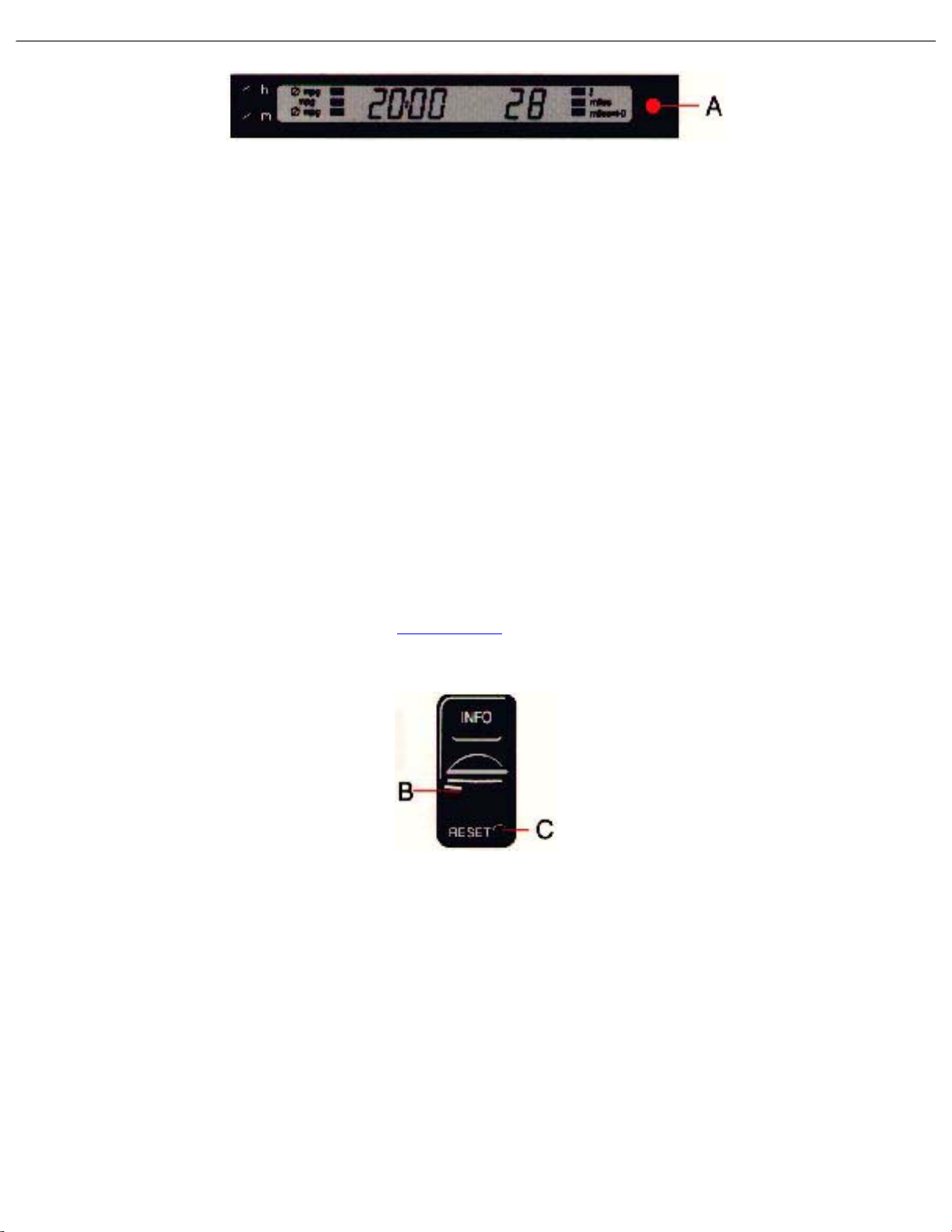
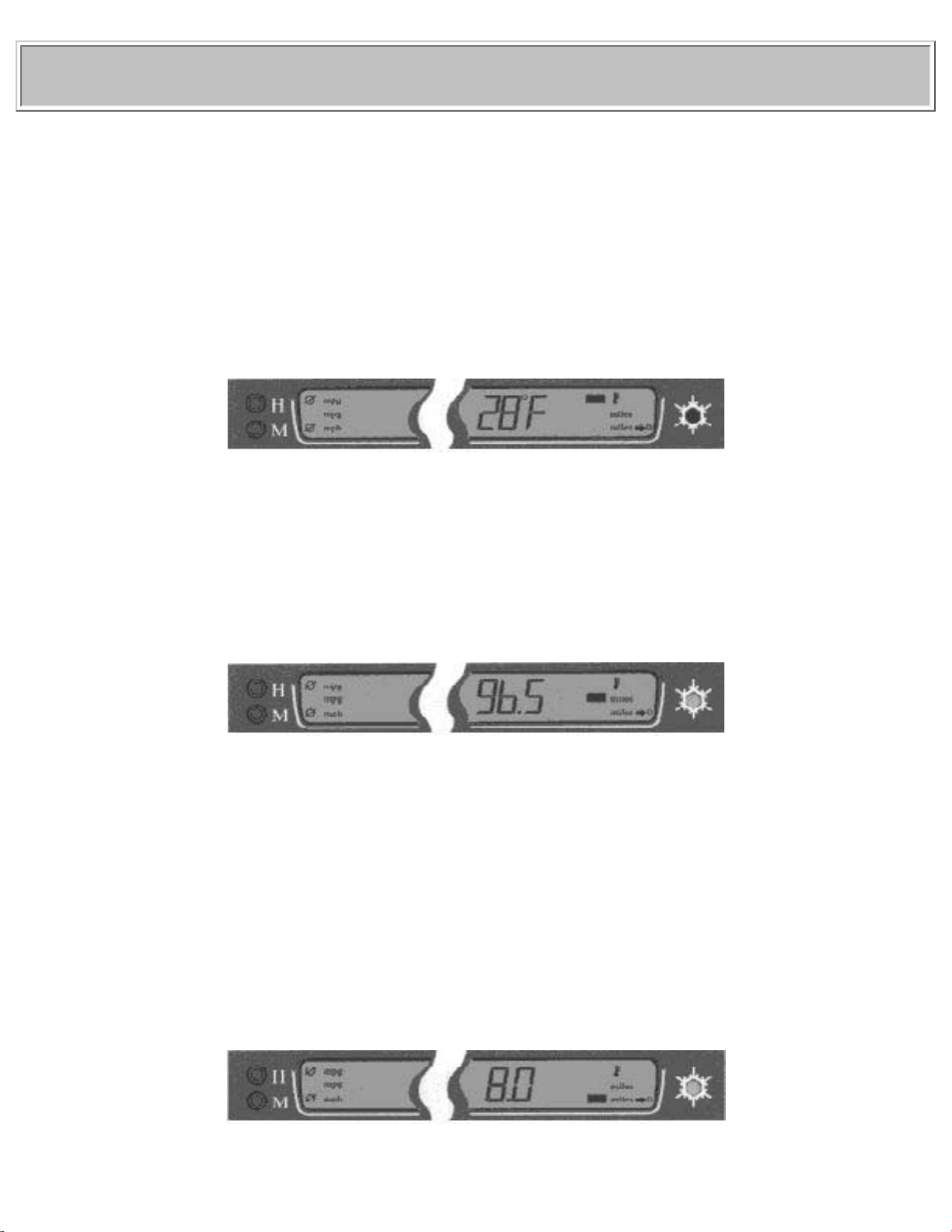
The trip computer offers six functions which are presented in a single display. The cursor indicates the
selected function. The trip computer's clock is shown permanently in the left-hand field. Refer to the
previous page for more detailed information regarding the clock function.
The following data is monitored by the computer:
● Average speed
● Current fuel consumption
● Average fuel consumption
● Ambient temperature*
● Tripmeter
● Driving distance on current fuel reserve
* Warning light A in the illustration above.
See page 30 for more details.
Trip computer controls
Select one of the trip computer's six functions by using control B. The Reset button (C) is used to reset
the following functions:
● Average speed
● Average fuel consumption
● Trip meter
Rotate the control to the required position and press the button for at least two seconds to reset the
selected function.
file:///K|/ownersdocs/1998/1998_SV70/98sv70_027.htm (2 of 5)12/30/2006 1:51:25 PM
Page 49
1998 S70 & V70
NOTE: If pressure is maintained on the button for another three seconds, all three of the functions
mentioned above will be reset.
pg. 29 Trip computer (certain models) (cont.)
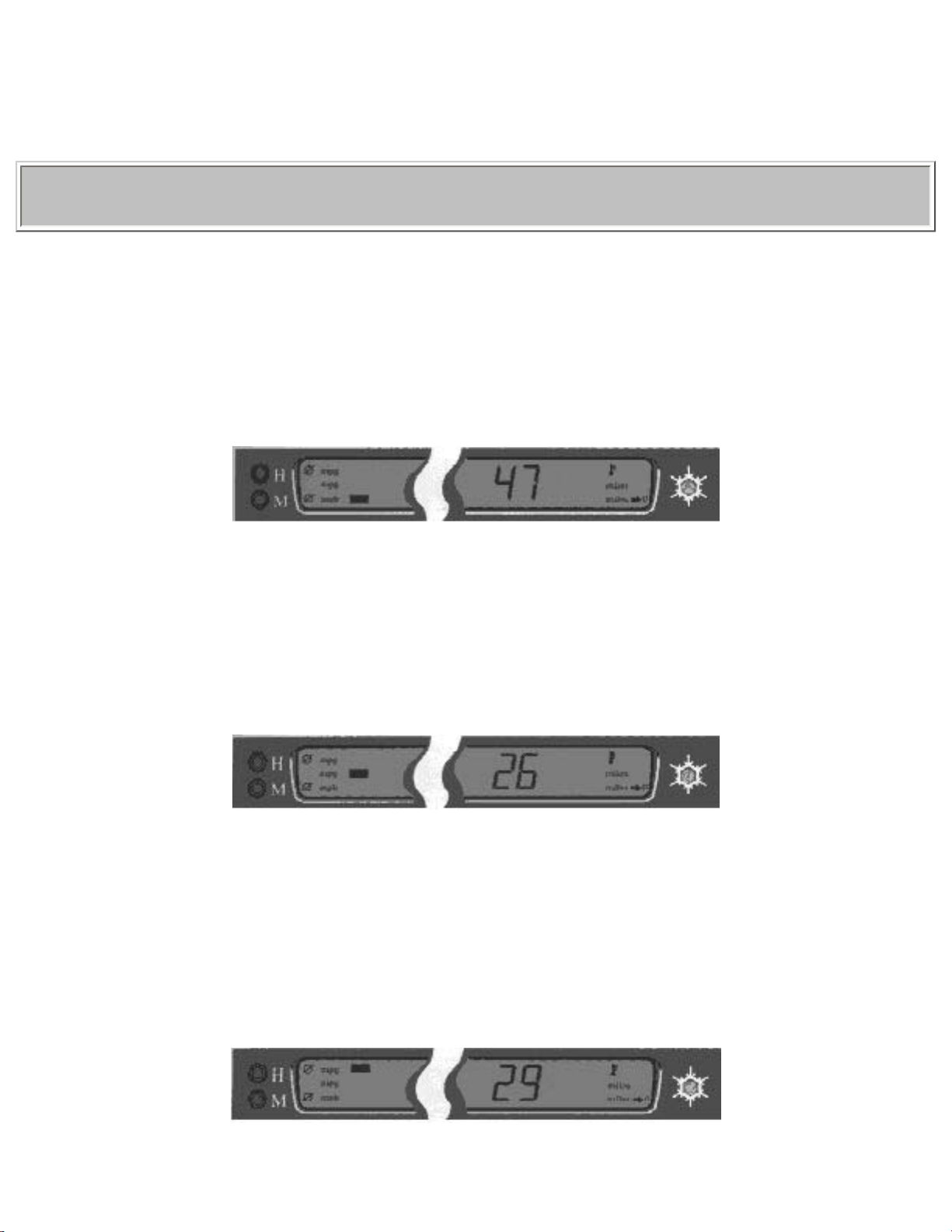
Average speed Ø mph (Canada: km/h)
Average speed since the function was last reset. When the ignition is switched off, the average speed is
stored in memory and is used as the basis for the new figure when the engine is started again. It can be
reset by pressing the reset button on the trip computer control.
Current fuel consumption mpg (Canada: L/100 km)
Continuous information on current fuel consumption, calculated once per second. When the car is not
moving, the display shows "---".
Average fuel consumption Ø mpg (Canada: L/100 km)
Average fuel consumption since the function was last reset. When the ignition is switched off, the
average fuel consumption figure is stored in memory and remains in memory until it is reset using the
button on the trip computer control.
file:///K|/ownersdocs/1998/1998_SV70/98sv70_027.htm (3 of 5)12/30/2006 1:51:25 PM
Page 50
1998 S70 & V70
pg. 30 Trip computer (certain models) (cont.)
Ambient temperature
Shows the ambient temperature just above the road surface while driving. When the temperature is in the
range 23 - 36° F (-5 - +2° C), the ambient temperature sensor activates an amber warning light. Please
note that this lamp does not indicate a fault with your car.
At low speeds or when the car is not moving, the temperature readings may be slightly higher than the
actual ambient temperature due to the heat generated by the engine.
Tripmeter in miles (Canada: km)
Shows the distance driven since the function was last reset. This value is stored in memory until it is
reset using the reset button on the trip computer control.
Driving distance on current fuel reserve
mile 0 (Canada: km)
Shows the distance which can be driven on the fuel remaining in the tank, calculated on the basis of the
average fuel consumption and the amount of fuel remaining in the tank at the time of the reading.
When the quantity of fuel drops to below approximately 1.8 US gals. (8 liters), a warning light in the
instrument panel comes on. When the driving distance on the current fuel reserve is less than 5 miles (8
km), the display shows "—".
file:///K|/ownersdocs/1998/1998_SV70/98sv70_027.htm (4 of 5)12/30/2006 1:51:25 PM
Page 51

1998 S70 & V70
Contents | Top of Page
file:///K|/ownersdocs/1998/1998_SV70/98sv70_027.htm (5 of 5)12/30/2006 1:51:25 PM
Page 52
1998 S70 & V70
pg. 31 Cruise control
Cruise control
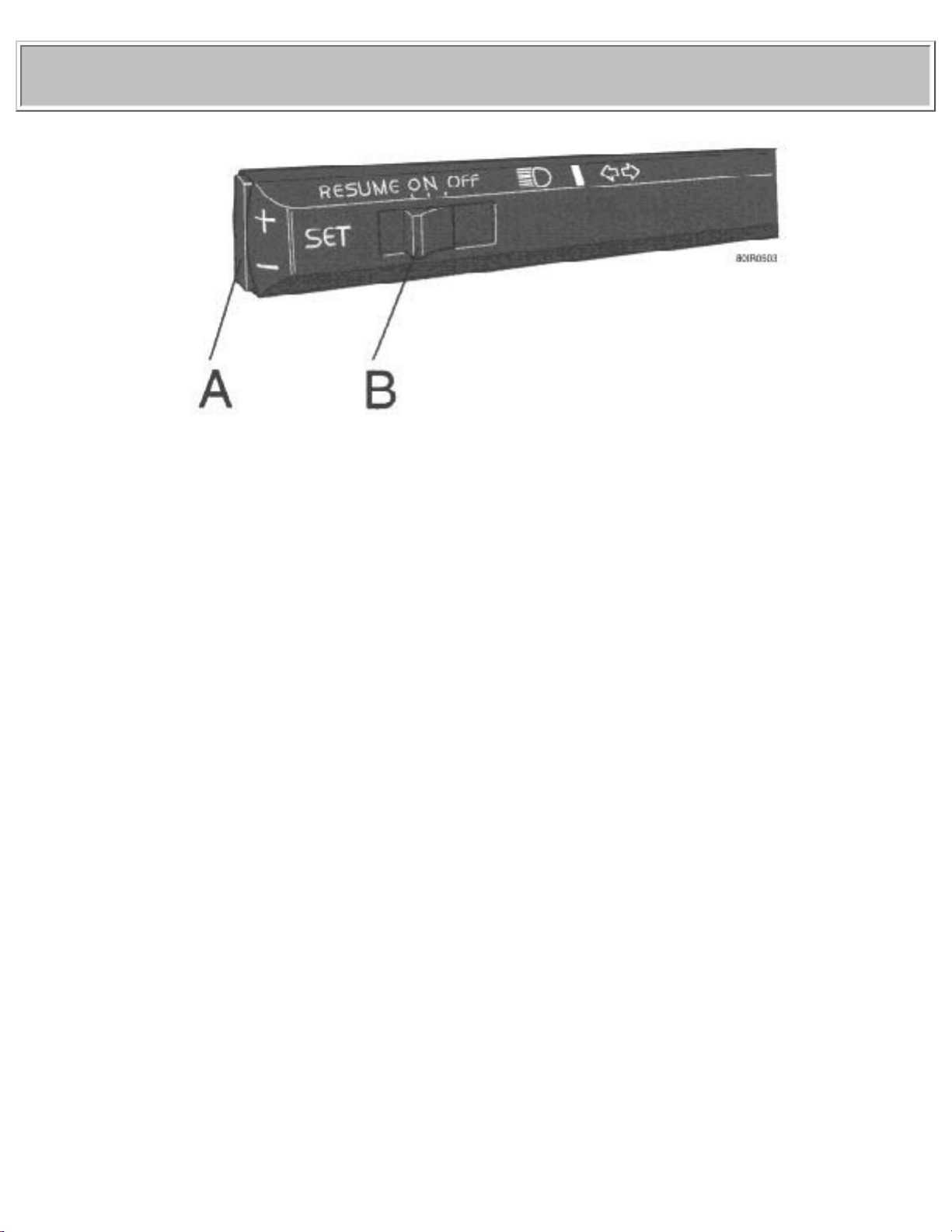
The cruise control switches are located on the turn signal lever.
To engage and set the desired speed:
1. Set switch (B) to ON.
2. Accelerate to the desired cruise speed.
3. Press the + or - area of the SET button (A) to set the desired speed.
NOTE: The cruise control cannot be engaged at speeds below 22 mph (35 km).
Braking
This will automatically disengage the cruise control. The previously selected cruise speed is retained in
the memory and by momentarily setting the switch to RESUME position, that speed will be re-engaged.
If the cruise control is already engaged, the cruising speed can be increased or decreased by depressing
the SET button (A) towards either + or -. One short press on the button corresponds to a speed change of
approx. 1 mph (1.6 km/h). When thebutton is released, the vehicle will maintain the current speed.
If actual speed falls below 70% of the set speed or if the wheels spin or lock, the cruise control will
disengage automatically.
NOTE: (AUTOMATIC TRANSMISSION)
When driving up steep hills with the cruise control engaged, the transmission may shift intermittently.
file:///K|/ownersdocs/1998/1998_SV70/98sv70_031.htm (1 of 6)12/30/2006 1:51:26 PM
Page 53
1998 S70 & V70
This can be avoided by switching between transmission modes E or S while on the hill.
Normally, the ( E )conomy mode should be used when the cruise control is engaged.
Acceleration
Momentary acceleration, such as for passing, does not interrupt cruise control operation. The previously
selected speed will be maintained without having to set the switch to RESUME.
To disengage the cruise control system :
Set switch (B) to OFF, depress the brake pedal or move the gear selector to position N. Switching off the
starting (ignition) switch will automatically disengage the cruise control system.
On cars equipped with manual transmissions, the cruise control can also be disengaged by depressing
the clutch.
WARNING! The cruise control should not be used in heavy traffic or when driving on wet or slippery
roads. Do not use or resume cruise control in reverse gear.
NOTE: When the ignition is switched off, any information stored in the cruise control memory is erased.
pg. 32 Heated front seats (certain models), Parking brake
file:///K|/ownersdocs/1998/1998_SV70/98sv70_031.htm (2 of 6)12/30/2006 1:51:26 PM
Page 54
1998 S70 & V70
Heated front seats
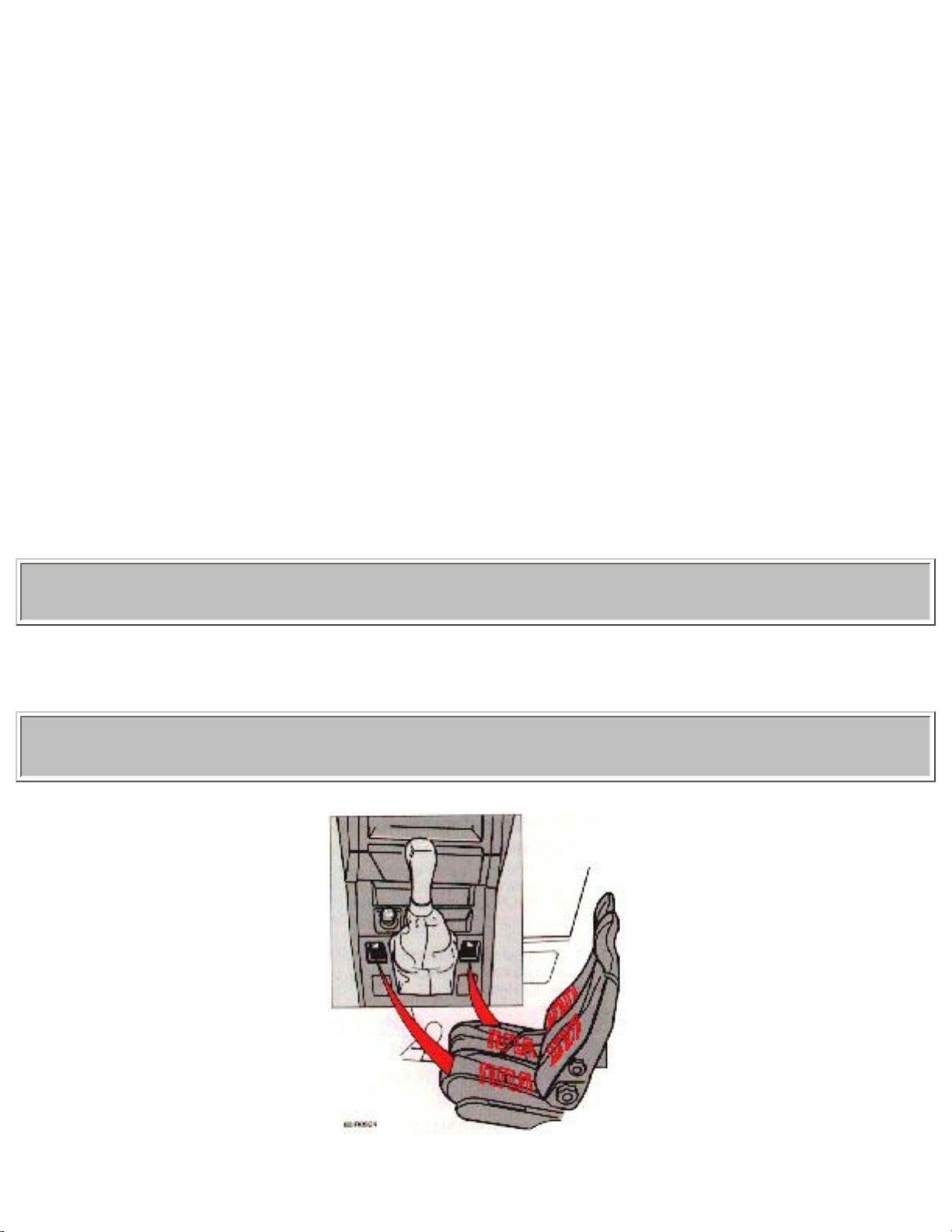
The heated front seats can be switched on and off as required. When switched on, the system senses the
ambient temperature and regulates the level of heat applied. When the optimum temperature is reached,
the heating switches off automatically. While driving, the seat heating for the passenger seat should be
switched off when the seat is not occupied.
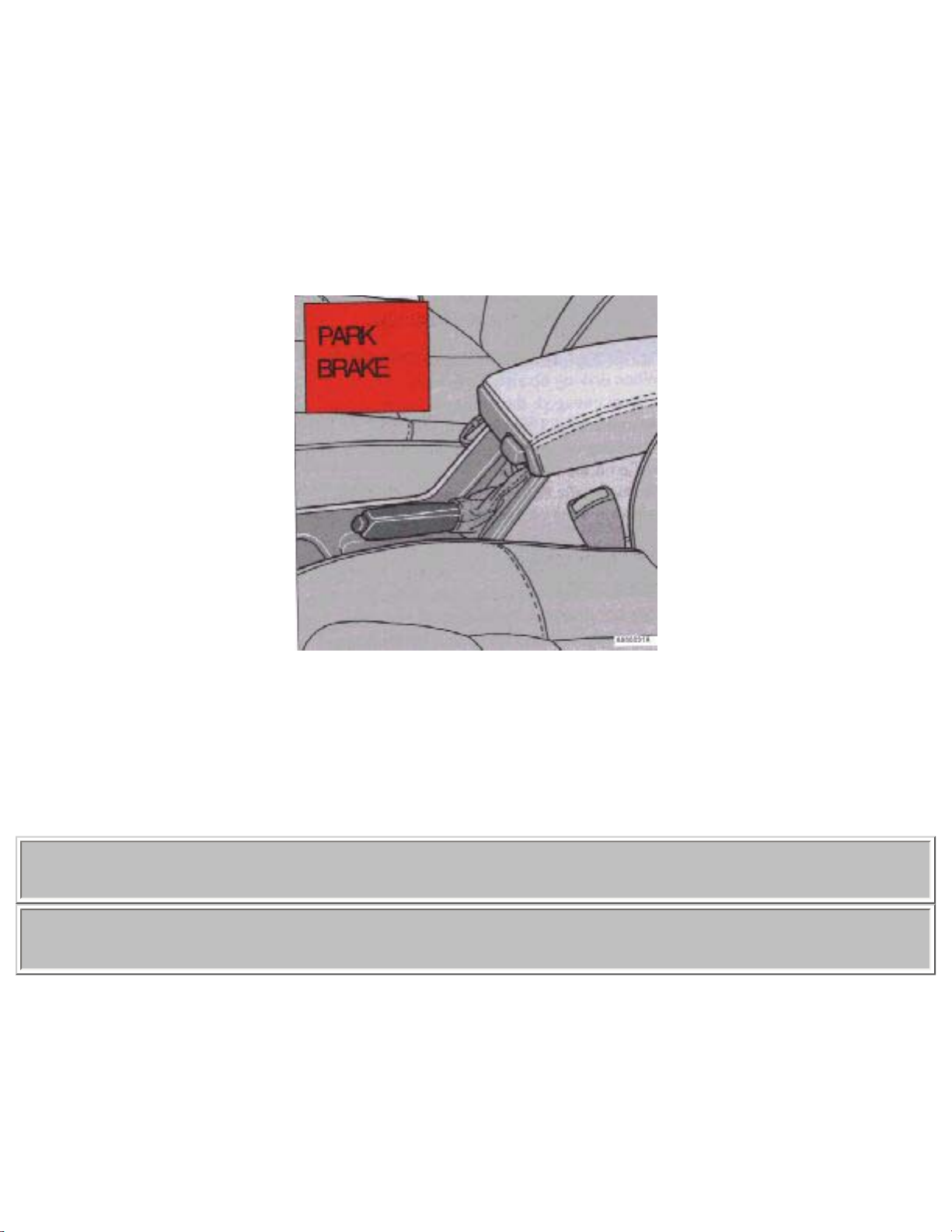
Parking brake lever
The lever is situated between the front seats.
The brake is applied to the rear wheels.
WARNING! Always use the parking brake (hand brake) when parking. On hills, also turn the front
wheels toward the curb.
pg. 33 Ashtrays, Auxiliary socket
file:///K|/ownersdocs/1998/1998_SV70/98sv70_031.htm (3 of 6)12/30/2006 1:51:26 PM
Page 55
1998 S70 & V70
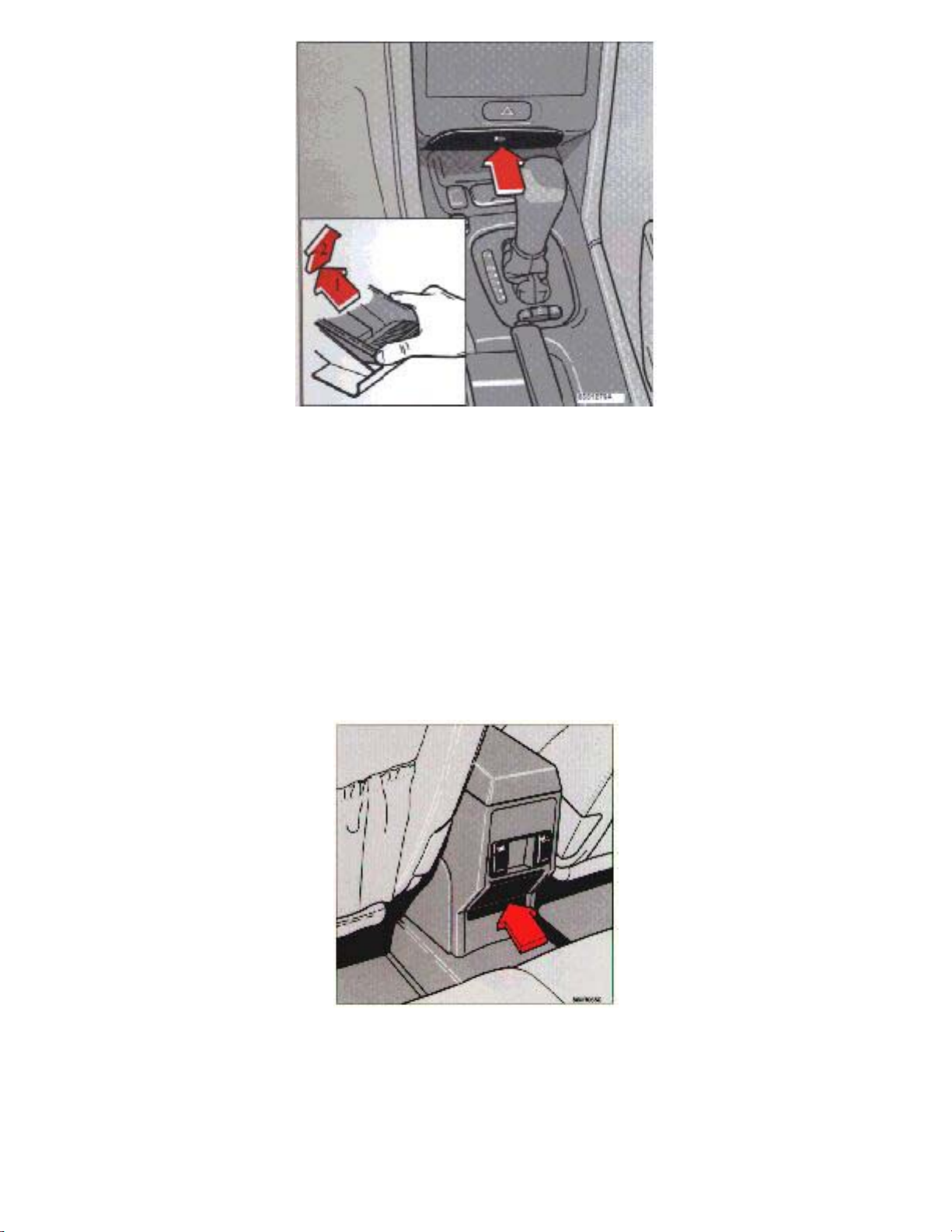
Front ashtray
To open the front ashtray, press lightly on the panel.
To empty the front ashtray:
● Put the gear selector (aut. transmission) in position L.
● Grasp the front edge of the ashtray and pull it straight out.
Rear seat auxiliary socket* and ashtray
Rear ashtrays
file:///K|/ownersdocs/1998/1998_SV70/98sv70_031.htm (4 of 6)12/30/2006 1:51:26 PM
Page 56
1998 S70 & V70
To open the rear ash tray, pull it straight out.
To empty the rear ash tray, pull it out, lift up the rear edge and remove.
Front auxiliary socket*
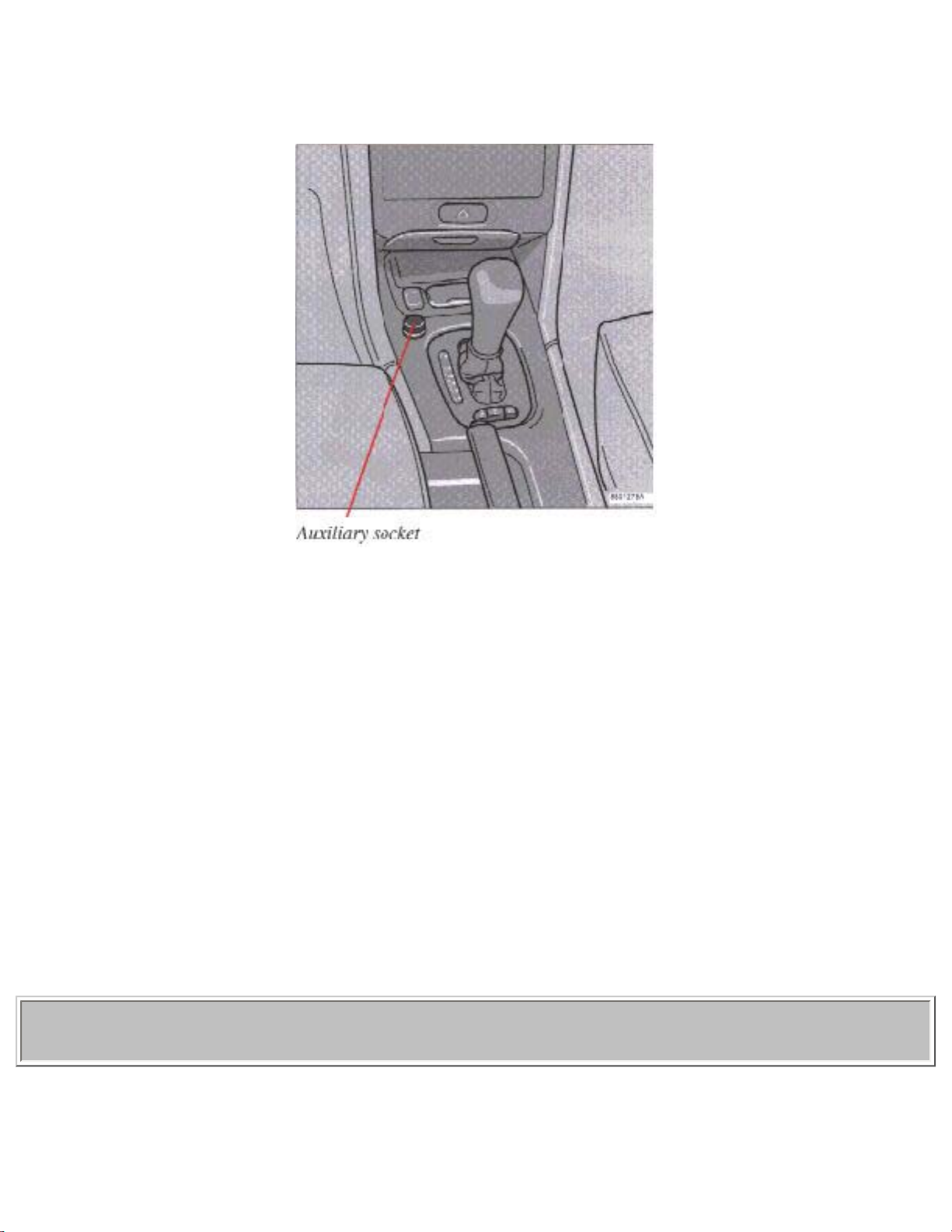
Auxiliary socket
This 12 volt socket can be used to plug in certain accessories such as cellular telephones, etc. The key
must be in position I (or higher) for the auxiliary socket to function.
NOTE: The "OBD II" terminal, a connector for diagnostic equipment, is located under the cover of the
storage compartment between the front seats. This terminal is intended for use by authorized service
technicians only.
* The auxiliary sockets can also be used as cigarette lighters, which are available at your Volvo retailer.
pg. 34 Steering wheel adjustment
file:///K|/ownersdocs/1998/1998_SV70/98sv70_031.htm (5 of 6)12/30/2006 1:51:26 PM
Page 57
1998 S70 & V70
Steering wheel adjustment
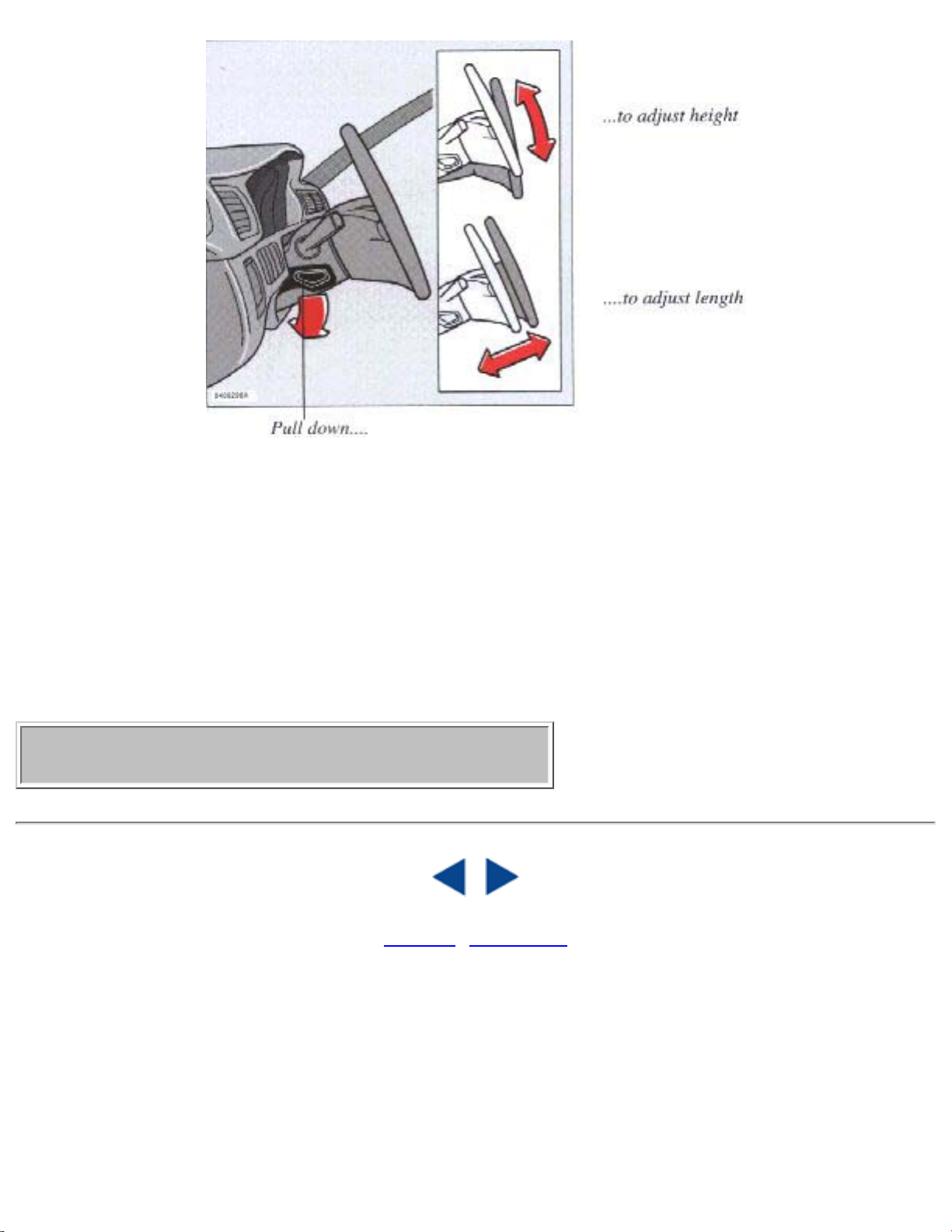
Both the height and the reach of the steering wheel can be adjusted to a comfortable position for the
driver. Pull down the lever on the left of the steering column. Adjust the steering wheel to a suitable
position and press the lever back intoplace to lock the steering wheel in the new position. Check that the
steering wheel is locked in the new position.
WARNING! Never adjust the steering wheel while
driving.
Contents | Top of Page
file:///K|/ownersdocs/1998/1998_SV70/98sv70_031.htm (6 of 6)12/30/2006 1:51:26 PM
Page 58
1998 S70 & V70
pg. 35 Heating, ventilation and air conditioning
Heating and air conditioning
Your Volvo is equipped with a heating system combined with air conditioning. Depending on which
function you select, warm or cool/cold air is distributed to the different parts of the passenger
compartment. A slight amount of condensation may beemitted from the air vents when the air
conditioning is initially switched on. This can occur when both humidity and ambient temperature are
high and is normal.
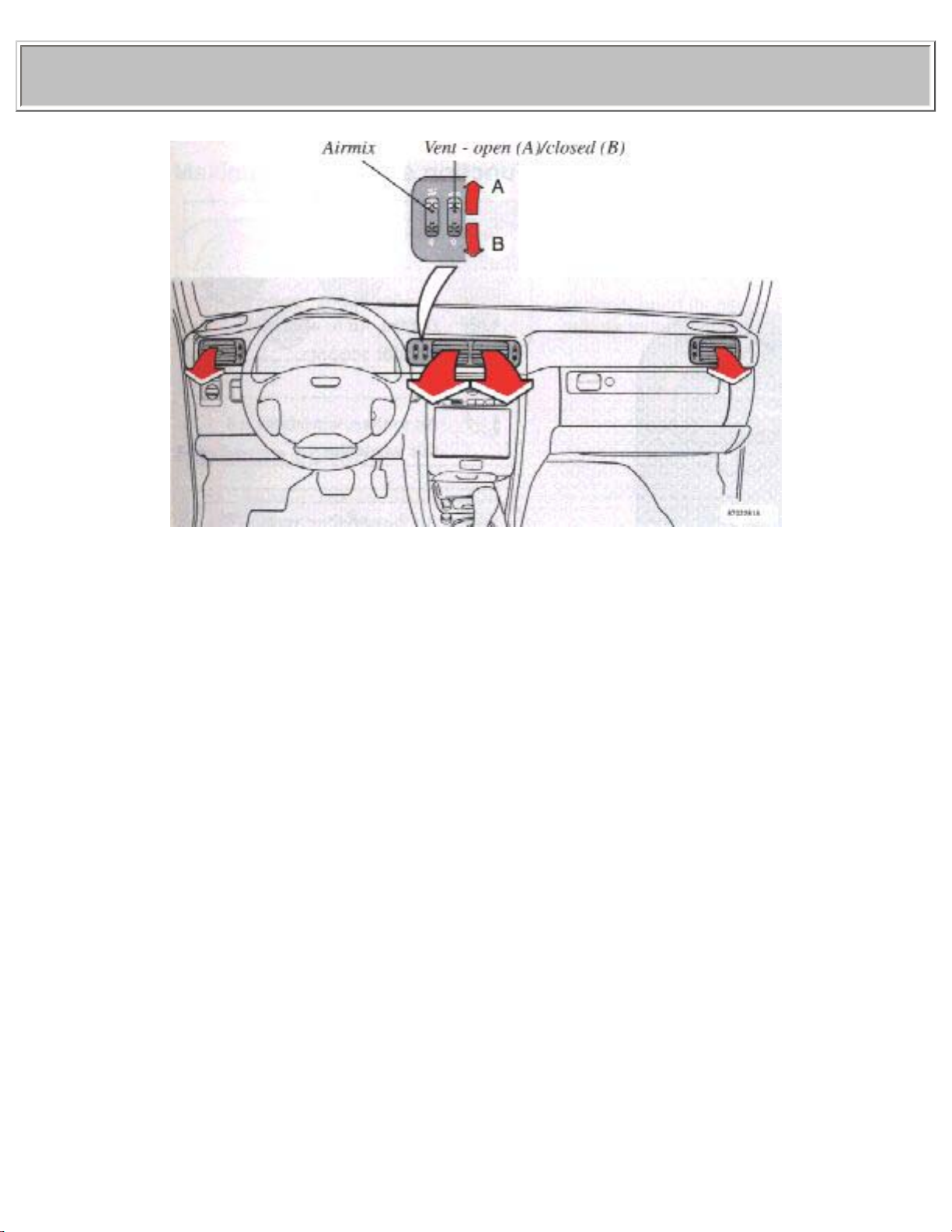
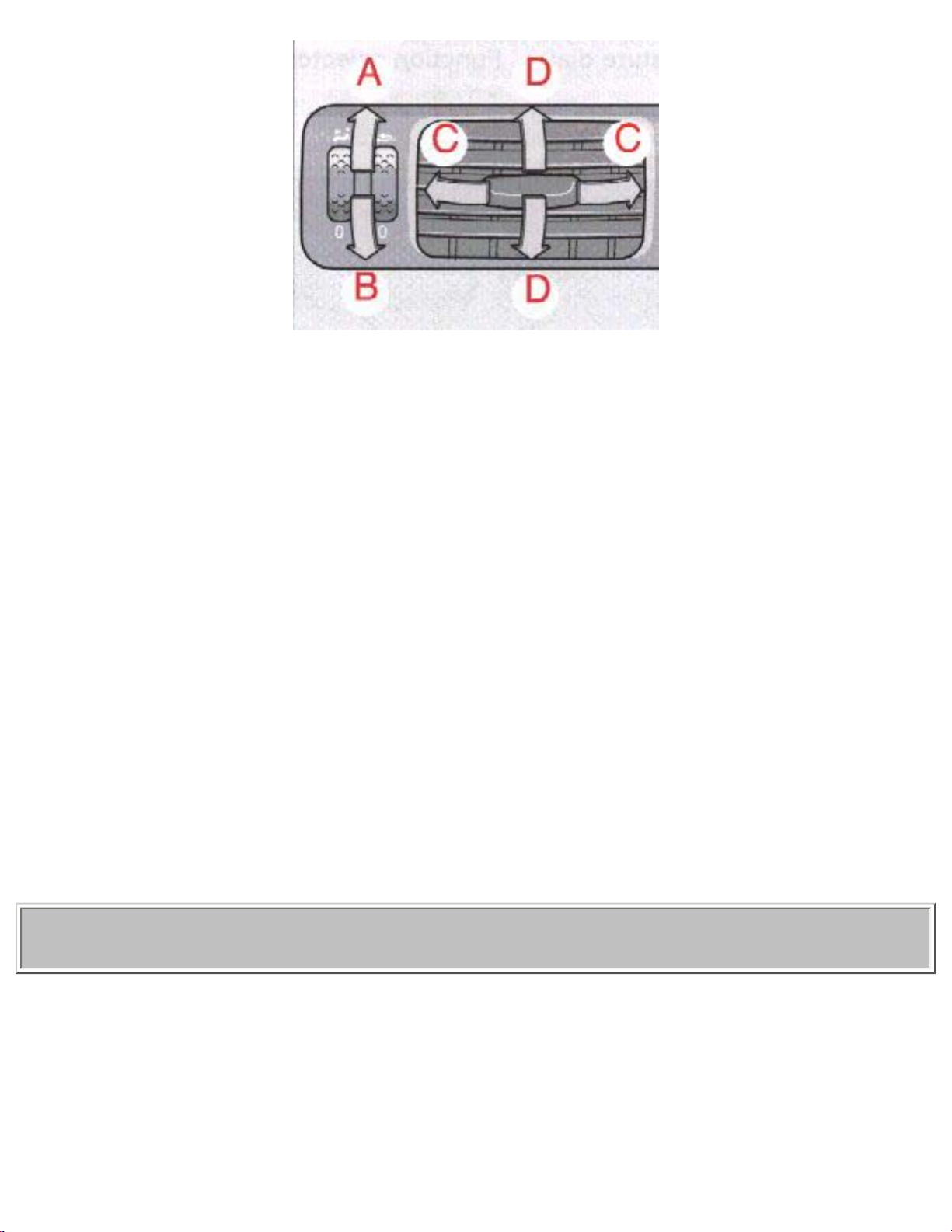
Air mix (fresh air)
The center panel vents have an air mix function which allows fresh air to enter the passenger
compartment when the vents are open (position B). This function is designed to allow you to direct cool
air toward your face while directing warmer airto the rest of the passenger compartment.
To warm/cool the compartment as quickly as possible, the air mix control should be in the closed
position.
file:///K|/ownersdocs/1998/1998_SV70/98sv70_035.htm (1 of 11)12/30/2006 1:51:26 PM
Page 59
1998 S70 & V70
Air vents (dash)
A Closed
B Open
C Directing air flow horizontally
D Directing air flow vertically
Refrigerant
Volvo cares about the environment. The air conditioning system in your car contains a CFC-free
refrigerant - R134a. This substance will not deplete the ozone layer. The system contains 1.65 lbs (0.75
kg) R134a and uses ZXL 100PG (type PAG) oil.
NOTE: All maintenance on the climate control systems should be carried out by an authorized Volvo
service technician only.
pg. 36 Heating, ventilation and air conditioning (standard unit)
file:///K|/ownersdocs/1998/1998_SV70/98sv70_035.htm (2 of 11)12/30/2006 1:51:26 PM
Page 60
1998 S70 & V70
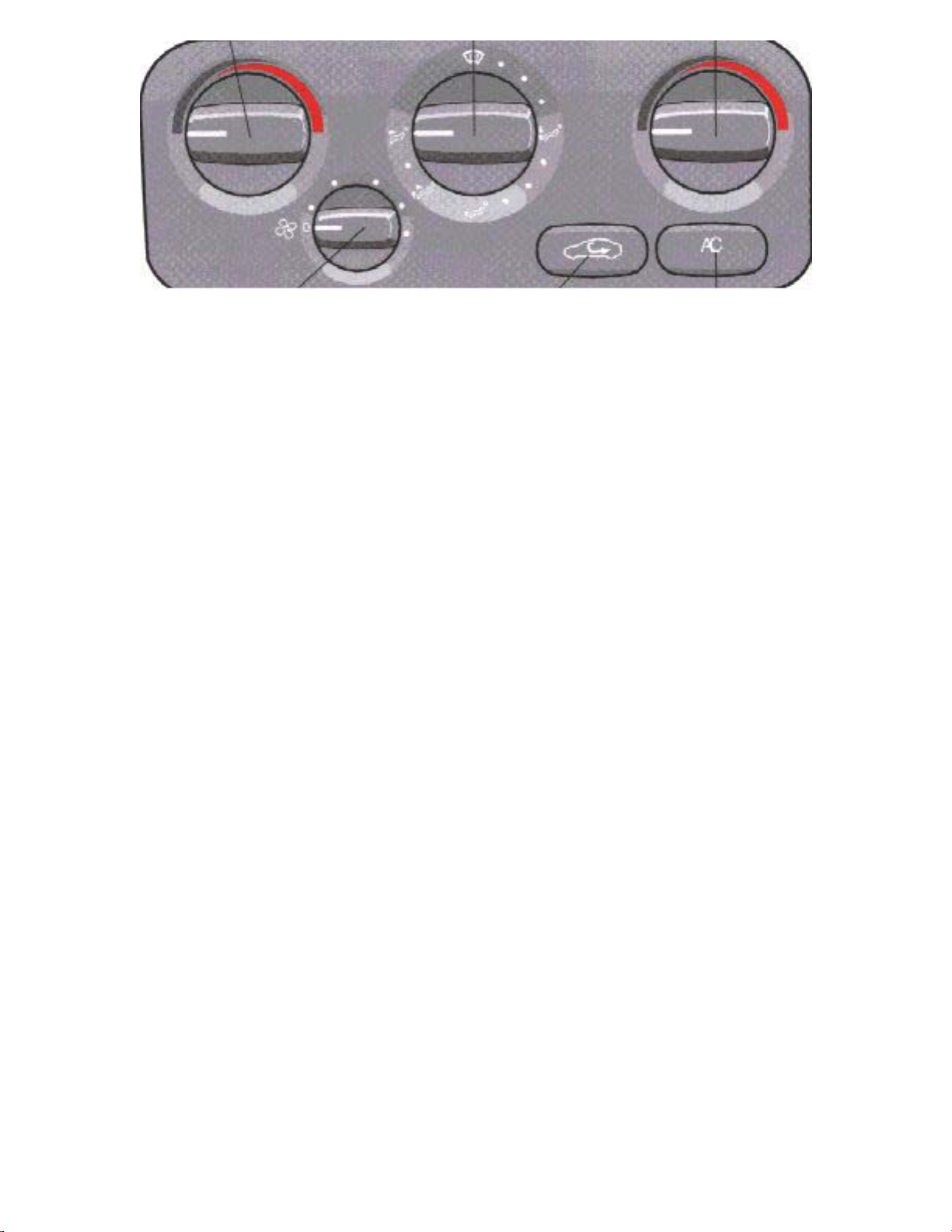
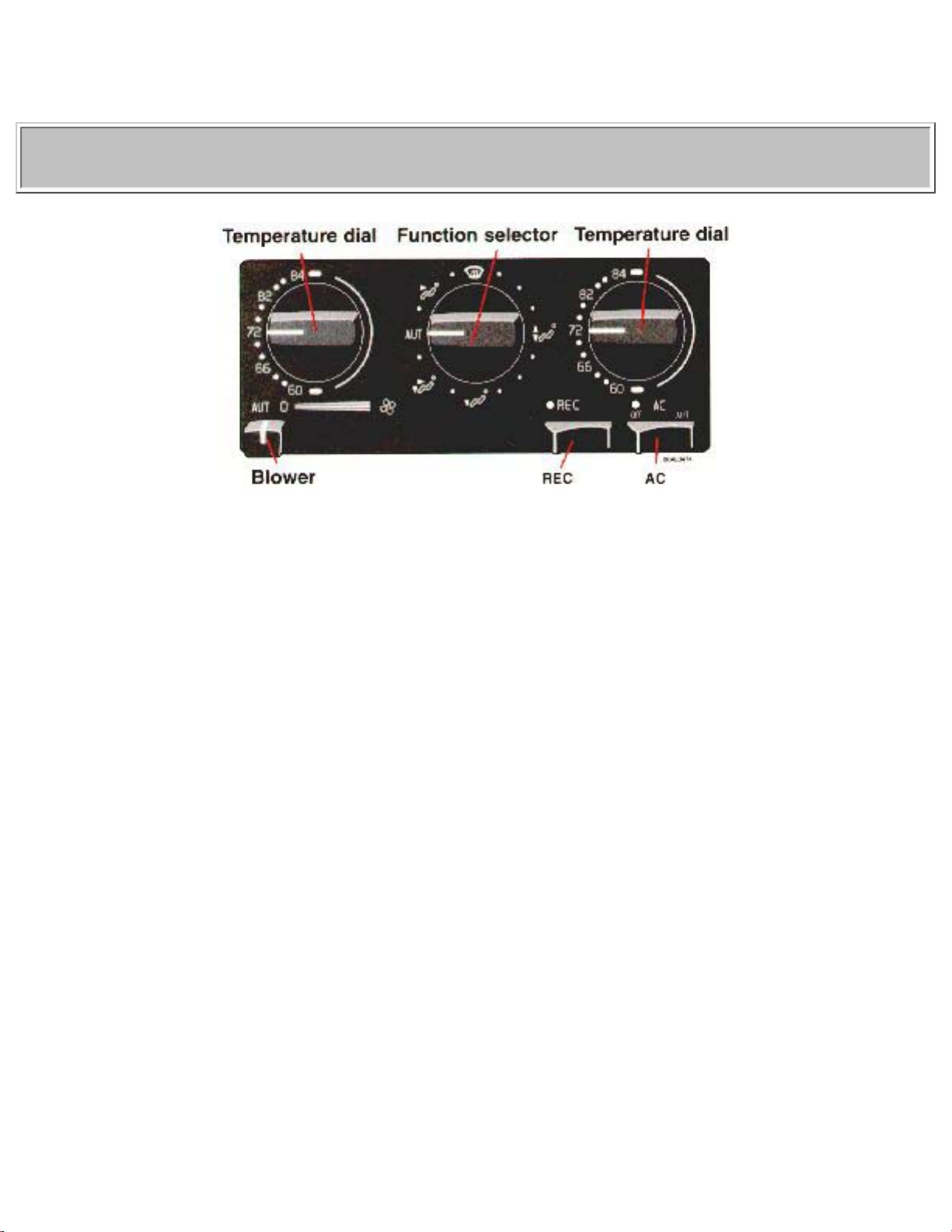
Temperature dial
Driver's side
Set desired temperature
Function selector
Set desired function
Temperature dial
Passenger's side
Set desired temperature
Blower
Turn the control clockwise to increase blower speed. The blower is OFF if the control is in the 0
position.
Recirculation
Air in the passenger compartment recirculates (no fresh air enters the car). The light is ON when the
function is engaged. It should not be used for more than 15 minutes.
AC
The A/C system is ON when the light is ON*.
* When the function selector is in the defrost setting, the A/C will automatically be ON if recirculation is
not on and the blower control is not in position 0.
file:///K|/ownersdocs/1998/1998_SV70/98sv70_035.htm (3 of 11)12/30/2006 1:51:26 PM
Page 61
1998 S70 & V70
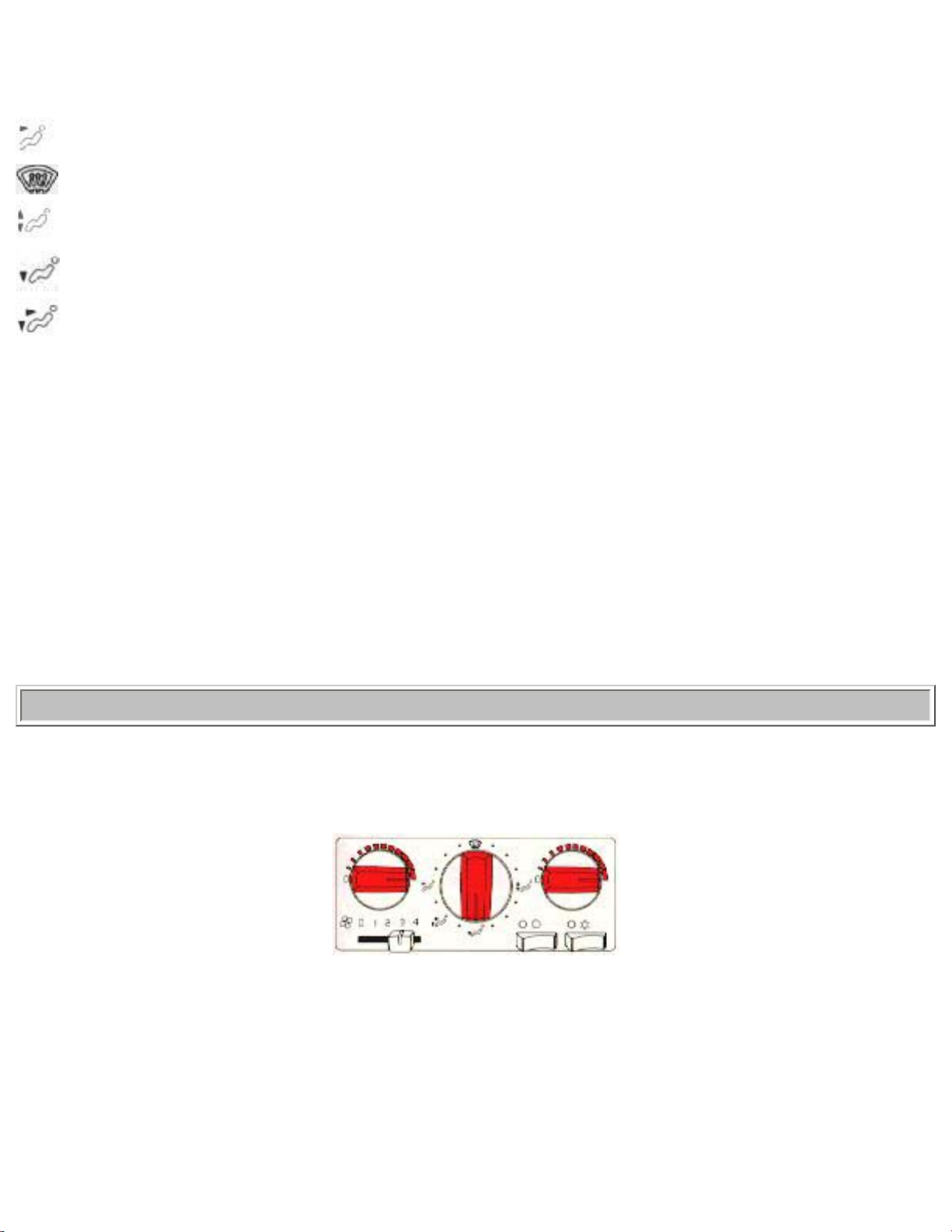
Function selector
Air through panel vents
Defrost. Air to windshield and side windows.
Air to floor, windshield and side windows.
Air through floor vents.
Bi-level. Air through floor and panel vents.
NOTE: If your windows begin to fog or mist, check that the recirculation function is NOT engaged.
Faults in the A/C system
The RECIRCULATION and AC lights will flash for approximately 20 seconds if a fault is detected in
the A/C ssystem.
If this flashing recurs the next time the system is switched on, the climate control nit should be checked
by an authorized Volvo retailer.
pg. 37 Heating, ventilation and air conditioning (standard unit) (cont.)
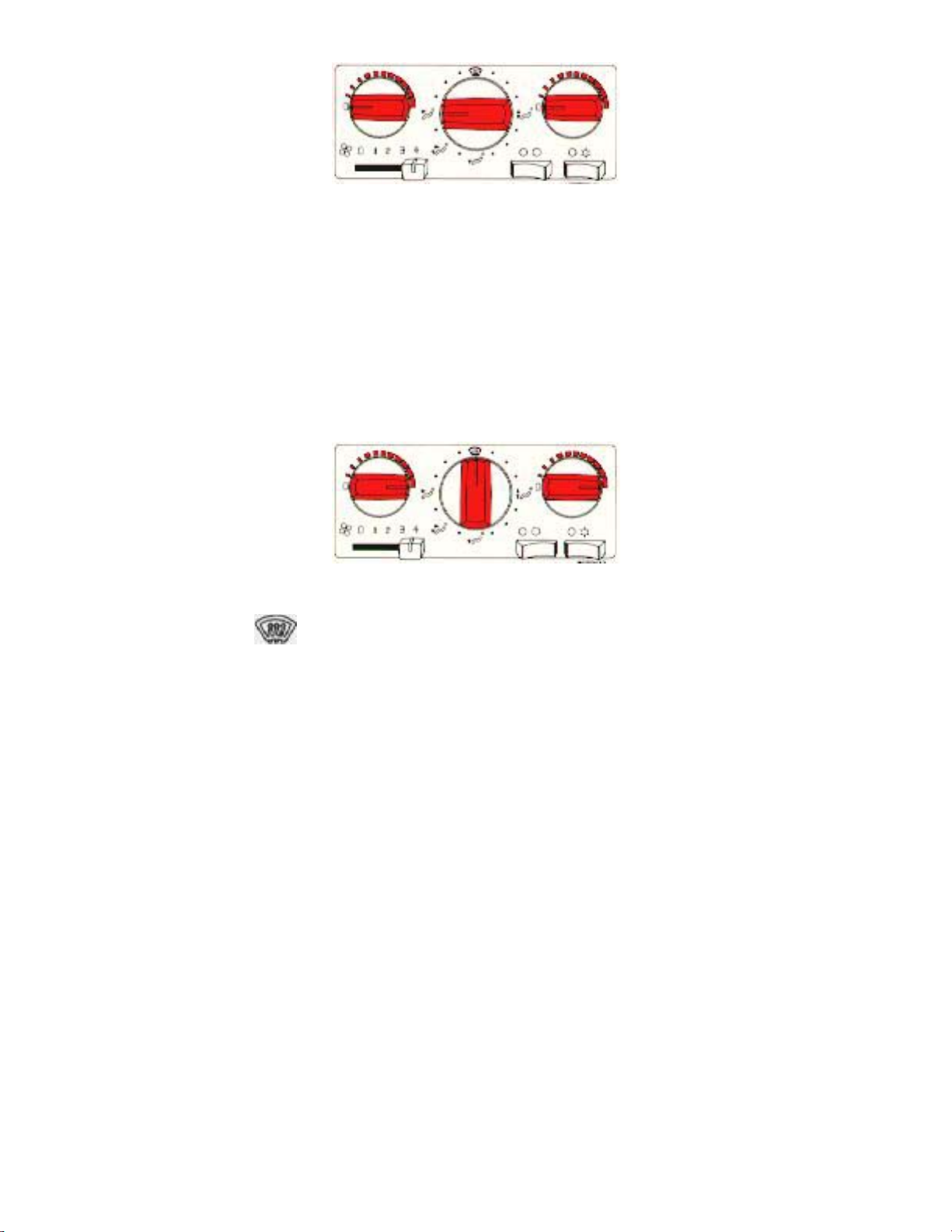
Maximum heating:
Close the center panel vents. When the passenger compartment has become sufficiently warm, set the
blower control to the fourth position, adjust the temperature and open the side air vents.
Maximum cooling:
file:///K|/ownersdocs/1998/1998_SV70/98sv70_035.htm (4 of 11)12/30/2006 1:51:26 PM
Page 62
1998 S70 & V70
Open the vents. The A/C system should be ON.
Adjust the temperature with the temperature selectors to raise the temperature if necessary.
The recirculation function should not be used for more than 15 minutes.
To demist/defrost the windows:
Set the function selector to
and the blower control to the highest position. The A/C will be ON if
recirculation is not on. When the windows have cleared, set the blower control to the second position
and the function selector to the desired position. Always keep the air intake grille at the base of the
windshield under the rear edge of the hood free of snow.
Additional information
● The air conditioning system will function best if it is always left on.
● Water under the vehicle in hot weather can be the result of condensation from the air conditioning
system and is quite normal.
● The air conditioning system functions only at temperatures above 32° F (0° C).
● Use the RECIRCULATION function if the outside air is contaminated with exhaust gases, smoke, etc
or to heat/cool the car quickly. In this position, very little air is drawn into the passenger compartment
from the outside. Do not leave the system in this mode for more than 10-15 minutes since the air inside
the car will become stale. The temperature can be controlled with the temperature selectors.
● If the panel vents are open, a certain amount of air will always flow through, regardless of the position
the function selector is in. To increase the flow of air to either the floor or the windows, close the panel
vents and open the outer vents .
● The panel vents may emit some condensation when the air conditioning is initially switched on and is
file:///K|/ownersdocs/1998/1998_SV70/98sv70_035.htm (5 of 11)12/30/2006 1:51:26 PM
Page 63
1998 S70 & V70
quite normal. This may occur if the ambient temperature and humidity are high.
● The air conditioning is momentarily disengaged during full-throttle acceleration.
pg. 38 Heating, ventilation and air conditioning (Electronic Climate Control) - option
Temperature dial
Driver's side
Set desired temperature
Function selector
Set desired function
Temperature dial
Passenger's side
Set desired temperature
Blower
AUT=Blower speed automatically regulated.
0 = OFF
Move the knob to the right to increase blower speed.
RECIRCULATION
Air in the passenger compartment recirculates (no fresh air enters the car). The amber light in the righthand button is ON when the function is engaged. It should not be used for more than 15 minutes*. The
green light in the left-hand button indicates that outside air can enter the passenger compartment.
file:///K|/ownersdocs/1998/1998_SV70/98sv70_035.htm (6 of 11)12/30/2006 1:51:26 PM
Page 64
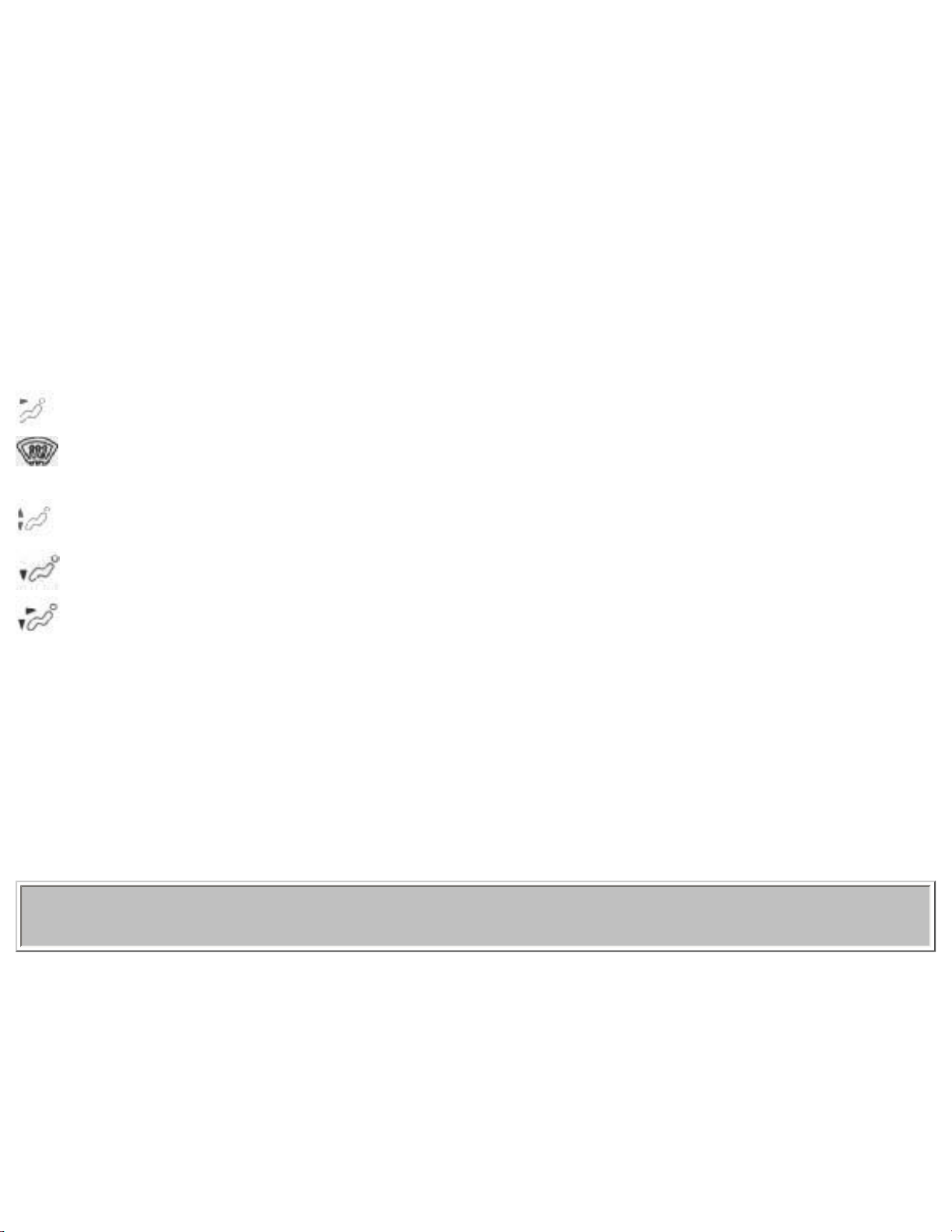
1998 S70 & V70
AC ON/OFF
The light in the buttons indicate if the A/C is off or on**
**When the function selector is in the defrost setting, the A/C system is ON and the blower will function
at its highest speed if it is in the AUT position.
Function selector
AUT Air distribution automatically regulated
Air through panel vents
Defrost. Air to windshield and side windows. Recirculation will not function regardless of button
position.
Air to floor, windshield and side windows.
Air through floor vents.
Bi-level. Air through floor and panel vents.
* Pressing the ON section of the button for more than 3 seconds activates a timer function. Recirculation
will then always operate for 5 minutes periods, after which the button will flash to indicate that
Recirculation has automatically switched off. Pressing the OFF button at any time during 5 minute
period will allow fresh air into t he passenger compartment. Press the ON button again for more than 3
seconds to return the button to its original function (i.e., Recirculation will remain on until the OFF
button is pressed).
pg. 39 Heating, ventilation and air conditioning (Electronic Climate Control) - option (cont.)
Automatic setting
file:///K|/ownersdocs/1998/1998_SV70/98sv70_035.htm (7 of 11)12/30/2006 1:51:26 PM
Page 65
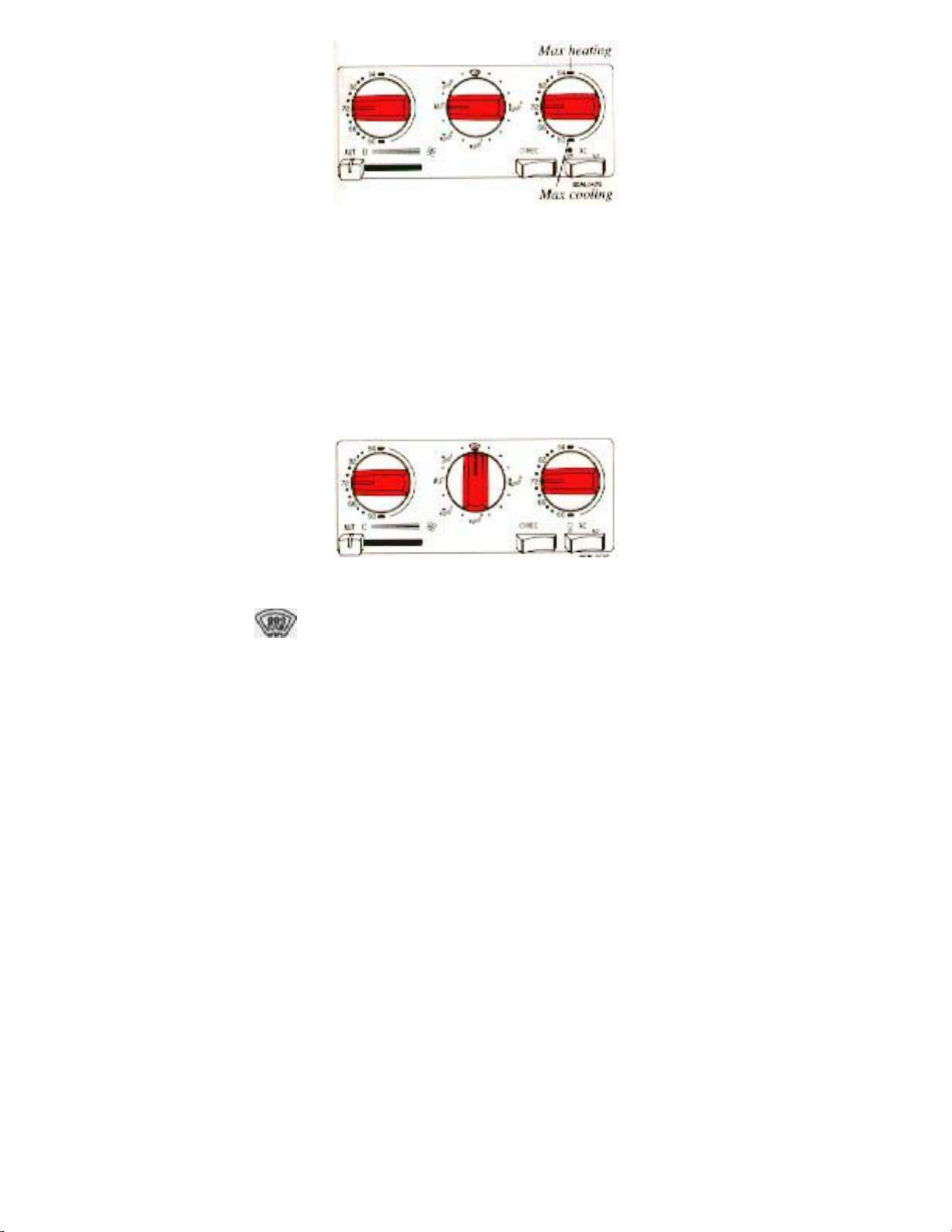
1998 S70 & V70
Set the mode selector to AUT and select the desired temperature. If the driver's side temperature selector
is set to either the max heating or max cooling position, the blower will run at its maximum speed.
Optimum defrosting
Set the function selector to
and move the blower control to the position AUT (as far to the left as
possible). The A/C system will be on at this time regardless of the A/C button's position and the blower
will run at its maximum speed. When the windows have cleared, set thefunction selector in the AUT
position.
Additional information
● The air conditioning system will function best if used regularly (at least once a month).
● Always keep the air intake grille at the base of the windshield under the rear edge of the hood free of
snow.
● Water under the vehicle in hot weather can be the result of condensation from the air conditioning
system and is quite normal.
● The air conditioning is disengaged when the blower is set at 0 and the speed of the vehicle is less than
20 mph (30 kn/h).
● The air conditioning system functions only at temperatures above 32° F (0° C).
● Recirculation : Use this function if the outside air is contaminated with exhaust gases, smoke, etc. or
to heat/cool the car quickly. When Recirculation is activated, very little air drawn into the passenger
compartment from the outside.
If your windows begin to fog or mist, check that the recirculation function is NOT engaged.
file:///K|/ownersdocs/1998/1998_SV70/98sv70_035.htm (8 of 11)12/30/2006 1:51:26 PM
Page 66

1998 S70 & V70
NOTE: To help maintain stable passenger compartment temperature when driving with the sun roof or
windows open, place the blower control in position "0" and adjust the desired temperature manually.
● If the panel vents are open, a certain amount of air will always flow through, regardless of the position
the function dial is in. To increase the flow of air to either the floor or the windows, close the panel vents
and open the outer vents
● The panel vents may emit some condensation when the air conditioning is initially switched on and is
quite normal.
This may occur if the ambient temperature and humidity are high.
● The sunlight sensor (located at the top center of the dashboard) should not be covered in any way as
this could cause incorrect information to be sent to the ECC system.
● The air conditioning is momentarily disengaged during full-throttle acceleration.
Difficult weather conditions
When driving in very humid conditions, heavy rain, sleet, etc., it may be better to use the manual rather
than the automatic setting to defrost the windows. Set the mode selector to "Defrost"
or "Defrost/
floor" and the fan speed to midrange. Also shut the middle air vents.
Faults in the ECC system
The RECIRCULATION ON and AC OFF lights will flash for approximately 20 seconds if a fault is
detected in the ECC system.
If this flashing recurs the next time the system is switched on, the climate control unit should be checked
by an authorized Volvo retailer.
pg. 40 Electrically-operated windows
file:///K|/ownersdocs/1998/1998_SV70/98sv70_035.htm (9 of 11)12/30/2006 1:51:26 PM
Page 67
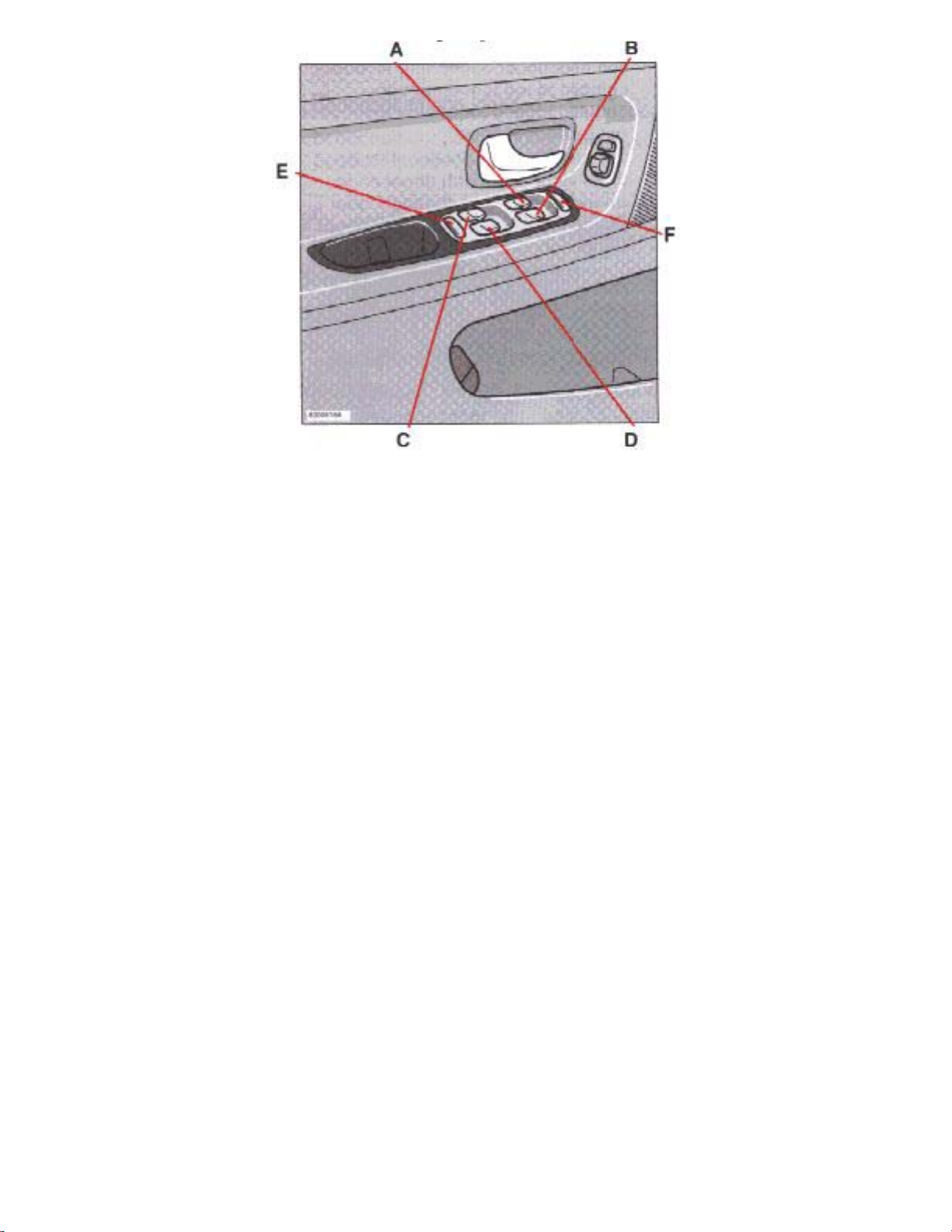
1998 S70 & V70
A- Left front, B- right front, C- left rear, D- right rear
Electrically-operated windows
The electrically-operated windows are controlled by switches in the driver's door as shown in the
illustration above. The starting (ignition) switch must be ON (intermediate position I) for the electricallyoperated windows to function.
To lower : press down on the front edge of the button
To raise : pull up on the front edge of the button.
NOTE:
● Auto-down function (driver's window only): The window can be opened completely by pressing the
front part of the switch lightly and releasing it immediately. The window can be stopped by pressing the
button again. If the button is held down, the window will be lowered until the button is released.
● The power window motors have an overload protecting circuit breaker which is activated when an
object blocks a window. Should this occur, remove the object and wait 20 seconds for the circuit breaker
to reset. The power windows should then function.
Cut-out switch for rear windows
If your car is equipped with electrically operated rear door windows, this function can be disabled by a
switch located on the driver's door (see illustration).
file:///K|/ownersdocs/1998/1998_SV70/98sv70_035.htm (10 of 11)12/30/2006 1:51:26 PM
Page 68
1998 S70 & V70
ON The rear door windows can be raised or lowered with the respective door switches as well as with
the switches on the driver's door armrest.
OFF The rear door windows cannot be raised or lowered with the respective door switches but instead
only with the corresponding switches on the driver's door armrest.
WARNING! Remove the starting (ignition) key when children are left unattended in the
vehicle.
Make sure that children's hands are clear before raising the windows.
Contents | Top of Page
file:///K|/ownersdocs/1998/1998_SV70/98sv70_035.htm (11 of 11)12/30/2006 1:51:26 PM
Page 69

1998 S70 & V70
Chapter 3 - Body and interior
pg. 41 Body and interior
Body and interior
The seats, sun roof, mirrors, etc. are described on the following pages.
Page No. Subject
pg. 42
Keys
pg. 43
Doors and locks
pg. 44
Remote keyless entry system
pg. 45
Alarm
pg. 47
Trunk/tailgate
pg. 48
Child safety locks
pg. 49-50
Front seats
pg. 50
Rear/side view mirrors
pg. 51
Interior lights, Vanity mirror
pg. 52
Sun roof
pg. 53
Hood
pg. 54
Storage compartments
pg. 55
Trunk light, Spare tire, Jack
pg. 56
Cargo space lighting, Spare tire, Jack (wagon)
pg. 57
Folding rear seat (sedan)
pg. 58-59
Folding rear seat (wagon)
pg. 59
Removing seat cushions
pg. 60
Concealed storage bin/Bumper cover (wagon), Avoiding battery
drain
pg. 61
Luggage net/Side cargo net (wagon)
pg. 62
Securing cargo
file:///K|/ownersdocs/1998/1998_SV70/98sv70_041.htm (1 of 6)12/30/2006 1:51:27 PM
Page 70
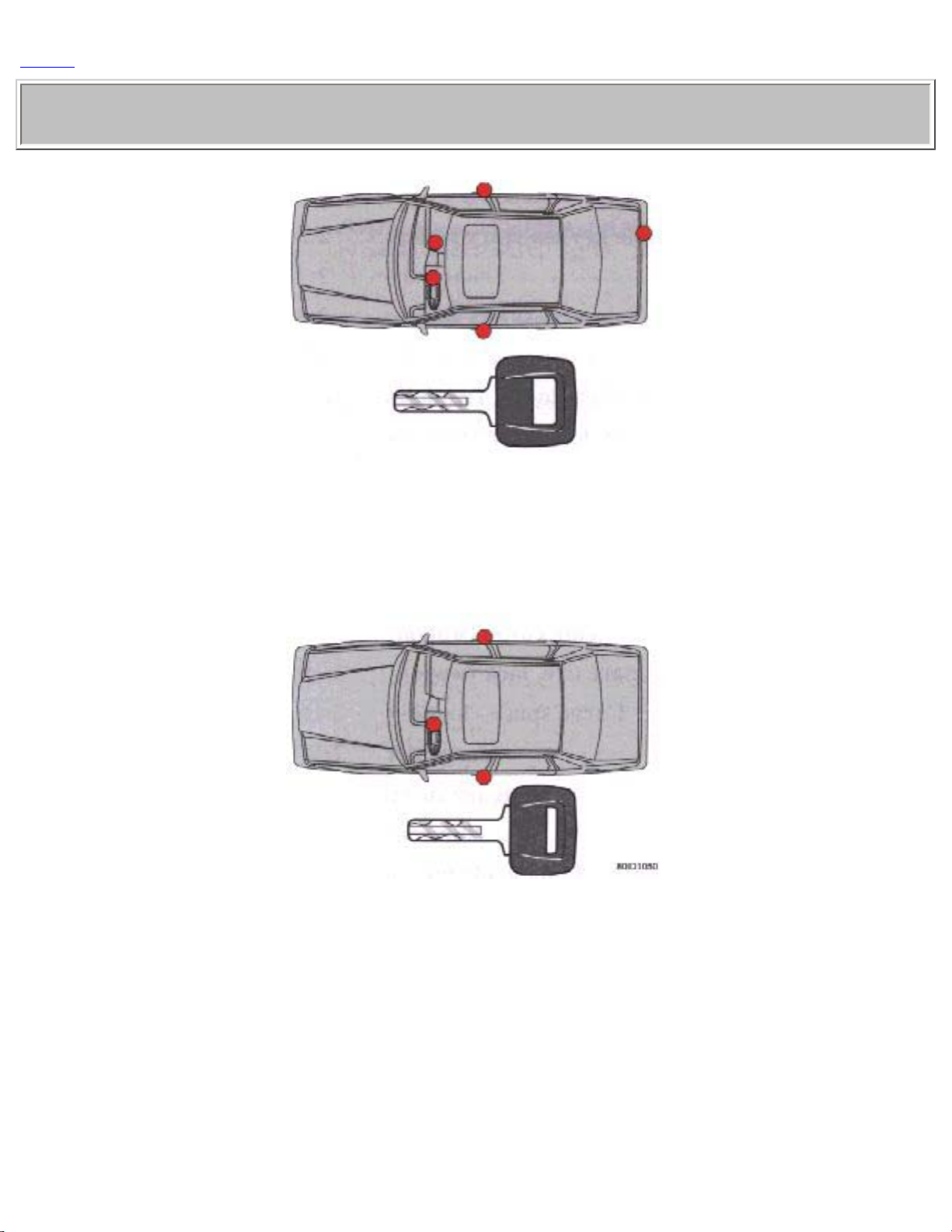
1998 S70 & V70
pg. 63
Folding front seat, Long load storage
pg. 42 Keys
Master key
This key operates all locks (ignition switch/steering wheel lock, driver's door, trunk/tailgate and glove
compartment).
Service key
This key operates the driver's door and the ignition switch/steering wheel lock.
NOTE:
● An an added anti-theft measure, new keys have been developed which may take slightly longer to
copy or replace if the original keys are misplaced. Duplicate keys may be ordered from your Volvo
retailer.
● The key number codes are stamped on a separate tag supplied with the keys. This tag should be
file:///K|/ownersdocs/1998/1998_SV70/98sv70_041.htm (2 of 6)12/30/2006 1:51:27 PM
Page 71
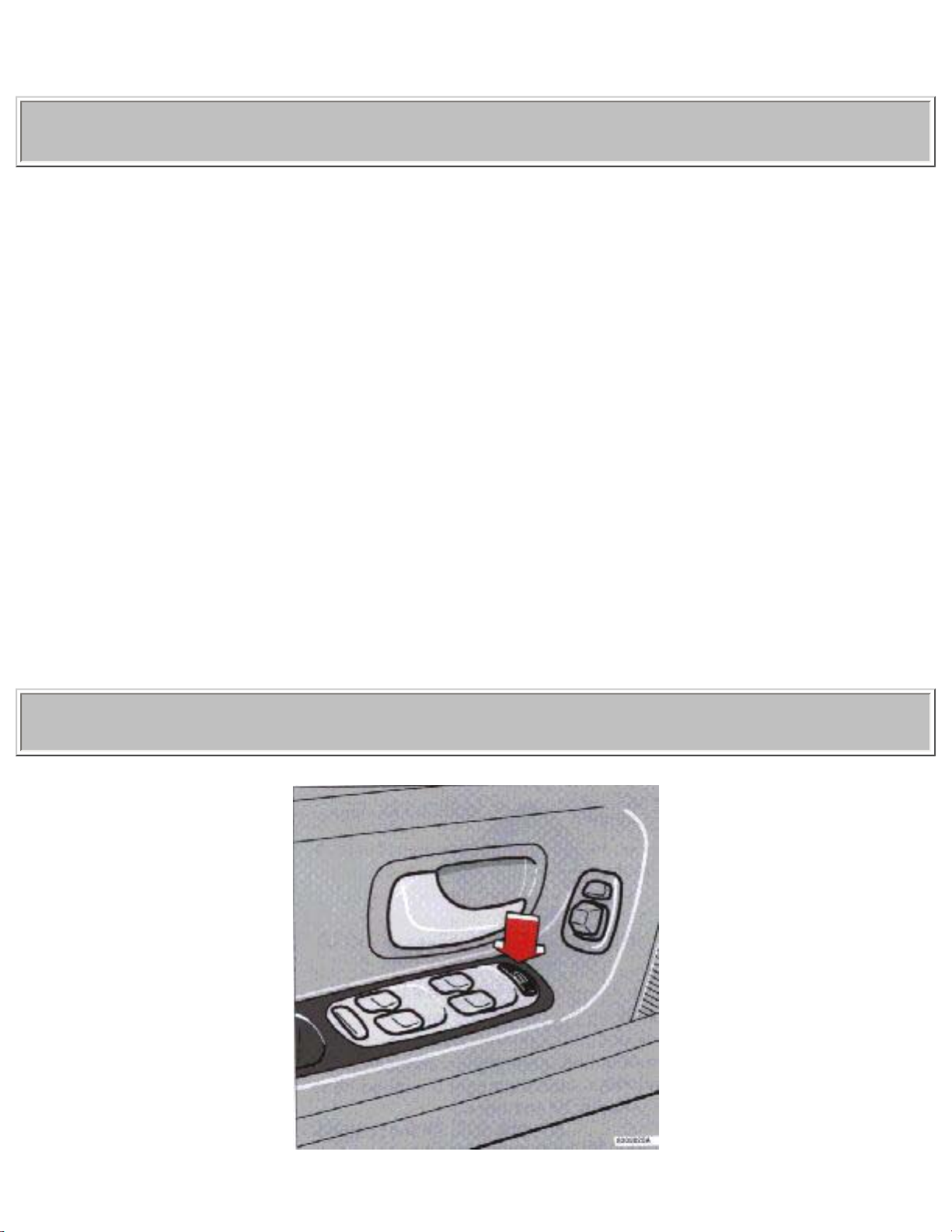
1998 S70 & V70
separated from the key ring and kept in a safe place.
pg. 43 Doors and Locks
Doors and locks
Your car is equipped with a two door operated central locking system.
The key, used on the driver's doors, the remote control, or central locking button, will lock/unlock all
doors, trunk/tailgate.
Turn the key once to unlock the driver's door only.
Turn the key again (within 10 seconds) to unlock all doors, trunk/tailgate.
One turn with the key towards lock in the drivers door locks all doors, trunk/tailgate.
Use the switch on the front door armrests to lock/unlock the car from the inside.
Check the action of the buttons on the other doors to verify their correct function (lock/unlock).
WARNING! The doors should not be locked while driving. In case of an accident, this may hinder
rapid access to the occupants of the vehicle. (Also see information on "Child safety locks".)
file:///K|/ownersdocs/1998/1998_SV70/98sv70_041.htm (3 of 6)12/30/2006 1:51:27 PM
Page 72
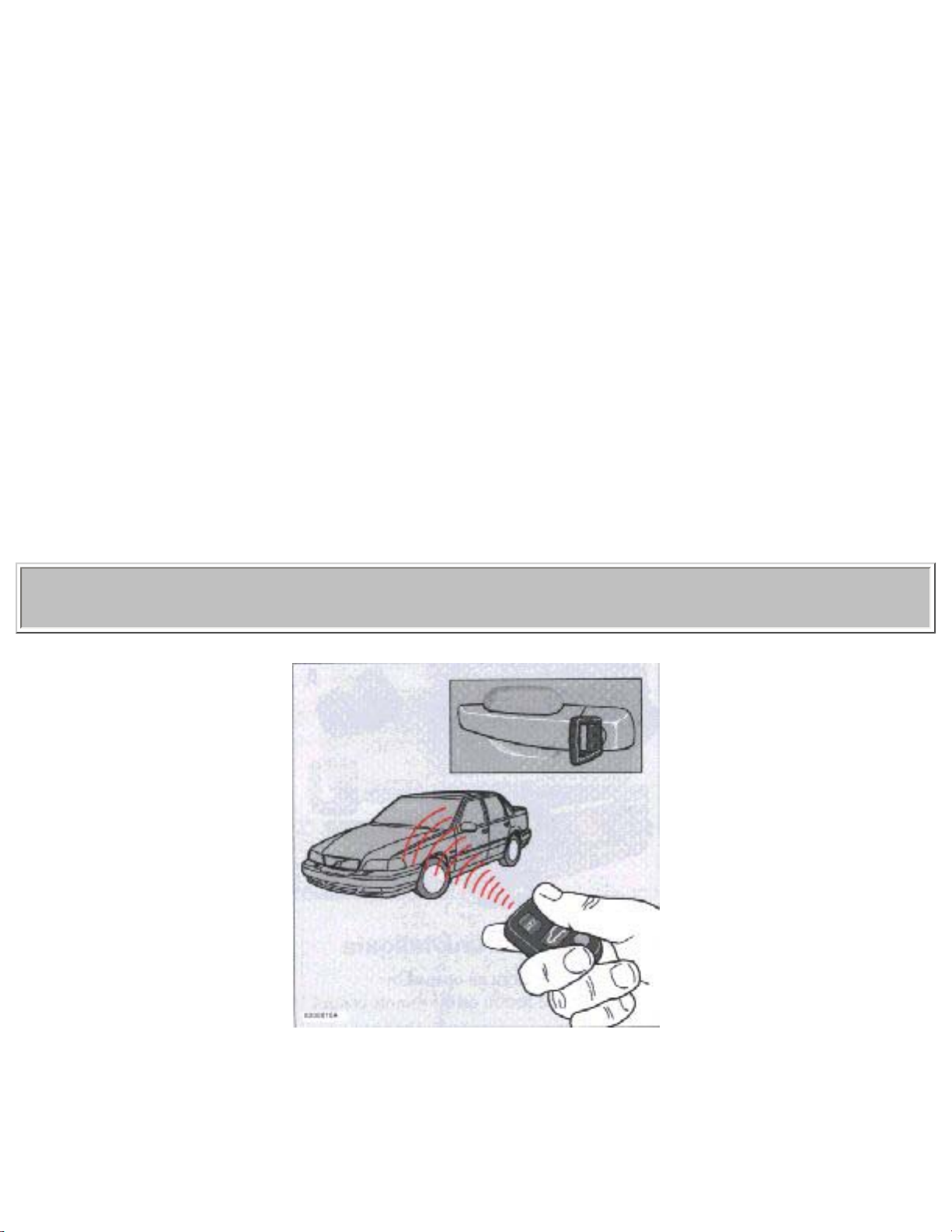
1998 S70 & V70
Central locking button (on both front doors)
Central locking button
The central locking buttons on both front door armrests can be used to lock or unlock all doors and trunk/
tailgate and set the alram if your car is so equipped. This switch functions even if a door/trunk/tailgate is
open.
Lock: Press the left side of the button
Unlock: Press the right side of the button
NOTE: To help prevent accidentally locking the keys in the car, the central locking system is designed
to unlock the doors immediately if the key is left in the ignition switch and the car is locked using the
lock button on the door. A sound from the lock will be audible at this time.
Please note that this function will not unlock the doors if the engine is running.
pg. 44 Remote keyless entry system
Remote keyless entry system
file:///K|/ownersdocs/1998/1998_SV70/98sv70_041.htm (4 of 6)12/30/2006 1:51:27 PM
Page 73
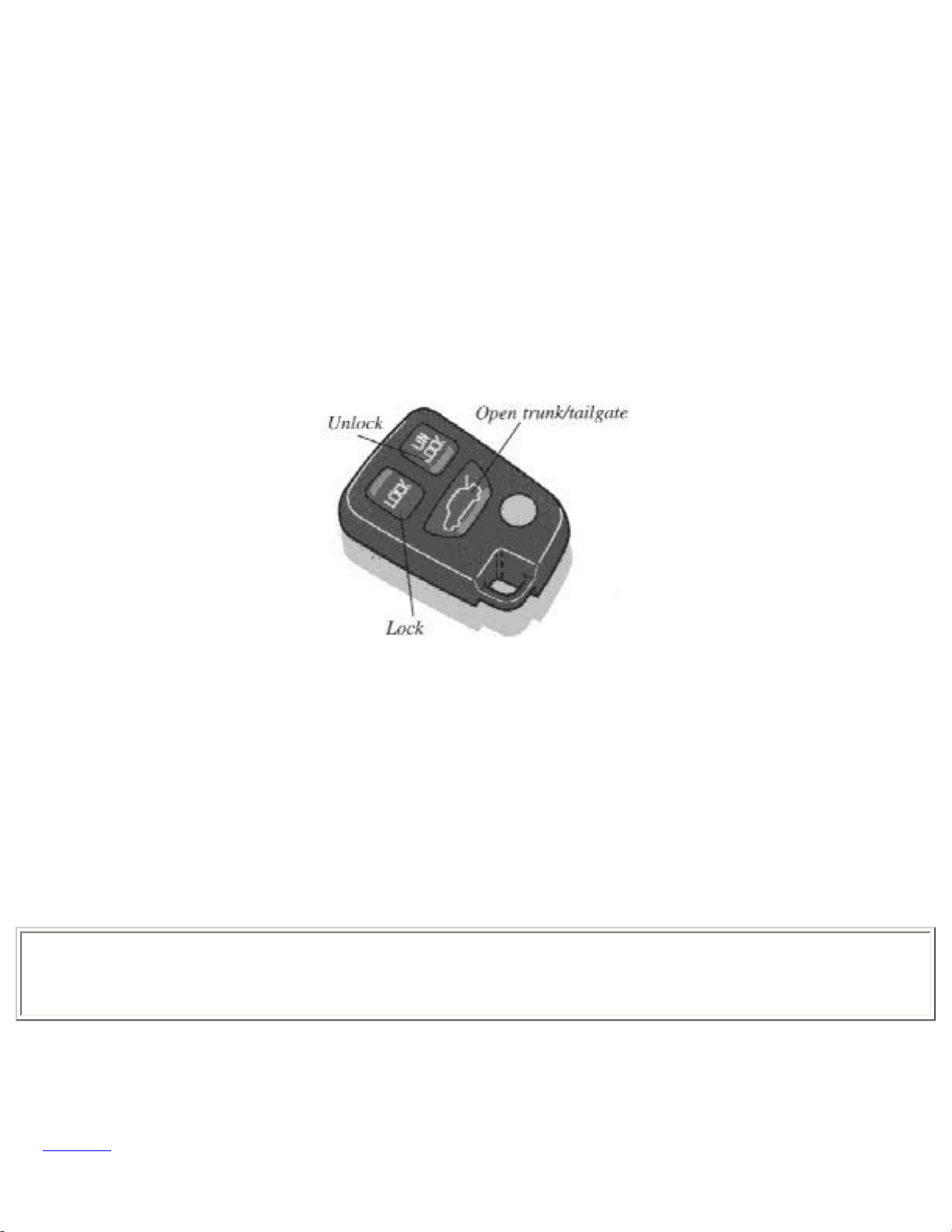
1998 S70 & V70
Your car is equipped with a remote control transmitter. This transmitter uses a readio frequency which
will allow “keyless” entry into the passenger compartment or the trunk. You will be supplied with two
coded key ring transmitters, which willenable you to lock/unlock all doors and the trunk/tailgate from a
distance of 10-15 feet (3-5 meters).
The car can also be locked/unlocked with the key.
As an extra security precaution in certain situations (valet parking,etc.), Volvo recommends that the
transmitter not be included when the keys are given to anyone. The service key can be used instead. If
one of transmitters is misplaced , contact the nearest authorized Volvo retailer for assistance.
Using the remote control
• Press the LOCK button once to lock all doors and trunk/tailgate.
• Press the UNLOCK button once to unlock the driver’s door only. Press this button again (within 10
seconds) to unlock all doors, trunk/tailgate.
• Press the OPEN TRUNK/TAILGATE button twice to pop open the trunk or unlock the tailgate
This device complies with FCC rules Part 15. Operation is subject to the following two conditions: (1)
This device may not cause harmful interference and (2) this device must accept any interference that
may be received, including interferencethat may cause undesired operation.
NOTE: If only the driver’s door is unlocked, the lock will automatically reengage (re-lock) and the
alarm will reset after 2 minutes unless the door has been opened.
The lock/unlock and alarm features can also be utilized by using the keys. See section: Doors and Locks
on
page 43.
file:///K|/ownersdocs/1998/1998_SV70/98sv70_041.htm (5 of 6)12/30/2006 1:51:27 PM
Page 74

1998 S70 & V70
If the alarm LED glows coninuously for 5 seconds, this indicates a fault in the system or that a door is
not properly closed.
WARNING! Volvo does not recommend using the transmitter to lock the doors from inside the car.
On cars equipped with an alarm, the alarm would be activated and would sound when one of the doors
is opened. The doors must not be locked using the remote transmitter while the vehicle is occupied. In
case of an accident, this may hinder rapid access to the occupants of the vehicle. The alarm will also
sound on models equipped with this feature.
NOTE : To avoid leaving your keys in the car, make a habit of always locking the car with the remote
control.
Contents | Top of Page
file:///K|/ownersdocs/1998/1998_SV70/98sv70_041.htm (6 of 6)12/30/2006 1:51:27 PM
Page 75
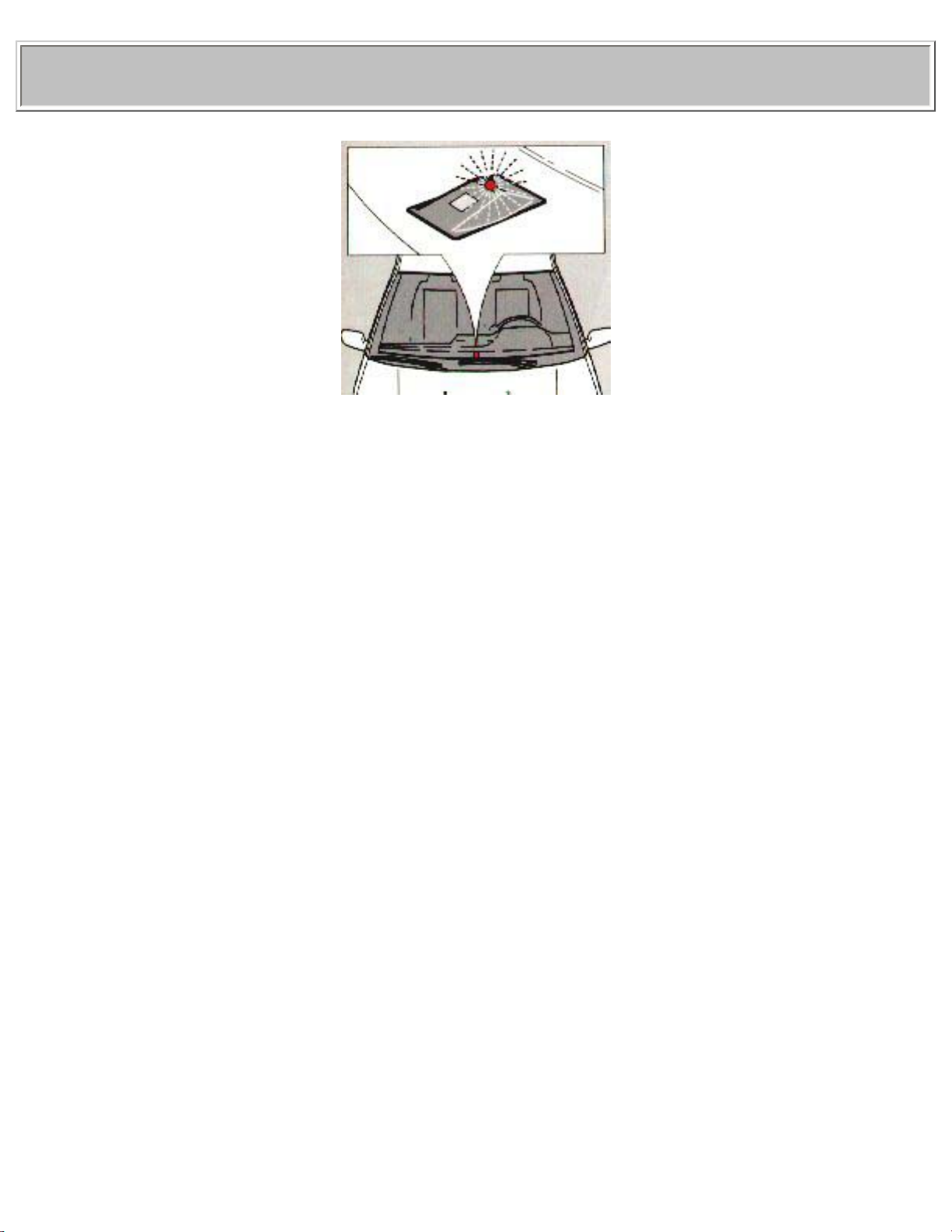
1998 S70 & V70
pg. 45 Alarm (certain models)
LED alarm status indicator
Alarm
The radio signal emitted from the transmitter, which is used to set/unset the alarm, is a “rolling code”
signal. This means that the signal is changed randomly for each transmission and is intended to help
prevent unauthorized recording of the code.
When armed (set), the alarm continuously monitors a number of points on the car. The following
conditions will set off the alarm:
• The hood is opened
• The trunk/tailgate is opened
• A door is opened
• The ignition switch is tampered with
• The car is lifted or towed (if the car is equipped with the optional inclination sensor)
• The battery is disconnected (if the car is equipped with the optional backup battery siren)
Arming (setting) the alarm
Press the LOCK button on the remote control, lock the car using the key in the driver’s door or press the
central lock button on one of the front doors with the door open. One long flash of the turn signals will
confirm that the alarm is set.
Disarming the alarm
file:///K|/ownersdocs/1998/1998_SV70/98sv70_045.htm (1 of 8)12/30/2006 1:51:27 PM
Page 76
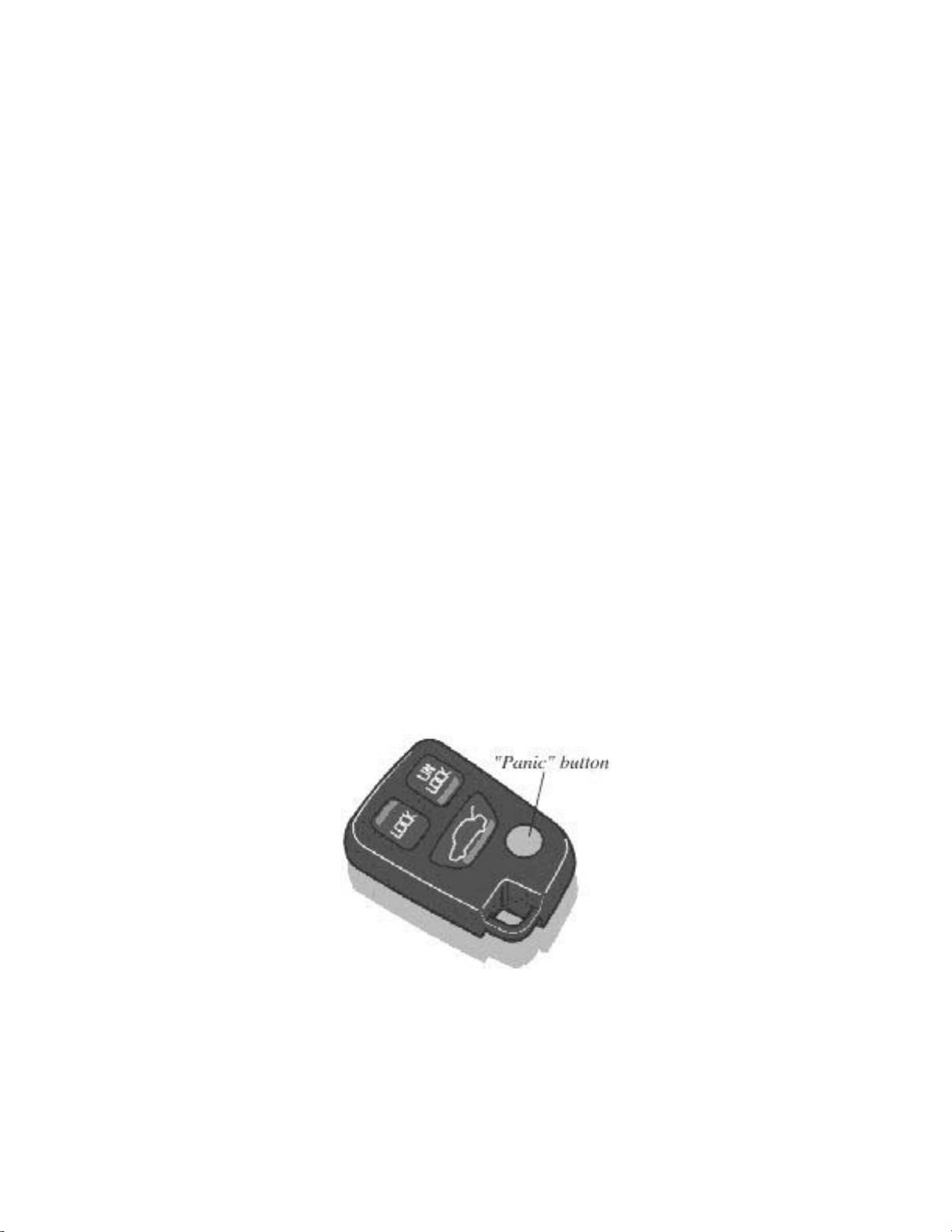
1998 S70 & V70
Press the UNLOCK button on the remote control or unlock the doors with the key.
Turning off (stopping) the alarm
If the alarm is sounding, it can be stopped by pressing the UNLOCK button on the remote control or by
unlocking the driver’s door with the key.
If the alarm is stopped with the remote control, this will be confirmed by two short flashes from the turn
signals.
Visual alarm signal
The visual alarm signal is given by flashing all turn signals and turning on the interior lighting for 5
minutes.
Audible alarm signal
An audible alarm signal is given either by a separate alarm horn or by the optional back-up sire. One
alarm cycle lasts for 30 seconds.
“Panic “ function
In an emergency situation, this feature can be used to attract attention.
Activate the “panic” function by pressing the red panic button on the remote control for at least 3
seconds or by pressing this button twice within 3 seconds. The turn signals will flash, the interior lights
file:///K|/ownersdocs/1998/1998_SV70/98sv70_045.htm (2 of 8)12/30/2006 1:51:27 PM
Page 77

1998 S70 & V70
will go on and the alarm will sound.
The function can be turned off by pressing any of the buttons on the remote control or will stop
automatically after 25 seconds.
NOTE: This button will NOT unlock the car.
pg. 46 Alarm
LED alarm status signals
The status of the alarm system is indicated by the red LED at the top center of the dash:
• LED off - the alarm is not armed (set)
• LED flashes once per second - the alarm is armed (set)
• LED flashes rapidly before the ignition is switched on - the alarm has been triggered.
• LED flashed rapidly for 15 seconds after the ignition has been switched on - a fault has been detected
in the alarm system.
Contact a Volvo retailer.
Automatic reset function
If only the driver’s door is unlocked with the remote control, the lock will automatically reengage (relock) and the alarm will reset after 2 minutes unless the door has been opened.
Temporarily disconnecting the alarm sensor(s)
In certain situations it may be desirable to disconnect the optional alarm sensor, particularly the
inclination sensor, if, for example, you drive your car onto a ferry where the rocking of the boat could
trigger the alarm. To temporarily disconnect the sensor(s) from the alarm system:
• With all doors closed, switch off the ignition and remove the key from the ignition switch
• Press the locking (left) side of the central locking button on the driver’s door for at least 3 seconds.
• The doors will first lock and then unlock after 3 seconds to confirm that the sensors have been
disconnected.
The car can then be locked in the usual way to set the alarm.
file:///K|/ownersdocs/1998/1998_SV70/98sv70_045.htm (3 of 8)12/30/2006 1:51:27 PM
Page 78
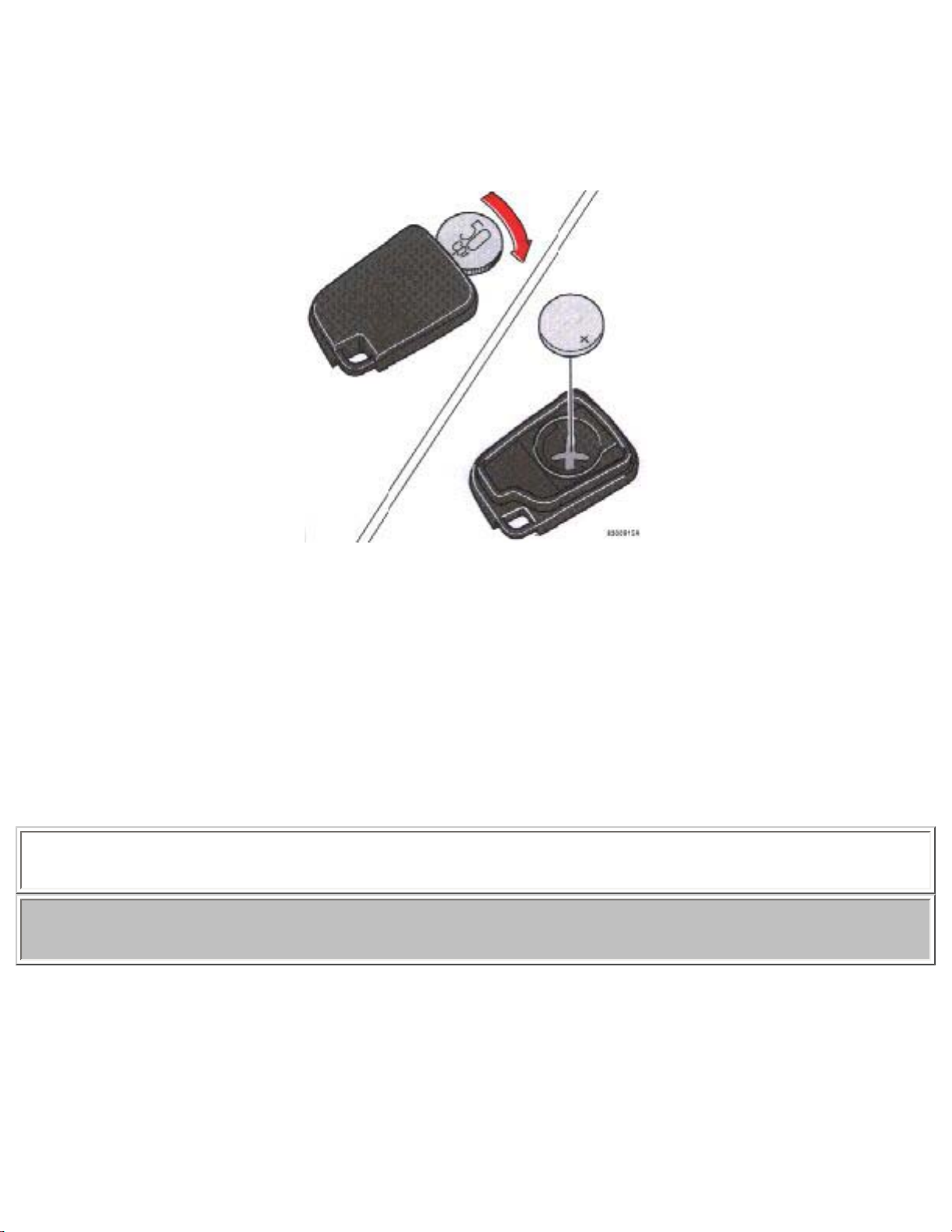
1998 S70 & V70
NOTE: The sensors will automatically be reconnected to the alarm system the next time the ignition is
switched on.
Batteries
Each remote transmitter is powered by a three volt battery, type CARE. If the range of the transmitter is
noticeably reduced, this indicates that the battery is weak and should be replaced.
Replacement: Remove the battery cover on the back of the transmitter with a coin. Replace the battery.
Reinstall the cover, making sure it is secured tightly to help protect the transmitter.
CAUTION: Do not attempt to service or repair any components of the alarm system yourself. This
should only be done by an authorized Volvo retailer.
pg. 47 Trunk/Tailgate
file:///K|/ownersdocs/1998/1998_SV70/98sv70_045.htm (4 of 8)12/30/2006 1:51:27 PM
Page 79
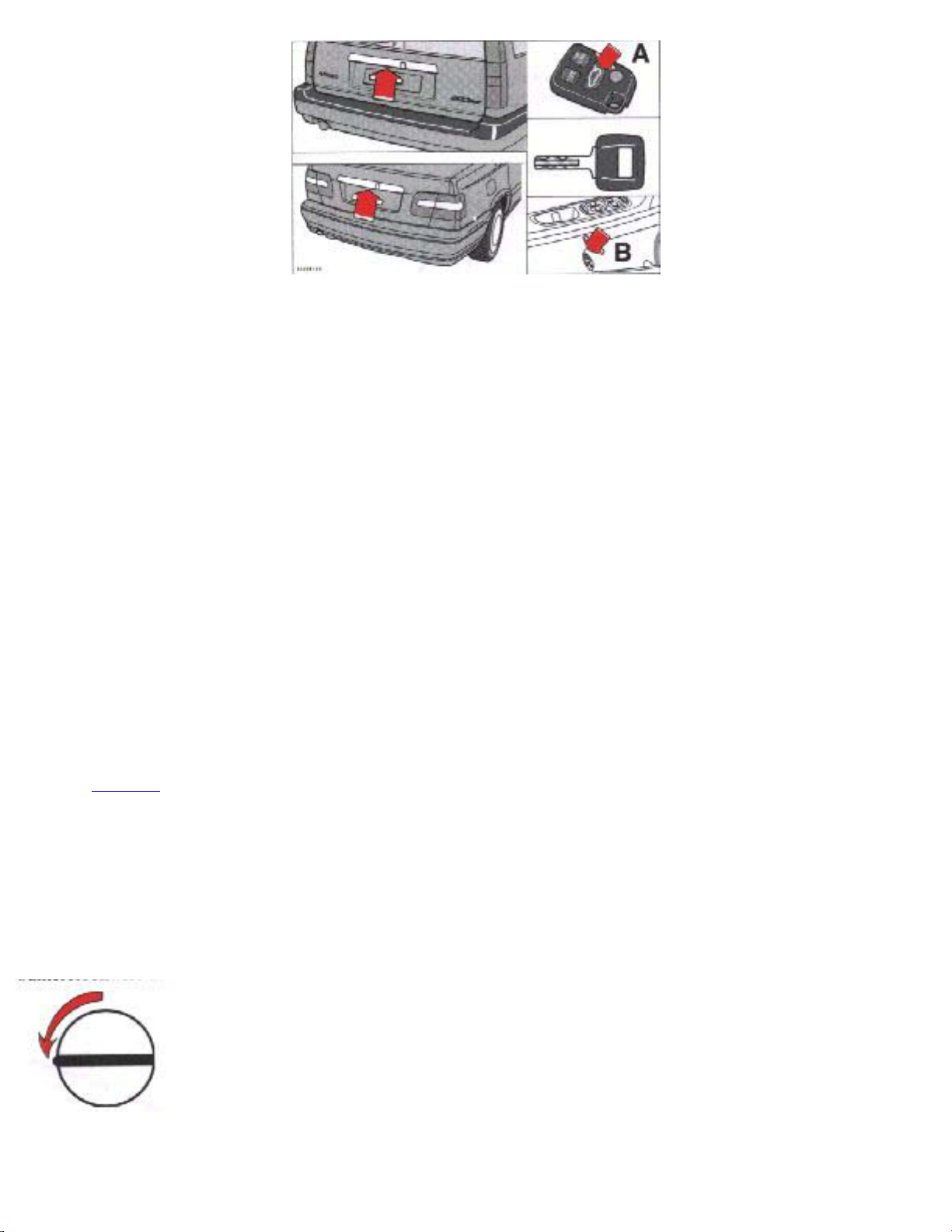
1998 S70 & V70
Opening/unlocking the trunk/tailgate
The trunk/tailgate locks are incorporated in the central locking system and are locked or unlocked when
the driver's door is locked/unlocked.
The trunk/tailgate can be opened by:
● Pressing the button on the remote control (A) twice *
● Using the master key in the trunk/tailgate ** lock
● Using the trunk/tailgate control on the driver's door (B) *
* The tailgate will be unlocked only, not opened.
** The master key should not be used to unlock the tailgate on models equipped with the tailgate lock
button. This will trigger the alarm.
Refer to
page 44 for information on the remote control locking system.
Disconnecting the trunk lock
The trunk lock can also be disconnected from the central locking system by turning the key
counterclockwise as shown below:
Withdraw the key in the horizontal position **
file:///K|/ownersdocs/1998/1998_SV70/98sv70_045.htm (5 of 8)12/30/2006 1:51:27 PM
Page 80
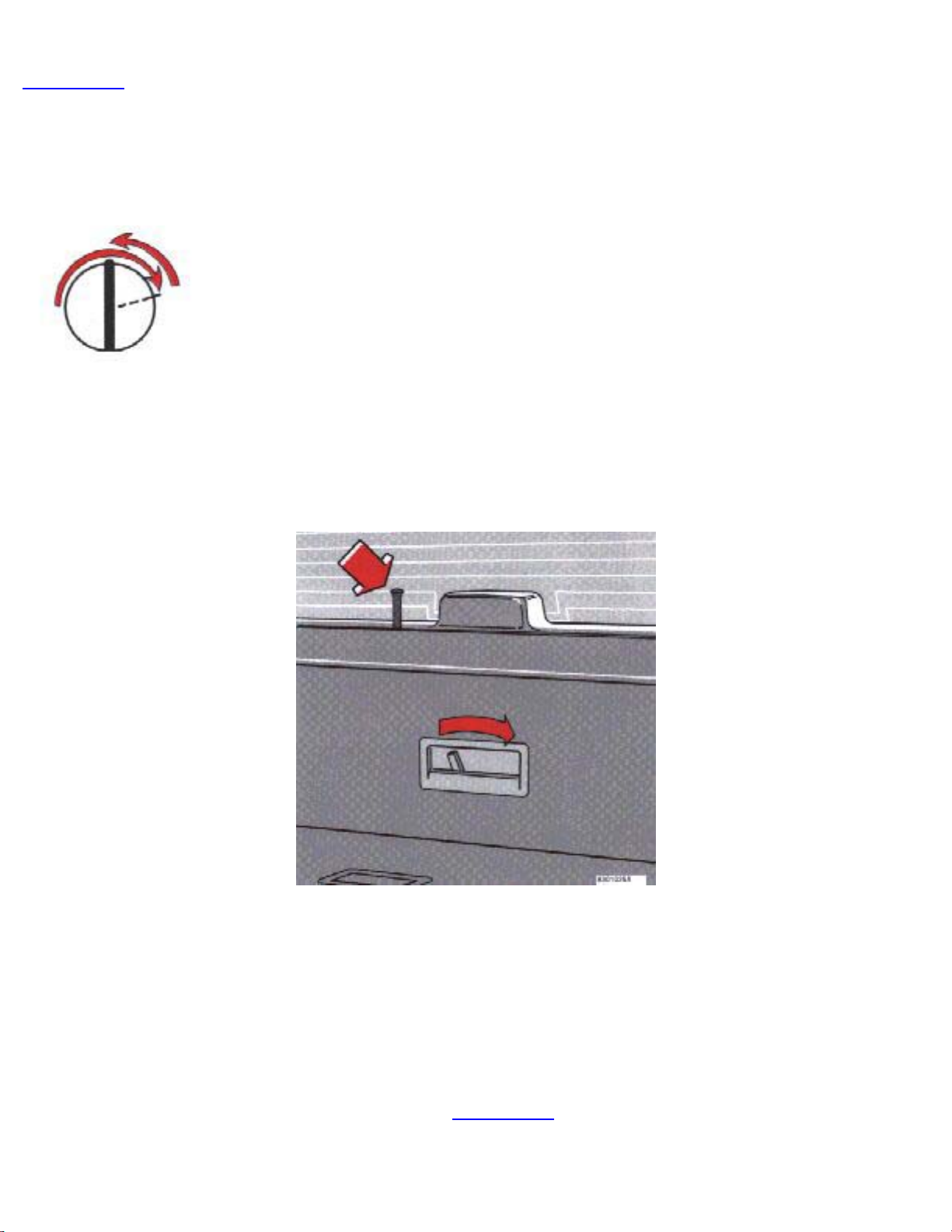
1998 S70 & V70
The trunk is now always locked. The optional folding rear seatback can also be locked from the trunk
(see page 57). This feature can be used for e.g., valet parking. If you give only the service key to the
driver, it will not be possible to gain access to the trunk. Please be aware that this setting may preclude
access to the spare tire and jack.
To reconnect the lock to the central locking system:
Withdraw the key in the vertical position
** In this position, the trunk cannot be opened with the control on the driver's door or the remote
control.
Unlocking/opening tailgate from the inside
Tailgate lock button (certain models)
If the doors and tailgate are locked, the tailgate can be unlocked from the inside by pulling up the lock
button (see illustration). This unlocks the tailgate only. Please note that this button will only function if
the child safety lock in the tailgate is disengaged (
see page 48) .
file:///K|/ownersdocs/1998/1998_SV70/98sv70_045.htm (6 of 8)12/30/2006 1:51:27 PM
Page 81
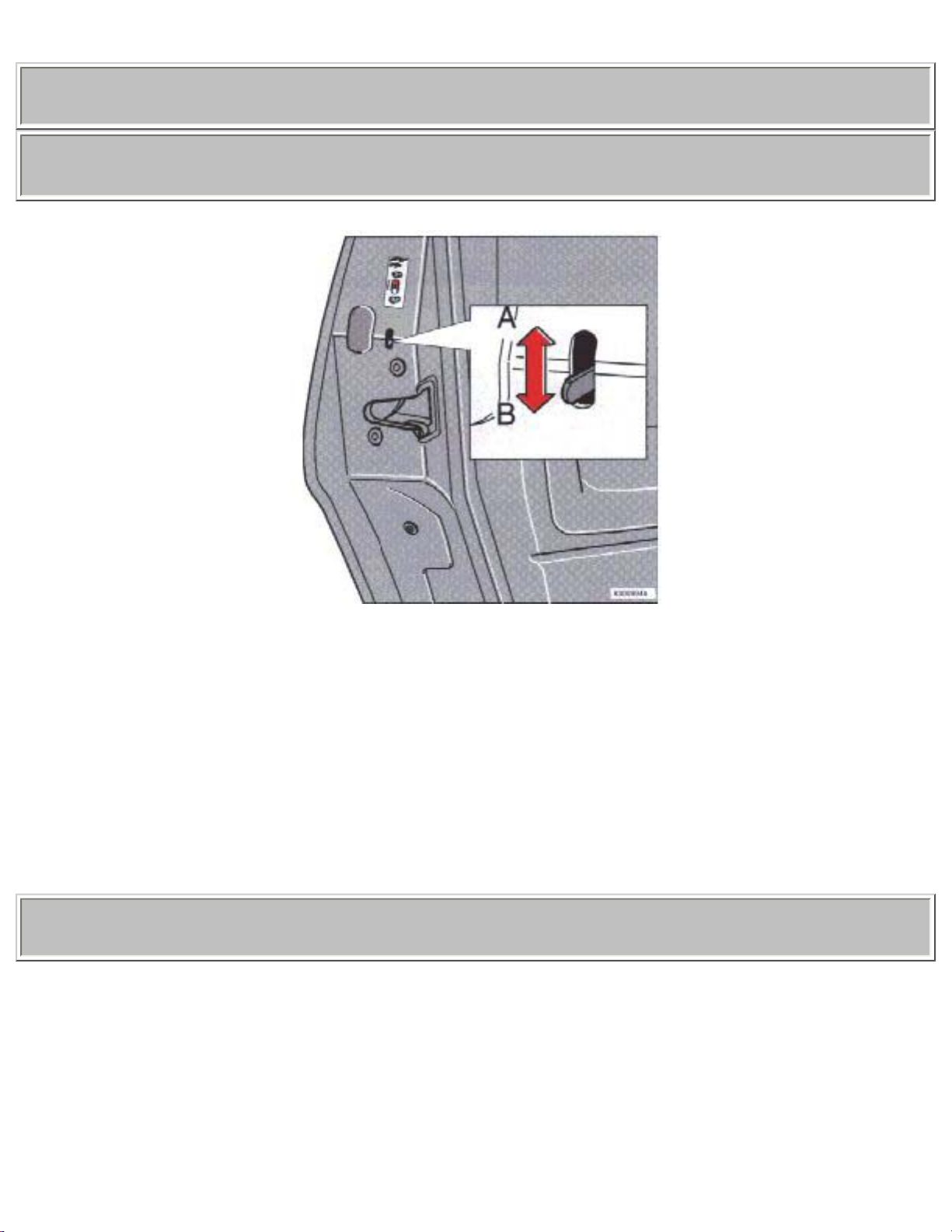
1998 S70 & V70
WARNING! Do not drive with the tailgate open! Poisonous exhaust gases may enter via the open
tailgate.
pg. 48 Child safety locks (sedan/wagon)
Location and setting of child safety lock
Child safety locks (sedan/wagon)
The controls are located on the rear door jams.
A The door cannot be opened from the inside. Normal operation from the outside.
B The door lock lock functions normally.
WARNING! Remember, in the event of an accident, the rear seat passengers cannot open the doors
from the inside with the buttons in position A.
file:///K|/ownersdocs/1998/1998_SV70/98sv70_045.htm (7 of 8)12/30/2006 1:51:27 PM
Page 82
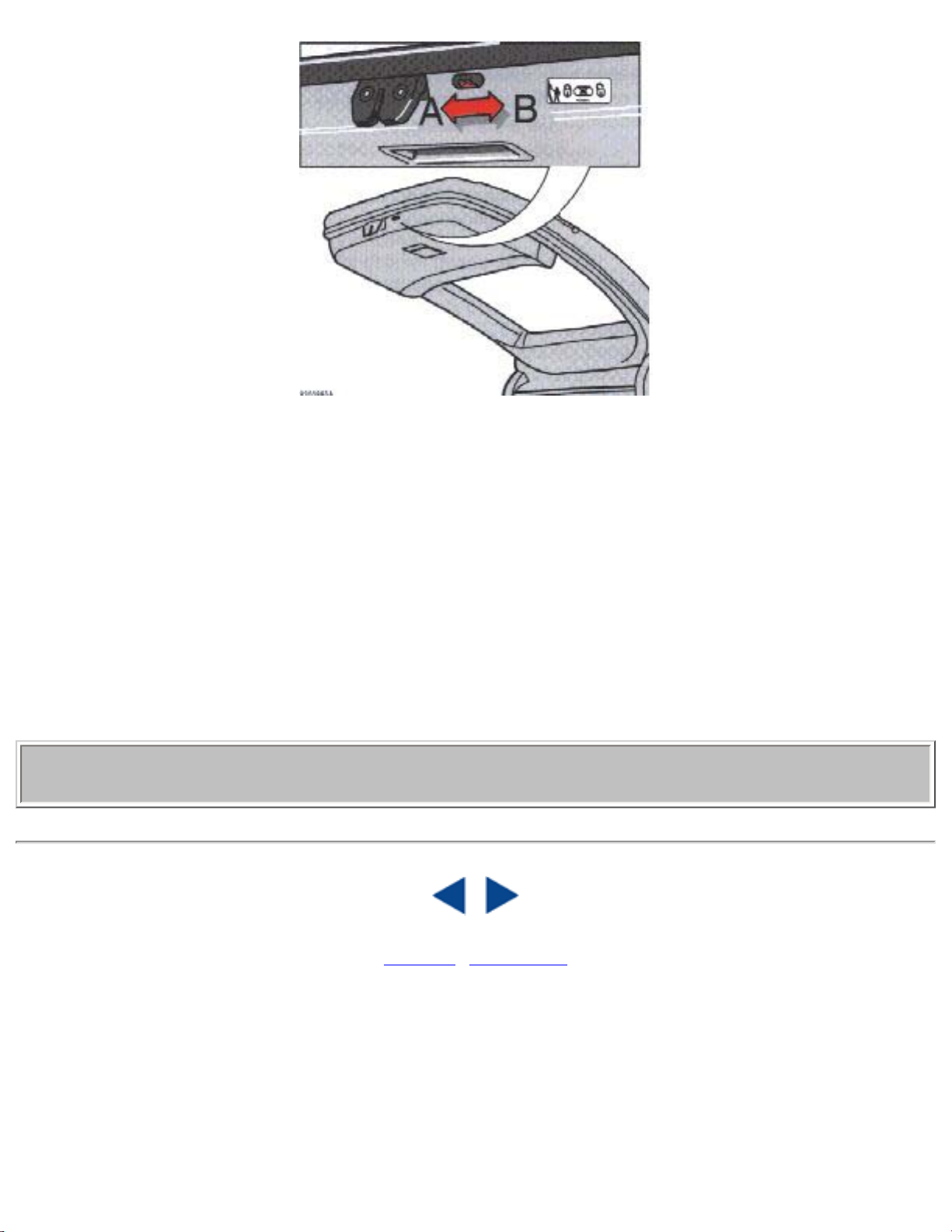
1998 S70 & V70
Child safety lock in tailgate
Child safety lock (wagon)
The tailgate incorporates a safety catch which is located to the side of the lock.
A The tailgate cannot be opened from the inside.
B The tailgate functions normally.
NOTE: You must use the end of a key, screwdriver, etc. to move the child safety lock.
WARNING! Remember, in the event of an accident, the tailgate cannot be opened from the inside
when the safety catch is in position A.
Contents | Top of Page
file:///K|/ownersdocs/1998/1998_SV70/98sv70_045.htm (8 of 8)12/30/2006 1:51:27 PM
Page 83

1998 S70 & V70
pg. 49 Front seats
1 Height adjustment (manual)
The front section of both front seats can be adjusted to eight different height settings and the rear section
of both seats can be adjusted to nine different height settings.
Forward lever = adjustment of front section
Rear lever = adjustment of rear section
WARNING! Do not adjust the seat while driving. The seat should be adjusted so that the brake pedal
can be depressed fully. In addition, position the seat as far rearward as comfort and control allow. The
seat rails on the floor must not be obstructedin any way when the seat is moved.
2 Forward-rearward seat adjustment (manual)
Pull the control upward, then slide the seat forward or rearward to the desired position. Make sure that
the seat is properly secured when you release the control.
Folding front seat
The passenger's seat backrest has a quick forward release mechanism which can be used when long
loads are carried.
See page 63.
3 Backrest angle (manual)
Rotate the control counterclockwise to tilt the backrest rearward and clockwise to tilt the backrest
forward.
4 Lumbar support *
file:///K|/ownersdocs/1998/1998_SV70/98sv70_049.htm (1 of 9)12/30/2006 1:51:28 PM
Page 84
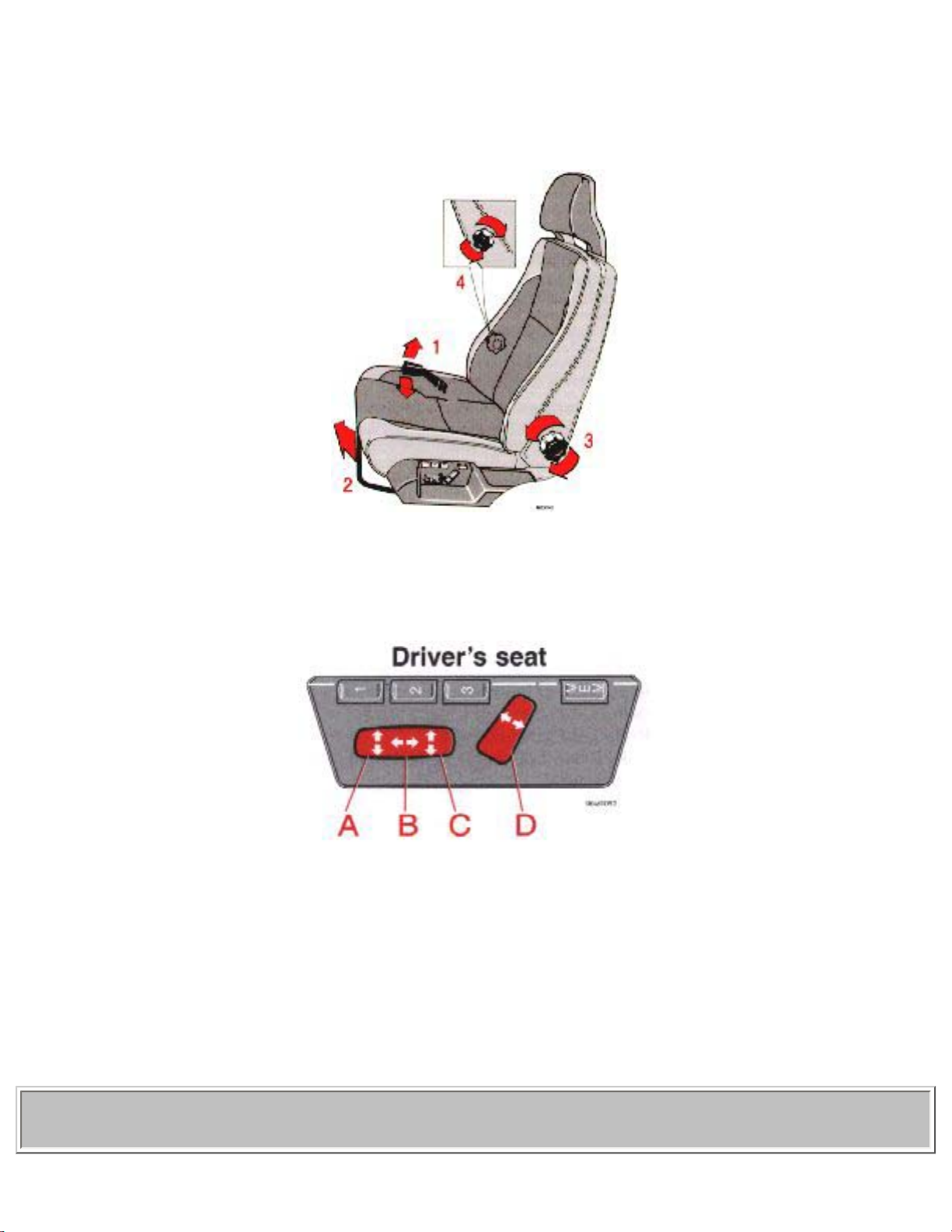
1998 S70 & V70
Firm: turn clockwise
Soft: turn counter-clockwise.
* Driver's seat only on certain models
Electrically operated seats with memory function (certain models)
Power seat control panel
A Seat front (raise/lower)
B Forward - rearward
C Seat rear (raise/lower)
D Backrest tilt
WARNING! The power seats are operable with the ignition OFF. Therefore, children should never be
left unattended in the car.
file:///K|/ownersdocs/1998/1998_SV70/98sv70_049.htm (2 of 9)12/30/2006 1:51:28 PM
Page 85
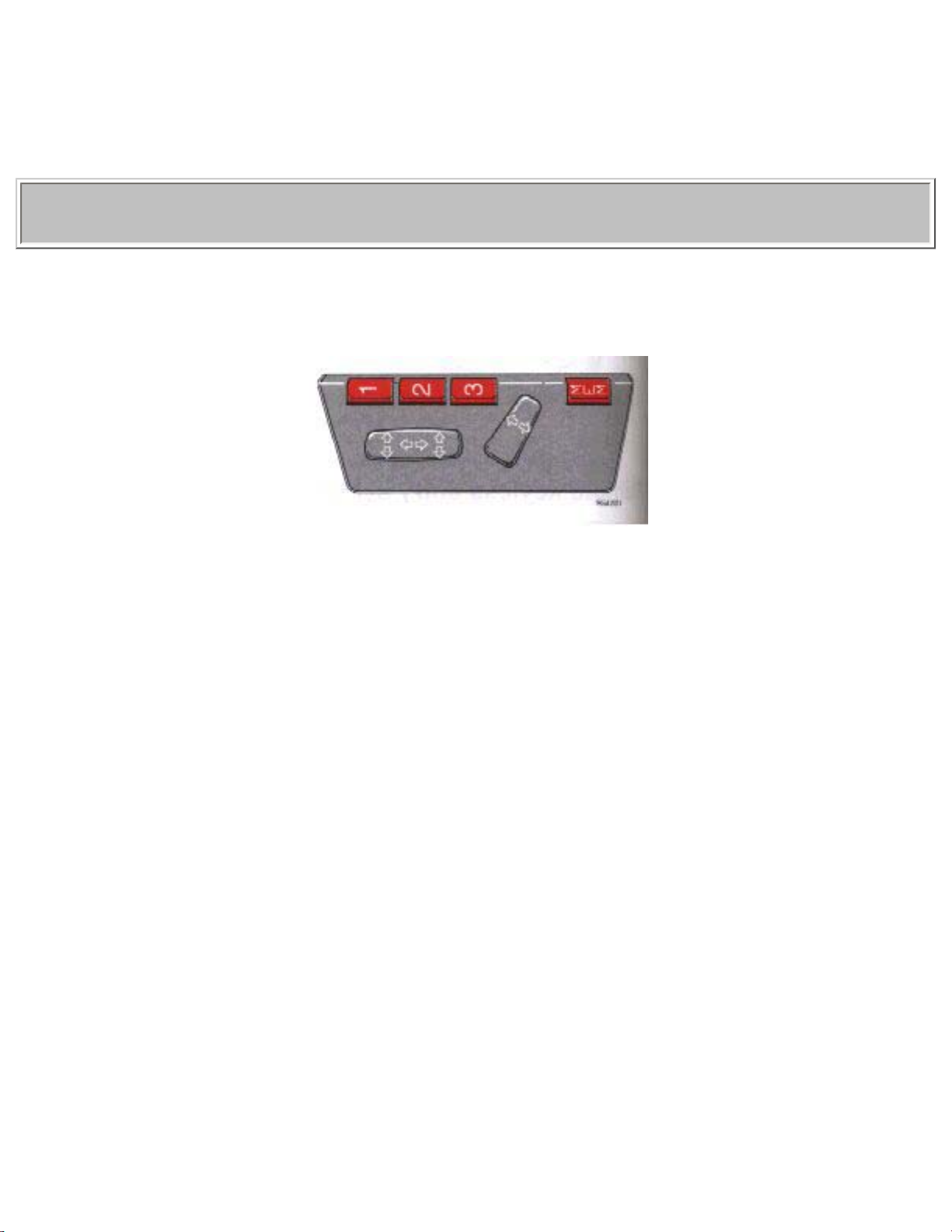
1998 S70 & V70
Movement of the seat can be STOPPED at any time by pressing any button on the power seat control
panel.
Refer to the following page for information on programming the memory function.
pg. 50 Electrically operated driver's seat, Rear/side-view mirrors
Programming the memory
Three seat positions can be programmed. To program a seat position:
1 Adjust the seat to the desired position.
2 Depress the MEM button.
3 Press button 1 to program the current position of the seat.
Buttons 2 and 3 can be programmed in the same way. To move the seat to a programmed position,
depress button 1, 2 or 3 until the seat stops. If the button is released before the seat has the reached the
programmed position, it will stop as a safety precaution.
NOTE: The seat has an overload protector which engages if an object blocks the movement of the seat.
If this happens, remove the object and wait 20 seconds before operating the seat again.
file:///K|/ownersdocs/1998/1998_SV70/98sv70_049.htm (3 of 9)12/30/2006 1:51:28 PM
Page 86
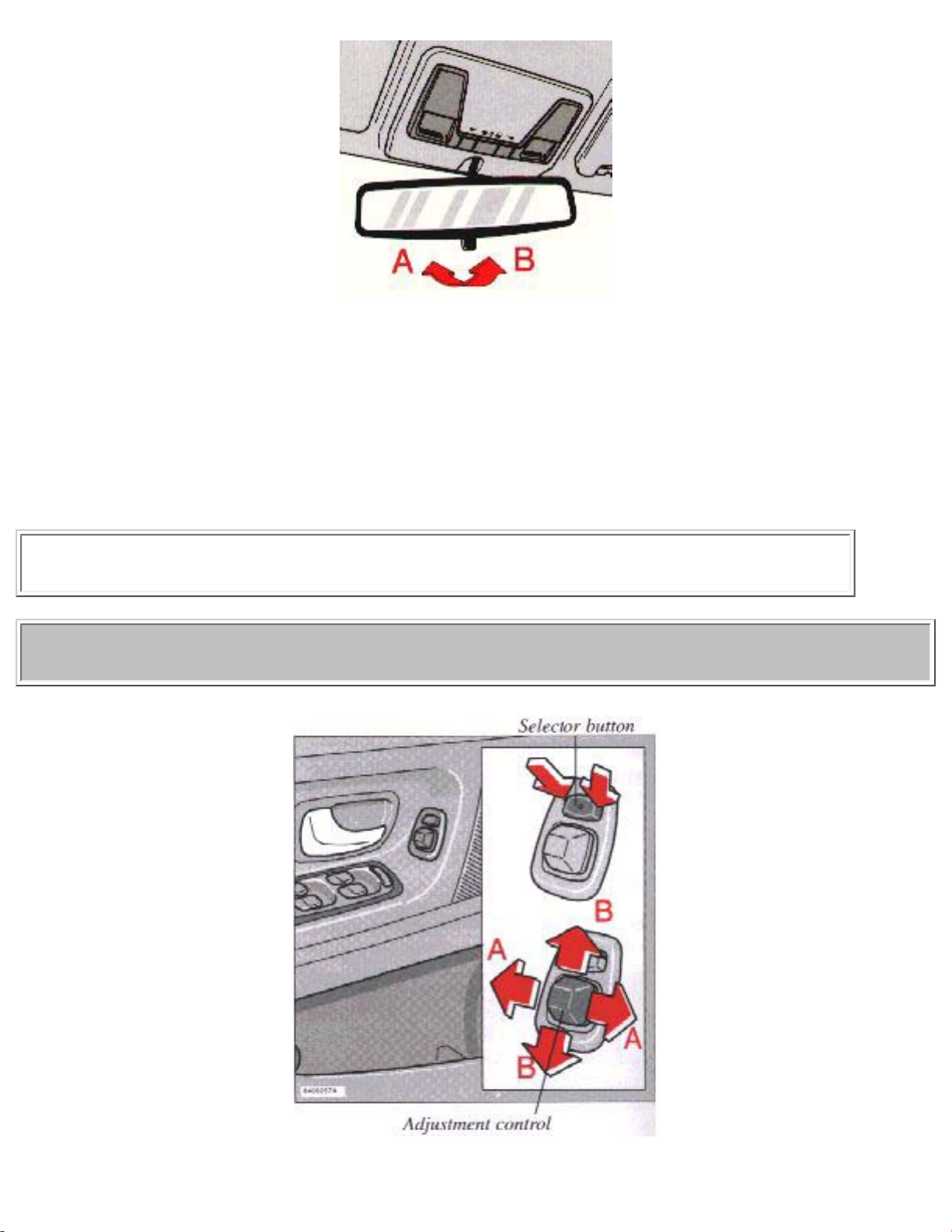
1998 S70 & V70
Rear-view mirror
A Normal position
B Night position, reduces glare from following headlights
CAUTION: Never use ice scrapers made of metal as they can easily scratch the mirror
surface
WARNING! The mirrors should always be adjusted prior to driving. Objects seen in the wide-angle
right side-view mirror are closer than they appear to be.
Adjustment control
file:///K|/ownersdocs/1998/1998_SV70/98sv70_049.htm (4 of 9)12/30/2006 1:51:28 PM
Page 87
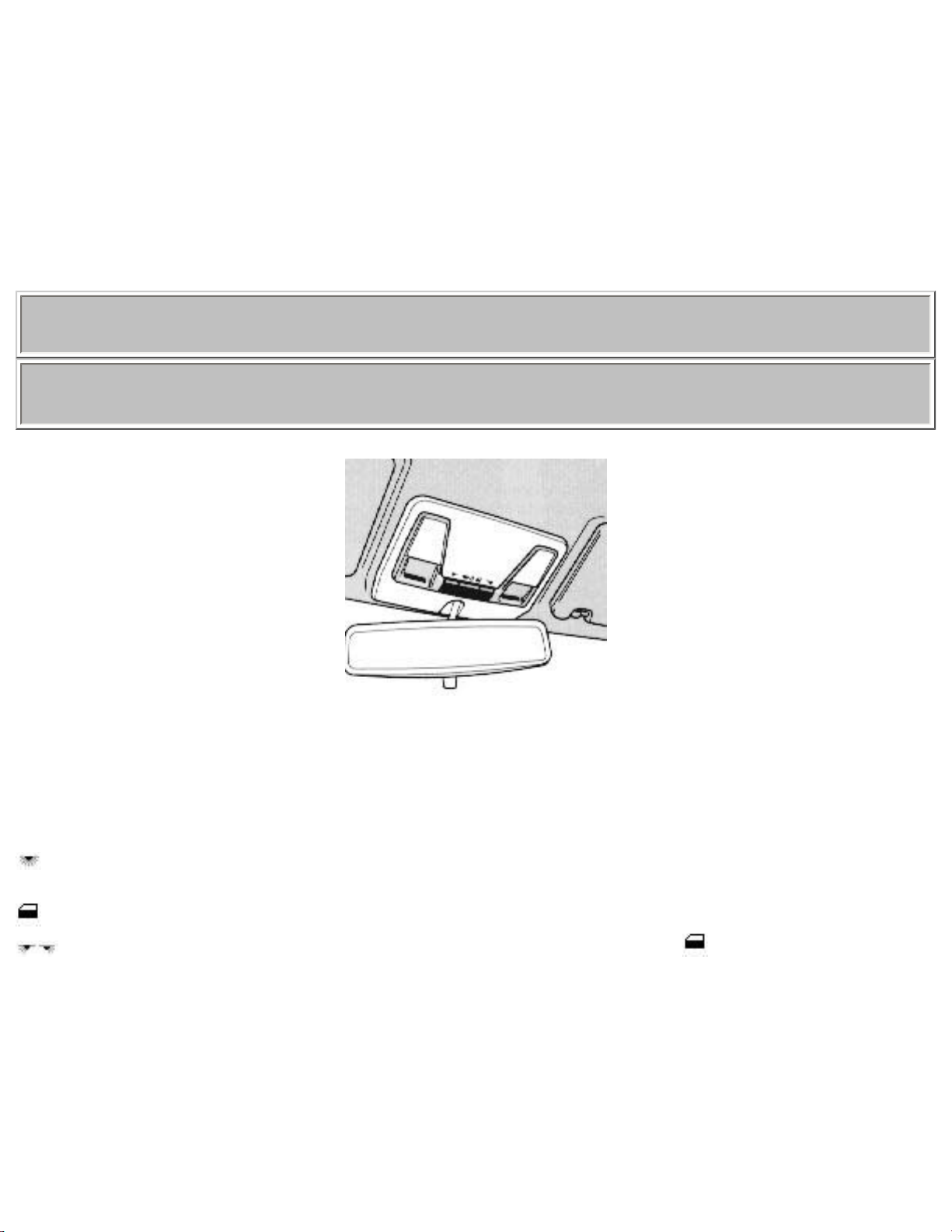
1998 S70 & V70
Electrically operated side-view mirrors
The control switches are located in the center console, beside the parking brake.
A Lateral adjustment
B Vertical adjustment
WARNING! The mirrors should always be adjusted prior to driving. Objects seen in the wide-angle
right side-view mirror are closer than they appear to be.
pg. 51 Interior lights, Vanity mirror
Front courtesy lights
The front courtesy lighting consists of two reading lights for the front seat occupants.
Front and rear reading lights always on
0 Front and rear reading lights always off
Front and rear reading lights come on when a door is opened
Left or right reading light illuminates if the center switch is in position .
The courtesy lights remain illuminated for 30 seconds after the doors have been closed but will be
switched off if the ignition is turned on or the doors are locked.
file:///K|/ownersdocs/1998/1998_SV70/98sv70_049.htm (5 of 9)12/30/2006 1:51:28 PM
Page 88
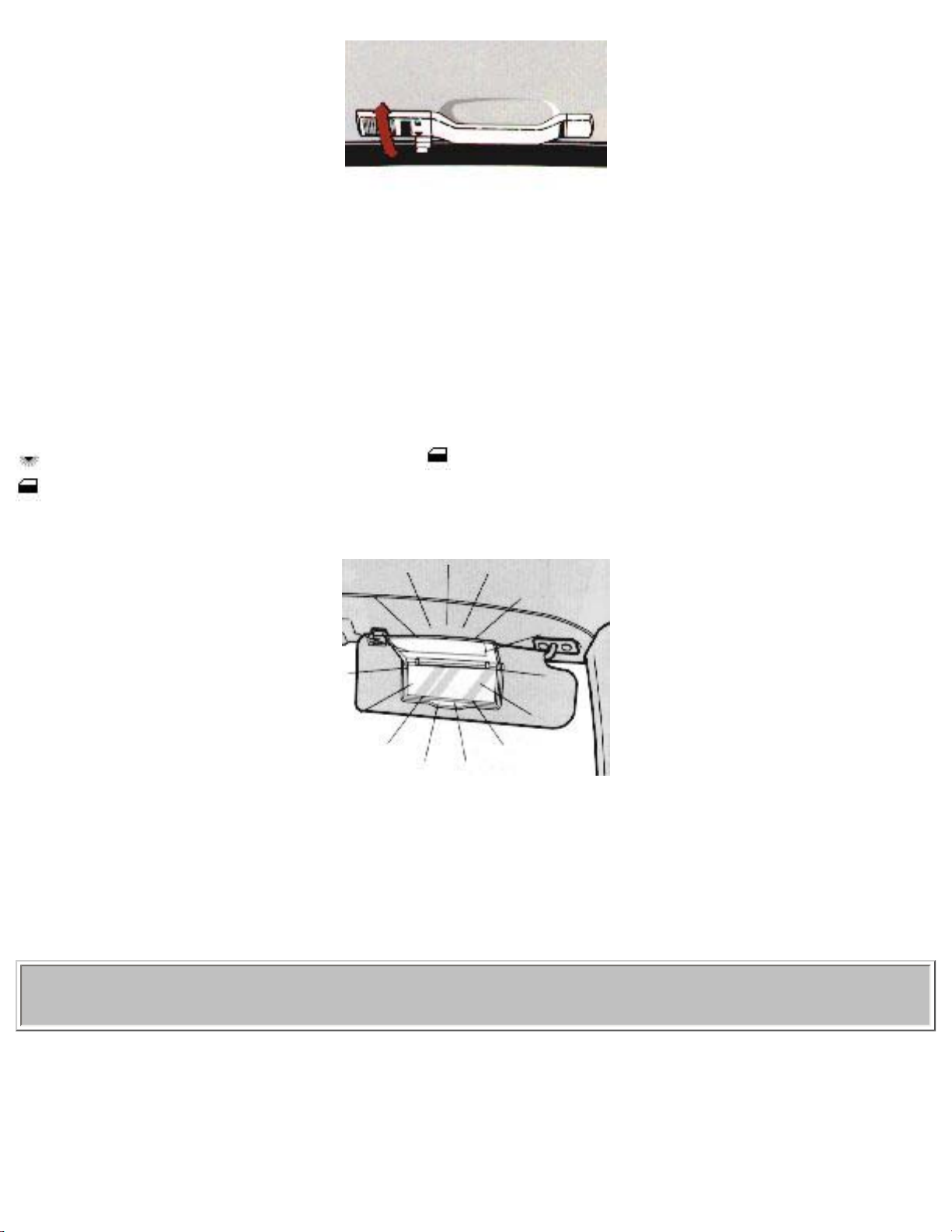
1998 S70 & V70
Reading lights, rear seat
There are two reading lights for the rear seat passengers. These are turned on/off by using the adjacent
switches.
Light is on if the front switch is in position .
Light turns on if any door is opened.
Vanity mirrors
The light illuminates when the cover is opened.
pg. 52 Sun roof (option)
file:///K|/ownersdocs/1998/1998_SV70/98sv70_049.htm (6 of 9)12/30/2006 1:51:28 PM
Page 89
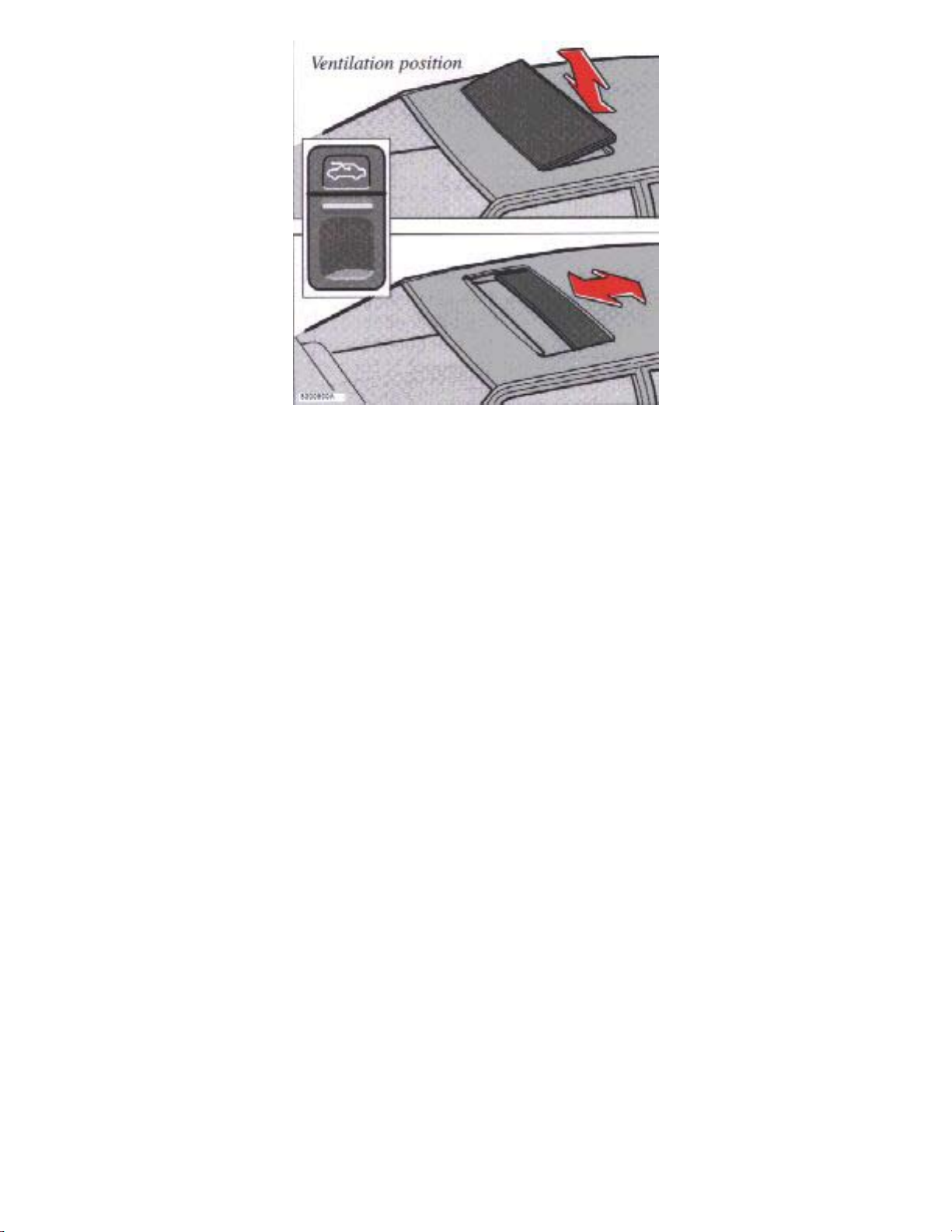
1998 S70 & V70
Sliding sun roof
Electrically-operated sun roof
The switch for operating the sun roof is located on the instrument panel. The starting (ignition) key must
first be turned to the drive position. On certain models, the sun roof is equipped with a one-touch,
AUTO-open function.
● AUTO-open: Press the lower section of the switch once to automatically open the sun roof to the
"comfort position"*. Press again to open the sun roof completely. The AUTO-open function can be
stopped at any time by pressing the switch.
file:///K|/ownersdocs/1998/1998_SV70/98sv70_049.htm (7 of 9)12/30/2006 1:51:28 PM
Page 90
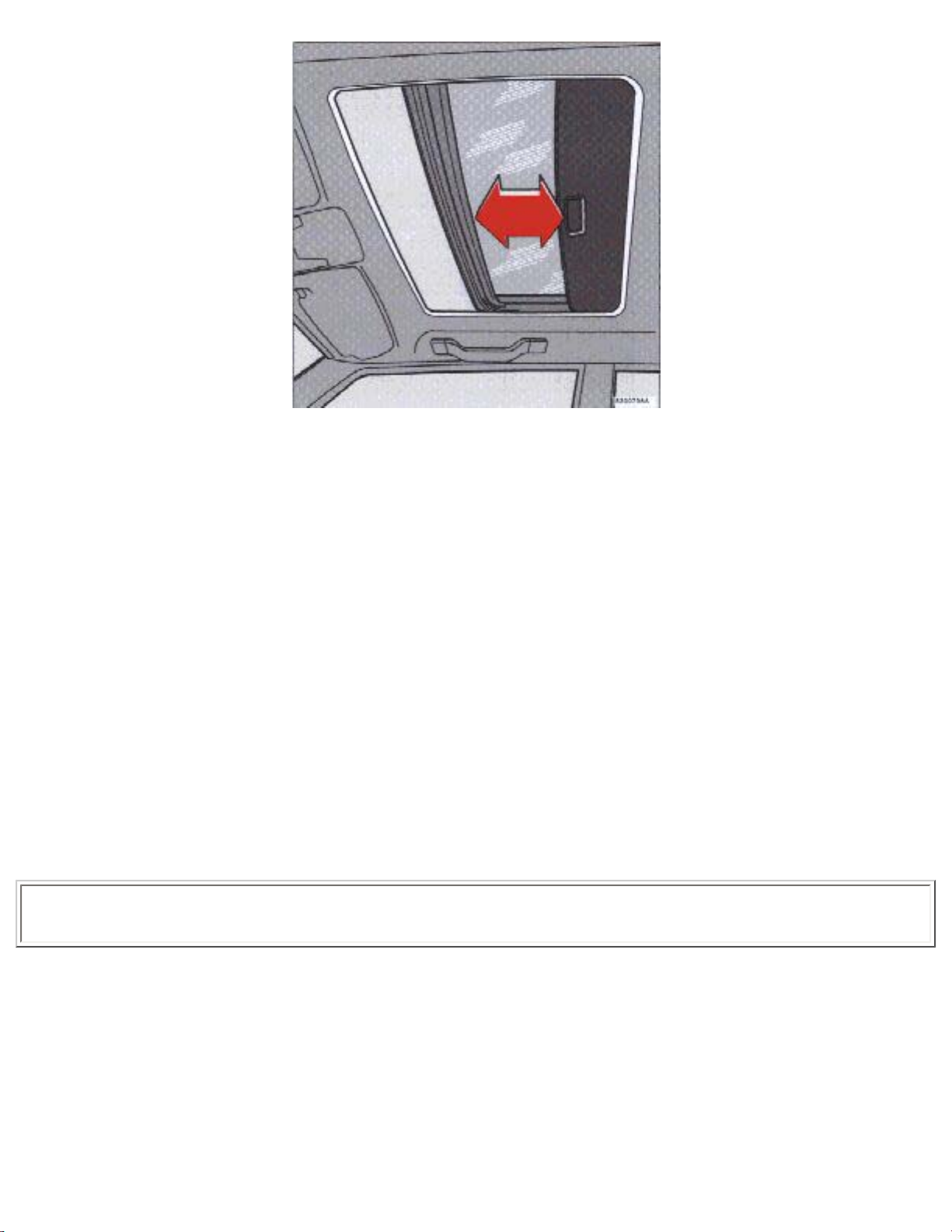
1998 S70 & V70
Sun visor
● To close the sun-roof : Depress the upper section of the switch until the sun roof has closed
completely .
● To open the rear edge of the sun roof (ventilation position) : With the sun roof closed, depress the
upper section of the switch. To close, depress the lower section of the switch until the sun roof has
closed completely.
● To slide open the sun roof: Depress the lower section of the switch until the sun roof has opened to
the position you prefer or hold the switch until the sun roof reaches the "comfort position"*. Depress the
lower section of the switch again to open the sun roof completely.
Sun visor: The sun roof also features a sliding sun visor. The visor slides back automatically when the
sun roof is opened and also slides back slightly when the sun roof is opened to the ventilation position.
The visor must be closed manually.
CAUTION: Do not close the sun visor when the sun roof is in the ventilation position as this could
damage the mechanism.
NOTE:
● The electrically-operated sun roof has an overload protecting circuit breaker (fuse no. 37) which is
activated when an object blocks the sun roof. Should this occur, remove the object and wait 20 seconds
for the circuit breaker to reset. The sun roof should then function normally. Also check fuse no. 35.
file:///K|/ownersdocs/1998/1998_SV70/98sv70_049.htm (8 of 9)12/30/2006 1:51:28 PM
Page 91

1998 S70 & V70
WARNING! The sun roof must never be obstructed in any way when in
operation.
* A position where the sun roof is not quite fully open. This position helps alleviate "rumbling" wind
noise.
Contents | Top of Page
file:///K|/ownersdocs/1998/1998_SV70/98sv70_049.htm (9 of 9)12/30/2006 1:51:28 PM
Page 92
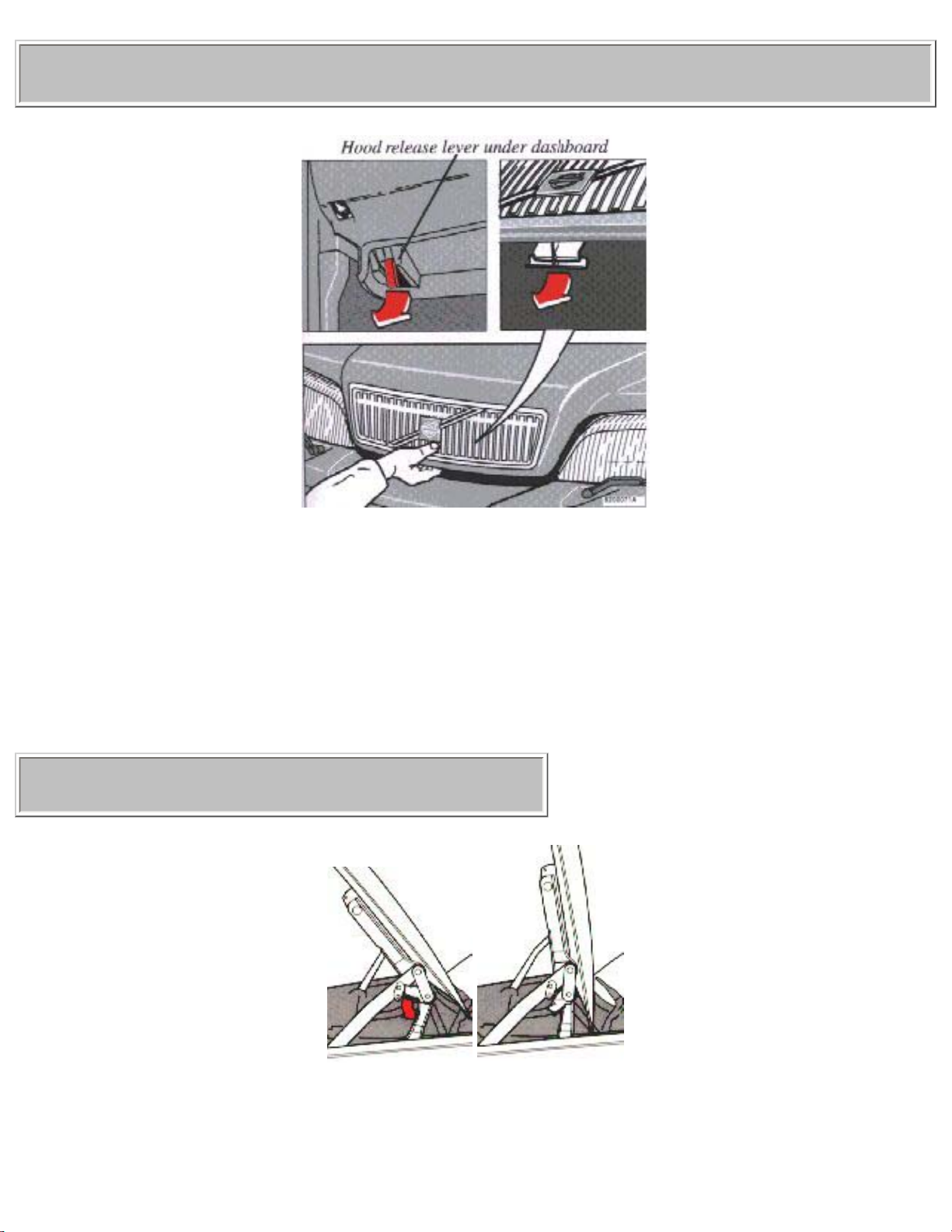
1998 S70 & V70
pg. 53 Hood
To open the hood
● Pull the lever located under the left side of the dash to release both hood catches.
● Lift the hood slightly.
● Pull the release control on the inside of the lower edge of the grille toward you and lift the hood.
WARNING! Check that the hood locks properly when
closed.
The hood normally opens to an angle of 57°. The hood can be opened to the vertical position by rotating the
hinge catches (see illustrations). The catches will return to their normal positions when the hood is closed.
file:///K|/ownersdocs/1998/1998_SV70/98sv70_053.htm (1 of 5)12/30/2006 1:51:28 PM
Page 93
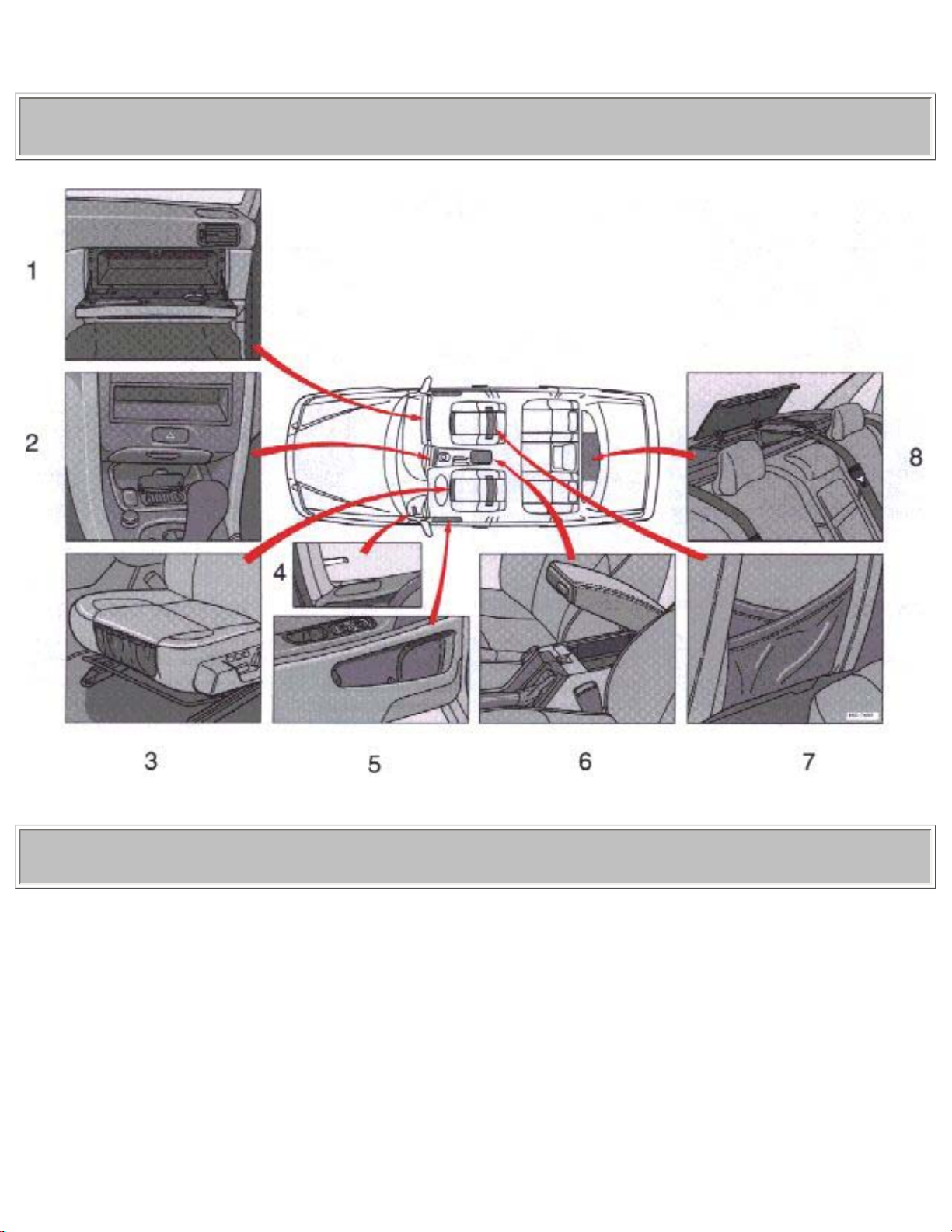
1998 S70 & V70
Ensure adequate clearance in low-roof garages to avoid damaging the hood.
pg. 54 Storage compartments
WARNING! Packages on the rear window shelf can obscure vision and may become dangerous projectiles
in the event of a sudden stop or an accident.
1 Glove compartment
2 Compartment in center console (certain models)
3 Pocket in seat front (certain models)
4 Clip for parking receipts
5 Compartment in door (certain models)
6 Compartment between front seats/Cup holder (certain models)
7 Pocket on rear of front seat
8 Compartment in hat shelf (sedan)
file:///K|/ownersdocs/1998/1998_SV70/98sv70_053.htm (2 of 5)12/30/2006 1:51:28 PM
Page 94
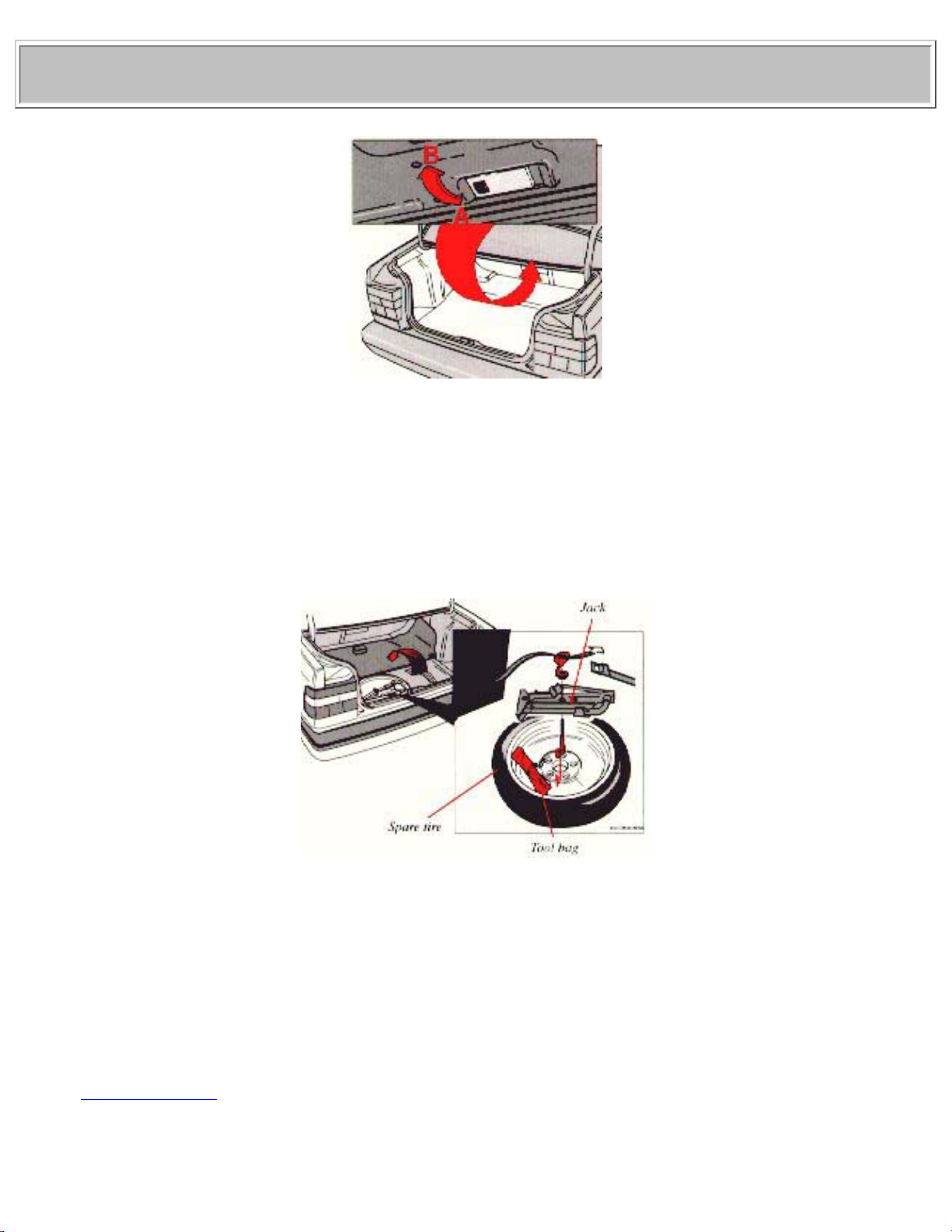
1998 S70 & V70
pg. 55 Trunk light, Spare tire, Jack (sedan)
Trunk light
A Light always off.
B Light is on when trunk lid is opened.
Spare tire
The spare tire is located under the carpet in a special well under the floor of the trunk. The jack is placed
inside the wheel rim. Make sure that the jack is properly secured in this position after use (see illustration).
NOTE:
See pages 92-93 for information on how the jack should be used.
file:///K|/ownersdocs/1998/1998_SV70/98sv70_053.htm (3 of 5)12/30/2006 1:51:28 PM
Page 95
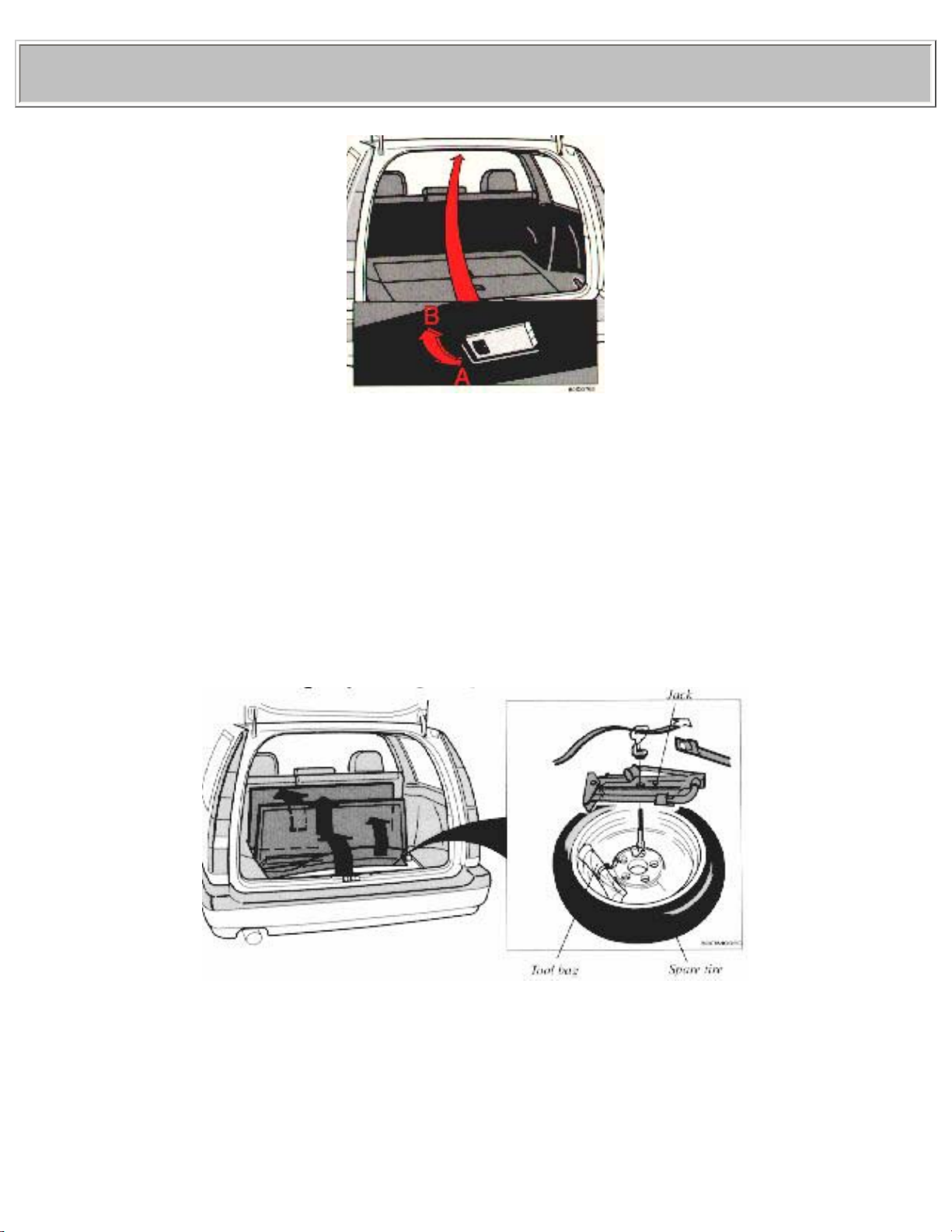
1998 S70 & V70
pg. 56 Cargo space lighting, Spare tire, Jack (wagon)
Cargo space lighting
There is an extra courtesy light at the rear of the cargo space.
1 The light is always OFF
2 Light comes on when the tailgate is opened
Spare tire and jack
The spare tire and the jack are located beneath the floor mat in the large storage bin. Always secure the spare
tire and the jack to prevent them from rattling (see illustration).
file:///K|/ownersdocs/1998/1998_SV70/98sv70_053.htm (4 of 5)12/30/2006 1:51:28 PM
Page 96

1998 S70 & V70
NOTE: See pages 92-93 for information on how the jack should be used.
Contents | Top of Page
file:///K|/ownersdocs/1998/1998_SV70/98sv70_053.htm (5 of 5)12/30/2006 1:51:28 PM
Page 97
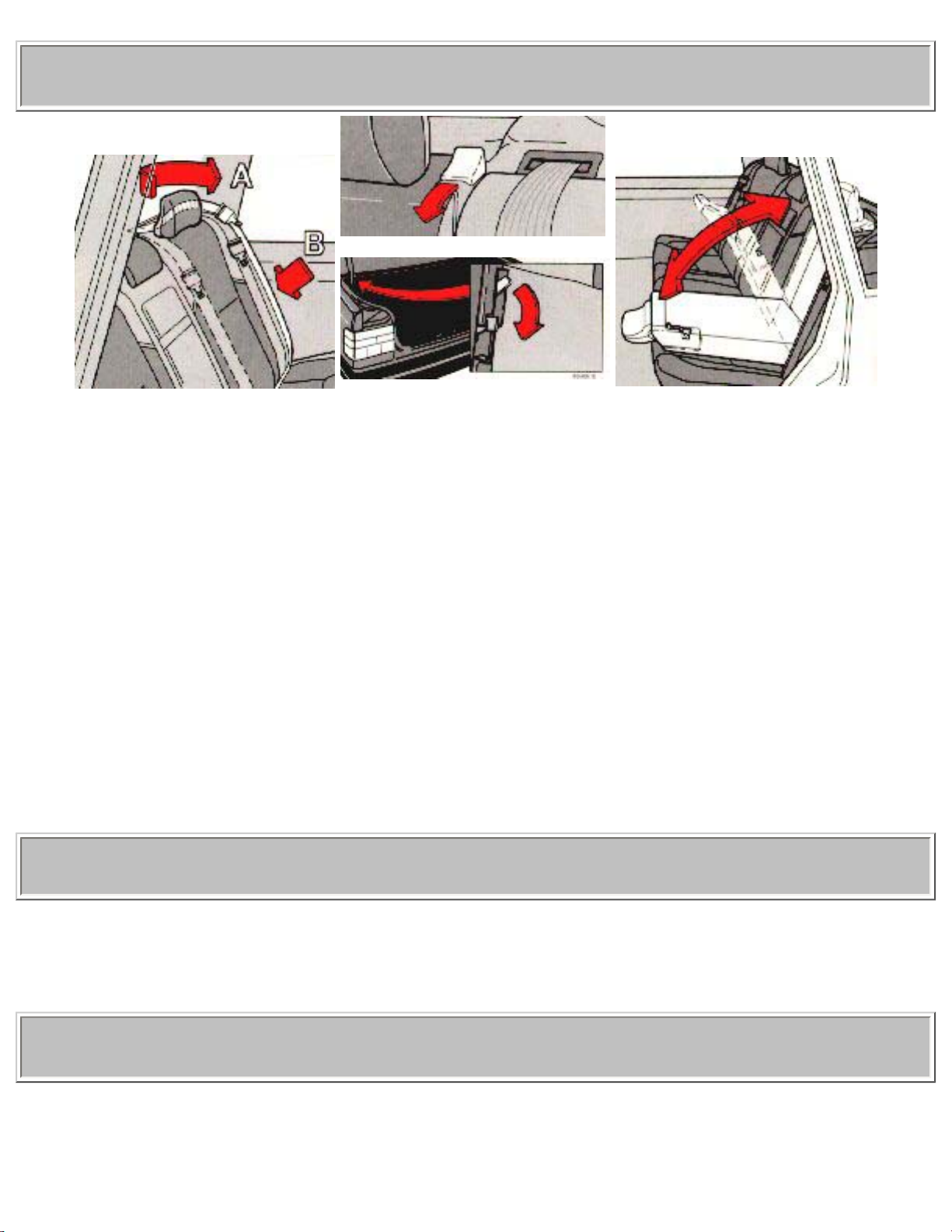
1998 S70 & V70
pg. 57 Folding rear seat (sedan)
Locking levers
Folding rear seat
The rear seat is split into two sections so that each section can be folded independently.
● Lift the rear seat belts to the fixed section of the backrest. The center seat belt can also be folded
across the fixed part of the backrest so that it does not get in the way if the right-hand backrest is folded
down (see illustration above).
● Pull the catch forward and fold the backrest down.
The two red levers on the rear side of the backrests can be used to bypass the folding mechanism and
prevent the backrests from being folded down from inside the car. Push the levers down to lock
backrests in the upright position. This function can be used to limit access to the trunk.
● When folding the backrests up, make sure the seat belts return to their normal positions.
WARNING! When the backrest is returned to the upright position, check that it is properly locked in
place.
NOTE: If the backrest is folded down for prolonged periods, the seat belt locks could be covered (i.e.,
with a towel) to help avoid marks on the backrest upholstery.
pg. 58 Folding rear seat (wagon)
file:///K|/ownersdocs/1998/1998_SV70/98sv70_057.htm (1 of 11)12/30/2006 1:51:29 PM
Page 98
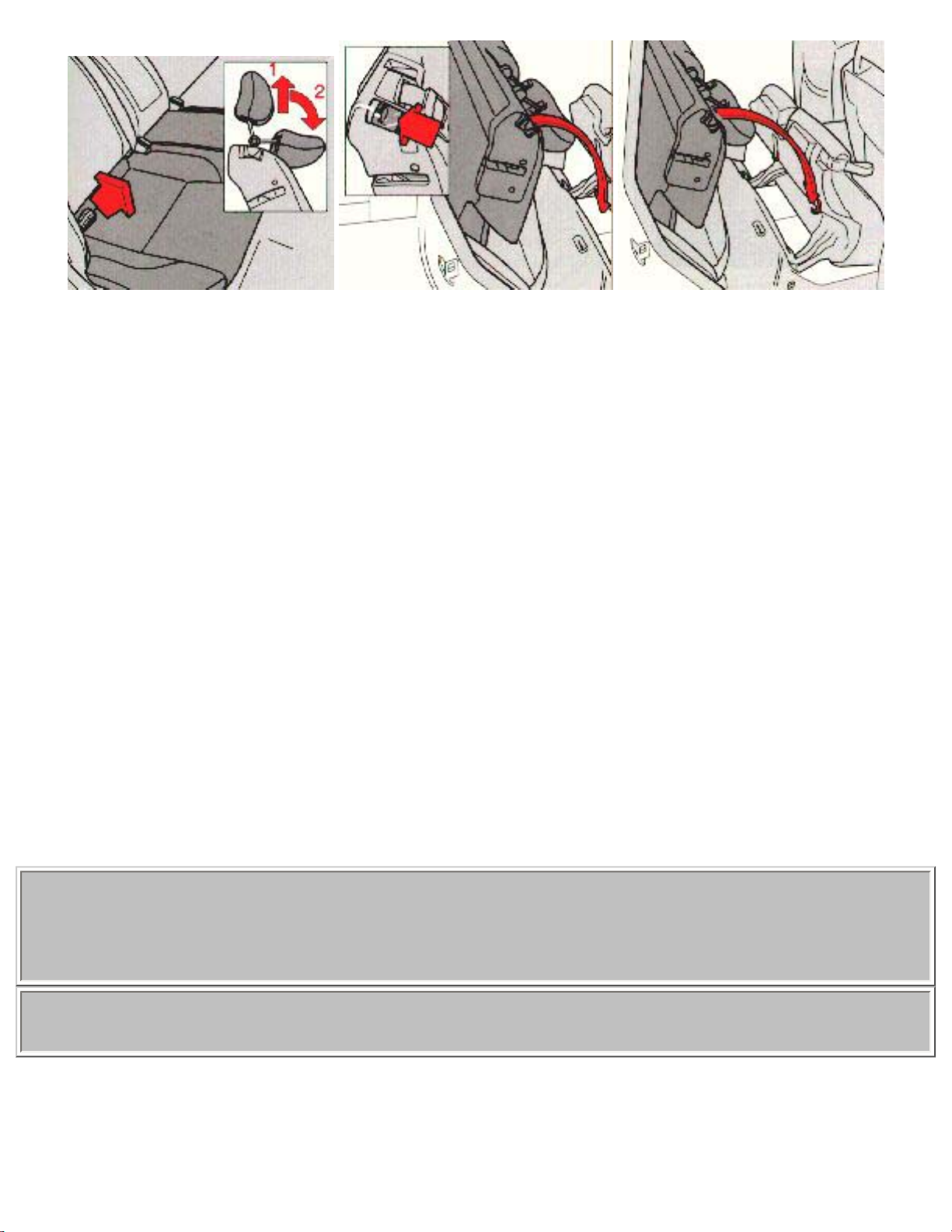
1998 S70 & V70
Seat cushion strap Release lever - backrest Hooks fit into holes
Folding rear seat (wagon)
The rear seat is split into two sections so that each section can be folded independently.
● Straighten front seat backrests if they are tilted too far to the rear.
● Pull the strap to lift the rear seat cushion and swing the cushion up and toward the back of the front
seats.
● The outboard head restraints must be lowered before the backrest is folded down (see inset illustration
above):
1 - pull straight up, 2 - fold forward
● Push the center head restraint straight down if it has been raised.
● Move the backrest release lever rearward and fold the backrest down.
● Check that the hooks under the seat cushions engage the holes on the top edge of the backrest.
When the backrest is raised, the outboard head restraints must be returned to their normal position.
The backrest must lock into place. The red lock indicator will not be visible if the seat has locked into
place correctly.
The seat belts must be correctly positioned when the seat is returned to the normal position.
WARNING! When the rear seat is folded down, do not place heavy objects against the backs of the
front seats. This places a severe strain on the folded down backrest of the rear seat. Be sure to secure
cargo. Cargo must not be stacked higher than the top of seatbacks. This will reduce the possibility of
luggage, etc. becoming projectiles during sudden maneuvers, rapid braking or an accident.
pg. 59 Folding rear seat, Removing seat cushions (wagon)
file:///K|/ownersdocs/1998/1998_SV70/98sv70_057.htm (2 of 11)12/30/2006 1:51:29 PM
Page 99
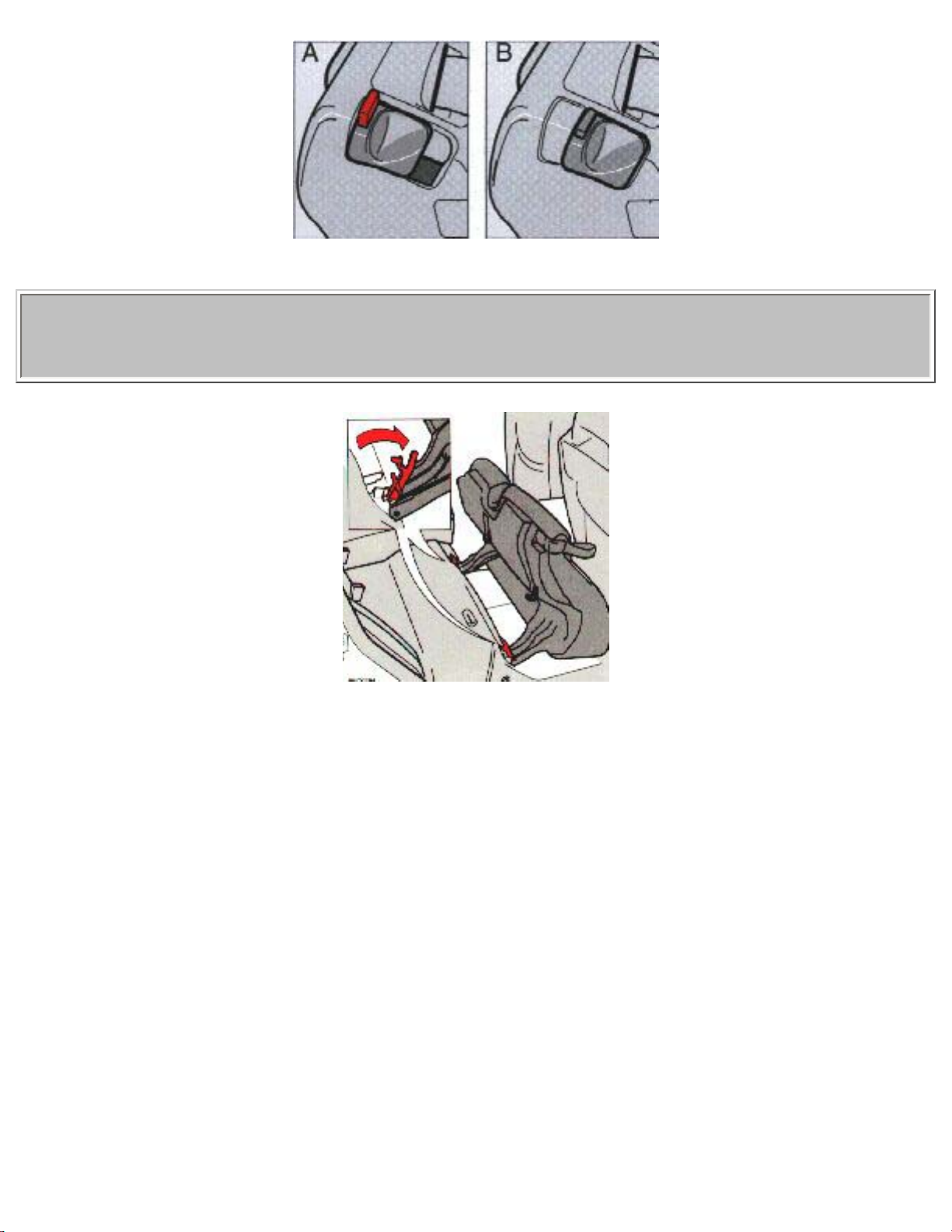
1998 S70 & V70
WARNING! The red lock indicator is VISIBLE (A) when the backrest is NOT locked in position and
not visible (B) when the backrest is correctly locked in place. When the backrest is in the upright
position, it must always be correctly locked in place.
Removing seat cushions
The seat cushion can be easily removed to provide a slightly larger cargo storage area.
● Fold the seat cushion toward the back of the front seats
● Release the red catches
● Disconnect the connector for the rear seat heating (certain models)
● Fold the cushion back to a nearly horizontal position.
● Lift out the cushion
file:///K|/ownersdocs/1998/1998_SV70/98sv70_057.htm (3 of 11)12/30/2006 1:51:29 PM
Page 100
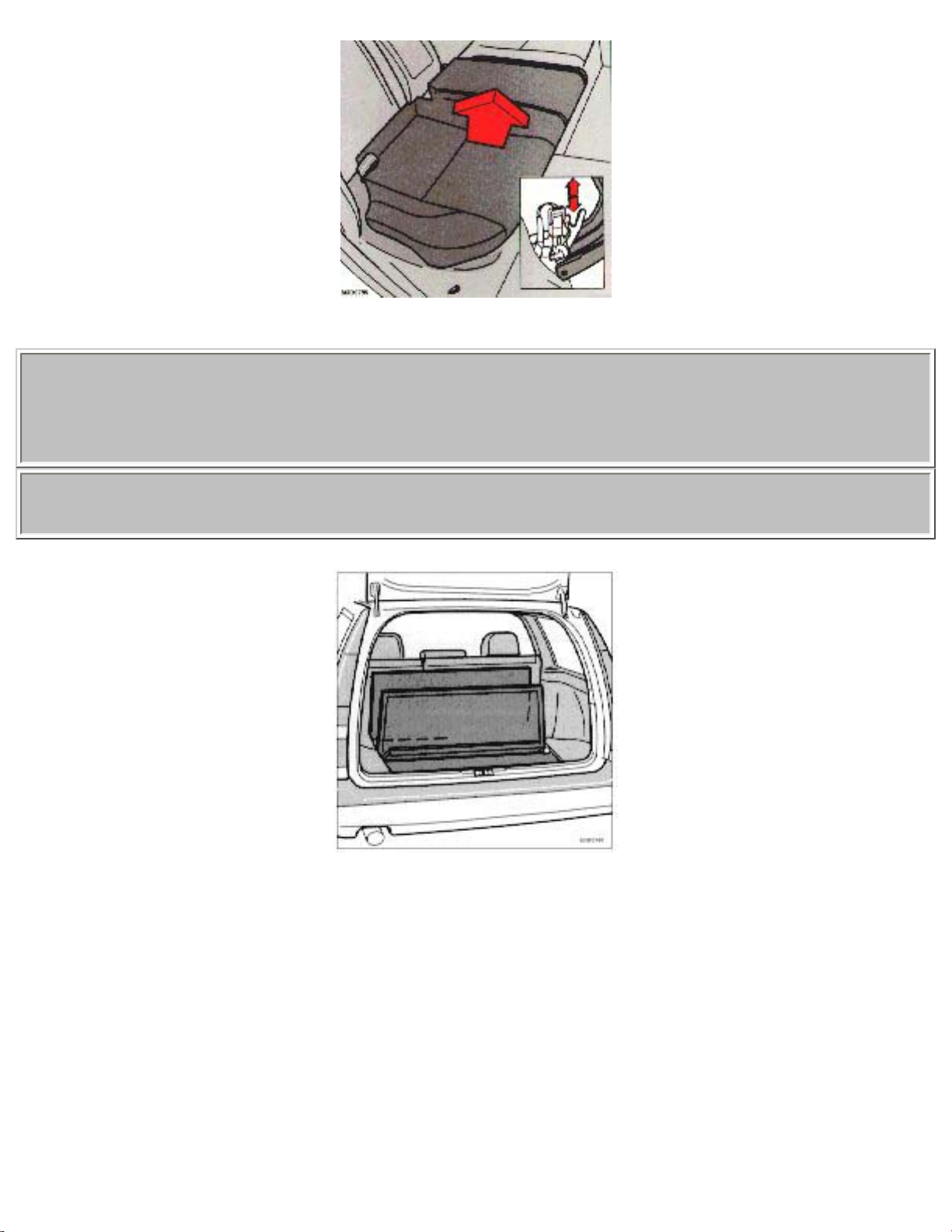
1998 S70 & V70
WARNING! Do not place extremely heavy articles against the front seats, as the backrest which is
folded down is then placed under severe strain.
Be sure to secure cargo. Hard and sharp articles could otherwise damage the frontseat backrest and/or
cause injury to passengers in the event of rapid braking or a collision.
pg. 60 Concealed storage bin (wagon), Bumper cover (wagon), Avoiding battery drain
The lid of the storage compartment is hinged in the middle
Concealed storage bin
The storage compartment under the floor of the cargo space is hinged in the middle and can be locked
with a key.
file:///K|/ownersdocs/1998/1998_SV70/98sv70_057.htm (4 of 11)12/30/2006 1:51:29 PM
 Loading...