

Page 1

1986 Volvo 740 GL, GLE, Turbo
1 9 8 6
VOLVO
740 GL, GLE, Turbo
Contents
A comprehensive index is located at the back of this manual.
Presentation
Instruments and controls
Body and interior
Starting and driving
Wheels and tires
In case of emergency
Car care
Service and routine
maintenance
Specifications
Index
All information, illustrations and specifications contained in this manual are based on the latest product
information available at the time of publication. Volvo reserves the right lo make model changes at any
time, or to change specifications or design, without notice and without incurring obligation.
pg. 2 Presentation
file:///K|/ownersdocs/1986/1986_740/86740_00.htm (1 of 3)12/30/2006 7:51:26 AM
Page 2
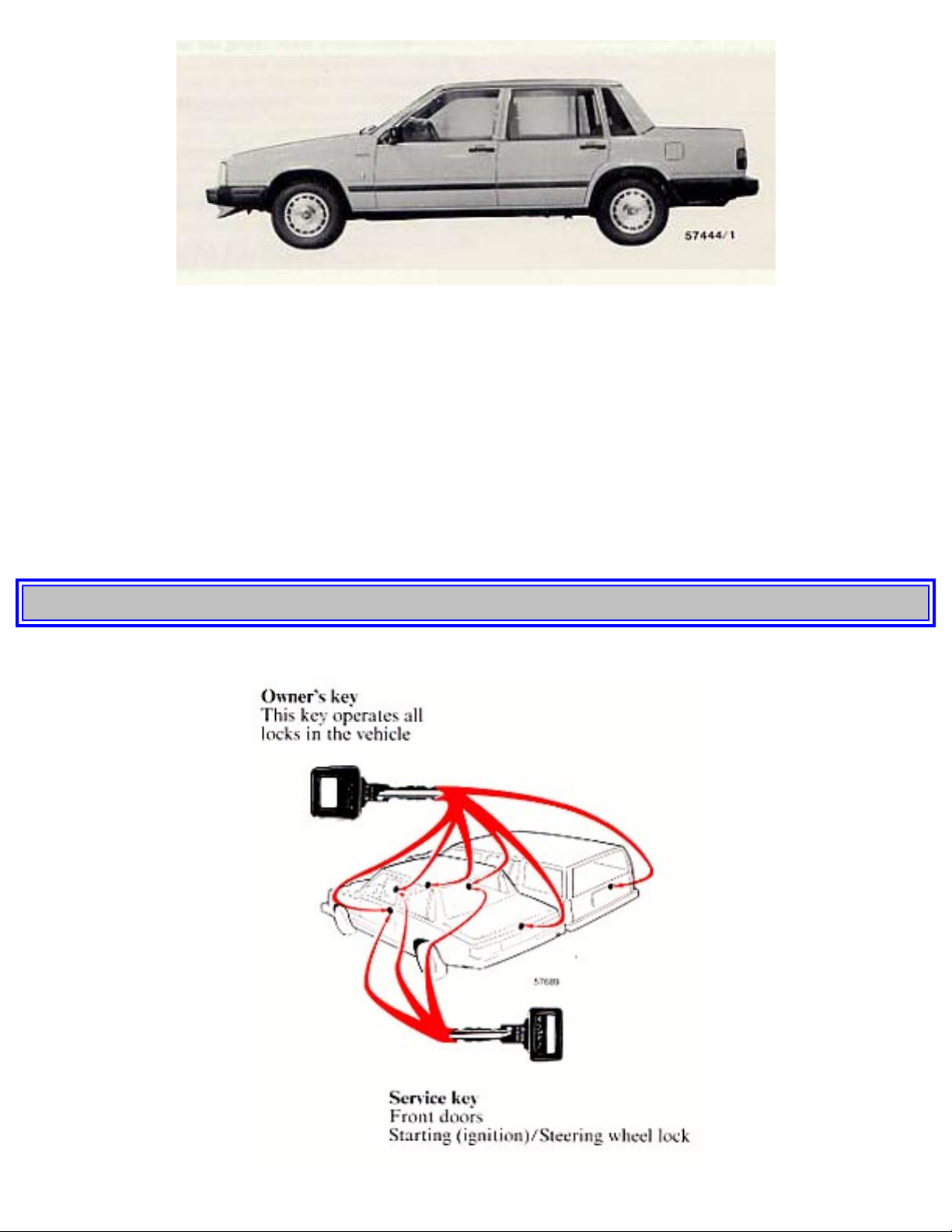
1986 Volvo 740 GL, GLE, Turbo
This Owner's manual provides information on driving and maintaining your Volvo
It should be noted that there are certain differences among model versions and market requirements;
thus, you may find features described and/or pictured in this manual that do not appear on your car.
Should you require more detailed information with regard to adjustments or repairs please contact your
Volvo dealer.
Do not export your Volvo to another country before investigating that country's applicable safety
and exhaust emission requirements. In some cases it may be difficult or impossible to comply with
these requirements. Modifications to the emission control system(s) may render your Volvo not
certifiable for legal operation in the U.S., Canada, and other countries.
pg. 3 Keys
file:///K|/ownersdocs/1986/1986_740/86740_00.htm (2 of 3)12/30/2006 7:51:26 AM
Page 3
1986 Volvo 740 GL, GLE, Turbo
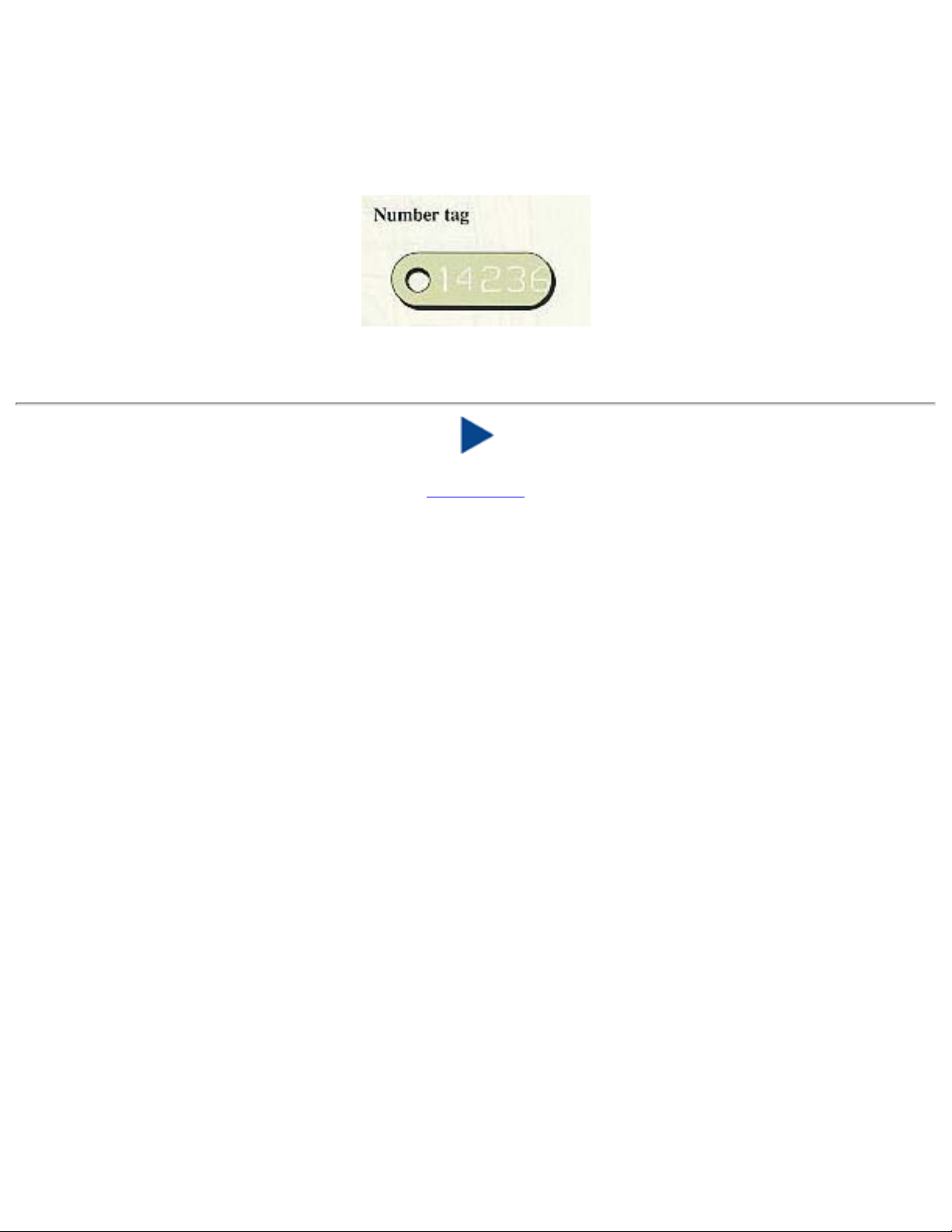
The key number codes are stamped on a separate tag supplied with the keys. This tag should be
separated from the key ring and kept in a safe place (the back of the tag is coated with adhesive tape).
In the event the original keys are lost, duplicates may be ordered from your Volvo dealer.
The central locking system is described in detail in section "Door and locks".
Top of Page
file:///K|/ownersdocs/1986/1986_740/86740_00.htm (3 of 3)12/30/2006 7:51:26 AM
Page 4
1986 Volvo 740 GL, GLE, Turbo
1 9 8 6
VOLVO
740 GL, GLE, Turbo
Instruments and controls
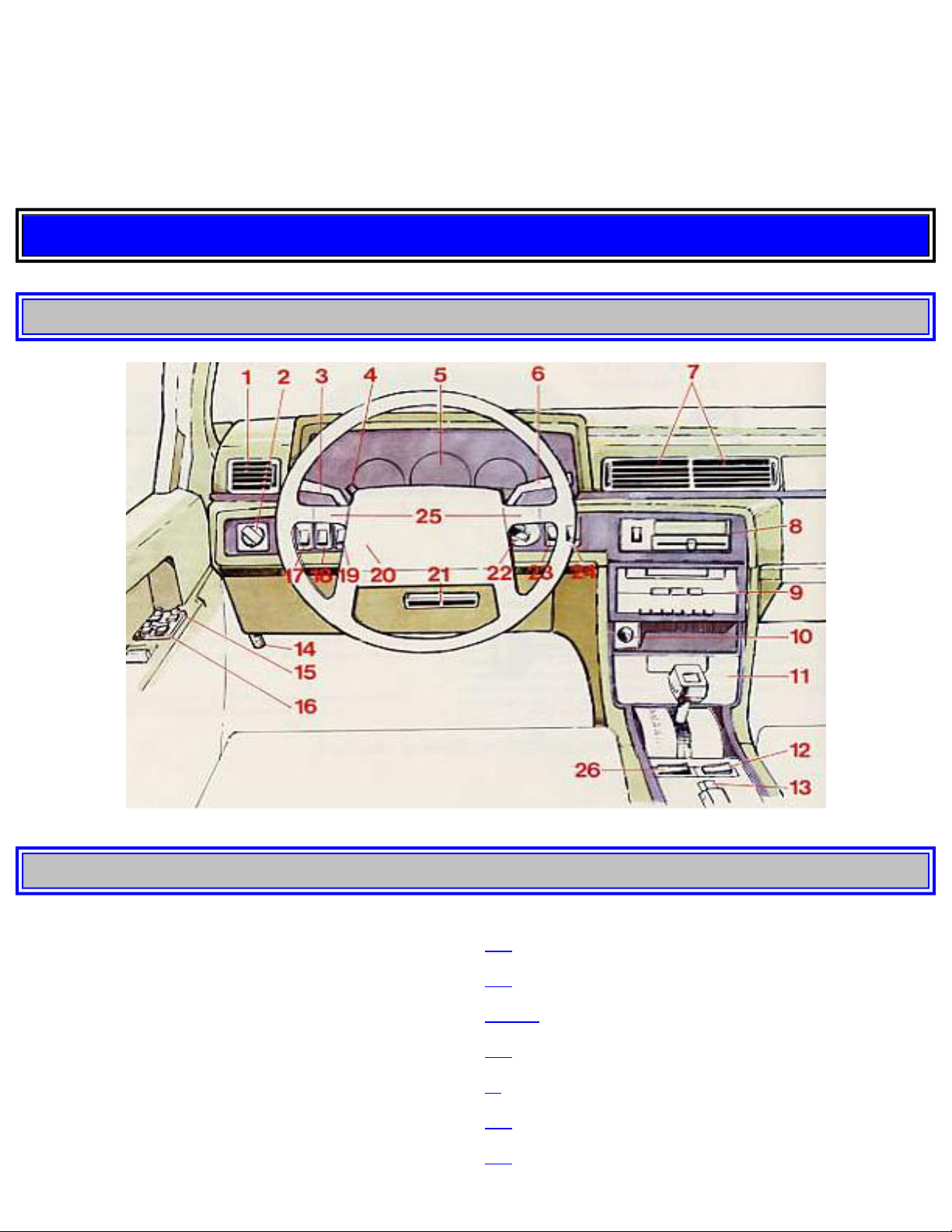
pg. 4 Instruments, Switches and controls
pg. 5 Instruments, Switches and controls
1 Air louver
20
2 Headlights, parking lights
15
3 Turn signals, Cruise Control (optional)
12,13
4 Hazard warning flashers
12
5 Instruments
6
6 Wiper/washer
14
7 Air louvers
20
file:///K|/ownersdocs/1986/1986_740/86740_01.htm (1 of 25)12/30/2006 7:51:27 AM
Page 5

1986 Volvo 740 GL, GLE, Turbo
8 Heating and ventilation
20
9 Audio cassette/tuner
24
10 Cigarette lighter
18
11 Ash tray
18
12 Electrically-heated passenger seat
17
13 Parking brake
18
14 Hood release handle
35
15 Space for additional equipment
16 Electrically operated windows
19
17 Rear fog lamps
16
18 Fog lights (standard on Turbo optional GL,
GLE)
16
19 Space for additional equipment 20 Space for additional equipment 21 Air louver
20
22 Starting (ignition) switch/steering wheel lock
11
23 Space for additional equipment
24 Rear window demister
17
25 Horn 26 Electrically-heated driver's seat
17
The pages in this section provide a detailed description of the vehicle's instruments and controls.
Note that vehicles may be equipped differently, depending on special legal requirements, etc.
pg. 6 Instruments
file:///K|/ownersdocs/1986/1986_740/86740_01.htm (2 of 25)12/30/2006 7:51:27 AM
Page 6
1986 Volvo 740 GL, GLE, Turbo
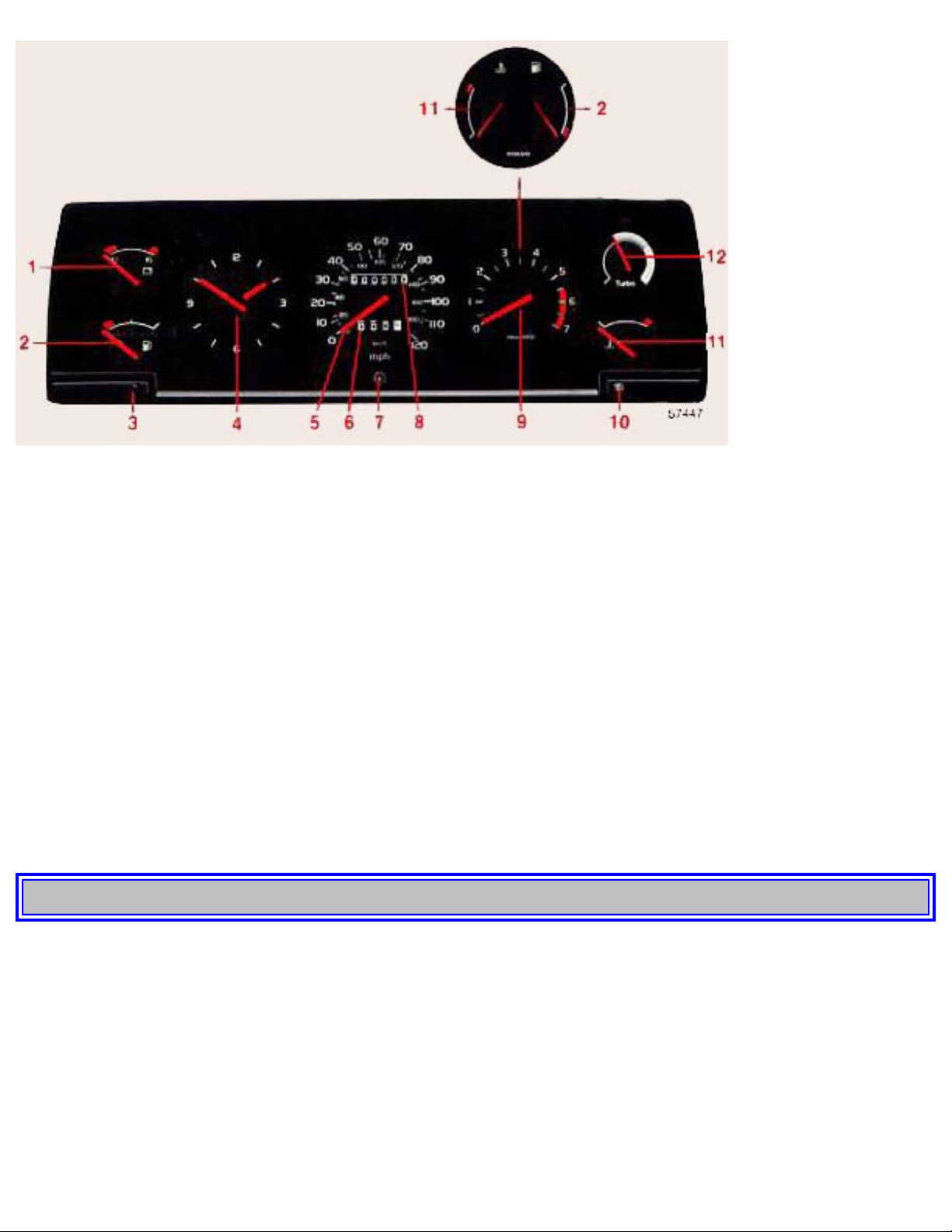
NOTE: Canadian model speedometers/odometers indicate kilometers only.
1 Voltmeter (Turbo models)
2 Fuel gauge
3 Clock reset knob
4 Quartz crystal clock
5 Speedometer
6 Trip odometer
7 Trip odometer reset knob
8 Odometer
9 Tachometer (GLE, Turbo models)
10 Instrument panel lamps rheostat
11 Temperature gauge
12 Boost gauge (Turbo models)
pg. 7 Instruments
Quartz crystal clock
To reset the hands, push in the reset knob and turn.
Tachometer (GLE, Turbo models)
Reads thousands of engine rpm. Red striped range for momentary use, during acceleration.
Engine should not be operated in red range.
Maximum continuous rpm is 6000.
file:///K|/ownersdocs/1986/1986_740/86740_01.htm (3 of 25)12/30/2006 7:51:27 AM
Page 7

1986 Volvo 740 GL, GLE, Turbo
Trip odometer
Used form measuring shorter distances.
(last figure represents 1/10 mile or 1/10 km)
Trip odometer reset knob
Push in to reset.
Temperature gauge
The pointer should be approximately midway on the gauge face when driving. If the pointer enters
the red range repeatedly, check coolant level and fan belt tension. (See "Coolant" and "Drive belts")
WARNING!
Allow engine to cool before adding
coolant.
Fuel gauge
The fuel tank capacity is approx. 15.8 US gals (60 liters).
The red range represents approx. 3.2 US gals (12 liters). See "refueling" for further information.
Instrument panel lamps rheostat
Clockwise = brighter.
Counterclockwise = dimmer.
Voltmeter
(turbo-engine cars only)
The voltmeter indicates the voltage in the electrical system and thereby also the state of the battery.
While the car is being driven the pointer should be within the black field.
Should the pointer point to the upper or lower red field when driving, this may indicate some fault in the
electrical system.
Boost pressure gauge
(turbo-engine cars only)
The boost pressure gauge is divided into sections.
Black section: The engine acts as a normally-aspirated engine. Best fuel economy is achieved while
driving in this range.
Yellow section: The turbo is engaged.
Red section(if applicable): The pressure in the intake manifold is too high. Drive the car carefully to a
Volvo dealer for inspection.
file:///K|/ownersdocs/1986/1986_740/86740_01.htm (4 of 25)12/30/2006 7:51:27 AM
Page 8
1986 Volvo 740 GL, GLE, Turbo
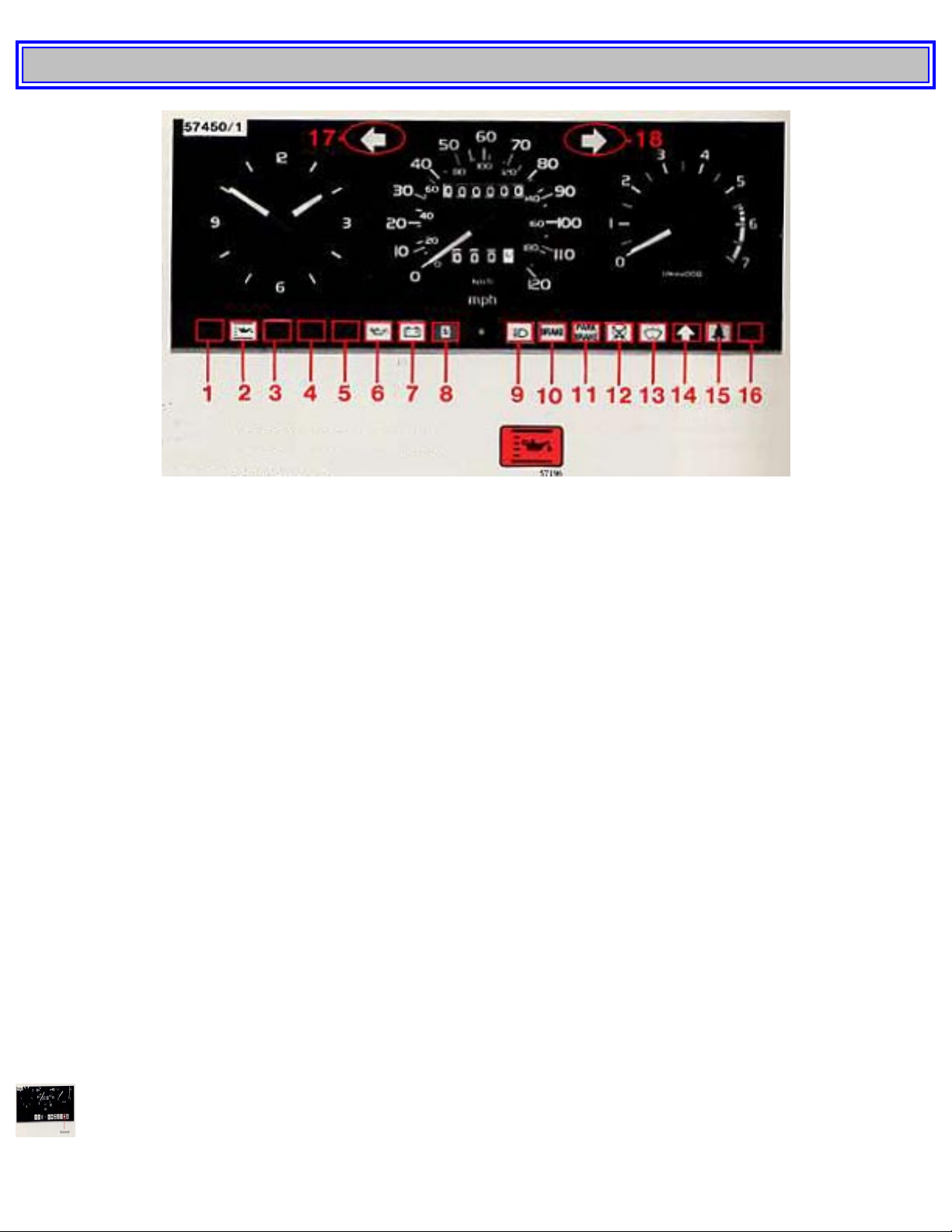
pg. 8 Indicator and warning lights
1 (Not connected)
2 Low engine oil level (certain models)
3 (Not connected)
4 (Not connected)
5 (Not connected)
6 Low engine oil pressure
7 Alternator not charging
8 Overdrive (5th gear) engaged (manual transmission)
9 High beams
10 Brake failure
11 Parking brake applied
12 Bulb failure
13 Low washer fluid level.
If the lamp glows continuously when the engine is running, there is only about 1/2 - 1 US qts. remaining
in the washer fluid reservoir.
14 Shift indicator light
(manual transmission models) or 4th gear disengaged (Turbo models with automatic transmission)
15 Fasten seat belts
16 (Not connected)
17 Turn signal, left
18 Turn signal, right
Indicator light, low oil level (certain models)
file:///K|/ownersdocs/1986/1986_740/86740_01.htm (5 of 25)12/30/2006 7:51:27 AM
Page 9

1986 Volvo 740 GL, GLE, Turbo
Check the oil level indicator light before starting the car - it takes only a few seconds. The car should be
standing on level ground and the engine should be cold. Turn the ignition key to the start position so that
the warning lights illuminate. If the oil level is adequate, the oil level light will go off after two seconds.
If the oil level is low, the light will stay on until the engine is started. If low, check level with dipstick
and add oil as required.
NOTE! If you turn the ignition key too far and start the engine, no indication of the oil level will be
given. Moreover, if you switch the engine off after a few seconds and then check the oil level as
indicated, the result you obtain will be incorrect because a certain amount of oil will have been pumped
out of the oil pan.
pg. 9 Warning lights
The warning lights described on this page should never stay on when driving
When the ignition key is turned on, and before the engine starts, all of the warning lights should be on to
test the function of the bulbs. Should a light not go off after the engine has started, the system indicated
should be inspected. (However, the parking brake reminder light will not go off until the parking brake
is fully released.)
Alternator warning light
If the light comes on while the engine is running, check the tension of the alternator drive belt as soon as
possible.
NOTE: This warning light is illuminated if the alternator is not charging. However, parking brake,
brake failure and bulb failure warning lights will be illuminated at the same time due to the design
of the system.
Brake failure warning light
If the light comes on while driving and the brake pedal can be depressed further than normal, it is an
indication that one of the brake circuits is not functioning.
Stop immediately, open hood and check brake fluid level (see section "Brake fluid, power steering".)
Fluid level below MIN mark: Do NOT drive. Tow car to shop for check/repair of brake system.
Fluid level between MIN and MAX mark: proceed immediately and with caution to a Volvo dealer for
an inspection of the brake system.
file:///K|/ownersdocs/1986/1986_740/86740_01.htm (6 of 25)12/30/2006 7:51:27 AM
Page 10
1986 Volvo 740 GL, GLE, Turbo
Oil pressure warning light
If the light comes on during driving, the oil pressure is too low. Stop the car and then stop the engine
immediately and check the engine oil level. See section titled "Engine oil".
After hard driving, the light will come on occasionally when the engine is idling. This is normal,
provided it goes off when the engine speed is increased.
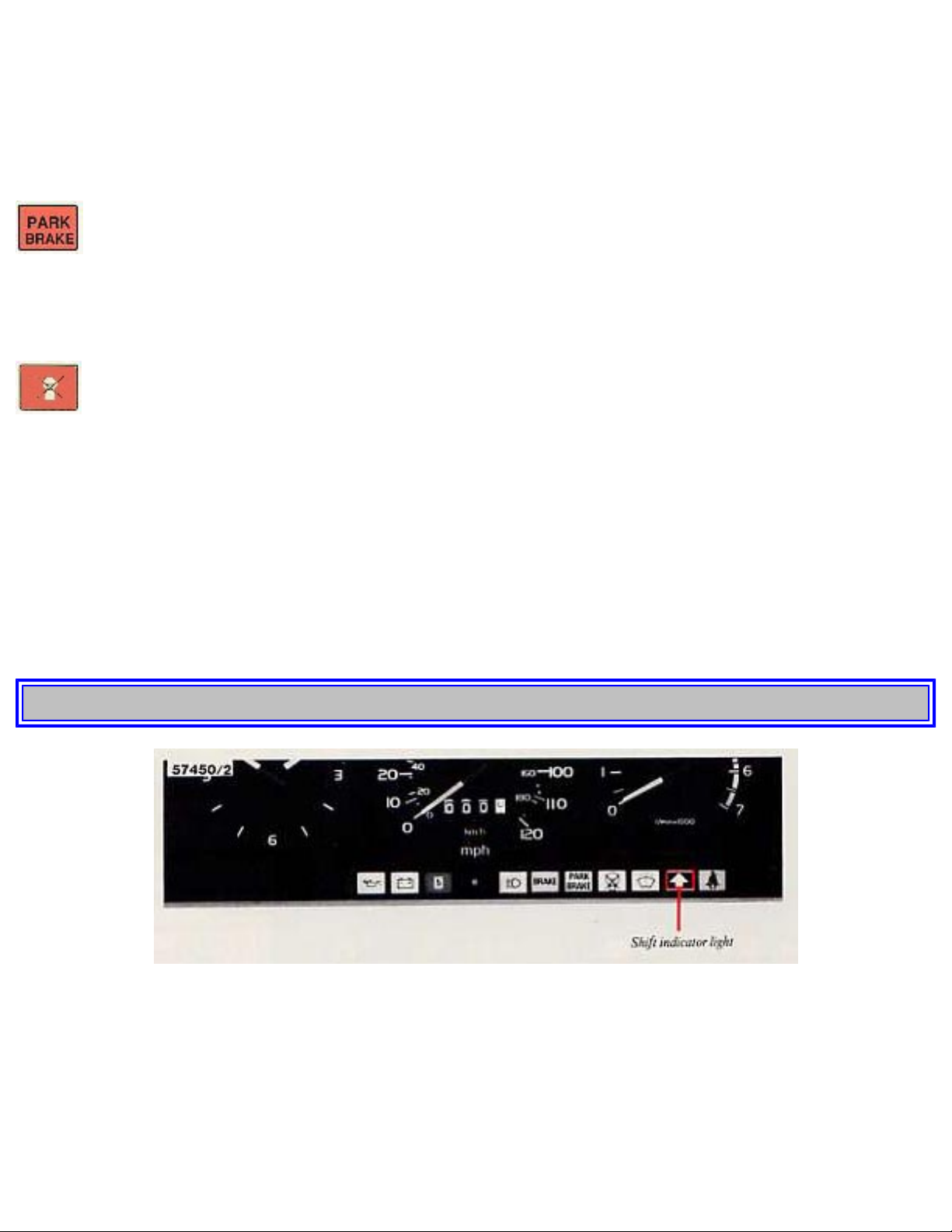
Parking brake reminder light
This light will be on when the parking brake (hand brake) is applied. The parking brake lever is situated
between the front seats.
Bulb failure warning light
The light will come on if any of the following bulbs are defective:
one of the low beam headlights
one of the tail lights
one of the brake lights (when the brake pedal is depressed).
Check the fuse and bulb.
See sections titled "Replacing bulbs" and "Fuses". Should the warning light come on after a defective
outside bulb has been replaced, the corresponding bulb on the other side of the car should also be
replaced.
pg. 10 Shift indicator light
Shift indicator light (Manual transmission cars only)
The Volvo shift indicator light (S.I.L.) is a device designed to help you get even better gas mileage from
your Volvo car. Studies have shown that the best fuel economy is obtained by shifting gears at low
engine rpm and high relative engine load. The Volvo S.I.L. is calibrated to show you when to shift for
improved mileage without sacrificing smooth acceleration.
Use of the S.I.L. is simple. Shift to the next higher gear as soon as the light comes on. You may find
after using the S.I.L. for some time that your natural shifting rhythm will adapt to the S.I.L's suggestion.
file:///K|/ownersdocs/1986/1986_740/86740_01.htm (7 of 25)12/30/2006 7:51:28 AM
Page 11
1986 Volvo 740 GL, GLE, Turbo
Obviously, there will be times when you need to shift later than the light would indicate (for example,
when climbing hills or trailer towing). using the light regularly, however, should result in a mileage
improvement of six percent or more, depending on how you normally drive.
Programming instructions for shift indicator
If the current supply to the control unit is cut (battery disconnected), the control unit will have to be reprogrammed as the control unit memory will be erased.
Drive the car in each gear (first gear not necessary) for approximately 8 seconds.
The gear change indicator light will flicker once (0.5 seconds), as each gear is programmed.
Note: Remove the foot completely from the clutch pedal after each gear change when programming the
control unit.
pg. 11 Starting (ignition) switch
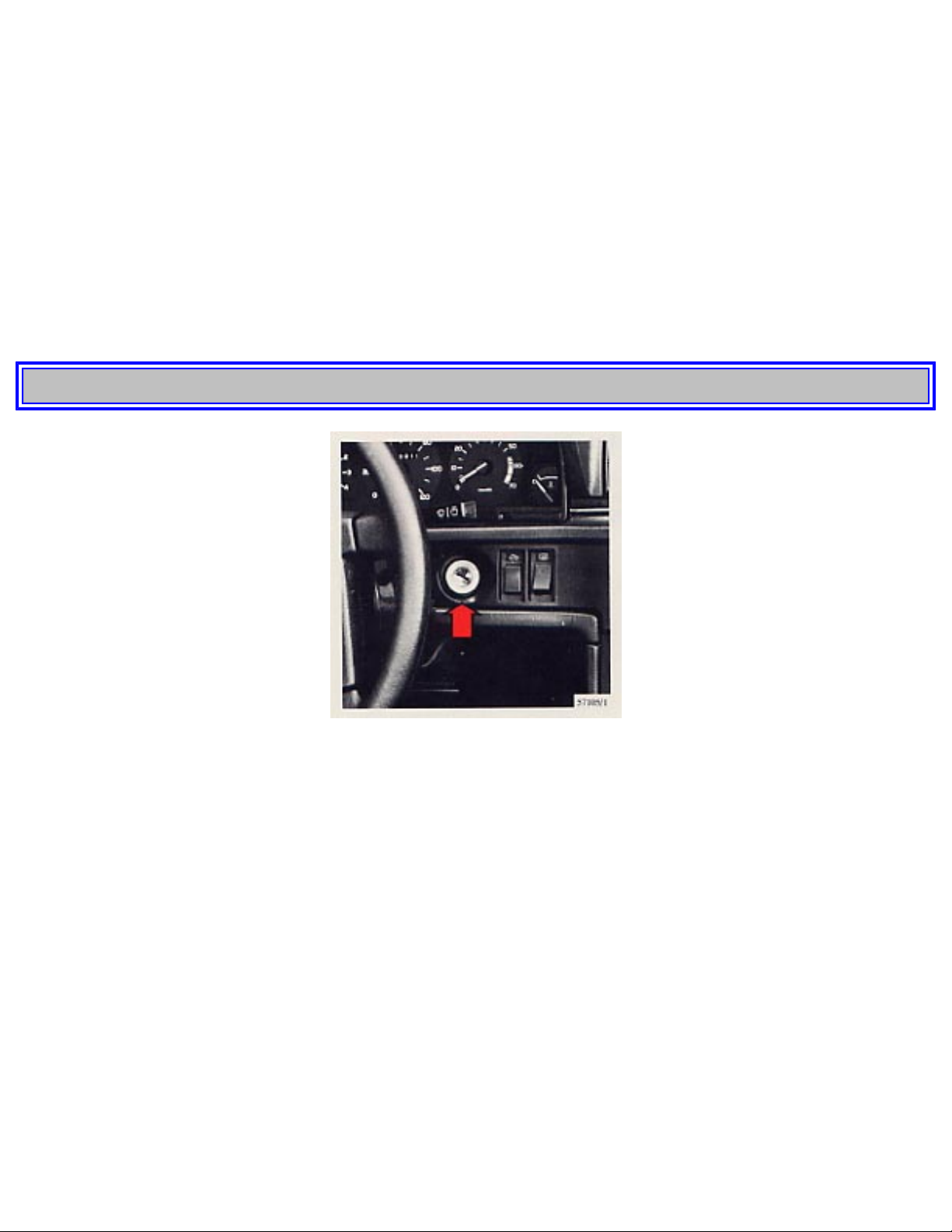
Starting (ignition) switch/steering wheel lock
The steering wheel lock might be under tension when the car is parked. Turn the steering wheel slightly
to free the ignition key.
A chime will sound if the starting key is left in the ignition lock and front door on the driver's side is
opened.
file:///K|/ownersdocs/1986/1986_740/86740_01.htm (8 of 25)12/30/2006 7:51:28 AM
Page 12

1986 Volvo 740 GL, GLE, Turbo
pg. 12 Turn signals, Hazard warning flasher
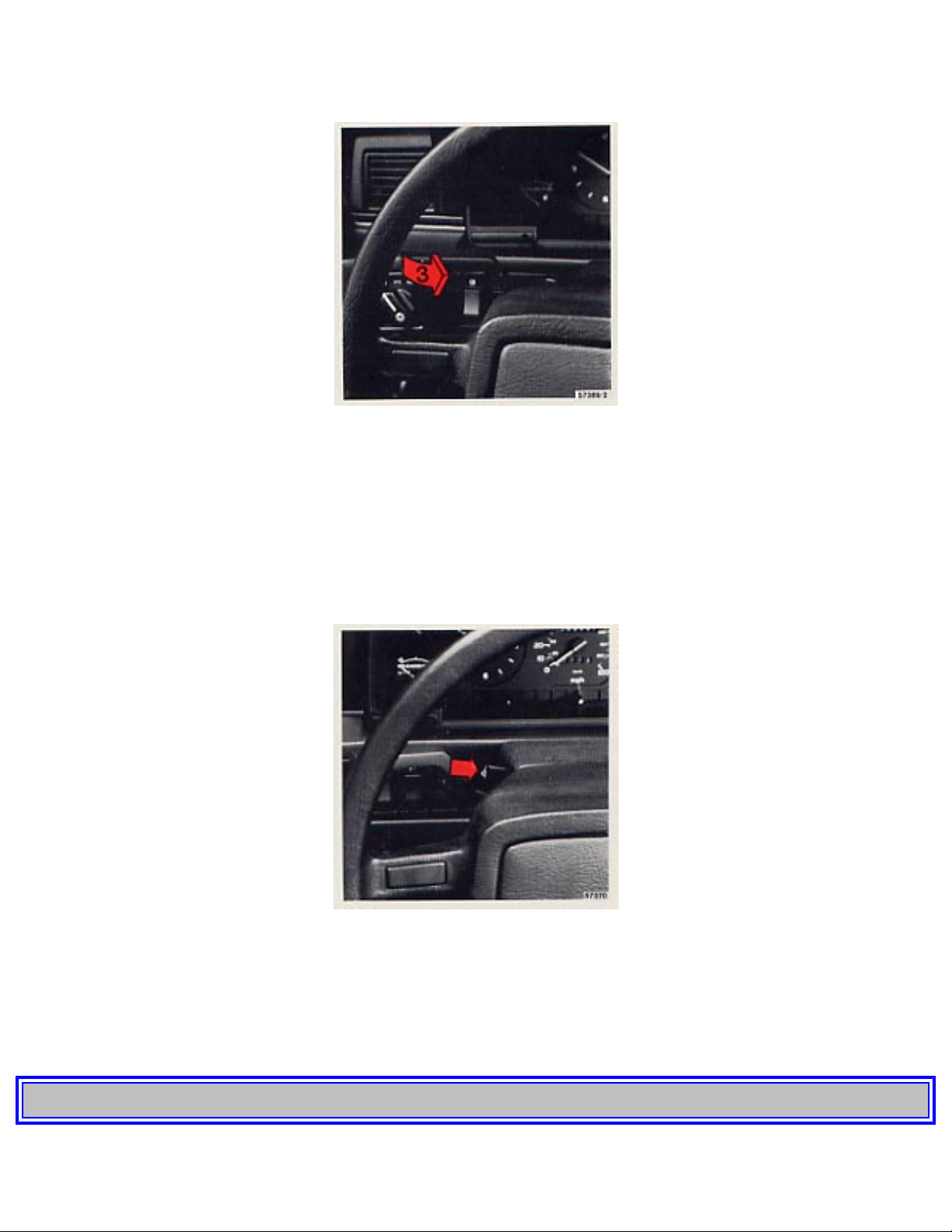
Turn signals
1 Lane change position.
In maneuvers such as lane changing, the driver can flash the turn signals by moving the turn signal lever
to the first stop and holding it there. The lever will return to the neutral position when released.
2 Signal lever engaged for normal turns.
file:///K|/ownersdocs/1986/1986_740/86740_01.htm (9 of 25)12/30/2006 7:51:28 AM
Page 13
1986 Volvo 740 GL, GLE, Turbo
NOTE: Defective turn signal bulb will cause turn signal indicator and remaining signal lights to flash
more rapidly than normal.
3 High beam/low beam switch (headlights on).
Move the lever towards the steering wheel and release it.
3 Headlight flasher (headlights off).
Move the lever towards the steering wheel. The headlight high beam will be on until the lever is
released.
Hazard warning flasher
The four-way flasher should be used to indicate that the vehicle has become a traffic hazard.
NOTE: Regulations regarding the use of the hazard warning flasher may vary from state to state.
pg. 13 Windshield, Tailgate wipers/washers
file:///K|/ownersdocs/1986/1986_740/86740_01.htm (10 of 25)12/30/2006 7:51:28 AM
Page 14
1986 Volvo 740 GL, GLE, Turbo
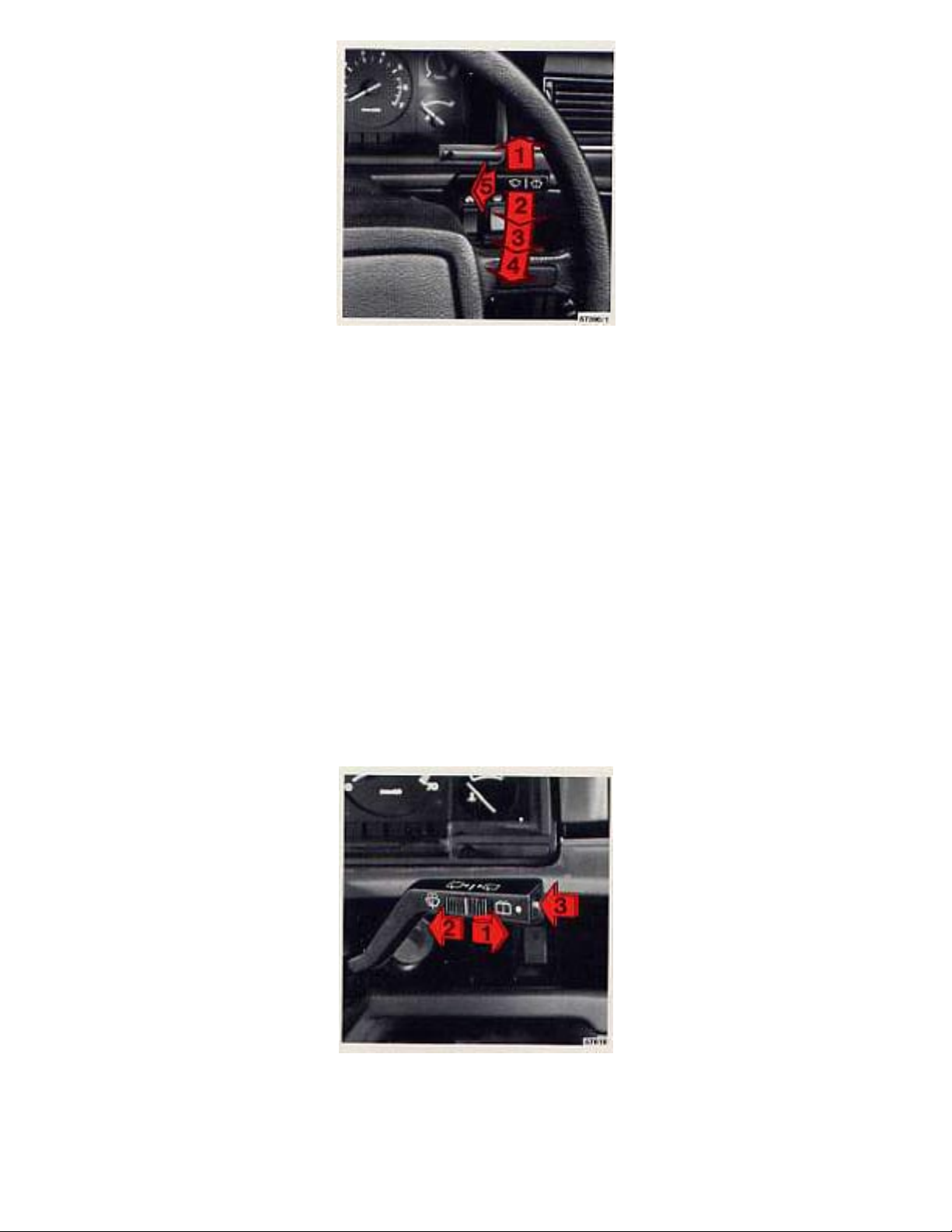
Wiper/washer
1 Intermittent wiper.
With switch in this position, the wipers will sweep approximately every seventh second.
2 "Single sweep" position.
Switch returns automatically when released.
3 Wipers, low speed.
4 Wipers, high speed.
5 Windshield wiper/washer.
The wiper will make 2-3 complete sweeps after the lever is released.
Tailgate window wiper/washer (wagon)
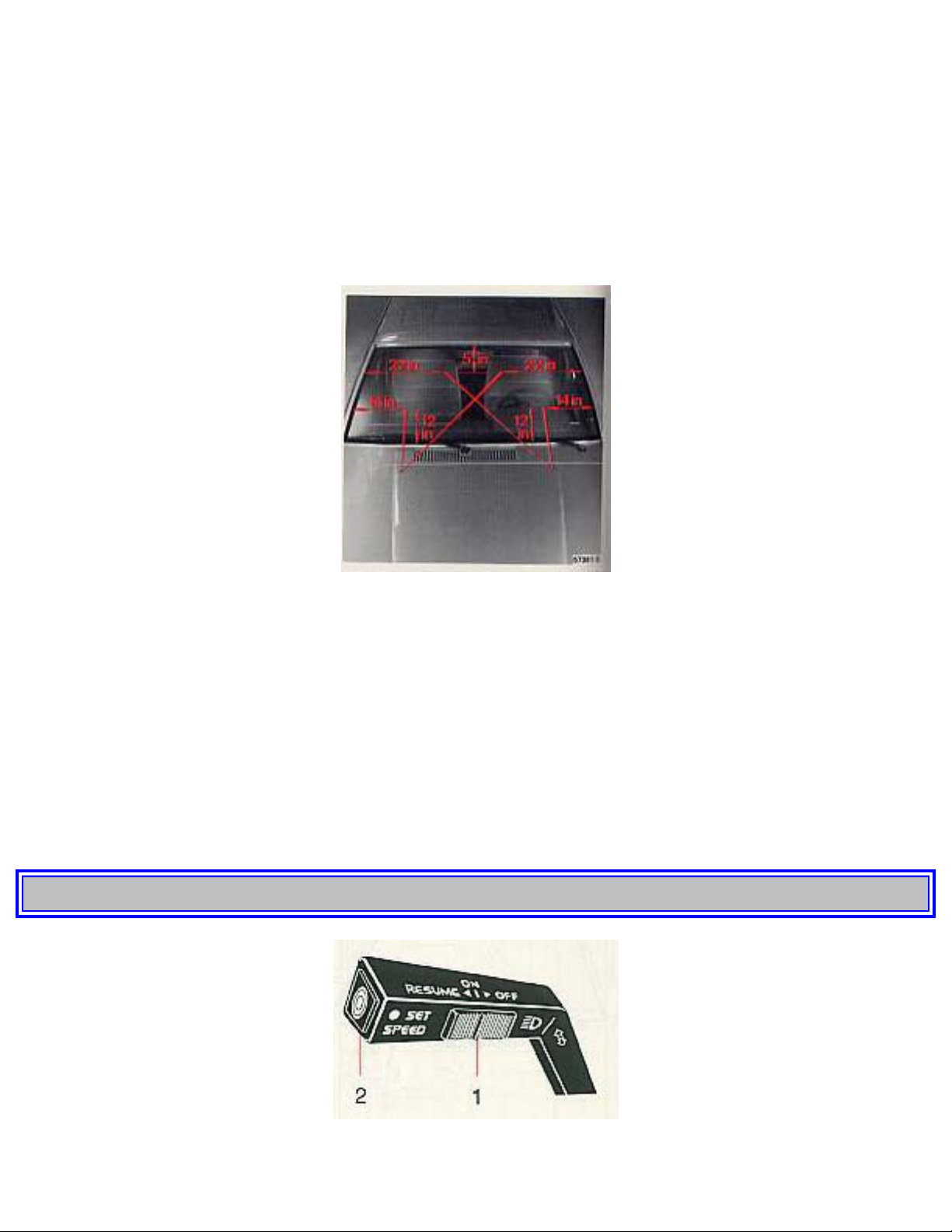
The tailgate window wiper/washer is operated by a switch at the end of the wiper lever.
file:///K|/ownersdocs/1986/1986_740/86740_01.htm (11 of 25)12/30/2006 7:51:28 AM
Page 15
1986 Volvo 740 GL, GLE, Turbo
1 The wiper operates continuously.
2 Intermittent position: the wiper strokes approximately every 15 seconds.
3 Tailgate washer (note that the wiper also operates when this button is depressed).
After the button is released the wiper strokes 2-3 additional times before stopping.
The electrical circuit is protected by fuse 14, located in the central electrical unit. See the section entitled
"Fuses".
Adjusting washer nozzles
The washer jets should spray the windshield as shown. Use the edge of a small screwdriver to adjust the
nozzles, if necessary.
Washer fluid reservoir
The washer fluid reservoir is located in the engine compartment and holds approx. 0.5 US gal. (2.0
liters) on sedan models and approx. 0.8 US gal (3.2 liters) on wagon models. (See back cover for
locations.)
During cold weather, the reservoir should be filled with windshield washer solvent.
pg. 14 Cruise control
Cruise control
file:///K|/ownersdocs/1986/1986_740/86740_01.htm (12 of 25)12/30/2006 7:51:28 AM
Page 16

1986 Volvo 740 GL, GLE, Turbo
(optional on certain models)
The cruise control switches are located on the turn signal switch lever.
To engage and set desired speed:
1. Set switch (1) to ON.
2. Accelerate to desired cruise speed.
NOTE: The cruise control cannot be engaged at speeds below 22 mph (35 km).
3. Depress SET SPEED switch (2).
Operating brake pedal or clutch pedal (where applicable)
This will automatically disengage the cruise control. Previously selected cruise speed is retained in the
memory and by momentarily setting the switch to RESUME position that speed will be re-engaged.
NOTE: The vehicle will accelerate very quickly should there be a substantial speed differential when
the switch is reset to RESUME. It is therefore recommended that the vehicle be accelerated manually
and the switch reset to RESUME when the speed differential is reduced.
Acceleration
Momentary acceleration, such as for passing, does not interrupt cruise control operation. The previously
selected speed will be maintained without having to set switch to RESUME.
To disengage the cruise control system:
set switch (1) to position OFF, or depress brake pedal, or depress clutch pedal (where applicable).
Switching off the starting (ignition) switch is will automatically disengage the cruise control system.
WARNING!
The cruise control should not be used in heavy traffic or when driving on wet or slippery roads.
If the gear shift is moved to Neutral while the cruise control is engaged, then depress the brake pedal
momentarily, or set the cruise control switch (1) to OFF. This will disengage the cruise control and
prevent overreving the engine.
NOTE: When driving on a grade, actual vehicle speed may vary slightly from the set cruise control
speed.
pg. 15 Lighting
file:///K|/ownersdocs/1986/1986_740/86740_01.htm (13 of 25)12/30/2006 7:51:28 AM
Page 17
1986 Volvo 740 GL, GLE, Turbo
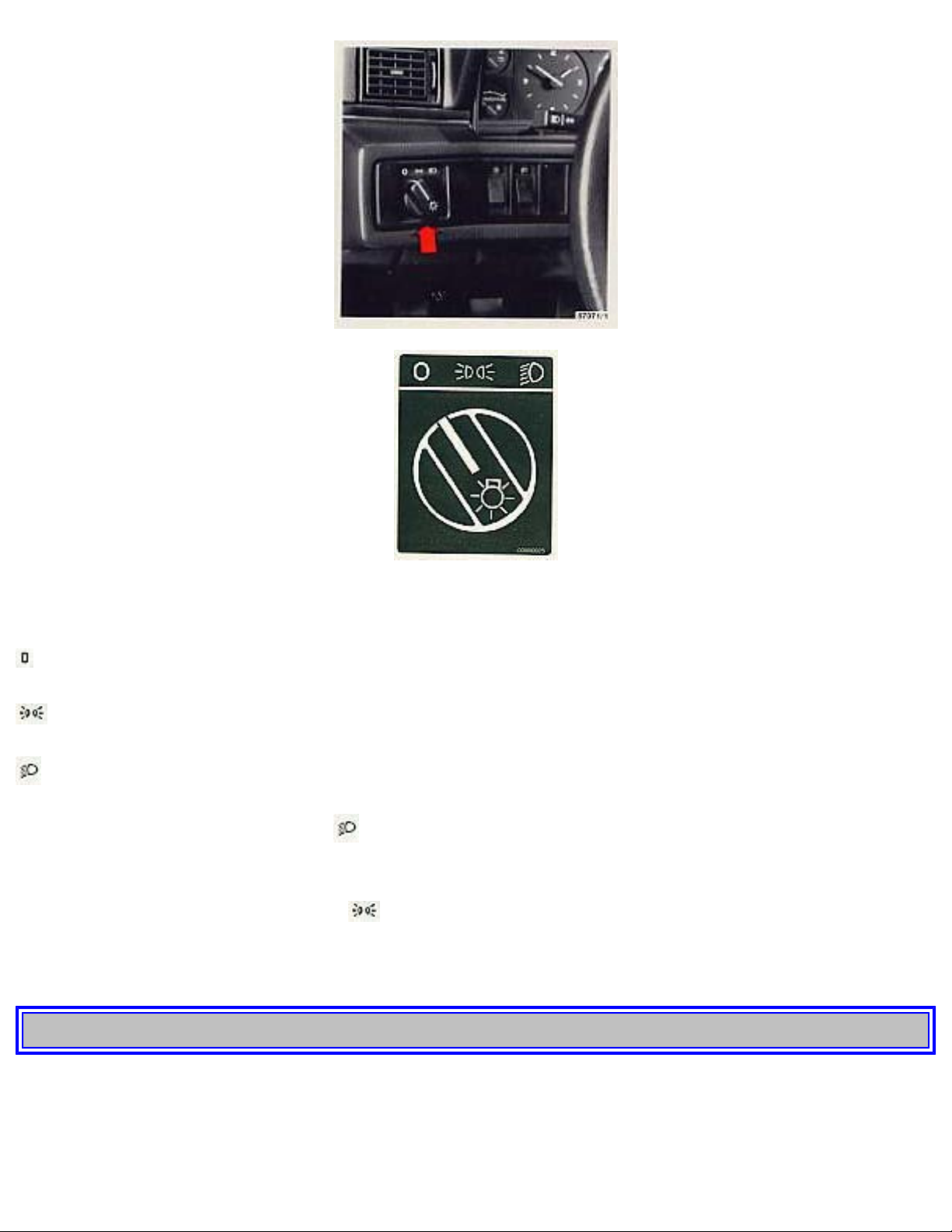
Headlights and position lights
All lights off
Parking lights on
Headlights and parking lights are on if starting (ignition) switch is in position I or II.
If the headlight switch is in position
all lights will go out when starting (ignition) switch is switched
off.
With the headlight switch in position,
the parking lights will stay on.
Switch from high to low beams, and vice versa, by moving the turn signal switch lever on the left side of
the steering column towards the steering wheel.
pg. 16 Rear fog lights, Front fog lights, Power antenna
file:///K|/ownersdocs/1986/1986_740/86740_01.htm (14 of 25)12/30/2006 7:51:28 AM
Page 18
1986 Volvo 740 GL, GLE, Turbo
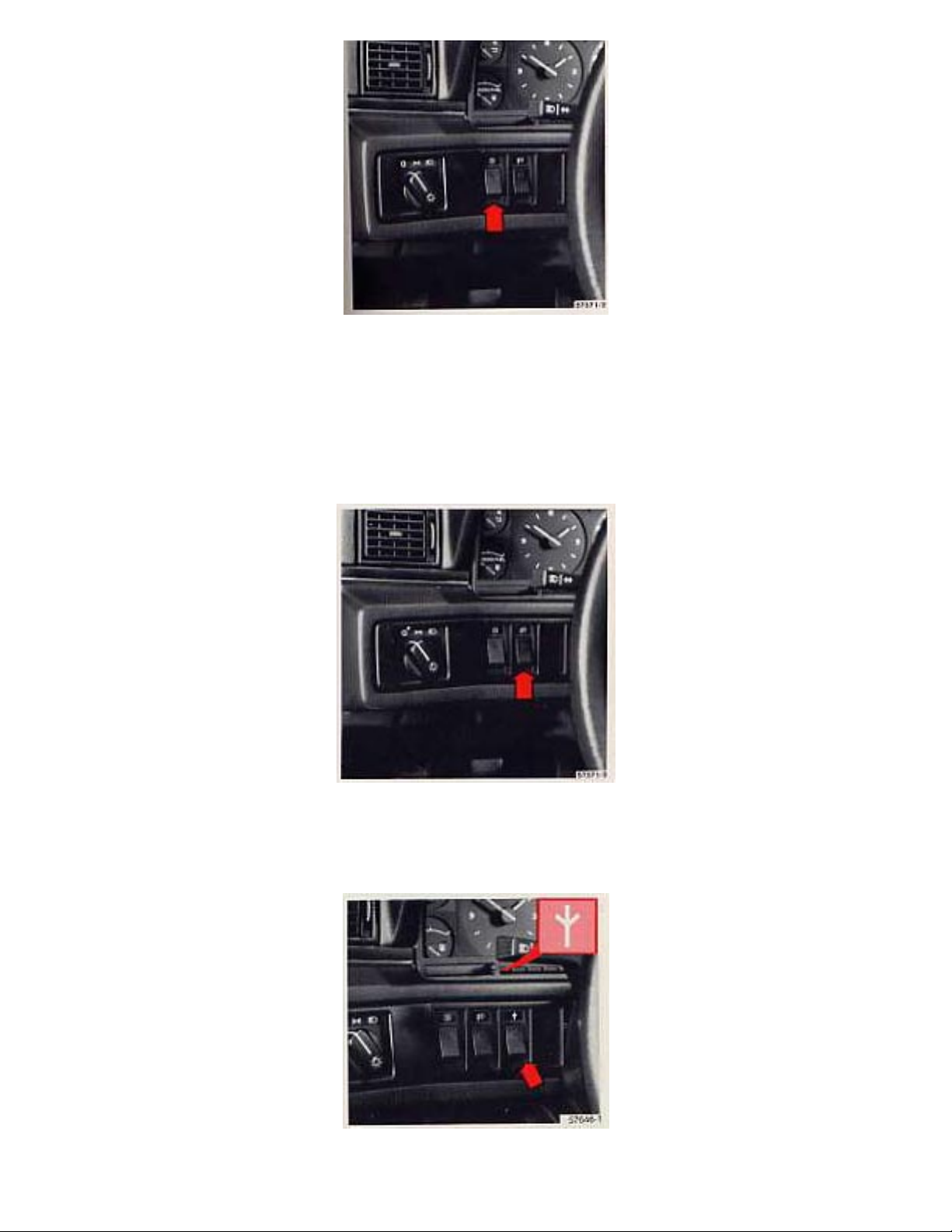
Rear fog lights
The rear fog lights are considerably brighter than the normal tail lights and should be use only when
atmospheric conditions, such as fog, rain, snow, smoke or dust reduce the daytime or nighttime visibility
of other vehicles to less than 500 ft. (152 meters). (The headlights must be switched on.)
Note that local regulations governing the use of these lights may vary.
Auxiliary front fog lights (optional on certain models)
Auxiliary front fog lights can be switched on only with the low-beam headlights on.
file:///K|/ownersdocs/1986/1986_740/86740_01.htm (15 of 25)12/30/2006 7:51:28 AM
Page 19
1986 Volvo 740 GL, GLE, Turbo
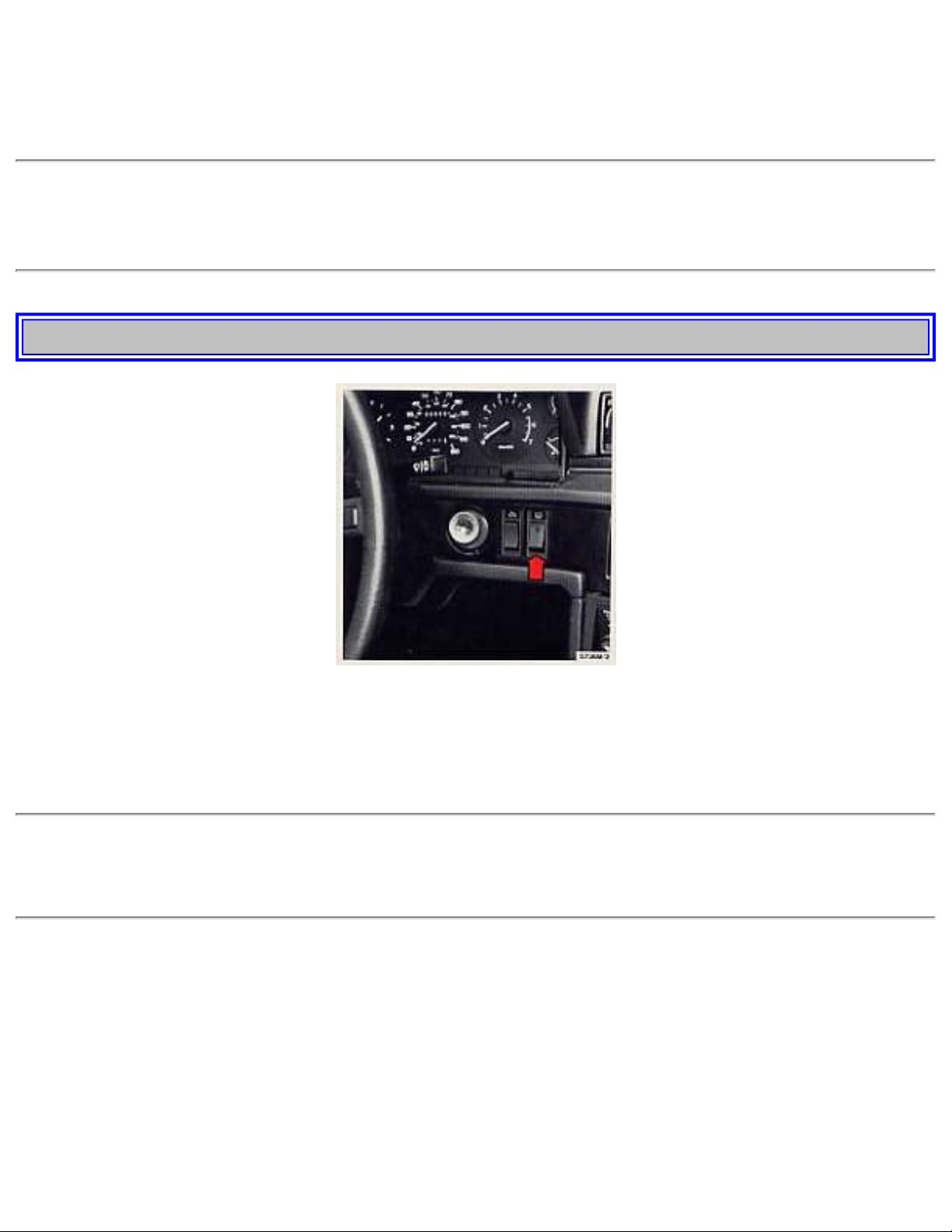
Power antenna (optional on certain models)
The power antenna switch can be used to retract the antenna when the audio system is turned on. This
will permit operation of the cassette drive with the antenna in the down position.
CAUTION: Always lower the antenna when entering a garage or car wash to avoid antenna damage.
pg. 17 Rear window demister. Heated front seats
Rear window demister
To operate, depress the switch. The indicator lamp in the switch will come on. The system will be
switched off automatically after 10-15 minutes or when the starting (ignition) key is switched off.
CAUTION: Do not place items that may damage the printed circuit against the inner surface of the rear
window. Do not scrape the inner surface of the rear window glass with a hard object or use an abrasive
window cleaner, otherwise damage to the printed circuit will occur.
file:///K|/ownersdocs/1986/1986_740/86740_01.htm (16 of 25)12/30/2006 7:51:28 AM
Page 20
1986 Volvo 740 GL, GLE, Turbo
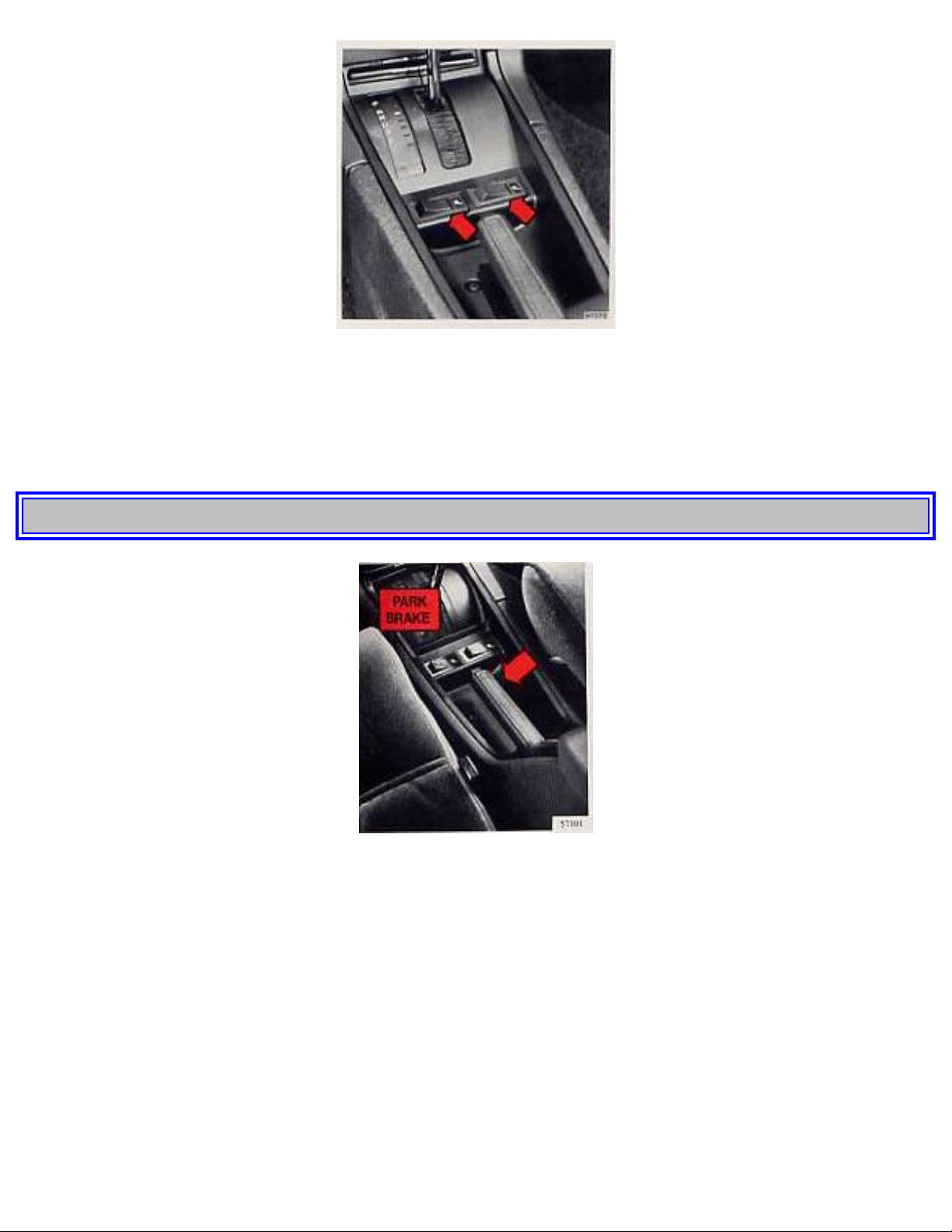
Heated front seats (certain models)
The front seats are equipped with electrically-heated backrests and seat cushions. The heating is
thermostatically-controlled and switches on automatically when the seat temperature drops below 50°F
(10°C) and switches off at about 95°F (+35°C). Use the switches to disengage the seat heating manually.
pg. 18 Parking brake, Cigarette lighter, Ash trays
Parking brake (hand brake)
The lever is situated between the front seats.
The brake is applied to the rear wheels.
Always use the parking brake (hand brake) when parking. On hills, also turn the front wheels toward the
curb.
In order to obtain the best possible performance of the parking brake, the brake linings should be broken
in. (See section titled "Brake system").
file:///K|/ownersdocs/1986/1986_740/86740_01.htm (17 of 25)12/30/2006 7:51:28 AM
Page 21
1986 Volvo 740 GL, GLE, Turbo
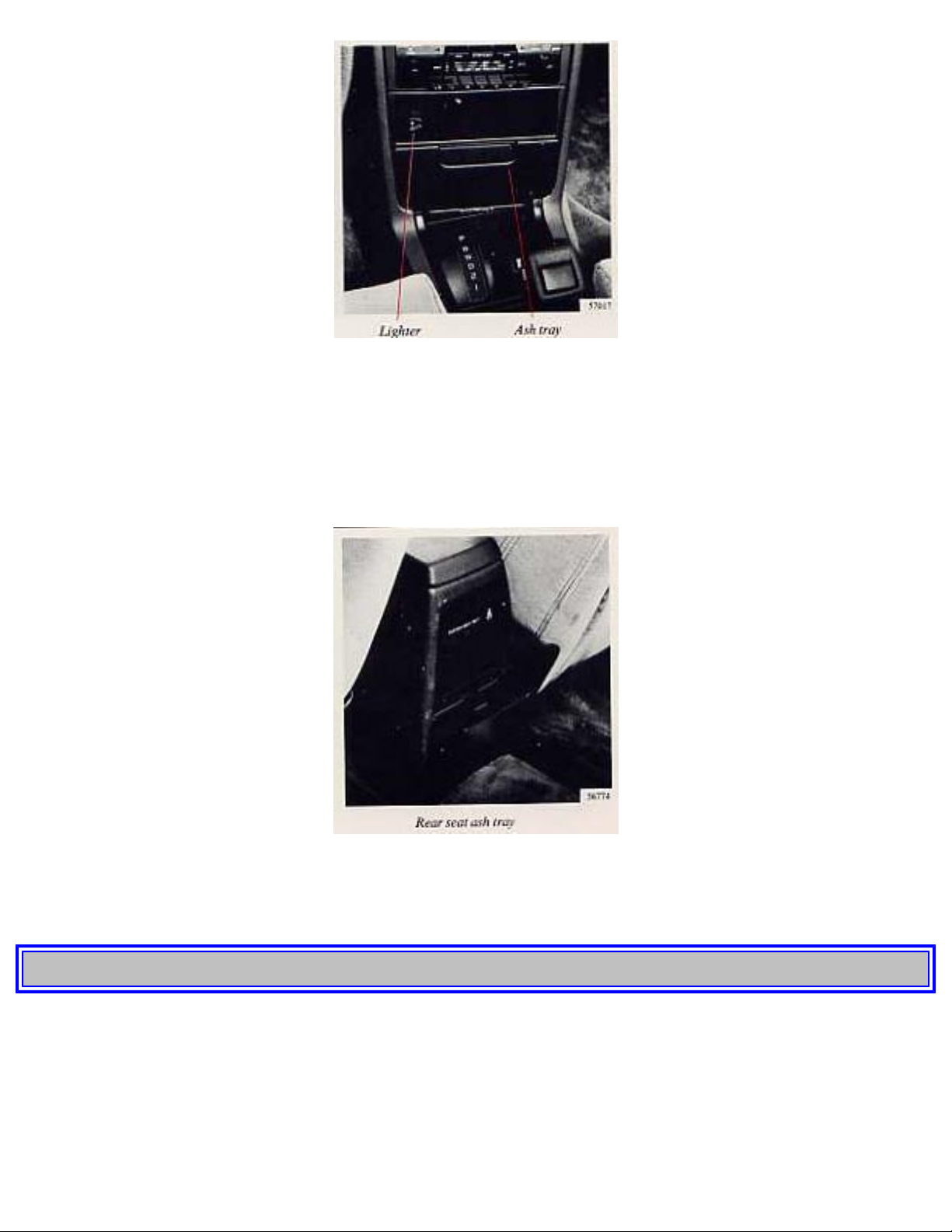
Cigarette lighter
To operate, depress the knob fully. When the knob automatically releases, the cigarette lighter is ready
for use.
The starting (ignition) switch must be switched on (to position I or II) for the cigarette lighter to
function.
Ash trays
To remove the ash trays depress the center spring and remove.
pg. 19 Electrically operated windows
file:///K|/ownersdocs/1986/1986_740/86740_01.htm (18 of 25)12/30/2006 7:51:28 AM
Page 22
1986 Volvo 740 GL, GLE, Turbo
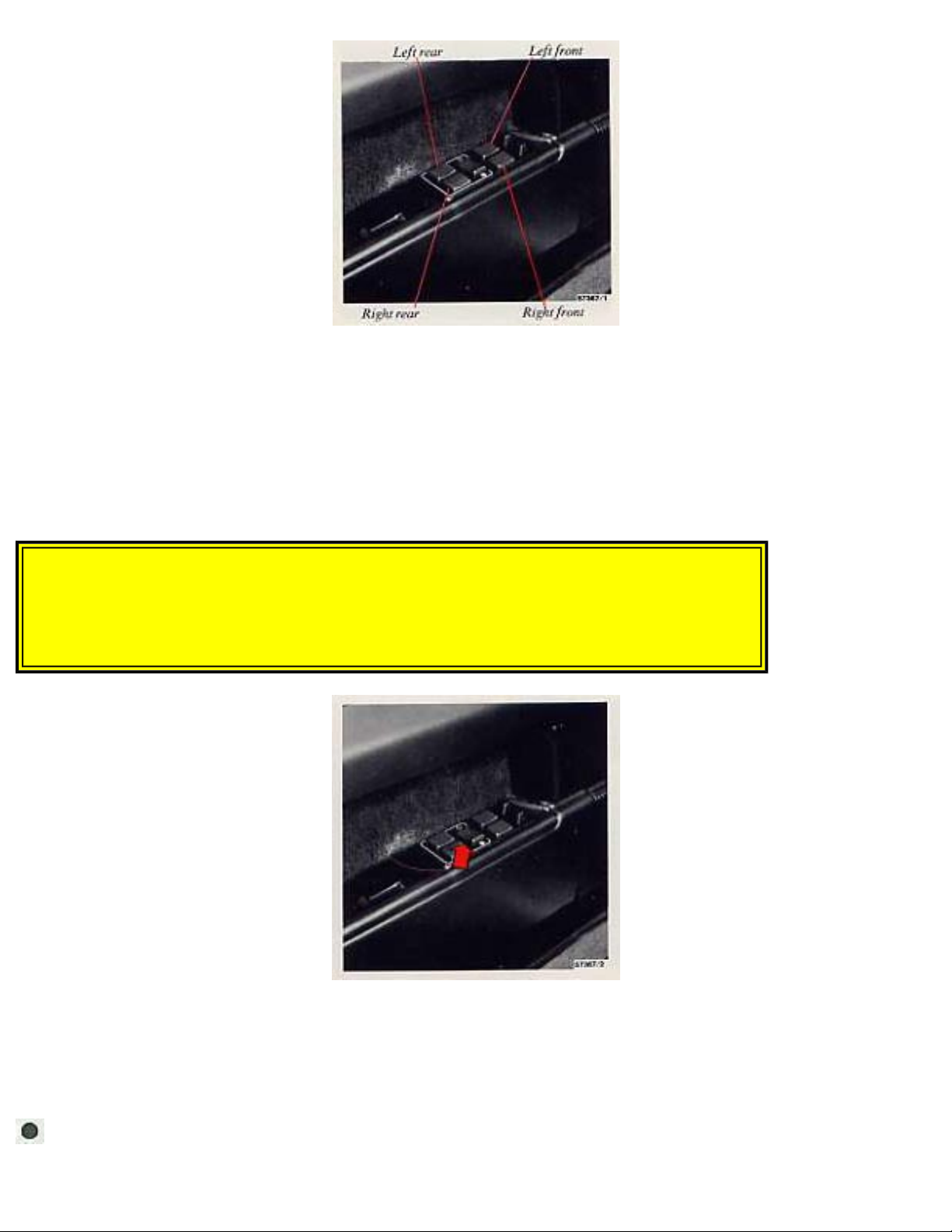
Electrically-operated windows (certain models)
The electrically operated windows are controlled by switches from the driver's armrest as shown in the
above illustration.
The starting (ignition) switch must be ON (position II) for the electrically operated windows to function.
The window is lowered if the rear part of the switch is pressed and raised if the front part of the switch is
pressed.
WARNING!
Remove the starting (ignition) key when children are left unattended in the
vehicle.
Cut-out switch for electrically-operated rear-door windows
If the car is equipped with rear door power windows, this function can be disabled by a switch located
on the driver's door armrest. This switch is positioned 90° in relation to the other switches.
The rear door windows can be raised or lowered with the respective door switch as well as the
switch on the driver's door.
file:///K|/ownersdocs/1986/1986_740/86740_01.htm (19 of 25)12/30/2006 7:51:28 AM
Page 23
1986 Volvo 740 GL, GLE, Turbo
The rear door windows cannot be raised or lowered with the respective door switch but instead only
with the corresponding switch on the driver's door.
pg. 20 Heating and ventilation
Heating and ventilation
Your Volvo is equipped with:
● Heating system
or
● Heating system combined with air conditioning.
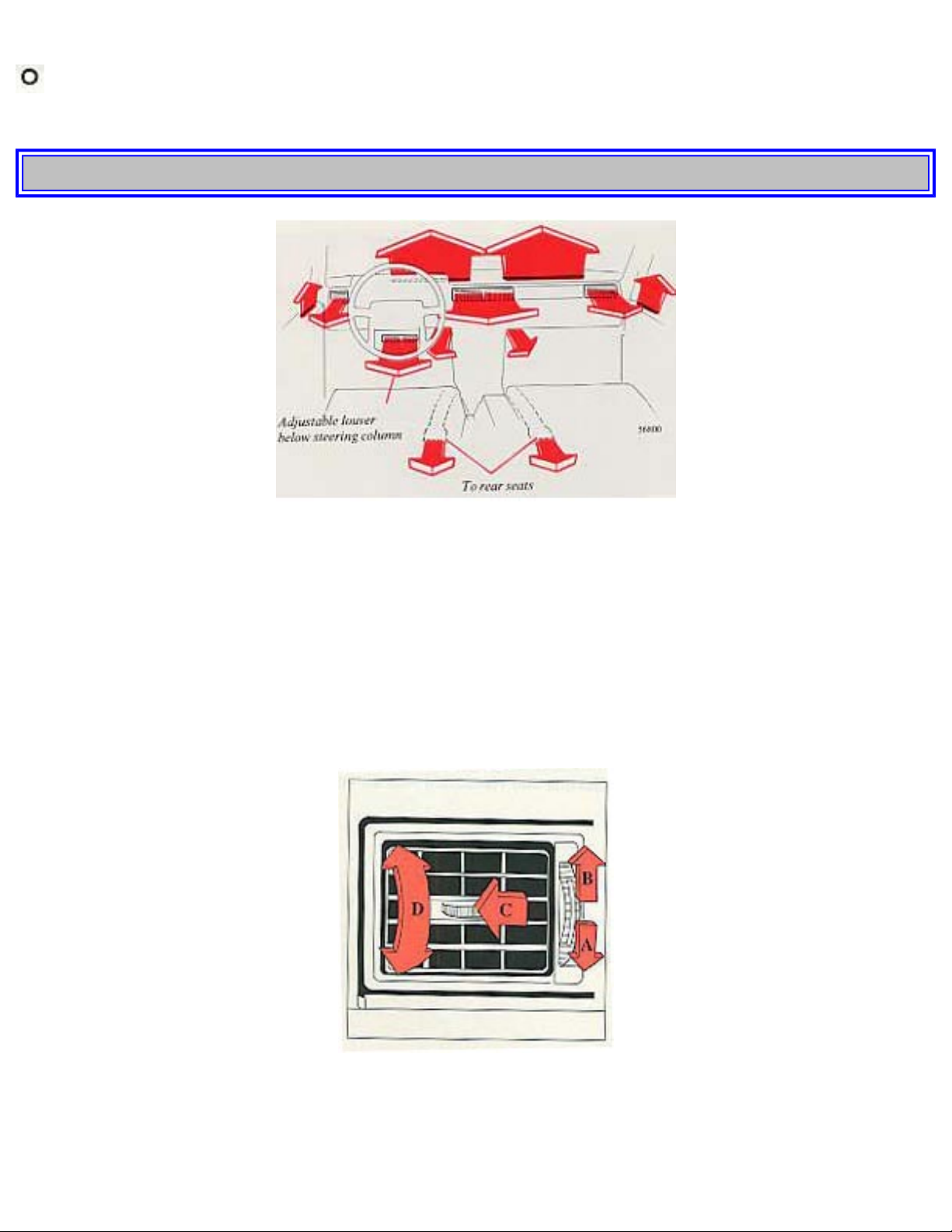
Depending on which function you select, warm or cool/cold air is distributed to the different parts of the
passenger compartment. An additional driver's air louver is located beneath the steering column and can
be adjusted upwards, downwards, or closed as desired.
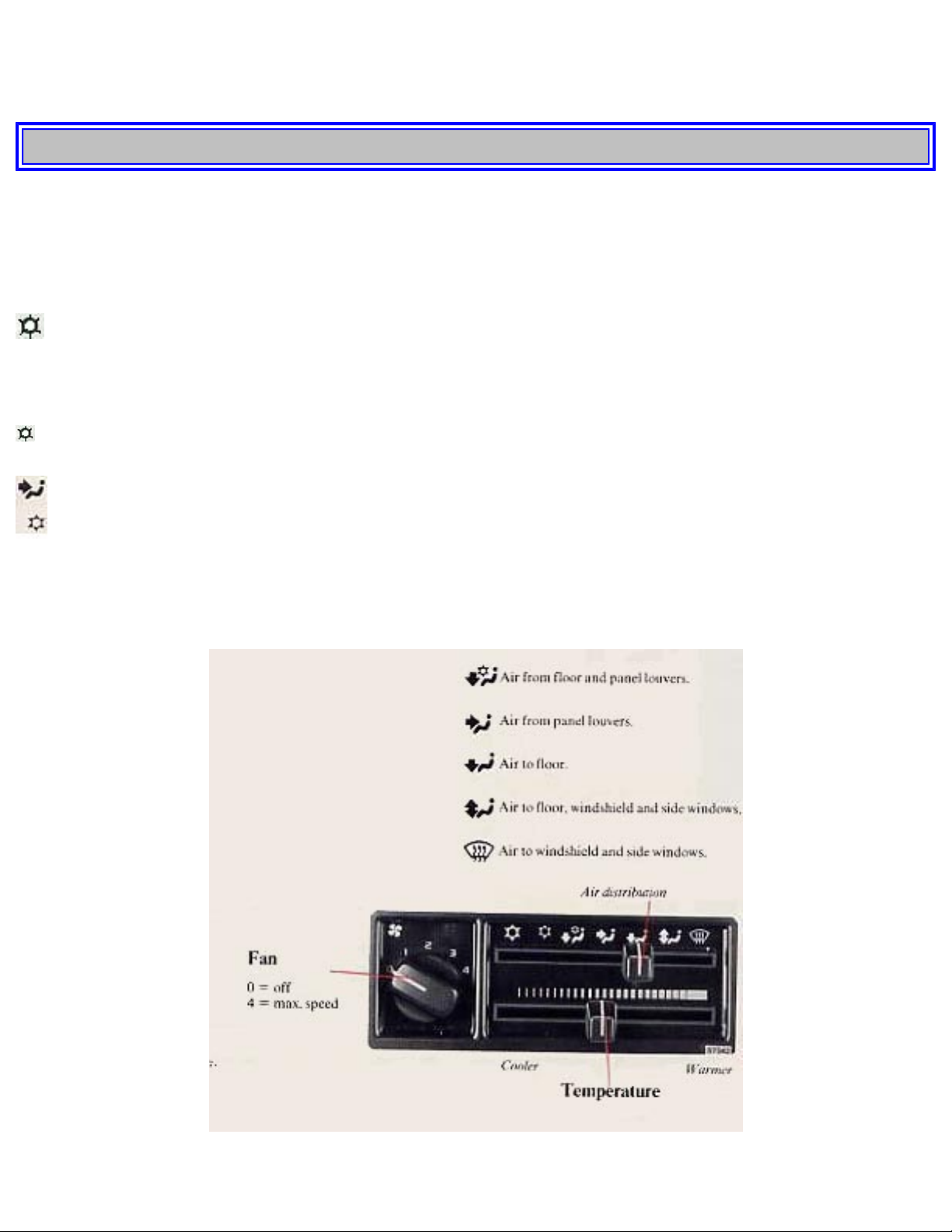
Air louvers (dash)
A Open
B Closed
file:///K|/ownersdocs/1986/1986_740/86740_01.htm (20 of 25)12/30/2006 7:51:28 AM
Page 24
1986 Volvo 740 GL, GLE, Turbo
C Directing air flow horizontally
D Directing air flow vertically
pg. 21 Heating and ventilation
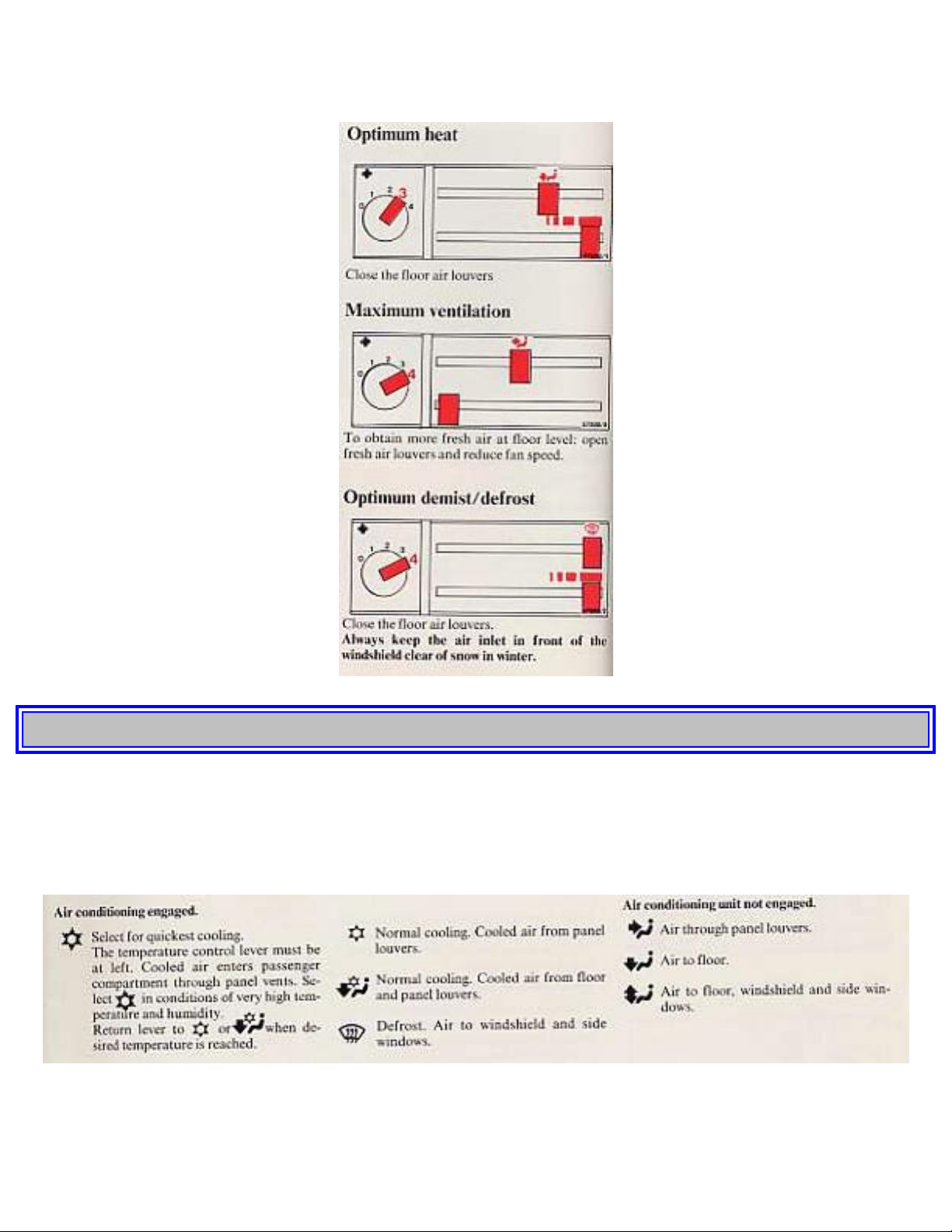
Heating and ventilation system without air conditioning
Air distribution
Recirculation interior air enters through panel vents. Very little air is drawn from outside. Use this
position to avoid circulating dense exhaust gases (as when driving through a tunnel). Do not use this
position for more than 10-15 minutes as very little fresh air will be supplied.
Air from panel louvers.
On the system without air conditioning these two symbols represent identical functions. (With air
conditioning the upper sign position emits cooled air).
Always keep the air inlet in front of the windshield clear of snow in winter.
file:///K|/ownersdocs/1986/1986_740/86740_01.htm (21 of 25)12/30/2006 7:51:28 AM
Page 25
1986 Volvo 740 GL, GLE, Turbo
NOTE: A certain amount of air will always enter through the dash air louvers as long as they are open;
independent of the position of the air distribution control.
pg. 22 Heating and ventilation
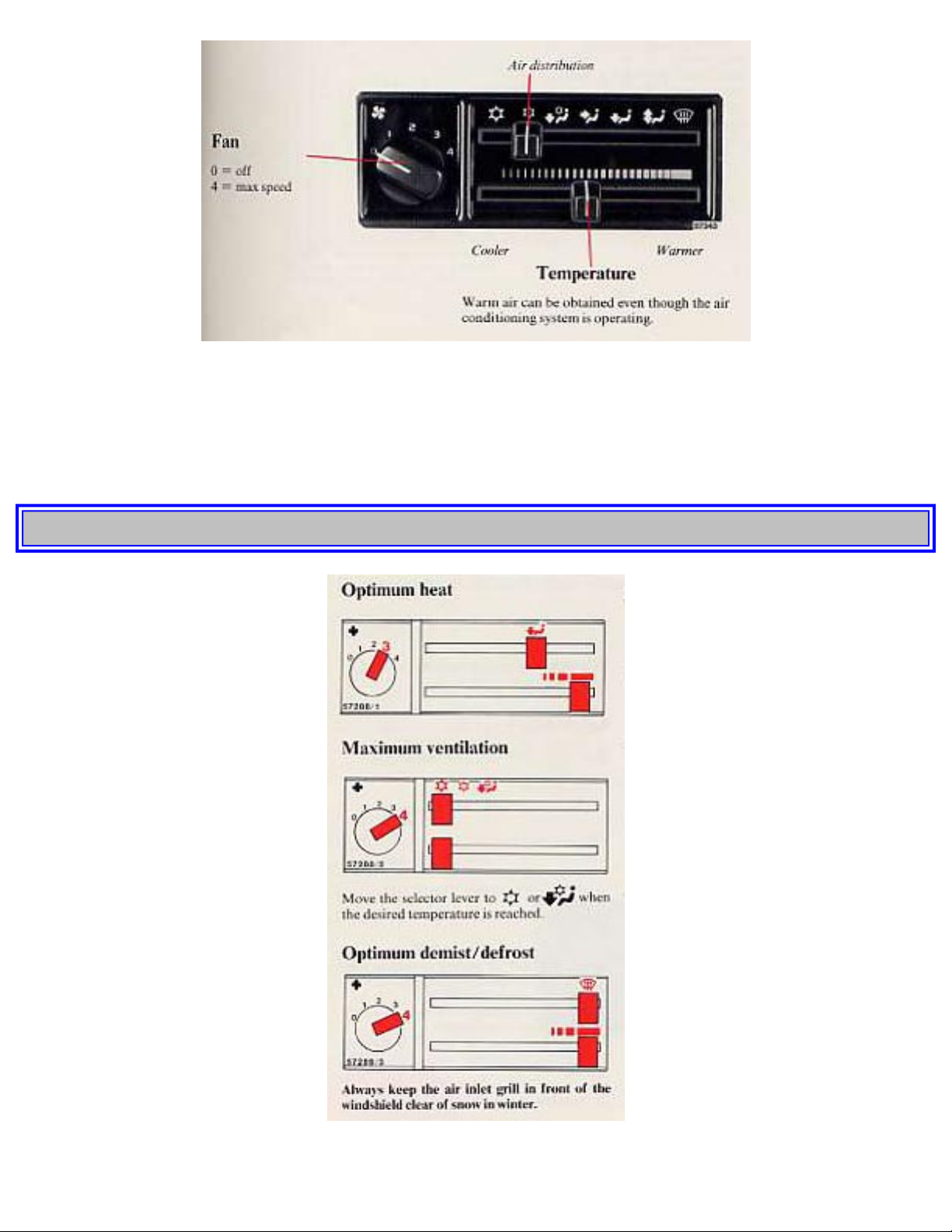
Heating and ventilation system with air conditioning
Air distribution
file:///K|/ownersdocs/1986/1986_740/86740_01.htm (22 of 25)12/30/2006 7:51:28 AM
Page 26
1986 Volvo 740 GL, GLE, Turbo
NOTE: A certain amount of air will always enter through the dash air louvers as long as they are open;
independent of the position of the air distribution control.
Close the dash air louvers to obtain maximum air flow to floor or windshield.
Open the two outer air louvers if the side windows become misted.
pg. 23 Heating and ventilation
Additional information and tips
file:///K|/ownersdocs/1986/1986_740/86740_01.htm (23 of 25)12/30/2006 7:51:28 AM
Page 27
1986 Volvo 740 GL, GLE, Turbo
● The air conditioning compressor is engaged only if the temperature is above 46°F (+8°C).
● In all three air conditioning positions the fan runs at speed 1 if the switch is at "0". This is a safety
measure to prevent formation of ice in the system.
● When the outside air isn't fresh
When the outside air is contaminated with exhaust gases, smoke, etc. (as when driving through a tunnel),
move the lever to for a few minutes. In this position very little air is drawn in to the passenger
compartment from outside. Do not, however, leave the lever in this position for more than 10-15
minutes, since hardly any fresh air is being supplied.
Regulate the temperature with the temperature control lever.
pg. 24 Audio Cassette/Tuner controls and indicators
file:///K|/ownersdocs/1986/1986_740/86740_01.htm (24 of 25)12/30/2006 7:51:28 AM
Page 28
1986 Volvo 740 GL, GLE, Turbo
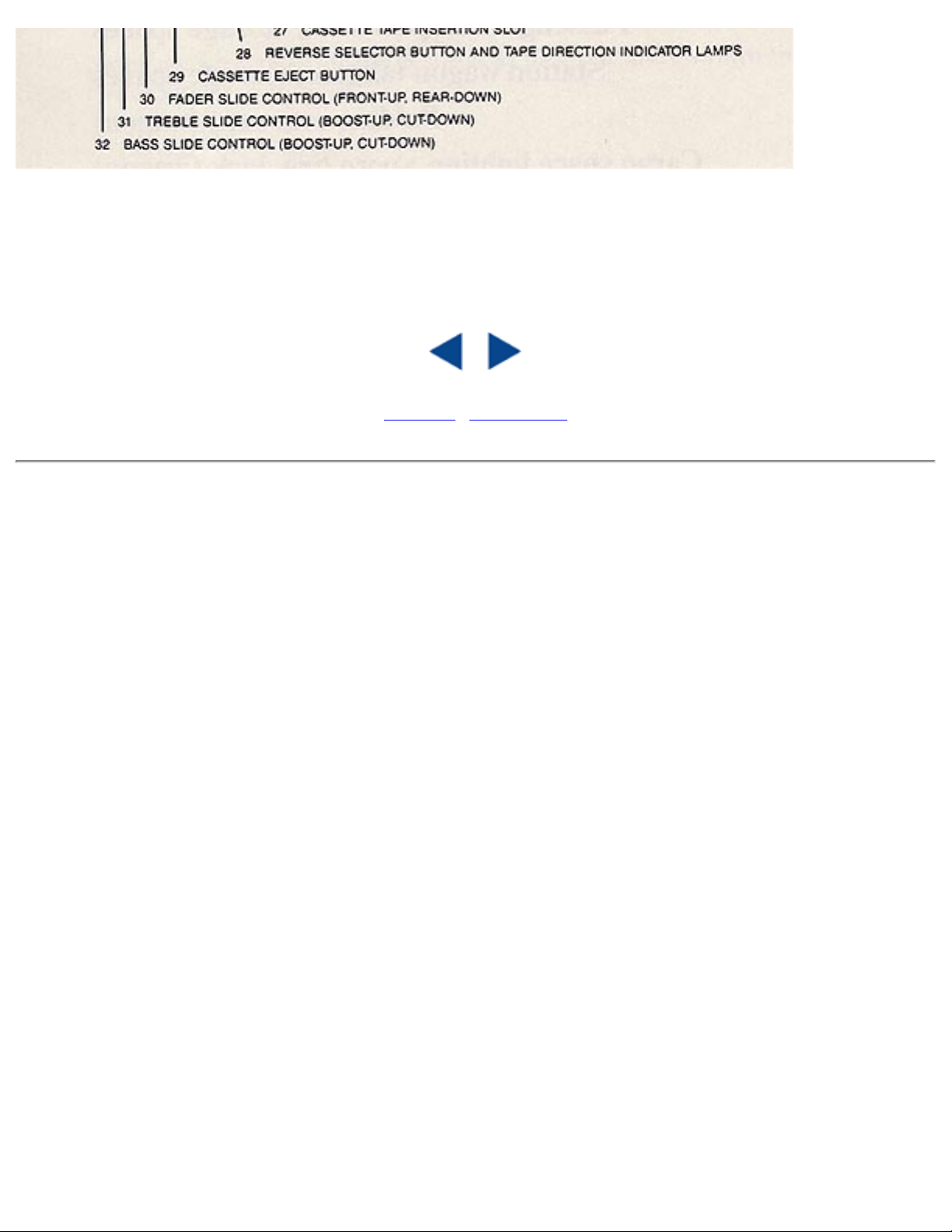
The diagram above identifies the controls and indicators for Audio/Cassette Tuner TD-3141.
For complete operating instructions, maintenance guidelines, and specifications, please consult your
Audio Cassette/Tuner Instruction Booklet. The Booklet also contains information on radio reception and
the radio antenna.
Contents | Top of Page
file:///K|/ownersdocs/1986/1986_740/86740_01.htm (25 of 25)12/30/2006 7:51:28 AM
Page 29

1986 Volvo 740 GL, GLE, Turbo
1 9 8 6
VOLVO
740 GL, GLE, Turbo
Body and interior
pg. 25 Body and interior
The seats, seat belts, doors, etc. are described on the following pages.
Rear-view/side-view mirrors
26
Interior light, sun roof
27
Front seats
28
Child safety
29
Seat belts
30
Doors and locks
32
Trunk, long load storage
34
Hood
35
Passenger compartment, storage spaces
36
Station wagon tailgate, storage spaces
37
Folding rear seat (wagon)
39
Cargo space lighting, spare tire, jack (wagon)
41
pg. 26 Rear/side-view mirrors, Make-up mirror
file:///K|/ownersdocs/1986/1986_740/86740_02.htm (1 of 22)12/30/2006 7:51:29 AM
Page 30
1986 Volvo 740 GL, GLE, Turbo
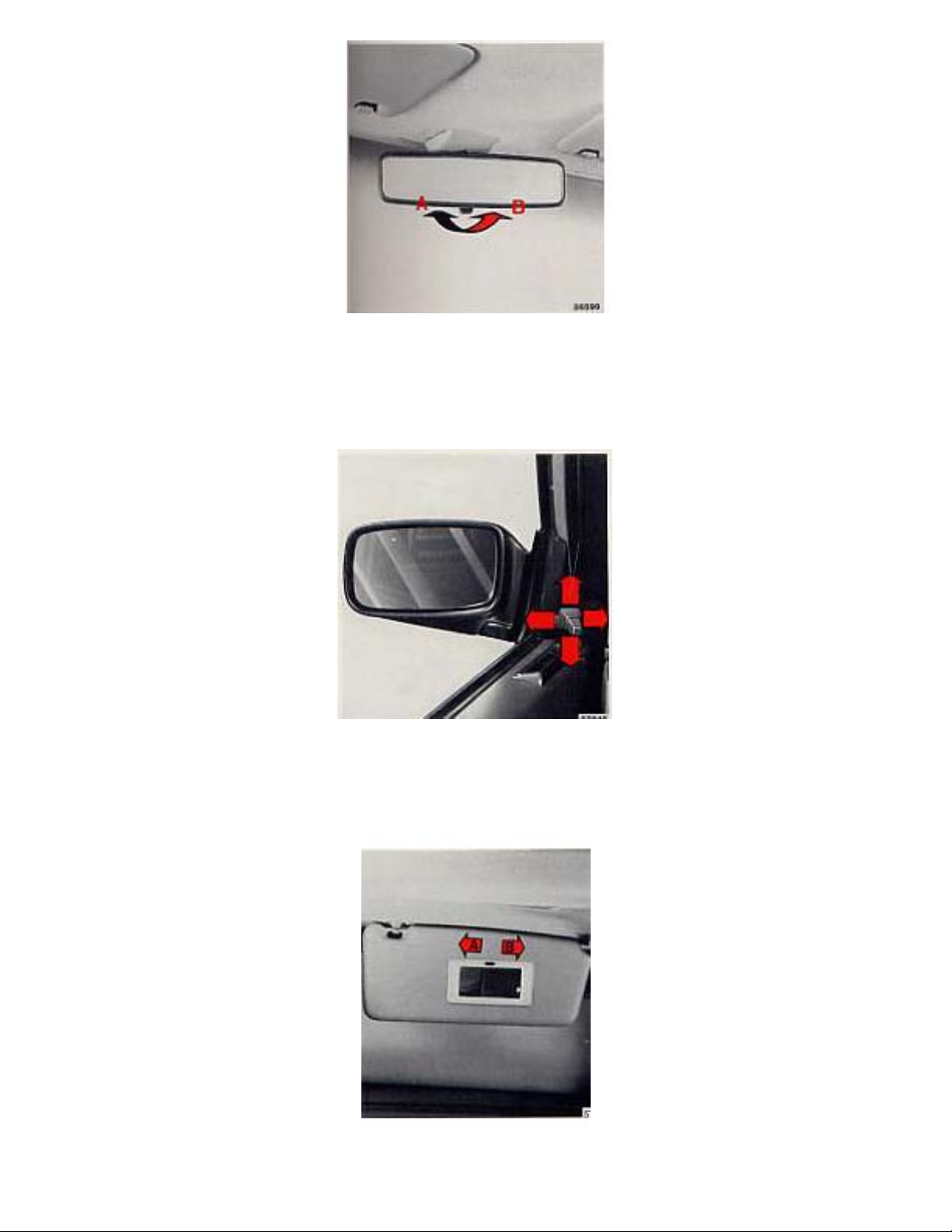
Rear-view mirror
A Normal position
B Night position, reduces glare from following headlights
Side-view mirrors
Use the lever to adjust.
file:///K|/ownersdocs/1986/1986_740/86740_02.htm (2 of 22)12/30/2006 7:51:29 AM
Page 31
1986 Volvo 740 GL, GLE, Turbo
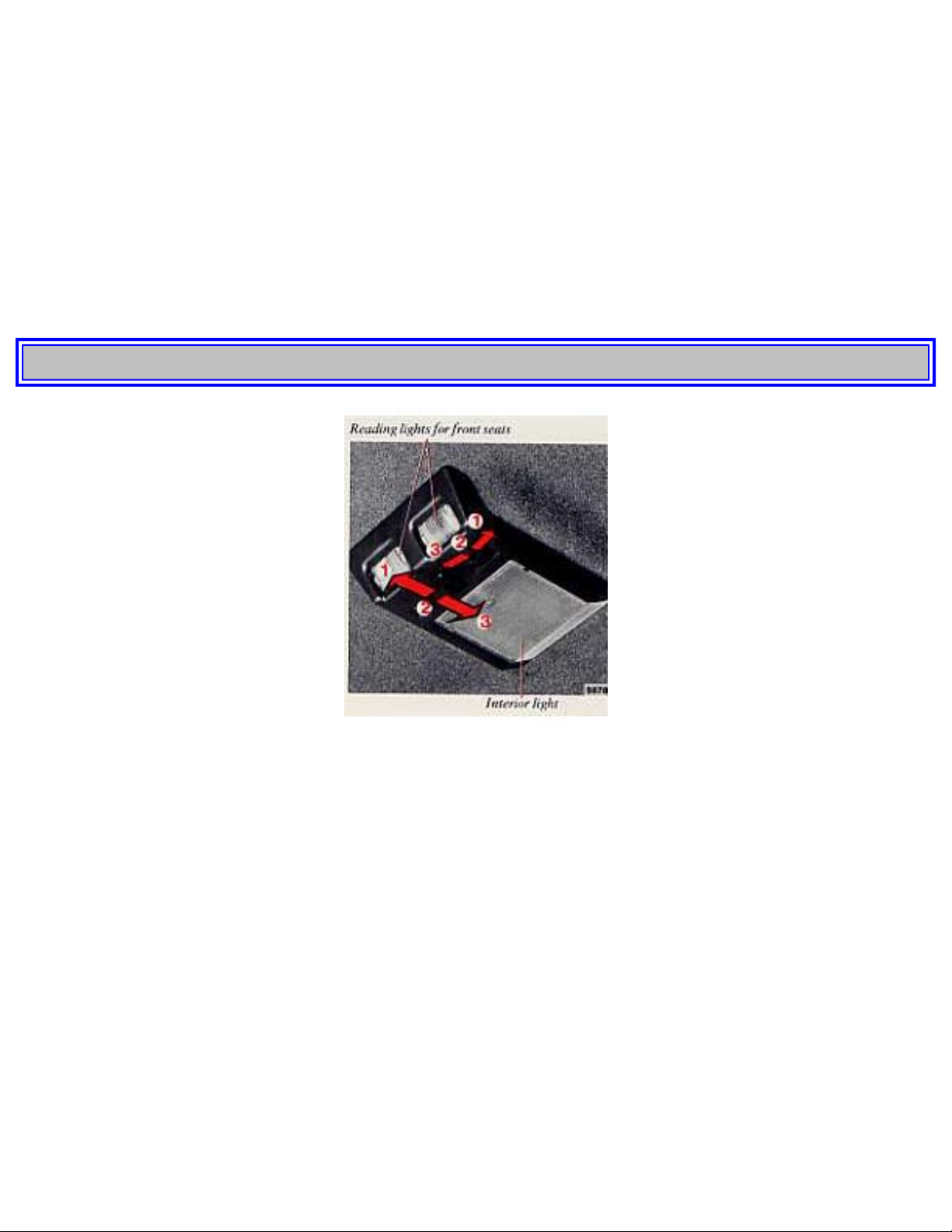
Make-up mirror
The make-up mirror is located on the right-side sun visor.
Make-up mirror lighting:
(certain models only)
A - OFF
B- ON
Never use ice scrapers made of metal as they can easily scratch the mirror surface.
The mirrors should always be adjusted before driving.
pg. 27 Interior light, Sun roof
Interior light
1. Light always on.
2. Light always off.
3. Light is on when either of the front or rear doors are opened.
file:///K|/ownersdocs/1986/1986_740/86740_02.htm (3 of 22)12/30/2006 7:51:29 AM
Page 32
1986 Volvo 740 GL, GLE, Turbo
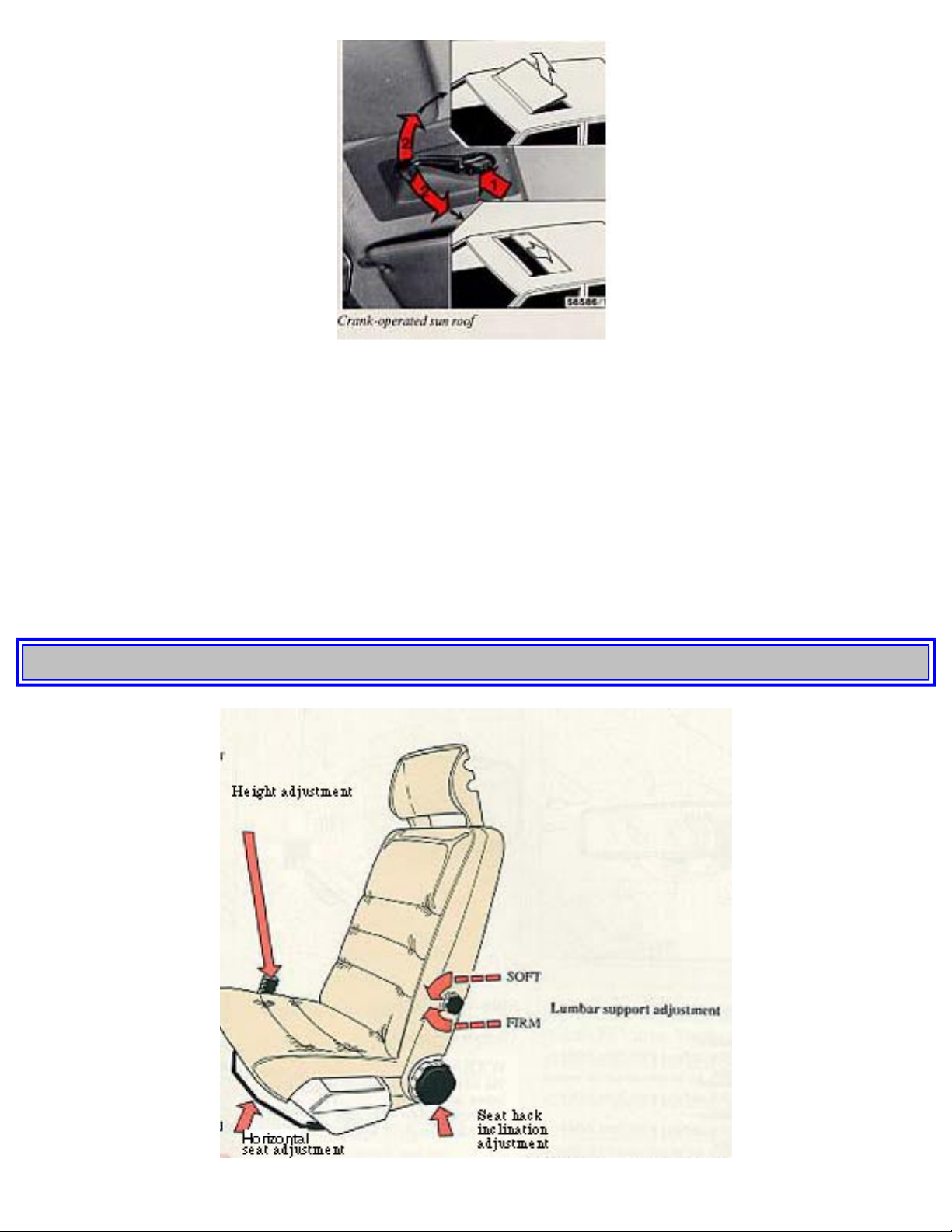
Sun roof (certain models)
The sun roof can be used in two ways: as a conventional sliding roof, or the rear edge can be raised or
lowered to provide various ventilation positions.
Depress the button prior to cranking.
Counter-clockwise: sliding roof
Clockwise: ventilation positions
NOTE:
For added safety, always have the crank folded during driving!
pg. 28 Front seats
file:///K|/ownersdocs/1986/1986_740/86740_02.htm (4 of 22)12/30/2006 7:51:29 AM
Page 33

1986 Volvo 740 GL, GLE, Turbo
Height adjustment
The front section of the seats can be adjusted to three height positions and the rear section to four.
Lever forward = front height adjustment
Lever rearward = rear height adjustment
Do not adjust the seat while driving.
The passenger's seat is rigidly attached to the floor. Tools are required to adjust the height. It has two
height positions at both front and rear.
Fore-aft seat adjustment
Pull control upward, then slide seat forward or rearward to desired position.
Make sure that the seat is properly secure when you release the control.
Note: For your safety, never adjust the seat while driving.
Seat back inclination adjustment
Rotate control clockwise to tilt seat back rearward.
Rotate counterclockwise to tilt seat back forward.
Note that body weight must be shifted to allow seat back to move forward or rearward.
pg. 29 Child safety
Child safety
Volvo recommends the proper use of restraint systems for all occupants including children. Remember
that, regardless of age and size, a child should always be properly restrained in a car.
Holding a child in your arms is NOT a suitable substitute for a child restraint system. In an accident, a
child held in a person's arms can be crushed between the vehicle's interior and an unrestrained person.
The child could also be injured by striking the interior, or by being ejected from the vehicle during a
sudden maneuver or impact. The same can also happen if the infant or child rides unrestrained on the
seat. Other occupants should also be properly restrained to help reduce the chance of injuring or
increasing the injury of a child.
In many states and provinces have legislation governing how and where children should be carried in a
car. Find out the regulations existing in your state or province.
A child restraint system can help protect a child in a vehicle. Here's what to look for when selecting a
child restraint system:
● It should have a label certifying that it meets applicable Federal Motor Vehicle Safety Standards
(FMVSS 213-80) - or in Canada, CMVSS 213.
● Make sure the child restraint system is approved for the child's height, weight and development - the
label required by the standard or regulation, or instructions for infant restraints, typically provide this
file:///K|/ownersdocs/1986/1986_740/86740_02.htm (5 of 22)12/30/2006 7:51:29 AM
Page 34

1986 Volvo 740 GL, GLE, Turbo
information.
● In using any child restraint system, we urge you to look carefully over the instructions that are
provided with the restraint. Be sure you understand them and can use the device properly and
safely in this vehicle.
● If your child restraint requires a top tether strap, consult your authorized Volvo dealer for top tether
anchorage and installation information (sedan models only).
When a child has outgrown the child safety seat (approximately age 4-5 years, depending on size) you
should use the rear seat with the standard seat belt fastened. The best way to protect the child here is to
place the child on a cushion so that the seat/lap belt is properly located on the hips.
A specially designed and tested safety cushion for this purpose can be obtained from your Volvo dealer.
pg. 30 Seat belts
Seat Belts
Fasten the seat belts before you drive or ride.
Two lights will be illuminated for 4-8 seconds after the starting (ignition) key is turned to the driving
position. One light is located in the instrument panel and one in the console between the front seats.
A chime will sound at the same time if the driver has not fastened his seat belt. The rear outboard seats
are provided with self-retracting inertia-reel belts. The front seats are provided with twin roller belts.
To buckle:
Pull the belt out from both retractors far enough to insert the latch plate into the receptacle (buckle for
rear seats), until a distinct snapping sound is heard.
The seat belt retractors are normally "unlocked" and you can move freely, provided that the shoulder
belt is not pulled out too far. The retractors will lock up as follows:
● if belt is pulled out rapidly
● during braking and acceleration
● if the vehicle is leaning excessively
● when driving in turns.
file:///K|/ownersdocs/1986/1986_740/86740_02.htm (6 of 22)12/30/2006 7:51:29 AM
Page 35
1986 Volvo 740 GL, GLE, Turbo
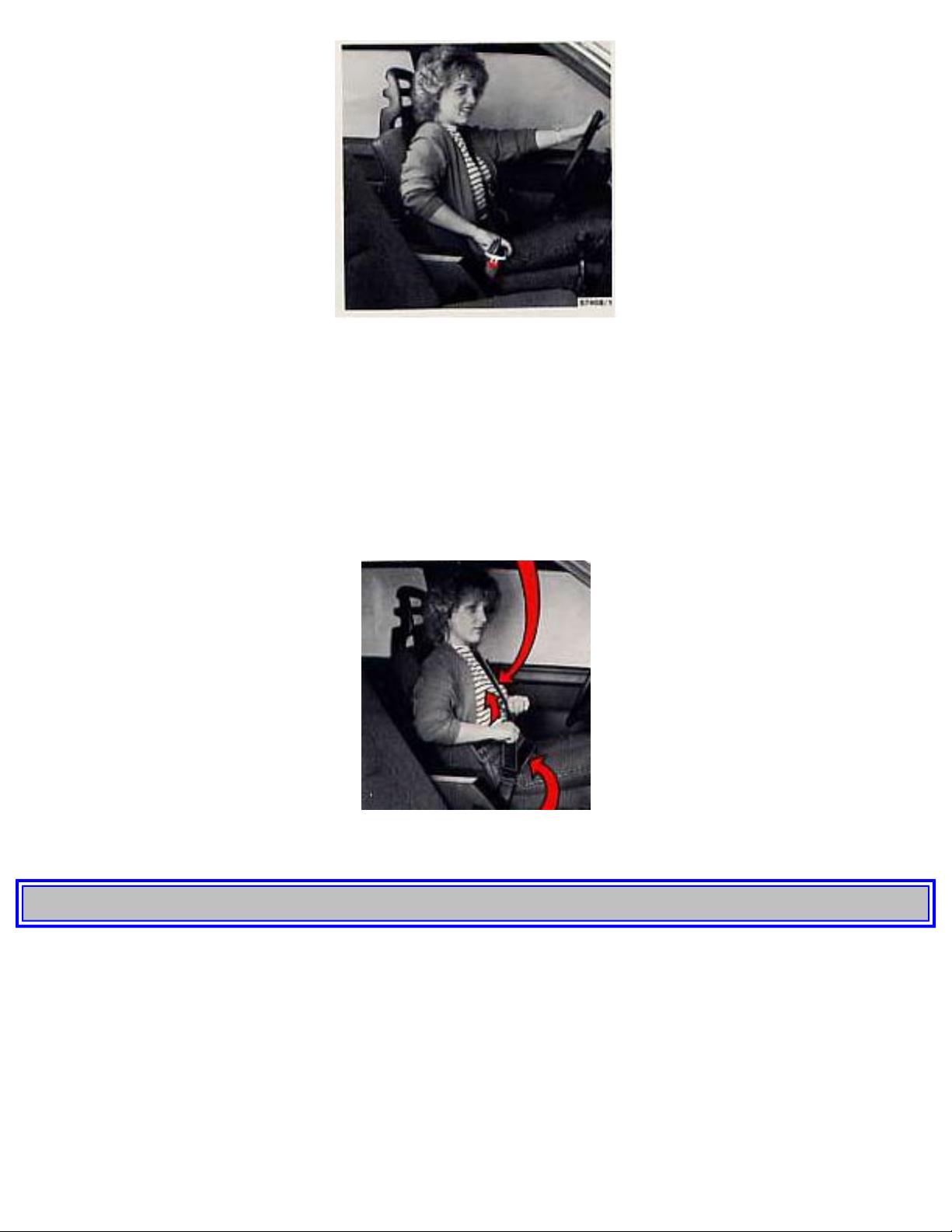
In order for the seat belt to provide maximum protection in the event of an accident, it must be worn
correctly. When wearing remember:
● the belt should not be twisted or turned
● the lap belt must be positioned low (not pressing against the abdomen). Make sure that the shoulder
belt is rolled up into its retractor and that the shoulder and lap belts are taut.
To unfasten, depress red pushbutton in receptacle (buckle) and let the belts rewind into their retractors.
Adjusting shoulder belt
Lap portion of the belt should sit low
pg. 31 Seat belts
file:///K|/ownersdocs/1986/1986_740/86740_02.htm (7 of 22)12/30/2006 7:51:29 AM
Page 36
1986 Volvo 740 GL, GLE, Turbo
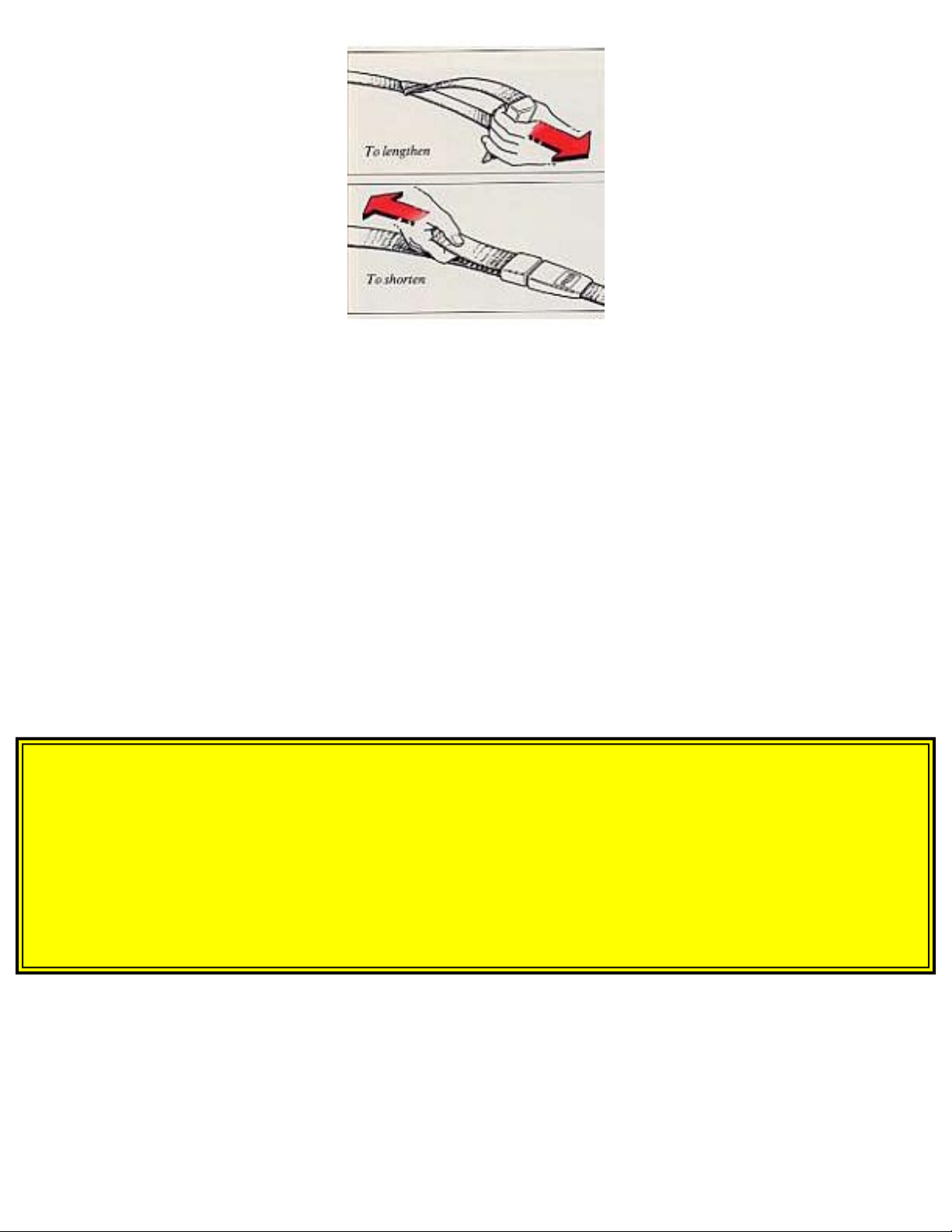
Center-rear belt adjustment
The center-rear seat belt is manually adjustable. It should always be adjusted to the correct length.
Maintenance
Check periodically that the anchor bolts are secure and that the belts are in good condition.
Use water and a mild detergent for cleaning. Check seat belt mechanism function as follows:
1. Attach the seat belt. Pull rapidly on the strap.
2. CAUTION: Check other traffic before performing the following check.
Brake firmly from approximately 30 mph (50 km/h) or turn in a tight circle while pulling on the belt.
In both of the over checks you should not be able to pull to belt out.
WARNING!
Never use a seat belt for more than one occupant.
Never wear the shoulder portion of the belt under the arm or otherwise out of position.
Such use could cause injury in event of accident.
As the seat belts lose much of their strength when exposed to violent stretching, they should be
replaced after any collision, even though they may appear to be undamaged.
Never repair the belt on your own, but have this done by an authorized Volvo dealer only
file:///K|/ownersdocs/1986/1986_740/86740_02.htm (8 of 22)12/30/2006 7:51:29 AM
Page 37
1986 Volvo 740 GL, GLE, Turbo
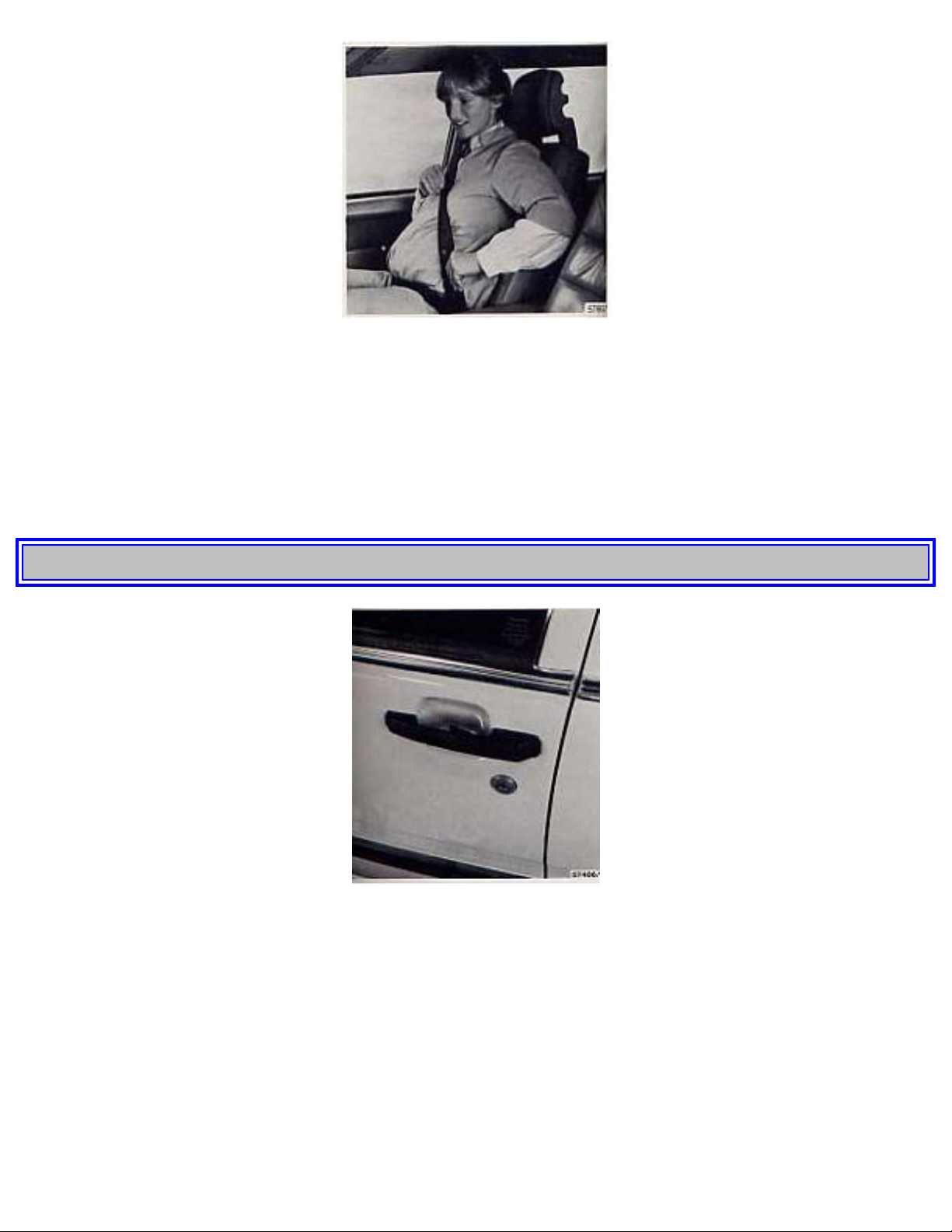
During pregnancy
Pregnant women should always wear seat belts. Remember that the belt should always be positioned in
such a way as to avoid any possible pressure on the abdomen. The lap portion of the belt should be
located low, as shown in the above illustration.
NOTE: Legislation in your state or province may mandate seat belt usage.
pg. 32 Doors and locks
Door locks
The vehicle is equipped with a central door-locking system. This means the lock on the driver's door
controls the locks on the other doors (including the trunk or, on the wagon models, the tailgate)
automatically.
If the driver's door is locked or unlocked from the outside using the key, the other doors will be locked
or unlocked automatically.
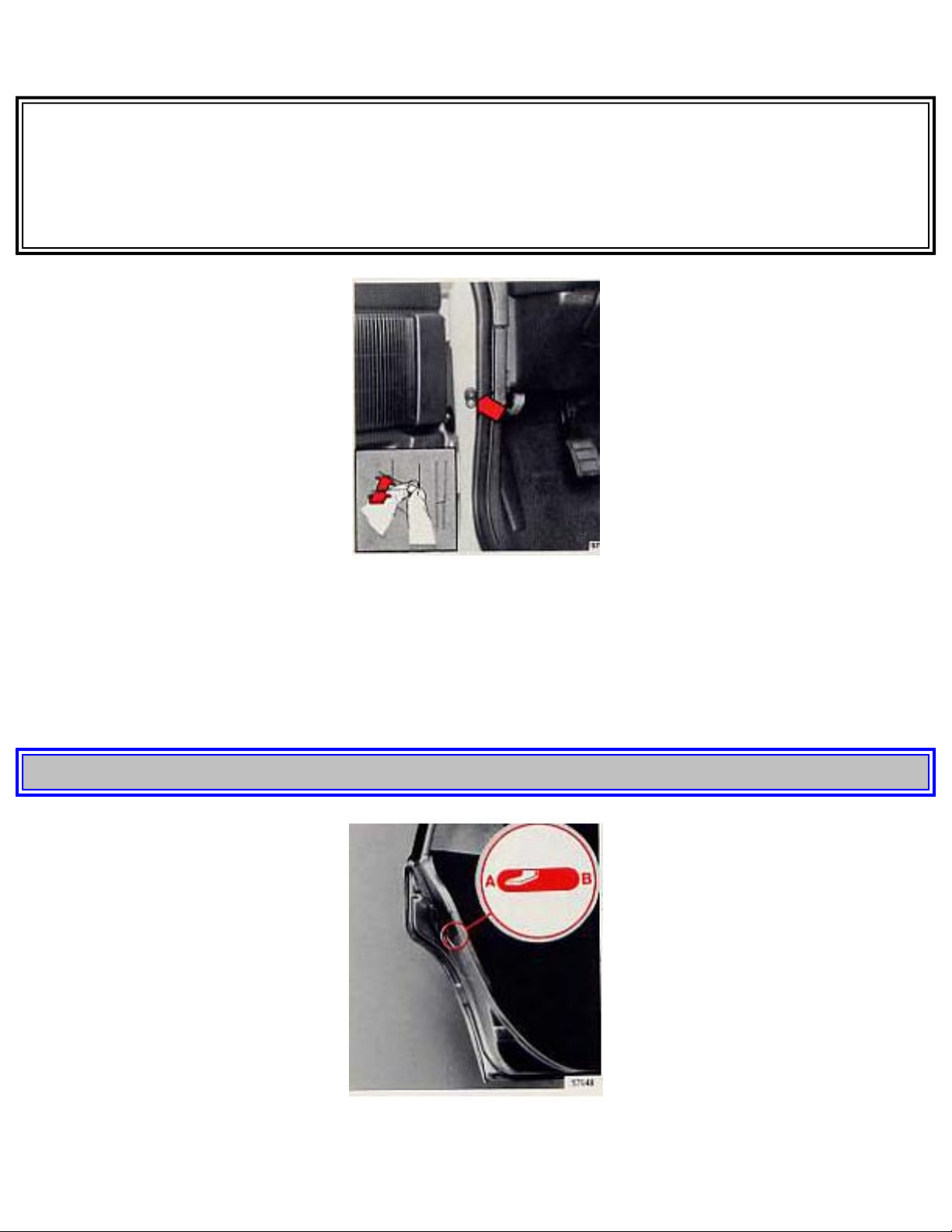
To lock/unlock the car by using the lock button on the inside of the driver's door, push/pull to lock/
unlock all the doors. Check the action of the buttons on the other doors to verify their correct function
(lock/unlock).
file:///K|/ownersdocs/1986/1986_740/86740_02.htm (9 of 22)12/30/2006 7:51:29 AM
Page 38
1986 Volvo 740 GL, GLE, Turbo
The driver's door can be locked only by using the key when outside the vehicle.
CAUTION!
The lock buttons should not be in the down position during driving. In case of an accident, this may
hinder rapid access to the occupants of the vehicle. (Also see information on "child safety locks" on
next page.)
To avoid battery drain
The interior light and the warning lights in the rear of the doors come on when a door is opened.
To avoid battery drain when the doors are opened for prolonged periods, these lights can be switched off
by pushing in and turning the door light switches slightly clockwise. When the door is closed the switch
will return to its normal position.
pg. 33 Child safety locks, Trunk lid (sedan)
Child safety Locks
file:///K|/ownersdocs/1986/1986_740/86740_02.htm (10 of 22)12/30/2006 7:51:29 AM
Page 39
1986 Volvo 740 GL, GLE, Turbo
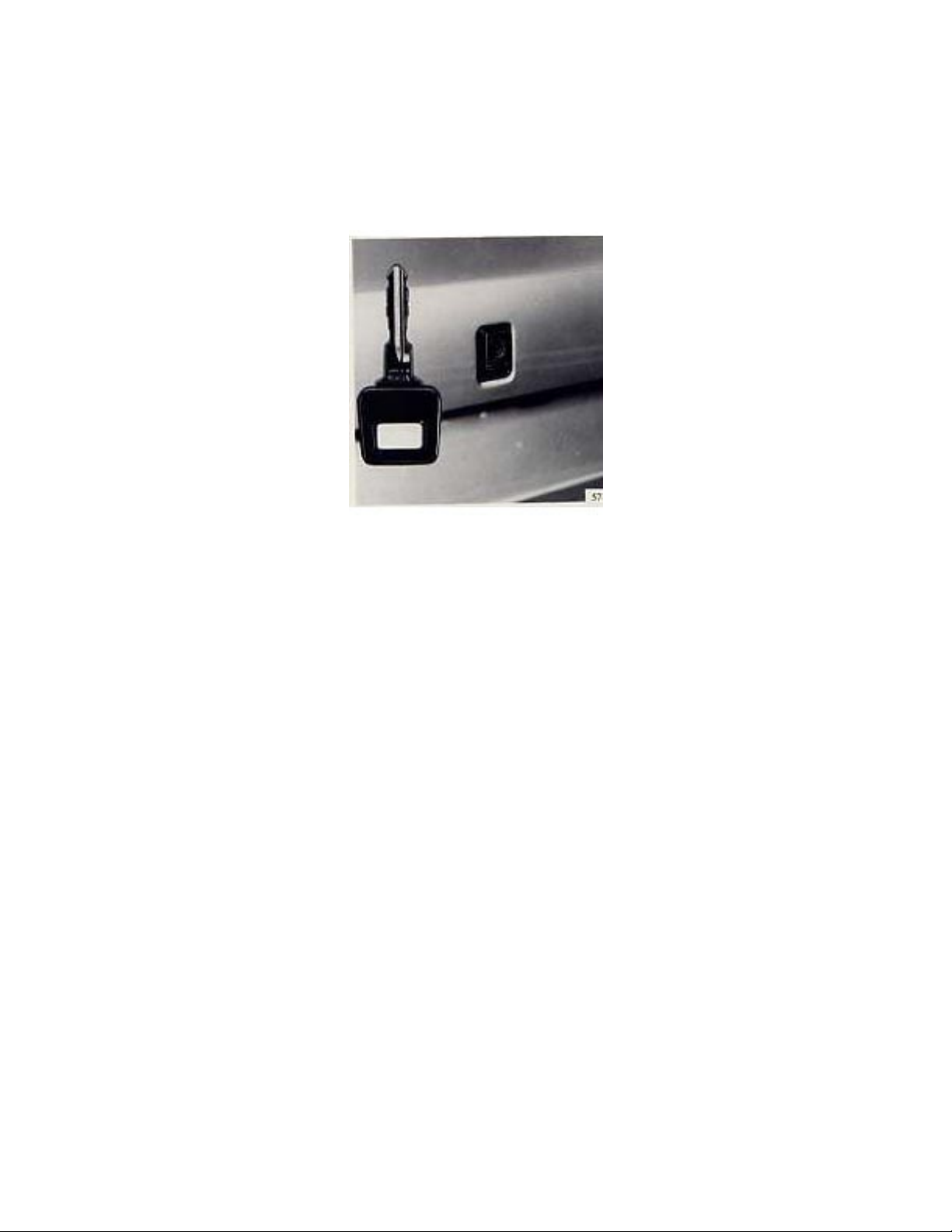
The buttons are located on the rear door jambs.
A The door lock functions normally.
B The door cannot be opened from the inside. Normal operation from outside.
Remember, in the event of an accident, the rear seat passengers cannot open the doors from the
inside with the levers in position B.
Trunk Lid
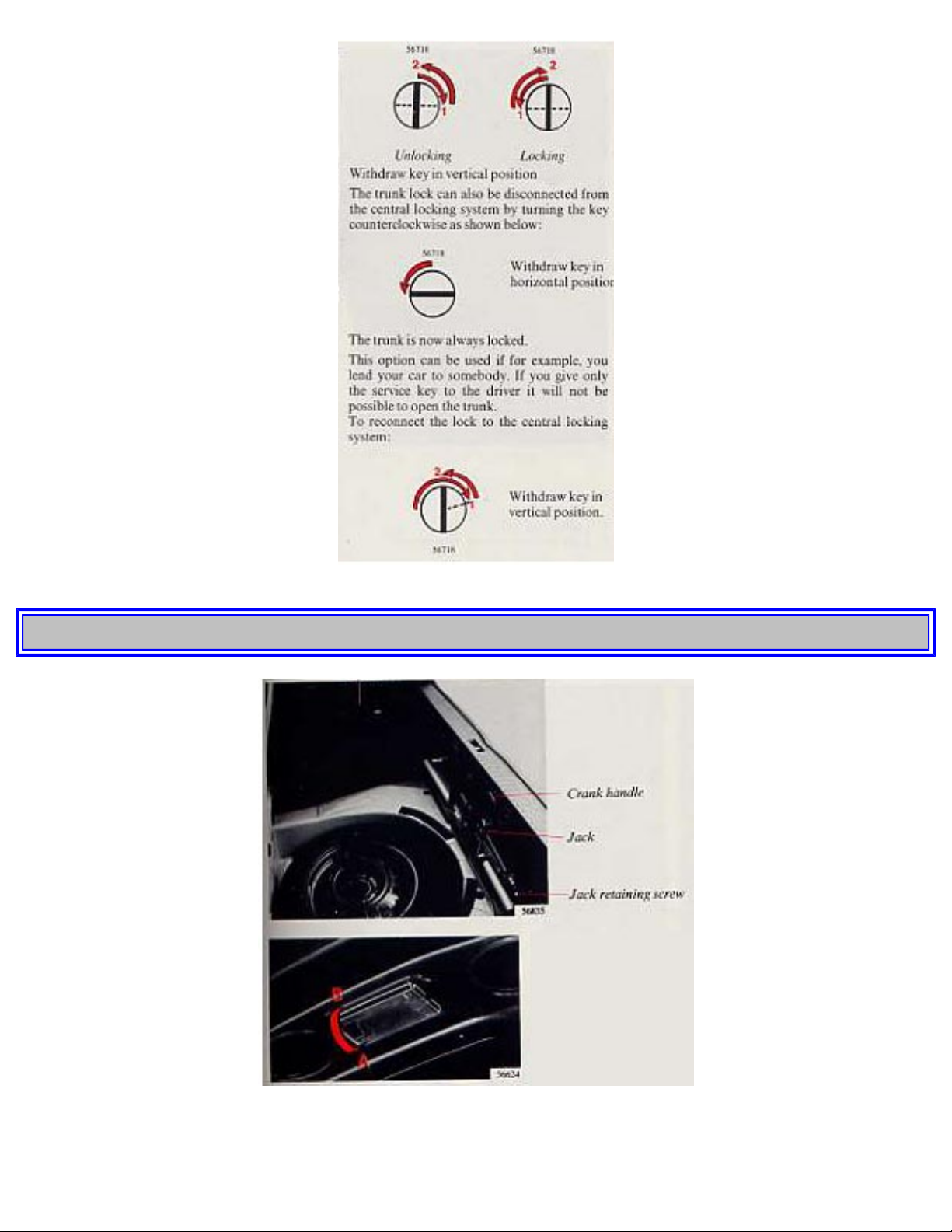
The trunk lock is incorporated in the central locking system. This means that you can either lock or
unlock the trunk by means of the driver's door lock.
You can also operate the trunk lock directly with the owner's key even if the vehicle is centrally locked.
file:///K|/ownersdocs/1986/1986_740/86740_02.htm (11 of 22)12/30/2006 7:51:29 AM
Page 40
1986 Volvo 740 GL, GLE, Turbo
pg. 34 Trunk, Long load storage (sedan)
Trunk light
A Light always off.
file:///K|/ownersdocs/1986/1986_740/86740_02.htm (12 of 22)12/30/2006 7:51:29 AM
Page 41
1986 Volvo 740 GL, GLE, Turbo
B Light is on when trunk lid is opened.
WARNING!
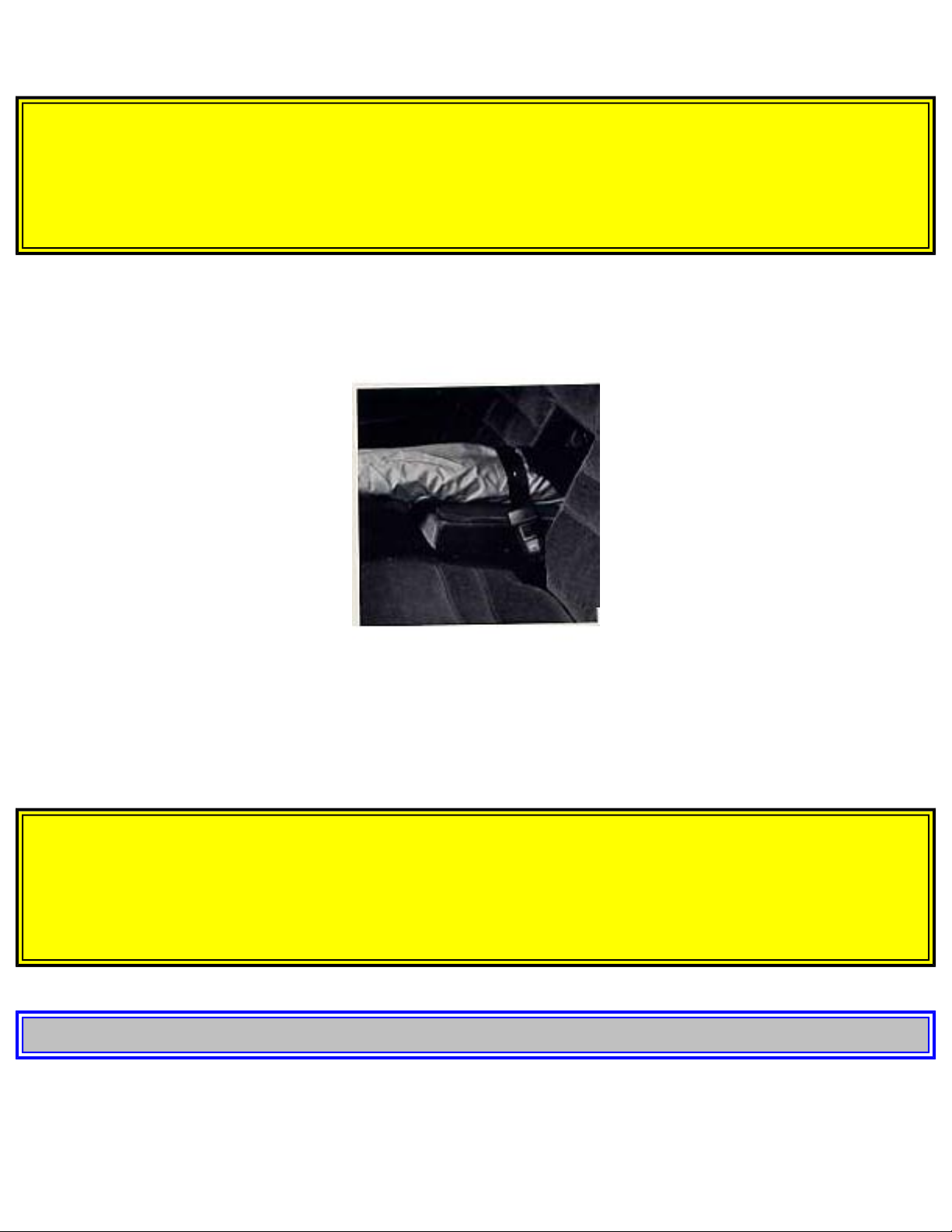
When braking rapidly the load could be displaced and cause injury to occupants. Sharp edges on the
load should be covered for protection. It is essential that the load be secured safely. Use belts locked
around the folded down armrest (see illustration).
Long load storage
In the panel behind the rear seat is a door which makes it possible to carry long loads such as skis. etc.
Protective covers (for skis) should also be used to avoid soiling or tearing the upholstery. Please note
that the flap in the rear seat is only intended for light loads such as skis, wood etc.
Max. length of' load 6 1/2 ft = 2 m.
Max. weight of load 33 lbs = 15 kg.
WARNING!
Take care when loading/unloading the vehicle. Always turn off the engine and apply the parking
brake. Place automatic transmission gear shift selector in P (PARK). This will prevent accidental
movement of the gear shift selector to position D (Drive).
pg. 35 Hood, Engine compartment light
file:///K|/ownersdocs/1986/1986_740/86740_02.htm (13 of 22)12/30/2006 7:51:29 AM
Page 42
1986 Volvo 740 GL, GLE, Turbo
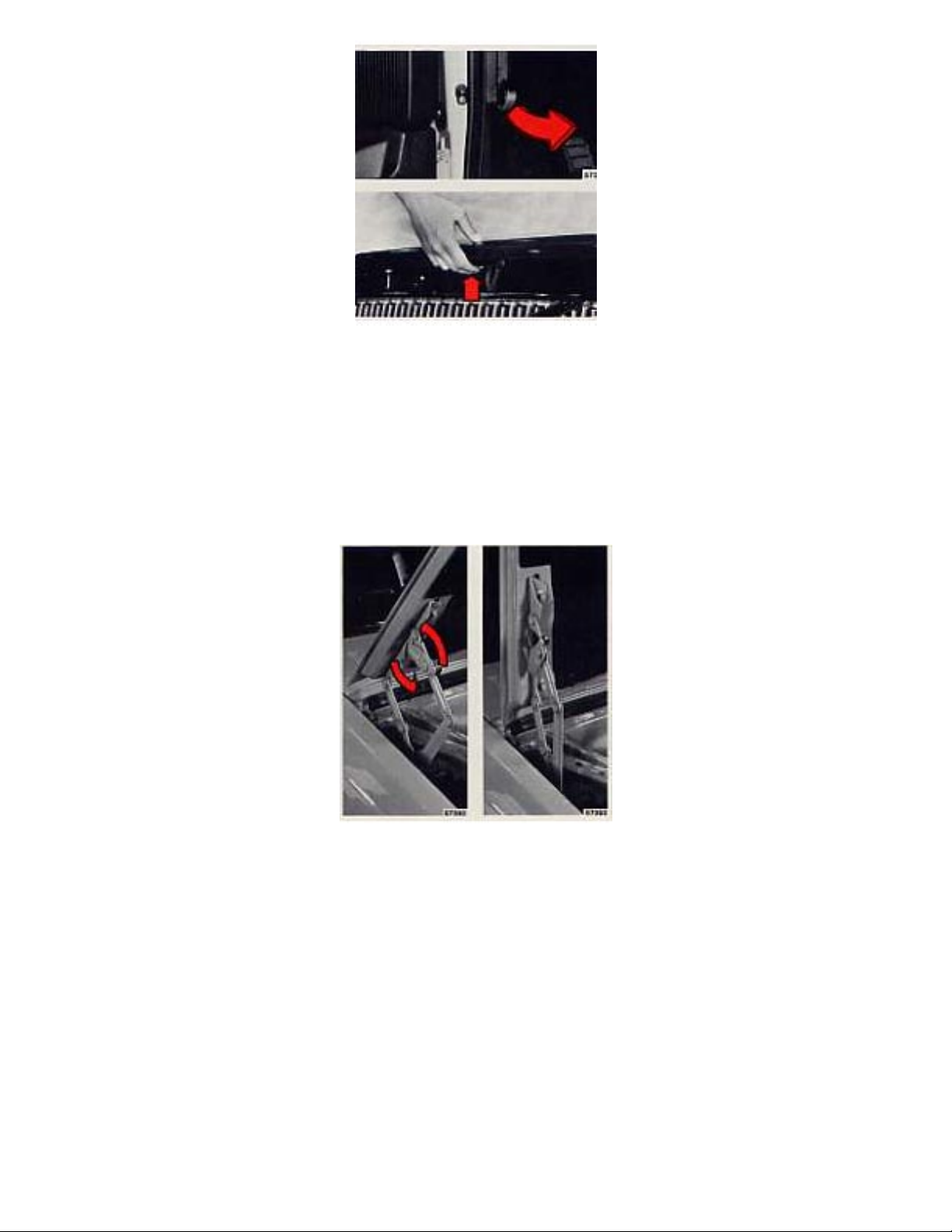
To open the hood
Pull the release handle (located under the left side of the dash).
Lift the hood slightly, insert a hand under the center line of the hood and depress the safety-catch handle.
Open the hood.
Check that the hood locks properly when closed.
The normal opening angle for the hood is approximately 55°. By turning the catches or the hinges as
illustrated, the hood can be opened to the vertical position. The catches will return to their normal
positions when the hood is closed.
Take care in low-roof garages!
file:///K|/ownersdocs/1986/1986_740/86740_02.htm (14 of 22)12/30/2006 7:51:29 AM
Page 43
1986 Volvo 740 GL, GLE, Turbo
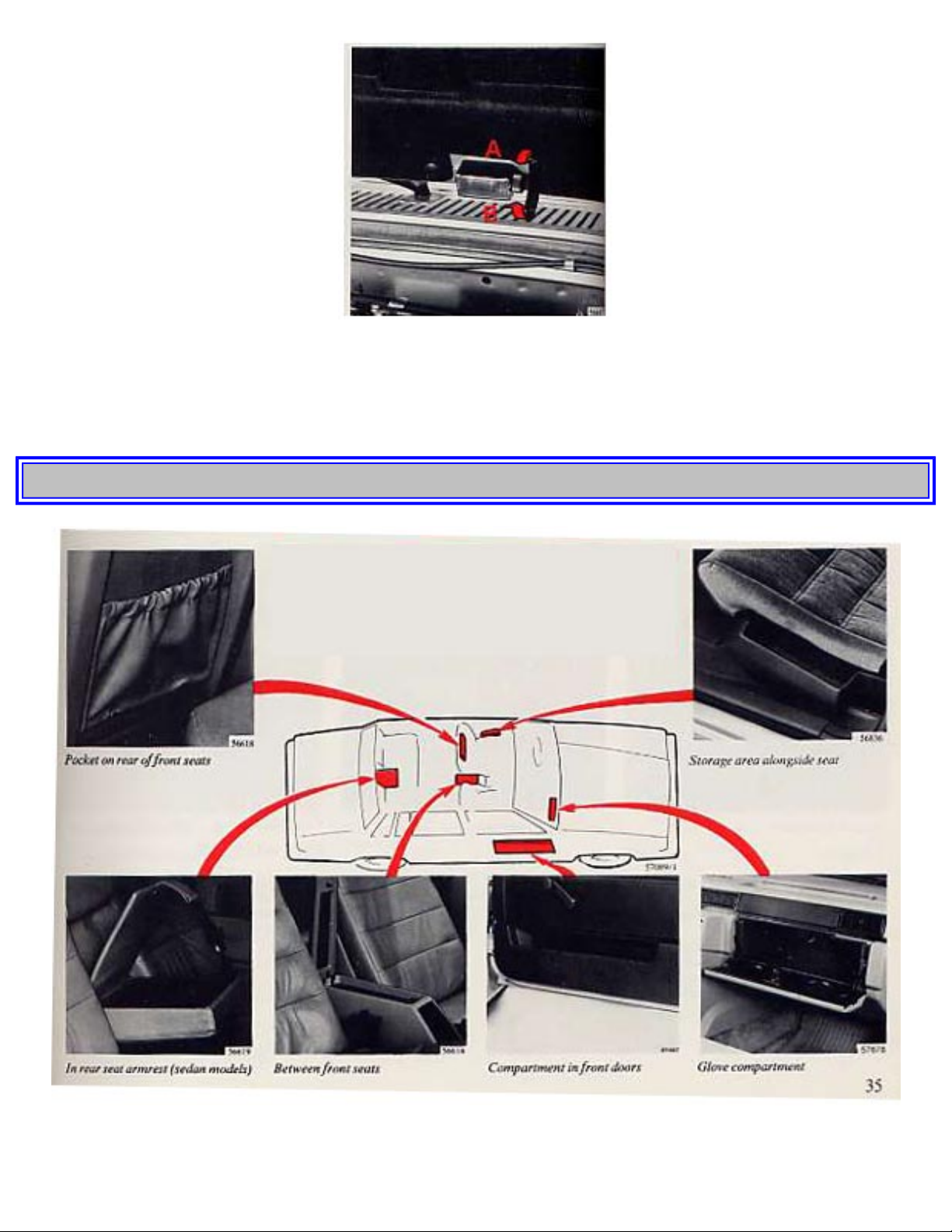
Engine compartment light
A the light is always off
B the light comes on when the hood is opened.
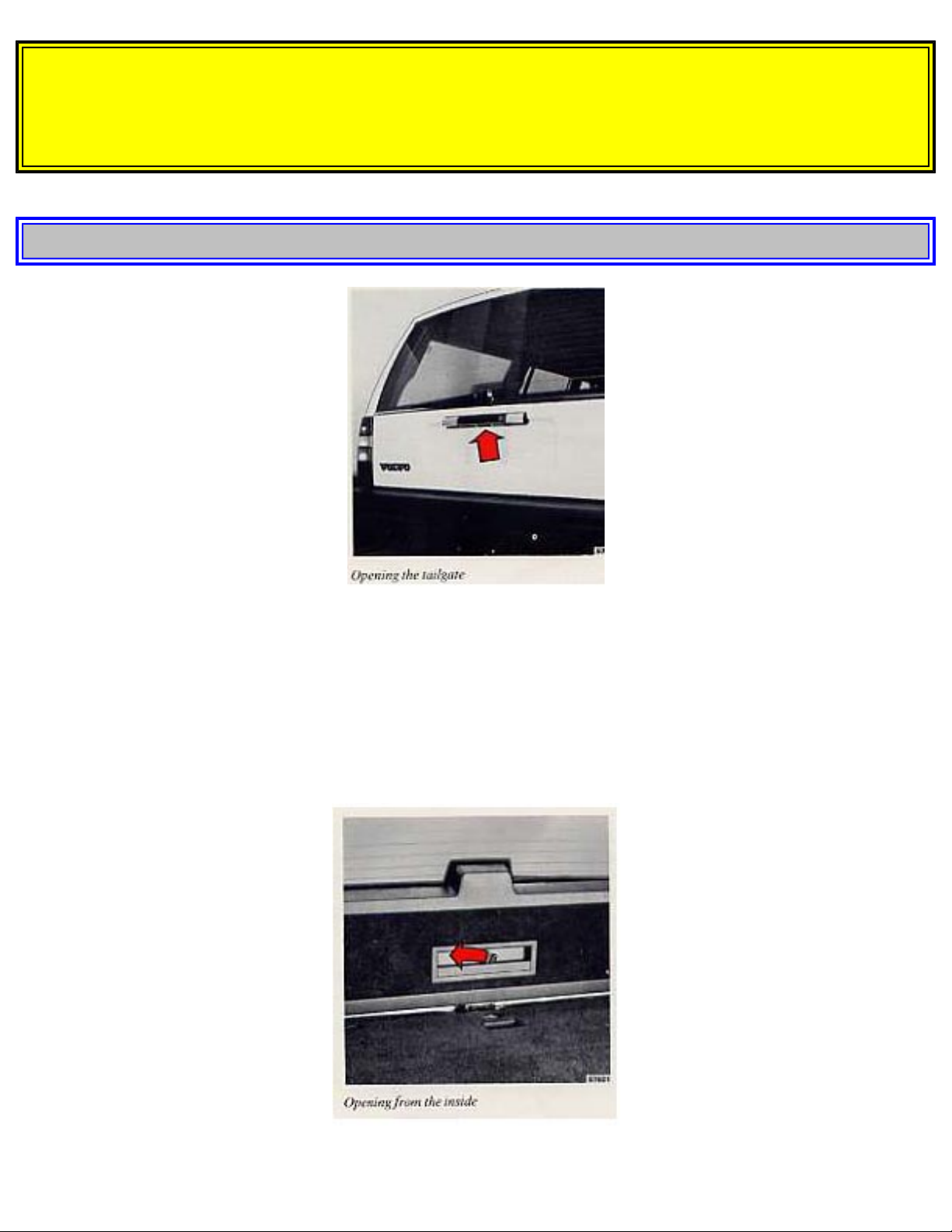
pg. 36 Storage spaces
file:///K|/ownersdocs/1986/1986_740/86740_02.htm (15 of 22)12/30/2006 7:51:29 AM
Page 44
1986 Volvo 740 GL, GLE, Turbo
WARNING!
Packages on the rear window shelf can obscure vision and may become dangerous projectiles in the
even of a sudden stop or an accident.
pg. 37 Tailgate, Child safety lock (wagon)
Tailgate
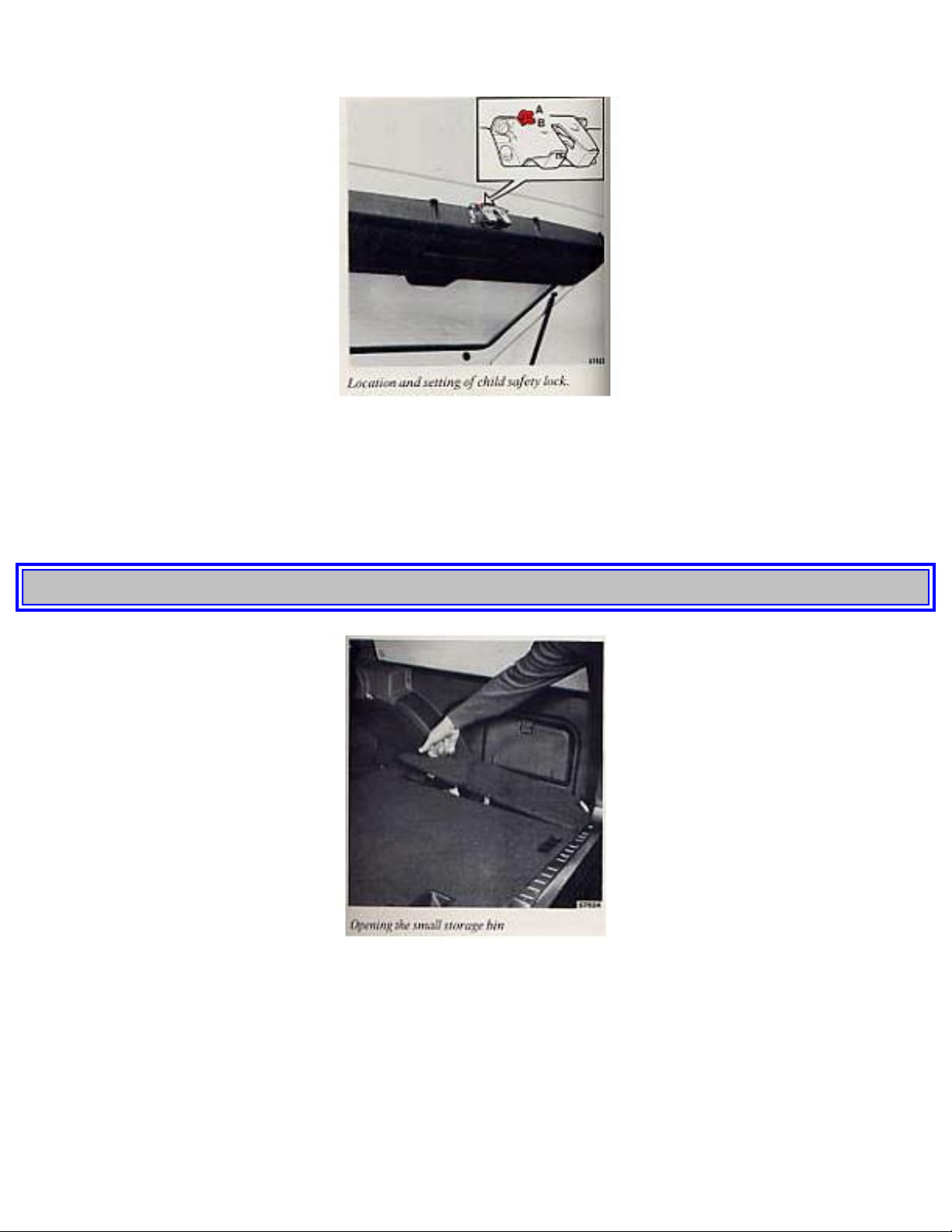
To unlock - turn the key clockwise and allow it to spring back.
To lock - turn the key counter-clockwise and allow it to spring back.
Note: If the vehicle has a central locking system the tailgate will be unlocked and locked at the same
time as the driver's door.
The tailgate is opened by pressing up the catch on the handle.
file:///K|/ownersdocs/1986/1986_740/86740_02.htm (16 of 22)12/30/2006 7:51:29 AM
Page 45
1986 Volvo 740 GL, GLE, Turbo
To open the tailgate from the inside of the vehicle, move the handle to the left and push outwards.
Child safety lock
The tailgate incorporates a safety catch which is located to the side of the lock.
A the tailgate functions normally
B the tailgate cannot be opened from the inside
pg. 38 Concealed storage bins, Tool box (wagon)
Concealed storage bins
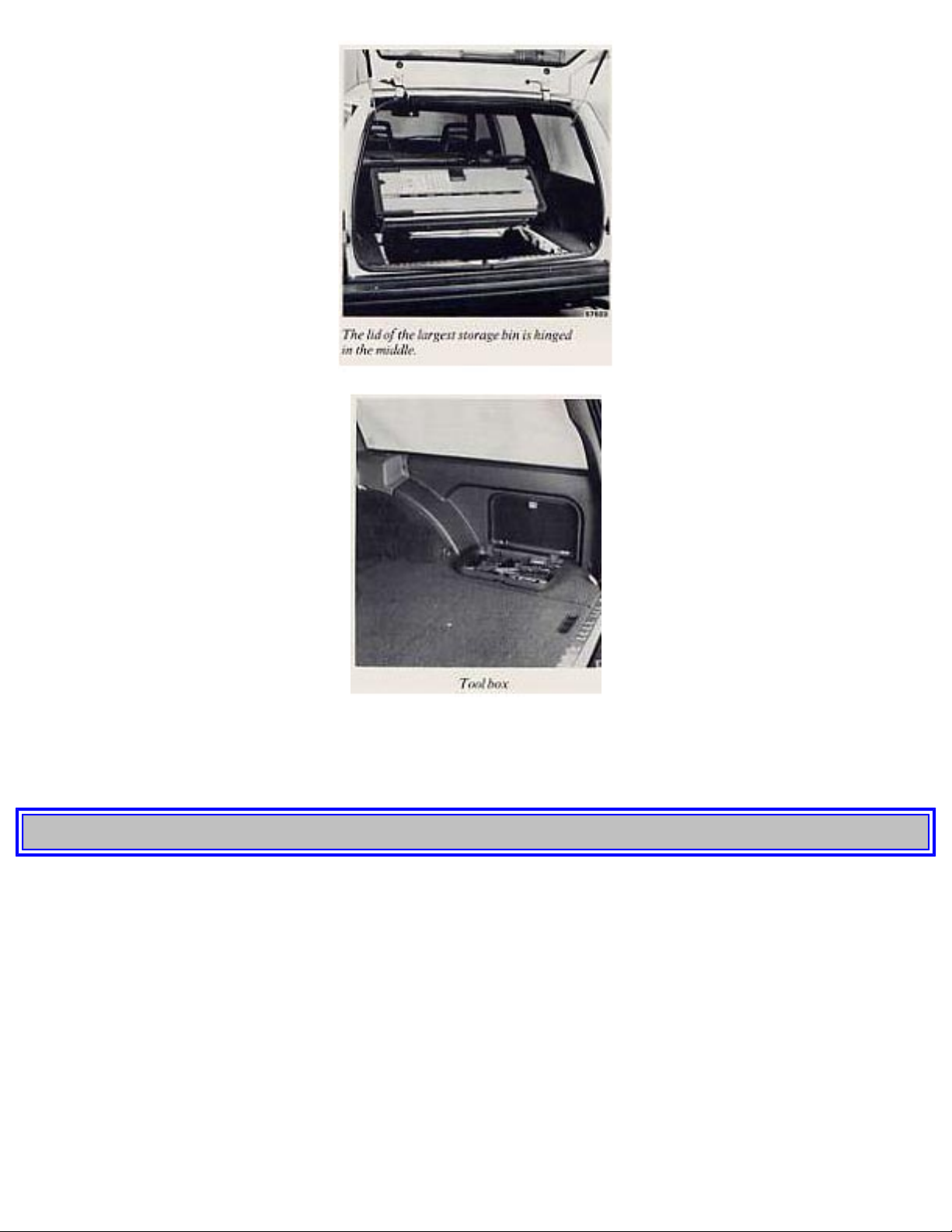
There are 3 storage bins under the floor of the cargo space; the largest bin can be locked with a key.
file:///K|/ownersdocs/1986/1986_740/86740_02.htm (17 of 22)12/30/2006 7:51:29 AM
Page 46
1986 Volvo 740 GL, GLE, Turbo
Tool box
The tool box can be released by turning the catch.
pg. 39 Folding rear seat (wagon)
file:///K|/ownersdocs/1986/1986_740/86740_02.htm (18 of 22)12/30/2006 7:51:29 AM
Page 47
1986 Volvo 740 GL, GLE, Turbo
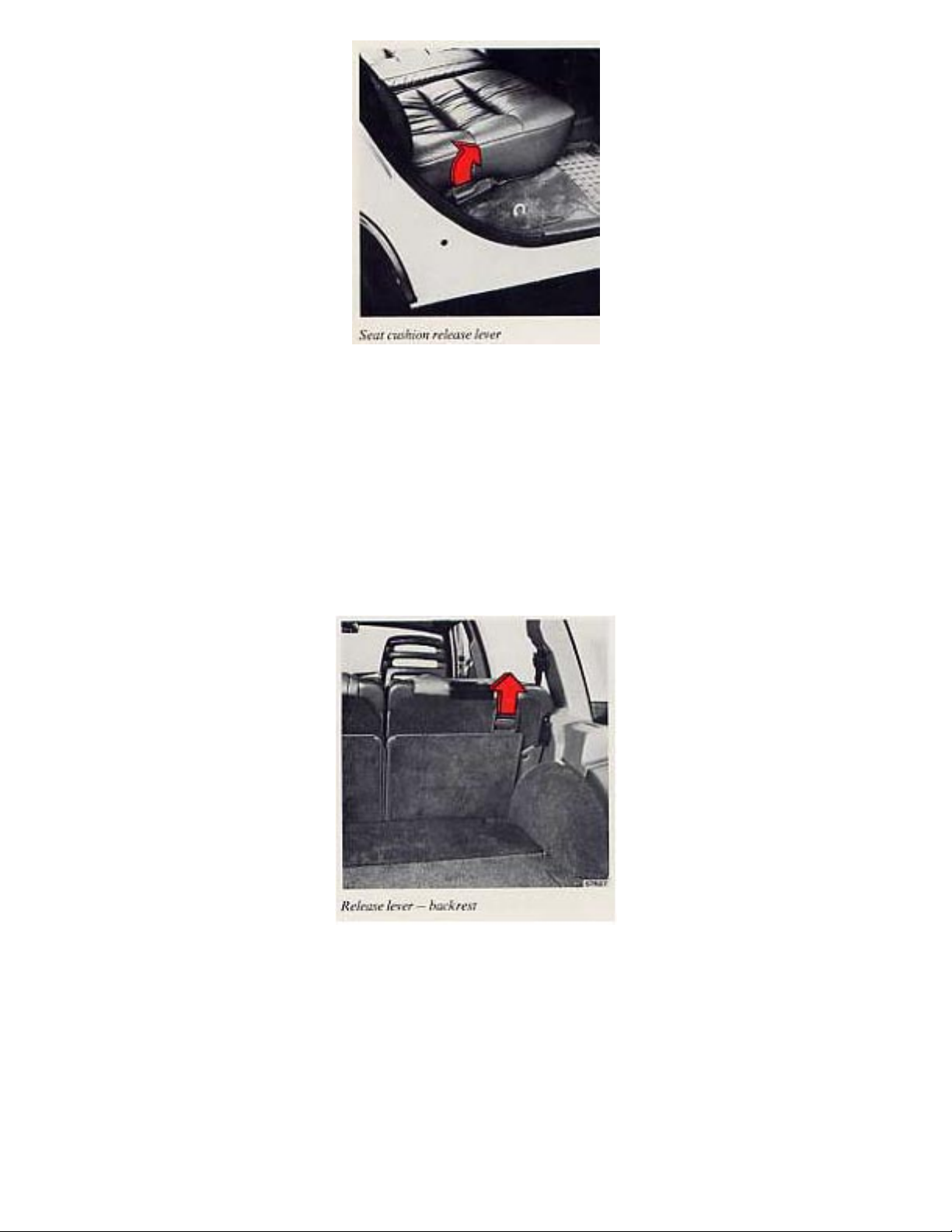
Folding rear seat: increasing the cargo space
The rear seat is split 60/40 so that each section can be folded independently.
Note: Straighten from backrests if they are tilted too far to the rear.
On models so equipped, remove head restraints from the rear seat. This is done by grasping the restraint
and lifting straight up.
Place a hand on the rear of the seat cushion, lift the release lever on the seat cushion, and swing the
cushion up and toward the back of the front seats.
Move the backrest release lever upwards and fold the backrest forward.
file:///K|/ownersdocs/1986/1986_740/86740_02.htm (19 of 22)12/30/2006 7:51:29 AM
Page 48
1986 Volvo 740 GL, GLE, Turbo
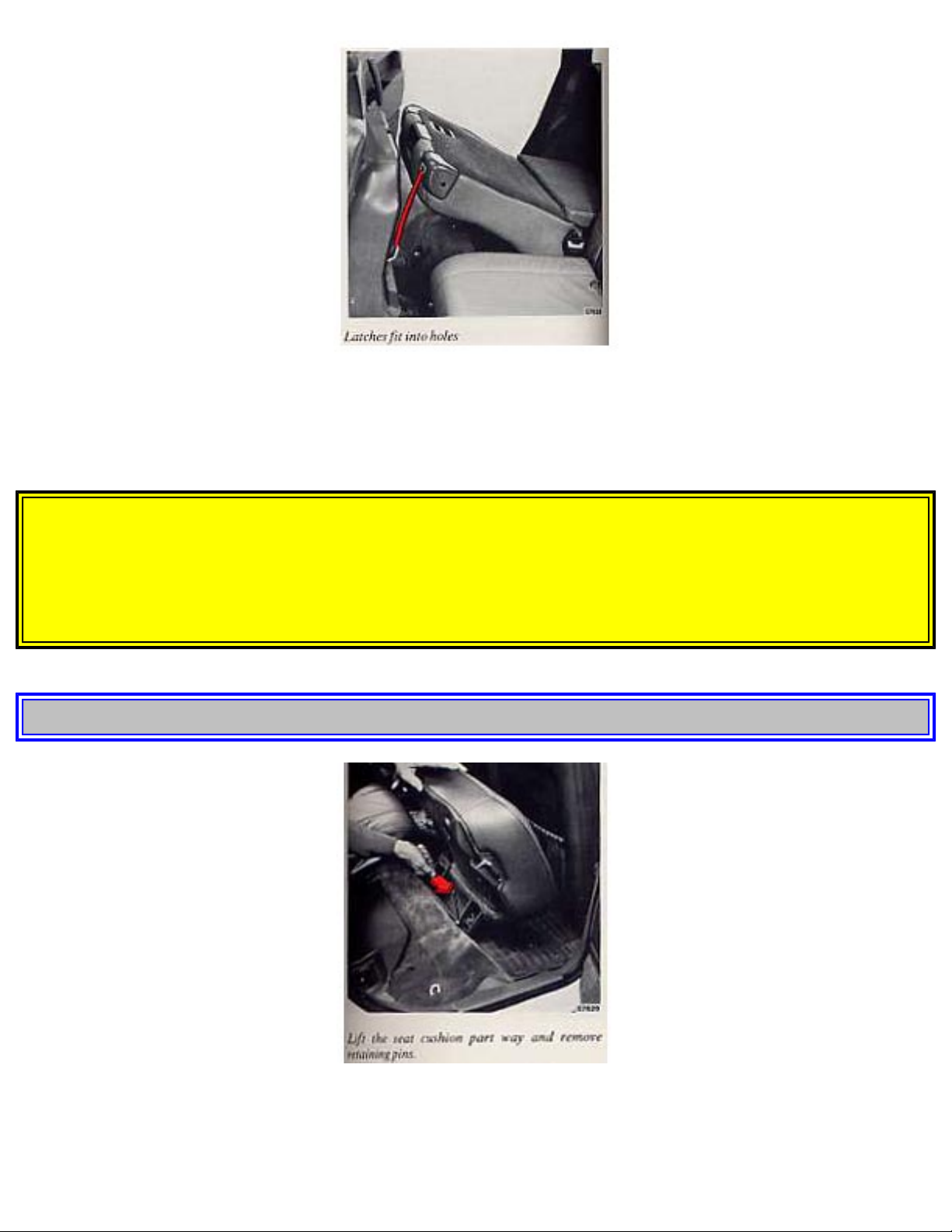
Important: Make sure that the latches on the underneath of the seat cushions engage holes at top edge
of backrest.
Make sure that the seat belts are correctly positioned when returning the seat to its original position.
WARNING!
Do not pile cargo higher that the top of the backrests. This will help prevent luggage, etc. from being
thrown about and, possibly injuring passengers in the event of sudden maneuvers, rapid braking, or an
accident.
pg. 40 Removing seat cushions. Securing cargo (wagon)
Removing seat cushions
The seat cushion can be easily removed to provide a slightly larger cargo storage area.
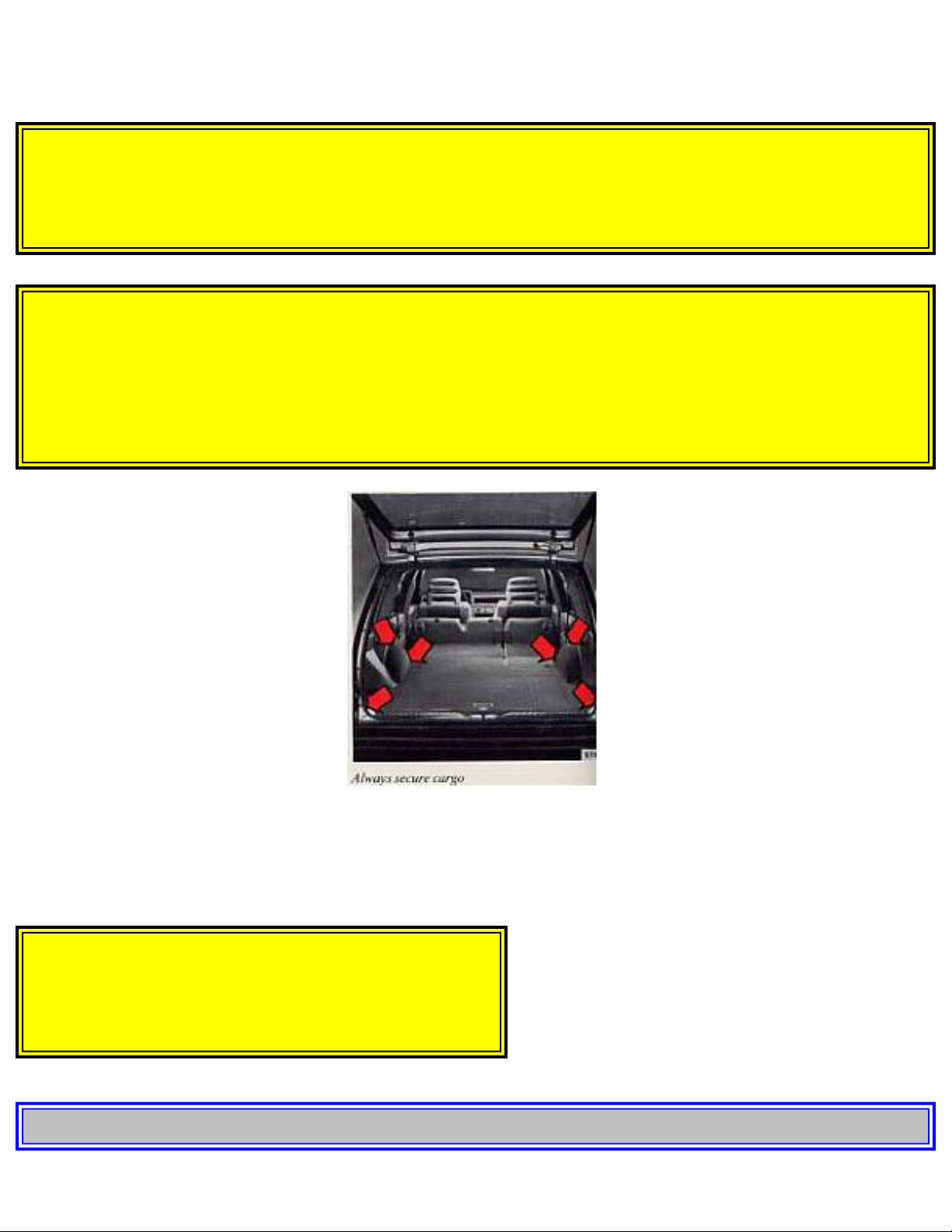
To remove: Lift the seat cushion part way and remove the retaining pins with a twisting motion. (Do not
file:///K|/ownersdocs/1986/1986_740/86740_02.htm (20 of 22)12/30/2006 7:51:29 AM
Page 49
1986 Volvo 740 GL, GLE, Turbo
fold the seat completely as the retaining pins will then be difficult to remove.)
Remove the seat cushion.
WARNING!
Unless the station wagon is equipped with a cargo-compartment seat (Volvo accessory), passengers
should not ride in this section of the car.
WARNING!
Do not place extremely heavy articles against the front seats, as the backrest which is folded down is
then placed under severe strain.
Be sure to secure cargo. Hard and sharp articles could, otherwise, damage the front-seat backrest and/
or cause injury to passengers in the event of rapid braking or a collision.
Securing cargo
As a safety precaution, the cargo space is equipped with six eyelets to which straps can be attached to
secure luggage. Suitable straps or a cargo net can be purchased from your Volvo dealer.
WARNING!
The eyelets are not to be used as passenger
restraints.
pg. 41 Cargo space lighting, Spare tire and jack (wagon)
file:///K|/ownersdocs/1986/1986_740/86740_02.htm (21 of 22)12/30/2006 7:51:29 AM
Page 50
1986 Volvo 740 GL, GLE, Turbo
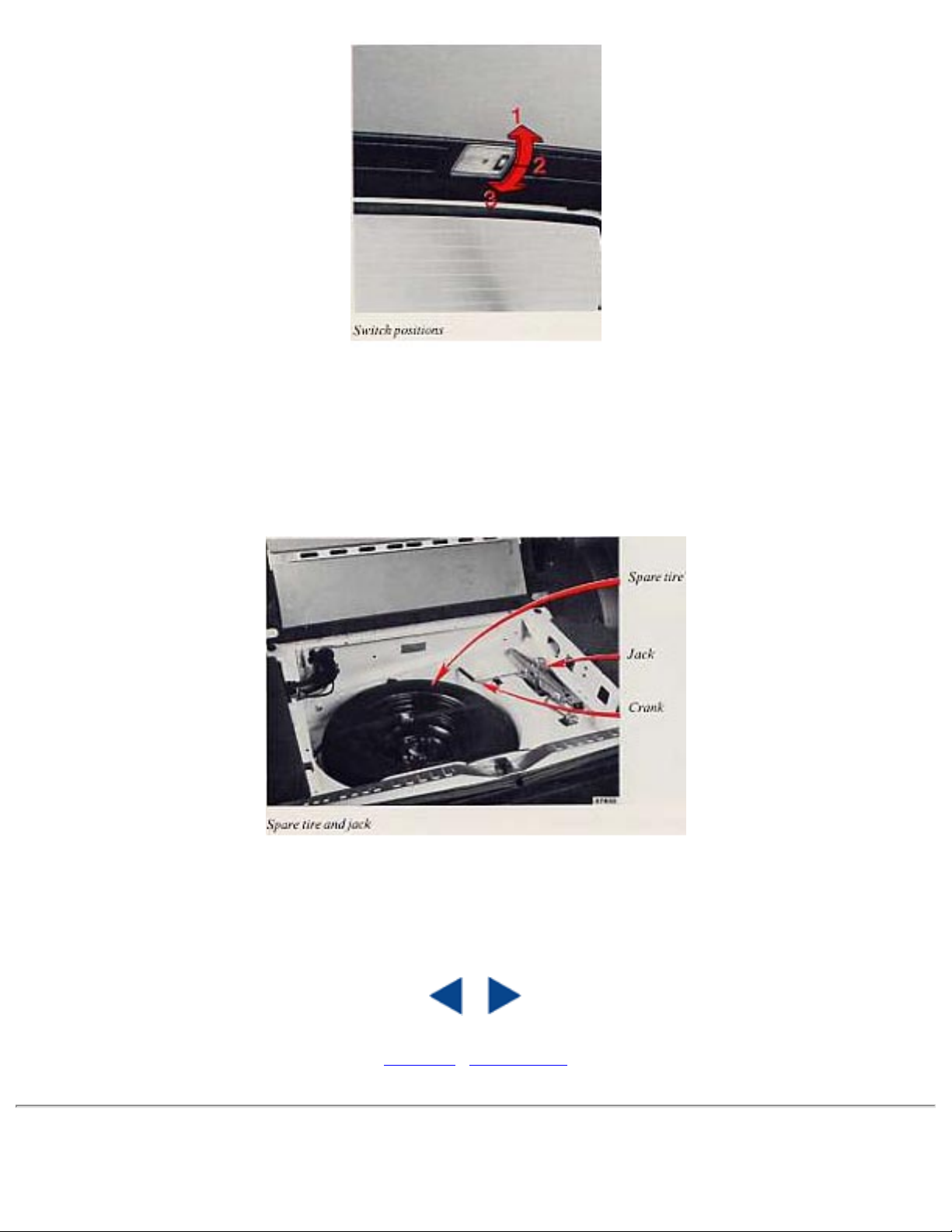
Cargo space lighting
There is an extra courtesy light at the rear of the cargo space.
1 Light comes on when the tailgate is opened
2 The light is always OFF
3 The light is always ON
Spare tire and jack
The spare tire and the jack are located beneath the floor mat in the large storage bin. Always secure the
spare tire and the jack to prevent them from rattling.
Contents | Top of Page
file:///K|/ownersdocs/1986/1986_740/86740_02.htm (22 of 22)12/30/2006 7:51:29 AM
Page 51

1986 Volvo 740 GL, GLE, Turbo
1 9 8 6
VOLVO
740 GL, GLE, Turbo
Starting and driving
pg. 42 Starting and driving. Break-in period
This section on starting and driving contains items such as starting the engine, operating gear selector,
towing, trailers.
Break-in period
42
Fuel requirements, Refueling
43
Economical driving
44
Starting the engine
45
Transmission
46
Points to remember
51
Emergency towing
53
Starting with an auxiliary
battery
55
Catalytic Converter
56
Brakes
57
Towing a trailer
58
Winter driving
59
Before a long distance trip
60
Vehicle storage
61
A new car should be broken-in!
Refrain from utilizing your car's full acceleration during the first 1,200 miles (2,000 km).
Automatic transmission
Do not use "kick-down" during the first 1200 miles (2000 km).
file:///K|/ownersdocs/1986/1986_740/86740_03.htm (1 of 22)12/30/2006 7:51:31 AM
Page 52

1986 Volvo 740 GL, GLE, Turbo
Manual transmission
Do not exceed following speeds:*
First 600 miles(1,000
km)
600-1,200 miles(1,000-2,000 km)
Gear mph km/h mph km/h
first 18 30 25 40
second 30 50 45 70
third 50 80 60 100
fourth 70 110 80 130
overdrive 80 130 90 150
*These are the maximum speeds recommended by the factory. Note that legislation in different countries
and states can stipulate maximum speeds other than those given here.
pg. 43 Fuel requirements, Refueling
Unleaded Fuel
Each Volvo has a catalytic converter and must use only unleaded gasoline (as specified on the
instrument panel and by a label near the filler inlet). US and Canadian regulations require that pumps
delivering unleaded gasoline be labeled "UNLEADED". Only these pumps have nozzles which fit your
car's filler inlet. It is unlawful to dispense leaded fuel into a vehicle labeled "unleaded gasoline only".
Leaded gasoline damages the catalytic converter and the oxygen sensor system. Repeated use of leaded
gasoline will lessen the effectiveness of the emission control system and could result in loss of emission
warranty coverage. State and local vehicle inspection programs will make detection of misfueling easier,
possibly resulting in emission test failure for misfueled vehicles.
Octane Rating
Volvo engines require unleaded gasoline with an (R+M)/2 octane rating (also called the Anti-Knock
Index, or AKI) of 87 or higher. This is generally equivalent to a Research Octane Number (RON) of 91
or higher. For turbocharged engines, Volvo recommends the use of premium unleaded gasoline , with an
(R+M)/2 of 91 or higher, for improved performance and driveability at high altitudes and in hot
climates.
Gasoline Containing Alcohol
Some fuel suppliers sell gasoline containing alcohol without advertising the presence of alcohol. If you
are not sure whether there is alcohol in the gasoline you buy, check with the service station operator.
Blends of unleaded gasoline and ethanol (ethyl alcohol, grain alcohol), sometimes called "gasohol", are
available in some areas. Gasohol, if used, must contain no more than 10 percent ethanol and must have
an (R+M)/2 rating of 87 or higher. If you experience problems with starting, driveability, or fuel
file:///K|/ownersdocs/1986/1986_740/86740_03.htm (2 of 22)12/30/2006 7:51:31 AM
Page 53

1986 Volvo 740 GL, GLE, Turbo
economy with gasohol, you should discontinue its use.
Take care not to spill gasoline during refueling. Gasolines containing alcohol can cause damage to
painted surfaces, which may not be covered under the New Vehicle Warranty.
Do not use gasolines containing methanol (methyl alcohol, wood alcohol). This practice can result in
vehicle performance deterioration and can damage critical parts in the fuel system. Such damage may
not be covered under the NEW VEHICLE LIMITED WARRANTY.
Refueling
The fuel tank filler cap is located behind the door on the left rear fender. Open cap slowly during hot
weather conditions.
When filling, position the cap in the special bracket on the door. After filling the tank, install the cap and
turn until a "click" is heard. The fuel tank is designed to hold approximately 15.8 US gal. (60 liters),
when sufficient volume left over to accommodate possible expansion of the fuel in hot weather.
Be aware that the "usable" tank capacity will be somewhat less than the specified maximum. When the
fuel level is low, such factors as ambient temperature, the fuel's "vapor pressure" characteristics, and
terrain can affect the fuel pumps' ability to supply the engine with an adequate supply of fuel. Therefore,
it is advisable to refuel as soon as possible when the needle nears the red zone. After the needle enters
the red zone, you should be able to drive approximately 25 miles (40 km) depending on driving style and
conditions.
pg. 44 Driving economy
Economical driving does not necessarily mean driving slow
Better driving economy may be obtained by thinking ahead, avoiding rapid starts and stops and
adjusting the speed of your vehicle to changing traffic conditions. Observe the following rules:
● Bring the engine to normal operating temperature as soon as possible by driving with a light foot on
the accelerator pedal for the first few minutes of operation. A cold engine uses more fuel and is subject
to increased wear.
● When possible avoid using the car for driving short distances. This does not allow the engine to reach
normal operating temperature.
● Drive carefully and avoid rapid acceleration and hard braking.
● Do not exceed speed limit.
● Avoid carrying unnecessary items (extra load) in the car.
● Check tire pressure regularly (check when tires are cold)
● Remove snow tires when threat of snow or ice has ended.
● Note that roof racks, ski racks, etc., increase air resistance and thereby fuel consumption.
● Turbo: try to keep the boost pressure gauge in the black range.
● Utilize overdrive at speeds above approx. 45 mph (70 km/h)
● Avoid using automatic transmission where applicable kick-down feature unless necessary.
● On cars with manual transmission, utilize the shift indicator light (S.I.L.). See "instruments".
● On models so equipped, avoid using the air conditioning when it is not required. When engaged, the
file:///K|/ownersdocs/1986/1986_740/86740_03.htm (3 of 22)12/30/2006 7:51:31 AM
Page 54

1986 Volvo 740 GL, GLE, Turbo
air conditioner's compressor places on additional load on the engine.
Other factors which decrease gas mileage are:
● Worn or dirty spark plugs
● Incorrect spark plug gap
● Dirty air filter
● Incorrect valve clearance
● Dirty engine oil and clogged oil filter
● Dragging brakes
● Incorrect front end alignment
● Low tire pressure
Some of the above mentioned items and others are checked at the standard Maintenance Service
intervals.
pg. 45 Starting the engine, Turbo caution
To start the engine:
1 Enter the car and fasten seat belt.
2 Apply the parking brake, if not already set.
3 Place the gear selector lever in neutral/park (position N or P on cars with automatic
transmission).
4 Without touching the accelerator pedal turn the ignition key to starting position. Release the key
as soon as the engine starts.
If the engine does not start at once, depress the throttle pedal half way and keep it there until the
engine starts.
Avoid repeated short attempts to start (fuel is injected every time the starter is engaged when engine is
cold). Allow the starter to operate for a longer time (but not more than 15 - 20 seconds).
Do not race a cold engine immediately after starting. Oil flow may not reach some lubricating
points fast enough to prevent engine damage.
WARNING!
Always open the garage doors fully before starting the engine inside a garage to ensure adequate
ventilation. The exhaust gases contain carbon monoxide, which is invisible and odorless but very
poisonous.
Engine warm-up - initial driving procedure
Experience shows that engines in vehicles driven short distances are subject to abnormally-rapid wear
because the engine never reaches normal operating temperature. It is therefore beneficial to reach normal
file:///K|/ownersdocs/1986/1986_740/86740_03.htm (4 of 22)12/30/2006 7:51:31 AM
Page 55
1986 Volvo 740 GL, GLE, Turbo
operating temperature as soon as possible. This is best achieved by driving with a light foot on the
accelerator pedal for a few minutes after starting, rather than prolonged idling.
Turbo caution
Never race the engine immediately after starting. Oil flow may not reach some lubricating points fast
enough to prevent engine damage.
Before switching off the engine, let it operate at idle for a short time to allow the spinning of the turbocompressor's turbine vanes to slow. After hard driving, this idle time should last a couple of minutes,
during which the vanes will slow and the compressor will cool down while still receiving lubrication. If
the turbine vanes are spinning at high speeds when the engine is switched off, there is a great risk of heat
damage and/or turbine seizure due to lack of lubrication.
Do not race the engine just prior to switching off!
pg. 46 Manual transmission + overdrive
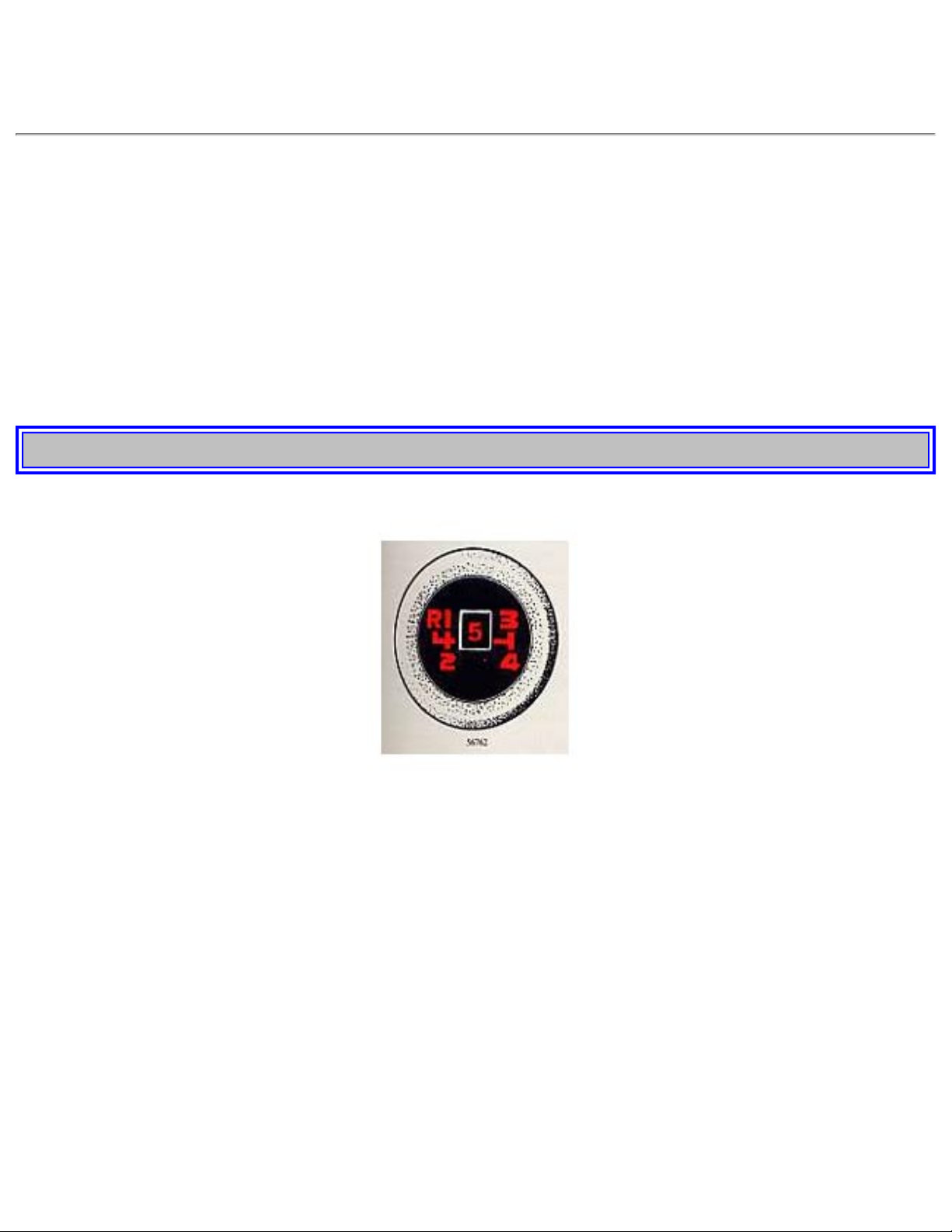
Gear lever positions
Depress the clutch fully when shifting gears, and when engaging/disengaging overdrive (5th gear).
Remove foot from the clutch pedal after shifting.
Overdrive (5th gear)
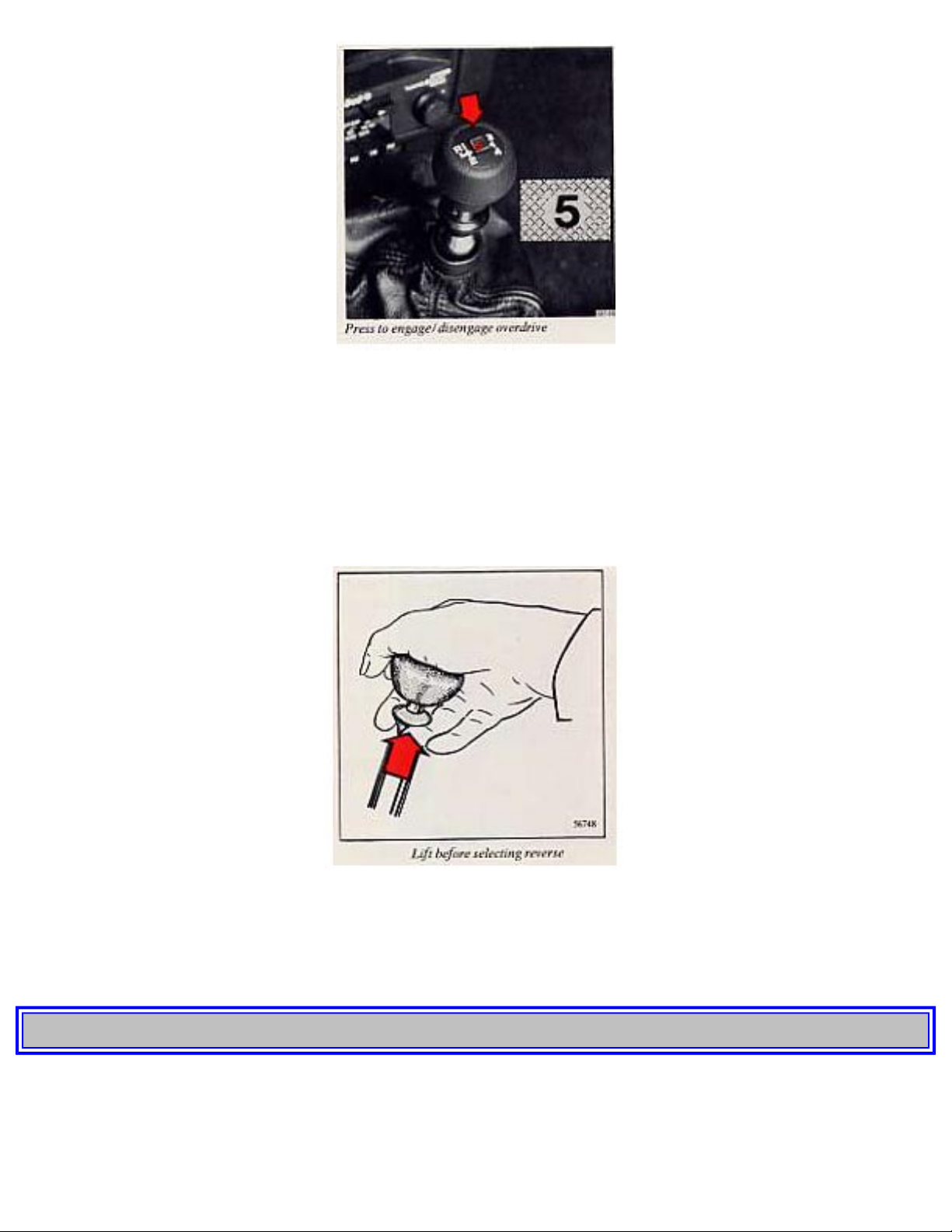
The overdrive can be engaged in 4th gear only. Depress the clutch fully when engaging/disengaging.
The overdrive is engaged/disengaged by depressing the switch on top of the gear shift lever.
file:///K|/ownersdocs/1986/1986_740/86740_03.htm (5 of 22)12/30/2006 7:51:31 AM
Page 56
1986 Volvo 740 GL, GLE, Turbo
The overdrive is automatically disengaged when downshifting from 4th gear, but you should always
disengage the overdrive manually before downshifting.
To improve mileage it is recommended to use the overdrive as much as possible at speeds above 45 mph
(70 km/h).
The green control light "5" on the dashboard lights when the overdrive is engaged.
See "Shift indicator light" section for more information on economical use of the manual transmission.
Reverse gear
The detent collar on the gear lever must be lifted prior to engaging reverse gear. This prevents
unintentional selection of the gear.
pg. 47 Automatic transmission
file:///K|/ownersdocs/1986/1986_740/86740_03.htm (6 of 22)12/30/2006 7:51:31 AM
Page 57
1986 Volvo 740 GL, GLE, Turbo
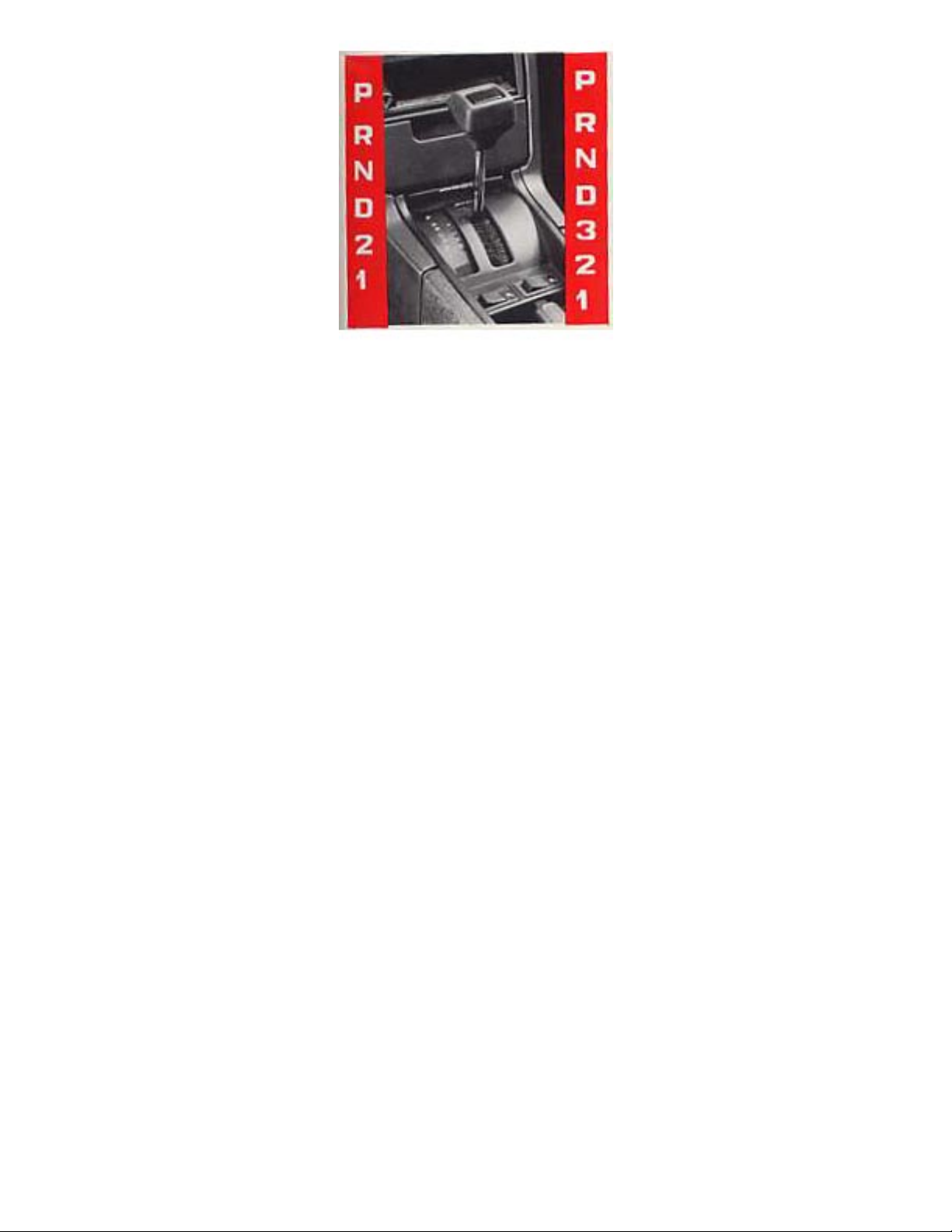
AW71 tranmission (Turbo models)
ZF transmission (GL, GLE models)
Gear selector positions
P park
R reverse
N neutral
D drive
3
2 intermediate
1 and low
P (Park)
Use this position when parked with the engine running or stopped.
Never use P while car is in motion.
The transmission is mechanically-locked when in position P. Also, apply the parking brake when
parking on grades.
Never leave the car when the engine is running. If, by mistake, the gear selector is moved from P,
the car may start moving.
R (Reverse)
Never engage R while car is moving forward.
N (Neutral)
Neutral position = no gear is engaged.
Use parking brake.
Driving gears
D (Drive)
file:///K|/ownersdocs/1986/1986_740/86740_03.htm (7 of 22)12/30/2006 7:51:31 AM
Page 58

1986 Volvo 740 GL, GLE, Turbo
D is the normal driving position. Upshifts and downshifts of the forward gears occur automatically and
are governed by accelerator pedal position and vehicle speed.
Lock-up
(GL, GLE models; ZF transmission)
With the gear selector in position D (Drive) the lockup device disengages the torque converter at speeds
above approx. 47-56 mph (75-90 km/h). It provides lowered engine speeds and improved mileage.
The lockup engagement may be noticed as an extra upshift when accelerating.
3 (upper position)
(GL, GLE models; ZF transmission)
Upshifts and downshifts between 1st, 2nd, and 3rd gears occur automatically. upshift to D does not
occur.
Position 3 can be used ...
● for passing
● when towing a trailer
● for stop and go city driving
83 mph (135 km/h)* is maximum permitted speed in position 3
*Always observe posted speed limits!
pg. 48 Automatic transmission
2 (intermediate position)
Upshifts and downshifts of first two gears (low and intermediate) occur automatically. No upshifts to
3rd or 4th gear occurs. Position 2 may be used to obtain forced downshift to 2nd gear for increased
engine braking effect.
1 (low position)
If position 1 is selected when driving at high speeds, 2 is engaged first and l when the speed has dropped
approx. 30 mph (50 km/h). No upshift can occur once l is engaged. Use position l to select low gear
when no upshift is desired, for instance, when entering and descending steep grades.
file:///K|/ownersdocs/1986/1986_740/86740_03.htm (8 of 22)12/30/2006 7:51:31 AM
Page 59
1986 Volvo 740 GL, GLE, Turbo
Shift gate: AW71 transmission (Turbo models)
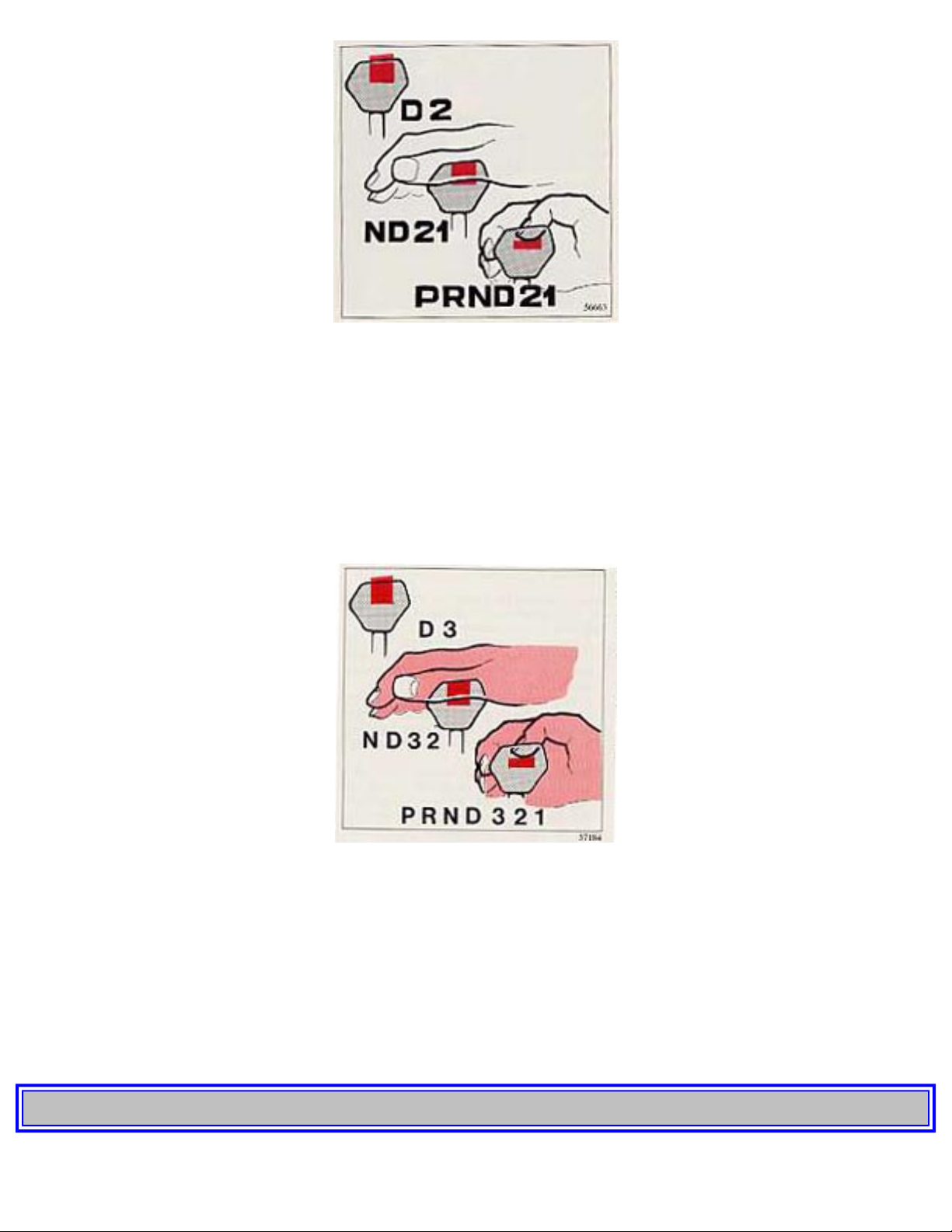
The gear selector can be moved freely between D and 2. Selections of other positions are obtained by
depressing the selector knob prior to moving the selector.
Slightly depressing the selector knob allows selection of positions N, D, 2 and 1.
Fully depressing the selector knob allows selection of positions R and P. This is also necessary when
initially bringing the selector out of position P.
Fully depressing the selector knob thus permits shifting freely between all positions.
Shift gate: ZF Transmission (GL, GLE models)
The gear selector can be moved freely between D and 3. Selections of other positions are obtained by
depressing the selector knob prior to moving the selector.
Slightly depressing the selector knob allows selection of positions N, D, 3 and 2.
Fully depressing the selector knob allows selection of positions R, P and 1. This is also necessary when
initially bringing the selector out of position P.
Fully depressing the selector knob thus permits shifting freely between all positions.
pg. 49 Automatic transmission
file:///K|/ownersdocs/1986/1986_740/86740_03.htm (9 of 22)12/30/2006 7:51:31 AM
Page 60
1986 Volvo 740 GL, GLE, Turbo
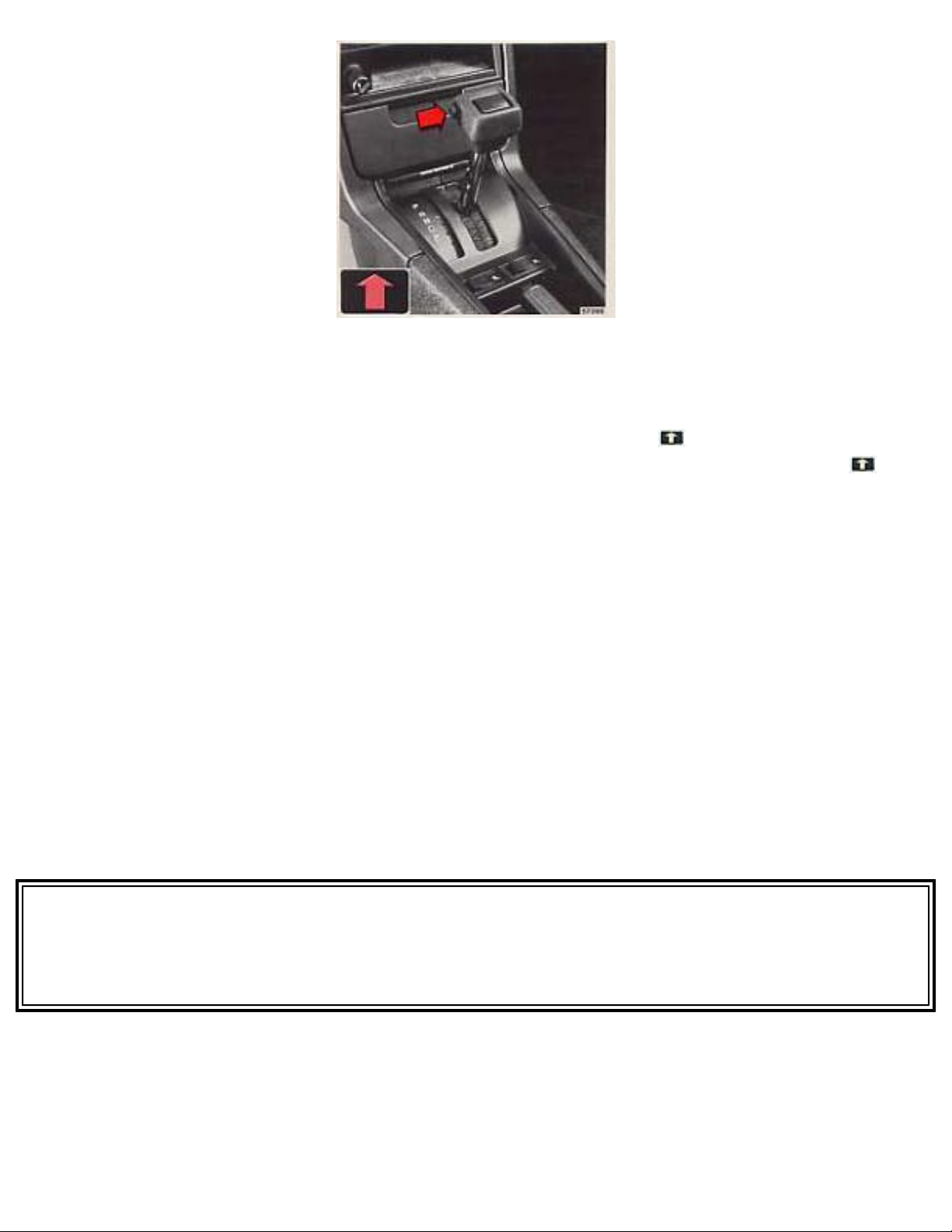
4th gear disengagement: AW71 transmission(Turbo models)
The 4th gear is engaged automatically after the transmission has shifted through 1st, 2nd and 3rd gears
at certain speeds and loads. By pressing in the button on the side of the selector lever, the 4th gear can be
disengaged, thus providing a three-speed transmission. As a reminder the light on the dashboard
glows. By pressing in the button again, the transmission reverts to four-speed operation and the light
shuts off.
Disengage the 4th gear when:
- towing a trailer
- driving in mountainous regions
Since using the 4th gear improves fuel economy, it should be used as often as possible in conditions
other than those stated above.
Kick-down
Automatic shift to a lower gear is achieved by depressing the throttle pedal fully and briskly. An up-shift
will be achieved when approaching the top speed for a particular gear or by releasing the throttle pedal
slightly.
Kick-down can be used for maximum acceleration or when passing at highway speeds below a certain
limit.
IMPORTANT NOTE: Certain 740 GLE station wagons are equipped with AW70 automatic
transmission. If your car is so equipped refer to shift pattern illustration, descriptions and instructions
designated for "AW71 transmission (Turbo models)".
file:///K|/ownersdocs/1986/1986_740/86740_03.htm (10 of 22)12/30/2006 7:51:31 AM
Page 61

1986 Volvo 740 GL, GLE, Turbo
NOTE:
● Never select P or R while the car is in motion.
● When initially selecting positions D, 3, 2, 1, or R the car should be standing still with the engine
idling.
● The gear selector should not be downshifted to 2 or 1 at speeds above 75 mph (125 km/h).*
*Always observe local speed limits!
pg. 50 Automatic transmission
Starting and stopping a car equipped with automatic transmission
1. Fasten the seat belts.
2. Apply the parking brake and press the brake pedal firmly to hold the car (to prevent it from moving
when the gear selector is moved).
3. Select position P or N. (engine cannot be started in any other position.)
4. Start the engine by turning the starting (ignition) key.
5. Select desired gear. The gear engages with a slight delay, especially noticed in R.
Engine should be idling; never accelerate until after you feel the gear is engaged!
Too rapid acceleration immediately after selecting gears will provide harsh engagement and premature
transmission wear.
6. Release the brakes and accelerate.
To stop the car, release the accelerator pedal and apply the brakes.
Selecting position N when standing still with engine running for prolonged periods of time will
avoid overheating transmission fluid.
The following "Special Tips" apply to cars with automatic transmission
● For steep hills and when driving for prolonged periods at low speeds position 1 should be selected.
Avoid, however, repeated changes since this can cause overheating of the transmission oil. For driving
on mountain roads with long persistent uphill gradients, select position 2.
● When negotiating long, steep downhill slopes, position 1 should be selected and position 2 for less
severe inclines, in order to obtain the best possible engine braking effect.
● Do not hold the car stationary on an incline by using the accelerator pedal; instead, engage the parking
brake. This prevents unnecessary heating of the transmission oil.
● When towing, prepare as follows:
AW71 Transmission (Turbo models):
Disengage the 4th gear (the indicator light on the instrument panel goes on).
ZF Transmission (GL, GLE models):
file:///K|/ownersdocs/1986/1986_740/86740_03.htm (11 of 22)12/30/2006 7:51:31 AM
Page 62

1986 Volvo 740 GL, GLE, Turbo
Disengage position D by selecting gear position 3. This prevents upshifts to Drive and helps ensure
lower transmission oil temperatures.
WARNING!
Always place gear selector securely in Park, and apply parking brake before leaving vehicle. Never
leave car unattended with engine running.
pg. 51 Points to remember
Cooling system
The risk for overheating is greatest, especially in hot weather, when:
● towing a trailer up steep inclines for prolonged periods at full throttle and low engine rpm.
● idling for prolonged periods while the air conditioning system is in operation.
● stopping the engine suddenly after high speed driving (so-called "after-boiling" can occur).
To avoid overheating, the following rules should be followed:
● Reduce speed and downshift when towing a trailer up long, steep inclines. The risk of overheating can
be reduced by switching off the air conditioning system for a short time.
● Do not let the engine idle unnecessarily for prolonged periods.
● Do not stop the engine immediately after high-speed driving, but instead, allow the engine to idle for
1/2-1 minute before switching off.
When the risk of overheating is imminent, or in the event of overheating, (the temperature gauge goes
repeatedly into, or stays continually in, the red section) the following precautions should be taken:
● Switch off the air conditioning system.
● Stop the car and put the gear lever into neutral (position N). Do not stop the engine!
● Increase the engine speed to approx. 2000 rpm (twice idling speed).
Electrical system
When replacing the battery or when carrying out work involving the electrical system, the following
should be observed:
● A battery connection to the wrong terminal will damage the diodes. Before connections are made,
check the polarity of the battery with a voltmeter.
● If booster batteries are used for starting, they must be properly connected to minimize the risk of the
diodes being damaged. For correct connection, see "Jump starting" section.
● Never disconnect the battery circuit (for example, to replace the battery) while the engine is running,
as this will immediately ruin the alternator. Always make sure that all the battery connections are
properly tightened.
● If any electrical-welding work is performed on the vehicle, the ground lead and all the connecting
file:///K|/ownersdocs/1986/1986_740/86740_03.htm (12 of 22)12/30/2006 7:51:31 AM
Page 63

1986 Volvo 740 GL, GLE, Turbo
cables of the alternator must be disconnected and the welder cables placed as near the welding point as
possible.
WARNING! Do not drive with trunk lid or tailgate open!
Poisonous exhaust gases may enter via the open trunk lid or tailgate. If the trunk lid/tailgate must be
kept open for any reason, proceed as follows:
● Close the windows.
● Set the ventilation system control to and fan control to its highest setting.
Driving through standing water
CAUTION:
Drive slowly and carefully if going through standing water (i.e. flooded roadways, etc.). Damage to
engine could result if excess water is ingested through the air intake system. Never drive the vehicle in
water deeper that 1 foot (300 mm).
pg. 52 Points to remember
Weight distribution affects handling
At the specified curb weight your car has a tendency to understeer, which means that the steering wheel
has to be turned more than might seem appropriate for the curvature of a bend. This ensures good
stability and reduces the risk of rear wheel skid. Remember that these properties can alter with the
vehicle load. The heavier the load in the trunk, the less the tendency to understeer.
Handling, roadholding
Vehicle load, tire design, and inflation pressure, all affect vehicle handling. Therefore, check that the
tires are inflated to the recommended pressure according to the vehicle load. See "Tire pressure" section.
CAUTION!
It is recommended that tires of the same make and dimensions be used on all four wheels. Do not use
bias ply tires as this will adversely alter vehicle handling characteristics.
file:///K|/ownersdocs/1986/1986_740/86740_03.htm (13 of 22)12/30/2006 7:51:31 AM
Page 64
1986 Volvo 740 GL, GLE, Turbo
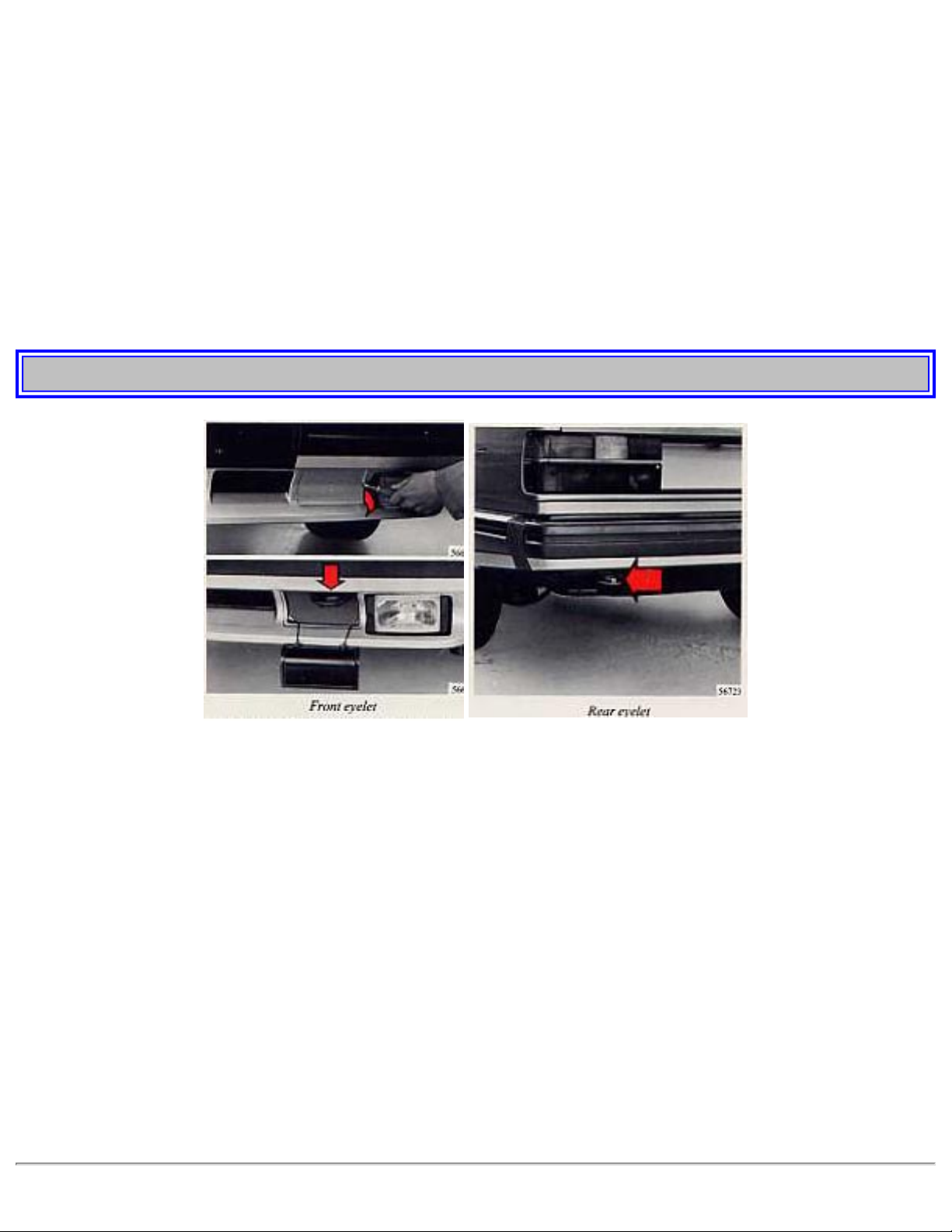
Roof racks (removable and permanent)
Roof racks are available as Volvo accessories.
Observe the following points when in use:
● Avoid single-point loads. Distribute the load evenly.
● Place heavier cargo at the bottom of load.
● Observe that center of gravity and handling are influenced by load weight.
● Increasing load size increases wind resistance and, thus, adversely affects fuel economy.
● Anchor the cargo correctly with a cord.
● Drive carefully. Avoid rapid starts, fast cornering and hard braking.
● Max. roof load is 220 lbs (100 kg) for removable rack mounted on drip rails.
● Max. roof load is 70 Ibs (30 kg) for permanent rack mounted directly on roof.
pg. 53 Emergency towing (pulling of vehicle)
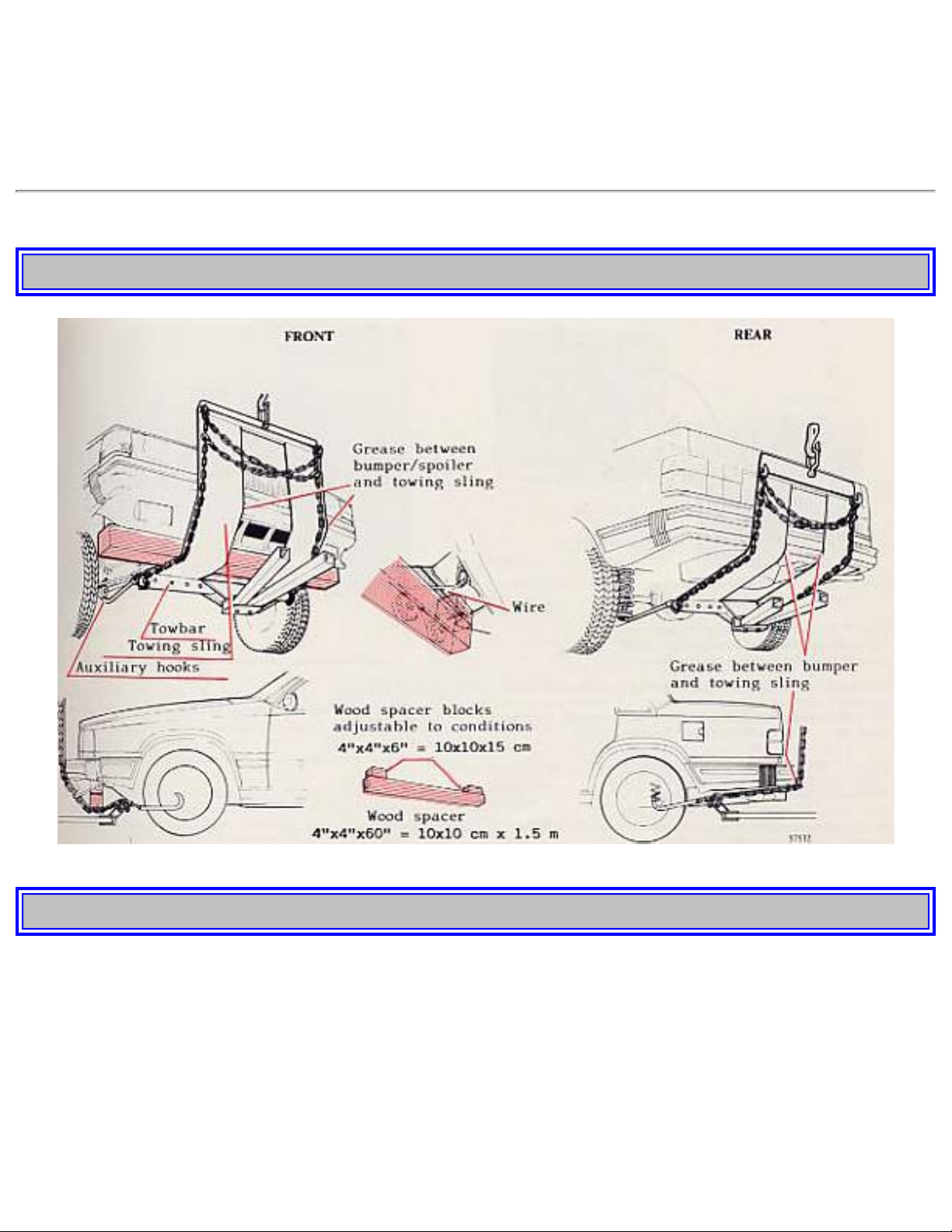
Precautionary steps to Observe when car is in tow:
● Steering must be unlocked.
● Please check with state and local authorities before attempting this type of towing, as vehicles
being towed are subject to regulations regarding maximum towing speed, length and type of
towing device, lighting, etc.
● Remember that power brake and power steering assists will not be available when engine is
inoperative. Brake pedal pressure required is 3-4 times above normal and greater steering effort must be
exerted.
● Gear selector in position N. Check transmission oil level (see section titled "Transmission oil")
● Maximum speed: 20 mph (30 km/h).
● Maximum distance with rear wheels on ground: 20 miles (30 km).
Cars equipped with automatic transmission cannot be started by pushing or pulling the car.
file:///K|/ownersdocs/1986/1986_740/86740_03.htm (14 of 22)12/30/2006 7:51:31 AM
Page 65
1986 Volvo 740 GL, GLE, Turbo
CAUTION:
The towing eyelets must not be used for pulling another vehicle out of a ditch or any similar purpose
involving severe strain.
pg. 54 Vehicle towing information
pg. 55 Jump starting
file:///K|/ownersdocs/1986/1986_740/86740_03.htm (15 of 22)12/30/2006 7:51:31 AM
Page 66
1986 Volvo 740 GL, GLE, Turbo
CAUTION:
Improper hook-up of jumper cables or use of other than 12-volt batteries could result in damage to
equipment and/or battery.
Check that cars are not touching to prevent premature completion of negative circuit.
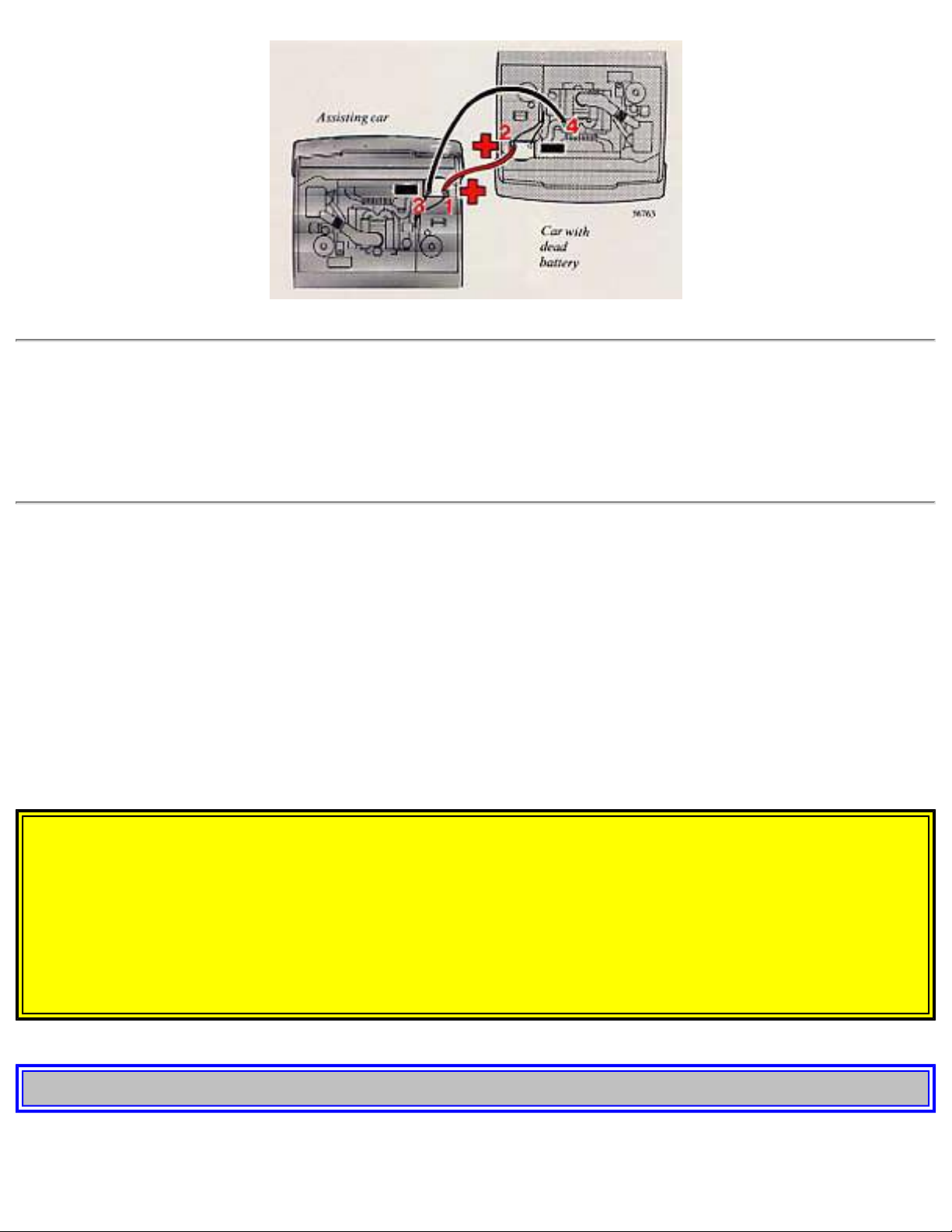
Note position of the battery terminals and using jumper cables:
First connect booster battery positive (+) terminal (1) to car battery positive (+) terminal (2).
Then connect booster battery negative (-) terminal (3) to a stationary solid metal part on the engine at a
point away from the battery (4).
Do not connect booster cable to any part of fuel system or any moving parts. Avoid touching hot
manifolds.
After engine has started, remove first the negative (-) terminal jumper cable. Then remove the positive
(+) terminal jumper cable.
WARNING!
To reduce the possibility of explosion, never expose battery to open flame or electric spark. Do not
smoke near battery. Batteries generate hydrogen gas which is flammable and explosive.
Battery fluid contains sulfuric acid. Do not allow battery fluid to contact eyes, skin, fabrics or painted
surfaces. If contact occurs, flush affected area immediately with water.
Obtain medical attention immediately if eyes are affected.
pg. 56 Catalytic Converter
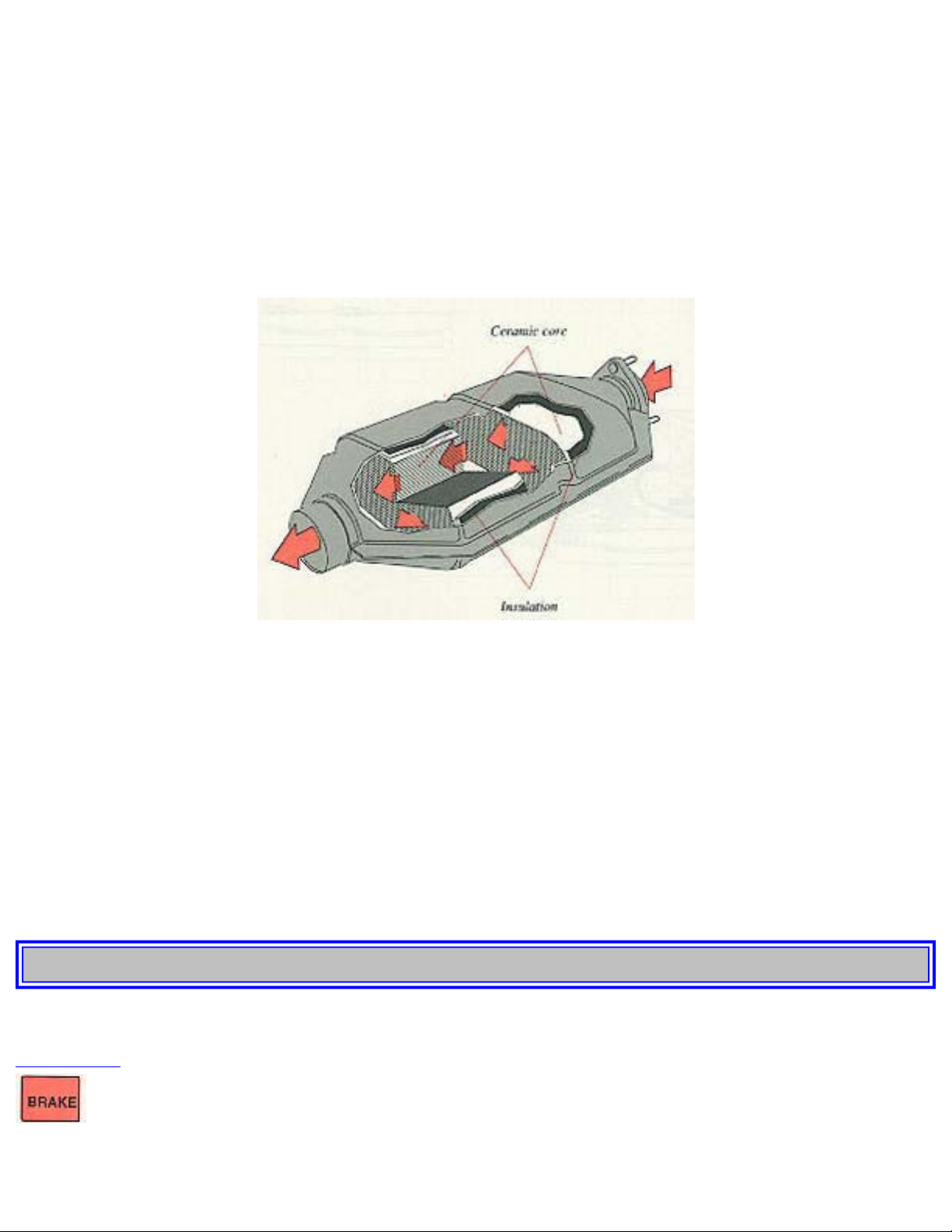
Catalytic Converter Cautions
file:///K|/ownersdocs/1986/1986_740/86740_03.htm (16 of 22)12/30/2006 7:51:31 AM
Page 67
1986 Volvo 740 GL, GLE, Turbo
● Keep your engine properly tuned. Certain engine malfunctions, particularly involving the electrical,
fuel or ignition systems, may cause unusually high converter temperature. Do not continue to operate
your vehicle if you detect engine misfire, noticeable loss of power or other unusual operating
conditions, such as engine overheating or backfires. A properly tuned engine will help avoid
malfunctions that could damage the catalytic converter.
● Remember that tampering or unauthorized modifications to the engine or the vehicle may be illegal
and can cause catalyst or exhaust system overheating. This include Altering fuel injection settings or
components. Adjusting ignition timing beyond specified limits. Altering emission system components or
location or removing components. Repeated use of leaded fuel.
● Do not park your car over combustible materials, such as grass or leaves, which can come into contact
with the hot exhaust system and cause such materials to ignite under certain wind and weather
conditions.
● Excessive starter cranking, in excess of one minute, with an intermittently-firing or flooded engine,
can cause catalyst or exhaust system overheating. This also applies to lengthy pushing or towing of
vehicle to start (manual transmission only).
NOTE: Unleaded fuel is required for cars with catalytic converter. A label on the instrument
panel and inside fuel tank Filler door will remind owners and filling station attendants of this
requirement.
Important! It is unlawful to dispense leaded fuel into any vehicle labeled "unleaded gasoline only".
pg. 57 Brake system
If one of the brake circuits should malfunction, the red warning light will come on
(see page 8)
file:///K|/ownersdocs/1986/1986_740/86740_03.htm (17 of 22)12/30/2006 7:51:31 AM
Page 68

1986 Volvo 740 GL, GLE, Turbo
The pedal stroke increases slightly and the pedal feels softer but the pedal pressure required does not
increase noticeably.
If the red warning light comes on: stop immediately, open the hood and check brake fluid level (see
"Brake fluid, power steering" section).
● Fluid level below MIN mark: do not drive. Tow car to shop for check/repair of brake system.
● Fluid level between MIN and MAX mark: proceed with extreme caution to a Volvo dealer for an
inspection of the brake system.
If the brake power-assist does not function
The power assist to the brakes functions only when the engine is running. When the car is moving
without the engine running the brake pedal pressure required to stop the car is increased by 3-4 times.
The brake pedal feels stiff and hard.
Moisture on brake discs and brake pads affects braking.
Driving in rain and slush or passing through an automatic car wash can cause water to collect on the
brake discs and pads. This will cause a delay in braking effect when the pedal is depressed. To avoid
such a delay when the brakes are needed, depress the pedal occasionally when driving through rain,
slush, etc. This will remove the water from the brakes. Check that brake application feels normal! This
should also be done after washing or starting in very damp weather.
Severe strain on the brake system
The brakes will be subject to severe strain when driving in mountains or hilly areas. The speed is
usually low which means that the cooling of the brakes is less efficient than when driving on level roads.
To reduce the strain on the brakes it is advisable not to use the brakes excessively.
Instead, shift into a lower gear and let the engine help with the braking. A good rule is to use the same
gear downhill as would be used ascending the same grade. For vehicles with automatic transmission use
position 2 or, in some cases, 1.
Do not forget that, if you are towing a trailer, the brakes will be subjected to greater load than is normal.
Breaking-in parking brake (hand brake)
To obtain best parking brake performance, the brake linings should be broken-in.
Stop 5-7 times from 30 mph (50 km/h), transmission in neutral, applying the parking brake with the
release button pressed in during the stop.
The force must not lock the rear wheels. If this happens, release the brake enough to let the wheels
rotate. Drive a mile between each stop to cool the brakes. Check for proper parking brake operation.
NOTE:
The brake lights are not illuminated when applying the parking brake. To warn traffic from behind it is
therefore advisable to depress the brake pedal slightly to illuminate the brake lights.
pg. 58 Trailer hauling
file:///K|/ownersdocs/1986/1986_740/86740_03.htm (18 of 22)12/30/2006 7:51:31 AM
Page 69

1986 Volvo 740 GL, GLE, Turbo
When preparing for trailer hauling, observe the following:
● Use a trailer hitch which meets Federal Safety Standards for rear end collisions (FMVSS 301-75). For
trailer weight exceeding 2,000 lbs (908 kgs) use only a trailer hitch offered as Genuine Volvo Accessory.
An automatic transmission oil cooler must also be installed, since the automatic transmission is subject
to increased load and temperature. Consult your Volvo dealer for further information.
● Maximum trailer weight recommended by Volvo is 3,300 lbs ( 1,500 kgs). Observe legal
requirements of the state in which the vehicles are registered.
All Volvo models are equipped with energy-absorbing shock-mounted bumpers. Trailer hitch
installation should not interfere with the proper operation of this bumper system.
WARNING!
Bumper-attached trailer hitches must not be used on Volvos, nor should safety chains be attached to
the bumper.
Trailer hitches attaching to the vehicle rear axle must also not be used.
CAUTION:
Never connect a trailer's hydraulic brake system directly to the vehicle brake system, nor a trailer's
lighting system directly to the vehicle lighting system. Consult your nearest authorized Volvo dealer
for correct installation.
Trailer towing does not normally present any particular problems, but take into consideration:
● Recommended hitch tongue load is 110 lbs (50 kgs) for trailer weights below 2,650 lbs (1,200 kgs)
and 143-154 lbs (65-70 kgs) for trailer weights above 2,650 lbs (1,200 kgs).
However, the hitch tongue load should not exceed 200 lbs (90 kgs).
● For trailer weights of 2,650-3,300 lbs (1,200-1,500 kgs) a top speed of 50 mph (80 km/h) should
never be exceeded.
● Engine and transmission are subject to increased loads. Therefore, engine coolant temperature should
be closely watched when driving in hot climates or hilly terrain. Use lower gear and turn off air
conditioner if temperature gauge pointer enters the red range.
● Disengage the overdrive on models with automatic transmission.
● Avoid overload and other abusive operation.
● Hauling a trailer affects handling, durability and economy. A trailer air dam (Volvo accessory) will
often improve mileage.
● It is necessary to balance trailer brakes with the towing vehicle brakes to provide a safe stop (check
and observe State/Local regulations).
● More frequent vehicle maintenance is required.
● Remove the ball and drawbar assembly when the hitch is not being used.
file:///K|/ownersdocs/1986/1986_740/86740_03.htm (19 of 22)12/30/2006 7:51:31 AM
Page 70
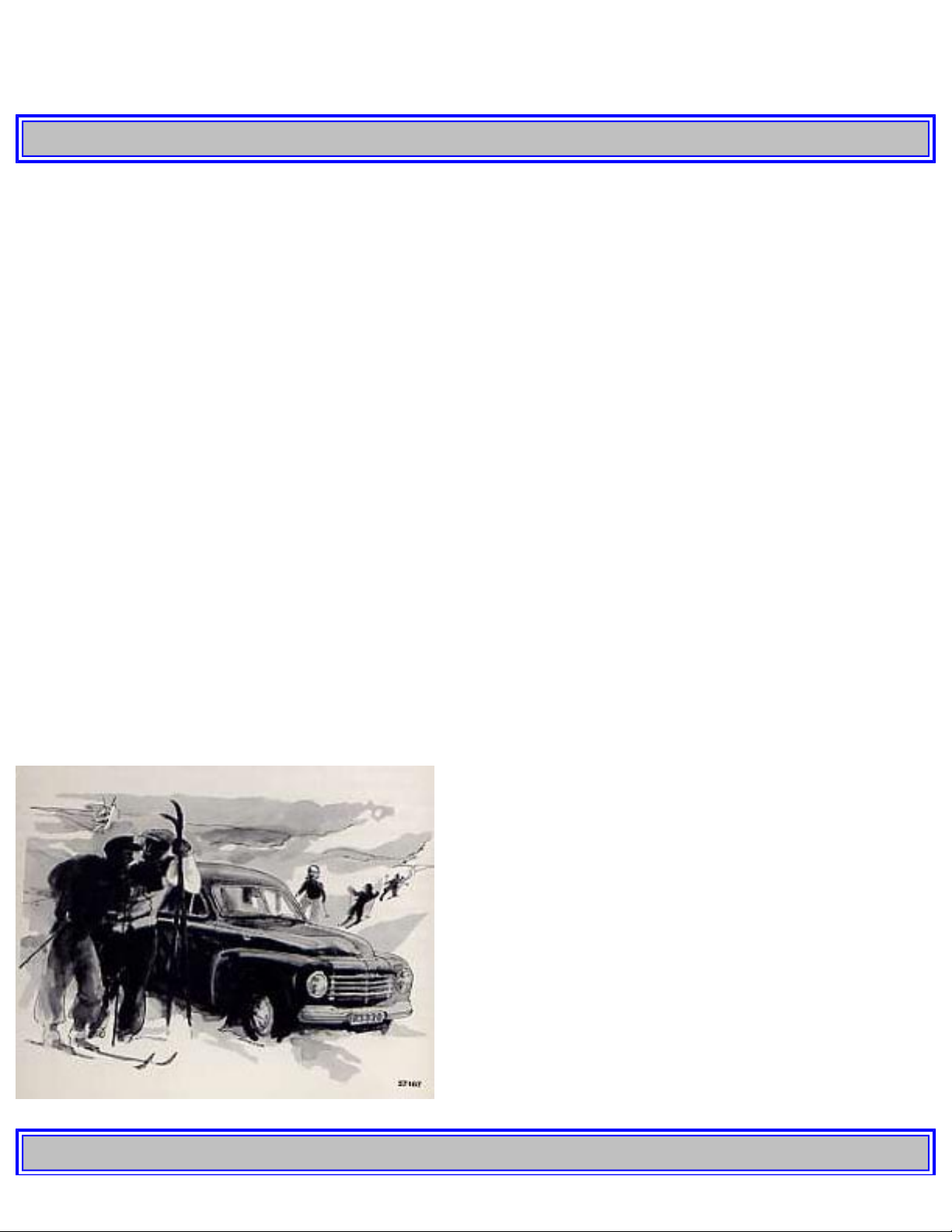
1986 Volvo 740 GL, GLE, Turbo
Note: Refer to section entitled "Automatic transmission" for additional trailer hauling tips.
pg. 59 Winter driving
Cold weather precautions
If you wish to check your car before the approach of cold weather, the following advice is worth noting:
● Make sure that the engine coolant contains at least 50 percent antifreeze: that is, 5.0 qts. (4.25 liters)
Volvo type C blue-green glycol additive. This gives protection against freezing down to -31°F(-35°C).
See section "Coolant".
● Try to keep the fuel tank well filled-this prevents the formation of condensation in the tank. In
addition to extremely cold weather conditions it is worthwhile to add fuel line de-icer before refueling.
● Use the correct grade of engine oil to avoid difficulties when starting. See section "Engine oil".
● The load placed on the battery is greater during the winter since the heater, windshield wipers,
lighting etc. are used more often. Moreover, the capacity of the battery decreases as the temperature
drops. In very cold weather, a poorly charged battery can freeze and be damaged. It is therefore
advisable to check the state of charge more frequently and spray an anti-rust oil on the battery posts.
● To prevent the washer reservoir from freezing, add washer solvents containing antifreeze. This is
important since dirt is often splashed on the windshield during winter driving, thus requiring frequent
use of the washers and wipers.
The Volvo washer solvent should be diluted as follows:
Down to 14°F (-10°C): 1 part anti-freeze and 4 parts water
Down to 5°F (-15°C): 1 part anti-freeze and 3 parts water
Down to 0°F (-18°C): 1 part anti-freeze and 2 parts water
Down to-18°F (-28°C): 1 part anti-freeze and 1 part water
pg. 60 Long distance trip
file:///K|/ownersdocs/1986/1986_740/86740_03.htm (20 of 22)12/30/2006 7:51:31 AM
Page 71
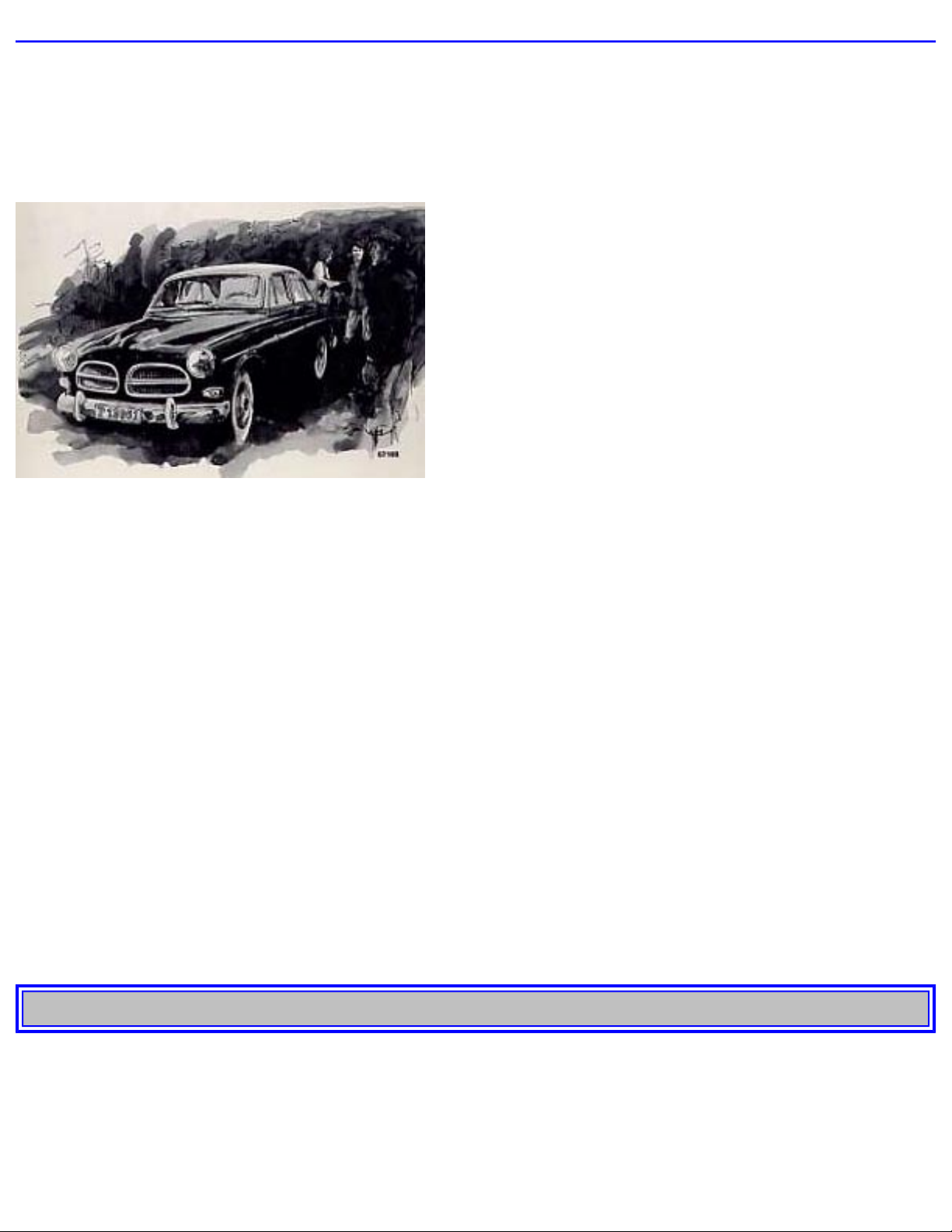
1986 Volvo 740 GL, GLE, Turbo
Before a long distance trip
It is always worthwhile to have your car checked at a Volvo dealer before driving long distances. Your
Dealer will also be able to supply you with bulbs, fuses, spark plugs and wiper blades for your use in the
event that problems occur.
A list of all authorized Volvo dealers in the U.S. and Canada is available.
If you prefer to check the car yourself, please note the following:
● Check that engine runs smoothly and that fuel consumption is normal.
● Check engine oil, coolant levels, and for possible fuel leakage.
● Check transmission oil level and rear axle for leakage.
● Check condition of drive belts.
● Check state of charge of battery.
● Examine tires carefully (the spare tire as well), and replace those that are worn. Check tire pressures.
● The brakes, front wheel alignment, and steering gear should br checked by your Volvo dealer only.
● Check all lights, including high beams.
● Reflective warning triangles are a legal requirement in some countries.
● Have a word with your Volvo dealer concerning engine adjustments if you intend to drive in countries
where it may be difficult to obtain correct fuel.
City driving
City driving can be a severe driving condition. Low operating speeds, long periods of idling combined
with high operating temperatures, air conditioning usage, etc. will make necessary more frequent
servicing (at least every third month).
pg. 61 Vehicle storage
If you do not intend to use your car for a long time
The following points may be of use if you do not intend to use your car for a long time (e.g. because of a
long holiday, winter, etc.)
● Fill fuel tank to prevent water from condensing inside the tank.
file:///K|/ownersdocs/1986/1986_740/86740_03.htm (21 of 22)12/30/2006 7:51:31 AM
Page 72
1986 Volvo 740 GL, GLE, Turbo
● Wash the car carefully and wax it to protect the paint - don't forget the chromed parts.
● The vehicle should be left in a dry, well ventilated garage.
● Do not apply the hand brake. Block the wheels instead.
● Lift the wiper arms away from the windshield.
● Increase tire pressure to maximum allowed, i.e. 36 psi.
● Open one of the windows slightly for ventilation.
● Ensure that the coolant contains sufficient anti-freeze to provide protection down to -22°F (-30°C).
Volvo anti-freeze also provides resistance against corrosion.
● Remove all valuables and lock the car.
● Check the battery voltage at least every 6 weeks.
Contents | Top of Page
file:///K|/ownersdocs/1986/1986_740/86740_03.htm (22 of 22)12/30/2006 7:51:31 AM
Page 73

1986 Volvo 740 GL, GLE, Turbo
1 9 8 6
VOLVO
740 GL, GLE, Turbo
Wheels and tires
pg. 62 Wheels and tires
The handling and riding comfort of the vehicle is dependent on the inflation pressure and the type of
tires fitted. Read the following pages carefully.
General
62
Tread wear
indicators
63
Tire wear
64
Inflation pressures
64
General information
Your vehicle is equipped with 6 x 15" or 14" wheel rims and 185/70 R14 (Gl, GLE) or 195/60R15
(Turbo) tires.
In other words the width of the wheel rim is 6 inches and its diameter 15 inches.
The tire designation is coded as follows:
185 or 195 = tire width in mm.
70 or 60 = tire profile. This is the relationship in percent between the section height and width of the tire.
R = radial tires.
14 or 15 = suitable intended rim size.
The tires have good road holding characteristics and offer very safe handling on dry or wet surfaces even at high speeds. It should be noted however that the tires have been developed to this performance
on snow-free surfaces. For optimum road holding on icy or snow covered roads = we recommend
suitable winter tires.
When replacing tires, be sure that the new tires are the same size (designation), type (radial) and
preferably from the same manufacturer, on all four wheels. Otherwise there is a risk of altering the car's
road-holding and handling characteristics.
NOTE:When storing wheel/tire assemblies (e.g. winter tires and wheels), either stand the assemblies
upright, or suspend them off the ground. Laying wheel/tire assemblies their sides for prolonged periods
can cause wheel and/or tire damage.
file:///K|/ownersdocs/1986/1986_740/86740_04.htm (1 of 4)12/30/2006 7:51:31 AM
Page 74

1986 Volvo 740 GL, GLE, Turbo
pg. 63 Wheels and tires
Wear indicator
The tires have a so-called "wear indicator" in the form of a number of narrow strips running across or
parallel to the tread. When approx. 1/16" (1.5 mm) is left on the tread, these strips show up and indicate
that the tire should be replaced.
Tires with less than 1/16" (1.5 mm) tread have a very poor grip in rain or snow.
When replacing worn tires, it is recommended that the tire be identical in type (radial) and size as the
one being replaced. Using a tire of the same make (manufacturer) will prevent alteration of the driving
characteristics of the vehicle.
To improve tire economy:
● Maintain correct tire pressure.
● Drive smoothly: avoid fast starts, hard braking and tire screeching.
● Tire wear increases with speed.
● Do not change wheel location unless necessary.
● Correct front wheel alignment is very important.
● Unbalanced wheels impair tire economy and driving comfort.
● Hitting curbs can damage the tires and/or wheels permanently.
Flat spots
All tires become warm during use. After cooling, when the vehicle is parked, the tires have a tendency to
distort slightly forming flat spots. These flat spots can cause vibrations similar to the vibrations caused
by imbalanced wheels.
They do, however disappear when the tire warms up. The degree to which flat spots form depends on the
type of cord used in the tire.
Remember that in cold weather, it takes longer for the tire to warm up and consequently longer for the
flat spot to disappear.
Snow tires, studded tires, snow chains
Tires for winter use:
Use snow tires fitted to the standard 14" or 15" wheel rims or, alternatively, steel wheel rims designed
for the 740. Suitable tire sizes: 185/70R14 (GL, GLE; on all four wheels) or 195/60R15 (Turbo; on all
four wheels). No rims from other Volvo models can be used on the 740.
Do not mix tires of different design, as this could negatively affect overall tire road grip especially
during slippery road conditions!
Studded tires should be run-in 300-600 miles (500-1000 km) during which the car should be driven as
smoothly as possible to give the studs the opportunity to seat properly in the tires. The car tires should
file:///K|/ownersdocs/1986/1986_740/86740_04.htm (2 of 4)12/30/2006 7:51:31 AM
Page 75
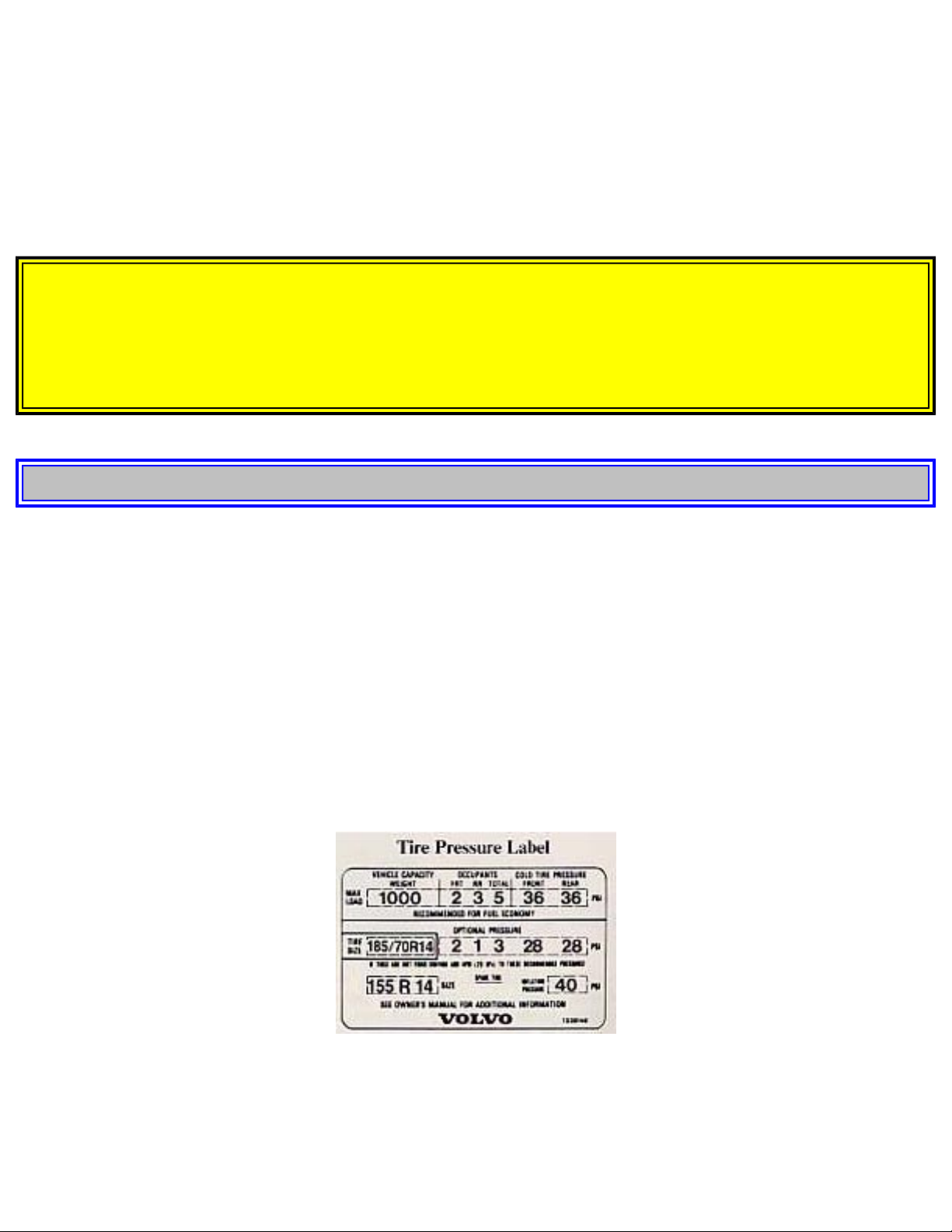
1986 Volvo 740 GL, GLE, Turbo
have the same rotational direction throughout their entire lifetime. In other words, if you wish to rotate
the wheels, make sure that the same wheels are always on the same side of the car.
Tire chains can only be used on the rear wheels if the chains do not project too far from the tire and
chafe against the brake caliper or other components.
Strap-on emergency chains must not be used since the clearance between the brake caliper and the
wheel rim is inadequate.
WARNING!
Special wheel rims for air dams
Only special wheel rims, tested and approved by Volvo, are suitable for use with the air dam installed
on the 740.
pg. 64 Wheels and tires
Checking and correcting tire pressure
Check the tire pressure when refueling.
The tire pressure should be corrected only when the tires are cold. With warm tires, correct only when
the pressure is too low. The tire temperature rises after driving just a few miles.
Vehicle Loading
The tires on your Volvo will perform to specifications at all normal loads when inflated as
recommended on the tire information label located on the rear facing side on the right front door. This
label lists both tire and vehicle design limits.
Do not load your car beyond the load limits indicated.
file:///K|/ownersdocs/1986/1986_740/86740_04.htm (3 of 4)12/30/2006 7:51:31 AM
Page 76
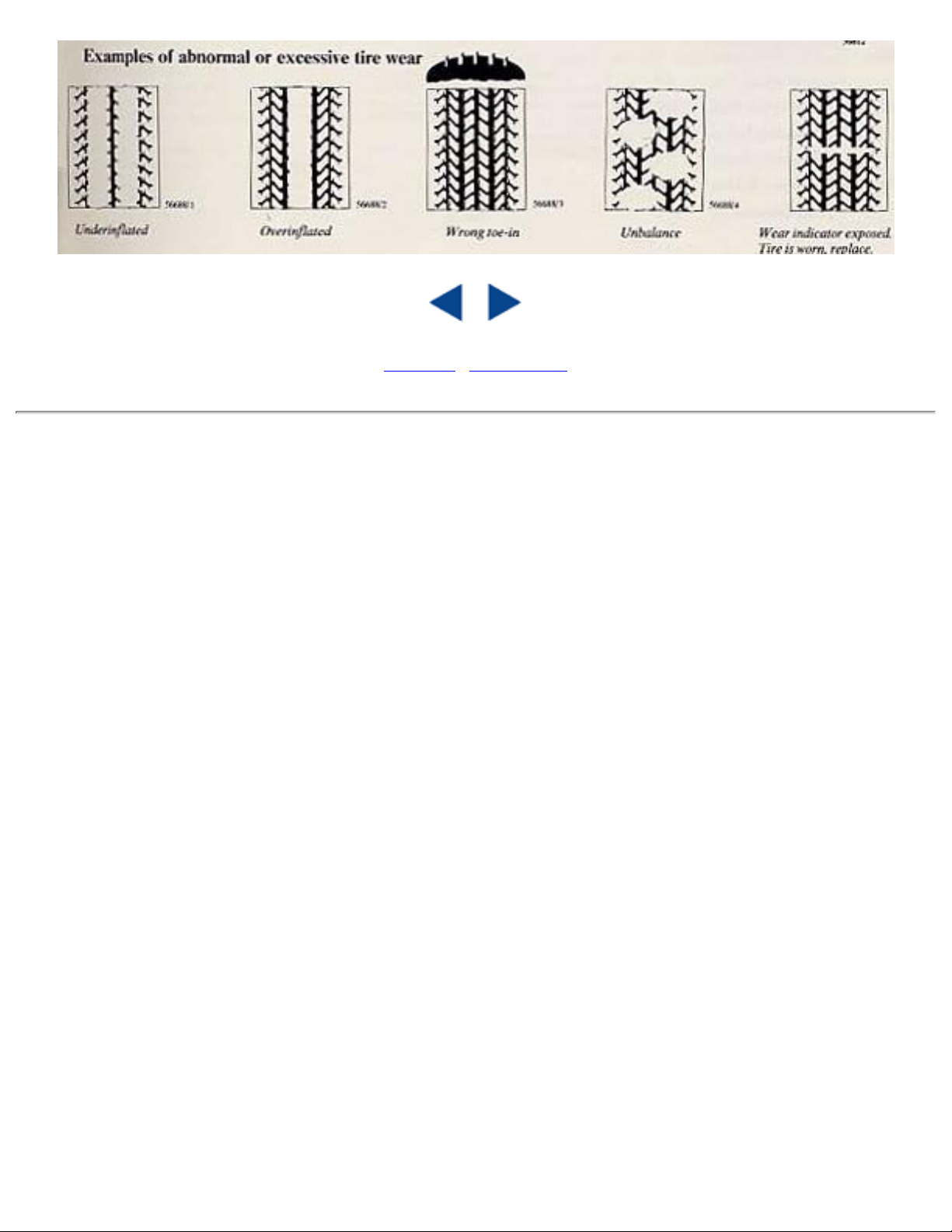
1986 Volvo 740 GL, GLE, Turbo
Contents | Top of Page
file:///K|/ownersdocs/1986/1986_740/86740_04.htm (4 of 4)12/30/2006 7:51:31 AM
Page 77
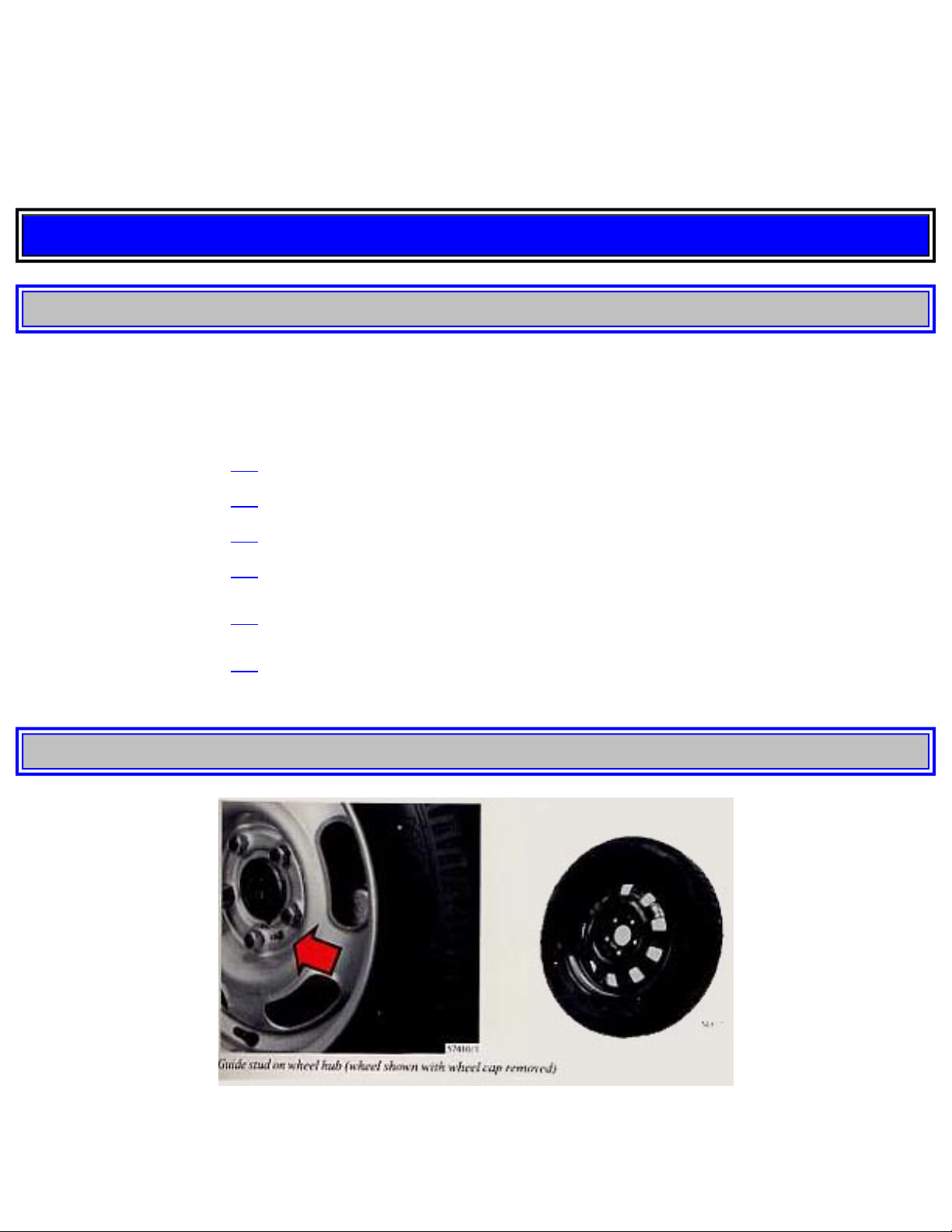
1986 Volvo 740 GL, GLE, Turbo
1 9 8 6
VOLVO
740 GL, GLE, Turbo
In case of emergency
pg. 65 In case of emergency
Even if you maintain your car in good running condition, there is always the possibility that something
might go wrong and prevent you from driving, such as a punctured tire, blown fuse or bulb....
Special spare tire
66
Changing a wheel
67
Replacing bulbs
69
Replacing fuses
76
Replacing wiper
blades
79
Troubleshooting
80
pg. 66 Spare tire
file:///K|/ownersdocs/1986/1986_740/86740_05.htm (1 of 18)12/30/2006 7:51:33 AM
Page 78
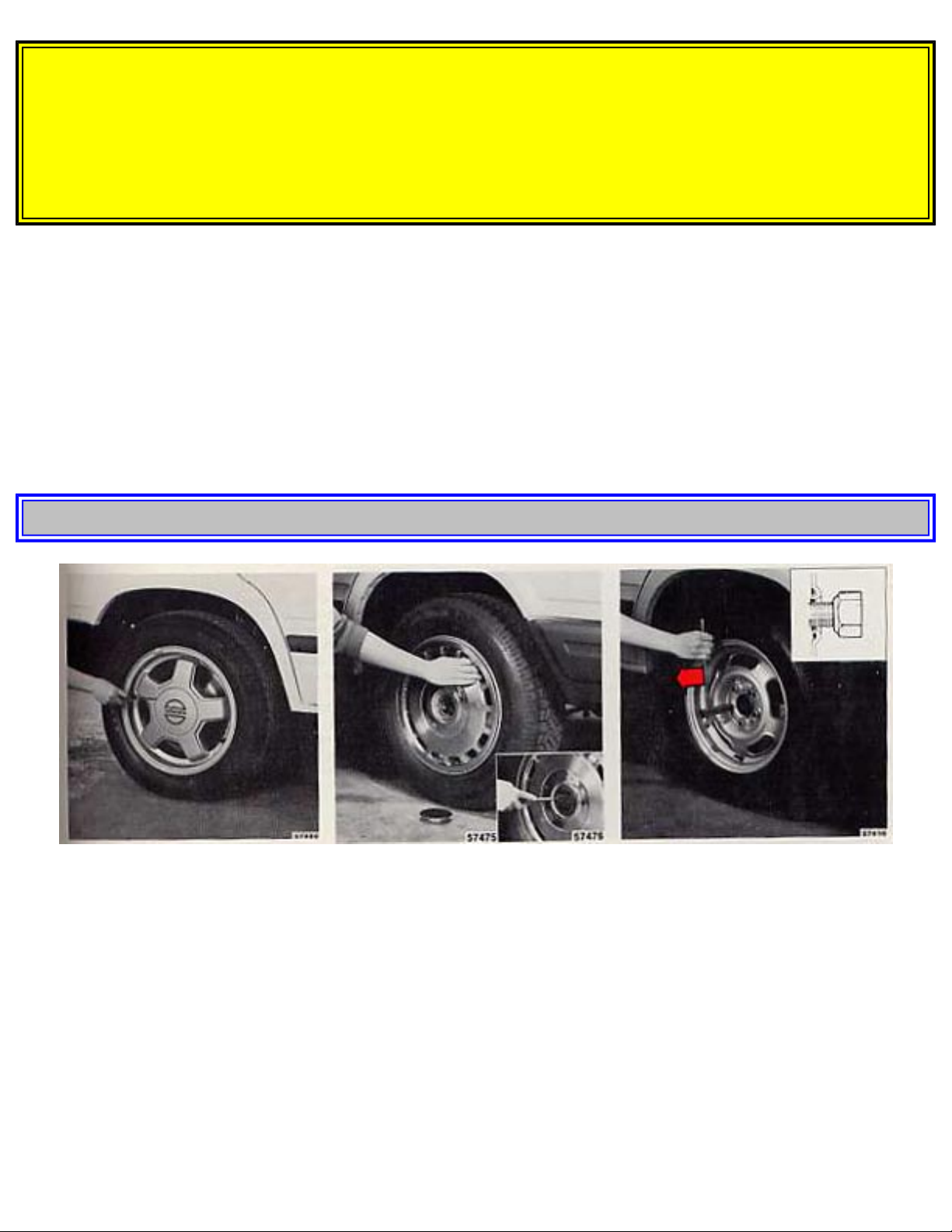
1986 Volvo 740 GL, GLE, Turbo
WARNING!
Current legislation prohibits the use of the "Special Spare" tire other than as a temporary replacement
for a punctured tire. In other words, it must be replaced as soon as possible by a standard tire.
Roadholding. etc., may be affected with the "Special Spare" in use. Do not, therefore, exceed 50 mph
(80 km/h).
Special Spare
The spare tire of your car is what is called a "Special Spare". This is embossed on the tire. See
illustration.
GL, GLE models have 14" wheels and Special Spare tire pressure 40 psi (280 kPa).
Turbo models have 15" wheels and Special Spare tire pressure 50 psi (350 kPa).
These pressures should be maintained irrespective of which position on the car the Special Spare tire is
used on.
In the event of damage to this tire a new one can be purchased from your Volvo dealer.
pg. 67 Wheel changing
Removal of wheel cap on aluminum wheel(turbo model shown 1st photo). 2nd photo shows Steel wheel
for GL
Changing a wheel
The spare wheel is located in the trunk, beneath the carpet (sedans), or beneath the rear cargo-area floor
(wagons).
Before using the jack, make sure the car is standing on firm, level ground. Apply the parking brake. On
models with automatic transmission, place the transmission selector lever in position P. On models with
manual transmission, place the gear-shift lever in 1st gear or reverse. Block the wheels standing on the
ground with wooden blocks or large stones.
● Remove the wheel cap, using the screwdriver in the tool kit.
file:///K|/ownersdocs/1986/1986_740/86740_05.htm (2 of 18)12/30/2006 7:51:33 AM
Page 79
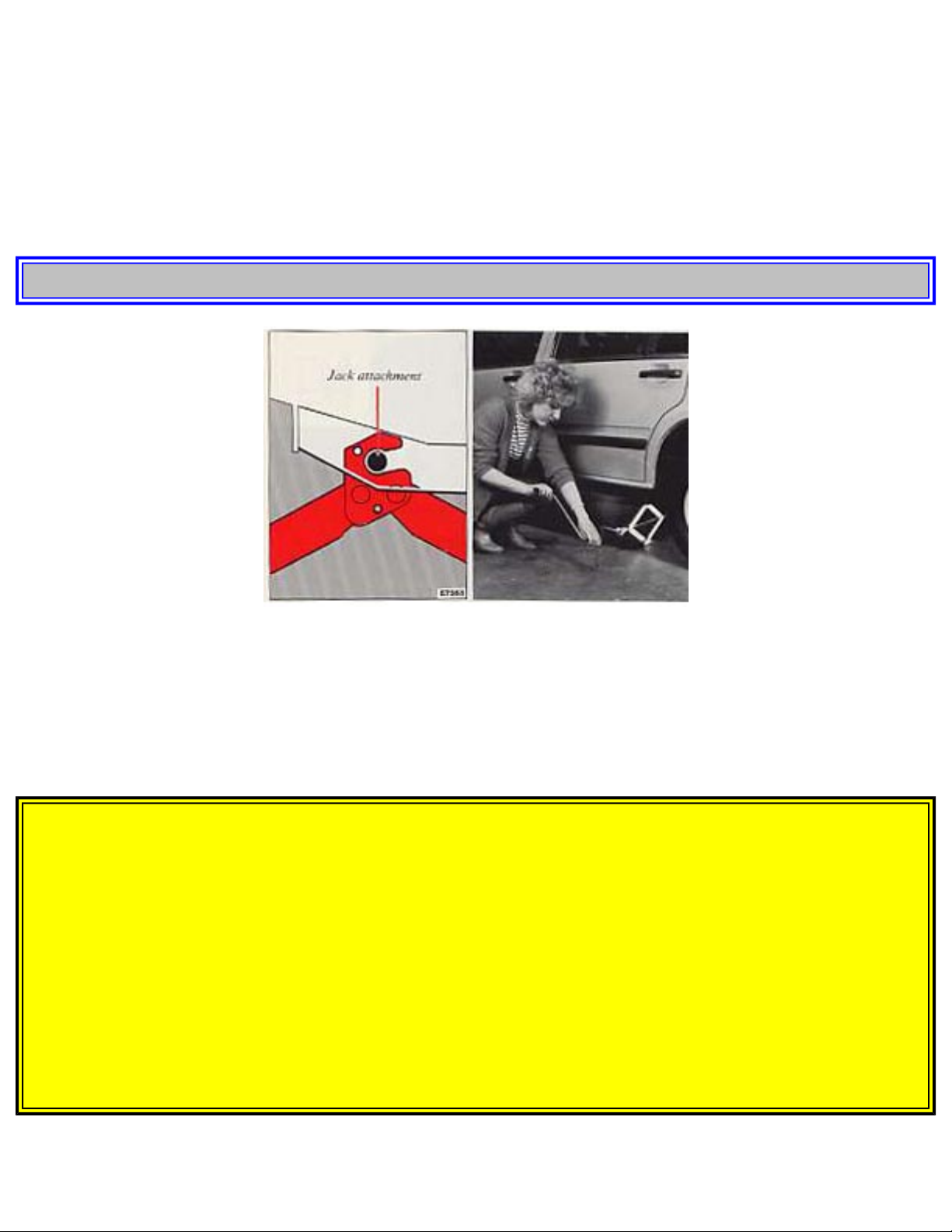
1986 Volvo 740 GL, GLE, Turbo
● With the car still on the ground, use the box wrench from the tool kit to loosen the wheel nuts 1/2 - 1
turn. Turn the nuts counterclockwise to loosen.
NOTE: To avoid excessive wear and the necessity of rebalancing, mark and reinstall wheels in same
location as before removal.
To lessen the chance of imbalance, each wheel hub is equipped with a guide stud to ensure that a
removed wheel can be reinstalled in its original position (as when changing over to winter tires/wheels).
pg. 68 Wheel changing
There is a jack attachment adjacent to each wheel location. Hang the jack from the attachment as shown
in the illustration and crank while simultaneously guiding the base to the ground. Before raising the car
check that the jack is still correctly positioned in the attachment.
Now raise the vehicle until the wheel is free from the ground. Unscrew the wheel nuts completely and
carefully remove the wheel so as not to damage the thread of the studs.
WARNING!
● Be sure the jack is on firm and level ground.
● Never allow any part of your body to be extended under a car supported by a jack.
● Use the jack intended for the car when replacing a wheel. For any other job, use stands to support
the end of the car being worked on.
● Apply the parking brake, select position P (automatic transmission), or 1st gear or reverse (manual
transmission).
● Block the wheels standing on the ground. Use rigid wooded blocks or large stones.
● The jack should be kept well-greased.
Installing the wheel
file:///K|/ownersdocs/1986/1986_740/86740_05.htm (3 of 18)12/30/2006 7:51:33 AM
Page 80
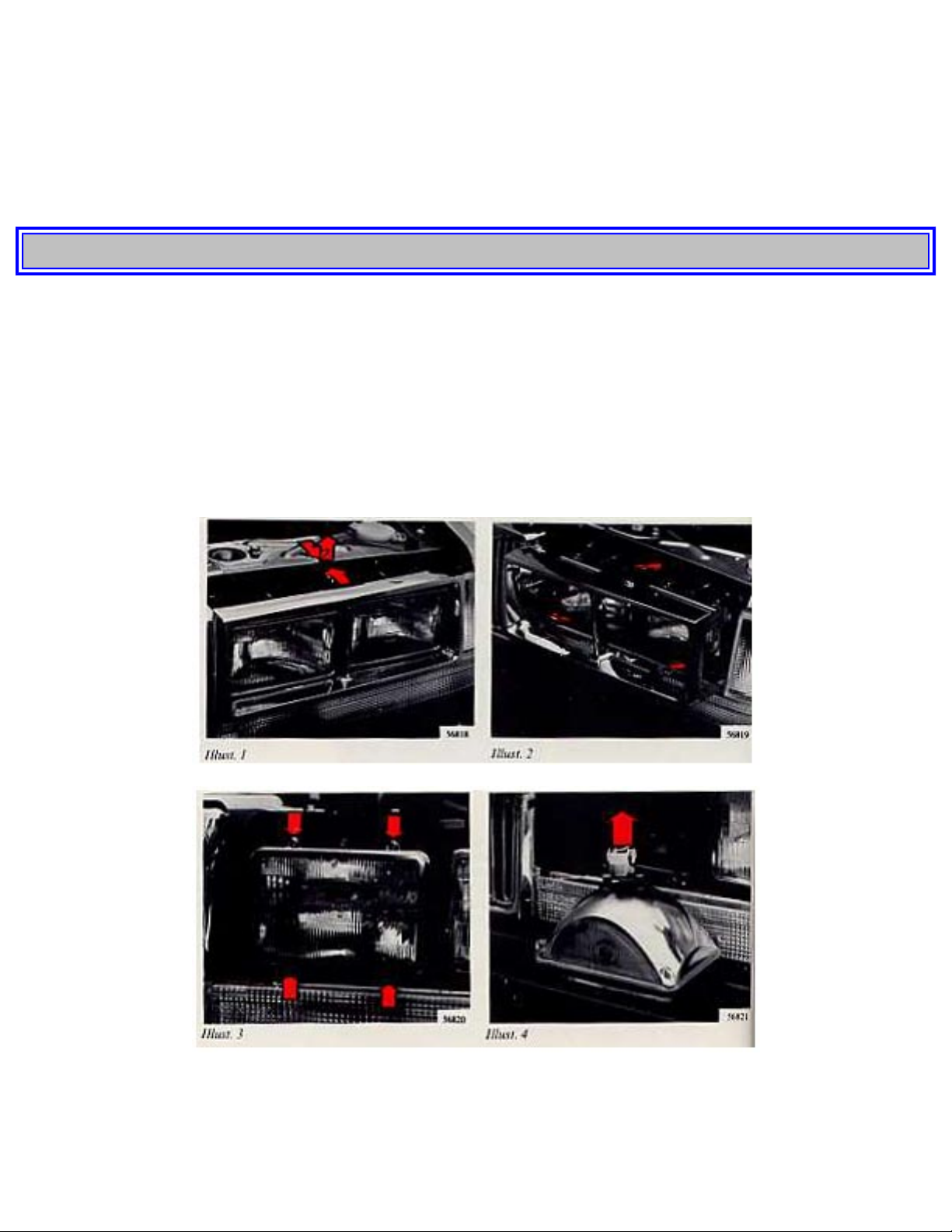
1986 Volvo 740 GL, GLE, Turbo
Clean the contact surfaces on the wheel and hub. Lift the wheel and place it on the hub. Make sure that
you align the wheel with the guide stud on the wheel hub prior to installation. Install the wheel nuts
clockwise and tighten lightly. The bevelled side of the nuts should face the wheel. Lower the vehicle to
the ground and alternately tighten the nuts to 63 ft. Ibs. (85 Nm). Install the wheel cap.
Some models have a hub cap that extends to the wheel rim. The valve symbol on the inside of the hub
cap should be installed toward the valve.
pg. 69 Replacing bulbs
NOTE:
The method for replacement of bulbs in the various lighting units is shown on the following pages.
Make sure when installing bulbs, that the guide pin on the socket fits into its corresponding recess.
When installing Halogen bulbs, do not touch the glass with your fingers. The reason for this is that
grease, oil or any other impurities can be carbonized onto the bulb and damage the reflector.
Use bulbs of correct type and voltage. Failure to do so could cause the bulb failure warning light to
activate.
Replacing sealed beam headlamp units
1. Squeeze the clip and pull it upwards.
2. Lift the rim slightly and remove it forwards.
file:///K|/ownersdocs/1986/1986_740/86740_05.htm (4 of 18)12/30/2006 7:51:33 AM
Page 81
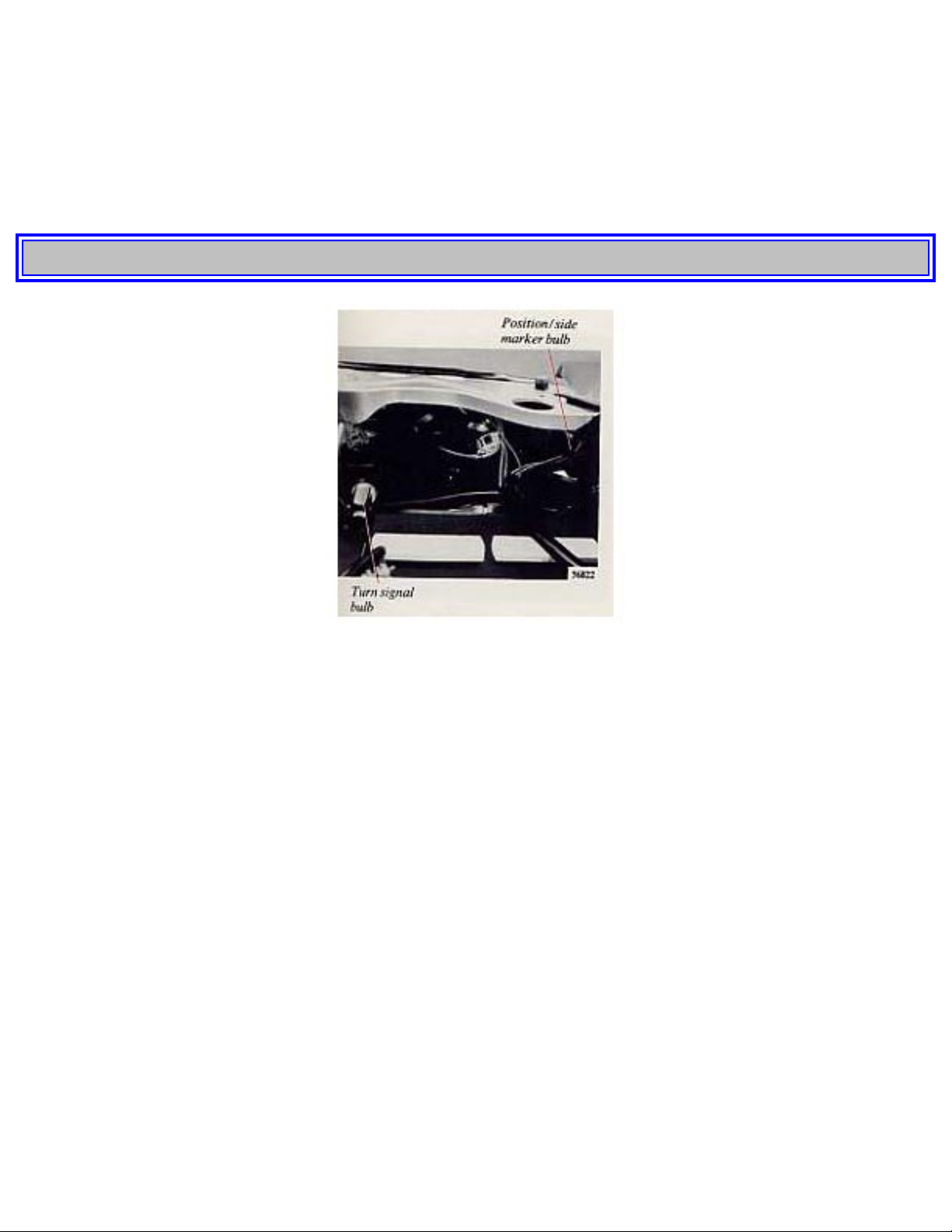
1986 Volvo 740 GL, GLE, Turbo
3. Remove Phillips screws and rim. Lift out the headlamp unit.
4. Disconnect the socket contact.
Installation is done by reversing the procedure.
Check headlight alignment.
pg. 70 Replacing bulbs
Replacing bulbs, front
Access to the bulbs is obtained from the engine compartment.
1 Switch off the lights and starting (ignition) key.
2 Do not remove the connector from the bulb holder. Turn the bulb holder slightly counterclockwise and
withdraw the bulb holder and bulb.
3 Remove the bulb from the holder by pressing in and turning slightly counterclockwise.
4 Insert a new bulb and install the bulb holder.
NOTE! One of the tabs on the bulb holder is slightly wider than the other two.
file:///K|/ownersdocs/1986/1986_740/86740_05.htm (5 of 18)12/30/2006 7:51:33 AM
Page 82
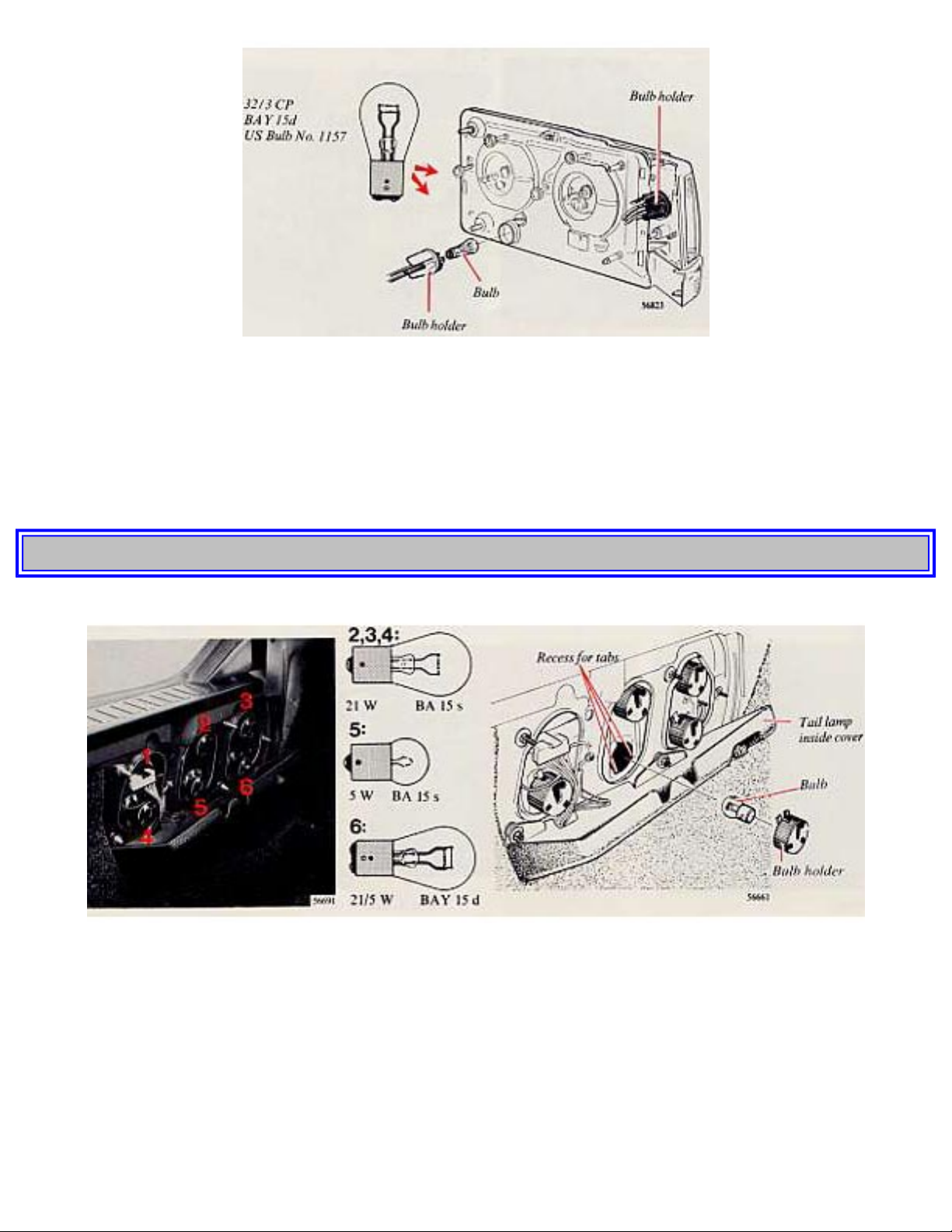
1986 Volvo 740 GL, GLE, Turbo
5 Turn the bulb holder clockwise to secure it.
Check the bulb function.
NOTE: It may be necessary to remove the washer fluid reservoir fill tube in order to gain access to the
bulb holder.
pg. 71 Replacing bulbs
Replacing tail light bulbs (sedan models)
All tail lamp bulbs are replaced from inside of trunk.
1. Unscrew and remove tail lamp inside cover. Note that inside cover is hooked at the lower edge.
2. Turn bulb holder approx. 3/8" counterclockwise and remove it.
3. Depress bulb in bulb holder, turn it slightly counterclockwise, and remove it.
4. Install a new bulb. Install bulb holder in tail lamp. NOTE: One of the bulb holder tabs is wider and
fits in corresponding recess only.
file:///K|/ownersdocs/1986/1986_740/86740_05.htm (6 of 18)12/30/2006 7:51:33 AM
Page 83
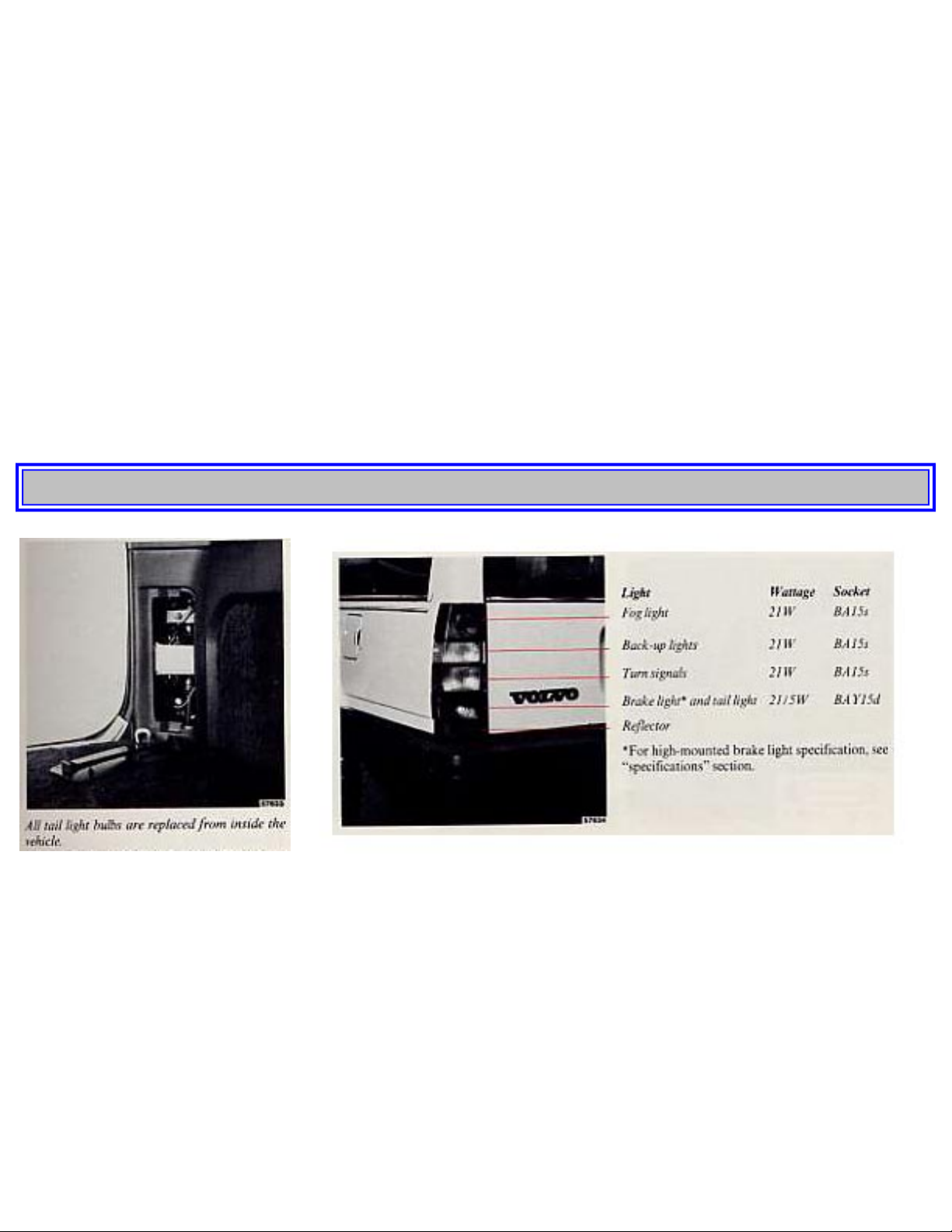
1986 Volvo 740 GL, GLE, Turbo
5. Turn bulb holder clockwise. Check that bulb lights. Replace tail lamp inside cover.
Bulbs
Power
CP(W)
Socket
US Bulb
No
1 Reflector 2 Back up light 32 (21) BA 15s 1073
3 Rear turn signal 32 (21) BA 15s 1073
4 Rear foglamp 32 (21) BA 15s 1073
5 Tail light 4 (5) BA 15s 67
6 Tail light/brake light*
32/3
(21/5)
BAY
15d
1157
*For high-mounted brake light specifications, see "specifications" section.
pg. 72 Replacing bulbs
Replacing tail light bulbs (wagon models)
● Turn off the lights
● Remove the cover with a screw driver
● Rotate the bulb holder about 1/2" (1 cm) counterclockwise and remove the holder from the tail light
cluster.
● Gently press the bulb into the holder, then rotate the bulb counterclockwise in order to release it.
● Install a new bulb in the holder and replace the bulb holder in the tail light cluster.
One of the guide lugs on the bulb holder is slightly wider than the other two and, thus, this lug fits
into the widest recess only.
● Turn the bulb holder clockwise
file:///K|/ownersdocs/1986/1986_740/86740_05.htm (7 of 18)12/30/2006 7:51:33 AM
Page 84
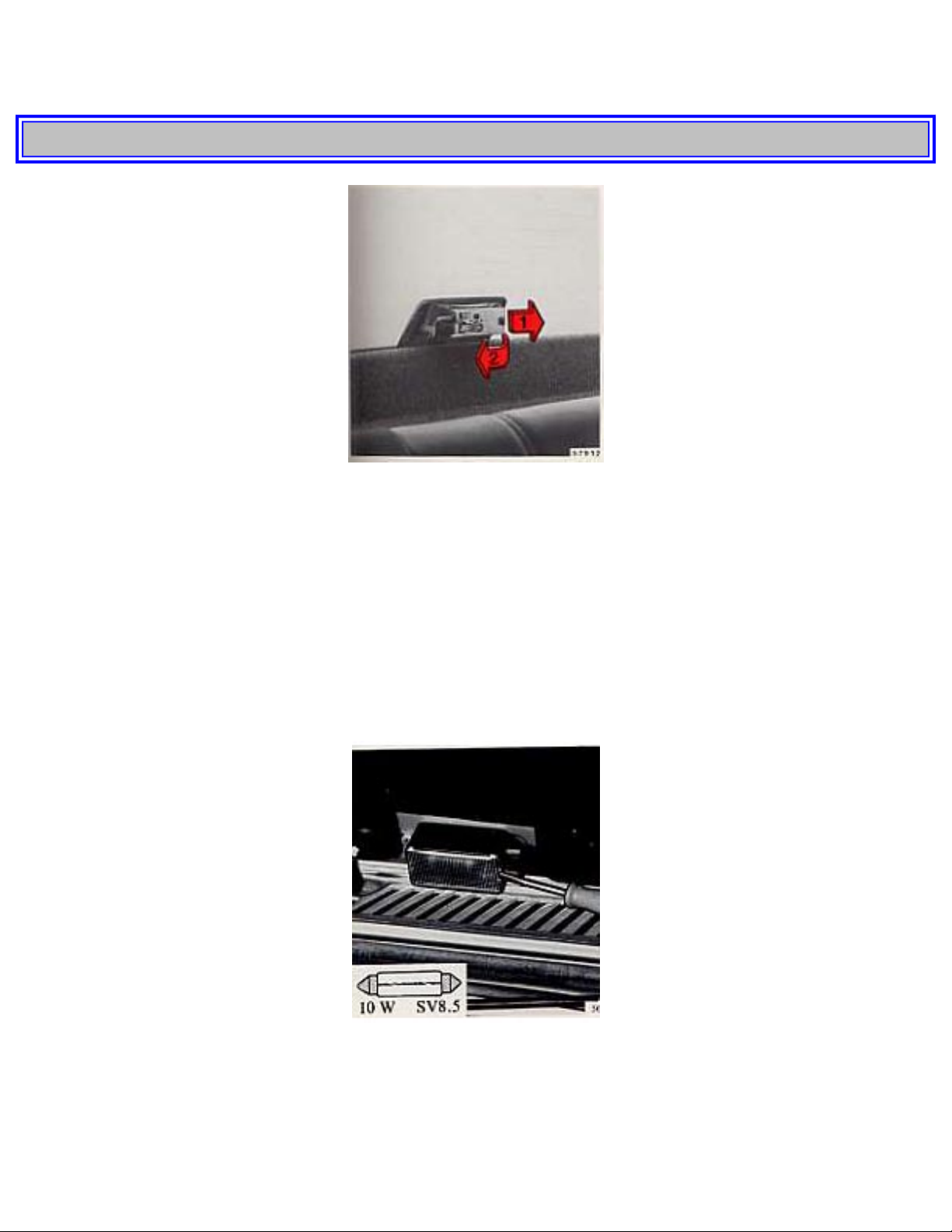
1986 Volvo 740 GL, GLE, Turbo
● Check that the bulb lights
● Re-install cluster cover
pg. 73 Replacing bulbs
High-mounted brake light
Remove the plastic housing by pulling it up and away from the light assembly. Depress the black catch
tab to release the bulb holder(1). Swing the bulb holder out and replace the bulb(2). (Sedan model is
shown; procedure similar on the wagon models.)
Bulbs Power Socket
High-mounted brake
light
20 W Ba 9s
Engine compartment light
Insert a screwdriver and pry off the light assembly. Lift it out to remove.
Replace the bulb.
file:///K|/ownersdocs/1986/1986_740/86740_05.htm (8 of 18)12/30/2006 7:51:33 AM
Page 85
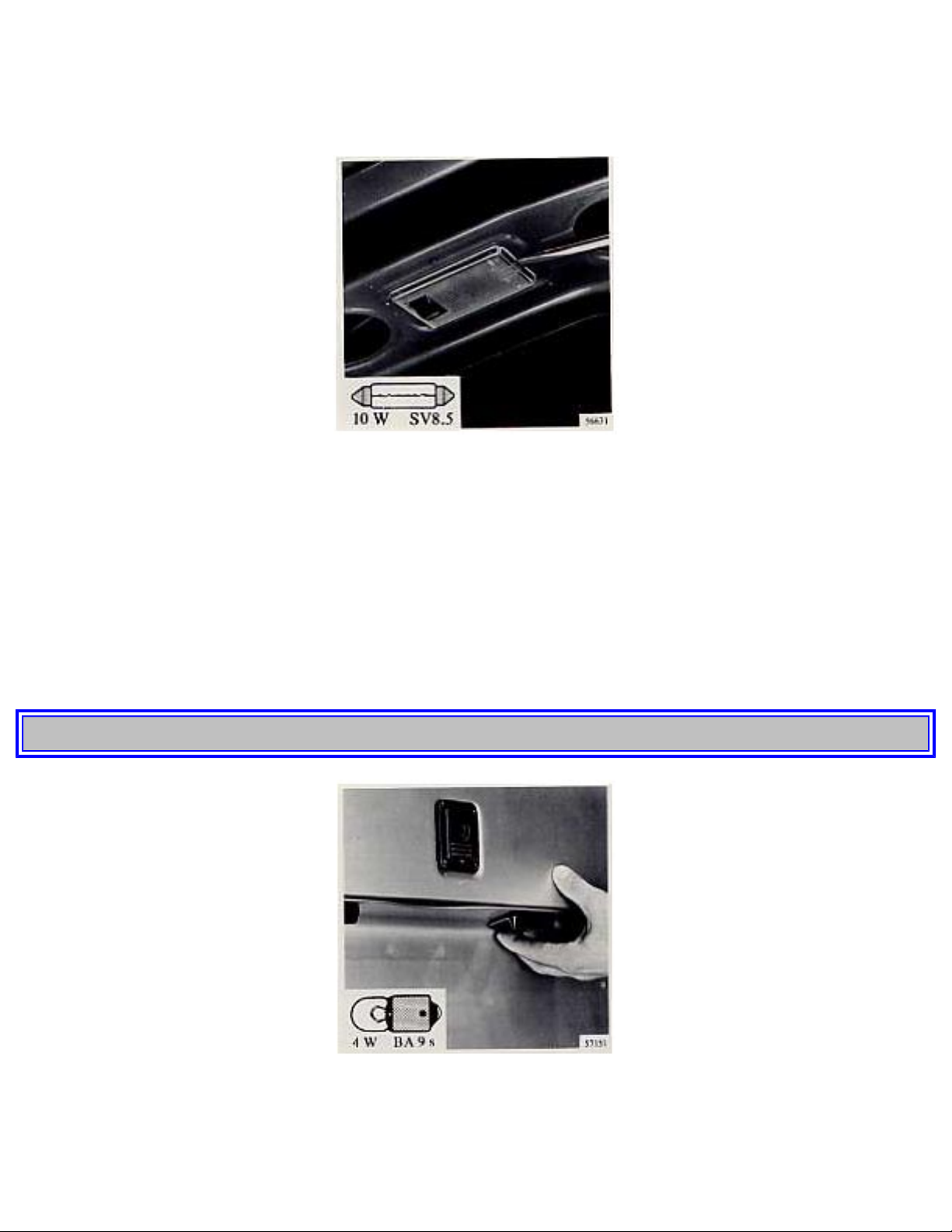
1986 Volvo 740 GL, GLE, Turbo
Bulbs Power Socket
Engine compartment
light
10 W SV8.5
Trunk light (sedan models)
Depress the catch with a screwdriver and remove the light assembly. Lift it out to remove.
Replace the bulb.
Bulbs Power Socket
Trunk
light
10 W SV8.5
pg. 74 Replacing bulbs
License plate light (sedan models)
Slide the bulb housing backwards until it is released from the front edge. Pull out the lamp housing and
replace the bulb. Insert the front edge of the lamp housing and press up the rear edge by hand.
file:///K|/ownersdocs/1986/1986_740/86740_05.htm (9 of 18)12/30/2006 7:51:33 AM
Page 86
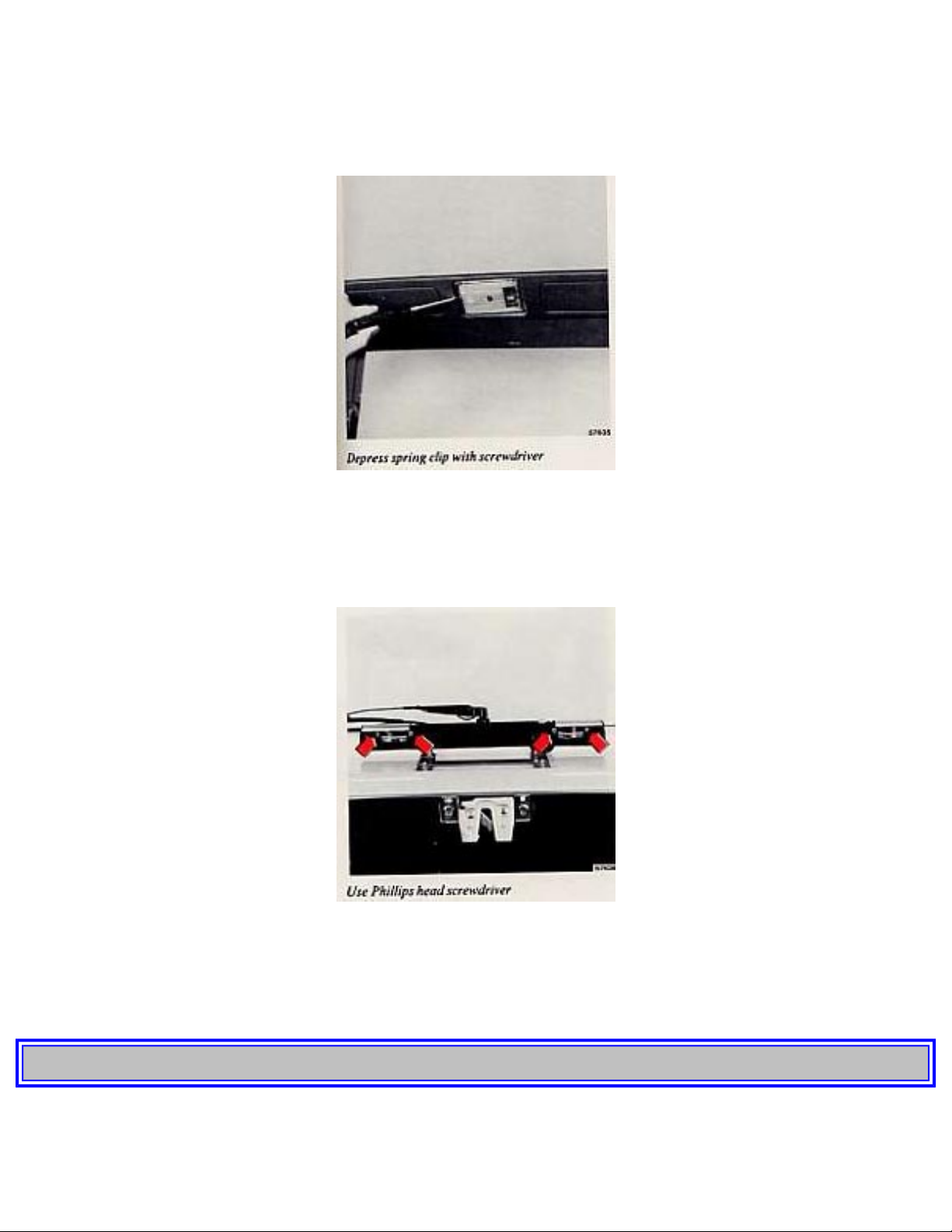
1986 Volvo 740 GL, GLE, Turbo
Bulbs Power Socket
License plate
light
4 W
W 2.1 x
9.5d
Courtesy light (wagon models)
To remove bulb depress the spring clip with a screwdriver, then twist and lift out the housing. Remove
the bulb and install a new one.
License plate light (wagon models)
Remove the screws with a Phillips head screwdriver. Remove lamp housing. Depress the bulb and rotate
it counterclockwise. Remove the bulb. Install a new bulb and re-install light housing.
pg. 75 Replacing bulbs
file:///K|/ownersdocs/1986/1986_740/86740_05.htm (10 of 18)12/30/2006 7:51:33 AM
Page 87
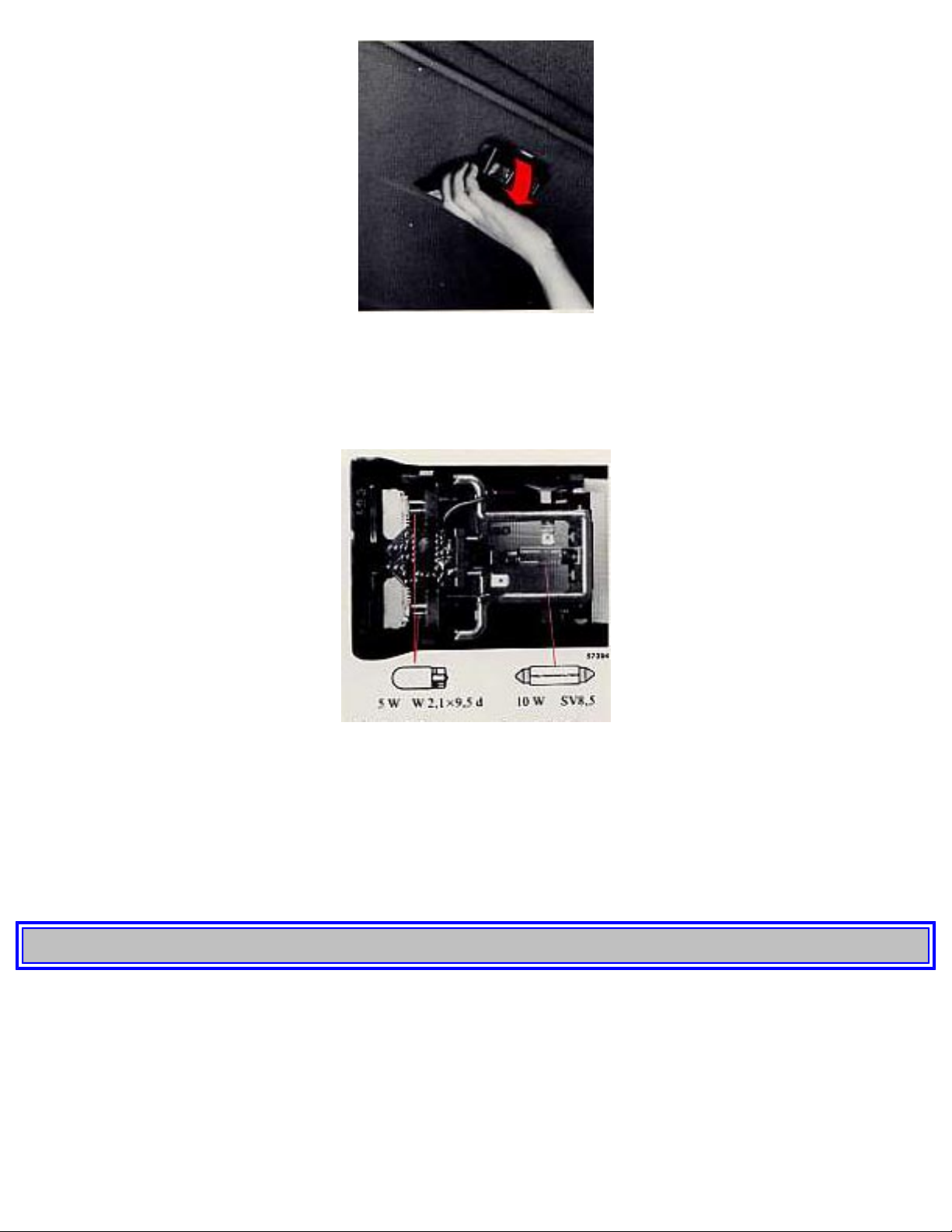
1986 Volvo 740 GL, GLE, Turbo
Interior light and reading lights
Take hold of the front section of the light as shown and pull straight down.
Replace the blown bulb and check operation before installing the bulb housing.
Bulbs Power Socket
Interior light 10 W SV8.5
Reading
light
5 W W2.1x9.5d
pg. 76 Fog lights, Fuses
file:///K|/ownersdocs/1986/1986_740/86740_05.htm (11 of 18)12/30/2006 7:51:33 AM
Page 88
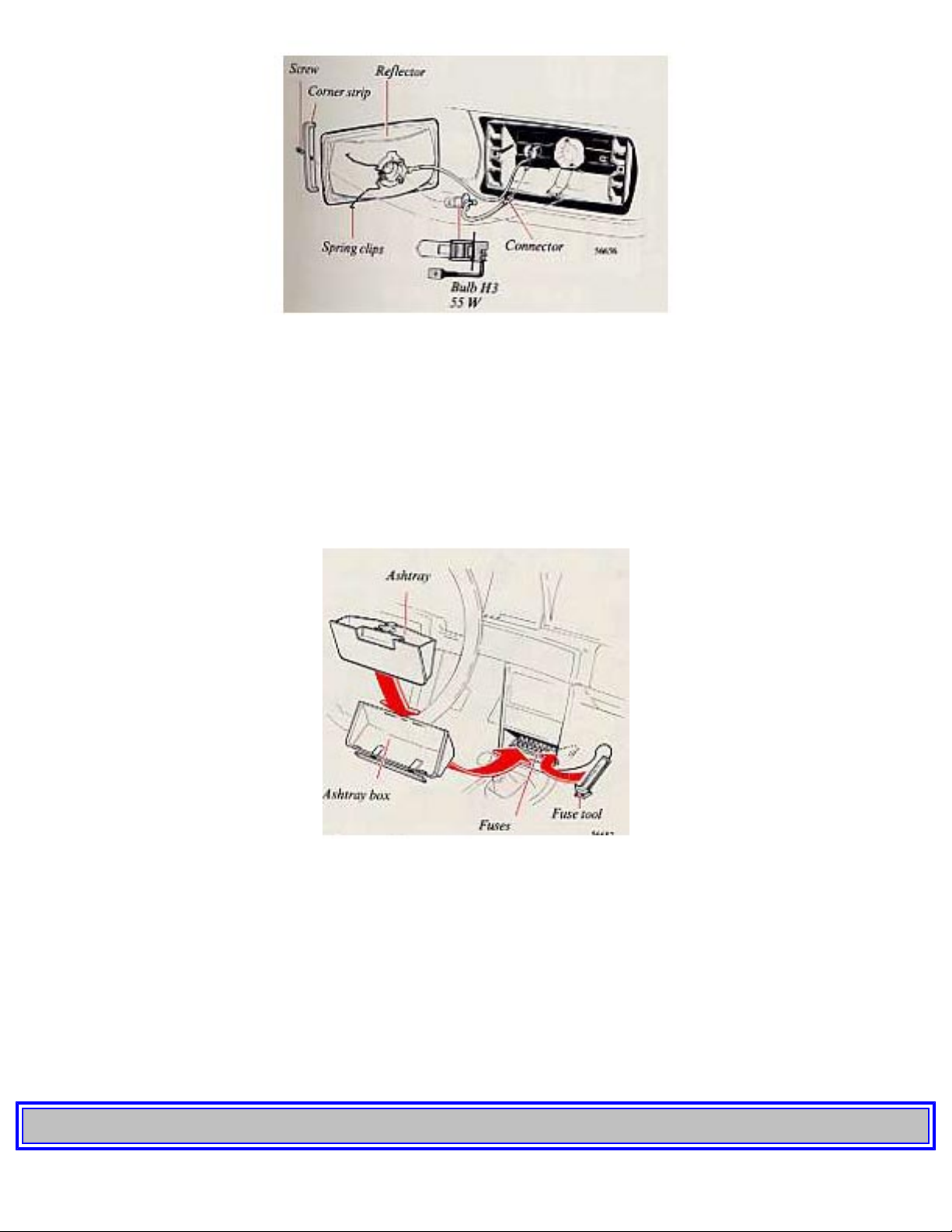
1986 Volvo 740 GL, GLE, Turbo
Fog lights (certain models)
Remove the Phillips screws securing the corner strips and pull out the reflector.
Remove the spring clips holding the bulb. Withdraw the connector and install a new bulb. Replace parts
in the reverse order. Observe "TOP" on the lens.
NOTE: Do not touch bulb glass with fingers. Grease or oil can damage reflector when heated.
Fuse replacement
A blown fuse is indicated by the failure of all the units protected by it, and it is caused by overloading
the circuits. The fuses (and relays) are located in the central electrical unit behind the ashtray in the
center console.
● Remove the ashtray. Pull out and depress the tongue.
● Press up the section marked "electrical fuses-press" and remove the unit.
There are 26 fuses in two rows. See following pages for fuse designations/locations.
pg. 77 Fuses
file:///K|/ownersdocs/1986/1986_740/86740_05.htm (12 of 18)12/30/2006 7:51:33 AM
Page 89
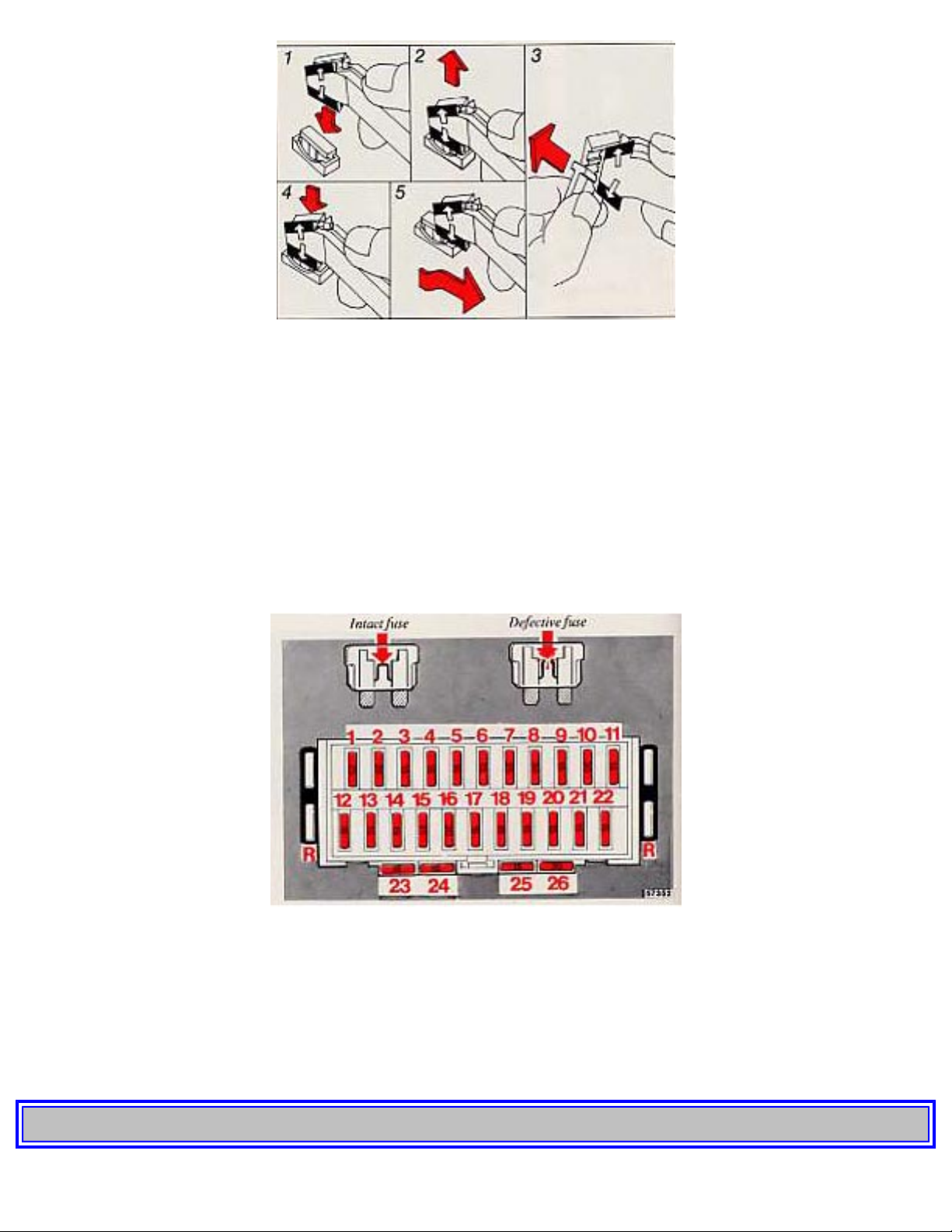
1986 Volvo 740 GL, GLE, Turbo
It is necessary to remove the fuses to see if they are blown, see next page for information on fuses and
related circuits.
If you find it difficult to obtain access to the fuses, unclip the fuse tool on the right-hand side of the fuse
compartment and use it to remove the fuse, see illustration.
1 Press the tool onto the fuse.
2 Pull the tool and fuse straight up.
3 Pull out the fuse from the tool and push in a new fuse in the same way.
4 Push in the fuse in the fusebox with the tool.
5. Slide the tool out.
The fuses are removed by pulling them straight out. If they are defective, the metal wire is broken. When
fitting a new fuse, be certain to use one with the same amperage and color as the one removed (see top
of fuse)! Spare fuses are located on each side of the fusebox (1xl5A, 1x25A, 1x30A).
If fuses burnout repeatedly, have the electrical system tested by a Volvo dealer.
pg. 78 Fuses
file:///K|/ownersdocs/1986/1986_740/86740_05.htm (13 of 18)12/30/2006 7:51:33 AM
Page 90

1986 Volvo 740 GL, GLE, Turbo
Location * Amperage
1 Fuel pump, fuel injection system 25
2 Central locking, hazard warning flasher, headlight flashers 25
3 Fog lights 15
4 Brake lights, shift indicator light, trunk light, antenna, door warning 15
5 Glove compartment light, clock, radio, engine compartment light, interior light, trunk
light, antenna, door open warning, power antenna, make-up mirror light
15
6 Heated front seats 30
7 Electric cooling fan 25
8 Electrically operated windows 30
9 Warning light, seat belt, turn signals, air conditioning, heated front seats, electric cooling
fan, electrically-operated windows
15
10 Heated rear window 30
11 Tank pump 15
12 Back-up lights, cruise control, overdrive(manual transmission), disengagement of 4th
gear on automatic transmission AW71
15
13 (Spare) 15
14 Electrically-operated side view mirrors, cigarette lighter, radio, rear wiper (wagon) 15
15 Horn, windshield wash/wipe 25
16 Heater blower, air conditioning 30
17 High beam,left 15
18 High beam, right, extra lights 15
19 Low beam, left 15
20 Low beam, right 15
21 LH parking lights (front and rear), license plate light, lighting for: ash tray, heater,
control panel, switch for heated rear window
15
22 Seat belt light, RH parking lights (front and rear), storage compartment behind parking
brake. Fog lights
15
23 (Spare) 15
24 (Spare)
25 Rear fog lights 15
26 (Spare) 30
For more detailed information concerning function and location of relays, fuses, etc., refer to the Volvo
Service Manuals. These can be purchased directly using the Service Literature Brochure/Order Form or
through your Volvo dealer.
file:///K|/ownersdocs/1986/1986_740/86740_05.htm (14 of 18)12/30/2006 7:51:33 AM
Page 91
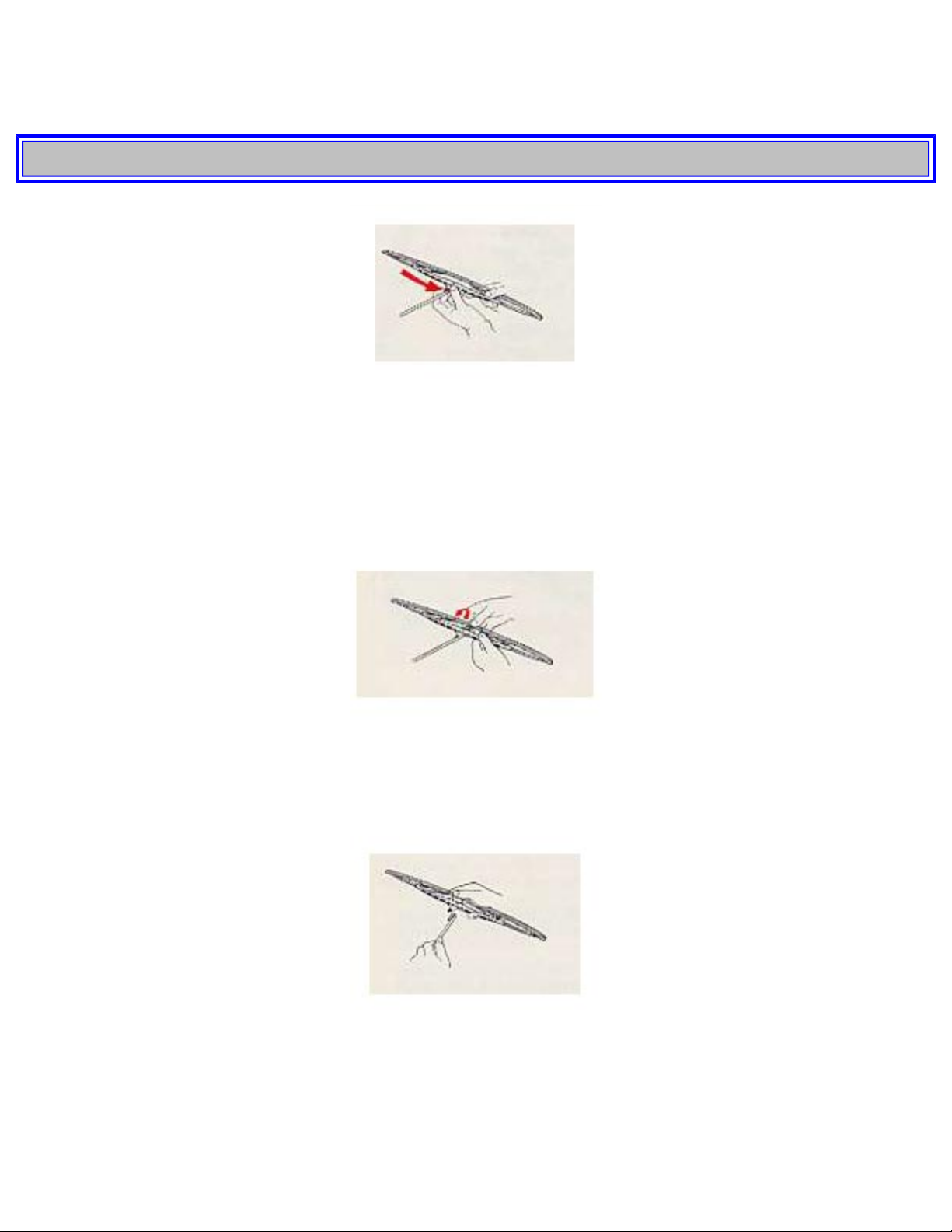
1986 Volvo 740 GL, GLE, Turbo
*Some of the equipment/systems listed may be available on certain models only and/or as optional items
only.
pg. 79 Replacing wiper blades
Replacing wiper blades
Lift the wiper arm off the windshield and hold blade at right angles to arm. Pinch the end of the plastic
clip located at the back of the arm.
Slide the wiper blade along the arm to release it from the hook.
Install new blade (installation is the reverse of removal) and make sure that it is properly attached to the
wiper arm.
For reasons of safety, you should change the windshield wiper blades as soon as they start to leave
marks on the windshield or fail to wipe efficiently and cleanly.
The wiper blades can be cleaned by using a stiff-bristle brush and warm, soapy water.
file:///K|/ownersdocs/1986/1986_740/86740_05.htm (15 of 18)12/30/2006 7:51:33 AM
Page 92

1986 Volvo 740 GL, GLE, Turbo
pg. 80 Service diagnosis
The diagnoses outlined below are intended to serve only as guides to locate and temporarily correct
minor faults. Causes of unsatisfactory performance should be investigated and corrected by your Volvo
dealer only.
Condition: Starter fails to operate (or operates very slowly)
Possible cause Correction
Weak battery or dead cell.
With the starting (ignition) switch in the "Driving" or
"On" position, check to see if the warning lights on the
dashboard come on and if they stay on when the starter
is engaged.
If the lights do not come on or if they go off when the
starter is engaged, the battery is discharged, or see
below.
Loose or corroded battery cable terminals.
Check the battery terminals and clamps. Clean or
replace if necessary. Check that the starter cable is
secure at its terminals.
The ground strap, which connects the body to the rear
of the engine, should also be checked for corrosion or
looseness.
Open circuit between starting (ignition) switch
and starting (ignition) switch terminal on
starter.
The circuit is closed if a clicking sound is heard from
the starter when it is engaged. If no clicking sound is
heard, check that the blue wire at the starter is secure.
If still no clicking sound is heard, the starting
(ignition) switch or the wire is defective.
Starter motor defective.
If the above checks have been performed, and no fault
is evident, the starter may be defective.
NOTE: In this case the headlight intensity will not
decrease when the starter is engaged.
pg. 81 Service diagnosis
Condition: Starter motor operates but engine does not start
Possible cause Correction
file:///K|/ownersdocs/1986/1986_740/86740_05.htm (16 of 18)12/30/2006 7:51:33 AM
Page 93

1986 Volvo 740 GL, GLE, Turbo
Intake system leaking.
Check vacuum hose connections at manifold and
auxiliary air valve.
No fuel reaching engine.
Check for fuel in the tank.
Check fuses No 1 and 11.
No spark.
If there is no spark, check that the high tension lead
from the coil to the distributor cap is connected and
that the wires to the distributor and coil are connected.
Spark plugs, high tension leads or distributor
cap wet or defective.
Clean the parts with a dry cloth or spray with a
moisture remover. Replace defective or worn parts.
If no fault is found following the above steps, contact
your Volvo dealer.
Condition: Excessive fuel consumption
Possible cause Correction
Fuel lines leaking.
Check
tightness.
Spark plugs worn Replace plugs.
pg. 82 Service diagnosis
Condition: Erratic idle (misfiring)
Possible cause Correction
Intake system leaking.
Check vacuum hose connections at manifold and
auxiliary air valve.
Spark plugs, high tension leads or distributor
cap worn (detective)
Clean distributor cap and leads, check the cap for
cracks. Replace defective or worn parts.
Worn spark plugs. Remove. Clean or replace spark plugs.
Condition: Engine stalls at irregular intervals
Possible cause Correction
Defective wires.
Check wire terminals at: fuel pump, fuse No. 1 and 11, coil, distributor, ignition
switch and relays.
Intake system leaking. Check vacuum hose connections at manifold and auxiliary air valve.
file:///K|/ownersdocs/1986/1986_740/86740_05.htm (17 of 18)12/30/2006 7:51:33 AM
Page 94

1986 Volvo 740 GL, GLE, Turbo
Fuel filter clogged. Clean fuel tank filter and replace line fuel filter.
Condition: Misfiring at highway driving speed
Possible cause Correction
Spark plugs
fouled.
Drive the vehicle in a lower gear and keep the engine rpm higher for a few miles in
order to remove carbon deposit on the spark plugs. If this procedure is not
effective, clean or replace the spark plug.
Please be aware that misfiring spark plugs can cause damage to the catalytic
converter.
Contents | Top of Page
file:///K|/ownersdocs/1986/1986_740/86740_05.htm (18 of 18)12/30/2006 7:51:33 AM
Page 95

1986 Volvo 740 GL, GLE, Turbo
1 9 8 6
VOLVO
740 GL, GLE, Turbo
Car care
pg. 83 Car care
Car care includes not only maintaining the appearance of the car, but also protecting the car exterior
from the effects of air pollution, rain and mud.
The rustproofing compound under the car should be checked regularly and, if necessary, damaged areas
should be repaired.
The paintwork should also be touched up immediately, if damaged, to prevent rust formation.
Rustproofing
84
Paintwork damage
86
Washing the car
88
Cleaning the
upholstery
90
pg. 84 Rustproofing
What causes rust
The two most common causes of rust to your car are:
The accumulation of road dirt and moisture in hard-to-get-at cavities and other areas under the car.
The removal of paint and protective coatings on the outside of the car and underneath through damage
by stones, gravel or minor accidents.
Several factors influence the speed at which corrosion will occur:
● The length of time various parts of a car stay wet. Parts of the car filled with road dirt and water
remain damp for long periods of time even after other parts have dried.
Particular attention should be paid to the underside of the car and floor sections inside. The floor
sections stay wet because moisture collects and remains under the floor matting.
Drain holes located at the bottom of the doors can get clogged with dirt, trapping water inside the door
file:///K|/ownersdocs/1986/1986_740/86740_06.htm (1 of 9)12/30/2006 7:51:34 AM
Page 96

1986 Volvo 740 GL, GLE, Turbo
and causing the door to rust through at the bottom.
● Corrosion will be accelerated in areas of higher relative humidity, especially where temperatures often
stay above the freezing point and where the atmosphere is affected by industrial pollution, or where salt
is used for de-icing the roads.
Where parts of the car are covered with road dirt containing road salt, corrosion will be accelerated at
lower relative humidity than if the surface were clean.
● Increased temperature will cause an accelerated rate of corrosion of those parts of the car which are
not well ventilated to permit quick drying.
● Industrial pollution and the presence of salt will also accelerate the deterioration of paint finishes.
The foregoing identifies the need for every car owner to keep his or her car-particularly the underside-as
clean and dry as possible and to repair any minor damage to paintwork and protective coating as soon as
possible.
The need is more important in those areas where road salt is used for de-icing, the relative humidity is
higher, air pollution is present, and temperatures regularly stay above freezing.
Rustproofing, inspection and touching-up
Your Volvo was carefully and thoroughly rustproofed at the factory. The underbody and wheelhousings
were sprayed with a thick, durable rustproofing compound and the beams, internal cavities and end
sections were sprayed with a low viscous, penetrating rustproofing agent.
There are two very effective methods of maintaining this protection:
● Keep your car clean.
Clean the underbody, wheelhousings and the edges of the fender using water at high pressure.
● Inspect and touch-up the rustproofing if necessary.
The invisible (internal) rustproofing
The invisible rustproofing, used for beams, internal cavities and end sections, should be retreated first
after 36 months and, thereafter, every 24 months.
Bear in mind, if good results are to be obtained, these sections must be treated with a fine spray of
Volvo-approved rustproofing compound at a workshop with the correct spraying equipment. Consult
your local Volvo dealer.
pg. 85 Rustproofing
The visible rustproofing
You should check the visible (external) rustproofing at regular intervals (at least once a year). If it is
necessary to touch-up the rustproofing, this should be done immediately to prevent moisture penetration.
Wash and dry the car thoroughly before touching up. Use spray-on or brush-on rustproofing compounds.
An oil can with a long flexible spout may be used for parts which are difficult to reach.
There are three different types of rustproofing compounds available:
file:///K|/ownersdocs/1986/1986_740/86740_06.htm (2 of 9)12/30/2006 7:51:34 AM
Page 97
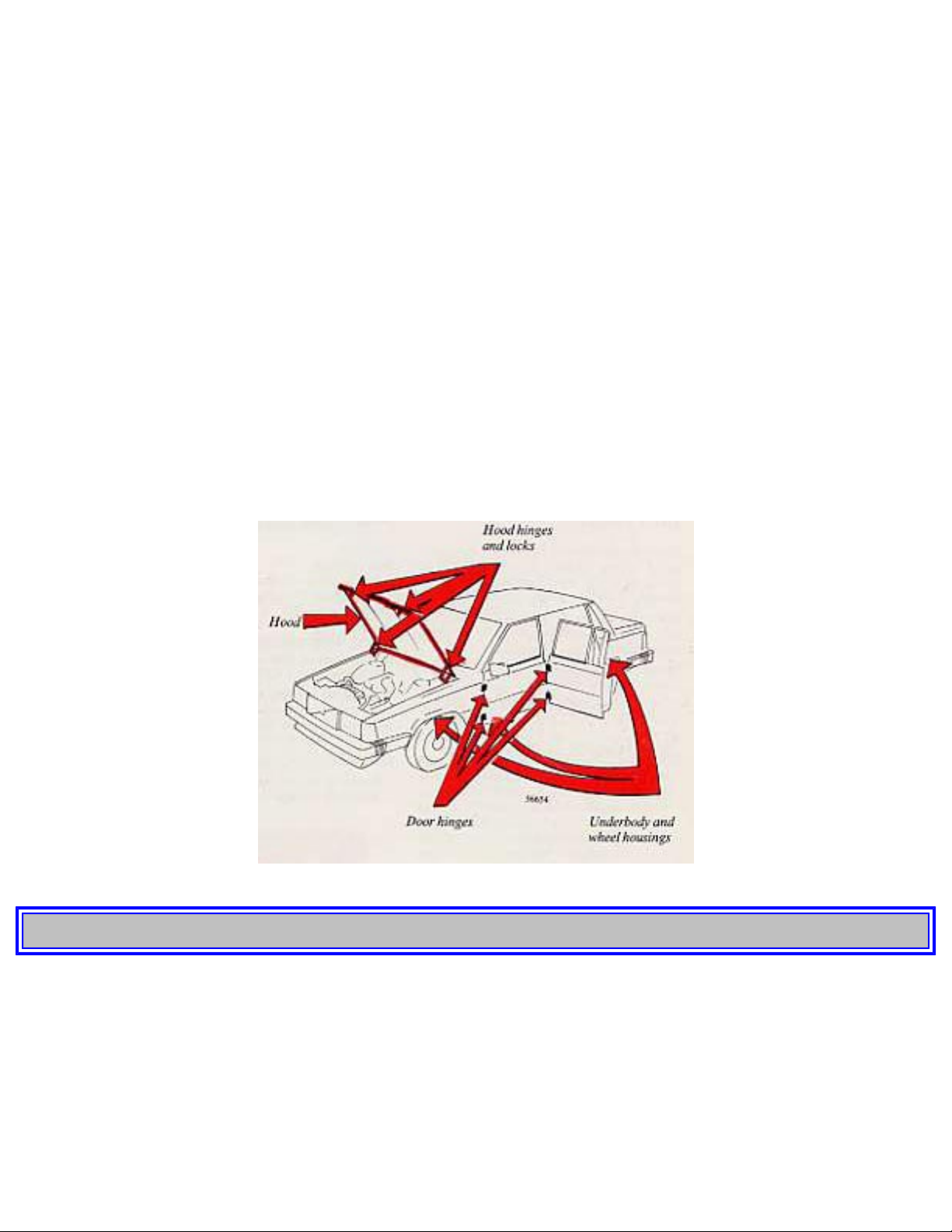
1986 Volvo 740 GL, GLE, Turbo
a. thin (ML), for seams under the car.
b. thin (transparent) for visible pans.
c. thick, for parts on the underbody and wheel housing which experience most wear.
Parts of the car which may need to be touched up (and the recommended rustproofing compound) are:
● visible welded seams and panel seams-(type b)
● underbody and wheel housings-(type c)
● hood-(type b)
● door hinges-(type b)
● hood hinges and locks-(type b).
After completion of all work on the vehicle, remove excess rustproofing compound with a cloth soaked
in kerosene.
The sheet metal surfaces of the engine compartment are protected by a transparent wax-based
rustproofing compound. The compound withstands normal washings without deterioration.
Mineral based solvents will, however, dissolve the compound, especially so if they contain emulgators.
In such cases the wax protection should be renewed.
pg. 86 Paint touch-up
Paint touch-up
Paint damage requires immediate attention to avoid rusting. Make a habit of checking the finish
regularly; when washing the car for instance. Touch up if necessary.
Paint repairs require special equipment and skill. Contact your Volvo dealer for any extensive damages.
Minor scratches can be repaired by using Volvo touch-up paint.
NOTE: When ordering touch-up paint from your Volvo dealer, use the paint code indicated on the
file:///K|/ownersdocs/1986/1986_740/86740_06.htm (3 of 9)12/30/2006 7:51:34 AM
Page 98
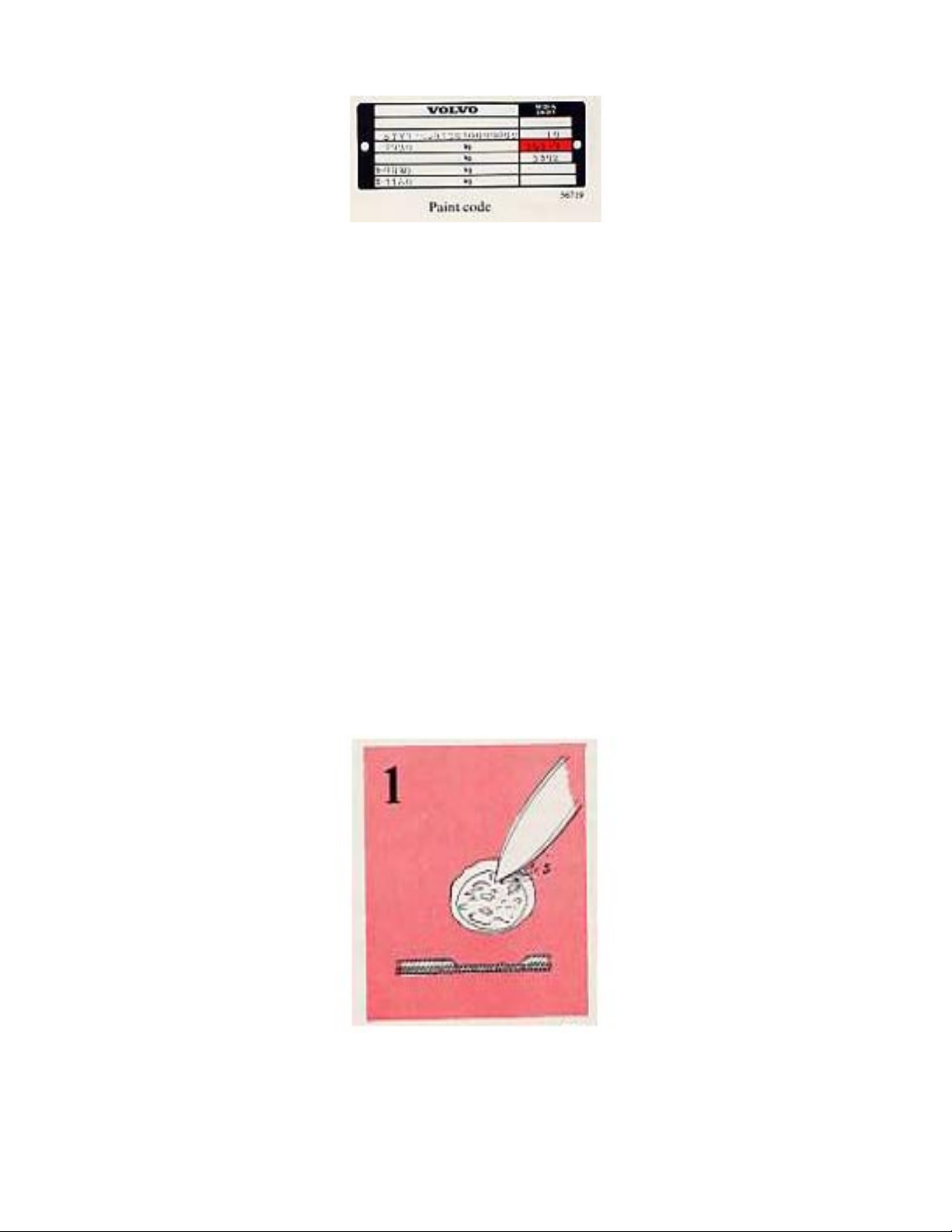
1986 Volvo 740 GL, GLE, Turbo
model plate. The plate is located on the panel above the right-side head lights.
Minor stone chips and scratches
Material:
Rust remover
Primer - brush-on type
Surface finish - brush-on type
Penknife or similar
Brush
NOTE:
When touching up the car, it should be well cleaned and dry and have a surface temperature about 60°F
(+15°C).
Scars on the surface (where the paint has not been completely penetrated). Repairs can be made
directly after light scraping to remove dirt.
Deep scars, (down to the bare metal):
1 Scrape or sand the damaged surface lightly and break the edges of the scar.
Apply the rust remover. (Avoid contact with eyes and skin!) Wait a few minutes and then rinse carefully
with water and wipe dry.
2 Thoroughly mix the primer and apply it with a small brush.
file:///K|/ownersdocs/1986/1986_740/86740_06.htm (4 of 9)12/30/2006 7:51:34 AM
Page 99
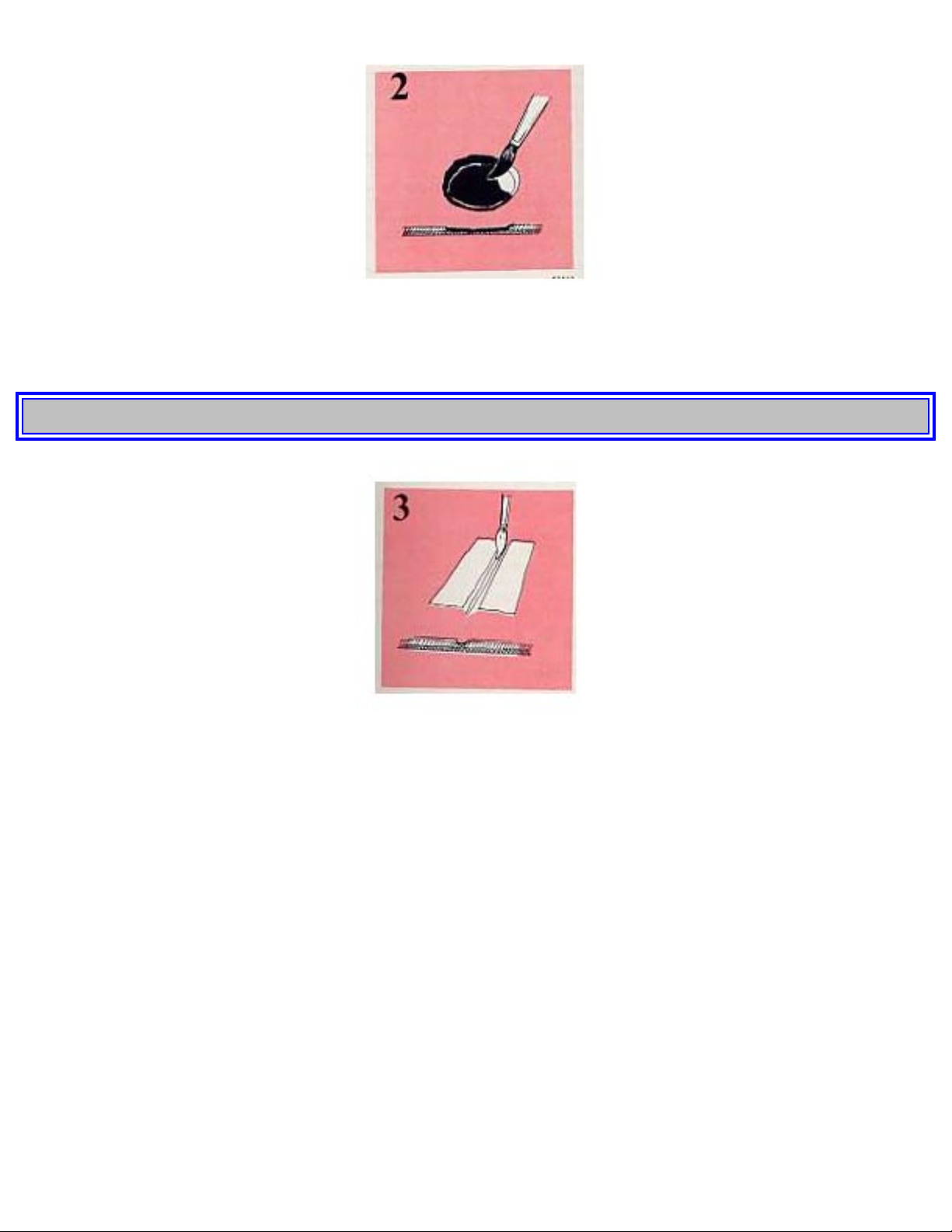
1986 Volvo 740 GL, GLE, Turbo
When the primer surface is dry, the paint can be applied using a brush.
Mix the paint thoroughly: apply several thin paint coats and let dry after each application.
pg. 87 Paint touch-up
3 If there is a longer scratch, you may want to protect surrounding paint by masking it off.
Touching up damaged paint on fender edges and sills
Material:
Rust remover
Primer - spray
Surface finish - spray
Sand paper (H 150 - 300 grit)
Thinner
NOTE: When touching up the car, it should be well cleaned and dry and have a temperature exceeding
60°F (+15°C).
Mask with tape and paper prior to painting larger surfaces. Remove the masking immediately after
application of the last paint coat, before the paint starts to dry.
file:///K|/ownersdocs/1986/1986_740/86740_06.htm (5 of 9)12/30/2006 7:51:34 AM
Page 100
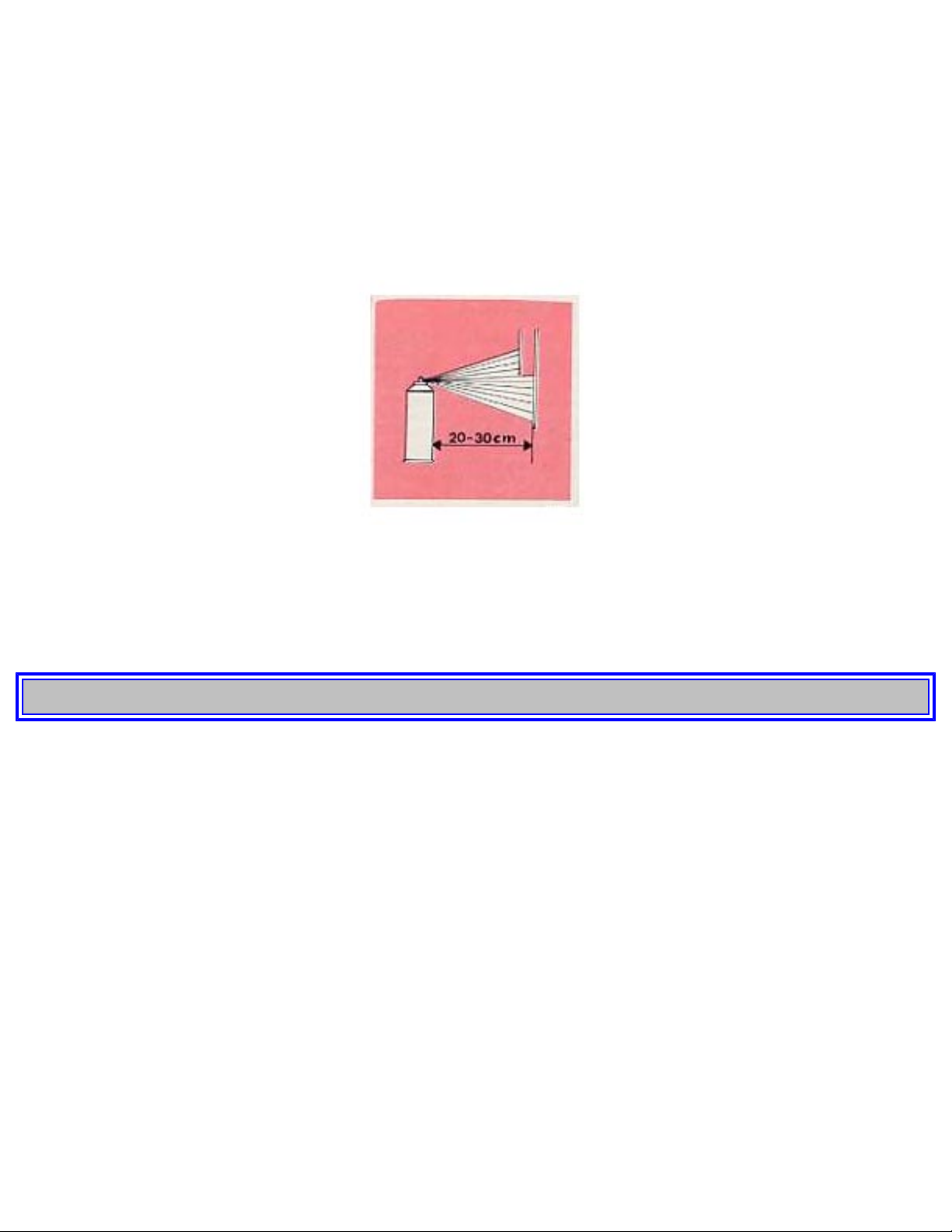
1986 Volvo 740 GL, GLE, Turbo
Touching up is as follows:
1. Remove paint flakes.
2.Sand the damaged surface and wash it clean with thinner.
Apply the rust remover. (Avoid contact with skin!). Wait a few minutes and then rinse carefully with
water and wipe dry.
3. Shake the spray can for at least 1 minute. Spray on the primer. Move the can slowly and evenly back
and forth over the spot and about 8-12 in. (20-30 cm) from the surface. Protect the surrounding surfaces
with suitable paper.
NOTE!
Spray painting should be done in a well ventilated and dust-free area.
4. When the primer has dried, apply the surface enamel in the same way. Spray on several times and
allow the paint to dry a minute or so between each application.
pg. 88 Washing
Washing the car
The car should be washed at regular intervals since dirt, dust, insects and tar spots adhere to the paint
and may cause damage.
When washing the car, do not expose it to direct sunlight. Use lukewarm water to soften the dirt before
you wash with a sponge, and plenty of water, to avoid scratching.
A detergent can be used to facilitate the softening of dirt and oil.
A water-soluble grease solvent may be used in cases of sticky dirt.
However, use a wash place equipped with a drainage separator.
Dry the car with a clean chamois and remember to clean the drain holes in the doors and rocker panels.
Tar spots can be removed with kerosene or tar remover after the car has been washed.
After washing, lubricate the electrically-operated antenna mast with a cloth soaked in oil.
A stiff-bristle brush and lukewarm soapy water can be used to clean the wiper blades. Frequent cleaning
improves visibility considerably.
NOTE: It is particularly important to wash the car frequently in the wintertime to prevent corrosion,
when salt has been used on the roads. Also wash off the dirt from the underside (wheel housings,
file:///K|/ownersdocs/1986/1986_740/86740_06.htm (6 of 9)12/30/2006 7:51:34 AM
 Loading...