

Page 1

056584500215
User Manual
Vodafone 225
Page 2
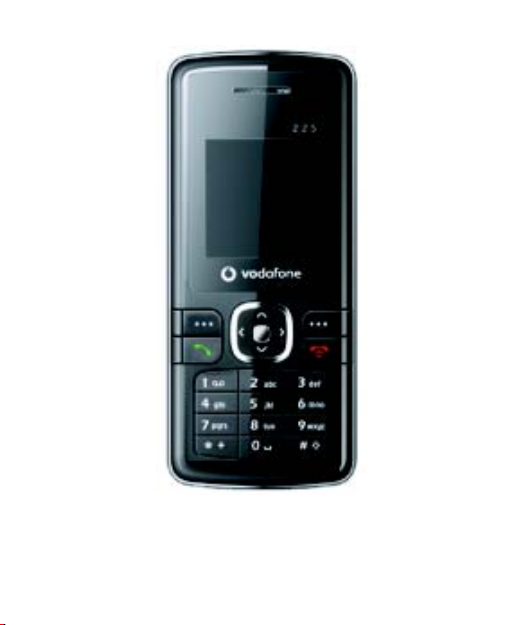
Vodafone 225
User Manual
Page 3

Notice
Copyright © 2007 ZTE Ltd.
All Rights Reserved
Your Vodafone 225 is made exclusively for Vodafone by ZTE Ltd.
No part of this manual may be reproduced or transmitted in any form or by any
means without prior written consent of ZTE Ltd.
Trademarks
VODAFONE and the Vodafone logos are trade marks of the Vodafone Group.
Notice
The information in this manual is subject to change without notice. Every effort
has been made in the preparation of this manual to ensure accuracy of the
contents, but all statements, information, and recommendations in this manual
do not constitute a warranty of any kind, expressed or implied.
Please read the safety precautions carefully to ensure the correct and safe use
of your mobile phone. For detailed information, refer to the section “Important
Safety Precautions”.
ZTE Ltd. Address:
ZTE Plaza, Keji Road South, Hi-tech Industrial Park,Nanshan District, Shenzhen,
P. R. China
Postal Code: 518057
Website: http://www.zte.com.cn
V6.9.0
Page 4
Important
safety
precautions
Failure to comply with the following
precautions may be dangerous or illegal.
Page 5
4
Road safety
Full attention should be given to driving at all times in order to reduce the risk
of an accident. Using a phone while driving causes distraction and can lead to
an accident. You should comply with local laws and regulations restricting the
use of wireless devices while driving.
Switch off the phone when refuelling
Do not use the phone at a refuelling point (service station) or near fuels or
chemicals.
Aircraft
Mobile phones can cause interference. Consult airport and airline staff about
the use of the phone on aircraft. Switch off the phone whenever you are
instructed to do so.
Switch off the phone near all medical equipment
Hospitals or health care facilities may be using equipment that could be
sensitive to external radio frequency energy. Follow any regulations or rules in
force.
Interference
All Mobile phones may be subject to interference, which could affect their
performance.
Be aware of special regulations
Meet any special regulations in force in any area and always switch off your
phone whenever it is forbidden to use it, or when it may cause interference or
danger.
Page 6
5
Water resistance
Your phone is not water-resistant. Keep it dry.
Sensible use
Use only in the normal position (held to the ear).
Emergency calls
Key in the emergency number for your present location, then press .
Keep your phone away from small children
Keep the phone and all its parts, including accessories, out of the reach of
small children. The product contains small parts with sharp edges that may
cause injury or which may become detached and create a choking hazard.
Accessories and batteries
Use only ZTE-approved batteries and accessories. Use of any unauthorised
accessories could damage you or your phone and may be dangerous.
Dispose of used batteries according to the manufacturer’s instructions.
At very high volume, prolonged listening to a mobile
phone can damage your hearing.
Qualified service
Do not attempt to disassemble your product or its accessories. Only qualified
service personnel may repair your phone.
Page 7

6
Health and safety information
SAR certification information
THIS MODEL MEETS INTERNATIONAL GUIDELINES FOR EXPOSURE TO RADIO WAVES.
Your mobile phone is a radio transmitter and receiver. It is designed not to
exceed the limits for exposure to radio waves recommended by international
guidelines. The guidelines were developed by independent scientific
organisation ICNIRP and include margins designed to assure the protection of
all persons, regardless of age and health.
This guideline uses a unit of measurement known as Specific Absorption Rate,
or SAR. The SAR limit for mobile devices is 2.0 W/kg and the highest SAR value
for this device when tested at the ear was 1.320W/kg.
1. The tests are carried out in accordance with international guidelines for
testing.
As SAR is measured utilising the device’s highest transmitting power, the
actual SAR of this device while operating is typically below that indicated above.
This is due to automatic changes to the power level of the device to ensure it
only uses the minimum level required to reach the network.
The World Health Organization has stated that present scientific information
does not indicate the need for any special precautions for the use of mobile
devices.
1
Page 8

7
Precautions when using batteries
• Never use a charger or battery that is damaged in any way.
• Use the battery only for its intended purpose.
• If you use the phone near the network’s base station, it uses less power.
Talk and standby time are greatly affected by the signal strength on the
cellular network and the parameters set by the network operator.
• Battery charging time depends on the remaining battery charge, the type
of battery, and the charger used. The battery can be charged and is
charged hundreds of times, but it will gradually wear out. When the
operation time is noticeably shorter than normal, it is time to buy a new
battery.
• If left unused, a fully charged battery will discharge itself over time.
• Use only ZTE-approved batteries, and recharge your battery only with
ZTE-approved chargers. Disconnect the charger from the power source
when it is not in use.
• Extreme temperatures will affect the charging capacity of your battery: it
may require cooling or warming first.
• Do not leave the battery in hot or cold places because the capacity and
lifetime of the battery will be reduced. Try to keep the battery at room
temperature. A phone with a hot or cold battery may not work temporarily,
even when the battery is fully charged. Li-ion batteries are particularly
affected by temperatures below 0°C (32°F).
Page 9

8
• Do not short-circuit the battery. Accidental shortcircuiting can occur when a
metallic object like a coin, clip or pen causes a direct connection between
the + and - terminals of the battery (metal strips on the battery). For
example, do not carry a spare battery in a pocket or bag where the battery
may contact metal objects. Short-circuiting the terminals may damage the
battery or the object causing the short-circuiting.
• Dispose of used batteries in accordance with local regulations. Always
recycle. Do not dispose of batteries in a fire.
Road safety
Your mobile phone gives you the powerful ability to communicate by voice,
almost anywhere, anytime. But an important responsibility accompanies the
benefits of mobile phones, one that every user must uphold.
When driving a car, driving is your first responsibility. Using a phone while
driving causes distraction and can lead to an accident. When using your mobile
phone while driving, follow local regulations in the country or region you are in.
Operating environment
Remember to follow any special regulations in force in the area you are in, and
always switch off your phone whenever it is forbidden to use it, or when it may
cause interference or danger.
When connecting the phone or any accessory to another device, read its user’s
guide for detailed safety instructions. Do not connect incompatible products.
Page 10

9
As with other mobile radio transmitting equipment, users are advised that for
the satisfactory operation of the equipment and for the safety of personnel, it
is recommended that the equipment should only be used in the normal
operating position (held to your ear).
Electronic devices
Most modern electronic equipment is shielded from radio frequency (RF)
signals. However, certain electronic equipment may not be shielded against
the RF signals from your mobile phone. Consult the manufacturer to discuss
alternatives.
Pacemakers
Pacemaker manufacturers recommend that a minimum distance of 15 cm (6
inches) be maintained between a mobile phone and a pacemaker to avoid
potential interference with the pacemaker. These recommendations are
consistent with the independent research and recommendations of Wireless
Technology Research. If you have any reason to suspect that interference is
taking place, switch off your phone immediately.
Hearing aids
Some digital mobile phones may interfere with some hearing aids. In the
event of such interference, you may wish to consult your hearing aid
manufacturer to discuss alternatives.
Page 11

10
Other medical devices
If you use any other personal medical devices, consult the manufacturer of
your device to determine if it is adequately shielded from external RF energy.
Your physician may be able to assist you in obtaining this information.
Switch off your phone in health care facilities when regulations posted in these
areas instruct you to do so.
Vehicles
RF signals may affect improperly installed or inadequately shielded electronic
systems in motor vehicles. Check with the manufacturer or its representative
regarding your vehicle.
You should also consult the manufacturer of any equipment that has been
added to your vehicle.
Posted facilities
Switch off your phone in any facility where posted notices require you to do
so.
Potentially explosive environments
Switch off your phone when in any area with a potentially explosive
atmosphere, and obey all signs and instructions to turn off mobile phones and
other radio equipment. Sparks in such areas could cause an explosion or fire
resulting in bodily injury or even death.
Page 12

11
Users are advised to switch off the phone while at a refuelling point (service
station). Users must observe restrictions on the use of radio equipment in fuel
depots (fuel storage and distribution areas), chemical plants, or where blasting
operations are in progress.
Areas with a potentially explosive atmosphere are often but not always clearly
marked. They include the areas below decks on boats, chemical transfer or
storage facilities, vehicles using liquefied petroleum gas, such as propane or
butane, areas where the air contains chemicals or particles, such as grain, dust
or metal powders, and any other area where you would normally be advised to
turn off your vehicle engine.
Emergency calls
This phone, like any mobile phone, operates using radio signals, wireless, and
landline networks as well as user-programmed functions, which cannot
guarantee connection in all conditions. Therefore, you should never rely solely
on any mobile phone for essential communications like medical emergencies.
To make or receive calls, the phone must be switched on and in a service area
with adequate signal strength. Emergency calls may not be possible on all
mobile phone networks or when certain network services and/or phone
features are in use. Check with local service providers.
To make an emergency call:
1. Switch on the phone.
2. Key in the emergency number for your present location. Emergency
numbers vary by location.
Page 13

12
3. Press [ ].
Certain features like Call Barring may need to be deactivated before you can
make an emergency call. Consult this document and your local cellular service
provider.
Other important safety information
• Only qualified personnel should service the phone or install the phone in a
vehicle. Faulty installation or service may be dangerous and may invalidate
any warranty applicable to the device.
• Check regularly that all mobile phone equipment in your vehicle is
mounted and operating properly.
• Do not store or carry flammable liquids, gases, or explosive materials in the
same compartment as the phone, its parts, or accessories.
• For vehicles equipped with an air bag, remember that an air bag inflates
with great force. Do not place objects,including installed or portable
wireless equipment, in the area over the air bag or in the air bag
deployment area. Improperly installed wireless equipment could result in
serious injury if the air bag inflates.
• Mobile phones can cause interference. Consult airport and airline staff
about the use of the phone on aircraft. Switch off the phone whenever you
are instructed to do so.
• Failure to observe these instructions may lead to the suspension or denial
of telephone services to the offender, or legal action, or both.
Page 14

13
Care and maintenance
Your phone is a product of superior design and craftsmanship and should be
treated with care.
• Keep your phone and all its parts and accessories out of the reach of small
children and pets. They may inadvertently damage these things or choke
on small parts.
• Keep the phone dry. Precipitation, humidity, and liquids contain minerals
that corrode electronic circuits.
• Do not use the phone with a wet hand. Doing so may cause an electric
shock to you or damage to the phone.
• Do not use or store the phone in dusty, dirty areas, as its moving parts may
be damaged.
• Do not store the phone in hot areas above 60°C (140°F). High tempera-
tures can shorten the life of electronic devices, damage batteries, and warp
or melt certain plastics.
• Do not store the phone in cold areas. When the phone warms up to its
normal operating temperature, moisture can form inside the phone, which
may damage the phone’s electronic circuit boards.
• Do not drop, knock, or shake the phone. Rough handling can break internal
circuit boards.
• Do not use harsh chemicals, cleaning solvents, or strong detergents to
clean the phone. Wipe it with a soft cloth.
Page 15

14
• Do not paint the phone. Paint can clog the device’s moving parts and
prevent proper operation.
• Do not put the phone in or on heating devices, such as a microwave oven,
stove, or radiator. The phone may explode when overheated.
• If the phone, battery or charger is not working properly, take it to your
nearest qualified service facility. The personnel there will assist you, and if
necessary, arrange for service.
Page 16
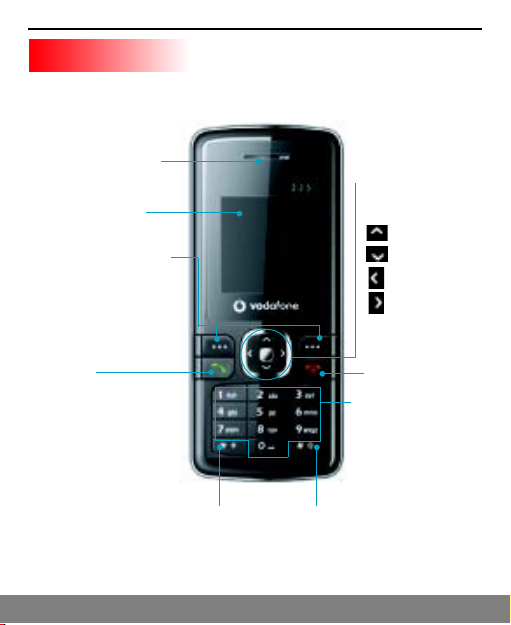
Your Phone
15
Earpiece
Display
Left/Right soft keys
Performs the function
indicated at the bottom
of the display.
Send key
Dials a phone number and
answers a call.
In standby mode, shows a
history of calls made,
received and missed.
* key
4-Way Navigation keys
In standby mode
accesses:
History
Contacts
Profiles
Alarm
End/Power key
Alpha numeric keys
In standby mode, input
numbers to dial.
# key
Page 17
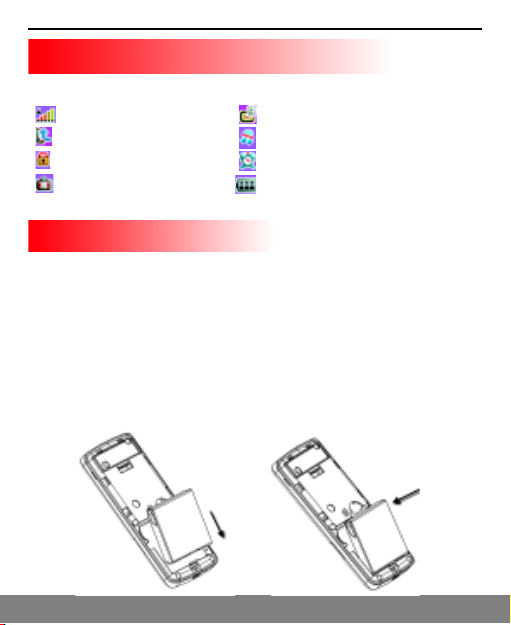
16
Interface Icons
Icon Description Icon Description
Signal strength
Call diverting
Keypad locked
Roaming
New message
Silent profile is activated
Alarm clock set
Battery status
Battery
The lithium battery of the mobile phone can be immediately used after unpacking.
A new battery performs best after performing a full charge/discharge 3 times.
Installing the battery
1. Ensure that your mobile phone is switched off.
2. Insert battery by aligning the gold contacts on the battery with the gold
contacts in the battery compartment on the phone.
3. Push down on the upper section of the battery until it clicks into place.
4. Replace the battery cover and press it gently until you hear a click.
Page 18
17
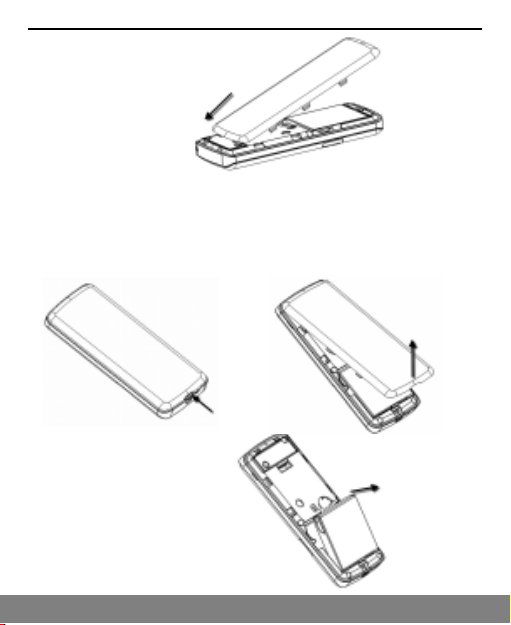
Removing the battery
1. Ensure that your mobile phone is switched off.
2. Remove the battery cover.
3. Pull the battery up and remove it from the mobile phone.
Page 19
18
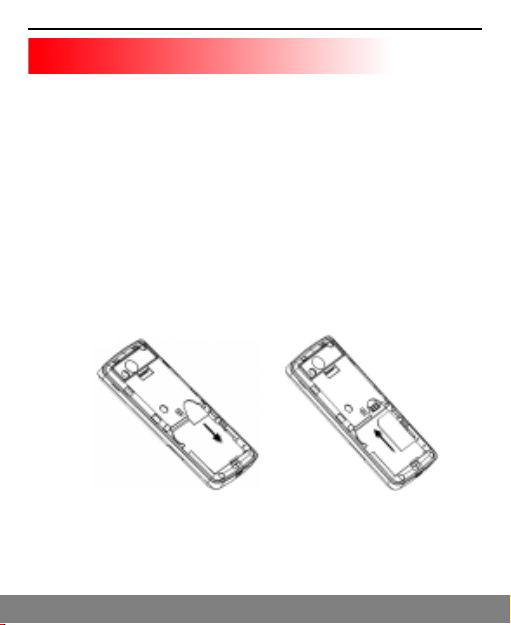
How to insert the SIM card
You want a mobile phone that is sophisticated yet easy to use and here it is in
your hands! Naturally you are eager to start using it, but first you need to insert
the SIM card.
The SIM card lives under your battery, here’s how to insert it.
z
Ensure that the phone is switched off and the charger is disconnected
from the bottom of the phone.
z
Turn the phone over and remove the back cover.
z
If the battery is already inside, remove it!
z
Hold your SIM card with the cut corner oriented as shown and then slide it
into the card holder face down.
z
Replace the battery first.
z
Replace the back cover.
What is a SIM card?
Every mobile phone has a SIM card (Subscriber Identity Module). This is a microchip that holds your personal information such as names and phone numbers.
Your phone won’t work without it. If you already have contacts on your SIM card,
these can be transferred in most cases.
Page 20
19
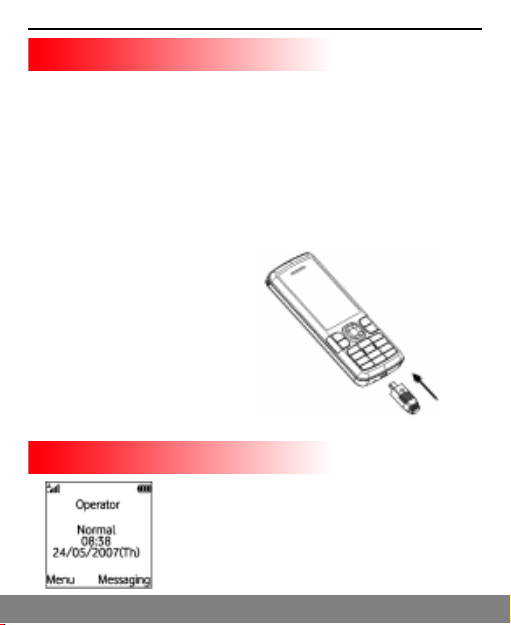
How to Charge the battery
Your phone is powered by a rechargeable battery. This needs to be charged for at
least 6-8 hours before you can make your first call.
z
Connect your travel adapter to the bottom of your mobile phone as shown in
the diagram.
z
Connect the other end of the travel adapter to the mains socket.
Note: The side with arrow should be upright while connecting.
z
The bars on the battery icon on the display will move from right to left.
This indicates that the phone is charging.
z
When the battery is fully charged.
z
Disconnect the charger.
Power on/ off Your Phone
Ensure that your SIM card is in your mobile phone
and that the battery is charged.
Please hold the End key to power on/off the phone.
The phone will automatically search for the network.
Page 21
20
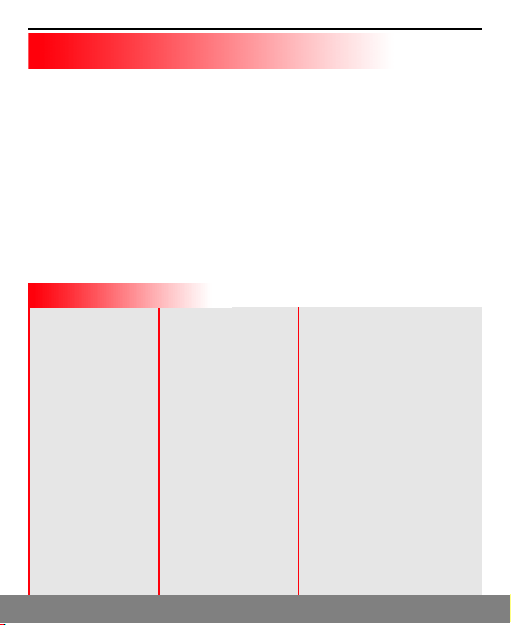
Display information
Besides sending and receiving calls, you can also do:
¾
Press Left soft key to enter main Menu.
¾
Press Right soft key to view Messaging.
¾
Press Send key in standby mode to enter Call menu list.
¾
Press End key to exit to standby mode.
¾
Press # key and then * key in standby mode to lock/unlock the keypad.
¾
You can customise the fastkey settings of 4-Way Navigation key for
standby mode.
Note: In this User Manual to “press” a key means to press the key and release
it. To “hold” a key means to keep pressing the key.
Menu Tree
1. Games
1.1 Tetris
1.2 Push box
2. Call Menu
2.1 Calls
2.2 Diverts
3. Tools
3.1 Calculator
3. 2 World clock
3. 3 Calendar
3.4 Conversion
4. Profiles
4.1 Normal
4. 2 Meeting
4.3 Outdoor
4. 4 Silent
5. Messaging
5.1 New message
5. 2 Inbox
5.3 Outbox
5.4 Draftbox
5.5 Msg settings
5. 6 Voicemail
5.7 Cell info
6. Alarm
6. 1 Set alarm
6.2 List alarms
6.3 Clear all
6.4 Define rest day
7. SIM
8. Contacts
9. Settings
9.1 Phone settings
9.2 Display settings
9.3 Clock settings
9.4 Call settings
9. 5 Fixed dialling number
9. 6 Service dialling number
9.7 Network settings
9.8 Security settings
9.9 Factory settings
Page 22

21
Writing Text
zz
z Change input mode: Press # key to change the input mode (input modes: Eng, ABC,
zz
abc and 123).
zz
z Input Letters: In ABC/abc/123 mode, press the corresponding letter key till the
zz
letter appears.
zz
z Input Words: In Eng mode, key-in any letter with a single key press. Press each key
zz
only once for every letter. The word changes after each key stroke. When you have
finished writing the word and it is correct, confirm it by adding a space withe or by
pressing any of the
cursor. Predictive text input is based on a built-in dictionary.
z Input Digits: In 123 mode, press digit key once to key-in a digit.
z Input Symbol: Press * key to enter a symbol. In ABC/abc mode, press 1 key till the
required symbol (common symbols) appears.
z Selecting Template: Hold * key to open Templates. Select the required template.
z Input Space: Press 0 key to input space. It does not work in 123 mode.
z Delete Character: Press Right soft key to clear a character.
z Delete all Characters: Press and hold Right soft key to delete all characters and clear
the display.
zz
z Move Cursor to Left or Right: Press Left/Right navigation keys to move the
zz
cursor left or right.
How do I add people to my Contacts
There are some phone numbers that you may want to call again and again so it
makes sense to add these to your Contacts. You can then access these numbers
quickly and easily.
Navigation keys. Pressing a Navigation key also moves the
Page 23

22
z Select Menu then Contacts.
z Press left soft key [Options], and then select Add new Contact.
z Select whether to save the new contact to your SIM card or to the phone’s
memory.
z Enter the contact’s phone number.
z Press left soft key [OK], then enter a name and confirm by clicking OK key.
z If Handset is selected to save new contact, you need also to select the group
and then confirm by clicking OK key.
You can also save a number right after you’ve made or received a phone call or
a text message from someone who is not yet in your Contacts list.
z To delete someone from your Contacts list, first select the name, then
press left soft key [Options] and choose Delete.
How to make and receive calls
The most basic way to make a call is to key in the number and press the Send key.
One advantage of a mobile phone is that you can also store people’s names and
numbers in your mobile Contacts and call them more easily.
To call someone:
z Press OK key in standby mode and then choose [Contacts]. From here
use the Up/Down keys to find the name of the person you want to call. You
can also type in the first letter of the name of the person you want to call.
z Now simply press the green Send key.
z End the call by pressing the red End key.
z
Make sure you are in an area with sufficient coverage to make calls. The
strength of the network signal is indicated on top left corner of screen.
Page 24

23
How to Send and Receive Text Messages
You can use your mobile phone to send and receive text messages.
1. Go to Menu J Messaging J New message.
2. Write your message. For more information on writing, refer to Writing Text.
3. Press the Left soft key [Options] and select Send to one to send the message
to one person.
To send to more than one person, select Send to contacts and select the
names from the contact list.
Select Send and save to send the message and save it to Outbox. Select Save
as draft to save it to Draftbox.
4. Enter the recipient’s phone number or select Contacts if you have previously
stored the person’s number. Then select OK to send the message.
Upon receiving a message, mobile phone indicates with ringtone, prompt,or
a new message icon.
1. Press Left soft key [Select] to open the new message. You can also go to Inbox
to read the message.
2. Use Up/Down keys to read the message.
3. While the message is open, use Left soft key [Options] to Reply, Delete, or
Forward the message.
Page 25

24
Menu Functions
Here are some brief instructions of the menu functions of the phone.
Function Description Selection
Add new contact Save Phone numbers ContactsJOptions
Edit contact Edit information of each ContactsJOptionsJEdit
Delete contact Delete one contact ContactsJOptions
Find contact Search for a phonebook ContactsJOptions
Memory Status Number of entries saved ContactsJ Options
Send message Send text messages to MenuJMessaging
Read message Read text messages MenuJMessaging
Templates Preset messages to help MenuJMessaging
Voicemail Receive and listen to MenuJMessaging
Recent calls View all recent calls MenuJCall MenuJCalls
and names JAdd new Contact
record
information JDelete
entry JSearch
and maximum number of JSettingsJUsed space
entries capacity in phone
other mobile phones JNew message
(received, sent) JInbox/Outbox
make sending text JMsg settings
messages easier and quicker JTemplates
Voice messages JVoicemail or long press
on 1 key to call voicemail
JAll calls/Received calls
/Dialled calls/Missed calls
or Select green Send key
from the home screen
Page 26

25
Function Description Selection
Calculator Execute basic MenuJToolsJCalculator
World clock Check time on major cities MenuJToolsJWorld clock
Calendar View a full-screen MenuJToolsJCalendar
Conversion Set the exchange rate MenuJTools
Ringtone Set ringtone MenuJProfilesJSelect
Alarm Set alarm alert time MenuJAlarmJSet alarm
Language Set the default language MenuJSettingsJPhone
Fastkey settings Set the shortcuts for the MenuJSettings
Wallpaper Select wallpaper MenuJSettingsJDisplay
Clock Settings Set date and Time MenuJSettings JClock
Anykey answer Press any key to answer MenuJSettingsJCall
Minute minder Sound an alert tone MenuJSettings JCall
math calculation
monthly calendar
and account foreign JConversion
currency or vice versa
Profile (Normal/Meeting
etc.)JPersonalise
JRingtone
settingsJLanguage
navigation keys (Up/Down JPhone settings
/Left/Right key) JFastkey settings
you preferred settingsJWallpaper
Date and Time
settingsJ
an incoming call except settingsJAnykey answer
End key and Right soft key
ahead of every minute settingsJMinute minder
Page 27

26
Function Description Selection
Connected Sound an alert tone MenuJSettingsJCall
minder when a call is connected settingsJConnected
Call waiting Hold the first call and MenuJSettingsJCall
answer the second call settingsJCall waiting
Hide my number Choose whether to show/ MenuJSettingsJCall
hide my number when settingsJHide my number
calling someone
Fixed dialling Phone numbers preset in MenuJSettingsJFixed
number the list can be dialled dialling number
Service dialling Phone numbers preset by MenuJSettingsJService
number network service provider dialling number
can be dialled
Network settings Set network searching MenuJSettings
mode JNetwork settings
Security settings Access your phone’s MenuJSettings
security settings JSecurity settings
minder
* Default phone code is 1234
Factory settings Restore to original MenuJSettings
factory settings J Factory settings
Page 28

27
Declaration of RoHS Compliance
To minimise the environmental impact and take more responsibility to the
earth we live in, this document shall serve as formal declaration that the Vodafone
225 manufactured by ZTE CORPORATION is in compliance with the Directive
2002/95/EC of the European Parliament - RoHS (Restriction of Hazardous
Substances) with respect to the following substances:
(1) Lead (Pb)
(2) Mercury (Hg)
(3) Cadmium (Cd)
(4) Hexavalent Chromium (Cr (VI))
(5) Polybrominated biphenyls (PBB’s)
(6) Polybrominated diphenyl ethers (PBDE’s)
(Compliance is evidenced by written declaration from our suppliers, assuring
that any potential trace contamination levels of the substances listed above are
below the maximum level set by EU 2002/95/EC, or are exempt due to their
application.)
The Vodafone 225 manufactured by ZTE CORPORATION, meets the requirements of EU 2002/95/EC.
Page 29
28
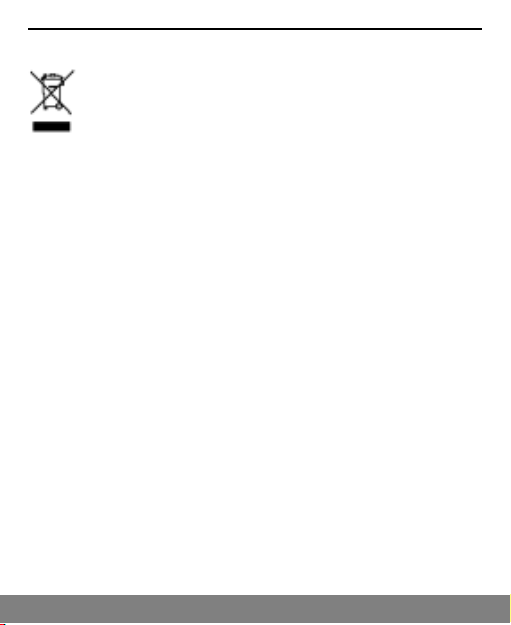
Disposal of your old appliance
1.When this crossed-out wheeled bin symbol is attached to a product
it means the product is covered by the European Directive 2002/96/
CE.
2.All electrical and electronic products should be disposed of separately from the municipal waste stream via designated collection facilities appointed by the government or the local authorities.
3.The correct disposal of your old appliance will help prevent potential
negative consequences for the environment and human health.
For this product’s Recycling Manual based on WEEE directive, please send an
email to [email protected], or visit the website below to download the
document:
http://ensupport.zte.com.cn
 Loading...